Introduction
Specialist continuing care services for older adults are an example of long-term care provision, one of the key elements of old age psychiatric services nationally (Banerjee and Chan, Reference Banerjee and Chan2005). Service models for the long-term care of the elderly mentally ill are varied and operate in a mixed economy of healthcare, with varying degrees of involvement of the private and third sectors and overlap with social services arrangements (Challis et al., 2002; Banerjee and Chan, Reference Banerjee and Chan2005; Ryan, Reference Ryan2005). Older people under the care of long-term old age psychiatric services are a heterogeneous group; including people with dementia, late onset mental illness, so-called “graduates” with long-term mental illness as well as those who suffer from both dementia and other mental illness (Mann and Cree, Reference Mann and Cree1976; Jolley et al., 2004; Banerjee and Chan, Reference Banerjee and Chan2005). In addition, older adults are more likely to have physical health problems, increasing the complexity of their presentation and management (Banerjee and Chan, Reference Banerjee and Chan2005). Most will have their care funded by NHS continuing care arrangements due to their high level of need (DH, 2007; 2012a). Bearing in mind the global trend towards deinstitutionalization of psychiatric care, it could be argued that the provision of long-term care services for the elderly by mental health trusts is one area in which considerable quality improvements and cost efficiency savings could be made. This is particularly topical in the context of current financial pressures on the UK NHS, as long-term care services account for a large proportion of spending within mental health services for older adults. This paper explores what is currently known about service models for the delivery of long-term psychiatric care in older adults and their cost effectiveness, and also presents the results of a survey into the current provision of long-term specialist care services by NHS organizations in the UK. A literature review was conducted by means of an online search of Pubmed, Medline, Cinahl, Psycinfo, and NHS Evidence databases. Search terms used were as follows: continuing care service models and mental health, continuing care psychiatry, continuing care psychogeriatrics, costs of continuing care, costs of long-term care, discharge from long-term care, and relocation of the elderly.
NHS continuing care
In the UK, continuing care funding is provided by the NHS for people of any age with complex care needs who meet specific criteria determined nationally by the Department of Health (DH, 2012a). Some people under the care of old age psychiatry services will meet these criteria due to their on-going mental health needs, and will require long-term care (Banerjee and Chan, Reference Banerjee and Chan2005). Within an old age psychiatric service these are likely to be people who have dementia with accompanying behavioral disturbance, or those with long-term functional mental illness and on-going management problems, often towards the end of their lives. (RCPsych, 2006b). Comorbid physical health problems may also be present, and contribute to the complexity of the individual's needs. Importantly, NHS Continuing Care funding places no restrictions on the settings in which the package of support can be offered or on the model of service delivery (DH, 2012b); in practice care is provided in a range of settings, including NHS long stay units and facilities operated by private providers (RCPsych, 2006a).
In April 2013, the Health and Social Care Act (2011) was fully implemented, with commissioning responsibilities moving from Primary Care Trusts to the newly formed Clinical Commissioning Groups (CCGs) and the NHS Board, and Strategic Health Authorities were abolished. CCGs are now the bodies legally responsible for both NHS continuing care eligibility decisions and the arrangement of services required to meet their needs (DH, 2012b), in accordance with the National Framework for Continuing Healthcare (DH, 2007). This framework includes a Decision Support Tool (DST), which standardizes the process for needs assessment and decision-making regarding eligibility for NHS Continuing Care funding, and also sets out guidelines for review of eligibility at both three months after initial assessment and a minimum of yearly intervals thereafter.
Service models of long-term psychiatric care for the elderly
Studies of service provision of long-term psychiatric care have tended to focus on working age adults rather than older people with mental illness (Hellman, Reference Hellman and Shore1988; Trieman and Leff, Reference Trieman and Leff1996; Reference Trieman and Leff2002a; Reference Trieman and Leff2002b; Thornicroft et al., Reference Thornicroft, Bebbington and Leff2005), and the majority of studies that have been conducted solely in older adults focus on service models of dementia care exclusively (Holmes et al., Reference Holmes1990; Carr and Marshall, Reference Carr and Marshall1993; Wimo et al., Reference Wimo, Mattson, Krakau, Eriksson, Nelvig and Karlsson1995; Rovner et al., Reference Rovner, Steele, Shmuely and Folstein1996; Green et al., Reference Green, Girling, Lough, Ng and Whitcher1997; Roberts et al., Reference Roberts2000; Brodaty et al., Reference Brodaty2003; Jonsson, Reference Jonsson2004; Macdonald and Cooper, Reference Macdonald and Cooper2007; Comas-Herrera et al., Reference Comas-Herrera2011). There is a lack of comparative evaluation of models of psychogeriatric care in terms of effectiveness and cost (Banerjee and Chan, Reference Banerjee and Chan2005). However, the body of research in this area has been increasing over the last two decades (Draper, Reference Draper2000) despite acknowledgment that research in this area is difficult methodologically (Mccrae and Banerjee, Reference Mccrae and Banerjee2010).
De-institutionalization within psychiatric services has been the focus of mental health policy in many geographical regions over the last quarter of a century including in the UK (Mangen, Reference Mangen1994; Monroe-Devita and Mohatt, Reference Monroe-Devita and Mohatt1999; Prince and McDaid, Reference Prince, McDaid, Knapp, McDaid, Mossialos and Thornicorft2007), and the effects of this have been well documented (Trieman and Leff, Reference Trieman and Leff1996; Reference Trieman and Leff2002a; Reference Trieman and Leff2002b; WHO, 2004; Prince and McDaid, Reference Prince, McDaid, Knapp, McDaid, Mossialos and Thornicorft2007). The Team for the Assessment of Psychiatric Services (TAPS) Project (Leff et al., Reference Leff, Trieman, Knapp and Hallam2000) conducted a series of observational studies of long stay patients moved during planned hospital closures according to national policy at the time. Movement into the community resulted in positive outcomes for patients in terms of social functioning, behavior, and quality of life (Trieman and Leff, Reference Trieman and Leff1996; Leff et al., Reference Leff, Trieman, Knapp and Hallam2000; Trieman and Leff, Reference Trieman and Leff2002a). All bar one of these studies included solely working age adults without dementia, although the mean age of some of these cohorts was in the early 60’s (Trieman and Leff, Reference Trieman and Leff1996) which may make some of this work more relevant to the older adult population.
TAPS Project 30 specifically explored outcomes (but not costs) of the psychogeriatric hospital population post discharge from long stay hospital wards (Trieman and Wills, Reference Trieman, Wills and Leff1997). Surveys of the psychogeriatric populations in two hospitals revealed that the majority of the 89 patients in one hospital had organic disorders, with most of these suffering from Alzheimer's dementia. Of the 214 long stay patients in the other hospital aged over 70 years, most were originally diagnosed as having functional illness (the majority of these had schizophrenia). Importantly, many of the functional patients were also found to have severe cognitive impairment, with a “mixed type of morbidity in which dementia had apparently superseded the original illness” (Trieman and Wills, Reference Trieman, Wills and Leff1997) later described by the authors as a “functional-mixed-organic continuum.”
The project went on to compare the quality of care for patients based in community facilities versus those remaining in long stay wards; overall quality of care was found to be higher in the community. One key recommendation was that when planning new facilities, attempts must be made to avoid a mixture of elderly functionally ill patients with patients suffering from dementia; for the reason that mixed compositions may “reduce the ‘graduates’ to the lowest common level of functioning” (Trieman and Wills, Reference Trieman, Wills and Leff1997) and the expectation that those with functional illness are more likely to have any deterioration in cognition and behavior reduced to a minimum in the right environment. These conclusions would seem highly relevant to any future developments of specialist continuing care services; however TAPS Project 30 was limited by two key factors. First, patients in the community facilities had already been discharged from long-term hospital wards; and this earlier discharge might suggest they were likely to have been considered less complex to start with (Leff et al., Reference Leff, Trieman, Knapp and Hallam2000). The study also did not use any standardized outcome measures for quality of care or quality of life.
International and European perspective
A report by the World Health Organization's Health Evidence Network (WHO, 2004) highlighted a lack of studies evaluating models of old age specific mental healthcare, and a need for further research. The authors stated that “while community residences for long term institutional care appear to offer better quality care than hospitals, it is unclear whether there are particular patients who require long term psychogeriatric hospitalisation”. (WHO, 2004). Whilst the WHO is unclear, others have stated clear opinions that some patients will always need long-term hospitalization due the severity and complexity of their illness (Macpherson et al., Reference Macpherson, Shepherd and Edwards2004).
Dementia Specialist care units (SCUs) are an example of a service model for long-term care particularly popular in the USA (Holmes et al., Reference Holmes1990). Evidence with regard to outcomes has been mixed (Roberts et al., Reference Roberts2000) and generally research on SCUs has been varied in quality, tending to be based on small studies using different outcome measures, with several sources of bias identified (Sloane et al., Reference Sloane, Lindeman, Phillips, Moritz and Koch1995). SCUs set up in Italy have reported reduced use of psychotropics and reduced behavioral disturbance at six months follow-up compared with hospital admission (Bellelli et al., Reference Bellelli1998). In a descriptive study of available services in Sweden, Annerstedt et al. (Reference Annerstedt, Sanada and Gustafson1996) called for broader research on the effects of differentiation in dementia care and argued that patients on long stay wards may become suitable for nursing home care due to deterioration in dementia and decreased mobility. One Australian randomized controlled study on specialized long-term care for dementia (Wells and Jorm, Reference Wells and Jorm1987) found evidence that relatives of residents in specialized care had improved psychological health as opposed to those admitted into non-specialized institutional care; and that costs of care were reduced mainly due to lower hospitalization rates, however this finding has not been reproduced by any other studies. A number of studies argue for the effectiveness of psychogeriatric outreach services to nursing homes (Draper et al., Reference Draper, Meares and McIntosh1998; Bartels et al., Reference Bartels, Moak and Dums2002; Fischer et al., Reference Fischer2011), particularly as nursing home environments have been found to have difficulty in meeting the needs of more complex patients (Martin et al., Reference Martin2002).
Cost effectiveness studies
The TAPS studies considered the move from long stay hospitals into the community to have been successful in terms of improved outcomes and reduced costs (Leff et al., Reference Leff, Trieman, Knapp and Hallam2000); but follow-up periods were limited. One study (Beecham et al., Reference Beecham2004) involved much longer follow up than the TAPS studies (12 years as opposed to 1–5 years) and looked at 75 former long stay patients and their outcomes. This study found that most people lived in staffed accommodation supported by community services, with mean care costs lower than long stay hospital costs. With regard to the long-term care of working age adults, Knapp et al. (Reference Knapp, Beecham, Hallam and Fenyo1993) argues that community-based services do not necessarily reduce costs, as often these are redistributed to other budgets and agencies. He agrees that quality of care, quality of life, and patient satisfaction are usually improved for patients in the community.
Few studies have looked specifically at both outcomes and costs of long-term care services for the elderly and mentally ill. One cohort study looked at the costs of “domus care” in South East London (Beecham et al., Reference Beecham, Cambridge, Hallam and Knapp1993). The “domus” model of care was viewed as being a community-based home as opposed to a long-term psychiatric unit (Dean et al., 1993). Costs of care in the community were found to be marginally greater than costs in the long stay ward. Unfortunately, this study was too small to link with any specific outcomes based data, but qualitative data (Dean et al., Reference Dean, Briggs and Lindesay1993) indicated improvements in quality of life for residents after moving. These studies looked at two “domuses” which were run by local authorities with some psychiatric service input; one unit housed residents with ongoing severe mental illness, and the other housed patients with dementia. Movement of patients from long stay wards into these domuses resulted in increased cognitive abilities for those with dementia (Dean et al., Reference Dean, Briggs and Lindesay1993) and other improvements for those with schizophrenia, including higher levels of global social functioning. Importantly, both these domuses were later regarded as specialist continuing care units, commissioned by local CCGs from a mental health trust, and have now both closed.
The effect of relocation on elderly patients
The studies discussed above did not report increased mortality rates amongst patients discharged from long stay units; however there is a body of evidence that shows that relocation can have negative impacts on the elderly (Castle, Reference Castle2001), including increased mortality rates on moving from institution to institution (Aldrich and Mendkoff, Reference Aldrich and Mendkoff1963; Killian, Reference Killian1970). Not all studies have found this to be the case (Danermark et al., Reference Danermark, Ekstrom and Bodin1996). Degree of physical frailty has been identified as a possible predictor of increased mortality (Killian, Reference Killian1970). This issue is likely to be highly relevant to any changes in long-term service provision for the continuing care population in the UK.
Summary
There is some evidence that community-based care for long-term psychogeriatric patients is more cost effective than long stay wards, however this is limited in terms of being specific either to the deinstitutionalization movement or purely dementia care. The literature tends to separate service models into dementia care and other long-term psychogeriatric services and this could be seen to reflect an underlying view that there is a need for different models of service provision for people with dementia and those with other mental illness, whether it is late onset or longstanding in nature. What is unclear is which services are most appropriate for those people who have both ongoing mental illness and dementia; and whether or not this group could be effectively cared for in a dementia care setting that is equipped to deal with severe behavior disturbance. Further work is required to add to the body of evidence available on both the costs and outcomes of discharging a very specific and vulnerable group of patients, as well as exploring which factors may predict positive outcomes.
Background to survey
Specialist continuing care services are under review at South London and Maudsley NHS Foundation Trust (SLaM), as an area for improvement of quality of care and patient outcomes. At the time of writing, SLaM provided approximately 60 specialist continuing care beds in three standalone specialist care units across three inner London boroughs for older adults. In order to gain a national perspective, we sought to explore to what extent NHS mental health service providers in the UK are still providing their own specialist continuing care services for older adults. Of particular interest is whether or not organizations are planning to reduce or expand existing services, or to develop new services in the light of recent changes in UK health services commissioning and the pressure to make efficiency savings.
Key survey questions
-
1. What proportion of NHS mental health service providers in the UK still provide specialist continuing care services for older adults?
-
2. How are these services provided?
-
3. Are NHS organizations planning to reduce or expand these services?
Methods
Using the Royal College of Psychiatrists membership database, all consultant old age psychiatrists in the UK were contacted with a link to an electronic survey. Survey questions regarding specialist continuing care services were included amongst other questions regarding older adults’ mental health services being asked as part of a wider review of service provision. Respondents were asked which organization they worked for, whether or not their organization ran its own specialist care service; and if not, how this service was provided (e.g. by third or private sector). They were also asked if their employing organizations had any plans to develop such services. Options were given as well as free text comments box for each question. A reminder email was sent after four weeks, and a deadline of eight weeks was set for completion of the survey. Respondents were asked to provide contact details in order to clarify information in cases where unclear or conflicting responses had been given.
Results
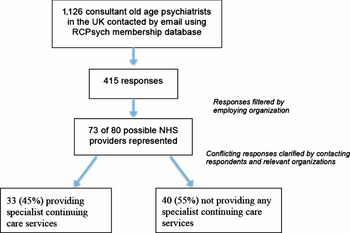
As per Figure 1 below, 415 responses were received from a sampling frame of 1,126 consultant old age psychiatrists (37%). 81 (20%) of the 415 surveyed said that they worked in continuing care services either wholly or partially; with 163 (68.5%) reporting that they thought that these services were necessary.
Flowchart illustrating survey responses.

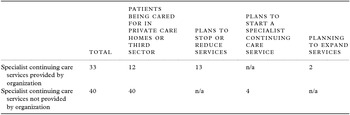
NHS mental health services for older people in the UK are provided by 80 different organizations (56 Mental Health Trusts in England, 12 Health Boards in Scotland, 7 University Health Boards in Wales, and 5 Health and Social Care Trusts in Northern Ireland). 91% (73) of these organizations were represented by the 415 survey responses received. As the organizations were not represented proportionately (i.e. some organizations had more responders than others) the data were analyzed having filtered the responses by organization. Of the organizations represented, 33 (45%) provided specialist continuing care services and 40 (55%) did not. Further detail on these services and plans to expand or reduce them is given in Table 1 below.
Break down of specialist continuing care service provision

Of the 33 NHS organizations that did provide specialist continuing care services, 12 also had patients being cared for in the private or third sector in addition to the service provided by the mental health trust/health board/university health board. Of the 33 that did provide services, 13 reported that they were planning to stop (4) or reduce (9) existing services. Just two were planning to expand their services.
In the 40 organizations that did not provide any specialist continuing care services, placements were provided either in private care homes (35) third sector care homes (5), spot purchasing of beds in the private sector or within other NHS organizations (5). Just four of these organizations (10%) had reported plans to start a specialist care service.
The majority of organizations that did not run their own specialist care services placed patients within the private sector, although a small number referred to the third sector, or out of area specially commissioned placements. Many of the free text comments provided referred to this causing additional pressure on acute inpatient services due to difficulties with delayed discharges. Several organizations reported having access to “Challenging Behaviour Units” for people with dementia, which do not appear to be funded by continuing care funding but provide more of a rehabilitation type model before discharge into a community placement. Others referred to running in-reach services for private or local authority nursing homes to provide additional support for people with complex care needs.
Limitations
Not all organizations providing mental health services were represented in this survey, however the majority were. Response bias is possible in that consultants may have been more likely to give additional information on services if they thought they were sub-standard or excellent. Information gathered was dependent on consultants having accurate knowledge of existing service models and planned changes within their organizations. Data were triangulated by direct contact with trusts in some cases where responses were contradictory or unclear, however this was not done in all cases. A question asking whether services are being redesigned would have been helpful as several respondents reported that services were going to both expand and reduce; this could refer to areas in which a service is being redesigned, as is the case with SLaM NHS Foundation Trust.
Discussion
Survey results confirm that there is variation in how specialist continuing care services are provided in the UK, with no set model of service delivery, and that most (55%) of NHS mental health service providers do not provide any of their own specialist continuing care services for older adults.
Whereas previously individuals may have stayed on long stay units for many years, regular review of needs and eligibility for funding using the DST is likely to encourage discharge into non-specialist community placements, e.g. nursing homes. This is due to both pharmacological and non-pharmacological treatments, as well as the likely change in presentation and reduction in behavioral disturbances secondary to the inevitable deterioration in those individuals with dementia. As a result of this, the complexity of needs of patients within specialist care services is likely to increase, as those who no longer meet needs based criteria are discharged. This will impact on necessary staffing levels and expertise within existing services.
Over recent years, there has been an increasing focus on quality within healthcare as well as the culture of care (Francis, Reference Francis2013) and a number of scandals in long-term care institutions have led to a particular focus on care homes and elderly dementia care. Changes in commissioning of services following the 2011 Health and Social Care Act and an expansion of the role of the Care Quality Commission (CQC) are likely to lead to more scrutiny of current provision of services, and may require complex commissioning arrangements due to relatively small numbers of people requiring specialist long-term continuing care services. It is possible that NHS organizations will be deterred from running long stay units due to the costs and quality of care issues inherent in these services, particularly for the relatively small numbers of individuals who will continue to meet eligibility criteria in the long term.
Evaluating the effectiveness of service models in old age psychiatry is complex and frequently not undertaken (Banerjee, Reference Banerjee2012). In the absence of clear evidence as to the best model for providing specialist continuing care services, cost pressures rather than quality of care may well be the predominant driver in the further evolution on these services. Interestingly, a Canadian systematic review on continuing care services for dementia sufferers found that there was benefit to receiving care in specialist units compared with non-specialized institutional care, and that costs of care were reduced mainly due to lower hospitalization rates (Roberts et al., Reference Roberts2000). Two of the organizations reporting that specialist continuing care services were being developed referred to this as a business opportunity, to avoid having to make spot purchases of placements, and to make money from other organizations purchasing continuing care placements from them.
The British Geriatrics Society issued guidance advising that geriatric medicine and old age psychiatry should be “re-engaged in a structured manner within the care home population” and that no individual should enter institutional care without having had access to an effective multidisciplinary and specialist assessment system with appropriate treatment and rehabilitation (BGS, 2004). One possible model for patients with dementia who are eligible for NHS continuing care is a rehabilitation model with additional community support services to allow people to exit long-term care units. Specialized challenging behavior units for patients with dementia which focus on trying to transition patients back into the community rather than keeping them on inpatient units are already established in some areas; care home support teams to provide specialist input for patients with mental health needs in community placements are also under development in some organizations.
Increasing attention has been focussed on dementia care, including continuing care provision for those with dementia, but less on the long-term care of the elderly with long-term functional illness, an issue highlighted by Green et al. (Reference Green, Girling, Lough, Ng and Whitcher1997). Patients who have been detained under Section 3 of the Mental Health Act are eligible for Section 117 aftercare – also funded by the NHS. It may be that for some patients who do not meet continuing care eligibility criteria this can be used as an alternative. There is a paucity of information available on the characteristics of patients who currently receive specialist continuing care funding for mental health reasons.
In summary, the results of the survey indicate that where NHS run specialist care services still exist, they are more likely to be being cut than developed from scratch and this is an area of service review for many organizations. What is not yet clear is how these services are to be replaced and the effect on current patients of these changes to service delivery. There is evidence to suggest that discharging long stay patients leads to negative outcomes (Mccrae and Banerjee, Reference Mccrae and Banerjee2011). This raises important questions as to how best to manage these changes for this very vulnerable group of patients with varying and complex needs, as well as highlighting the fact that the type of care that is available will vary depending on region within the UK. The effect of closing or developing services on both quality of care and cost measures needs to be assessed where possible, particularly as there is a lack of research in this area and no known best model of service delivery. More research is needed on both the characteristics of patients within old age psychiatric services who meet criteria for NHS continuing care funding and the effectiveness of different models of service delivery.
Conflict of interest
None.
Description of authors’ roles
Dr Josie Jenkinson: Conducted survey and literature review.
Professor Robert Howard: Advised on literature review methods, presentation of results and subsequent discussion.
Acknowledgments
Dr James Warner, Chair of Faculty of Old Age Psychiatry, Royal College of Psychiatrists.