The tragically high prevalence of suicide-related behaviors across early development represents a serious public health concern. Suicide is the second leading cause of death, globally, among those aged 15 to 25 (see Turecki & Brent, Reference Turecki and Brent2016). More broadly, approximately 10% to 20% of adolescents report serious suicidal ideation, which, in turn, predicts future suicide attempts (e.g., Bridge, Goldstein, & Brent, Reference Bridge, Goldstein and Brent2006; Nock et al., Reference Nock, Green, Hwang, McLaughlin, Sampson, Zaslavsky and Kessler2013). These numbers are alarming, and highlight the critical public health need for enhanced understanding of the development of suicide-related risk across childhood and adolescence, and for identifying effective intervention and prevention practices in this age range. The recognition of the incredible challenges faced by far too many youth and families is part of what drove Thomas Dishion's seemingly tireless efforts to develop and disseminate adaptable and sensitive preventive interventions that might have lasting implications for health. As part of this Special Issue dedicated to Dr. Dishion's work and legacy, the current paper reflects his long-standing focus on identifying the mechanisms of complex prevention effects across development and his focus on examining the potential collateral effects of programs targeting common risk factors during important developmental periods.
Suicide-related behaviors are related to a range of risk factors in youth. For instance, a substantial proportion of suicidal youth exhibit difficulties not only with depression (Bridge et al., Reference Bridge, Goldstein and Brent2006) but also with substance use and conduct problems (Spirito & Esposito-Smythers, Reference Spirito and Esposito-Smythers2006), and youth with co-occurring depression and conduct problems are at particularly high risk for suicide-related behaviors (Vander Stoep et al., Reference Vander Stoep, Adrian, Mc Cauley, Crowell, Stone and Flynn2011). Difficulties effectively regulating emotions or adaptively coping with stress are related to emotional and behavior problems in youth (Silk, Steinberg, & Morris Reference Silk, Steinberg and Morris2003), and more specifically to suicidality (Pisani et al., Reference Pisani, Wyman, Petrova, Schmeelk-Cone, Goldston, Xia and Gould2013). In addition to psychopathology, family dysfunction, including poor family problem solving, family conflict, and poor support from parents (King & Merchant, Reference King and Merchant2008; Wagner, Silverman, & Martin, Reference Wagner, Silverman and Martin2003), have been identified as a significant suicide-related risk in adolescence, in part because of associations with proximal risk factors for suicide, such as substance use and depressive symptoms (Prinstein, Boergers, Spirito, Little, & Grapentine, Reference Prinstein, Boergers, Spirito, Little and Grapentine2000). Broader social and relationship difficulties, such as with peers and suicide attempts by friends (e.g., Bridge et al., Reference Bridge, Goldstein and Brent2006), are also related to the risk for suicide in adolescence.
This array of risk factors provides potentially important targets for prevention and intervention programs. Common components of successful school- or clinic-based suicide-prevention programs include targeting both family functioning and youth symptomatology, as well as enhancing motivation to change (see Brent et al., Reference Brent, McMakin, Kennard, Goldstein, Mayes and Douaihy2013; Katz et al., Reference Katz, Bolton, Katz, Isaak, Tilston-Jones and Sareen2013). For example, a trial of Attachment-Based Family Therapy for adolescents with significant suicidal ideation, focused on improving parent–child relationship functioning, produced significant reductions in ideation and depressive symptoms relative to brief clinical management (Diamond et al., Reference Diamond, Wintersteen, Brown, Diamond, Gallop, Shelef and Levy2010). Similarly, the Resourceful Adolescent Parent Program, focused on building parenting skills and enhancing family relationships, yielded reductions in suicide risk in youth exhibiting recent suicidal ideation or attempts, relative to treatment as usual (Pineda & Dadds, Reference Pineda and Dadds2013). Long-term effects of family-focused interventions have also been observed. In particular, Sandler, Tein, Wokchik, and Ayers (Reference Sandler, Tein, Wolchik and Ayers2016) reported that a family-focused prevention program for parentally bereaved youth ages 8 to 16 reduced suicide ideation or attempts 15 years following treatment. Although suicidal adolescents were not specifically targeted in this study, bereaved youth are at substantially heightened risk for suicidality, and so the long-term program effects are consistent with the importance of targeting family functioning to reduce suicide risk.
Based on the breadth of suicide risk factors and the diversity of prevention programs targeting those factors (rather than suicide risk, per se), examination of the extent to which such prevention programs may have collateral effects on suicidality is important, and may broaden our armamentarium of effective programs for suicide risk reduction (see Wyman, Reference Wyman2014). In one of the first studies to examine such crossover effects of a broader prevention program on suicide risk, Wilcox et al. (Reference Wilcox, Kellam, Brown, Poduska, Ialongo, Wang and Anthony2008) found that the Good Behavior Game delivered in early elementary school predicted reductions in suicide risk at age 19–21 years. Similarly, Kerr, DeGarmo, Leve, and Chamberlain (Reference Kerr, DeGarmo, Leve and Chamberlain2014) found that Multidimensional Treatment Foster Care predicted reduced suicidal ideation across 9 years for adolescent girls involved in the juvenile justice system. In addition, Connell, McKillop, and Dishion (Reference Connell, McKillop and Dishion2016) documented this with the early adolescent version of the Family Check-Up (FCU), a program primarily focused on preventing externalizing types of behavior (e.g., substance use and antisocial behavior), to reduce suicide risk in late adolescence and early adulthood. Taken together, emerging evidence highlights the potential impact of more broad-based prevention programs on early suicide risk. One goal of the current study was to extend this literature by examining the effects of the FCU delivered to lower income families beginning in early childhood on suicide risk behaviors in late childhood and early adolescence.
Inhibitory Control and Suicide Risk
In addition to examining direct effects of the early childhood version of the FCU on suicide risk, we sought to identify possible mechanisms underlying treatment effects. The current study examined trajectories of inhibitory control across early childhood as a mediator of intervention effects on suicide reduction in late childhood and early adolescence. Inhibitory control is a central component of effortful control and executive functioning in youth, reflecting the ability to inhibit responses that are inappropriate to the current task (Posner & Rothbart, Reference Posner and Rothbart2000). Such skills appear central to self-regulatory skills in youth (Carlson & Wang, Reference Carlson and Wang2007), and poor self-regulation is associated with heightened risk for a range of negative outcomes across early development, including heightened impulsivity, conduct problems, and depression in adolescence (e.g., Insel & Gould, Reference Insel and Gould2008; Nigg, Reference Nigg2017). In particular, inhibitory control difficulties may be associated with depression through cognitive mechanisms, signaling difficulties disengaging from negative events or memories, thereby predicting escalating rumination and hopelessness. In turn, rumination and hopelessness are associated with depression (e.g., Miranda, Tsypes, Gallagher, & Rajappa, Reference Miranda, Tsypes, Gallagher and Rajappa2013). Of particular relevance to the current study, poor inhibitory control has also been linked to heightened risk for suicidality in adolescence (Auerbach, Stewart, & Johnson, Reference Auerbach, Stewart and Johnson2017; Gvion & Apter, Reference Gvion and Apter2011; Venables et al., Reference Venables, Sellbom, Sourander, Kendler, Joiner, Drislane and Patrick2015), and thus may provide an important target for early childhood preventive interventions to reduce the risk of subsequent suicide-related behaviors. Further, inhibitory control develops in the context of early family relationships, with harsh, inconsistent, or abusive parenting associated with poorer inhibitory control across early childhood (e.g., Moilanen, Shaw, Dishion, Gardner, & Wilson, Reference Moilanen, Shaw, Dishion, Gardner and Wilson2010; Pears, Fisher, Bruce, Kim, & Yoerger, Reference Pears, Fisher, Bruce, Kim and Yoerger2010). Hence, early prevention programs targeting such aspects of early parenting may yield benefits for children's inhibitory control and the prevention of suicide risk.
Although inhibitory control appears to be an important factor in the development of social, emotional, and behavioral difficulties across childhood, it has not been widely studied as a potential mediator of the effects of prevention or intervention programs targeting emotional or behavioral problems in childhood or adolescence. In one notable exception, however, Riggs, Greenberg, Kusché, and Pentz (Reference Riggs, Greenberg, Kusché and Pentz2006) found that a behavioral indicator of inhibitory control from the Stroop task mediated the effects of the Promoting Alternative Thinking Strategies (PATHS) curriculum on teacher-rated internalizing and externalizing problems. PATHS is a school-based universal prevention curriculum teaching self-control and social problem-solving skills, in this case delivered to second and third graders, that has been found to reduce internalizing and externalizing symptoms (via teacher reports) at 1-year follow-up. Similarly, both the PATHS curriculum (Bierman, Nix, Greenbert, Blair, & Domitrovich, Reference Bierman, Nix, Greenberg, Blair and Domitrovich2008) and the Chicago School-Readiness Program (Raver et al., Reference Raver, Jones, Li-Grining, Zhai, Bub and Pressler2011), which targets effective teaching and classroom management strategies, found that behavioral indices of executive control mediated prevention effects on early academic skills in low-income preschoolers. These results suggest that early prevention efforts focused on supporting social and emotional development may produce improvements, in part, by fostering improvements in youth self-regulation.
The Current Study
The aim of the present study was to examine long-term effects of the FCU intervention, delivered to children ages 2 to 10.5, on suicide risk in late childhood (ages 7.5 to 10.5) and early adolescence (age 14), in the Early Steps Multisite trial. The FCU is a brief, tailored intervention, based on motivational interviewing (MI) principles, and designed to support positive parenting practices to reduce the risk for conduct problems. We previously documented effects of the FCU delivered initially in early adolescence on suicide risk reduction in late adolescence and early adulthood in a separate sample (Connell et al., Reference Connell, McKillop and Dishion2016).
As suicide risk may have identifiable antecedents earlier in development, we believe that the examination of prevention effects related to the early childhood version of the FCU (i.e., the Early Steps Multisite trial) may have important implications for early identification and prevention efforts. In the Early Steps Multisite trial, 731 low-income toddlers were screened as high risk for problem behavior in Women, Infants, and Children Nutritional Supplement (WIC) centers, and randomly allocated to a brief assessment-driven early parenting intervention, the FCU, or to WIC services as usual. Prior work with this sample has documented intervention effects on improvements in observed parenting in early childhood (Dishion et al., Reference Dishion, Shaw, Connell, Gardner, Weaver and Wilson2008), reductions in maternal depressive symptoms (Shaw, Connell, Dishion, Wilson, & Gardner, Reference Shaw, Connell, Dishion, Wilson and Gardner2009), reductions in slope of internalizing symptoms from ages 2 to 4 (Shaw et al., Reference Shaw, Connell, Dishion, Wilson and Gardner2009) and child depressive symptoms at ages 7.5–8.5 via reductions in early childhood maternal depression (Reuben, Shaw, Brennan, Dishion, & Wilson, Reference Reuben, Shaw, Brennan, Dishion and Wilson2015), and of particular relevance to the current work, on improvements in inhibitory control across early childhood (Chang, Shaw, Dishion, Gardner, & Wilson Reference Chang, Shaw, Dishion, Gardner and Wilson2014). Further, we sought to examine whether improvements in inhibitory control may mediate the effects of intervention on later suicide risk. Identifying such mechanisms represents a critical step toward the further development of effect prevention and intervention strategies to reduce the rates of suicide-related behaviors across childhood and adolescence.
Method
Participants
Participants included 731 mother–child dyads, originally recruited between 2002 and 2003 from WIC programs around Pittsburgh, Pennsylvania; Eugene, Oregon; and Charlottesville, Virginia (Dishion et al., Reference Dishion, Shaw, Connell, Gardner, Weaver and Wilson2008). Families with children between the ages of 2 years 0 months and 2 years 11 months were contacted at WIC sites and invited to participate, following a screen to ensure that they met the study criteria. Risk criteria for recruitment were defined as at or above 1 SD above normative averages (from published standardization data) on one or more screening measures in the following three domains: (a) child behavior (conduct problems, high-conflict relationships with adults), (b) family problems (maternal depression, daily parenting challenges, substance use problems, teen parent status), and (c) sociodemographic risk (low educational achievement and low family income using WIC criteria). High-risk status on at least two of the three risk domains was required for study inclusion. In cases where the high risk criterion was not met for child behavior, children were required to have above average scores on either the Eyberg Child Behavior Inventory intensity or problem scales (Robinson, Eyberg, & Ross, Reference Robinson, Eyberg and Ross1980) to increase the probability that parents would be motivated to change this behavior. Ethical approval was granted by the institutional review boards at all authors’ institutions. Parental informed consent was obtained both for screening and for trial stages of the study.
Recruitment
Initially, 1,666 families with a 2-year-old child were screened at WIC programs across the three study sites, of which 879 met eligibility requirements and 731 (83%) agreed to participate (Dishion et al., Reference Dishion, Shaw, Connell, Gardner, Weaver and Wilson2008). Of the 731 families (49% girls), 37% each were recruited in Pittsburgh and Eugene, and 26% in Charlottesville. Children had a mean age of 30 months (SD 3.2) at the time of the age 2 assessment. Across sites, primary caregivers’ self-identified ethnicity was as follows: 28% African American, 50% European American, 13% biracial, and 9% other groups. Thirteen percent self-reported as Hispanic American. Over two-thirds of families reported an annual income of less than $20,000 (in 2002–2003).
Retention
Of the 731 families who participated at baseline, 659 (90%), 620 (85%), 621 (85%), 537 (73%), 565 (77%), 588 (80%), 573 (78%), and 594 (81%) participated at the age 3, 4, 5, 7.5, 8.5, 9.5, 10.5, and 14 assessments, respectively. As found for earlier study waves (e.g., Chang et al., Reference Chang, Shaw, Dishion, Gardner and Wilson2014), lower levels of parental education at baseline were associated with a greater likelihood of missingness at the age 10.5, F (1, 730) = 17.93, p < .05, and age 14 assessments, F (1, 730) = 17.14, p < .05. However, missingness at these study waves was unrelated to other baseline demographic variables, child behavior ratings (inhibitory control or internalizing/externalizing symptoms by parent report), or parental symptoms of depression. Overall analysis of missing data patterns for age 10.5 and 14 suicide risk indices in relation to baseline covariates (intervention condition, child age, gender, ethnicity, primary caregiver's education level, income, and relationship status, number of people living in home, parental depressive symptoms, as well as parent-reported inhibitory control, internalizing and externalizing symptoms) indicated that data were consistent with missing completely at random assumptions (Little's MCAR test: χ2 = 160.91, df = 136, p = .07).
Measures
Demographics questionnaire
A demographics questionnaire was administered to parents, including items about family structure and demographic variables (age, ethnicity, marital/relationship status, household size, education level, employment, and income).
Inhibitory control
The inhibitory control scale of the Children's Behavior Questionnaire (Rothbart, Ahadi, & Hershey, Reference Rothbart, Ahadi and Hershey1994) was administered to primary caregivers during yearly assessments from ages 2 through 7.5. This scale evaluates children's abilities to inhibit or moderate desired behaviors and delay actions (e.g., “My child can easily stop a play activity when told to stop.”). Items are rated on a 7-point scale (1 = extremely untrue of child; 7 = extremely true of child). Acceptable alpha levels were observed for this scale across assessment waves (all α ≥ .66 in the current study). As observed in other studies of cross-method assessments of inhibitory control (e.g., Olson et al., Reference Olson, Sameroff, Kerr, Lopez and Wellman2005), scores on the inhibitory control scale were significantly, but modestly, correlated with observed child performance on behavioral tasks assessing aspects of inhibitory control at ages 3 and 5 (delay of gratification tasks; age 3, r = .21; age 5, r = .22, both p < .01).
Suicide-related behaviors (age 10.5)
Parents and target children independently completed diagnostic interviews regarding child psychopathology using the computerized Diagnostic Interview Schedule for Children IV (DISC-IV; Shaffer, Fisher, Lucas, Dulcan, & Schwab-Stone, Reference Shaffer, Fisher, Lucas, Dulcan and Schwab-Stone2000). The DISC-IV is a fully structured, computer-based diagnostic instrument designed for use by nonclinicians to determine the prevalence of mental disorders based on the DSM-IV diagnostic criteria. The DISC-IV was found to have adequate test–retest reliability in a clinical sample of youth aged 9–17 years (Shaffer et el., 2000).
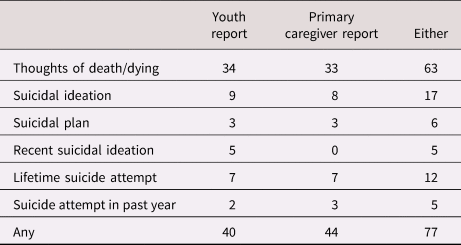
Six DISC-IV items are related to suicidality, including thoughts of death/dying, suicidal ideation (ever and recent), lifetime suicide attempt, and suicide attempt in past year. Frequencies of item endorsement for parents and youth are shown in Table 1. For the current analyses, a categorical variable aggregating responses from parents and youth on suicidal ideation or attempts (excluding thoughts of death/dying) was created (0 = no ideation/attempts, 1 = endorsement of ideation/attempts).
Suicide risk endorsement from DISC (age 10)

Note: Any = any endorsement of ideation through attempt, excluding thoughts of death/dying (n = 26).
Suicide-related behaviors (ages 7–14)
Parents and teachers completed the 99-item Child Behavior Checklist for Ages 6–18 (CBCL; Achenbach & Rescorla, Reference Achenbach and Rescorla2000) during the age 7.5, 8.5, 9.5, 10.5, and 14 year assessments. The current analyses focused on a single-item reflecting suicide-related behaviors (“Talks about killing self”), rated on a 3-point scale (0 = not true, 1 = somewhat/sometimes true, 2 = very true/often true). Although the CBCL includes a second suicide-related item (“Deliberately harms self or attempts suicide”), that item was not administered in the current study because of concerns with human subjects. Prior research supports the validity of the CBCL items as suicide risk indices in relation to interview-reported measures with youth and parents (VanMeter et al., Reference Van Meter, Algorta, Youngstrom, Lechtman, Youngstrom, Feeny and Findling2018). Significant correlations were observed between primary and alternate caregiver reports at each time point (rs between .36 and .53), although more modest correlations between parent and teacher reports were observed (rs between –.03 and .24). For the current analyses, a categorical variable was created (0 = no talk of suicide; 1 = any talk of suicide), aggregating reports across primary caregivers, alternate caregivers, and teachers, with a positive score reflecting endorsement of this item by at least one reporter.
Procedures
Assessment protocol
Parents and children who agreed to participate in the study were scheduled for a 2.5-hr home visit. Family members completed interaction tasks and other assessments reported elsewhere (e.g., Dishion et al., Reference Dishion, Shaw, Connell, Gardner, Weaver and Wilson2008) that were not included in the current analyses. Families were randomly assigned to the intervention or control condition. The randomization sequence was computer generated by a staff member who was not involved with recruitment, and was stratified by gender. To ensure allocation concealment, the examiner opened a sealed envelope with the family's group assignment only after the initial assessment was completed, and shared this information with the family. Assessments were recompleted nearly yearly from ages 2 through 10.5 (i.e., except at age 6 because of lapse in funding), with another follow-up assessment at age 14. Examiners for follow-up assessments were not informed of families’ allocation. From age 7.5 to 14, teachers were also asked to complete questionnaires regarding the target child. Families and teachers were compensated for completing assessments.
Intervention protocol
The FCU. The FCU is a brief, three-session intervention based on MI (Dishion & Kavanagh, Reference Dishion and Kavanagh2003; Dishion & Stormshak, Reference Dishion and Stormshak2007) and modeled after the Drinker's Check-Up (Miller & Rollnick, Reference Miller and Rollnick2002). As previously described, the first session involved a comprehensive assessment, including parent–child interaction, and the completion by caregivers of several questionnaires about their own, their child's, and their family's functioning. Families were unaware of their randomly assigned intervention status until after the initial assessment, after which they were randomized. Families randomly assigned to the intervention condition were then scheduled to meet with a parent consultant for at least two sessions for the FCU, during which the consultant explored parent concerns, focusing on family issues related to the child's well-being, and were provided with feedback based on the assessment, using MI strategies to enhance parental motivation to improve parenting skills. Parents were also offered follow-up sessions focused on parenting practices, family management concerns (e.g., co-parenting), and contextual issues (e.g., daycare, partner relationship, and housing), using the Everyday Parenting curriculum (Dishion, Stormshak, & Kavanagh, Reference Dishion, Stormshak and Kavanagh2012).
All parent consultants had doctoral- or master's-level qualifications and experience in family interventions. They were trained using a combination of strategies, including didactic instruction and role playing, followed by ongoing videotaped supervision of intervention activity. Before working with families, parent consultants were certified by lead consultants at each site who had been certified by the FCU intervention developer (Dishion), and recertified annually. Certification was established by reviewing videotapes of feedback and follow-up intervention sessions to evaluate competence in core intervention components. Weekly supervision plus weekly cross-site video conferences also helped to enhance fidelity and prevent drift, and annual parent consultant meetings were held to update training and address the needs of families across sites.
Of the 367 families randomized to the intervention condition, 343 (93.5%) took part in the FCU (including at least the meeting with the consultant and feedback sessions) at least once between age 2 and 10.5. The percentage of families receiving the FCU at each wave from age 2 to 10.5 ranged from 66% (at age 5) to 76% (at age 2). Most families who engaged with the FCU elected to receive follow-up sessions focused on parenting, child development, and behavior management, with the percentage of FCU-completing families opting for further sessions ranging from 65% (at age 7.5) to 74% (at age 4). The average number of sessions at each wave ranged from 2.3 ( atage 10.5) to 3.5 (at age 5) across waves.
Analysis plan
Hypothesis-testing analyses were conducted in Mplus 7.1 (Muthen & Muthen, 1998–Reference Muthén and Muthén2015), using an intention-to-treat analytic design, incorporating all families assigned to intervention in analyses (including the 6.5% of families who did not participate in the FCU at any wave). Main effect analyses included four aspects of suicide risk derived from CBCL and diagnostic interview data, including (a) a categorical variable reflecting endorsement of suicidal ideation through attempts from diagnostic interviews at age 10.5; (b) a categorical variable reflecting any suicide risk endorsement from age 7.5 to 14, across raters on the CBCL; (c) a more temporally specific categorical variable reflecting suicide risk endorsement at age 14 across raters on the CBCL; and (d) a “chronicity” score, calculated as the count of the number of waves with suicide risk endorsement across raters, from age 7.5 to 14. Logistic regression analyses were used to examine the effect of intervention status on suicide risk outcomes, controlling for covariates. Analyses focused on age 10.5 endorsement of ideation through attempts from parent or child (not including broad thoughts of death), and on endorsement of suicide risk across parents and teachers both at any time from age 7.5 to 14, and more narrowly at age 14, as well as a “chronicity” variable, as previously described.
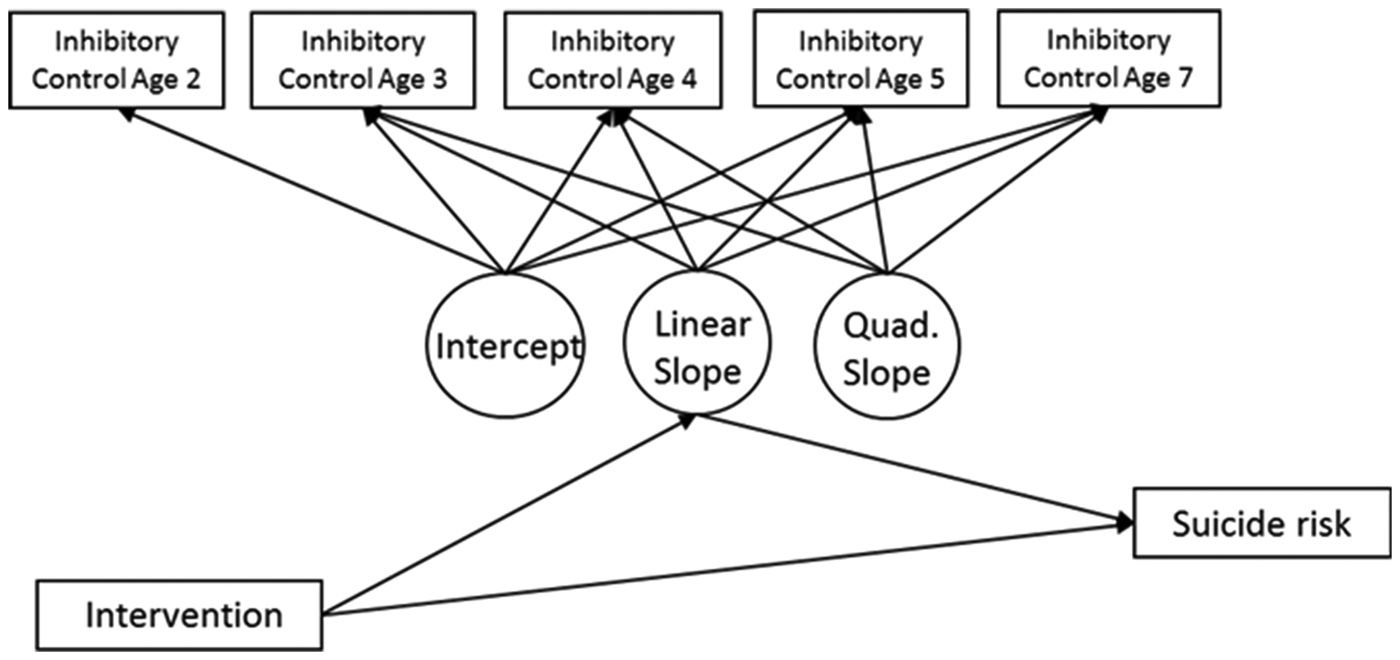
Changes in inhibitory control from ages 2 to 7.5 were examined with a latent growth model that included intercept, linear slope, and quadratic slope parameters. The linear and quadratic slope parameters were regressed on intervention assignment (0 = control, 1 = intervention), as well as demographic covariates (gender and ethnic minority status). As shown in Figure 1, suicide risk variables were modeled as categorical outcomes, and were regressed on the latent slope parameters. In light of the categorical outcome variables, analyses were conducted using Monte Carlo integration, with the full information maximum likelihood estimator. Statistical tests of the indirect effects of intervention on suicide risk outcomes employed a model constraint approach to calculate the estimates and standard errors of the indirect pathways.
Indirect effects model of inhibitory control on suicide risk outcomes.

Results
Descriptive data
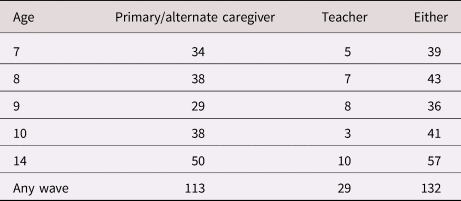
Frequencies for suicide risk indices on the age 10 diagnostic interview are shown in Table 1, and from parent and teacher reports on the CBCL from ages 7 to 14 in Table 2. Of the 132 (18.1%) youth with positive suicide risk endorsement from parents or teachers on the CBCL, 80 (10.9%) were endorsed once, 32 (4.4%) at two assessments, 10 (1.4%) at three assessments, 8 (1.1%) at four assessments, and 2 (.3%) at five assessment waves.
Suicide risk endorsement from parent and teacher reports

Main effects of intervention
Suicide risk: Age 10.5 diagnostic data
As shown in Table 1, 26 youth exhibited suicidal ideation or attempts at age 10.5 by parent or youth report on the DISC, including 17 in the control condition youth (65.4% of risk group) and 9 in the intervention condition youth (34.6% of risk group). The main effect of intervention, however, was not statistically significant, χ2 (df = 1) = 2.17, p = .14 (odds ratio = 0.56). In logistic regression analyses, the main effect of intervention remained nonsignificant, controlling for youth gender and ethnicity, neither of which was significantly associated with suicide risk at age 10.5.
Suicide risk from parent/teacher data (ages 7.5–14)
Of 132 youth exhibiting suicide risk from ages 7.5 to 14 by primary/alternate caregiver or teacher report on the CBCL, 75 were in the control condition (56.8% of risk group) and 57 in the intervention condition (43.2% of risk group). In logistic regression analysis, the main effect of intervention was at statistical-trend level using a two-tailed test (β = –0.35, SE = 0.19, p = .07; odds ratio = 0.70). The effect of ethnicity was not significant, although there was a significant gender effect (β = 0.44, SE = 0.19, p = .03), with suicide risk endorsement more likely for males than females between age 7.5 and 14.
Suicide risk chronicity from age 7.5 to 14
A regression analysis examined intervention, gender, and ethnicity as predictors of the number of waves in which parents or teachers endorsed suicide risk for youth from ages 7.5 to 14, providing an analysis of chronicity of suicide-related risk. The main effect of intervention was at statistical-trend level (β = –0.10, SE = 0.06, p = .09). Males exhibited greater chronicity of suicide risk compared to females (β = 0.17, SE = 0.06, p = .01). Ethnic minority status was negatively related to chronicity at the level of statistical trend (β = –0.10, SE = 0.06, p = .09).
Suicide risk at age 14
We also examined suicide risk at age 14, separately, for greater temporal specificity. Of 57 youth with suicide risk endorsement, 34 were in the control group (59.6% of risk group), and 23 in the intervention group (40.4% of risk group). In logistic regression analyses, the main effect of intervention was not significant, controlling for gender and ethnicity (β = –0.45, SE = 0.28, p = .11). The main effects of ethnicity and gender were also not significant.
Indirect effects of intervention
In line with prior reports from this study (Chang et al., Reference Chang, Shaw, Dishion, Gardner and Wilson2014), an unconditional latent growth model for inhibitory control from ages 2 to 7.5 that included intercept, linear slope, and quadratic slope parameters provided good fit to the data (χ2 = 4.34, df = 6, comparative fit index = 1.00, root mean square error of approximation = .00, standardized root mean square residual = .03). All growth parameters were statistically significant (intercept: estimate = 3.96, SE = 0.03; linear slope estimate = 0.23, SE = 0.03; quadratic slope estimate = –0.01, SE = 0.006), indicating that inhibitory control scores increased over time, with the rate of change de-escalating over time. When intervention status was added to the model (with the linear and quadratic slopes regressed on intervention status), excellent model fit was still observed (χ2 = 18.56, df = 13, comparative fit index = .99, root mean square error of approximation = .02, standardized root mean square residual = .05). Intervention status was significantly positively related to the linear rate of change in inhibitory control (estimate = 0.09, SE = 0.04), indicating that the receipt of the FCU predicted greater increases in parent-reported inhibitory control across early childhood. A trend-level intervention effect was also observed for the quadratic slope parameter (estimate = –0.02, SE = 0.01, p = .07).
Suicide risk across interview and questionnaire measures
Suicide risk variables from the DISC and parent/teacher reports from the CBCL were added to the inhibitory control model as categorical outcome variables, regressed on the linear slope parameter and on intervention status, as well as on covariates. The initial model included both age 10.5 suicide-related behavior assessed via diagnostic interview and any suicide risk endorsement from age 7.5 to 14 via parent or teacher report on the CBCL. Direct effects of intervention on suicide risk outcomes were not significant, and constraining these paths to zero did not result in worse model fit (χ2diff = 1.44, df diff = 2, ns), and so direct intervention effects were constrained to zero in subsequent analyses.
Age 10.5 diagnostic interview effects
The linear inhibitory control slope was significantly negatively related to suicide-related behaviors at age 10.5, via parent or youth reports on diagnostic interviews (estimate = –7.63, SE = 2.60). Greater increases in inhibitory control predicted reduced likelihood of suicide-related outcomes at age 10.5. The indirect effect of intervention on age 10.5 suicide-related behaviors via the linear rate of change in inhibitory control across early childhood was statistically significant (estimate = –0.59, SE = 0.28, p = .03).
Age 7.5 to 14 effects
Suicide risk from ages 7.5 to 14 (by parent or teacher report on the CBCL) was significantly negatively related to the linear rate of change in inhibitory control (estimate = –9.26, SE = 2.62). The indirect effect of intervention to age 14 suicide risk via the linear rate of change in inhibitory control across early childhood was statistically significant (estimate = –0.50, SE = 0.20, p = .01).
Suicide risk chronicity from age 7.5 to 14
An additional model was run to examine indirect effects of intervention on suicide risk chronicity (i.e., the number of waves in which parents or teachers endorsed suicide risk for youth from ages 7.5 to 14). The linear rate of change in inhibitory control was significantly negatively related to the number of waves in which parents or teachers endorsed suicide risk for youth (estimate = –2.22, SE = 0.48). Although the direct effect of intervention on suicide risk chronicity was not significant (estimate = 0.11, SE = 0.12), the indirect effect of intervention on suicide risk chronicity via changes in inhibitory control was significant (estimate = –0.12, SE = 0.05, p = .02), such that greater increases in inhibitory control were associated with less chronic suicide risk.
Age 14 effects
A final model examined suicide risk endorsement across caregivers and teachers separately at age 14 on the CBCL, to provide a more temporally specific examination of effects than the previous analysis. Suicide risk at age 14 was significantly negatively related to the linear rate of change in inhibitory control (estimate = –6.49, SE = 2.60), with greater increases in inhibitory control associated with less likelihood of suicide risk at age 14. The indirect effect of intervention on age 14 suicide risk via the linear rate of change in inhibitory control across early childhood was statistically significant (estimate = –0.50, SE = 0.21, p = .02), with treatment indirectly associated with suicide risk at age 14 via treatment-related increases in inhibitory control across early childhood.
Discussion
In light of the prevalence and tragic consequences of suicide risk across early development, the search for both effective interventions and potential mechanisms of such intervention effects represents a critical public health endeavor. Our goal in the current study was to examine the effects of the Family Check-Up (FCU) intervention, delivered to high-risk lower income families in early childhood, on reductions in suicide risk during late childhood and early adolescence. Further, in light of the central role of self-regulatory skills in early social and emotional development, the connection between self-regulatory abilities and suicide risk, and the importance of parenting and family environments on the development of such skills, we examined development of inhibitory control as a potential mediator of prevention effects on suicide risk. The current study builds upon prior work with the Early Steps sample that had documented the effects of the FCU on changes in inhibitory control from age 2 to 7.5 years (Chang et al., Reference Chang, Shaw, Dishion, Gardner and Wilson2014), and earlier work with a separate sample that documented effects of the FCU delivered in adolescence on suicide risk reduction into early adulthood (Connell et al., Reference Connell, McKillop and Dishion2016). As suicide risk may have identifiable antecedents earlier in development, we believed that the examination of prevention effects related to the early childhood version of the FCU may have important implications for early identification and prevention efforts.
Main effects
Most broadly, although the main effects of the FCU prevention on aspects of suicide risk in late childhood and early adolescence was not significant, the results generally supported the effects of the FCU at the level of statistical trend. The direction of effects pointed to reductions in parent and teacher reports of suicide risk from ages 7.5 to 14, as well as reductions in the chronicity of such reports over time. The odds ratios associated with these effects were generally small to medium in magnitude. One challenge of the current analyses is that the numbers of youth with positive suicide risk scores was relatively low. Such numbers are consistent with the age range covered by the study, as the youth are just entering the period of elevated risk by age 14, and the sample was not specifically selected for suicide-related risk (but rather for heightened risk for early behavior problems). As the youth in the current study are followed into later adolescence, it is likely that rates of suicide risk will increase in line with epidemiological trends. It will be important for future work to examine the durability of the FCU effects on suicide risk into late adolescence and early adulthood.
Indirect effects
While the main effects of the FCU on suicide-related functioning were suggestive, the effect of intervention on changes in inhibitory control were statistically reliable (as previously reported; Chang et al., 2014), and growth in inhibitory control from age 2 to 7.5 was associated with reductions in suicide risk at ages 10.5 to 14. The effects of inhibitory control on suicide risk are consistent with several other studies in this domain (e.g., Venables et al., Reference Venables, Sellbom, Sourander, Kendler, Joiner, Drislane and Patrick2015), but are notable in documenting the association between inhibitory control and suicide risk in late childhood and early adolescence, while most prior studies have focused on adult samples.
Further, improvements in inhibitory control mediated the effects of the FCU on several aspects of suicide- risk development. Treatment-related improvements in inhibitory control mediated reductions in suicidality from maternal and youth reports on diagnostic interviews at age 10.5. Further, such improvements mediated prevention effects on a multi-informant index of suicide risk from teacher and parent reports from ages 7.5 to 14, as well as on reduced chronicity of suicide risk across this age range. The consistency of these effects is noteworthy because they reflect multiple assessment methods (interviews and questionnaires) and incorporate reports across multiple informants (including youth, parents, and teachers), thereby capturing suicide risk across multiple important domains of functioning (e.g., home and school). The reductions in chronicity are also worth highlighting, as they suggest that the effects of early prevention were identified despite the reliance on a single item for each reporter, and the inclusion of different teachers over time, which may reduce the consistency of reporting over time. Such reductions in chronicity may also have important prevention implications, as chronic suicide risk may be associated with worse outcomes into adolescence and early adulthood (e.g., Czyz & King, Reference Czyz and King2015), suggesting that early prevention may have long-term benefits for the highest risk youth (i.e., those with more chronic suicidality).
Future research examining the specific mechanisms through which inhibitory control is related to reductions in suicide risk is needed. One possibility is that improvements in inhibitory control may help children cognitively disengage from negative repetitive thoughts associated with rumination that promote escalations in depression and hopelessness. Reductions in such negative, self-focused rumination may then lead to diminished difficulties with depression and reduced risk for suicide across later childhood and early adolescence. A second possibility is that improved inhibitory control may promote better self-regulation in both academic and social settings. Patterson's dual failure model (Patterson & Stoolmiller, Reference Patterson and Stoolmiller1991), for instance, highlighted the important role of academic failures and peer relational difficulties in the cascade toward depression across adolescence. Greater inhibitory control, however, may facilitate engagement with schoolwork and improved classroom behavior, preventing the development of academic difficulties (Valiente, Lemery-Chalfant, Swanson, & Reiser, Reference Valiente, Lemery-Chalfant, Swanson and Reiser2008; Valiente, Swanson, Lemery-Chalfant, & Berger, Reference Valiente, Swanson, Lemery-Chalfant and Berger2014). Further, improved inhibitory control may promote greater self-regulation in peer interactions, thereby decreasing the risk of peer rejection. Improvements in both of these important domains may then lead to reductions in suicide risk as youth progress into adolescence. It will be important for future studies to examine such pathways in greater detail.
Our results are consistent with the broader suicide-prevention literature in several ways. First, the existing literature highlights the importance of family-focused prevention efforts for suicide risk reduction in childhood and adolescence (Brent et al., Reference Brent, McMakin, Kennard, Goldstein, Mayes and Douaihy2013). Prior work has documented the effects of the Early Steps prevention program on improvements in parenting quality across early childhood, and identified improvements in family interaction quality as an important mediator of prevention effects on early emotional and behavioral problems (e.g., Dishion et al., Reference Dishion, Shaw, Connell, Gardner, Weaver and Wilson2008). Although we did not include a multistep mediation analysis, in part because the relatively small number of youth with positive suicide reports limited statistical power, the prevention targets suggest that improvements in the early family environment promoted improvements in youth inhibitory control, which in turn lead to reductions in suicide risk.
Second, our results are consistent with emerging evidence for the collateral effects of prevention programs designed to reduce the risk for behavior problems on a wider array of outcomes, including, in several instances, reduced suicide risk (e.g., Connell et al., Reference Connell, McKillop and Dishion2016; Wilcox et al., Reference Wilcox, Kellam, Brown, Poduska, Ialongo, Wang and Anthony2008). Early work in this area on the Good Behavior Game highlighted the potential durability of prevention efforts targeting early behavior problems on long-term reductions in suicide risk (Wilcox et al., Reference Wilcox, Kellam, Brown, Poduska, Ialongo, Wang and Anthony2008). Although the specific targets and implementation methods were different than the current trial (i.e., the Good Behavior Game was implemented in schools, and focused on classroom management practices), the results across these studies highlight the potential importance of early prevention efforts for reducing suicide-related behaviors later in development. Early childhood may provide an important developmental span for suicide-prevention efforts, as self-regulatory skills are developing, peer relationship patterns are being established, and self-perceptions may be more malleable than later in development (e.g., Carlson & Wang, Reference Carlson and Wang2007). It is worth highlighting, however, that we have also observed long-term reductions in suicide risk in adulthood, from an adolescent-focused version of the FCU (Connell et al., Reference Connell, McKillop and Dishion2016), and collateral effects of improvements in parenting, maternal depression, and child dysregulated behavior in an early childhood sample with indirect effects on later academic achievement (Brennan et al., Reference Brennan, Shelleby, Shaw, Gardner, Dishion and Wilson2013) and internalizing symptoms (Reuben et al., Reference Reuben, Shaw, Brennan, Dishion and Wilson2015).
Limitations and future directions
As with any study, there are several limitations that are important to highlight, and point to important directions for future research. First, analyses focused only on parent reports of inhibitory control across childhood, rather than including behavioral indices of inhibitory control. As previously reported, parental reports of inhibitory control were related to behavioral measures of executive functioning at age 5 in the current sample (Chang et al., Reference Chang, Shaw, Dishion, Gardner and Wilson2014). However, such behavioral indices were not collected longitudinally, or at baseline, necessitating the focus on the parent-report measure. Unfortunately, the lack of longitudinal assessment of behavioral indices of self-regulation is a common feature of the studies that have addressed mediation of early prevention effects by effortful or executive control (e.g., Riggs et al., Reference Riggs, Greenberg, Kusché and Pentz2006), highlighting the need for future prevention studies to incorporate multimethod assessment longitudinally. Second, the parent and teacher report of suicide risk from ages 7.5 to 14 was brief, consisting of a single item. Although this brief CBCL-derived suicide risk index has been previously validated (Van Meter et al., Reference Van Meter, Algorta, Youngstrom, Lechtman, Youngstrom, Feeny and Findling2018), more robust and specific measures would enhance understanding of suicide-related prevention effects. We were encouraged that findings using the single item assessment were in line with our in depth assessment using the DISC at age 10.5.
Furthermore, although suicide represents a public health concern, it is still relatively rare in childhood and adolescence, necessitating our focus on multi-informant constructs to yield adequate numbers for analytic power. One benefit of this approach is that the use of multi-informant constructs reduces the potential for mono-rater biases that might otherwise be present, and therefore represents a strength of the current analyses. However, it is worth noting that agreement across parents and youth at age 10.5 interviews, and across parents and teachers from ages 7.5 to 14, was low. It is possible that parent and youth reports of suicide-related behavior, or parent and teacher reports, may have different correlates and consequences for functioning, and we were underpowered to examine such differences in the current analyses.
Despite these limitations, the current study adds important evidence to the literature on early prevention effects on suicide risk. Based on the scope of suicide-related outcomes, identifying not only programs that reduce suicide risk but also the mechanisms by which effects are achieved is of critical importance. We identified an important and understudied pathway to suicide risk reduction, via improvements in children's self-control that suggests several important goals for further work in this area. In addition to the methodological recommendations previously detailed, it will be important to examine a broader array of potential mechanisms of prevention effects on suicide risk reduction in future work. Based on prior work with this sample (e.g., Shaw et al., Reference Shaw, Connell, Dishion, Wilson and Gardner2009), it is possible that improvements in parenting, reductions in maternal depression, and/or improvements in early academic functioning may represent promising pathways. Furthermore, it will be important for future studies to examine the specific mechanisms through which inhibitory control is related to reductions in suicide risk, including cognitive mechanisms (e.g., improved ability to disengage from negative, repetitive thoughts) and social mechanisms (e.g., greater self-control during social interactions, promoting success with peers and teachers). It will also be important for future studies to identify alternative prevention and intervention strategies targeting inhibitory control and broader self-regulation, and to examine whether such interventions lead to reductions in suicide risk across early development. Such work represents a critical public health priority.
Finally, it is worth highlighting that Thomas Dishion was instrumental in the planning, analysis, and interpretation stages of this manuscript prior to his untimely death. We hope this paper illustrates some of the themes that he pursued throughout his influential career. As a highly creative clinical scientist, he was passionate about improving the lives of children and adolescents, particularly those facing challenging circumstances. He thought broadly about opportunities to develop flexible and adaptive interventions that would respect family strengths while motivating change when needed, and that could be disseminated widely to achieve public health impact. As a consummate researcher, he was also driven by efforts to identify underlying mechanisms through which interventions might exert their effects, and to recognize the wide-ranging effects that such interventions can have for parents and youth, including effects on important outcomes, such as suicidality, that were not originally targeted. It is clear that there is much work to be done in this area, and it is with great sadness that we continue this work following his passing. However, his influence on all of our future efforts will undoubtedly be long lasting.
Acknowledgments
We gratefully acknowledge the Early Steps staff for their assistance, and all the families and WIC services who participated in this project.
Financial Support
The research reported in this paper was supported by National Institute on Drug Abuse Grants DA25630 and DA26222 to coauthors Daniel Shaw, Thomas Dishion, and Melvin Wilson.