Introduction
It is very important to secure proper conditions for the body to rest and for the brain to perform intensive work during sleep. Balanced sleep architecture, regarding length and structure, is also very important, especially in a growing child. Adults' sleep comprises 80 per cent non-rapid eye movement sleep and 20 per cent rapid eye movement sleep. Normal infants and small children spend more time in rapid eye movement sleep than do older children and adults. Skeletal muscle tonus decreases gradually into sleep, with a significant drop during the rapid eye movement phase. In this phase, therefore, children are more vulnerable to airway obstruction.Reference Marcus1 Due to various factors, infectious, allergic or genetic hypertrophy of Waldeyer's ring may develop in children. Enlarged tonsils and adenoids (part of Waldeyer's ring) are responsible for obstructive sleep disordered breathing. Obstructive sleep disordered breathing is a general term that includes primary snoring, upper airway resistance syndrome and obstructive sleep apnoea syndrome.
Primary snoring is associated with snoring and behavioural and neurocognitive problems, with no abnormalities on polysomnography (number of obstructive apnoeas per hour (i.e. obstructive apnoea index) less than one).
Upper airway resistance syndrome is a form of obstructive sleep disordered breathing characterised by snoring, difficult breathing (measured by oesophageal pressure manometry), and behavioural and neurocognitive problems, with no abnormalities on polysomnography (obstructive apnoea index less than one).
Obstructive sleep apnoea syndrome is identified in children with apnoea, hypopnoea, arousals, hypoxaemia, behavioural and neurocognitive problems, craniofacial deformities, physical retardation, circulatory disorders, and abnormalities on polysomnography (obstructive apnoea index greater than one, SpO2 < 92 per cent).
Complete episodes of obstructive sleep disordered breathing (no airflow in the upper respiratory tract despite normal chest motions, i.e. apnoea) or partial episodes (airflow reduced by 50 per cent but chest motions present, i.e. hypopnoea) lead to repeated conditions of hypoxaemia, hypercapnia and an aroused state, all of which affect normal development of the nervous system. Damage to cells in the prefrontal regions of the central nervous system has been found to be of particular consequence, since any cortical dysfunction in this region results in behavioural and cognitive disturbances in children.Reference Rosen, Storfer-Isser, Taylor, Kirchner, Emancipator and Redline2, Reference Kurnatowski, Putynski, Lapienis and Kowalska3
A diagnosis of obstructive sleep disordered breathing is based on clinical history, physical examination, psychological examination and additional investigations (pulse oximetry and polysomnography). Neuropsychological tests can assess interpersonal relationships and behavioural problems involving extrovert emotional expression (e.g. hyperactivity or aggression) or introvert expression (e.g. anxiety, depression and somatic complaints).Reference Mitchell and Kelly4 Neurocognitive abilities can also be tested: perception, memory, sensorimotor coordination and learning abilities. Polysomnography can determine the obstructive apnoea index.
Tonsillectomy and adenoidectomy remain the most commonly recommended treatments.
This study aimed to test the following hypotheses: (1) obstructive sleep disordered breathing is caused by adenotonsillar hypertrophy and is associated with hypoxia and brain dysfunction; and (2) children with obstructive sleep disordered breathing more commonly display emotional lability, depressive behaviour and anxiety.
Subjects and methods
Subjects
A total of 225 children from primary and secondary schools and from the final kindergarten year were examined. The study group comprised 121 children (87 aged six to nine years and 34 aged 10 to 13 years) with obstructive sleep apnoeas and hypopnoeas confirmed by polysomnography. Those disorders were caused by adenotonsillar hypertrophy. Snoring children with adenotonsillar hypertrophy but without obstructive apnoea and hypopnoea on polysomnography were excluded.
Patients were compared with 104 healthy children of a similar age (74 aged six to nine years and 30 aged 10 to 13 years) with no obstructive sleep disordered breathing and no adenotonsillar hypertrophy.
Methods
The patients and their parents filled out a questionnaire which enquired about medical history and physiological, emotional and behavioural problems. The parents signed a statement of informed consent. The children then underwent complete physical examination, polysomnography and psychological testing. Physical examination focussed on adenotonsillar hypertrophy and malocclusion. Tonsil size was graded from one to four based on the following tonsillar hypertrophy grades:
Grade 1-the distance between tonsills is smaller than 0,5 centemeter
Grade 2-the distance between tonsills is 0,5-1,0 centemeter
Grade 3-the distance between tonsills is 1,0-1,5 centemeter
Grade 4- the distance between tonsills is greater than 1,5 centemeter
Obstructive sleep apnoea was confirmed by polysomnography (Sleep/Lab/Pro Erich Jaeger GmbH, Würzburg, German). Polysomnography studies were performed overnight in a quiet, dark room. No hypnotics or sedatives were used. During polysomnography, the following parameters were recorded: electroencephalogram (C3, C4), submental surface electromyogram (EMG), surface EMG (right and left tibialis anterior), electrooculogram, electrocardiogram, nasal airflow (thermistor), haemoglobin saturation (pulse oximetry), thoracic and abdominal movements, and snoring (via a microphone). The obstructive apnoea hypopnoea index was defined as the number of obstructive apnoeas and hypopnoeas per hour of sleep.
The diagnosis of obstructive sleep apnoea was based on detailed clinical history, physical examination and sleep monitoring. An obstructive apnoea hypopnoea index greater than one and an oxygen desaturation SpO2 < 92 per cent were required to confirm the diagnosis.Reference Bower and Gungor5, Reference Ray and Bower6
The following tests were used to measure the children's emotional disturbances.
The children's depression inventory was designed to assess depressive behaviour in children. The child answers a questionnaire which assesses his or her emotional state over the last two weeks. This test is one of the most widely used assessment instruments in the study of depression in childhood and adolescence.Reference Rola7
The state-trait anxiety inventory for children test, designed by Spielberger,Reference Spielberger and Vagg8, Reference Siek9 was used to measure the level of anxiety in children. It consists of two self-estimation scales. One scale assesses anxiety as a state, the other as a trait. In the present study, only the trait scale was used.
The emotional instability scale was developed by Capra and Pastorelli, and is used to measure emotional instability in children.Reference Rola7
All assessment instruments have been translated and validated in the Polish child population.
For all results, the average values and standard deviations were calculated. Student's t-test was used to compare differences in all groups of children. A minimum level of p < 0.05 was set as statistically significant.
Results
Obstructive sleep disordered breathing was confirmed in children with adenotonsillarhypertrophy during polysomnography. The mean total sleep time was 8.2 hours (range, 6.6–9.6); sleeping on the side occupied 2.6 hours (range 0.6–7.6), sleeping supine 2.1 hours (range 1.1–8.4) and sleeping prone 0.3 hours (range zero to 4.6). Snoring was significantly related to the supine position (p = 0.04). Body position modified the frequency of obstructive apnoea and hypopnoea. The mean obstructive apnoea hypopnoea index was 3.4 (range 1–46) when sleeping supine, 2.3 (range 1–17) when sleeping on the side and 1.8 (range 1–30) when sleeping prone. The general mean index of obstructive apnoea hypopnoea was 4.9 (range 1–29) and that of obstructive apnoea was 1.3 (range 0.1–9.25). Obstructive hypopnoeic episodes (mean 20.5; range zero to 200) appeared more often than obstructive apnoeic episodes (mean 9.6; range zero to 52). The number of obstructive events increased during rapid eye movement sleep. The frequencies of central apnoeic episodes (mean 5.1; range zero to 54) and central hypopnoeic episodes (mean 4.6; range zero to 27) were not related to sleep disordered breathing. Restlessness of sleep was associated with arousals from sleep. Spontaneous arousals (mean 17; range 2–110) were more common than arousals due to respiratory problems (mean 6.1; range zero to 20), snoring (mean 8.9; range zero to 38) or desaturation (mean 0.4; range zero to two). Obstructive apnoea hypopnoea index severity was associated with a significantly higher number of respiratory arousals (p = 0.01). The mean percentage of Sp02 (91.6 per cent; range 83–94 per cent) and the number of desaturations greater than 4 per cent/hour of sleep (mean 49.3; range 4–404) were significantly related to the frequencies and durations of apnoeic and hypopnoeic episodes (p = 0.037).
Children's emotional status was measured using psychological tests.
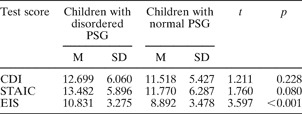
The differences in mean results obtained with the different tests, for six- to nine-year-old children with normal polysomnography findings compared with those with apnoea, are presented in Table I.
Test results for 6- to 9-year-old children with apnoeic and hypopnoeic episodes on PSG, compared with normal controls

PSG = polysomnography; t = Student's t-test; M = average; SD = standard deviation; CDI = children's depression inventory; STAIC = state-trait anxiety inventory for children; EIS = emotional instability scale
According to Table I, only the mean values for the emotional instability scale showed a statistically significant difference between the groups, being higher in children with adenotonsillar hypertrophy than in healthy children. The mean values for the children's depression inventory were higher in children with adenotonsillar hypertrophy, but this difference was not statistically significant. In the state-trait anxiety inventory for children, the mean T score was T = 1.760, and the level of significance was p = 0.08 for both groups. Since the standard level of significance was set at p < 0.05, the differences in mean values for the state-trait anxiety inventory for children test bordered on statistical significance.
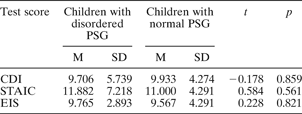
According to Table II, the differences between the two groups were minimal and statistically insignificant.
Test results for 10- to 13-year-old children with apnoeic and hypopnoeic episodes on PSG, compared with normal controls

PSG = polysomnography; t = Student's t-test; M = average; SD = standard deviation; CDI = children's depression inventory; STAIC = state-trait anxiety inventory for children; EIS = emotional instability scale
Discussion
Children with adenotonsillar hypertrophy are more likely to experience poor brain development. They also have many sleep problems.
The present study found that only children aged six to nine years with apnoea displayed emotional disturbances (emotional lability, anxiety and depressive behaviour). Analysis of the results does not confirm the hypothesis regarding emotional problems in children aged 10 to 13 years. The association between behavioural change and nocturnal apnoea has been confirmed in many studies.Reference Bower and Gungor5, Reference Chervin and Archbold10, Reference O'Brien, Mervis, Brunner, Klaus, Rutheford and Raffield11 Children with obstructive sleep disordered breathing have a lower quality of life, because of problems with social relationships and behavioural disturbances. The present study found that behavioural problems associated with obstructive sleep disordered breathing were of both the externalising (e.g. hyperactivity and aggression) and internalising (e.g. anxiety, depression and psychosomatic problems) type.
Basing on neuropsychological tests, Blunden et al. reported that obstructive sleep disordered breathing had negative effects on behaviour and interpersonal relationships; however these correlations were not statistically significant.Reference Blunden, Lushington, Kennedy, Martin and Dawson12 Other studies have confirmed the association between aggressive behaviour, social problems (but not hyperactivity) and the presence of apnoea.Reference Mulvaney, Goodwin, Morgan, Rosen, Quan and Kaemingk13
Hyperactivity may lead to attention deficit hyperactivity disorder (ADHD). Therefore, children with ADHD should be investigated to exclude obstructive sleep disordered breathing. O'Brien et al. have found a strong association between ADHD and obstructive sleep disordered breathing. Furthermore, obstructive sleep disordered breathing increases already existing behavioural problems.Reference O'Brien, Holbrook, Mervis, Klaus, Bruner and Raffield14
• Children with adenotonsillar hypertrophy are more likely to experience poor brain development. They also have many sleep problems
• The present study found that children with obstructive sleep apnoea aged six to nine years displayed emotional disturbances, including emotional lability, anxiety and depressive behaviour
• Additional emotional support should be offered to younger children with adenotonsillar hypertrophy
Many studies have confirmed the impact of hypoxia and reduced rapid eye movement sleep on the developing brain. Rapid eye movement sleep is thought to be important in young children for growth and maturation. Since sleep-related breathing disorders may occur at times of critical brain development in children, neuropsychological disorders may appear later and may be irreversible.Reference Marcus1, Reference Brown15, Reference Gozal and Pope16
Adenotonsillectomy has been found to improve behaviour in most children, if obturation was the result of adenotonsillar hypertrophy. Three to 10 months after adenotonsillectomy, behavioural improvement occurred regardless of age, sex, parental education and income.Reference Ray and Bower6, Reference Friedman, Hendeles-Amitai, Kozminsky, Leiberman, Friger and Tarasiuk17, Reference Goldstein, Fatima, Campbell and Rosenfeld18 Recovery is not dependent on the character of the behavioural changes or on the severity of the breathing disorder. Recently, it has been found that not only apnoea but also hypopnoea and snoring have negative effects on children's neurocognitive abilities as well as their behaviour.Reference Mitchell and Kelly4, Reference O'Brien, Mervis, Brunner, Klaus, Rutheford and Raffield11 It is important for parents to observe their child during sleep. It is also important for doctors to take a history not only of the child's ear, nose and throat problems but also of their sleeping, behavioural problems, learning abilities and concentration.
Conclusions
The results of recent studies have confirmed the negative physical and emotional effects of obstructive sleep disordered breathing resulting from adenotonsillar hypertrophy in children aged six to nine years. The main problems are sleep disturbance, emotional lability, anxiety and depressive behaviour. Such emotional problems subside in older children (aged 10 to 13 years). The results of the present study emphasise the necessity of offering additional support to younger children with adenotonsillar hypertrophy.