Introduction
Agriculture is continuously undergoing changing conditions. Climate change, population pressure, new pests and diseases, bioenergy, food standards and food price volatility are among the numerous challenges and opportunities faced by farmers. There is a need to adapt quickly when challenges occur, and to respond readily when opportunities arise. This requires constant innovationReference Waters-Bayer and Bayer 1 , 2 . While investments in public agricultural research and development are necessary, they are not sufficient to create a dynamic innovation capacity required in addressing the intensifying and increasing challenges confronting agriculture 2 , Reference Hall, Mytelka and Oyeyinka 3 . Similarly, farmers are involved in diverse farming systems under a wide range of agro-ecological conditions, which imply high costs of developing location-specific technologiesReference Biggs 4 . Thus, diversity of farming systems requires site-specific innovation and not one-size-fits-all technologies, and this is a huge challenge for formal researchReference Waters-Bayer, van Veldhuizen, Wongtschowski, Wettasinha, Sanginga, Waters-Bayer, Kaaria, Njuki and Wettasinha 5 .
Over the years, farmers have been recognized as innovators and experimenters and not just adopters of introduced technologies. Farmers were innovating long before the emergence of formal research and extension servicesReference Biggs 4 , Reference Waters-Bayer, van Veldhuizen, Wongtschowski, Wettasinha, Sanginga, Waters-Bayer, Kaaria, Njuki and Wettasinha 5 , and some of the technologies developed by scientists are claimed to have stemmed from ideas and practices of local farmersReference Chambers, Pacey and Thrupp 6 – Reference Röling, Sanginga, Waters-Bayer, Kaaria, Njuki and Wettasinha 8 . Farmers modify existing technologies, invent new practices or experiment with new ideas to adapt to changes in their environmentReference Millar, Scoones and Thompson 9 – Reference Bentley 11 . They often use locally available resources and generate low-cost innovation in many farming domains, including soil fertility, crop varieties, animal husbandry and marketingReference Reij and Waters-Bayer 12 . These innovation-generating activities of farmers are generally referred to as farmer innovation. Thus, farmer innovation involves a new or modified practice, technique or product that was developed by an individual farmer or a group of farmers without direct support from external agents or formal research.
Farmer innovation could play a critical role in addressing the numerous challenges facing agriculture. This is because the knowledge generated through the farmer innovation process leads to the creation of site-appropriate technologies, but more importantly, it increases farmers' capacity to adapt to changing conditionsReference Haile, Abay, Waters-Bayer, Reij and Waters-Bayer 13 . Thus, supporting farmer-led innovations may help farmers to value their own knowledge and provide incentives for further exercising their ingenuity. Moreover, farmers generate different farming system innovations, and this is something difficult for scientific research to achieveReference Röling, Sanginga, Waters-Bayer, Kaaria, Njuki and Wettasinha 8 . Efforts to encourage farmers' innovativeness also reduce the responsibilities of formal research systems to manageable proportionsReference Biggs 4 . It is therefore imperative to recognize innovative behavior of farmers, design opportunities for them to innovate and strengthen their innovative capacityReference Röling, Sanginga, Waters-Bayer, Kaaria, Njuki and Wettasinha 8 .
Unfortunately, the increased promotion of modern farming techniques coupled with the top-down technology transfer approach have resulted in under-valuation of farmer innovations. Farmers are, however, continuously innovating, and with increasingly changing economic environments, added to the failure of many introduced technologies and the growing recognition of farmers' innovative capacities, there has been renewed attention to farmer innovation in recent decadesReference Reij and Waters-Bayer 12 . There are now many programs and non-governmental organizations (NGOs) supporting the promotion of farmer innovation in many developing countries.
The first step of promoting farmer innovation is the identification and documentation of these innovations. Identification can serve as an initial process of further experimentation and improvements of the innovations' applicability through joint research or participatory innovation development involving farmers, scientists, and extension and development agentsReference Wettasinha, Wongtschowski and Waters-Bayer 14 . However, not all innovations developed by farmers are technically and economically effective or socially acceptable. For instance, farmers are more likely to adopt innovations that are affordable or less labor-intensive. Validating the farmers' innovations is, therefore, important in categorizing those that have potential for improvement and dissemination.
The objective of this study is, therefore, to identify farmer innovations and prioritize them in order to recommend promising innovations for further scientific validation or research. The study was conducted in northern Ghana, where farming is the major economic activity. The region is characterized by pervasive food insecurity, poverty, soil infertility and environmental problems. Farmers in the region are continuously innovating to adapt to these challenges and changing conditionsReference Millar, Scoones and Thompson 9 . An international NGO, Prolinnova (Promoting Local Innovation in Ecologically Oriented Agriculture and Natural Resource Management), has been promoting farmer innovations in selected areas of northern Ghana in collaboration with local partners. They have identified and cataloged some farmer innovations, but many farmers in the region are not aware of this initiative due to limited dissemination efforts. This study was conducted within the West African Science Service Center for Climate Change and Adapted Land Use (WASCAL) research program, which is funded by the German Federal Ministry of Education and Research (BMBF). One aspect of the program aims at identifying and supporting farmers' innovative practices.
Identification of farmer innovation is a tedious and difficult processReference Reij and Waters-Bayer 12 . The commonly employed identification methods include household survey, focus group discussion, snowballing, key informant interviews and field observation. In this study, we implemented an innovative farmer innovation contest, in addition to a household survey for the identification of the innovations. Farmers develop several innovations, and the validation of these innovations is very expensive and time-consumingReference Bentley 11 . We propose the multi-criteria analysis as a useful and cost-effective means of ranking alternative innovations before suggesting high-potential or best-bet innovations for further scientific validation or joint experimentation.
The remainder of this paper proceeds as follows. The next section provides a brief review of some past and existing initiatives and institutional arrangements for the promotion of farmer innovation. The section ‘Methods’ includes the methods used in scouting the innovations as well as the ranking approach. In the section ‘Results’, we present the results of ranking of the identified innovations and also describe some of the high potential innovations. We conclude in the section ‘Conclusion’ with a summary of the usefulness of the approaches employed in identifying and ranking the innovations.
Identification and Promotion of Farmer Innovation: A Review
In recent years, there has been growing recognition of the importance of locally developed innovations. Consequently, there are several projects and initiatives promoting local innovation processes. In this section, we describe some notable institutional arrangements and research programs that have supported the identification and promotion of farmer innovation. We focus mainly on the aims, types of innovations and the methods used by the various initiatives in scouting and disseminating the innovations. It should be stressed that this section relies largely on information obtained from the listed references in the bottom row of Table 1.
Summary of some of the initiatives supporting farmer innovations.

Indigenous Soil and Water Conservation
Indigenous Soil and Water Conservation (ISWC 2) was a Netherlands Government funded research program implemented between 1997 and 2001 in Burkina Faso, Cameroon, Ethiopia, Tanzania, Tunisia, Uganda and Zimbabwe. The program aimed at improving the effectiveness of indigenous and modern soil and water conservation (SWC) practices using joint experimentation approachesReference Reij and Waters-Bayer 12 . A key component of the program was the identification of farmer innovators of SWC practices as a first step in a process of joint experimentation. The program identified over 800 innovations in the seven participating countries. These innovations were identified by extension and development agents, students, scientists, teaching staff and farmers through field observation, farmer group and key informant interviews, contests and radio programs. The identified innovations were documented in reports, database, photographs and videos and widely disseminated through farmer to farmer extension, radio programs and workshops. Some of the innovations were further validated and improved in joint experiments involving farmers, scientists, and extension and development agents.
Promoting Farmer Innovation in Rainfed Agriculture
Promoting Farmer Innovation in Rainfed Agriculture (PFI) was another research program funded by the Government of the Netherlands; hence, it had similarities with the ISWC 2 program. It was implemented in Kenya, Tanzania and Uganda from 1997 to 2001 and was co-ordinated by the United Nations Development Programme (UNDP) Office to Combat Drought and Desertification (UNSO). The main aim of the program was to stimulate farmer innovation in the field of land husbandry. The program identified, verified and disseminated farmer innovations related to SWC. The innovations identified were mainly in the domains of water harvesting, organic matter production and gulley control. About 120 farmer innovations were identified in the three program countries, and 18 of these innovations which were considered to promising or best-bet techniques have been extensively documented. The innovations were scouted by many actors such as village leaders, scientists, farmers and NGO field staff, through key informant interviews, field observations and participatory rural appraisal (PRA). Similar to the ISWC 2 project, the innovations identified were evaluated jointly by farmers, scientists and extension agents. The identified innovations were cataloged and disseminated through farmer networks, field visits and the media.
PROLINNOVA
PROLINNOVA is an NGO-initiated international network of multiple stakeholders with the interest of promoting local innovations in agriculture and natural resource management. The PROLINNOVA initiative started in 1999 and until 2012, it was mainly funded by the Dutch Ministry of Foreign Affairs. There are also several donors supporting specific activities in the participating countries. Currently, the network operates in about 20 countries (including Ghana) in Africa, Asia and South America. Local NGOs normally coordinate the activities of the network in partner countries. In Ghana, for instance, the network is coordinated by an NGO, Association of Church-Based Development Projects (ACDEP). Through a number of country-specific initiatives, PROLINNOVA focuses on recognizing the dynamics of indigenous knowledge and enhancing farmers' capacity to develop and adapt innovations to local conditions. Such initiatives include identification and documentation of local innovations, strengthening the links between farmers, extension and researchers, and other actors to enhance local innovation processes, participatory innovation development (PID), providing funding to promote local innovations through the Local Innovation Support Fund (LISF) and farmer-led documentation. Using field observation, key informant interviews, community sensitization and chain or snowball sampling methods, several local innovations have been identified and documented in each of the participating countries. Some of these innovations have been scientifically validated by students, researchers, and particularly through joint experimentation or PID involving key actors. The identified innovations are often disseminated through printed catalogs, brochures, posters, magazines, field visits, fora, featuring on radio and television programs, award ceremonies to celebrate innovators and participatory videos.
Grassroot innovations in India
The most comprehensive and institutional support for local innovations in the world is the Indian example. It all started with the Honey Bee Network, an informal movement of individuals, innovators, farmers, scholars, academicians, policy makers, entrepreneurs and NGOs, which was formed in the late 1980s to acknowledge grassroot innovations and traditional knowledge. It engages in the scouting and documentation of grassroot innovations in more than 75 countries, but largely in India. The innovations are identified by volunteers, members of the network and through scouting competitions. The network has a database of about 100,000 documented grassroot innovations and traditional practices, and also publishes a newsletter in English and seven Indian languages to disseminate these innovations and activities of the network. The innovations include both farm and non-farm related innovations. The achievements of the network have induced the establishment of other institutions to further support and promote its activities. Notable among them are the Society for Research and Initiatives for Sustainable Technologies (SRISTI), the Grassroots Innovation Augmentation Network (GAIN), and the National Innovation Foundation (NIF). The SRISTI was established in 1983 to provide support to the Honey Bee Network activities, such as managing the database of innovations, newsletter publication and protecting innovations through intellectual property rights. The GAIN was set up in 1997 to provide incubation support to outstanding grassroot innovators and traditional knowledge holders by promoting linkage with scientific institutions, market research and funding organizations. Finally, the NIF was set up in 2000 by the Indian Department of Science and Technology as a national initiative to strengthen and provide institutional support to the activities of the Honey Bee Network and its partners. Among other things, it collaborates with research institutions to validate identified innovations and convert them into marketable products. It also organizes a biennial competition to award outstanding innovators and traditional knowledge experts.
Organic farmers' experiments
Our final case is a research project, Organic Farmer Experiments, which was funded by the Austrian Science Foundation and implemented by the University of Natural Resources and Life Sciences (BOKU) in three countries, Austria, Israel and Cuba between 2006 and 2008. The research, which was mainly conducted by doctoral students, aimed at obtaining empirical evidence on the processes of organic farmers' experiments. It focused on the domains, motives, drivers, methods and outcome of farmer experiments and innovations by conducting comparative studies in the three project countries. Using key informant interviews and snowball sampling techniques, about 73 and 72 farmer experimenters were identified and interviewed in Austria and Cuba, respectively. Most of the experiments were related to crop production and animal husbandry. The farmer experimenters disseminated their innovations through farmer networks, field visits and publication in magazines or books. The outputs of the research project were disseminated through conference presentations and publications in journals and doctoral dissertations.
In summary, the five examples illustrated above indicate that there are concerted efforts to promote farmer innovation processes, but mainly in developing countries. Most of the promotional efforts are through externally funded research projects or development initiatives of NGOs. The Indian case appears to be the only national initiative that is well institutionalized, hence, likely to be sustainable. These five examples identified numerous farmer innovations using varied identification methods. Some of the identified innovations have been validated and widely disseminated, but only the Indian example often goes beyond validation to provide patent protection and convert the innovations into marketable products. Table 1 summarizes the key issues in the five cases considered. In this paper, we contribute to the various initiatives aimed at scouting farmer innovation by highlighting the application of innovation contest in Ghana. We also make a methodological contribution to the farmer innovation literature by proposing multi-criteria analysis as an effective method that can be used in prioritizing promising innovations.
Methods
This study intends to identify outstanding farmer innovations and conduct stakeholder's validation so as to prioritize the innovations with high potential for dissemination or further improvement through scientific research. In this section, we explain the methods employed in the identification and validation processes.
Identification methods
The review above shows that various projects and initiatives have used several methods in scouting farmer innovations. As already mentioned, we employed two of these methods: innovation contest and household survey.
Farmer innovation contest
To identify farmer innovations, we organized an innovation contest in the Upper East Region of northern Ghana between August and November 2012. The objectives of the contest included: identification of high-potential farmer innovations in order to motivate further research into innovation and possibly improve and disseminate to other farmers, acknowledging farmers' creativity, creating awareness of farmer innovation among stakeholders and testing the effectiveness of the contest to unearth farmer innovations. The contest was implemented in collaboration with local partners, which include the Upper East Regional and District Offices of the Ministry of Food and Agriculture (MoFA), Savanna Agricultural Research Institute (SARI), University of Development Studies (UDS) and the Navrongo-Bolgatanga Catholic Diocesan Development Office (NABOCADO), a regional NGO which is part of the Prolinnova-Ghana network.
To create awareness among farmers in the region, we employed two channels: extension contacts and radio announcements to disseminate information on the innovation contest. First, a one-day workshop was held at each of the offices of the MoFA district offices in the region. The purpose of the district workshops was to meet the extension officers, introduce to them the concept of farmer innovation and innovation contest, and explain the application processes and their roles. The extension officers were given application forms which were purposely designed for the contest, and asked to search for farmer innovations in their assigned zones and assist the innovators to fill the application forms after verifying that they are the originators of the innovations. The verification process involved randomly asking farmers in the communities to indicate and confirm the originator of an identified innovation.
We also contacted a radio station, URA radio, which has a wide coverage in the region, to broadcast information on the contest. We created a 1-min radio jingle in English which was also translated into four local languages, Buli, Gurini, Kasem and Kusaal. The jingles, which captured information on farmer innovation, application process and deadline, prizes to be awarded and a central phone number where farmers could call to get further details on the contest, were aired about 5 times daily for nearly 2 months. Farmers who had developed innovations were asked to contact extension officers in their zones to help them fill an application form for each of their innovations. The filled application forms had to be signed or thumb printed by the innovators, confirming that they agreed to participate in the contest and that their innovations could be shared with other farmers or stakeholders. The farmers were given a deadline to submit their applications and when the date elapsed, we visited the various districts to collect the filled application forms.
After receiving all the entries submitted to the contest, we formed an evaluation committee to help evaluate them. The evaluation committee members were representatives from our partners, including two farmer representatives. The evaluation team consisted of experts who have gained significant experience working on farming related-activities in northern Ghana. Overall, we had eight committee members. They evaluated the innovations using four criteria: innovativeness or originality, economic potential, dissemination potential, and social and environmental sustainability. Scores for each criterion ranged from zero to three (0=none, 1=low, 2=middle and 3=high). The innovations were ranked based on their overall sum of scores from all the committee members. The best six innovations were then short-listed, and the innovators were visited by the evaluation committee members in order to get detailed information on processes involved in developing the innovations and their applications. The visit also allowed further confirmation of the original innovators of the reported innovations. Based on the field visits, the best three innovators to be awarded were selected and informed.
Household survey
To further identify farmer innovations in the region, we implemented a household survey in three out of the nine districts where the farmer innovation contest was held. The household survey took place in 17 communities in the Bongo, Kassena Nankana East (KNE) and Kassena Nankana West (KNW) districts between December 2012 and April 2013. The survey was part of a field study to obtain data on the determinants and impacts of farmer innovation. About 409 randomly selected farm households were interviewed by trained enumerators on (among other things) their innovation practices, which range from experimentation, modification of existing practices, adaptation of outside ideas and invention of new techniques. At the end of the survey, farmers who were found to have developed interesting and outstanding innovations, but who did not participate in the contest, were visited and interviewed with the aid of the application form used for the innovation contest. These innovations were to be included in a subsequent edition of the contest.
Validation and ranking of innovations
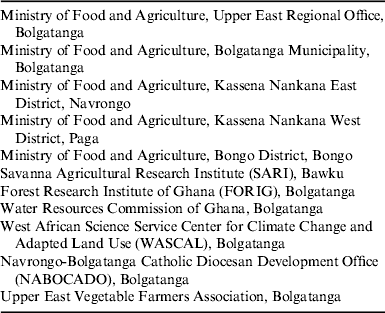
To validate the identified innovations in order to recommend promising ones for further scientific evaluation and dissemination, we convened a participatory stakeholders' workshop on 10 May 2013 at the Water Resources Commission of Ghana office in Bolgatanga, the administrative capital of the region. We invited 12 experts and stakeholders who have knowledge on farmer innovations and farming systems in the region. They were selected from research institutions, MoFA, NGO's and farmer organizations (see Table 2 for the affiliations of the invited stakeholders). The purpose of the workshop was threefold: identify the criteria to evaluate the innovations, weighting of each criterion and assigning scores to innovation using the weighted criteria.
Institutional affiliation of stakeholders and experts invited to the workshop.

In a participatory and iterative approach, the stakeholders deliberated on the criteria to evaluate innovations. Several evaluation criteria, such as problem-solved, acceptability, dissemination potential, research potential, economic viability, technical viability, affordability, flexibility and gender responsiveness, were suggested, but criteria that are more relevant to the promotion of farmer innovation were given priority. Also, related criteria were merged into one so as to avoid double counting. The experts finally agreed to evaluate the innovations based on: originality/innovativeness, economic potential, environmental friendliness and dissemination potential. These are related to the criteria used in evaluating the innovations during the innovation contest. All the experts agreed on the definitions of the four evaluation criteria. Originality refers to the extent to which an innovation differs from common or traditional practices in the region. In other words, originality implies the uniqueness or degree of ‘newness’ of the innovation. Economic viability was considered to be the cost-effectiveness of the innovation as well as the potential contribution to household income and food security. An innovation was regarded as environmentally sustainable if it does not negatively impact on the environment. Dissemination potential relates to the degree to which the innovation is likely to be adopted by farmers in the region. This includes the social acceptability, gender responsiveness, the ease with which it can be replicated or modified, and the extent to which required resources are locally available, accessible and affordable.
To rank the identified innovations, we employed a multi-criteria decision-making (MCDM) analysis. MCDM is a decision analysis tool that is frequently used (particularly in climate change and energy policy research) in prioritizing alternative options and which has several functions, including criteria weighting, which involves scoring all the innovations based on the relative importance of the agreed criteriaReference Bell, Hobbs and Ellis 24 . Following de Bruin et al.Reference de Bruin, Dellink, Ruijs, Bolwidt, van Buuren, Graveland, de Groot, Kuikman, Reinhard, Roetter, Tassone, Verhagen and van Ierland 25 , we adapted the method of MCDM for criteria weighting, based on expert judgment. First, all the experts agreed on the weights for the four evaluation criteria based on the relative importance of each criterion. The experts were then assigned into three groups of four members. To ensure equal representation, each group had at least an expert from MoFA, research institute, NGO or farmer association. Each group was asked to score all the innovations on a scale of 1 (very low) to 5 (very high) on the four evaluation criteria. The weighted summations of the scores for each innovation from each group were then averaged to obtain the overall score. Thus, the overall weighted sum of scores for each innovation was computed by:
 $$I_j = \displaystyle{{w_o s_{ojg_i} + w_{e_p} s_{e_p jg_i} + w_{d_p} s_{d_p jg_i} + w_{e_s} s_{e_s jg_i}} \over 3}$$
where, I
j
, weighted sum of scores for innovation j, w
o
,
 $w_{e_p} $
,
 $w_{d_p} $
and
 $w_{e_s} $
=weights assigned to originality, economic potential, dissemination potential and environmental sustainability criteria, respectively.
 $s_{ojg_i} $
=Score assigned to originality criterion for innovation j by group i;
 $s_{e_p jg_i} $
, score assigned to economic potential criterion for innovation j by group i;
 $s_{d_p jg_i} $
, score assigned to dissemination potential criterion for innovation j by group i;
 $s_{e_s jg_i} $
, score assigned to environmental sustainability for innovation j by group i.
The innovations were then ranked based on the overall weighted sum of scores.
Results and Discussion
We identified 48 farmer innovations in the study region: 29 through the innovation contest and 19 from the household survey. Applications to the innovation contest were obtained from six out of the nine districts of the Upper East region. Bolgatanga municipality had the highest number of applicants (8). The top three innovations from the contest were: storing of onion seeds using a local herb, Barakuk; using onion residues to control striga; and designing an integrated aquaculture–agriculture system. The three innovators were given certificates and prizes during the annual National Farmers' Day celebration. The prizes were a motor tricycle, a motor cycle and a water pump for the first, second and third ranked innovators, respectively. Using the household survey, 6, 8 and 5 innovators were identified in the KNE, KNW and Bongo Districts, respectively. Overall, the average age of the innovators was 45.53, and about 30% of them were women. Nearly all the innovations were developed by individuals (only two applications by groups) and were largely technical innovations.
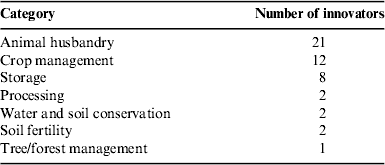
The categorization of the innovations is presented in Table 3. It shows that most of the innovations were related to animal husbandry and crop management, and this is consonant with the findings of the Organic Farmer Experiments research project reported earlier. Animal husbandry innovations were mainly new formulations of animal feeds and the discovery of ethnoveterinary medicine for the treatment of livestock diseases. The crop management included the use of local and low-cost resources such as plant extracts to control weeds, pests and diseases. Other important categories of innovations were storage, processing and SWC. Similar to the findings of BentleyReference Bentley 11 , a large share of the identified innovations were developed to save production costs, such as pesticide, storage and veterinary costs, by blending different ideas. Most of the innovations have been adopted by other farmers located in the same or nearby communities of the innovators. Such claims of high adoption rates by the innovators have also been reported by Critchley and MutungaReference Critchley and Mutunga 15 . The high rate of adoption is due to the fact that farmer innovations are often adapted to local conditions and are relatively inexpensive. This finding suggests that farmer innovations could be disseminated with little support from formal research, and this has positive (e.g., cost-saving) implications for the promotion of agricultural innovations. This also supports BiggsReference Biggs 4 arguments on the potential role of farmer innovations in the reduction of the tasks of formal agricultural research.
Categories of identified innovations.

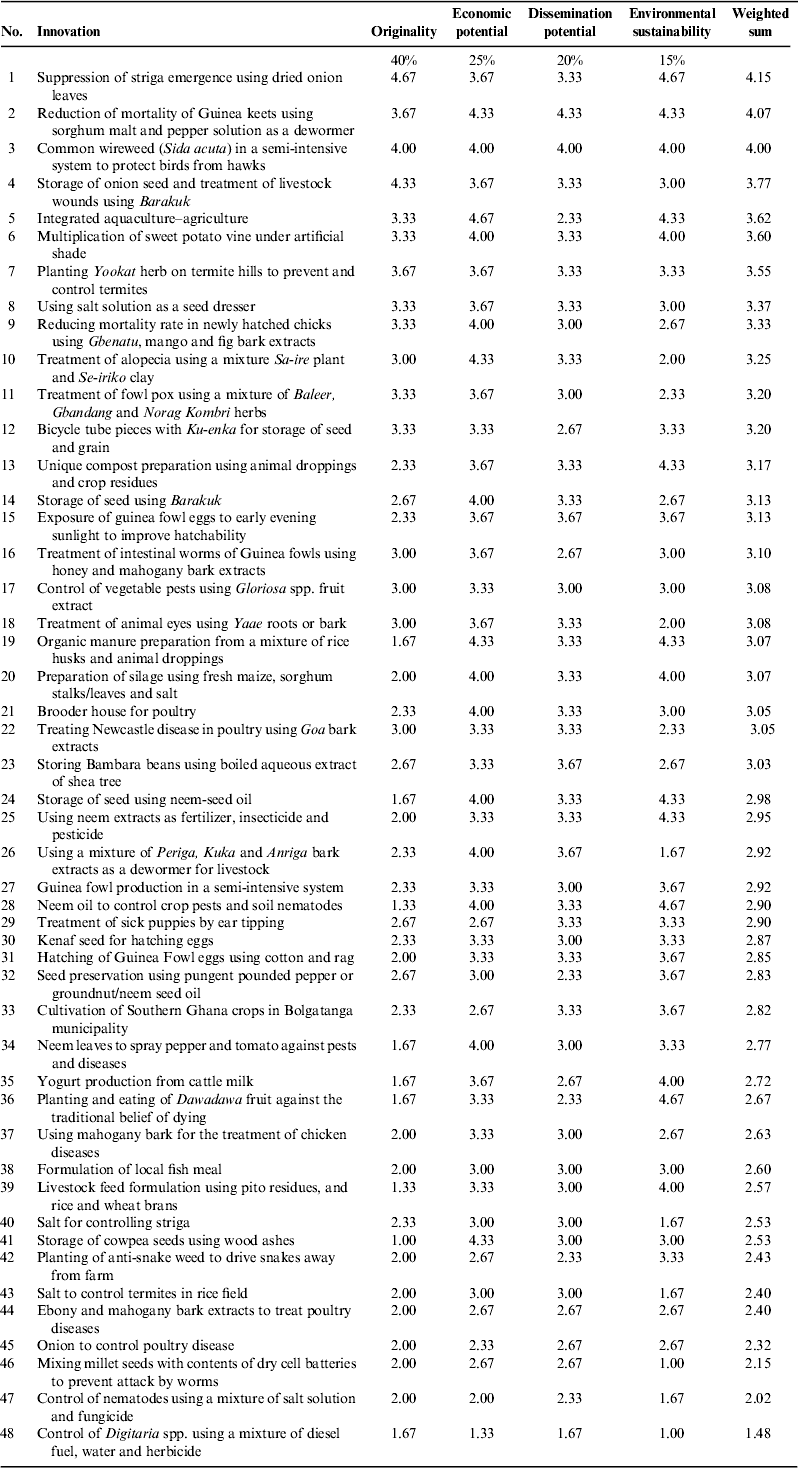
The identified innovations also relate to those found by MillarReference Millar, Scoones and Thompson 9 , who studied farmer experimenters in northern Ghana and categorized the innovations based on the driving factors into curiosity, problem-solving, adaptive and peer pressure experiments. For instance, innovations numbered 33, 1, 6 and 36 in Table 4 can be considered as examples of these four types of experiments, respectively.
Ranking of farmer innovations based on criteria weighting.

Ranking of innovations
As mentioned, we used MCDM analysis based on expert judgment to score the 48 identified innovations on the criteria: originality, economic potential, dissemination potential and environmental sustainability. The innovations were evaluated on these criteria using scores of 1 (very low) to 5 (very high). The average scores of the innovations on the four criteria are 2.51, 3.47, 3.08 and 3.18 for originality, economic potential, dissemination potential and environmental sustainability, respectively. Thus, the innovations score is the highest on economic potential but low on originality. The low average score on originality can be explained by the fact that most of the identified innovations are modifications and value additions to known practices in the study region and not complete novelties.
Based on the relative importance of the agreed evaluation criteria to the concept of farmer innovation, the experts assigned weights of 40, 25, 20 and 15% for originality, economic potential, dissemination potential and environmental sustainability, respectively. The weighted sums of scores were computed and used in prioritizing the innovations. Thus, an innovation with very high dissemination potential but low originality will rank lower than one with average originality and low dissemination potential, due to the criteria weighting. The results of the ranking are presented in Table 4. From the ranking, the most promising innovations include: suppression of striga emergence using dried onion leaves; reduction of mortality of Guinea keets using sorghum malt and pepper solution as a dewormer; and planting common wireweed (Sida acuta) in a semi-intensive system to protect birds from hawks. Among the innovations with least potential include: control of Digitaria spp. using a mixture of diesel, water and herbicide; control of nematodes using a mixture of salt solution and fungicide; and mixing millet seeds with contents of dry cell batteries to prevent attack by worms.
The ranking results also show that the three top-ranked innovations by the evaluation committee in the innovation contest do not attain the same rank in the MCDM approach. For instance, onion seed storage using Barakuk and suppression of striga with onion residues were judged first and second best innovations in the contest but ranked fourth and third in the MCDM analysis, respectively. The difference in the ranking positions is due to criteria weighting which was not implemented in the contest. Also, in the contest, the committee members evaluated the innovations independently, but the MCDM approach was participatory. Moreover, the MCDM analysis involved more and diverse experts with knowledge on innovations and farming systems in northern Ghana.
The use of MCDM analysis based on expert judgment to rank the identified innovations is not devoid of limitations. The choice of evaluation criteria and assigning of weights can be criticized for being subjectiveReference Belton and Stewart 26 . Nonetheless, it is a useful method which can be applied in the first stage of validating farmer innovations. It is easy to implement, and it also considers stakeholders' preferences. Initially, this study also intended to estimate quantitatively the costs and benefits of the identified innovations; but, similar to the observation by Critchley and MutungaReference Critchley and Mutunga 15 in a study on farmer innovations in East Africa, we found that there were insufficient data to permit such an analysis. Thus, the MCDM analysis employed in this study can be used as a good qualitative evaluation approach in cases where quantitative analyses are impossible, or to first prioritize innovations before undertaking comprehensive evaluations such as scientific validation.
Case studies
In this section, we present the six most highly ranked farmer innovations and their respective innovators.
Case 1: Suppression of striga using onion residues
Striga is a parasitic weed that hampers cereal production in northern Ghana and other savanna regions of Africa, and there are several research efforts in the continent to address this challengeReference Khan, Midega and Pickett 27 . Several approaches have been suggested to farmers to control the weed, including crop management practices, seed treatment and striga-tolerant crop varieties. We present the case of Mr Ramani Abe-bieli, a 33-year-old innovative farmer in Kuka Megogo near Missiga in the Bawku Municipality, who mixes dried onion leaves with seeds before planting to suppress the emergence of striga on his millet and sorghum farms. Ramani discovered this innovation serendipitously. He has a parcel of land where he cultivates millet and sorghum. The parcel was highly infested with striga which affected crop yield. He tried several measures to control the weed but was unsuccessful. In one cropping season, he decided to cultivate onion on the parcel instead of cereals. He harvested the onion and left the residues on the field. The following season, he cultivated the cereals again and realized that, unlike previous years, there was very little emergence of striga on the field. He then developed the idea that onion residues could help control striga. He further improved this innovation by processing the onion leaves and using this for coating seeds for planting, to control striga in his fields. Ramani found that the innovation is less expensive compared to other seed treatment methods. He also claims that the innovation is effective as it has prevented the emergence of striga in his field and has subsequently been adopted by more than 50 farmers in his community.
Case 2: Reduction of mortality of Guinea keets using ethnoveterinary medicine
Guinea fowl is an important bird reared by many households in the study region. One of the main causes of mortality, particularly in keets, is worm infection. Ethnoveterinary medicines are commonly used in treating worms and other diseases in birds. One such example, which was highly ranked by the experts, is the innovation of Mr Asaa Abagre, a 76-year-old livestock and poultry farmer in Googo village in the Bawku West district. He uses a mixture of sorghum malt and pepper solution as a dewormer for Guinea keets to reduce mortality. Sorghum is one of the major crops cultivated in northern Ghana, and malted sorghum is used in brewing a local beer known as pito. Asaa, however, uses it in addition to pepper solution to deworm his keets. The malt is sun-dried and pulverized into flour. He also dissolves two pepper fruits in the drinking water of the birds. The keets are confined and fed with the malt flour three times daily and allow to drink the water with pepper solution for 1 week. Asaa asserts that he has successfully reduced the mortality of his keets through this innovation.
Case 3: Sida acuta in a semi-intensive system to protect birds from hawks
Mr Samuel A. Anaba is a poultry farmer in Zaare near Bolgatanga, the capital of the Upper East region. He rears chicken and Guinea fowls in a semi-intensive system. He has designed a unique way of protecting his young birds from hawks, which are a major cause of loss of young birds in his community. He broadcast the seeds of common wireweed (Sida acuta) in front of his brooder house at the beginning of the rainy season. The chicks and keets are brooded in the brooder house for 4 weeks and then released into the S. acuta. Sida acuta is a small shrub with many branches on the stem, and this serves as a hiding place for the birds and protects them from hawks. It also provides a good micro-climate for the birds. The birds also derive nutrients by feeding on the plant as well as insects, such as ants and worms, beneath the plant. Through this innovation, Samuel significantly reduces the mortality rate and cost of protecting his young birds and also supplements the mineral and vitamin requirements of the birds.
Case 4: Storage of onion seed and treatment of livestock wounds using Barakuk
Mr John A. Akugre is a 56-year-old farmer from Tilli in the Bawku West District, and the first prize winner of the innovation contest organized in 2012 to identify farmer innovations, which was described above. Onion production is a major farming activity in his community. Onion seeds are difficult to store for long periods and lose viability before the next planting season, and this is a major production challenge in his community. After several unsuccessful attempts to store the seeds, John experimented using Barakuk, a local plant herb to store the seeds. He collects the plants from the wild during the rainy season, dries, burns them into char and grinds them into powder. The powdered herb is stored in clean containers. He mixes an amount of the herb with the onion seeds and fills a bottle with the mixture for storage in a cool, dry place. With this method, the seeds remain viable even after a year, and he obtains a high germination percentage. A large share of onion farmers in his community has subsequently adopted this innovation.
John also uses the Barakuk herb to treat animal wounds. The powdered Barakuk is mixed with melted shea oil. After cooling, the ointment is applied daily on a cleaned animal wound. John argues that the wound will be completely healed within a week, and the ointment is 90% effective in treating animal wounds. Thus, the use of Barakuk herb improves onion seed viability and saves the cost of drugs for treating animal wounds. A limitation of the innovation is the seasonality and limited distribution of the Barakuk plant. However, the powdered Barakuk can be bottled and stored, and is still effective even after 2 years. John's innovations have been documented in brochures by PROLINNOVA-Ghana and disseminated among key stakeholders.
Case 5: Integrated aquaculture–agriculture
Mr Joseph A. Abarike is an outstanding 55-year-old innovator and experimenter from Zuarungu in the Bolgatanga Municipality. He engages in crop and livestock production, and fish farming. He undertakes several innovative activities on his farm and is responsible for the innovations numbered 5, 33 and 38 in Table 3. He was awarded the third best innovator in the innovation contest. High cost of imported fish food is a major challenge of fish farming in Ghana. To address this challenge and save costs, Joseph decided to formulate fish food from local materials. He mixes rice bran, pito mash, soybean, fish waste, maize or millet flour, and pulverized baobab leaves. He dries and stores the mixture in bags for feeding the fish. The different ingredients provide varied nutrients such as carbohydrate, protein, folic acid and other vitamins to the fish.
Another of Joseph's innovations, which actually won him the awards, is the use of fish pond water as a liquid manure and insecticide. Apart from the fish food, he also drops livestock droppings and neem leaves into his fish ponds. This promotes the growth of micro-organism needed by the fish. The pond water is recycled and used as liquid fertilizer for the crops he cultivates around the ponds. The addition of the neem leaves also serves as a pesticide for the crops. This innovation reduces the amount of fertilizer and pesticide needed for his crops.
Joseph is also a curious experimenter. He cultivates several crops that are grown in southern Ghana and considered to be unsuitable for the climate in northern Ghana. To satisfy his curiosity, he collects planting materials of crops grown in southern Ghana anytime he travels to this region. Some of the crops, like avocado and cocoa, were unsuccessful but most of them, including banana, plantain, cassava, oil palm, pineapple, coconut, orange and cocoyam did very well on his farm. He multiplies the planting materials in order to increase production. He now sells the planting materials to other farmers in the region, and his household is able to prepare southern Ghanaian dishes with products from his own farm.
Case 6: Multiplication of sweet potato vine under artificial shade
Sweet potato is the most widely grown root and tuber crop in the Upper East region of Ghana. It is propagated using vine cuttings, which are generally obtained from young plants. To improve the amount and quality of vine cuttings, Mr John Adjabui, a 46-year-old farmer from Wiaga in the Builsa district produces sweet potato vines under artificial shade instead of the usual method of growing them on the ground. He erects a shade of about 3 m tall and covers it with millet stalks. He plants two-node cuttings under the shade with one of the nodes above the ground and supported with millet stalk to enhance upward growth. The vines grow, climb and spread on top of the shade. Within 4 months, the vines completely cover the shade. He cuts them for planting and sells the rest to other farmers. With this method, he obtains more vines because it prevents phototropism, and also there is no destruction by insects such as beetles or termites as in the case of vines grown completely on the ground. Additionally, there is an increase in vine length since the nodes do not touch the soil for rooting, which retards the length of vine. He is also able to produce vine cuttings throughout the year.
Conclusion
The aim of this paper was to identify innovations developed by smallholder farmers in northern Ghana, and prioritize the high potential ones for further scientific validation or dissemination. Using an innovation contest that rewards farmers' creativity, we identified 29 promising innovations. Additionally, 19 innovations were scouted through a household survey. Using expert judgment in a MCDM analysis, these 48 innovations were ranked, and among the most promising innovations were those involving the control of weeds, pest and diseases using plant residues and extracts, and the treatment of livestock diseases using ethnoveterinary medicines.
The study shows that farmers have added value to existing practices or externally introduced techniques to solve their production constraints, save costs and adapt to changing conditions. The innovations are related to diverse farming practices and largely involve the use of local resources. Most of the innovations are not necessarily new inventions. They are mainly extensive modifications of existing practices or combinations of different known practices in unique ways to address production constraints. Though these low-cost innovations have not been verified, they are increasingly spreading through farmer networks. The innovators are also pleased to share their innovations with other farmers and stakeholders as it builds their reputation and social capital. The claims of high adoption rate suggest that these innovations may have potential in addressing farmers' problems. Most of these innovations involve less use of external inputs, hence, have positive effects on the environment. The result from the MCDM analysis also indicates that most of these innovations have high economic and dissemination potential.
The paper also shows that contest can be a good instrument in unearthing farmer innovations. Awards through the innovation contest may provide incentives for innovators, who may have kept their innovations in secrecy, to reveal their practices. The contest processes also create awareness of farmer innovations. It facilitates stakeholders to appreciate the importance of farmer innovation and provides a platform for further improvements of the innovations through joint research. Thus, the contest strengthens the partnership between farmers and key actors such as extension officers and scientists. The contest may also inspire farmers to try out new things. As part of the WASCAL project, steps are currently under way to evaluate the potential of the contest in inducing farmers to innovate.
While some of the identified innovations can be recommended or disseminated to other farmers, most of them may require further validation or research. For instance, with the first ranked innovation on suppression of striga using onion residues, it would be essential to ascertain how it works and to what extent. That is, which component of the onion residues limits striga emergence, can this be found in other plant extracts and what amount will ensure a high success rate? Also, what value can be added to make it more effective, and is it cost-effective? Validating all these 48 innovations, and the several innovations that have been identified by other research programs, will be costly and time-consuming. We show in this study that MCDM analysis can be used as a first step in prioritizing innovations that will need further validation and to suggest the high-potential innovations. The MCDM used in this study is based on expert judgment, which involves key stakeholders in agriculture. This provides an opportunity to further create awareness and promote farmer innovation processes.
There is the need for better support for farmers' innovations. As shown by the Indian example, such support may include validating the innovations, adding value, assigning patents and commercializing the products. The WASCAL project aims to go beyond identification of innovations to validate some of these innovations with relevant stakeholders in the region. For instance, discussions are currently ongoing with SARI for scientific validation of storing onion seeds using Barakuk and suppression of striga using onion residues. Some of the identified innovations, particularly the ethnoveterinary medicines, have the potential to be converted to marketable products if proven to be effective. Achieving this will, however, require strong institutional support.
This case study from northern Ghana provides further evidence that smallholder farmers develop diverse and spectacular innovations to address the myriad challenges in crop and livestock production. Their efforts have to be recognized, and some of these innovations have high potential that needs to be validated and promoted. More efforts are needed to promote and institutionalize farmer innovation approaches.
Acknowledgements
The financial support of the German Federal Ministry of Education and Research (BMBF) through the West African Science Service Center for Climate Change and Adapted Land Use (WASCAL) research program is gratefully acknowledged. We also thank all the interviewed farmers for sharing their ideas and innovations, and the stakeholders who participated in the evaluation of the innovations, as well as the two anonymous reviewers who helped to improve the paper.