In democracies, the policy ambitions of governments ultimately hinge upon the ability to collect tax revenue from citizens. The Internal Revenue Service (IRS) is the agency responsible for carrying out tax collection in the USA, including enforcement of the tax code through audits. However, IRS funding and staffing have both substantially decreased in recent years, diminishing the agency’s auditing capacity (Kiel and Eisinger Reference Kiel and Eisinger2018). The budget allocated to these tasks has declined by nearly a third over a 10-year period (Congressional Budget Office 2020). Staffing of enforcement activities has also witnessed a sharp decline of around 31% from 2010 to 2018.
A lack of tax code enforcement fundamentally threatens the United States’ state capacity or the ability of its government to accomplish policy goals (e.g., Besley and Persson Reference Besley and Persson2009). Declining state capacity often yields Democratic backsliding, human rights abuses, and a lack of police enforcement of the law (Englehart Reference Englehart2009). As such, the subject of IRS enforcement funding has begun to enter more prominently into policy discussions and media coverage (House Committee on the Budget 2020). Yet, despite the ongoing importance of this issue, no research, to our knowledge, has sought to understand citizens’ attitudes toward the IRS and, in particular, funding for IRS enforcement activities. Public opinion polls show that Americans are at least somewhat knowledgeable about, and interested in, the IRS as a government agency (Miller Reference Miller2016). However, national polls suggest that American support for the IRS in general tends to be lukewarm at best (see Section 7 of the Supplementary Information (SI) for a partial review). A 2013 study, for example, found that support for the IRS was among the lowest of all federal agencies (DeSilver Reference DeSilver2013), while a more recent survey found 58% of respondents giving the IRS a favorable rating (Pew Research Center 2018).
Our study is premised upon the notion that most citizens are unlikely to have strongly crystallized views on funding for IRS enforcement activities. For example, citizens may be unlikely to have considered the potential macro and politico-economic consequences of insufficient funding for IRS enforcement and are likely unaware of the potential benefits of increased funding (e.g., a recent estimate finds that for every additional dollar the IRS spends on its tax enforcement activities, the US government stands to gain $6 in revenue; see Rampell Reference Rampell2021).Footnote 1 Further, because it only recently emerged as a focal point in policy circles, citizens are also unlikely to have internalized cues about the IRS from political elites.
Previous research indicates that, with limited policy knowledge and little ability to rely upon cues from preferred elites, citizens can substantially change policy attitudes when presented with novel policy information (e.g., Bullock Reference Bullock2011). We therefore hypothesize that providing information about the consequences of underfunding IRS enforcement activities can affect citizens’ attitudes toward IRS funding, their willingness to invest more time into learning about the topic, and even their willingness to become politically active on the issue.
H1 Exposure to information about the consequences of IRS underfunding is expected to increase Americans’ willingness to support Internal Revenue Service enforcement activities relative to a control condition.
While H1 is applicable to all Americans, it is nevertheless reasonable to expect substantial partisan differences in receptivity to such information. For example, existing polling finds a sizeable partisan gap in favorability toward the IRS in general, with only 50% of Republicans supportive of the agency, compared to 68% of Democrats (Pew Research Center 2018). This implies that Republicans may be more resistant to simple informational frames about the IRS than Democrats. Thus, while framing has been shown to increase support for government agencies and their functions in the past (e.g., Hvidman and Andersen Reference Hvidman and Andersen2016), for some citizens, attitudes toward the IRS may be more entrenched – especially among ideological opponents to taxation.
We therefore also explore whether, and to what extent, value-consistent frames are effective in changing partisans’ policy attitudes and behavior regarding IRS funding. Value framing is a type of emphasis framing in which the idea elements invoked by the frame speak to individuals’ core values (Luong, Garrett, and Slater Reference Luong, Garrett and Slater2019; Shen and Edwards Reference Shen and Edwards2005). If value frames resonate with the pre-existing ideological worldviews of audience members, they can powerfully reshape attitudes toward the issue under consideration. For example, DeMora, Merolla, Newman, and Zechmeister (Reference DeMora, Merolla, Newman and Zechmeister2021) evaluated the use of pro-masking frames targeted toward white evangelical Christians, finding that mask-wearing recommendations were most persuasive when accompanied by religious and partisan cues that appealed to core values.
For Republicans, we propose a frame that invokes the IRS’ role in reducing the federal budget deficit through the enforcement of the tax code. A logical consequence of enforcing the tax code is that, ceteris paribus, it will assist the US government with minimizing deficit spending. This frame therefore explicitly invokes values related to fiscal conservatism and aversion to deficit spending, which should resonate favorably with Republicans.
We also explore the effectiveness of a value-consistent frame for Democrats. The nature of the American tax code is progressive—that is, income inequality-reducing—only to the extent that the IRS is able to enforce this code. In other words, without proper enforcement of the tax code, the redistributive effects of US income tax policy are mitigated, particularly when there exists substantial tax avoidance at the top of the income distribution. Given the tendency for Democrats to identify fairness and equality as core concerns (e.g., Jost, Nosek, and Gosling Reference Jost, Nosek and Gosling2008), a value-consistent frame emphasizing this consideration is expected to increase Democratic support for IRS funding. Based on this logic, we propose H2:
H2 Exposure to value-consistent frames is expected to increase partisans’ willingness to support the Internal Revenue Service, relative to the receipt of information about IRS underfunding alone.
We acknowledge, though, that such value frames may not work symmetrically across parties. Republicans may not value deficit reduction to the same degree that Democrats value inequality reduction, or vice versa. Additionally, Republicans may have stronger attitudes about the IRS than Democrats, whether for ideological and/or historical reasons. For example, the IRS admitted that it had excessively scrutinized (conservative) Tea Party groups’ applications for tax exempt status during the 2012 campaign season (Gurman Reference Gurman2017), leading to collections of large legal settlements from the IRS.
In sum, while some literature has investigated the correlates of tax evasion and attitudes toward the tax system more broadly (e.g., Cowell Reference Cowell1992; Etzioni Reference Etzioni1986; Mason, Utke, and Williams Reference Mason, Utke and Williams2020), few scholars have investigated public support for the administration of tax policy. More specifically, public opinion research often studies perceptions of the fairness of the tax system but has dedicated little attention to support for the operations of the IRS itself (e.g., Williamson Reference Williamson2017). By examining support for its enforcement activities, our study helps to advance our understanding of perceptions of the IRS as well as public support for a more nuanced conceptualization of government taxation (e.g., Yackee and Lowery Reference Yackee and Lowery2005).
Methods and data
To test H1, we fielded a large preregisteredFootnote 2 survey experiment on the Lucid Theorem platform from September 22 to 23, 2021 (N = 1,559).Footnote 3 Lucid Theorem is a respondent marketplace that provides users with quota-based national samples that are demographically representative on characteristics such as age, sex, race and ethnicity, and region (see Coppock and McClellan Reference Coppock and McClellan2019). See Section 1 of the SI for additional sample information.
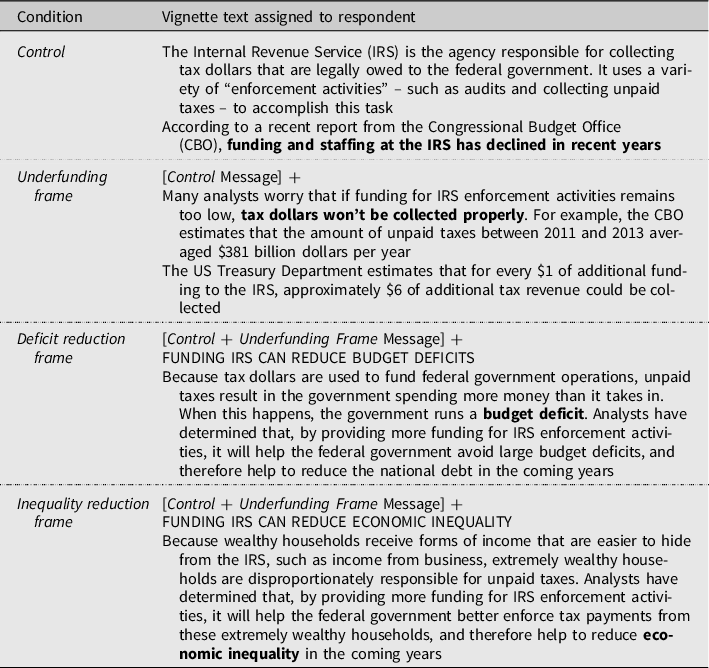
The survey collected demographic information, including partisanship, prior to random assignment (with equal probability) into one of four experimental conditions. Respondents were asked to read a brief passage about the IRS in every condition. In the Control condition, respondents read a brief statement describing the IRS and informing them that, “funding and staffing for the IRS has declined in recent years.” In the Underfunding Frame, respondents saw this same message, in conjunction with an information-based statement concerning the consequences of underfunding IRS enforcement activities – specifically, the loss of government revenue.
The value-consistent experimental treatments include all text from the Control and Underfunding Frame conditions. However, the Deficit Reduction Frame also notes that “funding [the] IRS can reduce budget deficits.” The Inequality Reduction Frame, alternatively, notes that funding the IRS can reduce economic inequality. Respondents were exposed to the Deficit and Inequality Reduction frames regardless of their party identification. See Table 1 for the verbatim text used in these vignettes.Footnote 4
Experimental Vignette Wording

Because the value-consistent frames build directly upon the Underfunding frame, our experimental design enables us to test the unique effects of both (1) information about the consequences of underfunding and (2) value-consistent framing net of receiving information about underfunding. Specifically, treatment effect contrasts between the Underfunding Frame and the Control show the effects of information framing alone, while contrasts of the other frames against the Underfunding Frame identify the independent effects of value-consistent framing. The latter is important insofar as respondents might vary in how they infer IRS enforcement limitations from the value-consistent frames.
We test the effects of these messages on three operationalizations of support for IRS enforcement activities (see the SI for full question wording). Our first item is a measure of attitudinal support, which asks respondents whether Congress “should increase funding for the IRS’ enforcement activities,” measured on a seven-point Likert scale ranging from “strongly disagree” (1) to “strongly agree” (7).
The next measures examine behavioral support. We asked respondents if, after the survey, they would be “willing to receive an email containing more detailed information” about the benefits of funding the IRS, measured on a three-point scale (“yes,” “unsure,” or “no”).Footnote 5 We also asked respondents if they would be “willing to either create or forward a brief message to [their] state’s representatives in support” of IRS funding, also measured on the same three-point scale. Together, these questions provide us with a basis for understanding respondents’ support for the IRS, as well as the strength of their convictions as they consider acting upon them.
We also included a series of manipulation checks. These included a factual manipulation check (e.g., Kane and Barabas Reference Kane and Barabas2019), which found that respondents were more knowledgeable of the benefits of IRS funding in the treatment conditions compared to the control condition, as well as a subjective manipulation check, which found that the Deficit Reduction and Inequality Reduction messages significantly affected, as intended, perceptions of the IRS’s ability to reduce deficits and inequality, respectively, relative to the Underfunding message.
Our analytical strategy relies primarily upon Ordinary Least Squares (OLS) regression to analyze the relevant treatment–control and treatment–treatment contrasts.Footnote 6 To evaluate H1 and H2, we analyze three experimental contrasts for each dependent variable: Underfunding Frame vs. Control; Deficit Reduction Frame vs. Underfunding Frame; and Inequality Reduction Frame vs. Underfunding Frame.
Results
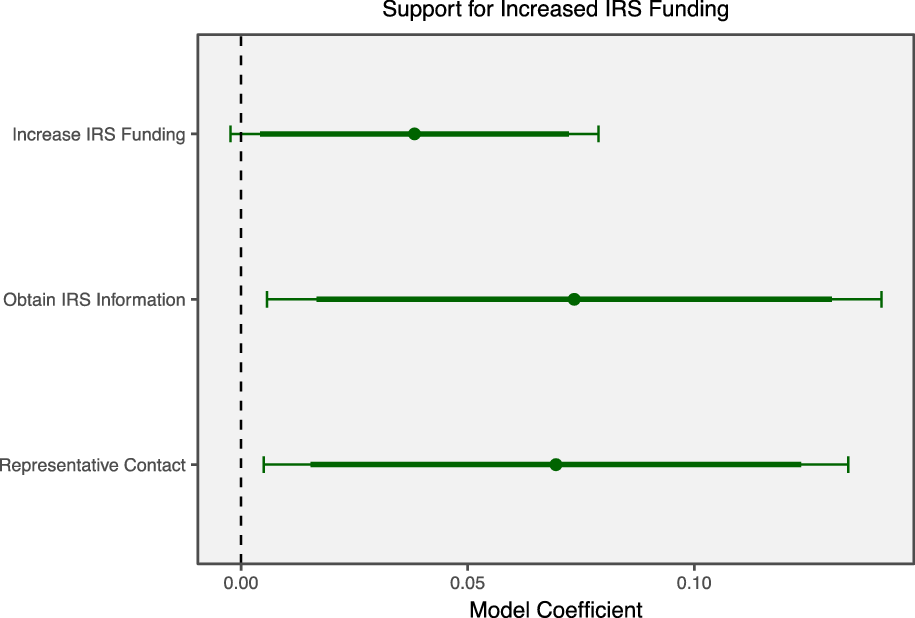
We first evaluate H1 by examining the effects of the Underfunding Frame on willingness to support the IRS relative to the Control condition. In Figure 1, below, we show that informing respondents that underfunding will result in lost tax revenue (Underfunding Frame) increases respondents’ attitudinal support relative to Control by around 4 percentage points (p = 0.07). This information also increases their willingness to learn more about the IRS by approximately 7 percentage points (p < 0.05), as well as their willingness to contact their representatives in support of the IRS by 7 percentage points (p < 0.05). These represent sizable increases above the Control means of 39%, 31%, and 25%, respectively. Thus, consistent with H1, relative to the Control condition, informing citizens of the nature and consequences of IRS budget and staffing shortfalls stands to increase public support for funding IRS enforcement activities.Footnote 7
Effects of Underfunding Frame on Three Measures of Support for IRS. NOTE: Thick horizontal lines denote 90% CIs; thin lines denote 95% CIs. Model coefficients based on results of OLS regression models predicting rescaled DVs with range [0,1]. Control group serves as the baseline for all estimates, represented by the dashed vertical line. N = 778.

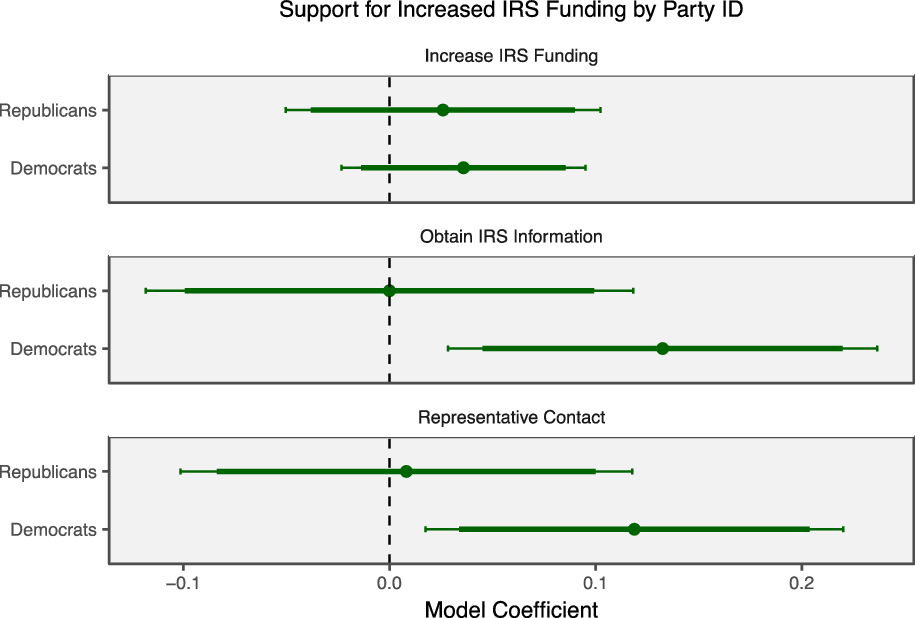
To what extent were these findings homogeneous across partisan groups? Figure 2 displays the treatment effects, for all three outcome measures, across Republican and Democratic subgroups. The results suggest that the Underfunding Frame has a stronger impact on Democratic respondents than Republicans. For instance, Democrats’ increasing willingness to get information about the IRS (δ = 13.2 percentage points, p < 0.05) and willingness to contact their representatives (δ = 11.9 percentage points, p < 0.05) stands in marked contrast to Republicans’ near-zero treatment effects. While the interaction terms between treatment and party are not statistically significant by conventional standards (p = 0.84, 0.12, and 0.19, respectively), each interaction is identically signed (indicating that Democrats responded more strongly than Republicans in three separate tests), and differences in effect sizes are substantively large. Thus, while partisan differences are not statistically significant, the larger, consistently positive treatment effects among Democratic respondents provide suggestive evidence that arguments about IRS underfunding may cultivate greater support from Democrats than Republicans.
Effects of Underfunding Frame on Three Measures of Support for IRS by Party. NOTE: Thick horizontal lines denote 90% CIs; thin lines denote 95% CIs. Model coefficients based on results of OLS regression models predicting rescaled DVs with range [0,1]. Control group serves as the baseline for all estimates. Democratic N = 740; Republican N = 477. 343 pure independents excluded from results.

These asymmetric results across Democratic and Republican groups further motivate our next set of analyses, which examine the effects of value-consistent framing on support for the IRS (H2). Specifically, we examine whether, relative to the Underfunding Frame, messages cueing the IRS’s ability to (1) reduce budget deficits and (2) reduce economic inequality, significantly affect attitudinal and behavioral support for the IRS among Republicans and Democrats.
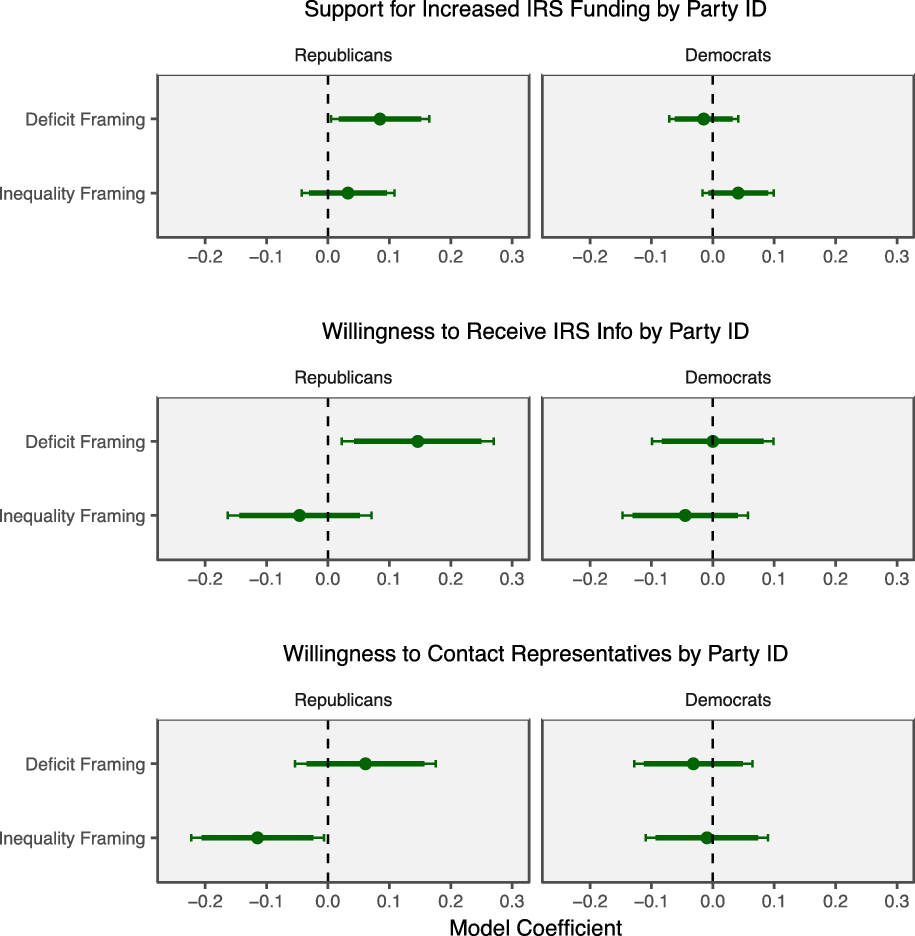
Figure 3 displays the effects of these value-consistent frames among both Republicans and Democrats, relative to the Underfunding Frame alone. Beginning with Republican respondents, the figure reveals that, in response to receiving a value-consistent message about the role of the IRS in reducing the federal budget deficit, Republicans increased their willingness to support the IRS by around 8.5 percentage points (p < 0.05). In contrast, no significant increase in support for the IRS was found among Republicans assigned to the Inequality Reduction Frame relative to the Underfunding Frame (p = 0.40). Further, Republicans exhibited a remarkable 14.6 percentage point increase in the probability of requesting more information about IRS activities (p < 0.05) and a 6.1 percentage point increase in the probability of being willing to contact their representatives, although this latter result was not statistically significant (p = 0.30, two-tailed). Interestingly, Republicans reacted negatively to the Inequality Reduction Frame condition in these latter measures of IRS support, even becoming 11.4 percentage points less likely to seek out more information about the IRS (p < 0.05).
Effects of Value-Consistent Frames on Three Measures of Support for IRS by Party. NOTES: Thick horizontal lines denote 90% CIs; thin lines denote 95% CIs. Model coefficients based on results of OLS regression models predicting rescaled DVs with range [0,1]. Underfunding group serves as the baseline for all estimates, represented by the dashed vertical line. Democratic N = 740; Republican N = 477. 343 pure independents excluded from results.

The significant effects for value-consistent framing relative to an informational frame found among Republicans do not, however, tend to hold for Democrats. The effect of framing IRS enforcement activities as inequality-reducing on Democratic support for funding the IRS (δ = 4.1, p = 0.16), likelihood of requesting more information (δ = −4.4, p = 0.39), and likelihood of being willing to contact representatives (δ = −0.9, p = 0.85) were non-significant relative to the Underfunding Frame, though the former was nearly (marginally) significant and in the expected direction. Democrats also displayed no significant tendency to alter support for the IRS when enforcement activities were framed as being able to reduce the federal budget deficit. In this vein, we find at least marginally significant interactions between experimental conditions and party in the top and middle panels of Figure 3, indicating a significantly larger effect of the Deficit Reduction Frame for Republicans vis-à-vis Democrats (0.04 and 0.07, respectively). Republicans also exhibit a larger effect for the Deficit Reduction Frame than Democrats in the bottom panel, though the interaction itself is not significant (p = 0.24). In contrast, for the Inequality Reduction Frame, Democrats and Republicans only marginally significantly differ in the bottom panel (p = 0.09), but this is largely because of the negative effect of Republicans rather than (as hypothesized) a positive effect among Democrats.
We find a similar pattern in the way partisans responded to the value-consistent frames in a pretest conducted via Amazon MTurk in 2020, lending further support to these tentative conclusions (see SI document). Notably, we also find that compared to a pure control group, information about underfunding tended to have negative effects. One possibility, therefore, is that the effects we observed in our Lucid study are contingent upon citizens having some baseline understanding of the state of government administration funding in order for further information to have a significant effect.Footnote 8
In sum, for the average citizen, providing information about the consequences of underfunding the IRS appears to increase support for funding, desire to learn more information about the issue, and willingness to become more politically involved via contacting one’s representatives in government. Among partisan citizens, however, information framing appears somewhat more efficacious among Democrats vis-à-vis Republicans, with Democrats exhibiting consistently positive effects and Republicans exhibiting far weaker, non-significant treatment effects. Once partisans were equipped with such information, however, we find that additional value-consistent framing (i.e., emphasizing the deficit-reducing or inequality-reducing potential of the IRS) tends to be more consequential for Republicans vis-à-vis Democrats, with Republicans exhibiting greater support for IRS funding, and greater willingness to learn more information, when told that funding the IRS’s enforcement activities can potentially help to reduce federal budget deficits.
As an additional exploration, we tested the value frames using the control group as a baseline (see the SI, Table S8). We find that, whereas the Deficit Reduction Frame never yields lower interest among Democrats or for the sample as a whole, the Inequality Reduction Frame does yield lower interest among Republicans, suggesting that the message likely to have the overall largest effect on public interest may be one involving underfunding information in combination with deficit-reduction framing.
Discussion and conclusions
Public knowledge of, and support for, tax collection agencies and the administration of the tax code remains an understudied topic in political science. Message sender effects are an important aspect of the present findings that deserve increased scrutiny in further research designs. Nevertheless, our study’s results indicate that while information frames have the potential to increase public support for the IRS, by combining that information with value-consistent framing, partisan actors, think-tanks, public scholars, and nonprofit organizations may be better able to increase public support for the IRS.Footnote 9
Though framing research finds that message senders’ identities can have powerful effects on the acceptance of new information, these results indicate that elites across the political spectrum may be more effective in increasing support for IRS enforcement activities (especially Republican identifiers) if they invoke considerations related to the federal budget deficit. While a small group of committed Republicans may remain intransigent to these issues due to deeply entrenched anti-tax stances, the evidence presented above suggests that attitudes toward the IRS are malleable for most partisans.Footnote 10
The IRS as a government agency is, of course, unique in its function and level of name recognition to the public. That said, our findings may be likely to generalize to other government agencies whose function is (1) generally viewed as necessary (even if not highly favorable), and, especially given the importance of partisanship for determining public attitudes (e.g., see Kane, Mason, and Wronski Reference Kane, Mason and Wronski2021), (2) not explicitly ideological or strongly associated with one party. For such agencies and institutions, our study suggests that information about their funding levels, and the larger macro-socioeconomic consequences of that funding, can be effective in shifting public support.
Finally, we reason that value-consistent framing of tax bureaucracy is likely broadly applicable a variety of country contexts. As tax collection agencies are scorned by rent-seeking elites in developing countries as well as in industrialized democracies, we suggest that utilizing frames that invoke policy consequences and/or core political values may be an effective strategy that governments could employ to reestablish support for the very institutions that grant them their state capacity.
Supplementary material
To view supplementary material for this article, please visit https://doi.org/10.1017/XPS.2022.26
Data availability statement
The data, code, and any additional materials required to replicate all analyses in this article are available at the Journal of Experimental Political Science Dataverse within the Harvard Dataverse Network, at https://doi.org/10.7910/DVN/L5QIRU (Anson and Kane Reference Anson and Kane.2022).
Acknowledgements
The authors contributed equally to this work and are listed in the alphabetical order. The authors wish to thank Jamie Druckman, Dan Hopkins, Soubhik Barari, the participants at the 2022 MPSA panel on “Framing and Tailoring Messages to Shift Public Opinion,” and the anonymous reviewers for helpful comments on earlier versions of this manuscript.
Conflicts of interest
We report no conflicts of interest.
Ethics statement
All studies obtained Institutional Review Board (IRB) approval from the first author’s university IRB prior to survey deployment (UMBC Institutional Review Board approval #675, Review type: Exempt; approved July 7, 2021).
We affirm that this research adheres to APSA’s Principles and Guidance for Human Subjects Research.
Please see the online Appendices for more information about the ethical treatment of human subjects in this study.