Implications
This model of lifetime performance of dairy cattle provides a basis for predicting nutrient partitioning across different physiological states and genotypes. The model has two tightly linked parts: a conceptual framework that focuses on priorities for life functions, and rules for modifying the outcomes when nutritional supply is inadequate. The rules to model variations of performance in response to nutritional challenge described in this paper provide a combination of genotype and nutritional effects in the prediction of performance.
Introduction
The question we address in these two companion papers is how to represent in animal models (i) dynamic changes of performance throughout the lifespan, (ii) genetic differences between individuals and breeds and (iii) modulations of performance in response to nutritional challenges. The specific aspect we address in this paper is how to simulate variations of performance in response to nutritional challenges.
In the first paper (Martin and Sauvant, Reference Martin and Sauvant2010), we presented an integrated whole-animal model, structured on the basis of teleonomic arguments and genetic scaling parameters, to describe performance over repeated reproductive cycles throughout the lifespan of various genotypes of dairy cows. This first part of the model allows the simulation of a genetically scaled reference pattern of performance dynamics, that is, expressing the trajectory of a genotype. Accepting that animals have a genotypic trajectory of performance immediately raises the question of what happens when the nutritional resources available are inadequate to allow this trajectory to be achieved. In other words, the model should be able to describe the adjusted trajectory of a genotype in a potentially challenging nutritional environment. To do this, the model must explicitly (i) incorporate a voluntary intake module to generate potential deviations from the optimal intake covering requirements and (ii) describe the resulting deviation from the reference pattern of performance. This would permit the model to be used for in silico experiments to explore changes in animal performance resulting from the interactions of genetic and environmental factors (dietary energy supply in the first instance).
The whole model, presented in the two companion papers, simulates on a daily basis feed intake, milk yield and composition, foetal growth, calf birth weight and body weight (BW) and composition changes in dairy cows throughout their lifespan, that is, during growth, over successive reproductive cycles and through ageing. In this paper, voluntary intake is predicted according to energy requirements, diet energy content and body reserves level, and modulation of performance is controlled by theoretical rules of energy partitioning.
The objective of this paper is to evaluate the efficacy of this part of the model, dealing with voluntary intake and energy partitioning, to describe the effect of energy deficit or surplus from a genetically scaled requirement on performance dynamics throughout the lifespan of dairy cows.
Model description
Rationale for the teleonomic model
The model (Martin and Sauvant, Reference Martin and Sauvant2010) consists of two connected sub-models, namely regulating and operating. The regulating sub-model describes, throughout the lifespan of dairy cows, the dynamic partitioning of relative priorities to elementary life functions (growth, reproduction, ageing and balance of reserves) and is structured on a teleonomic basis, embodying the idea that the coordination of life functions is goal-directed towards the preservation of life for the reproduction of life form (Bricage, Reference Bricage2002). The operating sub-model describes the dynamics of performance (body, milk and intake) expressed, for simplicity, using standard metabolizable energy units, and is structured with genetic scaling parameters (mature weight, milk potential, milk composition and body reserves lability). Performance (Q: daily material flow) is converted into energy (E: daily energy flow) with appropriate conversion coefficients (eQ: energy/material). The use of metabolizable energy implies that the level of performance effects on energy values is ignored but avoids hidden assumptions associated with energy conversions. This was judged to be acceptable for a model focused on the regulation of energy partitioning rather than on energy accounting.
At any time, priorities to life functions, together with genetic scaling parameters, are used to define a reference pattern of performance Q*, which determines an energy requirement E* = Q*×eQ. Given the actual intake, the difference between energy supply and demand is apportioned between energy flows, giving energy deviation δE. The actual energy flow is thus calculated such that E = E*+δE, giving the actual performance Q = E/eQ, which expresses a deviation from the reference performance δQ = Q−Q*. This paper describes (i) the model of voluntary intake potentially generating an energy deviation from the energy reference requirement (deficit or surplus) and (ii) the energy partitioning model apportioning the energy deviation between flows and giving δE and δQ (description of reference E* and Q* is given in Martin and Sauvant, Reference Martin and Sauvant2010).
Regulating sub-model: trajectories of life function priorities
A comprehensive description of the regulating sub-model is given in the companion paper (Martin and Sauvant, Reference Martin and Sauvant2010). Briefly, the model describes the partition of a female priority over lifetime t and during successive reproductive cycles between six elementary goals: G: achieve growth, A: achieve ageing, R: balance body reserves, U: complete intrauterine growth of offspring, N: supply nutrients to the neonate and S: supply nutrients to the nursing young. Priority is formalized as a dimensionless quantity flowing from G to R during growth, from R to A with ageing and cyclically through R, U, N and S during reproductive cycles such that G + A + R + U + N + S = 1. The so-called GARUNS dynamic pattern defines a teleonomic trajectory providing rules for the time-based orchestrated changes in energy metabolism.
Operating sub-model: performance
Structure
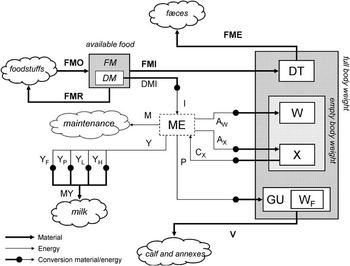
The operating sub-model describing performance (change in body state and material flow as output of milk components or intake of feed) of the cow over her lifetime is based on the partitioning of metabolizable energy between functions of growth, maintenance, body reserves storage and mobilization, pregnancy and lactation. The diagram of the operating sub-model linking energy flows to performance (material) is shown in Figure 1.
Operating sub-model diagram. ME: metabolizable energy ‘zero pool’; I, M, Y, Yj (j: fat, protein, lactose, water), P, AW, AX, CX: ME flows; FMO, FMR, FMI, FME: dietary fresh matter flows; DMI: dry matter intake; MY: raw milk yield; V: parturition; components of empty body weight (BW): W: non-labile body mass, X: labile body mass; components of full BW: DT: digestive tract contents, GU: gravid uterus including foetus (W F) and products of conception.

Body state is described in terms of mass components of full BW (kg) given by BW = EBW + GU + DT, where EBW (kg) is the empty BW given by EBW = W + X, where W (kg) is the non-labile body mass weight, X (kg) is the labile body mass weight (body reserves), DT (kg) is the digestive tract contents weight and GU (kg) is the gravid uterus weight including foetus weight (W F) and products of conception (placentome, membranes and fluids). In addition, body condition score (BCS, 0 to 5 scale defined by Mulvany (Reference Mulvany1977)) is used to characterize body performance.
Milk performance is described by flows of raw milk (MY, kg/day) defined as the sum of milk fat (j:F), protein (j:P), lactose (j:L) and water (j:H) yields (MYj:F,P,L,H, kg/day), such that MY=∑j:F,P,L,HMYj. Milk constituent contents (MCj:F,P,L,H, kg/kg) are given by MCj:F,P,L,H=MYj:F,P,L,H/MY (if MY > 0).
Intake is a daily material flow both expressed (i) in a fresh matter (FM) basis (FMI, kg/day) as the current material flow ingested from available feed (AF, kg FM) and entering the digestive tract, and (ii) conventionally in a dry matter (DM) basis (DMI, kg DM/day) as the flow providing the dietary metabolizable energy inflowing the central zero pool of metabolizable energy (ME, MJ). Other continuous flows of fresh material include the daily amount of fresh feed offered (FMO, kg FM/day), refused (FMR, kg FM/day) and excreted (FME, kg FM/day), neglecting the excretion of endogenous material. The flow FMO is defined by the feeding system of the cow and is an input of the model potentially generating a limit to the voluntary intake.
Finally, expressing a reproductive performance, the flow V (kg/day) is a discrete transfer of material occurring at parturition and representing calving, that is, the birth of the newborn calf and expulsion of products of conception from the cow’s gravid uterus. Other variables of the operating sub-model are source or sink compartments of energy (maintenance) or material (milk, foodstuffs, faeces and calf and annexes).
Energy flows, expressed in a common metabolizable energy unit, are the energy inflowing from diet (I, MJ/day), the energy for growth in W (AW, MJ/day), the energy for anabolism of X (AX, MJ/day), the energy from mobilization of X (CX, MJ/day), the energy for pregnancy (P, MJ/day), the energy for milk secretion (Y, MJ/day) and the energy for maintenance (M, MJ/day). The term Q refers to performance {DMI, W, X, DT, GU, MY, (MY, MC)j:L,F,P,H} and the term E refers to energy flows {I, M, AW, AX, CX, P, Y}.
Formalism
The full description of the model formalism under a non-challenged feeding context is given in the companion paper (Martin and Sauvant, Reference Martin and Sauvant2010).
The differential equation for ME is

The principle of energy conservation such that dME/dt=0 implies

The differential equation for digestive tract contents weight is given by

with DTt =0 = δ×W B, FMI = DMI/DMC and FME = k 0×(DT−δ×W), where k 0 (day) is the fractional rate of daily DT removal, DMC = 0.6 kg DM/kg is the diet DM content, W B is the non-labile body mass at birth and δ (kg/kg) is a parameter scaling the minimal and permanent digestive tract content fresh weight (parameter values are given in Martin and Sauvant, Reference Martin and Sauvant2010).
The differential equation for AF is simply given by

where FMR = FMO−FMI with the assumption that feed refusals are daily removed and that AF is a zero pool compartment.
Given the reference pattern of performance (Q* and associated E*) calculated with the formalism given in the companion paper, the resulting reference energy flow  corresponds to the energy required to realize the reference pattern of performance. Given the dietary ME content e D (set to 11.3 MJ/kg DM, see Appendix A in the supplementary online appendix available at http://www.animal-journal.eu/), the level of DMI covering energy requirements (DMI*, kg DM/day) is

In this paper, energy intake may not cover reference requirements such that DMI = DMI*+δDMI and I=I*+δI.
Voluntary intake model
The feed intake capacity (DMIC, kg DM/day) limiting intake to a digestive tract maximal fill is given by

where  is defined as the theoretical optimal dietary ME content maximizing intake.
By the way of I*, this level of maximal intake relies on the assumption that the dynamic pattern of feed intake capacity is under teleonomic drive, meaning that the digestive tract size follows a specific dynamic pattern along the animal lifetime and during the reproductive cycle. This approach is consistent with the INRA Fill Unit System of voluntary dry matter intake prediction in dairy cows recently proposed by Faverdin et al. (Reference Faverdin, Delaby and Delagarde2007), which involves corrective indexes of maturity, gestation and lactation. By way of  , this level of maximal intake relies on the assumption that an optimum diet is associated with the exact coverage of energy requirement.
Given the amounts of offered (DMO = FMO×DMC, kg DM/day), maximum (DMIC) and required (DMI*) intake, the actual DMI is defined as the minimum value between DMO, DMIC and an optimum feed intake amount lying between DMI* and DMIC, and is given by

where q×DMIC+(1−q) × DMI* is an optimum feed intake, defined when DMI*⩽DMIC according to the value of q given by

where X L = X/W is the labile to non-labile body mass ratio and χ I (kg/kg) is a threshold parameter for X L.
The actual ME intake is then given by

This formalism assumes that when the digestive tract fill is not limiting (i.e. when DMI* < DMIC), feed intake tends to exceed the energy requirement based amount DMI* and to reach the intake capacity DMIC in lean animals (X/W < χ I). Inversely, in fat animals (X/W > χ I), feed intake tends to the strict coverage of energy requirements. This formalism is consistent with the lipostatic theory of Kennedy (Reference Kennedy1953), suggesting that the long-term regulation of feed intake is linked to the regulation of body reserves. This simple representation of feed intake allows simulation of the physical limitation of intake of low-density energy diets ( ) and situations of overfeeding of high-density diets (
 ) leading to fattening and reduced intake. Moreover, this model allows simulation of a compensatory higher intake following a restricted feeding period (Faverdin et al., Reference Faverdin, Delaby and Delagarde2007).
Energy partitioning
Flows I (and DMI) and I* (and DMI*) are, respectively, the supply and the demand in energy (and feed). If the actual intake I is different from the reference amount I* in underfeeding (I < I* and δI < 0) or overfeeding (I > I* and δI > 0) situations, the deviation δI characterizes an energy imbalance ( ). The deviation δI is divided between these flows through deviations δE such that

The way δI is apportioned between flows AW, AX, CX, P, Y and M is defined through a theoretical model of energy partitioning taking into account (i) the levels of priority to lactation (S) and to growth (G), (ii) the relative energy feeding level f given by f = I/I* and (iii) the ratio of labile to non-labile body mass (X L = X/W).
Components δE are defined as a proportion of the deviation δI with the general formalism given by

where ΘE is a specific function of partitioning defined for each energy flow E (AW, (AX, CX), P, Y and M) such that  .
The difference δI (by construction ΘI = 1) between energy supply and demand is thus integrally diverted between flows, which may be increased or decreased in relation to their reference value E*. In particular, a deficit of energy may induce a slowing down in growth, a decrease in body reserve storage, an increase in body reserve mobilization, a decrease in foetal growth and/or a decrease in milk production. Inversely, a surplus of energy may induce a speeding up of growth, an increase in body reserve storage, a decrease in body reserve mobilization and/or an increase in milk production. The model of partitioning assumes that maintenance requirements (M) are unaffected by the level of energy feeding, which is given by ΘM = 0 and implies that δM = 0 and M = M* whatever δI.
The mathematical formalism of functions ΘY, ΘP and ΘAW is provided in Appendix B in the supplementary online appendix available at http://www.animal-journal.eu/.
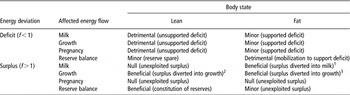
The effects of changes in the levels of energy feeding on the diversion of energy into milk (regulation by the function ΘY), into pregnancy (regulation by the function ΘP) and into growth (regulation by the function ΘAW) are summarized in Table 1.
Basis assumptions for energy partitioning: effect of energy deviation (deficit or surplus relative to requirements) on energy flows according to body state (lean or fat relative to a threshold parameter)

1According to the level of priority S to lactation.
2According to the level of priority G to growth (compensatory growth in young animal).
3According to the level of priority G to growth (accelerated growth).
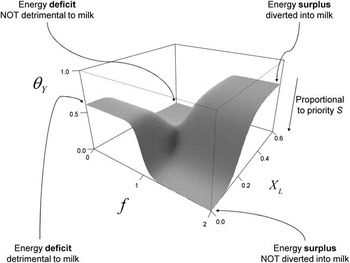
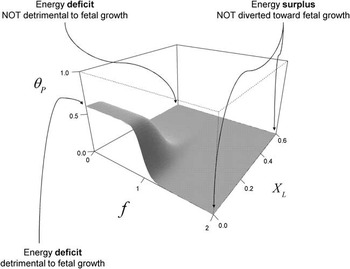
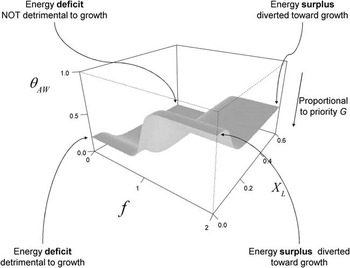
These functions generate a smooth transition of energy-partitioning profile according to the animal state defined by values of the couple (f, X L). Surface responses of ΘY, ΘP and ΘAW are shown in Figures 2, 3 and 4, respectively. By construction, the maximal value of ΘY equals Y*/I*, which implies δY→Y* when δI→I*, the maximal value of ΘP equals P*/I*, which implies δP→P* when δI→I*, and the maximal value of ΘAW equals  , which implies
 when δI→I*. This partition is assumed to affect simultaneously all flows, which reflects a harmonized use of energy reserves to counter temporary energy deficit or take advantage of favourable conditions to constitute energy reserves. The model explicitly considers body reserves as an energy buffer, that is, an energy source to partially compensate the effect of underfeeding and an energy sink formalizing the fattening effect of overfeeding. Severe energy deficits are detrimental to the completion of lactation and gestation, which corresponds to situations where milk production and foetal growth are severely reduced as body reserve mobilization becomes inefficient to lessen the effect of underfeeding. The modulation of ΘY by priority S is consistent with the more pronounced effect of underfeeding on milk production in early lactation (Broster, Reference Broster1972) and the favoured diversion of energy surplus into milk, when this option is available, rather than into body reserves (Friggens et al., Reference Friggens, Ingvartsen and Emmans2004). As in the model of energy requirements of the pregnant ewe developed by Geisler and Neal (Reference Geisler and Neal1979), the supply of energy to ensure an optimal foetal growth is seen as a ‘protected’ function. This formalism implicitly assumes that the flow P* corresponds to an optimal foetal growth. Overfeeding during pregnancy induces body reserve formation and underfeeding is associated with body reserves mobilization to supply foetal growth requirements (Lins et al., Reference Lins, Gruber and Obritzhauser2003). As energy deficit increases, a greater part is detrimental to foetal growth (Wade and Schneider, Reference Wade and Schneider1992).
Surface response of the function (ΘY) modulating milk yield according to relative feeding (f) and body reserves (X L) levels. f is the ratio of actual to required energy intake in MJ/MJ and X L is the ratio of labile to non-labile body mass in kg/kg.

Surface response of the function (ΘP) modulating foetal growth according to relative feeding (f) and body reserves (X L) levels. f is the ratio of actual to required energy intake in MJ/MJ and X L is the ratio of labile to non-labile body mass in kg/kg.

Surface response of the function (ΘAW) modulating growth according to relative feeding (f) and body reserves (X L) levels. f is the ratio of actual to required energy intake in MJ/MJ and X L is the ratio of labile to non-labile body mass in kg/kg.

The partition of energy deviation defined by ΘY, ΘP and ΘAw implies body reserve mobilization or storage with a net result (∂BX, MJ/day) given by

where ΘX=1−ΘY−ΘP−ΘAw−ΘM achieved through changes in body reserve mobilization or storage relative to the reference levels  and
 such that

with

and

.
These equations reflect the fact that an increase in body reserve storage is achieved by reducing mobilization (if  ) or by increasing storage (if
 ) and that an increase in body reserve mobilization is achieved by reducing anabolism (if
 ) or by increasing mobilization (if
 ).
The above model of energy partitioning implies that δAW+δAX−δCX+δP+δY+δM = δI, showing that the energy deviation ∂I is integrally apportioned to adjust flows AW, AX, CX, P and Y, expressing actual performance after conversion into material flows (see Martin and Sauvant, Reference Martin and Sauvant2010).
The hypothetical apportioning of the milk energy deviation δY into deviations of energy channelled to milk fat, protein lactose and constituent yields (δYj:F,P,L,H) is given in Appendix C in the supplementary online appendix available at http://www.animal-journal.eu/.
Parameters
The model of voluntary intake involves the parameter χ I (set to 0.3), which corresponds to the threshold of labile to non-labile body mass ratio at which occurs the shift between physical to energetic regulation of intake.
The model of energy partitioning involves the parameters χY, χP and χAW, which correspond to thresholds of the labile to non-labile body mass ratio at which the functions ΘY, ΘP and ΘAW shift the channelling of energy deficit or surplus. For instance, a high value of χY implies that body reserves recovery prevails over milk yield, that an energy surplus is diverted into milk yield when body reserves are at a high level, and that an energy deficit is primarily detrimental to milk yield. A low value of χP defines the level of protection of the pregnancy function: an energy deficit is detrimental to foetal growth only when body reserves fall under a critical value. Analogously, the value of χAW determines the level of body reserves at which an energy deficit starts to be detrimental to growth and an energy surplus enhances growth. To exemplify the modelling principle, these parameters were set to χY = 0.22, χP = 0.16 and χAW = 0.10, which correspond approximately to BCS of 2.0, 1.5 and 1.0, respectively (0 to 5 scale).
Methods
Implementation
The model was implemented with Modelmaker version 3.0 (Cherwell Scientific Ltd, 2000) using the Runge–Kutta four numerical integration procedure and a fixed integration step of 1 day for t ranging from 0 to 7300 days (∼20 years, arbitrary long-term horizon).
Evaluation of intake
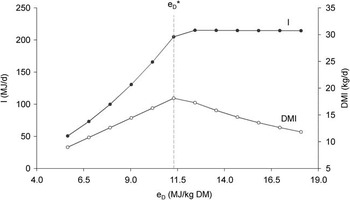
Our first specific objective was to simulate a realistic voluntary intake pattern in challenging feeding contexts and to generate an energy deficit or surplus from energy requirements according to the feeding allowance. To evaluate the realism of the voluntary intake model, simulations were generated with values of dietary metabolizable energy content e D ranging from 50% to 150% of the theoretical value maximizing intake set to e*D = 11.3 MJ/kg DM. The simulated changes in diet composition were applied during the 5th week of lactation of a second parity cow and associated changes in weekly average intake (DMI and I) were recorded. The overall pattern of change was graphically considered and compared to the classically admitted response pattern (e.g. Faverdin, Reference Faverdin1992).
Evaluation of energy partitioning
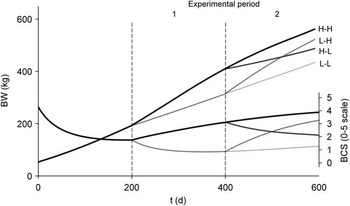
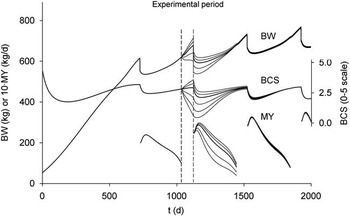
Our second specific objective was to evaluate the efficacy of the energy partitioning model to simulate the effect of challenging feeding contexts on performance dynamics throughout the lifespan of dairy cows. To address this issue, two virtual experimentations were designed. Simulations were performed with the parameterization used for the standard reference cow used in the companion paper (Martin and Sauvant, Reference Martin and Sauvant2010). The first experiment focused on the effect of feeding on growth and involved two dietary metabolizable energy content (H:e D = 12.5 MJ/kg DM and L: e D = 10.0 MJ/kg DM) fed during two periods of age (200 to 400 day and 400 to 600 day). The second experiment focused on the pre-partum feeding effect on lactation and involved six levels of feeding (e D = 9.2→13.4 MJ/kg DM) 3 months pre partum in a second parity cow. Trajectories of BW, BCS and MY for the different treatment groups were graphically considered and qualitatively compared to like-for-like real experiments.
Results
Evaluation of intake
Figure 5 shows the simulated changes in weekly average DMI and I during the 5th week of lactation of a second parity cow associated with changes in e D ranging from 50% to 150% of  . The model produces the typical pattern of physical fill effect limiting DMI of a low-energy density diet and the plateau response of I to the level of requirement resulting in a decrease of DMI (e.g. Faverdin, Reference Faverdin1992).
Model simulations of average intake of metabolizable energy (I, MJ/day) and dry matter (DMI, kg/day) in the 5th week of lactation according to the dietary metabolizable energy content e D (MJ/kg DM), where  is the dietary metabolizable energy content maximizing intake.

Evaluation of energy partitioning
First experiment
Figure 6 shows the simulated effect on BW and BCS of two dietary metabolizable energy content (H:e D = 12.5 MJ/kg DM and L: e D = 10.0 MJ/kg DM) during two periods of age (200 to 400 days and 400 to 600 days). The model produces typical patterns (e.g. Crichton et al., Reference Crichton, Aitken and Boyne1960) of retarded (LL and HL), accelerated (HH) and compensatory growth (LH).
Model simulated effect of two dietary metabolizable energy contents (H: e D = 12.5 MJ/kg DM v. L: e D = 10.0 MJ/kg DM) during two experimental periods (200 to 400 days and 400 to 600 days) on body weight (BW, kg) and body condition score (BCS, 0 to 5 scale) changes during growth.

Second experiment
Figure 7 shows the simulated effect of six levels of feeding (e D = 9.2→13.4 MJ/kg DM) 3 months pre partum on BW, BCS and MY of a second parity cow. The model produces the main known features of such treatment (e.g. Garnsworthy and Topps, Reference Garnsworthy and Topps1982), that is, pre-partum weight gain and increase in body condition, increased BW loss with body condition at calving, return to an apparently defended level of BW and score during lactation, the residual difference between treatment groups at the end of the subsequent lactation being reduced, and a detrimental effect on milk yield.
Model simulated effect of six dietary metabolizable energy contents (e D = 9.2→13.4 MJ/kg DM) 3 months pre partum on body weight (BW, kg), body condition score (BCS, 0 to 5 scale) and milk yield (MY, kg/day) of a second parity cow.

Discussion
The results presented in this paper exemplify the suitability of the model to simulate deviations of performance dynamics from a genetically scaled trajectory in response to changes in dietary energy supply.
Voluntary intake
The intake model involves a body reserves dependent trade-off between the saturation of the intake capacity to take benefit from a liberal feeding situation to improve body condition and the exact coverage of energy demand. This two-way modelling principle, initially proposed by Conrad et al. (Reference Conrad, Pratt and Hibbs1964), is the basis of several models of intake (review in Faverdin, 1992; Ingvartsen, Reference Ingvartsen1994). Results of Ellis et al. (Reference Ellis, Qiao and Cant2006) have shown that the incorporation of the effect of body reserves in a dynamic model of energy balance significantly improves prediction of intake and BW changes. The originality of our approach is to formalize possible intermediary levels of intake between energy requirements and fill-based prediction that account for a long-term energy demand relying on a target level of body reserves to be reached. Thus, intake is a full-fledged performance in the same way as milk production and BW change. The animal is considered as a whole, on a lifetime scale, with its own ‘agenda’ and the model simulates ad libitum feeding situations as well as situations of restricted feeding. Simulated trajectories of DMI × MY daily values fall within the scatter plot shown by Hristov et al. (Reference Hristov, Price and Shafii2004), gathering a large set of data reported in the literature.
As the dietary energy content is the only feed characteristic used as input, the model provides a synthetic but reductive view of nutrition. As such, the model simulates a realistic voluntary intake, potentially generating energy deficit or surplus from requirements, and allowing the energy-partitioning model to simulate deviation from the reference pattern of performance. In the future, further testing will be necessary to evaluate the accuracy of intake predictions in response to nutritional challenges.
Energy partitioning
The present sophistication of the model is aimed at accounting for the effect of variations in feed intake around this level and thus yields a prediction of performance based on a combination of genotype and energy nutrition. The basic principle is to model the partitioning of energy deviation from the optimal reference between functions to generate an adjusted pattern of performance.
The time-based pattern of priorities defined by way of a regulating sub-model determines an optimal requirement according to the physiological status and body condition, and the actual energy supply determines the actual performance, which in turn modifies the animal status and consequently updates the optimal requirement. Lifetime performance is thus the result of a long-term tendency to home on to a goal-directed trajectory given a genetically determined ability and the short-term tendency to ensure an energy equilibrium given an environmentally determined resource. This approach relies on a comprehensive coupling of homeorhetic drive and homeostatic control. The concepts of homeostasis and homeorhesis have been widely used in animal nutritional science to explain regulations of nutrient partitioning (Bauman and Currie, Reference Bauman and Currie1980; Sauvant, Reference Sauvant1994). Both are properties of living systems to return to a particular state, a particular set point in the physiological parameters space for homeostasis and a set of points composing a dynamic trajectory for homeorhesis. From a modelling standpoint, it was assumed that the formalization of this trajectory, coined a chreod by Waddington (Reference Waddington1957), should be the starting point, rather than an exhaustive representation of metabolic pathways, composing the piping of an animal model. This teleonomic and integrative approach echoes the suggestion of Friggens and Newbold (Reference Friggens and Newbold2007) to focus on ‘why does partition change with time?’ rather than ‘how do animals partition nutrients?’
By way of the homeorhetic driven variables (E*, Q*) and the homeostatic corrections (δE, δQ), the model combines push and pull approaches (Drackley et al., Reference Drackley, Donkin and Reynolds2006; input makes output v. output makes input): trajectories of physiological functions determine reference dynamic energy requirements (homeorhetic pull standpoint) and lifetime animal performance is corrected according to effective energy supply (homeostatic push standpoint). Performance (P) is thus expressed as the trajectory of a genotype (G) in a challenging nutritional environment (E). Contrary to the classical additive formalism P = G + E+(G × E) (Bryant et al., Reference Bryant, Lopez-Villalobos, Holmes and Pryce2005), the proposed model explicitly focuses on the interaction G × E and formulates performance through a whole integrated function P = f(G, E).
Throughout the lifespan, the level of body reserves determines to which extent an energy deficit is detrimental to growth, lactation and pregnancy and to which extent an energy surplus is diverted to growth, lactation or body reserves replenishment. Body reserves represent an energy buffer being either an energy source in a restricted feeding context or an energy sink in liberal feeding contexts. Structurally, the body reserves level is thus a central variable of control regulating energy partitioning in situations of energy deviation from the reference pattern of requirements. The reference pattern of performance is built independently of the current level of feeding but with respect to the body reserve size, which reflects previous feeding and acts as a ‘memory’.
As a whole, the proposed model of energy metabolism resembles the growth models of the metabolic theory of ecology (MTE; Brown et al., Reference Brown, Gillooly, Allen, Savage and West2004) and the earlier theory of dynamic energy budgets (DEB; Kooijman, Reference Kooijman1986). All these approaches are founded on simple mechanistic descriptions of how individual organisms take up and use energy and material. MTE is based on the physics and geometry of supply networks and DEB is based on relationships between the surface area and volume (Van der Meer, Reference Van der Meer2006). The model is also related to the model developed by Vetharaniam et al. (Reference Vetharaniam, McCall, Fennessy and Garrick2001) based on the concept of absorbed energy and designed to predict performance of different genotypes under different feeding regimes. The main differences of our approach are the more detailed representation of the sequence of reproductive cycles and the involvement of teleonomic trajectories for life functions. Our approach is dedicated to the development of an operational tool rather than the construction of a new theory. The GARUNS model is intended to artificially simulate rather than explain the biological basis of energy partitioning.
The energy partitioning model is a theoretical formalization of the modulation of the animal’s response to nutrient supply. This problem has been tackled with the aim of integrating the basic knowledge and further improvements will be necessary to accurately predict a wide range of feeding contexts at different physiological stages. Refinements of this specific component of the whole model can be madewhile keeping the principle of a model diverting an energy deficit or surplus between processes. An interesting question to tackle concerns the incorporation of genetic parameters into the homeostatic function to account for differences between animals and breeds in the ability to cope with challenging feeding contexts. Our purpose is to keep as much as possible the overall model structure with a generic regulating sub-system at the species level and a specific operating sub-system at the individual level. From that standpoint, the regulating sub-model is intended to embody invariant determining factors in the process of performance elaboration and the operating sub-model is intended to express the way a given genotype performs in a given nutritional environment. The model of energy partitioning is set as a null hypothesis to test and illustrates the proposed formalism using a genetically scaled and teleonomic reference pattern of energy partitioning and deviations from this pattern caused by resource availability and depending on the body state.
The present model evaluation remains on illustrative typical properties and has not been performed quantitatively. The first step should concern the repeated fit of the model to various data sets and the study of threshold parameter estimates variability. The second step could concern the suitability of the general framework to describe lifetime performance in other lactating species.
Conclusion
We proposed a model of lifetime performance of dairy cattle accounting for changes in energy supply. We conjecture that this work provides a novel conceptual framework. This approach explicitly incorporated a homeorhetic drive by way of the tendency to home on to the teleonomic trajectory defined in the companion paper and a homeostatic control by way of the tendency to maintain an energy equilibrium in response to nutritional constraints. The model formalized lifetime performance as a defended trajectory. Applied to dairy cows, this framework allowed us to build a whole animal predictive model defined as an autonomous entity with its ‘own agenda’, and ultimately as a ‘virtual cow’. The quantification of the predictive ability of the model and its application to other lactating species remains to be tested.
Acknowledgements
The authors are indebted to the reviewers for their constructive criticism and comments, which helped in improving the manuscript, and also thank Laurence Puillet and Muriel Tichit for stimulating discussions relating to the ideas contained in this paper.