Implications
Feed intake is a major cause of variation in the performance of cattle and is, therefore, of central importance in animal production. This study showed that chopping increased intake in growing cattle fed whole-crop barley silage (WCBS) harvested at a late stage of maturity (dough stage), but that chopping had no effect when the WCBS was harvested at an earlier stage of maturity (heading stage).
Introduction
Whole-crop cereals often are ensiled as chopped material, but also are preserved with a considerably larger particle size as large-bale silage. However, studies on the latter are scarce and crop material is precision-chopped in the majority of published studies. During the grain filling process, whole-crop cereals undergo extensive morphological and compositional changes. The properties of the stalk changes and due to starch accumulation its relative proportion of the crop decreases, often leading to decreased fibre concentrations (Khorasani et al., Reference Khorasani, Jedel, Helm and Kennelly1997) and decreased fibre digestibility (Cherney et al., Reference Cherney, Marten and Goodrich1983). These changes during maturation can affect dry matter (DM) intake (DMI) which is negatively related to dietary concentrations of neutral detergent fibre (NDF), when intake is limited by physical factors (Mertens, Reference Mertens1994). The NDF intake (NDFI) is negatively related to the concentration of indigestible neutral detergent fibre (INDF) (Huhtanen et al., Reference Huhtanen, Rinne and Nousiainen2007).
Forage particle size (Deswysen and Vanbelle, Reference Deswysen and Vanbelle1978) and stage of maturity (Perez-Barberia and Gordon, Reference Perez-Barberia and Gordon1998) are positively related to chewing activity in ruminants. An increased need for chewing during ingestion might decrease eating rate and restrict the time available for rumination (Teller et al., Reference Teller, Vanbelle and Kamatali1993) and as the digestive function of rumination is to reduce the particle size and facilitate particle outflow from the reticulo-rumen, restricted rumination can decrease feed intake (Welch, Reference Welch1982). Faecal particle size reflects the size of particles leaving the rumen (Kennedy, Reference Kennedy2005) and is affected by forage particle size (Jaster and Murphy, Reference Jaster and Murphy1983) and stage of maturity (Jalali et al., Reference Jalali, Nørgaard, Nadeau, Arnesson and Weisbjerg2008).
Awns in whole-crop silages might restrict feed intake in growing cattle (Bolsen et al., Reference Bolsen, Berger, Conway and Riley1976). Wallsten et al. (Reference Wallsten, Nadeau, Bertilsson and Martinsson2009) found that dairy heifers, fed round-baled whole-crop barley silage (WCBS) selected for the non-fibrous parts, when fed two-rowed but not when fed six-rowed barley harvested at the dough stage of maturity. They claimed that awns prevented the heifers from selecting kernels of the six-rowed barley which resulted in depressed intake. However, there are few reports on depressed intake due to awns in chopped WCBS and hence, any negative effect awns might have imposed could be expected to decrease by chopping.
Little is known about the effect of long v. chopped whole-crop cereal silage on animal performance. Furthermore, stage of maturity is of major importance in the use of whole-crop cereals and its possible interaction with chopping needs to be clarified. The aim of this study was to examine the effects of physical form and stage of maturity at harvest of WCBS on feed intake, eating and rumination activity, diet selection and faecal particle size in dairy steers. We predicted chopping to increase the intake of WCBS, the increase being more pronounced at a late compared to an early stage of maturity.
Material and methods
Whole-crop barley silage
The WCBS was produced at the Götala Research Station (58°23′N, 13°29′E; altitude 120 m) outside Skara in south-west Sweden. Spring barley (Hordeum distichum, cv. Kinnan) was sown on 13 April 2005 and harvested as whole crop at the heading stage on 27 June, code 59 according to Zadoks et al. (Reference Zadoks, Chang and Konzak1974), or at the mid-dough stage of maturity on 18 July (code 85). Common production practices were used and the crops were fertilised with 100 kg N/ha in the spring.
At both harvests, crops were cut with a mower conditioner (JF 3200 Flex; JF-Stoll, Sønderborg, Denmark), which was run with the conditioner rotor at a low speed to prevent grain loss. Both crops were baled and wrapped with eight layers of plastic film (Horse Wrap®, 0.025 × 750 mm; Trioplast AB, Smålandsstenar, Sweden) with an integrated round baler and wrapping machine (Deutz-Fahr RB 4.6 OC). Four litres of Kofasil® Ultra (12% sodium nitrite, 8% hexamethylentetramine, 5% sodium propionate, 15% sodium benzoate and 60% water; Addcon Agrar GmbH, Bonn, Germany) per tonne fresh matter were applied with a pump and sprayer system (Perstorp AB, Perstorp, Sweden) on the swath, immediately in front of the pick-up during baling. Bales were conserved for at least 90 days before feed-out. During the feeding period, bales were opened continually, at a rate of three bales per week, and divided into two equal parts with a silage cutter. One part of the bale was fed in its long physical form and the other part was chopped to a theoretical length of cut of 20 mm using a precision chop forage wagon (JF ES 3500; JF-Stoll, Sønderborg, Denmark). Long and chopped silage from one bale were fed simultaneously to parallel groups of steers. To determine particle size distribution, all silages were sieved once in each experimental period with a Penn State Particle Separator (Nasco, Fort Atkinson, WI, USA) consisting of two sieves, 19 mm and 8 mm, and a bottom pan.
Average ear proportion of the harvested crop was determined by taking three samples of approximately 2 kg of fresh weight each from the swath on a diagonal line across the harvested fields, immediately after cutting. From each sample, two subsamples of 50 undamaged plants each were taken, from which ears were cut off. Ear and stalk were dried separately at 105°C for 24 h.
Animals, experimental design and housing
Eight dairy steers (Swedish Red) with an average initial live weight (LW) of 350 (±10) kg were used in a duplicated 4 × 4 Latin square design with a 2 × 2 factorial arrangement of dietary treatments assigned to four experimental periods (periods 1 to 4) with a length of 3 weeks each. The treatments were WCBS harvested at two stages of maturity (heading, dough stage) fed in long or chopped physical form (long, chopped). In each experimental period, day 1 to 7 was the adaptation period, day 8 to 17 was the recording and collection period at ad libitum intake and day 21 was the recording period at restricted intake. The steers were kept in individual tie stalls, with rubber mats in the front and rubber slats at the back, in a temperate stable (8°C to 12°C). The animals had access to separate, automatic water bowls. Each animal had one manger for forage and one for soybean meal and mineral feed. Experimental procedures used in this study were approved by the Research Animal Ethics Committee (Swedish Animal Welfare Agency).
Feeding and management
The animals were fed at 0900 and 1600 h. From day 1 to 17, each animal was offered WCBS ad libitum by adjusting the daily forage portion to 110% of the average intake during the three preceding days. Orts from each animal were removed every day before the morning feeding. Feed and orts were weighed daily during the recording period. From day 18 to 21, each animal was offered WCBS at approximately 85% of the ad libitum intake during day 15 to 17 in each period. Soybean meal was given twice a day, 0.3 kg fresh weight at each feeding, simultaneously with the silage. A mineral mixture containing 14.6% Ca, 6.5% P and 9.2% Mg (Normal; Lactamin AB, Kimstad, Sweden) was fed at the morning meal in an amount of 100 g. The LW of each steer was recorded on days 6 and 7 in each period. The average LW gain of the steers during the experiment was 0.74 kg/day (s.d. 0.14).
Sampling and analyses of feeds and orts
Daily samples of fed WCBS and orts were collected, frozen and later pooled to one sample for days 8 to 12 and one sample for days 13 to 17 in each period. Soybean meal was sampled every second day during days 8 to 17 in each period and pooled to one sample for the whole experiment.
All chemical analyses of feed and orts were performed at Kungsängen Research Laboratory, Swedish University of Agricultural Sciences, Uppsala. Silage fermentation products were analysed on extracts from pooled samples of WCBS, representing each stage of maturity in each period. Water was added to thawed samples at a 1 : 1 ratio (weight-based), mixed by hand and stored at <8°C over night. The wet samples were pressed in a hydraulic press and the juice was analysed. The pH was measured with a Metrohm 654 pH meter (Metrohm AG, Herisau, Switzerland). Lactic, butyric, acetic, propionic and succinic acid and ethanol were quantified using HPLC (Andersson and Hedlund, Reference Andersson and Hedlund1983). Ammonia nitrogen was determined with an auto-analyser system (Broderick and Kang, Reference Broderick and Kang1980).
The two subsamples of silage and orts from each treatment and period were dried at 60°C for 18 h in a forced-air oven for DM determination and further analyses. Dried samples of silages, orts and soybean meal were ground through a 1 mm screen in a Kamas hammer mill. The DM content of soybean meal was determined by drying at 103°C for 16 h. The two subsamples of silage and orts from each period and the soybean meal were analysed for ash, which was determined after 3 h at 550°C in a preheated furnace, and NDF which was analysed according to Chai and Udén (Reference Chai and Udén1998), using undiluted detergent solution, α-amylase and sodium sulphite. For further analysis, the two subsamples of WCBS from each treatment and period were pooled to one sample per period. Period samples of WCBS and soybean meal were analysed for total nitrogen (N) following the Kjeldahl procedure with digestion on a Kjeltec 2460 (Tecator, Höganäs, Sweden) device and crude protein was calculated as N × 6.25. Period samples of WCBS were analysed for acid detergent fibre (ADF) and lignin as described by Robertson and Van Soest (1981), sugar (free glucose and free fructose) and starch (including maltodextrins) which were determined enzymatically according to Larsson and Bengtsson (Reference Larsson and Bengtsson1983) and in vitro organic matter digestibility (IVOMD) which was determined after 96 h incubation in buffered rumen fluid (Lindgren, Reference Lindgren1979). Starch was also determined in period samples of orts from animals receiving long or chopped WCBS harvested at the dough stage. The INDF was determined in situ on pooled samples of WCBS representing each stage of maturity in each period, which were incubated for 288 h in the rumen after being ground through a 1.5 mm screen in a Wiley mill (NorFor, 2007).
Chewing activity
Jaw movements (JM) and oscillations (JMO) were recorded continuously by use of a special chewing halter during 96 h, starting before the morning meal on day 8 on four steers and starting on day 13 on another four steers, each group of four steers belonging to the same square. The digital JMO values were sampled at 20 Hz and the time and amplitude value of the individual JM were identified (Nørgaard and Hilden, Reference Nørgaard and Hilden2004). The JM were clustered into crude cycles (CC) and the chewing rate, basic chewing rate according to Schleisner et al. (Reference Schleisner, Norgaard and Hansen1999), within each cycle was estimated. The CC were ranked according to their deviation from typical rumination cycles (RC), and atypical CC were excluded before clustering into rumination periods. Subsequently, no RC were clustered into eating or idling periods. The daily eating and rumination times were estimated as the accumulated daily duration of identified eating and rumination periods. The cycle time was estimated as the time from the first JM to the last JM in a CC plus 1/chewing rate. The effective eating and rumination times within eating and rumination periods were estimated as the sum of cycle time values. The inter-cycle time between the individual rumination cycles was estimated as the difference between total rumination time and effective rumination time divided by the number of rumination cycles minus one cycle per period, using the principles described by Schleisner et al. (Reference Schleisner, Norgaard and Hansen1999). The eating and rumination periods identified were validated by visual scrutiny of the pattern of JM. Periods with atypical eating or rumination patterns were further revalidated by use of video recordings of the behaviour of the steers.
Eating rate
Eating rate at restricted feeding was measured during four daily meals of 20 min on day 21 in each experimental period. One quarter of the daily silage ration was offered at 0900, 1000, 1500 and 1600 h. Eating behaviour was observed and eating rate was calculated as silage consumed per time spent eating. Orts were re-fed after the second and fourth meal. Eating rate at ad libitum intake was calculated from chewing observations by dividing average daily feed intake by average daily eating time during a 4-day period.
Diet selection
To investigate the extent to which the animals selected for chemical constituents while eating WCBS, the concentration of each constituent in the WCBS offered was subtracted from the concentration in the orts. To evaluate the effect of selection on composition of the consumed ration, the concentration of each constituent in the WCBS consumed was subtracted from the concentration in the feed offered. Selection of NDF was determined for all WCBS, whereas selection for starch was determined for long and chopped WCBS harvested at dough stage of maturity.
Faeces sampling and sieving
In each experimental period, spot samples were taken from fresh faeces in the morning and in the evening (250 ml per occasion) during the chewing recording periods on days 9 to 12 from four steers and days 14 to 17 from another four steers, each group of four steers belonging to the same square. Samples were frozen and later pooled to one sample per animal and period. Before dry sieving, faecal samples were washed in nylon bags in a washing machine and thereafter freeze-dried as described by Nørgaard et al. (Reference Nørgaard, Husted and Ranvig2004). The faecal samples were dry-sieved, by use of a sieve shaker (Retsch AS 200; Retsch GmbH, Haan, Germany), into six fractions by five sieves with square holes of 2.36, 1.0, 0.5, 0.212, 0.106 mm and a bottom bowl. Mean faecal particle size was calculated according to Waldo et al. (Reference Waldo, Smith, Cox, Weinland and Lucas1971).
Calculations and statistical analyses
The values for eating rate and restricted intake from one steer fed heading-stage silage in its long form in period 3 was excluded from the statistical analyses because it did not eat at all during the morning feeding. Chewing data and ad libitum intake from two steers in period 2 and one steer in period 3, all receiving heading-stage silage in its long form, were excluded from the analyses because of incomplete recordings due to problems with the equipment. Due to these missing values, all results are presented as least square means.
Intake, eating rate, chewing activity and faecal particle size data were analysed according to the following model using the Mixed procedure of SAS (SAS system for Windows, release 9.1; SAS Institute Inc., Cary, NC, USA):

where Yijkl = dependent variable, μ = overall mean, Si = fixed effect of square (i = 1 to 2), Aj (i ) = random effect of animal within square (j = 1 to 4), Pk = fixed effect of period (k = 1 to 4), Ml = fixed effect of stage of maturity of WCBS (l = 1 to 2), Fm = fixed effect of physical form of WCBS (m = 1 to 2), MFlm = interaction between stage of maturity and physical form, PMkl = interaction between period and stage of maturity, PFkm = interaction between period and physical form and eijklm = residual error.
Diet selection of NDF and starch were analysed as a paired t-test (Minitab 15; Minitab Inc., State College, PA, USA). Offered WCBS and orts and offered WCBS and consumed WCBS from each animal were considered as pairs in the analysis. Effects were declared significant at P < 0.05 and as a tendency to significance at 0.05 < P < 0.10 in the F-test. Pairwise comparisons between treatment means, shown as least square means, were performed with Tukey’s test.
Results
Crop, feed and diet characteristics
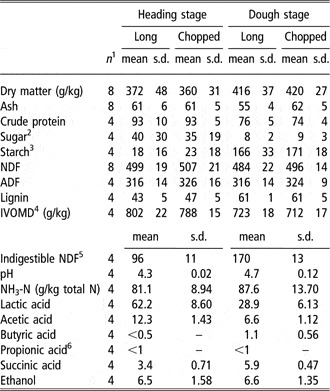
Ear proportion of the crop was 0.22 (s.d. 0.011) at heading and 0.56 (s.d. 0.012) at dough stage of maturity. The respective mass (wet weight) distribution of WCBS after sieving on the 19 mm sieve, 8 mm sieve and bottom bowl was (%, s.d. within brackets) 98 (1.1), 1 (0.5), 1 (0.5) (heading) and 96 (1.2), 2 (0.6), 2 (0.6) (dough stage) for long silage, and 35 (3.7), 37 (2.0), 28 (4.7) (heading) and 38 (2.0), 35 (7.7), 27 (7.6) (dough stage) for chopped silage.
The chemical composition and nutritional characteristics of the silages are presented in Table 1. The composition of soybean meal was 872 g DM per kg and 63 g ash, 520 g CP and 120 g NDF per kg DM. Dietary CP concentration was 118 and 119 g/kg DM, respectively, in the diets with long and chopped WCBS harvested at heading stage of maturity and 101 and 102 g/kg DM in the diets with long and chopped WCBS harvested at dough stage of maturity.
Chemical composition, digestibility and pH of whole-crop barley silage harvested at heading or dough stage of maturity fed in its long form or chopped

1Number of observations per treatment.
2Free glucose and fructose.
3Including maltodextrins.
4In vitro organic matter digestibility (g/kg organic matter) after 96 h incubation in buffer and rumen liquid.
5Determined in situ (288 h) on pooled samples of long and chopped silages. Fermentation products and pH analysed on pooled samples of long and chopped silages.
6Propionic acid from additives is included.
All values are in g/kg dry matter, unless stated otherwise.
Intake, eating rate and chewing activity
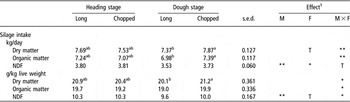
Chopping increased DMI by 6.8% (kg/day) in WCBS harvested at the dough stage but had no effect on intake when WCBS was harvested at the heading stage. The NDFI (kg/day) was 4.8% higher for the heading-stage silage compared with the dough-stage silage and 2.9% higher for the chopped silage compared with the long silage (Table 2).
Effects of physical form (long or chopped) and stage of maturity (heading or dough stage) on ad libitum intake of whole-crop barley silage fed to dairy steers

1Main effects: maturity (M), physical form (F) and their interaction (M × F): *P < 0.05; **P < 0.01; T = tendency (0.05 < P < 0.1).
a,bMeans within a row with different superscripts differ (P < 0.05).
Data are presented as least square means.
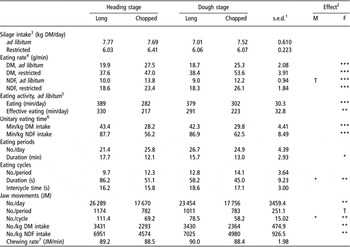
Chopping of WCBS increased eating rate but decreased eating time, the number of JM during eating and the duration of eating periods and eating cycles. There tended (P = 0.08) to be a larger difference in eating cycle duration between long and chopped silage harvested at the heading stage compared with the dough stage of maturity (Table 3). The feeding of WCBS harvested at the heading stage caused more JM per eating cycle and longer duration of the eating cycle compared with feeding WCBS harvested at the dough stage (Table 3).
Effects of physical form (long or chopped) and stage of maturity (heading or dough stage) of whole-crop barley silage on eating activity in dairy steers

DM = dry matter, NDF = neutral detergent fibre.
1Standard error of the difference (s.e.d.) for comparisons between the treatment heading stage long and the other treatments. For other comparisons the presented s.e.d. should be multiplied by 0.671–0.732 except for variables based on restricted intake where it should be multiplied by 0.947–0.949. For heading long, n = 5 except for variables based on restricted intake where n = 7. For the other treatments, n = 8 in all variables.
2Main effects of maturity (M) and physical form (F): *P < 0.05; **P < 0.01; ***P < 0.001; T = tendency (0.05 < P < 0.1). There was a tendency for interaction between M and F in eating cycle duration.
3Intake observed during recording of eating rate and chewing activity.
4Silage eating rate at ad libitum intake calculated from intake and chewing observations during 4 days. Silage eating rate at restricted feeding determined during 1 day.
5Eating activity during ad libitum intake.
6Effective eating time per kg intake.
7Basic chewing rate according to Schleisner et al. (Reference Schleisner, Norgaard and Hansen1999).
Data are presented as least square means.
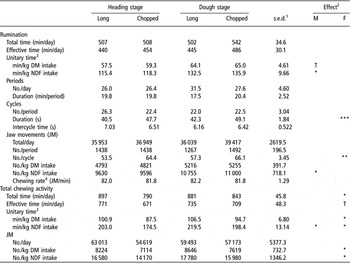
Chopping increased rumination cycle time and the number of JM per rumination cycle. When steers were fed dough-stage silage, rumination time and JM, in relation to NDFI, were greater than when they were fed heading-stage silage (Table 4).
Effects of physical form (long or chopped) and stage of maturity (heading or dough stage) of whole-crop barley silage on ruminating and total chewing activity in dairy steers

DM = dry matter, NDF = neutral detergent fibre.
1Standard error of the difference (s.e.d.) for comparisons between the treatment heading stage long and the other treatments. For other comparisons, the presented s.e.d. should be multiplied by 0.663–0.732. For heading long n = 5 and for the other treatments n = 8 in all variables.
2Main effects of maturity (M) and physical form (F): *P < 0.05; **P < 0.01; ***P < 0.001; T = tendency (0.05 < P < 0.1). There were no interactions between M and F in any of the variables.
3Effective ruminating and chewing times per kg intake.
4Basic chewing rate according to Schleisner et al. (Reference Schleisner, Norgaard and Hansen1999).
Data are presented as least square means.
The daily total chewing time, the unitary chewing time (min/kg intake) and the number of JM per kg DMI and per kg NDFI were decreased by chopping. Effective chewing time per kg NDFI was longer for dough-stage silage than for heading-stage (Table 4).
Diet selection
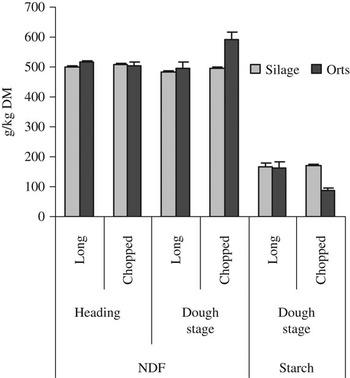
The NDF concentration was 98 g/kg DM higher (P < 0.01) in the orts than in the offered chopped dough-stage silage and 18 g/kg DM higher (P < 0.001) in the orts than in the offered long heading-stage silage. Furthermore, the starch concentration was 84 g/kg DM lower (P < 0.001) in the orts than in the offered chopped dough-stage silage (Figure 1). Diet selection reduced the NDF concentration in consumed WCBS compared with offered WCBS by 22 g/kg DM (P < 0.05) in chopped dough-stage silage and by 4 g/kg DM (P < 0.05) in long heading-stage silage. Diet selection increased the starch concentration in consumed chopped dough-stage silage compared with offered by 17 g/kg DM (P < 0.01).
Concentrations of NDF and starch in long and chopped whole-crop barley silages harvested at heading and dough stage of maturity and their corresponding orts. T-bars represent standard error of the mean (n = 8).

Particle size distribution and grain in faeces
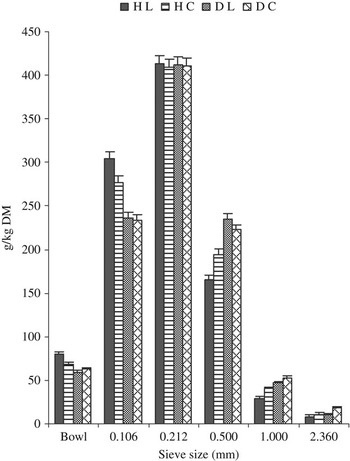
Chopping increased mean faecal particle size when steers were fed WCBS harvested at the heading stage but not when they were fed WCBS harvested at the dough stage (Table 5). The mean faecal particle size and the proportion of particles retained on the 1 mm sieve size was larger when steers were fed chopped compared with long WCBS and when steers were fed heading-stage silage compared with dough-stage silage. Figure 2 shows a more detailed picture of the mass distribution of faecal particles on the different sieves. There was a higher proportion of faecal particles <0.212 mm from steers fed heading-stage silage compared with steers fed dough-stage silage (Figure 2). There were more grains in faeces from steers fed long silage than from steers fed chopped silage when harvested at dough stage but there were no grains in the faeces from steers fed silage harvested at heading stage (Table 5).
Effects of physical form (long or chopped) and stage of maturity (heading and dough stage) of whole-crop barley silage on particle size distribution and grain concentration after dry sieving of faeces from dairy steers

DM = dry matter.
1Main effects of maturity (M), physical form (F) and their interaction (M × F): **P < 0.01; ***P < 0.001.
2Whole grains in faeces were not included in the calculations of mean particle size and >1 mm value.
3According to Waldo et al. (Reference Waldo, Smith, Cox, Weinland and Lucas1971).
4Proportion of faecal particles retained on a sieve with a pore size of 1 mm.
a,b,cMeans within a row with different superscripts differ (P < 0.05).
Distribution of washed faecal particle mass on the different sieving fractions from dairy steers fed whole-crop barley silage harvested at heading (H) or dough stage (D) of maturity offered in its long form (L) or chopped (C). Whole grains in faeces were not included in the calculations. T-bars represent standard error of the difference within sieve size (n = 8).

Discussion
Intake
The fact that chopping increased intake in the WCBS when harvested at dough stage but not when harvested at heading stage of maturity is in agreement with Ingvartsen (Reference Ingvartsen1994), who predicted a larger increase in DM intake due to chopping with decreasing OMD in grass forages. The effect of chopping on intake at the dough stage might be explained by diet selection. Selection for starch by the steers fed chopped dough-stage silage probably increased DM intake by decreasing the NDF concentration of the diet and thereby decreasing its effect on rumen fill (Mertens, Reference Mertens1994). The selection for starch can be explained by the ability of ruminants to select for highly digestible nutrients through feedback mechanisms (Forbes and Provenza, Reference Forbes and Provenza2000). The animals receiving long dough-stage silage also had the opportunity to select for starch, but the fact that they did not do so indicates that ingestion of grain was restricted in some way. In the long silage harvested at dough stage of maturity the grains were attached by long awns, which was generally not the case with grain in the chopped dough-stage silage. The long awns might have been unpleasant for the animals (Laca et al., Reference Laca, Shipley and Reid2001; Wallsten et al., Reference Wallsten, Nadeau, Bertilsson and Martinsson2009), which could have affected their intake negatively.
The DM intake did not differ due to maturation (Table 2) which was contradictory to Rustas et al. (Reference Rustas, Nadeau and Johnsson2008), who found increased intake with increasing stage of maturity in WCBS fed to dairy steers. Similar DM intake for the two stages of maturity in this study was probably due to similarity in NDF concentration and DM content, which was not the case in the report by Rustas et al. (Reference Rustas, Nadeau and Johnsson2008) where NDF concentration decreased and DM content increased with maturation. Feed intake in ruminants is negatively correlated with dietary NDF concentration when intake is physically regulated (Mertens, Reference Mertens1994), which it probably was in the steers used in this study and in the study by Rustas et al. (Reference Rustas, Nadeau and Johnsson2008) due to the small amount of concentrate in the diets. Besides, intake is positively related to the DM content of silage (Dulphy and VanOs, Reference Dulphy and VanOs1996). However, NDFI was higher for the steers fed heading-stage silage, which probably was due to the higher digestibility of the NDF, as reflected by the lower concentration of INDF. According to Huhtanen et al. (Reference Huhtanen, Rinne and Nousiainen2007), NDFI in dairy cows is negatively correlated with the concentration of INDF.
No systematic effect of eating rate on intake was found in this study which is in contrast to McLeod and Smith (Reference McLeod and Smith1989), who found a positive correlation between eating rate and voluntary intake. The higher eating rate but shorter eating time of chopped WCBS compared with long can be explained by the lower need for chewing per kg DM and NDF during ingestion of the chopped silage. Similarly, Jaster and Murphy (Reference Jaster and Murphy1983) found shorter daily eating time for chopped lucerne hay compared with long and Deswysen and Vanbelle (Reference Deswysen and Vanbelle1978) found shorter eating time for chopped grass silage compared with long when fed to dairy heifers. There were no differences in eating rate due to maturity, which might be explained by the similar NDF concentrations in heading- and dough-stage silages in the present study. These results are supported by Jung and Baker (Reference Jung and Baker2002), who found that reduced NDF concentration but not lignification was associated with a more pronounced particle size reduction during ingestive mastication, when comparing lucerne at two stages of maturity and oat hay.
Teller et al. (Reference Teller, Vanbelle and Kamatali1993) suggested that eating rate might affect intake in stall-fed animals by limiting the rumination time. A slower eating rate, and consequently a longer eating time, might restrict rumination time, as ruminants are believed to have a limited total chewing time per day (Teller et al., Reference Teller, Vanbelle and Kamatali1993). However, daily rumination time was probably not limited by daily eating time in the present study, as it did not differ between the long and chopped silage treatments whereas daily eating and chewing times did. The daily rumination time was within the normal range of 8 to 9 h per day given by Welch (Reference Welch1982) and comparable with results from other studies with growing cattle (Deswysen and Vanbelle, Reference Deswysen and Vanbelle1978; Jaster and Murphy, Reference Jaster and Murphy1983; Teller et al., Reference Teller, Vanbelle and Kamatali1993).
Chopping extended the duration of the rumination cycles and according to Kennedy (Reference Kennedy2005), cycle length during rumination is inversely related to the efficiency of large particle comminution. This might indicate that long particles in the unchopped WCBS were more efficiently reduced in size during rumination than long particles in the chopped silage, as suggested by Jaster and Murphy (Reference Jaster and Murphy1983). Chopping increased the proportion of faecal particles retained on the 1 mm pore size and the mean faecal particle size in agreement with findings by Jaster and Murphy (Reference Jaster and Murphy1983) and might be related to a more efficient particle size reduction during rumination of long silage, as daily rumination time was similar across treatments (Jaster and Murphy, Reference Jaster and Murphy1983). Larger mean faecal particle size with later maturity of the WCBS is in agreement with findings by Jalali et al. (Reference Jalali, Nørgaard, Nadeau, Arnesson and Weisbjerg2008) for faeces from ewes fed grass silage at different stages of maturity. Nørgaard and Kornfelt (Reference Nørgaard and Kornfelt2006) found a larger mean particle size in faeces from cows fed barley straw than early-cut grass silage. This implies that breakdown into smaller fragments during rumination is negatively related to stage of maturity in WCBS and might be due to physical properties of the forage particles, possibly related to lignin concentration. The difference in concentration of grain in the faeces from steers fed long dough-stage silage compared with chopped indicates a higher grain digestion in the latter. This probably was caused by damage to the protective pericarp during chopping.
Conclusions
Increased intake of WCBS due to chopping when harvested at dough stage of maturity but not when harvested at heading stage did not seem to be caused by eating or chewing behaviour of the steers, but was influenced by the presence of long awns in the unchopped dough-stage silage, which depressed the intake of grain. Chopping increased eating rate and decreased daily eating time but did not affect daily rumination time. Additionally, chopping resulted in increased mean faecal particle size and decreased number of undigested grain in the faeces. Chopping improves intake and is likely to improve animal performance in late, but not in early-harvested WCBS when fed to growing dairy steers.
Acknowledgements
This work was funded by Agroväst, The Swedish Farmers’ Foundation for Agricultural Research and the Swedish University of Agricultural Sciences (SLU). The silage additive Kofasil® Ultra was supplied free of charge by AB Hansson & Möhring, Halmstad, Sweden. The authors thank Jan-Eric Englund for statistical advice, Jonas Dahl, David Johansson and Lars Johansson for preparing the stalls and taking care of animals and forages and we thank Ann Sahlin, Jenny Richardsson, Johanna Nykvist and Aviva Hansson for their assistance during the experiment.