INTRODUCTION
Family Members' Caregiving Situations
Family members' experiences of caregiving situations in end-of-life care have been described in studies as both challenging and confirming (Funk et al., Reference Funk, Stajduhar and Toye2010; Stajduhar et al., Reference Stajduhar, Funk and Toye2010, Andershed, Reference Andershed2006). A family caregiver can be characterized as a person with or without formal training for caring in general (Smith, Reference Smith, Payne, Seymore and Ingleton2004), or as “an important relative or friend who provides psycho-social and/or physical assistance to a patient needing palliative care” (Hudson, Reference Hudson2003a, p. 35).
Becoming a family caregiver can occur suddenly or more gradually, depending on the trajectory of a disease (Cameron & Gignac, Reference Cameron and Gignac2008). Adopting the role as family caregiver can be attributed to moral obligation (Brereton & Nolan, Reference Brereton and Nolan2000), a lack of choice (Stajduhar & Davies, Reference Stajduhar and Davies2005), disenchantment with institutional care, or the ill person's desire to be cared for at home (Wennman-Larsen & Tishelman, Reference Wennman-Larsen and Tishelman2002). Being a family caregiver also affords the possibility to be close to the ill person (Ashworth & Baker, Reference Ashworth and Baker2000), to express and pay back love and care in a relationship (Grbich et al., Reference Grbich, Parker and Maddocks2001).
Family caregiving mostly occurs in the private home, as it is the preferred place of care for many ill people (Higginson & Sen-Gupta, Reference Higginson and Sen-Gupta2000; Cohen et al., Reference Cohen, Bilsen and Hooft2006), and a place connected with privacy, autonomy, and maintained relationships with family and friends (Mitty & Flores, Reference Mitty and Flores2009). However, the private home also becomes a workplace for professionals, which requires mutual consideration, respect, and cooperation (Öresland et al., Reference Öresland, Määttä and Norberg2008; Dybwik et al., Reference Dybwik, Nielsen and Brinchmann2011). According to Gomes and Higginson (Reference Gomes and Higginson2006) is the opportunity to die at home associated with environment (health care input, social support, history), the illness (length of disease, functional status), and individual factors (demographic and personal variables). Other important factors are caregiving ability within the family, satisfactory symptom control, physician support (Bell et al., Reference Bell, Somogyl-Zalud and Masaki2010), and registered nurses' support, coordination and management of the care (Burt et al., Reference Burt, Shipman and Addington-Hall2008). Family members are expected to participate in palliative home care and are often one precondition for this model of care to work (Aranda & Hayman-White, Reference Aranda and Hayman-White2001; Wennman-Larsen & Tishelman, Reference Wennman-Larsen and Tishelman2002; Gomes & Higginson, Reference Gomes and Higginson2006).
Becoming a family caregiver of someone with a life-threatening illness comprises often new responsibilities and unknown situations to handle, even if the care responsibility is shared with professionals. These new roles affect the family caregiver's identity (Carlander, Reference Carlander2011) and the life situation in family, because the illness has been described as a disruption of normal life (Koop & Strang, Reference Koop and Strang2003). One way to fight against the illness is to try to maintain normalcy in family as far as possible (Dawson & Kristjanson, Reference Dawson and Kristjanson2003; Houldin, Reference Houldin2007). For the family caregiver it could mean an investment in time, affecting employment with financial impact (Jo et al., Reference Jo, Brazil and Lohfeld2007). In these situations conflicting feelings such as anxiety (Jo et al., Reference Jo, Brazil and Lohfeld2007), and hopelessness (Mok et al., Reference Mok, Chan and Chan2003) can arise, as well as satisfaction of being able to provide care (Brobäck & Berterö, Reference Brobäck and Berterö2003). Family caregiving at home is also described in terms of a life in social isolation (Boyd et al., Reference Boyd, Murray and Kendall2004), as being in a cocoon (Strang, Koop & Peden, Reference Strang, Koop and Peden2002). This could be related to family caregivers' own reluctance to leave home (Brobäck & Berterö, Reference Brobäck and Berterö2003), worried that something would happened during their absence (Carlander, Reference Carlander2011). In fact, family caregivers rarely prioritize their own needs and wellbeing (Aoun et al., Reference Aoun, Kristjanson and Currow2005; Armes & Addington-Hall, Reference Armes and Addington-Hall2003).
Important for family caregivers' coping with these situations is the possibility to be prepared for the caregiving task, but they often lack this information, knowledge, and preparation (Kazanowski, Reference Kazanowski2005; Aoun et al., Reference Aoun, Kristjanson and Currow2005; Funk et al., Reference Funk, Stajduhar and Toye2010). A connection has been described between not being prepared and fear, anxiety, stress, and feelings of insufficiency (Milberg et al., Reference Milberg, Strang and Jacobsson2005). Access help when there is a need is another factor important for coping in family caregiving (Dobrof et al., Reference Dobrof, Ebenstein and Dodd2006).
Thus, being a family caregiver assumes dual roles, as both providers of support and care, but also with own needs of support (Wennman-Larsen & Tishelman, Reference Wennman-Larsen and Tishelman2002; Andershed, Reference Andershed2006; Hudson et al., Reference Hudson, Thomas and Trauer2011). To prevent adverse effects of caregiving could be addressed by both informal and formal support (Grande et al., Reference Grande, Stajduhar and Aoun2009). One requested and valued form of support for family caregivers is the sitting service (Shipman et al., Reference Shipman, Addington-Hall and Richardson2005; Wolkowski et al., Reference Wolkowski, Carr and Clarke2010; Ashworth & Baker, Reference Ashworth and Baker2000). Sitting service in this study means support for the patient and family caregivers during a longer time than an ordinary care visit, offering help, support, and respite during the dying process. In Sweden this service is to a varying degree available for patients and family caregivers in home care. On a specialist level of palliative home care the organization for sitting service is more obvious with well-educated staff. Internationally, the umbrella concept respite care is used to describe various supportive actions related to the patient and/or family caregivers (Wolkowski et al., Reference Wolkowski, Carr and Clarke2010; Payne et al., Reference Payne, Ingleton and Scott2004; Skilbeck et al., Reference Skilbeck, Payne and Ingleton2005). Receiving sitting service can offer a sense of safety and security (Wallerstedt et al., Reference Wallerstedt, Benzein and Andershed2011), a break from care responsibilities and a possibility to rest for family caregivers (Kristjanson et al., Reference Kristjanson, Cousins and White2004). This service increases the possibility for the ill person to remain at home until death (Kristjanson et al., Reference Kristjanson, Cousins and White2004; Wallerstedt et al., Reference Wallerstedt, Benzein and Andershed2011), and hospital admissions can be avoided (Barrett et al., Reference Barrett, Wheatland and Haseby2009).
Family caregiving at the end-of-life in the private home is a complex undertaking, affecting individual family members and the family as a whole. Thus, there is a need to increase knowledge and understanding about that, and the complexity has to be understood taking into account differences in situations, individuals, needs, and contexts. Such knowledge and understanding may serve as an empowering and supporting tool in these situations. Therefore, the aim of this study was to deepen the understanding of the variation of complexity in family members' caregiving situations, when the private home is the place for care, dying, and sitting service.
METHODS
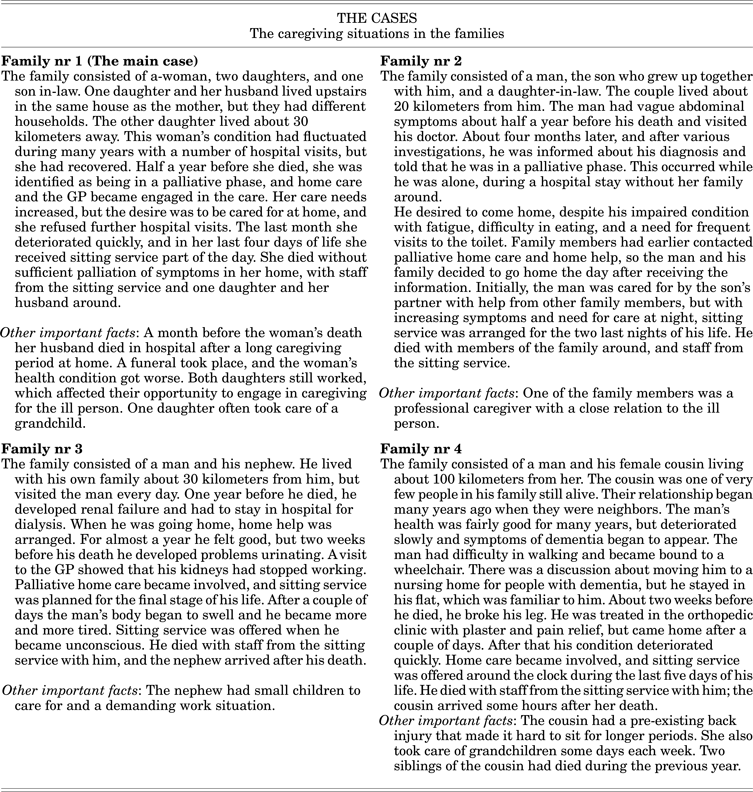
A qualitative case study design was used to describe and gain understanding of multiple realities of family caregiving situations experienced by different individuals in families (Stake, Reference Stake1995). In this study, the cases will be defined as consisting of four families, i.e., the deceased individuals and their family members (Table 1). Each family is an integrated and bounded system, which offers an opportunity to understand each family, but also to gain a general understanding of family members' caregiving situations in context. The variety of these situations increases the learning opportunities about family caregiving situations. Our choice was to focus on one of the family caregiving situations more thoroughly than the others (described as the main case), related to a caregiving situation with high complexity, uniqueness, and particularity (Stake, Reference Stake1995). Stake (Reference Stake1995) describes this type of case study as a collective (instrumental) case study.
The case consisting of four family caregiving situations, where relatives care for a dying family member in the private home and sitting service is received in the final stage of life

Procedure
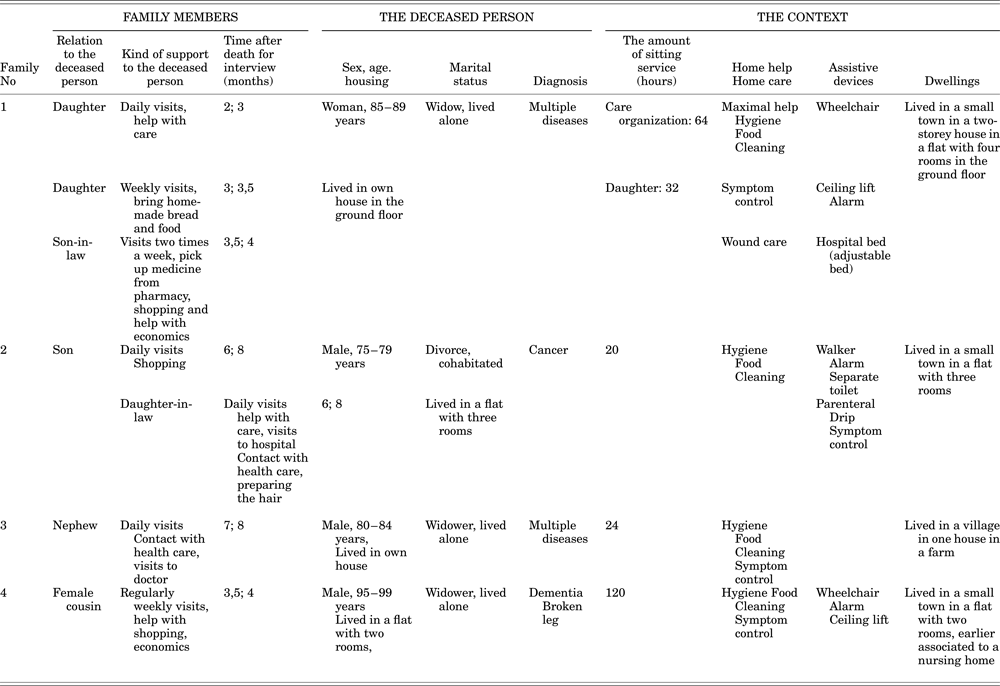
The inclusion criteria were: a family member who had been involved in caring for a dying family member who also received sitting service in the private home (Table 2). Two different municipalities in the south of Sweden with sitting service organizations were contacted during 2010. A letter with information about and a request to assist in the study was sent to managers of health care centers in one municipality, and to the director of social services in the other. Responsible registered nurses for the sitting service organizations and the head nurses for community care were then informed, and asked to identify corresponding family members. In one of the municipalities, five, and in the other municipality, 13 family members were found, to whom invitations to participate in the study were sent by the first author (BW), who also contacted them by phone. In the first municipality, all family members declined participation, but in the second municipality, seven family members in four different families agreed to participate in the study.
Overview of the four families; demographic data for family members, their support to the deceased person, time after death for the interviews; demographic data for the deceased person and the contexts: the residences, the amount of sitting service, kind of home help, home care and assistive devices
Context
In a case study design, according to Stake (Reference Stake1995), it is important to describe the context, so as to understand the interactions between the families and their context. In this study, the contexts of palliative care, home care, and home help are integrated (Table 2). Palliative care can be seen as an umbrella concept focusing on quality-of-life for people with a life-threatening illness and their families by relieving suffering in physical, psychosocial, and existential areas. The care responsibility also includes the family, both during and after the care process (WHO, 2002).
In all cases, home care was involved, which in Sweden entails health care interventions during a longer time in the individual's home, given by registered professionals, as well as other delegated staff. Home care should be offered to people around the clock, irrespective of diagnosis, including those in need of palliative care (SOU, 2011:55). In the municipality in this study, home care was offered to patients who were living in private homes and enrolled as home care patients.
The ill people also used home help to varying degrees (Table 2). Home help involves help with personal care such as personal hygiene, meals, dressing, and moving around, and services such as shopping, laundry, and cleaning (SFS, 2001, p. 453).
In the municipality in this study, sitting service was offered to the dying person and the family around the clock in the private home. Enrolled nurses who had reported an interest in working in palliative care had received special education in palliative care. When there was a need for sitting service, the enrolled nurses were released from their ordinary duties to help the dying person and the family during the final phase, with personal care and support. The enrolled nurses could call for the registered nurse responsible for the particular geographic area in the municipality to get support for complex issues, such as symptom management. Two registered nurses responsible for organizing sitting services were available to give special counseling and support when needed.
Data Collection
Two interviews were conducted with each family member (Table 2). Each interview, recorded on an MP3 player, lasted from one to one and a half hours. At the first interview, the family member was asked to explain why the home became the care place, and to talk about the care situation and the sitting service. According to Stake (Reference Stake1995), those questions could be called topical questions, necessary for describing each family. At the second interview, the respondents were asked to reflect about the care process, including responsibility, decisions, support, and participation. In both interviews issue-oriented questions were asked based on what the interviewee said, to get explanations, linkages, and descriptions of episodes (Stake, Reference Stake1995). Data was also obtained from spontaneous observations in connection to the interviews, which were written down shortly after the interview. The findings are mainly based on the repeated interviews.
The study was approved by a Regional Ethics Committee (Dnr 2010/228).
Data Analysis
Data for analysis deal with phenomena in caregiving situations in four families. According to Stake (Reference Stake1995), direct interpretation and categorical aggregation are two strategies to analyze data in a case study. The aim is to find new meanings in data and to give the possibility of drawing conclusions, so-called naturalistic generalizations about the case. This means that interpretation is mainly based on experiences, and the interpretation takes place in the reader. Direct interpretation is an intuitive process to “draw important meanings even from single instances” (Stake, Reference Stake1995, p. 170). The process is based on the question What does that mean? Categorical aggregation is “aggregation of instances until something can be said about them as a group” (Stake, Reference Stake1995, p. 74). In order to find the meaning in situations, it is necessary to find patterns and a correspondence between the patterns (Stake, Reference Stake1995).
The interviews were transcribed verbatim and read several times to get a sense of the whole. During both data collection and data analysis, research questions were raised, for example; What happened in the family during the caregiving time? In which situations were you asking for help? What were your expectations and outcomes? What does it mean that the private home is the care place? Relevant topics were identified to serve as the focus at the second interview. All text concerning family members' experiences of the sitting service given in the private home was extracted from the interviews to a separate file. These data were sorted into four separate files, one for each family, which were read several times to find similarities and differences between the families. Direct interpretations of the files were then made to find patterns in common, as well as variants of a pattern in episodes, experiences, and events, in order to better understand the case (Stake Reference Stake1995). From the four text files, statements concerning interactions between individuals were put together in two separate files, one for the complex caregiver situation (the main case) and one for the others. This was done to find meanings in caregiving situations. The whole procedure was a process of reading, thinking, and going back to the data again several times. This analysis resulted in isolating three themes and nine patterns.
During the data collection and analysis, the authors read and validated the texts and the steps in the analysis process, and after repeated discussions, a consensus among the authors was reached concerning the result.
RESULTS
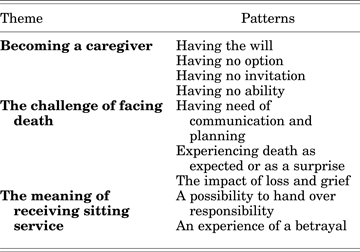
Three themes and nine patterns emerged from the data (Table 3). The quotations used in the result are representative of the person's relationship to the deceased and membership of a particular family.
The Result Presented in Themes and Patterns Describing Multiple Realities in Family Caregiving Situations at the End of Life
Becoming a Caregiver
Having the Will
Family members' willingness to become family caregivers was strongly related to fulfilling the dying persons' wishes to be cared for in their own homes. This meant offering the dying person care in a familiar environment, focusing on quality-of-life and normality. Their willingness also meant a greater attachment to the dying person, as a result of increasing needs for help. Most family caregivers could not stay with the dying person around the clock, but they found it unacceptable that a family member was in danger of dying alone in their home.
You feel so small when you not are around … I wanted to be there as much as possible, because they (staff) would see that there was somebody who cared about him … Yet I knew that he had it good (Cousin in family number 4).
Having No Option
Becoming a family caregiver at the end-of-life could also be related to having no options. These situations were described as a moral duty to act, although not in a planned way. The situation was described as the dying person ultimately being likely to die alone in the home without the possibility to call for help. Sitting service had been requested, but was not available around the clock because of a lack of health professionals. As a result, one family member began to sit with the dying person during part of the day, and she became unexpectedly both a “non-professional caregiver” and a “non-professional professional caregiver.” In this caregiving situation, she was given a task, which she experienced as having been tricked into taking on, for which she had no training. She was also sitting on two chairs at the same time, compensating for a lack of professionals and being a family member simultaneously. This quote exemplifies what the alternative might have been, if she had not become a caregiver.
I: Had they gone to the hospital then or …? What are your thoughts?
R: Yes, it had almost been necessary … I mean, you do not leave a dying woman … I hope not to do it anyway … with all the anxiety that may arise from time to time.
I: And then when you knew she wanted to be at home …
R: Yes, exactly (Son-in-law in family number 1, main case).
Having No Invitation
Another caregiving situation, also related to a lack of professionals in sitting service, can be characterized as not having been invited. There was a need in the family to succeed one another to sit with the dying person, but one family member was not invited to participate in this task. This person had reasons not to participate, but would have done so, if he had been asked. Instead, he created time and space for the engaged family caregiver, by doing shopping, taking care of washing and laundry, and just listening to the other family members.
Having No Ability
Sometimes, family members want to become family caregivers, but are not able to assume the task.
Fear of the process of dying and death can make a family member unable to care for a dying person alone. This is exemplified by a caregiving situation in which a family member who had never seen a dead person was afraid of what the memory would be of such an experience. One professional responded to this fear and uncertainty with the comment that “one can handle more (responsibility) than one imagines.” In that statement, the family member experienced no respect and understanding for her feelings, but rather, a requirement to be able. Further, the family member felt that she did not fit the template for the way family members should be and behave in end-of-life care. Thus, she refrained from becoming a family caregiver because of a risk of having to do things she did not want, or was not able to do. The experience meant that she became a remote observer of the dying process, because she did not dare to visit the dying person any more during her last time of life. The treatment resulted in a frightened-away family member who felt as if she was never in the right place and had no opportunity to relax. It also engendered feelings of guilt and frustration for not being with the dying person, for not supporting the family in caregiving, for being a burden and not a resource in the family. In this situation, she was abandoned by professionals and family members.
The Challenge of Facing Death
Having Need of Communication and Planning
How families experienced death was related to the way communication was conducted, both within families and between families and professionals. Another critical factor was the planning for death.
However, communication and planning were performed in different ways in the families. One way was connected with openness in communication about both life and death for many years. This in turn facilitated communication with professionals, and planning about how to act in the final phase.
In these families, information was both given and asked for concerning resources for home-based care. The possibility of getting sitting service in the end was communicated to the ill person and then planned for, as along with other efforts from home care and home help. This behavior increased the level of preparation for death. These family caregivers described dying and death as a calm, non-dramatic, controlled, and dignified event. They also experienced satisfaction with the process, with what they had done for the deceased person, and with the private home really becoming the place of death.
Other caregiving situations were characterized by difficulties talking about death, related to the ill person's denial of the dependence on help from health care personnel and family. Thus, no communication or planning was performed concerning home-based care to the end or any limitations in resources or inabilities within the family. There were just assumptions related to earlier experiences, regarding what the family needed and what resources could be offered. This resulted in a dying process without preparation for family and professionals. The final phase was to a high degree characterized by chaos, including contradictory information, unsatisfying symptom control, and demands instead of support. For the family, these caregiving situations were experiences of vulnerability and loneliness, expressed as frustration, anger, and uncertainty about how to behave and act. The last hours in the dying person's life were hard to forget and face for the family caregivers.
Before we might have been game pieces and could be a little more … But finally we were just leaves that flew there between all claims and all thoughts. We had the absolute worst conditions the last days of our mother's life, because we were like … We were not even leaves, we just … I do not know (Daughter in family number 1, the main case
Experiencing Death as Expected or As a Surprise
The illness trajectory was related to family caregivers' experiences of dying and death. In most families, the illness trajectory was predictable, with an obvious deterioration leading to death. This predictability affected caregiving situations in a positive way, due to the possibility for family members to be prepared and to be with the dying person when death came. With a not predictable illness trajectory, related to multiple diseases and repeated deterioration over many years, it was hard to know for all those involved, when death really was imminent. These circumstances increased uncertainty and insecurity for the family members. They had to continually adapt to an imminent death, as well as to realize that death did not come that time, and life must go on. So when the final moment really came for the ill person, it was hard to believe and came as a surprise to family. They had experienced the switches between death and life many times, so in one way they were really prepared, but in another not at all. For professionals, too, it could be hard to judge the severity of the clinical symptoms in such an illness trajectory and to quickly adapt treatment, efforts, and resources to the situation.
The Impact of Loss and Grief
In facing death, family caregivers' management of loss and grief are important. When two members of the same family died one month apart, and a funeral also had to be conducted during that month, it was hard for family caregivers to really understand and manage what was happening, both practically and emotionally. The caregiving situation, when the second family member was going to die, could be characterized by her great need of attention and help. The family caregivers were still affected by the first death, with distracted minds and mental fatigue. They wanted to mourn the deceased family member, but there was no time and space for that. All this together affected the possibility for them to prepare for death number two.
The Meaning of Receiving Sitting Service
A Possibility to Hand over Responsibility
Sitting service is intended to support family members and give respite in end-of-life care. Most family caregivers' situations were facilitated by the possibility to hand over responsibility to professionals in sitting services. Some family members still stayed with the dying person. If they had to leave for rest or sleep, they knew that the dying person never had to be alone and was treated with dignity by skilled professionals. They themselves were also supported during the dying process by these professionals. Thus, this service created safety and security, both for themselves and for the dying person. With help from the sitting service, family caregivers also fulfilled the dying person's wish to remain in the private home until death.
It felt great. [The staff of the sitting service] were very gentle and the chemistry [between staff and family] worked. It was positive; I have nothing else to say. They knew what they were doing … Then we went home at 11 o'clock in the evening, and at 1 o'clock … my brother called: “Well, now it is time!” (Son in family number 2).
An Experience of Betrayal
Sitting service could also be experienced as non-supportive, which resulted in increased responsibility, experienced as a betrayal. These caregiving situations were characterized by expectations in the family of help from sitting services in the same manner as they had received before, that is, around the clock. At that time there were no requirements that family caregivers had to be engaged in sitting service. However, this time they did not get the help they needed, because there were no professionals available around the clock in the sitting service organization. Instead, the family had to take responsibility for the situation, when, in reality, they needed to hand over responsibility. The situations were characterized as “demands” on the family caregivers to stay with and not leave the dying person, because “the system” must work. However, the “system” instead had betrayed the family, because in their opinion, no family member should have to sit with a dying person alone, without any professional backup. Further, their own needs as family caregivers were not recognized and met sufficiently, and they were left alone and abandoned in stressful situations, without support from professionals.
DISCUSSION
The main results from the study concerned the understanding of family members' multiple realities related to caregiving, preparedness for death, and the significance of support. The results show some important patterns, but do not claim to give a complete picture of family members' caregiving situations.
Understanding Multiple Realities
It is important to understand that experiences and needs in dying and death in a family are built on multiple realities. Stake (Reference Stake1995) describes multiple realities as variations in views of what happens — sometimes contradictory views. Maturana (Reference Maturana1988), a Chilean biologist, describes the acknowledgment of multiple realities as viewing the world as objectivity in parentheses (objectivity), meaning there is no objective truth about the appearance of the caregiving situation. According to Stake (Reference Stake1995), reality is constructed of external stimulation, interpretation, and integrated interpretation, and knowledge is constructed rather than discovered. Daaleman et al. (Reference Daaleman, Usher and Williams2008, p. 408) define co-creation in health care as a “mutual and a fluid activity between patient, family members and caregivers.” Meiers and Brauer (Reference Meiers and Brauer2008) argue that nurses' understanding of perspectives other than their own is built on interaction and co-creation between nurses and the families. In this study, we detected both similarities and differences in family members' experiences of various phenomena in the caregiving situations, something which gives a nuanced picture of a complex situation. Without this understanding it is hard to give adequate and individual help and support to family caregivers (Hudson, Reference Hudson2003b; Harding & Higginson, Reference Harding and Higginson2001).
Family Members' Involvement in Caregiving
It seems that it is not always willingness that determines the involvement in family caregiving in palliative home care. However, having no option and no ability, as described in our study, seemed to increase the vulnerability for already vulnerable individuals, such as family caregivers. Sellman (Reference Sellman2005) has described ordinary and extraordinary vulnerability related to different risk factors, to the ability to be protected against harm, and to sensibility. In this study, there were examples of both protection against harm through receiving sitting service (avoiding fatigue in family caregivers), as well as no protection at all, despite an increased sensibility. Being vulnerable, and in that way unsafe, may also affect the possibility of keeping the private home as a safe base, important for caregiving at the end-of-life (Milberg et al., Reference Milberg, Wåhlberg and Jakobsson2012). Other situations of vulnerability were described as experiences of being in a trap, of having feelings of guilt, and of taking responsibility for something you are not trained for. Several studies point to family members being expected to take caregiving responsibility
(Armes & Addington-Hall, Reference Armes and Addington-Hall2003; Wennman-Larsen & Tishelman, Reference Wennman-Larsen and Tishelman2002; Brobäck & Berterö, Reference Brobäck and Berterö2003). One way to decrease vulnerability is to assess the resources and competence in relation to the responsibility the person is expected to assume (Maeckelberghe, Reference Maeckelberghe2004). However, family members' experiences of caregiving and their degree of vulnerability must be different, depending on whether it is a self-selected position or an imposed task. In an effort to cope with the responsibility, there is a risk that family caregivers deny their own needs, which can affect their wellbeing after the dying process (EAPC, 2010) and further increase their vulnerability (Sellman, Reference Sellman2005).
Preparedness for Death
In several studies, family caregivers lacking preparedness for caregiving in end-of-life situations is the focus (Brereton & Nolan, Reference Brereton and Nolan2000; Wennman-Larsen & Tishelman, Reference Wennman-Larsen and Tishelman2002; Burridge et al., Reference Burridge, Winch and Clavarino2007). In this study some family members had not been together with a dying person before the described caregiving situations. Lacking preparedness has a connection with caregivers' fear, stress, and feelings of insufficiency (Oldham & Kristjanson, Reference Oldham and Kristjanson2004). Families, facing faster, but more predictable illness trajectories seemed to be more prepared for death than the family facing a long but very unpredictable illness trajectory. Predictive difficulties concerning disease, dying, and death are found in other studies (WHO, 2004; Ek, Reference Ek2010). These circumstances indicate the importance of planning for the end to avoid complexities in caregiving situations (Curtis Reference Curtis2008) and supporting family caregivers in facing death.
One crucial way to prepare for death is through communication. The result showed that meetings between relatives and professionals were arranged earlier in the illness trajectory, but not near the end. A continuous communication between all involved had detected expectations, abilities, concerns, fears, and wishes, and needs of support in this family. In addition, other family caregiver situations were characterized by an ongoing communication all the time until death. Considine and Miller (Reference Considine and Miller2010) have described a dialectical tension in communication between staff and caregivers, related to being a leader or a follower, and who is regarded as expert in the situation. This reflects the need to regard relatives as important, with specific knowledge in caregiving situations, and the need for cooperation between relatives and staff. Another study has reported that caregivers to dying persons did not discuss questions with professionals, if they felt overwhelmed, or if they did not trust professionals, despite a need for information (Herbert et al., Reference Herbert, Schulz and Copeland2008).
The malfunction in the sitting service organization that occurred for one family could be just an unfortunate coincidence. The family's needs occurred at “the wrong time,” because when death finally was coming, professionals for the sitting service were not available to the necessary extent.
The malfunction might also be an indicator for preparedness in the organization to meet needs for support around the clock and all days of the year. However, it can be questioned whether an organization can be prepared for all eventualities, related to, for example, financial frames. The big question is to what degree palliative care and sitting service were prioritized in the municipality.
Wolkowski et al. (Reference Wolkowski, Carr and Clarke2010) have reported ambivalence toward providing respite care, where sitting service is a part. The reason was a lack of consensus concerning the aim for the service, that is, who would benefit from this service, the ill person or the caregiver, and which organization should take responsibility for providing this service.
The Significance of Support
The families in the case study were more or less supported by the sitting service at the end-of-life.
Many of the family members were satisfied with the help for themselves and for the dying person, but some were not. They did not get the help they expected, wanted, and needed, so for them, the total experience of the sitting service was non-supportive. Non-supportive interactions have been described in other studies (Neufeld et al., Reference Neufeld, Harrison and Hughes2007; Neufeld & Kushner, Reference Neufeld and Kushner2009; Rempel et al., Reference Rempel, Neufeld and Kushner2007) as negative, ineffective interactions, as well as a lack of expected support (Neufeld et al., Reference Neufeld, Harrison and Hughes2007).
This study has described different experiences of facing death with and without support. In some families, family members' experiences of end-of-life care contributed to an increased sense of togetherness during the dying process. In other families, another, different feeling of togetherness than experienced before grew up. Carlander (Reference Carlander2011) has found that one way for family caregivers to cope with daily life is to seek togetherness with others with similar experiences.
STRENGTHS AND LIMITATIONS OF THE STUDY
We have used the methodology of qualitative case study to capture family caregiving situations at the end-of-life. A qualitative case study is an in-depth investigation of a single entity, or several entities, aiming to study a phenomenon (Stake, Reference Stake1995). The advantages of this methodology are the possibility to get a depth of data, despite a limited number of participants. The disadvantages are that the method is time-consuming and is a poor base for generalization. However, Stake (Reference Stake1995) argues that “the real business of case study is particularization, not generalization” (p. 8), and the emphasis is on understanding the uniqueness of the case.
One limitation of the study is that the participants came from one municipality only, and therefore the base for the result comes from one care culture and one sitting service organization. If several municipalities or metropolitan areas had been involved in the study, perhaps other variations of family caregiving situations might have been seen. At the same time, despite a small sample, there were differences in diagnoses, sex, living conditions, and family caregivers, which created great variations in caregiving situations, from common to more extreme variants. Specific to this sample is the fact that it describes older people dying in their own homes with family members around but not living together, described as extended family members (Wright & Leahey, Reference Wright and Leahey2009). The result would probably have been different, if younger families or persons living together with the dying had participated. However, it is increasingly common that older people stay in their own homes until death in Sweden, related to a decreasing number of care places in hospitals and nursing homes (National Board of Health and Welfare, 2010; SALAR, 2008–2009), so there is a need to understand more about caregiving situations for this age group in these contexts.
One strength in this study is the use of repeated interviews, which provided the opportunity to follow family caregivers' mourning, moods, and feelings, and allowed time to talk more about areas that had been hard to deal with during the first interview. The time when the first interview was performed after the family member's death varied from 2 to 7 months. The family caregivers were in varying degrees affected by the caregiving experiences. Some were still stressed during the first interview, something that changed to the next. The second interview situation was therefore characterized by an increased trust, and it seemed easier for the respondent to go to a deeper level in what they told. For some family caregivers participation in the interviews became a kind of debriefing situation, and helped them in some way to come to terms with their experiences. Many of them expressed satisfaction that they had possibility to do something special for the dying person during this time of caregiving (cf Hudson, Reference Hudson2006). The interviewer tried to be as open and empathetic as possible during the interviews, and time was given for expressions of feelings.
CONCLUSION
The dying person's wishes concerning the care and care place were important for family members' engagement in care. In general, family members were willing to participate in caregiving for end-of life care, but subject to their own conditions. However, abilities for caregiving varied among family members, and preparation, experiences of losses and grief, and the illness trajectory were important to their needs of support. Family members' engagement in end-of-life care can be facilitated by supportive efforts such as sitting service during the dying process. However, the support must be based on continuous empathetic communication between family members and professionals, to ensure the support really meets existing needs. Thus, communication is a prerequisite to having an available, economical, and supportive sitting service organization.
Implications for Care
Multiple realities, created in different ways by different individuals, must be considered when discussing conditions to facilitate the caregiving situations for family caregivers. The support and other efforts to help family caregivers must be related to their specific needs, not only to what the care organization can offer as a standard solution. Repeated family meetings can be used to increase communication and plan for the care, and thereby foster the families' preparedness for caregiving.
Nurses can facilitate and promote conversations in and with families about their beliefs and experiences of their current situation (Benzein et al., Reference Benzein, Hagberg and Saveman2008).
ACKNOWLEDGEMENT
We would like to express our gratitude to the Research Section, County Council of Kalmar, Sweden, and to Signe and Olle Engqvists' Foundations, Stockholm, Sweden, for financial support.