Introduction
Nematodes of the genus Rhabdochona Railliet, 1916 are frequent intestinal parasites of freshwater fish (Hirasawa et al., Reference Hirasawa, Urabe and Yuma2004). Although a great number of studies have been carried out on this genus in countries such as Pakistan, Iraq and India (Asmatullah et al., Reference Asmatullah, Bilqees and Kakar2006; Moravec et al., Reference Moravec, Saraiva, Abdullah, Bilal and Rahemo2009), few studies have been conducted in Iran. Four valid Rhabdochona species have been reported in Iranian freshwater fish (mostly Cyprinidea) thus far (Jalali, Reference Jalali1998; Pazooki et al., Reference Pazooki, Masoumian and Jafari2006). These include Rhabdochona hellichi (in Esox lucius, Barbus capito, B. lacerta, B. mursa, Capoeta capoeta gracilis and Chalcalburnus chalcoides), R. sulaki (previously known as R. filamentosa) (in B. brachycephalus and C. c. gracilis), and R. denudata (in Squalius cephalus) along with the most frequently reported species, R. fortunatowi, found in a wide range of host species, including Nemacheilus bergianus, Alburnus filippi, B. capito, B. lacerta, B. mursa, C. c. gracilis, Carassius auratus and Neogobius fluviatilis (Pazooki et al., Reference Pazooki, Masoumian and Jafari2006). Rhabdochona fortunatowi has been reported from C. c. gracilis of the Shiroud River in previous investigations (Roohi, Reference Roohi2004; Maleki, Reference Maleki2006).
Previous studies revealed that sex ratios (female/male ratio or FMR) of dioecious nematodes demonstrate some deviations from a 1:1 ratio and are generally female biased. Several causal mechanisms have been discussed for this female-biased sex ratio, including fecundity-dependent selection and avoidance of inbreeding. However, some exceptionally male-biased sex ratios (mainly in experimental studies) have been reported, too (see Poulin, Reference Poulin1997). Such variations in FMR have been observed to be negatively related to parasite intensity/density. But, the unresolved issue concerns variations in sex ratio. Is the sex ratio constantly in favour of one sex or are there some fluctuations in the parasite population, notably in natural conditions?
Therefore, the present study aimed to consider this issue for a given nematode at different temperatures (June and October) under natural conditions (Shiroud River, Iran). A previous study in the same sampling area (Roohi, Reference Roohi2004) has indicated an increase in the nematode burden of fish hosts with a seasonal decrease in water temperature. This relationship was also reported by Moravec (Reference Moravec1994). In the present study, this relationship between nematode infection and water temperature was taken into account and these objectives were addressed: (1) considering intensity of infection in terms of the size and sex of fish host; (2) seeking evidence confirming the relationship between the intensity of infection and the sex ratio of dioecious nematodes; and (3) investigating R. fortunatowi distribution in the host intestine and variations in FMR in different parts of the intestine considering two different infection levels in June and October. Previous studies have shown that R. hellichi and R. phoxini, two congeneric species closely related to R. fortunatowi, are mainly concentrated in the mid-portion of the host digestive tract (Moravec & Scholz, Reference Moravec and Scholz1995 and Moravec, Reference Moravec1994, respectively). Such a study of intestinal site preference has not been conducted for R. fortunatowi.
Although the background of parasitological studies in Iran goes back nearly 40 years (Pazooki et al., Reference Pazooki, Masoumian and Jafari2006), unfortunately these studies were discrete and insufficient. Therefore, there are considerable gaps in our knowledge of freshwater fish nematodes compared to other parts of the world such as Europe (see Moravec, Reference Moravec1994) and even neighbouring countries (see Asmatullah et al., Reference Asmatullah, Bilqees and Kakar2006; Moravec et al., Reference Moravec, Saraiva, Abdullah, Bilal and Rahemo2009), where more studies have been conducted. This study represents a first step in drawing scientific attention to these gaps in information.
Materials and methods
Collection of fish and parasites
Shiroud River is an important fishery river in western Mazandaran, Iran (Abu, Reference Abu1994). The sampling station (50°45′1.283″E, 36°47′8.516″N) was upstream, where C. c. gracilis was the dominant fish species. This station was selected based on previous observations that infection of C. c. gracilis with R. fortunatowi in this area was higher than in other areas of the river, while infection with other parasite species was lower. Hence, interspecific interactions of R. fortunatowi parasites with other species are probably not important at that site.
In order to study the possible effects of variations in the mean intensity of infection on FMR, specimens of C. c. gracilis were collected during June (lower infection rate) and October 2007 (higher infection rate). These times were selected according to the previous study conducted by Roohi (Reference Roohi2004).
Eighty-one fish were collected by electro-fishing and transferred alive to the Laboratory of Zoology, Department of Animal Biology of the University of Tehran. After killing, fish weight and total length were measured and recorded. The digestive tract was removed and divided into three relatively equal parts. Each segment was examined stereomicroscopically and microscopically and the number and sex of R. fortunatowi in each part was recorded. There were also numerous immature worms, but as the purpose of this study was primarily on FMR, immature worms were ignored. Moreover, adult females were counted regardless of whether or not they contained mature and/or immature eggs.
In order to identify parasite species, some specimens were washed in 6% saline, placed between two slides, and fixed in 4% formalin, stained by carmine-alum for 24 h, washed in acid ethanol, dehydrated in an ascending ethanol series, cleared in xylol and mounted in Canada balsam. Nematodes were identified using Moravec (Reference Moravec1994).
Data analysis
Data were analyzed using SPSS software v. 18 (SPSS Inc., Chicago, Illinois, USA). The prevalence and mean intensity of infection were calculated according to the criteria of Bush et al. (Reference Bush, Lafferty, Lotz and Shostak1997). Changes in prevalence were analyzed using the chi-square test. Based on normality tests (Kolmogorov–Smirnov and Shapiro–Wilk), data did not exhibit a normal distribution, even after log-transformation. Therefore, non-parametric tests were applied in all analyses. Although most fish included both male and female nematodes, some harboured only male or female worms. As variations in FMR across the whole host population were the main case, it was important to include the hosts with only one sex too. So, FMR could not be calculated as the simple ratio of ‘female/male number’. The following formula was applied instead to calculate FMR:

Mean intensities and FMR were compared using the Mann–Whitney or Kruskal–Wallis tests between two or more than two groups, respectively.
Results
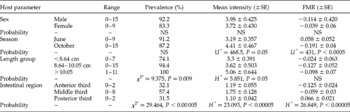
Two-hundred and eighty (119 female and 161 male) R. fortunatowi were collected from 72 infected fish (prevalence = 88.9%). Mean abundance ( ± SE) and mean intensity ( ± SE) were 3.46 ( ± 0.31) and 3.89 ( ± 0.31), respectively. There were no significant differences in the prevalence, mean intensity and FMR between male and female hosts (table 1).
Statistical indices of R. fortunatowi infection among C. c. gracilis in relation to host sex, host length, intestine section and sampling time along with FMR variations.

χ2* = Chi-square test; U * = Mann–Whitney U test; H * = Kruskal–Wallis test; FMR, female/male ratio; NS, not statistically significant.
However, host length group comparisons revealed the prevalence and mean intensity of parasites to be significantly higher in larger fish (table 1), although FMR did not vary significantly among fish of different sizes. Further analyses revealed that the mean intensity of infection in large fish (>10.05 cm) was higher than in medium (8.64–10.05 cm) (Mann–Whitney U = 192.5, P = 0.027) and small ( < 8.64 cm) (Mann–Whitney U = 110, P = 0.038) fish. Furthermore, host body size (log-transformed) and FMR were negatively correlated (r = 0.268, P = 0.016).
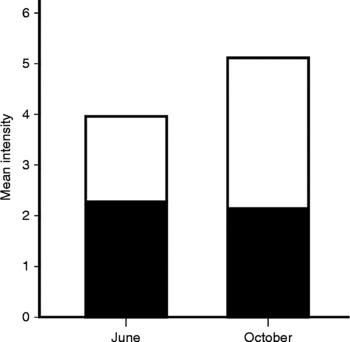
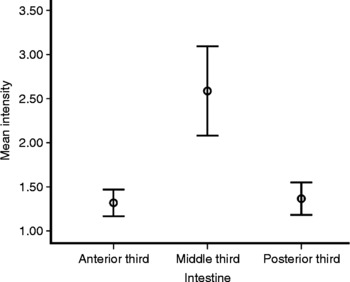
Mean intensity of infection was higher in October fish, but accompanied by a decrease in FMR (fig. 1). Apart from prevalence, significant differences were acquired comparing intensity and FMR of nematodes in the three sections of the intestine (table 1 and fig. 2).
Mean intensity of male (white) and female (black) R. fortunatowi in two host samples from June and October 2007.

Mean intensity (95% CI) of infection to R. fortunatowi in the anterior, middle and posterior thirds of the host intestine.

More parasites were observed in the middle third of the intestine in comparison with the anterior (Mann–Whitney U = 771, P < 0.0005) and posterior (Mann–Whitney U = 1102, P = 0.007) thirds. However, no significant difference in the mean intensity of infection was observed between the anterior and posterior thirds (fig. 2). Variations in FMR in different parts of the intestine were examined with respect to sampling time and nematode sex. Significant male-biased change in the anterior and female-biased change in the middle parts of intestine from June to October were observed. However, the female-biased condition in the posterior part was not statistically significant (table 2). In summary, a male-biased change in sex ratio from June fish, with lower parasite density, to October fish, with higher parasite density, was recorded (tables 1 and 2). In other words, the female-biased sex ratio (approximately 7:5) in June fish changed to a male-biased one (approximately 1:2) in October fish.
FMR (sex ratio) of R. fortunatowi in C. c. gracilis intestine from June and October samples.

U * = Mann–Whitney U test; NS, not statistically significant.
Discussion
The prevalence and mean intensity of infection in larger fish was higher than in smaller ones. There is no doubt that host body size can be a determining factor in parasite burden. Larger fish provide a greater area available to parasites (Moravec & Scholz, Reference Moravec and Scholz1995; Sharples & Evans, Reference Sharples and Evans1995; Poulin, Reference Poulin1998, Reference Poulin1999). Furthermore, if infection is regarded as a random process, then the older and, thus, bigger fish will be expected to accumulate more parasites as they forage more than smaller ones and acquire more trophically transmitted parasites (Poulin, Reference Poulin2000). More interestingly, there was a negative relationship between host body size and FMR, i.e. larger fish were infected with noticeably more male worms than female ones. One possibility is that factors like rapid ageing of female nematodes and increased longevity of males may contribute to the higher occurrence of male nematodes in the larger host fish (McCulloch & Gems, Reference McCulloch and Gems2003). From another point of view, such a negative relationship may be the indirect result of increases in parasite burden.
The mean intensity of R. fortunatowi was lower in June samples compared to the October ones, and June samples presented higher FMR than the October ones. Such increases in the parasite burden have been reported previously to be related to changes in water temperature. As water temperature decreases during autumn and winter, the nematode's intermediate hosts (mayfly nymphs) become increasingly available and thus accelerate the rate of transmission to the definite fish host (Burgmer et al., Reference Burgmer, Pfenninger and Hillebrand2007). Šimková et al. (Reference Šimková, Jarkovský, Koubková, Baruš and Prokeš2005) suggested that in some cases, especially in dioecious nematodes infecting freshwater fish, environmental factors such as water temperature and availability of the intermediate hosts are the primary factors regulating parasite reproductive cycles. Such an increase in R. fortunatowi burden during autumn and then further during winter was also recorded by Roohi (Reference Roohi2004) in the same fish host. But what about the decrease in the FMR from June to October? As noted above in terms of host body size, such a negative relationship may be the indirect result of parasite burden increase.
As Poulin (Reference Poulin1997) stated, the sex ratio in nematodes is usually female-biased. However, some exceptionally male-biased sex ratios, especially with high parasite infections, have also been reported previously. Probably, in order to avoid inbreeding and to increase the chance of mating, as well as enduring selection pressure for size-dependent fecundity at lower intensities, nematode populations are mainly female-biased (Roche & Patrzek, Reference Roche and Patrzek1966). In addition, parasite populations are generally overdispersed (Poulin, Reference Poulin1998), this results in a mating problem in dioecious parasites, particularly at lower infection rates. At higher intensities, more males will be needed to ensure that all females will be able to mate and thus the sex ratio in such nematode populations will be more male-biased (Poulin, Reference Poulin1997).
Poulin (Reference Poulin1999) demonstrated a negative correlation between the body sizes of different intestinal nematode species and their intensity of infection. Thus, we might expect a negative relationship between different sexes of a parasite, with different intrasexual sizes, in relation to infection burden. From another point of view, it is evident that R. fortunatowi individuals, like other living organisms, experience both interspecific and intersexual competition for available resources and space. In the October samples where the mean intensity of infection was significantly higher than in June, small/male R. fortunatowi (9–11.5 mm average length) were more prevalent than large/female worms (14.4–19.8 mm average length). Size-specific resource requirements may be the determining factor. As Poulin (Reference Poulin1999) discussed, intensity-dependent regulation is likely to be more severe in species with greater body size ranges and ‘fewer large-bodied animals can be packed in a given area and resource requirements in general scale positively with body size’. Thus, in this case study, more male R. fortunatowi can be aggregated in the host intestine. In Poulin's (Reference Poulin1999) opinion, large-bodied animals (female worms in this study), tend to be more frequent at lower mean intensities (June fish and fish with smaller body size), primarily because of experiencing weaker intensity-dependent constraints and vice versa. Therefore, according to Poulin (Reference Poulin1997), an increase in the mean intensity of infection favours an increase in the proportion of males in the nematode population. However, it is possible, as Poulin (Reference Poulin1997) has suggested for most nematodes, that the sex ratio in R. fortunatowi populations is generally female-biased but exhibits some density-dependent fluctuations.
Although the actual causes of such biases have not been established yet, Poulin (Reference Poulin1997) noted factors such as an adaptive bias in the primary sex ratio, environmental sex determination and different mortality rates between individuals of the two sexes, as well as population structure as probable factors driving such biases.
Variations in preference for different parts of the host intestine between male and female nematodes were also studied. Intestinal nematodes usually gather in a particular area of the digestive tract (Moravec, Reference Moravec1994). The results of the present study indicated that R. fortunatowi mostly occurred in the middle third of the intestine (table 1 and fig. 2). The changes in numbers of the different sexes of the Rhabdochona along the host digestive tract have not been studied so far, and it is unclear why and how such fluctuations occur. But as noted above, interspecific and intersexual competition, as well as intrasexual competition, occur in every living system and dioecious nematodes are no exception (Moravec, Reference Moravec1994; Poulin, Reference Poulin1999). Furthermore, as Moravec (Reference Moravec1994) stated about R. phoxini, in studied species of this genus, mating occurs in the middle third of the intestine. Most nematodes live in the anterior and middle thirds and after maturation they gradually migrate to the middle third where mating occurs. Gravid females then migrate to the posterior third for oviposition. Mature male and female worms will eventually be expelled from the host intestine. As demonstrated in table 2 and fig. 1, the FMR was male-biased in the anterior part in either June and October fish. However, changes from male-biased in June to female-biased FMR in October took place in the middle part of the intestine. Although the likely causal mechanisms for fluctuations of sex ratio from June to October were discussed above, no investigation has evaluated changes in FMR along different parts of the intestine. It is probable that factors such as intersexual competition, reproductive migration, density-dependent selection and different rate of mortality between male and female worms could drive such variations in FMR. Given the present state of knowledge, the exact mechanisms are not clear.
In conclusion, Poulin (Reference Poulin1997) presented the relationship between parasite burden and sex ratio in dioecious parasites with caution. He stated that although this relationship is clearly evident in experimental studies, there are few supporting findings in natural populations. The results of this study strongly confirmed Poulin's ideas in a natural host–parasite system.
Acknowledgements
We thank Dr Robert Poulin for his valuable comments. We would like to express our gratitude to Dr Allan Pike for critical review of the manuscript. We want to kindly thank the international translation agency ‘Primowords’ for English editing of this paper. We are also grateful to Mr Abbas Kazemi for his great help during sampling and to the Office of Research Affairs of the University of Tehran for providing financial support.