Introduction
Prostate cancer (PC) is the most common solid organ tumour in men and it is the second leading cause of death by cancer in men.Reference Jemal, Bray and Center1 It is usually diagnosed in older people, and is a slow-growing tumour that can co-exist with the patient for several years. At present, more than 90% of patients with PC are diagnosed at localized or locally advanced stage.Reference Siegel, DeSantis and Virgo2 The current treatment options for localized prostate are active surveillance, radiotherapy and radical prostatectomy (RP), depending on the characteristics of the tumour and patient. According to Resnick et al.Reference Resnick, Koyama, Fan, Albertsen, Goodman and Hamilton3 the median life expectancy after treatment for clinically localized PC is 13.8 years. A common complication of RP is male stress urinary incontinence (SUI).
In the last few years, better understanding of the pathophysiology and improvements in surgical technique have decreased the post-operative incontinence rate.Reference Van der Horst, Naumann and Al-Najaar4 The male SUI incidence ranges widely among published series, ranging from 0.8 to 87%, due to the lack of standardization and the use of different definitions (no leakage at all, no pad use but loss of a few drops of urine, one pad per day).Reference Bauer, Bastian, Gozzi and Stief5 The definition more commonly used is ‘social continence’, defined as the use of one pad or less per day, but this degree of incontinence is still unacceptable for the majority of patients. SUI devastates lives and affects every facet of human life: work, home, social, physical, sexual, psychological and medical. SUI markedly impairs the quality of life of those affected, whose desire for social continence is strong.Reference Adamakis, Vasileiou and Constantinides6 In the developed world, SUI imposes large public health and social costs, but it has been shown that any of the available therapeutic options are better than no treatment considering their cost-effectiveness.Reference Payne, Walsh, Retik, Vaughan and Wein7
The artificial urinary sphincter (AUS) is still the gold standard for the surgical treatment of post-prostatectomy urinary incontinence (PPUI) and offers the highest success rate.Reference Kim, Sarmast, Daignault, Faerber, McGuire and Latini8–Reference Bauer, Gozzi and Hübner10 However, over the last decade, there has been revived interest in other procedures as a treatment option for PPUI, including peri-urethral injection of bulking agents, compressive devices and suburethral slings.
A literature review was carried out using Medline database and Cochrane Registered Trials. All articles published in the last decade concerning PPUI surgical treatment options were evaluated.
Pathophyisiology
At present, the precise aetiology of PPUI is not completely understood.Reference Bauer, Bastian, Gozzi and Stief5 We know that there is no single cause and that it is usually the result of the failure of several components, including bladder neck dysfunction, external urethral sphincter damage, sphincteric laxity and bladder dysfunction, which act alone or in synergy. Proper urethral sphincter function depends on an intact urethral urothelium, the proper functioning of smooth and striated muscle, the right location and support of the membranous urethra and an intact pelvic floor.Reference Collado Serra11 RP not only damages the muscle fibres of the urethral sphincter but may also result in neurological injury and ischaemic damage of the neurovascular bundles. According to De Rider et al.,Reference De Ridder and Rehder12 in 90% of cases sphincter damage is implicated but it can also be associated with bladder dysfunction, or both simultaneously. Urinary incontinence due to bladder dysfunction (overactive bladder, poor compliance, underactive detrusor) is uncommon, occurring in less than 10% of cases.Reference Groutz, Blaivas and Chaikin13
Reported risk factors for PPUI include pre-operative factors (such as patient age, stage of disease, prior continence status, body mass index, prostate volume), intra-operative factors (such as surgical technique and surgeon's experience) and post-operative factors (functional urethral length after surgery (minimal length should be >28 mm), surgical complications and prior surgery of the urethra or bladder neck).Reference Catalona, Carvalhal, Mager and Smith14, Reference Eastham, Kattan and Rogers15 However, various studies have come to conflicting conclusions with regard to specific risk factors.
Assessment and diagnosis
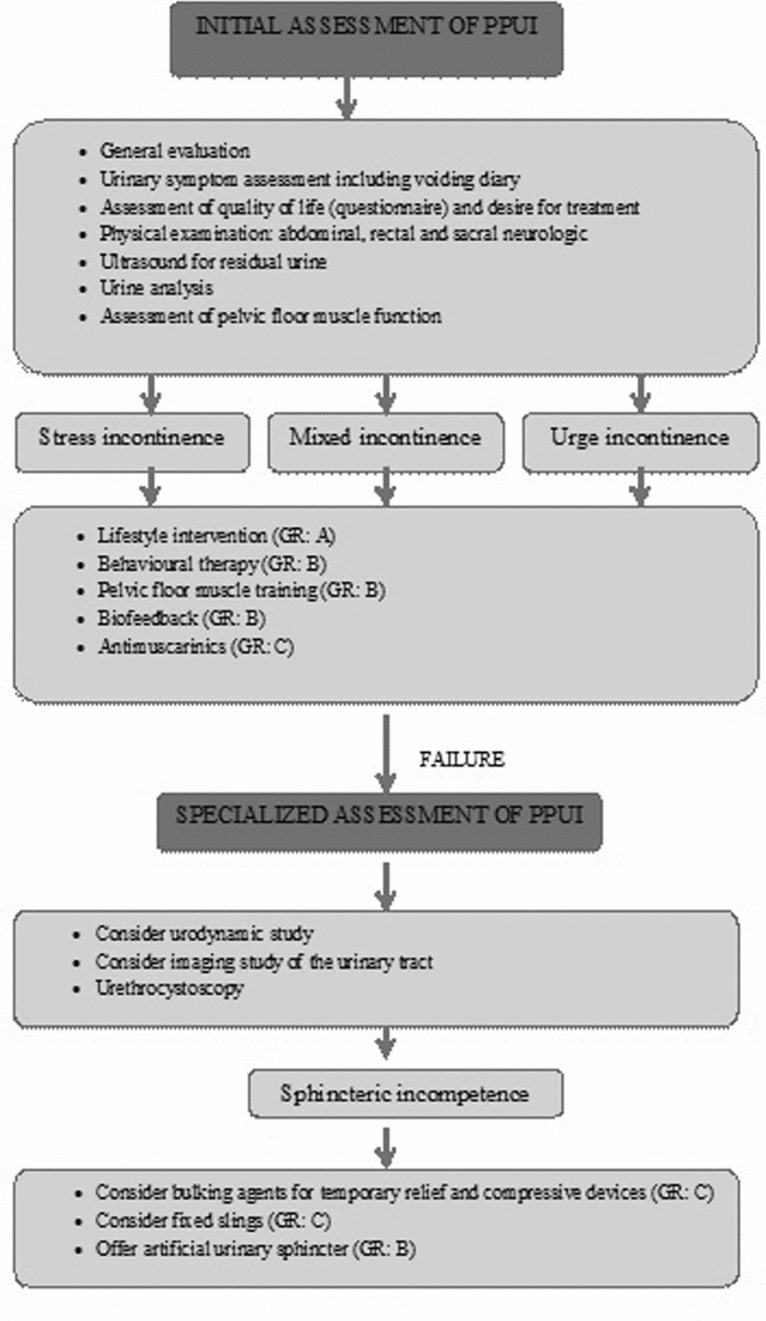
The goal of diagnosis is the correct characterization of SUI, which is essential when choosing the most appropriate therapeutic option. The European Association of Urology (EAU) proposes a two-step assessment for the management of male urinary incontinence (Fig. 1).Reference Thüroff, Abrams and Andersson16
Initial and specialized assessment for male incontinence based on European Association of Urology 2013 guidelines. PPUI, post-prostatectomy urinary incontinence; GR, grade of recommendation.

The first step of assessment includes a medical history, an objective assessment of the symptoms, voiding diary and a physical examination including urine analysis and ultrasound for residual urine. Several questionnaires exist for evaluation of quality of life and the individual's desire for treatment. The International Consultation on Incontinence Questionnaire-Urinary Incontinence Short Form (ICIQ-UI SF) is the most widely used for its brevity and simplicity.Reference Seckiner, Yesilli, Mungan, Aykanat and Akduman17, 18 It is the questionnaire recommended by the EAU with grade or recommendation (GR) A and a level of evidence (LE) 1. It is validated into several languages and is rated from 0 to 21. It is essential to quantify losses of urine to assess the severity of male SUI. The International Continence Society (ICS) recommend determining the grade of SUI by a standardized pad weight test.Reference Abrams, Cardozo and Fall19 The 24-hour pad test is the most accurate for quantification and the most reproducible; however, the 1-hour pad test is the most widely used due to feasibility reasons.Reference Mouritsen, Berild and Hertz20, Reference Sullivan, Swithinbank and Abrams21 The 1-hour pad test grade of SUI is: grade 1, urine loss <10 g; grade 2, urine loss 11–50 g; grade 3, urine loss 51–100 g and grade 4, urine loss >100 g.
The second step of assessment should be adapted to the particular patient and include imaging techniques (cystourethrography, computerized tomography (CT), magnetic resonance imaging (MRI), etc.), urethrocystoscopy and urodynamic study. Flexible urethrocystocopy is useful to verify the integrity of the urethra and sphincter function and to rule out urethral and anastomotic stenosis. Urodynamic study should be performed under strict conditions and according to the ICS recommendations. This provides useful information about bladder dysfunction, such as overactive bladder (OAB), poor compliance, detrusor underactivity and bladder outlet obstruction, which is present in up to 33% of patients.Reference Anger, Raj, Delvecchio and Webster22
Conservative management
Continence may improve significantly during the first year after RP, although some authors claim that it can only be achieved in 2 years.Reference Sacco, Prayer-Galetti and Pinto23 Therefore one should take a conservative attitude during this period before proposing any surgical treatment (Fig. 1).Reference Herschorn, Bruschini and Comiter9–Reference Collado Serra11, Reference Thüroff, Abrams and Andersson16, Reference Lucas, Bosch and Burkhard24 Conservative management of PPUI includes lifestyle interventions (limiting fluid intake, weight loss, caffeine reduction, physical exercise, no smoking), pelvic floor muscle training (PFMT) with or without biofeedback and schedule voiding. In some patients with additional OAB, additional anti-muscarinic pharmacotherapy is recommended.Reference Thüroff, Abrams and Andersson16, Reference Lucas, Bosch and Burkhard24
Supervised PFMT is the most widely recommended non-invasive conservative treatment.Reference Bauer, Gozzi and Hübner10 Pre-operative or immediate post-operative PFMT has shown an earlier return to continence after surgery (GR: B; LE: 2) but this difference is not significant after 12 months of follow-up.Reference Ribeiro, Prota and Gomes25, Reference Hunter, Glazener and Moore26 Neither has it been shown to have increased efficacy when combined with biofeedback (GR: B; LE: 3).Reference Hunter, Glazener and Moore26
Currently, no approved pharmacology therapy for PPUI exists. However, the efficacy of duloxetine (serotonin and noradrenalin re-uptake inhibitor) has been evaluated for use in male SUI. In two randomized controlled trials, a mean reduction of incontinence episodes of 52.2% was achieved after 12 weeks of 80 mg duloxetine.Reference Filocamo, Lo Marzi and Del Popolo27, Reference Cornu, Merlet and Ciofu28 However, some studies show a high prevalence of side-effects (nausea, fatigue, dry mouth, insomnia and constipation), near to 50%, with a rate of withdrawal of 25%.Reference Collado Serra, Rubio-Briones, Puyol Payás, Iborra Juan, Casanova Ramón-Borja and Solsona29 Warning must be given that duloxetine can only be prescribed as an off-label therapy.
In general the efficacy of these procedures is unclear, as the data for the conservative options are much poorer for men than women, weakening the evidence for treatment recommendations in this group.Reference Adamakis, Vasileiou and Constantinides6, Reference Bauer, Gozzi and Hübner10, Reference Thüroff, Abrams and Andersson16, Reference Lucas, Bosch and Burkhard24
Surgical treatment
Surgical treatment is recommended in patients with persistent PPUI after conservative treatment has failed or is incomplete.Reference Thüroff, Abrams and Andersson16, Reference Lucas, Bosch and Burkhard24, Reference Lucas, Bosch and Burkhard30 We currently have a wide range of surgical procedures, among which AUS remains the treatment of choice for this disease, with cure rates near to 90%. Nevertheless, AUS is expensive, requires invasive surgery and the patient must have the mental and physiological ability to handle the sphincter. It also has the risk of surgical revision in 30–50% of patients due to mechanical failure, urethral atrophy, infection and erosion. For this reason, new systems have developed (male slings, urethral bulking agents, ProAct), which are theoretically easier, less invasive and less expensive.
The selection criteria for one device over another is not clear and clinical guidelines only provide general recommendations, so the overall trend is to use the severity of incontinence as a selection criteria. Neither are there guidelines concerning the timing of surgical treatment in the post-operative period. In general, surgical treatment should be offered if the PPUI is stable after one year of conservative management (GR: C; LE: 4).Reference Lucas, Bosch and Burkhard30
For patients with mild or moderate SUI, we usually choose one of the alternatives to AUS, although in some cases these alternatives are also used in severe SUI. Therefore it is very important to take into account factors that increase the risk of complications and are associated with a low success. These are common to all surgical treatment modalities and include prior surgery/radiotherapy, the surgeon's experience, severe SUI and neurological pathology. Therefore, the options should be discussed with the patient, along with the relevant goals and expectations.
Urethral bulking agents
Peri-urethral bulking agents improve continence by increasing urethral wall coaptation. A wide variety of biodegradable and non-biodegradable substances have been used as bulking agents during the last 40 years, such as bovine collagen (Contigen®), Teflon, autologous fat, autologous chondrocytes, dextranomer/hyaluronic acid copolymer (Deflux®), pyrolitic carbon microspheres (Durasphere®) and silicone macroparticles (Macroplastique®) (Fig. 2). In general, published results show a limited effectiveness that decreases with time, so patients usually require several reinjections (GR: C; LE: 3). Definitive cures are rarely achieved and continence rates range from 17 to 73%. Early failure rate is about 50%.Reference Smith, Appell, Rackley and Winters31–Reference Secin, Martínez-Salamanca and Eiber33 The reinjections may induce inflammatory reactions resulting in an impairment of urethral elasticity and can cause a frozen urethra. Although evidence-based data concerning bulking agents for the treatment of male SUI are lacking, clinical EAU guidelines suggest trying this procedure if you want to achieve a temporary improvement (Fig. 1).Reference Lucas, Bosch and Burkhard30
Non-biodegradable bulking agent: silicone macroparticles (Macroplastique®); courtesy of Palex, Inc.
Stem cell therapy
Initial results obtained by Mitterberger et al. in 2008 with peri-urethral injection of autologous myoblast/fibroblast at the striated sphincter in 63 patients with PPUI were very promising.Reference Mitterberger, Marksteiner and Margreiter34 They reported a continence rate of 65% and improvement for an additional 27% of patients without any complication. However, doubts about these results were raised shortly afterwards and other groups have not been able to reproduce the same results. At the moment, stem cell therapy for the treatment of PPUI cannot be recommended, although further studies are necessary for proper evaluation.
Adjustable balloons – ProAct
Adjustable balloons are compression devices, introduced in 2000, that consist of two adjustable silicone balloons, which are placed peri-urethrally at the level of the bladder neck (GR: D, LE: 3). The implantation is performed through a perineal incision via fluoroscopy or endoscopy or guided by transrectal ultrasound monitoring (Fig. 3).Reference Hubner and Schlarp35, Reference Gregori, Romano and Scieri36 This system enables adjustment through scrotum titanium ports that allows progressive injection of isotonic saline up to 8 ml. Elevation and compression of the bladder neck and the membranous urethra is the functional concept of the ProAct®. Continence rates in published studies range from 30 to 67%, with an average of adjustments between three and five times (maximum nine).Reference Hubner and Schlarp35–Reference Alcaide, Alvarez Maestro and Martín Hernández37 Complications (3–58%) included bladder or urethral perforation (in less than 20%), infection (8%), migration (8%) (Fig. 4) and balloon failure (3%) that required device removal in up to 58% of relevant patients. It seems that implants placed by ultrasound guide have fewer complications; Gregori et al. Reference Gregori, Romano and Scieri36 reported that only 8% have had to be removed. Risk factors associated with complications were prior external beam radiotherapy and the surgeon's experience.Reference Herschorn, Bruschini and Comiter9, Reference Bauer, Gozzi and Hübner10, Reference Hubner and Schlarp35
Adjustable balloon PROACT®; courtesy of Uromedica, Inc. www.uromedica-inc.com.
Cystography in which down migration of the right balloon is observed.
Male slings
The first male slings were introduced in the early 1970s by Kaufman and later by Schaeffer et al., but they did not gain favour due to the low success and high complication rates.Reference Kaufmann38, Reference Schaeffer, Clemens, Ferrari and Stamey39 Over the last decade, there has been revived interest in suburethral slings as a treatment option for PPUI and they have emerged as preferred management for many patients (GR: C; LE: 3).Reference Welk and Herschorn40, Reference Comiter41 The mechanism of action is based on the principle of passive, semicircumferential urethral compression or proximal reposition of bulbar urethra.
The slings are generally used in patients with mild to moderate SUI and are not recommended in those with a history of previous surgery or radiotherapy. Many modifications of the procedure have been described, involving the use of different materials for the sling as well as different surgical approaches, positions for the sling and methods for placing it. They can be classified as adjustable (Argus®, Remeex® and Atoms®) and non-adjustable (Invance®, Advance®, Virtue® and I-STOP TOMS®).
Adjustable male slings
Argus
The Argus® system (Promedon, Cordoba, Argentina) was designed by Romano in 2003 and consists of a silicone foam booster, ribbed silicone struts and adjustable tensioning washers (Fig. 5).Reference Moreno Sierra, Romano, Galante Romo, Barrera Ortega, Salinas Casado and Silmi Moyano42 It can be implanted through a retropubic or a transobturator approach. The sling tension is set to a retrograde leak-point pressure of 45 cmH2O, or 37 cmH2O, which has been associated with significantly less erosion, pain and urinary retention.Reference Bochove-Overgaauw and Schrier43–Reference Hubner, Gallistl, Rutkowski and Huber45 The reported dry rates range from 17 to 79% and readjustments are needed in up to 38% of patients (1–4 adjustments).Reference Bochove-Overgaauw and Schrier43–Reference Dalpiaz, Knopf, Orth, Griese, Aboulsorour and Truss47 Intra-operative bladder perforation was reported in 5–6% of cases and was solved by reinserting the needle. Transient perineal pain (9–15%) and acute urinary retention (AUR) (16%) were the most common post-operative complications. Removal of the sling was required in up to 35% of patients due to complications, such as persistent perineal pain, infection, urethral erosion and breakage or migration of the column.Reference Dalpiaz, Knopf, Orth, Griese, Aboulsorour and Truss47
Adjustable sling Argus®; courtesy of Promedon, Inc.
Remeex
The Remeex® sling (Neomedic Inc., Terrasa, Spain) was originally designed for female SUI and Sousa-Escandon et al. introduced it in 2003 for the treatment of PPUI.Reference Moreno Sierra, Galante Romo and Pérez Romero48, Reference Sousa-Escandon, Rodríguez, Uribarri and Marques-Queimadelos49 It is composed of a monofilament polypropylene mesh bulbar urethral sling connected via two monofilaments traction threads to a suprapubic mechanical regulator (Fig. 6). Adjustment is possible via an external manipulator. There was a 64–83% cure rate, although most patients need at least one readjustment at 1–4 months to achieve such results.Reference Sousa-Escandon, Rodríguez, Uribarri and Marques-Queimadelos49–Reference Sousa-Escandón, Cabrera and Mantovani52 In a multicentre European study of 51 patients with a mean follow-up period of 32 months, 64.7% were cured and 20% were improved.Reference Sousa-Escandón, Cabrera and Mantovani52 Reported complications are similar to the Argus system, with a 50% rate of transient perineal discomfort, 11% rate of bladder perforation and 11% rate of removal of the device due to erosion or infection.
Adjustable sling Remeex®. An external manipulator inserted into the varitensor allows adjustment; courtesy of Neomedic, Inc.
Atoms
Atoms is an emerging adjustable transobturator male system (ATOMS) (A.M.I., Vienna, Austria) designed by Bauer et al.Reference Bauer and Brössner53 in 2008, which consists of a mesh implant with an integrated adjustable cushion, protection sheet and titanium port for adjustment of cushion volume. The silicon cushion is located in the middle of the mesh tape and filled via the port during and after operation (Fig. 7). Published data on the efficacy and complications of Atoms are scarcer than Remeex, with few patients and short follow-up. The success rate (dry patients) published by Seweryn et al.Reference Seweryn, Bauer, Ponholzer and Schramek54 in a series of 38 patients with mild–severe SUI (including radiated cases with previous surgery) was 60.5 and 23.7% improved, with a median follow-up of 16.9 months. The mean number of adjustments during follow-up was 3.97 (range 0–9). In a recent multicentre study of 99 patients, the overall success rate was 92%; 63% were considered dry and 29% were improved.Reference Hoda, Primus, Fischereder, Von Heyden, Mohammed and Schmid55 The most frequent complications were perineal pain and dysaesthesia (52.6%), which spontaneously resolved within 3 months, whilst 10.5% of patients had to remove the device for port infection after adjustment or urethral erosion (one patient).
ATOMS® Implant, silicon cushion is located in middle of tape and is filled through the titanium port located at suprapubic region; courtesy of A.M.I., Inc.
Non-adjustable male slings
Invance
Several large prospective studies have demonstrated sustained efficacy of the Invance (American Medical Systems, Minnetonka, MN, USA) sling with 3–5 years of follow-up. This device, designed by Madjar et al.Reference Madjar, Jacoby and Gilberti56 in 2001, uses a silicon-coated polypropylene mesh positioned under the bulbar urethra via a perineal incision. It is attached to both ischiopubic rami by three titanium screws (Fig. 8). It is the sling with the most available data, as there are studies with over 4 years of follow-up. The published cure rates range from 37 to 88%.Reference Madjar, Jacoby and Gilberti56–Reference Carmel, Hage and Hanna61 Giberti et al. reported a 70% success rate at a median follow-up of 41 months. The failure rates are higher in men who have undergone radiotherapy.Reference Giberti, Gallo, Schenone and Cortese58, Reference Guimaraes, Oliveira, Pinto, Soares, Maia and Botelho59 Many of these case series have poorly defined inclusion and exclusion criteria, which makes the application of their clinical results difficult.Reference Herschorn, Bruschini and Comiter9, Reference Welk and Herschorn40 Published studies show no significant intra-operative complications, with the most frequent side-effect being perineal pain (76%). As with other slings, this limits itself without treatment. In 3% of patients, the removal of the device was necessary for intractable pain. Other reported complications include AUR (up to 12%), the need for removal due to infection (up to 15%), and bone-anchor dislodgement (up to 5%).Reference Giberti, Gallo, Schenone and Cortese58–Reference Carmel, Hage and Hanna61 It should be noted that this device ceased production in 2012.
The bone Anchored InVance® sling (left) (courtesy of American Medical Systems, Inc). The mesh is fixed to both ischiopubic rami by titanium screws (right) (with permission of Dr Collado Serra).
AdVance XP
This device (American Medical Systems, Minnetonka, MN, USA) was first described by Rehder and Gozzi in 2005.Reference Rehder and Gozzi62 It is an innovative sling that adjusts the changed anatomy after radical prostatectomy by repositioning the lax and descended supporting structures of the posterior urethra and sphincter region to the former preoperative position.Reference De Ridder and Rehder12, Reference Rehder and Gozzi62 It is very important that, before placing the sling, a good mobility of the sphincter region and a good residual function of the sphincter with a coaptive zone of >1 cm should be confirmed by cystoscopy.Reference Rehder, Freiin von Gleissenthal, Pichler and Glodny63 The mesh is passed ‘outside-in’ through the obturator foramen, similar to the sling transobturator tape (TOT) in women (Fig. 9). The reported dry rates in larger studies with at least 1-year of follow-up ranges from 51 to 91%.Reference Bauer, Soljanik, Fülhase, Karl, Becker and Stief64–Reference Bauer, Mayer, May, Gratzke, Burchner and Soljanik70 However, in patients with adjuvant radiotherapy, the success rates are reduced (25–53%).Reference Cornu, Sebe, Ciofu, Peyrat, Cussenot and Haab68, Reference Bauer, Soljanik, Füllhase, Butchner, May and Stief69 The reported complications include transient AUR that requires temporary recatheterization (up to 21%), moderate perineal pain (3–20%) and local wound infection and haematoma (1–3%). In addition, device removal is exceptional.Reference Bauer, Mayer, May, Gratzke, Burchner and Soljanik70 Similar to the other slings, prior radiation and more severe SUI are adverse prognostic factors.
Transobturator sling ADVANCE XP®; courtesy of American Medical Systems, Inc.
Virtue and I-STOP TOMS
These two emerging devices are implanted by a perineal approach through the obturator foramen (Fig. 10). Small numbers of patients, with limited follow-up do not allow for adequate assessment of these new devices. With the Virtue® quadratic sling (Coloplast, Humlebaek, Denmark), Comiter et al. evaluated the resistance of the sling to leakage via measurement of retrograde leak point pressure (RLPP).Reference Comiter, Nitti, Elliot and Rhee71 After mesh tensioning the RLPP increased to 68 cm water (mean baseline RLPP was 33). Grise et al.Reference Grise, Vautherin, Njinou-Ngninkeu, Bochereau, Lienhart and Saussine72 reported a phase IV multicentre trial of 122 patients with PPUI treated with the I-STOP TOMS® sling (CL Medical, Winchester, USA). Success was achieved in 59.4% of men at a median follow-up of 12 months. There was also a significant improvement in 20.3% of patients (<1 pad per day). The complications observed were transient perineal pain and haematoma in two patients and AUR did not occur.
Virtue quadratic sling® (left); courtesy of Coloplast, Inc. I-STOP TOMS® device (right); courtesy of Braun, Inc.
Artificial urinary sphincter
There is no doubt that AUS, despite new therapeutic alternatives, is the treatment of choice for PPUI with success rates of more than 80% regardless of the degree of incontinence (GR: B; LE: 2).Reference Kim, Sarmast, Daignault, Faerber, McGuire and Latini8, Reference Lai, Hsu, The, Butler and Boone73–Reference Wilson, Delk, Henry and Siegel77, Reference O’Connor, Lyon, Guralnick and Bales81–Reference Raj, Peterson, Toh and Webster85 It has the longest track record in the treatment of male SUI, with more than 40 years of experience. AUS was introduced in 1973 and the current device, the AMS 800®, represents its fifth generation (American Medical Systems, Minnetonka, MN, USA). Over the last few years, improvements in design and innovative research into AUS devices have introduced new products, such as the FlowSecure with two reservoirs (Presurgy, Madrid, Spain) and Zephyr (Zephyr Surgical implants, Swiss-French), but there are still no reliable data on such devices (Fig. 11).Reference García Montes, Knight, Greenwell, Mundy and Craggs78–Reference Staerman, G-Llorens, Leon and Leclerc80
FlowSecure® sphincter with two reservoirs (left), courtesy of Presurgy, Inc.; Zephyr® sphincter (right), courtesy of Palex, Inc.
The AMS 800 consists of a urethral cuff, a pressure-regulating balloon and a single control pump that is responsible for deflating the cuff and has an auto refill mechanism (Fig. 12). The standard operating technique for AUS insertion includes the placement of a urethral cuff measured to size around the bulbar urethra through a perineal or trans-scrotal incision. As the cuff pressure of the AUS is constant, fibrosis and atrophy of the urethra is relatively common. The use of the double-cuff systems was thought to reduce urethral atrophy and increase continence rates. However, it has been shown that patients with this procedure have higher complication rates with no significant advantage regarding dry rates.Reference O’Connor, Lyon, Guralnick and Bales81
AMS 800® sphincter; courtesy of American Medical Systems, Inc.
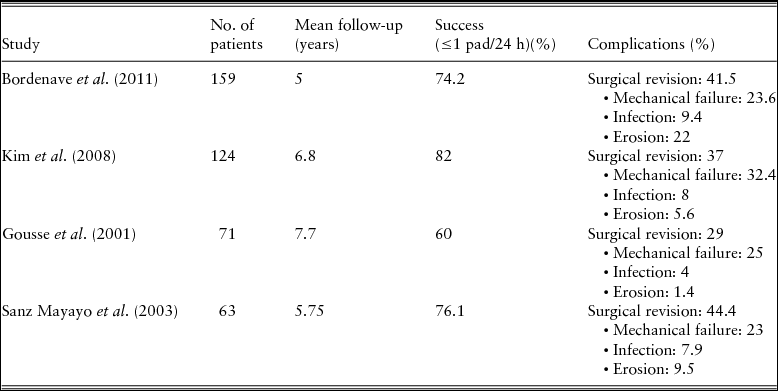
The success rates for AUS are still the best compared with all the alternatives, close to 90% (44–90%),Reference Kim, Sarmast, Daignault, Faerber, McGuire and Latini8, Reference Lai, Hsu, The, Butler and Boone73–Reference Wilson, Delk, Henry and Siegel77 even in men aged >75 years.Reference O’Connor, Nanigian, Patel, Guralnick, Ellision and Stone82 As happens with the slings, AUS implantation after radiotherapy showed lower dry rates and higher complications in some studies due to higher incidence of infection and erosion (GR: C; LE: C).Reference Gomha and Boone83, Reference Nam, Herschorn, Loblaw, Liu, Klotz and Carr84 The main drawback is the high percentage of surgical revisions, that can reach 45% at 5 years and 60% at 10 years. Revision and removal rates due to mechanical failure, urethral atrophy, infection and erosion vary considerably among studies with reports of 29–44% (Table 1).Reference Kim, Sarmast, Daignault, Faerber, McGuire and Latini8, Reference Gousse, Madjar, Lambert and Fishmann74–Reference Mayayo, Gómez García, Fernández Fernández, Perales Cabanas, García Ortells and García Navas76 In general, with the narrow back cuff introduced in 1987, the revision rate has decreased and is not associated with worse outcomes than primary implantation.Reference Lai, Hsu, The, Butler and Boone73, Reference Raj, Peterson, Toh and Webster85
Results of the AMS 800 after radical prostatectomy with a mean follow-up of 5 years
Conclusions
The most common cause of male SUI is iatrogenic, due to inadvertent damage of the external urethral sphincter during radical prostatectomy. The evaluation and diagnosis of this problem should be performed according to the two-stage assessment recommended by the EAU guidelines. Although there is no standardized definition for PPUI, it is fundamental to quantify the grade of SUI with a pad weight test, so that the best therapeutic option can then be offered. There is no clear data on timing of surgical intervention for the treatment of PPUI. A certain period of watchfulness combined with conservative measures, particularly early post-operative PFMT with or without biofeedback, seems to be the most reasonable option. However, there are no strong data to support this recommendation. Although some studies have shown the efficacy of duloxetine, the high rate of side-effects limits its use.
If conservative treatments fail, after a period of at least 6–12 months, surgical therapy is recommended. AUS remains the procedure of choice for the treatment of PPUI with the longest record of efficacy, although between 30 and 50% of patients will require surgical revision at 5 years. The need of mechanical handling also has to be taken in account. In addition, the patient's demand for a minimal invasive treatment option has been recently increasing. For these reasons, over the last decade, there has been revived interest in novel devices, particularly suburethral slings as a treatment option. The main drawback of this approach is that existing clinical guidelines give only general recommendations. This limitation can only be overcome in the future with larger randomized trials comparing the different devices.
Nowadays the new devices such as slings and ProAct for mild to moderate PPUI are used, reserving AUS for severe and complex cases. When the first selected option fails, fibrosis and devascularization of the urethra can be produced and it will respond poorly to further treatments. For this reason, the selection of the device to be placed in the first attempt at treatment of male SUI is crucial, so it is very important to know the risk factors associated with higher complication rates and lower success rates. A bulking agent represents the least invasive technique but its success rate is often suboptimal. Stem cell therapy to regenerate the urethral sphincter is not recommended. Evidence for the adjustable balloons is accruing and the early high complication rate appears to have been reduced. However, more evidence is required before specific recommendations can be made with regard to these new treatment options. The use of male slings in severe SUI and radiated patients is still unclear. At present there are no studies that compare the different procedures (slings versus AUS).
Many physicians may be reluctant to offer surgical treatment to ageing patients for fear of increased surgical/post-operative complications or lower dry rates. Some studies have shown that the continence improvement and complication rates are comparable to those previously seen in younger men. Age by itself should not preclude any patients from treatment. Newer and novel devices are innovative and show promising outcomes in short- to intermediate-term follow-up. However, there exists the need for prospective randomized clinical trials and complete reporting of adverse and long-term results before these surgical procedures can replace the existing AMS 800 device.
Conflict of interest
None