In recent decades, the study of transferring patients with chronic illness from paediatric to adult care has focussed on the growing number of adults with CHD.Reference Marelli, Mackie, Ionescu-Ittu, Rahme and Pilote 1 In an era where adults with CHD now out-number children with CHD,Reference Lloyd-Jones, Adams and Carnethon 2 , Reference Marelli and Gurvitz 3 the need for appropriate transfer of specialty care is important. Adults with CHD will require continued care by a cardiologist who has had specialised training in the diagnosis, treatment, and management of CHD. Continued follow-up to prevent secondary disability such as arrhythmia and valvular disorders is recommendedReference Williams and Lu 4 and has been associated with less morbidity and emergent procedures.Reference Yeung, Kay, Roosevelt, Brandon and Yetman 5
As CHD patients reach adulthood, they often feel well and may require less-intensive medical care. Late adolescence is a time associated with major life changes including relocation due to school or employment and change in primary caregiver from parent to self. Adolescent patients are, thus, learning to take care of their own basic needs, including healthcare, and they are vulnerable to poor follow-up. Another barrier in many institutions lies in the necessity of transfer to another healthcare system for adult congenital heart disease care. It is known that patients at this juncture who are lost to follow-up often present later with worsened health conditions.Reference Mackie, Ionescu-Ittu, Therrien, Pilote, Abrahamowicz and Marelli 6 From an economic perspective, a healthcare system should consider retention of transferring patients with chronic health needs a high priority, as the costs incurred due to the need for emergent or urgent care for patients without continued follow-up may exceed the cost of secondary prevention.Reference Yeung, Kay, Roosevelt, Brandon and Yetman 5 , Reference Garson, Allen and Gersony 7
Our centre is the major tertiary referral centre for the state and the only centre with an adult congenital heart disease programme. Paediatric and adult care are housed within the same institution, physically and administratively, with shared health information systems, patient care areas, and care conferences. Thus, adult and paediatric care providers are in frequent contact. In order to foster transfer of care, a mid-level provider position was filled in 2007 with a role to help transfer patients from one clinic to the other. Within this context, we hypothesised that patient transfer would be better than the published experience. We studied CHD patients who were eligible for transfer to the adult congenital heart disease service at this time in order to define the number of patients who were transferred successfully and to identify factors associated with successful transfer, as well as factors associated with failure to transfer patients to the adult congenital heart disease service.
Methods
In January, 2008, a query of patients who had been seen by paediatric cardiology care providers between 1 January, 2002 and 31 December, 2007 was obtained via an electronic database of all care visits, with the intent of tracking patient follow-up and transfer of care. From this data set, we excluded patients without a confirmed CHD diagnosis, such as those who had been seen for a murmur, chest pain, family history of heart disease, or non-congenital diagnosis such as cardiomyopathy or Marfan syndrome. From the remaining patients, it was observed that many had not had any follow-up with any provider between 2004 and 2007, and were, therefore, essentially lost to paediatric follow-up before the opportunity for transfer. These patients were, therefore, excluded. The remaining patients were deemed eligible for transfer of care if they were at least 18 years old by 2008, had confirmed CHD, and were previously not lost to follow- up. The study protocol was approved by the OHSU Institutional Review Board.
Transfer of paediatric cardiology patients to adult congenital heart disease providers was arranged by the paediatric cardiologists during the time period examined, usually through referral via the electronic health record, which is shared by both the adult and paediatric care providers. A mid-level practitioner was available to see patients in both the paediatric cardiology and adult congenital heart disease clinics.
Follow-up data were obtained for all patients initially by acquisition of electronic data via queries of a system-wide research data warehouse updated daily from the electronic medical record (Epic Systems Corporation, Verona, Wisconsin, United States of America). This query included age, gender, zip code, clinic visits, providers, diagnoses, and insurance provider, as well as dates of emergency room visits, hospitalisations, pregnancies, major surgeries, and deaths.
All data were imported to a study database for the review of each patient. Missing or unclear data were further reviewed by examination of the complete electronic medical record by a physician. In addition, the last paediatric cardiology note was reviewed to determine whether the patient had been instructed to follow-up with the adult congenital heart disease clinic. Patients were considered to have been referred to an adult congenital heart disease provider based on either an electronic order or notation in the progress notes from the last clinic visit.
Anatomical diagnoses were obtained from diagnostic codes and were verified or corrected as necessary after reviewing clinic notes. Severity of CHD was defined as simple, moderate, or complex based on definitions outlined in Task force 1 of the 32nd Bethesda Conference Report.Reference Mackie, Ionescu-Ittu, Therrien, Pilote, Abrahamowicz and Marelli 6 Postal codes were used to define whether patients were located inside or outside the major metropolitan area at the time of their last known follow-up.
The primary outcome was location of follow-up between 2008 and 2011. Based on follow-up, each patient was categorised into one of the following three groups. Group A consisted of patients who were successfully transferred to the adult congenital heart disease service, defined by attending at least one adult congenital heart disease clinic visit. Group B were the patients who continued to be seen by paediatric care providers, but not adult congenital heart disease providers. Group C were patients not seen by any provider in the institution and were considered “lost to follow-up”. An attempt was made to contact all patients in Group C to establish details regarding their healthcare utilisation. At least three attempts were made to contact each patient by e-mail and/or by telephone. When contacted, patients were questioned regarding their healthcare visits – for example, emergency room visits, pregnancy, and surgery – cardiology follow-up, employment status, and insurance status.
Statistical analyses were performed with SPSS for Windows (Version 20.0, Armonk, New York, United States of America). The χ2 test was used to analyse comparisons between groups for categorical variables, and analysis of variance was used to analyse comparisons between groups for continuous variables.
Results
Of the 916 patients identified (Fig 1), 495 were eligible for inclusion based on age of at least 18 years as on 1 January, 2008, a confirmed diagnosis of CHD, and attendance at a paediatric cardiology clinic. Of these, 266 (54%) patients were lost to follow-up between 2004 and 2007. The remaining 229 patients were eligible for transfer to adult congenital cardiology care and were considered the primary study cohort. Of these, 77 (34%) transferred successfully to an adult congenital cardiologist (Group A), 47 (21%) continued to be seen by paediatric cardiologists (Group B), and 105 (46%) lost to follow-up (Group C).
Patient enrolment and exclusions. ACHD=adult congenital heart disease.

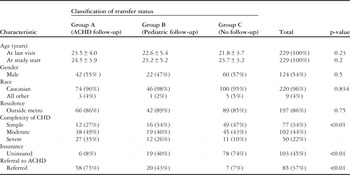
Comparisons of the three groups are shown (Table 1). There was no difference in age at last clinic visit, gender, race, or residence within the metropolitan area. The mean age among all groups was between 23 and 24 years in 2008 – with a range from 19 to 44 years old. Gender division was similar in each group, with ~50% male. All groups were predominantly Caucasian, and all groups had a similar percentage of patients living in the metropolitan area based on postal code.
Characteristics with inter-group analysis.

ACHD=adult congenital heart disease
There was a significant difference between groups with regard to complexity of diagnosis, insurance status, and whether a referral to adult congenital heart disease was made (Table 1). More patients with complex and moderate CHD were successfully transferred (Group A). Among those patients who continued to be seen by a paediatric cardiologist (Group B), there were similar numbers of patients with complex, moderate, and simple CHD diagnoses.
The group that successfully transferred care (Group A) was more likely to have insurance and to have been referred to the adult congenital heart disease service, although there was a proportion of patients who were referred but continued to receive care by a paediatric cardiologist. Of those who were lost to follow-up, only six (6%) were referred to the adult congenital heart disease service.
Several other factors that may have influenced local follow-up were considered, but were relatively uncommon and no associations could be shown. These included referral for heart surgery, emergency department visits, pregnancy, Down syndrome, in-dwelling pacemaker, or implantable cardiac defibrillator.
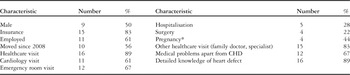
Attempted contact was made for all patients in Group C. For the majority, contact information was not current, possibly implying re-location. For the 38 patients with valid contact details, 20 patients could not be reached either by e-mail or after at least three attempts by telephone. Contact was established with 18 patients (5.8% of all patients lost to follow-up, 47% of the patients with valid contact information). Of these, eight had simple defects, seven had moderate defects, and three had complex CHD. Characteristics of the responders are shown (Table 2). The majority (16 patients, 89%) had a healthcare visit since 2008, and 11 (61%) had been seen by a cardiologist, either paediatric, adult congenital heart disease, or adult general practitioner. Of the patients who had cardiology follow-up, three had simple defects, six had moderate defects, and two had complex CHD. The majority of patients were insured, employed, and had other medical problems in addition to CHD. In addition, 10 patients in this group (56% of those contacted) had moved residence since 2008. Based on updated postal codes, six patients (33% of those contacted) lived within the metropolitan area, six lived 100–200 miles from the tertiary-care centre, and six lived >200 miles away.
Healthcare encounters of reachable patients without follow-up before the start of study period (n=18).

* Total female patients were nine
Discussion
The percentage of patients who successfully transferred care from paediatric to adult congenital cardiology was low, despite the lack of institutional obstacles that we postulated would facilitate more successful transfer. Many important features are shared between adult and paediatric care givers at our institution, such as physical facilities, interventional laboratories, electronic medical records, congenital care conferences, and university administration. In addition, there is a general appreciation among our paediatric cardiologists of the need to educate patients and facilitate their healthcare into the adult setting, and a mid-level provider with joint appointments in both paediatric and adult divisions was in place during the study period. Further, many young adults did not migrate out of state. Nevertheless, despite these factors, the proportion of patients successfully receiving adult care was similar in our group to published numbers at other centres. In Canada, for example, where health insurance is not a barrier to transfer of care and healthcare is structured and centralised, the prevalence of transfer in the era before established transition programmes was found to be 37–47% nationally.Reference Williams and Lu 4 , Reference Reid, Irvine and McCrindle 8
Although only a minority of eligible patients successfully transferred, a striking finding was the high percentage of patients without follow-up with paediatric cardiology, adult congenital heart disease cardiology, or any other healthcare service that would be encompassed by our electronic medical record – including outreach services provided anywhere in the state. In addition to this was the high numbers of patients (54%) who we excluded because they had already been lost to follow-up while under the care of paediatric cardiology before 18 years of age. This emphasises the high-risk period of adolescence when individuals are prone to poor follow-up. In addition, it suggests that there is a systemic problem to be addressed at the paediatric level to improve follow-up before adolescence. Patients who were actively referred were more likely to transfer successfully, highlighting the importance of providing education in the process. There was no difference in successful transfer by age, gender, or race. Our participants were primarily Caucasians, which reflects the population of the state (88.6%). 9
We recognise that those who were lost to follow-up may not be lost to medical care entirely. Of the patients in Group C whom we were able to contact, the majority was receiving regular medical care elsewhere and many were receiving continued care from a cardiologist. Owing to the fact that the majority of Oregonians tend to stay in Oregon and that our adult congenital heart disease programme is the only one in the state, after the Adult Congenital Heart Association Clinic Directory listing, we believe it is safe to assume that most are not receiving specialty care, although healthcare utility for this population needs additional study.
In 2006, the National Heart, Lung, and Blood Institute working group on research in adult congenital heart disease recommended that “outreach programs be established to identify the ‘lost’ population of adults with CHD”.Reference Williams, Pearson and Barst 10 Our paediatric cardiology division has a well-established and extensive outreach programme to 11 areas in Oregon outside Portland, whereas adult congenital heart disease provided care at only two satellite sites during the study period. We speculated that transfer among patients seen in outreach satellite centres would be poor, but the distance from Portland was not a factor associated with successful transfer. It is likely, however, that transfer would be facilitated in locations served by both paediatric and adult congenital heart disease care providers.
Adults with simple CHD were least likely to transfer to adult congenital heart disease care providers. There is less data to support a strong recommendation for continued follow-up with this group by a cardiologist with training in adult congenital heart disease. The 32nd Bethesda conference of the American Heart AssociationReference Webb and Williams 11 supports adults with simple CHDs, such as isolated valve disorders and atrial or ventricular septal defects that have been repaired, seeking follow-up with non-congenital adult cardiologists on an infrequent basis only up to 5 years between follow-up appointments. There is greater concern for those with more complex CHD. The Bethesda conference further recommended follow-up for patients with moderate or complex CHD at least every 12 to 24 months to screen for conditions such as residual haemodynamic lesions and arrhythmia,Reference Knauth, Verstappen, Reiss and Webb 12 with the goal to prevent secondary cardiac complications and the need for urgent cardiac interventions.Reference Yeung, Kay, Roosevelt, Brandon and Yetman 5 Patients without follow-up accounted for nearly a quarter of the group with complex CHD. Complex CHD, as outlined by the Bethesda Conference,Reference Webb and Williams 11 refers primarily to patients with cyanotic CHD, single ventricles, and Eisenmenger syndrome. Improved transfer and retention would avoid patients returning to specialty care only when they are admitted secondary to sequelae from neglected CHD.Reference Yeung, Kay, Roosevelt, Brandon and Yetman 5
The majority of patients with complex CHD in this study continued to be followed-up by paediatric cardiologists or were successfully transferred to the adult congenital heart disease service. Although it is reassuring that these patients with specialised healthcare needs continue to be followed by specialists who comprehend their anatomy and physiology, it is suboptimal that nearly a quarter of the patients with complex CHD continued to be seen by paediatric cardiologists. The literature surrounding adult congenital heart disease and the transition of adolescents with any chronic disease from paediatric to adult care providers describes multiple reasons why patients may not leave their paediatric group. Insurance limitations, the strong, and often emotional relationships that patients and families have with paediatric care providers, concerns for inadequate care by a different physician who does not have a long-standing relationship with the patient, and inadequate access to adult care providers are a few contributing causes for continued care of adults with CHD by paediatric cardiologists.Reference Saidi and Kovacs 13 , Reference Fernandes, Khairy and Fishman 14 It is, however, currently recommended that physicians without specialised training in adult CHD only manage adult CHD patients in collaboration with an adult CHD service, and that every adult CHD patient with moderate or complex CHD should be seen by an adult CHD cardiologist at least once for risk stratification.Reference Webb and Williams 11
We found that patients were more likely to follow-up with the adult CHD group if they were referred by the paediatric cardiologists, and most of them who were lost to follow-up were not referred. Reasons for no referral may be lack of medical insurance as well as the reasons outlined above in reference to adult patients with complex CHD who continue to be seen by paediatric cardiologists. Others have examined referral patterns among American paediatric cardiologists nationwide and found that there was a tendency to refer most commonly when patients had adult co-morbidities,Reference Fernandes, Khairy and Fishman 14 although this is not ideal. Attachment of a clinician to the patient/family and lack of qualified adult congenital heart disease care providers were the main barriers identified to referring patients eligible for transfer. In our centre, there were adequate numbers of adult congenital heart disease providers. There was also a mid-level provider who was available to facilitate patient transfer, although patients were not consistently referred to this service. It has been well-established that transfer of care to adult congenital heart disease providers is ideally done when a patient is relatively well and stable. Opportunistic transfers, which occur when a patient is acutely unwell, are more disruptive, foster poor communication, and may produce unnecessary psychosocial burden for patients and their families.Reference Knauth, Verstappen, Reiss and Webb 12
In the United States, it is not surprising that insurance is a barrier to transfer of care to the adult congenital heart disease service. Change of insurance or loss of insurance is a serious problem for all Americans, especially those with specialised healthcare needs. Delay in transition of care due to lack of insurance among young adults with chronic healthcare needs has been described.Reference Fortuna, Halterman, Pulcino and Robbins 15 This delay may lead to an increase in morbidity and mortality of young adults with specialised healthcare needs.Reference Yeung, Kay, Roosevelt, Brandon and Yetman 5 Guidelines regarding transition programmes for adolescents with CHD include the issue of insurance challenges as an important factor to address and link patient educational/vocational choices before transferring care to an adult care provider.Reference Knauth, Verstappen, Reiss and Webb 12 , Reference Sable, Foster and Uzark 16
Based on guidelines, consensus statements, and studies specific to the population with CHD, as well as children with other chronic health needs, a formalised transition programme to address the continued care of cardiology patients into adulthood should be a feature of every centre.Reference Webb and Williams 11 – Reference Saidi and Kovacs 13 , Reference Sable, Foster and Uzark 16 – 18 A formalised mandatory transition programme may have improved some patient transfer in our institution, but may not have impacted the large proportion of patients who were lost to follow-up before their late adolescent years. Institutional programmes will always have a difficult battle against the social influences that govern a patient’s clinical behaviour at this critical period.
Conclusion
Even within a single organisation, the successful transfer of care from paediatric to adult congenital cardiology was 34% over 3 years, and was independent of age, gender, race, and residential proximity to a care centre. CHD complexity, active referral to adult congenital cardiology care, and active health insurance were associated with successful transfer. Many CHD patients are at risk of not transferring care to an adult congenital cardiologist. A large proportion of patients was lost to follow-up but may not be lost to medical care in general.
Acknowledgement
None.
Financial Support
This research received no specific grant from any funding agency, commercial, or not-for-profit sectors.
Conflicts of Interest
None.
Ethical Standards
The authors assert that all procedures contributing to this work comply with the ethical standards of the relevant national guidelines on human experimentation and with the Helsinki Declaration of 1975, as revised in 2008, and has been approved by the Oregon Health & Science University Institutional Review Board.