Introduction
Complaints of cognitive disturbance are common among breast cancer patients (Hutchinson, Hosking, Kichenadasse, Mattiske, & Wilson, Reference Hutchinson, Hosking, Kichenadasse, Mattiske and Wilson2012; Pullens, De Vries, & Roukema, Reference Pullens, De Vries and Roukema2010; Shilling & Jenkins, Reference Shilling and Jenkins2007). Patients tend to attribute these cognitive changes to toxic effects of chemotherapy, as implied by their use of terms such as “chemo fog” and “chemobrain”. Although it is now recognized that many factors can influence cognition in cancer patients—mood disturbance, other adjuvant treatments, even the disease itself—research conducted over the past 15–20 years corroborates patients’ beliefs, clearly implicating chemotherapy-related toxicity as a contributing factor to these cognitive disturbances (Wefel & Schagen, Reference Wefel and Schagen2012).
The time course of these chemotherapy-related cognitive changes is less clear. Prospective longitudinal studies generally find that the cognitive changes remit after termination of chemotherapy (Ahles et al., Reference Ahles, Saykin, McDonald, Li, Furstenberg, Hanscom and Kaufman2010; Jansen, Cooper, Dodd, & Miaskowski, Reference Jansen, Cooper, Dodd and Miaskowski2011; Wefel, Saleeba, Buzdar, & Meyers, Reference Wefel, Saleeba, Buzdar and Meyers2010; Weis, Poppelreuter, & Bartsch, Reference Weis, Poppelreuter and Bartsch2009). However, some of these studies find that a subgroup of patients continues to show more persistent impairment (Wefel et al., Reference Wefel, Saleeba, Buzdar and Meyers2010; Weis et al., Reference Weis, Poppelreuter and Bartsch2009). Cross-sectional studies have found evidence of abnormalities in cognitive functioning and in brain structure and function in breast cancer patients as long as 20 years post-chemotherapy (de Ruiter et al., Reference de Ruiter, Reneman, Boogerd, Veltman, van Dam, Nederveen and Schagen2011; Silverman et al., Reference Silverman, Dy, Castellon, Lai, Pio, Abraham and Ganz2007).
Due in large part to more widespread and aggressive use of chemotherapy, there is a huge and growing breast cancer survivorship. Many of these breast cancer survivors are quite young and are looking to resume pre-illness social and occupational roles. In a recent on-line survey of breast cancer patients (Canadian Breast Cancer Network, 2010), 8% reported that cognitive impairment was a significant barrier to returning to work. At least two cohort studies have reported an association between cognitive test scores and work-related outcomes. Nieuwenhuijsen et al. (Nieuwenhuijsen, de Boer, Spelten, Sprangers, & Verbeek, Reference Nieuwenhuijsen, de Boer, Spelten, Sprangers and Verbeek2009) found that, at 12 months after beginning sick leave, one-third of their clinical sample of 45 mixed cancer patients showed cognitive impairment and this subgroup had lower workability scores and were less likely to have returned to work than those without impairment. In a prospective longitudinal study involving 18 women with breast carcinoma recruited for a clinical trial, Wefel, Lenzi, Theriault, Davis, and Meyers (Reference Wefel, Lenzi, Theriault, Davis and Meyers2004) found that those patients who exhibited cognitive decline shortly after completing chemotherapy reported greater difficulty working. One year later, 45% of these decliners exhibited improvement in cognitive function and self-reported ability to work was also improved. Thus, while the data are still somewhat lacking, there are suggestions that these cognitive changes may be of functional significance.
The current work is an extension of our second prospective longitudinal study in which we examined a dose-response relationship between chemotherapy and cognition by assessing breast cancer patients following each chemotherapy cycle (Collins, Mackenzie, Tasca, Scherling, & Smith, Reference Collins, MacKenzie, Tasca, Scherling and Smith2013). Short-term results showed progressive linear decline in cognitive function over the course of treatment, providing compelling evidence that chemotherapy is acutely neurotoxic. The current paper examines the cognitive outcome in these breast cancer patients 1 year following the completion of chemotherapy. In an earlier prospective, longitudinal study conducted by our group (Collins, MacKenzie, Stewart, Bielajew, & Verma, Reference Collins, MacKenzie, Stewart, Bielajew and Verma2009a), we found an increased frequency of cognitive decline in chemotherapy-treated breast cancer patients apparent immediately after completion of chemotherapy but this was no longer in evidence 1 year later. We speculated that this was due to remission of chemotherapy-induced neural dysfunction. However, our control group in that study was comprised of breast cancer patients who received anti-estrogen therapy over the follow-up interval; thus, we could not rule out the possibility that the apparent remission was actually due to cognitive decline resulting from this hormonal treatment. Other longitudinal studies have also found evidence of remission of acute chemotherapy-related cognitive disturbances. However, this has not been universally found and, indeed, one study has even reported delayed decline (Wefel et al., Reference Wefel, Saleeba, Buzdar and Meyers2010). Presumably, it is the persistent adverse effects of treatment that are of most concern to breast cancer survivors and clearly further data addressing this issue are needed. Toward that end, we report the 1-year follow-up data from our more recent study with breast cancer patients.
Methods
Participants
Sixty women with non-metastatic breast cancer scheduled to receive chemotherapy were recruited to the study. Our control group was comprised of 60 healthy women, individually matched to patients on age, education and first language. All participants were required to be between the ages of 18 and 65 at baseline, to be fluent in English and to have at least a grade-8 education. Exclusion criteria included history of previous cancer or chemotherapy, serious psychiatric or neurological illness, and significant substance abuse.
Procedures
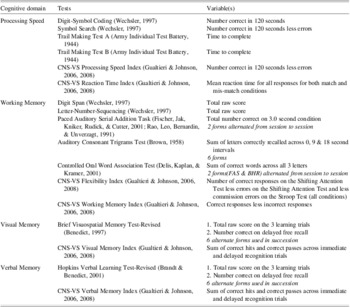
The study was approved by the ethics board of The Ottawa Hospital and written informed consent was obtained from all participants. The breast cancer patients were recruited through their treatment team at the Ottawa Hospital Regional Cancer Centre between September 2008 and April 2010. Women in the control group were recruited through hospital advertisements and peer nomination. Neuropsychological assessment was conducted at several time points. The breast cancer patients underwent baseline assessment following surgery but prior to commencement of chemotherapy and were re-assessed between each chemotherapy cycle, typically at 3-week intervals. Patients were assessed again shortly following completion of all chemotherapy cycles (short-term follow-up) and 1 year following completion of chemotherapy (long-term follow-up). The number of chemotherapy cycles, and hence the number of testing sessions, varied among the breast cancer patients according to individual treatment regimen. For the remainder of the paper, T1 refers to baseline testing, T2-T7 refer to the testing sessions immediately following each chemotherapy cycle, and T8 refers to the long-term (i.e., 1 year) follow-up assessment. The short-term follow-up for any given patient may have occurred at T5, T6, or T7, depending on the number of chemotherapy cycles she received. The assessment schedule for each control participant was matched to that of her index patient. The neuropsychological test battery (see Table 1) was 90–120 min in duration and was composed of traditional pencil-and-paper tests as well as CNS-Vital Signs (CNS-VS), a brief computerized test (Gualtieri & Johnson, Reference Gualtieri and Johnson2006, Reference Gualtieri and Johnson2008). CNS-VS randomly generated alternate forms at each session. With the exception of the subtests from the Wechsler Adult Intelligence Scale-III (WAIS-III) and Trail Making A and B, alternate forms of all neuropsychological tests were used as described in Table 1. The same form was administered to all participants at a given time point and tests were administered in the same order at every session. We administered the Beck Depression Inventory-II (BDI-II; Beck, Steer, & Brown, Reference Beck, Steer and Brown1996) at T1 to measure baseline depressive symptoms, and the Profile of Mood States (POMS; McNair, Lorr, & Droppleman, Reference McNair, Lorr and Droppleman1992) at every testing session to track changes in depression and fatigue over time.
Test battery organized by cognitive domain

Data Analysis
Cognitive summary scores
The same procedure described by Cutter et al. (Reference Cutter, Baier, Rudick, Cookfair, Fischer, Petkau and Willoughby1999) and Doolittle et al. (Reference Doolittle, Korfel, Lubow, Schorb, Schlegel, Rogowski and Neuwelt2013) was followed in deriving cognitive summary scores. Raw scores on the traditional neuropsychological tests and the index scores from CNS-VS were standardized using the mean and standard deviation on that same variable at the same time point in the control group. This process served to control for practice effects. Putting all variables on the same scale moreover allowed us to combine the individual test scores and thereby reduce the 19 neuropsychological measures to a much smaller set of cognitive summary scores (see Table 1). We calculated a global cognitive summary score (COGSUM) by averaging all standardized scores. We also calculated a Working Memory score, a Processing Speed score, a Visual Memory score, and a Verbal Memory score by averaging relevant neuropsychological measures as determined by principal components analysis (as described in our previous paper, Collins et al., Reference Collins, MacKenzie, Tasca, Scherling and Smith2013).
Cognitive summary scores were analyzed using multi-level growth modeling (MLM; Singer & Willett, Reference Singer and Willett2003). In these models, the time parameter (e.g., estimate of the slope of the dependent variable over time) indicates the rate of change in the dependent variable (Singer & Willett, Reference Singer and Willett2003). These analyses included the breast cancer patients only because changes in the control group (i.e., practice effects) had already been accounted for by standardizing the cognitive test scores to the control group. A separate MLM analysis was conducted for each cognitive summary score. Baseline scores on the dependent variable were co-varied in these analyses in the event that initial cognitive status might be correlated with, and therefore influence, the rate of change (i.e., time) parameter. Each model also controlled for other variables that might affect rate of change, specifically, participant age, education, and baseline depression scores on the BDI-II. We took a sequential model building approach such that a completely unconditional base model was run first, followed by a growth model, and then covariates were added. We set the time parameter to 0 at the seventh testing session, which defines this as the intercept for each individual. (In the event that participants did not undergo T6 or T7, that intercept value was estimated using the maximum likelihood method.) We then added a quadratic parameter to the linear model to test if this new model would better fit the data (using an AIC statistic between nested linear and quadratic models), and if the quadratic parameter was significantly greater than 0. A linear modeling of the data would indicate continued deterioration over the long-term follow-up period whereas a quadratic modeling of the data would indicate deterioration in scores from baseline to the short-term follow-up with some rebound in scores from the short-term to the long-term follow-up. Setting the time parameter to zero at time 7 allowed us to test if a quadratic model of rebounding scores after chemotherapy was a better fit than a linear model indicating continued deterioration after chemotherapy. Model 1 in the Appendix shows the full quadratic model which was compared to a nested linear model without the quadratic parameter (i.e., without π2i(timeti)2), to test best fitting time parameter. Model 2 shows the growth model.
To evaluate if change in the cognitive summary scores was associated with depression or fatigue at any time point, we ran an MLM using the POMS Depression and Fatigue scores as time-varying covariates. Again, a sequential model building approach was taken in which scores on the covariate were allowed to vary. With this model we were able to assess if change in the cognitive summary score (i.e., its slope) remained significant after controlling for the covariation between depressive symptoms or fatigue with cognitive summary scores across time (Model 3 in the Appendix). To test the effect of change in depressive symptoms or fatigue on change in cognitive summary scores, we first ran separate MLM linear growth models for depressive symptoms and for fatigue (similar to Model 2 in the Appendix) and saved the ordinary least squared (OLS) slope values for each individual. These values were then entered as independent variables at level 2 of the MLM that modeled growth in each cognitive summary score (Model 4 in Appendix). Again, we assessed if the slope of the cognitive summary scores remained significant after controlling for concurrent change in depression or fatigue. For all MLM analyses, full maximum likelihood method of estimation was used.
Standardized Regression-Based scores
Standardized Regression-Based (SRB) scores were used to classify each participant (breast cancer patients and controls) as showing decline, improvement, or no change on the neuropsychological tests. SRB scores were calculated for each of 3 time intervals: Baseline to short-term follow-up; baseline to long-term follow-up; and short-term to long-term follow-up. The neuropsychological scores of the healthy group were used to develop regression equations predicting later scores from earlier scores. Change on POMS depression and fatigue scores over the same time interval were included as covariates in these analyses. An SRB score was obtained for each participant, on each neuropsychological variable, by subtracting her actual retest score from the predicted retest score and dividing by the standard error of estimate of the prediction model in the healthy group. The resultant SRB scores reflect the extent to which the observed change on each neuropsychological measure deviated from the change that would be expected on the basis of change in the control group (i.e., the change that occurs over the same interval in the absence of chemotherapy). A given participant was deemed to show decline if she had an SRB score of ⩽−2.0 on 3 or more of the 19 cognitive measures. The frequency of decliners was compared in the chemotherapy and control groups at each time point using Fisher's Exact Test. In an analogous manner, an individual with an SRB score of ⩾+2.0 on 3 or more cognitive measures was considered to show cognitive improvement. We based the criteria for decline and improvement on the work of Ingraham and Aiken (Reference Ingraham and Aiken1996) showing that the probability of meeting these criteria by chance would be less than 5%.
Results
Sample Characteristics
In the interim between short- and long-term follow-up, our sample of breast cancer patients was reduced from 60 to 56. One breast cancer patient received further chemotherapy and 3 others died. Because the focus here is on the outcome of disease-free breast cancer survivors, data from these participants and their matched controls were omitted from the current analyses. Two additional breast cancer patients declined to participate in the final assessment. Despite the fact that we did not have long-term follow-up data for these individuals, we nonetheless included them in the MLM analyses, because this method allows for reliable estimation of parameters by the maximum likelihood method. The n was equal at all time points for the patient and control groups and ranged from a maximum of 56 at baseline to a minimum of 43 at T6 and T7 (see Table 3). Since the SRB analyses require actual data for each time point, only the 54 patients and their matched controls who completed the 1-year follow-up assessment were included in these analyses. The n was 54 in either group at the 3 time points of interest, namely, baseline (T1), short-term follow-up (T5, T6, or T7, depending on number of chemotherapy cycles for the index breast cancer patient), and long-term follow-up (T8).
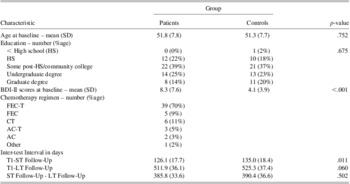
As can be seen in Table 2, breast cancer patients and controls did not differ in terms of age or education, but mean BDI-II score at baseline was significantly higher in the breast cancer patients than in the control group. The breast cancer patients differed from one another in terms of chemotherapy regimen, but 70% received FEC-T (3 cycles of 5-fluorouracil, epirubicin, and cyclophosphamide followed by 3 cycles of taxotere), with or without Herceptin or Avastin, and underwent 8 testing sessions including the baseline and long-term follow-up. In the remaining breast cancer patients, the number of treatment cycles varied from 4 to 8 and the number of assessment sessions ranged from 6 to 8 (AC-T was a dose-dense regimen involving 8 treatments 2 weeks apart and assessments were conducted after every 2 cycles). Eighty-four percent of the breast cancer patients went on to receive hormonal therapy (primarily tamoxifen) following completion of chemotherapy.
Demographic and treatment characteristics of the sample

Note. SD = standard deviation, FEC = 5-fluourouracil, epirubicin, cyclophosphamide, FEC-T = FEC plus taxotere, CT = cyclophosphamide plus taxotere, AC = adriamycin and cyclophosphamide, AC-T = AC plus paclitaxel, Other = carboplatin, taxotere, Avastin, and Herceptin, ST = short-term, LT = long-term.
The inter-test intervals across both groups ranged from 21.0 days to 25.8 days for the first 7 testing sessions. The intervals were always slightly longer for the healthy control group than the chemotherapy group, owing to the fact that there was greater latitude for scheduling these participants. These differences were significant only for the T2–T3 interval (difference of 2.0 days, p = .014) and the T3–T4 interval (difference of 1.6 days, p = .023). The shorter intervals for the chemotherapy group would be expected, if anything, to benefit their performance due to stronger practice effect. The interval between the short-term and long-term follow-up was 385.8 days (SD = 33.6) in the chemotherapy group and 390.4 days (36.6) in the healthy control group (p = .502).
Cognitive Measures
Table 3 shows the means and standard deviations of the cognitive summary scores and the POMS depression and fatigue scores for the breast cancer group at each assessment. The cognitive summary scores, used as the primary dependent variables for MLM analyses, were normally distributed and there were no extreme outliers at any time point.
Means and standard deviations (in parentheses) for cognitive summary scores and for POMS Depression and Fatigue scores at all time points for BREAST CANCER patients

Note. T2 – T7 refer to testing sessions following first to sixth chemotherapy treatment; LT = long-term. Cognitive summary scores are the average of the z scores on the neuropsychological measures that were obtained by standardization to the control group at the corresponding time point; POMS Depression and Fatigue scores are raw scores.
MLM analysis
We first modeled linear change for each dependent variable. There was a significant rate of decline in COGSUM scores from baseline to long-term follow-up, even after controlling for baseline scores, age, depression, and education (β10 = −.034; t(51) = 8.17; p < .001). The effect size for COGSUM was medium (∼R 2 = .24) according to the convention of Cohen (Reference Cohen1988). The results were similar for each cognitive domain summary score. The effect size was medium in the case of Working Memory (∼R 2 = .14; p < .001), Verbal Memory (∼R 2 = .13; p < .001) and Processing Speed (∼R 2 = .14; p < .001), and the effect was small in the case of Visual Memory (∼R 2 = .05; p = .007). To assess for any rebound in scores from short-term to long-term follow-up, we added a quadratic parameter to the linear model with the intercept centered at the last assessment time (i.e., T7). In the case of COGSUM and Working Memory, the quadratic parameter values were significantly greater than 0 (p < .001 in both cases) and their addition to the linear model accounted for an additional 18% and 14% of the variance, respectively. The quadratic parameter was not significant for any of the other cognitive summary scores, indicating no rebound in these measures. Models 1 and 2 in the Appendix show the equations for these analyses.
Although changes in the cognitive summary scores were, in some cases, associated with fatigue and depression as measured by the POMS, the quadratic slope (for COGSUM and Working Memory) and the linear slope (for Processing Speed, Visual Memory, and Verbal Memory) remained significant even after controlling for concurrent POMS depression or fatigue scores over time. POMS fatigue scores were negatively related to COGSUM (p = .004), Processing Speed (p < .001) and Working Memory (p = .001). There was no significant relationship between POMS depression scores and any of the cognitive summary scores except for Working Memory (p = .004). Model 3 shows these time-varying covariate analyses.
We then assessed if change in cognitive summary scores remained significant after controlling for change in POMS depression and fatigue scores (Model 4 in Appendix). POMS depression slopes were not significant (β10 = 0.17; t(54) =0.97; p = .34), indicating no change in depression over the assessment periods across all participants. POMS fatigue slopes were significant (β10 = 0.34; t(54) = 3.52; p < .001) indicating a significant increase in fatigue over the assessment periods. Neither OLS slopes for depression nor for fatigue were associated with any of the cognitive summary score slopes (all p > .05), suggesting no relationship between change in these variables across assessments. Most importantly, the slopes of all cognitive summary scores remained significant after controlling for the effects of OLS slopes of POMS depression and fatigue (all ps < .003).
Frequency of decline and improvement at the individual level
The frequency of decline at the short-term follow-up was 48% in the breast cancer patients (26 of 54) and 9% in the control group (5 of 54). This group difference in frequency of decline was significant (p < .001). Although, only 22% of breast cancer patients (12 of 54) showed decline relative to baseline at the long-term follow-up (less than half the frequency observed at the short-term follow-up), this was still significantly higher than the frequency of decline in the control group, which was only 6% (3 of 54) (p = .006). The frequency of cognitive improvement from baseline to short-term and long-term follow-up, respectively, was low in both the breast cancer patients and the controls (11% or less) and did not differ between the groups. The frequency of improvement from short-term to long-term follow-up was higher among the breast cancer patients than the controls (30% and 17%, respectively), but not significantly so. There was no difference between the respective groups in frequency of decline over this interval (11% and 9%).
Of the 26 breast cancer patients who showed decline at the short-term follow-up, only 10 continued to meet the decline criterion at the long-term follow-up (i.e., were “persistent decliners”). Two additional breast cancer patients were identified as “new decliners” at long-term follow-up but there were also two “new decliners” in the control group, suggesting that this is a chance finding.
Characterizing long-term decliners
Within the chemotherapy group, there were no differences between the 12 decliners and the 42 non-decliners at long-term follow-up in terms of chemotherapy regimen, age, education, baseline cognitive status (T1 COGSUM), or inter-test interval. Decliners and non-decliners were equally likely to be receiving hormone therapy at the long-term follow-up. Baseline fatigue and mood state (as reflected in BDI-II score and POMS depression and fatigue scores at T1) did not differ between decliners and non-decliners.
Additional MLM analyses were conducted to compare the trajectory of change in depression and anxiety scores in the decliners and the non-decliners. The linear change in POMS Depression from baseline to 1-year follow-up was non-significant in the full sample of 54 breast cancer patients after controlling for baseline scores (p = .555). However, there was a significant effect of decline status on the slopes (β11 = 1.206; p = .008; ∼R 2 = .41): depression scores for the non-decliners significantly decreased over time (β10 = −.324; p = .006), whereas those of the decliners significantly increased (β10 = .882; p = .037). In the case of POMS fatigue, a quadratic model fit the data better than a linear one. After controlling for baseline scores, there was a consistent increase in POMS fatigue from T1 to T7 in the full sample, followed by a decrease from T7 to T8 (β10 = −.099; p < .001). This was a medium-sized effect (∼R 2 = .18). However, there was no effect of decline status on this change in POMS fatigue (p = .54).
Discussion
The current study adds to a substantial literature (Wefel and Schagen, Reference Wefel and Schagen2012) showing that chemotherapy for breast cancer is associated with acute cognitive changes. Although mean raw scores of the patient group did not actually decline on most tests (indeed, they often improved slightly from before to after treatment), the breast cancer patients did not benefit from practice to the same extent as a healthy matched control group, such that the decline became evident once the expected positive practice effect was removed. This could reflect one of two things: a positive effect of practice could oppose the subtle adverse cognitive effects of chemotherapy such that the latter only emerge when the former are removed; or, the adverse effect of chemotherapy may actually be an attenuation of the usual positive effect of practice. We contend that either of these phenomena is evidence of cognitive disturbance.
Almost half of our breast cancer patients showed cognitive decline during or shortly following their chemotherapy. The greater concern for patients, however, is whether chemotherapy results in long-term, or even permanent, cognitive side effects. The answer to this question is less clear. Retrospective, cross-sectional studies show impaired cognitive functioning in breast cancer patients, as well as irregularities in brain structure and function, as long as 20 years post-treatment (de Ruiter et al., Reference de Ruiter, Reneman, Boogerd, Veltman, van Dam, Nederveen and Schagen2011, Reference de Ruiter, Reneman, Boogerd, Veltman, Caan, Douaud and Schagen2012; Kopplemans, Breteler, et al., Reference Koppelmans, Breteler, Boogerd, Seynaeve, Gundy and Schagen2012; Koppelmans, de Ruiter, et al., Reference Koppelmans, de Ruiter, van der Lijn, Boogerd, Seynaeve, van der Lugt and Schagen2012; Kreukels et al., Reference Kreukels, Schagen, Ridderinkhof, Boogerd, Hamburger and van Dam2005, Reference Kreukels, Schagen, Ridderinkhof, Boogerd, Hamburger, Muller and van Dam2006; Kreukels, Hamburger, et al., Reference Kreukels, Hamburger, de Ruiter, van Dam, Ridderinkhof, Boogerd and Schagen2008; Kreukels, van Dam, Ridderihkhof, Boogerd, & Schagen, Reference Kreukels, van Dam, Ridderinkhof, Boogerd and Schagen2008; Silverman et al., Reference Silverman, Dy, Castellon, Lai, Pio, Abraham and Ganz2007). However, prospective longitudinal studies have shown that cognitive impairment remits in the months following completion of chemotherapy (Ahles et al., Reference Ahles, Saykin, McDonald, Li, Furstenberg, Hanscom and Kaufman2010; Collins et al., Reference Collins, MacKenzie, Stewart, Bielajew and Verma2009a; Jansen et al., Reference Jansen, Cooper, Dodd and Miaskowski2011; Weis et al., Reference Weis, Poppelreuter and Bartsch2009). In keeping with these latter studies, our current results showed that the number of decliners at the long-term follow-up was less than half that observed shortly following completion of chemotherapy and that a quadratic model, indicating a steady decline over the course of chemotherapy with rebound 1 year later, best captured the trajectory of change. These results substantiate those of our earlier prospective, longitudinal study in which we also found remission of chemotherapy-related cognitive changes at a long-term follow-up (Collins et al., Reference Collins, MacKenzie, Stewart, Bielajew and Verma2009a). However, in contrast to our previous results, the rebound in the current study was only partial and the number of breast cancer patients showing decline at 1 year was still significantly higher than in the control group.
We suspect that the inconsistency in recovery rate observed in our two studies is due to differences in control group. In our previous study, the control group was comprised of breast cancer patients who received hormonal therapy without chemotherapy whereas the control group in the present study was comprised of healthy women. Anti-estrogen treatments for breast cancer may themselves have adverse effects on cognition (Collins, MacKenzie, Stewart, Bielajew, & Verma, Reference Collins, MacKenzie, Stewart, Bielajew and Verma2009b; Palmer, Trotter, Joy, & Carlson, Reference Palmer, Trotter, Joy and Carlson2008; Phillips et al., Reference Phillips, Aldridge, Ribi, Sun, Thompson, Harvey and Bernhard2011; Schilder et al., Reference Schilder, Seynaeve, Beex, Boogerd, Linn, Gundy and Schagen2010; Walker, Drew, Antoon, Kalueff, & Beckman, Reference Walker, Drew, Antoon, Kalueff and Beckman2012) and there were some indications in our previous study that the lack of difference in frequency of cognitive decline between the chemotherapy patients and the controls at 1 year may have been partially due to increasing effects of hormonal therapy in our control group (Collins et al., Reference Collins, MacKenzie, Stewart, Bielajew and Verma2009a). There is also a growing body of evidence indicating that verbal memory is particularly sensitive to estrogen (Maki & Hogervorst, Reference Maki and Hogervorst2003; Maki, Zonderman, & Resnick, Reference Maki, Zonderman and Resnick2001; Ryan, Scali, Carriere, Ritchie, & Ancelin, Reference Ryan, Scali, Carriere, Ritchie and Ancelin2008; Wolf et al., Reference Wolf, Kudielka, Hellhammer, Torber, McEwen and Kirschbaum1999) and anti-estrogen therapies (Bender et al., Reference Bender, Sereika, Brufsky, Ryan, Vogel, Rastogi and Berga2007; Collins et al., Reference Collins, MacKenzie, Stewart, Bielajew and Verma2009b; Jenkins, Shilling, Fallowfield, Howell, & Hutton, Reference Jenkins, Shilling, Fallowfield, Howell and Hutton2004; Schilder et al., Reference Schilder, Eggens, Seynaeve, Linn, Boogerd, Gundy and Schagen2009, Reference Schilder, Seynaeve, Beex, Boogerd, Linn, Gundy and Schagen2010; Shilling, Jenkins, Fallowfield, & Howell, Reference Shilling, Jenkins, Fallowfield and Howell2003). While the current finding that verbal memory did not rebound in the year following completion of chemotherapy is consistent with compounding effects of hormonal treatment, we could not empirically address this hypothesis because the vast majority of the patients in our current sample began hormonal therapy shortly following their chemotherapy.
Factors other than exposure to hormonal therapies may account for the discrepancy between our two longitudinal studies in the detection of persistent cognitive impairment in chemotherapy-treated breast cancer patients. Such factors might include constitutional risk factors that are common for both cancer and cognitive dysfunction as well as biological changes associated with cancer. These factors were better accounted for in our previous study by use of a disease control group. Psychosocial factors are another potentially confounding factor. We might expect that breast cancer patients would be experiencing higher levels of psychological distress than healthy women and that this, in turn, might adversely affect cognition. We have attempted to control for the effects of depression and fatigue by including them as covariates in the current analyses but we acknowledge that it is difficult to take full account of the psychological impact and life disruption caused by cancer.
In reviewing the trajectory of change in the respective cognitive domain summary scores, it appears that the rebound in COGSUM from the short-term to the long-term follow-up is primarily due to recovery in working memory. This is supported by the results of our MLM analyses showing that Working Memory was the only cognitive domain summary score to show significant rebound from T7 to T8. Together with our earlier short-term analyses from this study (Collins et al., Reference Collins, MacKenzie, Tasca, Scherling and Smith2013), which showed a particularly steep decline in working memory over the course of chemotherapy, the current data suggest that working memory may be most vulnerable to the acute effects of chemotherapy and the most likely to recover following its completion. As discussed in our previous report of the short-term results from this study (Collins et al., Reference Collins, MacKenzie, Tasca, Scherling and Smith2013), the working memory summary score may have been particularly sensitive to change because it was comprised of more measures than the other domain scores or because some of the component measures were time-dependent and it may be that subtle cognitive deficits are better captured by speed than by accuracy of response.
The current results are consistent with most studies to date in finding that only a subgroup of breast cancer patients shows chemotherapy-related cognitive decline. Various risk factors have been postulated, including age, cognitive reserve, and type of chemotherapy regimen (Ahles et al., Reference Ahles, Saykin, McDonald, Li, Furstenberg, Hanscom and Kaufman2010; Vardy & Tannock, Reference Vardy and Tannock2007; Wefel & Schagen, Reference Wefel and Schagen2012). We did not find support for any of these putative risk factors; however, the present study was not adequately powered for these types of subgroup analyses and the group of decliners was small and disproportionate to the non-decliners.
Mood disturbance and fatigue have been posited as causes of cognitive symptoms in breast cancer patients (Vardy & Tannock, Reference Vardy and Tannock2007). We did find that depression ratings worsened over time in the long-term decliners in contrast to the non-decliners, whose depression scores improved. We also found evidence in the MLM analyses that depression and fatigue were associated with cognitive scores across time. However, neither the change in mood nor the change in fatigue could account for the cognitive decline in our chemotherapy patients. Thus, it appears that there is more to the “chemo fog” story than depression and fatigue.
It is now well established that a sizeable proportion of breast cancer patients will experience cognitive decline in the short-term following exposure to chemotherapy. The current findings are consistent with this. They also add to mounting evidence that a smaller subgroup of these women experience longer-term cognitive side effects. Future studies should be aimed at identifying the risk factors for persistent cognitive impairment, including the effects of anti-estrogen therapy. This will require multi-centre studies in order to generate large enough sample sizes to allow such subgroup analyses. Prospective studies with longer follow-up intervals are also required to determine if these cognitive changes eventually remit. Increasing numbers of cancer survivors are looking to resume premorbid social and occupational functioning following treatment. A better understanding of the late cognitive effects of cancer treatment is essential to allow patients to make informed treatment decisions and to support them in the transition back to a full life.
Acknowledgments
We thank the women who volunteered as participants, as well as the oncologists, nurses, and support staff at the Ottawa Hospital Cancer Centre for their support. This research was funded by the Canadian Breast Cancer Foundation – Ontario Chapter. Giorgio A. Tasca holds a research chair in psychotherapy research at the University of Ottawa and The Ottawa Hospital. This manuscript reports original data. Portions of the data were presented in poster format at the International Cognition and Cancer Conference in New York City, USA in March, 2010, at the Multinational Association of Supportive Care in Cancer Conference in Athens, Greece in June, 2011 and at the International Cognition and Cancer Conference in Paris, France in March, 2012. The short-term data from this study were previously published in Psycho-Oncology in 2012. The authors have no conflicts of interest.
Appendix
Model 1
Full two-level multilevel model to assess addition of quadratic parameter and best fitting time parameters
 $${\matrix{{\rm{Level}}\,{\rm{1:}}\,{{{\rm{Y}}}_{{\rm{ti}}}} = {}{{{\rm{\pi }}}_{{\rm{0i}}}} + {{{\rm{\pi }}}_{{\rm{1i}}}}{\rm{(tim}}{{{\rm{e}}}_{{\rm{ti}}}}{\rm{)}} + {{{\rm{\pi }}}_{{\rm{2i}}}}{{{\rm{(tim}}{{{\rm{e}}}_{{\rm{ti}}}}{\rm{)}}}^{\rm{2}}} + {{{\rm{e}}}_{{\rm{ti}}}}} \cr {\rm{Level}}\,{\rm{2:}}\,{{{\rm{\rpi }}}_{{\rm{0i}}}}\, = {{{\rm{\rbeta }}}_{{\rm{00}}}} + {{{\rm{r}}}_{{\rm{0i}}}} \cr {{{\rm{\rpi }}}_{{\rm{1i}}}} = {{{\rm{\rbeta }}}_{{\rm{10}}}} + {{{\rm{r}}}_{{\rm{1i}}}} \cr {{{\rm{\rpi }}}_{{\rm{2i}}}} = {{{\rm{\rbeta }}}_{{\rm{20}}}} + {{{\rm{r}}}_{{\rm{2i}}}}$$
Model 2
Full two-level multilevel model to assess change in cognitive functioning controlling for baseline and covariates
 $${\matrix {{\rm{Level}}\,{\rm{1}}:{{{\rm{Y}}}_{{\rm{ti}}}} = {{{\rm{\rpi }}}_{{\rm{0i}}}} + {{{\rm{\rpi }}}_{{\rm{1i}}}}{\rm{(tim}}{{{\rm{e}}}_{{\rm{ti}}}}{\rm{)}} + {{{\rm{e}}}_{{\rm{ti}}}}} \cr {\rm{Level}}\,{\rm{2}}:{{{\rm{\rpi }}}_{{\rm{0i}}}} = {{{\rm{\rbeta }}}_{{\rm{00}}}} + {{{\rm{\rbeta }}}_{{\rm{01}}}}{\rm{(age)}} + {{{\rm{\rbeta }}}_{{\rm{02}}}}{\rm{(education)}}\, \cr + \,{{{\rm{\rbeta }}}_{{\rm{03}}}}{\rm{(depression)}} + {{{\rm{\rbeta }}}_{{\rm{04}}}}{\rm{(baseline)}} + {{{\rm{r}}}_{{\rm{0i}}}} \cr \ \ {{{\rm{\rpi }}}_{{\rm{1i}}}} = {{{\rm{\rbeta }}}_{{\rm{10}}}}\, + \,{{{\rm{\rbeta }}}_{{\rm{11}}}}{\rm{(age)}} + {{{\rm{\rbeta }}}_{{\rm{12}}}}{\rm{(education)}} + {{{\rm{\rbeta }}}_{{\rm{13}}}}{\rm{(depression)}}\, \cr+ \,{{{\rm{\rbeta }}}_{{\rm{14}}}}{\rm{(baseline)}} + {{{\rm{r}}}_{{\rm{1i}}}}$$
Model 3
Full two-level multilevel model to assess POMS Depression and Fatigue scores as a time varying covariate
 $${\matrix {{\rm{Level}}\,{\rm{1}}:{{{\rm{Y}}}_{{\rm{ti}}}} = {}{{{\rm{\rpi }}}_{{\rm{0i}}}} + {{{\rm{\rpi }}}_{{\rm{1i}}}}{\rm{(time)}} + {{{\rm{\rpi }}}_{{\rm{2i}}}}{\rm{(POMSscore)}} + {{{\rm{e}}}_{{\rm{ti}}}}} \cr {\rm{Level}}\,{\rm{2}}:{{{\rm{\rpi }}}_{{\rm{0i}}}} = {{{\rm{\rbeta }}}_{{\rm{00}}}} + {{{\rm{\rbeta }}}_{{\rm{02}}}}{\rm{(baseline)}} + {{{\rm{r}}}_{{\rm{0i}}}} \cr {{{\rm{\rpi }}}_{{\rm{1i}}}} = {{{\rm{\rbeta }}}_{{\rm{10}}}} + {{{\rm{\rbeta }}}_{{\rm{12}}}}{\rm{(baseline)}} + {{{\rm{r}}}_{{\rm{1i}}}} \cr {{{\rm{\rpi }}}_{{\rm{2i}}}} = {{{\rm{\rbeta }}}_{{\rm{20}}}} + {{{\rm{r}}}_{{\rm{2i}}}}$$
Model 4
Full two-level multilevel model to assess the effect of POMS Depression and Fatigue ordinary least square (OLS) slopes on cognitive summary scores.
 $${{\rm{Level}}\,{\rm{1}}:{{{\rm{Y}}}_{{\rm{ti}}}} = {}{{{\rm{\rpi }}}_{{\rm{0i}}}} + {{{\rm{\rpi }}}_{{\rm{1i}}}}{\rm{(time)}} + {{{\rm{e}}}_{{\rm{ti}}}} \cr {\rm{Level}}\,{\rm{2}}:{{{\rm{\rpi }}}_{{\rm{0i}}}} = {{{\rm{\rbeta }}}_{{\rm{00}}}} + {{{\rm{\rbeta }}}_{{\rm{02}}}}{\rm{(baseline)}} + {{{\rm{\rbeta }}}_{{\rm{03}}}}{\rm{(age)}}\, \cr + {{{\rm{\rbeta }}}_{{\rm{04}}}}{\rm{(education)}}\, + {{{\rm{\rbeta }}}_{{\rm{05}}}}{\rm{(depression)}} + {{{\rm{\rbeta }}}_{{\rm{06}}}}{\rm{(OLS depression)}}\, \cr+ \,{{{\rm{\rbeta }}}_{{\rm{07}}}}{\rm{(OLS fatigue)}} + {{{\rm{r}}}_{{\rm{0i}}}} \cr {{{\rm{\rpi }}}_{{\rm{1i}}}} = {{{\rm{\rbeta }}}_{{\rm{10}}}} + {{{\rm{\rbeta }}}_{{\rm{12}}}}{\rm{(baseline)}}\, + \,{{{\rm{\rbeta }}}_{{\rm{13}}}}{\rm{(age)}} + {{{\rm{\rbeta }}}_{{\rm{14}}}}{\rm{(education)}} \cr+ {{{\rm{\rbeta }}}_{{\rm{15}}}} {\rm{(depression)}}\, + \,{{{\rm{\rbeta }}}_{{\rm{16}}}}{\rm{(OLS depression)}} \cr + {{{\rm{\rbeta }}}_{{\rm{17}}}}{\rm{(OLS fatigue)}} + {{{\rm{r}}}_{{\rm{1i}}}}$$
Note: Time was centered at time 7 or last testing session. All predictors at level two were grand mean centered. In Models 2, 3, and 4 for COGSUM and Working Memory, time was modeled as a quadratic function. In all models, Level 1 refers to modeling repeated measurements across time within the individual; Level 2 refers to modeling between individual intercepts and slopes (population estimates); Yti refers to the dependent variable Y at time “t” for individual “i”; individual and mean (population estimated) intercepts are represented by π0i and β00, respectively; eti and r.i indicate within and between individual residuals respectively; all other parameters represent individual (π) and population estimated (β) slopes. In Model 1, π1i(timeti) indicates a linear modeling of time and π2i(timeti)2 indicates a quadratic modeling of time. In Model 2, covariates are controlled at Level 2, including the baseline value of the dependent variable. In Model 3, the time varying covariates were added so that β20 indicates the relationship between the POMS score and the dependent variable at any time point. In Model 4, OLS slopes are indicators of change in POMS depression and fatigue scores over time derived from a linear growth model.