Prologue
We write these lines on 2 November 2025, the anniversary of Pier Paolo Pasolini’s murder on the beach at Ostia in 1975 – an event pursued through inquiries and trials yet long shadowed by uncertainties and disputed versions.
Pasolini – Italian poet, novelist, and filmmaker – was a singular public conscience in the Italy of the post-ventennio. Born in 1922 and formed under the regime, he read its afterlives in language, institutions, and everyday habits; in his essays he would later speak of a “nuovo fascismo” rooted in the conformism of mass consumer society and cultural homologation. In November 1974, amid the anni di piombo – a climate of bombings, political violence, and insinuations of plots – Pasolini published the intervention remembered as “Io so.” Its force lay not in documentary proof but in the tension between knowledge and evidence: “Io so. Ma non ho le prove. Non ho nemmeno indizi.”Footnote 1 The text was not a dossier; it was a civic provocation. “I know” named a moral knowledge about complicity and power; “I have no proof” acknowledged the limits of evidence in an atmosphere thick with fear, censorship, and euphemism. The challenge was – and remains – how to speak plainly when certainty is rationed.
This Element inhabits that same space between knowledge and sayability. It is not a new history of fascism, nor a catalogue of contemporary parties. It asks a simpler, more uncomfortable question: How do European democracies live with a charged past? In some contexts, public reckoning has re-centered responsibility and raised the cost of nostalgic talk. In others, memory has been softened by amnesia, kitsch, or the reassuring fiction that wrongdoing belonged to a few, elsewhere. These choices – of curricula and ceremonies, of plaques and erasures – do more than arrange archives; they draw the moving boundary between what is avowable and what must be coded, and they seep into ordinary judgments about leaders, parties, and order.
Italy and France offer demanding vantage points. Italy bears the imprint of a native regime and a long democratic afterlife in which traces of that archive never completely disappeared from public view. France’s later, explicit reckoning with Vichy re-anchored responsibility and made overt rehabilitation normatively costly. Across both cases, the stakes are not semantic. They concern the moral economy of memory: how words such as fascism circulate through schools, media, and everyday talk; how they are minimized, aestheticized, rejected, or transposed into present-tense appeals to strength, order, and protection.
On Pasolini’s anniversary, we borrow his urgency, not his certainties. What citizens remember, and what they allow themselves to say about the past, structures the possibilities of the present – what they are willing to excuse, what they will endorse, what they will reject. Our contribution is modest and civic: to read that talk with care; to separate pride from usefulness, myth from expediency; to show how different memorial climates shape the language in which politics is argued at the level of everyday evaluation. If, in doing so, we help clarify where remembrance has hardened into ritual – or where amnesia has become indulgence – then this Element will have earned its place beside Pasolini’s admonition: Some things are widely known yet hard to prove, and still they govern how a democracy understands itself – through the cumulative weight of individual judgments.
Introduction
The resurgence of radical right parties across Western Europe has re-energized debates about their ideological foundations and implications for democratic stability (Mudde, Reference Mudde2019; Rydgren, Reference 100Rydgren2018; Zaslove, Reference Zaslove2009). A rich body of scholarship has examined these actors’ authoritarian, nativist, and populist bases, emphasizing how they challenge liberal democracy by undermining pluralism, minority rights, and institutional checks and balances. Yet despite these advances, we still know remarkably little about how ordinary citizens evaluate “fascism” itself – not merely authoritarian values, but fascism as a historical and political object of attitude. Existing research rarely addresses fascism directly. Most studies focus on proximate constructs such as authoritarian predispositions, populist distrust, or anti-immigrant resentment (see, for instance, Renström, Bäck, & Carroll, Reference Renström, Bäck and Carroll2022). These frameworks have generated valuable insights, but they have also abstracted away from the ideological core that historically defined Europe’s most consequential anti-democratic movements. As a result, a critical blind spot remains: To what extent do citizens today hold positive or ambivalent views of fascism – whether as emotional attachment to its symbols or as pragmatic endorsement of its perceived efficacy?
Importantly, this neglect does not imply that fascism has disappeared from public consciousness. As early as the 1930s, social psychologists sought to measure sympathy for fascism empirically. Stagner’s pioneering work (1936) designed one of the first attitude scales to assess approval of authoritarian and ultranationalist ideas among ordinary Americans. Subsequent studies during World War II found that while respondents overwhelmingly rejected the label “fascism,” many agreed with fascist principles when these were presented without explicit reference (Edwards, Reference Edwards1941; Stagner & Katzoff, Reference Stagner and Katzoff1942). These findings revealed a paradox: fascism could be normatively condemned yet cognitively rationalized, suggesting latent pro-fascist dispositions in democratic contexts. After 1945, however, direct inquiries into fascist attitudes largely vanished from mainstream social research. The concept became both morally and empirically taboo, relegated to history or to marginal subcultures. In its place, scholars turned to broader proxies: the study of the “authoritarian personality,” ethnocentrism, or generalized anti-liberalism. Yet in the twenty-first century – amid rising polarization, democratic backsliding, and the mainstreaming of radical-right rhetoric – revisiting this neglected object has become pressing once again.
This Element addresses precisely that gap by returning the fascist legacy to the center of empirical analysis. Rather than assuming that “authoritarianism” or “populism” suffice to capture citizens’ attitudes toward the far right, it examines directly how people in two mature democracies – Italy and France – evaluate, recast, or reject fascism as part of their political imagination.
Our wager is that treating fascism as an object of evaluation in its own right yields analytical and civic dividends. It lets us observe whether citizens’ judgments still distinguish between symbolic attachment and perceived usefulness, and whether either register connects to contemporary political choices in ways that standard proxies cannot capture. The point is not terminological policing; it is measurement fidelity. If publics continue to separate pride from performance in talking about fascism, then conflating these strands obscures both mechanisms and risks – precisely at a time when democratic backsliding and the mainstreaming of radical-right rhetoric have made historical analogies newly salient (Rydgren, Reference 100Rydgren2018).
Aims of the Element
The central aim of this contribution is to propose and test a theoretical and empirical framework for measuring attitudes toward fascism and assessing their electoral resonance in contemporary Italy and France. Building on original pre-electoral surveys conducted in both countries in 2022 and 2024, the project systematically explores how citizens evaluate fascism as a historically bounded object – anchored in the Italian interwar regime and Vichy France – rather than treating it as a vague synonym for contemporary illiberalism. Our conceptual approach distinguishes between two underlying attitudinal dimensions that structure people’s responses – Two Faces of Fascism. The first, which we term affective, refers to emotional, symbolic, or moral attachments to fascist leaders, myths, or national narratives. The second, instrumental, reflects pragmatic assessments of fascism’s perceived usefulness or efficacy in delivering order, stability, or national strength. These orientations are related but analytically distinct: one expresses admiration or identification; the other, a form of conditional endorsement motivated by perceived performance or functionality.
We anchor fascism in its historical referent rather than use it as a floating synonym for illiberalism. By contrast, we use the term far right in today’s commonly used definition – a family defined by nativism, populism, and authoritarianism – without equating contemporary actors with the interwar regime (Mudde, Reference Mudde2019; Rydgren, Reference 100Rydgren2018; Copsey, Reference Copsey2013). Keeping this border sharp allows us to test – rather than assume – whether positive or negative evaluations of the fascist archive travel into present-day electoral behavior. Although the full conceptual and operational framework is developed in Section 2, this initial discussion signals the theoretical intuition behind the distinction. Not all sympathy for fascism stems from the same sources or has the same implications. A citizen who nostalgically admires Benito Mussolini as a symbol of national pride may differ from one who, disillusioned with contemporary democracy, believes that “strong government” in the fascist sense might work better today. Recognizing this heterogeneity allows us to map more precisely the different ways in which fascism’s legacy persists in public opinion.
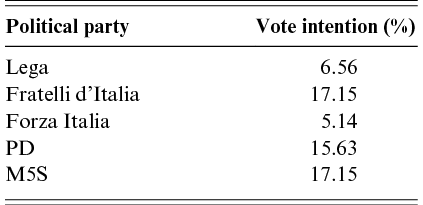
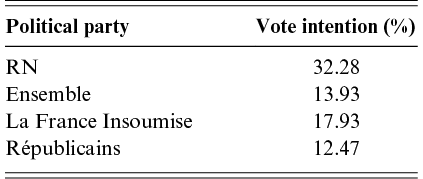
Empirically, our analysis pursues two core objectives. First, to identify the individual-level determinants – sociodemographic, ideological, and psychological – of affective and instrumental attitudes toward fascism. Second, to examine how these attitudes translate into electoral behavior. Specifically, we test whether citizens expressing more positive views of fascism – either emotionally or instrumentally – are more likely to support radical-right parties such as Fratelli d’Italia (FdI) and the Rassemblement National (RN).Footnote 2
The comparative design is central to this inquiry. Italy and France provide contrasting but complementary contexts for studying the afterlives of fascism. Italy was the birthplace of Fascism as a regime and retains an unbroken post-war lineage through the Movimento Sociale Italiano (MSI), Alleanza Nazionale (AN), and FdI, whose 2022 electoral victory brought a radical-right force with explicit post-fascist roots to government (Baldini et al., Reference Baldini, Tronconi and Angelucci2023). France, by contrast, experienced authoritarian rule through the Vichy regime rather than a homegrown fascist movement; its radical right has long sought to distance itself from that past, with Marine Le Pen’s dédiabolisation strategy reframing the RN as a populist-nationalist but non-fascist party (Bolzonar, Reference Bolzonar2023). Comparing these two cases enables us to test whether fascist attitudes resonate differently under conditions of historical normalization (Italy) and normative stigma (France). Italy and France also differ in their memory regimes – the normative environments that set reputational costs for speaking about the past. Italy combines an indigenous fascist regime and a continuous post-war lineage – from the MSI to FdI – within a deinstitutionalized party system (Zanotti, Reference Zanotti2019), conditions that have left symbolic references publicly legible (Baldini, Tronconi, & Angelucci, Reference Baldini, Tronconi and Angelucci2023; Puleo & Piccolino, Reference Puleo and Piccolino2022; Chiaramonte et al., Reference Chiaramonte, Emanuele, Maggini and Paparo2022). France’s post-1990s devoir de mémoire consolidated a high-stigma environment around overt Vichy nostalgia and incentivized strategic distancing by the radical right (Sweets, Reference Sweets1988; Bolzonar, Reference Bolzonar2023). Our design exploits these contrasts: if attitudes toward the authoritarian past matter even where stigma is high, we learn something robust about how legacies surface electorally; if they matter differently where expression is more permissive, we learn how mnemonic climates shape which registers – affective or instrumental – are publicly voiced.
Scope and Delimitations
This Element is not a new history of the interwar years nor a typology of contemporary parties. It studies evaluations – how citizens in two democracies appraise a historically charged label – while keeping the historical anchor in view. Our evidence comes from original pre-electoral surveys (Italy 2022 and France 2024).Footnote 3 We remain agnostic about respondents’ mental representations (regime, ideology, leaders, policies, and memories) and interpret associations prudently: results are observational, not causal. Because the object is sensitive, our items solicit evaluations (admiration, closeness, and perceived usefulness) rather than identities, and the cross-national wording is identical – “fascism” – in Italy and France; what varies is the term’s semantic freight given each country’s memory regime.
Our theoretical framework distinguishes an affective register and an instrumental register of attitudes toward fascism. Empirically, however, our coverage is asymmetric by design and context: in Italy, we field both registers; in France, given the more restrictive memory regime and questionnaire constraints, we field only the instrumental evaluation. We treat this asymmetry not as a flaw but as a theoretically meaningful feature: if overt affect is more reputationally costly in France, observable resonance should concentrate in performance-oriented, instrumental talk. Accordingly, Section 3 analyzes determinants of both registers in Italy and the instrumental register in France; Section 4 examines their respective electoral links.
Contribution
The Element makes three major contributions to the study of the far right and democratic resilience. First, it moves beyond indirect proxies to offer a direct, multidimensional measure of attitudes toward fascism. Rather than inferring sympathy from traits such as right-wing authoritarianism (RWA), populist resentment, or nationalism, we measure citizens’ explicit evaluations of fascism as a political idea. This shift re-centers empirical analysis on the actual ideological referent that continues to haunt European democracies. It also builds on early insights from social psychology – Stagner (Reference Stagner1936), Stagner and Katzoff (Reference Stagner and Katzoff1942), and Edwards (Reference Edwards1941) – by updating them for the twenty-first century.
Second, it reframes the debate on authoritarian legacies by showing that attitudes toward fascism are neither extinct nor homogeneous. By disaggregating them into affective and instrumental components, we uncover distinct mechanisms through which the fascist past resonates today. Affective attachment points to enduring symbolic and cultural admiration – a challenge for democratic memory and civic education. Instrumental endorsement, in contrast, signals a more immediate risk: the willingness to tolerate authoritarian solutions when democracy appears ineffective. Distinguishing these paths refines our understanding of the conditions under which citizens become receptive to illiberal politics.
Third, the Element contributes to broader discussions about the mainstreaming of extremism and the post-fascist transformation of the European right. Scholars have noted how radical-right actors normalize elements of the fascist legacy while formally rejecting it (Traverso, Reference Traverso2019; Mudde, Reference Mudde2019; Finchelstein, Reference Finchelstein and la Torre2019). By tracing voters’ attitudes toward fascism, we show how such normalization operates from below: how citizens’ moral boundaries vary, and how parties activate or mute these dispositions electorally.
Taken together, these contributions extend beyond Italy and France. They invite renewed attention to how democratic publics reckon with discredited pasts – and how latent sympathies for authoritarianism, once thought extinct, can find new expression through democratic channels. By providing the first systematic, comparative evidence on contemporary attitudes toward fascism, this Element helps clarify how legacies of authoritarianism endure and why they continue to matter for the resilience of democracy in Western Europe.
The rest of this Element unfolds as follows. Section 1 establishes the historical baselines and memory regimes that structure what is sayable about fascism and Vichy in Italy and France. Section 2 develops the conceptual framework: We clarify what we mean by fascism as a historical object, explain why direct attitudes are required beyond standard proxies, and specify two distinct attitudinal faces – affective and instrumental – along with our measurement strategy. Section 3 investigates the determinants of each face in both countries, focusing on sociodemographic, ideological, and psychological profiles. Section 4 examines electoral resonance, asking whether affective and instrumental evaluations of fascism bear on vote choice once ideological self-placement and sociodemographic characteristics are taken into account. Section 5 synthesizes the comparative findings and their implications for understanding far right electorates and democratic resilience and concludes with avenues for future research.
1 From Fasci to Vichy: Regimes, Afterlives, and Memory
1.1 Italy
1.1.1 Origins of Italian Fascism: From the Fasci di Combattimento to Regime (1919–1925)
Italian fascism emerged from the fractures of the Great War and its unsettled aftermath. Victory in 1918 did not deliver equilibrium. Instead, the country faced mass demobilization, inflation, unemployment, and a punitive politics of grievance – the rhetoric of the “mutilated victory,” claiming that the Paris Peace settlement failed to deliver promised territorial gains, dramatized by D’Annunzio’s 1919 seizure of Fiume. Liberal cabinets looked brittle; the monarchy was cautious; and a public sphere saturated by trench memories and nationalist resentment proved fertile ground for anti-parliamentary experiments.
Between 1919 and 1920 in the industrial North and parts of the agrarian Po Valley, the “two red years” (Biennio Rosso) brought unprecedented strikes, land seizures, factory occupations, and maximalist rhetoric from the Socialist Party and revolutionary unions. At once exhilarating and alarming, this wave of contention exposed the weakness of the liberal state’s coercive capacity and persuaded many landowners, industrialists, and local officials that ordinary policing could not restore order. That perception would power the search for paramilitary solutions. On 23 March 1919, in Milan’s Piazza San Sepolcro, Benito Mussolini assembled ex-servicemen, Arditi, nationalists, and syndicalists to launch the Fasci di Combattimento. The early platform was eclectic: anticlerical and republican accents sat alongside calls for national rejuvenation, expansion of suffrage, social discipline, and a rhetoric of order and energy. In the 1919 election, the Fasci performed poorly; as a parliamentary force, they were negligible. But at street level they were learning the tactic that would define their ascent: routinized political violence. From 1920 onward, fascist squadristi – paramilitary squads organized by provincial ras, financed by landowners and industrialists – mounted “punitive expeditions” against socialist headquarters, cooperatives, union halls, and left-wing municipalities, especially across Emilia-Romagna, Veneto, and Tuscany.Footnote 4 Violence had a dual logic: it disciplined enemies and signaled to notables that the Fasci could deliver what the liberal state could or would not. Landowners, industrialists, veterans’ networks, and segments of the police increasingly tolerated – or actively supported – this privatized coercion. The Fasci thus became a brokered movement, binding paramilitary activism to the protection and patronage of local elites.
1.1.2 From Movement to Party
The attempt at a “Pact of Pacification” with the socialists (summer 1921) was brief and instrumental; by November 1921 Mussolini refounded the movement as the Partito Nazionale Fascista (PNF). The PNF married a formal electoral vehicle to a paramilitary arm – the camicie nere (black shirts) – and a repertoire of mass mobilization: rallies, uniforms, liturgy, and a leader cult. As liberal parties fragmented and the Socialists and Catholic Popular Party struggled to coordinate, the PNF offered elites and voters a simple promise – authority, unity, and national dignity – enforced by squads and wrapped in patriotic ritual.
Over 1921–1922, prefects and police acquiesced, notables shifted support to the squads, and socialist municipalities were dismantled. A “dual power” emerged in the North – formal authority on paper, fascist order on the ground – leaving the liberal government exposed.
Against this backdrop of localized dominance and national paralysis, the March on Rome (October 1922) was as much choreography as insurrection. Between 27 and 28 October 1922, squadristi moved toward Rome; Mussolini was appointed Prime Minister by King Victor Emmanuel III on 30 October. Despite epic imagery, most traveled by train: the “march” worked less as an armed takeover than as calibrated pressure on a hesitant monarchy and fractious elites. Few clashes, much theatre – yet enough to consecrate fascism as the guarantor of “order.” The threat of mass mobilization, combined with elite bargaining in Rome, pushed King Victor Emmanuel III to invite Mussolini to form a government. The new cabinet was formally constitutional and coalition-based, but the balance of force had shifted. Fascist control over provincial order, combined with a capacity for organized intimidation, gave the PNF leverage far beyond its seat share.
1.1.3 From Government to Dictatorship (1922–1925)
The 1923 Acerbo Law engineered a majority premium, helping the fascist-led bloc in the 1924 elections. When Partito Socialista Unitario (PSU) secretary and Deputy Giacomo Matteotti denounced electoral violence, he was abducted in Rome on 10 June 1924 by fascist squad members; his body was found two months later, triggering a national outcry and legitimacy crisis. Opposition parties withdrew in protest (the “Aventine Secession”),Footnote 5 hoping the crown would dismiss Mussolini. Instead, on 3 January 1925 Mussolini delivered the speech that marked the decisive turn to dictatorship, assuming “political responsibility” and inaugurating a wave of exceptional laws (1925–1926) that dismantled civil liberties, outlawed opposition, and built the architecture of the one-party state – censorship, special tribunals, and the political police (OVRA).
Born from post-WWI dislocation, Mussolini’s movement leveraged paramilitary violence and elite bargains to convert a minority party into a one-party dictatorship between 1922 and 1925. The exceptional laws (1925–1926) outlawed opposition and created special tribunals, while the regime established and subsequently expanded its political-police apparatus, commonly known as OVRA. The corporatist economy subordinated labor-capital conflict to state tutelage – unions dismantled, strikes banned – promising a “third way” that maintained property while disciplining conflict. Propaganda and ritual integrated the masses: youth organizations, school curricula, and parades sacralized the leader. The Lateran Pacts (1929) resolved the long-running “Roman Question” over the papacy’s status after Italy’s 1870 annexation of Rome by recognizing Vatican City’s sovereignty and granting Catholicism a privileged position – conferring a powerful seal of moral respectability on a state that was simultaneously jailing opponents and erasing pluralism.
Imperial ventures in Libya, the invasion of Ethiopia (1935–1936), intervention in Spain, and the 1938 racial laws normalized exclusion. Italy entered WWII in June 1940, slid into German tutelage, and imploded in 1943; the Nazi-backed Italian Social Republic prolonged violence until 1945. This baseline anchors what we mean by fascism as a regime – mass-mobilizing, personalist, repressive, imperial, and ultimately militarized – and clarifies how today’s attitudes relate to (or disavow) that legacy (Varley, Reference Varley2012; Farquet, Reference Farquet2025; Bolzonar, Reference Bolzonar2023).
The Italian path from paramilitary brokerage to elite accommodation and finally to legal-institutional lock-in established the core features of historical fascism: fusion of party and state; personalist leadership sacralized through propaganda; a corporatist political economy that subordinated labor under state tutelage; and routinized coercion presented as national renewal. It also helps explain why Italy remains an analytically “permissive” case: the regime was indigenous; its memory was never fully cordoned off; and a post-war party lineage kept facets of that archive legible in democratic politics. Equally important is the texture of popular memory: durable micro-legends that circulate in everyday talk – “Mussolini also did some good things,” the cliché that “at least he made the trains run on time” – offer a vocabulary for softening judgment without overt nostalgia, lowering the stigma threshold for selective references to the fascist past and keeping them publicly usable. Those contrasts will organize our comparison with France later in this section.
1.1.4 From Post-War Neo-Fascism to Government – Continuities, Rebranding, and Mainstreaming
The “Fiuggi turn” (1995) marked the transformation of MSI into AN and the latter’s formal repudiation of fascism’s totalitarian legacy, opening governing coalitions with Berlusconi while maintaining personnel continuities with MSI-era elites (Puleo & Piccolino, Reference Puleo and Piccolino2022). After the Popolo della Libertà cycle (2009–2012), FdI was founded in 2012. FdI is thus a “rooted newcomer”: electorally new yet drawing on pre-existing networks, symbols, and narratives familiar to right-of-center voters. That rootedness is also legible in iconography: FdI’s logo retains the tricolor flame – historically associated with the MSI – as a visual marker of continuity, even as the party’s manifesto has moderated its language (Puleo & Piccolino, Reference Puleo and Piccolino2022; Baldini, Tronconi, & Angelucci, Reference Baldini, Tronconi and Angelucci2023; Zanotti & Meléndez, Reference Zanotti, Meléndez, Ringe and Rennó2023).
FdI’s ascent unfolded in a deinstitutionalized party system. Meloni’s decision to remain outside the Draghi government (2021–2022) differentiated FdI from its allies, concentrating opposition votes and accelerating the party’s move to primacy (Baldini et al., Reference Baldini, Tronconi and Angelucci2023; Chiaramonte et al., Reference Chiaramonte, Emanuele, Maggini and Paparo2022). In the 25 September 2022 election, FdI emerged as Italy’s largest party, and Meloni formed the first government led by a radical-right actor in the republican era (Chiaramonte et al., Reference Chiaramonte, Emanuele, Maggini and Paparo2022).
Scholarly debate therefore turns on the quality of FdI’s mainstreaming: Is it primarily a moderation story (convergence toward conservative democracy) or also a normalization of undemocratic legacies? Recent comparative work suggests limited ideological continuity with MSI/AN – constraining outright diffusion of extreme-right programmatic content – yet highlights symbolic and organizational links (personnel, narratives, emblems) that can still indirectly lower taboos and move boundaries in public discourse (Lorimer & Cavallaro, Reference Lorimer and Cavallaro2025; Baldini et al., Reference Baldini, Tronconi and Angelucci2023; Puleo & Piccolino, Reference Puleo and Piccolino2022).
Conceptually, this sits at the intersection of two literatures. First, the far right–radical right debateFootnote 6 cautions against treating contemporary actors as wholly severed from neo-fascist legacies; adaptation and repackaging have long been part of the European far right’s playbook (Copsey, Reference Copsey2013). Second, research linking illiberal, leader-centric attitudes to radical-right voting underlines why Italy’s configuration matters for democratic resilience: in contexts where supply-side actors with rooted networks gain legitimacy, demand-side reservoirs of support for strong, unchecked leadership can be more readily mobilized (Donovan, Reference Donovan2021).
1.2 France
1.2.1 Origins of Vichy: From Collapse to the Révolution Nationale (1940–1942)
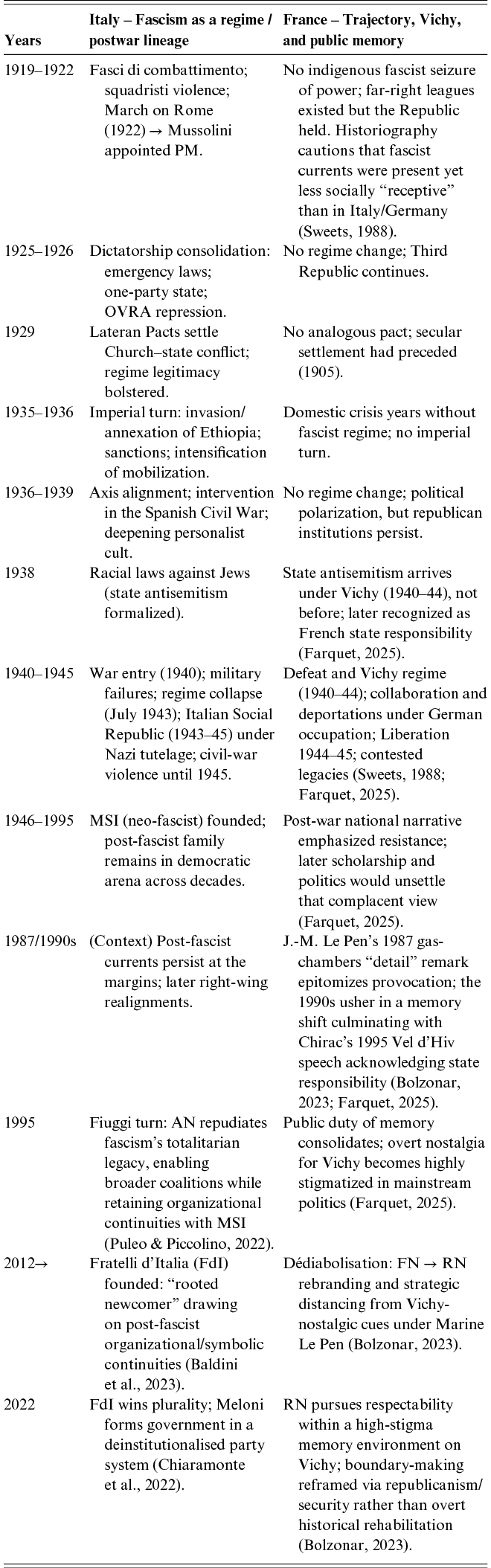
As summarized in Table 1, the French trajectory diverges sharply from the Italian path, with defeat and collaboration – rather than a mass seizure of power – setting the terms for later memory politics.

Table 1 Long description
Three-column timeline comparing Italy and France. Years run from 1919–1922 to 2024. Italy’s column traces the Fasci di combattimento, squadristi violence, dictatorship consolidation, the Lateran Pacts, imperial expansion, racial laws, war and regime collapse, MSI and post-fascist lineages, the Fiuggi turn, Fratelli d’Italia’s founding, and Meloni’s 2022 government. France’s column contrasts the absence of an indigenous fascist seizure, Vichy and collaboration, post-war memory politics, Le Pen’s provocations, the post-1990s duty of memory, RN dédiabolisation, and 2024 boundary-making rhetoric.
France’s authoritarian turn did not stem from a homegrown fascist seizure of power but from military defeat and state collapse in May–June 1940. The 22 June 1940 armistice split France into occupied and “unoccupied” zones, the latter governed from Vichy. On 10 July 1940, Parliament granted Marshal Pétain “full powers,” suspending republican laws and concentrating authority in his hands as Chef de l’État. What followed was framed not as a coup but as national continuity under exceptional constraints (Sweets, Reference Sweets1988).
The new regime announced the Révolution Nationale (“Travail, Famille, Patrie”), repudiating parliamentarism and emphasizing hierarchy, order, and Catholic traditionalism. Unlike Italian or German fascism, Vichy relied on prefects, police, and administrative state apparatus rather than mass party mobilization (Sweets, Reference Sweets1988).
The Montoire meeting (October 1940) symbolized the turn to “state collaboration.” The regime promulgated racial statutes (October 1940, 1941) excluding Jews from public life, coordinated dispossession through a General Commissariat, and cooperated in deportations – culminating in the rafle du Vél d’Hiv (July 1942). Repressive tools expanded: censorship, special jurisdictions, the Milice (January 1943), and Compulsory Work Service (STO, February 1943).
Vichy officials justified choices as protecting “national interests” under duress, but the historical reassessment has emphasized autonomous French agency in persecution and collaboration (Sweets, Reference Sweets1988; Bolzonar, Reference Bolzonar2023). These features – defeat and state reconfiguration, administrative agency in collaboration, and territorial unevenness – constitute the historical referent of “Vichy” we carry forward. We return next to how, decades later, public reckoning recast that past and reshaped the costs of invoking it.
1.2.2 From Gaullist Myth to Devoir de Mémoire (1990s–present)
By the early 1990s, the historiographical turn described earlier crystallized into a wider public reckoning. With all the caveats of comparability, opinion series show a steady decline in benevolent views of Pétain, and President Jacques Chirac’s 1995 address on the rafle du Vél d’Hiv marked a watershed: for the first time, the presidency explicitly acknowledged French state responsibility in the deportations, re-centering commemorations on administrative complicity and inaugurating a durable “duty of memory” (devoir de mémoire). This rhetorical realignment was accompanied by institutional guard-rails – the 1990 Gayssot Law penalizing Holocaust denial; the consolidation of memorial infrastructure (e.g., the Mémorial de la Shoah); high-profile trials foregrounding bureaucratic agency (Papon, 1997–1998); and curricular reforms that brought Vichy collaboration into mainstream civic instruction. Together, these measures raised the reputational – and sometimes legal – costs of overt rehabilitation of Vichy in mainstream competition and stabilized the post-1990s moral economy of memory within which parties must operate (Sweets, Reference Sweets1988; Varley, Reference Varley2012; Bolzonar, Reference Bolzonar2023).
Within that tightening memory regime, the radical right’s first durable vehicle, Jean-Marie Le Pen’s Front National (FN), often pursued deliberate boundary-testing. Provocations about the Occupation and the Holocaust – such as dismissing gas chambers as a “detail” of the war, or punning slurs against opponents – functioned in two ways: they signaled to radical sub-publics while scandalizing the mainstream and securing media oxygen. The strategy fit an anti-system posture but carried electoral and coalition penalties in a setting where explicit nostalgia or relativization had become toxic; the more the devoir de mémoire consolidated, the narrower the space for transgressive historical cues as a path to normalization (Bolzonar, Reference Bolzonar2023).
Against this backdrop, Marine Le Pen recoded the repertoire. Organizationally, dédiabolisation paired a symbolic rupture – marginalizing Jean-Marie Le Pen’s repertoire and rebranding FN as RN – with tighter candidate vetting and message discipline. Substantively, it shifted the party’s justificatory grammar from suggestive flirts with the wartime archive to present-tense idioms of republicanism, sovereignty, laicity, and security. The move did not imply a liberal turn; it was a strategic re-casing of exclusionary nationalism within accepted moral coordinates. On memory, the RN has generally avoided taboo-triggering cues and, where necessary, adopted responsibility language – while episodes like Marine Le Pen’s 2017 claim that “France” was not responsible for Vél d’Hiv reveal the persistent temptation to hedge by separating “the state in 1942” from “the nation,” a distinction that courts controversy without amounting to overt rehabilitation. In Bolzonar’s supply–demand lens, as stigmatization of Vichy strengthened in national culture, it narrowed the ideological space for nostalgic signaling and rewarded a pivot: channel boundary-making through republican security and sovereigntist frames rather than through the discredited archive (Bolzonar, Reference Bolzonar2023). Electorally, the reframing dovetailed with changes in the RN’s social geography – gains among blue-collar voters and in deindustrialized territories – where the party’s “protections” narrative (borders, crime, and purchasing power) travels better than any backward-looking claim about the 1940–1944 period.
Éric Zemmour’s 2021–2022 bid tested these boundaries with openly revisionist claims (e.g., that Pétain “protected” French Jews). The wager mobilized a niche electorate but triggered counter-mobilization and forced RN to mark distance, confirming that overt Vichy apologia remains electorally costly (Bolzonar, Reference Bolzonar2023). For our purposes, the implication is straightforward: if attitudes toward the authoritarian past still surface in France, they are most likely to do so indirectly – as performance-oriented talk of order, sovereignty, and protection – rather than as open affective nostalgia grounded in the 1940–1944 archive.
Bringing these strands together, France today exhibits a relatively stable equilibrium shaped by three forces. First, the historical scholarship and subsequent institutionalization of memory politics (laws, trials, curricula, and memorials) have entrenched high stigma for overt nostalgia or relativization (Sweets, Reference Sweets1988; Varley, Reference Varley2012; Bolzonar, Reference Bolzonar2023). Second, party strategy has adapted: the RN’s dédiabolisation seeks governing potential by aligning with the duty-of-memory consensus in form, while translating exclusionary agendas into present-tense registers – order, security, sovereignty, and laicity – that avoid the stigma trigger. Third, attempts to reverse this equilibrium through revisionist provocation (Zemmour) face visible ceilings and impose collateral costs on coalition-building to the right.
For our comparative framework, the implication is straightforward. In France, explicit positive couplings to Vichy carry high reputational costs; whatever resonance the authoritarian past retains is more likely to appear instrumentally – as performance talk about decisiveness, protection, and sovereign control – than as open affective attachment. This is precisely why France serves as a restrictive test case in our design: if attitudes toward the authoritarian past bear any observable relation to electoral behavior here, they are doing so through coded, present-oriented registers, not through nostalgic avowal (Bolzonar, Reference Bolzonar2023).
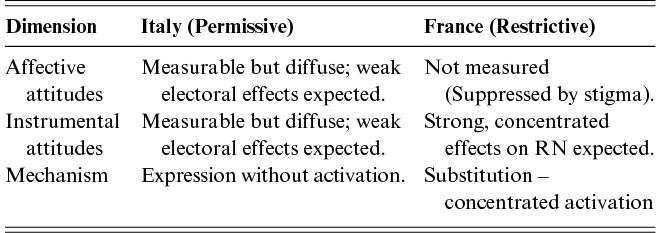
Side by side, Italy and France sketch the expression frontier for historically charged attitudes. Italy couples an indigenous regime and continuous post-war lineage with weak normative constraints, making affective registers more publicly admissible. France couples occupation with a decisive duty-of-memory turn and radical-right dédiabolisation, channeling residual resonance into instrumental, present-tense vocabularies. These contrasts set the reputational prices of saying the past aloud and structure the measurement strategy developed in Section 2.
2 Affective and Instrumental Attitudes toward Fascism in Italy and France
This section provides the conceptual foundations for studying direct attitudes toward fascism in Italy and France. The objective is not to relabel contemporary party families but to keep a historically bounded object – “fascism” – in analytic view while theorizing how citizens evaluate it today. We proceed in four steps: bounding the object (Section 2.1), motivating direct measurement (Section 2.2), specifying the affective–instrumental distinction and theorizing memory regimes as expression filters (Section 2.3), and presenting the operationalization, descriptive patterns, and measurement considerations (Sections 2.4 and 2.5). Sections 3 and 4 test these distinctions empirically.
2.1 Guard-Rails: What We (Do and Don’t) Mean by “Fascism”
We anchor “fascism” in its historical referent rather than use it as a floating synonym for illiberalism. By “fascism” we mean the Italian interwar regime and, in the French case, the Vichy authoritarian state – the specific historical formations detailed in Section 1. This is an analytic choice that provides a bounded object of evaluation and prevents the term from collapsing into a vague placeholder for “authoritarianism” or “things I dislike.” It allows us to interpret cross-national patterns in a common frame while recognizing that memory regimes shape what each country’s publics associate with the term.
This boundary aligns with established conceptual practice. Comparative scholarship typically distinguishes between interwar fascism – often theorized as a revolutionary, palingenetic form of ultranationalism that sought to remake the nation through a totalitarian state (Griffin, Reference 98Griffin2013) – and today’s far-right actors, who operate as illiberal democratic forces competing within procedural constraints (Mudde & Rovira Kaltwasser, Reference Mudde and Kaltwasser2017). While party-level research has examined how contemporary movements selectively rework, normalize, or distance themselves from those legacies (Caramani & Manucci, Reference Caramani and Manucci2019; Manucci, Reference Manucci2019; Finchelstein, Reference Finchelstein and la Torre2019; De la Torre, Reference De la Torre2025), far less is known about how ordinary citizens evaluate the historical regimes themselves. Do voters harbor residual admiration for fascist leaders or narratives? Do they view authoritarian methods from that era as pragmatically useful today? And do these evaluations, if they exist, shape contemporary political behavior? Answering these questions requires treating fascism as a distinct object of evaluation rather than inferring attitudes from adjacent constructs like authoritarianism or populism. Keeping the historical referent in view lets us ask whether – and how – these legacies still resonate, without presuming continuity or equivalence between past regimes and present parties.
We do not assume that respondents share our definition. When citizens evaluate “fascism,” they may invoke regime features, specific leaders, wartime memories, family stories, symbolic aesthetics, policy outcomes, or contemporary political rhetoric that deploys the term. We remain agnostic about these mental representations. At the measurement stage, we field identical neutral wording in both countries – asking about “fascism” without further specification – and allow respondents to map the label onto their own frameworks of national memory and political language. Analytically, we retain the historical anchor so that cross-national variation remains interpretable; empirically, the evaluations are respondent-defined.
By contrast, we use far right in the contemporary, standard sense: a party family that competes within democratic procedures and typically bundles nativism, populism, and an authoritarian orientation – without equating these actors with the interwar regimes (Rydgren, Reference 100Rydgren2018; Mudde & Rovira Kaltwasser, Reference Mudde and Kaltwasser2017; Copsey, Reference Copsey2013). Maintaining this distinction lets us test – rather than assume – whether evaluations of the historical object connect to contemporary electoral behavior.
This conceptual boundary – fascism as historical object, radical right as contemporary party family – conditions what we measure and how we interpret cross-national contrasts. Section 2.2 explains why direct evaluations of the historical regime, rather than proxies alone, are required to separate identity work from performance reasoning.
2.2 Why Measuring Direct Attitudes toward Fascism (and not Just Proxies)
A large literature explains contemporary illiberalism using adjacent orientations – RWA, social dominance orientation (SDO), securitarian threat sensitivity, and populist attitudes. These predispositions travel across policy domains and correlate with support for radical-right parties, making them valuable tools for understanding authoritarian potential in mass publics (Altemeyer, Reference Altemeyer1981; Sidanius & Pratto, Reference Sidanius and Pratto1999; Norris & Inglehart, Reference Norris and Inglehart2019). Yet they do not tell us whether people evaluate fascism itself positively or negatively – and that distinction matters for both inference and democratic diagnostics. This concern aligns with a growing empirical literature on historical political economy that has documented the long-run persistence of attitudes shaped by authoritarian regimes and political violence (Voigtländer & Voth, Reference Voigtländer and Voth2012; Wittenberg, Reference Wittenberg2006; Charnysh & Finkel, Reference Charnysh and Finkel2017; for a synthesis, see the relevant chapters in Jenkins & Rubin, Reference Jenkins and Rubin2024). This work shows that authoritarian pasts leave durable imprints on mass political behavior – imprints that generic predispositions like RWA or SDO are not designed to detect, since they are calibrated to capture stable psychological orientations rather than the historically specific evaluations through which these legacies surface. Party rhetoric, crises, and media framing can alter how citizens evaluate a historical regime without changing their underlying traits – dynamic processes that trait-based proxies cannot fully capture (Hetherington & Weiler, Reference Hetherington and Weiler2009).
The core issue is one of specificity. RWA, SDO, and related constructs measure broad psychological orientations: preferences for order, hierarchy, group-based dominance, or punitive responses to threat. These traits are foundational and predictive, but they are not evaluations of particular historical regimes or political objects. A citizen can score high on RWA – preferring conventional morality and strong authority – and still categorically reject fascism on moral or historical grounds, viewing it as a cautionary tale of dictatorship gone wrong. Conversely, someone might express little general authoritarian disposition yet view fascist-era “decisiveness” or “order” as pragmatically useful in moments of perceived crisis, institutional failure, or disorder. By relying solely on proxies, we risk misattributing the sources of radical-right support: conflating stable psychological traits with historically conditioned evaluations, or assuming that high RWA automatically translates into positive views of any authoritarian past (Rydgren, Reference 100Rydgren2018).
The comparative payoff hinges on memory regimes (see Section 1). Our items use identical wording – “fascism” – in Italy and France, but what varies is the sayability of positive evaluations given each country’s mnemonic climate. In more permissive environments, where selective normalization has lowered reputational costs, citizens may be more willing to express positive views when directly asked. In more restrictive climates shaped by a duty of memory and high stigma around overt nostalgia, such evaluations may be suppressed or recoded into more admissible idioms. Proxies alone cannot reveal these shifts because RWA and SDO do not vary with memory regimes in the same way – they are psychological traits, not publicly voiced evaluations subject to social desirability pressures or normative constraints. Direct attitudes, by contrast, are sensitive to what is publicly sayable and thus allow us to test how mnemonic environments filter expression (Bolzonar, Reference Bolzonar2023).
Finally, the distinction carries normative weight. If we infer attitudes solely from RWA or SDO, we treat authoritarianism as generic disposition to be managed through tolerance. But if publics specifically evaluate the fascist regime positively, the challenge shifts to how societies reckon with their histories: whether civic education and memory institutions successfully delegitimize discredited pasts, or whether those pasts remain available as symbolic or functional resources. Section 2.3 develops this further, arguing that attitudes toward fascism are not monolithic but comprise distinct evaluative registers with different psychological mechanisms and political consequences.
Having established why direct measurement is necessary, we now turn to theorizing how attitudes toward fascism are structured. Section 2.3 argues that these attitudes are multidimensional, comprising distinct evaluative registers with different psychological mechanisms and political consequences.
2.3 Conceptualizing Two Dimensions: Affective and Instrumental Attitudes
Having established why direct measurement of attitudes toward fascism is necessary (Section 2.2), we now argue that these attitudes are themselves multidimensional. This is a familiar lesson in political behavior research. Easton’s classic framework distinguished diffuse support (intrinsic, identity-laden attachment to a regime) from specific support (performance-based evaluations of outputs), showing that collapsing the two obscures how legitimacy is built or eroded over time (Easton, Reference Easton1975; Norris, Reference Norris1999). Partisan attachments similarly combine expressive identity and instrumental running tallies of party performance (Fiorina, Reference Fiorina1981). Attitudes toward the European Union exhibit the same duality: affective European identity operates through different mechanisms than utilitarian cost–benefit reasoning (Boomgaarden et al., Reference Boomgaarden, Schuck, Elenbaas and De Vreese2011). When an attitude domain mixes identity and use-case strands, treating it as a single construct produces attribution errors – we cannot tell which dimension is doing the work, or whether distinct pathways exist from predispositions to behavior.
Applying this logic to fascism, we theorize that citizens may respond to the historical archive along (at least) two analytically distinct dimensions. The first, which we term affective, captures emotional or symbolic attachment: warmth toward emblematic leaders, pride in mythologized narratives of national “strength,” or a sense of closeness to associated symbols and memories. The second, instrumental, captures performance-oriented judgments: the view that traits commonly associated (rightly or wrongly) with fascism – decisive rule, hierarchical discipline, “getting things done” – would be useful or effective under present conditions. One concerns identity work; the other, use-case reasoning. While related, they need not move together.
2.3.1 Affective Attitudes: Identity and Symbolic Attachment
By affective attitudes toward fascism, we mean emotional or symbolic orientations to the historical archive – not endorsement of authoritarianism across all domains, but a localized sense of warmth, pride, or identification with leaders, narratives, or symbols associated with the regime. This can take multiple forms: admiration for charismatic figures (e.g., Mussolini as embodying “strength”), pride in selective memory of national achievements attributed to the era (infrastructure myths, the “trains running on time” trope), or a diffuse sense of heritage attachment transmitted through family stories or local commemorations. Crucially, affective attitudes can exist without a full-throated defense of dictatorship; they are compatible with democratic commitments if bracketed as “a different time” or if the regime’s repressive features are minimized or aestheticized.
Psychologically, affective attitudes operate through mechanisms of identity and heritage: they draw on symbolic attachment to leaders, narratives of moral order, and in-group belonging. The conceptual core is that affective warmth reflects who I am or where I come from rather than calculations about governance effectiveness. Affective orientations resonate with rhetoric that frames the past as a repository of lost virtues (discipline, sacrifice, unity) rather than as a policy blueprint. Section 3 examines empirically which psychological and ideological traits align with this evaluative register. Memory transmission shapes how these affective orientations are sustained across generations. In contexts where families or local communities retained positive or ambivalent oral histories – “my grandfather said Mussolini did good things,” or localized pride in specific regime-era public works – such narratives can circulate as durable micro-legends that soften judgment without requiring overt ideological commitment (Foot, Reference Foot2009). These are not elite-driven campaign messages but everyday cultural resources that lower the threshold for expressing warmth when survey items invite evaluation.
Affective attitudes also function as identity signals: they mark belonging to a political or cultural tradition without requiring explicit self-identification as “fascist.” In Italy, where post-fascist party lineages maintained organizational and symbolic continuities, expressing affective warmth toward the fascist archive can serve as shorthand for right-bloc membership or anti-leftism, even among voters who would reject totalitarian rule in principle. In such settings, affective evaluations operate less as policy preferences than as expressive positioning – a way to signal “who I am” or “where I come from” in the political landscape without embracing a stigmatized identity label.
2.3.2 Instrumental Attitudes: Performance and Efficacy
By instrumental attitudes toward fascism, we mean performance-oriented evaluations: the belief that methods or outcomes associated (fairly or unfairly) with fascism would be effective or useful today. This is not admiration for the historical regime; it is a use-case judgment. Respondents holding instrumental views may believe that “strong,” hierarchical government delivers order in moments of crisis, that decisiveness trumps deliberation when institutions are gridlocked, or that discipline and command structures “get things done” more efficiently than pluralistic negotiation. Crucially, instrumental attitudes can coexist with explicit moral disavowal of the past. The reasoning is not “fascism was good” but “those methods work when democracy is weak.”
Psychologically, instrumental attitudes operate through mechanisms of performance and efficacy: they are activated by perceptions of disorder, institutional failure, or external threat and express preferences for command structures that “deliver results” regardless of moral attachment to the past. The conceptual core is that instrumental reasoning reflects what works rather than who I am. This makes instrumental attitudes theoretically sensitive to context: they may shift as perceptions of crisis or institutional effectiveness change (Hetherington & Weiler, Reference Hetherington and Weiler2009). Section 3 examines empirically which psychological and ideological traits align with this evaluative register. Importantly, instrumental attitudes are more easily translated into present-tense idioms that avoid overt rehabilitation. Rather than defending Mussolini or Pétain, citizens can argue for “strong leadership,” “law and order,” “sovereignty,” or “discipline” without naming the historical referent.
2.3.3 Why the Distinction Matters
Treating attitudes toward fascism as a single score risks misattribution. Affective and instrumental orientations are likely activated by different considerations (identity/heritage vs. performance/crisis), may align with different psychological profiles, and – critically – may map onto electoral behavior through distinct pathways. By “memory regime,” we refer to the institutionalized set of practices, norms, and discourses through which a polity organizes the public memory of its authoritarian past – encompassing legal frameworks (e.g., laws penalizing denial), commemorative infrastructure (memorials, anniversaries, museums), curricular content, judicial rulings, and elite rhetoric (Bernhard & Kubik, Reference Bernhard and Kubik2014; Wüstenberg, Reference Wüstenberg2017). Memory regimes vary along two key dimensions: the content of officially sanctioned narratives (which actors are remembered as victims, perpetrators, bystanders) and the intensity of normative pressure they exert against alternative or revisionist accounts (Art, Reference Art2005). Following this literature, we treat memory regimes not as static cultural backdrops but as actively maintained political settlements that shape the reputational costs of speaking about the past in particular ways. They function, in our framework, as expression filters: by raising or lowering the social and legal price of overt nostalgia, they channel where latent attitudes toward authoritarian legacies become publicly observable.
Memory regimes thus act as expression filters rather than causes. They shape what can be said in surveys, media, and everyday talk: narratives that decouple “authoritarian order” from “totalitarian excess” widen niches for affective expression, while commemorative cycles and legal constraints (e.g., France’s Gayssot Law) raise the cost of overt nostalgia and channel expression toward instrumental idioms (Bolzonar, Reference Bolzonar2023).Footnote 7
In sum, affective and instrumental attitudes toward fascism are conceptually and analytically distinct: citizens can admire a mythologized archive yet doubt its usefulness today; they can view decisiveness as effective under stress while rejecting any pride in the past. Conflating them into a single measure would obscure these distinct routes and mask how predispositions, memory regimes, and party rhetoric interact to shape contemporary evaluations of authoritarian pasts.
The comparative design leverages this distinction. Italy’s permissive mnemonic environment lets us observe both registers and test whether they exhibit distinct correlates and electoral effects. France’s restrictive setting allows us to observe only the instrumental channel – but precisely where theory predicts any residual resonance should concentrate. Sections 3 and 4 use this framework to model the determinants of each dimension (Section 3) and their electoral consequences (Section 4). Section 2.4 presents the survey items that operationalize these dimensions and reports core descriptive patterns from both countries.
2.4 Operationalization and Descriptive Patterns
Having established the conceptual distinction between affective and instrumental attitudes, we now turn to measurement. This section presents the survey items used to capture each dimension, reports descriptive distributions from Italy and France, and examines how respondents distribute across the two-dimensional space.
2.4.1 Measuring Affective Attitudes (Italy)
Affective attitudes toward fascism were operationalized through two survey items administered in Italy. Both solicit emotional or symbolic orientations toward the historical archive without imposing a definition of what “fascism” means.
The first item measured fascist admiration, asking: “Which of the following words best describes your feelings about fascism?” Responses ranged on a five-point scale from disdain (1) to admiration (5). The second item measured fascist closeness, asking: “Which of the following words best describes your sense of proximity to fascism?” Responses ranged from hatred (1) to closeness (5). Together, these items index affective attachment: higher scores signal stronger emotional or symbolic affinity with the fascist archive.
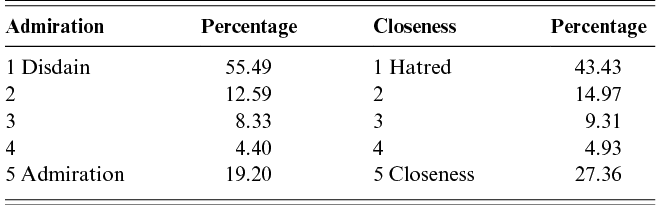
The descriptive distributions reveal that, while a majority of Italians express negative affect, a non-trivial minority registers warmth or proximity. Table 2 reports the full distributions.
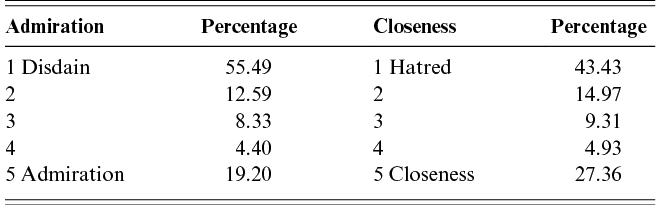
Table 2 Long description
The table reports percentages on two five-point scales. For admiration: disdain 55.49, category 2 12.59, midpoint 8.33, category 4 4.40, and admiration 19.20. For closeness: hatred 43.43, category 2 14.97, midpoint 9.31, category 4 4.93, and closeness 27.36.
On the admiration scale, a majority (55.49%) select “disdain,” and an additional 12.59% choose category 2, anchoring the distribution in disapproval. Yet the right tail is visibly thick: 8.33% fall at the midpoint, 4.40% select category 4, and 19.20% – nearly one in five respondents – choose “admiration.” The closeness scale shows a similar but slightly more dispersed pattern: 43.43% report “hatred,” 14.97% select category 2, but 27.36% express “closeness,” with 9.31% at the midpoint and 4.93% in category 4.
These distributions yield mean scores of 2.19 for admiration and 2.57 for closeness. While both remain well below the scale midpoint (3.0), indicating aggregate disapproval, the substantial minorities expressing positive affect are inconsistent with a fully delegitimized archive. Instead, they suggest pockets of residual warmth that persist in the Italian electorate – what we elsewhere term “soft affective normalization.” This is consistent with a public sphere where selective rehabilitation of the fascist past circulates with lower reputational costs (see Section 1), and where family memories, local myths (e.g., “Mussolini made the trains run on time”), and party lineages (MSI → AN → FdI) keep affective idioms publicly legible.
The two affective items capture related facets of affective attachment – emotional warmth (admiration) and identity-based proximity (closeness). For modeling purposes (Section 3), we combine them into an affective index.
2.4.2 Measuring Instrumental Attitudes (Italy and France)
Instrumental attitudes toward fascism were measured through a single item administered in both countries: “Fascist ideas can, in some way, contribute to the politics of my country.” Responses ranged on a five-point scale from strongly disagree (1) to strongly agree (5). This wording solicits a pragmatic, performance-oriented judgment – whether traits associated with fascism (rightly or wrongly) are seen as useful today – without requiring admiration or identification. We interpret responses to this item not as endorsements of the historical regime itself but as projections of present-day governance preferences onto a historical referent: respondents who agree are signaling that traits they associate with fascism – decisiveness, hierarchy, and order – would be useful today, regardless of whether such traits are historically accurate features of interwar fascism or Vichy.
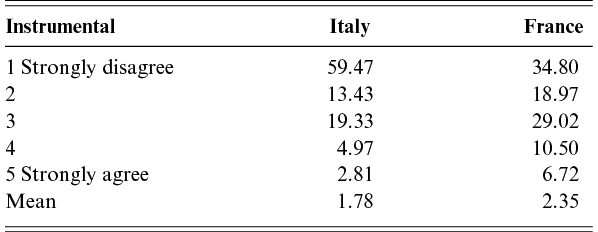
The cross-national distributions reveal that instrumental resistance remains predominant but not universal, and they exhibit a striking reversal: stronger resistance in Italy (the permissive mnemonic environment) and greater openness in France (the restrictive environment). Table 3 presents the full comparison.
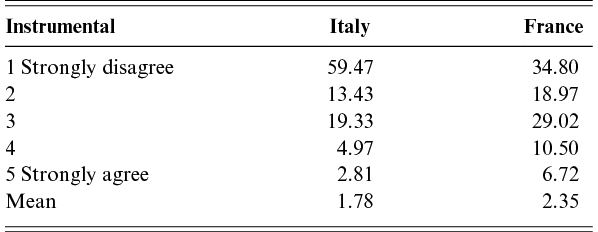
Table 3 Long description
The table compares agreement that fascist ideas can contribute to national politics. Italy: strongly disagree 59.47, category 2 13.43, midpoint 19.33, category 4 4.97, strongly agree 2.81, mean 1.78. France: strongly disagree 34.80, category 2 18.97, midpoint 29.02, category 4 10.50, strongly agree 6.72, mean 2.35.
2.4.3 The Four Configurations: Conceptual Implications
Having examined each dimension separately, we now consider how they combine. In Italy, where we measure both affective and instrumental attitudes, respondents can theoretically distribute across four configurations. Here we outline what each configuration implies substantively.
Profile 1: High affective, high instrumental. Respondents express both symbolic attachment and belief in contemporary utility. This configuration most straightforwardly aligns with far-right voting.
Profile 2: High affective, low instrumental. Respondents admire the past but reject its contemporary usefulness – heritage consumption decoupled from authoritarian policy preferences. This profile is consistent with democratic commitments that bracket the past as “a different time.”
Profile 3: Low affective, high instrumental. Respondents reject emotional attachment but believe decisive methods would work under present conditions – validating that the two dimensions are distinct. This configuration is likely more common in high-stigma environments where affective expression is costly.
Profile 4: Low affective, low instrumental. Respondents reject the fascist archive on both registers – the normatively modal position. Analytic interest lies in the structured deviations (Profiles 1–3).
Several inferences follow. Profile 2’s existence would confirm that affective warmth operates independently of performance endorsement. Profile 3 validates distinguishing performance heuristics from nostalgia. The framework clarifies what memory regimes filter: Italy’s permissive environment should reveal all four configurations; France’s restrictive climate likely underestimates total resonance. The higher instrumental mean in France (2.35 vs. 1.78 in Italy) is consistent with – though does not directly demonstrate – a substitution effect, since alternative explanations (e.g., differences in contemporary political discourse around order and security, distinct distributions of underlying predispositions) cannot be fully ruled out without affective measurement in the French case.
In sum, memory regimes are not passive backdrops but active filters that shape what citizens are willing to say and, therefore, what researchers can observe. Italy’s permissive climate makes affective expression publicly viable, reducing the need for instrumental substitution. France’s restrictive climate stigmatizes affect and channels residual resonance into instrumental idioms. The result is a cross-national reversal that initially appears paradoxical – lower instrumental endorsement where stigma is low, higher where stigma is high – but is interpretable – though not uniquely so – if we accept that identical survey items interact with distinct normative environments to tap different portions of latent opinion. This insight structures the analyses that follow and underscores the value of the two-dimensional framework: by separating affective from instrumental reasoning, we can observe how memory regimes modulate expression and how that modulation shapes the terrain on which democratic politics unfolds.
2.5 Measurement Considerations
Our measurement strategy balances three goals: capturing direct evaluations of a historically sensitive object, maintaining cross-national comparability, and minimizing respondent risk and social desirability bias. This section addresses key design choices, discusses the rationale for asymmetric coverage across countries, and previews robustness checks detailed in the Appendix.
A central design principle is that our items solicit evaluations rather than identity labels. We do not ask respondents to self-identify as “fascist” or to declare membership in a stigmatized category. Instead, we ask them to assess their feelings, sense of proximity, or views on usefulness regarding “fascism” as a historical and political object. This distinction is crucial in a sensitive domain where social desirability pressures are strong.
The affective items – “Which of the following words best describes your feelings about fascism?” (disdain to admiration) and “Which of the following words best describes your sense of proximity to fascism?” (hatred to closeness) – invite respondents to locate their emotional orientation on a continuum without requiring avowal of a taboo identity. The instrumental item – “Fascist ideas can, in some way, contribute to the politics of my country” – solicits a pragmatic judgment about perceived usefulness rather than a declaration of personal commitment. This framing reduces respondent risk: one can agree that “fascist ideas might contribute” without endorsing the regime or identifying as a fascist sympathizer. It also lowers the threshold for honest reporting, as the question allows for conditional, instrumental reasoning (“it might work under some conditions”) rather than demanding categorical acceptance or rejection. The distributions in Section 2.4 show substantial variation, suggesting respondents are willing to voice evaluations when framed as assessment rather than identity.
We use identical wording – “fascism” without further specification – in both Italy and France. This choice prioritizes analytic comparability over imposed definitional control. We do not tell respondents what “fascism” means; we let them map the term onto their own frameworks of national memory, political discourse, and personal experience. The tradeoff is clear: we gain the ability to compare responses across countries using a common metric, but we accept that the term carries different semantic loads depending on context.
This agnosticism is a feature, not a flaw. Our goal is not to determine “what fascism really is” in respondents’ minds but to observe how they evaluate the term as it circulates in their national political language. If memory regimes shape what “fascism” connotes – and they do – then identical wording will inevitably tap different associative networks across countries. The task is to interpret cross-national patterns in light of these differences, not to eliminate them. Section 1 provides the historical and memorial baseline that makes such interpretation possible; here, we acknowledge the semantic variation and treat it as part of the comparative design rather than as measurement error to be purged.
This stance can be made more explicit. The question is whether our items measure attitudes toward a shared object or toward context-specific meanings of fascism, and our answer is: deliberately the latter. We do not assume that “fascism” carries a homogeneous semantic content across – or even within – national publics. Drawing on the collective memory tradition (Halbwachs, Reference Halbwachs and Coser1992; Assmann, Reference Assmann, Erll and Nünning2008; Rigney, Reference Rigney2018), we treat the term as a mnemonic resource whose meaning is reconstructed through national memory regimes, family transmission, and contemporary political discourse. What survey items capture, then, is not respondents’ alignment with a fixed historical referent but their evaluative response to the term as it circulates in their political language. This is consistent with how citizens actually reason about historically charged labels: not as historians retrieving a stable object, but as members of mnemonic communities mobilizing the term to position themselves politically. The heterogeneity is the data, not the noise – and Section 1 supplies the comparative architecture for interpreting it.
We measure both affective and instrumental attitudes in Italy but only instrumental in France. This asymmetry reflects questionnaire constraints and theoretical expectations: in France’s restrictive memory regime, we expected affective items to yield floor effects or high non-response. The instrumental item allows performance-oriented reasoning without triggering taboo – a theoretically motivated choice that measures what is sayable rather than what we wish were sayable. A reasonable question is whether we assume the Italian two-dimensional structure (affective/instrumental) to exist in France but remain unobserved, or whether the French case is conceptually distinct. Our position is the former. We posit a common latent structure – the two registers operate in both publics – and treat the asymmetry as one of expression rather than ontology. The restrictive French memory regime is theorized to compress observable variance on the affective dimension toward a normatively dominant pole, not to eliminate the dimension itself. This stance has clear implications for what cross-national claims we can and cannot make. We can compare instrumental attitudes directly across the two cases, since identical items were fielded. We cannot compare affective levels, nor directly demonstrate that French respondents who score high on the instrumental scale would also score high on a hypothetical affective scale if it were administrable. Claims about substitution from affective to instrumental registers in France are therefore consistent with – but not direct evidence of – the suppression mechanism we theorize.
The asymmetry has implications for interpretation. In Italy, we can observe the full two-dimensional space and test how affective and instrumental attitudes combine, correlate, and independently predict vote choice. In France, we observe only one dimension – the instrumental face – and must infer the role of suppressed affect from indirect evidence (e.g., higher instrumental means than in Italy, suggestive of substitution; or correlates of instrumental attitudes that look like identity work rather than pure performance reasoning). This is a limitation, but it is an interpretable limitation: the design captures what each memory regime permits to be observed, and the comparative contrast reveals the substitution dynamic that single-country analysis would miss.Footnote 8
The items minimize respondent harm by soliciting evaluations rather than requiring defense of indefensible acts or self-identification with stigmatized labels. Anonymity and confidentiality were ensured. Non-response rates were low (<3% Italy, < 5% France), suggesting a successful balance of informativeness and ethical responsibility.
In sum, our measurement strategy prioritizes fidelity to the research question (do citizens evaluate fascism positively, and along which dimensions?) while managing the ethical and methodological challenges inherent in studying sensitive attitudes. The use of evaluative rather than identity-based items, the theoretically motivated asymmetry across countries, and the robustness checks detailed in Appendix A.2 all serve to ensure that what we measure is interpretable, comparable, and respectful of respondent agency. The remainder of the Element analyzes these attitudes as outcomes (Section 3) and as predictors (Section 4).
This section established that attitudes toward fascism comprise two analytically distinct dimensions – affective and instrumental – activated by different predispositions and shaped by memory regimes. Sections 3 and 4 test these claims empirically.
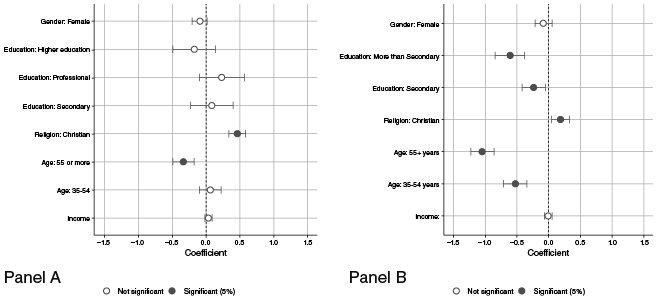
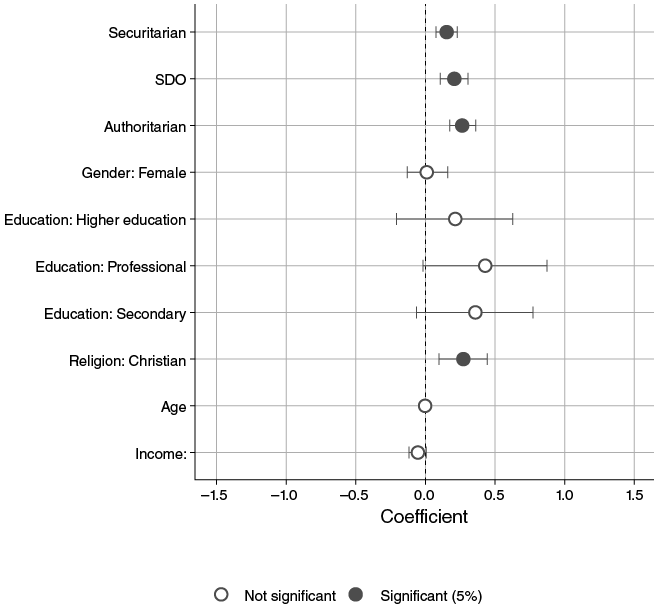
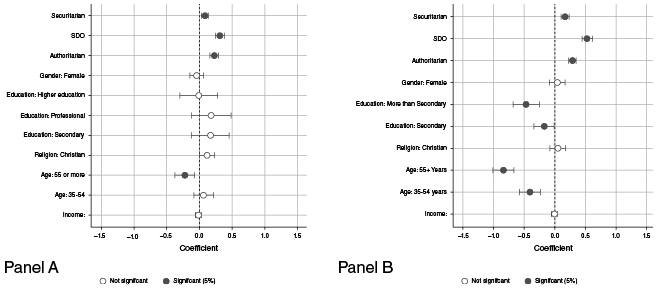
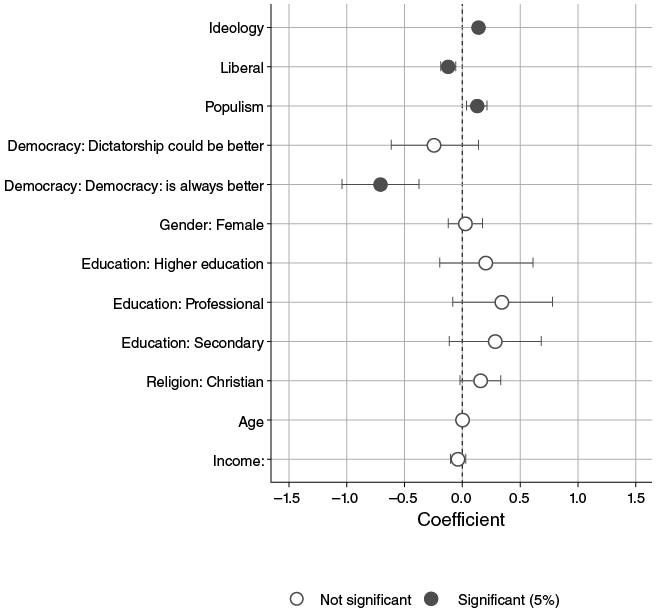
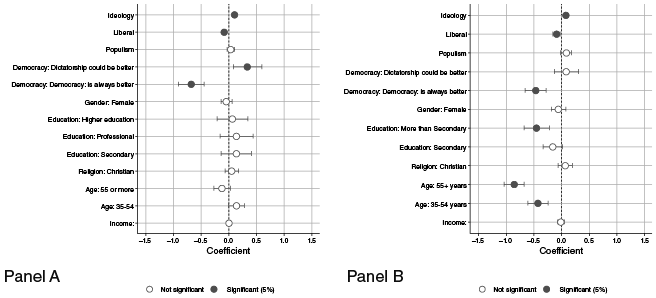
Section 3 treats affective and instrumental attitudes as dependent variables, modeling their determinants using RWA, SDO, threat sensitivity, left-right self-placement, populist orientations, and democratic commitment. The goal is to identify whether the dimensions exhibit distinct correlate structures and whether patterns vary cross-nationally.
Section 4 treats these attitudes as independent variables, testing whether they predict radical-right voting net of ideological self-placement and sociodemographic characteristics. If affective and instrumental attitudes capture identity-laden attachments or performance-oriented judgments not fully reducible to ideological positioning, they should exhibit independent electoral associations.
3 The Determinants of Attitudes toward Fascism
Building on the conceptual framework developed in Section 2, this section turns to the empirical analysis of the two attitudinal dimensions toward fascism – affective and instrumental. We treat each as a dependent variable and examine their individual-level determinants using three groups of predictors: sociodemographic attributes, psychological predispositions, and ideological orientations. This ordering reflects our theoretical understanding that psychological traits represent foundational, pre-ideological dispositions that shape how individuals process political information and construct ideological positions (Jost et al., Reference Jost, Glaser, Kruglanski and Sulloway2003; Duckitt & Sibley, Reference Duckitt and Sibley2010). These deep-seated orientations toward authority, hierarchy, and threat precede – and help generate – more specific ideological commitments such as left-right self-placement or democratic support.
Our approach operationalizes the theoretical claim that affective attachment and instrumental endorsement are analytically distinct, even if moderately correlated, and that both are filtered by the mnemonic and normative environments described in Section 1. The analysis proceeds comparatively, examining Italy and France to test whether the determinants of attitudes toward the authoritarian past vary across memory regimes. Italy, with its permissive mnemonic climate and continuous post-fascist party lineage, allows us to observe both affective and instrumental registers; France, with its restrictive devoir de mémoire environment, permits measurement only of the instrumental dimension. This asymmetry is not a limitation but a design feature: it lets us test whether psychological and ideological predictors operate differently when expression is filtered by stigma.
The empirical strategy models attitudes toward fascism as outcomes, asking which citizens – defined by their demographic profile, psychological makeup, and ideological orientations – are more likely to express positive evaluations of the fascist archive. In Section 4, we reverse the causal arrow and treat these attitudes as predictors of radical-right voting. Together, these sections trace a pathway from predispositions to attitudes to electoral behavior, revealing how historically anchored evaluations continue to structure contemporary political judgments.
3.1 Analytical Strategy and Model Design
The models are estimated separately for Italy and France, reflecting asymmetric data availability and theorized differences in expression constraints. For Italy, we observe both affective and instrumental attitudes toward fascism; for France, only the instrumental register was fielded, given the higher stigma attached to overt emotional expressions about Vichy and the expectation that residual resonance would concentrate in performance-oriented reasoning (see Section 2). This design choice mirrors the theoretical architecture: in permissive mnemonic climates, affective attachments are more publicly sayable; in restrictive climates, any residual orientation is channeled through instrumental idioms (Bolzonar, Reference Bolzonar2023).
Each set of models proceeds in three stages, corresponding to conceptually distinct layers of influence.Footnote 9 The first stage includes sociodemographic controls – gender, age, education, income, and religious identification – to capture background influences and potential generational, status, or cultural gradients. These variables are not theorized as primary drivers but as markers of social location that may structure exposure to particular narratives, family memories, or group identities. The second stage introduces psychological predispositions: Right-wing authoritarianism (RWA), SDO, and Securitarianism – foundational orientations toward authority, hierarchy, and threat (Altemeyer, Reference Altemeyer1981; Sidanius & Pratto, Reference Sidanius and Pratto1999; Duckitt, Reference Duckitt2001). The third stage adds ideological orientations: left-right self-placement, conservatism-liberalism (measured through attitudes toward social issues such as gender and reproductive rights), populist attitudes (captured through anti-elitism, people-centrism, and Manichaeism), and democratic commitment (measured by preference for democracy over dictatorship or indifference). These variables represent more crystallized, politically salient belief systems that structure citizens’ evaluations of regimes, parties, and policies. Unlike the pre-ideological psychological traits, these orientations are consciously held and articulated as part of political identity. We expect right self-placement and conservatism to predict affective attitudes toward fascism through alignment with traditionalism and leader-centered narratives, while populism’s anti-elite rhetoric may provide moral cover for nostalgic references to “strong leadership.” Democratic commitment should negatively predict both dimensions, as explicit preference for democracy is conceptually opposed to positive evaluations of an authoritarian past. Critically, we also include a measure of conditional openness to dictatorship (“In certain circumstances, a dictatorship is preferable”), which we expect to selectively predict instrumental attitudes: those willing to entertain authoritarian solutions under stress should be more likely to view fascist methods as pragmatically useful, even if they lack affective attachment to the regime itself.Footnote 10
In Italy, affective attitudes toward fascism are measured through two items: an admiration scale (from disdain to admiration) and a closeness scale (from hatred to closeness), averaged into a single index. Instrumental attitudes toward fascism are captured by agreement with the statement “Fascist ideas can, in some way, contribute to the politics of my country” (from strongly disagree to strongly agree). In France, only the instrumental item is available. Both scales range from 1 to 5, with higher values indicating more positive evaluations. As reported in Section 2 (Section 2.4.1), the two dimensions in Italy are positively but moderately correlated (r = 0.439). This confirms shared variance – citizens high on one dimension are somewhat more likely to be high on the other – but also substantial empirical autonomy. Some respondents admire the fascist archive without viewing it as useful today; others see instrumental value in authoritarian methods without expressing emotional warmth. This moderate association justifies treating the dimensions separately in modeling and supports the conceptual claim that identity-based and performance-based reasoning are distinct routes to evaluating a historically charged object.
We employ ordinary least squares (OLS) regression, treating both dependent variables as continuous Likert-type scales. Models are estimated separately for Italy and France, and for each country we present three specifications corresponding to the three stages outlined earlier. Coefficients are standardized where appropriate to facilitate comparison of effect sizes across predictors with different scales. All models include robust standard errors to account for potential heteroskedasticity. The models thus test structured associations consistent with our theoretical expectations, allowing us to assess whether affective and instrumental attitudes toward fascism exhibit distinct correlate profiles and whether these profiles vary cross-nationally in ways consistent with the memory-regime framework developed in Section 2.
3.2 Sociodemographic Foundations
We begin with sociodemographic variables – gender, age, education, income, and religious identification – not because we expect them to be the primary drivers of attitudes toward fascism, but because they establish a baseline profile and allow us to test whether background characteristics exert independent effects or whether they operate primarily through mediation by psychological predispositions and ideological orientations. Previous research on authoritarian attitudes and radical-right voting has produced mixed evidence on the role of sociodemographic factors: some studies find strong class or generational cleavages, while others report that such effects largely disappear once values and predispositions are controlled (Norris & Inglehart, Reference Norris and Inglehart2019; Inglehart & Norris, Reference Inglehart and Norris2016). Our three-stage modeling allows us to adjudicate this question directly.
3.2.1 Italy: Affective Attitudes toward Fascism
In the baseline sociodemographic model for affective attitudes toward fascism in Italy, most background variables show no statistically significant relationship. Gender, income, and age differences are negligible, suggesting that emotional attachment to the fascist archive does not follow simple demographic gradients. This absence of age effects is particularly notable: it suggests that affective orientations are not primarily a matter of generational inheritance or cohort memory but rather reflect value orientations that can be transmitted or adopted independently of direct biographical proximity to the regime.
As shown in Figure 1, two variables do emerge as relevant in the baseline specification. First, Christian religious identification shows a positive association with affective attitudes toward fascism. This pattern is consistent with the historical overlap between moral traditionalism and symbolic valorization of order, hierarchy, and authority in Italian political culture (Garzia, Reference Garzia2023). The Catholic Church’s complex relationship with Mussolini’s regime – formalized through the 1929 Lateran Pacts, which secured the Church’s institutional interests in exchange for legitimation – has left traces in collective memory, and religious affiliation may still function as a marker for those oriented toward hierarchical moral authority (Kertzer, Reference 99Kertzer2014).
Sociodemographic correlates of affective attitudes toward fascism (Italy)
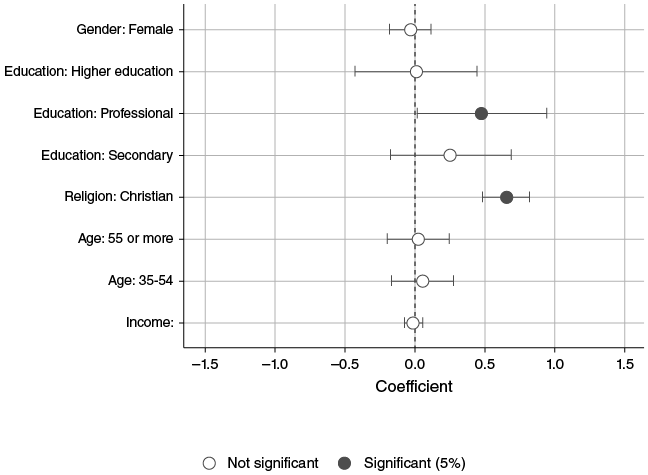
Second, professional education (a mid-level educational category) shows a positive association with affective attachment. This pattern is intriguing: it may reflect a middle-status nostalgia for authority and efficiency, where individuals with moderate educational attainment are drawn to narratives of competence and decisiveness without the cosmopolitan detachment or critical-historical literacy more common among university-educated elites. However, this effect is modest and should be interpreted cautiously given the absence of strong theoretical priors.
Crucially, once psychological predispositions and ideological orientations are introduced in subsequent model stages, both the religious and educational effects lose statistical significance. This suggests that sociodemographic markers operate primarily as proxies for underlying psychological traits and ideological commitments rather than as independent causal forces. Being Christian or having professional education does not directly generate affective warmth toward fascism; rather, these categories correlate with conservatism, conventionalism, or traditionalism, which are the actual predictors.
3.2.2 Italy and France: Instrumental Attitudes toward Fascism
For instrumental attitudes toward fascism in Italy, the sociodemographic profile shifts slightly. In Figure 2 (panel A), Christian identification again shows a positive association in the baseline model, reinforcing the connection between religious affiliation and openness to hierarchical authority. Additionally, younger age predicts higher instrumental endorsement, a pattern that stands in contrast to the null effect of age on affective attitudes. This suggests that pragmatic openness to authoritarian methods as tools for “getting things done” may be more appealing to younger cohorts who lack direct or transmitted memory of the regime’s repressive features and who evaluate fascism instrumentally – as a potential model of governance – rather than emotionally.
Educational attainment shows no significant effect in the baseline model, and this null result persists even as psychological and ideological variables are added. This contrasts with affective attitudes, where professional education showed a modest association, and with the French case (discussed later), where education remains significant. The implication is that in Italy’s permissive mnemonic environment, instrumental reasoning about fascism is not strongly structured by formal schooling or civic literacy; other factors – psychological predispositions and ideological frames – do the work.
A–B Sociodemographic correlates of instrumental attitudes toward fascism (A = Italy; B = France)
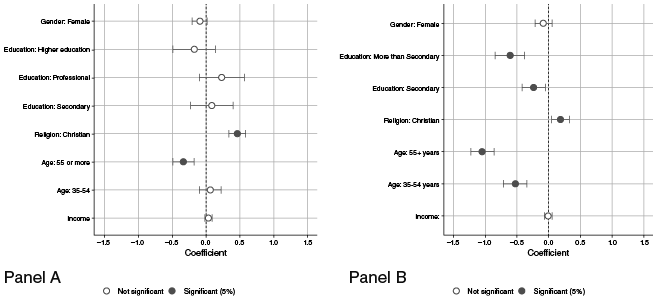
As with affective attitudes, the effects of religion and age weaken or disappear once psychological traits (RWA, SDO, and Securitarianism) and ideological orientations (left-right placement, conservatism, and democratic commitment) are controlled, confirming that sociodemographic variables primarily capture variation that is better explained by deeper predispositions and belief systems.
3.2.3 France: Instrumental Attitudes toward Fascism
Figure 2 (panel B) shows that, in France, where only the instrumental dimension is measured, the sociodemographic profile mirrors Italy in some respects but diverges in one important way. Christian religious identification is again positively associated with instrumental attitudes toward fascism in the baseline model, consistent with the cross-national pattern linking religious affiliation to hierarchical authority preferences. Younger age also predicts higher instrumental endorsement, paralleling the Italian case and suggesting that generational distance from authoritarian regimes may lower inhibitions about evaluating their methods pragmatically.
The key difference is education. In France, lower educational attainment is significantly associated with higher instrumental attitudes toward fascism, and this effect persists even when psychological predispositions and ideological orientations are introduced. This durability contrasts with Italy, where education’s effects are fully mediated. The pattern is consistent with research linking populist receptivity and openness to authoritarian solutions to limited civic literacy and perceived elite detachment (Norris & Inglehart, Reference Norris and Inglehart2019). In France’s high-stigma environment, where overt nostalgia is reputationally costly, instrumental talk may be more admissible among those with less exposure to formal historical education or civic norms that emphasize the devoir de mémoire. Education may thus function not only as a proxy for broader values but also as a marker of exposure to institutional narratives that delegitimize authoritarian reasoning.
3.3 Psychological and Social Predispositions
We now introduce psychological predispositions – RWA, SDO, and Securitarianism – variables theorized as foundational orientations that precede and shape ideological commitments. As discussed in Section 3.1, these traits represent stable, pre-ideological dispositions toward authority, hierarchy, and threat that develop relatively early and structure how individuals process political information and construct political preferences (Duckitt, Reference Duckitt2001; Jost et al., Reference Jost, Glaser, Kruglanski and Sulloway2003). The seminal work on the authoritarian personality (Adorno et al., Reference Adorno, Frenkel-Brunswik, Levinson and Sanford1950) established that certain psychological configurations predispose individuals toward acceptance of hierarchical rule and punitive responses to deviance. While the original F-scale faced well-known psychometric and methodological critiques, the underlying intuition – that authoritarian predispositions are stable, measurable, and politically consequential – has been substantially vindicated by subsequent empirical research that developed more rigorous measurement batteries (Feldman, Reference Feldman2003; Stenner, Reference Stenner2005). Altemeyer’s (Reference Altemeyer1981) Right-Wing Authoritarianism scale, Sidanius and Pratto’s (Reference Sidanius and Pratto1999) SDO, and the child-rearing items used by Hetherington and Weiler (Reference Hetherington and Weiler2009) and MacWilliams (Reference MacWilliams2016) constitute the contemporary toolkit through which the macro-construct of “authoritarian personality” has been operationalized for systematic empirical analysis. Our use of RWA, SDO, and Securitarianism in this section follows directly in this lineage: rather than treating Adorno’s framework as merely evocative, we deploy validated instruments that have descended from it and accumulated decades of empirical refinement.
Right-Wing Authoritarianism (RWA) encompasses three components: authoritarian submission, conventionalism, and authoritarian aggression (Altemeyer, Reference Altemeyer1981). Because conventionalism fosters reverence for tradition and aggression legitimizes punitive responses to threat, RWA’s multidimensional structure should predict both affective attitudes (through identity-laden reverence for order) and instrumental attitudes (through functional demand for hierarchical control) (Duckitt et al., Reference Duckitt and Sibley2010; Donovan, Reference Donovan2019). Social dominance orientation captures preferences for group-based hierarchies and intergroup dominance (Sidanius & Pratto, Reference Sidanius and Pratto1999; Ho et al., Reference Ho, Sidanius, Kteily, Sheehy-Skeffington, Pratto, Henkel, Foels and Stewart2015). Unlike RWA’s deference to authority, SDO is rooted in a competitive zero-sum worldview. We therefore expect SDO to predict instrumental attitudes most strongly – authoritarian governance as a tool for preserving hierarchy – with a secondary, weaker association with affective attitudes when past regimes are retrospectively framed as effective enforcers of status order (Sibley & Duckitt, Reference Sibley and Duckitt2008; Thóridóttir et al., Reference Thorisdottir, Jost, Liviatan and Shrout2007). Securitarianism refers to a heightened, threat-driven concern for national security and law and order (Hibbing, Reference Hibbing2020). Often situational, it becomes salient during perceived instability, crime, or external threats (Vasilopoulos, Marcus, & Foucault, Reference Vasilopoulos, Marcus and Foucault2018). We expect securitarianism to predict both dimensions, with instrumental attitudes as the primary pathway (functional desire for decisive leadership) and affective attitudes as a secondary, emotion-driven route (nostalgic longing for symbolic protectors in anxious times) (Hetherington & Weiler, Reference Hetherington and Weiler2009; Mols & Jetten, Reference Mols and Jetten2017; Kang, Reference Kang2016).
3.3.1 Italy: Affective Attitudes toward Fascism
All three psychological predispositions are positively and significantly associated with affective attitudes toward fascism in Italy, confirming their foundational role (see Figure 3). Right-Wing Authoritarianism (RWA) is a robust predictor, with a coefficient of 0.27. This strong association confirms that individuals high in authoritarian submission, conventionalism, and aggression are significantly more likely to express admiration or closeness toward the fascist archive (Altemeyer, Reference Altemeyer1981).
The mechanism operates through multiple channels: conventionalism fosters reverence for traditional authority and moral order, framing the fascist past as an era of discipline and national unity; authoritarian submission generates emotional identification with strong leaders; and authoritarian aggression legitimizes punitive responses to perceived deviance, which can be retrospectively projected onto the regime’s repressive features as necessary measures for order (Duckitt et al., Reference Duckitt and Sibley2010). The result aligns with theoretical expectations: RWA’s multidimensional structure predicts affective warmth through its conventionalism and submission components. Social dominance orientation also predicts affective attitudes toward fascism, confirming our expectation of a secondary association, though with a smaller magnitude than its effect on instrumental attitudes (see later). This moderate positive association is theoretically consistent with SDO’s core focus on hierarchy maintenance: while SDO primarily operates through instrumental calculations about preserving social dominance, it can also generate affective resonance when past regimes are retrospectively framed as effective enforcers of hierarchical order and national status (Sidanius & Pratto, Reference Sidanius and Pratto1999; Thóridóttir et al., Reference Thorisdottir, Jost, Liviatan and Shrout2007). The emotional attachment here is not to symbols per se but to the perceived outcomes – a “strong” Italy, hierarchically organized – that the regime is imagined to have delivered. The most striking finding is Securitarianism, which exhibits a coefficient of 0.15 – stronger than its effect on instrumental attitudes (see Section 3.3.2). This pattern diverges from our initial theoretical expectation that securitarianism would primarily drive instrumental reasoning about order and protection. Instead, the data suggest that heightened threat perceptions activate a deeper, more emotional mechanism: a nostalgic longing for a symbolic protector or a retrospective framing of the fascist past as a period of security and strength (Mols & Jetten, Reference Mols and Jetten2017; Kang, Reference Kang2016). In other words, when individuals perceive the social world as dangerous – threatened by crime, immigration, or instability – they may turn affectively toward historical figures or regimes that are culturally coded as guarantors of safety, even if those regimes were authoritarian. This finding underscores that the “securitarian path” to positive attitudes toward fascism operates less through cold pragmatic calculation than through emotionally charged responses to fear and anxiety (Vasilopoulos, Marcus, & Foucault, Reference Vasilopoulos, Marcus and Foucault2018).
Psychological correlates of affective attitudes toward fascism, Italy
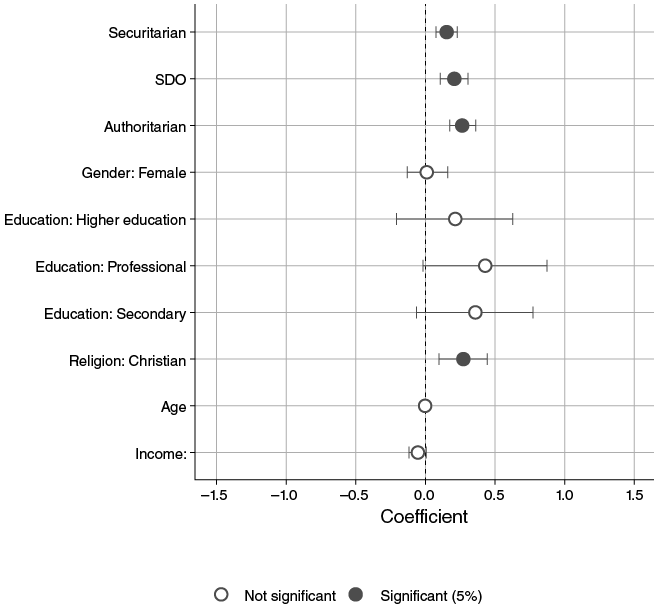
Taken together, the psychological profile of affective attitudes toward fascism is one of identity-laden, threat-sensitive attachment. Citizens high in RWA, SDO, and Securitarianism are drawn to the symbolic and emotional register of the fascist archive, expressing warmth or proximity that reflects both deference to authority and a longing for the perceived security and moral clarity of a hierarchically ordered past.
3.3.2 Italy and France: Instrumental Attitudes toward Fascism
Figure 4 presents the psychological determinants of instrumental attitudes toward fascism in Italy (Panel A) and France (Panel B). In both countries, all three predispositions are significant, but the pattern of magnitudes differs from affective attitudes: SDO emerges as the strongest predictor, confirming its role as the trait most directly linked to hierarchy-maintenance reasoning, while Securitarianism shows weaker effects than on affective attitudes. RWA remains robustly predictive (0.23 in Italy), operating as a broad authoritarian disposition across both dimensions.
Looking at Italy, the psychological predictors of instrumental attitudes toward fascism in Italy show a similar pattern of significance but with revealing shifts in magnitude that align with and refine our theoretical expectations (see Figure 4, panel A). Right-Wing Authoritarianism (RWA) remains a strong and significant predictor, with a coefficient of 0.23 – comparable to its effect on affective attitudes. This confirms our expectation that RWA functions as a broad authoritarian disposition that shapes multiple evaluative registers: individuals high in RWA are drawn both to the symbolic appeal of fascism (affective) and to its perceived efficacy as a governance model (instrumental). The authoritarian aggression component of RWA is particularly relevant here: the belief that strong, punitive leadership is necessary to maintain order translates directly into instrumental endorsement of methods associated with the fascist archive (Altemeyer, Reference Altemeyer1981; Duckitt, Reference Duckitt2001). Social dominance orientation emerges as the strongest predictor of instrumental attitudes toward fascism, confirming our primary theoretical expectation. This aligns precisely with SDO’s conceptual core: it captures preferences for group-based hierarchies and competitive zero-sum worldviews, making it the psychological trait most directly linked to instrumental reasoning about authoritarian governance (Sidanius & Pratto, Reference Sidanius and Pratto1999). Individuals high in SDO view hierarchical command structures not as symbols to be admired but as tools to be deployed – effective mechanisms for enforcing social order, maintaining status differentials, and controlling perceived threats to the existing hierarchy (Sibley & Duckitt, Reference Sibley and Duckitt2008). The instrumental logic is clear: fascism “works” because it concentrates power, disciplines dissent and preserves group-based dominance. Securitarianism, by contrast, shows a weaker effect on instrumental attitudes (coefficient of 0.09) than on affective attitudes. This asymmetry contradicts our initial expectation but is theoretically revealing. While threat sensitivity does contribute to instrumental reasoning – citizens perceiving disorder or danger are more likely to endorse “strong government” solutions – the association is modest. The stronger affective pathway discovered in Section 3.3.1 suggests that securitarianism’s primary political consequence may be less about rational cost-benefit calculations regarding governance efficacy and more about emotionally driven searches for symbolic protection and retrospective idealization of “strong” leaders (Hetherington & Weiler, Reference Hetherington and Weiler2009). This finding refines our understanding: securitarianism activates affect more than instrumentality.
A–B Psychological predictors of instrumental attitudes toward fascism (A = Italy; B = France)
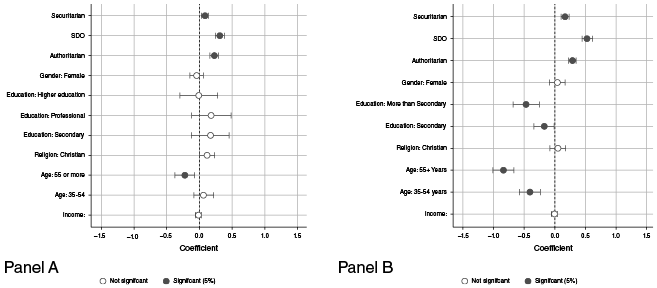
The overall psychological profile of instrumental attitudes toward fascism is thus performance-oriented and hierarchy-focused, with SDO as the dominant driver (as expected), RWA as a robust secondary predictor (as expected), and Securitarianism playing a more limited role than initially anticipated.
In France, where only the instrumental dimension is measured, all three psychological predispositions are positively and significantly associated with instrumental attitudes toward fascism, confirming the cross-national robustness of these foundational orientations. SDO is again the strongest predictor, paralleling the Italian pattern and validating our expectation that hierarchy maintenance operates as a cross-national mechanism (see Figure 4, panel B). French citizens high in SDO, like their Italian counterparts, are more likely to view authoritarian methods as pragmatically useful for preserving social order and group-based status differences (Sidanius & Pratto, Reference Sidanius and Pratto1999). RWA is also a significant predictor, consistent with its role as a foundational authoritarian disposition. The cross-national similarity in RWA’s effects underscores that deference to authority, conventionalism, and punitive orientations translate into instrumental endorsement of fascist-associated methods regardless of whether the national context involves a native fascist regime (Italy) or collaboration under occupation (Vichy). This robustness supports the claim that RWA operates as a pre-ideological trait that shapes authoritarian attitudes across mnemonic contexts. Securitarianism is also positively associated with instrumental attitudes in France, where contemporary political discourse around immigration, terrorism, and crime has made security a central axis of partisan competition (Vasilopoulos, Marcus, & Foucault, Reference Vasilopoulos, Marcus and Foucault2018). The salience of securitarian rhetoric in French politics – especially in the RN’s framing of threats to sovereignty, public safety, and national identity – provides a legitimating cultural frame for instrumental reasoning about authoritarian solutions. Citizens high in Securitarianism, perceiving instability or external danger, are more likely to view “strong government” and decisive leadership as necessary, and in a high-stigma environment where overt nostalgia is costly, this reasoning surfaces as instrumental talk about order and efficacy rather than affective identification (Bolzonar, Reference Bolzonar2023). The positive association of Securitarianism in the French case underscores how threat-sensitive dispositions can be channeled through context-specific discourses while retaining their underlying psychological structure. The cross-national similarity in the psychological determinants of instrumental attitudes toward fascism is striking. Despite differences in historical referents (Italian fascism vs. Vichy), memory regimes (permissive vs. restrictive), and party strategies, the same psychological traits – RWA, SDO, Securitarianism – predict instrumental endorsement in both countries. This robustness supports the claim that these predispositions are foundational and pre-ideological: they operate across contexts to shape how citizens evaluate authoritarian governance as a functional option.
3.3.3 Interpreting Psychological Foundations
Two inferences follow from these results. First, psychological predispositions predict both affective and instrumental attitudes toward fascism (in Italy, where both are measured), confirming their status as foundational orientations. Unlike ideological variables (examined in Section 3.4), which will exhibit striking selectivity – some predicting only affective, others only instrumental – the psychological traits show cross-dimensional reach. This pattern is consistent with their theorized role as deep-seated, pre-ideological dispositions that shape multiple facets of authoritarian attitudes (Duckitt & Sibley, Reference Duckitt and Sibley2010). Second, the differential magnitudes reveal distinct pathways and refine our theoretical framework. SDO’s substantially stronger effect on instrumental attitudes, as expected, reflects its focus on hierarchy as a governance tool: maintaining group-based dominance requires effective authoritarian structures, making instrumental reasoning the primary route. However, Securitarianism’s unexpectedly stronger effect on affective attitudes represents an important theoretical refinement: threat perception activates an emotional search for symbolic protectors more powerfully than it generates cold instrumental calculations. This suggests that the relationship between threat and authoritarianism is more emotionally mediated than standard rational-choice frameworks acknowledge (Vasilopoulos, Marcus, & Foucault, Reference Vasilopoulos, Marcus and Foucault2018). RWA, as a multidimensional construct encompassing submission, conventionalism, and aggression, operates robustly across both registers, with its effects distributed relatively evenly – confirming that it functions as a broad authoritarian orientation rather than a dimension-specific trait.
We now turn to ideological orientations, where the two faces of fascism diverge more sharply and the selective associations validate the conceptual distinction between identity-laden warmth and performance-oriented pragmatism.
3.4 Ideological Orientations
Having established the psychological foundations of attitudes toward fascism, we now introduce ideological orientations – left-right self-placement, conservatism-liberalism, populist attitudes, and democratic commitment. Unlike the pre-ideological predispositions examined in Section 3.3, these variables represent more crystallized, politically salient belief systems that structure citizens’ evaluations of regimes, parties, and policies. Ideologies provide cognitive heuristics that organize political judgment, shaping the extent to which individuals view fascism as a legitimate governance model and as an admired historical reference (Jost et al., Reference Jost, Federico and Napier2009). While psychological traits are foundational and relatively stable, ideological orientations are consciously held, articulated as part of political identity, and potentially more responsive to party rhetoric, media framing, and shifts in public discourse.
Left-Right Ideological Self-Placement is one of the most widely used measures of political orientation in comparative research. It captures a broad dimension of political conflict that, in Western European contexts, bundles preferences about economic distribution, cultural authority, national identity, and social hierarchy (Huber & Inglehart, Reference Huber and Inglehart1995). Individuals who position themselves further to the right on the ideological spectrum often hold more exclusionary nationalist views, favor hierarchical governance models, and are skeptical of pluralism and minority rights – all orientations that may increase propensity toward positive evaluations of fascism (Rydgren, Reference 100Rydgren2018). Right-wing ideology can foster both affective and instrumental attitudes, but through different mechanisms. On the one hand, right-wing positioning fosters nationalistic attitudes that promote reverence for past authoritarian leaders as protectors of national identity, thereby strengthening affective attachments to symbols, narratives, and heritage. On the other hand, right-wing ideological orientations may also drive instrumental attitudes by reinforcing the belief that strong, centralized leadership is necessary to maintain social stability, enforce order, and protect the nation from perceived threats. We therefore expect right-wing self-placement to predict both affective and instrumental attitudes toward fascism.
Conservative Ideological Orientations, particularly in their traditionalist and moral forms, emphasize hierarchical social structures, cultural continuity, deference to established norms, and resistance to social change (Jost et al., Reference Jost, Glaser, Kruglanski and Sulloway2003). Conservatism, especially when measured through attitudes toward gender, sexuality, and reproductive rights, captures moral traditionalism – a focus on preserving a “traditional” way of life and resisting progressive social transformations (Duckitt, Reference Duckitt2001). This emphasis on the socio-moral sphere should contribute to stronger affective attitudes toward fascism, as it fosters admiration for past regimes perceived as guarantors of national strength, moral certainty, and cultural homogeneity. Fascism, retrospectively framed as a defender of traditional family structures, religious authority, and moral discipline, can become an object of nostalgic identification for those high in conservatism (Traverso, Reference Traverso2019). This represents a symbolic or identity-based allegiance rather than a functional endorsement of authoritarian governance. However, we do not expect conservatism to strongly predict instrumental attitudes toward fascism. Instrumental reasoning is driven more by concerns about security, hierarchy maintenance, and functional efficacy than by moral traditionalism. Those high in conservatism may admire the past without necessarily believing that its methods should be reimplemented today as pragmatic solutions to contemporary governance challenges.
Liberalism, by contrast, prioritizes civil liberties, democratic governance, pluralism, and individual autonomy, making it fundamentally incompatible with fascist principles (Inglehart & Welzel, Reference Inglehart and Welzel2005). Liberal ideology is strongly associated with support for institutional checks and balances, minority rights, and tolerance for diversity – all of which directly contradict the authoritarian and exclusionary nature of fascist rule. We therefore expect individuals with stronger liberal orientations – measured here through support for same-sex marriage, adoption rights, and reproductive autonomy – to reject both the nostalgic appeal of affective attitudes toward fascism and the authoritarian solutions embedded in instrumental attitudes. Liberalism should exhibit negative associations with both dimensions.
Populist Attitudes capture anti-elitism, people-centrism, and a Manichean worldview that divides society into “the pure people” versus “the corrupt elite” (Mudde, Reference Mudde2004; Akkerman et al., Reference Akkerman, Mudde and Zaslove2014). As a thin-centered ideology, populism is not inherently authoritarian but can adopt such features when it rejects institutional constraints in favor of a singular conception of “the will of the people” (Weyland, Reference 101Weyland2020; Mudde & Rovira Kaltwasser, Reference Mudde and Kaltwasser2017). Populism’s relationship with attitudes toward fascism is therefore complex and potentially selective. On the one hand, populism’s emphasis on strong, charismatic leadership and authentic representation of “the people” may reinforce affective attitudes toward fascism, particularly when historical fascist figures are retrospectively framed as genuine defenders of the “true people” against corrupt elites and external enemies (Stanley, Reference Stanley2019; Mudde, Reference Mudde2019). The anti-establishment rhetoric and leader-centered moralism of populism can provide cultural cover for nostalgic references to authoritarian strongmen, making affective warmth toward the fascist past more sayable. On the other hand, populism’s core axis is a moral opposition between the people and the elites, not a focus on rigid hierarchical governance structures or systematic exclusion based on group dominance. Instrumental attitudes toward fascism require explicit endorsement of authoritarian rule as a functional necessity – a preference for hierarchical command that is not an inherent feature of populist discourse. We therefore expect populist attitudes to predict affective attitudes toward fascism but not instrumental attitudes.
Support for Democracy and Openness to Authoritarian Alternatives is measured through a standard three-category item that captures normative commitment to democratic governance: “Which of the following statements do you agree with the most?” with options: (1) “Democracy is always better than any other form of government,” (2) “In certain circumstances, a dictatorship is preferable,” and (3) “It does not matter whether we live in a democracy or a dictatorship.” This item allows us to distinguish between unwavering democratic commitment, conditional openness to authoritarianism, and regime-type indifference. Strong democratic commitment – selecting the first option – should negatively predict both affective and instrumental attitudes toward fascism, as it represents explicit normative preference for pluralism, institutional checks, and civil liberties over authoritarian rule (Norris, Reference Norris2017; Foa & Mounk, Reference Foa and Mounk2017). However, the second category – conditional openness to dictatorship – warrants specific theoretical attention because we expect it to operate selectively. Citizens who express that “in certain circumstances, a dictatorship is preferable” are signaling that their democratic commitment is performance-based rather than intrinsic: they will support democracy when it delivers but are willing to entertain authoritarian shortcuts when institutions appear ineffective or when crises demand “strong leadership” (Schedler, Reference Schedler1996). This conditional orientation should predict instrumental attitudes toward fascism, as both reflect performance-based reasoning about governance: if authoritarian methods work better under stress, they are acceptable. Critically, we do not expect openness to dictatorship to predict affective attitudes toward fascism. Affective warmth requires nostalgic identification, pride in symbols, or emotional attachment to historical narratives – orientations rooted in identity and heritage rather than in cold calculations about governance efficacy. One can be open to dictatorship as a pragmatic solution without feeling any admiration for past dictatorships. This selective association – openness to dictatorship predicting instrumental but not affective attitudes – would provide strong validation for the conceptual distinction between the two dimensions.
Based on this framework, we expect ideological orientations to exhibit more selective associations than psychological predispositions, with certain ideologies predicting only one dimension. We anticipate that right-wing self-placement will predict both affective and instrumental attitudes toward fascism, as it bundles nationalist identity with preferences for hierarchical governance. Conservatism, measured through moral traditionalism, should predict affective attitudes by fostering heritage-based identification but should not strongly predict instrumental attitudes, which are driven by hierarchy maintenance and threat rather than by moral nostalgia. Conversely, liberalism should negatively predict both dimensions, as it is fundamentally opposed to authoritarianism in all forms. Populist attitudes should selectively predict affective attitudes – providing moral cover for nostalgic leader worship – but not instrumental attitudes, as populism’s anti-elite axis does not translate into endorsement of systematic hierarchical rule. Strong democratic commitment should negatively predict both dimensions, while openness to dictatorship should selectively predict instrumental attitudes, signaling conditional democratic support based on performance rather than principle. These expectations position ideological variables as more differentiated and selective than psychological predispositions, with the selective associations serving as a crucial test of whether affective and instrumental attitudes represent distinct evaluative routes.
3.4.1 Italy: Affective Attitudes toward Fascism
As shown in Figure 5 when ideological variables are introduced, model fit rises markedly, and the selective associations anticipated above emerge clearly. Right-wing self-placement correlates positively and significantly with affective attitudes toward fascism, confirming our expectation. Respondents identifying with the political right express significantly warmer feelings toward the fascist archive, consistent with nationalist framing of the past as a period of national strength and identity assertion. This association holds even when psychological predispositions are controlled, indicating that ideological positioning exerts an independent influence on symbolic attachments to the authoritarian past.
Value conservatism – measured through opposition to same-sex marriage, adoption rights, and reproductive autonomy – is a strong and robust predictor of affective attitudes toward fascism, again confirming expectations. This finding underscores that moral traditionalism fosters emotional identification with regimes retrospectively framed as defenders of “traditional” family structures, religious authority, and moral discipline (Jost et al., Reference Jost, Glaser, Kruglanski and Sulloway2003). The fascist archive, selectively remembered through the lens of order and moral certainty rather than repression, becomes an object of nostalgic reverence for those resisting progressive social change. Notably, the association is stronger for affective than for instrumental attitudes. Greater liberalism is negatively associated with both outcomes, but the coefficient is smaller in the instrumental model. (see Section 3.4.2), validating the claim that moral traditionalism operates through identity and heritage rather than through functional reasoning about governance efficacy.
Populist attitudes also correlate positively with affective attitudes toward fascism, though with a moderate effect size (coefficient = 0.13). This confirms our expectation that anti-elitist and people-centered rhetoric provides moral cover for nostalgic references to strong leadership. Populism’s emphasis on charismatic leaders who authentically represent “the people” against corrupt elites can frame historical fascist figures – Mussolini in particular – as genuine champions of national will, thereby lowering the reputational costs of expressing affective warmth (Mudde, Reference Mudde2019; Stanley, Reference Stanley2019). Critically, and as anticipated, populist attitudes show no significant effect on instrumental attitudes (Section 3.4.2), confirming the selective association: populism fuels identity-based nostalgia but does not translate into endorsement of authoritarian governance as a functional necessity.
Democratic commitment exerts a consistent negative association with affective attitudes toward fascism. Individuals who affirm that “democracy is always preferable to any other form of government” are significantly less likely to express admiration or closeness toward the fascist past. This pattern confirms that strong normative commitment to democracy and affective attachment to authoritarian regimes remain attitudinally opposed, even when controlling for ideology and psychological predispositions (Norris, Reference Norris2017). Conversely, openness to dictatorship – the conditional view that authoritarian rule might be preferable under certain circumstances – shows no significant association with affective attitudes. This null result is as theoretically important as the significant findings: it confirms that willingness to entertain dictatorship as a pragmatic option does not require, and is not predicted by, nostalgic identification with past authoritarian regimes. One can be conditionally open to authoritarianism without feeling emotional warmth toward historical fascism.
Ideological correlates of affective attitudes toward fascism (Italy)
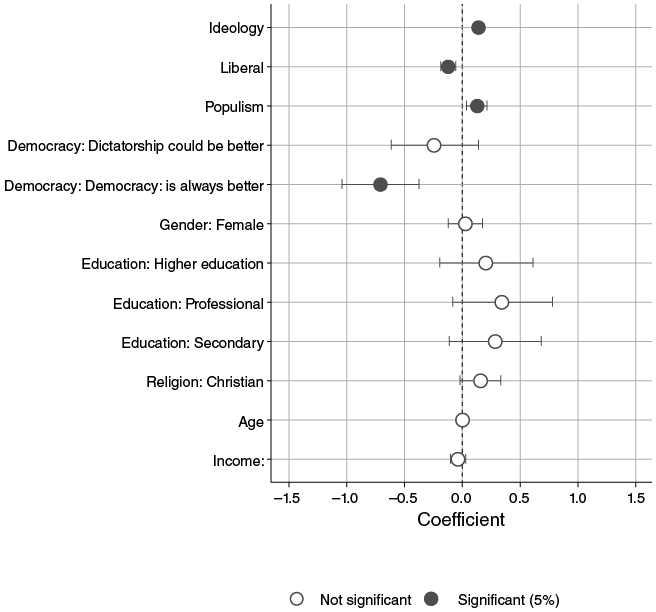
Once ideological variables are entered into the model, sociodemographic effects – including the baseline association with Christian religious identification – lose statistical significance. This highlights the mediating role of value orientations: religion operates primarily as a marker for conservatism and conventionalism rather than as an independent driver of affective attitudes.
3.4.2 Italy and France: Instrumental Attitudes toward Fascism
Figure 6 presents the ideological determinants of instrumental attitudes toward fascism in Italy (Panel A) and France (Panel B). The pattern reveals striking selective associations: populism shows no effect in either country (contrasting with its positive effect on affective attitudes), while openness to dictatorship shows a strong positive effect in Italy – the mirror image of the affective model. This divergence provides powerful validation for the two-dimensional framework: the same ideological variables predict different dimensions through distinct mechanisms.
In more detail, in Italy, the ideological profile of instrumental attitudes toward fascism diverges sharply from the affective dimension, confirming the selective associations anticipated in our theoretical framework. Right-wing self-placement again correlates positively and significantly with instrumental attitudes, paralleling its effect on affective attitudes. This confirms that ideological positioning on the left-right axis captures both identity-based nationalism and functional preferences for hierarchical governance, making it a broad predictor of positive evaluations of the fascist archive across both registers.
Conservatism–liberalism is also significantly associated with instrumental attitudes, although more weakly than with affective attitudes. Because higher values indicate greater liberalism, the negative coefficient (b = –0.08) means that more liberal respondents are less likely to view fascist ideas as politically useful; equivalently, respondents at the conservative end of the scale display greater instrumental openness. The difference between the two dimensions is therefore one of magnitude rather than the presence or absence of an association: moral traditionalism is more strongly related to affective attachment, but it also contributes modestly to performance-based endorsement.
Populist attitudes show no significant relationship with instrumental attitudes toward fascism, confirming the selective association predicted theoretically. While populism provides moral cover for affective warmth toward charismatic strongmen, it does not translate into endorsement of fascism as a usable governance model. Populism’s core axis – moral opposition between the people and the elites – does not inherently support hierarchical command structures or systematic exclusion, which are the functional features captured by instrumental attitudes (Mudde, Reference Mudde2004; Weyland, Reference 101Weyland2020). This null result is a crucial validation of the two-dimensional framework: it demonstrates that the mechanisms driving affective and instrumental attitudes are distinct, with populism operating through identity and symbolism (affective) but not through performance reasoning (instrumental).
Democratic commitment again shows a significant negative association: those who affirm that democracy is always preferable are less likely to endorse the instrumental usefulness of fascist ideas. This confirms that strong democratic principle constrains openness to authoritarian methods across both dimensions. However, the most striking finding is the positive association between openness to dictatorship and instrumental attitudes toward fascism. Individuals who express conditional acceptance of dictatorship – “In certain circumstances, a dictatorship is preferable” – are significantly more likely to view fascist ideas as potentially useful for contemporary politics. This selective association confirms that instrumental attitudes reflect conditional and fragile loyalty to democracy: citizens may support democratic procedures in principle but are willing to entertain authoritarian shortcuts when institutions appear ineffective or when crises demand decisive action (Schedler, Reference Schedler1996). Critically, this openness to dictatorship did not predict affective attitudes (Section 3.4.1), confirming that performance-based reasoning and identity-based nostalgia are empirically and conceptually distinct.
Once these ideological and normative factors are included, Christian religious identification ceases to be a significant predictor, paralleling the pattern observed for affective attitudes. Education, which showed limited effects in baseline models, remains non-significant, confirming that in Italy’s permissive mnemonic environment, instrumental reasoning about fascism is structured by ideology and psychology rather than by formal schooling.
A–B Ideological correlates of instrumental attitudes toward fascism (A = Italy; B = France)
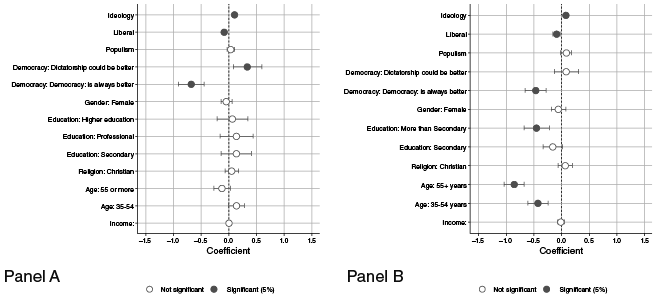
3.4.3 France: Instrumental Attitudes toward Fascism
In France, ideological patterns parallel those observed in Italy, supporting the cross-national robustness of these associations (see Figure 6, panel B). Right-wing self-placement is positively and significantly associated with instrumental attitudes toward fascism, consistent with the bundling of nationalist identity and hierarchical governance preferences. Conservatism (measured through opposition to progressive social values) also predicts higher instrumental attitudes, though as in Italy, the association is weaker than might be expected if conservatism were primarily a driver of instrumental reasoning. This suggests that even in France’s high-stigma environment, moral traditionalism contributes modestly to openness to authoritarian methods, though its primary pathway (affective) cannot be observed.
Populist attitudes show no significant effect on instrumental attitudes toward fascism in France, mirroring the Italian result and confirming that the populism-instrumentality null association is cross-nationally robust. This reinforces the interpretation that populism’s anti-elite, people-centered rhetoric does not translate into endorsement of hierarchical authoritarian governance as a functional model.
Democratic commitment is negatively associated with instrumental attitudes: those who affirm that democracy is always preferable are less likely to view fascist ideas as useful. This parallels the Italian finding and confirms that strong democratic principle constrains instrumental openness across mnemonic contexts. Openness to dictatorship is not significantly associated with instrumental attitudes in France. The negative association with democratic commitment suggests that weakening normative attachment to democracy is associated with greater instrumental receptivity to authoritarian solutions in both countries.
The cross-national similarities in ideological determinants of instrumental attitudes are striking. Despite differences in historical referents (fascism vs. Vichy), memory regimes (permissive vs. restrictive), and party strategies (FdI’s post-fascist lineage vs. RN’s dédiabolisation), the same ideological orientations predict instrumental reasoning in both contexts. Right-wing positioning, weakened democratic commitment, and (modest) conservatism all predict higher instrumental attitudes, while populism shows no effect. This robustness suggests that the ideological architecture of instrumental reasoning about authoritarianism is cross-nationally generalizable, even as memory regimes filter which register (affective vs. instrumental) is publicly expressible.
3.4.4 Interpreting Ideological Selectivity
The ideological results provide strong validation for the two-dimensional framework through their striking selectivity. Unlike psychological predispositions, which predicted both affective and instrumental attitudes (though with differential magnitudes), ideological orientations exhibit dimension-specific associations that partly align with theoretical expectations. populism predicts only affective attitudes, while conservatism predicts both dimensions, with a stronger association with affective attitudes. In Italy, openness to dictatorship predicts only instrumental attitudes. These selective patterns demonstrate that affective and instrumental attitudes toward fascism are not reducible to a single underlying “pro-fascism” orientation but represent distinct evaluative routes – identity and heritage versus performance and efficacy – that draw on different ideological mechanisms.
Why is conservatism more strongly associated with affective attitudes? Conservatism, rooted in moral traditionalism and resistance to progressive social change, maps especially closely onto the affective register (Jost et al., Reference Jost, Glaser, Kruglanski and Sulloway2003). It can foster emotional identification with symbols, leaders, and narratives retrospectively framed as embodying a lost moral order – discipline, hierarchy, religious authority, and traditional family structures. In this sense, positive evaluations of the fascist past function primarily as expressions of identity, heritage, and cultural preservation. As Figures 5 and 6 show, the significant but weaker association with instrumental attitudes indicates, however, that conservatism is not confined to this affective pathway. Respondents at the conservative end of the scale are also somewhat more likely to regard authoritarian methods as politically useful, although such performance-based reasoning appears to depend more strongly on orientations toward authority, hierarchy, and democratic rule (Altemeyer, Reference Altemeyer1981; Duckitt & Sibley, Reference Duckitt and Sibley2010). The difference between the two dimensions is therefore one of magnitude rather than kind: moral traditionalism is most strongly connected to nostalgic and symbolic attachment, while its relationship with instrumental endorsement is more limited.
Why does populism predict only affective attitudes? Populism’s emphasis on charismatic leadership, authentic representation of “the people,” and moral Manichaeism can frame historical fascist leaders as genuine champions of national will against corrupt elites (Mudde, Reference Mudde2019; Stanley, Reference Stanley2019). This generates affective resonance: Mussolini becomes “a leader who truly represented the people,” and his regime becomes “a time when Italy was strong and united.” However, populism’s thin ideological core – centered on vertical opposition between people and elites – does not translate into endorsement of systematic hierarchical governance or group-based exclusion. Instrumental attitudes require belief that authoritarian structures are effective tools for managing society, a claim that is orthogonal to populist rhetoric. One can be deeply anti-elite without endorsing fascism as a usable governance model.
Why does openness to dictatorship predict only instrumental attitudes in Italy? This is perhaps the most theoretically revealing selective association. Citizens who express conditional acceptance of dictatorship – “under certain circumstances, dictatorship is preferable” – are signaling that their democratic commitment is performance-based rather than intrinsic (Schedler, Reference Schedler1996). They will support democracy when it delivers order, security, and prosperity, but are willing to entertain authoritarian shortcuts when institutions appear ineffective. This conditional orientation aligns perfectly with instrumental reasoning about fascism: if authoritarian methods work better under stress – if they “get things done” – then they are acceptable. Critically, this pragmatic logic does not require nostalgic identification with the past. Indeed, instrumental responses are best understood as projections of contemporary governance preferences onto a historical label rather than as endorsements of the historical regime as such. One can be open to dictatorship as a functional solution without feeling any admiration for Mussolini, Pétain, or their regimes. The null association with affective attitudes confirms this: openness to authoritarianism as performance differs fundamentally from attachment to authoritarianism as heritage.
These selective associations expose a critical distinction in how authoritarian legacies may threaten democratic stability. Affective attitudes reflect a culturally embedded, identity-based orientation toward the past that can coexist with formal commitment to democratic institutions. Citizens high in affective attitudes may not actively seek to restore dictatorship but maintain emotional warmth toward symbols and narratives that normalize the authoritarian archive. The remedy for this orientation involves memory work, civic education, and symbolic boundary-setting – efforts to delegitimize affective identification with authoritarian pasts through historical reckoning.
Instrumental attitudes, by contrast, show a more direct connection to contemporary regime preferences. They are associated with explicit willingness to abandon democratic governance under stress – a conditional, performance-based loyalty that signals democratic vulnerability. Citizens high in instrumental attitudes do not necessarily admire the past, but they view authoritarian methods as pragmatically useful, making them receptive to contemporary political rhetoric that frames strong leadership, executive aggrandizement, or illiberal shortcuts as necessary responses to crisis. The remedy here involves credible institutional performance, effective crisis management, and democratic delivery on security, order, and stability – demonstrating that democracy can provide what citizens seek without resorting to authoritarian methods.
The ideological results thus underscore that the two faces of fascism – affective and instrumental – pose different democratic challenges. Conflating them into a single measure would obscure these distinct pathways and prevent accurate diagnosis of where authoritarian resonance persists and how it might be activated electorally. The Section 3.5 synthesizes the comparative findings and discusses their implications for understanding how memory regimes shape the expression of attitudes toward the authoritarian past.
3.5 Comparative Balance and Cross-National Implications
Bringing together the analyses of sociodemographic, psychological, and ideological determinants, three overarching conclusions emerge that validate the two-dimensional framework and clarify how memory regimes shape the expression of attitudes toward the authoritarian past.
First, affective and instrumental attitudes toward fascism are empirically distinct yet psychologically adjacent. The moderate correlation between the two dimensions in Italy (r = 0.439) confirms that they share foundations in authoritarian and hierarchy-seeking dispositions. Psychological predispositions – RWA, SDO, and Securitarianism – predict both dimensions, underscoring that these traits function as pre-ideological orientations that broadly structure receptivity to authoritarian appeals (Duckitt & Sibley, Reference Duckitt and Sibley2010). Citizens high in these traits are drawn to authoritarianism in multiple registers: they may express emotional warmth toward its symbols (affective) and endorse its methods as pragmatically useful (instrumental). This overlap explains the positive correlation and confirms that both faces of fascism draw on a common psychological substrate. However, the determinants diverge once we move beyond foundational predispositions. Ideological orientations exhibit striking selectivity: conservatism predicts both affective and instrumental attitudes while populism predicts only affective ones, while in Italy, openness to dictatorship predicts only instrumental attitudes. These dimension-specific associations demonstrate that affective and instrumental reasoning are not merely two intensities of the same underlying “pro-fascism” orientation but represent qualitatively different evaluative routes. Affective attitudes are expressive and identity-laden, rooted in heritage, nostalgia, and moral traditionalism. They signal belonging to a political or cultural tradition and resistance to progressive change, but they do not necessarily translate into a mandate for contemporary authoritarian governance. Instrumental attitudes are pragmatic and performance-oriented, justified through crisis narratives, hierarchy maintenance, and perceived democratic inefficacy. They reflect conditional democratic commitment: citizens may support democracy in principle but are willing to entertain authoritarian shortcuts when institutions appear to fail (Schedler, Reference Schedler1996). Treating these attitudes as a single continuum would obscure these evaluative differences and the distinct democratic risks each entails. The two-dimensional framework preserves analytic fidelity to how citizens actually reason about a historically charged object, revealing that some are drawn to fascism as heritage, others as utility, and some as both.
Second, ideological selectivity and psychological reach validate the conceptual framework through complementary patterns. Psychological predispositions validate the distinction through differential magnitudes: all three traits (RWA, SDO, Securitarianism) predict both dimensions, but SDO is substantially stronger for instrumental attitudes (reflecting its focus on hierarchy as a governance tool), while Securitarianism is unexpectedly stronger for affective attitudes (reflecting threat-driven nostalgia for symbolic protectors). These magnitude differences reveal distinct pathways even when both dimensions are activated. Ideological orientations validate the distinction through selective associations: populism uniquely predicts affective attitudes, whereas conservatism predicts both dimensions but is more strongly associated with affective attitudes. In Italy openness to dictatorship uniquely predicts instrumental attitudes, with no effect on affective attitudes. This pattern supports the distinction between the two faces, whose correlates differ in strength and selectivity. Conservatism operates through moral traditionalism and heritage attachment, which are more strongly associated with affective than with instrumental attitudes. Populism operates through anti-elite rhetoric and leader-centered moralism, which can frame historical strongmen as authentic representatives of “the people” but does not translate into endorsement of hierarchical command structures. Openness to dictatorship operates through conditional democratic commitment, signaling willingness to trade pluralism for order under stress, which aligns with instrumental reasoning but not with nostalgic identification. The complementary patterns – uniform psychological reach contrasted with selective ideological effects – demonstrate that attitudes toward fascism are multidimensional and require disaggregation to understand their distinct roots and political implications. A single-dimension measure would collapse identity-based warmth, performance-based pragmatism, and their combination, misattributing the sources of variation and masking how different predispositions route citizens toward different evaluative registers.
Third, memory regimes channel expression without erasing underlying predispositions. The cross-national comparison reveals that the same psychological and ideological traits predict instrumental attitudes toward fascism in both Italy and France. RWA, SDO, Securitarianism, right-wing self-placement, and weak democratic commitment operate similarly across contexts, showing the same direction and significance pattern despite differences in historical referents (Italian fascism vs. Vichy), memory regimes (permissive vs. restrictive), and party strategies (FdI’s post-fascist lineage vs. RN’s dédiabolisation). This robustness confirms that the psychological and ideological architecture of instrumental reasoning about authoritarianism is cross-nationally generalizable (Sidanius & Pratto, Reference Sidanius and Pratto1999; Altemeyer, Reference Altemeyer1981). However, memory regimes act as expression filters that shape which attitudinal register is publicly sayable and thus observable in surveys (as theorized in Section 2.5). In Italy’s permissive mnemonic climate – where selective normalization, post-fascist party lineages, and ambivalent public discourse lower reputational costs – both affective and instrumental registers are expressible. Citizens can voice emotional warmth toward the fascist archive directly, through admiration for leaders, pride in mythologized achievements, or closeness to symbols. This availability of the affective idiom reduces the need to translate residual sympathies into instrumental talk. Consistent with this interpretation, instrumental endorsement in Italy is relatively low (mean 1.78). In France’s restrictive devoir de mémoire environment – where high stigma, legal constraints (Gayssot Law), commemorative rituals, and party strategies of distancing make overt nostalgia reputationally toxic – affective expression is suppressed or driven underground. Any residual resonance with the authoritarian past is more likely to surface in instrumental terms: present-tense talk of “order,” “sovereignty,” “decisiveness,” and “strong government” that avoids direct rehabilitation of Vichy while still expressing preferences for hierarchical, command-based solutions. This pattern is consistent with a substitution effect that may help explain why France exhibits a higher instrumental mean (2.35 vs. Italy’s 1.78) despite its more restrictive climate: what would appear as affective warmth in a permissive setting is channeled into performance talk where affect is stigmatized (Bolzonar, Reference Bolzonar2023).
This dynamic has important implications for interpretation. The higher instrumental endorsement in France does not necessarily indicate that French citizens are “more authoritarian”; it may instead reflect that the observable manifestation of authoritarian orientations is concentrated in the instrumental register because memory regimes have made that the only publicly admissible idiom. Conversely, Italy’s lower instrumental mean does not necessarily indicate weaker authoritarian potential; it may reflect the greater availability of affective expression. Memory regimes thus modulate expression – they shape the form in which latent predispositions become publicly visible, surveyable, and electorally actionable – without necessarily altering the underlying distribution of authoritarian traits.
This insight refines our understanding of how historically charged attitudes persist. The same psychological predispositions (RWA, SDO, and Securitarianism) and ideological orientations (right-wing positioning, weak democratic commitment) generate authoritarian sympathies across contexts, but the register in which these sympathies are expressed shifts with mnemonic climate. In permissive environments, multiple registers coexist; in restrictive environments, expression concentrates in the least stigmatized channel. Survey researchers and democratic diagnosticians must therefore attend not only to levels of authoritarian attitudes but also to which register is observable, recognizing that measurement captures what is sayable rather than the full distribution of latent orientations.
These findings speak directly to democratic resilience and the persistence of authoritarian legacies in consolidated democracies. Both affective and instrumental attitudes toward fascism pose normative challenges, but their remedies differ because they operate through distinct mechanisms.
Affective attitudes challenge the civic boundary of remembrance. They normalize emotional closeness to an authoritarian past, signaling that segments of the electorate maintain pride in or warmth toward regimes that dismantled pluralism, repressed dissent, and pursued imperial violence. This represents a failure of historical reckoning: the archive is not fully delegitimized but remains available as symbolic capital that can be mobilized by parties deploying heritage narratives, leader cults, or aestheticized references to “strength” and “order.” The democratic response to affective resonance centers on memory work, civic education, and symbolic boundary-setting – efforts to delegitimize nostalgic identification through sustained confrontation with the regime’s repressive features, victims’ testimonies, and institutional safeguards against rehabilitation (as France has attempted through its devoir de mémoire) (Bolzonar, Reference Bolzonar2023).
Instrumental attitudes challenge the procedural boundary of governance. They legitimize authoritarian methods under the banner of efficacy, framing hierarchical command, executive aggrandizement, and illiberal shortcuts as pragmatically necessary responses to crisis, disorder, or institutional failure. This represents conditional and fragile democratic commitment: citizens support democracy when it delivers but are willing to trade pluralism for decisiveness when institutions appear ineffective. The democratic response to instrumental resonance centers on credible institutional performance, effective crisis management, and democratic delivery on security and order – demonstrating that democracy can provide what citizens seek (stability, protection, and efficacy) without resorting to authoritarian methods. This requires not only normative education but tangible policy success, particularly on issues where authoritarian rhetoric gains traction (crime, immigration, economic insecurity) (Norris & Inglehart, Reference Norris and Inglehart2019).
The distinction thus clarifies where democratic vulnerabilities lie and how they might be addressed. In Italy, where both registers are visible, parties like FdI can activate affective warmth through symbolic continuities (the tricolor flame, selective memory, heritage rhetoric) while also deploying instrumental frames (“strong government,” “law and order”). In France, where affective talk is costly, the RN’s electoral strategy emphasizes instrumental idioms – sovereignty, security, republican order – that resonate with citizens high in SDO, Securitarianism, and conditional democratic commitment without triggering the taboo associated with Vichy nostalgia. Understanding these dynamics requires attending to both dimensions and recognizing that memory regimes shape which appeals are electorally legible.
This section has demonstrated that attitudes toward fascism are structured, interpretable, and contextually mediated – not random noise or residual ignorance. Citizens’ evaluations of a historically discredited ideology remain anchored in psychological predispositions and ideological orientations, with memory regimes filtering which evaluative register is expressible. Fascism, in this sense, persists less as coherent ideology than as grammar: a repertoire of emotional and pragmatic cues through which democratic publics continue to debate authority, order, and belonging.
We have treated affective and instrumental attitudes as dependent variables, asking what predicts them. Section 4 reverses the causal arrow: we treat these attitudes as independent variables and ask whether they predict radical-right voting, net of ideological self-placement and sociodemographic characteristics. If attitudes toward fascism were merely redundant with ideological positioning, they should add no explanatory power once ideology is controlled. But if they capture something additional – identity-laden attachments or performance-oriented judgments that are not fully reducible to ideological positioning – then they should exhibit independent associations with the probability of voting for FdI or the RN. Moreover, if the two faces operate through different mechanisms, we should observe that affective attitudes matter more in contexts where symbolic cues are electorally activatable (Italy), while instrumental attitudes carry weight in both countries but for potentially different reasons. Section 4 takes up these questions and completes the pathway from predispositions to attitudes to electoral behavior.
4 Electoral Resonance: Do Affective and Instrumental Attitudes toward Fascism Shape Contemporary Vote Choice?
4.1 Introduction
Sections 2 and 3 demonstrated that attitudes toward fascism are multidimensional and psychologically structured, with memory regimes filtering which evaluations are publicly expressible. Citizens may relate to the fascist archive through two distinct registers: affective attachment – expressed as admiration, closeness, or pride in historical symbols – and instrumental endorsement – the belief that methods or outcomes associated with fascism might be useful for contemporary governance. These evaluations are not randomly distributed. They correlate systematically with psychological predispositions (RWA, SDO, Securitarianism) and ideological orientations (right-wing self-placement, conservatism, populism, weak democratic commitment), and they vary cross-nationally in ways consistent with how memory regimes filter expression: Italy’s permissive mnemonic climate allows both affective and instrumental registers to be voiced, while France’s restrictive devoir de mémoire environment suppresses overt affective nostalgia and channels residual resonance into instrumental performance talk.
The question that now arises is whether these historically anchored evaluations bear electoral consequences. Do citizens who express warmth toward the fascist past or who view authoritarian methods as pragmatically useful vote differently from those who categorically reject such orientations? And if so, does this relationship hold once we account for ideological self-placement and sociodemographic characteristics? This section addresses these questions by examining the electoral resonance of affective and instrumental attitudes toward fascism in Italy and France.
The stakes of this inquiry are both empirical and normative. Empirically, this allows us to assess whether historically specific evaluations of the fascist past function as distinctive electoral cues beyond standard measures like RWA, SDO, or left-right ideology. Normatively, the question matters because it clarifies where democratic vulnerabilities lie. If affective warmth toward fascism drives radical-right voting, the challenge for democratic resilience centers on memory work, civic education, and symbolic boundary-setting – efforts to delegitimize nostalgic identification through sustained confrontation with the regime’s repressive features. If instrumental reasoning drives support, the challenge shifts to credible institutional performance and democratic delivery on security, order, and efficacy – demonstrating that democracy can provide what citizens seek without resorting to authoritarian shortcuts. And if neither register predicts voting once ideology is controlled, this would suggest that attitudes toward the fascist past remain culturally visible but politically inert, absorbed by broader ideological alignments rather than functioning as independent mobilizing forces.
The comparative design is central to this analysis. Italy’s permissive mnemonic environment – shaped by an indigenous fascist legacy and continuous post-fascist party lineage – allows both affective and instrumental registers to be expressed and measured, whereas France’s restrictive devoir de mémoire regime, institutionalized through legal frameworks and commemorative rituals, raises reputational costs for overt nostalgia and channels residual sympathies into instrumental idioms centered on order and sovereignty. In Italy, we might expect affective attachment to map onto support for FdI, given the party’s symbolic continuities with the post-fascist right, and instrumental endorsement to predict voting for the broader far-right coalition (FdI, Lega, and Forza Italia). However, Italy’s permissive climate also creates the risk of ideological absorption: if attitudes toward fascism are widely expressible and normalized, they may be so thoroughly integrated into conventional left-right positioning that they cease to function as independent predictors once ideology is controlled – remaining observable but electorally diffuse, latent rather than activated. In France, where only instrumental attitudes are measurable (affective expression being reputationally costly), we expect a different dynamic. The RN, under Marine Le Pen’s dédiabolisation strategy, has recoded its appeal away from explicit references to Vichy or the authoritarian past and toward present-tense idioms of sovereignty, security, and republican order. This rhetoric resonates with instrumental reasoning: citizens who believe that “fascist ideas could contribute to politics” may view RN as the party most aligned with decisiveness, hierarchy, and performance-oriented governance. If this is correct, instrumental attitudes should exert a strong and concentrated effect on RN voting, even after controlling for ideology and sociodemographic characteristics. Conversely, these same attitudes should predict negative alignment with La France Insoumise (LFI), whose programmatic emphasis on participatory democracy and egalitarian redistribution stands at the opposite pole of the hierarchical, command-based logic embedded in instrumental fascist evaluations.
This section proceeds in seven parts. Section 4.2 develops the theoretical framework for understanding how attitudes toward the fascist past translate – or fail to translate – into electoral behavior, specifying the mechanisms through which affective and instrumental registers may be activated, the role of memory regimes as filters of political expression, and the testable hypotheses that guide the empirical analysis. Section 4.3 presents the dependent variables – vote choice and partisan identity – and outlines the analytical strategy, including model specification and the rationale for using logistic regression with controls for ideology and sociodemographic characteristics. Sections 4.4 and 4.5 report results for Italy, and Sections 4.6 and 4.7 for France, examining whether affective and instrumental attitudes predict support for far right parties, negative identities toward their opponents, or neither. Section 4.8 offers a comparative discussion, assessing the cross-national patterns and their implications for understanding how memory regimes shape the political afterlives of authoritarianism. A brief conclusion transitions to Section 5, where we synthesize the Element’s findings and reflect on what they reveal about the resilience of democracy in the face of authoritarian legacies.
4.2 Theoretical Framework: From Attitudes to Electoral Behavior
4.2.1 From Attitudes to Vote: The Activation Problem
A substantial literature identifies psychological and ideological predictors of far-right voting: RWA, SDO, threat sensitivity, and anti-immigrant attitudes robustly correlate with support for parties like FdI and RN (Rydgren, Reference 100Rydgren2018; Norris & Inglehart, Reference Norris and Inglehart2019). Section 3 confirmed that these same predispositions predict attitudes toward fascism in both Italy and France. Yet a critical question remains unanswered: do historically specific evaluations of the fascist past translate into electoral behavior once ideological self-placement and sociodemographic characteristics are taken into account?
The activation problem hinges on supply-side mediation. Attitudes, even when widely held, do not automatically structure vote choice; they require political entrepreneurs capable of mobilizing them through rhetoric, symbols, and policy frames that make latent orientations electorally salient (Zaller, Reference Zaller1992; Rovira Kaltwasser et al., Reference Rovira Kaltwasser, Salas-Lewin and Zanotti2024). Research on authoritarian activation identifies three conditions: (1) parties willing to deploy cues that resonate with authoritarian predispositions, (2) crisis contexts that elevate the salience of order, security, or strong leadership, and (3) permissive normative environments where such appeals do not trigger reputational costs (Hetherington & Weiler, Reference Hetherington and Weiler2009; Norris & Inglehart, Reference Norris and Inglehart2019). Our framework here builds on the literature on political entrepreneurship and cleavage activation (De Vries & Hobolt, Reference De Vries and Hobolt2020; Hooghe & Marks, Reference Hooghe and Marks2018). Latent attitudinal divides do not translate automatically into electoral cleavages: they require entrepreneurial actors – typically challenger parties – who strategically politicize previously dormant or sub-articulated dimensions, framing them as politically salient and connecting them to partisan choice. Applied to attitudes toward fascism, this means that affective and instrumental evaluations may exist as widely held dispositions without becoming electorally consequential unless a partisan supply-side actor finds it strategically advantageous to mobilize them – a dynamic that helps explain the cross-national divergence we document between Italy (diffusion without activation) and France (concentration and activation through the RN’s recoded appeal).
Historically charged attitudes toward fascism complicate this framework. Unlike abstract authoritarian predispositions (RWA, SDO), which travel across contexts and issues, attitudes toward the fascist past are object-specific, memory-regime dependent, and symbolically loaded. A party deploying the tricolor flame or invoking sovereigntist rhetoric is not merely activating generic authoritarianism; it is signaling alignment with a historically bounded archive that carries distinct reputational risks and resonances depending on national memory politics. Whether such cues activate electoral support or remain politically inert depends on how memory regimes shape what is publicly sayable and how parties strategically navigate those constraints.
Two mechanisms link attitudes toward fascism to electoral behavior. The affective pathway operates through symbolic congruence: citizens who feel warmth, admiration, or closeness to the fascist archive may be drawn to parties deploying visual symbols (FdI’s tricolor flame), genealogical continuities, or commemorative rhetoric evoking heritage and tradition (Baldini et al., Reference Baldini, Tronconi and Angelucci2023; Puleo & Piccolino, Reference Puleo and Piccolino2022). This pathway is fundamentally expressive – it reflects identity and belonging rather than performance calculus.
The instrumental pathway operates through performance-based reasoning: citizens who believe that decisiveness, hierarchical command, or authoritarian methods would be effective under present conditions may view far-right parties as the most credible vehicles for delivering such outcomes. This reasoning is often activated by perceptions of institutional failure, disorder, or external threat – contexts where “strong government” becomes appealing as a pragmatic tool rather than an object of nostalgia (Hetherington & Weiler, Reference Hetherington and Weiler2009). In France, where overt Vichy nostalgia is reputationally toxic, RN channels this reasoning through present-tense idioms of sovereignty, security, and order, avoiding explicit historical references while resonating with instrumental attitudes (Bolzonar, Reference Bolzonar2023).
Critically, activation is contingent, not automatic. Parties differ in their willingness and capacity to mobilize historically charged attitudes. Where memory regimes impose high reputational costs – as in France’s devoir de mémoire environment – affective cues are suppressed, and activation channels through instrumental reasoning coded in present-tense language. Where normative constraints are weaker – as in Italy’s permissive regime – both affective and instrumental registers are expressible, but their very normalization risks ideological absorption: attitudes become observable but electorally diffuse, integrated into conventional left-right positioning rather than functioning as independent predictors. Section 4.2.2 develops these cross-national dynamics theoretically.
While the survey data analyzed in this Element are cross-sectional, Appendix A reports a supplementary temporal-ordering check using the 2022 ITANES pre/post-electoral panel (Table A.6.1, Figure A.6.1), which shows that theoretically adjacent predispositions measured before the election predict subsequent radical-right voting – consistent with, though not a direct test of, the activation logic developed here.
4.2.2 Memory Regimes as Activation Filters
The affective and instrumental pathways do not operate uniformly across national contexts. As established in Section 1, Italy and France differ fundamentally in their memory regimes – normative environments governing what can be publicly said about the authoritarian past. These regimes act as activation filters, shaping which evaluative register is electorally actionable.
Section 3’s finding that identical psychological predispositions predict instrumental attitudes across both countries – despite radically different mnemonic climates – clarifies that memory regimes moderate activation rather than determine attitudes themselves. What varies is not whether citizens hold authoritarian sympathies, but which register is publicly sayable and thus electorally mobilizable.
Italy’s permissive regime generates a paradox. Precisely because both affective and instrumental attitudes toward fascism are expressible and relatively normalized – embedded in routine political discourse through selective rehabilitation and weak normative constraints – they risk absorption into conventional left-right ideology rather than functioning as independent electoral predictors. Voters who hold positive evaluations may already be captured by standard conservatism or RWA. Once these broader orientations are controlled, historically specific attitudes toward fascism may add little explanatory power. In other words, Italy’s permissive regime allows expression but not necessarily activation – attitudes remain observable but electorally diffuse, latent rather than mobilized.
France’s restrictive devoir de mémoire regime produces the opposite dynamic. High stigma attached to overt Vichy nostalgia suppresses affective expression entirely, channeling residual authoritarian sympathies into instrumental reasoning. Performance-oriented evaluations offer a publicly admissible vocabulary for preferences aligned with the authoritarian past without triggering reputational costs. RN’s dédiabolisation strategy exploits this by recasting appeals in present-tense idioms of sovereignty and security, avoiding explicit historical references while resonating with instrumental attitudes (Bolzonar, Reference Bolzonar2023). In this restrictive setting, instrumental attitudes become concentrated and electorally activated – the only register through which resonance with the past can surface. Section 3’s finding that instrumental attitudes in France exhibit higher mean endorsement than in Italy supports this substitution interpretation.
These filtering dynamics generate distinct cross-national expectations (Table 4). For Italy, attitudes toward fascism should be widely expressible but politically diffuse: affective attitudes may structure symbolic boundaries – particularly negative identities toward anti-fascist actors like PD – but are unlikely to drive positive far-right support once ideology is controlled. Instrumental attitudes should exhibit similar diffusion. The overall pattern: expression without activation.
For France, instrumental attitudes should predict RN voting and positive RN identity even after controlling for ideology and sociodemographic characteristics, precisely because they constitute the only publicly admissible pathway for performance-oriented authoritarian preferences. These same attitudes should predict negative identities toward LFI, whose egalitarian vision opposes hierarchical command logic. The overall pattern: concentration and activation.
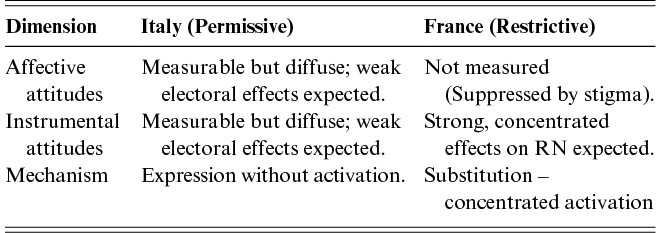
Table 4 Long description
The table has rows for affective attitudes, instrumental attitudes and mechanism. In Italy’s permissive regime, affective and instrumental attitudes are expected to be measurable but diffuse, with weak electoral effects; the mechanism is expression without activation. In France’s restrictive regime, affective attitudes are not measured because they are suppressed by stigma, while instrumental attitudes are expected to have strong, concentrated effects on RN; the mechanism is substitution and concentrated activation.
Cross-national differences in electoral outcomes thus reflect not fundamental differences in authoritarian potential between Italians and French, but distinct institutional and normative environments shaping how identical psychological predispositions are expressed and activated. The empirical sections that follow test these expectations by examining vote choice (Sections 4.4 and 4.6) and partisan identity (Sections 4.5 and 4.7) in both countries.
4.3 Dependent Variables and Analytical Strategy
4.3.1 Vote Choice
Vote choice constitutes the first and most direct behavioral outcome through which we assess the electoral resonance of attitudes toward fascism. In both national contexts under study, the variable is operationalized as respondents’ intended vote in the most proximate national election the forthcoming/proximate national election at the time of fieldwork. – Italy’s general election of September 2022 and France’s legislative contest of 2024. Although intention rather than reported past behavior, this measure remains strongly predictive of actual electoral patterns in pre-electoral survey research and is commonly used in comparative studies of radical-right voting (Rydgren, Reference 100Rydgren2018; Norris & Inglehart, Reference Norris and Inglehart2019). More importantly for our purposes, it provides a clean test of whether affective or instrumental evaluations of fascism surface in the domain where political preferences must be rendered explicit and choice-constraining.
In the Italian case, respondents were asked which party they would vote for if the election were held today, choosing among the principal actors in the 2022 contest: Lega, FdI, Forza Italia (FI), the Partito Democratico (PD), and the Movimento 5 Stelle (M5S). As shown in Table 5, the distribution mirrors the fragmentation and realignment characteristic of Italy’s post-2013 party system, with FdI and M5S emerging as the largest parties in the sample. These parties differ not only ideologically but also genealogically: FdI, as discussed in Section 1, represents the most recent node in a long post-war lineage with symbolic continuities to the neo-fascist right, whereas M5S articulates an anti-establishment, ideologically hybrid appeal that crosscuts traditional left–right patterns. This heterogeneity makes Italy a demanding case for evaluating whether fascist attitudes correlate with electoral behavior once ideological self-placement is accounted for.
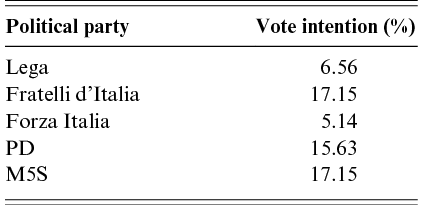
Table 5 Long description
The table reports vote intention in Italy in 2022: Lega 6.56 percent, Fratelli d’Italia 17.15, Forza Italia 5.14, PD 15.63 and M5S 17.15.
For France, vote choice is measured analogously, capturing respondent intentions among the principal blocs competing in 2024: The RN, Ensemble (the centrist presidential coalition associated with Emmanuel Macron), LFI, and Les Républicains (LR). As displayed in Table 6, RN emerges as the plurality force in the sample, consistent with its growing national prominence and the mainstreaming of radical-right appeals under Marine Le Pen’s dédiabolisation strategy. The French case also offers analytic leverage for detecting the potential activation of instrumental attitudes toward fascism in a context where explicit affective attachment to the authoritarian past is reputationally costly and normatively policed. If fascist evaluations bear any relation to electoral choice in France, they are theoretically expected to do so through the instrumental register.
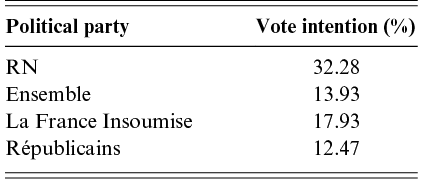
Table 6 Long description
The table reports vote intention in France in 2024: RN 32.28 percent, Ensemble 13.93, La France Insoumise 17.93 and Republicans 12.47.
In both countries, vote choice serves as the most stringent behavioral test of our theoretical claims. Whereas attitudes may be diffuse, contradictory, or weakly held, voting requires prioritization: citizens must choose one party over another, making the act of voting a consequential site where latent orientations toward authority, order, or historical legacies may be activated or suppressed. The comparative design strengthens this logic. If affective or instrumental attitudes toward fascism shape electoral behavior even after controlling for ideological self-placement and sociodemographic characteristics, this would indicate that such attitudes possess explanatory power beyond standard predictors of radical-right support. Conversely, if these evaluations do not travel into vote choice, this would signal either that fascist attitudes remain politically inert or that they are displaced by more proximate ideological cues.
Thus, vote choice operates as a behavioral hinge: a domain where the two faces of fascism – affective and instrumental – may translate into partisan preference, remain dormant, or manifest differently across national mnemonic regimes. The subsequent sections assess precisely whether, and how, these evaluative dispositions toward the authoritarian past structure contemporary electoral decisions in Italy and France.
4.3.2 Partisan Identity
While vote choice captures an episodic and situational expression of political preference, partisan identity provides a deeper window into the affective and motivational underpinnings of political behavior. Electoral decisions can fluctuate from one election to the next, influenced by short-term evaluations of leaders, campaigns, or issue salience. By contrast, partisan identity reflects a more enduring psychological and social orientation, one that embeds citizens within partisan camps and shapes how they interpret political conflict, process information, and evaluate the legitimacy of political actors (Converse, Reference 97Converse1969). Analyzing both outcomes – vote choice and PID – allows us to distinguish between short-term electoral behavior and the longer-term gravitational forces that structure political alignments.
Our operationalization builds on two complementary strands of research. First, the literature on positive partisanship conceptualizes partisan identification as a form of social identity, rooted in feelings of belonging and expressed through loyalty to a party “in good times and bad” (Huddy, Mason & Aarøe, Reference Huddy, Mason and Aarøe2015). This perspective emphasizes affective attachment: identifying with a party means internalizing its successes and failures, perceiving its members as in-group, and defending its legitimacy even in the face of contradictory information. Second, research on negative partisanship highlights that durable hostility toward an opposing party can be as influential as (or even more influential than) attachment to one’s own (Meléndez, Reference Meléndez2022). Negative partisanship reframes electoral competition as a defensive exercise: voters mobilize not primarily to support their preferred party, but to prevent the victory of parties they view as threatening, illegitimate, or fundamentally incompatible with their values. This distinction is crucial in contemporary contexts where affective polarization reshapes political behavior, often leading to stable out-group animus without a correspondingly strong in-group identity.
Our measure of partisan identity is intentionally stringent in order to capture these deep affective orientations rather than episodic sympathies. Respondents are classified as holding a positive partisan identity only when they indicate that they would “definitely” vote for a party’s candidate across three institutional arenas:
1. local government,
2. national legislative elections, and
3. European Parliament elections.
This multi-level requirement increases conceptual validity by ensuring that identity is not inferred from a single domain of political engagement. It also follows the logic of identity-based approaches to partisanship, in which stability across contexts signals a deeper psychological anchor.
Conversely, respondents are coded as holding a negative partisan identity when they respond “definitely not” in all three arenas. This approach aligns with recent research showing that out-group rejection often emerges as a multidimensional affective disposition rather than a one-off electoral preference. By requiring consistent rejection across political levels, our measure captures durable hostility rather than transient disapproval.
As shown in Tables 7 and 8, the resulting distributions differ meaningfully from those obtained through vote choice. In both Italy and France, the proportions of respondents who hold strong positive or negative identities vary sharply from those who merely intend to vote for or against a party in a given election. This divergence illustrates a well-established insight in the literature: voting and partisanship, while related, are distinct phenomena. Citizens may cast a vote for pragmatic or strategic reasons without developing an enduring identity; others may hold strong partisan attachments or aversions yet choose not to vote for the corresponding party due to contextual or tactical considerations.
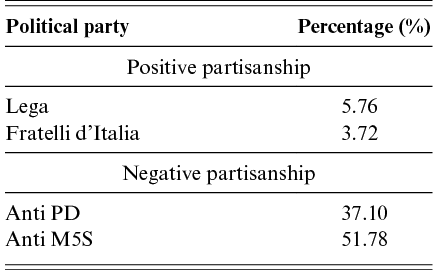
Table 7 Long description
The table reports positive partisan identity in Italy: Lega 5.76 percent and Fratelli d’Italia 3.72. Negative identity is anti-PD 37.10 percent and anti-M5S 51.78.
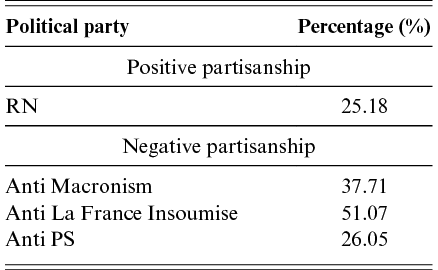
Table 8 Long description
The table reports positive partisan identity in France: RN 25.18 percent. Negative identities are anti-Macronism 37.71 percent, anti-La France Insoumise 51.07, and anti-PS 26.05.
For our purposes, the analytical value of considering PID alongside vote choice is twofold. First, it allows us to test whether attitudes toward fascism resonate more strongly at the level of identity – where political meaning and affect are more deeply rooted – than at the level of behavior, which may be filtered through strategic or ideological considerations. Second, it offers leverage for distinguishing whether fascist attitudes contribute to positive alignment with radical-right formations, negative rejection of their opponents, or both. As later sections show, Italy and France diverge sharply along these lines, underscoring the importance of treating PID as an independent behavioral outcome rather than a derivative of vote intention.
4.3.3 Model Specification and Presentation
The empirical analysis employs logistic regression models estimated separately for Italy and France, and for each major party competing in the respective national elections. Logistic regression is the appropriate estimation technique given that both dependent variables – vote choice and partisan identity – are operationalized as dichotomous outcomes.Footnote 11 For vote choice, respondents are coded as either intending to vote for a given party (1) or not (0). For partisan identity, respondents are coded as either holding a positive or negative identity toward a party according to the stringent multi-level criteria outlined in Section 4.3.2 (1) or not holding such an identity (0). This binary coding allows us to model the probability of electoral or identity-based alignment as a function of attitudes toward fascism, net of other relevant predictors. In each model specification, the main independent variables are affective and instrumental attitudes toward fascism, depending on country-specific data availability. As detailed in Section 2, Italy permits measurement of both registers: affective attitudes (operationalized through admiration and closeness scales) and instrumental attitudes (agreement that “fascist ideas could contribute to politics”). France, given its restrictive memory regime, includes only the instrumental measure. These attitudes constitute the theoretical focus of the analysis: we seek to determine whether historically anchored evaluations of the authoritarian past are independently associated with contemporary political behavior once ideological self-placement and sociodemographic characteristics are accounted for.
All models include a comprehensive set of control variables designed to isolate the autonomous contribution of fascist attitudes. First and most importantly, we control for ideological self-placement on a standard 1–10 left-right scale. As demonstrated throughout the comparative literature on radical-right voting and extensively documented in Section 3, left-right ideology remains the dominant structuring dimension of political competition in both Italy and France (Rydgren, Reference 100Rydgren2018; Norris & Inglehart, Reference Norris and Inglehart2019). Controlling for ideological positioning is therefore essential: if attitudes toward fascism were merely redundant with right-wing ideology, they should exhibit no explanatory power once this variable is included. The presence of significant effects for affective or instrumental attitudes net of ideology would indicate that these historically specific evaluations constitute an additional, distinctive layer of political preference.
Second, we include standard sociodemographic controls: age, education, income, and sex. These variables capture well-documented sources of political heterogeneity and allow us to account for compositional differences across party electorates. Age may capture generational distance from the fascist past and differential exposure to memory regimes; education reflects civic literacy and exposure to formal historical narratives; income proxies for economic security and material interests; and sex captures the pronounced gender gap documented in radical-right support (Rovira Kaltwasser, Salas-Lewin and Zanotti, Reference Rovira Kaltwasser, Salas-Lewin and Zanotti2024). Including these controls ensures that any observed effects of fascist attitudes are not confounded by demographic stratification.
Crucially, the models do not include psychological predispositions (RWA, SDO, and Securitarianism) as controls. This modeling choice is deliberate and theoretically motivated. Section 3 established that these psychological traits are foundational determinants of both affective and instrumental attitudes toward fascism: they precede and generate these evaluations. Including them as controls in vote-choice models would risk over-controlling, as it would partial out variation in fascist attitudes that operates precisely through these psychological pathways. Our analytic strategy is instead to ask: conditional on citizens’ ideological self-placement and demographic profile, do attitudes toward fascism – regardless of their psychological origins – predict electoral behavior? This approach treats psychological predispositions as upstream factors that shape attitudes (Section 3), and attitudes as proximate orientations that may or may not translate into partisan choice (Section 4). The two sections thus test different stages of a causal sequence rather than competing explanations within a single model.
Results are presented graphically through coefficient plots that display point estimates and 95 percent confidence intervals for each predictor. This visual format offers several advantages over traditional regression tables. It provides an intuitive assessment of coefficient estimates and statistical significance: coefficients whose confidence intervals do not cross zero are statistically significant at conventional levels, while the point estimates indicate the direction and magnitude of the estimated associations. The plots also facilitate direct comparison across parties within a country and, where appropriate, across countries. Each figure presents results for multiple parties simultaneously, allowing readers to observe whether affective or instrumental attitudes exhibit party-specific activation or operate uniformly across the political spectrum. Figures are organized by country (Italy, France), by dependent variable (vote choice, partisan identity), and by attitudinal register (affective, instrumental), following the sequence of theoretical expectations developed in Section 4.2.
This combination of logistic estimation, theoretically motivated control variables, and transparent visual presentation enables us to assess with precision whether – and under what conditions – attitudes toward the authoritarian past resonate in electoral behavior and partisan identity formation. The models test the activation dynamics theorized in Section 4.2: whether Italy’s permissive memory regime facilitates expression without mobilization (diffusion), and whether France’s restrictive regime channels latent orientations into concentrated instrumental reasoning that becomes electorally consequential (activation). The sections that follow report results for Italy (Sections 4.4 and 4.5) and France (Sections 4.6 and 4.7), concluding with a comparative discussion (Section 4.8) that synthesizes the cross-national patterns and their implications for understanding the political afterlives of fascism in contemporary democracies.
4.4 Electoral Resonance in Italy
Italy provides the most comprehensive setting in which to analyze the electoral resonance of both affective and instrumental orientations toward fascism (see Section 1). If affective nostalgia or symbolic warmth toward fascism bears electoral significance anywhere, Italy constitutes the most plausible environment in which such effects might appear. The Italian case is therefore a crucial test for determining whether affective attitudes toward the authoritarian past translate into contemporary political choice. Within this context, the empirical analysis proceeds by evaluating the extent to which affective and instrumental attitudes predict vote choice and, subsequently, partisan identity. This section examines the first of these outcomes: whether affective evaluations of fascism are systematically associated with support for the major parties competing in the 2022 general election.
4.4.1 Vote Choice and Affective Attitudes toward Fascism
In Figure 7 we show the estimation of the relationship between affective attitudes toward fascism and intended vote for the principal Italian parties – Lega, FdI, Forza Italia (FI), the PD, and the M5S – while controlling for ideological self-placement and a set of sociodemographic characteristics. The central empirical finding is straightforward yet analytically significant: affective attitudes toward fascism do not predict voting for Lega, FdI, or FI. The analysis shows that, once ideological orientation is taken into account, affective attitudes toward fascism lose their explanatory power entirely, exerting no statistically significant effect on support for FdI or for the broader right-of-center coalition. Appendix A.4 further examines these Italian null findings through distributional comparisons between radical-right and non-radical-right voters, tests for ceiling effects, and alternative model specifications.
Determinants of vote choice – affective attitudes toward fascism (Italy)
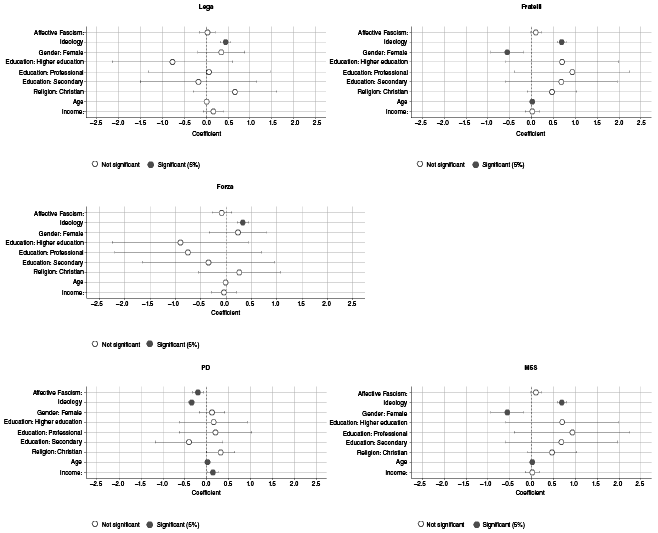
The broader structure of correlates aligns with established findings in the literature on Italian voting behavior. Ideological self-placement remains the dominant predictor of vote choice for the contemporary right: respondents who locate themselves on the right of the ideological spectrum are significantly more likely to express support for Lega and FdI, underscoring that current ideological alignments – not symbolic attachments to the authoritarian past – constitute the primary axis of partisan sorting. A modest gender effect also emerges for FdI, with men more likely than women to indicate support for the party, a pattern that mirrors gendered dynamics identified in radical-right electorates across Western Europe. Beyond these associations, however, affective attitudes toward fascism show no significant positive relationship with any right-wing party.
The only statistically significant relationship involving affective attitudes toward fascism appears on the center-left: higher levels of affective attitudes toward fascism are negatively associated with support for the PD. This finding is intuitively consistent with the PD’s symbolic and organizational anchoring in Italy’s anti-fascist tradition. The party’s identity is historically intertwined with narratives of democratic resistance and post-war reconstruction, and these associations remain salient in public discourse and partisan rhetoric. The negative coefficient therefore reflects a boundary of incompatibility – an attitudinal dissonance between affective warmth for the fascist past and the PD’s explicitly anti-fascist political identity – rather than a positive mobilizing force in favor of any particular right-wing alternative.
Taken together, these results yield a counterintuitive but theoretically illuminating conclusion: in Italy, affective attitudes toward fascism are politically diffuse and do not operate as mobilizing emotions for the contemporary far right. Despite a permissive memory regime that allows for open expression of affective evaluations and despite the continuing legibility of fascist symbols in political communication, these emotional orientations do not significantly structure vote choice for Lega, FdI, or FI once ideological commitments are accounted for. This decoupling between affective nostalgia and radical-right voting underscores that contemporary far-right mobilization in Italy relies primarily on issue-based appeals, ideological positioning, and leadership effects rather than on affective invocations of the interwar past.
This finding substantiates one of the central claims introduced in Section 2: affective and instrumental attitudes toward fascism must be analytically separated, as their political consequences diverge. Affective orientations may remain socially expressible in Italy, but their capacity to shape electoral behavior is limited. By disentangling the two faces of fascism, we observe that affective warmth is not a reliable predictor of far-right support, even in settings where such warmth is least constrained by stigma.
The Italian case thus illustrates a more general theoretical point: the political relevance of authoritarian legacies cannot be inferred from their cultural visibility. The mere expression of affective attachment to the fascist archive does not automatically imply its mobilization in electoral behavior. Emotional availability does not equal political activation. As Section 4.6 shows, this decoupling contrasts sharply with France, where instrumental evaluations – rather than affective ones – are selectively activated and concentrated around the radical right, producing a markedly different pattern of electoral resonance.
4.4.2 Vote Choice and Instrumental Attitudes toward Fascism
We now turn to the second evaluative register: whether instrumental attitudes toward fascism – operationalized as agreement with the idea that “fascist ideas could, in some way, contribute to the politics of my country” – predict vote choice in the Italian context. Figure 8 estimates this relationship across the same set of parties examined in Section 4.4.1: Lega, FdI, Forza Italia (FI), the PD, and the M5S, again controlling for ideological self-placement and sociodemographic characteristics.
Determinants of vote choice – instrumental attitudes toward fascism (Italy)
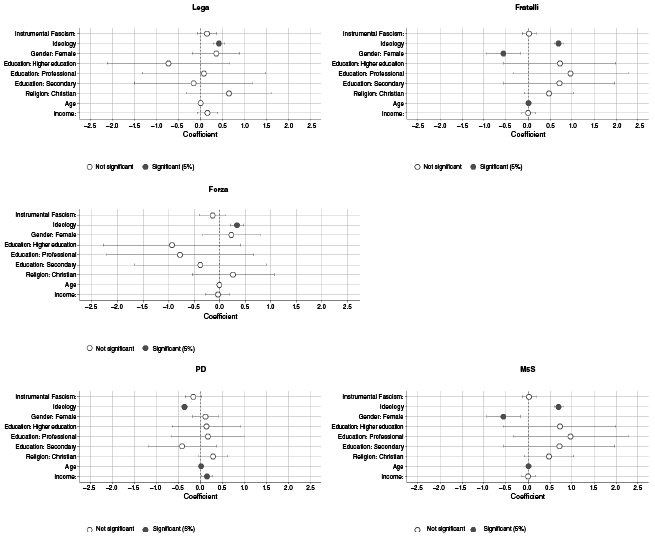
The results are unambiguous. Instrumental attitudes toward fascism do not exert a statistically significant effect on vote choice for any of the major parties in Italy. Even among voters of the radical right, and in particular among intended supporters of FdI, instrumental agreement with fascism fails to emerge as an independent predictor. This null effect resembles, but also deepens, the pattern observed for affective attitudes toward fascism. Whereas affective evaluations displayed a limited and targeted association – namely, a negative relationship with PD support – instrumental evaluations display no meaningful electoral correlation at all, whether positive or negative. This absence of association is theoretically instructive. One might expect instrumental considerations – perceptions that certain elements associated with fascism (e.g., decisiveness, discipline, and capacity for order) could improve contemporary governance – to translate more directly into support for right-wing parties, especially in moments of institutional volatility or perceived crisis. Indeed, in other contexts where memory regimes constrain affective expression, instrumental arguments often provide the primary vocabulary through which authoritarian preferences are voiced. Yet in Italy such a translation does not occur. Instrumental evaluations appear to be attitudes that are cognitively available but politically dormant. Respondents may be willing to acknowledge, in abstract terms, that certain traits associated with fascism could be effective today, but these evaluations do not shape their electoral choices once their ideological commitments are considered.
The lack of electoral activation is especially noteworthy in the case of FdI. As detailed in Section 1, FdI’s ascent has unfolded within a party system marked by deinstitutionalization and symbolic ambiguity, factors that might create openings for instrumental appeals to order or strong leadership. Nevertheless, instrumental attitudes toward fascism remain orthogonal to FdI’s support base. This suggests that FdI’s electoral mobilization relies more on conventional ideological structuring – right-wing cultural conservatism, nativism, and opposition to establishment coalitions – than on any latent appeal to the perceived efficacy of authoritarian governance. The party’s strategic moderation and distancing from explicit references to the fascist past may further explain why instrumental attitudes, even when held, do not coalesce into vote choice for FdI.
The absence of any relationship between instrumental attitudes toward fascism and support for the PD or M5S further reinforces this interpretation. While ideological incompatibility explains why affective attitudes toward fascism predict lower support for the PD, instrumental attitudes toward fascism do not generate a symmetrical disassociation. This asymmetry clarifies that instrumental evaluations do not constitute a generalized political heuristic in Italy; they are not employed by voters to structure decisions either for or against specific parties. Instead, they remain a latent cognitive resource that does not crystallize into partisan behavior.
Thus, the Italian case reveals a broader pattern: instrumental attitudes toward the fascist past may exist at the level of opinion, but they do not bear electoral resonance when contemporary ideological anchors are taken into account. This confirms the argument advanced in Section 2 that instrumental attitudes cannot be assumed to operate in the same manner as affective ones. Their political consequences are contingent on contextual and supply-side conditions, which, in the Italian case, appear insufficient to activate them. The absence of an instrumental effect also reinforces a fundamental theoretical insight: the political relevance of attitudes toward authoritarian legacies depends not only on their prevalence but on their routinization in electoral competition. Italy’s permissive memory environment facilitates the expression of both affective and instrumental evaluations, yet this permissiveness does not translate into their mobilization in partisan contests. The Italian case thus stands in contrast to the French case, examined in Section 4.6, where the opposite dynamic emerges: instrumental evaluations become highly consequential precisely in a setting where affective ones are normatively constrained.
In sum, the Italian evidence demonstrates that attitudes toward the fascist archive – whether affective or instrumental – do not, by themselves, shape radical-right voting. This finding underscores the necessity of distinguishing between the expression of authoritarian evaluations and their electoral activation, a distinction that proves essential for understanding cross-national variation in the political afterlives of authoritarianism.
4.5 Partisan Identities and Fascist Attitudes in Italy
While vote choice offers insight into situational behavior within a given electoral cycle, partisan identities capture a more durable and affectively laden dimension of political alignment. As established in Section 4.2.2, partisan identity – whether positive attachment or negative hostility – reflects a deeper psychological anchoring than episodic electoral preferences. It structures how individuals perceive the political field, evaluate competing actors, and interpret new information. For this reason, partisan identities constitute a crucial test of the political resonance of fascist attitudes. If affective or instrumental evaluations of fascism are meaningful beyond electoral contingencies, they should appear not merely as correlates of vote choice but as predictors of long-term partisan affinities and aversions. Italy’s permissive memory regime (Section 2.3.3) makes it plausible that fascist attitudes – particularly affective ones – might help anchor partisan identities on the right or shape negative identities toward parties historically rooted in anti-fascism. Conversely, instrumental attitudes, given their performance-oriented nature, may structure perceptions of parties that voters deem incapable of providing order or governmental efficacy. Figures 9 and 10 allow us to examine these possibilities by testing whether affective or instrumental evaluations of fascism predict positive identity toward Lega and FdI, or negative identity toward PD and M5S.
4.5.1 Affective Attitudes toward Fascism and Partisan Identities
The results for affective attitudes toward fascism reveal a pattern as intriguing as it is theoretically coherent (see Figure 9). Most notably, affective attitudes toward fascism do not predict positive partisan identity with either Lega or FdI. Even though affective closeness to fascism is more easily articulated in Italy than in France, and despite FdI’s symbolic continuities with the post-fascist lineage, these emotional evaluations do not crystallize into sustained partisan attachment. This absence of a positive relationship reinforces the earlier conclusion (Section 4.4.1) that affective warmth toward the fascist archive is politically diffuse: it may be personally expressible and socially intelligible, but it does not translate into enduring identification with the radical right.
Determinants of partisan identity – affective attitudes toward fascism (Italy)
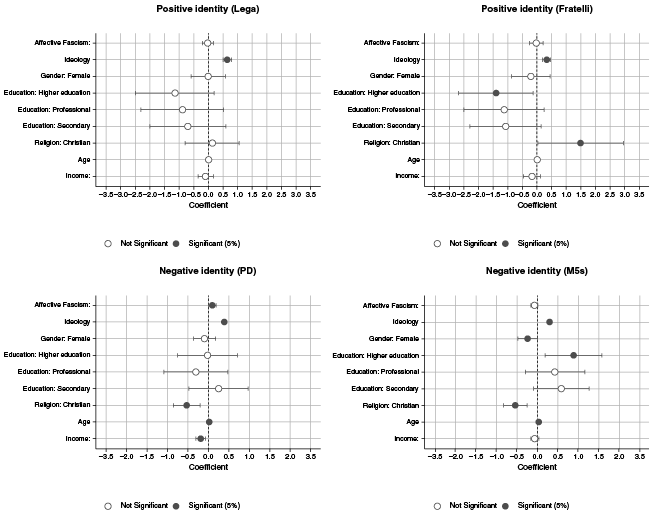
Where affective attitudes toward fascism do exert influence is in the structure of negative partisan identities. Respondents with higher affective positive attitudes toward fascism are significantly more likely to hold strong negative identities toward the PD. No significant association emerges for negative identity toward M5S. This asymmetry – absence of positive effects for the radical right but presence of negative effects for the PD – is consistent with the PD’s anchoring in Italy’s anti-fascist tradition. The PD’s lineage, rhetoric, and symbolic repertoire situate it as the clearest contemporary heir to the anti-fascist consensus forged after 1945. As a result, individuals expressing affective closeness to the fascist archive appear to position themselves against the PD as a matter of partisan identity, even if they do not consistently identify with any particular party on the right.
This finding strengthens the insight that affective attitudes toward fascism should not be interpreted solely as a positive mobilization cue. Rather, it can operate through negative partisanship, shaping the boundaries of political exclusion. In this sense, affective attitudes toward fascism function less as an anchor for right-wing loyalties than as a marker of identity-driven rejection of the PD, which is historically aligned with anti-fascist narratives. The fact that it does not consolidate positive identities for FdI or Lega suggests that symbolic attachment to the fascist past is not sufficiently integrated into the contemporary radical-right appeal to generate ongoing loyalty, but it remains powerful enough to define what voters oppose.
In short, affective attitudes toward fascism resonate in Italy not as a basis for right-wing partisan identity, but as an affective mechanism of partisan distancing, delimiting the emotional boundary between respondents and the PD, which is most closely associated with anti-fascist traditions.
4.5.2 Instrumental Attitudes toward Fascism and Partisan Identities
The results for instrumental attitudes toward fascism, shown in Figure 10, reveal a largely null pattern, with one unexpected association. As with affective attitudes toward fascism, instrumental evaluations do not predict positive partisan identity for Lega or FdI. This indicates that respondents who view fascist ideas as potentially useful for Italy’s present are not significantly more likely to hold a positive partisan identity toward the radical right. The absence of a positive identity effect mirrors the lack of influence on vote choice (Section 4.4.2), underscoring the limited political activation of such instrumental evaluations within Italy’s contemporary electoral and partisan landscape.
Determinants of positive and negative partisan identity – instrumental attitudes toward fascism (Italy)
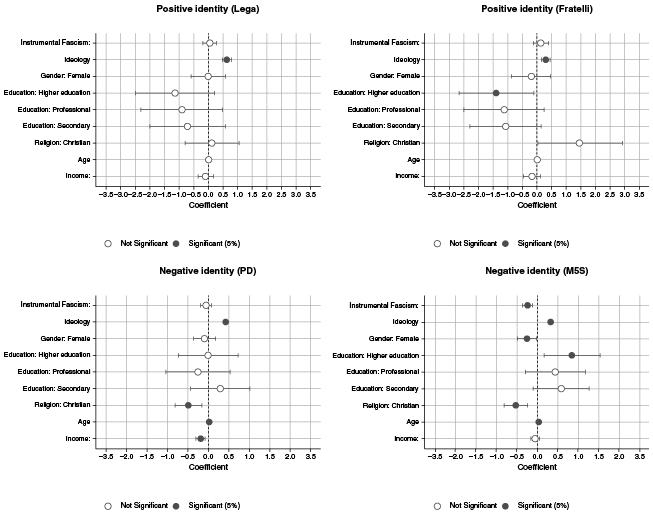
However, higher instrumental attitudes toward fascism are associated with a lower likelihood of strongly rejecting M5S, while no significant association emerges for the PD. This result runs counter to the intuitive expectation that instrumental attitudes would foster rejection of M5S and should therefore be interpreted cautiously. Taken together, these patterns reveal that instrumental attitudes toward fascism, like affective ones, are not a foundation for positive right-wing partisan identity. Affective attitudes toward fascism predict negative identity toward the PD, whereas instrumental attitudes are unexpectedly associated with a lower probability of negative identity toward M5S. The latter result does not provide evidence of performance-based rejection of M5S.
4.6 Electoral Resonance and Fascist Attitudes in France
France offers a sharply contrasting context to Italy in the political articulation of attitudes toward fascism. As discussed in Section 1, France’s memory regime is characterized by a high degree of normative constraint: explicit affective nostalgia for the authoritarian past is socially stigmatized, legally proscribed in its most overt forms, and embedded within a political culture structured by the devoir de mémoire. In such an environment, the expressive costs of openly admiring the fascist archive are substantial, reducing the feasibility of affective articulations. For this reason, our French study focuses exclusively on instrumental evaluations – the belief that ideas associated with fascism might possess contemporary usefulness. These instrumental evaluations offer citizens a coded and socially acceptable means of expressing preferences related to order, decisiveness, and authority without invoking explicit symbolic attachment to the discredited past.
France’s party system at the time of the 2024 election provides fertile ground for examining whether these instrumental attitudes carry electoral and identity-based resonance. The RN, under Marine Le Pen, has strategically pursued dédiabolisation, recasting the party as a respectable governing alternative while retaining a platform centered on sovereignty, hierarchy, border control, and the restoration of social order. Conversely, LFI presents a programmatic vision emphasizing popular mobilization, institutional overhaul, and social transformation – positions that directly counter the hierarchical and performance-oriented imaginaries commonly associated with instrumental authoritarianism. Ensemble/Macronism and Les Républicains (LR) offer moderate centrist and conservative alternatives, but neither mobilizes a political grammar grounded in the decisive, extra-institutional problem-solving that characterizes instrumental fascist thinking. This partisan configuration provides a strong theoretical basis for expecting asymmetrical effects: instrumental attitudes toward fascism should resonate positively with RN supporters, negatively with LFI supporters, and remain largely irrelevant for the center and center-right.
Figure 11 tests whether instrumental attitudes toward fascism predict intended vote for RN, Ensemble, LFI (La France Insoumise), and LR, controlling for ideology and sociodemographic variables. The results largely support the theoretical expectations outlined earlier. Instrumental attitudes toward fascism emerge as a strong and statistically robust predictor of vote for the RN. Respondents who perceive fascist ideas as potentially useful today are significantly more likely to support RN, even after accounting for ideological self-placement. This indicates that instrumental evaluations capture a dimension of political preference that is not reducible to the standard left–right ideological continuum. Rather, they reflect a specific performance-oriented understanding of governance – one that anticipates decisiveness, order, and hierarchical authority, and that voters appear to associate most directly with RN.
Determinants of vote choice – instrumental attitudes toward fascism (France)
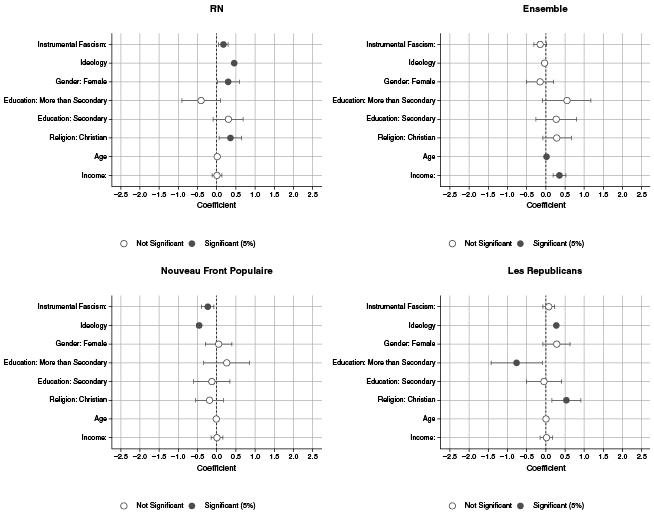
The analysis also reveals a negative association between instrumental attitudes toward fascism and support for LFI. This relationship is theoretically consistent: LFI’s programmatic emphasis on participatory democracy, institutional transformation, and egalitarian redistribution stands at the opposite pole of the political logic underpinning instrumental evaluations of authoritarian governance. For respondents who believe that the political system requires forceful, urgent, or hierarchical intervention, LFI represents not merely an alternative but an ideological counterpoint.
By contrast, instrumental attitudes toward fascism show no meaningful association with support for Les Républicains or Ensemble. Both groups draw voters whose preferences may include order or stability, but neither party deploys the rhetorical or ideological registers that would activate perceptions of the authoritarian past as a source of contemporary utility. The absence of such associations confirms that instrumental attitudes toward fascism are not a general authoritarian predisposition applicable across the right; their electoral effects are selectively activated within a particular partisan project – namely, that of the RN.
Taken together, these results demonstrate that instrumental attitudes toward fascism are electorally activated in France, in stark contrast to the Italian case. The combination of a restrictive memory regime and a radical-right party capable of translating performance-oriented authoritarian evaluations into electoral mobilization produces a strong and distinctive pattern of political resonance.
4.7 Partisan Identities and Attitudes toward Fascism in France
If attitudes toward fascism are consequential beyond episodic elections, they should also appear in the structure of partisan identities. Figure 12 provides clear evidence that this is the case for France. Instrumental attitudes toward fascism are a strong predictor of positive partisan identity toward RN: individuals who believe that elements of fascist-era governance could be useful today are substantially more likely to identify firmly with the RN across multiple electoral arenas. This indicates that instrumental evaluations are associated not only with vote choice but also with positive partisan identity toward RN.
Determinants of positive and negative partisan identity – instrumental attitudes toward fascism (France)
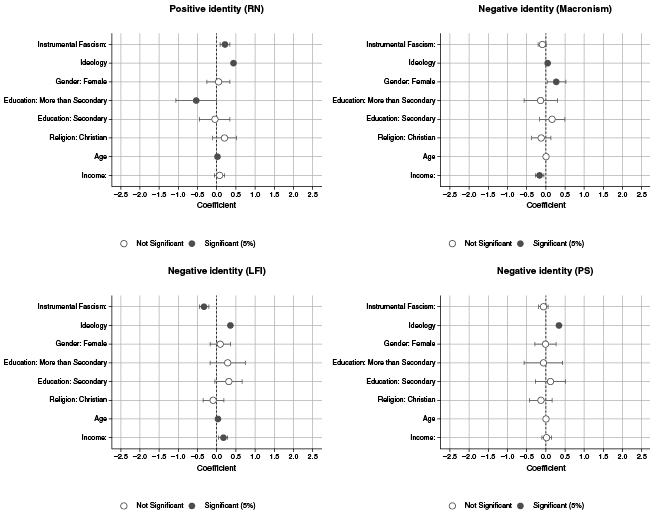
Instrumental attitudes toward fascism are also significantly associated with a lower probability of holding a negative partisan identity toward LFI. This result runs counter to our expectation that such attitudes would foster rejection of LFI and should therefore be interpreted cautiously. No significant associations emerge for negative identities toward Ensemble or the Parti Socialiste. Crucially, instrumental attitudes toward fascism do not predict negative identities toward Ensemble or the Parti Socialiste. The significant negative association with negative identity toward LFI, however, indicates a lower likelihood of strongly rejecting LFI and should therefore be interpreted cautiously.
4.8 Discussion
The findings presented in this section show that the electoral resonance of fascist attitudes is highly conditional, shaped by the interaction between evaluative registers (affective vs. instrumental) and national mnemonic regimes. In Italy, neither affective nor instrumental attitudes exert autonomous effects on vote choice for right-wing or radical-right parties once ideology is taken into account. Affective attitudes toward fascism emerge only as a marker of negative identity toward anti-fascist actors such as the PD, while instrumental ones are unexpectedly associated with a lower probability of negative identity toward M5S and do not predict attachment to the radical right.
France presents the mirror image of this dynamic. The restrictive memory regime suppresses affective articulations of attachment to fascism, but instrumental evaluations become highly politicized, mapping tightly onto both electoral behavior and partisan identity formation. Instrumental attitudes toward fascism are strongly associated with vote choice for RN and with positive RN identity, while unexpectedly being associated with a lower probability of negative identity toward LFI. This concentration of the positive electoral and identity effects around RN confirms the expectation, developed earlier in the Element, that mnemonic constraint does not eliminate authoritarian attitudes but instead channels them into coded, performance-oriented registers. The partisan supply side is critical here: RN offers an available and legitimate vessel through which instrumental authoritarianism can be translated into durable political alignment, demonstrating how contemporary radical-right actors can harness latent evaluative dispositions toward the authoritarian past.
The comparative evidence presented in this section demonstrates that attitudes toward the authoritarian past remain politically relevant in contemporary democracies, but their electoral activation is profoundly shaped by institutional and normative contexts. Italy’s permissive memory regime facilitates expression without mobilization, France’s restrictive environment channels residual sympathies into concentrated instrumental reasoning. These contrasting dynamics clarify that democratic vulnerabilities to authoritarian legacies are not uniform but contextually mediated. Section 5 synthesizes these findings, reflects on their broader implications for democratic resilience, and outlines directions for future research.
5 Conclusion
This Element set out to answer a deceptively simple question: How do citizens in contemporary European democracies evaluate fascism as a historical regime and political object, and do these evaluations bear on their electoral behavior? The question is deceptively simple because it requires confronting a legacy that democracies have long treated as settled – morally condemned, historically understood, and politically neutralized. As the empirical sections demonstrated, the afterlives of fascism remain contested, multidimensional, and selectively activated. The comparative design leveraged Italy and France as contrasting cases on the dimension of memory regimes. Italy’s permissive environment allowed both affective and instrumental registers to be expressed but produced electoral diffusion: attitudes toward fascism are widely held yet absorbed into conventional left-right positioning, exerting no independent effect on radical-right voting once ideology is controlled. France’s restrictive devoir de mémoire is theorized to constrain affective expression but instrumental attitudes became concentrated and electorally consequential, predicting RN voting and identity even after controlling for ideology. This asymmetry is the central comparative finding: memory regimes do not eliminate authoritarian sympathies; they shape which register is publicly sayable and thus electorally mobilizable. This synthesis positions us to assess the Element’s broader contributions, normative implications, and limitations.
This Element makes four major theoretical contributions to the study of far-right politics, authoritarian legacies, and democratic resilience. First, it moves beyond indirect proxies to offer direct, multidimensional measurement of attitudes toward fascism. Most research on far right voting infers authoritarian sympathies from general traits like RWA, SDO, populist resentment, or nationalism. These constructs are valuable, but they do not tell us whether citizens evaluate fascism itself positively or negatively and conflating the two risks misattributing the sources of far right support. Our approach treats fascism as a distinct political object and measures explicit evaluations of it. By fielding items that solicit evaluations rather than identities – asking respondents to assess their feelings, proximity, or views on usefulness – we reduced social desirability bias and captured meaningful variation even in a sensitive domain. The finding that substantial minorities in both Italy and France express positive evaluations when directly asked confirms that attitudes toward the fascist past are neither extinct nor uniformly suppressed, and that treating them as unmeasurable or irrelevant obscures politically consequential orientations.
Second, the two-dimensional framework reveals that attitudes toward fascism are not monolithic but comprise affective and instrumental registers that operate through distinct psychological and ideological mechanisms. This distinction builds on Easton’s classic insight that political support comprises diffuse (intrinsic, identity-laden) and specific (performance-based) orientations, extending it to historically charged objects. Affective attitudes reflect symbolic attachment, heritage pride, or nostalgic identification with leaders and narratives; instrumental attitudes reflect pragmatic judgments about governance efficacy, often activated by perceptions of crisis or institutional failure. Section 3 demonstrated that while both dimensions share psychological foundations (RWA, SDO, Securitarianism predict both), they diverge sharply in their ideological correlates: populism predicts only affective attitudes, conservatism predicts both dimensions, although more strongly for the affective one; and, in Italy, openness to dictatorship predicts only instrumental attitudes. This pattern supports the distinction between the two faces, with affective reasoning more closely rooted in identity work and instrumental reasoning more closely rooted in performance heuristics.
The analytic payoff is substantial. Treating fascist attitudes as a single continuum would conflate citizens who admire the past as heritage with those who view authoritarian methods as pragmatically useful, obscuring the distinct routes to each and masking how they relate to psychological predispositions and electoral behavior. By disaggregating the two faces, we observe that some citizens hold affective warmth without instrumental endorsement (admiring symbols but doubting their contemporary utility), others hold instrumental views without affective attachment (viewing decisiveness as effective while morally disavowing the past), and still others score high on both. These configurations have different implications for democratic vulnerability and require different remedies, as we discuss later.
Third, the Element reframes the role of memory regimes as expression filters rather than determinants of attitudes. The same three psychological predispositions are positively associated with instrumental attitudes in both countries, indicating that memory regimes do not create or eliminate authoritarian sympathies but shape which evaluative register is publicly sayable and thus electorally actionable. Italy’s permissive climate allows both affective and instrumental expressions, a pattern consistent with less reliance on instrumental forms of expression. In France’s restrictive devoir de mémoire environment, we theorize that affective expression is suppressed and that residual authoritarian sympathies are more likely to surface in instrumental reasoning. The higher instrumental means observed there (2.35 vs. 1.78 in Italy) are consistent with this substitution dynamic but do not, on their own, demonstrate it: alternative explanations (such as differences in the contemporary political salience of order and security in French public discourse) remain plausible, and a direct test of the mechanism would require fielding affective items in France – which the design explicitly avoided for the theoretical reasons set out in Section 2.5. This dynamic offers one possible interpretation of the cross-national reversal – lower instrumental endorsement where stigma is low, higher where stigma is high – and clarifies that memory regimes moderate activation rather than determine underlying orientations.
This insight refines how we interpret attitudes toward authoritarian pasts. What surveys capture is not the full distribution of latent sympathies but the portion that is expressible under given normative constraints. In permissive environments, multiple registers coexist; in restrictive environments, expression concentrates in the least stigmatized channel. Scholars of democratic resilience must therefore attend not only to levels of authoritarian attitudes but also to which register is observable, recognizing that identical predispositions manifest differently depending on mnemonic context. This framework extends beyond fascism: it applies to any historically discredited ideology – communism in Eastern Europe, military dictatorships in Latin America, colonialism in former empires – wherever memory regimes structure what can be publicly said about the past.
Fourth, the Element demonstrates that electoral activation of fascist attitudes is contingent on the alignment of three conditions: the structure of attitudes (affective vs. instrumental), the memory environment governing their expression, and the partisan actors capable of mobilizing them. Section 4 showed that expression does not automatically translate into activation. In Italy, both affective and instrumental attitudes are widely expressible, yet neither predicts radical-right voting once ideology is controlled. They remain politically diffuse, absorbed into conventional left-right positioning rather than functioning as independent cues. In France, instrumental attitudes are concentrated and highly predictive of RN support and identity, precisely because the restrictive memory regime has made them the only admissible pathway for expressing performance-oriented authoritarianism and because RN has strategically recoded its appeal to resonate with such reasoning.
This contingency clarifies that the political relevance of authoritarian legacies depends on supply-side mediation (De Vries & Hobolt, Reference De Vries and Hobolt2020). Parties differ in their willingness and capacity to activate historically charged attitudes. Where parties deploy rhetoric, symbols, or policy frames that align with citizens’ evaluations of the past – as RN does with sovereignty, security, and order – those attitudes crystallize into electoral behavior. Where parties avoid such cues or where ideological positioning prioritizes other appeals, attitudes may remain latent. The implication is that democratic vulnerability to authoritarian legacies is not fixed but dynamic, shaped by institutional contexts, party strategies, and the temporal alignment of mnemonic cycles with political opportunities.
Together, these contributions extend the study of far right politics by showing that historically specific attitudes toward discredited regimes are measurable, multidimensional, and selectively activated depending on memory regimes and partisan supply. They invite renewed attention to how democratic publics reckon with their pasts and how latent sympathies for authoritarianism, once thought extinct, can find new expression through democratic channels.
The findings carry direct normative implications for understanding and addressing democratic vulnerability to authoritarian legacies. The two faces of fascism – affective and instrumental – pose distinct challenges, and their remedies differ because they operate through different mechanisms. Affective attitudes challenge the civic boundary of remembrance. They signal that segments of the electorate maintain emotional warmth, symbolic identification, or pride in relation to regimes that dismantled pluralism, repressed dissent, and pursued exclusionary or imperial projects. This represents a failure of historical reckoning: the authoritarian past is not fully delegitimized but remains available as heritage capital that can be mobilized by parties deploying nostalgic cues, leader-centered narratives, or aestheticized references to “strength” and “order.” In Italy, affective attitudes do not directly predict (far) right voting, but they structure negative identities toward anti-fascist actors like the PD, revealing that symbolic attachment to the fascist archive continues to mark political boundaries even when it does not drive positive partisan alignment. The democratic response to affective resonance centers on memory work, civic education, and symbolic boundary-setting. France’s devoir de mémoire provides a partial model: legal frameworks (the Gayssot Law), commemorative rituals (Chirac’s 1995 acknowledgment of state responsibility), high-profile trials (Papon), and curricular reforms embedding collaboration into civic instruction have raised reputational costs for overt nostalgia and driven affective expression underground. While imperfect and contested, this regime demonstrates that sustained institutional effort can shift what is publicly sayable about the past, even if it cannot eliminate latent sympathies entirely.
Instrumental attitudes challenge the procedural boundary of governance. They legitimize authoritarian methods under the banner of efficacy, framing hierarchical command, executive aggrandizement, and illiberal shortcuts as pragmatically necessary responses to crisis, disorder, or institutional failure. This represents conditional and fragile democratic commitment: citizens support democracy when it delivers but are willing to trade pluralism for decisiveness when institutions appear ineffective. In France, instrumental attitudes strongly predict RN voting and identity, indicating that performance-based reasoning about authoritarianism has become electorally consequential in a context where parties frame contemporary challenges – immigration, security, sovereignty – as crises requiring “strong government.” The democratic response to instrumental resonance cannot rely solely on normative education or historical memory; it requires credible institutional performance and democratic delivery on the very issues where authoritarian rhetoric gains traction. This means effective crisis management, visible provision of security and order within democratic rules, responsive governance that demonstrates competence without resorting to shortcuts, and political communication that contests the premise that democracy is inherently slow, weak, or incapable of decisiveness.
The Italy–France contrast clarifies that neither memory regime is normatively superior but both face vulnerabilities of different kinds. Italy’s permissiveness allows multiple evaluative registers to coexist, but their very normalization risks complacency: attitudes remain diffuse and politically inert, yet they could be activated if partisan entrepreneurs found effective ways to mobilize them or if external shocks (economic crisis, security threats, and institutional collapse) made instrumental reasoning more salient. France’s restrictiveness has raised the reputational costs of overt affective nostalgia, while a possible substitution dynamic may concentrate residual sympathies into instrumental reasoning that is already electorally activated through RN. The restrictive regime has not eliminated authoritarian orientations; it has channeled them into a coded register that parties can exploit without triggering taboo.
Both challenges require sustained democratic effort. Affective attitudes call for ongoing memory work: not one-time commemorations but institutionalized practices that continuously delegitimize nostalgic identification with authoritarian pasts through education, public discourse, and symbolic interventions. Instrumental attitudes call for institutional credibility: democracies must demonstrate that they can deliver security, stability, and efficacy without resorting to authoritarian methods, a task that becomes harder in contexts of prolonged crisis, polarization, or governance failure. The Element’s findings underscore that democratic resilience in the face of authoritarian legacies is not a static achievement but an ongoing process of managing both symbolic boundaries and performance expectations.
Several scope conditions frame the interpretation of our findings. The cross-sectional design captures structured associations at specific time points (Italy 2022, France 2024) and cannot establish temporal precedence between attitudes toward fascism and electoral behavior. Two interpretations of the patterns we document are observationally compatible: attitudes toward the fascist past may shape vote choice, or voters may reinterpret their attitudes post hoc through party messaging and partisan motivated reasoning (Taber & Lodge, Reference Taber and Lodge2006; Achen & Bartels, Reference Achen and Bartels2016). We do not adjudicate between these mechanisms here; we argue, instead, that our findings remain politically consequential under either reading. Following Zaller (Reference Zaller1992), political attitudes are co-produced through interaction with elite cues and partisan frames; the systematic co-occurrence of attitudes toward fascism and radical-right support is therefore informative about the shared symbolic and evaluative terrain on which contemporary electoral competition unfolds, regardless of causal direction. Panel designs and framing experiments would constitute the natural next step for disentangling causal arrows – an agenda we leave to future work. We provide supplementary temporal and descriptive checks in Appendix A.Footnote 12
The asymmetric measurement strategy – both affective and instrumental attitudes in Italy, only instrumental in France – was theoretically motivated: we measured what each memory regime makes expressible. This design choice enabled us to interpret substitution dynamics that would otherwise remain invisible. We are explicit, however, about its costs. First, the suppression of affective expression in France is posited by the framework rather than directly tested; alternative explanations for the higher instrumental mean in France (contemporary discursive context, distributional differences in underlying predispositions) cannot be fully ruled out. Second, the asymmetry precludes direct cross-national comparison of affective resonance. Third, our framework assumes a common latent two-dimensional structure across the two publics, an assumption that future research could probe through unconventional measurement strategies – indirect questioning, list experiments, or conjoint designs – designed to elicit affective evaluations in high-stigma settings without triggering social desirability bias. We consider this part of an agenda for future comparative work on attitudes toward authoritarian pasts. We also acknowledge the usual concerns about social desirability bias inherent in self-reports on a sensitive domain, though our framing as evaluations rather than identities likely reduced underreporting.
The two-country design provides analytic depth at the cost of breadth. Italy and France offer contrasting memory regimes and party systems, but whether the framework extends to other European cases (Germany’s restrictive regime, Spain’s contested memory) or beyond Europe (Eastern European communist legacies, Latin American dictatorships) remains an empirical question. We focused on demand-side attitudes; how parties strategically activate or suppress historically charged cues through campaign rhetoric warrants systematic supply-side analysis. These scope conditions point toward productive extensions: longitudinal tracking of attitude stability, experimental manipulation of framing and cues, expanded geographic coverage, and elite-level analysis of strategic deployment. They do not undermine the core finding that attitudes toward fascism are multidimensional, psychologically structured, and selectively activated depending on memory regimes – a contribution that stands regardless of these boundaries.
The Element opens several avenues for future research that could address its limitations and extend its theoretical framework. Longitudinal designs would allow observation of how attitudes toward fascism evolve over time, whether they respond to political events (scandals, commemorations, and crises), and whether their electoral activation fluctuates across campaign periods. Panel data tracking the same respondents before, during, and after elections would clarify the temporal stability of affective and instrumental attitudes and test whether changes in party rhetoric or contextual conditions shift their salience. Such designs would also permit stronger causal inference about the relationship between attitudes and vote choice.
Experimental manipulation could test supply-side activation directly. Researchers could expose respondents to different frames – symbolic cues (e.g., FdI’s tricolor flame), performance narratives emphasizing order and decisiveness, or crisis frames highlighting institutional failure – and assess whether these treatments increase the salience of affective or instrumental attitudes and their correlation with vote intentions. Experiments could also test whether educational interventions (historical information, counter-narratives) reduce positive evaluations or shift them across registers.
Expanded geographic scope would assess the framework’s portability. Germany, with a restrictive memory regime around Nazism that is arguably even more institutionalized than France’s devoir de mémoire, provides a natural comparison case. Spain, where the Pacto del Olvido long deferred memory work around Franco’s dictatorship and where recent memorialization efforts remain contested, offers a case of shifting memory regimes. Eastern Europe, where communist pasts rather than fascist ones dominate historical memory, would test whether the affective-instrumental distinction applies to different ideological legacies. Extending beyond Europe to Latin America (military dictatorships) or post-colonial contexts (settler regimes, authoritarian independence leaders) would assess whether the framework generalizes across regime types and historical periods.
Elite rhetoric and party strategy remain underexplored. Content analysis of party manifestos, campaign speeches, and social media could identify how FdI, RN, and their competitors deploy or avoid historically charged language. Qualitative interviews with party elites could reveal strategic calculations about when to invoke heritage cues versus when to code authoritarian appeals in present-tense idioms. Process-tracing specific cases – such as Zemmour’s 2022 revisionist campaign in France or FdI’s symbolic messaging during the 2022 Italian election – could clarify the conditions under which supply-side activation succeeds or fails.
Generational dynamics warrant closer attention. Younger cohorts, with no direct or transmitted memory of the regime, may relate to fascism differently than older generations. Section 3 found that younger Italians score higher on instrumental attitudes, suggesting that generational distance lowers barriers to pragmatic reasoning even as it may weaken affective transmission. Cohort analysis could test whether this pattern reflects life-cycle effects (youth as a phase of ideological openness), period effects (specific political contexts), or genuine generational replacement (changing norms around historical memory).
Other authoritarian pasts could be analyzed through the same framework. Do citizens in former communist states exhibit affective nostalgia for state socialism alongside instrumental beliefs that central planning was efficient? Do Latin Americans distinguish between symbolic attachment to military leaders and pragmatic endorsement of authoritarian governance? Applying the two-dimensional framework comparatively would test its conceptual portability and reveal whether the mechanisms identified here – identity versus performance, memory regimes as filters, conditional activation – operate across diverse historical and ideological contexts.
This Element began with Pier Paolo Pasolini’s provocation: “Io so. Ma non ho le prove” – I know, but I have no proof. Written in 1974 amid Italy’s anni di piombo, Pasolini’s intervention named a moral knowledge about complicity and power while acknowledging the limits of evidence in an atmosphere thick with fear and euphemism. Fifty years later, we return to Pasolini’s urgency with the tools of systematic social science. What many observers intuitively “know” – that publics in mature democracies continue to hold heterogeneous, sometimes troubling views about their authoritarian pasts – we have now documented empirically. Fascism persists not as a coherent ideology seeking to reconquer the state, but as a grammar: a repertoire of emotional and pragmatic cues through which democratic publics continue to debate authority, order, and belonging.
The endurance of the past is neither automatic nor uniform. Memory regimes shape what can be publicly said; partisan actors decide whether and how to activate historically charged attitudes; and citizens navigate these constraints as they form political preferences. Italy’s permissive environment allows both affective warmth and instrumental reasoning to be voiced, yet neither consolidates into radical-right mobilization because they are absorbed by conventional ideological alignments. France’s restrictive devoir de mémoire is theorized to constrain overt affective expression, but instrumental reasoning becomes concentrated and electorally consequential, channeled through RN’s performance-oriented rhetoric. These divergent trajectories demonstrate that authoritarian legacies are neither extinct nor automatically dangerous; their political salience depends on institutional contexts, party strategies, and the alignment of mnemonic cycles with democratic vulnerabilities.
Understanding how citizens relate to discredited pasts is essential for democratic resilience. Affective warmth toward fascism requires memory work – sustained civic education, symbolic boundary-setting, and institutional safeguards that delegitimize nostalgic identification. Instrumental openness to authoritarian methods requires credible democratic performance – demonstrating that pluralism, checks and balances, and deliberation can deliver security, order, and efficacy without resorting to shortcuts. Both dimensions matter, both are measurable, and both demand proactive democratic responses rather than assumptions that legal prohibitions or the passage of time will suffice.
Our contribution is modest in scope but civic in ambition. We have provided the first systematic, comparative evidence on contemporary attitudes toward fascism in two mature democracies, revealing that these attitudes are multidimensional, psychologically structured, and selectively activated depending on memory regimes and partisan supply. The findings extend beyond Italy and France, inviting renewed attention to how democratic publics across Europe and beyond reckon with their authoritarian pasts – and how those reckonings shape the resilience of democracy in an age of populist challenges, institutional strain, and contested memory. If this Element helps clarify where remembrance has hardened into ritual or where amnesia has become indulgence, it will have earned its place beside Pasolini’s admonition: some things are widely known yet hard to prove, and still they govern how a democracy understands itself through the cumulative weight of individual judgments.
Acknowledgments
The authors are grateful to the Editors of the Cambridge Elements in the History and Politics of Fascism series and to the anonymous reviewers for their insightful comments and constructive suggestions, which greatly improved this Element. They also thank Jesús Guzmán Castillo for his excellent statistical assistance throughout the project.
Carlos Meléndez acknowledges the support of the Fundação para a Ciência e a Tecnologia (FCT) through the project Populist Appeals and Negative Partisanship: A Cross-Regional Comparison between Latin America and Southern Europe (Grant No. 2023.08788.CEECIND/CP2882/CT0006; DOI: https://doi.org/10.54499/2023.08788.CEECIND/CP2882/CT0006), as well as the FCT Mobility Outgoing Programme (Grant No. FCT/Mobility/1366208590/2024-25).
Carlos Meléndez also gratefully acknowledges the hospitality of the AXPO Observatory of Market Society Polarization at Sciences Po, where part of this Element was completed during his Visiting Fellowship (2025–2026). He is especially grateful to Olivier Godechot, Director of the Observatory, and Allison Rovny, Executive Director, for their generous support and for providing an outstanding academic environment.
Series Editors
Federico Finchelstein
The New School for Social Research
Federico Finchelstein is Professor of History at the New School for Social Research and Eugene Lang College in New York City. He is an expert on fascism, populism, and dictatorship. His previous books include From Fascism to Populism in History and A Brief History of Fascist Lies.
António Costa Pinto
University of Lisbon
António Costa Pinto is a Research Professor at the Institute of Social Sciences, University of Lisbon. He is a specialist in fascism, authoritarian politics, and political elites. He is the author and editor of multiple books on fascism, including The Fascist Zenith: War and Dictatorship under Axis Rule.
Advisory Board
Giulia Albanese, University of Padova
Mabel Berezin, Cornell University
Maggie Clinton, Middlebury College
Sandra McGee Deutsch, University of Texas, El Paso
Aristotle Kallis, Keele University
Sven Reichardt, University of Konstanz
Angelo Ventrone, University of Macerata
About the Series
Cambridge Elements in the History and Politics of Fascism is a series that provides a platform for cutting-edge comparative research in the field of fascism studies. With a broad theoretical, empirical, geographic, and temporal scope, it will cover all regions of the world, and most importantly, search for new and innovative perspectives.