


Introduction
Human beings evolved sharing something unique to their species; only humans, in the realm of social dynamics, can feel shame and shame others. One approach that offers important insights into the evolutionary nature of shame is the biopsychosocial approach (Gilbert, Reference Gilbert1992, Reference Gilbert, Gilbert and Andrews1998, Reference Gilbert, Gilbert and Miles2002, Reference Gilbert, Tracy, Robins and Tangney2007). This perspective is based on the notion that evolution plays a powerful role on human's proneness to be highly regulated within social relationships. Throughout life, social relationships are vital physiological and psychological regulators (Cacciopo, Berston, Sheridan and McClintock, Reference Cacioppo, Berston, Sheridan and McClintock2000; Carter, Reference Carter1998; Cozolino, Reference Cozolino2006; Gerhardt, Reference Gerhardt2004; Siegel, Reference Siegel2001). Thus, for humans, growing up with a sense of being loved, accepted, valued and chosen by others (e.g. caregivers, friends, allies, peers, lovers, superiors) for important social roles (e.g. friend, lover, team member), makes one's world safer and promotes affect regulation (Cacciopo et al., Reference Cacioppo, Berston, Sheridan and McClintock2000; Gilbert, Reference Gilbert2005, Reference Gilbert2009a; Masten, Reference Masten2001).
Ultimately, humans’ innate motives to form attachment to carers (Bowlby, Reference Bowlby1969; Cassidy and Shaver, Reference Cassidy and Shaver1999), seek group belonging (Baumeister and Leary, Reference Baumeister and Leary1995), and compete for an advantageous social rank position (Gilbert, Reference Gilbert1992, Reference Gilbert2000), guaranteed survival, prospering and welfare throughout the course of human evolution. So, both for purposes of making the social world safe and to engage others to choose in one's favour to form advantageous social roles, it is crucial to social success and survival to stimulate positive affects and beliefs about the self in the mind of others, and to be seen as an attractive social agent. Failure or rejections in these vital human needs make the world a dangerous place and may compromise several reproductive strategies (e.g. attracting sexual partners, allies and kin support; Gilbert, Reference Gilbert1992, Reference Gilbert1997, Reference Gilbert2003; Gilbert and McGuire, Reference Gilbert, McGuire, Gilbert and Andrews1998).
Shame occurs in the context of competition for social attractiveness and emerges from evolved cognitive abilities for processing social information and for self-conscious awareness (Byrne, Reference Byrne1995; Liotti and Gilbert, Reference Liotti and Gilbert2011; Lewis, Reference Lewis2003; Tracy and Robins, Reference Tracy and Robins2004; Gilbert, Reference Gilbert, Gilbert and Andrews1998, Reference Gilbert2003, Reference Gilbert, Tracy, Robins and Tangney2007). Hence, shame acts as a warning signal that we exist negatively in the mind of others, as someone with negative qualities (e.g. inferior, defective, inadequate), or lack of positive ones, and thus stand at risk of being rejected, excluded, passed by or even harmed or persecuted. Besides, shame has been conceptualized as one's experience of feeling inferior, worthless, inadequate, unlovable or powerless in some way, as having flaws, inadequacies, exposed as being an unattractive and undesirable self (Gilbert, Reference Gilbert, Gilbert and Andrews1998, Reference Gilbert, Tracy, Robins and Tangney2007; Lewis, Reference Lewis1992; Lindsay-Hartz, de Rivera and Mascolo, Reference Lindsay-Hartz, de Rivera, Mascolo, Tangney and Fischer1995; Tangney and Dearing, Reference Tangney and Dearing2002). Therefore shame is a self-conscious but socially shaped emotion that is linked to threats to (social) self-identity, and it plays a fundamental role in the formation of one's sense of self and self-identity as a social agent (Dearing and Tangney, Reference Dearing and Tangney2011; Gilbert, Reference Gilbert, Gilbert and Andrews1998, Reference Gilbert, Tracy, Robins and Tangney2007; Tracy, Robins, and Tangney, Reference Tracy, Robins and Tangney2007). In addition, this emotion evolved as a strategy to keep the self safe, by evoking defensive submissive responses along with self-monitoring and self-blaming, in an attempt to de-escalate possible attacks from the shamer and restore one's image in his/her eyes (Gilbert, Reference Gilbert1997, Reference Gilbert, Gilbert and Andrews1998).
In this sense, and according to Gilbert (Reference Gilbert1992, Reference Gilbert, Gilbert and Andrews1998), shame begins in the social arena and is intimately linked to how others think about and judge the self. This specific evaluation of how the self exists in the mind of the others (e.g. as unattractive, defective, inferior, inadequate) has been defined as “external shame”. In external shame one's attention is focused externally and one's behaviour might be orientated towards trying to positively influence how others see the self (e.g. by appeasing, submitting or displaying desirable qualities; Gilbert, Reference Gilbert1992, Reference Gilbert, Gilbert and Andrews1998, Reference Gilbert, Gilbert and Miles2002).
In turn, shame can be internalized in that one may start shaming oneself, by perceiving and evaluating the self in the same way others have, as being worthless, inadequate, inferior, defective, rejectable and globally self-condemning, that is “internal shame” (Gilbert, Reference Gilbert, Gilbert and Andrews1998, Reference Gilbert, Gilbert and Miles2002; Mikulincer and Shaver, Reference Mikulincer, Shaver and Baldwin2005). In this case, one's attention, cognitive and emotional processing are directed inwardly and accompanied by self-devaluations and negative feelings (Gilbert, Reference Gilbert, Gilbert and Andrews1998, Reference Gilbert, Gilbert and Miles2002, Reference Gilbert2003).
The internalized shame response may be seen as one of the major defensive strategies to (external) shame in that it involves a harsh self-blaming and self-persecutory attitude towards the self and the adoption of subordinate submissive strategies (Gilbert, Reference Gilbert, Gilbert and Andrews1998, Reference Gilbert, Gilbert and Miles2002). There is, therefore, an intimate link between external and internal shame, since they are both important for social functioning, and shame experiences typically involve their interaction, fuelling one another.
In this sense, there is a growing body of research showing a strong association between external and internal shame, and between shame and the development and maintenance of psychopathology, such as depressive symptoms (Alexander, Brewin, Vearnals, Wolff and Leff, Reference Alexander, Brewin, Vearnals, Wolff and Leff1999; Andrews, Qian and Valentine, Reference Andrews, Qian and Valentine2002; Ashby, Rice and Martin, Reference Ashby, Rice and Martin2006; Cheung, Gilbert and Irons, Reference Cheung, Gilbert and Irons2004; Matos and Pinto-Gouveia, Reference Matos and Pinto-Gouveia2010; Tangney and Dearing, Reference Tangney and Dearing2002; Tangney, Stuewig and Mashek, Reference Tangney, Stuewig and Mashek2007; Thompson and Berenbaum, Reference Thompson and Berenbaum2006; for a review see Kim, Thibodeau and Jorgensen, Reference Kim, Thibodeau and Jorgensen2011).
As a socially shaped and threatening experience, shame can occur early in life. In fact, a shame episode may be recorded as a conditioned emotional memory, which may operate as a threat activating memory and reveal traumatic memory characteristics, involving intrusion, hyperarousal and avoidance symptoms (Matos and Pinto-Gouveia, Reference Matos and Pinto-Gouveia2010, Reference Matos, Pinto-Gouveia and Duarte2011a). These early shame experiences can shape the entire sense of self and become central to one's identity and life story (Pinto-Gouveia and Matos, Reference Pinto-Gouveia and Matos2011). Recently, these traumatic and central shame memories were found to be associated with shame in adulthood and to increased vulnerability to psychopathological symptoms, such as depression, anxiety, stress or paranoia (Matos and Pinto-Gouveia, Reference Matos and Pinto-Gouveia2010, Reference Matos, Pinto-Gouveia and Duarte2011a,Reference Matos, Pinto-Gouveia and Duarteb; Matos, Pinto-Gouveia and Gilbert, Reference Matos, Pinto-Gouveia and Duarte2012; Pinto-Gouveia and Matos, Reference Pinto-Gouveia and Matos2011). Hence, traumatic self-defining shame memories can influence the formation of negative internal working models of self (e.g. as defective and inferior) and others (e.g. as agents of a threatening and hostile world, who may reject, criticize or harm the self) and structure autobiographical knowledge, guiding emotional, attentional and cognitive processing and social behaviour (Berntsen and Rubin, Reference Berntsen and Rubin2007; Conway, Reference Conway2005; Matos, Pinto-Gouveia and Costa, Reference Matos, Pinto-Gouveia and Costa2011; Matos, Pinto-Gouveia and Gilbert, Reference Matos, Pinto-Gouveia and Gilbert2012).
Moreover, early shame interactions with attachment figures were found to be key in the way shame memories are structured and impact upon mental well-being (Matos and Pinto-Gouveia, Reference Matos and Pinto-Gouveia2011a; Matos, Pinto-Gouveia and Costa, Reference Matos, Pinto-Gouveia and Martins2011). So, rearing interactions characterized by shame, neglect, fear of withdrawal of love and support, may over stimulate numerous brain pathways that mediate the threat system leading to more easily triggered and intense negative affect and defensive strategies, such as depression (Matos and Pinto-Gouveia, Reference Matos and Pinto-Gouveia2011a; Perry, Pollard, Blakley, Baker and Vigilante, Reference Perry, Pollard, Blakley, Baker and Vigilante1995). Simultaneously, one's ability to feel safe, warm, connected to others, and tone down distress via self-soothing may be undermined in individuals growing up in such adverse environments (Gilbert, Reference Gilbert2009a,b; Gilbert, Baldwin, Irons, Baccus and Palmer, Reference Gilbert, Baldwin, Irons, Baccus and Palmer2006).
In contrast, early positive affiliative interactions, especially those unfolding within the family where a child experiences a sense of being loved, accepted, valued and cared for, foster feelings of safeness, stimulate adaptive physiological and emotional regulation, and offer important coping resources to deal with adversity (Cacciopo et al., Reference Cacioppo, Berston, Sheridan and McClintock2000; Gilbert, Reference Gilbert2005, Reference Gilbert2010; Masten, Reference Masten2001; Porges, Reference Porges2003; Schore, Reference Schore1994). Increasing evidence converges on the notion that memories of experiencing safeness, warmth and nurture during childhood are associated with well-being and health (Martin, Reference Martin2006), heightened self-accepting and nurturing abilities, and ultimately that they protect against psychopathology, such as depression (Cacioppo et al., Reference Cacioppo, Berston, Sheridan and McClintock2000; Cheng and Furnham, Reference Cheng and Furnham2004; DeHart, Pelham and Tennen, Reference DeHart, Pelham and Tennen2006; Gilbert et al., Reference Gilbert, Baldwin, Irons, Baccus and Palmer2006; Mikulincer and Shaver, Reference Mikulincer, Shaver, Rholes and Simpson2004; Schore, Reference Schore1994; Richter, Gilbert and McEwan, Reference Richter, Gilbert and McEwan2009).
According to the above theoretical and empirical evidence supporting the link between early memories of shame and lack of safeness and warmth, and current feelings of shame and depressive symptoms, it is possible that such early memories may indirectly impact upon depression through their effect on shame. Thus the present study aims to develop a more complex conceptual model in which the mediator effect of current external and internal shame on the relationship between early shame and affiliative memories and depression is tested. It is expected that shame traumatic memory and centrality of shame memory will be associated with increased levels of internal and external shame and depressive symptoms. In contrast, we expect that early memories of warmth and safeness predict lower levels of external and internal shame and depressive symptoms. Furthermore, we hypothesize that early shame and affiliative memories will impact on depressive symptoms partially through their effect on current feelings of external and internal shame (see Figure 1).
The theoretical model Key: CES = Centrality of shame memories; IES-R = Shame traumatic memory; EMWSS = Early memories of warmth and safeness; OAS = External shame; ISS = Internal shame; Depression = DASS-42 depression subscale

Method
Participants and procedure
One hundred and seventy-eight undergraduate and graduate students (26 men and 152 women) from the University of Coimbra participated in the current study. Participants’ age ranged from 18 to 60, with a mean of 23.42 (SD = 6.49). Ninety-three per cent of the subjects were not married (n = 165). The participants’ years of education mean was 14.67 (SD = 1.65). These participants were recruited as part of a more comprehensive research investigating the relationship between affiliative and shame memories and psychopathology.
A series of self-report questionnaires were completed by all participants. The instruments were administered at the end of a lecture after the consent of the educational institution board. In line with ethical requirements, before completing the measures it was emphasized that their co-operation was voluntary and that their answers were confidential and only used for the purpose of the study.
Measures
Priming for the shame memory
Before completing the shame memory measures, participants were given a brief introduction on the concept of shame and asked to recall a significant and stressful shame experience from their childhood or adolescence. Afterwards they were asked to briefly describe the shame event, identify who was the shamer or who was present in the situation, and the age they were at that time. They were then instructed to answer the two shame memory related questionnaires based on that experience. This adjustment in the instructions has been made in other studies (Matos and Pinto-Gouveia, Reference Matos and Pinto-Gouveia2010; Pinto-Gouveia and Matos, Reference Pinto-Gouveia and Matos2011) and it does not seem to affect the validity of this measure, since the content of the items is well suited for both instructions.
Impact of Event Scale – Revised (IES-R; Weiss and Marmar, Reference Weiss, Marmar, Wilson and Keane1997; Portuguese version by Matos, Pinto-Gouveia and Martins, Reference Matos, Pinto-Gouveia and Costa2011). The IES-R is a self-report instrument designed to measure current subjective distress for any specific life event, and specifically in this study in relation to the shame memory described by the participants. This scale has 22 items rated on a 5-point Likert scale (0–4). The IES-R is composed of three subscales that measure the three main characteristics of traumatic memories: avoidance (e.g. “I stayed away from reminders of it”), intrusion (e.g. “Any reminder brought back feelings about it”) and hyperarousal (e.g. “I was jumpy and easily startled”) that parallel the DSM-IV criteria for PTSD. In the original study, Cronbach's alphas of the subscales ranged from .87 to .92 for intrusion, .84 to .86 for avoidance and .79 to .90 for hyperarousal (Weiss and Marmar, Reference Weiss, Marmar, Wilson and Keane1997). Cronbach's alpha for this measure in this study is shown in Table 1.
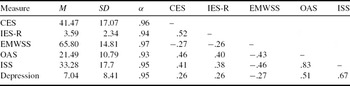
Means, standard deviations, Cronbach’ alphas (α) and intercorrelation scores on self-report measures (N = 178)

Notes: All coefficients are significant at p < .001. CES = Centrality of shame memories; IES-R = Shame traumatic memory; EMWSS = Early memories of warmth and safeness; OAS = External shame; ISS = Internal shame; Depression = DASS-42 depression subscale
Centrality of Event Scale (CES; Berntsen and Rubin, Reference Berntsen and Rubin2006; Portuguese version by Matos, Pinto-Gouveia and Gomes, Reference Matos, Pinto-Gouveia and Gomes2010) assesses the extent to which a memory for a stressful event (in this case a shame experience reported by each participant) forms a reference point for personal identity and to attribution of meaning to other experiences in a person's life. This self-report questionnaire consists of 20 items, rated on 5-point Likert scale (1–5), that measure three interdependent characteristics of a highly negative emotional event that load onto a single underlying factor – the extent to which the event is a central component of one's personal identity (e.g.“I feel that this event has become part of my identity.”), is viewed as a landmark in one's life story (e.g. “I feel that this event has become a central part of my life story.”) and acts as a reference point for inferences and attributions in everyday life (e.g.“This event has coloured the way I think and feel about other experiences.”). In its original study, CES showed sound psychometric properties with a high internal consistency (Cronbach's α = .94). Cronbach's alpha for this measure in the current study is given in Table 1.
Early memories of warmth and safeness scale (EMWSS; Richter et al., Reference Richter, Gilbert and McEwan2009; Portuguese version by Matos, Pinto-Gouveia and Duarte, Reference Matos, Pinto-Gouveia and Duarte2011a) was designed to measure personal emotional memories, specifically recall of feeling warm, safe, accepted and cared for in childhood. It comprises 21 items (e.g. “I felt cared about”, “I felt appreciated the way I was” and “I felt part of those around me”) rated on a Likert scale assessing how frequently each statement applied to the participant's childhood (0 = No to 4 = Yes, most of the time). In its original study the EMWSS presented an excellent internal consistency, with a Cronbach's alpha of .97. Cronbach's alpha for the current study is reported in Table 1.
Other As Shamer (OAS; Allan, Gilbert and Goss, Reference Allan, Gilbert and Goss1994; Goss, Gilbert and Allan, Reference Goss, Gilbert and Allan1994; Portuguese version by Matos, Pinto-Gouveia and Duarte, Reference Matos, Pinto-Gouveia and Duarte2011b). This 18-item scale measures external shame (global judgements of how people think others view them). Respondents rate on a 5-point Likert scale (0–4) the frequency of their feelings and experiences, for example, “I feel other people see me as not quite good enough” and “I think that other people look down on me”. Scores can range from 0 to 72, with higher scores on this scale indicative of higher external shame. A Cronbach's alpha of .92 was reported in the original study of this scale (Goss et al., Reference Goss, Gilbert and Allan1994). The Cronbach's alpha for this study is given in Table 1.
Internalized Shame Scale (ISS; Cook, Reference Cook and Nathanson1994, Reference Cook2001; Portuguese version by Matos, Pinto-Gouveia and Duarte, Reference Matos, Pinto-Gouveia and Gilbert2012) comprises a 24-item measure of internal shame, consisting of negatively worded items (e.g. “Compared with other people, I feel like I somehow never measure up”) assessing the frequency in which people experience feelings of shame and a 6-item scale consisting of positively worded items (e.g. “All in all, I am inclined to feel that I am a success”) assessing self-esteem. All of the items are rated on a scale of 0 (never) to 4 (almost always). The shame subscale items were based on phenomenological descriptions of shame feelings. In this study, only the shame subscale was used as a measure of internal shame. Previous studies (Cook, Reference Cook and Nathanson1996) have reported test–retest correlations of .84 and .69, respectively, and have reported good convergent and divergent validity. The Cronbach's alpha for this study is reported in Table 1.
Depression, Anxiety and Stress Scale (DASS-42; Lovibond and Lovibond, Reference Lovibond and Lovibond1995; Portuguese version by Pais-Ribeiro, Honrado and Leal, Reference Pais-Ribeiro, Honrado and Leal2004) is a self-report measure composed of 42 items and designed to assess three dimensions of psychopathological symptoms: depression, anxiety, and stress. The items indicate negative emotional symptoms and are rated on a 4-point Likert scale (0–3). On the original version, Lovibond and Lovibond (Reference Lovibond and Lovibond1995) found the subscales to have high internal consistency (Depression subscale Cronbach's α = .91; Anxiety subscale Cronbach's α = .84; Stress subscale Cronbach's α = .90). In the present study, only the Depression subscale will be considered. Cronbach alpha for this subscale in this study is shown in Table 1.
Results
Statistical analysis
Data analyses were conducted using PASW (version 18 SPSS, Chicago Inc.) and AMOS (version 18, SPSS Inc., Chicago, IL) was used to estimate path analyses. Pearson correlation coefficients were performed to explore the correlations between the study variables (Cohen, Cohen, West and Aiken, Reference Cohen, Cohen, West and Aiken2003). A mediational study was then conducted in which we tested whether external shame (OAS) and internal shame (ISS; mediator variables) mediated the relationship between centrality of shame memory (CES), shame traumatic memory (IES-R), early memories of warmth and safeness (EMWSS; independent, exogenous variables) and depression (DASS-42 Depression subscale; dependent, endogenous variables).
A path analysis was carried out to test for the mediator effects described above. This technique is a special case of structural equation modeling (SEM) and considers hypothetic causal relations between variables that have already been defined. A Maximum Likelihood method was used to evaluate the regression coefficients significance. SEM procedure estimates the optimal effect of one set of variables on another set of variables in the same equation, controlling for error (Byrne, Reference Byrne2010; Kline, Reference Kline2005). Multivariate outliers were screened using Mahalanobis squared distance (D 2) method and uni and multivariate normality was assessed by skewness and kurtosis coefficients. There was no severe violation of normal distribution (|Sk|<3 and |Ku|<8–10), with skewness values ranging from .48 (IES-R) to 1.70 (DASS depression subscale), and with kurtosis values ranging from −.62 (IES-R) to 2.39 (DASS depression subscale; Kline, Reference Kline2005). The significance of direct, indirect and total effects was assessed using χ 2 tests (Kline, Reference Kline2005). Bootstrapping resampling method was further used to test the significance of the mediational paths, using 1000 bootstrap samples and 95% confidence intervals (CIs; Kline, Reference Kline2005). Effects with p < .050 were considered statistically significant.
Descriptives
The means, standard deviations and Cronbach's alphas of the variables studied are presented in Table 1. All scales showed high internal consistency. The means and standard deviations for these variables are similar to those obtained in previous studies (Cook, Reference Cook and Nathanson1996; Goss et al., Reference Goss, Gilbert and Allan1994; Matos and Pinto-Gouveia, Reference Matos and Pinto-Gouveia2010; Matos, Pinto-Gouveia and Duarte, Reference Matos and Pinto-Gouveia2011a,Reference Matos and Pinto-Gouveiab, Reference Matos, Pinto-Gouveia and Duarte2012; Pinto-Gouveia and Matos, Reference Pinto-Gouveia and Matos2011; Richter et al., Reference Richter, Gilbert and McEwan2009). There were no significant gender differences.
Correlations
Pearson product-moment correlations for all variables are presented in Table 1. Shame traumatic memory and centrality of shame memory were significantly and positively correlated with each other and negatively associated with early memories of warmth and safeness. Both shame memory variables revealed positive moderate correlations with external and internal shame and were also positively and significantly correlated with depressive symptoms. In turn, early memories of warmth and safeness were negatively and moderately related to external and internal shame and also presented a negative significant association with depression. External shame showed a positive and moderate relation to depression whereas internal shame presented a high positive correlation with depressive symptoms. External and internal shame were highly correlated with each other.
Path analysis
Taking together these findings and our hypotheses, we aimed at testing whether external and internal shame mediated the effect of centrality of shame memory, shame traumatic memory, and early memories of warmth and safeness on depressive symptoms.
The hypothesized model (Figure 1) was tested through a fully saturated model (i.e. zero degrees of freedom), consisting of 30 parameters. Given that fully saturated models always produce a perfect fit to the data, model fit indices were neither examined nor reported. The model explained 45% of depression variance. In this model the following paths were not statistically significant: the direct effect of shame traumatic memory on depression (b IES-R = .103; SEb = .241; Z = 1.427; p = .670; βIES-R = .029), the direct effect of centrality of shame memory on depression (b CES = −.002; SEb = .034; Z = −.072; p = .942; βCES = −.005), the direct effect of early memories of warmth and safeness on depression (b EMWSS = .024; SEb = .036; Z = .672; p = .502; βEMWSS = .042), and the direct effect of external shame on depression (b OAS = −.095; SEb = .080; Z = −1.813; p = .237; βOAS = −.121).
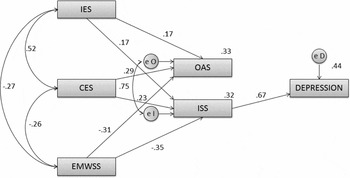
For this reason, these non significant paths were removed and the model recalculated (Figure 2). In the evaluation of the adjusted model, a very good model fit with a non significant chi-square test [χ2(4) = 2.126; p = .713) was found. Well-known and recommended goodness of fit indices were selected to assess the model fit (Kline, Reference Kline2005). The analysis of these indices indicated an excellent model fit (CMIN/DF = .531; CFI = 1.000; TLI = 1.016; NFI = .995; RMSEA = .000).
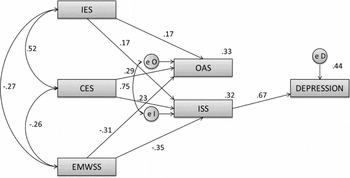
Results of mediation path analysis showing the relationships among shame traumatic memory (IES-R), centrality of shame memory (CES), early memories of warmth and safeness (EMWSS), external shame (OAS) and depression, having internal shame (ISS) as a mediator, with standardized estimates and square multiple correlations (N = 178)

All the paths were statistically significant and the model accounted for 44% of depressive symptoms' variance. The model also accounted for 33% of external shame and 32% of internal shame variances. Regarding depression, only internal shame presented a significant direct effect on depression of .67 (b ISS = .317; SEb = .027; Z = 11.894; p < .001).
Indirect mediational test results suggest that shame traumatic memory (IES-R) predicted greater depression through elevated feelings of internal shame (ISS) (b IES-R = .110, 95% CI = .000 to .230). Centrality of shame memory (CES) also indirectly predicted increased depressive symptoms again through increased internal shame (ISS) (b CES = .153, 95% CI = .034 to .252). On the contrary, higher levels of memories of warmth and safeness in childhood (EMWSS) predicted lesser levels of depression through diminished feelings of internal shame (ISS) (b EMWSS = −.234; 95% CI = −.319 to −.316). Figure 2 presents the mediation model with regression coefficients standardized estimates and R 2 for depression, external and internal shame.
In conclusion, these findings reveal that internal shame completely mediated the effects of shame traumatic memory, centrality of shame memory and early memories of warmth on depression. Contrary to our prediction, external shame neither accounted significantly for depression variance nor mediated the aforementioned associations.
Discussion
Shame has been pointed out as one of the major sources of human suffering and vulnerability factor for a range of psychopathological symptoms, such as depressive ones (see Kim et al., Reference Kim, Thibodeau and Jorgensen2011 for a review). Increasing evidence suggests that early shame experiences that become central to personal identity and that operate as traumatic memories are associated with increased shame feelings in adulthood and elevated vulnerability to depression (Matos and Pinto-Gouveia, Reference Matos and Pinto-Gouveia2010, Reference Matos, Pinto-Gouveia and Duarte2011a,Reference Matos, Pinto-Gouveia and Duarteb; Pinto-Gouveia and Matos, Reference Pinto-Gouveia and Matos2011). Contrastingly, there is good empirical support for the importance of feeling safe and supported in attachment and social relationships to well-being and resilience against difficult life events (Cacciopo et al., Reference Cacioppo, Berston, Sheridan and McClintock2000; Masten, Reference Masten2001; Richter et al., Reference Richter, Gilbert and McEwan2009). Yet the question remained as to the role shame plays on the link between early shame and affiliative memories and depression. Therefore, based upon these existing evidence and theory, the present study sought to test a mediator model, through path analyses, in which it was predicted that external and internal shame would mediate the association between shame traumatic memory, centrality of shame memory, early memories of warmth, and safeness and depressive symptoms.
Consistent with prior findings (Matos and Pinto-Gouveia, Reference Matos and Pinto-Gouveia2010, Reference Matos, Pinto-Gouveia and Duarte2011a,Reference Matos, Pinto-Gouveia and Duarteb; Pinto-Gouveia and Matos, Reference Pinto-Gouveia and Matos2011; Richter et al., Reference Richter, Gilbert and McEwan2009) and our predictions, results showed that shame traumatic memories and centrality of shame memory were associated with increased levels of external shame and internal shame. Also, as expected, early memories of warmth and safeness predicted lower levels of current external and internal shame. These findings give further support to the assumption that emotional memories of shame and of lack of safeness and warmth may influence the emergence of shame feelings in adulthood. So individuals whose shame memories reveal traumatic memory features and function as central components of their identity and life story tend to believe they exist negatively in the mind of the others and to see and judge themselves negatively as inferior or undesirable. On the contrary, individuals who recall feeling safe, nurtured and cared for as a child are less prone to experience a sense of self as existing negatively for others and as globally self-condemning. Therefore, these data are in line with evidence from attachment and neuroscience research (Bowlby, Reference Bowlby1969, Reference Bowlby1973, Reference Bowlby1980; Cacciopo et al., Reference Cacioppo, Berston, Sheridan and McClintock2000; Gilbert, Reference Gilbert, Tracy, Robins and Tangney2007; Mikulincer and Shaver, Reference Mikulincer, Shaver and Baldwin2005; Siegel, Reference Siegel2001; Taylor et al., Reference Taylor, Way, Welch, Hilmert, Lehman and Eisenberger2006) suggesting that the quality of early interactions with significant others drastically impacts on the formation of internal working models of self and others, which, in turn, guide emotional and thought processing, and influence one's social behaviour.
In addition, the key finding in the present study is that internal shame fully mediated the relationships between shame traumatic memory, centrality of shame memory and early memories of warmth and safeness, and depression. Surprisingly, and contrary to our expectation, current feelings of external shame were not a significant predictor of depression nor mediated the above stated relationships. Nevertheless, the high correlation between internal and external shame found in this study, which corroborates prior research (Goss et al., Reference Goss, Gilbert and Allan1994; Kim et al., Reference Kim, Thibodeau and Jorgensen2011; Matos and Pinto-Gouveia, Reference Matos and Pinto-Gouveia2010; Matos, Pinto-Gouveia and Duarte, Reference Matos and Pinto-Gouveia2011b, Reference Matos, Pinto-Gouveia and Gilbert2012), may account for this finding. That is, our results support the idea that the pain that derives from recognizing that one's social attractiveness has declined is likely to encompass harsh self-devaluation and self-blame. At the same time, it is unlikely that the hurting affect of private depreciation arises in the absence of an awareness that others share the same negative view of the self (Gilbert, Reference Gilbert2003, Reference Gilbert, Tracy, Robins and Tangney2007; Kim et al., Reference Kim, Thibodeau and Jorgensen2011).
Thus, our results partially confirmed our prior hypotheses but extended them by suggesting that shame memories, which operate as traumatic ones and that become central to personal identity and life narrative, impact on depressive symptoms fully through their influence on generating current feelings of the self as flawed, undesirable, inadequate or unlovable in one's own eyes (and in the eyes of others, as the high association between internal and external shame suggests). Simultaneously, our findings suggest that recalls of feeling safe and cared for as a child within the family protect against depression through their influence on lessening a sense of the self as inferior, inadequate, defective or globally bad.
These results extend previous research (Matos and Pinto-Gouveia, Reference Matos and Pinto-Gouveia2010, Reference Matos, Pinto-Gouveia and Duarte2011a,Reference Matos, Pinto-Gouveia and Duarteb; Matos, Pinto-Gouveia and Duarte, Reference Matos, Pinto-Gouveia and Martins2011b, Reference Matos, Pinto-Gouveia and Gilbert2012; Richter et al., Reference Richter, Gilbert and McEwan2009) and can be understood in light of the biopsychosocial approach of shame (Gilbert, Reference Gilbert, Gilbert and Andrews1998, Reference Gilbert, Gilbert and Miles2002, Reference Gilbert, Tracy, Robins and Tangney2007) and evolutionary perspectives on depression (Gilbert, Reference Gilbert1992; Price, Sloman, Gardner, Gilbert and Rohde, Reference Price, Sloman, Gardner, Gilbert and Rohde1994; Sloman, Gilbert and Hasey, Reference Sloman, Gilbert and Hasey2003). In fact, early attachment or social interactions, characterized either by shame and threat or by the absence of safeness and affiliation, seem to be the source of shame feelings in adulthood, translating into beliefs one exists negatively in the mind of the others and into negative self-evaluations and feelings. Our data further imply that the internalization of these early shame experiences, that become structured as traumatic and central memories to one's identity and life narrative, along with the dearth of recalls of feeling safe and cared for in childhood, may lead one to see and evaluate the self the same way others have (e.g. as worthless, unlovable, unattractive, inferior) and thus compromise one's ability to articulate positive self and others schema, undermining one's emotional regulation abilities (e.g. one's ability to self-soothe when facing distress). In addition, this internalized shame response, involving feelings of being unattractive and unable to compete in the social arenas, is usually accompanied by self-blaming, self-monitoring and negative affects directed at oneself (e.g. contempt, anger, disgust). These self-devaluation and self-persecutory attitudes, although aiming at defending the self against the negative evaluations and possible rejection from others, may render one more prone to enter defeat states and activate involuntary defeat strategies when facing aversive life events, and thus elevating vulnerability to experience depressive symptoms. Of note is also the buffering effect of early memories of safeness and nurturance against the emergence of a negative sense of self and the proneness to enter depressive states.
The present study provides some suggestions for clinicians intervening with patients with high levels of shame and suffering from depressive symptoms. First, our results imply the relevance of using specific strategies to evaluate these memories (e.g. through structured clinical interviews such as the Shame Experiences Interview, Matos and Pinto-Gouveia, Reference Matos and Pinto-Gouveia2006) and that working with these individuals’ shame memories may help decrease current levels of shame feelings, thus lessening current depressive symptoms. Furthermore, clinicians should bear in mind the importance of addressing and intervening in shame, especially when shame memories become the foundations for experiencing and understanding the self and translate into emotional difficulties. In these cases, treatment interventions should be tailored to help patients develop compassionate attributes and skills, that is promoting a self-to-self relationship based on feelings of compassion, warmth and kindness, which enable the individual to tone down distress and negative affect via self-soothing, facilitating effective emotional regulation. These are all key points addressed in Compassion Focused Therapy (Gilbert, Reference Gilbert2005, Reference Gilbert2009a,Reference Gilbert and Stropab,Reference Gilbertc, Reference Gilbert2010), that aims to help the patient build up and experience compassionate feelings, both from the self and from others (e.g. within a supportive therapeutic relationship), and help them recognize the evolved defensive function of their symptoms.
Even though these results may significantly contribute to the conceptualization of shame and its relation to early interactions with significant others and to current emotional difficulties, this study does have some limitations. First of all, our results reflect the responses of a college-age and predominantly female sample. Replication of the present study with more heterogeneous and representative samples from the general community population is necessary before the findings can be generalized. Although the processes involved in shame and shame experiences may apply at a clinical or nonclinical level, the replication of the present study in clinical samples would add additional robustness to our findings. We should also note that, albeit we used path analyses, a powerful statistical technique based on structural equation modeling, these were based on correlational data, impairing the establishment of strong causal relations. To overcome this limitation, researchers might continue this line of research by conducting prospective studies using younger samples (e.g. adolescents). Finally, we assessed the type of shame experiences and guaranteed confidentiality, but our study is mostly limited to self-report measures to evaluate early memories. Although this may raise some concerns regarding the influence of current emotional states on these recollections, retrospective recall data were found to be generally reliable, accurate, and stable over time (Brewin, Andrews and Gotlib, Reference Brewin, Andrews and Gotlib1993; Matos and Pinto-Gouveia, Reference Matos and Pinto-Gouveia2010, Reference Matos and Pinto-Gouveia2011a; Matos, Pinto-Gouveia and Costa, Reference Matos, Pinto-Gouveia and Costa2011). Nevertheless, we hope that the findings presented here offer insight towards the development of a more complex conceptual model on the links between early shame and safeness memories, current shame and depressive symptoms, which can be incorporated into existing approaches (Gilbert, Reference Gilbert1992, Reference Gilbert, Gilbert and Andrews1998, Reference Gilbert, Tracy, Robins and Tangney2007; Sloman et al., Reference Sloman, Gilbert and Hasey2003).
Acknowledgments
This research has been supported by the first author (Marcela Matos) PhD grant reference SFRH/BD/36617/2007, sponsored by FCT (Portuguese Foundation for Science and Technology).



Comments
No Comments have been published for this article.