CHD is a chronic condition, with cardiology care recommended across the lifespan according to the 2018 American Heart Association/American College of Cardiology Guideline for the Management of Adults With Congenital Heart Disease. Reference Stout, Daniels and Aboulhosn1 Depending on the anatomy or physiology, these current adult guidelines recommend follow-up visits very frequent or years spaced apart. Reference Stout, Daniels and Aboulhosn1 From adult studies, it is known that there is a reduction of mortality when CHD patients are followed by specialised adult CHD clinics. Reference Mylotte, Pilote and Ionescu-Ittu2 There has been much research on how to arrange appropriate transfer of care from childhood to adulthood.
However, many patients are lost to follow-up prior to reaching adult care clinics, with much of that loss starting in early childhood: almost half of patients with CHD are lost to follow-up by the age of 13 years. Reference Mackie, Ionescu-Ittu, Therrien, Pilote, Abrahamowicz and Marelli3 The reasons for loss of cardiology follow-up are unclear; much of what is known comes from studies on lack of transition from paediatric to adult care. Several risk factors for lack of follow-up are broad but likely include male sex, income level, lower severity of disease, and frequency of prior hospitalisation and catherization. Reference Mackie, Ionescu-Ittu, Therrien, Pilote, Abrahamowicz and Marelli3,Reference Mackie, Rempel, Rankin, Nicholas and Magill-Evans4 In evaluating the transition to adult care, studies have found greater than 40% of new patients had a greater than 3-year gap between visits with a cardiologist. Reference Gurvitz, Valente and Broberg5 The majority had a mild disease complexity; however, 26% had severe disease. Reference Gurvitz, Valente and Broberg5 There is higher mortality in adults with CHD when there are long gaps in their care. Reference Wacker, Kaemmerer and Hollweck6 Additional factors for lapse in follow-up include the perception among young adults of feeling well and lack of understanding of their disease. Reference Mylotte, Pilote and Ionescu-Ittu2,Reference Gurvitz, Valente and Broberg5,Reference Sable, Foster and Uzark7 Modifiable risk factors for lack of follow-up have not fully been evaluated previously, although the American Heart Association scientific statement on transition recommends annual follow-up in adolescence to emphasise the importance of follow-up. Reference Sable, Foster and Uzark7
Given that the loss of cardiology follow-up often starts in early childhood, the purpose of this study was to determine variables associated with loss of appropriate paediatric cardiology follow-up, including potentially modifiable factors. We hypothesised that having earlier recommend follow-up time intervals, a factor that has not been fully evaluated previously, would be associated with less likelihood of being lost to follow-up within the paediatric population.
Materials and methods
We performed a retrospective cohort study of patients seen in a large, outpatient paediatric practice with over 20 locations in our state with approval from Children’s Healthcare of Atlanta Institutional Review Board (IRB). The electronic medical records provided demographic information, International Classification of Disease, Ninth Revision (ICD-9) and International Classification of Disease, Tenth Revision (ICD-10) codes, and allowed for tracking of the outpatient cardiology recommendations for follow-up and completed appointments.
All encounters from the large outpatient statewide practice from January 2013 to June 2016 were evaluated for inclusion as index encounters in this study. Individual patient electronic records were queried for the inclusion or exclusion criteria. To be included in our study, the patient must be 5–17 years of age at the time of their index encounter and had recommended follow-up time in our clinics of 1–3 years. Only the initial eligible index encounter was selected for patients who had more than one eligible encounter during the study period. The extent of data collection for follow-up times was from January 2013 to December 2019. Extracted data included demographic information, cardiologist recommendation for follow-up timing and subsequent appointment data for said return to follow-up visit, and all cardiac specific ICD-9 and ICD-10 codes. Patients were excluded based on age outside of inclusion range, not receiving a recommendation for cardiology follow-up, deceased status, or known address move outside our state.
The primary outcome of interest was loss of follow-up when cardiology follow-up was recommended at the initial index encounter. Loss of follow-up was defined as failure to have a subsequent outpatient encounter by 6 months after the recommend follow-up time. For example, if follow-up in 1 year was recommended, the subject was considered lost to follow-up if they did not return to cardiology clinic within 18 months of the index encounter. In addition to recommended time of follow-up, additional variables obtained at time of the index appointment included disease severity, age, sex, race/ethnicity, insurance payor (public versus private), clinic site, and provider (random effect). Subjects’ ICD-9 and ICD-10 codes were categorised into four groups to indicate severity. The categories used for subjects were, in order of severity, “single ventricle,” “severe 2-ventricle,” “non-severe 2-ventricle,” and “other.” In cases where there was more than one ICD code, the most severe code was used to categorise the patient. For example, if the patient diagnoses included tetraology of Fallot and listed atrial septal defect, the patient was categorised in the “severe 2-ventricle” category based of the diagnosis of tetraology of Fallot. In our “single ventricle” group, diagnoses such as “Fontan,” “hypoplastic left ventricle syndrome,” and “tricuspid atresia” were included. In our “severe 2-ventricle” group, diagnoses such as “double-outlet right ventricle,” “tetralogy of Fallot,” and “d-transposition of the great arteries” were included. In our "non-severe 2-ventricle" group, diagnoses such as “ventricle septal defect,” “atrial septal defect,” and “coarctation” were included. The “other” group included cardiomyopathies and arrythmias. Supplement material 1 provides a review of the diagnoses in each severity group (Supplement material 1).
Statistical analyses were performed using SAS version 9.4 (Cary, NC, United States of America). Statistical significance was assessed at the 0.05 level. Descriptive statistics were calculated for all variables of interest and included medians with 25–75th percentiles or counts with percentages when appropriate. Normality of continuous variables was assessed using histograms, normal probability plots, and the Anderson–Darling test for normality. Chi-square tests were used to compare categorical characteristics and Wilcoxon rank-sum tests were used to compare continuous characteristics between those lost to follow-up and with successful follow-up. The association between each independent variables and follow-up group status was analysed using univariate logistic regression treating loss of follow-up as the outcome and these associations were quantified with the use of odds ratios and 95% confidence intervals. A multivariable logistic regression model was created with variables that were significant with p < 0.20 at the univariate level as well as measured confounders felt to be associated with follow-up status. In order to account for these confounders, we treated provider as a random effect and clinic site as a fixed effect in the multivariable model. Lastly, we performed two stratified analyses in similar fashion, one by disease severity and another by age severity to estimate the associations within disease severity and age category.
Results
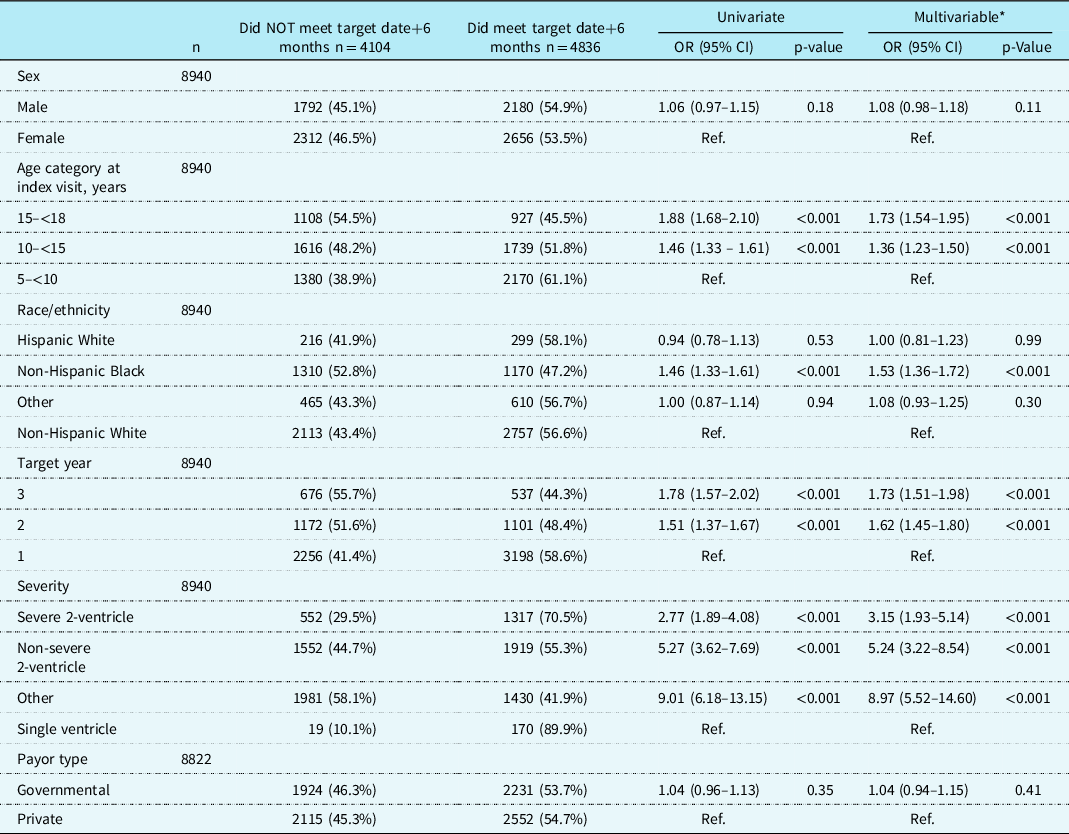
Of 8940 patients included in this study, the majority of patients were male, non-Hispanic White, had private insurance, and had recommended follow-up at 1 year (Table 1). The “non-severe-2 ventricle” and “other” groups were the largest categories of patients, with 39 and 38% falling into these groups. Of the included patients, 2% are within our "single ventricle” category and 21% are within our “severe 2-ventricle” category. About 40% of the patients fell into our younger age group of 5–10 years of age.
Factors associated with NOT following up within 6 months after target date

aOR = adjusted odds ratio.
Values shown as row percentages.
* Multivariable model includes other variables in the table as well as provider (treated as a random effect) and clinic site (treated as a fixed effect).
Overall, 4104 (46%) experienced loss of follow-up. Severity of illness was inversely associated with loss of follow-up; those with the most severe disease had the least likelihood of loss of follow-up. Compared to those with single-ventricle disease; those with severe 2-ventricle disease had 3.2 times the odds of loss of follow-up, and those with non-severe 2-ventricle disease had 5.2 times the odds of loss of follow-up. Older age was directly associated with greater likelihood of loss of follow-up. After adjustment, those aged 15–<18 years had 1.7 times the odds of loss of follow-up as compared to those 5–<10 years; and those 10–<15 years had 1.4 times the odds. For race/ethnicity, there were not any differences for Hispanic or other race/ethnicity as compared to non-Hispanic Whites, but there was a difference for non-Hispanic Blacks. Non-Hispanic Blacks had 1.5 times the odds of loss of follow-up as compared to non-Hispanic Whites. There were no significant differences based on sex or insurance type (private versus government).
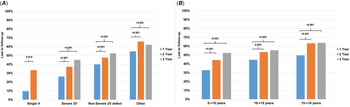
Timing of recommended follow-up was significantly associated with loss of follow-up, overall and across strata of severity and age. Overall, those with recommended follow-up at 2 years and 3 years had 1.4 and 1.7 times the odds, respectively, of loss of follow-up as compared to those with recommended follow-up at 1 year. By severity, those with single-ventricle CHD had only 10% loss of follow-up at 1 year, but this increased to 33% for recommended follow-up at 2 years (Fig 1). (There were no patients with single-ventricle CHD with recommended follow-up at 3 years.) Those with severe 2-ventricle CHD, non-severe 2-ventricle CHD, and other types of heart disease similarly had increasing loss of follow-up as recommended follow-up time interval increased. By age grouping, those who were 5–<10 years of age had the best follow-up with only about one-third lost to follow-up at 1 year, but this increased to more than half being lost to follow-up if recommended follow-up time was 3 years. In the older age groups, nearly half of patients with recommended follow-up time of 1 year experienced loss of follow-up, with this portion increasing with longer recommended follow-up time.
In the stratified analyses by severity of disease ( A ) and age ( B ), longer recommended follow-up time was associated with greater loss of follow-up among all severity and age categories.

Discussion
In this study, the largest of its kind to assess loss of cardiology follow-up during childhood, we found loss of follow-up to occur in all age ranges with more occurring in the teenage years, especially when longer follow-up intervals were recommended. This is a significant problem in paediatric cardiology, with almost half of the patients in our cohort not returning for the recommended follow-up care. We found within similar disease severity, those who were recommended for longer follow-up intervals had more loss of follow-up.
These findings are consistent with prior published data on this topic. Reference Mackie, Ionescu-Ittu, Therrien, Pilote, Abrahamowicz and Marelli3,Reference Gurvitz, Valente and Broberg5 Some important factors may not be modifiable, such as severity of disease, age, and race/ethnicity. However, shorter follow-up time interval was associated with less loss of follow-up among all categories of disease severity and age. Even in patients with more severe disease (single ventricle and severe 2-ventricle), there was a significant difference in the amount of missed appointments when it was recommended to follow-up in 2 years rather than annually.
Loss of follow-up is not just a problem unique to the cardiology subspeciality practice. In a recent study evaluating a 10-year period of follow-up after bone marrow transplantation in haematological and oncological patients, of the 4332 children who received haematopoietic cell transplantation, only roughly 25% continued to follow-up. The authors defined loss of follow-up as having missed two consecutive follow-up reporting periods. They found male sex, older paediatric age at time of transplant, public/no health insurance, and non-malignant disease to be factors that influenced loss of follow-up. Reference Buchbinder, Brazauskas and Bo-Subait8 With endocrinology, a recent study also found that loss of follow-up for chronic lifelong endocrinology problems were more prevalent with older paediatric age and lower insurance status (which the authors used as a surrogate to lower socio-economic status) in this smaller study from France. Reference Atger-Lallier, Guilmin-Crepon and Boizeau9 They defined loss of follow-up as missing clinical follow-up for two consecutive years as the author notes that most of their diseases are considered to need clinical visits annually. In a separate study evaluating long-term type II diabetes care, the researchers found older adolescent age and distance from the medical centre to be factors associated with loss of follow-up. Reference Shoemaker, Cheng and Gal10 In this study, they did not find socio-economic status to be an influencing factor. Reference Shoemaker, Cheng and Gal10 In a very large global cohort database, researchers were able to demonstrate loss of follow-up was associated with mortality in HIV adolescent patients. The group found that older age at diagnosis (aged 15 years or greater) were at a higher risk for loss of follow-up and mortality. Reference Kariminia, Law and Davies11 In contrast to the above studies, in our study, we did not find a significant difference between insurer types.
The theoretical barriers to follow-up could be vast. From our study and the prior studies mentioned above, factors such as age, sex, and possibly socio-economic status play a crucial role in chronic management of lifelong conditions. In our study, we attempted to identify socio-economic status as insurer payor type but did not demonstrate a change in follow-up occurrence based on this difference. Admittedly, using public insurance as our only surrogate for economic status does not help identify problems for the extremely poverty-stricken population where reliable transportation, child care for other children, and consistent housing could be confounding factors among the very poor. Factors such as distance from the clinic was not likely a factor in our cohort as 95% of patients seen in our practice live within 50 miles of one of our 21 clinics in the state but was identified as a barrier for an endocrinology study when patients lived greater than 50 miles away. Reference Shoemaker, Cheng and Gal10 It is possible that the families may not feel as concern about their child’s heart disease if we recommend longer intervals between seeing cardiology.
During this study period, our outpatient practice employed several ways to contact and engage with families to return to care based on the recommended timeline as documented in the patient medical record. Reminders were sent via cellphone texts, automated phone calls, and letters sent to the patient home and primary care provider on file. If the family signed up to join the web-based patient portal system, emails were also sent out using this platform. In addition, if those interventions were unsuccessful, staff directly called the family to facilitate return visits. Despite these modern techniques of reminders to families, a large number of patients do not return to cardiology practice as recommended as shown in this study and earlier studies. Reference Mackie, Ionescu-Ittu, Therrien, Pilote, Abrahamowicz and Marelli3
There does not exist specific guidelines for recommendations to return to the outpatient office for most paediatric heart lesions. There has been generally accepted practice to see the more severe CHD patients annually once out of the early surgical stages. Specifically, protocols have been produced to help eliminate the variability within practices for patients with single-ventricle physiology, d-transposition of the great arteries, and tetralogy of Fallot. Reference Wernovsky, Rome and Tabbutt12 These guidelines provide a framework for evaluation from infancy through adolescence based on potential risks for the patient and surgical repair for these three lesions. Reference Friedman, Rathod and Farias13 However, these standardised protocols only exist for a small handful of cardiac problems. For the adult CHD population, guidelines exist for routine follow-up as well as specified evaluations for most lesions. Reference Stout, Daniels and Aboulhosn1 The outpatient paediatric cardiologist must use their best judgement on making recommendations on frequency and time interval for follow-up appointments for most patients. Our findings can help the paediatric cardiologist by recommending annual follow-up as a means to provide continued care for these patients and emphasising the importance of cardiology involvement to the families, patients, and other healthcare providers alike. Continuity of follow-up during childhood may also help improve eventual transition to adult congenital care. Reference Gerardin, Menk, Pyles, Martin and Lohr14 However, cardiologists should continue to base recommendations on the disease process, natural history, and severity. Shorter follow-up cannot be generalised to all lesions and possibly recommending unnecessary shorter follow-ups may be burdensome on the healthcare system and the family.
This study is not without its limitations. First, although follow-up may have been recommended at our single institution practice, it is possible that some patients chose to pursue follow-up care with another paediatric cardiology group or that patients moved out of state without our knowledge. Second, while we did attempt to stratify by severity of underlying cardiac disease, we were not able to further account for degree of any ongoing sequelae or concerns such as poor heart function, arrhythmia, or valve competency. It is likely that those with more ongoing problems were more likely to return to care creating a selection bias to more severe and more concerned patients. To that extent, we excluded anyone who was recommended for follow-up of less than 1 year from this study in an attempt to minimise that bias. Finally, we do not know if missing follow-up appointments correlated with worse outcomes. This study did not follow patients long term to determine if the patients who missed appointments were more ill than their counterparts who attended appointments on time per their cardiologist recommendations. However, we know from adult CHD clinics, there is an increased risk for future adverse outcomes when routine care is not accomplished. Reference Wacker, Kaemmerer and Hollweck6 This may be an important area for future research for determining a deeper correlation. This study looked at the recommendations provided by the cardiologist for follow-up time intervals but did evaluate the validity of those time intervals to the disease process as we believe the cardiologist seeing the patient has the autonomy to provide the recommendations.
Loss of follow-up of paediatric cardiology patients continue to be an ongoing problem. Shorter follow-up time interval was associated with less loss of follow-up among all categories of disease severity and age. Recommending shorter follow-up intervals may be one initiative for paediatric cardiologists to improve rates of follow-up and to guide a more successful transition to adult care, particularly for our higher severity groups as shown in this paper. Cardiologists should overall continue to base their recommendations based on the appropriateness of the disease.
Supplementary material
To view supplementary material for this article, please visit https://doi.org/10.1017/S1047951121003619
Acknowledgements
None.
Financial support
This research received no specific grant from any funding agency, commercial or not-for-profit sectors.
Conflicts of interest
None.
Ethical standards
The authors assert that all procedures contributing to this work comply with the ethical standards of the relevant national guidelines on human experimentation and with the Helsinki Declaration of 1975, as revised in 2008, and have been approved by the institutional committees (Institutional Review Board at the Children’s Healthcare of Atlanta).