Introduction
An academic makerspace, home to tools and people dedicated to facilitating and inspiring a making culture, is characterized by openness, creativity, learning, design, and community (Halverson and Sheridan, Reference Halverson and Sheridan2014; Barron and Barron, Reference Barron and Barron2016; Sheridan and Konopasky, Reference Sheridan, Konopasky, Peppler, Halverson and Kafai2016; Pernia-Espinoza et al., Reference Pernia-Espinoza, Sodupe-Ortega, Pecina-Marqueta, Martinez-Banares, Sanz-Garcia and Blanco-Fernandez2017). Makerspaces offer members of the academic community an environment where learning may develop around creative endeavors, such as design and craft, as well as social enterprises, such as membership in social clubs and management activities. Makerspaces as academic learning environments have found an increase in popularity and investment in the last decade (Lou and Peek, Reference Lou and Peek2016), and this spike in popularity, specifically in the higher education setting, has seemed to coincidentally align with a shift toward more hands-on and design-centric learning activities in higher education in general.
Understanding the exchange of learning occurring in the makerspace is challenging, though, due to the very aspects that make a makerspace unique, such as experiential, collaborative, self-paced, problem-based, and interactive (Halverson and Sheridan, Reference Halverson and Sheridan2014; Lande and Jordan, Reference Lande and Jordan2014; Litts, Reference Litts2015). Consequently, there remains little empirical evidence demonstrating the value of makerspaces for the educational and professional development of students in STEM disciplines. This is especially true for women, whereby some estimates, only 19% of the maker demographic are female (Make/Intel, 2012). In order to understand the value and to be able to qualify the challenges that women face with respect to engagement within academic makerspaces, we investigate the learning experiences of women who already are active users in academic makerspaces. Through understanding their stories, we aim to be able to distill best practices toward creating open and welcoming academic makerspaces. This research joins existing research into the underlying beliefs for the gender gap of users in community makerspaces and the barriers to women's engagement presented in a report (Lewis, Reference Lewis2015).
To determine if and how learning is occurring in an academic makerspace, we sought to develop out a typology of learning as a means to create a learning model that represents the interaction between various learning proficiencies (showing how to design learning unfolds). To do so, we implemented a phenomenologically based interviewing process to capture the making experiences of 20 women students, recruited through purposive and snowball sampling. By eliciting the narratives of women students, we captured how making, designing, and creating evolved through engaging in the university makerspace. Through analyzing the interview transcriptions, we identify makerspaces to create a culture of learning, facilitate students’ design journey, and form a “laboratory for creativity.” These themes forwarded the creation of a learning model that showcases how design and learning interact in the makerspace. In this paper, we focus on presenting the major themes of learning and the learning model, while the in-depth approach for creating the typology can be seen in Tomko (Reference Tomko2019). This work demonstrates that students are encountering learning and inspiration; developing confidence and resilience; and learning how to work with others and collaborate.
Background
Makerspaces are equipped with various tools and machines that forward the sharing of knowledge, ideas, and projects (Sheridan and Konopasky, Reference Sheridan, Konopasky, Peppler, Halverson and Kafai2016; Pernia-Espinoza et al., Reference Pernia-Espinoza, Sodupe-Ortega, Pecina-Marqueta, Martinez-Banares, Sanz-Garcia and Blanco-Fernandez2017). A makerspace brings together a community of people as they collaborate, discover, and innovate (Halverson and Sheridan, Reference Halverson and Sheridan2014; Radniecki et al., Reference Radniecki, Klenke and Purpur2016; Pernia-Espinoza et al., Reference Pernia-Espinoza, Sodupe-Ortega, Pecina-Marqueta, Martinez-Banares, Sanz-Garcia and Blanco-Fernandez2017). Members learn to explore creative thinking and to visualize ideas via creating art and physical models (Root-Bernstein and Root-Bernstein, Reference Root-Bernstein and Root-Bernstein2013). On an individual level, a person is given the opportunity to immerse in contextualized and personalized decision-making, which allows for personal engagement and motivation (Cordova and Lepper, Reference Cordova and Lepper1996) through taking responsibility for one's own learning (Martinez and Stager, Reference Martinez and Stager2013, Reference Martinez and Stager2014). Through an individual integrating hands-on designs, they tap into this natural desire to make and foster their creativity, curiosity, determination, grit, independence, and critical problem-solving skills (Halverson and Sheridan, Reference Halverson and Sheridan2014; Fleming, Reference Fleming2015; Johnson et al., Reference Johnson, Adams Becker, Estrada and Freeman2015; Barron and Barron, Reference Barron and Barron2016).
However, integrating makerspaces into academia requires changing the narrative from the more common approach of a lecture-based classroom to one of a creative and collaborative environment (Papert and Harel, Reference Papert and Harel1991; Donaldson, Reference Donaldson2014; Schön et al., Reference Schön, Ebner and Kumar2014). In understanding makerspaces as learning environments, the current research engages mobile and online communities (Litts, Reference Litts2015; Peppler et al., Reference Peppler, Halverson and Kafai2016; Smith, Reference Smith, Mills and Wake2017), K-12 and higher education (Kafai et al., Reference Kafai, Fields and Searle2014; Peppler et al., Reference Peppler, Halverson and Kafai2016; Tomko et al., Reference Tomko, Nagel, Alemán, Newstetter and Linsey2018a, Reference Tomko, Schwartz, Newstetter, Alemán, Nagel and Linsey2018b), libraries and museums (Brahms and Werner, Reference Brahms, Werner, Honey and Kanter2013; Bowler, Reference Bowler2014; Brady et al., Reference Brady, Salas, Nuriddin, Rodgers and Subramaniam2014; Sheridan et al., Reference Sheridan, Halverson, Litts, Brahms, Jacobs-Priebe and Owens2014; Litts, Reference Litts2015; Bowler and Champagne, Reference Bowler and Champagne2016; Brahms and Wardrip, Reference Brahms and Wardrip2016; Bieraugel and Neill, Reference Bieraugel and Neill2017). At a mid-sized university, researchers utilized Bloom's taxonomy as a means to understand student perceptions on learning, creativity, and innovation supported by various makerspaces (Bieraugel and Neill, Reference Bieraugel and Neill2017). Alternatively, in contrast to using a priori framework, the work presented in this paper uses grounded theory techniques in the data analysis processes as a means to create a learning model that emerges from women student narratives.
Research question and methods
The aim of this paper is to understand the nature of learning in the academic makerspace for women students at a higher education institution. The focus on women students is included as a means to narrow the scope of the research endeavor and to further delve into the societal constructs surrounding the gender disparities of makerspaces (Make/Intel, 2012; Faulkner and McClard, Reference Faulkner and McClard2014; Meyer, Reference Meyer2018), as this paper is part of a larger research effort. The research question of concern herein is as follows:
How are women students’ design and learning proficiencies interacting and developing?
In order to address the research question, we conducted two phases of in-depth qualitative interviews with 20 undergraduate women students who identified as “makers” at a large public university in the southern United States. The first phase sought an in-depth understanding of women maker's learning experiences through the use of Seidman's (Reference Seidman2006) phenomenologically based interview process. Five women were recruited through purposive maximum variation sampling and snowball sampling. Each volunteer participated in a series of three 90-min interviews over the course of several weeks. The interviews are designed to elicit the participant's narrative of making experiences, their learning in makerspaces, and the meanings associated with making. As part of the interviews, participants drew a timeline from childhood to the present of their making experiences, brought and reflected on the process of an artifact that they made, and reflected on their overall making experiences. In the second phase, 15 additional women students who identified as makers were recruited using the sampling methodologies in phase one. Each volunteer participated in a 1-h in-depth interview in which they discussed and reflected upon their timeline of making experiences and photographs of artifacts they have made. Together, the two phases of interviews resulted in 868 single-spaced pages of transcriptions.
Transcripts were analyzed by the first author using grounded theory techniques of analytic induction and constant comparison via multiple cycles of open and axial coding (Glaser and Strauss, Reference Glaser and Strauss1967; Charmaz, Reference Charmaz2014). These analyses produced a typology of women's learning in makerspaces. To gain inter-coder agreement, a second rater was trained in the use of the typology before coding 10% of the unitized data corpus as recommended by Campbell et al. (Reference Campbell, Quincy, Osserman, Pedersen, Oserrman and Pederson2013). Using Cohen's Kappa analysis, the inter-coder reliability on the primary categories in the typology was 0.70 with a percent agreement of 75.8. Using the same methods of analytic induction, the authors identified additional themes related to experiences of learning that aid in understanding how students make sense of their experiences in academic makerspaces. Importantly, our coding processes involved in vivo codes which center the participants' words and meanings (Birks and Mills, Reference Birks and Mills2015). Therefore, participants’ exact language and terminology is highlighted in quotations in the identification of themes described in the findings. Further, quoted exemplars from the students’ interviews are presented throughout the findings to demonstrate the manner in which the data were used to develop the theoretical model of learning. The themes that emerged in the data are discussed as the foundation for a learning model we present. This learning model showcases the relationship between cognitive, intrapersonal, and interpersonal proficiencies.
Findings on learning in makerspaces
Categories of learning in makerspaces
The broad categories of learning reported by the students interviewed in this study capture both how the students learned and what they learned through their experiences in makerspaces. The categories presented herein are described in greater detail with a full typology of learning in Tomko (Reference Tomko2019), and for brevity sake, this paper maintains discussion to the broad categories. Students described learning through two processes: (1) Learning by Doing and (2) Learning through Others. Students descriptions also revealed six types of proficiencies enveloped into three larger categories that are developed in makerspaces:
• Cognitive proficiencies: (1) Cultural knowledge and skills and (2) Content knowledge and skills.
• Intrapersonal proficiencies: (3) Self-awareness and (4) Ingenuity.
• Interpersonal proficiencies: (5) Management skills and (6) Communicating skills.
The cognitive proficiencies (Cultural and Content knowledge and skills) characterize the comprehensive knowledge and skills gained, whether that be specific to a particular subject area and field of knowledge or to the community in which the knowledge is being transferred and gained. For example, in creating a project in a makerspace, a student will learn how to form a concept, how to use the machinery and tools, and how certain materials work along with learning how to navigate the culture as a means to forward and finish a project.
The intrapersonal proficiencies (Self-awareness and Ingenuity) emphasize the internal growth and reflections on oneself and the world. To illustrate, as a student further designs and builds in a makerspace, she becomes confident and aware of her own abilities while examining and reflecting on the function of the world around her, for example, seeing how engineers ergonomically design a bike rack for maximum storage.
The interpersonal proficiencies (Management and Communication) reflect the proficiencies acquired through interacting with others. For instance, a student describing the idea of what they want to make with another student is learning how to communicate ideas. It is important to emphasize that the interpersonal proficiencies mirror with the learning through others process of learning category, as the learning interpersonal proficiencies occurs through others.
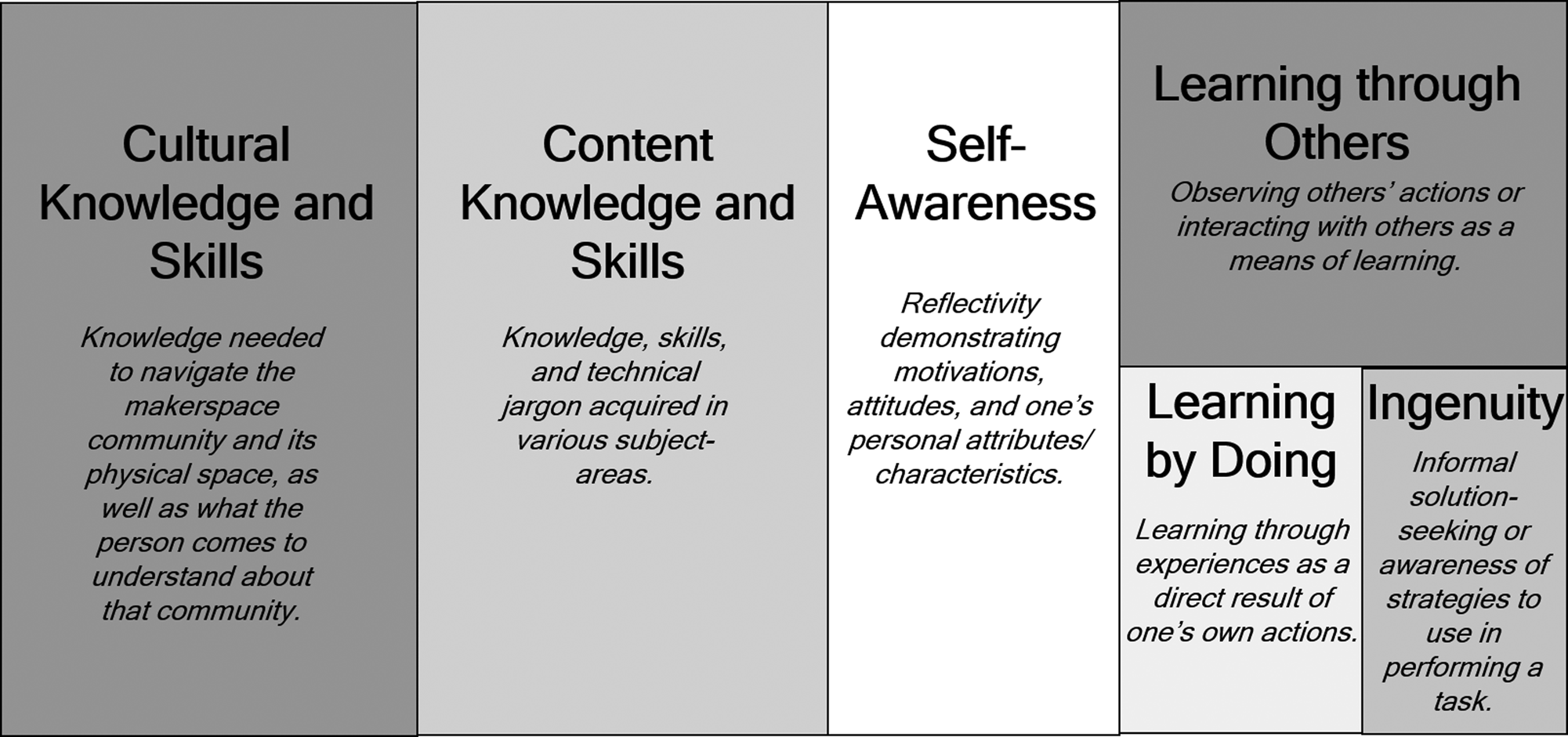
These categories are presented in a tree map as shown in Figure 1, a useful tool for visualizing hierarchical qualitative data. Figure 1 represents the comparative magnitude of each of the categories reflected in the students’ talk on learning, as each square reflects the comparative number of instances in which participants discussed the topic in their interviews.
Tree map of the types of learning in makerspaces.

Interestingly, content and cultural knowledge were discussed with similar levels of recurrence in the interviews, followed by self-awareness, and learning through others (i.e., interpersonal proficiencies). Ingenuity and learning by doing also were discussed with equal magnitude, but lesser so than the others. The similar magnitude of content and cultural knowledge suggests that these two cognitive proficiencies are both paramount to students learning in makerspaces; learning one set of skills to some extent requires learning the other. For example, as a woman builds knowledge on how to gain access to the makerspace and its community, the more opportunities she has to gain competence in the tools. Likewise, as a woman seeks to build a design, the more she has to learn about who to talk to and what is and is not allowed in the makerspace.
There was also a difference in magnitude of the intrapersonal proficiencies discussed by participants. Figure 1 illustrates the recurrence of participants’ discussion of self-awareness to be nearly double that of their talk about ingenuity. The relative weight that women placed on developing self-awareness in makerspaces demonstrates the centrality of its role in their learning pathways. For example, woman makers might need to gain patience, resilience, and confidence toward their ability to think on the spot or outside of the box.
Characteristics of learning in makerspaces
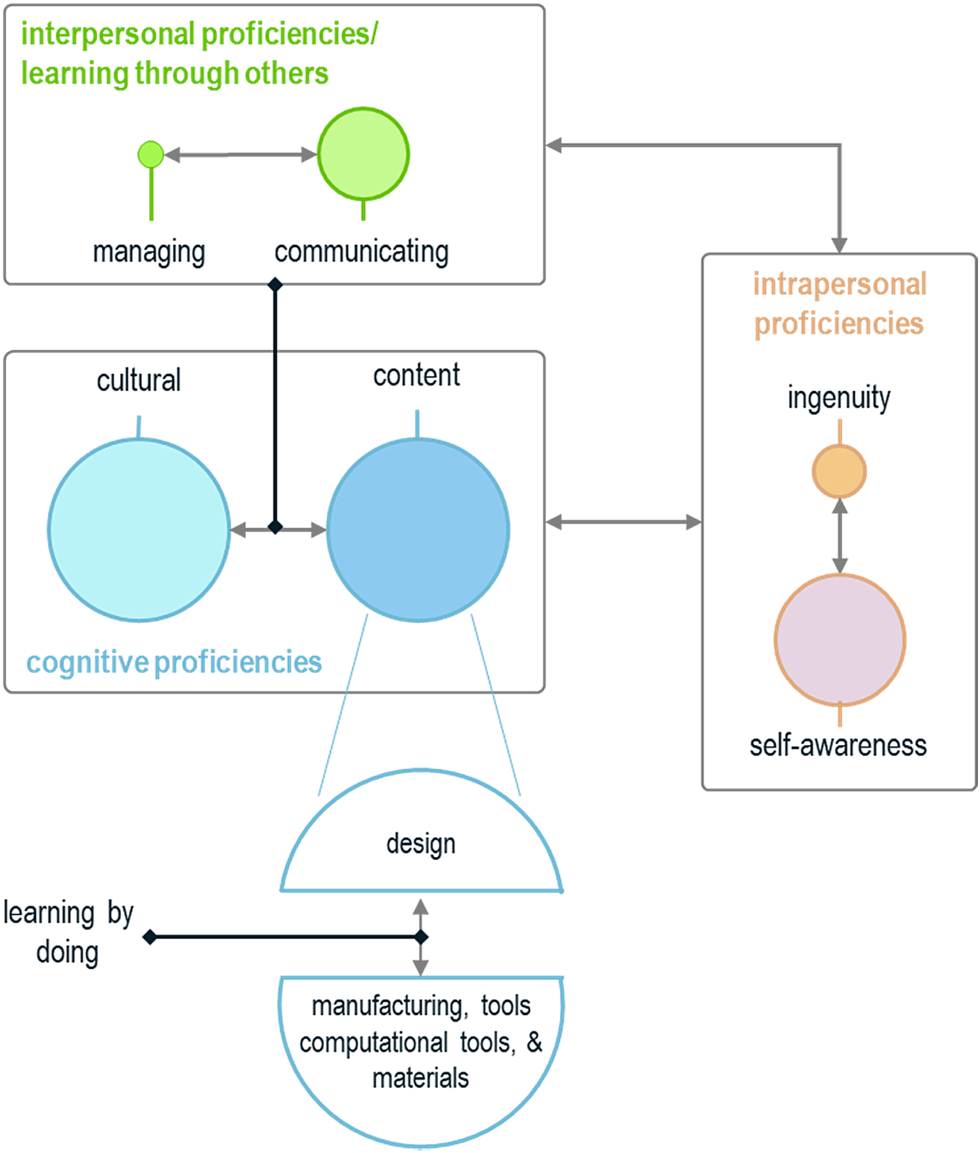
The emerging patterns of the tree map help to illustrate the comparative ways in which women are building proficiencies in makerspaces. In the next step, we examine the themes about the experience of learning in a makerspace that emerge from the data (Table 1) and how these themes contribute toward the foundation for a learning and design model (Fig. 2).
The learning model.

Characteristics of makerspace environments

Makerspaces create a culture of learning: “environment of everybody is learning”
Makerspaces support the women students through instilling the notion that “everyone's learning all the time,” which is encouraged by an environment that invites failure and supports asking for help. These elements allow for a culture that encourages students to create in a judgment-free environment, as one participant noted, where “people don't judge when I make mistakes.” Another interviewee described her experiences in a similar manner: “The culture there is everyone's there to learn something new, and no one knows how to use everything in the space.” This invitational feature of makerspaces offers an important dynamic for learning for women students. The tensions related to the role of failure in learning are portrayed in the following participant's reflections:
When I do things, I do them right or I just don't. I mean with tools that I am proficient in, I'm going to take more risks – but, if I don't feel proficient in something – it also helps that I can go to someone and be like, “Hey can you help me out with this?” But, sometimes it will be like, I don't want to do this project, because I don't think I'm good enough at it and I really don't want to fail at it.
In this short excerpt, we see the student's struggle to resolve the conflict between developing proficiency and failure. This conflict is heavily rooted in the socialization of the classroom, where one's proficiency is based on letter grades and assessed on one's ability to succeed in homework, exams, quizzes, and projects. With this attitude, students enter into makerspaces with intrapersonal barriers that can result in creating design barriers, as seen in the following participant's account:
You've always been taught that when you do something wrong it's because you're like dumb or you haven't learned something correctly is why you failed. I think a lot of [university] kids link that together, so they're afraid of failure, so when their design fails, when their 3D print fails, they think it's something they've done versus like, oh – it's not something – yeah, it's something you've done because you've designed things wrong, but how do you learn from that to make it right versus just accepting that you've failed and maybe could try something else.
As this participant points out, students are socialized to extrapolate failure in an activity with them being a failure as a person. This form of extrapolation is present in Brown's (Reference Brown2017) work on vulnerability, shame, and empathy where people extrapolate a situation and create a lie that they tell themselves. For learning in makerspaces, this self-talk might look like the following: because I failed, then I am a failure. Overcoming self-talk, such as “It's too hard; I can't; I can't understand it; I'm not smart enough” can be challenging. However, as one participant noted, “not being afraid to start is a big thing,” and the makerspace provides the opportunity to overcome the fears of failure and concern that one is not good enough. For another, the makerspace “gave me confidence that I could create on my own. I feel like the makerspace still endorsed that better than the class did” because “at the space you actually make something and get a physical product. In class, you're just doing it for a grade, which is a lot less fun than doing it for yourself.” The act of creating and generating tangible products through failing, struggling, practicing, iterating, and exploring enables the women students to embrace failure and grow in confidence in an atmosphere that encourages learning.
“And if all those fail, I can find someone who knows more.” The makerspace environment not only encourages learning and failure but the act of asking for help. Similar to not feeling good enough, asking for help is likewise associated with connotations of weakness or lack of knowledge. Asking for help requires the women students to recognize that they are learners and that asking for help is not a weakness. However, asking questions comes with uncertainty with how others will respond, especially in a male-dominated makerspace environment that women have been shown to avoid (Faulkner and McClard, Reference Faulkner and McClard2014). For instance, one participant had helped to change the culture of the makerspace at her university, but when she first started out using the makerspace, the response toward her questions was not positive:
I had to ask a lot of questions, to people that were pretty condescending, and pretty mean, just for no reason … I didn't want to ask people all that information one at a time. I wanted to space it out, so I could space out the feeling of condescension and embarrassment … So what I did was, I avoided the people who were [jerks] to me, and I went to other people who seemed knowledgeable. Sometimes, they turned out to be not knowledgeable.
From here, this participant made efforts to change the culture of the makerspace such that all members recognize the value of asking questions and of learning. With a focus on this type of learning, other women students became “not afraid to ask questions anymore” because of the makerspace's welcoming environment. A learning culture that fosters the attitude that seeking help is welcomed thereby allows women students to (1) “realize what went wrong, and making sure that the situation didn't happen again for any of the users”; (2) be “able to say, ‘I don't know, let me get back to you,’ has been a really important thing for me to develop and a lot of that's come from working in the shop”; and (3) to learn that “if you want to learn how to make stuff at [the Makerspace] you're going to have to ask people for help, or just talk to people.”
The makerspace breaks down the barrier that students have to know everything, an assumption that can be especially challenging for women who are student workers in the space. While student volunteers and employees in makerspaces recognize that “there's a lot to gain from being in a position to teach others and also say, I don't know,” they “want to have the answer for people all the time” which instills in them a desire to learn and ask questions so that they can have the right answers for people the next time. “The beauty of the [Makerspace] is that there's always going to be someone who knows and always going to be someone who has a specialty is some realm or whatever.” One participant describes the open learning of the space and how she overcomes the worry in failing:
It's because everyone's so open in just sharing their knowledge in the makerspace. Anytime I want to know a little bit more about something, I ask. It's the word of mouth that helps in that. Then if I'm a little skeptical on how to operate a tool, I just do it because what's the worst that can happen if I know how to do it but I'm just maybe a little worried or something like that. I just go for it.
This participant is not suggesting that a person with zero knowledge on a tool should try to use it without asking for help. Instead, she is recognizing that sometimes her own skepticism and worry creates a barrier to her endeavor and effort toward operating a tool. The tension between failure and proficiency is reconciled in the culture of a makerspace that allows learning all of the time.
Another aspect of a learning-infused culture is that learning permeates the essence of the makerspace and engages learning and inspiration from working on projects, interacting with others, or seeing what other people are doing. Simply by being in the space, women students are “getting to see the tangible results of all these great ideas people have” which is “really inspiring to see all these projects that people come in with.” Seeing what other people are doing coupled with being encouraged to ask questions allows “learning by either watching other people or learning by asking them questions about like, ‘Hey, I saw you were doing this. It looked really cool. Could you tell me a little bit more about what you're doing?’” Learning from asking questions and seeing what other people are doing then opens the opportunity for pondering “like, ‘Oh, how can I apply your knowledge to what I'm doing?’ I think it's a lot of what I've seen and experienced myself with like how people learn in that environment, which is pretty cool.”
There are numerous ways in which learning is engaged, which is reflected in the varied categories for learning described in the first section of the findings. Participants’ expressions of how they learn showcases that learning happens “by teaching,” “in passing,” by “word of mouth and practice,” by “doing things,” by “actually making something,” by “watching other people,” and by “asking them questions.” The extensive means through which women students acquire knowledge is a direct result of the culture and environment of the makerspace.
Participants showcase that processes of learning related to makerspaces are overlapping and varied, supporting the different learnings styles of the makers and recognizing that learning is characterized by combinations of activities – such as reading, doing, and observing others. Students do not always agree on the “best” ways to learn. For example, one participant opined that “All those machines come with giant manuals, so you sit there and read the manuals. You don't have to, but it's the best way to learn.” Yet, another participant asserts that “you can study a manual … all you want,” but taking a 3D printer apart and putting it back together brings forth the best way to learn about the machine. While these may seem in conflict with one another, these excerpts are not provided in the full context of the participant's narratives. The woman who talks about reading manuals as a form of learning is referring to the fact that a manual sets the foundation for where to start in truly understanding the machine thoroughly. This same participant characterizes herself as a hands-on learner, and later mentions that “we don't realize how intricate computers are until we actually open one, and be like, what's wrong with you?” Her discussion of learning through manuals stems from her involvement in helping to set up one of the makerspaces on campus. In the process of setting up the makerspace, the team decided to identify particular members as “experts” on specified equipment, and these “experts” were to read the manuals so as to be able to fix the machine and ensure the safe use of the machine. Her follow-up recognizes the limitations of written instructions, as sometimes a problem occurs that a manual cannot resolve; rather an individual must figure out a solution by working with their hands and problem-solving. Indeed, one participant aptly captured the varied learning that happens in makerspaces as adding to her “toolbox”:
This is something I've learned through like [messing] up, which is when you're in design – or in anything, anything you learn, like 3D printing, any of the tools, the 3D print, the CNC mill, the bandsaw, all of those are tools in your toolbox of design.
Ultimately, the different ways of learning, whether that be with the manual or through watching others, contribute to this “toolbox of design” because this allows for opportunities “if you just have the ideas, then they're in your toolbox, stored away to where you can use them later. Yeah, it's cool. So I think the [makerspace] is what we make it to be.”
Makerspaces facilitate students’ design journeys
Participants’ stories each highlighted the manner in which makerspaces facilitate students’ design journey. The last section began a discussion on the power of seeing other people's ideas in the makerspace. For one participant, they expanded on this concept in recognizing that “it's really interesting seeing people with these really cool ideas and then how that interplays with the more tangible, actual machining of it.” She further specifies that “sometimes with my own projects, sometimes starting with knowledge of what can be done on machinery can be really helpful while you're designing.” This begins to indicate that the concrete knowledge of the machinery allows for the conceptual understanding and knowledge of design. As one student reflected, “There's some sort of connection between looking at a design and knowing which machines can do it.”
The women's narratives strongly support the notion of developing concrete knowledge first, and then honing technical skills. Generally speaking, the women sought to hone in on their technical skills as a means to then be able to engage in design and create projects. Their narratives illustrate the iterative nature of the relationship between developing design and fabrication and manufacturing skills related to making. As a student aims to hone a specific fabrication or manufacturing skill, then they must think of or create a design to be able to use on a piece of machinery or tool. Alternatively, should a student come in with a design, then she learns more about a piece of equipment in the process of creating the design. Even when the individual is practicing with the same design, they are instilling the sense of “muscle memory” with the machines, as the following participant described:
Sometimes it's, with a sticker cutter it was a just coming up with simple ideas of things I could make so I could get practice on it at first. Sometimes it's just a matter of taking a piece of scrap wood and making a couple of cuts in it and just playing around with it, not really making anything. Just making a blob of wood that has a bunch of practice cuts in it … it's the muscle memory of how to use the machine often. Especially for more complicated things like the lathe probably involves a little more just muscle memory to make sure what does what … It's like using a pencil; you have to practice it at first to make sure you know how to use it correctly.
Students commonly made sense of the development of their fabrication and manufacturing skills in relation to the idea of design, particularly through the idea of “practicing” on the machines. In the following account, the participant views the makerspace as a place to both learn (honing skills) and as a place where people come to make particular project ideas happen – each part of students’ design journeys:
When I came in as a user, I never really came in with a project in mind. More of – a lot of times I would come in with a tool in mind. Like I have this material and this tool, let me think of a project to make on it, while most of the people coming in as user usually have – here's the thing I need to make, how do I get there. And, so it's – you get some of each, but a lot of people – like, there's a – there's a difference between people who see the [Makerspace] as a place to accomplish a task and that it's like a place to spend time and learn things.
Indeed, this participant recognizes that there is no singular pathway into a makerspace, not a single “end” goal of the use of that space, yet for all who use the space it distinctly shapes their experiences of design.
While most users reported seeking to first gain comfort in their fabrication and manufacturing understanding, there are instances when a design is used to jumpstart a participant's engagement in a makerspace. In those instances, the project is typically linked to a class-related activity or is dependent upon a person's extensive background in design, such as a design or art background. Further, some students reported how negative experiences using the makerspaces for class projects spurred them on to return to the makerspace in efforts to better learn how to use the equipment. For example, one student who had a negative class experience reflected that she “kept thinking about what [she] could do to make things … why [she] hadn't done a good job.” The student decided she wanted to build a clock, so she “bought all the materials that [she] needed, and [she] started working on it in the [Makerspace]” even though she “didn't know how to use anything.” As a result of her desire “to learn tools better,” she reported that she “learned to drill press, bandsaw, sanders, scroll saw” through that personal project.
For another student with an art background, she started with a class-related project that spawned her interest in woodworking. Then, “because of the project, and then I was like, ‘You know what? I wanna build my own furniture’.” Her art and design abilities were further nurtured and expanded from her interest in woodworking. When asked how she finds ideas, she articulated:
I have an idea of something that I want to make or, I'll say … I wanna make a plant stand. … but most of the time it's just a vague thing and I pick and pull what I like about different things and put them together to make my thing.
With her newfound interest in woodworking, the participant describes that she faces the challenges of “bridging the gap between what needs to be done when you don't know anything of how to do it.” As such, she learns how to break down the “communication barrier” of her not “really know[ing] how to explain what you want” to the student workers in the space, and thereby learns “technical jargon,” what tools are appropriate for the tasks that she wishes to pursue, and then how to use the tools.
It is through developing these fabrication and manufacturing skills that students feel confident to advance their employment of design processes. Further, students describe that they also have “a leg up for a lot of classes like senior design when you have to build stuff.” One student describes this relationship between fabrication and manufacturing skills and design skills: “Because once you understand how it works and how it functions, then you understand how to undo any mistakes that you made” and you are able to approach projects or problems with knowing whether an idea is feasible or not. Understanding that process for building a quick prototype can help provide the insights that a student needs in other avenues, such as research or class. For one student who already had experience in the makerspace and was taking a project-based class, reported that she realizes that “because I had the technical knowledge, I was able to figure out different things we could build easily.” Another participant recognized that both fabrication/manufacturing and design skills are developed over time, in tandem, and with accumulated experience:
A lot of it's just experience … Basically the more you work with the machinery because we have to just sort of keep maintaining them, the more you know what it can do … there's some sort of connection between looking at a design and knowing which machines can do it.
Another student builds out this connection by recognizing, “it's a relationship. It's three ways. So, it's the user, the material, and the machine. And you have to interact with each one, how they interact with each other to create what you want, to create your vision.” Thus, the materials, the machine, and the maker are working together as a means to move toward one's vision or design.
As part of their design journey, women students are able to use their hands-on, fabrication, and manufacturing skills along with design knowledge as a foundation and springboard toward developing problem-solving skills, critical thinking, and creativity. Throughout the interviews, students described their experiences working through a problem when making. For example, one student when describing her making process names problem-solving as an important to her designs, as she needs to first “learn how to problem solve like here on the table physically, and then … figure out how [she] could problem solve more conceptually” showcasing how working through a problem with one's hands influences the ability to think through a problem. Students further describe problem-solving and creativity to be both necessary and interconnected, as one student reported, “they go hand in hand … like you have to be creative to be an effective problem solver to think of a creative solution.” Students described how their ability to work through problems and be creative develops over time and with experience, as one woman reported: “the further I got in using the [Makerspace] I think I got a lot more creative and how I can get things to work.” Through working in a makerspace, another student reported that she “realize[d] you have to learn how to adapt and figure out what tools can be combined to meet someone's request or find alternative ways to accomplish something.” Whether for your own project or another person's project, the ability to adapt is developed through learning and creating in a makerspace.
Makerspaces as a “laboratory for creativity”: “there's limitless potential”
While students discussed the development of creativity as part of their design journey, it was also routinely described as a central characteristic of the makerspace environment, notably a “laboratory for creativity.” Women participating in the study described that nothing is out of reach and “there's limitless potential” in a makerspace. Students describe that the makerspace environment supports creativity in two main ways: (1) through creating opportunities (opening up doors) and (2) through instilling belief in oneself. Both of these features are illustrated in one participant's reflection, “I think it just opens up a lot of doors. Coming from someone who makes not very practical things, learning how to use the tools was just … it's dangerous. ‘Cause then you're like, Wow, I know how to do this’.” She describes her newfound abilities as “dangerous” because now she has the access and confidence to be able to create anything.
One of the values of capturing women's narrative through phenomenologically based interviews is the focus on reflective storytelling. Through reflecting on their own stories and journeys into the makerspace, the women in this study share their experiences, as one stated, of how the makerspace “opened up a whole new world. [I] didn't even know these tools and equipment existed because I wasn't exposed to it.” In another student's reflection, she realizes that the access and exposure to the makerspace are valuable for classwork, but also for engineers to be able to unleash their “creative freedom”:
I feel like engineers aren't always able to express themselves in a creative way, and I feel like this is like an ‘engineery’ way to be able to do that. I feel like in our classes, there's not a lot of creative freedom for a lot of stuff. And I feel like engineers are like, oh, I can't have hobbies. … But this is a really cool way that lets you use your skills that you learn in class to create something, and you use that engineering mindset in an artistic way.
As a resource, the makerspace becomes an environment in which one can “use that engineering mindset in an artistic way,” and fosters the pursuit of creative endeavors. While recognizing that creativity in design may be challenging, the makerspace environment opportunities to create. As one woman noted,
It's those little ideas that flip through your head when you run into an everyday problem, and that's sort of what we encourage people is like, hold onto that thought, hold on to that problem because we almost guarantee that there's a way to fix it.
There are several features of makerspace environments that enable students to view it as a laboratory for creativity that creates opportunity and instills confidence. First, as a multi-use space, there are less constraints to how it is and can be used. Second, community members’ likelihood of spending time together in the makerspace opens up the possibility for creativity. For example, one student notes that makers “spend probably hundreds of collective hours down there and … probably a thousand” in a place “that was a study space, that was a hangout space, that was a workspace, that was a creative space [and] just had so many other purposes” than “just a room full of tools.” In short, a makerspace is more than the sum of its parts; it is more than just the equipment housed within its walls.
Once the door is opened, the woman begins to assume the perspective that their visions and designs are more possible, as they come to believe in themselves. One participant expresses, “So it took me a while because I was learning everything, I think sometimes people don't know that you really have the technology to say, ‘okay, if I can design something, I can make it, and it's not impossible’.” Similarly, another student claimed that the “power to make something that I want, like I can bring ideas to life,” builds the confidence and feelings of empowerment:
I started having all of these brilliant ideas. I had confidence that, whatever I was going to think of, it was going to be great. I could make it great. It was going to look good. I knew how to use the machines. It was so empowering. It was the best feeling.
Through knowing how to use the machines and being in a makerspace environment, not only does creativity evolve but also the belief that one can physically create nearly any idea that passes through their mind. For example, one student described that the makerspace “definitely help[s] … with the whole creativity side of it” and “when you see you can build things, it's more easy to believe in ideas.” Another woman participant described the feelings of confidence in getting over fears of the equipment, as she realizes that “things are more attainable and less intimidating. Like after getting trained on some of the really intimidating metal equipment that shoots sparks and are really loud and scary, once you can conquer that, you can conquer anything.” These bold claims of being able to “conquer anything” are rooted in a “willingness to take challenges and try new problems,” where “new problems are exciting, not the end all, not the end of the game” because the students “have had a lot of experience now taking something from idea to solution.” Through this experience, the women students are engaging in the design process and building their “toolbox of design,” which allows them to recognize the feasibility of their designs:
I think you might not end up laser cutting for your job, but it's still a mindset where it's like, if you design things but then you never see the manufacturing feasibility of it, you'll never know if it's possible. I could design something super cool, and not be able to make it. Then what do I do with the design now? That's a really cool side of the makerspace, where it's, I designed something that I'm like, ‘I actually cannot laser cut this because the balsa will just break in half because it's not structurally sound,’ or, ‘I can't water jet this thick piece of aluminum. It's just not possible.’ Through those things you learn how to modify your design, and so on and so forth. As an engineer everybody goes through this, where you make design changes, or you pick design constraints, and then you try to manufacture it and it doesn't work. You need both sides to balance each other out.
Possibility corresponds to feasibility, which is learned from experiencing and balancing manufacturing and design in the makerspace. A student reflected that before the makerspace, “if we had this idea, we have no way to test it, no way to really see if it works, so it stays a problem. With the [Makerspace], it's cool. We have this problem, we've got a solution, we can really fix this. Which has been a really, really cool experience to have.” Not only are the students learning how to have an idea and then create the project, but they are also experiencing great enjoyment in the process.
A final byproduct of being involved in the makerspace and the experience of its “limitless potential” is the students’ recognition of the makerspaces’ transdisciplinary character. For example, one student reflects, “the makerspace pretty much gives me the ability to contribute in any field possible.” The lessons learned and experiences in the makerspace further help students to develop an adaptable and transferrable skillset. The design skills that they have learned are applicable to domains outside of the makerspace, such as in research, classes, industry, art, and among others. One participant announces that she “could actually go and use these skills in my actual career 1 day, versus just in the hobby. They're applicable to like real world life and job.”
Development of a model of learning in makerspaces
The categories of learning in makerspaces and the characteristics of the makerspace environment described in the above two sections were used to develop a model of learning in makerspaces, as illustrated in Figure 2. The following propositions drawn from the findings above constitute the features of the model of learning. First, students acquire cultural and content knowledge in a reciprocal manner; both are mutually necessary for learning in makerspaces. Second, fabrication and manufacturing skills cultivated in makerspaces enhance design skills, and vice versa. Third, interpersonal, intrapersonal, and cognitive proficiencies are developed simultaneously and are mutually supportive. These proficiencies are enhanced by students engaging in “learning by doing” (practice) and also enable students’ confidence to learn by doing.
Content Knowledge ← → Cultural Knowledge. The data reveals that makerspaces “create a culture of learning,” showcasing the reciprocal exchange between cultural and content knowledge acquisition. This interplay between cultural and content knowledge is facilitated by learning through others as students gain insights into the culture and content through asking for help, thus building interpersonal proficiencies. Then, the particular acquisition of content knowledge is assisted by learning by doing. Further, overcoming the fears associated with failure and with asking for help demonstrate a direct link between the cognitive proficiencies and learning through others toward one's self-awareness. Students discussed how the opportunity to see other people's tangible products and learn from that, whether simply for inspiration or content, indicates a connection between the cognitive proficiencies and learning through others toward ingenuity.
Fabrication and Manufacturing Skills ← → Design Knowledge and Skills. The data demonstrate the interplay between fabrication and manufacturing skills with design knowledge and skills, as having more hands-on knowledge with the machines, materials, and computers allows for one to engage in design and then further generate more creative solutions. Further, the acquisition of content knowledge and an individual's desire to create a design can result in creative solutions, which confirms the link between content knowledge and ingenuity.
Interpersonal Proficiencies ← → Interpersonal Proficiencies ← → Cognitive Proficiencies. While understanding the makerspace as a “laboratory for creativity,” the findings helped to showcase how the intrapersonal proficiencies link back with both interpersonal proficiencies and the cognitive proficiencies in mutually supporting relationships. The women recognized that as they went from idea to solution, they became more confident in their abilities to be creative, which further confirms the link from content knowledge and intrapersonal proficiencies and the link between self-awareness and creativity. Then, as the women students became more confident, resilient, and creative, they were willing to try more designs and machines. In that case, the intrapersonal proficiencies link back to content knowledge/skills. Similarly, the women students have the confidence and affirmation that they can communicate in any field because of their experience in the makerspace. As such, a link results from intrapersonal proficiencies to interpersonal proficiencies. In turn, these propositions are illustrated a model of learning, see Figure 2.
Discussion
In examining how learning unfolds in an academic makerspace, we developed and articulate themes of learning and design that recur in women student narratives along with the interaction between the types of learning (represented by a learning model). Through delving into these themes, we illuminate the nature of the makerspace environment:
• Makerspaces create a culture of learning = learning environment,
• Makerspaces facilitate students’ design journeys = design environment, and
• Makerspaces form a “laboratory for creativity” = open, creative environment.
Given these learning-focused themes on makerspaces, the learning model exposes the dynamic nature of the makerspace, where the types of learning and proficiencies are intertwined and impacted by each other. The more an individual negotiates and navigates the culture, then the more opportunities that they have to engage in the makerspace, make more projects, and learn various equipment/tools. The learning model alone showcases the power of culture in promoting academic learning, and that both intrapersonal and interpersonal proficiencies, while small in comparison to cognitive proficiencies, support and influence the individual's overall opportunity to learn and engage in the makerspace. Collectively, these learning findings promote the following:
Makerspaces are open, dynamic, learning design environments, where collaboration, support, failure, and resources invite a breadth of skills/proficiencies and open the doors to creativity, inspiration, and confidence.
These findings present a soundboard for existing claims and a springboard into understanding the nuances and learning experiences of all students. For example, Fleming (Reference Fleming2015) states that “failure is a necessary step on the road to success and innovation” (p. 9) and that
maker education fosters curiosity, tinkering, and iterative learning, which in turn leads to better thinking through better questioning. I believe firmly that this learning environment fosters enthusiasm for learning, student confidence, and natural collaboration. Ultimately the outcome of maker education and educational makerspaces leads to determination, independent and creative problem solving, and an authentic preparation for real world by simulating real-world challenges (p. 48).
Confirming Fleming's beliefs, this work demonstrates that students, women in particular, are engaging learning and inspiration; developing confidence and resilience; and learning how to work with others and collaborate. In another instance, makerspaces foster the notion that “owning the learning experience opens unexplored horizons to students because independent thinkers have the uncanny ability to strike out into uncharted territory” (Kurti et al., Reference Kurti, Kurti and Fleming2014, p. 20), which is evidenced as makerspaces become a “laboratory for creativity” for students where doors are opened, they believe in themselves, and they gain transferrable skillset for uncharted territory. The women students “see themselves as learners who have good ideas and can transform their own ideas into reality” (Martinez and Stager, Reference Martinez and Stager2013, p. 36), as they are engaging in “creative, higher-order problem-solving through hands-on design, construction, and iteration” (Johnson et al., Reference Johnson, Adams Becker, Estrada and Freeman2015, p. 38). Indeed, the findings offer to the budding research that debunks the think maker, think man stereotype that poses a barrier for girls and women's participation in makerspaces (Intel/Harris_Poll, 2014).
Ultimately, Burke provides a clear and well-aligned expression regarding the impact of learning in makerspace: “What is made may not matter at all; it can still influence the thought process, vision, and ability to connect of a learning maker. These abilities can enhance a person's thinking and work in many different fields” (Burke, Reference Burke2014, p. 13). The makerspace changes how women students think, whether how they think about design or how they think about themselves. Makerspaces have provided women students with the opportunity to explore learning with a creative mindset, where the makerspace offers “limitless potential” in building one's “toolbox of design.”
While this work focuses on women students at a technology-focused institution, we expect these findings to be transferrable to experiences in makerspaces of many different styles and across different makers from varied demographic backgrounds. This work emphasizes women student experiences in particular due to the lack of attention in engineering literature regarding women students and because of the notion that making and designing are gendered toward men (Meyer, Reference Meyer2018). It is not to say that men do not experience the same breadth of learning nor the same fears and anxieties as women, as that will be addressed in future work that is currently being undertaken. Rather, this work aims is to (1) highlight and animate the narrative of and the discussion on women making experiences, which have been neutralized and belittled by echoes within the engineering discipline and (2) showcase ample evidence toward existing claims that makerspaces are these open, creative design learning environments as a means to evoke an understanding of learning in these makerspaces for all students.
Conclusions
In using a phenomenologically based interviewing process, we interviewed 20 women who were highly involved in various university makerspaces. To understand how the learning was unfolding in the makerspace, we identified recurring themes and patterns among the interview data which exposed how a makerspace supports the design experiences for highly involved women.
• Makerspaces create a culture of learning by
o inviting failure,
o supporting asking for help, and
o cultivating engaged learning and inspiration.
• Makerspaces facilitate students design journeys by
o honing fabrication and manufacturing skills,
o advancing the employment of design processes, and
o developing problem-solving, critical thinking, and creativity.
• Makerspaces create a “laboratory for creativity” by
o creating opportunities,
o instilling belief in oneself, and
o developing an adaptable and transferrable skillset.
These three major themes set the context in which the students developed cognitive, interpersonal and intrapersonal proficiencies in the makerspaces as visualizes in the learning model in this paper. Thereby, makerspaces are shown to offer women students proficiencies within culture, content, design, communication, management, ingenuity, and self-awareness through the processes of learning by doing and learning through others. The data clearly demonstrate that effective makerspaces have great potential for revolutionizing engineering education and warrant much further study. The current data captured the narratives of women who are highly involved in a makerspace, and consider themselves “makers.” Additional research is needed for students who are less involved and also to determine if the effects are similar or different for men.
Alternatively, the learning findings produced in this work provide immeasurable insights and opportunities for other makerspaces. The learning model demonstrates structured articulation of how learning occurs in the makerspace. Other makerspaces and/or researchers can use the learning model as a means to analyze or assess the learning of their own makerspaces. Here, we have set the foundational work for the overall learning engaged in a makerspace. Further work can look to dive deeper into certain categories (e.g., looking at the design in more depth), to examine other types of makerspaces (e.g., industry, community-based, etc.), or to examine other demographics (e.g., gender, ethnicity, and race). Given the work presented in this paper, the findings are transferrable and applicable to other makerspaces and potentially other community-oriented spaces. Ultimately, it is important to understand that makerspaces afford a diverse type of learning, and the acquisition of a diverse skillset comes from the opportunities provided within a makerspace. Makerspaces are not only constituted by equipment/tools and space itself but also by the culture created by those who manage and use those spaces.
Acknowledgments
This work is supported by the National Science Foundation through grants EEC-1733708 and EEC-1733678. Any opinions, findings, and conclusions or recommendations expressed in this material are those of the authors and do not necessarily reflect the views of the National Science Foundation.
Megan E. Tomko completed her PhD in the George W. Woodruff School of Mechanical Engineering at the Georgia Institute of Technology under the guidance of Dr. Julie Linsey and Dr. Wendy Newstetter in 2019. She is an ASME Teaching Fellow and worked in sophomore and graduate level courses focused on teaching engineering design methods. Megan's research interests are in identifying ways to teach students how to become better designers and learners through creative and nontraditional means. Specifically, she focused on understanding the experiences and pathways of women students in engineering design and academic makerspaces.
Wendy C. Newstetter, a learning and cognitive scientist, is the Assistant Dean for Educational Research and Innovation in the College of Engineering at Georgia Tech. As an augural member of the biomedical engineering faculty, Dr. Newstetter spearheaded the development of problem-driven learning (PDL) which was recently awarded the Gordon Prize for educational innovation by the National Academy of Engineering. She is a Co-PI on the Georgia Tech Revolutionizing Engineering Departments (RED) program and a member of the Army Science Board.
Melissa W. Alemán is a Professor of Communication Studies, and a member of the Women's, Gender, and Sexuality Studies teaching faculty at James Madison University. Her research agenda focuses on the qualitative study of communication, storytelling, and culture in a variety of contexts, including makerspaces, campus cultures, and families. As the Co-PI of a National Science Foundation supported collaborative interdisciplinary research project, she brings her expertise as a qualitative methodologist toward the identification and modeling of the intersections between communication, culture, and learning in engineering makerspaces and other informal learning environments.
Robert L. Nagel is an Associate Professor in the Department of Engineering at James Madison University (JMU). At JMU, Nagel directs the Center for Innovation in Engineering Education and leads the year-long sophomore design experience where students work with and learn from differently abled individuals of the local community to design and deliver to them adapted human-powered vehicles. Dr. Nagel's research explores the learning effectiveness of interventions used in engineering design education. Dr. Nagel is currently investigating the role of functional modeling toward developing students’ mental models as well as studying the learning role of academic makerspaces on engineering education.
Julie S. Linsey is an Associate Professor in the George W. Woodruff School of Mechanical Engineering at the Georgia Institute of Technological. Her research area is design cognition including systematic methods and tools for innovative design. Her research seeks to understand designers’ cognitive processes with the goal of improved tools and approaches to enhance engineering design and innovation. Her current work explores the impact of university makerspaces, an AI statics tutor system, computational approaches to analogy retrieval, and the representation of analogy. She has authored over 190 technical publications including 43 journal papers and 10 book chapters.