Introduction
Cervical cancer is the second most commonly diagnosed cancer after breast cancer and the third leading cause of cancer-related deaths after breast and lung cancers in the developing countries. India alone accounts for one quarter of the world’s cancer deaths.Reference Lindsey, Farhad, Rebecca, Elizabeth and Ahmedin1 India has the highest age standardised incidence of cervical cancer in South Asia at 22 per 100,000 women, compared to 19·2 in Bangladesh, 13 in Sri Lanka and 2·8 in Iran.Reference Sreedevi, Javed and Dinesh2 For women who develop locally advanced cervical cancer, the standard of care has historically evolved from brachytherapy alone to external beam radiation therapy (EBRT) alone to EBRT plus brachytherapy to the present combination of EBRT and brachytherapy with concurrent chemotherapy.Reference Green, Kirwan and Tierney3,4 The EBRT encompasses treatment to the primary tumour along with pelvic lymph nodes to a dose adequate to control microscopic disease. The addition of brachytherapy serves to boost the gross tumour dose to improve local control and survival without increasing the toxicities.Reference Eifel, Thomas, Smith, Morris and Oswald5–Reference Pinkawa, Pursch-Lee and Asadpour7
Since the beginning over more than century ago, brachytherapy has evolved from the low dose rate (LDR) mode (around 50 cGy/hour) to the present high dose rate (HDR) mode (1,200 cGy/hour or more). About 89% of respondents to a recent Indian Brachytherapy Society annual meeting survey reported fractionated HDR brachytherapy mode of practice at their institutions.Reference Gandhi, Sharma, Julka and Rath8 Though HDR intracavitary brachytherapy (ICBT) practice has clear logistical advantages over the LDR-ICBT, it is worth highlighting that careful treatment planning and fractionation become far more crucial in the HDR mode for effective treatment. A modern approach in ICBT treatment planning for cervical cancer utilises computed tomography (CT) and other forms of 3D imaging for volumetric dosimetry, plan optimisation, dose prescription and reporting. The 3D image guided brachytherapy (IGBT) has increasingly replaced the earlier system of 2D radiographic method that involved point-based dose prescription and reporting. The International Commission on Radiation Units and Measurement (ICRU) in its report no. 38 (ICRU 38) provided recommendations for 2D radiography-based treatment planning that included point dose reporting for organs at risk (OAR), namely, bladder and rectum.9 It is worthwhile to note that the 2D method of ICBT yielded satisfactory local control rates and acceptable toxicities. Nevertheless, it was felt that the clinical correlation between dose and response would improve with IGBT. Recently, the Groupe Européen de Curiethérapie and the European Society for Radiotherapy & Oncology (GEC-ESTRO) in association with the ICRU has provided comprehensive guidelines to practise IGBT in its report no. 89.10 The concept of target and OAR volumes has been defined in these recommendations for dose optimisation, prescription and reporting.
Several studies over recent years have demonstrated that the 2D-point based dose reporting did not truly represent the maximum doses received by the OARs, mainly the rectum and the bladder. In a study by Fellner et al. on 28 patients with a total of 35 ICBT applications, it was reported that the maximum dose to the rectum and bladder was 1·5 and 1·4 times higher than the dose at the ICRU rectum and bladder points, respectively.Reference Fellner, Pötter, Knocke and Wambersie11 Kim et al. evaluated 15 consecutive ICBT patients and found that bladder maximum dose was underestimated and rectum maximum dose was overestimated by the radiographic method.Reference Kim, Shen and Duan12 Madan et al. in their study of 22 patients reported underestimation of the OAR doses by 2D planning.Reference Madan, Pathy and Subramani13 Such type of studies mostly included small datasets and thus had the limitations of validation for a larger population of patients, especially considering the fact that practice of brachytherapy has inherent scope for dosimetric variations. The factors impacting on the dosimetric variations from centre to centre include applicator types, bladder and rectum protocols for brachytherapy and patient shifting procedures from operation theatre to imaging suite to brachytherapy suite.
Two years ago we transitioned from radiography-based 2D treatment planning to CT-based 3D planning for HDR-ICBT for cervical cancer. As per our institutional protocol every patient selected for ICBT undergoes three HDR-ICBT fractions of 7 Gy each after 50 Gy of EBRT. On rare occasions a fourth ICBT fraction is also considered if the OAR tolerance criteria with three fractions are not met. We continue to prescribe dose to ICRU point A but have started reporting volume doses for the OARs, namely, bladder, rectum and sigmoid for each fraction as per ICRU 89 guidelines. In the present work we prospectively included 103 consecutive patients with over 300 ICBT applications. Using the multi-planar reconstruction feature available in the treatment planning system (TPS), we also estimated ICRU reference point doses to bladder and rectum. The data were analysed to find out relationship, if any, between corresponding volume and point doses for the OARs. Further, we also explored the impact of volumes of the OARs such as bladder on the doses received by them. With our sufficiently large dataset we hoped that the results and conclusions would have considerably improved statistical validity. This would result in a higher acceptability of the results and conclusions of this study among the community of clinical practitioners of HDR brachytherapy, thus having potential for impacting their practise.
Material and Methods
For this prospective ICBT study we included cervical cancer patients with stage IIB-IVA as determined by FIGO (International Federation of Gynecology and Obstetrics) system of staging.14 The other inclusion criteria were patients with inoperable cervical cancer of any histology with Karnofsky Performance Status (KPS) more than 80%.Reference Karnofsky, Burchenal and MacLeod15 A total of 103 consecutive patients, with over 310 ICBT applications, treated with concomitant chemo-radiotherapy at our centre were included in the study.
All the patients received EBRT to pelvis on a linear accelerator model Primus (Siemens, Germany) using 15 MV X-rays. A dose of 50–50·4 Gy in 25–28 fractions was delivered using two (anterior/posterior) or four fields (box fields). The EBRT was followed by HDR-ICBT using Fletcher Williamson Asia Pacific applicators on the microSelectron HDR brachytherapy machine model V3 (Nucletron B.V., Veenendaal, the Netherlands). The institutional brachytherapy dose protocol was 21 Gy in three fractions at weekly intervals. The rectum protocol required that a patient took 20 mg bisacodyl laxative suppositories (Dulcolax®) 12 hours prior to every brachytherapy application. All the applications were performed under spinal anaesthesia. The vaginal packing was done with gauze soaked in betadine to fix the applicator in position and to displace the bladder and rectum away from the vaginal applicators. Prior to the CT scan, 7 cc of Iohexol (iodine-based non-ionic contrast dye) with 1:6 dilution was instilled in the balloon of Foley’s catheter. About 20 mL of the same contrast medium with a dilution of 1:20 was also instilled in the bladder at the time of imaging for better delineation of the bladder wall. The catheter was clamped for a minute after contrast instillation for allowing its uniform spread inside the bladder. It was then unclamped to allow emptying of the bladder before starting the imaging. The patient was shifted on a specially made wooden stretcher placed on a trolley from the operation theatre after applicator placement and remained on it for imaging as well for treatment delivery to minimise any potential applicator shift within the patient.
CT imaging was performed on a helical CT model Lightspeed VXR 16 (GE Medical Systems, Waukesha, USA) with 3 mm contiguous slice thickness protocol without any dummy X-ray markers inside the applicators. The images were then pushed to the TPS model Oncentra Brachytherapy version 4.5.1 (Nucletron) through a DICOM network. Outer walls of the bladder and rectum were delineated on each transverse CT slice in the TPS. The rectum was contoured starting at 1 cm from anus to the recto-sigmoid transition. Point A was marked as per the ICRU-38 definition on the frontal plane reconstruction of axial CT images containing the tandem. A dose of 7 Gy was prescribed to point A for each fraction. We used standard loading pattern unless OAR dose constraints warranted modifications. In a later situation, we either performed graphical optimisation or reduced the dose per fraction and accordingly increased the number of fractions. We estimated the minimum dose to the most irradiated OAR volumes of 0·1, 1 and 2 cm3 (D0·1cc, D1cc and D2cc) from the dose volume histograms (DVH). The ICRU bladder and rectum reference point doses were estimated from the appropriately reconstructed image planes using the live dose feature of the TPS.
Statistical analysis: Pearson correlation method (two-tailed) and paired t-test (two-tailed) were used for data analyses.
Results and Discussion
The point and volume dose data for all the 103 patients with over 300 ICBT applications collected for this study is shown in Table 1. The average prescription dose per application was estimated to be 6.77 Gy (±0·63). We observed that for bladder the mean difference between ICRU point and volume dose was minimum for D2cc value and for rectum it was minimum for D1cc. The bladder ICRU point underestimated the dose when compared with the volume doses. In the case of rectum the ICRU point underestimated the dose when compared with D0·1cc value but overestimated when compared with D1cc and D2cc values. The under- and overestimation of doses was statistically significant. The ICRU point and volume dose (D0·1cc, D1cc and D2cc) correlation coefficient values were 0·630289, 0·581058, 0·548576 for bladder and 0·679113, 0·667454, 0·63978 for rectum, respectively. The coefficient values show moderate to high positive correlation between ICRU point and volume doses for the OARs under consideration. The correlation was significant at 0·01 level (two-tailed). Unique positioning, configurations and/or variations in bladder shape for each patient such as close proximity of the lateral pouches of bladder to radiation sources in the vagina and variable position of the Foley balloon within the bladder occasionally resulted in a large difference in ICRU reference point dose and the most irradiated bladder volume dose.
Point versus volume dose comparison for bladder and rectum

* The number of estimated difference values (n) varied from 307 to 314 for each pair.
Abbreviations: OAR, organ at risk; SD, standard deviation; D0·1cc, D1·0cc, D2cc, minimum dose received by the most irradiated 0·1cc, 1·0cc and 2·0cc volumes, respectively; MD, mean difference of dose; p, paired t-test probability value.
Onal et al. in their study of 29 patients comprising 62 ICBT plans reported that the mean D2cc values for rectum and bladder were 1·66 and 1·51 times higher than the mean ICRU rectum and bladder doses, respectively.Reference Onal, Arslan and Topkan16 Kim et al. in their study found that the mean ICRU bladder point dose (401 cGy) was markedly underestimated when compared to the mean bladder D2cc value (484 cGy).Reference Kim, Shen and Duan12 However, the difference between mean ICRU rectal point dose (412 cGy) and mean rectal D2cc (373 cGy) was not that marked. In an MRI-guided ICBT study on 20 patients, Zwahlen et al. reported the correlation coefficient values of 0·45 and 0·6 (r 2 values) between ICRU reference point dose and D2cc value for bladder and rectum, respectively.Reference Zwahlen, Jezeioranski and Chan17 Rangarajan et al. in their study on 136 ICBT applications found that the Pearson correlation coefficient values (r) were 0·639 and 0·752 for D2cc and ICRU reference points of bladder and rectum, respectively. The mean D2cc values for bladder and rectum were 1·35 and 0·8 times the corresponding ICRU reference point doses to these organs.Reference Rangarajan, Subramanian and Gopalakrishnan18 Bergh et al. in a study on 13 patients undergoing ICBT found that the ICRU rectum point dose was not a reliable estimate for maximum dose received by the rectum for prediction of clinical toxicities. There was poor correlation between D2cc value and ICRU rectum point dose with a linear regression correlation coefficient value of 0·50.Reference van den Bergh, Meertens, Moonen, van Bunningen and Blom19 Our results are broadly in line with all the studies mentioned earlier except for the study by Onal et al. Our results show rectum dose overestimation by ICRU reference point as against the underestimation reported by them.
The OAR sparing is critically implicated in HDR-ICBT with long-term toxicities. From the results shown in the table we observe that the mean D2cc values for bladder and rectum were 87 and 67% of the prescription dose, respectively. With these mean D2cc values, the total EQD2 (equivalent dose to 2 Gy per fraction) for EBRT plus ICBT (D2cc value) for rectum and bladder estimated using the linear quadratic equation for BED (biologically effective dose) with α/β value of 3 Gy were 74 and 82 Gy, respectively.Reference Barendsen20 It was expected that with these EQD2 values long-term toxicities to rectum and bladder could be avoided considering their acceptable tolerance values of 75 Gy2 (rectum) and 90 Gy2 (bladder).10 In other words the OAR sparing achieved in our clinical practice was satisfactory. Madan et al. reported bladder and rectum BED values (D2cc) as 62 and 46%, respectively, of the prescribed dose.Reference Madan, Pathy and Subramani13 Mahantshetty et al. in their study of 21 patients reported D2cc bladder as 6·58 ± 1·58, 7·05 ± 1·59, 7·6 ± 1·55 Gy for emptied, 50 and 100 mL saline infused bladder, respectively.Reference Mahantshetty, Shetty and Majumdar21 Fellner et al. in their study on 28 patients (35 applications) reported that the D2cc values for rectum and bladder were 6·5 and 8·1 Gy, respectively, for a prescription dose of 7 Gy.Reference Fellner, Pötter, Knocke and Wambersie11 Zwahlen et al. found that D2cc bladder and rectum was about 78 and 40% of the prescribed dose.Reference Zwahlen, Jezeioranski and Chan17 The variation in OAR sparing among different studies could be due to variations in many parameters such as differences in bladder and rectum protocols, vaginal packing practice and type of applicators used by these institutions.
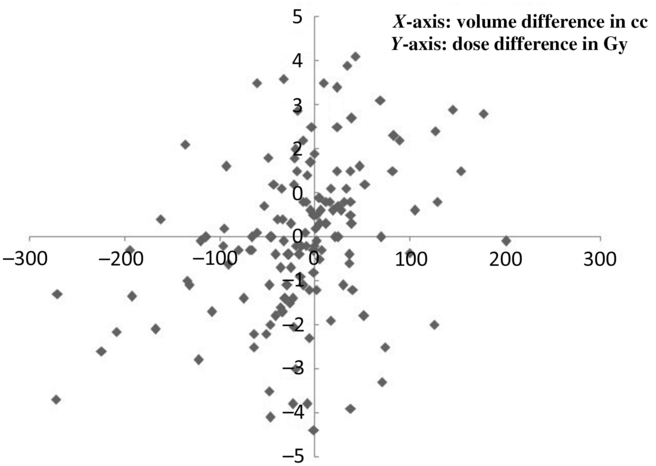
We also analysed whether the bladder volume made any difference to the maximum dose (D2cc) received by it. For this purpose we calculated the absolute volume and dose differences among pairs of ICBT fractions (first and second fractions, second and third fractions and first and third fractions) for each patient. We then estimated correlation between volume difference and dose difference for over 300 such pairs. The mean volume difference was 52·3cc (±55·2cc). It is likely that the bladder protocol we strived to follow, though not strictly enforced, in our practice could be responsible for the limited variations in the volume of bladder from fraction to fraction. Figure 1 shows the scatter plot between the two quantities. The wide and random scatter of graph points shows the poor correlation between bladder volume and corresponding maximum dose to it. The same is confirmed by the estimated correlation coefficient value of 0·348 indicating a poor correlation. Sun et al. in their study on 20 patients showed that bladder distension did not change the maximum dose to the bladder.Reference Sun, Huang and Huang22 Mahantshetty et al. in their study reported that there was no significant impact of bladder filling on its DVH parameters.Reference Mahantshetty, Shetty and Majumdar21 On the other hand Yamashita et al. in their study on ten patients reported an increase in mean bladder D2cc value by approximately 47% for a full bladder (volume > 200 cc) as compared to an empty bladder (volume about 40 cc).Reference Yamashita, Nakagawa and Okuma23 The increase was found to be statistically significant (p < 0·001) by them. We believe that the larger difference in bladder volume (about 180 cc or more) in their case as compared to 52 cc in our study could be the reason for the difference in conclusion between the two studies.
Bladder volume versus bladder dose. Scatter plot between inter-fraction differences of bladder volumes and D2cc (minimum dose to the most irradiated 2cc bladder volume) values. X-axis shows bladder volume difference (cc), and Y-axis shows bladder D2cc difference (Gy).

Conclusions
From our results and analyses of over 300 HDR-ICBT applications we observed that ICRU reference point doses for bladder and rectum were not reliable indicators for the maximum volume doses received by these organs. Also, there was no correlation between bladder volume and the maximum dose (D2cc) to the bladder for the limited range of bladder volume variations observed at our centre. While reaching to this conclusion we would like to highlight that though we had broad guidelines related to bladder protocol, these were not strictly enforced. Further, considering the satisfactory bladder and rectum sparing observed by us, the bladder and rectum protocol practice as well as the vaginal packing practice at our centre seemed satisfactory with the type of ICBT applicators used by us. Long-term patient follow-up for assessing the toxicity profile would be the next step for us to enable establishing a correlation between OAR dose and toxicities.
Acknowledgements
We thank the radiotherapy technologists and staff for their help during patient preparation, simulation and treatment delivery.
Financial Support
This research received no specific grant from any funding agency, commercial or not-for-profit sectors.
Conflict of Interests
None.
Ethical Clearance
The study presented in the article comprises patients undergoing standard institutional treatment protocols for ICBT. It did not require any special investigations/interventions. Nevertheless, as part of a standard practice at our institution, clearance from the institutional ethical committee was obtained.