

On 9 January 1964, the 86-year-old E. M. Forster took a curtain call at the Covent Garden revival of Billy Budd alongside his colibrettist, Eric Crozier. The Times review of the event neglected to mention either of the librettists, prompting Forster to write:
Dear Sir,
I have read with interest and approval your article on An Opera of Good and Evil in this morning's Times, but wish you could have managed to squeeze in a reference to Eric Crozier and myself. We did the Libretto. We worked on it in Britten's house for several weeks. We might reasonably be credited with having helped to interpret his intentions and his conception of Melville's intentions.
Yours faithfully,
E. M. ForsterFootnote 1
For Forster, the stakes were higher than his laconic prose would suggest. He had not published a major work of fiction since A Passage to India forty years earlier; Billy Budd was to be “my Nunc Dimittis, in that it dismisses me peacefully, and convinces me I have achieved.”Footnote 2 The failure of musicologists to take Forster's work into account in the creation of this opera parallels the failure of literary theorists to consider the libretto a meaningful part of Forster's oeuvre. Scholarship on Billy Budd is indicative of the more general difficulties scholars have in analyzing opera as a collaborative and heterogeneous genre. Forster's work on Billy Budd prompts us to rethink common assumptions about the sharp distinctions often drawn between written text and performance. In Forster's theoretical writings and novels, he proposes models of reading and performance that collapse distinctions between text and performance and between discursive modes. For Forster, reading a novel can be an exercise in hearing music that transcends the written word, while the communal sensibility of an audience at a performance mirrors the cooperation between the creators.
My goals in this essay are twofold: first, I want to argue that in opera it is as important to address the collaborative process of production is it is to address embodied performance. This assertion cuts against the grain of opera and performance studies in several ways. It questions the tendency of musicologists to understate the role of librettists in the creation of opera.Footnote 3 At the same time, I want to suggest that performance studies and theatre scholars may have cause to renew an interest in texts—not as determinative and closed prescriptions for what a performance should be but rather as the outcome of collaborative and even sometimes contentious practice.
My second aim is to complicate the strong dichotomies that often inform analysis of theater and opera. When confronted by opera's heterogeneity it is tempting to fall back on a set of established dialectics (text–performance, words–music, score–voice, male composer–female singer, work–stagings, heteronormativity–transgender flaunting, etc.). Such dialectics can provide insight into the instability of operatic scores, challenge popular assumptions that opera is inherently conservative, and effectively critique stagings that seek to efface the heterogeneity of the genre. At the same time, relying on this pattern of dialectical thinking can also result in an overly predictable narrative in which a bad, reactionary element (the text, the male composer, the score) is destabilized by a good, progressive one (the performance, the female singer, the voice). This essay suggests that there may be other ways to draw together such oppositional pairs. Instead of separating text from performance, I seek to analyze the creation of the text as a sort of performance; instead of interpreting music and words as two different forms of discourse that unravel each other, I look at the ways that words can become music. In order to focus on the moments when these commonly opposed pairs come together, this essay explores three different constellations of liminality and border crossings in connection with the opera Billy Budd.
While this essay is about opera as a genre, it is also about one opera. Billy Budd is neither a generic case study nor entirely unique. Certain elements of Billy Budd make it particularly suitable for my approach: the weight Britten himself placed on the connection between words and music in opera and the collaborative process, the articulateness of all of the collaborators in their letters and writings about their joint endeavors, and the proliferation of political essays, literary criticism, and fiction by E. M. Forster. At the same time, Billy Budd follows a structure similar to that of many other operas: it is a libretto based on an earlier work, by librettists who worked in close collaboration with the composer. The dynamics of contention and collaboration that emerge in the creation of Billy Budd are thus not Billy Budd's alone. My analysis of Billy Budd tries to offer new interpretations of this particular opera while suggesting ways to escape some common dualisms of opera and performance studies.
I begin with a discussion of the collective authorship of the opera. I use the accounts the authors gave of the collaborative process to suggest some ways this collaboration can be interpreted as an embodied performance of aesthetic ideals Forster had formulated in earlier critical writings. The second section explores how the themes of collective authorship are inscribed in the opera itself. In both the first and second sections I emphasize the tension between the positive connotation of collaboration as cooperation on an interpersonal artistic level and the negative associations of the same word: collaboration as political betrayal. In the third and fourth sections, I use Forster's theories of aesthetic reception to discuss the idea of an audience as a collectivity constituted through performance.
Authoring Billy Budd
The tendency to attribute Billy Budd solely to Britten despite the curtain call that included Forster and the names on the copyright falls in line with more general tendencies of opera scholarship. For example, Lloyd Whitesell's analysis of Billy Budd explores the changes made to the narrative in its adaptation but makes no reference to E. M. Forster's role in the project (much less Eric Crozier's) and attributes all changes exclusively to Britten, who did not actively take part in writing the libretto.Footnote 4 When scholars have taken the librettists into consideration it has been with the aim of studying the libretto in isolation. Philip Brett's article “Grimes Is at His Exercise: Sex, Politics, and Violence in the Librettos of Peter Grimes” tries to account for the development of the Peter Grimes libretto by dividing its construction into three chronological stages, each of which is given a specific author or authors and theme: “Sex” (Britten and his partner and collaborator, Peter Pears), “Politics” (the Marxist librettist Montagu Slater), and finally “Violence (with Some Sex)” (Britten, Pears, and Crozier, who was the stage manager of this production).Footnote 5 This account splits up the authorship (and thus the themes of the work) among the various collaborators to explain the libretto as a sum of its parts, a procedure that neither Forster nor Britten would find justifiable.
Forster emphasized that Billy Budd, like any other work of art, must be more than the sum of its parts or its authors. He saw himself not as the coauthor of the libretto of Billy Budd but as the coauthor of Billy Budd itself. Accounts of the collaboration suggest that at times it is not entirely accurate to explain the opera's creation as a simple division of labor. In a letter to Crozier, Britten rejected the separation of libretto and music as completely distinct stages in the creation of an opera: “I think with all our operas we consider it from musical angles right from the beginning. … I know the composer takes a back seat at the beginning—but the librettist is always planning an opera not a play.”Footnote 6 For Britten the specific texts of operas and other vocal music were extremely significant, not only in broad narrative strokes but in the precise musical setting of words. Words provided a sense of stability and direction in his works: “I get the same kind of security from English poetry that continental composers … get from the twelve-tone system.”Footnote 7
It is impossible to pinpoint the moment when the collaboration between Britten and Forster began. In 1941, Benjamin Britten, who was living in exile in California with Peter Pears, came across E. M. Forster's essay on George Crabbe. Britten was inspired not only to read Crabbe himself but to write an opera based on Crabbe's Peter Grimes and to move back to England—to 4 Crabbe Street in Aldeburgh, the town where Grimes takes place. As he read Forster's essay and Crabbe's poems, Britten “suddenly realized where I belonged and what I lack.”Footnote 8 Seven years later, after Forster gave a lecture at an Aldeburgh Festival on Crabbe and Grimes, Britten approached him to discuss a possible collaboration on a new opera. Forster was enthusiastic about the idea, and on 2 March 1949, Forster and Crozier went to stay at Britten's house for two weeks of intensive work on the libretto. Forster and Britten had already exchanged correspondence about Melville's “Billy Budd” as the basis for their opera, and on the morning of the first day they gave Crozier a copy of “Billy Budd” to read.Footnote 9 Afterward the three sat together and Britten wrote out two separate lists: on one the novella's characters and on another its main events. Britten then sketched the ship, Forster labeled it with technical terms, and the men embarked on their work.
The beginning of their trip was thrown slightly off due to tumultuous high tides and a threat of flooding; Crozier described it to his wife as “cold, dark, stormy weather at Aldeburgh, with the sea looking hungry and very near the house.”Footnote 10 Nevertheless they soon settled into a routine: every morning after breakfast Britten would retreat to his study to work on the scoring of his Spring Symphony while Forster and Crozier worked through the novella, each day reading a passage, discussing it, and drafting a libretto version of the episode together.Footnote 11 At midmorning Britten would come in and they would discuss the work thus far. Despite his other work, Britten later recounted that “all my interests and emotions at that point were focused on Billy Budd.”Footnote 12 During these two weeks and a similar two-week session in August (but with Crozier living in a separate vacation home with his two daughters), Crozier, Britten, and Forster wrote the bulk of the libretto.
From the beginning of the collaboration, Forster looked upon Billy Budd as a communal child. Before their trip to Aldeburgh, he wrote to Crozier: “As far as I can see, it looks as if you and I will be joint librettists, but the enterprise is still nebulous, and I think we shall do well not to define it yet. So far (which is not far) it has seemed to issue forth like a living being, without sponsors.”Footnote 13 As the collaboration progressed, this spontaneous issuing forth became characteristic of their work process. Crozier reported to his wife during the first session: “The work goes surprisingly well at present, with great speed and ease, and Morgan and I have reached a state of agreement in which we can guess how the other's mind is working and save time by talking shorthand.”Footnote 14 Similarly, at the end of August, Crozier wrote:
When we have a good morning's work, the ideas that come seem to have a life of their own and to present themselves for testing each of us in turn, and each one may add a little contribution to the subject under discussion, and gradually a whole scene is built up from hints that have been floating in the air among us.Footnote 15
Central to these descriptions of the collaboration are moments when the work takes over to the extent that the lines of authorship and indeed the subjectivity of the individual authors are blurred.
So far, the story of collaborative authorship has been by and large a happy one, characterized by a flowing interchange that sounds almost utopian. But Forster's letter to the editor hints at a very different sort of collaboration, one in which something can be lost that is unrecoverable. It betrays a deep disappointment that the opera had become Benjamin Britten's Billy Budd. This disappointment was foreshadowed by several conflicts that emerged once Britten began to compose. Forster came to feel that Britten was neglecting him, while Britten in return felt that he could not continue to compose if he had to continue playing segments of his music for Forster and heeding his criticism. Tensions mounted in November 1950, when Britten and Crozier went to visit Cambridge:
We found Forster huddled in his overcoat over a dying fire, glacial, disgusted, enraged, and inconsolable. To me, as his college guest, he was chilly but polite. To Britten, he was outrageous: he spoke to him like some low-class servant who deserved to be whipped. Then he stalked off into the night to his lodgings, a King Lear facing the oncoming storm with no Fool to keep him company.Footnote 16
Crozier, more experienced than Forster in the creation of opera, found Forster's sudden shock at his own lack of power as foolish as Lear's belated realization that he could not repossess the rights he had bequeathed on others. Troubles persisted in the following month after Forster wrote Britten a letter very critical of the music for Claggert's monologue “O Beauty, O Handsomeness, Goodness,” complaining that “it is my most important piece of writing and I did not, at my first hearing, feel it sufficiently important musically.”Footnote 17
Crozier intervened and was able to placate both Forster and Britten so that each felt that his work would be respected. They continued to work together until the premiere and were all able to agree to revise the opera in 1960.Footnote 18 Despite disagreements during their work, Forster felt that his collaboration with Britten had been a profound one. After the original premiere of Billy Budd, in the “Nunc Dimittis” letter to Britten quoted earlier, Forster declared: “You and I have both put into it something which lies deeper than artistic creation, and which we both understand. I could never have got there but for both of us.”Footnote 19 Presumably, Forster and Britten shared a connection based on their homosexuality and the homoeroticism and sexual frustration that underlie Billy Budd. Yet this statement goes beyond celebration of common identity with the opera's characters. Here Forster suggests that by working together he and Britten shared something deeper than the opera itself.
Forster had formulated his ideals of interpersonal exchange and self-transcendence long before his work with Britten. His most famous line—“Only connect!”—is bound up in this conception of human relations. Forster's celebration of sharing “something deeper” with Britten echoes his 1927 lecture on “Prophecy” printed in Aspects of the Novel:
Dostoyevsky's characters ask us to share something deeper than their experiences. They convey to us a sensation that is partly physical—the sensation of sinking into a translucent globe and seeing our experience floating far above us on its surface, tiny, remote, yet ours. We have not ceased to be people, we have given nothing up, but “the sea is in the fish and the fish is in the sea.”
There we touch the limit of our subject. We are not concerned with the prophet's message, or rather … we are concerned with it as little as possible. What matters is the accent of his voice, his song.Footnote 20
In stormy Aldeburgh, Forster, Crozier, and Britten touched their individual limits. It was only when Forster felt that he had “given something up”—when he felt that Britten was neglecting the importance of his words in the Claggert monologue—that this sensation became a threatening one.
As Forster continues his discussion of the “prophetic” in literature, he moves to the novelist-composer who “stands at the center of this picture”: Herman Melville. While the suggestion that they use “Billy Budd” as material for their opera initially came from Britten, it is likely that he was spurred by this very passage of Aspects of the Novel.Footnote 21 Forster defines prophecy as “a tone of voice. It may imply any of the faiths that have haunted humanity … or the mere raising of human love and hatred to such a power that their normal receptacles no longer contain them.”Footnote 22 When we read “Billy Budd,” Melville's prophecy allows us to “become bigger.”Footnote 23 While Forster, Crozier, and Britten were creating Billy Budd, then, they were also in a sense performing “Billy Budd.” Through their work together they enacted the journey beyond individual limits that Forster had identified two decades earlier as characteristic of Melville's prose.
Narrating Billy Budd
Confusion about the identity and stability of the narrator is already present in the novella. The subtitle of Melville's “Billy Budd” is “An Inside Narrative.” While the narrator emphasizes the authenticity of his account and frequently addresses the reader directly, he never discloses his relationship to the characters in the story. In their adaptation, Forster, Crozier, and Britten destabilize authorship even further by turning Captain Vere into the narrator of the story. In the novella, Vere plays an instrumental role in sentencing Billy to death and dies soon thereafter of a wound incurred during a naval clash, muttering “Billy Budd” in his dying fever. Vere of the opera does not die soon after Billy's execution but lives, haunted by his guilt for not having saved Billy. The opera is framed with a prologue and an epilogue featuring Vere as an old man. The curtains open on Vere in a moment of deep introspection and confusion. Although he has dedicated his life to guiding others, he declares, “I have been lost on an infinite sea.”Footnote 24 He then begins to narrate his own account. At the moment the narration begins (“In the summer of seventeen hundred and ninety seven, in the French wars”), Vere's vocal line becomes recitative and the orchestra and lights simultaneously fade out—Vere is narrating for us, and the entire opera becomes his song.
Even though the older narrator-Vere appears only in the prologue and the epilogue and there is no recitative narration within the inner story of the opera, we can hear narrator-Vere's voice in the account through other characters. Vere's words “lost on an infinite sea” from the prologue are voiced by the entire chorus of sailors, who sing of being “lost forever on the endless sea” in the first act. A close connection also exists between the last line of narrator-Vere's recitative in both the prologue and the epilogue, “I, Edward Fairfax Vere, commanded the Indomitable,” and the end of Claggert's “O Beauty, Handsomeness, Goodness” monologue, “I, John Claggert, Master-at-Arms upon the Indomitable,” which also becomes recitative.Footnote 25
In addition, the character-Vere of the inner opera has the uncanny ability to echo words and musical phrases that characters enunciate in scenes in which he is not present. Directly after Billy accidentally strikes and kills Claggert, Vere sings, “the mists have cleared / … I see all the mists, the mists concealed, all, all. / Beauty, handsomeness, goodness.” With “Beauty, handsomeness, goodness,” Vere not only echoes the opening words of Claggert's earlier monologue in which he decides to annihilate Billy but also Claggert's melodic line. Narrator-Vere similarly repeats Billy's final song (both the words and melodic line), which Billy sings on his own as he awaits execution: “I've sighted a sail in the storm, The far-shining sail … and I'm content.”
These repetitions and permutations of words and music provide an example of how Britten uses verbal phrases to undergird the structure of the opera. In these repetitions, there is a noticeable idiom to Vere's speech: he complicates the meters of the phrases he repeats. In Vere's repetition of “Beauty, Handsomeness, Goodness,” Vere sings in 4/4 over the 12/8 of the orchestra as opposed to Claggert's original 3/4 over an orchestral 3/4; in Vere's repetition of “I was lost on the infinite sea,” he recasts Billy's constant 3/4 over the orchestral 3/4 into alternating measures of 5/4, 3/4, and 4/4. In Vere's repetition of “I was lost on the infinite sea,” Britten also separates the shared words and shared melodic line, so that while Vere repeats both Billy's words and melody, he does not do both simultaneously. Such shifts in how similar phrases are repeated suggests that Vere's retelling is not a perfect reiteration of what actually happened. Like the novella, whose tension relies on a play between the agency of the narrator and presumed historical fact, the opera undermines the stability of its own narrator.
Although we do not know who the novella's narrator is or how trustworthy he is, we have a sense that the characters in his story are integral and stable. Turning the main character into the narrator of the story destabilizes this integrity of character. It is no longer possible to disentangle completely the voices in Vere's story. This confusion of subjectivities in the narrative echoes the blurring of subjectivities that took place during the collaborative production of the opera. When Vere begins to speak in Claggert's voice, when Billy adopts Vere's melodic lines, and when the sailors reiterate Vere's words, we are reminded of Forster's and Crozier's descriptions of a work process in which scenes were not written by one author but were “built up from hints that have been floating in the air” among the collaborators. While this collaborative authorship was by and large a positive and necessary transcendence of its individual authors, the narrative of the opera presents far more dangerous consequences of unbounded subjectivity than a few tiffs over scoring and extends to contemporary political preoccupations.
Narrator-Vere's slippages into Claggert's songs are the nightmarish opposite of the union with Billy that he tells the story to achieve. This is most apparent in the parallel structure in Vere and Claggert's statements of identity that not only begin and end the opera but resound at its climax. The fear that one will become what one is attempting to fight pervades not only the opera but Forster and Britten's political concerns as well. Britten had been a pacifist for decades and was a conscientious objector during World War II. Forster, while not a pacifist, spent the prewar years increasingly concerned that “if Fascism wins we are done for, and that we must become Fascist to win.”Footnote 26
“Billy Budd,” with its theme of naval warfare between the French and British, would seem an odd choice for an opera composed in 1949. Indeed, the opera includes proportionally far more dialogue and criticism of the French than the novella, including the word “froggy,” an anachronism for 1797, the time of the action.Footnote 27 The longest scene about the French is one that takes place in Vere's cabin in Act 1. Vere has been reading Plutarch and invites two of his underofficers to join him. Vere begins the conversation by remarking that they will soon enter enemy waters. The officers then present a caricatured account of anti-Frenchness in which Vere does not take part:

The music and the absurdity of the words ridicule militant nationalism. The officers gradually become self-conscious and apologize to Vere. Vere responds that he shares their sentiments exactly, and after speaking of the danger of mutiny expounds on that thought:

In Vere's monologue we move beyond the superficiality of the officers' nationalism to understand the true threat: it is not the French, but the Terror. That is, it is not the Frenchified ways but the hypocrisy of a revolution whose bloodshed made it as cruel as the monarchy that had preceded it. The monologue has multiple layers of contemporary political references, all of which are connected to collaboration in its negative connotations. The first is the experience of World War II and Britten's and Forster's fear that violence is self-defeating. The “seditious” French also bring to mind the Vichy regime, in which allies turned fascist. In the opera, the French are never engaged in naval battle: the true danger is that their political notions might seep into the minds of lower-ranked British sailors and lead them to mutiny. (The threat of sedition was closer to home than one might imagine: the year of the premiere was the same year that Guy Burgess, a member of the exclusive Cambridge club to which Forster had belonged as an undergraduate, was exposed as a Soviet spy and fled to Moscow.) The scene comes to an end when Ratcliff announces that they have crossed into enemy waters. The phenomenon that Forster celebrates in Dostoevsky's writing when “the sea is in the fish and the fish is in the sea” is recast in a negative light. The political dangers of the opera are precisely in this dissolution of boundaries between oneself and the enemy: becoming fascist in order to win; the enactment of “French” principles by British sailors. This danger is expressed both on the politicohistorical scale and the personal one, as when Vere reiterates Claggert's phrases. On both the personal and political levels, this removal of the boundaries of an individual is simultaneously a moment of mortal danger and of utopian potential.
There is no clear distinction between the political frame and the sexual relations of the novella when it comes to the desire for and dangers in boundary crossing. When Forster criticized Britten's music for Claggert's monologue “O Handsomeness,” it was because he felt the erotic underpinning to be lacking: “I want passion—love constricted, perverted, poisoned, but nevertheless flowing down its agonizing channel; a sexual discharge gone evil. Not soggy depression or growling remorse.”Footnote 29 Incapable of a more blissful union with Billy, Claggert decides that he must annihilate him. After Claggert accuses Billy of fomenting a mutiny, Vere sends Claggert into another room and calls Billy in. Billy arrives convinced that Vere is about to offer him a promotion:

In Melville, this private conversation does not appear (in “Billy Budd,” Vere and Billy are not alone together until after the trial), and although Billy hears a rumor that he is to become captain of the mizzen, the novella contains no reference to him being promoted to the role of coxswain, although it uses the term in other contexts. One may understand the repeated use of the word “coxswain” in this dialogue as a double entendre analogous to the numerous times that Melville's narrator uses the word “ejaculate” to describe speech or “erect” to describe stance: in order to maintain the sexual innuendo of the novella, Forster and Crozier needed to find a substitute for these descriptive terms that could be used in dialogue. Billy's stated desire to be near his captain and die for him, his statement that he never knew life before now, and the informal intimacy implied by “I'll look after you” (a phrase that had previously only been spoken by sailors with equal standing) leads to a heightened homoeroticism in this scene. In production, the eroticism should be staged in Billy's body posture as well, as Vere has to command him “now stand at attention” before he lets Claggert into the room.
In a letter to Lionel Trilling, Forster asks why it is that Billy hits Claggert directly after Vere touches Billy on the shoulder.Footnote 30 One possibility Forster may have explored is that Billy's blow is also a sexual discharge gone wrong. Standing at attention yet unable to “ejaculate” his speech at Vere's command after proposing that he be his coxswain, Billy instead strikes Claggert. Here the tide of the work begins to turn. The mists clear before Vere's eyes, and in the final scenes he and Billy begin to exchange song. Billy is the only character besides Vere to whom narrator-Vere attributes the power to hear the inside opera and repeat it: as he wakes on the morning of his execution and speaks to Dansker, Billy repeats Vere's words and musical phrase “O this cursed mist!” Later, when Vere repeats Billy's “I see a far-shining sail,” the union has, in a sense, gone both ways. The salvation that comes to Vere at the end of the opera, then, is erotic as much as spiritual.
The Politics of Redemption
Much has been made of spiritual redemption in Billy Budd. Footnote 31 But these studies neglect the central importance of the erotic in the opera. The redemption offered here is not simply Christian; is also Wagnerian.Footnote 32 On 8 April 1949, Forster wrote to Crozier:
We must manage Portsmouth after Easter. We shall discuss the opera's difficult end. Perhaps I am being deflected by Wagnerism from essential truth, but I do feel that the abortive mutiny might be an anti-climax, whereas Billy's last phrase, if Ben could get it into the air as he did the last phrase of Lucretia, might be very fine.Footnote 33
The “Wagnerianism” that Forster confesses to here is one of wanting to conclude Billy Budd with Billy's benediction “Starry Vere, God bless you!” and death in a manner similar to the ending of Götterdämmerung, which closes with Brünnhilde throwing herself onto Siegfried's funeral pyre with the words “Selig sei gegrüßt!” (Be blessedly greeted!), thus redeeming the world through her love. There is also a parallel to the final lines of Wagner's Der fliegende Holländer in which Senta flings herself to her death (in this case, in the ocean) with the words “Preis deinen Engel und sein Gebot! Hier steh ich—treu dir bis zum Tod!” (Bless your angel and his command! Here I am—true to you until death), redeeming the Dutchman.
While Der fliegende Holländer does not play a significant role in Forster's work, the characters of the Ring cycle and specifically Brünnhilde occupy an important place in his political writings during World War II. In his 1939 essay “Post-Munich,” Forster wrote:
The decade being tragic, should not our way of living correspond? … Ought we not, at such a moment, to act as Wagnerian heroes and heroines, who are raised above themselves by the conviction that all is lost or that all can be saved, and stride singing into the flames? … One elderly gentleman, for instance, described in the newspaper as having a great many friends, exclaimed to his housekeeper, “Oh, Agnes, Agnes, what will become of us all now?” and jumped out of a top-storey window in his pyjamas. He saw what he could do and he did it, and his conduct when analysed shows parallels with Brünnhilde's.Footnote 34
In a similar, though less ironic, vain, in “What I Believe,” the Ring is the only work of art Forster discusses in the context of contemporary politics.
Fafnir, coiled round his hoard, grumbles and grunts; we can hear him under Europe today; the leaves of the wood already tremble, and the Bird calls its warnings uselessly. Fafnir will destroy us, but by a blessed dispensation he is stupid and slow, and creation goes on just outside the poisonous blast of his breath. The Nietzschean would hurry the monster up, the mystic would say he did not exist, but Wotan, wiser than either, hastens to create warriors before doom declares itself. The Valkyries are symbols not only of courage, but of intelligence; they represent the human spirit snatching its opportunity while the going is good, and one of them even finds time to love. Brünnhilde's last song hymns the recurrence of love, and since it is the privilege of art to exaggerate, she goes even further, and proclaims the love which is eternally triumphant and feeds upon freedom, and lives.Footnote 35
While Forster was anxious to derail the Heldentenor—that is to say, the myth of the Great Man—his stance regarding Brünnhilde is far more positive: the sort of redemption through love that she represents appears often in Forster's own novels.
Attention to Forster's role in the creation of Billy Budd provides one example of why it is important to take librettists seriously. Britten's manifest disinterest in Wagner has led musicologists who are primarily interested in Britten to ignore the intertextual connection that exists between Götterdämmerung and Billy Budd via Forster. It is productive to understand Billy Budd in relation to Wagner because the narrative of the opera enacts a sort of Brünnhildization of the original Billy. One of the opera's main departures from the novella is Billy's consciousness of death. Whereas in the novella Billy is represented as too much of a child to understand the full meaning of his impending execution, the opera Billy certainly knows what death is. Not only does he imagine his death on the morning of his execution but he has already had a clairvoyant dream of this death at the end of Act 1. Dansker comes to Billy after Billy's first monologue in the scene and tells him that the men are ready to rebel on his behalf, but Billy asks Dansker to tell the men not to rise up: he recognizes that it was fate that has led him to where he is: “I had to strike down at Jemmy Legs—It's fate / And Captain Vere has had to strike me down—Fate.” As soon as Dansker leaves, Billy continues:
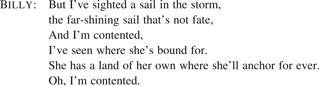
While his hanging is fate, the redemption that he sees is “not fate”—paradoxically, it is his free choice to accept fate that leads him not only to his own but to Vere's redemption.Footnote 36 Billy must hang, but he did not have to call out his last words, “Starry Vere, God bless you!” In doing so he not only helps prevent a mutiny by signaling to the men not to rebel on his behalf but he also symbolically upholds the system of law on the ship. In the novella, Billy chooses to forgive, but in the opera, Billy consciously chooses to die as well.Footnote 37 It is only because of this conscious choice that Forster's connection of Billy's death to Brünnhilde's action of self-immolation makes any sense. The central difference is that whereas Brünnhilde's act destroys the former order of the gods (a fact that Forster avoids in his invocations of Brünnhilde), Billy's self-sacrifice preserves the social order of the ship.
In Melville's “Billy Budd,” Billy is continually described as having something of the effeminate about him. Despite having cast him as a baritone, the libretto feminizes Billy through narrative devices such as the insertion of his clairvoyant dream into the story.Footnote 38 As a “strong young man of the lower classes” who fulfills the archetype of the Handsome Sailor, Billy may serve an analogous purpose to Wagner's sacrificing woman in his embodiment of transcendent vitality and nonintellectualism, on the one hand, and subservient social position, on the other.Footnote 39 Forster makes a point that Billy of the opera, in contradistinction to Billy of the novella, is lower class. In a radio broadcast about Billy Budd, Forster commented that according to the novella, both Billy and Claggert “might have had aristocratic blood in them—a thought which rather depresses me.”Footnote 40 After all, Billy Budd is, among other things, a stunted upward mobility story. If Vere had granted Billy's sexually charged request to be his coxswain, Billy would have taken a large step upward in the hierarchy of the ship. Thus, the heightened eroticism of the scene is correlated to Billy's prospect of upward social mobility. When Vere tells him that he was not called in order to be given a promotion, Billy answers, “That's alright, Sir, I'm content.” Billy repeats the words “I'm contented” after having seen the far-shining sail to signal his acceptance of (and not just his resignation to) fate, and Vere also repeats the phrase “I'm content” at the end of the opera to indicate his salvation from confusion and guilt. By sublimating erotically charged ambition in a song that Vere voices, the opera presents a fusing of Billy and Vere. Britten, Forster, and Crozier thereby bestow art with a form of redemptive power that does not threaten the existing social order. In his final words, Billy simultaneously quells the rumbling of French notions in the men (bad collaborationism) and achieves a union with Vere (self-transcendence through love).
At the same time, we may say that Billy himself becomes a collaborator: he accepts the injustice of his own hanging and undermines the stirring of rebellion by his fellow sailors for the sake of Starry Vere. This action complicates the distinction between good and bad collaborationism, because whatever Billy does there will be a betrayal, either of justice and the Rights o' Man (the aptly named civilian ship from which he was impressed) or of Vere, whom he had promised to protect. Forster, at any rate, would have approved of Billy's choice of personal admiration and love over the cause of the sailors. In “What I Believe,” Forster wrote, “I hate the idea of causes, and if I had to choose between betraying my country and betraying my friend, I hope I should have the guts to betray my country.”Footnote 41 While Billy may uphold the ship's brutal hierarchy, he also offers Vere a glimpse of transcendence from that brutality through his love.
Creating an Audience
But is Vere really redeemed? Why not flip the fable, as could very well be done in performance? Both of Billy's phrases “I'm content” are sung on the descending scale degrees 5 to 1, a setting so obviously connected to the resolution within the words that there may be a hint of irony implied. Vere's phrase “I'm content” parallels Billy's in its move from E-flat major into A major. But his vocal line falls from scale degree 4 (D) rather than 5 (E-natural) to 1 (A) on the first syllable of content. Vere then moves down to G on the second syllable, while Billy stays on A, introducing a slight ambiguity into Billy's seemingly clear resolution with his fate. Even after having merged his narrative voice with Billy's song and sighting the far-shining sail, Vere does not stop narrating. The orchestra fades out once more, and Vere repeats his recitative: “and my mind can go back in peace to that far-away summer of seventeen hundred and ninety seven, long ago now, years ago, centuries ago, when I, Edward Fairfax Vere, commanded the Indomitable.” Despite the text's hint of reconciliation with the past, the music signals that the opera could begin again from the start. And perhaps it does (ad nauseam), we just do not see it. The possibility of redemption for Vere would have been in a melding with Billy—erotic, vocal, self-transcending—when Billy was present before him. Restaging the drama is (potentially) transformative because it brings Billy physically close to Vere once more. But rather than ending with the “Wagnerian” climax of redemptive self-sacrifice, as Forster had suggested in the letter to Crozier, the narration keeps going. Narrator-Vere is no longer a human narrating his own story—he has become one of the undead, speaking of an event that happened “centuries ago.” Unlike the Flying Dutchman, there is no escape from this cycle because the political and social system to which Vere was subject did not allow his full redemption through love.
While there may not be redemption in the opera's narrative, this does not mean that the opera itself is devoid of transformative power. For Forster, the communal work on the opera provided something that went beyond his own individual contributions, and for this reason it became his Nunc Dimittis. Moreover, Forster believed that opera had the power to transform its audience as well as its creators. In both his novels and his essays, he dwells on music's capacity to transcend boundaries between subject and object. He described the effects of listening to Brahms's Fourth Symphony, during the performance of which “there has been an infection from Brahms through his music to myself. Something has passed. I have been transformed towards his condition, he has called me out of myself, he has thrown me into a subsidiary dream.”Footnote 42 A community joined by music reflects exactly the sort of aristocracy that Forster wanted to instill: “not an aristocracy of power, based upon rank and influence, but an aristocracy of the sensitive, the considerate and the plucky.”Footnote 43 The notion of an aristocracy based on the understanding and appreciation of high culture is perhaps suspect. Yet the attempt to find bases of community beyond religion or nationalism is one that makes Forster stand out from the political circumstances and rhetoric of the day.
During World War I, Forster wrote to his mother of a concert he had attended in London. The program
was almost all German music, and the Hall crowded, and the applause after the Beethoven Concerto immense. I think people in the thick are never as silly and venomous as the sit at homes. … Henry Wood, or rather his manager, published a nice manifesto, in which he said that they had only knocked off German music for a little because compelled to by the owners of the hall, and that the masterpieces of art are common property, above the passions and prejudices of the moment.Footnote 44
He also saw the transformative abilities of music as communal, writing several years later of harpsichordist Violet Gordon Woodhouse, whose performance “opened a new region for our hearts and brains.”Footnote 45 But after the spectacle of World War II's fascist rallies, it became harder to keep an essential faith in “people in the thick.” Here we have to confront the positive and negative potentials of a loss of boundaries, a feeling that can lead one to meld with Billy Budd but yet might also lead one to sail into enemy waters. The question becomes how to create a collective in which people are “never as silly and venomous as the sit at homes.” How to produce the sort of community that can promote mutual compassion and respect without creating a homogenous mass through the imposition of collective norms—in other words, how to motivate a sense of totality without fostering totalitarian implications?
While Forster conceived of Billy Budd as a Brünnhilde-like figure, and the characters and narratives of Wagner's operas surface in a number of his political essays, his ideal of aesthetic reception is sharply opposed to that of Wagner. Wagner was interested in the dissolution of boundaries between subject and object in the narratives of his operas (Tristan und Isolde being the prime example) and in forging a collectivity of audience members. This Wagnerian collectivity depended on collapsing the distance between the stage and the audience as well as that between individual members of the audience. Forster did not believe that individual distance could be eliminated in a text or a performance for two related reasons. The first is that he conceived of language, both musical and literal, as open systems in which texts could never completely determine meaning. The second is that he did not believe it either possible or desirable for any audience to be absorbed into an ocean of music without individualized reactions to the performance. These resistances—the indeterminacy of language and individualized perception—are expressed in his novels as well as in his essays on music.
Forster's description of a concert audience in Howard's End exemplifies his ideal of individualized and yet communal reception:
It will be generally admitted that Beethoven's Fifth Symphony is the most sublime noise that has ever penetrated into the ear of man. All sorts and conditions are satisfied by it. Whether you are like Mrs. Munt, and tap surreptitiously when the tunes come—of course, not so as to disturb the others—or like Helen, who can see heroes and shipwrecks in the music's flood; or like Margaret, who can only see the music; or like Tibby, who is profoundly versed in counterpoint, and holds the full score open on his knee; or like their cousin, Fraulein Mosebach, who remembers all the time that Beethoven is ‘echt Deutsch’; or like Fraulein Mosebach's young man, who can remember nothing but Fraulein Mosebach: in any case, the passion of your life becomes more vivid, and you are bound to admit that such a noise is cheap at two shillings.Footnote 46
While Helen experiences something like the Wagnerian myths of “heroes and shipwrecks in the music's flood,” Tibby embodies the critical distance of an expert who takes the performance as merely contingent. While Fraulein Mosebach suggests the dangerous nationalist sentiment that music can provoke, her young man undermines the power of this nationalism by remaining oblivious to anything but the body of the woman next to him. The music does not impart a lesson but rather makes each individual's passions more vivid.Footnote 47 The mechanism that prevents communities created through such performance from drowning out individual sensitivities is the impossibility of complete articulacy. If each audience member is able to decide for him- or herself what the music means (or even if it means anything at all), the collective that is forged is automatically a democratic one.
Although Forster emphasizes the power of music in performance, he does allow for prose that can affect the same sorts of transcendence in its reader by signifying as music would. Once again, Melville is at the center of the picture:
The essential in Moby Dick, its prophetic song, flows athwart the action and the surface morality like an undercurrent. It lies outside words. Even at the end, when the ship has gone down with the bird of heaven pinned to its mast, and the empty coffin, bouncing up from the vortex, has carried Ishmael back to the world—even then we cannot catch the words of the song.Footnote 48
In their choice of material, Britten, Forster, and Crozier were drawn to a work that was already a mixed form: musical prose. At the heart of Forster's discussion of words and their transcendence in Moby-Dick is a paradox: the novel is obviously constituted by words that it transcends through song, yet the whole song is contained in the words themselves. According to Forster, while Moby-Dick is pure song, “Billy Budd” is “a remote unearthly episode, but it is a song not without words.”Footnote 49 The novella is a mixed form in which words exist as prose, but they can also signify as music would: “Melville's main note is Fate, but the note has an overtone to it.”Footnote 50
The concept of the overtone is crucial for Forster. It is both a physical property of music and a metaphor for art that transcends direct signification while remaining grounded in sensual experience. Overtones are also primarily a performative element of music: at least as of 1947, they were heard but not notated. Thus the elements that Forster so valued in live performance existed even within the novella. Like Beethoven's Fifth in performance, the novella contains both sensuous experience and potentially transcendental overtones. The freedom from direct signification that comes about through the space between the text or performance and its overtones solves the problem of creating a protototalitarian community but creates a new one: the difficulty of articulacy.
An Author's Voice
Inarticulacy was perhaps one of the themes of “Billy Budd” that drew Forster and Britten to the material. Billy himself has a stutter, which ultimately leads to his death. The narrator as well fills his account with moments of silence and inarticulacy that emphasize the holes in his narrative and the limits of his knowledge. He also refuses to explain his own role in the “inside narrative” that he recounts. Forster, Britten, and Crozier included two crucial moments of inarticulacy in Billy Budd. The first takes place when Vere leaves the stage to tell Billy what his sentence is. The private interview occurs offstage; the spectator is confronted by an empty set and thirty-four consecutive chords in the orchestra. Much has been written about this “missing scene,”Footnote 51 focusing on a formal analysis of the chain of chords in relation to the opera as a whole. Many of these analyses also situate the moment of redemption in these chords rather than in Billy's benediction, an argument that neither makes dramaturgical sense nor is corroborated by the writings of Britten, Crozier, and Forster. Norbert Abels argues that Britten's orchestra creates a symphonic Gestus that takes up the task of signification where Billy has left off and creates a Sea of Loss (“Meer der Verlorenheit”) that rolls over the audience like a wave touching the heavens (“die wie eine den Himmel berührende Welle vorbeizieht”).Footnote 52 But I believe that such accounts read too much Wagner into the contributions of Britten and Forster. To understand these chords as an illustration—whether literal or merely expressive—of what is happening between Vere and Billy may stem from a Wagnerian bias on the part of scholars. The misplacement of Wagner in interpretations of Billy Budd is telling: the influence Wagner had on Forster's shaping of Billy Budd's narrative has been neglected because scholars tend to devalue the librettists' role in writing an opera, especially when it comes to intertextual references to other composers. But at the same time that musicologists have not drawn explicit connections between Wagner and Billy Budd, assumptions that the music of the “missing scene” is a form of narration or a moment of oceanic unity between music and audience read Britten through Wagner.Footnote 53
Britten and Forster are trying to keep us out at this moment, not pull us in. The music is a barrier between the audience and the stage. Rather than attempting close analyses of the formal content as expressive narration of what is happening offstage in Billy Budd's missing scene, we should take the importance of the music to be its freedom from signification. The use of music to obfuscate the conversation between Billy and Vere also corresponds to what the narrator of “Billy Budd” tells us. He emphasizes the mystery of this exchange: “Beyond the communication of the sentence, what took place at this interview was never known.” He goes on to make various conjectures but also emphasizes indeterminacy: “Even more may have been.”Footnote 54
If this first moment demonstrates the possible freedoms in inarticulacy and the division of essential meaning from music, the second moment of inarticulacy shows the forfeiture that comes with the loss of words. Directly after Billy is hanged, the lower ranks of men show their discontent through vocalization in the chorus, “to be sung to a dark vowel—like -ur in purple, or the French un. It is suggested that when the climax is reached a straight ah is more suitable.” The inarticulacy of the men, their pure musicality, is not evidence of a state of freedom or transcendence: the only expression of freedom in this scene is in Billy's performative utterance “Starry Vere, God bless you!”
Even though he had produced a plethora of nonfiction since A Passage to India in 1924, Forster had fallen silent in the genre that had earned him renown. His decision to withhold from publication the novel Maurice as well as short stories on the theme of homosexual love, and thus to remain publicly inarticulate about his own sexuality, has earned him posthumous sympathy as well as critique. On the one hand, Forster's novelistic silence has been interpreted as a tragedy due to his inability to express his own desires and his “weariness of the only subject I both can and may treat—the love of men for women and vice versa.”Footnote 55 On the other hand, Forster's inarticulacy about his sexuality has been attacked as a form of cowardliness and betrayal: collaborationism with heterosexual norms.Footnote 56 In both of these accounts creative silence is bound up in an inarticulacy about sexual identity.
In the Cambridge Opera Handbook on Billy Budd, Mervyn Cooke claims that there is “little doubt that the homosexual implications of Billy Budd were a prime reason for the story's attractiveness to Britten and Forster.” He editorializes: “Melville's sexual imagery is not always subtle and his labouring of the words ‘erect’ and ‘ejaculate’ verges on the tiresome.”Footnote 57 One interpretation of Forster's valuation of the opera as his Nunc Dimittis, then, might be that he was finally able to work on a narrative about homosexual male love. Free to depend on music to hint at all of the erections and ejaculations of the piece, he found his creative voice again. But such a limited reading does a disservice to Forster.
Forster, Britten, and Crozier did not chose “Billy Budd” solely for its homosexual overtones: Billy Budd is hardly the only work in the Western canon with such suggestions. They chose “Billy Budd” because as a “song not without words,” the novella itself already blurred distinctions between text and performance, word and music. Britten, Forster, and Crozier were drawn to the subject matter because Melville's prose had already shown “Billy Budd” to be a musical story, one that through its overtones achieved a sort of copresence with its reader that is usually specific to live musical performance.
This essay has laid out the ways that a complicated dynamic took place in the movement from the novella to opera. The distinctions between creation and interpretation were ambiguous from the start: Britten was drawn not primarily to “Billy Budd” but to Forster's interpretation of Melville in his Cambridge lectures. In the process of reworking “Billy Budd” into an opera, Forster was able to enact the same sort of transcendence that a reader could achieve through communion with prophetic prose, that an audience member could experience in performance when “something has passed,” or that individuals could reach through love. Billy Budd was Forster's Nunc Dimittis not so much because it had homoerotic themes but because it allowed him to achieve a sort of union that could have also been achieved through erotic love. A performance with transformative powers may very well occur with contemporary stagings of Billy Budd, but it also occurred in the creation of Billy Budd. Forster's role in creating Billy Budd offers one glimpse at how the genre of opera may complicate received wisdom about the relationship between text and performance.


