1 Introduction
Let
 $D\subsetneq \mathbb {C}$
be a simply connected domain. A family
 $(\phi _t)_{t\ge 0}$
of holomorphic functions
 $\phi _t:D\to D$
is called a one-parameter continuous semigroup of holomorphic functions in D (or for short semigroup in D) provided the following three conditions are satisfied:
-
(i)
 $\phi _0=\text {id}_{D}$
;
-
(ii)
$\phi _{t+s}=\phi _t\circ \phi _s$
, for all
$t,s\ge 0$
; -
(iii)
$\phi _t \xrightarrow {t\to 0^+} \phi _0$
, locally uniformly in D.




A consequence of the definition is that every term
 $\phi _t$
of the semigroup is a univalent function in D. If, in addition, for some
 $t_0>0$
,
 $\phi _{t_0}$
is onto, then every term is necessarily an automorphism of D and
 $(\phi _t)$
is a group.
One of the main features of semigroups is their close relationship with vector fields and dynamical systems (see, e.g., [Reference Perko21, Chapter 2]). More specifically, given a semigroup
 $(\phi _t)$
in D, there exists a unique holomorphic semi-complete vector field
 $G:D\to \mathbb {C}$
such that
 $$ \begin{align} \dfrac{\partial\phi_t(\zeta)}{\partial t}=G(\phi_t(\zeta)), \quad\quad \zeta\in D, \quad t\in[0,+\infty). \end{align} $$
Therefore, a semigroup
 $(\phi _t)$
in D can be thought of as the flow of the vector field G. The converse process is also well-defined. The unique such mapping G is called the infinitesimal generator of the semigroup. As it turns out, the infinitesimal generator and its properties reveal various information about the semigroup. This will be the focal point of this present work.
In recent literature, the usual reference domain when studying semigroups is the unit disk
 $\mathbb {D}$
. We are going to follow this trend and mostly work with semigroups in
 $\mathbb {D}$
. These semigroups were introduced by Berkson and Porta [Reference Berkson and Porta4] in 1978. Since then, the field has enjoyed remarkable prosperity. A comprehensive overview of the main theory along with the recent achievements may be found in the monograph [Reference Bracci, Contreras and Díaz-Madrigal8].
Let
 $(\phi _t)$
be a semigroup in
 $\mathbb D$
. For a point
 $z\in \mathbb {D}$
, the curve
 $$ \begin{align} \gamma_z:[0,+\infty)\to\mathbb{D},\;\;\;\; \gamma_z(t)=\phi_t(z), \end{align} $$
is called the forward orbit of z. The point z is its starting point. It is proved in [Reference Berkson and Porta4] that, in fact, each
 $\gamma _z$
is a real analytic curve and by (1.1),
 $$ \begin{align} \gamma_z^\prime(t)=G(\gamma_z(t)),\;\;\;\;t\ge0, \;\;z\in\mathbb{D}. \end{align} $$
Naturally, we are interested in the asymptotic behavior of the forward orbits, as
 $t\to +\infty $
. By the continuous version of the Denjoy–Wolff Theorem (see, e.g., [Reference Abate1, Theorem 5.5.1]), if the semigroup is not a group of hyperbolic rotations, then there exists a unique point
 $\tau \in \overline {\mathbb {D}}$
such that
 $$ \begin{align} \lim\limits_{t\to+\infty}\phi_t(z)=\lim_{t\to+\infty}\gamma_z(t)=\tau, \quad\text{for all }z\in\mathbb{D}. \end{align} $$
The position of the Denjoy–Wolff point
 $\tau $
in the closure of the unit disk leads to a first classification within the class of semigroups.
-
(1) If
$\tau \in \mathbb {D}$
, then
$(\phi _t)$
is called elliptic, -
(2) whereas if
$\tau \in \partial \mathbb {D}$
, then
$(\phi _t)$
is called non-elliptic.


If
 $z\in \mathbb {D}$
, we can also think of a backward orbit of a semigroup starting from z until it reaches a point on the unit circle. More precisely, let
 $z\in \mathbb {D}$
. The function
 $\phi _t^{-1}$
is defined at z for every t in an interval of the form
 $[0,T)$
. Let
 $T_z$
be the supremum of all such numbers T. The continuous curve
 $\tilde \gamma _z:[0,T_z)\to \mathbb {D}$
with
 $$ \begin{align} \tilde\gamma_z(t)=\phi_t^{-1}(z) \end{align} $$
is called the backward orbit of the semigroup starting from z. Backward orbits were initially studied in [Reference Contreras and Díaz-Madrigal12] and [Reference Elin, Shoikhet and Zalcman15]. Further results appear in [Reference Arosio, Fiacchi, Guerini and Karlsson2], [Reference Bracci, Contreras and Díaz-Madrigal8, Chapter 13], [Reference Elin, Khavinson, Reich and Shoikhet14], [Reference Kourou and Zarvalis19], and [Reference Zarvalis23].
Various properties of the orbits have been studied (see, e.g., [Reference Betsakos5], [Reference Betsakos and Karamanlis6], [Reference Bracci, Contreras, Díaz-Madrigal and Gaussier9], [Reference Bracci, Contreras, Díaz-Madrigal, Gaussier and Zimmer10], [Reference Gumenyuk16], [Reference Zarvalis23]). It has been proved, in particular, that there exists a non-elliptic semigroup in
 $\mathbb D$
such that each one of its forward orbits oscillates as it approaches the Denjoy–Wollf point (see [Reference Betsakos5], [Reference Bracci, Contreras and Díaz-Madrigal8, Chapter 17], [Reference Contreras, Diaz-Madrigal and Gumenyuk13]). A similar result holds for backward orbits; see [Reference Kelgiannis18]. In the case of elliptic semigroups, the orbits, in general, approach the Denjoy–Wolff point
 $\tau $
spiralling around it. Because of these oscillating and spiralling examples, it is natural to wonder whether an orbit can actually have infinite length. The answer to this question is negative and can be inferred easily from the Hayman–Wu Theorem for non-elliptic semigroups and from the Bishop–Jones Theorem for elliptic semigroups. We will prove the following.
Theorem 1.1 Let
 $(\phi _t)$
be a semigroup in
 $\mathbb {D}$
. Every orbit of
 $(\phi _t)$
(forward or backward) is rectifiable.
Our next aim is to investigate whether the (forward or backward) orbits of a semigroup are Lipschitz. Recall that a function
 $\gamma :I\to \mathbb {C}$
, where
 $I\subset \mathbb {R}$
is some interval, is called Lipschitz if there exists some constant
 $C>0$
, depending solely on
 $\gamma $
, such that
 $$ \begin{align*}|\gamma(t)-\gamma(s)|<C|t-s|, \quad\text{for all }t,s\in I.\end{align*} $$
A first observation is that, by Theorem 1.1, every orbit of a semigroup in
 $\mathbb {D}$
can be reparametrized using the arc-length parameter, and thus it has a Lipschitz parameterization. Nevertheless, in the study of semigroups, it clearly makes more sense to deal with orbits with the parameterization induced directly by the semigroup and examine whether they are Lipschitz. Partial results on this subject appear in [Reference Bracci, Contreras and Díaz-Madrigal8, Proposition 10.1.7] and [Reference Zarvalis23, Proposition 3.1]. Our aim is to completely find out under what conditions an orbit, forward or backward, is Lipschitz or not. Our main result concerning forward orbits is the following.
Theorem 1.2 Let
 $(\phi _t)$
be a semigroup in
 $\mathbb {D}$
. Every forward orbit of
 $(\phi _t)$
is Lipschitz.
Next, in order to work with backward orbits, we are going to need an important tool of semigroup theory, the Koenigs function (see, e.g., [Reference Abate1, Section 5.7] or [Reference Bracci, Contreras and Díaz-Madrigal8, Chapter 9]). The definition of this function depends on the type (elliptic or non-elliptic) of the semigroup. For an elliptic semigroup
 $(\phi _t)$
with Denjoy–Wolff point
 $\tau \in \mathbb {D}$
, its Koenigs function is the (unique up to a multiplicative complex constant) conformal mapping
 $h:\mathbb {D}\to \mathbb {C}$
such that
 $h(\tau )=0$
and
 $$ \begin{align} h(\phi_t(z))=e^{-\mu t}h(z), \quad\text{for all }t\ge0\text{ and }z\in\mathbb{D}, \end{align} $$
where
 $\mu \in \mathbb {C}$
, with
 $\text {Re}\mu>0$
. The number
 $\mu $
is called the spectral value of
 $(\phi _t)$
and is the unique complex number satisfying
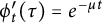 $\phi _t'(\tau )=e^{-\mu t}$
, for all
 $t\ge 0$
(see [Reference Abate1, Definition 5.2.10]). When
 $(\phi _t)$
is non-elliptic, its Koenigs function is the (unique up to an additive complex constant) conformal mapping such that
 $$ \begin{align} h(\phi_t(z))=h(z)+t, \quad\text{for all }t\ge0\text{ and }z\in\mathbb{D}. \end{align} $$
In both cases, the simply connected domain
 $\Omega :=h(\mathbb {D})$
is called the Koenigs domain of the semigroup.
Our main result concerning backward orbits will be stated in hyperbolic terms. Given a simply connected domain
 $\Omega \subsetneq \mathbb {C}$
, we denote by
 $\lambda _{\Omega }$
the hyperbolic density in
 $\Omega $
and by
 $k_\Omega $
the corresponding hyperbolic distance (more details on hyperbolic quantities follow in Section 2).
Theorem 1.3 Let
 $(\phi _t)$
be a semigroup in
 $\mathbb {D}$
with Koenigs function h and Koenigs domain
 $\Omega $
. Let
 $z\in \mathbb {D}$
.
-
(a) Suppose
$(\phi _t)$
is non-elliptic. The backward orbit
$\tilde {\gamma }_z$
is Lipschitz if and only if (1.8)
$$ \begin{align} \limsup\limits_{t\to T_z}\dfrac{\lambda_{\Omega}(h(z)-t)}{e^{2k_\Omega(h(z),h(z)-t)}}<+\infty. \end{align} $$
-
(b) Suppose
$(\phi _t)$
is elliptic with spectral value
$\mu \in \mathbb {C}$
,
$\text {Re}\mu>0$
. The backward orbit
$\tilde {\gamma }_z$
is Lipschitz if and only if (1.9)
$$ \begin{align} \limsup\limits_{t\to T_z}\dfrac{e^{\text{Re}\mu t}\lambda_{\Omega}(e^{\mu t}h(z))}{e^{2k_\Omega(h(z),e^{\mu t}h(z))}}<+\infty. \end{align} $$


Contrary to forward orbits, we see that backward orbits are not necessarily Lipschitz. Indeed, in Section 4, we will construct a semigroup that has a non-Lipschitz backward orbit.
The condition described in Theorem 1.3 provides an intuitive way of understanding whether a backward orbit is Lipschitz based on the geometry of the Koenigs domain. In particular, it may lead to simple sufficient conditions.
Corollary 1.4 Let
 $(\phi _t)$
be a semigroup in
 $\mathbb {D}$
. Every regular backward orbit of
 $(\phi _t)$
is Lipschitz.
The notion of regular backward orbits will be defined in Section 2.3.
Corollary 1.5 Let
 $(\phi _t)$
be a semigroup in
 $\mathbb {D}$
such that its Koenigs domain
 $\Omega $
is convex. Every backward orbit of
 $(\phi _t)$
is Lipschitz.
By [Reference Gumenyuk16], given
 $\zeta \in \partial \mathbb {D}$
, the non-tangential limit
 $\phi _t(\zeta ):=\angle \lim _{z\to \zeta }\phi _t(z)$
exists always finitely. In particular, the function
 $$ \begin{align} [0,+\infty)\ni t\mapsto\phi_t(\zeta) \end{align} $$
is continuous. Therefore, we may consider forward orbits with starting points on the unit circle. A forward orbit emanating from a point on the boundary may lie fully on the unit circle or have an initial part on the boundary (even if it is a singleton) and then fall inside the unit disk until it reaches the Denjoy–Wolff point. The part of the forward orbit lying inside
 $\mathbb {D}$
can be considered as the union of a backward and a usual forward orbit. Thus, it can be treated through the previous results. For this reason, given
 $\zeta \in \partial \mathbb {D}$
we will only deal with the part
 $\gamma _\zeta ([0,+\infty ))\cap \partial \mathbb {D}$
and only in the case when this intersection is larger than a singleton (if it is a singleton, then there is no sense in examining the Lipschitz condition). We will call such sets boundary orbits for the sake of convenience. Thus, for
 $\zeta \in \partial \mathbb {D}$
, we will denote by
 $\gamma _\zeta $
only the boundary orbit and not the full forward orbit of
 $\zeta $
. The interested reader may refer to [Reference Bracci and Gumenyuk11] for the first appearance of such orbits. As circular arcs, boundary orbits are clearly rectifiable. So, we will only examine the Lipschitz condition for such orbits.
Boundary orbits require a different approach than before. We are going to classify boundary orbits into three categories and treat each of them separately. We will proceed to a brief explanation of these categories and their behavior concerning the Lipschitz condition. If the boundary orbit reaches the Denjoy–Wolff point, we will call it exceptional. So exceptional orbits may appear only in non-elliptic semigroups. On the other hand, if the boundary orbit ends at some point
 $\sigma $
other than the Denjoy–Wolff point and the image through the Koenigs function of
 $\sigma $
has positive distance from the rest of the boundary of the Koenigs domain, we will call it isolated. These definitions are inspired from [Reference Bracci, Contreras and Díaz-Madrigal8, Chapter 14] and [Reference Bracci, Contreras and Díaz-Madrigal8, Chapter 15], respectively. In Theorem 5.1, we will prove that all exceptional orbits are Lipschitz and all isolated orbits are not Lipschitz. Finally, the third category contains all the boundary orbits that do not fall in the first two. We will call them boundary orbits of the third type. In this case, some of them are Lipschitz and some are not. For those orbits we are going to prove Theorem 5.2 which offers a necessary and sufficient condition similar to that in Theorem 1.3.
The structure of the article is as follows: First, in Section 2, we are going to mention all the information that is deemed necessary for our proofs. We will prove Theorem 1.1 in Section 3. Next, in Section 4, we will deal with orbits strictly contained in the unit disk proving all the relative results with regard to the Lipschitz condition. Furthermore, we will provide explicit examples demonstrating that the situation described in Theorem 1.3 can indeed occur. Then, in Section 5, we work with orbits lying on the unit circle. Finally, in Section 6, we are going to examine under what assumptions our results may be extended to a semigroup in any simply connected domain
 $D\subsetneq \mathbb {C}$
other than the unit disk
 $\mathbb {D}$
.
2 Preliminaries
2.1 Semigroup theory
Let
 $(\phi _t)$
be a semigroup in
 $\mathbb {D}$
with Koenigs function h and Koenigs domain
 $\Omega $
. When
 $(\phi _t)$
is elliptic with spectral value
 $\mu $
, the Koenigs domain is
 $\mu $
-spirallike; this means that
 $e^{-\mu t}\Omega \subseteq \Omega $
, for all
 $t\ge 0$
. Moreover, given
 $z\in \mathbb {D}$
, the image of its forward orbit is the half-spiral
 $\{e^{-\mu t}h(z):t\ge 0\}$
. For non-elliptic semigroups,
 $\Omega $
is convex in the positive direction (also known as starlike at infinity); this means that
 $\Omega +t\subseteq \Omega $
, for all
 $t\ge 0$
. The image of the forward orbit
 $\gamma _z$
through h is the horizontal half-line
 $\{h(z)+t:t\ge 0\}$
.
Let G be the infinitesimal generator of
 $(\phi _t)$
. There exists a useful relation between the Koenigs function and the infinitesimal generator. Indeed (see [Reference Bracci, Contreras and Díaz-Madrigal8, Theorem 10.1.4 and Corollary 10.1.12]), for an elliptic semigroup with spectral value
 $\mu $
and Denjoy–Wolff point
 $\tau $
,
 $$ \begin{align} G(z)=-\mu\frac{h(z)}{h'(z)}\;\;\;\mbox{and}\;\;\;G'(\tau)=-\mu,\;\;\;z\in\mathbb{D}. \end{align} $$
On the other side, when
 $(\phi _t)$
is non-elliptic,
 $$ \begin{align} G(z)=\frac{1}{h'(z)},\;\;\;z\in\mathbb{D}. \end{align} $$
2.2 Hyperbolic geometry
Even though we primarily work with Euclidean quantities, it will turn out later on that the hyperbolic geometry can provide valuable assistance with regard to the Lipschitz condition. In this part of the present article, we will briefly mention certain hyperbolic quantities that we are going to need. For a more detailed presentation of hyperbolic geometry, we refer the interested reader to [Reference Bracci, Contreras and Díaz-Madrigal8, Chapter 5].
We start with the hyperbolic metric in the unit disk
 $\mathbb {D},$
which is given through the formula
 $$ \begin{align} \lambda_{\mathbb{D}}(z)|dz|=\frac{1}{1-|z|^2}|dz|, \quad z\in\mathbb{D}. \end{align} $$
The function
 $\lambda _{\mathbb {D}}$
is called the hyperbolic density of
 $\mathbb {D}$
. In addition, the hyperbolic distance
 $k_{\mathbb {D}}$
in the unit disk
 $\mathbb {D}$
is given by
 $$ \begin{align} k_{\mathbb{D}}(z,w)=\frac{1}{2}\log\frac{|1-\bar{z}w|+|z-w|}{|1-\bar{z}w|-|z-w|}, \quad z,w\in\mathbb{D}. \end{align} $$
If
 $\Omega \subsetneq \mathbb {C}$
is a simply connected domain and
 $f:\Omega \to \mathbb {D}$
is a corresponding Riemann map, then we may define the hyperbolic density
 $\lambda _{\Omega }$
and the hyperbolic distance
 $k_\Omega $
in
 $\Omega $
through the relations
 $$ \begin{align} \lambda_{\Omega}(z)=\lambda_{\mathbb{D}}(f(z))|f'(z)|, \quad k_\Omega(z,w)=k_{\mathbb{D}}(f(z),f(w)), \end{align} $$
where
 $z,w\in \Omega $
. This definition is independent of the choice of the Riemann mapping f.
The hyperbolic quantities inside a simply connected domain
 $\Omega $
are closely associated with the Euclidean distance from the boundary
 $\partial \Omega $
. This correlation will be very useful in the sequel and may be demonstrated by means of the following inequalities. For the rest of the present work, given a domain
 $\Omega \subsetneq \mathbb {C}$
and
 $z\in \Omega $
, we are going to use the notation
 $\delta _\Omega (z):=\text {dist}(z,\partial \Omega )$
.
Lemma 2.1 [Reference Bracci, Contreras and Díaz-Madrigal8, Theorem 5.2.1]
Let
 $\Omega \subsetneq \mathbb {C}$
be a simply connected domain. Then, for every
 $z\in \Omega $
,
 $$ \begin{align*} \frac{1}{4\delta_\Omega(z)}\le\lambda_{\Omega}(z)\le\frac{1}{\delta_\Omega(z)}. \end{align*} $$
Lemma 2.2 [Reference Bracci, Contreras and Díaz-Madrigal8, Theorems 5.3.1 and 5.3.3]
Let
 $\Omega \subsetneq \mathbb {C}$
be a simply connected domain. Then, for every
 $z,w\in \Omega $
,
 $$ \begin{align} k_{\Omega}(z,w)\ge\frac{1}{4}\log\left(1+\frac{|z-w|}{\min\{\delta_\Omega(z),\delta_\Omega(w)\}}\right). \end{align} $$
If, in addition,
 $\Omega $
is convex, then the constant
 $\frac {1}{4}$
may be replaced by
 $\frac {1}{2}$
.
2.3 Backward orbits
Given a semigroup
 $(\phi _t)$
and a point
 $z\in \mathbb {D}$
, the backward orbit
 $\tilde {\gamma }_z:[0,T_z)\to \mathbb {D}$
is called regular if
 $T_z=+\infty $
and
 $$ \begin{align*}\limsup\limits_{t\to+\infty}k_{\mathbb{D}}(\tilde{\gamma}_z(t),\tilde{\gamma}_z(t+1))<+\infty.\end{align*} $$
If
 $T_z=+\infty $
and the above upper limit is infinite, the backward orbit is called non-regular.
It can be readily verified that the image of the backward orbit
 $\tilde {\gamma }_z$
through the Koenigs function h is either the spiral arc or half-spiral
 $\{e^{\mu t}h(z):t\in [0,T_z)\},$
when
 $(\phi _t)$
is elliptic with spectral value
 $\mu $
, or the horizontal segment or half-line
 $\{h(z)-t:t\in [0,T_z)\}$
when
 $(\phi _t)$
is non-elliptic.
Contrary to forward orbits, the asymptotic behavior of backward orbits conceals some intricacies. Depending on the type of the semigroup (elliptic or non-elliptic) and the type of the backward orbit (regular or non-regular), the convergence of
 $\tilde {\gamma }_z$
, as
 $t\to T_z$
, varies. In fact, when
 $T_z<+\infty $
,
 $\tilde {\gamma }_z$
converges to some point of
 $\partial \mathbb {D}\setminus \{\tau \}$
, tangentially or not. When
 $T_z=+\infty $
, combining [Reference Bracci, Contreras and Díaz-Madrigal8, Lemma 13.1.5, Proposition 13.1.7], we have the following.
Proposition 2.3 Let
 $(\phi _t)$
be a semigroup in
 $\mathbb {D}$
with Denjoy–Wolff point
 $\tau $
. Let
 $z\in \mathbb {D}$
with
 $T_z=+\infty $
. Then:
-
(i) if
$(\phi _t)$
is elliptic (i.e.,
$\tau \in \mathbb {D}$
), then-
(i1) either
$z=\tau $
and
$\tilde {\gamma }_z(t)=\tau $
, for all
$t\ge 0$
, -
(i2) or
$z\ne \tau $
,
$\tilde {\gamma }_z$
is regular and converges to a point of the unit circle non-tangentially, -
(i3) or
$z\ne \tau $
,
$\tilde {\gamma }_z$
is non-regular and converges to a point of the unit circle in any manner.
-
-
(ii) if
$(\phi _t)$
is non-elliptic (i.e.,
$\tau \in \partial \mathbb {D})$
, then-
(ii1) either
$\tilde {\gamma }_z$
is regular and converges tangentially to
$\tau $
, -
(ii2) or
$\tilde {\gamma }_z$
is regular and converges non-tangentially to some
$\sigma \in \partial \mathbb {D}\setminus \{\tau \}$
, -
(ii3) or
$\tilde {\gamma }_z$
is non-regular and converges to some
$\sigma \in \partial \mathbb {D}\setminus \{\tau \}$
in any manner.
-


From now on, we disregard the case when the semigroup is elliptic and the backward orbit is constant and equal to the Denjoy–Wolff point. As a matter of fact, this last proposition shows that when working in backward terms, elliptic and non-elliptic semigroups are not really different from a dynamical standpoint.
The existence of a regular backward orbit
 $\tilde {\gamma }_z$
discloses helpful geometric information about the Koenigs domain
 $\Omega $
of a semigroup
 $(\phi _t)$
. More specifically, we have the following implications.
-
(a) If
$(\phi _t)$
is elliptic, then there exists a maximal spirallike sector V such that
$\tilde {\gamma }_z([0,+\infty ))\subset V\subset \Omega $
. -
(b) If
$(\phi _t)$
is non-elliptic and
$\tilde {\gamma }_z$
converges to
$\tau $
, then there exists a maximal horizontal half-plane H such that
$\tilde {\gamma }_z([0,+\infty ))\subset H\subset \Omega $
. -
(c) If
$(\phi _t)$
is non-elliptic and
$\tilde {\gamma }_z$
converges to a point in
$\partial \mathbb {D}\setminus \{\tau \}$
, then there exists a maximal horizontal strip S such that
$\tilde {\gamma }_z([0,+\infty ))\subset S\subset \Omega $
.








In all three cases, the notion of maximality signifies that there exists no other spirallike sector/horizontal half-plane/horizontal strip properly containing V/H/S and contained inside
 $\Omega $
.
To end the section, we make one brief mention about the “union” of a forward with a backward orbit. Let
 $z\in \mathbb {D}$
. Then, the curve
 $\hat {\gamma }_z:(-T_z,+\infty )\to \mathbb {D}$
defined through
 $$ \begin{align*}\hat{\gamma}_z(t)= \begin{cases} \gamma_z(t), \quad\text{for }t\ge0,\\ \tilde{\gamma}_z(-t), \quad\text{for }t\le0, \end{cases} \end{align*} $$
is called the full orbit of z (also seen as maximal invariant curve in literature). It can be easily seen that the full orbit of z is essentially the same as the full orbit of any point on
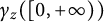 $\gamma _z([0,+\infty ))$
or
 $\tilde {\gamma }_z([0,T_z))$
.
2.4 Finite shift
Let
 $(\phi _t)$
be a non-elliptic semigroup in
 $\mathbb {D}$
with Denjoy–Wolff point
 $\tau \in \partial \mathbb {D}$
. For
 $R>0,$
consider
 $E(\tau ,R)$
to be the horodisk of
 $\mathbb {D}$
with center
 $\tau $
and radius
 $R>0$
. In other words,
 $E(\tau ,R)$
is a Euclidean disk of radius
 $\frac {R}{R+1}$
that is internally tangent to
 $\partial \mathbb {D}$
at the point
 $\tau $
. Analytically, we may write
 $$ \begin{align*}E(\tau,R)=\left\{z\in\mathbb{D}:\dfrac{|\tau-z|^2}{1-|z|^2}<R\right\}.\end{align*} $$
By means of these horodisks, we may proceed to a classification within the class of non-elliptic semigroups. Indeed,
 $(\phi _t)$
is said to be of finite shift if for every
 $z\in \mathbb {D}$
there exists some
 $R_z>0$
such that the orbit
 $\gamma _z$
does not intersect the horodisk
 $E(\tau ,R_z)$
even though it converges to
 $\tau $
. For more background on finite shift, we refer the interested reader to [Reference Bracci, Contreras and Díaz-Madrigal8, Section 17.7]. It can be proved that if there exists some
 $z\in \mathbb {D}$
which satisfies the above condition, then every
 $z\in \mathbb {D}$
does. If, on the contrary, for some (and hence every)
 $z\in \mathbb {D}$
, the orbit
 $\gamma _z$
intersects all horodisks centered at
 $\tau $
, then
 $(\phi _t)$
is said to be of infinite shift.
Therefore, it is easily understood that whenever
 $(\phi _t)$
is of finite shift, then every orbit must reach the Denjoy–Wolff point
 $\tau $
travelling between
 $\partial \mathbb {D}$
and some horocycle
 $\partial E(\tau ,R)$
. As a result, every orbit “stays very close” to the unit circle while converging to
 $\tau $
. For this reason, semigroups of finite shift are also called strongly tangential in the literature.
Later on in the present article, we will prove a result (Proposition 4.2) about the Lipschitz condition with respect to the shift of a non-elliptic semigroup. In order to do so, we will utilize the “translation” of finite shift in the setting of the standard right half-plane
 $\mathbb {H}$
. Consider
 $C:\mathbb {D}\to \mathbb {H}$
to be the Cayley transform with
 $C(z)=\frac {\tau +z}{\tau -z}$
. It is quite straightforward that given
 $R>0$
the horodisk
 $E(\tau ,R)$
is mapped through C conformally onto the vertical half-plane
 $\{w\in \mathbb {H}:\text {Re}w>\frac {1}{R}\}$
. Consequently,
 $(\phi _t)$
is of finite shift if and only if for each
 $z\in \mathbb {D}$
, there exists some
 $M_z>0$
such that
 $$ \begin{align*}\text{Re}C(\phi_t(z))=\text{Re}C(\gamma_z(t))<M_z, \quad\text{for all }t\ge0.\end{align*} $$
One final essential piece of information concerning semigroups of finite shift is the fact that they are necessarily parabolic of positive hyperbolic step. This means that their Koenigs domains are contained in some horizontal half-plane, but not inside a horizontal strip (see [Reference Bracci, Contreras and Díaz-Madrigal8, Theorem 9.4.10]). The actual definitions of parabolicity and hyperbolic step are different and require angular derivatives and hyperbolic geometry. Nevertheless, for our purposes, this equivalent counterpart suffices.
2.5 Distance from the boundary
Let
 $(\phi _t)$
be a semigroup in
 $\mathbb {D}$
with Koenigs function h and Koenigs domain
 $\Omega $
. Fix
 $z\in \mathbb {D}$
. In order to check whether the forward orbit
 $\gamma _z$
and the backward orbit
 $\tilde {\gamma }_z$
are Lipschitz, we will use inequalities concerning the distance of
 $h(z)$
from the boundary
 $\partial \Omega $
. We will need the following classical inequality about it.
Lemma 2.4 [Reference Pommerenke22, Corollary 1.4]
If f maps
 $\mathbb {D}$
conformally into
 $\mathbb {C}$
, then, for all
 $z\in \mathbb {D},$
 $$ \begin{align} \frac{1}{4}(1-|z|^2)|f'(z)|\le\delta_{f(\mathbb{D})}(f(z))\le(1-|z|^2)|f'(z)|. \end{align} $$
Assume, first, that
 $(\phi _t)$
is non-elliptic. Recall that in this case, the Koenigs domain
 $\Omega $
is convex in the positive direction,
 $h(\gamma _z(t))=h(z)+t$
and
 $h(\tilde {\gamma }_z(t))=h(z)-~t$
. Combining everything, we see that
 $\delta _\Omega (h(z)+t)$
is a (not necessarily strictly) increasing function of
 $t\ge 0$
, while
 $\delta _\Omega (h(z)-t)$
is a decreasing one.
When working with a forward orbit
 $\gamma _z$
of a non-elliptic semigroup
 $(\phi _t)$
, the quantity
 $\delta _\Omega (h(z)+t)$
is always bounded from below by
 $\delta _\Omega (h(z))$
. Of course, depending on the geometry of
 $\Omega $
, it could also be bounded from above, as well. Either way, the distance from the boundary
 $\partial \Omega $
presents more interest when working with a backward orbit
 $\tilde {\gamma }_z$
due to the intricacies that may appear.
First of all, if
 $T_z<+\infty $
, the the image through h of the orbit
 $\tilde {\gamma }_z$
converges to some point of
 $\partial \Omega $
, as
 $t\to T_z$
. Clearly then,
 $\lim _{t\to T_z}\delta _\Omega (h(z)-t)=0$
.
However, this is not always the case when
 $T_z=+\infty $
. We distinguish the following cases.
-
(i) When
$\tilde {\gamma }_z$
is regular, as we said either there exists a maximal horizontal half-plane H or a maximal horizontal strip S contained inside
$\Omega $
and containing
$h\circ \tilde {\gamma }_z([0,+\infty ))$
. Then, it is straightforward that
$\delta _\Omega (h(z)-t)$
is bounded above by
$\delta _\Omega (h(z))$
, and we have either or
$$ \begin{align*}\lim_{t\to+\infty}\delta_\Omega(h(z)-t)=\delta_H(h(z))>0\end{align*} $$
$$ \begin{align*}\lim_{t\to+\infty}\delta_\Omega(h(z)-t)=\delta_S(h(z))>0.\end{align*} $$
-
(ii) When
$\tilde {\gamma }_z$
is non-regular, then
$\lim _{t\to +\infty }\delta _\Omega (h(z)-t)=0$
.







On the other hand, when
 $(\phi _t)$
is elliptic, the situation is not so clear. First and foremost, the image of the curve
 $\gamma _z$
through h is no longer a half-line, but a half-spiral. Suppose that
 $\tau $
is the Denjoy–Wolff point and
 $\mu \in \mathbb {C}$
, with
 $\text {Re}\mu>0$
, is the spectral value of
 $(\phi _t)$
. Then,
 $h(\gamma _z(t))=e^{-\mu t}h(z)$
. Clearly,
 $\delta _\Omega (e^{-\mu t}h(z))$
is bounded for
 $t\ge 0$
. Moreover, we know that
 $h(\tau )=0$
, which means that
 $\delta _\Omega (e^{-\mu t}h(z))$
converges to
 $\delta _\Omega (0)$
. However, in general, we cannot make any further explicit observations on the upper and lower bounds or the monotonicity of
 $\delta _\Omega (e^{-\mu t}h(z))$
. The same is true in the case of backward orbits. The only remark we can make is that when
 $T_z=+\infty $
and
 $\tilde {\gamma }_z$
is non-regular, we have
 $\lim _{t\to +\infty }\delta _\Omega (h(\tilde {\gamma }_z(t)))=\lim _{t\to +\infty }\delta _\Omega (e^{\mu t}h(z))=0$
, while if it is regular
 $\lim _{t\to +\infty }\delta _\Omega (h(\tilde {\gamma }_z(t)))=\lim _{t\to +\infty }\delta _\Omega (e^{\mu t}h(z))=+\infty $
because of the spirallike sector contained inside
 $\Omega $
.
2.6 Length of curves under conformal mapping
We denote by
 $\ell $
the length measure on the plane (namely, the one-dimensional Hausdorff measure). We will need (in Section 3) the following well-known Hayman–Wu Theorem which was first proved in [Reference Hayman and Wu17] and later improved (in terms of the constant) in [Reference Øyma20].
Theorem 2.5 Let
 $f:\mathbb {D}\to \mathbb {C}$
be a conformal mapping and L be a straight line. Then,
 $$ \begin{align} \ell(f^{-1}(L\cap f(\mathbb{D})))\le4\pi. \end{align} $$
Bishop and Jones [Reference Bishop and Jones7] proved a more general theorem that involves Ahlfors regular sets. We say that a connected set
 $L\subset \mathbb {C}$
is Ahlfors regular if there exists a positive constant C such that for every
 $w\in \mathbb {C}$
and every
 $r>0$
,
 $$ \begin{align} \ell(L\cap\{z:|z-w|<r\})\le Cr. \end{align} $$
For more information about Ahlfors regularity, we refer to [Reference Pommerenke22, Chapter 7].
Theorem 2.6 [Reference Bishop and Jones7]
Let
 $L\subset \mathbb {C}$
be a connected set. There exists a constant
 $C_L>0$
such that for every conformal map
 $f:\mathbb {D}\to \mathbb {C}$
,
 $$ \begin{align} \ell(f^{-1}(L\cap f(\mathbb{D})))\le C_L \end{align} $$
if and only if L is Ahlfors regular.
3 Rectifiability of orbits
We first prove an elementary lemma.
Lemma 3.1 Let
 $w_o\in \mathbb {C}$
,
 $\alpha , \beta \in \mathbb {R}$
. Consider the spiral curve
 $$ \begin{align} \gamma(t)=w_o \;e^{(\alpha+i\beta) t},\;\;\;\; t\in [0,+\infty). \end{align} $$
Its trace
 $A=\{\gamma (t): t\in [0,+\infty )\}$
is Ahlfors regular.
Proof If
 $\alpha =0$
or
 $\beta =0$
, the result is trivial; so we assume that
 $\alpha \neq 0$
and
 $\beta \neq 0$
. Let
 $w\in \mathbb {C}$
and
 $r>0$
. Set
 $\Delta =\{z:|z-w|<r\}$
. We assume that
 $\Delta \cap A\neq \varnothing $
and set
 $$ \begin{align*}t_1=\inf\{t\ge 0:\gamma(t)\in \Delta\},\end{align*} $$
 $$ \begin{align*} t_2=\sup\{t\ge 0:\gamma(t)\in \Delta\}. \end{align*} $$
By continuity,
 $\gamma (t_1),\gamma (t_2)\in \overline {\Delta }$
. Note that,
 $$ \begin{align} |\gamma(t)|=|w_o|e^{\alpha t},\;\;\;\;\;\;|\gamma^\prime(t)|=\sqrt{\alpha^2+\beta^2}\;|w_o|e^{\alpha t},\;\;\;\;t\ge 0. \end{align} $$
Case 1:
 $0\notin \Delta $
Using (3.2), we obtain
 $$ \begin{align} \ell(A\cap\Delta)&\leq \int_{t_1}^{t_2}|\gamma^\prime(t)|dt=\frac{\sqrt{\alpha^2+\beta^2}}{|\alpha|}|w_o||e^{\alpha t_1}-e^{\alpha t_2}| \nonumber\\ &=\frac{\sqrt{\alpha^2+\beta^2}}{|\alpha|} ||\gamma(t_1)|-|\gamma(t_2)||\leq \frac{\sqrt{\alpha^2+\beta^2}}{|\alpha|}|\gamma(t_1)-\gamma(t_2)| \\ &\leq \frac{2\sqrt{\alpha^2+\beta^2}}{|\alpha|}\;r. \nonumber \end{align} $$
Case 2:
 $0\in \Delta ,\;\alpha>0$
In this case,
 $A\subset \{z:|z|\ge |w_o|\}$
and the proof is identical to that in Case 1.
Case 3:
 $0\in \Delta ,\;\alpha <0$
In this case,
 $A\subset \{z:|z|\le |w_o|\}$
,
 $0\leq t_1<+\infty $
and
 $t_2=+\infty $
. So
 $$ \begin{align} \ell(A\cap\Delta)&\leq \int_{t_1}^{+\infty}|\gamma^\prime(t)|dt=\frac{\sqrt{\alpha^2+\beta^2}}{|\alpha|}|w_o|e^{\alpha t_1} \nonumber\\ &=\frac{\sqrt{\alpha^2+\beta^2}}{|\alpha|} |\gamma(t_1)|= \frac{\sqrt{\alpha^2+\beta^2}}{|\alpha|}|\gamma(t_1)-0| \\ &\leq \frac{2\sqrt{\alpha^2+\beta^2}}{|\alpha|}\;r.\nonumber \end{align} $$
We conclude that A is Ahlfors regular.
Proof of Theorem 1.1
Let
 $(\phi _t)$
be a semigroup with Koenigs function h. Suppose first that
 $(\phi _t)$
is non-elliptic. Then, by (1.7), the image under h of any orbit of
 $(\phi _t)$
(forward or backward) lies on a straight line. Hence, by the Hayman–Wu Theorem 2.5, every orbit is rectifiable.
Next, suppose that
 $(\phi _t)$
is elliptic. Then, by (1.6), the image under h of any orbit of
 $(\phi _t)$
lies on a curve of the form (3.1); for forward orbits
 $\alpha < 0$
, while for backward orbits
 $\alpha> 0$
. It follows from Lemma 3.1 that the trace of any orbit is Ahfors regular. Subsequently, by the Bishop–Jones Theorem 2.6, every orbit is rectifiable.
4 Lipschitz property of orbits in the unit disk
In this section, we will provide the proofs of Theorems 1.2 and 1.3 and of several adjoint results. The theorems are stated for all semigroups, regardless of their type. However, elliptic and non-elliptic semigroups present certain dissimilarities in terms of their Koenigs function. Since our proofs are mostly based on this important tool, we are going to treat each type of semigroups separately. Hence, almost all the proofs contain two parts, one for elliptic semigroups and one for the non-elliptic ones.
4.1 Forward orbits
We will first focus on the forward orbits of a semigroup.
Proof of Theorem 1.2
Fix
 $z\in \mathbb {D}$
and consider h to be the Koenigs function of
 $(\phi _t)$
,
 $\Omega $
its Koenigs domain and G its infinitesimal generator. In both types of semigroups, the proof hinges upon bounding the modulus of the infinitesimal generator G on the forward orbit
 $\gamma _z$
.
Part A: Non-elliptic semigroups:
Utilizing Lemma 2.4, we have for all
 $t\ge 0$
,
 $$ \begin{align} |G(\gamma_z(t))|&=\frac{1}{|h'(\gamma_z(t))|} \le\frac{1-|\gamma_z(t)|^2}{\delta_\Omega(h(\gamma_z(t)))}\\ &\le\frac{1}{\delta_\Omega(h(z)+t)}\le\frac{1}{\delta_\Omega(h(z))}=:c_z<+\infty. \nonumber \end{align} $$
Let
 $t\ge s\ge 0$
. Using (1.1) and (4.1), we obtain
 $$ \begin{align} |\gamma_z(t)-\gamma_z(s)|&=|\phi_t(z)-\phi_s(z)| =\left|\int\limits_{s}^{t}\frac{\partial\phi_u(z)}{\partial u}du\right| \nonumber\\ &=\left|\int\limits_{s}^{t}G(\phi_u(z))du\right| \le\int\limits_{s}^{t}|G(\gamma_z(u))|du \le c_z(t-s). \end{align} $$
Therefore,
 $|\gamma _z(t)-\gamma _z(s)|\le c_z(t-s)$
and the forward orbit is Lipschitz.
Part B: Elliptic semigroups:
Let
 $\tau \in \mathbb {D}$
be the Denjoy–Wolff point of
 $(\phi _t)$
and
 $\mu $
its spectral value. In this case, for the upper bound of the infinitesimal generator G along the orbit
 $\gamma _z$
, we use (2.1) and (2.7) to conclude that for all
 $t\ge 0$
,
 $$ \begin{align} |G(\gamma_z(t))|&=|\mu|\frac{|h(\gamma_z(t))|}{|h'(\gamma_z(t))|} \le|\mu|\frac{|e^{-\mu t}h(z)|(1-|\gamma_z(t)|^2)}{\delta_\Omega(h(\gamma_z(t)))}\nonumber \\ &\le\frac{|\mu h(z)|}{\text{dist}(\gamma_z([0,+\infty)),\partial\Omega)}=:C_z<+\infty. \end{align} $$
Therefore, continuing exactly as in the preceding proof, we get that
 $\gamma _z$
is Lipschitz.
Remark 4.1 As we mentioned in Section 2, for non-elliptic semigroups the quantity
 $\delta _\Omega (h(\gamma _z(t)))$
is always bounded below by
 $\delta _\Omega (h(z))>0$
for all
 $t\ge 0$
, for each and every
 $z\in \mathbb {D}$
. Moreover, for non-elliptic semigroups,
 $|\gamma _z(t)|$
tends to 1, as
 $t\to +\infty $
, since every orbit of a non-elliptic semigroup converges to the Denjoy–Wolff point, which lies on the unit circle. Therefore, following the procedure of the last proof, we understand that
 $\lim _{t\to +\infty }G(\gamma _z(t))=0$
, for all
 $z\in \mathbb {D}$
. So, if we restrict to non-elliptic semigroups,
 $\lim _{t\to +\infty }G(\phi _t(z))=0$
even for orbits converging to
 $\tau \in \partial \mathbb {D}$
tangentially. This observation provides a slightly stronger result than the already known angular limit
 $\angle \lim _{z\to \tau }G(z)=0$
(see [Reference Bracci, Contreras and Díaz-Madrigal8, Corollary 10.1.2]).
To end this present subsection, we provide one more result correlating the Lipschitz condition with the shift of non-elliptic semigroups.
Proposition 4.2 Let
 $(\phi _t)$
be a parabolic semigroup of positive hyperbolic step with Denjoy–Wolff point
 $\tau \in \partial \mathbb {D}$
. Consider
 $C:\mathbb {D}\to \mathbb {H}$
to be the Cayley transform with
 $C(z)=\frac {\tau +z}{\tau -z}$
. The following are equivalent:
-
(i)
$(\phi _t)$
is of finite shift. -
(ii) The curve
$C\circ \gamma _z$
is Lipschitz for all
$z\in \mathbb {D}$
.


Proof Let h be the Koenigs function of
 $(\phi _t)$
,
 $\Omega $
its Koenigs domain and G its infinitesimal generator. Fix
 $z\in \mathbb {D}$
. Set,
 $$ \begin{align*}\delta(t)=C(\phi_t(z))=C(\gamma_z(t))= \frac{\tau+\gamma_z(t)}{\tau-\gamma_z(t)}, \;\;\;t\ge0. \end{align*} $$
Our first aim is to evaluate the derivative of
 $\delta $
.
 $$ \begin{align*}\delta'(t)=\frac{\gamma_z'(t)(\tau-\gamma_z(t))+\gamma_z'(t)(\tau+\gamma_z(t))}{(\tau-\gamma_z(t))^2}=\frac{2\tau\gamma_z'(t)}{(\tau-\gamma_z(t))^2}.\end{align*} $$
But we know that
 $$ \begin{align*}\gamma_z'(t)=\frac{\partial\phi_t(z)}{\partial t}=G(\gamma_z(t))=\frac{1}{h'(\gamma_z(t))}, \end{align*} $$
where
 $h'$
is the derivative of the Koenigs function with respect to z. Through Lemma 2.4, we get
 $$ \begin{align*}\frac{1-|\gamma_z(t)|^2}{4\delta_\Omega(h(\gamma_z(t)))}\le\frac{1}{|h'(\gamma_z(t))|}\le\frac{1-|\gamma_z(t)|^2}{\delta_\Omega(h(\gamma_z(t)))}.\end{align*} $$
As a result, combining everything, we arrive to the conclusion
 $$ \begin{align*}\frac{1-|\gamma_z(t)|^2}{2\delta_\Omega(h(z)+t)|\tau-\gamma_z(t)|^2}\le |\delta'(t)|\le\frac{2(1-|\gamma_z(t)|^2)}{\delta_\Omega(h(z)+t)|\tau-\gamma_z(t)|^2}.\end{align*} $$
Now, suppose that
 $(\phi _t)$
is of finite shift. Then, by definition, there exists some
 $R_z>0$
such that for all
 $t\ge 0$
,
 $$ \begin{align*}\frac{|\tau-\gamma_z(t)|^2}{1-|\gamma_z(t)|^2}\ge R_z. \end{align*} $$
Consequently, for all
 $t\ge 0$
,
 $$ \begin{align*}|\delta'(t)|\le\frac{2}{\delta_\Omega(h(z))R_z}<+\infty. \end{align*} $$
Since the derivative is bounded, we infer that
 $\delta =C\circ \gamma _z$
is Lipschitz.
Conversely, suppose that
 $(\phi _t)$
is of infinite shift. Then, for every
 $R>0$
, there exists
 $t_R\ge 0$
such that for all
 $t\ge t_R$
,
 $$ \begin{align*}\frac{|\tau-\gamma_z(t)|^2}{1-|\gamma_z(t)|^2}<R. \end{align*} $$
Therefore, for every
 $R>0$
, there exists
 $t_R\ge 0$
so that for all
 $t\ge t_R$
,
 $$ \begin{align*}|\delta'(t)|\ge\frac{1}{2\delta_\Omega(h(z)+t)R}. \end{align*} $$
But
 $(\phi _t)$
is parabolic of positive hyperbolic step, which implies that
 $\Omega $
is contained in some horizontal half-plane. Hence,
 $\delta _\Omega (h(z)+t)$
is bounded and we immediately get
 $\limsup _{t\to +\infty }|\delta '(t)|=+\infty $
. As a result, we deduce that
 $\delta =C\circ \gamma _z$
is not Lipschitz.
4.2 Backward orbits
We proceed to the backward orbits of semigroups. We will first need an easy lemma correlating the Lipschitz condition for a backward orbit
 $\tilde {\gamma }_z$
with the boundedness of
 $|G(\tilde {\gamma }_z(t))|$
, as
 $t\to T_z$
. In the case of forward orbits, its analog is trivial because of (1.3).
Lemma 4.3 Let
 $(\phi _t)$
be a semigroup in
 $\mathbb {D}$
with infinitesimal generator G. Then, for
 $z\in \mathbb {D}$
, the backward orbit
 $\tilde {\gamma }_z$
is Lipschitz if and only if
 $\limsup _{t\to T_z}|G(\tilde {\gamma }_z(t))|<+\infty $
.
Proof Suppose first that the limsup is finite. Then, there exists some
 $c=c(z)\in (0,+\infty )$
such that
 $|G(\tilde {\gamma }_z(t))|<c$
, for all
 $t\in [0,T_z)$
. Fix
 $0\le t_1\le t_2< T_z$
. Pick an arbitraty
 $s\in (t_2,T_z)$
and set
 $s_i=s-t_i$
,
 $i=1,2$
. Then,
 $$ \begin{align*} |\tilde{\gamma}_z(t_2)-\tilde{\gamma}_z(t_1)|&=|\tilde{\gamma}_z(s-s_2)- \tilde{\gamma}_z(s-s_1)|=|\phi_{s_2}(\tilde{\gamma}_z(s))-\phi_{s_1}(\tilde{\gamma}_z(s))|\\ &=\left|\int\limits_{s_1}^{s_2}\frac{\partial\phi_u(\tilde{\gamma}_z(s))}{\partial u}du\right|=\left|\int\limits_{s_1}^{s_2}G(\phi_u(\tilde{\gamma}_z(s)))du\right|\\ &=\left|\int\limits_{s_1}^{s_2}G(\tilde{\gamma}_z(s-u))du\right|=\left|\int\limits_{t_1}^{t_2}G(\tilde{\gamma}_z(t))dt\right|\\ &\le c(t_2-t_1), \end{align*} $$
and thus
 $\tilde {\gamma }_z$
is Lipschitz.
For the reverse implication, suppose that the limsup is infinite. So there exists a strictly increasing sequence
 $\{t_n\}\subset [0,T_z)$
with
 $\lim _{n\to +\infty }t_n=T_z$
and
 $\lim _{n\to +\infty }|G(\tilde {\gamma }_z(t_n))|=+\infty $
. Without loss of generality, we may assume
 $\lim _{t\to T_z}\text {Re}G(\tilde {\gamma }_z(t_n))=+\infty $
(in case
 $\lim _{t\to T_z}\text {Re}G(\tilde {\gamma }_z(t_n))=-\infty $
or
 $\lim _{t\to T_z}\text {Im}G(\tilde {\gamma }_z(t_n))=\pm \infty $
, the proof remains almost identical). Aiming toward a contradiction, assume that
 $\tilde {\gamma }_z$
is Lipschitz, and hence there exists some positive constant
 $C=C(z)$
with
 $$ \begin{align*}|\tilde{\gamma}_z(t_2)-\tilde{\gamma}_z(t_1)|<C(t_2-t_1), \quad\text{for all }0\le t_1\le t_2 < T_z.\end{align*} $$
Let
 $M>C+1$
. Then, there is
 $N\in \mathbb {N}$
satisfying
 $\text {Re}G(\tilde {\gamma }_z(t_n))>M$
, for all
 $n\ge N$
. By the continuity of
 $G\circ \tilde {\gamma }_z$
, we can find
 $T>t_N$
so that
 $\text {Re}G(\tilde {\gamma }_z(t))>M-1>C$
, for all
 $t\in (t_N,T)$
. Following a similar procedure as in the former case, we obtain
 $$ \begin{align*} |\tilde{\gamma}_z(T)-\tilde{\gamma}_z(t_N)|^2&= \left|\int\limits_{t_N}^{T}G(\tilde{\gamma}_z(t))dt\right|^2\\ &\ge\left(\int\limits_{t_N}^{T}\text{Re}G(\tilde{\gamma}_z(t))dt\right)^2\\ &\ge(M-1)^2(T-t_N)^2\\ &>C^2(T-t_N)^2. \end{align*} $$
But this violates the Lipschitz condition. Contradiction! Therefore,
 $\tilde {\gamma }_z$
is not Lipschitz.
We may now provide the proof of Theorem 1.3.
Proof of Theorem 1.3
Fix
 $z\in \mathbb {D}$
and let G be the infinitesimal generator of
 $(\phi _t)$
.
(a) Suppose that
 $(\phi _t)$
is non-elliptic. By the previous lemma,
 $\tilde {\gamma }_z$
is Lipschitz if and only if
 $\limsup _{t\to T_z}|G(\tilde {\gamma }_z(t))|<+\infty $
. So we will work with
 $G\circ \tilde {\gamma }_z$
. By (2.2), we know that
 $G(\tilde {\gamma }_z(t))=1/h'(\tilde {\gamma }_z(t))$
. Combining this with (2.5) and (2.3) yields
 $$ \begin{align} |G(\tilde{\gamma}_z(t))|=\frac{\lambda_{\Omega}(h(\tilde{\gamma}_z(t)))}{\lambda_{\mathbb{D}}(\tilde{\gamma}_z(t))}=(1-|\tilde{\gamma}_z(t)|^2)\lambda_{\Omega}(h(z)-t), \end{align} $$
for all
 $t\in [0,T_z)$
. Executing certain easy calculations, we have
 $$ \begin{align} 1-|\tilde{\gamma}_z(t)|^2&\le 4\frac{1-|\tilde{\gamma}_z(t)|}{1+|\tilde{\gamma}_z(t)|}\notag \\ &=4e^{-2k_{\mathbb{D}}(0,\tilde{\gamma}_z(t))}\notag \\ &\le 4e^{2k_{\mathbb{D}}(0,z)}e^{-2k_{\mathbb{D}}(z,\tilde{\gamma}_z(t))}\notag\\ &=4\frac{1+|z|}{1-|z|}e^{-2k_{\Omega}(h(z),h(z)-t)}, \end{align} $$
where we made consecutive use of (2.4), the triangle inequality and the conformal invariance of the hyperbolic distance. On the other hand,
 $$ \begin{align} \notag 1-|\tilde{\gamma}_z(t)|^2&\ge \frac{1-|\tilde{\gamma}_z(t)|}{1+|\tilde{\gamma}_z(t)|}\\ \notag &=e^{-2k_{\mathbb{D}}(0,\tilde{\gamma}_z(t))}\\ &\ge\frac{1-|z|}{1+|z|}e^{-2k_{\Omega}(h(z),h(z)-t)}, \end{align} $$
where we followed a similar process as above. As a result, through (4.4), (4.5), and (4.6) we obtain
 $$ \begin{align} \frac{1-|z|}{1+|z|}\frac{\lambda_{\Omega}(h(z)-t)}{e^{2k_{\Omega}(h(z),h(z)-t)}}\le |G(\tilde{\gamma}_z(t))|\le 4\frac{1+|z|}{1-|z|}\frac{\lambda_{\Omega}(h(z)-t)}{e^{2k_{\Omega}(h(z),h(z)-t)}}, \end{align} $$
for all
 $t\in [0,T_z)$
. Therefore,
 $\limsup _{t\to T_z}|G(\tilde {\gamma }_z(t))|$
is finite if and only if
 $$ \begin{align*}\limsup_{t\to T_z}\frac{\lambda_{\Omega}(h(z)-t)}{e^{2k_{\Omega}(h(z),h(z)-t)}}<+\infty\end{align*} $$
which leads to the desired result.
(b) Now suppose that
 $(\phi _t)$
is elliptic with spectral value
 $\mu \in \mathbb {C}$
,
 $\text {Re}\mu>0$
. The proof requires similar steps. Again, for a fixed
 $z\in \mathbb {D}$
, the backward orbit
 $\tilde {\gamma }_z$
is Lipschitz if and only if
 $\limsup _{t\to T_z}G |(\tilde {\gamma }_z(t))| <+\infty $
. However, this time by (2.1),
 $G(\tilde {\gamma }_z(t))=-\mu h(\tilde {\gamma }_z(t))/h'(\tilde {\gamma }_z(t))$
, for all
 $t\in [0,T_z)$
. By the definition of the Koenigs function and (2.3), this results in
 $$ \begin{align*} |G(\tilde{\gamma}_z(t))|=|\mu||e^{\mu t}h(z)|\frac{\lambda_{\Omega}(e^{\mu t}h(z))}{\lambda_{\mathbb{D}}(\tilde{\gamma}_z(t))}=|\mu h(z)|e^{\text{Re}\mu t}(1-|\tilde{\gamma}_z(t)|^2)\lambda_{\Omega}(e^{\mu t}h(z)). \end{align*} $$
Continuing exactly as in the non-elliptic case, we are led to the desired result.
Lemma 4.3 gives a characterization of the Lipschitz condition for backward orbits. Other than just yielding a second characterization, the importance of Theorem 1.3 lies on the fact that it is more easily checked through intuition and geometric consideration. Via the last theorem, we are also able to prove certain helpful corollaries. First, we will show that regularity is a sufficient condition for a backward orbit to be Lipschitz.
Proof of Corollary 1.4
Fix
 $z\in \mathbb {D}$
and let h be the Koenigs function of
 $(\phi _t)$
with
 $\Omega =h(\mathbb {D})$
. The regularity of the backward orbit dictates that
 $T_z=+\infty $
. There are three distinct cases for the kind of
 $\tilde {\gamma }_z$
as evidenced by Proposition 2.3. Either
 $(\phi _t)$
is elliptic and
 $\tilde {\gamma }_z(t)$
converges non-tangentially to a point on the unit circle (first kind), or
 $(\phi _t)$
is non-elliptic and
 $\tilde {\gamma }_z$
converges non-tangentially to a point on the unit circle other than the Denjoy–Wolff point (second kind), or
 $(\phi _t)$
is non-elliptic and
 $\tilde {\gamma }_z$
converges tangentially to the Denjoy–Wolff point of the semigroup (third kind).
We will first deal with the first two kinds collectively. Suppose that
 $\lim _{t\to +\infty }\tilde {\gamma }_z(t)=\sigma \in \partial \mathbb {D}$
. By [Reference Bracci, Contreras and Díaz-Madrigal8, Proposition 12.2.4, Theorem 12.2.5], we know that
 $\angle \lim _{z\to \sigma }G(z)=0$
. But
 $\tilde {\gamma }_z$
converges to
 $\sigma $
non-tangentially. Thus,
 $\lim _{t\to +\infty }G(\tilde {\gamma }_z(t))=0$
. At once, Lemma 4.3 yields that
 $\tilde {\gamma }_z$
is Lipschitz.
Finally, we must deal with the third kind. When passing to
 $\Omega $
through the Koenigs function, this signifies that
 $h\circ \tilde {\gamma }_z([0,+\infty ))$
is contained in a maximal horizontal half-plane. The maximality of the half-plane along with the convexity of
 $\Omega $
in the positive direction lead to
 $\lim _{t\to +\infty }\delta _\Omega (h(z)-t)=:\delta _z\in (0,+\infty )$
. By Theorem 1.2, we are interested in the boundedness of the quantity
 $\lambda _{\Omega }(h(z)-t)/e^{2k_\Omega (h(z),h(z)-t)}$
, as
 $t\to +\infty $
. Through Lemma 2.1, we have
 $$ \begin{align} \lambda_\Omega(h(z)-t)\le\frac{1}{\delta_\Omega(h(z)-t)}, \end{align} $$
for all
 $t\ge 0$
. On the other hand, by Lemma 2.2, we have
 $$ \begin{align} \notag k_\Omega(h(z),h(z)-t)&\ge\frac{1}{4}\log\left(1+\frac{|h(z)-(h(z)-t)|}{\min\left\{\delta_\Omega(h(z)),\delta_\Omega(h(z)-t)\right\}}\right)\\ &\ge\frac{1}{4}\log\frac{t}{\delta_\Omega(h(z)-t)}, \end{align} $$
where in the last inequality we have used the fact that
 $\delta _\Omega (h(z)-t)$
is a decreasing quantity of
 $t\ge 0$
due to the convexity of
 $\Omega $
in the positive direction. Combining relations (4.8) and (4.9), we obtain
 $$ \begin{align*} \frac{\lambda_\Omega(h(z)-t)}{e^{2k_\Omega(h(z),h(z)-t)}}&\le \frac{1}{\delta_\Omega(h(z)-t)}\frac{\sqrt{\delta_\Omega(h(z)-t)}}{\sqrt{t}}\\ &=\frac{1}{\sqrt{t\delta_\Omega(h(z)-t)}}. \end{align*} $$
But the limit of
 $\delta _\Omega (h(z)-t)$
, as
 $t\to +\infty $
, exists and is greater than
 $0$
. Hence,
 $$ \begin{align*}\lim_{t\to+\infty}\frac{\lambda_\Omega(h(z)-t)}{e^{2k_\Omega(h(z),h(z)-t)}}=0\end{align*} $$
and
 $\tilde {\gamma }_z$
is Lipschitz by Theorem 1.3.
Remark 4.4 In the previous corollary, the third kind of regular backward orbits required a more delicate approach due to the tangential convergence to the Denjoy–Wolff point. To prove the desired result, we used geometric techniques, both in hyperbolic and Euclidean terms. We note here that an almost identical proof works for the second kind, using a horizontal strip instead of a horizontal half-plane. Finally, similar arguments, albeit with greater difficulty and more tedious calculations, work for the first kind using a maximal spirallike sector in
 $\Omega $
and estimating the Euclidean distance of
 $\tilde {\gamma }_z$
from the boundary of the spirallike sector.
We now move on to Corollary 1.5 which gives a practical way of finding backward orbits that are Lipschitz, even if they are not regular. Indeed, if we construct a convex simply connected domain that is also convex in the positive direction (respectively,
 $\mu $
-spirallike), then through a Riemann mapping we may construct the associated non-elliptic (respectively, elliptic with spectral value
 $\mu $
) semigroup in
 $\mathbb {D}$
and all its backward orbits will be Lipschitz. Of course, in the elliptic case, the
 $\mu $
-spirallike domain can only be convex if
 $\mu>0$
(i.e., its imaginary part is
 $0$
).
Proof of Corollary 1.5
Let h be the Koenigs function of
 $(\phi _t)$
and so
 $\Omega =h(\mathbb {D})$
. Fix
 $z\in \mathbb {D}$
and consider its backward orbit
 $\tilde {\gamma }_z$
. Once again, we will exploit Theorem 1.3 to produce the desired result.
Part A: Non-elliptic semigroups:
Following a similar procedure as in the previous corollary, using Lemma 2.1, we get
 $\lambda _{\Omega }(h(z)-t)\le \frac {1}{\delta _\Omega (h(z)-t)}$
, for all
 $t\ge 0$
. On the other side, using the convexity of
 $\Omega $
and Lemma 2.2, we get
 $$ \begin{align*}k_\Omega(h(z),h(z)-t)\ge\frac{1}{2}\log\frac{t}{\delta_\Omega(h(z)-t)}.\end{align*} $$
Combining we get
 $$ \begin{align*}\frac{\lambda_{\Omega}(h(z)-t)}{e^{2k_\Omega(h(z),h(z)-t)}}\le\dfrac{\frac{1}{\delta_\Omega(h(z)-t)}}{\frac{t}{\delta_\Omega(h(z)-t)}}=\frac{1}{t}.\end{align*} $$
As a result,
 $$ \begin{align*}\limsup_{t\to T_z}\frac{\lambda_{\Omega}(h(z)-t)}{e^{2k_\Omega(h(z),h(z)-t)}}\le\frac{1}{T_z}\in[0,+\infty),\end{align*} $$
which means that
 $\tilde {\gamma }_z$
is Lipschitz by Theorem 1.3.
Part B: Elliptic semigroups:
The proof consists of analog arguments. Once again
 $\lambda _{\Omega }(e^{\mu t}h(z))\le \frac {1}{\delta _\Omega (e^{\mu t}h(z))}$
. Likewise, using Lemma 2.2 in the convex case,
 $$ \begin{align*}k_\Omega(h(z),e^{\mu t}h(z))\ge\frac{1}{2}\log\frac{|e^{\mu t}-1||h(z)|}{\delta_\Omega(e^{\mu t}h(z))}.\end{align*} $$
Combining, we obtain
 $$ \begin{align*}\frac{e^{\text{Re}\mu t}\lambda_\Omega(e^{\mu t}h(z))}{e^{2k_\Omega(h(z),e^{\mu t}h(z))}}\le\frac{\frac{e^{\text{Re}\mu t}}{\delta_\Omega(e^{\mu t}h(z))}}{\frac{|e^{\mu t}-1||h(z)|}{\delta_\Omega(e^{\mu t}h(z))}}\le\frac{e^{\text{Re}\mu t}}{(e^{\text{Re}\mu t}-1)|h(z)|}.\end{align*} $$
Evidently,
 $$ \begin{align*}\limsup_{t\to T_z}\frac{e^{\text{Re}\mu t}\lambda_\Omega(e^{\mu t}h(z))}{e^{2k_\Omega(h(z),e^{\mu t}h(z))}}\in[1/h(z),+\infty),\end{align*} $$
regardless of if
 $T_z$
is finite or infinite. In view of Theorem 1.3, we get the desired result.
Remark 4.5 A natural question is whether an orbit, forward or backward, of a semigroup can be bi-Lipschitz. For this to be true, we need the modulus of the infinitesimal generator to also be bounded from below. By Remark 4.1, we already know that for any forward orbit
 $\gamma _z$
, we have
 $\lim _{t\to +\infty }G(\gamma _z(t))=0$
. So following similar methods as before, there can be no
 $c>0$
such that
 $|\gamma _z(t_2)-\gamma _z(t_1)|\ge c(t_2-t_1)$
, for all
 $t_2\ge t_1\ge 0$
. Hence, no forward orbit can be bi-Lipschitz. A similar argument proves that regular backward orbits are not bi-Lipschitz either. On the other hand, if
 $\tilde {\gamma }_z$
is not regular (notice that not regular is not the same as non-regular), then it is entirely possible that
 $T_z<+\infty $
and
 $\lim _{t\to T_z}|G(\tilde {\gamma }_z(t))|>0$
. But we know that G is non-vanishing in the unit disk, and therefore there exist certain backward orbits that are indeed bi-Lipschitz.
In order for Theorem 1.3 to be of value, we need to prove that both cases described in the theorem can actually occur for non-regular backward orbits. More specifically, we need to certify that there exist non-regular backward orbits which are Lipschitz and others that are not. So, we will give certain examples.
Example 1 We start with an example where Theorem 1.3 can be used to show that a backward orbit is not Lipschitz. The example is inspired by [Reference Bracci, Contreras and Díaz-Madrigal8, Example 12.4.3]. For
 $x,y\in \mathbb {R}$
, set
 $L[x,y]:=\{w\in \mathbb {C}:\text {Re}w\le x,\;\text {Im}w=y\}$
, a horizontal half-line stretching to infinity in the negative direction. Denote
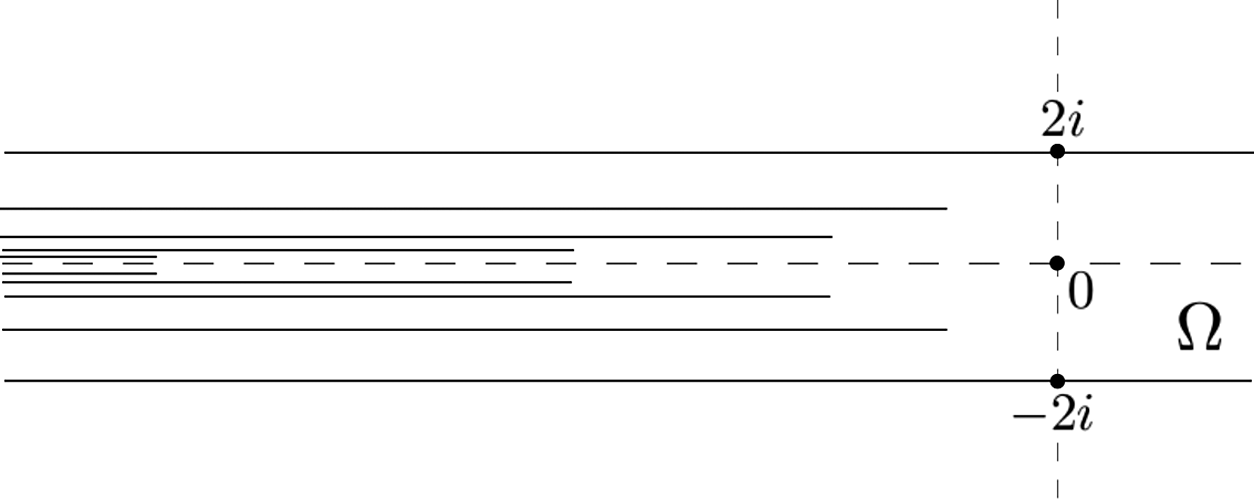
 $$ \begin{align*}\Omega:=\{w\in\mathbb{C}:|\text{Im}w|<2\}\setminus\bigcup\limits_{n=1}^{+\infty}\left(L\left[-2^n,\frac{1}{n}\right]\cup L\left[-2^n,-\frac{1}{n}\right]\right).\end{align*} $$
It is readily verified that
 $\Omega $
is a convex in the positive direction simply connected domain (see Figure 1). Then, given a Riemann mapping
 $h:\mathbb {D}\to \Omega $
fixing the origin, the relation
 $\phi _t(z)=h^{-1}(h(z)+t)$
,
 $z\in \mathbb {D}$
,
 $t\ge 0$
, gives birth to a non-elliptic semigroup
 $(\phi _t)$
with Koenigs function h and Koenigs domain
 $\Omega $
. Clearly
 $T_0=+\infty $
and
 $h(\tilde {\gamma }_0(t))=-t$
, for all
 $t\ge 0$
. In addition,
 $\tilde {\gamma }_0$
is non-regular since there is no horizontal strip or horizontal half-plane inside
 $\Omega $
containing
 $h(\tilde {\gamma }_0([0,+\infty )))$
. Notice that
 $\delta _\Omega (h(0)-t)=\delta _\Omega (-t)\le \frac {1}{\lfloor t\rfloor }$
, where
 $\lfloor .\rfloor $
denotes the floor function. Next, Lemma 2.1 leads to
 $$ \begin{align} \lambda_{\Omega}(h(0)-t)=\lambda_\Omega(-t)\ge\frac{\lfloor t\rfloor}{4}. \end{align} $$
To continue with, we are going to estimate the corresponding hyperbolic distance
 $k_\Omega (h(0),h(0)-t)=k_\Omega (0,-t)$
. Given
 $t\ge 1$
, the horizontal half-strip
 $\Sigma _t=\{w\in \mathbb {C}:\text {Re}w>-2^{\lfloor t\rfloor },\; |\text {Im}w|<1/\lfloor t\rfloor \}$
is contained inside
 $\Omega $
, while also containing the rectilinear segment
 $[-t,0]$
. By the domain monotonicity property of the hyperbolic distance, we get
 $k_\Omega (0,-t)\le k_{\Sigma _t}(0,-t)$
, so we will work with the latter quantity. The conformal mapping
 $$ \begin{align*}g(w)=\sin\left(\frac{i\pi\lfloor t \rfloor}{2}(w+2^{\lfloor t \rfloor})\right)\end{align*} $$
maps
 $\Sigma _t$
conformally onto the upper half-plane
 $\mathbb {H}$
. By the conformal invariance of the hyperbolic distance, we have
 $$ \begin{align} \notag k_\Omega(0,-t)&\le k_{\Sigma_t}(0,-t)\\ \notag &= k_{\mathbb{H}}\left(\sin\left(\frac{i\pi\lfloor t\rfloor2^{\lfloor t \rfloor}}{2}\right),\sin\left(\frac{i\pi\lfloor t\rfloor(2^{\lfloor t\rfloor}-t)}{2}\right)\right)\\ &= k_{\mathbb{H}}\left(i\sinh\left(\frac{\pi\lfloor t\rfloor2^{\lfloor t \rfloor}}{2}\right),i\sinh\left(\frac{\pi\lfloor t\rfloor(2^{\lfloor t\rfloor}-t)}{2}\right)\right). \end{align} $$
Since lying on an axis of symmetry, the segment
 $[-t,0]$
is a geodesic arc of
 $\Sigma _t$
. But conformal mappings map geodesics to geodesics. Therefore,
 $g([0,-t])$
is still a geodesic arc of the upper half-plane. Furthermore, the hyperbolic density of
 $\mathbb {H}$
is given by
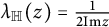 $\lambda _{\mathbb {H}}(z)=\frac {1}{2\text {Im}z}$
. Setting
 $$ \begin{align*}a_t=\sinh\left(\frac{\pi\lfloor t\rfloor2^{\lfloor t \rfloor}}{2}\right)\;\;\;\; \mbox{and}\;\;\;\;b_t=\sinh\left(\frac{\pi\lfloor t\rfloor(2^{\lfloor t\rfloor}-t)}{2}\right), \end{align*} $$
we infer that
 $$ \begin{align*} k_{\mathbb{H}}\left(i\sinh\left(\frac{\pi\lfloor t\rfloor2^{\lfloor t \rfloor}}{2}\right),i\sinh\left(\frac{\pi\lfloor t\rfloor(2^{\lfloor t\rfloor}-t)}{2}\right)\right)&= \left|\int\limits_{a_t}^{b_t}\frac{ds}{2s}\right|\\ &= \frac{1}{2}\log\frac{2^{\lfloor t\rfloor}}{2^{\lfloor t\rfloor}-t}. \end{align*} $$
which through (4.11) yields
 $k_\Omega (0,-t)\le \frac {1}{2}\log \frac {2^{\lfloor t\rfloor }}{2^{\lfloor t\rfloor }-t}$
. Combining with (4.10), we find
 $$ \begin{align*}\limsup\limits_{t\to+\infty}\frac{\lambda_\Omega(-t)}{e^{2k_\Omega(0,-t)}}\ge\limsup\limits_{t\to+\infty}\frac{\lfloor t\rfloor(2^{\lfloor t\rfloor}-t)}{4\cdot2^{\lfloor t\rfloor}}=+\infty.\end{align*} $$
In view of Theorem 1.3, we see that
 $\tilde {\gamma }_0$
is not Lipschitz.
The Koenigs domain in Example 1.

Next, we want an example of a Lipschitz non-regular backward orbit. Toward this goal we will prove one more proposition that stems from Theorem 1.3, but applies only to non-regular backward orbits of non-elliptic semigroups.
Proposition 4.6 Let
 $(\phi _t)$
be a non-elliptic semigroup in
 $\mathbb {D}$
with Koenigs function h and Koenigs domain
 $\Omega $
. Let
 $z\in \mathbb {D}$
and suppose that the backward orbit
 $\tilde {\gamma }_z$
is non-regular (and hence
 $T_z=+\infty $
). If
 $$ \begin{align*}\liminf_{t\to+\infty}(t\cdot\delta_\Omega(h(z)-t))>0,\end{align*} $$
then
 $\tilde {\gamma }_z$
is Lipschitz.
Proof Relying on similar arguments as in our previous results, we may see that through Lemma 2.1
 $$ \begin{align*}\lambda_\Omega(h(z)-t)\le\frac{1}{\delta_\Omega(h(z)-t)},\end{align*} $$
while through Lemma 2.2 we get
 $$ \begin{align*} k_\Omega(h(z),h(z)-t)&\ge \frac{1}{4}\log \left(1+\frac{t}{\min\{\delta_\Omega(h(z)),\delta_\Omega(h(z)-t)\}}\right)\\ &\ge \frac{1}{4}\log\frac{t}{\delta_\Omega(h(z)-t)}, \end{align*} $$
for all
 $t\ge 0$
. Blending the two relations, we obtain
 $$ \begin{align*} \frac{\lambda_{\Omega}(h(z)-t)}{e^{2k_\Omega(h(z),h(z)-t)}}&\le \frac{\frac{1}{\delta_\Omega(h(z)-t)}}{\frac{\sqrt{t}}{\sqrt{\delta_\Omega(h(z)-t)}}}\\ &=\frac{1}{\sqrt{t\cdot\delta_\Omega(h(z)-t)}}, \end{align*} $$
for all
 $t\ge 0$
. Therefore, our hypothesis implies
 $$ \begin{align*}\limsup_{t\to+\infty}\frac{\lambda_{\Omega}(h(z)-t)}{e^{2k_\Omega(h(z),h(z)-t)}}<+\infty.\end{align*} $$
Finally, Theorem 1.3 yields the Lipschitz condition for
 $\tilde {\gamma }_z$
.
This last proposition is actually very practical since it allows us to easily construct non-elliptic semigroups (or rather their associated Koenigs domains) having a non-regular Lipschitz backward orbit. Its advantage compared to Theorem 1.3 is that it is stated in Euclidean terms. Nevertheless, it does not provide a characterization. We will demonstrate its practicality via the next examples.
Example 2 Denote by
 $\mathbb {H}$
the right half-plane and consider
 $$ \begin{align*}\Omega=\overline{\mathbb{H}-1}\cup\left\{x+iy:x<-1, |y|<\frac{1}{\log|x|}\right\}.\end{align*} $$
Clearly,
 $\Omega $
is a simply connected and convex in the positive direction domain. Let
 $h:\mathbb {D}\to \Omega $
be a Riemann mapping fixing the origin. Then, as in our previous example, we may construct the associated non-elliptic semigroup
 $(\phi _t)$
through the formula
 $\phi _t(z)=h^{-1}(h(z)+t)$
,
 $z\in \mathbb {D}$
,
 $t\ge 0$
. The whole half-line
 $\{-t:t\ge 0\}$
is contained inside
 $\Omega $
, while there exists no horizontal strip contained inside
 $\Omega $
and containing this half-line. As a result, the curve
 $\tilde {\gamma }_0(t)=h^{-1}(-t)$
is a non-regular backward orbit for
 $(\phi _t)$
converging to some super-repelling fixed point of the semigroup. It is easy to see that
 $$ \begin{align*} \liminf_{t\to+\infty}(t\cdot\delta_\Omega(h(\tilde{\gamma}_0(t))))=\liminf_{t\to+\infty}(t\cdot\delta_\Omega(-t))>0. \end{align*} $$
Therefore, Proposition 4.6 implies that
 $\tilde {\gamma }_0$
is Lipschitz.
Example 3 Following a thought process similar to the previous example, consider
 $$ \begin{align*} \Omega=\overline{\mathbb{H}-1}\cup\left\{x+iy:x<-1, -\frac{1}{\log|x|}-1<y<\frac{1}{\log|x|}\right\}. \end{align*} $$
As before, there exists a non-elliptic semigroup
 $(\phi _t)$
with Koenigs function h such that
 $h(\mathbb {D})=\Omega $
. Clearly,
 $\Omega $
contains the horizontal strip
 $S=\{z:-1<\text {Im}z<0\}$
. Therefore, the backward orbit
 $\tilde {\gamma }_0$
with
 $\tilde {\gamma }_0(t)=h^{-1}(h(0)-t)=h^{-1}(-t)$
lying on
 $\partial S$
converges to a repelling point of
 $(\phi _t)$
and is non-regular. As previously,
 $\liminf _{t\to +\infty }(t\cdot \delta _\Omega (h(\tilde {\gamma }_0(t))))>0$
and thus
 $\tilde {\gamma }_0$
is Lipschitz.
Finally, combining all our preceding work, we may prove a relevant result for full orbits of semigroups of holomorphic functions.
Corollary 4.7 Let
 $(\phi _t)$
be a semigroup in
 $\mathbb {D}$
and
 $z\in \mathbb {D}$
. The following are equivalent:
-
(i) The full orbit
$\hat {\gamma }_z:(-T_z,+\infty ):\mathbb {D}$
is Lipschitz. -
(ii) The backward orbit
$\tilde {\gamma }_z$
is Lipschitz.


Proof Recall that by definition
 $$ \begin{align*}\hat{\gamma}_z(t)=\begin{cases} \tilde{\gamma}_z(-t), &\quad\text{when }t\in(-T_z,0], \\\gamma_z(t), &\quad\text{when }t\in[0,+\infty). \end{cases}\end{align*} $$
Trivially (i) implies (ii). If (ii) holds, there exists some positive constant
 $c_1$
such that
 $$ \begin{align*}|\hat{\gamma}_z(t)-\hat{\gamma}_z(s)|=|\tilde{\gamma}_z(-t)-\tilde{\gamma}_z(-s))|\le c_1 |t-s|, \quad\text{for all }t,s\in(-T_z,0].\end{align*} $$
We have showed that every forward orbit of every semigroup is Lipschitz. So there exists a second positive constant
 $c_2>0$
so that
 $$ \begin{align*}|\hat{\gamma}_z(t)-\hat{\gamma}_z(s)|=|\gamma_z(t)-\gamma_z(s)|\le c_2|t-s|, \quad\text{for all }t,s\in[0,+\infty).\end{align*} $$
Lastly, let
 $-T_z<t<0<s<+\infty $
. Then,
 $$ \begin{align*} |\hat{\gamma}_z(t)-\hat{\gamma}_z(s)|&\le |\hat{\gamma}_z(t)-\hat{\gamma}_z(0)|+|\hat{\gamma}_z(0)-\hat{\gamma}_z(s)|\\ &\le c_1(-t)+c_2s\\ &\le \max\{c_1,c_2\}|t-s|, \end{align*} $$
which leads to the desired implication.
5 Lipschitz property of orbits on the unit circle
We move on to boundary orbits starting with some brief exposition which is mostly taken from [Reference Bracci, Contreras and Díaz-Madrigal8, Chapter 14]. Let
 $(\phi _t)$
be a semigroup in
 $\mathbb {D}$
. Clearly, for
 $z\in \mathbb {D}$
, the trace of the orbit
 $\gamma _z$
is completely contained inside
 $\mathbb {D}$
. Therefore, in this section, we only deal with orbits
 $\gamma _\zeta $
starting from a point
 $\zeta \in \partial \mathbb {D}$
. Of course, the forward orbit of
 $\zeta $
either lies completely on the unit circle or has an initial part on the unit circle (even if it is just the singleton
 $\{\zeta \}$
) and then falls into the unit disk until it reaches the Denjoy–Wolff point. This second part has already been dealt with in the previous section. So, as we mentioned in Section 1, we will devote our study exclusively on the part
 $\gamma _\zeta ([0,+\infty ))\cap \partial \mathbb {D}$
. It can be actually seen that this intersection is connected and is equal to
 $\gamma _\zeta ([0,S_\zeta ])$
, where
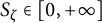 $S_\zeta \in [0,+\infty ]$
is called the life-time of
 $\zeta $
and is given through the relation
 $$ \begin{align} S_\zeta:=\sup\{t\in[0,+\infty):\phi_t(\zeta)\in\partial\mathbb{D}\} \end{align} $$
(in case
 $S_\zeta =+\infty $
the intersection is the whole
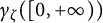 $\gamma _\zeta ([0,+\infty ))$
). For the sake of convenience, we will say that the set
 $\gamma _\zeta ([0,S_\zeta ])$
(or
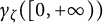 $\gamma _\zeta ([0,+\infty ))$
whenever
 $S_\zeta =+\infty $
) is the boundary orbit of
 $\zeta $
and we will still denote it by
 $\gamma _\zeta $
. It is obvious that when
 $S_\zeta =0$
, then
 $\gamma _\zeta \equiv \{\zeta \}$
and there is no point in examining the Lipschitz condition. So, we will only work with
 $\zeta \in \partial \mathbb {D}$
such that
 $S_\zeta>0$
. Any such point is called a contact point for
 $(\phi _t)$
. Evidently, every boundary fixed point of the semigroup is at once a contact point. In particular, if
 $\sigma \in \partial \mathbb {D}$
is a fixed point of
 $(\phi _t)$
, then
 $S_\sigma =+\infty $
and
 $\gamma _\sigma (t)=\sigma $
, for all
 $t\ge 0$
. So, again,
 $\gamma _\sigma \equiv \{\sigma \}$
and
 $\gamma _\sigma $
is easily seen to be Lipschitz. We disregard this case due to its simplicity.
An open arc (i.e., an arc not containing its endpoints)
 $A\subset \partial \mathbb {D}$
is called a contact arc if every
 $\zeta \in A$
is a contact point of
 $(\phi _t)$
. If there exists no other contact arc B with
 $A\subsetneq B$
, then A is said to be a maximal contact arc. Furthermore, if the one endpoint of a (maximal) contact arc A is the Denjoy–Wolff point of the semigroup, then A is known as an exceptional (maximal) contact arc.
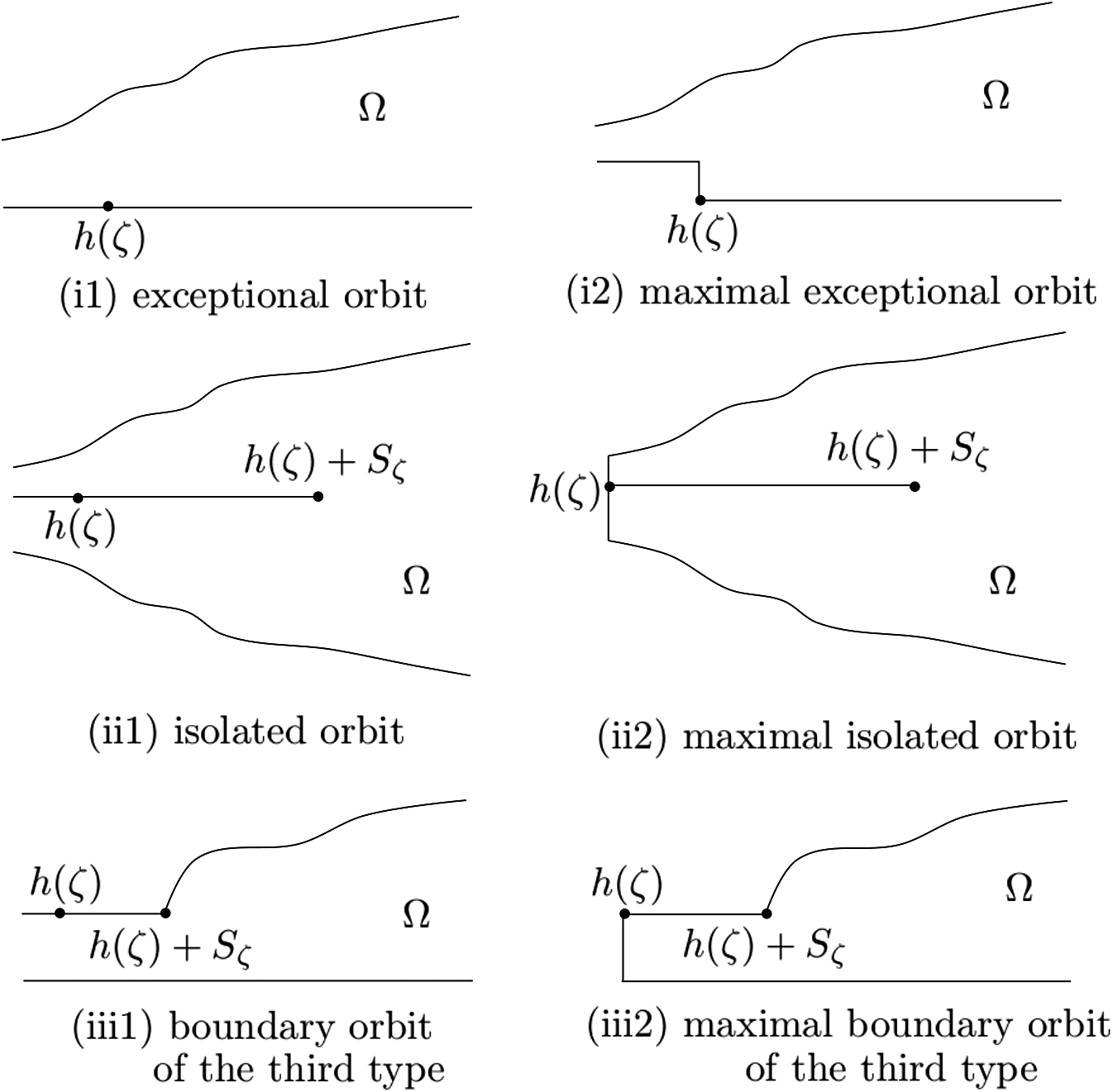
In order to state our main results concerning boundary orbits, we first have to proceed to a classification. We will distinguish boundary orbits into three main types, depending on their image through the Koenigs function and on whether the boundary orbit reaches the Denjoy–Wolff point or not.
(i) First, we will say that a boundary orbit
 $\gamma _\zeta $
is exceptional if
 $S_\zeta =+\infty $
and
 $\zeta $
is not a fixed point of
 $(\phi _t)$
. Clearly this signifies that
 $(\phi _t)$
is necessarily non-elliptic and that the arc
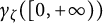 $\gamma _\zeta ([0,+\infty ))$
has the Denjoy–Wolff point of
 $(\phi _t)$
as an endpoint.
(ii) For the second type, we will slightly abuse the definitions introduced in [Reference Bracci, Contreras and Díaz-Madrigal8, Chapter 15]. Suppose that
 $\gamma _\zeta $
is not exceptional. Hence,
 $S_\zeta <+\infty $
. Then, the image of
 $\gamma _\zeta $
through the Koenigs function h is either the horizontal rectilinear segment
 $\{h(\zeta )+s:s\in [0,S_\zeta ]\}$
(non-elliptic case) or the spiral segment
 $\{e^{-\mu s}h(\zeta ):s\in [0,S_\zeta ]\}$
(elliptic case with spectral value
 $\mu $
). Then, the whole horizontal half-line
 $L_\zeta :=\{h(\zeta )+s:s\in (-\infty ,S_\zeta ]\}$
or the whole half-spiral
 $\Lambda _\zeta :=\{e^{-\mu s}h(\zeta ):s\in (-\infty ,S_\zeta ]\}$
is contained in
 $\mathbb {C}\setminus \Omega $
. For the non-elliptic case, suppose as well that there exists
 $\epsilon>0$
such that
 $D(h(\zeta )+S_\zeta ,\epsilon )\cap \partial \Omega \subset L_\zeta $
, where
 $D(w,r)$
denotes the Euclidean disk of center
 $w\in \mathbb {C}$
and radius
 $r>0$
. Likewise, in the elliptic case, suppose that there exists
 $\epsilon>0$
such that
 $D(e^{-\mu S_\zeta }h(\zeta ),\epsilon )\cap \partial \Omega \subset \Lambda _\zeta $
. In such cases, we will say that the boundary orbit
 $\gamma _\zeta $
is isolated. For the sake of convenience, we might refer to
 $L_\zeta $
as a radial slit and to
 $\Lambda _\zeta $
as a spiral slit, while the points
 $h(\zeta )+S_\zeta $
and
 $e^{-\mu S_\zeta }h(\zeta )$
will be their tip-points, respectively.
(iii) If none of the above hold, we will say that
 $\gamma _\zeta $
is a boundary orbit of the third type.
For an illustration of the preceding classification in the case of non-elliptic semigroups, see Figure 2.
Images of boundary orbits through the Koenigs function in non-elliptic semigroups.

Given a boundary orbit
 $\gamma _\zeta $
, where
 $\zeta $
is a contact point but not a boundary fixed point, its trace on the unit circle is always a circular arc. Whenever,
 $S_\zeta <+\infty $
, then this trace is the arc with endpoints
 $\zeta $
and
 $\gamma _\zeta (S_\zeta )$
including these endpoints. On the other hand, whenever
 $S_\zeta =+\infty $
, then the trace is the arc with endpoints
 $\zeta $
and the Denjoy–Wolff point, but including only
 $\zeta $
. In any case, the trace without its endpoints is therefore a contact arc. By [Reference Bracci, Contreras and Díaz-Madrigal8, Theorem 14.2.10], we know that both the Koenigs function h and the infinitesimal generator G of a semigroup
 $(\phi _t)$
may be extended holomorphically through contact arcs. Therefore, if
 $(\phi _t)$
is non-elliptic, the equalities
 $$ \begin{align} \frac{\partial\gamma_\zeta(t)}{\partial t}=G(\gamma_\zeta(t)) \text{ and } G(\gamma_\zeta(t))=\frac{1}{h'(\gamma_\zeta(t))}, \end{align} $$
continue to hold for all
 $t\in (0,S_\zeta )$
. In case,
 $(\phi _t)$
is elliptic with spectral value
 $\mu \in \mathbb {C}$
,
 $\text {Re}\mu>0$
, the second equality transforms to
 $$ \begin{align} G(\gamma_\zeta(t))=-\mu\frac{h(\gamma_\zeta(t))}{h'(\gamma_\zeta(t))}, \end{align} $$
for all
 $t\in (0,S_\zeta )$
.
Having provided all the necessary exposition, we are now ready to state and prove our main result concerning boundary orbits.
Theorem 5.1 Let
 $(\phi _t)$
be a semigroup in
 $\mathbb {D}$
and suppose that
 $\zeta \in \partial \mathbb {D}$
is not a fixed point of
 $(\phi _t)$
and satisfies
 $S_\zeta>0$
.
-
(a) If
$\gamma _\zeta $
is an exceptional orbit, then it is Lipschitz. -
(b) If
$\gamma _\zeta $
is an isolated orbit, then it is not Lipschitz.


Proof As in the case of forward orbits inside the unit disk, the objective is to check whether the infinitesimal generator G of
 $(\phi _t)$
is bounded or not along the boundary orbit. Of course, in any relatively compact subset of
 $\gamma _\zeta ([0,S_\zeta ])$
(or
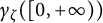 $\gamma _\zeta ([0,+\infty ))$
when
 $\gamma _\zeta $
is exceptional), G remains bounded since it can be holomorphically extended through it. So, we only need to deal with the upper limits
 $$ \begin{align*}\limsup\limits_{t\to0}|G(\gamma_\zeta(t))| \;\;\text{ and } \;\; \limsup\limits_{t\to S_\zeta}|G(\gamma_\zeta(t))|.\end{align*} $$
(a) First, suppose that
 $\gamma _\zeta $
is exceptional and thus
 $S_\zeta =+\infty $
. Without loss of generality, suppose that
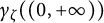 $\gamma _\zeta ((0,+\infty ))$
is actually a maximal contact arc. This is the hardest case. Indeed, if
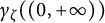 $\gamma _\zeta ((0,+\infty ))$
is not maximal, then by definition it is contained inside another contact arc. Evidently,
 $\zeta $
will be an interior point of that arc (i.e., not an endpoint) and
 $G(\zeta )$
will be well-defined. So the upper limit as
 $t\to 0$
would be trivially finite and equal to
 $|G(\zeta )|$
. Thus, assuming maximality, we know that
 $\angle \lim _{z\to \zeta }G(z)=:l_0$
exists finitely; cf. [Reference Bracci, Contreras and Díaz-Madrigal8, Theorem 14.3.1(1)]. By the well-known Berkson–Porta Formula, there exists a non-vanishing holomorphic function
 $p:\mathbb {D}\to \overline {\mathbb {H}}$
, where
 $\mathbb {H}$
is the right half-plane, such that
 $$ \begin{align*}G(z)=(z-\tau)(\bar{\tau}z-1)p(z),\end{align*} $$
where
 $\tau $
is the Denjoy–Wolff point of
 $(\phi _t)$
. Clearly, this signifies that the limit
 $\angle \lim _{z\to \zeta }p(z)$
also exists finitely and that p may be extended through
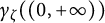 $\gamma _\zeta ((0,+\infty ))$
. In addition, it can be proved (see, e.g., the proof in [Reference Bracci, Contreras and Díaz-Madrigal8, Theorem 14.3.1]) that
 $\text {Re}p(\gamma _\zeta (t))=0$
, for all
 $t\in (0,+\infty )$
. As a result, applying [Reference Bracci, Contreras and Díaz-Madrigal8, Proposition 2.4.2], we get
 $$ \begin{align*}\angle\lim\limits_{z\to\zeta}p(z)=\lim\limits_{t\to0}p(\gamma_\zeta(t)).\end{align*} $$
Through the Berkson–Porta Formula, the same equality of limits holds for G as well. Therefore, we get that the limit
 $\lim _{t\to 0}G(\gamma _\zeta (t))$
actually exists finitely. Recall that due to the fact that
 $\gamma _\zeta $
is exceptional, the second endpoint of
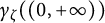 $\gamma _\zeta ((0,+\infty ))$
is the Denjoy–Wolff point
 $\tau $
of the semigroup. As we have mentioned in Remark 4.1, it is known that
 $\angle \lim _{z\to \tau }G(z)=0$
. Following exactly the same steps, we can prove that
 $$ \begin{align*}\angle\lim\limits_{z\to\tau}G(z)=\lim\limits_{t\to+\infty}G(\gamma_\zeta(t)).\end{align*} $$
Hence, both the limit
 $\lim _{t\to 0}|G(\gamma _\zeta (t))|$
and the limit
 $\lim _{t\to +\infty }|G(\gamma _\zeta (t))|=\lim _{t\to S_\zeta }|G(\gamma _\zeta (t))|$
exist finitely. Consequently, relation (5.2) shows that
 $\gamma _\zeta $
is Lipschitz.
(b) Next, suppose that
 $\gamma _\zeta $
is isolated. Ergo
 $S_\zeta <+\infty $
. An identical proof as in the previous case shows that the limit
 $\lim _{t\to 0}|G(\gamma _\zeta (t))|$
exists finitely regardless of whether
 $\gamma _\zeta ((0,S_\zeta ))$
is a maximal contact arc or not. We are left with evaluating the respective limit as
 $t\to S_\zeta $
. Let h be the Koenigs function of
 $(\phi _t)$
. As we stated previously, the fact that
 $\gamma _\zeta $
is isolated means that
 $h\circ \gamma _\zeta ([0,S_\zeta ])$
is part of a radial slit or part of a spiral slit and that
 $h(\gamma _\zeta (S_\zeta ))$
is its tip-point. In such cases, [Reference Bracci, Contreras and Díaz-Madrigal8, Theorem 15.2.6] certifies that
 $\angle \lim _{z\to \gamma _\zeta (S_\zeta )}G(z)=\infty $
. However, the same procedure as before yields
 $$ \begin{align*} \angle\lim\limits_{z\to\gamma_\zeta(S_\zeta)}G(z)=\lim\limits_{t\to S_\zeta}G(\gamma_\zeta(t)). \end{align*} $$
As a result,
 $\lim _{t\to S_\zeta }|G(\gamma _\zeta (t))|= +\infty $
and (5.2) proves that
 $\gamma _\zeta $
is not Lipschitz.
Finally, we need to examine the Lipschitz condition for boundary orbits of the third type. Contrary to exceptional and isolated orbits, not all boundary orbits conform to the same behavior. Indeed, it will be revealed that some of them are Lipschitz and some of them are not. As with the backward orbits, our aim is to discover a necessary and sufficient condition that will help us verify the Lipschitz condition for boundary orbits of the third type. Let
 $\gamma _\zeta $
be such an orbit. Arguing exactly as in the proof of Theorem 5.1, we see that
 $\lim _{t\to 0}|G(\gamma _\zeta (t))|$
once again exists finitely. Keeping in mind that
 $\gamma _\zeta ((0,S_\zeta ))$
is still a contact arc, relation (5.2) provides a first necessary and sufficient condition: a boundary orbit
 $\gamma _\zeta $
of the third type is Lipschitz if and only if
 $\limsup _{t\to S_\zeta }|G(\gamma _\zeta (t))|$
is finite. In reality, the actual limit exists and there is no need for the upper limit. Nevertheless, the limit exists either finitely or infinitely. Both situations may arise.
As mentioned before, the set
 $\gamma _\zeta ((0,S_\zeta ))$
is a contact arc and both the Koenigs function h and the infinitesimal generator G may be extended holomorphically through it. However, depending on the shape of the Koenigs domain
 $\Omega $
, it is possible that the extended h does not maintain its univalence. We will tweak this extension a little bit in order to reach the desired conclusion.
Construction Let
 $(\phi _t)$
be a non-elliptic semigroup in
 $\mathbb {D}$
with Denjoy–Wolff point
 $\tau \in \partial \mathbb {D}$
, Koenigs function h and Koenigs domain
 $\Omega =h(\mathbb {D})$
. Fix
 $\zeta \in \partial \mathbb {D}$
such that
 $S_\zeta>0$
,
 $\zeta $
is not a fixed point of
 $(\phi _t)$
and the boundary orbit
 $\gamma _\zeta ([0,S_\zeta ])$
is of the third type. Since
 $(\phi _t)$
is non-elliptic, the image of
 $\gamma _\zeta $
through h is just the rectilinear segment
 $\{h(\zeta )+t:t\in [0,S_\zeta ]\}$
(recall that
 $h(\zeta )=\angle \lim _{z\to \zeta }h(z)$
exists in
 $\mathbb {C}$
). Suppose that there exist two sequences
 ${t_n}$
and
 ${s_n}$
with
 $\lim _{n\to +\infty }t_n=\lim _{n\to +\infty }s_n=0$
and two sequences
 ${p_n}$
and
 ${q_n}$
with
 $\lim _{n\to +\infty }p_n=\lim _{n\to +\infty }q_n=S_\zeta $
such that
 $$ \begin{align*}L_n^+=\{w\in\mathbb{C}:\text{Re}h(\zeta)\le \text{Rew}\le\text{Re}h(\zeta)+p_n,\text{Im}w=\text{Im}h(\zeta)+t_n\}\subset\mathbb{C}\setminus\Omega\end{align*} $$
and
 $$ \begin{align*}L_n^-=\{w\in\mathbb{C}:\text{Re}h(\zeta)\le\text{Re}w\le\text{Re}h(\zeta)+q_n,\text{Im}w=\text{Im}h(\zeta)-s_n\}\subset\mathbb{C}\setminus\Omega,\end{align*} $$
for all
 $n\in \mathbb {N}$
. In simpler words, there exist components of
 $\partial \Omega $
that accumulate onto
 $h\circ \gamma _\zeta ([0,S_\zeta ])$
both from above and from below. But if this were the case, then the whole rectilinear segment
 $h\circ \gamma _\zeta ([0,S_\zeta ])$
would belong in the impression of the same prime end of
 $\Omega $
. Therefore, the preimage of
 $h\circ \gamma _\zeta ([0,S_\zeta ])$
through
 $h^{-1}$
would be a singleton. Having started with a boundary orbit
 $\gamma _\zeta ([0,S_\zeta ])$
satisfying our initial assumptions, we are led to a contradiction. This signifies that
 $h\circ \gamma _\zeta ([0,S_\zeta ])$
is necessarily isolated from the one side i.e., there exist some
 $\epsilon _1,\epsilon _2>0$
such that either
 $ L^+=\{w\in \mathbb {C}:\text {Re}h(\zeta )+\epsilon _1<\text {Re}w<\text {Re}h(\zeta )+S_\zeta ,\text {Im}h(\zeta )<\text {Im}w<\text {Im}h(\zeta )+\epsilon _2\}\subset \Omega $
or
 $L^-=\{w\in \mathbb {C}:\text {Re}h(\zeta )+\epsilon _1<\text {Re}w<\text {Re}h(\zeta )+S_\zeta ,\text {Im}h(\zeta )-\epsilon _2<\text {Im}w<\text {Im}h(\zeta )\}\subset \Omega. $
It is easy to see that both cannot be true, otherwise our boundary orbit would be isolated. Set
 $\Omega ^+:=\{w\in \Omega :\text {Im}w>\text {Im}h(\zeta )\}$
and
 $\Omega ^- :=\{w\in \Omega :\text {Im}w<\text {Im}h(\zeta )\}$
. If
 $L^+\subset \Omega $
, then write
 $\Omega ^*=\Omega ^+$
, whereas, if
 $L^-\subset \Omega $
, write
 $\Omega ^*=\Omega ^-$
. Denote by
 $R(\Omega ^*)$
the reflection of
 $\Omega ^*$
with respect to the horizontal line that carries
 $h\circ \gamma _\zeta ([0,S_\zeta ])$
and set
 $\widetilde {\Omega }=\Omega ^*\cup h\circ \gamma _\zeta ((0,S_\zeta )) \cup R(\Omega ^*)$
. Clearly,
 $\widetilde {\Omega }$
is simply connected. Let
 $\mathbb {D}^*=h^{-1}(\Omega ^*)$
and set
 $R(\mathbb {D}^*)$
its reflection through the circular arc
 $\gamma _\zeta ((0,S_\zeta ))$
. Let
 $\widetilde {\mathbb {D}}=\mathbb {D}^*\cup \gamma _\zeta ((0,S_\zeta )) \cup R(\mathbb {D}^*)$
. As we said before, h may be extended holomorphically through
 $\gamma _\zeta ((0,S_\zeta ))$
. Still denoting by h its extended version, by Schwarz’s Reflection Principle we see that h maps
 $\widetilde {\mathbb {D}}$
conformally onto
 $\widetilde {\Omega }$
.
Having constructed the necessary domains, we are now ready to state our final theorem regarding boundary orbits of the third type. The simply connected domains
 $\widetilde {\Omega }$
and
 $\widetilde {\mathbb {D}}$
will play the roles that
 $\Omega $
and
 $\mathbb {D}$
played, respectively, in Theorem 1.3.
Theorem 5.2 Let
 $(\phi _t)$
be a non-elliptic semigroup in
 $\mathbb {D},$
and suppose that
 $\zeta \in \partial \mathbb {D}$
is such that
 $\gamma _\zeta $
is a boundary orbit of the third type. Then,
 $\gamma _\zeta $
is Lipschitz if and only if
 $$ \begin{align} \limsup\limits_{t\to S_\zeta}\frac{\lambda_{\widetilde{\Omega}}(h(\zeta)+t)}{\lambda_{\widetilde{\mathbb{D}}}(\gamma_\zeta(t))}<+\infty, \end{align} $$
where
 $\widetilde {\Omega },\widetilde {\mathbb {D}}$
are the domains constructed above.
Proof Let h and G be the Koenigs function and infinitesimal generator of
 $(\phi _t)$
, respectively. G can also be holomorphically extended through
 $\gamma _\zeta ((0,S_\zeta ))$
, so still denoting by G the extension, we can consider G as a holomorphic function on
 $\widetilde {\mathbb {D}}$
(the pre-image of
 $\widetilde {\Omega }$
through the extended
 $h^{-1}$
). Since the identity
 $\partial \phi _t(z)/\partial t=G(\phi _t(z))$
continues to hold in
 $\widetilde {\mathbb {D}}$
, we understand that
 $\gamma _\zeta $
is Lipschitz if and only if
 $\limsup _{t\to S_\zeta }|G(\gamma _\zeta (t))|<+\infty $
. However, the identity
 $G=1/h'$
also holds in
 $\widetilde {\mathbb {D}}$
. Therefore, by (2.5),
 $$ \begin{align*} |G(\gamma_\zeta)|=\frac{1}{|h'(\gamma_\zeta(t))|}= \frac{\lambda_{\widetilde{\Omega}}(h(\gamma_\zeta(t)))}{\lambda_{\widetilde{\mathbb{D}}}(\gamma_\zeta(t))}, \end{align*} $$
for all
 $t\in (0,S_\zeta )$
and the desired result follows.
We understand that depending on the shape of the initial Koenigs domain
 $\Omega $
, the limit in (5.4) can sometimes be finite and some others infinite. Of course, Theorem 5.2 lacks the clearly intuitive nature of Theorem 1.3. Nonetheless, it still provides a necessary and sufficient condition that may be verified for certain domains.
Remark 5.3 There is an analog of Theorem 5.2 for elliptic semigroups, as well. However, recall that if
 $(\phi _t)$
is elliptic with spectral value
 $\mu \in \mathbb {C}$
,
 $\text {Re}\mu>0$
, then its Koenigs domain
 $\Omega $
is
 $\mu $
-spirallike and the image of
 $\gamma _\zeta ([0,S_\zeta ])$
through the Koenigs function h is a spiral segment. Through a logarithmic mapping, we may transform this spiral segment to a rectilinear segment and part of
 $\Omega $
to a new domain
 $\Omega '$
. Then, we may reflect
 $\Omega '$
as before and reach a similar condition. We omit this result for the sake of avoiding repetition.
Remark 5.4 An analog of Remark 4.1 holds for boundary orbits too. First, since exceptional orbits converge to the Denjoy–Wolff, we know that
 $\lim _{t\to +\infty } G(\gamma _\zeta (t))=0$
; see the proof of Theorem 5.1. Therefore,
 $\gamma _\zeta $
cannot be bi-Lipschitz. In addition, all isolated orbits are not bi-Lipschitz since they are not even Lipschitz. Finally, a boundary orbit of the third type is bi-Lipschitz if and only if it is Lipschitz since the modulus of the infinitesimal generator is always bounded from below along it, but not necessarily bounded from above.
6 Semigroups in simply connected domains
Let
 $(\phi _t)$
be a semigroup in
 $\mathbb {D}$
. Let
 $D\subsetneq \mathbb {C}$
be a simply connected domain and
 $f:\mathbb {D}\to D$
a Riemann mapping. Then, through a conjugation formula, we may define the mappings
 $$ \begin{align} \phi_t^D=f\circ\phi_t\circ f^{-1}:D\to D, \;\;\;t\ge0. \end{align} $$
It can be easily verified that in this way, we construct a semigroup
 $(\phi _t^D)$
in the simply connected domain D. We call this semigroup the D-version of
 $(\phi _t)$
. For
 $\zeta \in D$
, we denote by
 $\gamma _\zeta ^D$
its forward orbit and by
 $\tilde {\gamma }_\zeta ^D$
its backward orbit.
Out of all the properties of the semigroup
 $(\phi _t)$
, the most important ones are those shared by all its versions. The objective of this section is to find out whether the fact that all forward orbits are Lipschitz is such a property. Clearly, the Lipschitz condition is not conformally invariant in general. Nevertheless, it might be conformally invariant when restricting ourselves to orbits of semigroups.
Let
 $G:\mathbb {D}\to \mathbb {C}$
and
 $G^D:D\to \mathbb {C}$
be the infinitesimal generators of
 $(\phi _t)$
and
 $(\phi _t^D)$
, respectively. By the definition of the infinitesimal generator, we know that
 $$ \begin{align*}\frac{\partial\phi_t^D(\zeta)}{\partial t}=G^D(\phi_t^D(\zeta)), \quad t\ge0, \; \zeta\in D.\end{align*} $$
Following exactly the footsteps of the previous section, we are able to prove the following.
Lemma 6.1 Let
 $(\phi _t^D)$
be a semigroup in D with infinitesimal generator
 $G^D$
. Fix
 $\zeta \in D$
. The forward orbit
 $\gamma _\zeta ^D$
(respectively, the backward orbit
 $\tilde {\gamma }_\zeta ^D$
) is Lipschitz if and only if
 $$ \begin{align*}\limsup_{t\to+\infty}|G^D(\gamma_\zeta^D(t))|<+\infty\end{align*} $$
 $$ \begin{align*} (\textit{respectively}, \;\;\;\;\limsup_{t\to T_\zeta}|G^D(\tilde{\gamma}_\zeta^D(t))|<+\infty).\end{align*} $$
Even though Lemma 6.1 gives us a characterization of the Lipschitz condition for general simply connected domains, we would like to have a better understanding of the situation. In particular, it would be useful to know if every forward orbit is Lipschitz as in semigroups of the unit disk, or if we can state a better result for special classes of backward orbits.
Using the conjugation formula (6.1) of
 $(\phi _t^D)$
and the chain rule, we deduce
 $G^D(\phi _t^D(\zeta ))=f'(\phi _t(z))G(\phi _t(z))$
, for all
 $t\ge 0$
and all
 $\zeta \in D$
,
 $z\in \mathbb {D}$
with
 $\zeta =f(z)$
. In this way, we may write
 $G^D$
as the product of two holomorphic functions of
 $\mathbb {D}$
. So, with a multiple use of Lemma 2.4 and denoting the Koenigs function of
 $(\phi _t)$
by h and its Koenigs domain by
 $\Omega $
, we have
 $$ \begin{align} |G^D(\phi_t^D(\zeta))|&=|f'(\phi_t(z))|\cdot|G(\phi_t(z))| \le\frac{4\delta_D(f(\phi_t(z)))}{1-|\phi_t(z)|^2}\cdot\frac{1-|\phi_t(z)|^2}{\delta_\Omega(h(\phi_t(z)))} \nonumber \\ &\le 4\frac{\delta_D(f(\phi_t(z)))}{\delta_\Omega(h(z))}. \end{align} $$
However, the asymptotic behavior of the orbits of
 $(\phi _t^D)$
requires further attention. Let
 $\tau $
be the Denjoy–Wolff point of
 $(\phi _t)$
. Clearly, if
 $\tau \in \mathbb {D}$
, then
 $(\phi _t^D)$
has
 $f(\tau )\in D$
as its own Denjoy–Wolff point and remains elliptic. On the other hand, if
 $\tau \in \partial \mathbb {D}$
, then Carathéodory’s Theorem implies that
 $\tau $
corresponds through f to a prime end
 $\xi $
of D. Therefore, all the orbits of
 $(\phi _t^D)$
escape to the boundary of D and
 $(\phi _t^D)$
is still non-elliptic. Nevertheless, the impression of the prime end
 $\xi $
might be greater than a singleton; see [Reference Bracci, Contreras and Díaz-Madrigal8, Chapter 4] for details on prime ends and their impressions. This does not allow us to formally speak of a Denjoy–Wolff point for
 $(\phi _t^D)$
since in certain cases its orbits might cluster on a continuum. For this reason, we may say that
 $\xi $
is the Denjoy–Wolff prime end of
 $(\phi _t^D)$
and all its orbits converge to
 $\xi $
in the Carathéodory topology of D. For a recent discussion on conditions which certify the existence of an actual Denjoy–Wolff point (and not just a Denjoy–Wolff prime end) in arbitrary simply connected domains, we refer to [Reference Benini and Bracci3].
Keeping the note above in mind, we immediately deduce the following result:
Proposition 6.2 Let
 $D\subsetneq \mathbb {C}$
be a simply connected domain and
 $(\phi _t^D)$
be a semigroup in D.
-
(a) If
$(\phi _t^D)$
is elliptic, then every forward orbit is Lipschitz. -
(b) If
$(\phi _t^D)$
is non-elliptic and the impression of the Denjoy–Wolff prime end of
$(\phi _t^D)$
does not contain
$\infty $
, then every forward orbit is Lipschitz.


Proof (a) Fix
 $\zeta \in D$
. Since
 $(\phi _t^D)$
is elliptic, it has a Denjoy–Wolff point
 $\zeta _0\in D$
and
 $\lim _{t\to +\infty }\phi _t^D(\zeta )=\zeta _0$
. By (6.2), we obtain
 $$ \begin{align*}\limsup_{t\to+\infty}|G^D(\phi_t^D(\zeta))|\le4\dfrac{\delta_D(\zeta_0)}{\delta_\Omega(h(z))}<+\infty.\end{align*} $$
Hence, Lemma 6.1 yields that
 $\gamma _\zeta ^D$
is Lipschitz.
(b) Fix
 $\zeta \in D$
. This time,
 $(\phi _t^D)$
has a Denjoy–Wolff prime end
 $\xi $
with bounded impression. Arguing as in the previous case, from relation (6.2) we infer that
 $\limsup _{t\to +\infty }|G^D(\phi _t^D(\zeta ))|=0$
since
 $\gamma _\zeta ^D$
clusters on a bounded set of points of
 $\partial D$
. As a result,
 $\gamma _\zeta ^D$
is Lipschitz by Lemma 6.1.
Remark 6.3 But what about non-elliptic semigroups whose Denjoy–Wolff prime ends have unbounded impression? Working as above, we may see that
 $$ \begin{align} |G^D(\phi_t^D(\zeta))|\ge\frac{1}{4}\cdot\frac{\delta_D(f(\phi_t(z)))}{\delta_\Omega(h(\phi_t(z)))}. \end{align} $$
Thus, we may extract the following:
-
(i) If the distance
$\delta _D(f(\phi _t(z)))$
remains bounded, then by (6.2), every forward orbit is still Lipschitz. For instance, this happens if D is a strip or if D is a half-plane and
$(\phi _t^D)$
is parabolic of finite shift. -
(ii) Suppose now that for some
$z\in \mathbb {D}$
, the quantity
$\delta _D(f(\phi _t(z)))$
diverges, but
$\delta _\Omega (h(\phi _t(z)))$
remains bounded. Then, (6.3) dictates that
$\gamma _\zeta ^D$
is not Lipschitz. For example, this happens when D is a half-plane and
$(\phi _t^D)$
is hyperbolic or parabolic of positive hyperbolic step and infinite shift.






Therefore, both Lipschitz and non-Lipschitz forward orbits may arise in semigroups of general simply connected domains.
Similar results can be deduced when distinguishing cases with regard to the regularity of a backward orbit of
 $(\phi _t^D)$
(recall that regularity is defined through the hyperbolic distance which is conformally invariant) and to the point where it lands.
Acknowledgements
We thank V. Vellis for the interesting conversation about Lipschitz curves and the Hayman–Wu Theorem. We also thank M. D. Contreras and L. Rodríguez-Piazza for the helpful discussion on the properties of the orbits of holomorphic semigroups.