Introduction
Boehmeria Jacq. and Pouzolzia Gaudich. belong to the tribe Boehmerieae (Urticaceae) (Friis, Reference Friis and Kubitzki1993). Boehmeria comprises 45–50 species, 13 indigenous to the New World tropics (one extending to temperate North America), the remainder in the Old World tropics, mostly in Asia but with a few endemic to or extending to the Afro-Malagasy region and the Pacific. Pouzolzia comprises 37 species, 14 in the New World, the remainder fairly equally distributed between the Afro-Malagasy region and Asia.
During work by the authors of this paper on the taxonomy, fruit morphology and phylogeny of Boehmeria and Pouzolzia it was realised that the hitherto accepted position of Boehmeria rugulosa Wedd. next to other Himalayan species of Boehmeria with pendulous inflorescence-bearing axes was questionable. The relative responsibilities of the authors are as follows: C. Melanie Wilmot-Dear and Ib Friis have conducted the general taxonomic revision and took responsibility for writing this paper; T. Kravtsova has provided the data on fruit anatomy; and N. Acharya has provided the phylogenetic framework.
Distinction between Boehmeria and Pouzolzia
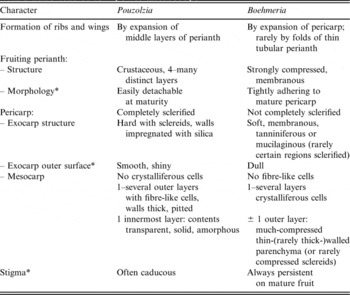
The first complete treatments of the Urticaceae by Weddell (Reference Weddell1856, Reference Weddell and de Candolle1869) and the following revisions of Boehmeria and Pouzolzia (Wilmot-Dear & Friis, Reference Wilmot-Dear and Friis1996, Reference Wilmot-Dear and Friis2006) showed that there are difficult taxonomic problems in the delimitation of the two genera. The above studies demonstrated that they are extremely close in gross morphology. Weddell (Reference Weddell1856: 341) stated that in Pouzolzia the stigma has a basal articulation and is caducous and the fruiting perianth is often ribbed and winged, whereas Boehmeria has a linear non-articulated stigma and no ribs or wings on the fruit. Subsequently (Weddell, Reference Weddell and de Candolle1869: 219) he modified this, stating that in Pouzolzia the stigma is ‘almost always’ caducous and that both genera can have winged fruits, Boehmeria differing in the wings always being expansions of the lateral margins of the perianth and therefore solitary on either side, whereas in Pouzolzia they are ‘very often’ expansions of the fruit ribs and, therefore, often paired. Wilmot-Dear & Friis (Reference Wilmot-Dear and Friis1996: 8–11 & 71) demonstrated that the only entirely consistent morphological distinctions between these two genera were certain characters of the fruit. Subsequent anatomical studies (Kravtsova, Reference Kravtsova2001; Kravtsova et al., Reference Kravtsova, Friis and Wilmot Dear2000, Reference Kravtsova, Friis and Wilmot Dear2003: 318) demonstrated that these characters reflect underlying structural differences within both the fruiting perianth and pericarp. These morphological and anatomical distinctions are summarised in Table 1 and discussed below.
Morphological and anatomical characters distinguishing Pouzolzia from Boehmeria. The characters marked with * are observable with a hand-lens or low-power microscope

The type of diaspore is the same in both genera, i.e. a diclesium (an anthocarp of floral parts, which may be winged, ribbed or spiny; Spjut, Reference Spjut1994). The diaspore consists of a fruit with a dry or slightly fleshy pericarp which is partly or entirely covered by a loose or tightly adhering dry accrescent, persistent and indehiscent perianth. However, there are considerable differences in the origin of ribs and wings on the diclesium. In Pouzolzia the fruiting perianth is crustaceous, composed of 4–many distinct layers and easily detachable (as can be observed under a low-power microscope) from the pericarp at maturity; ribs and wings on the mature fruit are formed entirely as outgrowths of the perianth by expansion of middle layers. In Boehmeria the fruiting perianth is strongly compressed and ± membranous, more tightly adhering to the mature pericarp (as can be observed under a low-power microscope); fruit ribs and wings are formed entirely by expansion of pericarp tissue or (rarely) formed from folds of thin tubular perianth but not by expansion of perianth layers. In Pouzolzia the pericarp is completely sclerified and the exocarp is hard, consisting of sclereids with all cell walls impregnated with silica. In Boehmeria the pericarp is incompletely sclerified and the exocarp is usually soft, membranous, tanniniferous or mucilaginous; very rarely the exocarp in a few species is sclerified in certain regions. (The only exception to this is Boehmeria pilosiuscula (Blume) Hassk., where the exocarp is sometimes completely sclerified.) Therefore the outer surface of the pericarp is smooth and shiny in Pouzolzia but not in Boehmeria. This difference in surface texture can be discerned using a hand-lens or low-power microscope. The mesocarp of Pouzolzia always has one or several outer layers of fibre-like cells with thick, pitted walls and an innermost single layer of cells filled with solid amorphous, transparent mineral matter (silica and calcium salts). In Boehmeria fibre-like cells are absent; the mesocarp consists of one or several cell layers which are either all crystalliferous or with an additional outer layer of usually thin-walled parenchyma (rarely thick-walled parenchyma or sclereids), cells of which are strongly compressed and hardly discernible, with greenish contents. With regard to the silicified pericarp and the partial transference of pericarp functions to the fruiting perianth the genus Pouzolzia may, perhaps, be regarded as more advanced in comparison with Boehmeria, but there is as yet no phylogeny against which this idea can be tested.
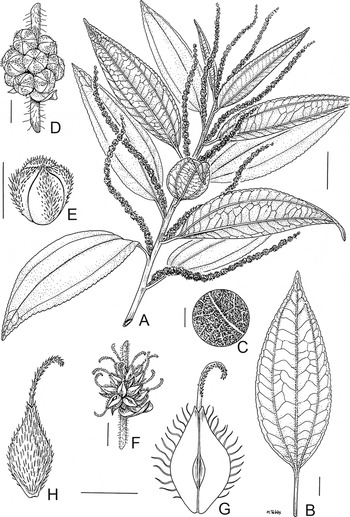
This paper provides a comprehensive reassessment of both the distinction between Boehmeria and Pouzolzia and the correct position of the taxon hitherto known as B. rugulosa (Fig. 1). This is based on the following studies: phylogeny and molecular systematics of Boehmeria (N. Acharya); fruit anatomy (T. I. Kravtsova); general morphology and taxonomy (C. M. Wilmot-Dear & I. Friis).
Pouzolzia rugulosa (Wedd.) Acharya & Kravtsova: A, habit with inflorescences; B, leaf; C, leaf undersurface; D, cluster of male flowers; E, male flower; F, cluster of female flowers and young fruits; G, fruiting perianth (diclesium). H, fruiting perianth of P. sanguinea var. fulgens for comparison with that of P. rugulosa. Scale bar for A, 20 mm; B, 10 mm; C–F, 1 mm; G–H (horizontal line between the two drawings), 1 mm. A, D, E, G from Parker s.n. (13 i 1920, K); B–C from Billet & Léonard 6658 (K); F from KEKE 229 (K); H from Clarke 18869A (K). Drawn by Margaret Tebbs.

Results and Discussion
Fruit anatomy
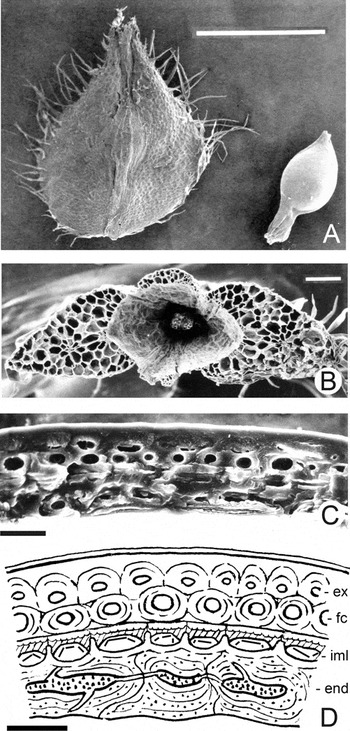
An examination of the fruit anatomy in the taxon hitherto known as Boehmeria rugulosa has revealed that it conforms in most respects to Pouzolzia rather than Boehmeria. The wings on the fruit, formed from the perianth, together with the pericarp with a silicified exocarp and a fibrous outer mesocarp layer, are all characters of Pouzolzia (Kravtsova, Reference Kravtsova2007: 17). However, the fruits are slightly anomalous because of the presence of what appears to be crystals, or silica bodies of similar appearance, in the innermost mesocarp layer. Morphological examination of mature fruits shows an easily detachable perianth and a shiny outer pericarp surface diagnostic for Pouzolzia. Figure 2 shows details of its fruit structure. Figure 2A (fruiting perianth, and pericarp after removal of perianth) shows the broad marginal fruit wings and the shiny outer surface of the exocarp. Figure 2B (cross-section of perianth) shows the fruit wings clearly derived from expansion of middle layers of the perianth. Figure 2C–D (cross-sections of part of the pericarp) show the silicified exocarp, the fibre-like outer mesocarp layer and the anomalous innermost mesocarp layer.
Details of fruit anatomy in Pouzolzia rugulosa: A, SEM micrograph of fruit in lateral view with fruiting perianth (left) and without (right); B, SEM micrograph of fruiting perianth in transverse section, pericarp removed; C, SEM micrograph of transverse section of part of pericarp with the innermost mesocarp layer and endocarp somewhat compressed (section obtained using freezing microtome); D, drawing of part of the pericarp in transverse section with all layers uncompressed (section obtained using freezing microtome) – ex, exocarp; fc, fibre-like cells (outer layer of mesocarp); iml, innermost mesocarp layer; end, endocarp. Scale bar for A, 1 mm; B, 100 μm; C–D, 10 μm.

Gross morphology
Grierson & Long (Reference Grierson and Long1983: 125) had already noted the similarity in general appearance and in leaf characters between the species hitherto known as Boehmeria rugulosa and some forms of Pouzolzia sanguinea (Blume) Merr. In the revision of the Old World species of Pouzolzia (Wilmot-Dear & Friis, Reference Wilmot-Dear and Friis2006) Boehmeria rugulosa was not transferred to Pouzolzia because its stigma is persistent, characteristic of Boehmeria (unusual but not unknown in Pouzolzia). However, its similarity to the sympatric Pouzolzia sanguinea, especially to P. sanguinea var. fulgens (Wedd.) Hara, in general habit and especially in the size, shape, marginal teeth and indumentum of the leaves was highlighted (Wilmot-Dear & Friis, Reference Wilmot-Dear and Friis2006: 23 & 30). Pouzolzia sanguinea var. fulgens has frequently been confused with Boehmeria rugulosa in herbaria. Both taxa have the same general habit and discolorous shiny-silky leaves. Boehmeria rugulosa is distinguishable from some forms of Pouzolzia sanguinea var. fulgens only by its winged fruiting perianth with glabrous fruit faces with a single prominent rib, and by its leaves with two kinds of hairs and without discernible upper lateral veins (Wilmot-Dear & Friis, Reference Wilmot-Dear and Friis2006: 30). The external fruit morphology of Boehmeria rugulosa and Pouzolzia sanguinea var. fulgens is compared in Fig. 1G–H.
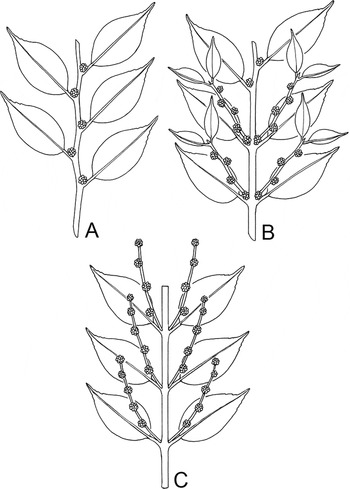
Weddell (Reference Weddell1856, Reference Weddell and de Candolle1869), Blume (Reference Blume1857) and later authors all placed the taxon hitherto known as Boehmeria rugulosa in Boehmeria, partly because of its persistent stigma but probably also because of its inflorescence architecture. Flower clusters in Boehmeria rugulosa are borne along long pendent side-branches; these axes are mostly entirely leafless, but on some specimens occasional clusters are subtended by a minute leaf with a clearly distinguishable lamina. This inflorescence type commonly occurs in Boehmeria but had not hitherto been seen in Pouzolzia. Variation in inflorescence architecture within and between Pouzolzia and Boehmeria is discussed by Wilmot-Dear & Friis (Reference Wilmot-Dear and Friis1996: 14; Reference Wilmot-Dear and Friis2006: 9) and three of the main types of inflorescence are shown in Fig. 3. Both genera can have flower clusters in the axils of unmodified leaves which are of approximately the same size as normal leaves (Fig. 3A). Both genera can also have clusters arranged along somewhat modified axes which are almost leafless along most of their length but with normal-sized or highly reduced leaves either scattered along the axis or (as in Fig. 3B) clustered at its apex, or a combination of both. This inflorescence architecture is common in Boehmeria but rare in Pouzolzia. Highly modified (often pendent) entirely leafless axes (Fig. 3C), where flower clusters are subtended only by bracts, are common in Boehmeria but were hitherto unknown in Pouzolzia. However, Pouzolzia sanguinea var. sanguinea and var. fulgens are unusual for Pouzolzia: their inflorescence architecture commonly conforms to Fig. 3A but in some Himalayan material the flower clusters are borne along almost leafless pendent terminal and lateral axes of the type shown in Fig. 3B or even intermediate between that and Fig. 3C. With regard to this character, there is a continuous range of intermediates between this variant and forms with clusters in axils of normal leaves. (Those variants with concolorous leaves were originally described as Boehmeria nepalensis Wedd. and later reduced to Pouzolzia sanguinea var. nepalensis (Wedd.) Hara (Reference Hara, Hara and Ohashi1975: 28). The many intermediate forms made the maintenance of this taxon untenable, resulting in Pouzolzia sanguinea var. nepalensis being reduced to synonymy under P. sanguinea var. sanguinea by Wilmot-Dear & Friis (Reference Wilmot-Dear and Friis2006: 25).) Boehmeria rugulosa behaves rather similarly to Pouzolzia sanguinea, its inflorescence-bearing axes being mostly of the type shown in Fig. 3C but occasionally like that of Fig. 3B.
Three of the main types of inflorescence architecture seen in Pouzolzia and Boehmeria: A, flower clusters in the axils of unmodified leaves; B, flower clusters on somewhat modified partly leafless axes; C, flower clusters on completely modified axes with completely reduced leaves. Drawn by Margaret Tebbs.

Molecular analysis
Molecular data are in harmony with a position of Boehmeria rugulosa in Pouzolzia. A phylogenetic analysis of the ITS2-region sequence of c.40 taxa of Old and New World Boehmeria, with three species of Pouzolzia and one of Oreocnide as outgroups (Acharya, Reference Acharya2001), showed B. rugulosa clearly nested within a clade which included the three species of Pouzolzia. This clade (bootstrap value 89) is clearly distinct from all the other species traditionally referred to Boehmeria.
Conclusion
This correlation of molecular data, morphology and fruit anatomy overwhelmingly suggests that Boehmeria rugulosa should be placed in Pouzolzia. It is, therefore, formally transferred below.
The Position of Pouzolzia rugulosa within the Genus
Provisionally, we believe that the morphological similarities of Pouzolzia rugulosa place it within the small group of species with serrate leaves (Wilmot-Dear & Friis, Reference Wilmot-Dear and Friis2006: 15). The fruiting perianth of Pouzolzia rugulosa is similar to that of another tree-like species, Pouzolzia australis (Endl.) Friis and Wilmot-Dear from the small Oceanian islands of Lord Howe, Norfolk and Kermadec. This species also has a prominent wing on either side and a large rib on each face of the fruiting perianth. However, Pouzolzia rugulosa is much more similar in leaf morphology to P. sanguinea, especially the almost sympatric P. sanguinea var. fulgens, than it is to P. australis. Following the arrangement of taxa in Wilmot-Dear & Friis (Reference Wilmot-Dear and Friis2006) it is, therefore, most appropriately placed between Pouzolzia niveotomentosa W.T.Wang and P. sanguinea. A final decision on the relationships within this whole group of serrate-leaved, woody taxa will have to wait until a phylogeny for the genus Pouzolzia is available.
The key of Wilmot-Dear & Friis (Reference Wilmot-Dear and Friis2006) is here revised to include Pouzolzia rugulosa as follows (only the relevant (first) section of the key is presented here).
1a. Margin of at least some leaves toothed 2.
1b. Leaf margin always entire, never toothed 11. (not included)
2a. Leaves discolorous; lower surface completely obscured by dense pale covering of either silky adpressed minute hairs (c.0.1 mm long) or tangled fine hairs 3.
2b. Leaves not discolorous; lower surface glabrous or if sparsely to abundantly hairy then hairs spreading or adpressed but longer (≥ 0.2 mm long) and surface of lamina always clearly visible 6. (not included)
3a. Indumentum on lower surface white or greyish, hairs tangled; male flowers 3- or 4-merous 4.
3b. Indumentum on lower surface pale, silky, usually shiny, with hairs closely adpressed, straight and all lying in ± same direction (longer spreading hairs may also be present on main veins); male flowers 4-merous 5.
4a. Male flowers 3-merous, fruiting perianth with a rib ≤ 0.1 mm deep running along each margin; petiole only up to 0.1 × lamina length; indumentum of lamina bright white, concealing tertiary veins and often even main veins, without short erect hairs projecting through thick layer of tangled indumentum; upper veins only 2(–3) either side, leaves not dimorphic nor thickly chartaceous (China) 2. P. niveotomentosa
4b. Male flowers 4-merous, fruiting perianth with distinct wing c.0.3 mm wide along each margin; at least some petioles 0.3–0.7 × lamina length; indumentum of lamina often greyish, ± absent from main veins and often also from fine reticulation, with short erect hairs always present projecting through layer of tangled indumentum; upper veins 3–6 either side, leaves often clearly dimorphic and thick-chartaceous (Lord Howe, Kermadec and Norfolk Is.) 1. P. australis
5a. Upper lateral veins absent (only basal lateral vein-pair present), lower leaf surface with two kinds of dense adpressed hairs, short weak and long silky; leaf margin always crenate; ♀ perianth clearly winged even when young; fruiting perianth dorsiventrally flattened with a broad papery wing c.0.5 mm wide along each margin and with sparse long weak hairs along wing margin, fruit surface glabrous 2.1. P. rugulosa
5b. Upper lateral veins 1–3 either side (in addition to basal lateral vein-pair); lower leaf surface with short shiny-silky hairs; leaf margin often markedly serrate; ♀ perianth with several longitudinal ribs at maturity; fruiting perianth scarcely flattened with at most a slight marginal rim, rim and whole fruit surface covered with dense short silky hairs 5*
5*a. Upper leaf surface always glabrous (Indian subcontinent, SW China) 3. (c). P. sanguinea var. fulgens
5*b. Upper leaf surface always with sparse to abundant fine adpressed hairs (Indonesia: Sumatra) 3. (d). P. sanguinea var. cinerascens
The remainder of the key remains as in Wilmot-Dear & Friis (Reference Wilmot-Dear and Friis2006: 11–15).
Description and Formal Taxonomy
The discussion and other information provided below follows the format of Wilmot-Dear & Friis (Reference Wilmot-Dear and Friis2006).
2.1. Pouzolzia rugulosa (Wedd.) Acharya & Kravtsova, comb. nov.Figs 1,2,4.
Urtica rugosula [sic] Wall., Num. List 4597 (1831), nom. nud. – Boehmeria rugulosa Wedd., Arch. Mus. Hist. Nat. 9: 378 (1856), excluding citation of name and original material of Urtica venosa Wall., nom. nud. – Type: Nepal (see Typification and original material below), Wallich 4597 (lecto K-W!, designated here; iso BR!, G!, K!, M!).
Boehmeria nervosa Madden, J. Asiat. Soc. Bengal 17(1): 403 (1848), nom. nud., cited by Weddell. Original material from India, Uttar Pradesh, Kumaon; no specimen cited.
Large shrub or small tree 3–10 m high; monoecious; ultimate stems c.1.3 mm diameter with abundant very fine very short (c.0.1 mm long) pale adpressed hairs. Stipules fused almost to apex, narrowly ovate-triangular, 5–6 × c.1.5 mm, chartaceous, densely hairy on midrib, sparsely hairy or glabrous elsewhere. Leaves alternate, not dimorphic, almost symmetrical, narrowly elliptic or elliptic-ovate, often long, (3–)10–16 × (1–)4–6 cm, 2.5–3 times as long as wide; margin shallowly and indistinctly crenate with 15–30 teeth 0.5–1 mm deep and (1.5–)3–4 mm broad, at the extreme base almost entire; apex long-acute to indistinctly short-acuminate, base very slightly asymmetrically cuneate to narrowly rounded; basal veins extending almost to apex, finely impressed above, finely prominent beneath, no upper lateral veins distinguishable; coarser tertiary venation more or less scalariform, this and fine reticulation finely prominent; chartaceous or thinly coriaceous, upper surface dark green, glabrous (cystoliths often large and dense), lower surface with two kinds of adpressed hairs, short soft weak hairs so dense as to completely obscure surface and abundant longer ones giving a shiny-silky appearance to leaf; petiole variable but short relative to lamina, 0.1–0.2 × lamina length. Inflorescence clusters arranged along specialised axes 10–20 cm long, one in each axil, occasionally up to 3 male axes from each axil, each axis leafless, or occasionally with one or two reduced leaves with tiny lamina c.1 cm long, unisexual or occasionally with a few male flowers in some female clusters, clusters spaced 2–10 mm apart; 25–30 in number (–40 in female) per axis; clusters 2–3 mm diameter with crowded flowers, in male 5–10(–20), in female 20–30 in number; modified stipules subtending each cluster conspicuous, ovate-triangular and very broad with broadly acute apex, 1.5–2 × 2–2.5 mm; bracts also broad but fairly inconspicuous, oblong to ovate or obovate, c.0.5 × 0.5 mm. Male flowers 4-merous, subsessile, said to be greenish yellow; mature buds relatively large, 1.2–1.4 mm, depressed-globose without dorsal appendages, pubescent as on the leaves. Female flowers narrowly oblong-ovoid, 1 × 0.2–0.3 mm, sparsely hairy; stigma 1.5–2.5 mm. Fruiting perianth 1.5–1.8 × 0.5–1.2 mm, with 2 distinct apical teeth and markedly laterally flattened into broad flattened papery wing either side of narrow scarcely flattened middle region which contains the fruit, middle region ornamented with 3–4 prominent or indistinct longitudinal facial ribs; most of perianth surface glabrous, wing margin with sparse long weak hairs; perianth parenchymatous in rib and wing regions, these outgrowths being formed by large cells (especially large in wings) of the mesophyll (middle layers), rounded in cross-section and with rather thin, slightly lignified, pitted walls. Fruit without the persistent perianth (i.e. the pericarpium sensu Spjut, Reference Spjut1994 and Kravtsova et al., Reference Kravtsova, Friis and Wilmot Dear2003; this structure has often been referred to in the literature as an ‘achene’), ovoid and scarcely flattened, c.0.5 × 0.3 mm, fawn-coloured, with abruptly narrowed apical portion and with short basal stipe (0.05 mm); pericarp completely sclerified, thin, 25–28 μm thick, 4-layered with all layers flattened.
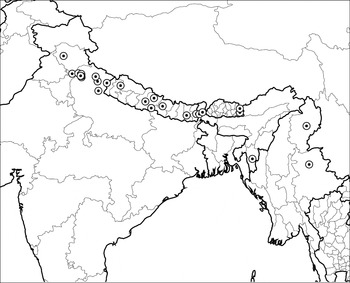
Distribution. Lower slopes of the Himalayan region: northern India (Himachal Pradesh, Uttar Pradesh, Sikkim, West Bengal, Mizoram [part of old Assam]), Nepal, China (Tibet), Bhutan and Burma. Fig. 4.
Distribution of Pouzolzia rugulosa. The records are based on the specimens cited in the text and, for the record from Bhutan, information in Grierson & Long (Reference Grierson and Long1983).

Habitat. Subtropical and warm broadleaved forest and on open or disturbed ground at forest margins, often near rivers; 300–1900 m.
Conservation status. Widespread, but presumably not common (not many collections known), mostly in vulnerable habitats such as montane forest. Records of Pouzolzia rugulosa are often from disturbed sites (clearings, forest margins), evidence that the species may persist in these vulnerable habitats. Not regarded as threatened, probably Least Concern (LC) (IUCN, 2001).
Discussion. Pouzolzia rugulosa is most similar vegetatively to P. sanguinea var. fulgens and is distinguished by leaves with only basal veins and fruit glabrous with broad marginal wings. Its habit and general appearance is similar to that of many Boehmeria species but no Old World Boehmeria taxon so far known has leaves with a similar shiny-silky indumentum.
Normal stem-leaves are usually at least 10 cm long, much larger than the occasional reduced leaves found on the inflorescence-bearing axis; stem-leaves measuring as little as 3 cm were observed occasionally on stunted shrubs.
Specimens examined. India. Himachal Pradesh: Nahan, Jaquemont 2513 (P); Chamba, Gola, Wazirat, Bhatiyat, 13 i 1920, Parker s.n. (K); Kangra Distr., 6 ix 1901, Ram in Herb. Lace s.n. (E); Simla, 31 i 1889, Watt 2861 (E). Uttar Pradesh: Bunasur, 1844, Edgeworth 171 (K); Dehra Dun, Smythies 155 (E); ibid., Wallich 4602B (K-W); Garhwal, Ganga R., Devaprayag, 21 viii 1975, Billet & Léonard 6658 (BR, K); Siwalik and Jaunsar, Lachiwala, 1922, Kaul 107 (K, UC); Siwilik and Jaunsar, Lachhiwala, 6 vi 1922, Shama 106 (G); Siwilik and Jaunsar, Kalsi, 3 iv 1922, Shama 109 (G); Kumaon, Chowpha, Arosa 50022 (CAL); Kumaon, Surju R., Strachey 21 (K); Kumaon, Thomson s.n. [‘515’] (L, M); Mussoorie, Sainji, Stewart 14563 (UC); ibid., 13 vii 1944, Stewart 21666 (K); Mussoorie, xii 1915, Anderson s.n. (E); ibid., 1839, Hugel s.n. (L, M); ibid., 31 viii 1930, Pooraiah s.n. (E); Rajpur, vii 1931, Venkateswaran s.n. (F); Rajpur, 8 ix 1929, Goel s.n. (BR). Sikkim: Kalimpung, Gamble 238A (K); Sedeng, iii 1875, Gamble 1190A (K); Rangpo, Gupta 283 (CAL). Sikkim/West Bengal: No further locality, 29 ix 1904, Haines 993 (K); Kali Valley, Balwakote, 1 ix 1900, Duthie s.n. (K). West Bengal: Darjeeling, Princhkilla, 14 xii 1876, Clarke 317117A (K); Darjeeling, Chombuttee, 14 xii 1876, Clarke 317117F (K); Darjeeling, Tista, 2 ix 1923, Cowan s.n. (E); ibid., 7 x 1902, Lace 2391 (E); Darjeeling, Rungeet, 5 ii 1912, Ribu s.n. (E); Darjeeling, Griffith 4563 (K); ‘Bengal’, NW part, boundary with Nepal, Huter 428 (K). Mizoram: Lushai Hills, Lakhu co., viii 1930, Parry 1349 (K).
Nepal. Tagring, 27 xi 1970, Dobremez 662 (G); Daman, 12 viii 1971, Dobremez 756 (G); Tatopan, 28 vii 1996, Hoshino 9662055 (E); Tamur R. Valley, Chipwa, 4 ix 1989, Kew-Edinburgh-Kathmandu Expedition KE 229 (K); Arun Valley, 15 x 1991, Long 829 (E); Mustang & Myagdi Div., 26 viii 1994, Mikage 9455374 (E); Gorkha Distr., 22 vii 1994, Suzuki 9455081 (E); Baijang Distr., 24 viii 1991, Suzuki 9192540 (E); Malemchi, 20 ix 1975, Stainton 7490 (E); Marsiandi, 20 viii 1984, Stainton 8860 (E); Luthor, Rapti Valley, 26 viii 1967, Williams 8289 (K). Nepal?/Sillet? (see note below): 1821, Wallich 4597 (BR, G, K, K-W, M).
China.Xizang (Tibet): Samlung, Monyul Prov., 5 xi 1938, Ludlow 7090 (BM).
Bhutan. No further locality, Griffith 2584 (G, K; K sheet also has additional no. 324).
Burma.Kachin: Mytkina, Kachin Hills, Toppin 4133 (E). Shan: Maymyo Distr., Laughing Water, 13 iv 1914, English s.n. (E).
Typification and original material
We have chosen a specimen of Wallich 4597 as the lectotype in preference to the other collections cited in Weddell's protologue because Wallich founded his nomen nudum, Urtica rugosula [sic], on this collection (Wallich, Reference Wallich1831). Weddell corrected Wallich's epithet to rugulosa and cited this collection number. Of the duplicates of Wallich 4597 we have chosen the one now in K-W because this was the one which Wallich retained when he distributed his duplicates, it is a representative specimen and it has been annotated in what appears to be Weddell's hand. The place of origin of Wallich 4597 is indicated in Wallich's catalogue and on the sheet at K-W as ‘Nepal?/Sillet?’. In this connection, Sillet is Sylhet in NE Bangladesh, which seems the less likely of the two because no other collections have been seen from this area; it seems more likely that the specimen was collected during Wallich's trip to Nepal in 1820–21.
The nomen nudum Urtica venosa and the collection Wallich 4602B were also cited by Weddell, but the material is in fact a specimen of Boehmeria polystachya Wedd.
Records from Bhutan
The only material seen from Bhutan (Griffith 2584) lacked locality data, but Grierson & Long (Reference Grierson and Long1983: 125) cite the following localities from Bhutan: Deothang distr., Tsalari Chu; Tashigang distr., Lunten Zampa.
Acknowledgements
The authors are indebted to the Directors and Curators of the herbaria from which the material used for this study was borrowed. Figures 1 and 3 were excellently prepared by Ms Margaret Tebbs, Royal Botanic Gardens, Kew. SEM studies were carried out with the technical assistance of L. A. Kartseva, Komarov Botanical Institute, St Petersburg.