INTRODUCTION
It has been proposed that actively using two languages increases cognitive reserve among bilinguals and may delay the emergence of dementia (Fischer & Schweizer, Reference Fischer and Schweizer2014; Perani & Abutalebi, Reference Perani and Abutalebi2015). In a retrospective review of patient charts, Bialystok, Craik, and Freedman (Reference Bialystok, Craik and Freedman2007) found that among Canadian bilinguals, the onset of dementia occurred on average 4.1 years later than dementia onset among English-speaking monolinguals. However, this sample consisted of mostly European post-WWII immigrants with exceptional life stories and thus, their performance may not necessarily be generalizable to Canadian bilinguals (Chertkow et al., Reference Chertkow, Whitehead, Phillips, Wolfson, Atherton and Bergman2010). Alladi et al. (Reference Alladi, Bak, Duggirala, Surampudi, Shailaja, Shukla and Kaul2013) studied an Indian bilingual sample and reported a 4.5-year delay in the onset of Alzheimer’s disease (AD), frontotemporal, and vascular dementia. In addition, they found trends toward a delay in the onset of Lewy body and mixed dementias.
In a more recent investigation, Woumans et al. (Reference Woumans, Santens, Sieben, Versijpt, Stevens and Duyck2015) found similar results even after controlling for potentially confounding variables such as sex, education, occupation, and initial Mini Mental-State Examination (MMSE) scores. Chertkow et al. (Reference Chertkow, Whitehead, Phillips, Wolfson, Atherton and Bergman2010) in Canada and Kavé, Eyal, Shorek, and Cohen-Mansfield (Reference Kavé, Eyal, Shorek and Cohen-Mansfield2008) in Israel demonstrated that the greater number of languages spoken by participants was associated with delays in cognitive decline. However, in the Canadian sample, this advantage was only observed for native French speakers and Canadian immigrants. Native English-speaking bilinguals showed no benefit to knowing two or more languages. The authors explained these inconsistent findings between the English and French native groups by the possible influence of other uncontrolled variables (genetics, socioeconomic status, and stress). Additionally, it is relevant to emphasize that in the study by Chertkow et al. (Reference Chertkow, Whitehead, Phillips, Wolfson, Atherton and Bergman2010) the multilingual group that showed an average 5-year delay in age of AD diagnosis compared to monolinguals, was a subgroup of a larger sample in which the bilingual advantage was not found longitudinally.
Studies investigating cognitive differences between bilinguals and monolinguals identify executive control as the most prominent cognitive domain affording an advantage to bilinguals (Bialystok, Craik, Klein, & Viswanathan, Reference Bialystok, Craik, Klein and Viswanathan2004; Bialystok, Craik, & Ruocco, Reference Bialystok, Craik and Ruocco2006; Bialystok, Craik, & Ryan, Reference Bialystok, Craik and Ryan2006; Bialystok, Craik, Green, & Gollan, Reference Bialystok, Craik, Green and Gollan2009; Bialystok & Poarch, Reference Bialystok and Poarch2014). Typically, bilinguals show less interference than monolinguals in tasks with salient conflict such as the Simon task (Bialystok et al., Reference Bialystok, Craik, Klein and Viswanathan2004; Salvatierra & Rosselli, Reference Salvatierra and Rosselli2010), the Stroop task (Bialystok, Craik, & Luk, Reference Bialystok, Craik and Luk2008), and the Flanker task (Costa, Hernández, & Sebastián-Gallés, Reference Costa, Hernández and Sebastián-Gallés2008; Costa, Hernández, Costa-Faidella, & Sebastián-Gallés, Reference Costa, Hernández, Costa-Faidella and Sebastián-Gallés2009).
Similar to the slower rates of progression to dementia in bilinguals, the superior performance of bilinguals in some executive control tasks remains controversial (for reviews, see Calvo, García, Manoiloff, & Ibáñez, Reference Calvo, García, Manoiloff and Ibáñez2016; Hilchey & Klein, Reference Hilchey and Klein2011; Paap, Johnson, & Sawi, Reference Paap, Johnson and Sawi2015). Certain studies indicated equal performance of bilingual and monolingual children and adults (Duñabeitia et al., Reference Duñabeitia, Hernández, Antón, Macizo, Estévez, Fuentes and Carreiras2014; Paap & Greenberg, Reference Paap and Greenberg2013), or no benefit of degree of bilingualism in tasks of inhibitory control (von Bastian, Souza, & Gade, Reference von Bastian, Souza and Gade2016). To reconcile discrepant results, several authors have suggested that the effects of bilingualism may be restricted to specific tasks of executive control in a limited group of bilinguals (Paap & Greenberg, Reference Paap and Greenberg2013; von Bastian et al., Reference von Bastian, Souza and Gade2016).
Among 1,067 Spanish–English-speaking elderly individuals tested over 23 years, memory and executive function were better in bilinguals compared to monolinguals at baseline, although rates of progression to dementia were equivalent in bilinguals and monolinguals (Zahodne, Schofield, Farrell, Stern, & Manly, Reference Zahodne, Schofield, Farrell, Stern and Manly2014). Activities such as speaking more than one language (Perani & Abutalebi, Reference Perani and Abutalebi2015) have been found to lessen the cognitive decline that occurs with aging (Borsa et al., Reference Borsa, Perani, Della Rosa, Videsott, Guidi, Weekes and Abutalebi2018). These effects are assumed to reflect a “cognitive reserve” (Stern, Reference Stern2009), which has been defined as a discrepancy between observed behavioral and/or cognitive functioning and the expected (reduced) levels shown with typical aging (Barulli & Stern, Reference Barulli and Stern2013).
The results from Zahodne et al. (Reference Zahodne, Schofield, Farrell, Stern and Manly2014) suggest that bilingualism is associated with higher cognitive function in individuals who are cognitively normal and in the early stages of abnormal aging. Ultimately, however, it does not appear to affect progression rates to dementia. In support of this concept, other studies demonstrated that higher cognitive reserve (evaluated by proxy measures, including educational level and leisure activities) was associated with later onset of AD, but faster progression rates thereafter (Helzner, Scarmeas, Cosentino, Portet, & Stern, Reference Helzner, Scarmeas, Cosentino, Portet and Stern2007; Scarmeas, Albert, Manly, & Stern, Reference Scarmeas, Albert, Manly and Stern2006; Scarmeas, Levy, Tang, Manly, & Stern, Reference Scarmeas, Levy, Tang, Manly and Stern2001; Stern, Tang, Denaro, & Mayeux, Reference Stern, Tang, Denaro and Mayeux1995).
Some studies (Chertkow et al., Reference Chertkow, Whitehead, Phillips, Wolfson, Atherton and Bergman2010; Gollan, Salmon, Montoya, & Galasko, Reference Gollan, Salmon, Montoya and Galasko2011) indicate that the delay in dementia onset among bilinguals is related to certain demographic variables. As stated above, Chertkow et al. (Reference Chertkow, Whitehead, Phillips, Wolfson, Atherton and Bergman2010) found that the protective effect of bilingualism relates to immigrant status, and Gollan et al. (Reference Gollan, Salmon, Montoya and Galasko2011) reported that the bilingual advantage was only seen in participants with low education level. However, other research showed that the protective influence of bilingualism is not moderated by immigrant status or level of education (Alladi et al., Reference Alladi, Bak, Duggirala, Surampudi, Shailaja, Shukla and Kaul2013). Moreover, Lawton, Gasquoine, and Weimer (Reference Lawton, Gasquoine and Weimer2015) found that the mean age of dementia diagnosis was not significantly different for bilinguals, monolinguals, U.S. born Hispanics, or Hispanic-American immigrants. Therefore, questions still remain about the effect of bilingualism in delaying dementia onset and the relevance of other variables in the interaction between linguistic experience and cognitive decline.
Despite having greater metabolic deficits, lifelong bilinguals with AD outperformed monolinguals with AD in short- and long-term verbal memory as well as in visuospatial tasks (Perani et al., Reference Perani, Farsad, Ballarini, Lubian, Malpetti, Fraccheti and Abutalebi2017). Other studies (Kerrigan, Thomas, Bright, & Filippi, Reference Kerrigan, Thomas, Bright and Filippi2017; Luo, Craik, Moreno, & Bialystok, Reference Luo, Craik, Moreno and Bialystok2013) provide further evidence that bilingualism confers an advantage on spatial working memory in young bilinguals. On verbal memory tasks, Ransdell and Fischler (Reference Ransdell and Fischler1987) reported that native English-speaking bilingual and monolingual college students had equivalent performance on four verbal memory tasks, although bilinguals were slower than monolinguals.
Contrary to Ransdell and Fischler’s (Reference Ransdell and Fischler1987) findings, Kaushanskaya and Marian (Reference Kaushanskaya and Marian2009) found that early experience with two linguistic systems facilitated bilinguals’ ability to acquire novel words. This advantage was reported in young adults who were native English speakers and had experience with two phonologically and orthographically similar languages (e.g., English and Spanish) and two phonologically and orthographically different languages (e.g., English and Mandarin Chinese). Bak, Nissan, Allerhand, and Deary (Reference Bak, Nissan, Allerhand and Deary2014) described that elderly bilinguals, who acquired their second language in adulthood, performed significantly better in their eighth decade than was predicted from their baseline cognitive abilities at 11 years old. They observed the strongest effects of bilingualism on general intelligence, verbal fluency, and reading.
In memory tasks, the benefit of early bilingualism was only noted in those with high childhood intelligence. Therefore, previous memory research shows evidence of a bilingual advantage in some tasks for elderly bilinguals, even in cases of abnormal aging, and advantages and disadvantages for verbal memory in young bilinguals.
Taken together, there is contradictory evidence about the advantage of bilingualism in the delay of cognitive decline (for a systematic review, see Mukadam, Sommerlad, & Livingston, Reference Mukadam, Sommerlad and Livingston2017), despite several findings of a bilingual advantage in certain tasks of executive control (Bialystok et al., Reference Bialystok, Craik, Klein and Viswanathan2004, Reference Bialystok, Craik and Luk2008; Costa et al., Reference Costa, Hernández and Sebastián-Gallés2008, Reference Costa, Hernández, Costa-Faidella and Sebastián-Gallés2009). Few studies have analyzed the importance of bilingualism in memory, one of the most sensitive cognitive functions related to abnormal aging.
The Current Study
The cognitive advantage of bilingualism has been mainly reported in tasks of cognitive control, including attention control (Bialystok, Reference Bialystok2017) and inhibitory control (Green & Abutalebi, Reference Green and Abutalebi2013). As compared to monolinguals, bilinguals have greater cognitive control, likely from the active monitoring of conflict between two languages and of inhibitory processes, which involve: (1) selecting the correct language from two competing options, (2) keeping one language “on” and the other “off,” (3) suppressing interference of the inactive language, and (4) continuously switching between both languages (Kroll, Bobb, & Hoshino, Reference Kroll, Bobb and Hoshino2014).
Bilinguals may demonstrate an advantage in memory tasks due to the development of skills for inhibiting interference from other sources (i.e., a second language). This skill is acquired because bilinguals cannot “shut off” one language and function as monolinguals (Abutalebi & Green, Reference Abutalebi and Green2007; Kroll, Dussias, Bogulski, & Valdés Kroff, Reference Kroll, Dussias, Bogulski and Valdés Kroff2012). Speaking two languages has been associated with improved cognitive control processes such as goal maintenance, conflict monitoring, interference suppression, salient cue detection, selective response inhibition, task disengagement, task engagement, and opportunistic planning (Green & Abutalebi, Reference Green and Abutalebi2013).
The purpose of the present study was to compare the performance of American Spanish–English bilinguals to English or Spanish monolinguals on a verbal and a nonverbal memory task. We focused on a cohort diagnosed with amnestic mild cognitive impairment (aMCI) to investigate the effect of bilingualism on different memory abilities in individuals who are at risk of developing dementia. The psycholinguistic literature suggests the possibility that interference suppression may be one of the inhibitory mechanisms used by bilinguals to control their two competing languages (Green & Abutalebi, Reference Green and Abutalebi2013).
Because bilingual speakers are accustomed to handling two languages as well as managing and resolving language competition, we predicted that bilinguals would outperform monolinguals on memory tasks such as paired word list learning, in which successful performance requires inhibitory processes to avoid concurrent word list interference (Friedman & Miyake, Reference Friedman and Miyake2004). The interference suppression as a mechanism underlying the bilingual advantage has been related to inhibitory processes on executive function measures (i.e., Stroop Color and Word Test) (Bialystok et al., Reference Bialystok, Craik and Luk2008; Hernández, Costa, Fuentes, Vivas, & Sebastián-Gallés, Reference Hernández, Costa, Fuentes, Vivas and Sebastián-Gallés2010). In the present study, we expected the Stroop Color Word (SCW) scores to correlate with any bilingual advantage in memory interference scores using a word list learning test.
We used a novel verbal memory cognitive stress test, the Loewenstein-Acevedo Scales for Semantic Interference and Learning (LASSI-L). The LASSI-L is a sensitive test of proactive semantic interference (PSI; observed when old verbal learning interferes with new learning of semantically related information), retroactive semantic interference (RSI; observed when new verbal learning interferes with old learning of semantically related material), and, uniquely, the failure to recover from PSI (frPSI). MCI participants have evidenced deficits in the frPSI effects, which is highly related to reductions of volume and cortical thickness in AD prone regions (Loewenstein, Curiel, Wright, et al., Reference Loewenstein, Curiel, Wright, Sun, Alperin, Crocco and Duara2017; Loewenstein, Curiel, DeKosky, et al., Reference Loewenstein, Curiel, DeKosky, Rosselli, Bauer, Grieg-Custo and Duara2017). To evaluate the underpinnings of cognitive differences between bilinguals and monolinguals, we examined the relationships between MRI measures of regional brain volumes and cognitive performance.
Our a priori hypothesis was that bilinguals would outperform monolinguals on initial learning of the LASSI-L and would exhibit superior recovery from PSI effects (recall of the second list of LASSI-L targets). This recovery would be primarily related to superior inhibitory control. In cognitive stress tests (i.e., LASSI-L), the presentation of a second list of to-be-learned items adds additional demands and requires better monitoring skills by requiring the inhibition of the first list (i.e., suppression of PSI) while the second list is learned and later recalled (Bialystok, Reference Bialystok2011; Costa et al., Reference Costa, Hernández, Costa-Faidella and Sebastián-Gallés2009).
Therefore, we predicted that the benefits of bilingualism would manifest in tests subject to PSI, rather than RSI. We expected bilinguals to perform better on cued recall (because of higher monitoring skills of proactive interference) compared to free recall. Cued memory is assumed to be encoded concurrently with cued presentation and independently of subsequent answer retrieval attempts (Rickard & Pan, Reference Rickard and Pan2018). We also explored the presence of a bilingual advantage on a nonverbal memory task, although this task did not have an interference condition. Finally, we evaluated the influence of a quantitative index of the degree of bilingualism on memory task performance.
Since MCI and dementia are classified as different stages of the same disorder, studying bilingual MCI participants offers an opportunity to understand the possible advantages of bilingualism before dementia onset (Kowoll, Degen, Gladis, & Schröder, Reference Kowoll, Degen, Gladis and Schröder2015; Ossher, Bialystok, Craik, Murphy, & Troyer, Reference Ossher, Bialystok, Craik, Murphy and Troyer2012). A unique aspect of this investigation was to determine the extent to which the bilinguals’ purported advantage on verbal memory tasks would relate to brain biomarkers of abnormal aging, such as volumetric reductions in the hippocampus and entorhinal cortex. These two regions in the medial temporal lobes are particularly vulnerable in early AD.
Previous models of cognitive reserve report that upon comparison of bilinguals and monolinguals with equal (or less) cognitive decline, bilinguals typically exhibit increased cortical atrophy (Schweizer, Ware, Fischer, Craik, & Bialystok, Reference Schweizer, Ware, Fischer, Craik and Bialystok2012). It was expected that the effects of brain atrophy in bilinguals with aMCI would have less adverse cognitive effects compared to monolinguals with comparable levels of atrophy.
Notably, this study included a culturally homogeneous sample of Spanish–English bilinguals. These individuals were exposed to Spanish since birth, grew up with Spanish-speaking parents, and were living in Miami, a Spanish–English bilingual city within the United States.
METHOD
Participants
Sixty-seven participants (73% female) diagnosed with aMCI from the 1Florida Alzheimer’s Disease Research Center (ADRC) in Miami Beach, Florida were included in this Institutional Review Board (IRB) approved study (Mount Sinai Medical Center-IRB). Forty-two individuals were Spanish–English bilinguals (74% female, immigrants to the United States from Latin American countries) and 25 were monolinguals (72% female). Of the 25 monolinguals, 4 were Spanish-speaking monolinguals, immigrants from Latin American countries, and 21 were English-speaking monolinguals born in the United States. All monolingual participants reported limited or no proficiency in a second language.
Bilingual participants acquired Spanish as their native language and reported an initial English acquistion age of 12.26 years (SD=8.69). We considered this sample to be sequential bilinguals, with most of them considered late bilinguals (Ardila, Reference Ardila2007). The mean age of immigration to the United States was 28.54 (SD=18.27), and the average number of years living in the United States was 43.63 years (SD=16.98). On average, they reported having a “very good” level of proficiency in Spanish and a “good” level of proficiency in English (see below for a description of the bilingual assessment used). Most participants were active bilinguals who used their languages daily, with Spanish used more often. Sixty-two percent considered Spanish their dominant language, 33% considered English, and 5% rated themselves as being equally proficient in Spanish and English.
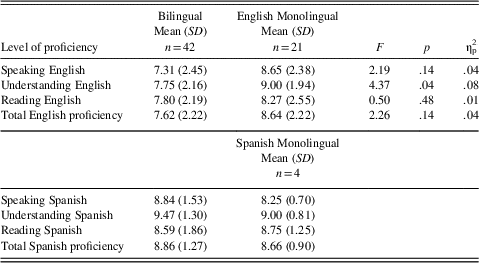
Both English and Spanish monolingual participants had, on average, a “very good” level of proficiency in their respective languages.
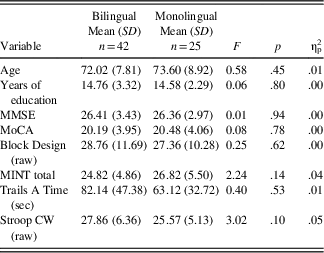
A demographic and language questionnaire was administered to determine language use. Demographic information is presented in Table 1. Both groups had similar age and years of educational attainment. Raw scores for Block Design subtest from the WAIS-III (Wechsler, Reference Wechsler1997) were used as a measure of nonverbal intelligence. MMSE (Folstein, Robins, & Helzer, Reference Folstein, Robins and Helzer1983) and Montreal Cognitive Assessment Test (MoCA) (Nasreddine et al., Reference Nasreddine, Phillips, Bédirian, Charbonneau, Whitehead, Collin and Chertkow2005) scores were used as cognitive screening tools. We used the Multilingual Naming Test (MINT) (Gollan, Weissberger, Runnqvist, Montoya, & Cera, Reference Gollan, Weissberger, Runnqvist, Montoya and Cera2012) to check for naming language differences between groups. The Trail Making Test – A (Reitan, Reference Reitan1986) was used to test simple visual attention and scanning, and the Stroop Color Word (SCW) from the Stroop Color and Word Test (Golden, Reference Golden1978) was administered to assess inhibitory control. As seen in Table 1, the groups did not differ on any of these measures, with low ηp 2 values indicating that the variance explained by these variables was close to zero, except for the SCW scores, which explained 5% of the variance.
Characteristics of the sample

Note. ηp 2=partial eta squared.
It was not necessary to adjust for unequal variance since the Levene Statistic was not significant and therefore the homogeneity of variance assumption was not violated for any of the variables.
Participants were community-dwellers, independent in their activities of daily living, were accompanied by an informant, and did not meet DSM-V criteria for a major neurocognitive disorder, active major depression, or other neuropsychiatric disorders. An additional criterion for exclusion involved reporting fluency in languages besides Spanish or English.
Measures
Bilingual assessment
The Language Experience and Proficiency Questionnaire (LEAP-Q) assesses self-rated measures of linguistic abilities (Marian, Blumenfeld, & Kaushanskaya, Reference Marian, Blumenfeld and Kaushanskaya2007). Proficiency scores are divided into three components: speaking, understanding spoken language, and reading, which are rated on a 0 to 10 Likert scale (0=none, 1=very low, 2=low, 3=fair, 4=slightly less than adequate, 5=adequate, 6=slightly more than adequate, 7=good, 8=very good, 9=excellent, 10=perfect; see Table 2). Scores in either Spanish or English were obtained for the monolinguals, and in both languages for bilinguals. Reliability analyses for internal consistency were conducted. The English and Spanish proficiency scales included three items each and were highly reliable (α=.90 and α=.83, respectively).
Self-Reported Levels of Proficiency (LEAP-Q)*

Note. * 0 to 10 scale, as follows: 0=none, 1=very low, 2=low, 3=fair, 4=slightly less than adequate, 5=adequate, 6=slightly more than adequate, 7=good, 8=very good, 9=excellent, 10=perfect; pη 2=partial eta squared.
The degree of bilingualism index (BI) used in the regression models was calculated by dividing each participant’s lower average LEAP-Q score (of one language, English or Spanish) by the higher average LEAP-Q score (of the other language, Spanish or English), yielding a score between 0 (monolingual) and 1 (bilingual) as previously done by Gollan et al. (Reference Gollan, Salmon, Montoya and Galasko2011) using the Spanish and English Boston Naming Test scores. In our sample, bilingual participants reported an average score of 6 or above on the LEAP-Q proficiency score in both languages. The degree of bilingualism index (BI) in our bilingual sample provides an indication of the balance of linguistic proficiency in both languages. To illustrate, a bilingual who has an average LEAP-Q proficiency score of 7 in one language and 10 in the other would have a BI of .70, and would be considered less balanced than an individual with an average LEAP-Q proficiency score of 8 in both languages (BI=1.0). The bilingual group’s mean BI score was .79 (SD=.20).
Verbal Memory
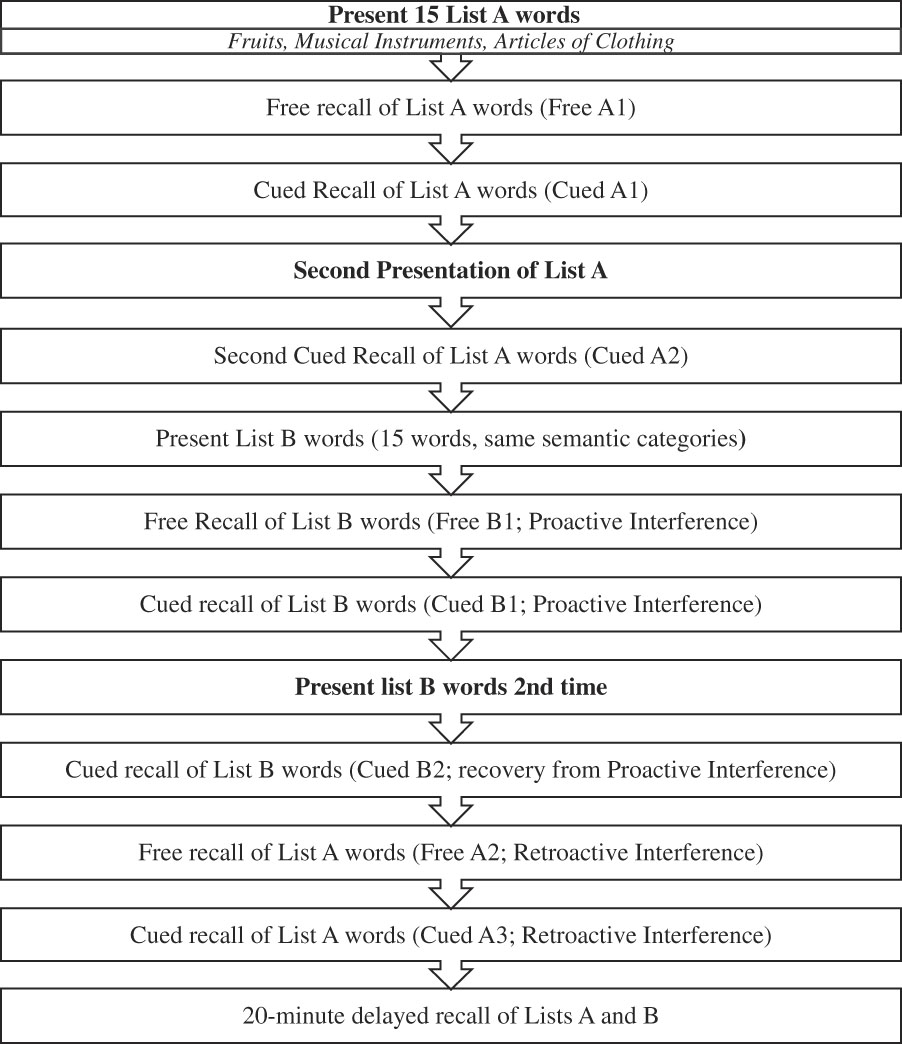
Verbal memory was examined using the Loewenstein-Acevedo Scales for Semantic Interference and Learning (LASSI-L; Curiel et al., Reference Curiel, Crocco, Acevedo, Duara, Agron and Loewenstein2013). This measure uses controlled learning and cued recall to maximize storage of two lists of words from three categories. The examinee is instructed to remember a list of 15 words that are fruits, musical instruments, or articles of clothing (five words per category). After reading the words, individuals recall them with a free recall trial and one cued recall for each category (Free A1 and Cued A1). The examinee is presented with the first list for a second learning trial, with subsequent cued recall to strengthen the acquisition and recall of the List A targets to provide maximum storage of the to-be-remembered information (Cued A2).
The participant is then introduced to a semantically related list, List B, consisting of 15 words which differ from List A, but belong to the same categories. This is followed by a free recall trial and three cued recall trials assessing proactive semantic interference (PSI) (Free B1 and Cued B1). List B words are presented for a second time, followed by a second cued recall trial (Cued B2). The second learning trial for List B evaluates failure to recover from PSI (frPSI). Lastly, a free and cued recall of List A is administered (Free A3 and Cued A3), followed by a 20-min delay and a free recall (Delayed Recall, see Figure 1 for administration procedure). The LASSI-L has adequate test–retest reliabilities (r=.60 to r=.89) among individuals with aMCI and early dementia. High discriminative and concurrent validity have been reported (Curiel et al., Reference Curiel, Crocco, Acevedo, Duara, Agron and Loewenstein2013; Crocco, Curiel, Acevedo, Czaja, & Loewenstein, Reference Crocco, Curiel, Acevedo, Czaja and Loewenstein2014; Loewenstein et al., Reference Loewenstein, Curiel, Greig, Bauer, Rosado, Bowers and Duara2016). We focused on Free A2 (maximum storage), Cued B1 (susceptibility to PSI), Cued B2 (frPSI), and delayed recall, as these have shown sensitivity in discriminating aMCI from normal aging (Crocco et al., Reference Crocco, Curiel, Acevedo, Czaja and Loewenstein2014; Loewenstein, Curiel, Duara, & Buschke, Reference Loewenstein, Curiel, Duara and Buschke2018).
Sequence of the LASSI-L administration procedure.

Nonverbal Memory
Nonverbal memory was observed using the Benson Figure Test, a simplified form of the Rey-Osterrieth Complex Figure measuring visuo-constructional and visual memory functions (Possin, Laluz, Alcantar, Miller, & Kramer, Reference Possin, Laluz, Alcantar, Miller and Kramer2011). It involves copying a figure and a 10 to 15-min delayed recall, constructing the figure from memory.
MRI Measurements
Forty-four aMCI subjects (18/25 monolinguals and 26/42 bilinguals) underwent MRI scanning using a Siemens Skyra 3T MRI scanner at the Mount Sinai Medical MRI Center in Miami Beach, Florida. Brain parcellation was obtained using a 3D T1-weighted sequence (MPRAGE) with 1.0 mm isotropic resolution. We used Free Surfer Version 5.3 software to assess volumes in the signature regions of AD, specifically the hippocampus and the entorhinal cortex. We combined homologous regions in the left and right hemispheres. All volumetric measurements were adjusted for total intracranial volume.
Procedure
All subjects and their informants provided their medical history during a clinical interview. A neuropsychological test battery was administered in each bilingual participant’s preferred language (16 in English and 26 in Spanish). The diagnosis of aMCI was based on the following criteria: (a) subjective memory complaints made by the participant and/or informant; (b) evidence by clinical evaluation/history of memory or other cognitive decline; (c) Global Clinical Dementia Rating Scale of 0.5; (d) one or more memory measures (the total immediate and delayed HVLT-R recall; Benedict, Schretlen, Groninger, & Brandt, Reference Benedict, Schretlen, Groninger and Brandt1998, or the delayed recall of the NACC story passage; Beekly et al., Reference Beekly, Ramos, Lee, Deitrich, Jacka, Wu and Raskind2007) which were used to differentiate MCI from cognitively normal elderly (de Jager, Schrijnemaekers, Honey, & Budge, Reference de Jager, Schrijnemaekers, Honey and Budge2009); and (e) scores within normal range in tests assessing non-memory cognitive functioning, such as naming (MINT), visual attention (TMT-A), and inhibition (SCW).
These tests are part of the AD initiative for English and Spanish-speaking groups and have been used for diagnostic determination in several studies with English and Spanish-speaking subjects (Loewenstein et al., Reference Loewenstein, Curiel, Greig, Bauer, Rosado, Bowers and Duara2016; Loewenstein, Curiel, Wright, et al., Reference Loewenstein, Curiel, Wright, Sun, Alperin, Crocco and Duara2017; Loewenstein, Curiel, DeKosky, et al., Reference Loewenstein, Curiel, DeKosky, Rosselli, Bauer, Grieg-Custo and Duara2017). Abnormal scores were considered 1.5 standard deviations below normal limits relative to age, education, and language related norms.
Statistical Analyses
We compared the bilingual and monolingual groups (with similar age, level of education, and general cognitive functioning) in memory test performance using univariate general linear model (GLM) analyses. A series of Spearman rank order correlational analyses were conducted to obtain correlations between memory scores and hippocampal/entorhinal cortex volumes. Finally, using stepwise regression analyses, we examined the impact of BI and SCW score on memory task performance after controlling for education and general cognitive functioning. All statistical analyses were performed using IBM SPSS Version 24.
RESULTS
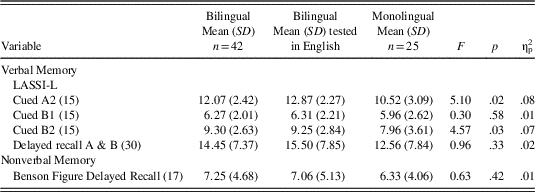
Univariate GLM analyses demonstrated that the bilingual group significantly outperformed the monolingual group on two LASSI-L measures: Cued A2 and Cued B2. No differences between the two groups emerged on other LASSI-L measures or the Benson delayed recall (see Table 3).
General linear model univariate analyses of bilingual and monolingual performance on memory tests

Note. Maximum possible points for each test are presented in parentheses after each variable. ηp 2=partial eta squared
Since most monolinguals were tested in English (21 of 25) and most bilinguals were tested in Spanish (26 of 42), there was a concern of the effect of language on our results. To separate this effect, we compared Cued A2 and Cued B2 between the subgroup of bilinguals tested in English (n=16) with the English monolinguals (n=21). The significance of the mean difference between groups remained for Cued A2 (F(1,35)=7.30; p<.01; ηp 2=.169) and Cued B2 (F(1,35)=4.10; p<.05; ηp 2=.085). Also, since differences in memory between L1 and L2 have been reported (Francis & Strobach, Reference Francis and Strobach2013), the mean scores for bilinguals tested in English are presented in Table 3.
Cued A2 and Cued B2 represent maximum learning capacity for different lists facilitated by semantic cues at the encoding and retrieval stage. Cued B2 is sensitive to the effects of frPSI. To separate general learning from frPSI, we created a ratio of Cued B2 divided by Cued A2 and compared the two language groups using GLM analyses. Results did not show significant differences between the language groups, F(1,65)=.471, p=.495, ηp 2=.007. This finding suggests that the bilinguals’ higher scores in Cued B2 may relate to general learning rather than an increased ability to inhibit PSI.
To understand the higher scores of bilinguals compared to monolinguals on Cued A2 and Cued B2, these scores were correlated with performance on an executive function inhibitory control task, the SCW (used for clinical diagnosis; see the Method section). The Spearman rank order correlations (r s ) between Cued A2 and the SCW, as well as Cued B2 and SCW in bilinguals were r s =.26, p=.114 and r s =.44, p=.007, respectively. In monolinguals, correlations were r s =.56, p=.006 and r s =.40, p=.055, respectively.
Given the significant correlation between the SCW and LASSI-L measures, we entered the SCW as a covariate to determine whether GLM univariate analyses comparing bilingual and monolingual performance on memory tests remained statistically significant. Results showed that the SCW was a significant covariate for Cued A2, F(1,64)=6.39, p=.015, ηp 2=.111, and Cued B2, F(1,64)=5.24, p=.026, ηp 2=.093. Therefore, the GLM univariate analyses comparing bilinguals and monolinguals lost significance in Cued A2, F(1,64)=1.86, p=.18, ηp 2=.04, and Cued B2, F(1,64)=1.19, p=.46, ηp 2=.004.
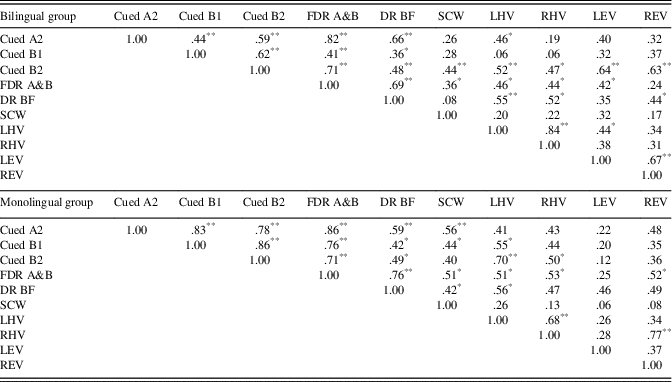
We analyzed the relationship between MRI measures and the memory tasks. LASSI-L scores correlated with MRI volumes, specifically the hippocampus and entorhinal cortex from both hemispheres. Table 4 shows the correlation matrix for the bilingual and monolingual groups, respectively. Cued A2 (maximum storage) showed a significant correlation with the volume of the left hippocampus in the bilingual group only; no other MRI correlations with Cued A2 reached significance in either language group. Cued B2 (frPSI) significantly correlated with the hippocampus and the entorhinal cortex of both hemispheres in the bilingual group, and with the left and right hippocampus in the monolingual group. Cued B1 (PSI) did not correlate with MRI measures in the bilingual group but was related to the left hippocampus in the monolingual group. The delayed free recall correlated with the hippocampal volume of both hemispheres across groups.
Correlations between memory measures, Stroop-CW, and MRI volumes

Note. *p<.05. **p<.01 (2-tailed). p=significance value.
Cued A2=LASSI-L Cued A2; Cued B1= LASSI-L Cued B1; Cued B2= LASSI-L Cued B2; FDR A&B=Free Delayed Recall List A and B; DR BF=Delayed Recall Benson Figure; SCW= Stroop Color Word; LHV=left hippocampus volume; RHV=right hippocampus volume; LEV=left entorhinal volume; REV= right entorhinal volume.
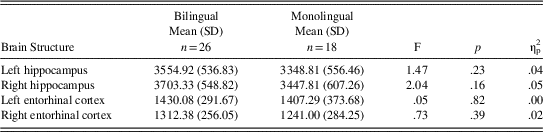
This subtest also correlated with the volume of the right entorhinal cortex in the monolingual group and with the left entorhinal cortex in the bilingual group. No significant correlations were observed between the SCW and MRI measures in either group. However, since a significant correlation between SCW and the Cued B2 was found in the bilingual group, partial correlations between the MRI measures and the Cued B2 were done, controlling for SCW. Of interest, the partial correlations between the Cued B2 and the hippocampal MRI measures decreased (the correlation between Cued B2 and the right hippocampus was r s =.43; p=.05). The correlation between Cued B2 and the right hippocampus while controlling for SCW was r s = .31, p=.18, whereas the correlations between the Cued B2 and the entorhinal cortex remained high (left entorhinal cortex, r s =.69; p=.001; right entorhinal cortex, r s =.59; p=.006). Table 5 shows the volumes of the hippocampus and entorhinal cortex by language group which were non-significantly different.
MRI volumes (mm3) of the left and right hippocampus and entorhinal cortex in the monolingual and bilingual groups

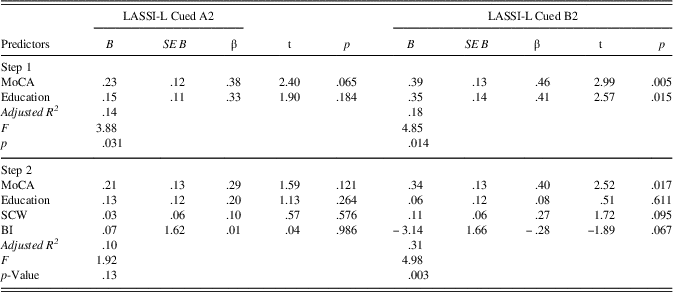
To further analyze the relationship between bilingualism, inhibitory control, and memory tests, we conducted stepwise regression analyses for bilinguals using BI as a predictor of the memory test scores that differentiated bilinguals from monolinguals, including the MoCA scores as a measure of general cognitive function and the SCW as a measure of inhibitory control. We used this regression analysis to examine the contribution of BI and the SCW to the variance of Cued A2 and Cued B2 after controlling for MoCA score and level of education within the bilingual sample. The models are presented in Table 6. The regression model for Cued B2 at step 2 was significant and predicted around 31% of the memory score variance. One of the predictors, MoCA total score, had the most significant weight in this model, indicating that the higher the MoCA score, the more likely it was for the participant to perform well on Cued B2.
Stepwise regression analyses using MoCA, SCW, and BI as predictors for LASSI-L Cued A2 and LASSI-L Cued B2

Note. MoCA=Montreal Cognitive Assessment; SCW=Stroop Color Word; BI=Bilingualism Index.
The SCW and the BI individually were not significant predictors, but together, they generated a significant variance change, accounting for an additional 13% of the variance already explained by MoCA alone at step 1 of the regression model. BI contributed to score variance in the Cued B2 model in an unexpected direction; bilinguals with dissimilar proficiency in their languages had higher performance on this trial. This model suggests that a combination of high MoCA and SCW scores in bilinguals with greater language proficiency differences predicted higher Cued B2 scores. However, the only significant predictor in this model was the MoCA score.
The regression model at step 2 for Cued A2 was not significant. At step 1, the model was significant explaining around 14 % of the Cued A2 score variance, but none of the individual predictors reached significance.
DISCUSSION
In the present study, we investigated the effects of bilingualism on memory performance in an aMCI sample, as well as the association of test scores and medial temporal lobe volume. We compared aMCI Spanish–English bilinguals to aMCI monolinguals (English and Spanish monolinguals combined) with similar age, level of education, general cognitive ability, naming skills, and visual attention. Differences between the two groups in verbal and nonverbal memory tests were examined. Memory scores correlated with performance on an inhibitory control task (executive function). We explored the associations between performance on memory tests and volumetric measures of brain areas that are vulnerable to AD and are related to memory function. Linear regression models investigated the relationship between memory test performance and the degree of bilingualism (BI).
Our results demonstrated a superior performance of aMCI bilinguals over aMCI monolinguals on verbal memory, supporting previous findings. Ljungberg, Hansson, Andrés, Josefsson, and Nilsson (Reference Ljungberg, Hansson, Andrés, Josefsson and Nilsson2013) reported that bilinguals outperformed monolinguals on episodic memory tests. Specifically, our findings demonstrated that bilinguals outperformed monolinguals on two indices of the LASSI-L: Cued A2 and Cued B2. In the bilingual group, significant correlations emerged between maximum learning capacity (Cued A2) and left hippocampal volume, while the index frPSI (Cued B2) correlated with right and left hippocampi in both groups. Moreover, there was a strong association between Cued B2 and bilateral entorhinal cortex values among bilinguals not observed on Cued A2. Taken together, these results support and expand upon previous findings that frPSI is associated with brain regions with some of the earliest volumetric changes specific to AD in bilinguals with MCI (Loewenstein, Curiel, DeKosky, et al., Reference Loewenstein, Curiel, DeKosky, Rosselli, Bauer, Grieg-Custo and Duara2017).
The LASSI-L cued recall procedure promotes the use of semantic clustering to maximize encoding. Therefore, the use of cues in Cued A2 helps reach maximum store retrieval, and in Cued B2, it helps reach maximum store retrieval of a new list and strengthens recovery from PSI. The superior performance of bilinguals on these tasks suggests that bilinguals, perhaps by using two languages regularly, develop a different and possibly more efficient semantic association system that influences verbal recall. Indeed, an increased ability to name pictures in Spanish is associated with a greater switching advantage in Spanish–English bilinguals (Tao, Taft, & Gollan, Reference Tao, Taft and Gollan2015).
Furthermore, lexical decision studies show that activation of semantic representations in one language accelerates the translation to the other language. This suggests that equivalent translations of the semantic representations in linguistic memory are at least partially shared, and that naming improvements in one language influence the other (Francis, Reference Francis2005).
Moreover, Antón-Méndez and Gollan (Reference Antón-Méndez and Gollan2010) showed that bilinguals and monolinguals differed in the type of responses on a word association task. Bilinguals were more likely to produce responses not listed in the norms than were monolinguals, suggesting that bilingualism influences the nature of lexical–semantic representations which may determine word selection (Riès, Karzmark, Navarrete, Knight, & Dronkers, Reference Riès, Karzmark, Navarrete, Knight and Dronkers2015). The semantic interference effect could be explained by changes in the relationship between such semantic and lexical representations (Navarrete, Del Prato, & Mahon, Reference Navarrete, Del Prato and Mahon2012).
Higher executive functioning is proposed as one of the reasons behind the improved memory task performance of elderly bilinguals compared to monolinguals (Schroeder & Marian, Reference Schroeder and Marian2012). Bilinguals, by having to control which language is active, may develop more efficient task-monitoring and task-control mechanisms, potentially influencing other cognitive tasks (Bialystok et al., Reference Bialystok, Craik and Luk2008; Costa et al., Reference Costa, Hernández, Costa-Faidella and Sebastián-Gallés2009).
We explored whether the performance on the SCW, a measure of inhibitory control, may contribute to differences in memory scores between bilinguals and monolinguals. Previous research has shown that behavioral inhibition correlates with performance on retrieval tasks (Schilling, Storm, & Anderson, Reference Schilling, Storm and Anderson2014). Better performance in the SCW was associated with an increased capacity to retrieve words using semantic cueing in Cued B2 for bilinguals but not monolinguals. However, in the monolingual group, this correlation was marginally significant, therefore, we cannot rule out the importance of inhibitory control in the retrieval process of both language groups. Furthermore, similar scores in the SCW between groups may indicate similar degrees of inhibitory control. Future research should determine whether the active use of two languages influences the association between inhibitory control and memory retrieval, or whether there are other components of executive control, such as conflict monitoring and resolution, that may also explain the memory advantage in bilinguals.
Semantic interference, observed in the LASSI-L, taps into control mechanisms (a component of executive function), and is observed on cycling naming tasks (e.g., naming a picture while ignoring semantically related or unrelated words) in healthy and aphasic patients (Schnur & Martin, Reference Schnur and Martin2012; Thompson, Robson, Lambon Ralph, & Jefferies, Reference Thompson, Robson, Lambon Ralph and Jefferies2015). However, it is unknown whether semantic interference has the same effect on a bilingual’s languages. In healthy bilinguals, the semantic interference effect is similar for both languages (Kleinman, Runnqvist, & Ferreira, Reference Kleinman, Runnqvist and Ferreira2015). In this study, we did not compare the performance in both of the bilinguals’ languages; therefore, it is unknown if interference differs across languages. Testing these differences should be explored in future research.
The current study focused on three cued recall trials and the delayed recall trial of the LASSI-L, as these components have shown sensitivity in detecting aMCI. We found differences between bilinguals and monolinguals on two cued recall trials. Cued B2 represents the maximum learning capacity facilitated by semantic cues during encoding and retrieval, and also evaluates frPSI. Therefore, we speculated Cued B2 would exhibit an increased sensitivity in detecting differences between the language groups among subjects with aMCI. Given the non-significant group difference in the ratio of Cued B2/Cued A2 and the similar performance of both groups in Cued B1, our results suggest that differences in Cued B2 scores between bilinguals and monolinguals are better explained by a higher verbal memory learning capacity in the bilingual group rather than a superior ability to inhibit PSI.
Nevertheless, the positive correlation between Cued B2 and SCW in bilinguals, not observed in monolinguals, suggests that we cannot rule out the influence of inhibitory executive control on Cued B2. On the other hand, only Cued B2 was strongly associated with bilateral entorhinal cortex deficits in bilinguals, suggesting that decreased scores on Cued B2 cannot be attributed to Cued A2 effects alone. The specificity of Cued B2 effects relative to Cued A2 effects and volumetric reductions in AD signature regions have been shown in individuals with aMCI (Loewenstein, Curiel, Wright, et al., Reference Loewenstein, Curiel, Wright, Sun, Alperin, Crocco and Duara2017; Loewenstein, Curiel, DeKosky, et al., Reference Loewenstein, Curiel, DeKosky, Rosselli, Bauer, Grieg-Custo and Duara2017). The inability to recover from proactive interference (Cued B2) is also uniquely related to amyloid load in elders with normal performance on traditional memory measures (Loewenstein et al., Reference Loewenstein, Curiel, Greig, Bauer, Rosado, Bowers and Duara2016).
Our findings show that memory skills associated with PSI relate to hippocampal volume in the monolingual group, and are more associated to other structures within the medial temporal areas (the hippocampus and the entorhinal cortex) in the bilingual group. No differences in the volume of these structures were found across groups.
The existence of overlapping brain regions involved in memory and language abilities may confer a memory advantage to bilinguals expected to have greater cognitive reserve for language (Dobbins & Davachi, Reference Dobbins and Davachi2006; Grant, Dennis, & Li, Reference Grant, Dennis and Li2014). Among cognitively normal individuals, fMRI studies show medial temporal lobe activation during initial word learning in a second language (Rodríguez-Fornells, Cunillera, Mestres-Missé, & de Diego-Balaguer, Reference Rodríguez-Fornells, Cunillera, Mestres-Missé and de Diego-Balaguer2009). The memory advantage among our bilingual aMCI subjects may result from the findings in fMRI studies that the brain network involved in memory retrieval seems less affected in its efficiency for bilinguals compared to monolinguals (Grant et al., Reference Grant, Dennis and Li2014). However, these functional subsystems in the brain cannot be evaluated by structural imaging.
Results from this study further our understanding of the protective effects of bilingualism against abnormal aging in numerous ways. We demonstrated that Spanish–English bilinguals with aMCI perform better in a semantic memory task compared to monolinguals. Our findings support previous research examining bilinguals and their executive function abilities (Bialystok, Craik, Binns, Ossher, & Freedman, Reference Bialystok, Craik, Binns, Ossher and Freedman2014). It appears that the positive effects of bilingualism are not confined to executive function tasks but could extend to some components of verbal memory, at least in aMCI late bilinguals. However, our results indicated that better memory performance in bilinguals compared to monolinguals was associated with bilinguals’ score on the SCW, a task of inhibitory control (a component of executive function).
Nevertheless, as only one executive function task was used, future research should replicate these findings using a more diverse battery of executive function tasks measuring additional components to inhibitory control. Also, future research should examine whether the memory task used in this study and the SCW draw upon similar attention processes. Our results also suggest that the bilingual memory advantage is only observed in word learning with semantic cueing, not in the free recall of words. This is consistent with earlier findings in MCI bilinguals (Ossher et al., Reference Ossher, Bialystok, Craik, Murphy and Troyer2012). We believe that advantages for bilinguals should be most apparent on challenging list-learning tasks (e.g., the LASSI-L). We did not find differences in performance between bilinguals and monolinguals on the nonverbal memory test used, the Benson Figure delayed recall, a relatively simple drawing task. Future research should use nonverbal memory tasks that may be comparable in difficulty to the LASSI-L cued recall.
The regression model was a good fit in predicting scores on LASSI-L Cued B2, entering BI, SCW, a measure of inhibitory control, and MoCA as a measure of general cognitive function. From our findings, aMCI bilinguals with greater unequal proficiency in both languages and high scores in the SCW and MoCA performed better on Cued B2, the LASSI-L trial that evaluates recovery from proactive semantic interference. However, since the individual contributions of SCW and BI were not significant, this interpretation is speculative.
Perhaps in a larger sample including other factors related to language, a more accurate representation of the linguistic influence on test scores can be observed. It is important to note that these findings can only apply to the participant’s dominant language. Gollan, Salmon, Montoya, and da Pena (Reference Gollan, Salmon, Montoya and da Pena2010) demonstrated that the dominant language is more susceptible during the earlier stages of AD. However, in a more recent and extensive review of the literature, Stilwell, Dow, Lamers, and Woods (Reference Stilwell, Dow, Lamers and Woods2016) found that both languages in bilinguals are equally affected by AD. Unfortunately, we did not test bilinguals in both languages and, therefore, cannot evaluate these changes.
Most research has found the benefits of bilingualism in early consecutive childhood acquisition and balanced proficiency of two languages (Luk, De Sa, & Bialystok, Reference Luk, De and Bialystok2011). Our results suggest that late second language acquisition in aMCI may provide memory advantages over monolinguals in some specific tests when administered in the participant’s first language. This is supported by previous research that has found that the effects of the bilingual experience extend to late bilingual young adults in tests of attention and naming (Bak, Vega-Mendoza, & Sorace, Reference Bak, Vega-Mendoza and Sorace2014; Pelham & Abrams, Reference Pelham and Abrams2014). While we found better LASSI-L Cued A and Cued B scores in aMCI bilinguals compared to monolinguals, it remains unclear to what extent the effects of bilingualism on these scores vary in late bilinguals who do not reach native-like proficiency compared to early and balanced bilinguals.
Some limitations should also be noted in the present study. First, most monolinguals were English speakers, and most bilinguals chose to be tested in Spanish. Therefore, language of evaluation could be a contributing variable. For example, verbal recognition memory for the two languages (L1 vs. L2, or dominant vs. non-dominant) is unequal for healthy bilinguals. There is a so-called bilingual advantage on memory, in which words in L2 are more easily recognized than words in L1 due to reduced interference in the memory system (Francis & Strobach, Reference Francis and Strobach2013). Although it would have been ideal to have a larger sample of monolingual Spanish speakers, we compared two groups similar in general cognitive and naming abilities.
Furthermore, our findings in the entire sample were consistent with a subsample of English monolinguals compared to bilinguals who were tested in English. This study is cross-sectional, so the protective effect of bilingualism in memory tests was only evaluated across individuals at one time point. Since these data are part of a longitudinal study, we will present longitudinal data as they become available. Another shortcoming of this study is the unequal distribution of sex and language groups. Most of our participants were females who volunteer for clinical studies at a higher rate than males (Harris et al., Reference Harris, Scott, Lebo, Hassan, Lighter and Pulley2012). However, there were no statistically significant differences between the monolingual and bilingual groups regarding the sex distribution.
Also, the 1Florida ADRC aims to collect data from Hispanic samples, therefore, the majority of our recruited participants had some level of Spanish/English bilingualism, explaining the unequal distribution of the language groups. Future research using equal group distributions is needed to overcome these limitations. Moreover, only 72% of monolinguals and 62% of bilinguals had MRI data available. Future research should replicate our findings with a larger MRI sample.
The assessment of language proficiency in the monolingual group is a unique component of this study. Previous studies have not measured “monolingualism” (Calvo et al., Reference Calvo, García, Manoiloff and Ibáñez2016), and it is often assumed that the gold standard of language proficiency is found in monolingual groups. These findings can apply only to immigrant bilinguals. Thus, research is necessary with non-immigrant bilinguals to eliminate the potentially confounding effect of immigrant status. Due to the small proportion of total variance in verbal memory tests associated with bilingualism, we used p values higher than .01 for significance. Future studies are required to confirm our findings, with a larger, more balanced bilingual/monolingual sample.
ACKNOWLEDGMENTS
This research was supported by the National Institute of Aging Grants number 5 P50 AG047726602 1Florida Alzheimer’s Disease Research Center (Todd Golde, PI; Ranjan Duara, Co-PI) and 1 R01 AG047649-01A1 (David Loewenstein, PI). None of the Authors have conflict of interest involving this manuscript.