Introduction
Mythological twin brothers played an integral part in how the Romans viewed and represented their past. These mythological siblings acquired a range of symbolic meanings and became one component in an array of propaganda tools used to promote individuals’ claims to positions of power, the political control over certain regions, or more generally, the greatness of Rome and her empire. As symbols, when paired with specific legends, images, and other figures, they came to exemplify the very ideas of Romanitas, imperial power, and the eternal nature of Rome. One set of brothers in particular, Castor and Pollux (the Dioscuri), adopted and adapted from the Greek brothers Castor and Polydeuces, served a variety of ideological purposes throughout the Roman period. The brothers appear very early in republican coinage in several different coin types and are one of the most common images to appear on these early coins. Later literary sources which reconstruct the republican period present the Dioscuri as heroes who came to Rome’s aid in her time of greatest need, the most famous example being their role in Rome’s victory at the Battle of Lake Regillus under Aulus Postumius.Footnote 3 During the imperial period, they came to embody ideas of fraternal piety and divine lineage, especially as the process of creating joint heirs and granting exceptional honours became important features of the construction of the image of the imperial family.Footnote 4
The fact that these brothers came to symbolise different ideologies meant that they could be used contemporaneously by different factions wishing to promote their own ideology over that of a rival. When Diocletian established the Tetrarchic system of joint rule with clearly identified succession plans, the Dioscuri served as ideal figures to symbolise the importance of this collective rule by like-minded individuals.Footnote 5 Yet, when Maxentius was declared emperor in Rome by the Praetorian guard in 306 ce, he also chose to promote Castor and Pollux on his coins. However, Maxentius used these figures to promote his position as saviour of Rome, drawing on earlier republican traditions. Throughout the imperial period, emperors and individuals seeking power drew on various ideologies, promoted certain virtues, and targeted particular audiences to legitimise their positions and ensure that their message was received. But the question arises as to how an individual in a position of power could ensure that the intended message was received and, specifically, how the message of one individual (or group of individuals) could be differentiated from that of his rivals. This study explores Maxentius’ use of Castor and Pollux as figures on several of his coin types, focussing on how these symbols of Rome were paired with other legends in order to promote his own claim to power in Rome. This assertion of power was in direct conflict with the government set up by Diocletian, which itself used Castor and Pollux, though in a different manner, to promote its own right to rule. Thus, by examining this ideological conflict between Maxentius and the Tetrarchy, one can better understand the mutability of myth and its role in the promotion of particular aspects of narratives and figures to support an individual’s own claims to power.
The Dioscuri as Symbols of Concordia
In Greek traditions, the Dioscuri were represented as either two divine brothers or as one mortal brother (Castor, the son of Tyndareus) and one divine brother (Polydeuces, the son of Zeus). In the tradition endorsed by Pindar, which then became an important propaganda tool for the promotion of the Roman imperial family, the immortal Polydeuces (Pollux) shared his immortality with his dying, mortal brother Castor.Footnote 6 The fact that the two brothers shared their immortality can be taken one step further to show that they could actually be seen as gods on earth, or at least mortals who had earned the right to immortality.Footnote 7
During the reign of Augustus, Castor and Pollux served as symbols of concordia within the imperial family, highlighted succession plans, and promoted ideas of deification.Footnote 8 Throughout the Julio-Claudian period, the concordia claimed between joint successors was never tested in terms of joint rulership. In some cases, these individuals did not survive long enough to become emperor (as was the case with Gaius and Lucius Caesar). In others, joint succession was stipulated in the former emperor’s will but these successors never ruled together (as was the case with Caligula and Tiberius Gemellus). Throughout the imperial period, there are only a few examples of joint rulership and, in most cases, these stem from the elevation of a successor in the final years of an emperor’s reign.
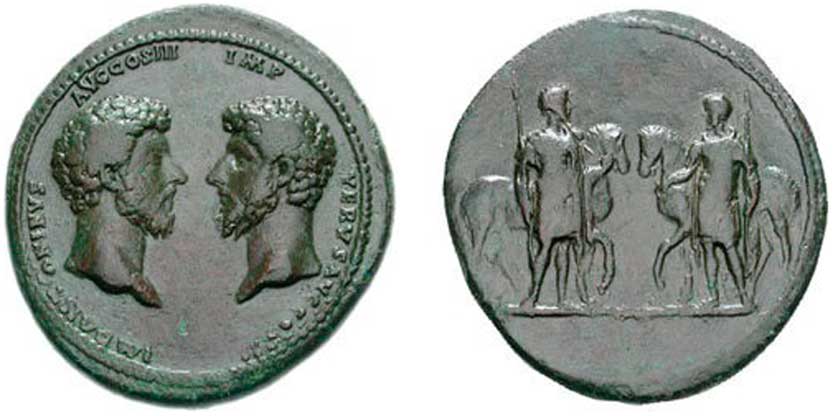
One exception is the case of Marcus Aurelius and Lucius Verus, who were elevated to the role of emperor together. On bronze medallions, struck during their joint rulership from 161-165 ce, the two emperors were shown facing one another on the obverse, with the Dioscuri and their horses depicted on the reverse (Figure 1).
Bronze medallion (Gnecchi, II, p.43 #5; 161-169 ce): Aurelius and Verus facing each other, IMP ANTONINVS AVG COS III and IMP VERVS COS II (Obverse). Dioscuri left and right, each holding a spear and bridled horse, facing each other (Reverse). Image courtesy of Classical Numismatic Group, Inc. (https://www.cngcoins.com/).
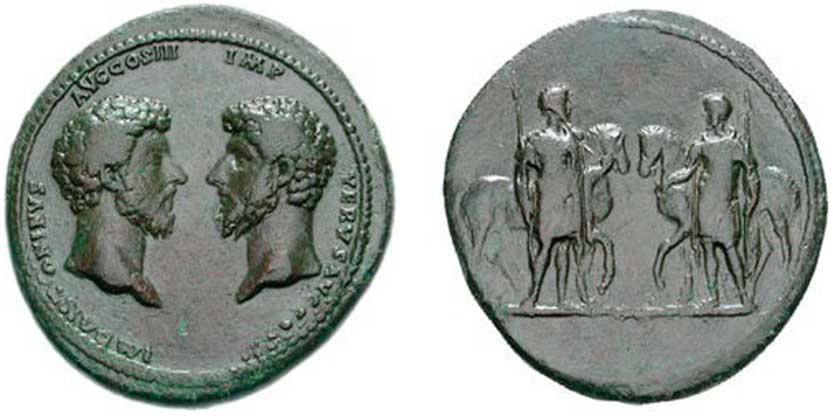
The inclusion of the Dioscuri’s horses promotes their martial aspect and highlights their roles as heroes who came to Rome’s aid and announced victory on the battlefield.Footnote 9 Yet, the Dioscuri also symbolise the concordia between these two rulers and the importance of their joint rule for military success, especially considering the inclusion of both Marcus Aurelius and Lucius Verus on the obverse. The concordia between the joint rulers is further contextualised in several other coin issues. These explicitly state the concordia celebrated between them by including the legend CONCORDIAE AVGVSTOR(um) and depicting the emperors clasping hands, although these types do not also include an image of the Dioscuri.Footnote 10
Following the turmoil of the second half of the third century ce, Diocletian was able to restore stability to the empire by developing and implementing a new form of government. The safety and prosperity of the Roman empire now relied on the ability of four men to rule together. Through the positions of Augusti and Caesares, Diocletian outlined a clear line for succession that was not based on hereditary lines.Footnote 11 For this new governmental organisation to function, the Tetrarchs had to give the impression of their concordia (perhaps better understood as a type of ‘fraternal pietas’, an important virtue adopted by the imperial family from the time of Augustus onwards). Moreover, the fact that the empire was no longer ruled by an individual, but rather by a collective body, led to the institutions of empire becoming decentralised and focussed on where any one of the emperors was, rather than on a fixed capital city.Footnote 12 These factors led the Tetrarchs to build their primary residences near the frontiers, rarely even visiting Rome.Footnote 13 Even though it was uncommon for the emperors to be physically in the same place, the iconography of the period stresses the Tetrarchs’ concordia through the uniformity of their depictions of the individuals (such as the porphyry statue groups and the types and legends of bronze and silver coinage).Footnote 14
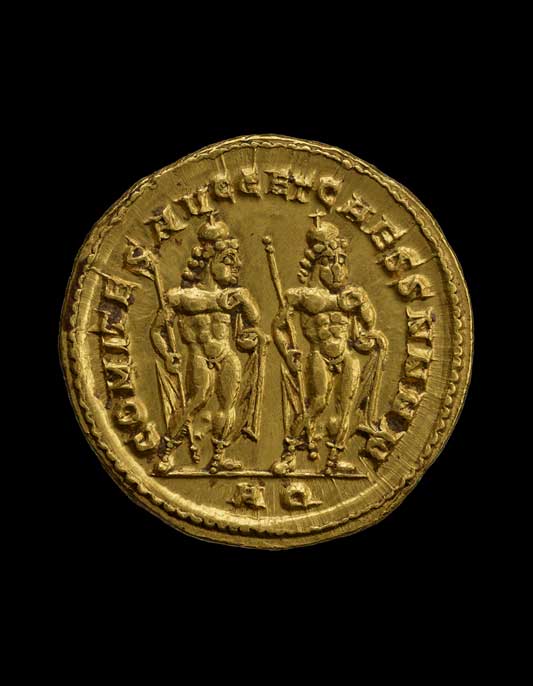
The previous role of the Dioscuri as symbols of concordia and succession meant that they would also serve as ideal figures to symbolise the new Tetrarchic system, which involved not only joint rulership but also clear mechanisms for succession. A gold coin of the Caesar Constantius from Aquileia, dating between 294 and 305 ce, exemplifies this usage (Figure 2).
Reverse of aureus (RIC VI. Aquileia 1; 294-305 ce): Dioscuri standing, facing right, stars above helmets, each holds staff in right hand and has chlamys falling wide behind. COMITES AVGG ET CAESS NNNN. © Image courtesy of The Trustees of the British Museum.

The reverse bears the legend COMITES AVGG ET CAESS NNNN with a depiction of the two Dioscuri – a depiction which does not appear to follow republican precedents. Although the coin itself is minted for Constantius, whose image and name can be seen on the obverse, all the Tetrarchs are celebrated through the use of the extra ‘G’ in the legend AVGG, ‘S’ in CAESS, and the four ‘N’s. Here Castor and Pollux symbolise the concordia between these ‘partners’ or ‘associates’ (comites). The use of these brothers, who lived in perfect harmony, to highlight the relationship between the co-rulers promotes the durability and security produced by this new style of government.Footnote 15 The obverse legend identifies Constantius as Caesar, thereby promoting his new status and identifying him as chosen successor of the Augustus Maximian in the West.Footnote 16
In addition to the concept of concordia between like-minded rulers, the Tetrarchs focussed on the empire as a whole, the stability of the entire world (orbis terrarum), and their role in securing its borders and repelling barbarian invaders.Footnote 17 The Romanitas they promoted was the victory and stability of the empire rather than of the city of Rome itself. This coin type, minted in Aquileia, and other similar types from the other western mints, promoted the roles of Maximian and Constantius as the western rulers who would oversee the continued peace and prosperity, while also highlighting the concordia of all four rulers through the use of COMITES and CONCORDIA, paired with AVGG ET CAESS NNNN. The inclusion of the Dioscuri highlights the traditions and ideology established by Augustus which persisted well into the third century, namely their role as symbols of divinity, succession, and concordia. By promoting these brothers on his coinage, Constantius was able to highlight the idea of concordia between the Tetrarchs and their ability to secure the safety of the empire and ensure a smooth transition of power to the next generation. Their empire was a universal one, not necessarily centred on the traditional seat of power, but instead on its totality and the stability inherent in Diocletian’s model for collective rulership.Footnote 18
Maxentius’ Coinage: Types and Audience
In contrast to the universality of empire promoted by the Tetrarchs within their iconography, and in an attempt to legitimise his own claim to the position of emperor, Maxentius focussed on the city of Rome herself, thereby catering to his power base.Footnote 19 As the son of the Augustus Maximian, it is likely that he had expected that he would eventually accede to imperial power.Footnote 20 However, for the first time in Roman history, a family member was passed over in favour of someone outside the family when establishing a succession plan.Footnote 21 In this case, power passed to political allies, with Severus and Maximinus Daia being named as Caesares, while Galerius and Constantius Chlorus were promoted to Augusti.
Although he was not named as an Augustus or a Caesar within the Tetrarchic system, Maxentius was able to achieve the position of emperor following a revolt which broke out when the Tetrarch Galerius revoked Rome’s ancient tax privileges and attempted to disband the Praetorian guard (justifying the decision with the argument that, since none of the Tetrarchs lived in Rome, an imperial guard was no longer needed there).Footnote 22 Having been declared emperor by that same Praetorian guard, Maxentius then secured his position by revoking Galerius’ new tax law, placating the Christians, and establishing a residence in the city.Footnote 23 He then minted coins showcasing his claim to imperial power, a power that was in conflict with that of the Tetrarchs. Over the six years of his reign in Rome, Maxentius used his iconography and building programmes to restore the city to her former position as centre of the empire, creating a noticeable ideology of his own that attempted to counteract the strategies and policies of the Tetrarchs and served to legitimise his own claim to the ancient capital.
While the Tetrarchs’ building programme within the city focussed on the promotion of universal concordia and the new government structure, Maxentius’ building programme promoted the traditional symbols and iconography of the city to legitimise his power.Footnote 24 His inspiration appears to have come from Augustus and Hadrian in particular, but in some instances he appears to have taken symbols from the Republic as well.Footnote 25 In terms of the promotion of his building programme on his coinage, the most important of his projects was the rebuilding of the Temple of Venus and Roma.Footnote 26 First built by Hadrian, this temple served not only to link Maxentius with Hadrian but also to stress the connection with the Julio-Claudian family through their divine ancestor, Venus.Footnote 27 To celebrate this temple, he then minted a series of coins, which will be discussed further below.
Although Maxentius had four mints under his control in 307 ce, by 309 he had consolidated his coin production in Rome and Ostia.Footnote 28 Whereas the mints established under the Tetrarchs were usually found in locations based on ease of distribution for military or bureaucratic purposes, Maxentius’ establishment of the new mint in Ostia appears to have been for political and ideological reasons. In particular, his overall focus was on the city of Rome and her environs rather than on the Roman Empire as a whole.Footnote 29 There is some debate over the reasons behind and the context of the establishment of this mint, but, following the suggestion of Albertson, it seems clear that the choice of Ostia for the gold and silver coinage was intentional, since it distanced the minting of these higher denominations from some of the political insecurities in Rome, while ensuring that the mint was close enough to supply the capital.Footnote 30
Once Maxentius had consolidated his coin production in Rome and Ostia, the Ostian mint became responsible for issuing Maxentius’ gold and silver coins (while still issuing bronze coins) whereas the Roman mint continued to issue only bronze. In contrast to the Tetrarchs’ coinage, which was widely circulated through the provinces and on the frontiers, Maxentius’ audience was that of Rome.Footnote 31 It was in Rome that the individuals who had granted him power could be found, so, unsurprisingly, the images on his coins specifically targeted this particular audience. In Maxentius’ earliest issues, the symbols chosen (and the legends with which they were paired) all promote Rome’s glorious past and his connection to the city, as well as his military strength and his ability to promote pax. Footnote 32
As Manders has rightly noted, the ideological value of coins should not be undervalued. Individuals claiming imperial power minted their own coins almost immediately after assuming that power; moreover, if individuals who were not the emperor minted coins, this was understood as a direct challenge to the existing emperor.Footnote 33 For example, some of Maxentius’ earliest coins minted in Rome, in particular, bear the title princeps. Footnote 34 This can be interpreted as a deliberately aggressive anti-Tetrarchic statement, since he is not using the titles Augustus or Caesar.Footnote 35 Equally, it could demonstrate Maxentius’ commitment to the city of Rome by using a title which recalled emperors of the first and second centuries – those who had actually resided there.Footnote 36 Although this title was found in historical writings, it had never previously appeared on coinage in this form.Footnote 37 His adoption of this title and its inclusion in his coin types set Maxentius apart from the Tetrarchs and served to send a very specific message through his iconography.
Although both the Ostian and the Roman mints produced bronze coins, the messages broadcast on those issues differed.Footnote 38 While the bronze coins from Rome broadcast the legend CONSERVATOR VRBIS SVAE and depicted the temple of Venus and Roma, thereby celebrating Maxentius’ reconstruction of that temple, a significant number of coins from Ostia displayed the AETERNITAS AVG N legend, paired with the Dioscuri.Footnote 39 These coin-types which highlighted mythological figures associated with the city as well as a temple dedicated to Roma herself strongly promoted Maxentius’ connection to the city and should thus be understood in terms of Maxentius’ Romanitas, centred on the city and his self-promotion as its saviour.
The Dioscuri and Maxentius as Saviour of Rome
Castor and Pollux do not appear on Maxentian coinage until after the establishment of the mint in Ostia. They should thus be understood as part of his political ideology and the promotion of his newly stabilised position in Rome.Footnote 40 In particular, Maxentius’ use of the Dioscuri and the legends with which they are paired highlights their roles as champions of Rome, saviours who came to its aid when its very survival hung in the balance, in order to distinguish his message from that of the Tetrarchs, who, in connection with the legend COMITES AVGG CAESS NNNN, focussed on the Dioscuri as symbols of concordia.
The portrayal of the Dioscuri as heroes of Rome first appears in connection with the Battle of Lake Regillus, fought circa 496 bce. As Roman tradition has it, in the first decade of the fifth century bce, the Tarquins, having been thrown out of Rome, united themselves with some of the Latin communities against Rome. Aulus Postumius, who had been granted dictatorial power to deal with this threat, headed out to confront the Latin forces already on the march. In the account by Dionysius of Halicarnassus, two men of greater than human beauty and size appeared to Postumius and led the charge of his cavalry.Footnote 41 Following the battle, they then appeared in the city of Rome, watered their horses at the fountain of Juturna, and announced the Roman victory. The two men were identified as Castor and Pollux. In Livy’s account, Postumius vowed a temple to Castor should he be victorious in battle.Footnote 42 Following the victory, a temple to Castor (so named in the sources, but likely also dedicated to Pollux as well) was set up by the temple of Vesta, where the men had watered their horses.Footnote 43 Castor and Pollux were seen as saviours who provided timely assistance in battle, bringing glory to armies on the brink of defeat.Footnote 44 Ultimately, these two heroes came to symbolise the greatness of Rome, especially when her own survival hung in the balance.
For this reason, Castor and Pollux are one of the most common symbols found on republican coinage. Generally, they are found in connection with the goddess Roma and serve as an important symbol for the city. The most common reverse type depicts the Dioscuri on horseback and serves to promote their military achievements and their role as the patron deities of the equites.Footnote 45 On some coin types, their heads are depicted on the obverse, often paired with symbols of military victory on the reverse, or have the head of one of the Dioscuri on the obverse and the other on the reverse.Footnote 46 These coins are some of the earliest coins, with many dating to the early to mid-third century bce. On many of the coins, especially those from the late second or early first centuries bce, they are found in a herald-like pose in front of their horses, highlighting their role as messengers carrying the news of victory from the battlefield.Footnote 47 Although their representations vary, the overall theme remains the same, with the Dioscuri playing a crucial role in symbolising the city of Rome, her glory, and her military achievements.
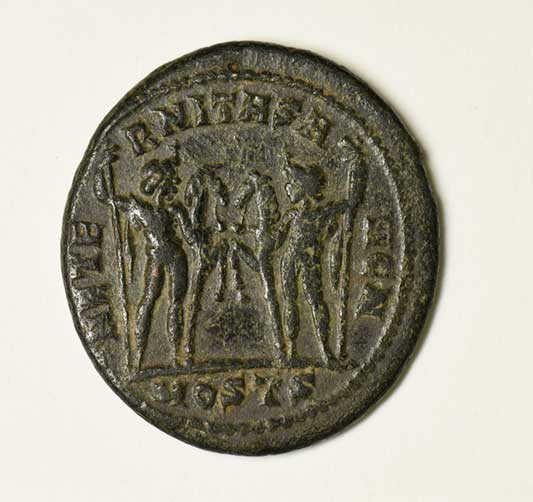
On Maxentius’ coins, the Dioscuri are paired with the legend AETERNITAS AVG N on the reverse and show Maxentius with the legend IMP C MAXENTIVS P F AVG on the obverse (Figure 3).
Reverse of bronze follis (RIC VI. Ostia 35; 309-312 ce). Dioscuri standing left and right, each holding a sceptre and a bridled horse. AETERNITAS AVG N. © Image courtesy of the Otago Museum.
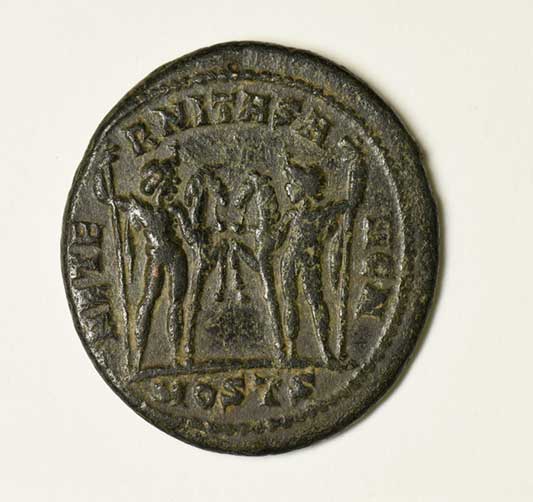
On this issue, the Dioscuri are depicted with their horses. Maxentius’ use of Castor and Pollux in a herald-like pose with their horses refers to their roles as messengers who came to Rome in her time of need, rather than to their relationship to each other. Their use in this form also links the coin images with the Quirinal statues, thereby connecting Maxentius to these symbols of the divinely sanctioned nature of Rome.Footnote 48
Although the martial aspect of the depiction of the Dioscuri here is clear, when considered alongside their similar depiction in Figure 1, its interpretation requires further analysis. On the medallion of Marcus Aurelius (Figure 1), the Dioscuri were used to highlight the concordia between two rulers and the importance of their joint rule for military success. Maxentius, however, was not a recognised member of the Tetrarchy and therefore needed to qualify his use of the Dioscuri through the coin’s legend. On this coin, the Dioscuri are paired with the AETERNITAS AVG N legend and Maxentius’ bust is paired with the legend IMP C MAXENTIVS P F AVG on the obverse. There is no mention of any other Augustus (usually represented by additional ‘G’s and ‘N’s, such as those present on the Constantius coin – Figure 2). This coin promotes the eternal nature of Rome’s (one) Augustus, whose image and legend are promoted on the obverse side of the coin. Importantly, although there are examples of coin types by the Tetrarchs that do not make explicit reference to the other Tetrarchs, these are never found with a legend announcing the virtue aeternitas.
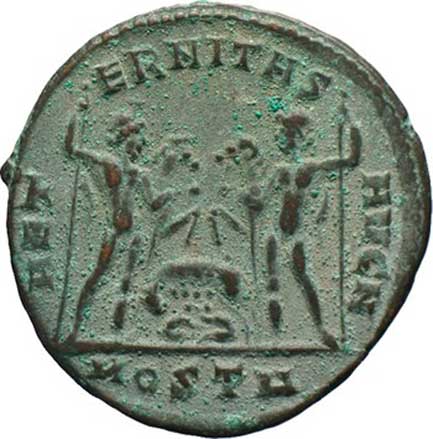
Maxentius’ Dioscuri coin type (Figure 3) should further be understood within the context of other coin types minted around the same time in Ostia. In a similar issue, using the same legend, Maxentius paired the Dioscuri with another quintessential symbol for the city of Rome: Romulus, Remus, and the she-wolf (Figure 4).
Reverse of bronze follis (RIC VI. Ostia 16; 309-312 ce). Dioscuri left and right, each holding sceptre and bridled horse; she-wolf and twins between. AETERNITAS AVG N. © Image courtesy of the American Numismatic Society.
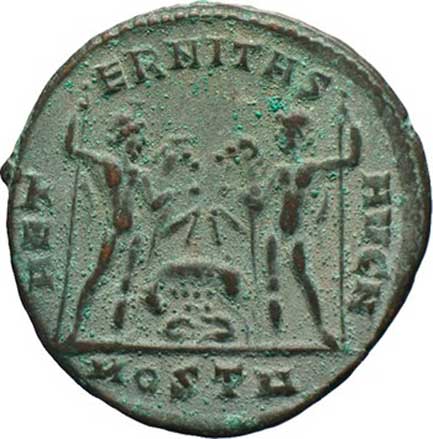
The Dioscuri here are shown in the same herald-like and martial pose as in Figure 3. The inclusion of Romulus, Remus, and the she-wolf between the Dioscuri ensures that the focus is taken away from them in terms of their relationship to each other. Instead, this configuration highlights their role as protectors of Rome. Such pairing of the AETERNITAS AVG N legend with Romulus, Remus, and the she-wolf had been included previously on a series of coins minted during the later part of the reign of Gallienus in the mid-third century ce.Footnote 49 Other coins bear legends such as SECVRIT(as) PERPETVA, PAX ETERNA, and ROMAE ETERNAE.Footnote 50 Understood within the larger context of his coinage, Gallienus’ promotion of aeternitas in connection with the she-wolf and twins symbolised the stability and permanence of Rome and promoted the message that Gallienus would ensure this would continue. Maxentius thus adopted a similar usage for his own coin types, thereby supporting his own claim that he would restore Rome to her former glory and ensure her continued success.
The she-wolf and twins motif was a common feature of third-century coinage and many individuals sought to promote their claims to power by including this quintessential icon of Rome in their coinage. For example, in 286 ce, Carausius, a commander of the fleet in the English Channel, revolted and proclaimed himself emperor in Britain. He then minted coins which included the she-wolf and twin motif paired with his title as renovator Romanorum (abbreviated in a variety of ways in the legend).Footnote 51 Although most of his coinage was focussed on pax, he also promoted his ability to serve as ‘restorer of the Roman people’ through his legionary issues (celebrating concordia militum). Carausius’ focus on the army strengthened his connection with his own support base in the same way as Maxentius’ focus on the city of Rome. Adopting and adapting these previous ways of representing the she-wolf and twins motif, Maxentius then capitalised on the connections made between this motif and particular types of legends to link these mythological figures with ideas of restoration and preservation. When the she-wolf and twins are used in conjunction with Castor and Pollux on Maxentius’ coins, we should therefore interpret these symbols together as referring to Rome’s glorious past, her eternal nature, and her importance as the centre of the empire.
Maxentius’ use of Romulus, Remus, and the she-wolf, as well as of Castor and Pollux served to promote himself as another ‘re-founder’ or saviour of Rome to the people living in and around the city. His message was further clarified through his use of the additional images and legends on his coinage, particularly his promotion of the Temple of Venus and Roma and his title as conservator urbis suae (Figure 5).Footnote 52
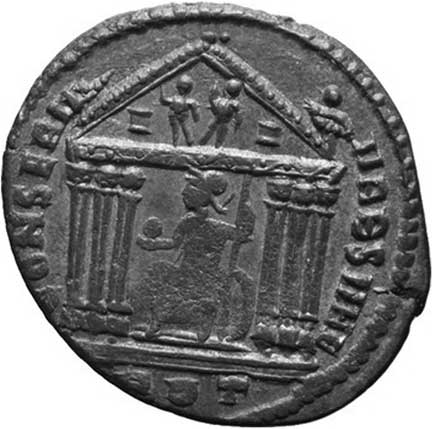
Reverse of bronze follis (RIC VI. Roma 208; 308-310 ce). Roma seated, facing left, in hexastyle temple, Dioscuri with altars in pediment. CONSERV VRB SVAE. © Image courtesy of the American Numismatic Society.

This coin is one example of a series of coins celebrating the rebuilding of the Temple of Venus and Roma, even though the temple depicted most likely does not reflect the full reality of the temple building itself.Footnote 53 The temple became a focal point for Maxentius’ building programme within the city and served to link him with the divine ancestress of the Roman people and with Roma herself, as depicted here.Footnote 54 Considering his interest in promoting Castor and Pollux on his coinage, the two figures depicted in the pediment could very well be a representation of them. This identification is further strengthened by a reference in Prudentius’ work Contra Symmachum, which mentions the Dioscuri in his discussion of the statues present within the temple.Footnote 55 Their inclusion here on the pediment of this artistic representation would therefore corroborate Prudentius’ statement by suggesting their association with this temple.
The Dioscuri’s presence on coins celebrating the temple as well as within the temple itself highlight their role as saviours of the city. However, in this depiction they are not represented with their horses but instead standing and holding spears. This variation in iconography should be understood in terms of the Dioscuri’s connection (and conflation) with the Penates.Footnote 56 Also a pair of divine twins, the Penates were worshipped at an earlier temple on the Velia, the ridge next to the temple of Venus and Roma. Maxentius removed the temple of the Penates to allow for the building of the basilica for the Prefect of the City and it has been argued that the rotunda that appears on the deification coins of Maxentius’ son Romulus might have become the new site for the worship of the Penates alongside Divus Romulus. It would have thus linked Maxentius’ son with these ancient guardians of the city.Footnote 57 Whether this was in fact the case or not, the importance placed on the divine twins as champions of the city further secured Maxentius’ claim that he could ensure that Rome would once again return to a place of glory.
The legend CONSERVATOR VRBIS SVAE, paired with the temple of Venus and Roma on the above coin, highlights both Maxentius’ building programme and his iconography by referring directly to the city of Rome. Maxentius thus promotes his own role as its saviour, adapting previous ideas of ‘restoration’ or ‘preservation’ and merging them with symbols of Rome to justify his own claim to power. The inclusion of urbis suae, ‘his own city’, highlights his own physical presence within the city, in sharp contrast to the absent Tetrarchs. This ‘saviour’ of Rome has come to its aid when, ideologically speaking, its very survival hung in the balance.
The aeternitas of the emperor, like that of the city, is therefore closely linked with the mythological foundation of the city.Footnote 58 Nevertheless, throughout the imperial period, the Dioscuri served as a symbol of the eternity of imperial power and its guaranteed success in the hands of like-minded individuals working together. For Constantius and the Tetrarchs, this eternity is related to the whole world and the cyclical nature of Tetrarchic time. For Maxentius, however, it is related to the city itself.Footnote 59 Throughout Rome’s history, the Dioscuri came to Rome’s aid and heralded its success when it looked as though Rome’s enemies would overcome the city. Now, with Maxentius as her saviour, Rome’s eternal success could be ensured.
Conclusion
Maxentius’ use of Castor and Pollux on his coins served to promote and legitimise his power through his adoption of these symbols to support his claim to be Rome’s saviour. Their use also served as a counterclaim to the ideology of the Tetrarchs in a number of ways. First, his use of Castor and Pollux in conjunction with other symbols of Rome (such as the depiction of the temple of Venus and Roma or the she-wolf and twins) highlights the position of Castor and Pollux as saviours of the city (rather than some of their other identities – namely their connection with concordia and succession as used by the Tetrarchs). Maxentius’ promotion of the temple of Venus and Roma and the cult statue of the goddess Roma identifies Maxentius as being championed by Roma herself. The image of the she-wolf and twins connects Maxentius to the very image of Rome (both its people and as a broader concept connected to the city).
Second, the legends clearly identify the meaning of the images. The AETERNITAS AVG N legend makes no mention of the Tetrarchs. Maxentius promotes himself as the only Augustus who can ensure Rome’s eternal prosperity. He is the champion of Rome, the conservator urbis suae (‘saviour and protector of his own city’), a man who will restore the city of Rome to its former glory, the city that has been neglected by the Tetrarchs in their search for eternal universality.
Although Maxentius maintained control of the city of Rome during his six-year reign, his position was never legitimised by the Tetrarchs and ultimately came to an end at the hands of Constantine in 312 ce. Even so, the study of his iconography provides a key insight into the ways in which individuals sought to promote and legitimise their power. Maxentius, having been passed over for a position of Caesar following the abdication of his father, Maximian, took it upon himself to gain control of Rome. He then capitalised on the Tetrarchs’ neglect of the city. Through his use of Castor and Pollux, focussing specifically on their connection with the city rather than their relationship with each other, he could highlight his own military prowess and his ability to save Rome from the ‘tyrants’ who threatened to damage its freedom and traditional place of honour. By reclaiming these traditional heroes of Rome, Maxentius attempted to legitimise his position and promote Rome as the true centre of imperial power.