Introduction
There is an increasing number of vacant posts in psychiatry (HSE: Minister for Health, 2018). In this context, it is important to identify issues that may adversely impact on recruitment and retention of trainees in psychiatry. Burnout, for example, is often cited as a reason for the loss of doctors and indeed a third of psychiatry trainees from 22 countries, showed severe burnout in a multi-centre survey (Jovanovic et al., Reference Jovanovic, Podlesek, Volpe, Barrett, Ferrari and Kuzman2016).
The specialty of psychiatry also incorporates unique challenges for trainees. There may be a physical risk of harm to the trainee, with assaults on psychiatric health staff in Ireland on the rise in recent years (Pollak, Reference Pollak2018). In 2016, more than 11 000 people presented to an emergency department (ED) in Ireland following self-harm and psychiatric trainees are routinely asked to assess these individuals as part of their on-call duties (HSE, 2018). This can be a stressful experience for the trainee, who must assess the patient within the limits of the services available and patient suicide itself can have a significant impact on the wellbeing of psychiatric trainees (Lafayette & Stern, Reference Lafayette and Stern2004).
Despite the attrition rate and the challenges identified above, the subjective experiences of trainees on-call for psychiatry have been poorly documented and researched. The current study aimed to assess and document the experiences and duties required of psychiatric trainees on-call in Irish hospitals, EDs and psychiatric units.
Methods
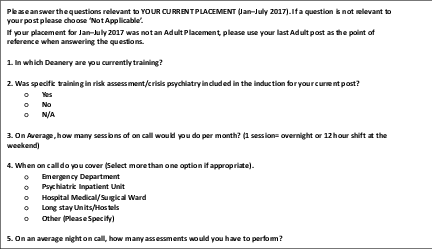
A 28-item questionnaire was developed in conjunction with the College of Psychiatrists of Ireland (CPsychI) trainee committee and the Postgraduate Training Committee (PTC) of the CPsychI. The proposed questions aimed to encapsulate a wide range of issues facing trainees, using both multiple choice questions and rating scales, with the option of open text responses in some questions. Individual questions were initially proposed by the authors and then added to and revised after consultation with the CPsychI trainee committee and the PTC (see Fig. 1)
Sample of questions included in the questionnaire sent to trainees.

The questionnaire was then piloted among members of the trainee committee, before 193 Basic Specialist Training (BST) psychiatry trainees at all levels of basic training across Ireland were invited to participate in the study via an email link. The survey itself was hosted by Survey Monkey website. The survey was open to trainees for four weeks, with a further reminder to participate sent after two weeks, to optimise the response rate. No identifying data was collected besides the participant’s deanery. Data was securely stored by staff in the CPsychI.
If BST trainees were not currently in a general adult psychiatry placement, they were asked to use their last general adult placement as the point of reference when answering the questions. The 28 questions surveyed trainees’ contact with crisis presentations on-call and during working hours. The questions regarding the on-call experience included the duties expected of the trainee, frequency of on-call, European Working Time Directive (EWTD) compliance, level of senior support, facilities available and the NCHD’s overall satisfaction with on-call. The questions on crisis presentations during working hours focussed on which staff were doing these assessments, the site where these assessments were taking place and availability of supports such as suicide community assessment nurses and crisis intervention/home-based treatment teams.
Results
In total, 68 out of 193 trainees completed the survey, giving a 35% response rate from BST trainees in Ireland over a 4-week period. No responses were excluded from analysis. Overall, 46% of respondents reported that they were not provided with training in risk assessment/crisis psychiatry at the start of their post. 96% of respondents covered call in a psychiatric inpatient unit, 66% also covered psychiatric issues in medical/surgical hospital wards on-call and 74% of respondents covered psychiatric presentations in an ED while on-call. The average number of calls per month was 3.9 (highest 14, lowest 2). On an average session on-call, trainees reported doing an average of 4.4 assessments (highest 15, lowest 1). In total, 37% responded that their on-calls were not EWTD compliant. Nearly 20% of trainees reported that if their call was classed as off site, they would spend the majority of their call on site.
If on-call in ED, 21% said there was not a suitable room for them to perform assessments in. In total, 34% reported no availability of panic alarms, 7% reported no availability of security at all, 24% answered that they never had a senior registrar on-call with them. 29% were very satisfied and 49% were satisfied with their senior support on-call. 9% were dissatisfied with their level of senior support on-call. The vast majority of respondents were satisfied with the handover process on-call (2% dissatisfied).
During normal working hours, 25% of trainees reported a known community mental health team (CMHT) patient, would be assessed in the ED by liaison psychiatry in an emergency. In total, 32% reported they would be assessed by a duty doctor in an inpatient unit and 27% by a CMHT staff member in their local clinic. Nearly 30% of respondents reported the availability of a rapid access telephone service for general practitioners (GPs) to direct emergency referrals to CMHTs during working hours. Overall, 19% of respondents reported the availability of a suicide crisis assessment nurse service for GPs.
In total, 53% reported there was a self-harm nurse or psychiatric clinical nurse specialist (CNS) to carry out assessments in the ED during normal working hours; 25% of those surveyed stated that there was a CNS or self-harm nurse available for assessments out of hours and the majority of these were only available for part of the on-call period. 64% responded there was not a crisis intervention team available out of hours and 24% reported that there was a team available 09:00 a.m. to 05:00 p.m. at the weekends.
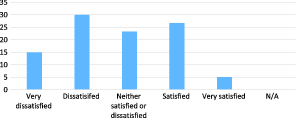
Overall, 5% said they were very satisfied with their experience in crisis/on-call psychiatry and 27% were satisfied, 23% responded they were neither satisfied nor dissatisfied with their experience. 30% reported there were dissatisfied and 15% were very dissatisfied with their experience overall (see Fig. 2).
Overall trainee satisfaction with on-call/crisis psychiatry experience.

Discussion
This study provided evidence of psychiatric trainees’ level of satisfaction with on-call and crisis psychiatry and explored the service provision roles expected of BST trainees across Ireland. A large number (45%) of respondents to the survey reported dissatisfaction with their experience of on-call and crisis psychiatry during their training. Dissatisfied trainees may have been more likely to respond as, in contrast, psychiatry training scored highly compared to training in other medical specialties in the medical council’s ‘Your Training Counts’ survey (Medical Council of Ireland, 2017).
Service provision issues like non-EWTD compliance, misclassification of call and lack of CNS support and lack of suitable, safe and secure assessment rooms in the ED are widespread, according to the survey findings. Non-EWTD compliance was particularly apparent if one considered that one fifth of respondents reported that most of their rostered off-site hours were spent on site. It is not possible to deduce from the survey findings, if this finding was separate to or part of the 37% non-compliance with EWTD reported elsewhere in the survey.
Elsewhere, trainees reported a lack of specific induction training in risk assessment and crisis psychiatry, which was surprising considering teaching on risk assessment is a core component of psychiatry training and induction. Several explanations may exist for this finding. The reported lack of teaching in risk assessment may simply reflect trainees being unable to attend training, yet induction training is generally compulsory. Some trainees may not have attended risk assessment training because they had attended risk assessment training before, as nearly half of the survey respondents were not in their first post in psychiatry. The reported lack of risk assessment training identified by the survey may reflect trainee dissatisfaction with risk management training itself. There is increasing acceptance and evidence that the prediction of suicide, a low probability event even in the presence of several risk factors, is not an exact science (Murray, Reference Murray2016, Franklin et al., Reference Franklin, Ribeiro, Fox, Bentley, Kleinman, Huang, Musacchio, Jarozewski, Chang and Nock2017). The complexity of suicide prediction may make it fundamentally difficult for risk assessment training to address trainees’ needs and prepare them for the increasingly large number of self-harm and psychiatric crisis presentations to the ED.
Many of the survey findings imply that inadequate resources are impacting negatively on trainee satisfaction. The survey findings suggest that many CMHT patients are being seen during normal working hours in EDs or inpatient psychiatric units by duty doctors on-call and not by CMHTs directly. This may be contributing to the large number of self-harm and other crisis psychiatry presentations to EDs. There also appears to be a lack of resources, like rapid access telephone lines, directing referrals to CMHTs during normal working hours. The authors are currently examining hospital records to clarify the quantity of known CMHT patients assessed in ED during normal working hours. This will supplement the limitations of the self-report data and relatively low response rate of 35% in this study.
Since this survey was conducted there has been several developments that may mitigate some of the findings. Increased compliance with the EWTD has occurred with some clinical sites adopting a night shift call, replacing the more widely practiced 24-hour call. In 2018, the College of Psychiatrists of Ireland introduced an annual, compulsory week of induction training (including increased risk assessment teaching and suicide response training), for all foundation year BST trainees (College of Psychiatrists of Ireland, 2018). The trainee portfolio now includes a record of on-call commitments and whether these commitments included an ED component. New senior registrar posts have been created which will add an extra level of senior support on-call in some posts for BST trainees. There has also been more widespread implementation of the national self-harm clinical care programme. There is also increased evidence-based awareness and exploration of burnout in Irish doctors in general (Walsh et al., Reference Walsh, Hayes, Freeney and McArdle2019). Performing a follow up survey would be helpful to ascertain if these changes will influence the subjective experiences of trainees.
It would be beneficial in a future survey to include specific questions addressing the impact of resource limitations, the complexity of suicide risk assessment and the increase in self harm presentations on the on-call experience. Directly comparing trainee experience in private and public hospitals or stand-alone units and EDs could also be explored. Surveying non-trainee psychiatry NCHDs to ascertain their satisfaction levels is also needed. The findings of this survey suggest that there is a need for ongoing surveys of the trainee experience, to be undertaken by the CPsychI in collaboration with the CPsychI trainee committee.
Specifically exploring trainee satisfaction and the duties expected of a psychiatry NCHD on-call is an under researched area. It is hoped that this report will inspire further studies in this area to help improve the training experience, reduce the attrition rate and to ultimately lead to better patient care.
Acknowledgements
CPsychI Trainee Committee.
CPsychI Postgraduate Training Committee.
CPsychI Postgraduate Training Department: Liz Kavanagh and Karen McCourt.
Trainee Editor of Irish Journal of Psychological Medicine: Kevin Glynn.
Conflict of interest
Dr D.O.D. has no conflicts of interest to disclose. Dr J.McG. has no conflicts of interest to disclose. Dr H.B has no conflicts of interest to disclose. Professor M.C. has no conflicts of interest to disclose. Professor D.C. has no conflicts of interest to disclose.
Ethical standards
The authors assert that all procedures contributing to this work comply with the ethical standards of the relevant national and institutional committee on human experimentation with the Helsinki Declaration of 1975, as revised in 2008. The local hospital ethics committee was contacted about this study and they advised that ethics committee approval was not required.
Financial support
This research received no specific grant from any funding agency, commercial or not-for-profit sectors.