In March 2016, the lord lieutenant of Cheshire, David Briggs, dedicated a new war memorial in the town of Handforth, which lies just north of Wilmslow and some sixteen kilometers south of Manchester. It might have been more than one hundred years since the outbreak of the First World War and more than seventy years since the end of the Second World War, but temporal distance did little to dampen local enthusiasm for the memorial. Schoolchildren, war veterans, and local councilors gathered to watch the lord lieutenant officially unveil the memorial and to hear the British national anthem ring out at the culmination of the ceremony. Panels on the stone structure's base contain the names of twenty-six soldiers from the First World War, ten from the Second World War, and one from the more recent Afghanistan conflict. As is typical of many British memorials, none of the war dead actually died in Handforth; instead they had lost their lives on the battlefield or in hospitals behind the lines.Footnote 1
What was far more unusual about this new memorial, however, was the fact that a further nineteen soldiers had actually died in Handforth during the First World War, yet their names do not appear on the memorial. This was no oversight; presumably the reason for their absence is that all of these men had been German prisoners of war held in the Handforth internment camp. During the First World War, more than 115,000 civilian and military prisoners were interned in twelve major camps and many smaller facilities scattered across Britain. This article focuses on three of the largest camps established in mainland Britain: Handforth in East Cheshire; Frith Hill near Frimley, Surrey; and Dorchester in Dorset.Footnote 2 This selection allows for geographical spread and also brings together three camps of a comparable size that operated, albeit with short breaks in the case of Frith Hill, from 1914 through to 1919.Footnote 3 Even though each camp housed up to four thousand prisoners at any one time, there are very few traces of this episode in these three towns today.Footnote 4 Indeed, in the case of Handforth, the erection of the new war memorial has almost completely obscured a complex history of internment in favor of a more familiar narrative honoring those who “made the ultimate sacrifice.”Footnote 5
This article considers the process by which these enormous camps, which once so dominated their surroundings, disappeared from local and national memory cultures. The key to uncovering this process, the article contends, lies in the landscape. As W. J. T. Mitchell and Simon Schama have long made clear, trees, rivers, forests, and fields play a crucial role in the formation of “social and subjective identities.”Footnote 6 When internment camps opened during the First World War, these places disrupted local people's relationship to their surroundings, challenging their sense of being part of an unchanged, “enduring landscape.”Footnote 7 Not only did the erection of barbed wire and watchtowers create new “militarized landscapes,” but the camps themselves also placed the enemy directly in what had hitherto been a British environment.Footnote 8 As the camps were never sealed off entirely from their surroundings, a more fluid zone developed around them, where the military world of guards and prisoners of war brushed up against the local population. With both civilians and prisoners forced to share the same militarized environment, tensions frequently occurred over everything from access to resources to the disposal of refuse and sewage.
Despite the deep entanglements between the camps and their civilian surroundings, historical writing very rarely views wartime internment as part of a militarized landscape. Indeed, the studies that have followed in the footsteps of David Cesarani and Tony Kushner's pioneering work from the early 1990s have largely confined themselves to the camps.Footnote 9 A narrow focus on the supposedly self-contained camp world is clear from explorations of the prisoners’ cultural activities. Based on the notion that confinement also provided some degree of cultural freedom, a vast body of historical writing has sought to explore everything from camp newspapers to art and photographs.Footnote 10 Taking this approach a stage further, Brian Feltman views the prisoners’ theater productions and musical activities as a sign of resistance; Alon Rachamimov, meanwhile, argues that such performances highlighted shifting masculine identities.Footnote 11 While these studies shed light on everyday life in the camps, they reveal far less about the world beyond the wire.
Other areas of the existing historiography are also spatially restricted. The treatment of enemy soldiers at the moment of capture, which forms another significant research strand, certainly extends beyond the camp boundaries but only really to consider incidences of violence once soldiers were in enemy hands.Footnote 12 Oliver Wilkinson's comprehensive exploration of British prisoners in German captivity is a case in point. In one detailed chapter, Wilkinson considers the psychological impact of surrender, particularly when soldiers were disarmed and often robbed of their possessions. But any interactions beyond the closed world of the individual are left largely unmarked.Footnote 13 Work on civilian internees might have offered more scope for exploring civilian-military entanglements, but here, too, the focus has tended to be on life in the camps themselves rather than on the world beyond the wire.Footnote 14 Both Matthew Stibbe and Panikos Panayi, for example, who have examined British and German civilians interned in Germany and Britain respectively, have concentrated principally on the camp system and its impact on those unfortunate enough to be held within its grasp.Footnote 15
If the wartime internment camps are instead situated within a wider militarized environment, reasons behind the absence of these facilities from Britain's memory culture become clearer. At first, local residents generally tolerated the camps, particularly as they allowed for a satisfactory glance at a vanquished enemy. However, neither the War Office nor the existing population had a real understanding of how these new places fitted into the landscape. As a result, it gradually became evident that the camps intruded into people's existing sense of place, and even damaged it.Footnote 16 The noise and smells of the prisoners flowed into neighboring communities, and even the streets became more threatening when the prisoners used them for exercise. It was only when the British started to employ prisoners of war to work the land that some of these tensions started to fade. With the end of hostilities, the local population was only too keen for the camps to close, the environment to be demilitarized, and their previous bonds to the landscape to be restored. There was never, therefore, a sentimental attachment to these sites of internment, which in other circumstances could have led to calls for their preservation. These were places that people were content to see fade rather than to ensure they became permanent British “sites of memory.”Footnote 17
Arrivals
At the start of the conflict, the residents of Dorchester, Frimley, and Handforth had every reason to believe that their towns would be making a considerable military contribution. The army already had a significant presence in both Frimley and Dorchester. The Surrey heathland bordering Frimley had long been home to training camps, while the Royal Military College, Sandhurst, lay only four kilometers further north. Dorchester had a similar military pedigree. The town was home to the Dorsetshire Regiment and had also once housed a battery of the Royal Horse Artillery. Handforth, by contrast, had no previous military associations, but this soon changed with the outbreak of hostilities. In August 1914, plans were immediately developed to house a battalion of the Manchester Regiment in the disused Bradford Dyers Association factory just south of the village center. Handforth's newspaper, the Alderley and Wilmslow Advertiser, welcomed this development, confirming that the factory was “plenty large enough” to accommodate two thousand men.Footnote 18
However, once Britain was fully at war, military authorities quickly realized that they required facilities not only for fighting troops but also for captured enemy. After only a matter of weeks, large numbers of Germans, Austrians, and Hungarians had already fallen into British hands. At first, “enemy aliens”—a catchall term for civilians living in Britain—formed the largest contingent of prisoners. They were arrested and interned on an ad hoc basis from August 1914 until May 1915 when the government finally announced the detention of all male “enemy aliens.” Soldiers captured in the fighting at the front formed a second group, initially much smaller, but it grew exponentially as the conflict dragged on.Footnote 19
Faced with a sudden need to intern thousands of people, the War Office scrambled frantically for a solution. The Royal Horse Artillery barracks in Dorchester, which at this time were empty, provided one immediate answer. During early August 1914, the barracks were adapted for prisoners, with space set aside for further accommodation blocks if required.Footnote 20 Frimley was also an early candidate for prisoners. The open heathland that bordered the town, long used for military maneuvers, now seemed ideal for enemy internment. Within the first weeks of the war, huts and tents started to be erected on an open piece of land known as Frith Hill.Footnote 21 Handforth, the site of the third camp, was chosen more by chance. In September the War Office had asked for information on sites across the country that could be used for internment purposes. Handforth's local Urban District Council did its best to ignore the War Office's advances, claiming that there was “no place” within the town “that would be suitable.”Footnote 22 In the end, though, it was hard to dispute that the large empty factory earmarked for the Manchester Regiment would also be suitable for prisoners. Once the decision had been made, the military made some rudimentary repairs to the site, “rapidly transforming the interior of the buildings into habitable quarters.”Footnote 23
Constructing the internment camps involved much more than simply providing beds and eating facilities. In all three cases, the surrounding landscape also had to be reconfigured and militarized. The most visible change in this respect came with the introduction of containment measures. Each camp was provided with a secure barbed-wire fence. In the case of Dorchester, a series of wooden guard towers along the fence line added a further layer of protection.Footnote 24 The open heathland of Surrey was also fenced off with “a thick entanglement of barbed wire” that, according to some reports, contained “a powerful electric current at high voltage.”Footnote 25 The enclosures surrounding the camps were as much about keeping local people out as the prisoners in. Indeed, the military declared the land around the Frith Hill camp a “forbidden zone,” with anybody coming too close threatened with arrest.Footnote 26 For the local population, a once-familiar landscape had suddenly been placed off limits.
The erection of internment camps, which would have been unfamiliar and unimaginable places for people living nearby, certainly altered their relationship to the existing landscape. However, with the war ongoing, they were powerless to object in any meaningful way. Unable to control the local environment physically, the British public instead sought to maintain a symbolic presence. Language, clothing, and flags became the weapons of choice in this struggle for space.Footnote 27 The setting for these symbolic clashes was the streets. Knowing that every prisoner entering or leaving a camp would have to make the slow passage along the open streets, local people often stood ready to confront their defeated enemy.
The moment of arrival was when the prisoners tended to be at their weakest. After stepping off the train in Frimley, George Kenner, a German businessman who had been living in London, recalled, “We marched into uncertainty.”Footnote 28 Many of the civilian prisoners, like Kenner, had gone from having homes, jobs, and families to being confined in strange surroundings. Others had been forced to undertake long, arduous journeys into captivity. Gotthilf Vöhringer, a Protestant missionary who had been serving in Cameroon, was captured by the British and sent to Lagos in Nigeria, from where he was shipped to Southampton. After a brief break on the south coast, he was placed on a train to the Handforth camp, arriving several weeks after his initial capture “hungry and chilled to the bone.”Footnote 29 If the strains of capture were bad enough for “enemy aliens,” they were worse for military prisoners. Not only did the prisoners have to cope with a disorientating journey to the camps but many also arrived battle-weary and wounded. What struck one journalist about “the Huns” disembarking in Frimley was their “bedraggled, untidy and unkempt appearance”; many were “without hats,” and their uniforms were “faded and of much worn appearance.”Footnote 30
For military prisoners, the journey to the camps could be deeply disconcerting. Soldiers who had been taken from the heat of battle, tired, exhausted, sometimes even nursing wounds, arrived in Dorchester, Frimley, and Handforth often to find crowds of British civilians waiting to “greet” them. In all three towns, news that a contingent of prisoners was on their way led people to gather in the streets hoping to catch a glimpse. The crowds, particularly in the early months of the war, could number in the hundreds. In Frimley, people “waited for several hours” outside the town's railway station to see the Germans arriving.Footnote 31 In Handforth, the road from the station became “so crowded” that the police had to intervene “with the object of dispersing the people,” while in Dorchester an “enormous” crowd also led to enforced road closures.Footnote 32 These occurrences were not unique. All across Britain, people flocked to see the new arrivals—just as in Germany the public also travelled to internment camps hoping to see their enemy behind wire.Footnote 33
However, the geographical location of the Frith Hill and Handforth camps—a short journey from London and Manchester, respectively—made them particularly susceptible to sightseerers. On weekends, “holiday-makers,” as the Manchester Evening News termed them, often traveled down to Handforth “in the hope of catching a glimpse” of the Germans.Footnote 34 In both regions, spotting prisoners became something of a spectator sport. One young Mancunian couple had planned to spend the day at the city's Belle Vue Zoo but then decided to join the crowds at the internment camp, instead. “Caged men at Handforth sounded more novel and exciting than caged animals,” reported the Liverpool Echo.Footnote 35 In Frith Hill, the arrival of the Germans apparently caused greater excitement than the annual Royal Ascot horse race, with more traffic and greater numbers of pedestrians.Footnote 36
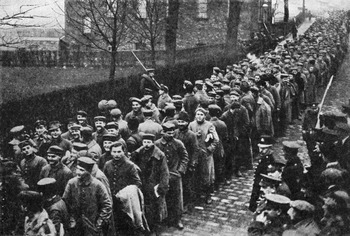
Evidence of tourism to the camps has added to the impression that the British public came to view the internment camps solely out of “curiosity.”Footnote 37 There was, however, always another motivation at play. The “curious” crowds often utilized the open space of the street to demonstrate their position of power against their vanquished foe. One British press photographer captured these interactions as a group of some six hundred men, reportedly fresh from the fighting at Neuve Chapelle, arrived in Handforth (see figure 1). In the photograph, the tightly packed group of German prisoners march four to five abreast to the camp, while armed soldiers and policemen guard the route. The men look to be in good physical shape, a few even smiling and joking to their neighbors; others, particularly those on the far left of the picture, look nervously around, seemingly surveying an unfamiliar landscape. Lest the arrivals feel too comfortable in their new surroundings, British civilians have taken up a position on one side of the street, held back by a policeman, while on the other some young men casually look on from a farm gate.
German prisoners from Neuve Chapelle arriving in Handforth, East Cheshire, March 1915. Science and Society Picture Library.

The contrast between the bedraggled soldiers in their dirty uniforms and the smartly dressed civilians, including two women (bottom right) wearing fine hats, highlights the power dynamics at play. Although this image reveals no sign of verbal exchanges between the British and Germans, earlier reports from Handforth suggest that shouts and taunts directed toward the prisoners likely occurred. When the first civilian prisoners arrived in November 1914, for example, the waiting crowds had directed “good-natured badinage” at their new enemy.Footnote 38 At the Frith Hill camp, people in the crowds went a stage further. One “well-dressed woman” stepped out of her car and began “frantically waving a Union Jack in the faces of the prisoners.”Footnote 39 Such overt displays of nationalism may have been rare, but they nonetheless reflected local people's attempts to stress their rightful position within the wider landscape.
Smellscapes and Soundscapes
Once the prisoners had arrived at their internment destination, their British captors placed them securely behind barbed wire. However, it soon became clear to all concerned that the boundaries of the camps were extremely fluid. As the local populations living in and around Dorchester, Frimley, and Handforth discovered, the prisoners and the camps that housed them had a major impact on the wider landscape. By the summer of 1915, there were up to 3,500 internees in Dorchester; some 1,500 in Frith Hill; and 2,100 in Handforth.Footnote 40 With such large numbers of people, the issue of sewage from the camps became an urgent and ever-growing problem as human waste seeped into neighboring fields and watercourses.
Very little thought had been given to the question of waste disposal when the camps had been established. In Handforth, the factory buildings that formed the basis of the internment camp had never been completely finished and lacked running water or a proper sewage system. Facilities were similarly provisional at Frith Hill, which consisted for the most part of temporary canvas tents erected on an open hillside. The government's official policy on the sanitation of internment camps allowed it to defray some of its wider responsibilities. Issues of health and hygiene, rather than being under sole jurisdiction of the military, were placed in the hands of the local councils and, more specifically, the local medical officers of health.Footnote 41 This approach was fine in principle but in reality was far from adequate; not only was the existing inspection regime ill-equipped to deal with the scale of the task but the local medical officers of health were also slow to commence work.
In their public pronouncements, however, the British military and the government firmly rejected suggestions that the camp system was failing. When a Glasgow export firm contacted the Foreign Office about alleged rumors of poor sanitation, it received a robust response. The complainant was assured that there had been a mere five deaths in the camps—all from “natural causes”—and that every effort was being made to ensure hygiene conditions were “as nearly perfect as possible.”Footnote 42 The government also took a firm line on the issue in parliamentary debates. In response to a Liberal Party politician who questioned standards in the Handforth camp, Harold Tennant, the under-secretary of state for war, insisted that “military sanitary officers” had fully examined the camp and did not believe “insanitary conditions will arise.”Footnote 43 In private, the military was less optimistic, admitting that the sanitation facilities at Handforth in particular were recognized “as not being satisfactory.”Footnote 44
The government may have been able to disregard critics in Parliament or in business, but the British population living in and around the camps proved much harder to appease. What most aggrieved local people was not just that the camps existed but that these sites had also started to change local landscapes. In all three areas, disposing of prisoner waste caused the greatest problems. With no connection to a sewage system, waste from the Frith Hill and Handforth camps had to be physically removed. Reverting to a nineteenth-century model, the Wilmslow and Frimley Urban District Councils regularly dumped sewage on open agricultural land where it could feed the soil.Footnote 45
It did not take long for the consequences of such decisions to be felt. In Frimley, effluent from the camp ran into a watercourse known as Jack's Pond and then flowed into neighboring ditches.Footnote 46 Facing similar environmental pollution in Handforth, one local landowner demanded an indemnity from the council. “Excreta,” the complainant pointed out, could potentially run off the fields and lead to the “fouling of the River Dean.”Footnote 47 Even more intrusive for local people were the altered “smellscapes” around the camps.Footnote 48 “Whenever the wind was blowing,” stated an A. Smithson from the hamlet of Dean Row southeast of the Handforth camp, smells continually wafted into his house. Smithson was not alone in bemoaning such nasal intrusions. Eventually Cheshire's chief medical officer stated that he was “so weary of receiving complaints” about smells that he would not defend the Urban District Councils if the matter went to court. In Frimley, the council proposed covering the prisoners’ waste with both soil and disinfectant to stop lingering odor.Footnote 49
The sewage problem had financial implications for the local councils. At the Handforth camp, the two neighboring councils of Wilmslow and Handforth took responsibility for waste disposal. They sent a regular procession of council carts to the camp to remove the growing piles of human waste and other refuse. All of this imposed a considerable financial burden on the two councils, particularly as the camp had initially been classed as a nonrateable property, meaning that the two councils received no regular payments from the War Office for their services.Footnote 50 Even in Dorchester, where the internment camp had a main sewage connection, financial and sanitation problems still occurred. The “large numbers of German prisoners” meant the town's sewage works had to “deal with an increased flow” and was very near capacity. After much negotiation, the War Office agreed to partly subsidize improvements to the existing infrastructure.Footnote 51
It was not just the altered “smellscapes” that appeared to threaten the existing landscape; with the opening of the camps, there were increased levels of noise as well. Rural landscapes accustomed to particular rhythms and sounds suddenly reverberated with the hustle and bustle of thousands of prisoners of war. In Dorchester, where the camp abutted the town, the most distinctive noise came from the prisoners’ band. German sailors captured in the early naval skirmishes practiced their musical skills most afternoons. According to Bruno Schmidt-Reder, a German civilian in the camp, many of Dorchester's residents gathered to hear the music. “It was little wonder,” he added, “as normally all that was to be heard in Dorchester was the bagpipes.” However, not all locals were enamored with the daily music. One contributor to the local newspaper was probably closer to the mark when he complained that “many think [the instruments] ought to have been taken from [the prisoners].”Footnote 52
Developing and then maintaining the camps also generated new and intrusive sounds. A major culprit was traffic noise, as a steady stream of motor vehicles trundled to and from the three sites, bringing supplies, visitors, and guards. This “extraordinary traffic” damaged the roads leading to both the Dorchester and Frith Hill camps. Frimley Urban District Council saw a ready solution in their midst and proposed using the prisoners to conduct the necessary repairs. In Handforth, where similar problems occurred, it was, ironically, the military authorities that made the loudest complaints, repeatedly demanding that the local council improve the roads to the camp for vehicular traffic.Footnote 53
Foreign Soil
Waste disposal and noise were just two of the many movements between the internment camp and the outside world. Another flow of concern for the local population was that of people. The prisoner population itself was never stable. The Frith Hill camp with its tented accommodation closed for the winter months and internees were distributed to other camps before returning in the spring. Handforth, meanwhile, was affected by the decision by British authorities, taken in the wake of the sinking of the Lusitania, to intern all male German civilians. After May 1915, the camp's civilian prisoners were gradually moved to the large Knockaloe internment camp on the Isle of Man. Maurice Jeger, an Austrian civilian, recalled being marched with some 250 other men up the kilometer-long hill to the railway station and then departing Handforth for good.Footnote 54 In their place, German military prisoners were brought in, but the population was still far from stable. The authorities frequently rotated the prisoners; some men were sent to working camps, while others were transferred to different internment sites. The boundaries of internment were thus never fixed, with constant comings and goings to the camps.
The prisoners first arriving in Dorchester, Frith Hill, and Handforth were a rather bedraggled group, exhausted by long journeys and cowed by unfamiliar surroundings. However, as they settled into the fixed routines of life behind wire, they gradually became accustomed to their new surroundings. Schmidt-Reder had arrived in Dorchester “soaked through and freezing”; for him, “these first hours in the camp were horrid.” But as the weeks passed, he began to appreciate the Dorset countryside: the landscape around the camp was “delightful,” the views “green,” and the sunsets “simply lovely.”Footnote 55 With increased familiarity came greater confidence. No longer were the prisoners content to passively tolerate the locals jeering at them on the streets or gawping at them through the camp fences; instead, they took opportunities to claim their own place within the local landscapes.
Prisoners’ first real occasion to sample the world beyond the wire came when some were briefly allowed out to buy supplies. Rather than being a state policy, the decision appears to have been made locally by the camp commanders on the ground. In Handforth, Jeger was permitted to walk to the nearby town of Wilmslow when his British-born son came to visit.Footnote 56 The situation was similar in Dorchester, where the camp commandant allowed several German officers to go “shopping” in the town. However, when news of this arrangement got out, not everyone was enthralled. One person complained of the “monstrous” situation that allowed Germans to “roam freely”—even if they were “spending a lot of money in the town.” Another Dorchester resident confirmed that he had already seen “three lots” out and about.Footnote 57
If the sight of individual prisoners strolling around town caused considerable disquiet, then decisions to allow larger groups to leave the camps were destined to unsettle British residents still further. In Handforth, the camp commandant introduced a scheme for prisoners to “march for an hour” in the surrounding countryside “on every fine day.” With limited space to circulate within the camp, the arrangement gave internees a chance to stretch their legs properly.Footnote 58 The same privilege was extended to the prisoners in Dorchester; as recreation facilities in that camp were limited there too, two hundred to three hundred internees were “allowed out for marches of 2 hours at a time under escort.”Footnote 59
Although these marches were intended to allow internees to take some exercise, the prisoners also used the occasion to discover more of the landscape that surrounded their places of interment. “The lovely open countryside,” as Gustav Plüschow, a captured German officer, described Dorset, no longer seemed threatening once they were free to take in the environment with their fellow prisoners. Increasingly confident of their surroundings, the prisoner marches were often a tuneful affair. In both Dorchester and Handforth, the men—all in uniform—marched along singing German military songs, including the popular, nationalist song “Die Wacht am Rhein” (“The Watch on the Rhine”).Footnote 60 When these large groups reached urban streets, Plüschow remarked, they sang their songs with “particular force and ecstasy,” almost as if they were “victorious troops” marching in under “General von Kluck.”Footnote 61
Any locals encountering the group would have come face to face with a large mass of enemy soldiers singing in German. The British people who had once stared menacingly at their imprisoned foe now found that it was not they but the Germans who seemed most comfortable in the wider environment. Understandably, this shifting relationship caused considerable consternation. Many feared that the landscape they knew so well was being disturbed by an intruding, enemy population. In Handforth, it fell to Samuel Stockton, vicar of Saint Chad's parish church, to lead the fight back. Stockton deemed the German walks “so serious” that he used part of his Sunday sermon to address the matter and started a petition to oppose them. Stockton and other locals claimed that the prisoners’ behavior was “objectionable”; it was “not pleasant” for “women and children” to be on the street at the same time as the Germans. With Stockton's complaints coming amidst violent protests following the Lusitania sinking (during which German-owned businesses in parts of the country were ransacked and looted), the camp commandant was forced to halt the walks briefly for the prisoners’ own safety.Footnote 62
Local residents could at least comfort themselves with the thought that the prisoner marches would be temporary affairs. As soon as the conflict was over, the men would leave. The prisoners, both civilian and military, of course were also desperate to end their internment and return home to friends, families, and old lives. While most did eventually make it home, the large group of prisoners who died in captivity were destined never to leave Britain. The majority of deaths at the camps in this study were from ill health or disease; the influenza epidemic of 1918 was particularly devastating. In addition, British sentries shot and killed two captured German soldiers, Wilhelm Schmidt and Franz Radojewski. Schmidt was “accidently” killed in Handforth in a dispute over cigarettes, while Radojewski was shot in May 1919 trying to cut through the wire fence around the Dorchester camp.Footnote 63
Schmidt, Radojewski, and the other prisoners who died in the camps were all laid to rest in the nearest cemeteries. The dead from Handforth were buried in Wilmslow Cemetery, a little over two kilometers from the camp gates. Fordington Cemetery, which took those who had died in the Dorchester camp, was at the other side of the town from the camp, while Frith Hill's dead were interred in the nearby Deepcut Cemetery. In all three cases, funerals provided prisoners with a brief opportunity to escape the confines of the camps. Like the much-contested countryside walks, attending funerals also brought internees and their British neighbors together in one shared local landscape.
In the view of the prisoners, the dead should have been laid to rest in their own “homeland” (Heimat) near their loved ones rather than in “foreign soil.”Footnote 64 With no possibility to return the dead to Germany, however, the prisoners instead attempted to personalize the burials. They were helped in this process by the British military authorities’ generally allowing prisoners an “elaborate funeral,” so long as it was done “at their own expense.”Footnote 65 In reconfiguring the British landscape to make it more in keeping with Germany, performative aspects of the funerals took center stage. Prisoner-of-war camps have long been recognized as hotbeds of theatrical activity, but in this instance the performers took to the streets.Footnote 66
Before the burial, prayer services were normally held within the camp. The commandants then allowed a selected group of prisoners to form a cortege to accompany the coffin to the cemetery. In Frith Hill, only sixteen prisoners were permitted to process, while in Handforth some funerals saw up to two hundred German prisoners following the coffin.Footnote 67 On the slow walk from the Handforth and Dorchester camps to the cemeteries, the funeral corteges passed right through the center of the two towns. Local people who came out to view proceedings would have been greeted with the sight of a uniformed mass of enemy soldiers marching slowly behind the biers. Draping the imperial German flag over the coffin helped prisoners to impose their own national identity on proceedings. In Handforth, funerals were awarded even more symbolism as the prisoners’ own band accompanied the procession through the streets. At the cemetery, readings and music in German accompanied the deceased into the grave.Footnote 68
The local population often viewed these elaborate funerals with suspicion. In Dorchester, one onlooker observed skeptically that she hoped that in Germany “they pay as much respect to those [British prisoners] who die.”Footnote 69 The funerals may well have met with local displeasure, but the only thing that residents could really do was to restrict the visibility of the graves. As was standard British practice for burials of prisoners of war, a simple wooden cross was all that initially marked the burial plots. Any attempts to erect more permanent memorial structures generally met with “much local opposition.”Footnote 70 In Handforth, the parish priest went a stage further and banned any tributes on the German prisoners’ graves. “So long as I'm in charge,” he is alleged to have said, “nothing is going to be placed on a Hun's grave.”Footnote 71 The location of the three camps on the edge of small urban areas forced British and Germans to recognize the other, yet at the same time, shared spaces like streets or cemeteries became points of conflict, particularly as the German prisoners started to become more at ease in the landscape.
Landscapes of Work
Tensions between the local British and the German prisoners of war reduced in intensity as the internment camps became more established. At the same time as the shock of the enemy's presence began to fade, improvements to the camps’ infrastructure eased grievances. In Handforth, military authorities finally commissioned a separate sewage system for the camp in early 1916. The changes, which met even with the American attaché’s approval, eradicated the foul smells hanging over the village and assuaged local residents’ complaints.Footnote 72 The lessening of tensions, however, did not just occur after German incursions into the environment had been curbed; relations also improved, ironically, when the prisoners were given more, not less, opportunity to roam the landscape. During the latter half of the war, prisoners of war were used increasingly to harvest crops, plow fields, and drain rivers. The local population generally accepted this work on the land, as they rather than the Germans outlined the parameters of these incursions into the countryside.
For the first two years of Britain's internment policy, prisoners of war were given few opportunities to work. The public, as the head of the Directorate of Prisoners of War later acknowledged, initially refused to tolerate the employment of prisoners.”Footnote 73 If men worked at all, it tended to be solely within the confines of the camps, where they performed their own trades. German journalists produced the camp newspaper, hairdressers offered barber services, and trained dentists filled the prisoners’ cavities. But with labor shortages in Britain increasing through late 1915, the prisoners’ inactivity became all the more noticeable. Lord Newton, the paymaster-general, was not alone in asking the pertinent question, “Why not use Germans on our farms?” Newton's suggestion, along with calls from landowners and politicians, gained traction through 1916 after the introduction of conscription had further reduced availability of workers. From 1917 onward, ever-increasing numbers of prisoners of war were deployed in Britain's industrial and agricultural sectors, so that by the time of the armistice, some 64,250 prisoners were in work.Footnote 74
Although the government accepted the need for labor by the prisoners of war, many locals living near the camps feared that the Germans would use the opportunity for either escape or sabotage. In Handforth, rumors spread that prisoners employed on farms “goug[ed] out the eyes” of potatoes before sowing them. Lieutenant Colonel Dauncey, the camp commandant, quickly scotched these allegations, pointing out that any farmer failing to notice such acts of sabotage would have to be “blind or an idiot.”Footnote 75 Tales of German treachery spread in Dorchester too. After a contingent of German prisoners had been employed to tend the town's main park, people complained that they had planted geraniums in the shape of an Iron Cross. On closer inspection, the council discovered that the shape was actually a Maltese Cross, which had formed part of the flowerbed design for fifteen years.Footnote 76
However, the more time the prisoners spent working, the more comfortable local people became with the basic principle that Germans might be allowed out of the camps. In Surrey, Frith Hill camp was resited to allow prisoners to work on the construction of a new railway line, while Dorset County Council frequently included prisoner labor in its plans for gravel quarrying and road repairs.Footnote 77 Further north in Cheshire, many of the farmers employing prisoners quickly warmed to their new workers. One farmer asked to be given more prisoners as they were cheap to employ, while another was so desperate for labor that he volunteered to billet five Germans in his home.Footnote 78 By 1918, the prisoner labor system had become so firmly established that the farms surrounding the Handforth camp received a quota of prisoners each day; camp guards distributed them almost “like postmen dropping letters.”Footnote 79
The prisoners, though, were not just employed to maintain the existing landscape: the British also used them to create entirely new landscapes. The Cheshire War Agricultural Committee was most active in this regard, recognizing early on that underutilized land in the county could be developed for food production. In both Germany and Britain, the war gave a fillip to long-standing human attempts to control nature by making it more productive.Footnote 80 As in other areas of Britain, the committee could draw on prisoner labor to complete this enormous task. From 1917, the committee used prisoners of war to clear overgrown watercourses. First to be cleared were the Gowy, Fender, and Arrowe rivers, but the greatest achievement occurred on the Wirral Peninsula, where 250 prisoners “thoroughly cleansed and scoured out” the River Birkett. This brought five thousand acres of low-lying land back into cultivation.Footnote 81 While the British expressed immense satisfaction at these environmental improvements, it is less clear what the German prisoners of war gained from their efforts. Reflecting a popular medical discourse on healthy landscapes, the committee merely suggested that the prisoners would develop bigger muscles and be in better health.Footnote 82
Using prisoners of war to clear rivers only whetted the Cheshire committee's appetite. With an ever-growing prisoner population at its disposal and continual demands to increase food production, the committee pushed forward ever-grander schemes of environmental reconfiguration. Its most ambitious plan was on the Frodsham Marshes to the east of Chester. This vast area of low-lying land, bordering the estuary of the River Mersey, had once been a tidal salt plain until the construction of the Manchester Ship Canal in the late nineteenth century had severed the marshes from the sea. The committee's grand plans involved German prisoners of war draining some three thousand acres of waterlogged land, transforming the marshes into “one of the best crop producing areas anywhere.”Footnote 83
At its 1918 peak, some two hundred prisoners of war at a time worked on the marshland drainage scheme. Laboring on average for nine hours each day, Monday to Friday, and five hours on Saturdays, prisoners systematically cleaned out old drainage ditches and, where needed, cut new ones. For an area where the weather was “nearly almost vile,” as one Swiss inspector put it, the working conditions were challenging. Some of the men spent their days wearing rubber boots, waist deep in cold water, yet the Cheshire committee still found reason to bemoan the speed of progress.Footnote 84 Instead of clearing two hundred yards of land a day, it was suggested, prisoners should be aiming for at least one mile. One member of the committee called for an inspector to be appointed to “ginger up” the prisoners.Footnote 85
Considerable tensions between the British and Germans undeniably remained. Indeed, in September 1918, prisoners working in Frodsham Marshes briefly laid down their tools in protest at the conditions. As had been the case at Frith Hill, the tented accommodation, which did not “offer sufficient protection in rainy weather,” was a particular source of complaint.Footnote 86 Yet such incidents were relatively minor compared to earlier disputes over the streets, sewage, and noise. In all camps, relations tended to improve the longer the war went on and familiarity grew.Footnote 87 Just as important in this process, however, was the fact that the prisoners appeared to be cultivating the local landscape. Gone was the sense that the landscape was somehow under attack from enemy outsiders; instead, local people could comfort themselves with the thought that the Germans were shaping their environment according to a British template.Footnote 88
A Fading Presence
When the armistice was signed on 11 November 1918 and fighting finally came to an end, little changed immediately for the thousands of enemy prisoners interned in Britain. By May 1919, some thirty-one thousand had left, but this number represented only one-quarter of those held.Footnote 89 The reason for the slow pace of returns lay with the British government's decision to follow France's lead and hold its prisoners until the formal signing of a peace treaty with defeated Germany.Footnote 90 As a result, daily life for the prisoners continued as before, with Germans still clearing Frodsham Marshes and working on farms in Cheshire and Dorset. This period of waiting was terribly frustrating for the prisoners, who, as a Swiss report noted, had only “one desire which [was] to be sent home.”Footnote 91 Not until the end of 1919 did the British finally start to empty the remaining camps. In mid-November, camp guards in Handforth led the prisoners back to the town's railway station, marching along the same streets that had been the scene of such tensions during the early years of the war. Trains then took the men to one of Britain's East Coast ports, where they were loaded onto ships bound for the Netherlands and then home.Footnote 92
At almost the very moment that the authorities emptied Handforth and the other camps of their prisoner populations, the British staged their first set of Armistice Day commemorations. In London, and across the country, on the morning of 11 November when clocks struck eleven, people stopped what they were doing to observe two minutes’ silence in memory of the war dead.Footnote 93 Scenes of sorrow and careful reflection occurred across Cheshire, Surrey, and Dorset too. The two minutes’ silence in Dorchester was apparently a “beautiful and touching observance,” while in Wilmslow and Handforth, “not a sound was heard.”Footnote 94 Armistice Day coinciding with the final departure of the prisoners appeared to mark a fresh start; the people of Handforth, Frimley, and Dorchester could finally draw a line under the difficult internment episode. The landscapes first militarized and then shared with the enemy could be returned to the local community, thereby masking the “reality of war.”Footnote 95 In short, the closure of the camps allowed local people to create a new, more “normal” past for their communities.
At the war's end, it was not just the military prisoners who departed Britain for good: the conflict also ushered in the demise of the country's previously deep-rooted Anglo-German community. Those who had not been deported to Germany understandably had little wish to remain in Britain.Footnote 96 With both military and civilian prisoners largely gone, there was no longer a German community within Britain in a position to remember the camps.Footnote 97 Yet this episode was not entirely forgotten. In Germany, groups of former prisoners of war fostered their own memory culture for Handforth, Frith Hill, Dorchester, and the other camps. Members of the Reichsvereinigung ehemaliger Kriegsgefangener (Reich Association of Former Prisoners of War), the largest of these organizations, met regularly for welfare and friendship and to record the history of their internment.Footnote 98 In 1921, for example, two former Handforth prisoners, Ludwig Bogenstätter and Heinrich Zimmermann, published a history of the camp. The association enthusiastically called it “by far the best portrayal of life in an English camp.” Reflecting the continuation of the camp communities within Germany, the two authors promised to donate all profits from the book to the relatives of those who had died in Handforth.Footnote 99
After the war, the memory culture for the camps had all but moved to Germany. Within Britain, only traces of this complex wartime story remained. The most visible reminders that thousands of prisoners had once lived in the country were the graves of the war dead. The bodies of nineteen prisoners lay in Wilmslow Cemetery; forty-eight prisoners of war were buried in Dorchester; and three near Frimley. Other former prisoners from the three camps had been interred near the hospitals, asylums, and labor camps where the deaths had taken place. During the war years, these “enemy” graves had been tolerated at best; after the war, little changed. When the Handforth camp finally closed in November 1919, the commandant left money with the cemetery authorities in Wilmslow for the maintenance of the burial plots of the prisoners of war. In the early 1920s, a small memorial stone was erected in the cemetery listing the men's names under the words “Ruhestätte: Kriegsgefangener Deutscher” (Final resting place of German prisoners of war). In Dorchester, a similar memorial, complete with the relief of a kneeling soldier and a German inscription, was placed in the cemetery during the camp's final months.Footnote 100
Besides these physical remains hidden away in quiet cemeteries, there was little else to remind local people of the internment camps. The Frith Hill camp, which had only ever been a tent encampment, was easily cleared. In Dorchester, the Ministry of Munitions auctioned off the main assets of the prisoner-of-war camp; the brick buildings that remained were given over to the Territorial Army.Footnote 101 In Cheshire, authorities returned the Handforth camp to its original owners, the Bradford Dyers Association, but as had been the case before the war, the association could find no use for the factory.Footnote 102 And although unacknowledged locally, the prisoners of war also left traces on the landscapes surrounding the camps. Their hours of hard toil on the Frodsham Marshes, for example, had left sustainable grazing pastures. And in Handforth too, some parts of a previously militarized landscape also found an afterlife. The camp's modern sewage facilities, which both the Handforth and Wilmslow Urban District Councils wanted, were eventually integrated into Wilmslow's system.Footnote 103 Yet in both cases, the role that the prisoners had played in shaping these environmental changes was left unspoken.
With few traces of the internment regimes remaining, local people turned to commemorating their own war dead. War memorials and remembrance rites, of course, had a crucial function for the bereaved, as the survivors tried to come to terms with their wartime losses.Footnote 104 But in Dorchester, Handforth, and Frimley more generally, the rituals also helped to normalize the regions’ complex wartime history. The greater the focus on British victims of the conflict, the more invisible the German prisoners became. In 1922, the members of Saint Chad's parish church in Handforth placed a wooden memorial plaque on the church walls. Even though small groups of prisoners had worshiped on occasion in the church, the simple plaque contained only the names of twenty-four British soldiers killed in the war.Footnote 105 The same was true of Frimley, where a brass memorial plaque for the community's own war dead was placed in Saint Peter's church in 1920, and Dorchester received its own cenotaph in 1921. As annual rituals of remembrance at these sites of memory became more established, the presence of the prisoners faded further. Only in Dorchester, where groups of Scouts occasionally laid a wreath on the German memorial in Fordington Cemetery, did some public recognition remain.Footnote 106
The increasing invisibility of local internment histories was encouraged by the public's suspicions of prisoners of war more generally. In Britain's “commemorative pecking order,” former prisoners who had returned from German captivity ranked fairly low.Footnote 107 In stark contrast, the war dead, particularly those killed on the western front, were at the center of commemorative activity. The reasons for the prisoners’ low standing were manifold but rested principally on a negative conception of their war experience. Whereas the conflict's front-line dead could easily be labeled as “heroic” victims, categorizing the former prisoners of war, who had survived the war, proved much trickier. As captured soldiers, their wartime service became something that they “lamented” and that the public also viewed “as lamentable.”Footnote 108 With even British prisoners of war struggling to maintain a place in the country's memory culture, it is little wonder that captured Germans found almost no place in local commemorative activity.
The outbreak of hostilities against Nazi Germany in 1939 encouraged a further reframing of Britain's First World War narratives. Fighting the brutal Nazi regime reinvigorated the remembrance of the earlier conflict, as the dead from two world wars were placed together on memorials and in rituals of remembrance.Footnote 109 For Handforth, Frimley, and Dorchester, the Second World War also provided a further opportunity to move beyond the earlier experience of internment. In Handforth, the disused factory buildings were brought back to life not to house German prisoners but to form part of a larger Royal Air Force complex. Rather than stories of marching prisoners, camp diseases, and deaths, the “friendly” sight of British tanks, RAF personnel, and military aircraft now provided the wartime backdrop. Further south, Frimley and Dorchester also gained a new role in the Second World War. Land around Frimley provided accommodation for troops fighting in Europe, while in Dorchester the land on which the former internment camp had stood was turned into an infantry training center.Footnote 110 The transposition of these sites into more familiar places helped them to blend unobtrusively into the landscape, in a way that was far more successful than had been the case in the earlier conflict.Footnote 111
During the Second World War, the German prisoners of war buried in British cemeteries were joined by British servicemen killed in the most recent conflict. Thirteen British servicemen were buried in Wilmslow, seven in Deepcut Cemetery near Frimley, and two in Dorchester's Fordington Cemetery. These new graves, marked with the familiar Imperial War Grave Commission Portland stone steles, dominated the sites, relegating the older German prisoners of war graves to greater obscurity. Under a 1959 international agreement between Britain and the Federal Republic of Germany, the bodies of all German servicemen killed in the two world wars, who had been buried in local British cemeteries, were to be brought together in a single site.Footnote 112 A remote part of Cannock Chase in Staffordshire was chosen for this purpose. Between the signing of the agreement and the dedication of the new cemetery in 1967, some five thousand bodies, including prisoners of war from the Handforth, Frith Hill, and Dorchester camps, were exhumed and reinterred in Staffordshire. Each prisoner now received a uniform headstone, which the German War Graves Commission supplied.Footnote 113
Once the bodies of the prisoners had been removed, even fewer visible reminders of these towns’ internment history remained. The prisoners’ memorial in Dorchester still stood, although it now looked over a series of empty burial plots. In Handforth, meanwhile, the Co-operative Wholesale Society took ownership of the former prisoner-of-war camp buildings in the early 1960s and utilized them as a warehouse facility. It was only in 1994 that the buildings were finally demolished, the land cleared, and a housing development built in its place. The new family homes were built in the mock-Tudor style that enjoyed something of a revival in the 1980s and 1990s. Half-timbered walls, fake leaded-light windows, and neat manicured front lawns filled the site. The architectural style of the new houses, set alongside the quiet waters of the River Dean, harked back to a rural, nostalgic past; the actual, far more complex history of the site and of Britain's twentieth century vanished in the new, artificial landscape.Footnote 114
Conclusion
After Dorchester bade farewell to the last of the internees, the Western Gazette declared the town to be “at last clear of German prisoners of war.” For good measure, it added that nobody “would ever wish them back.”Footnote 115 Pleasure at the news of the camp's closure reflected the obvious relief that the war had finally ended with Britain victorious, but it also stemmed from the fact that a lost landscape could now be reclaimed. As soon as the camp had been cleared, local people took “full advantage” of ancient rights to stroll around the land that had long “been enclosed by barbed wire.”Footnote 116 During the war, locals and the newly arrived prisoner population had reluctantly shared the landscape in and around the camps. For this reason, mutually competing claims to scarce resources and access to roads and basic sanitary facilities often turned the wider environment into an arena of bitter conflict. Contested places on the home front, whether in Dorchester, Frimley, Handforth, or elsewhere, are crucial for interpreting not only the history of internment but also for understanding the extent to which militarized landscapes spread at home during the First World War.
In the British case, the history of internment also helps shine a critical light on the country's First World War memory culture. In Dorchester, Frimley, and Handforth, a desire to return local landscapes to their earlier configuration helped ensure all evidence of the camps quickly faded. By the mid-1920s, the only significant signs of camp life were the prisoners’ graves, but even these had been cleared by the 1960s. With the loss of physical remains, a crucial link between memory and place, which might have helped to keep this history locally visible, was broken.Footnote 117 Nationally, there was also little incentive for the state to focus its attention on the wartime internment experience. At a time of economic and social upheaval, as the country tried to move from a wartime to a peacetime state, the focus of national commemorative activity was understandably on the British war dead rather than the interned enemy.Footnote 118 Solemn events, such as the two minutes’ silence each 11 November, helped create a workable narrative of the conflict while at the same time encouraging people to unite around the “sacrifice” of those killed at the front.Footnote 119 Locally and nationally, therefore, Britain's wartime internment camps quickly vanished from both the physical landscape and the country's burgeoning memory culture.
In many respects, the dedication of Handforth's new war memorial in 2016 fits within this pattern of commemoration. Harking back to the architecture of the interwar years, the stone obelisk with its embossed laurel wreath espouses a narrative of gallant national sacrifice. Following its dedication, the structure has served as a focal point for wreath-laying and remembrance services for the dead of the two world wars. Neither the memorial nor the rituals of remembrance performed at the site give any clues to the existence of the large camp for prisoners of war that had once dominated Handforth. Now buried mnemonically by a war memorial, the history of the camp and the prisoners who died in it have been completely silenced. The commemorative process in Handforth bespeaks a wider failure to integrate the history of internment into Britain's local and national memory culture. In state and public engagement in the First World War centenary, tales of personal tragedy, wartime poetry, and rituals of remembrance still take precedent over a more complex wartime past that included both civilian and military internment.Footnote 120