Introduction
Conduct disorders are among the most common mental disorders during childhood and adolescence and are known risk factors for later aggressive and delinquent behavior (Loeber & Farrington, Reference Loeber and Farrington2000; Odgers et al. Reference Odgers, Moffitt, Broadbent, Dickson, Hancox, Harrington, Poulton, Sears, Thomson and Caspi2008; Loeber et al. Reference Loeber, Burke and Pardini2009a , Reference Loeber, Burke and Pardini b ; Reef et al. Reference Reef, Diamantopoulou, van Meurs, Verhulst and van der Ende2009; Mordre et al. Reference Mordre, Groholt, Kjelsberg, Sandstad and Myhre2011). Children and adolescents who also suffer from co-morbid emotional disorders exhibit even greater impairment in social functioning (Ezpelata & Domènech, Reference Ezpelata and Domènech2006; Ingoldsby et al. Reference Ingoldsby, Kohl, McMahon and Lengua2006). Furthermore, young patients with co-morbid disorders of conduct and emotions show an increased risk of substance abuse (Ingoldsby et al. Reference Ingoldsby, Kohl, McMahon and Lengua2006; Fergusson et al. Reference Fergusson, Horwood and Ridder2007; Pardini et al. Reference Pardini, White and Stouthamer-Loeber2007). Importantly, preventing and treating conduct problems has the potential to reduce the adult health burden (Odgers et al. Reference Odgers, Caspi, Broadbent, Dickson, Hancox, Harrington, Poulton, Sears, Thomson and Moffitt2007).
Patients with co-morbid externalizing and internalizing disorders who are not adequately treated are at risk for developing personality disorders. Co-morbid disorders of conduct and emotions are strongly associated with borderline personality disorder (BPD), although the diagnosis of BPD in adolescents is controversial (Rey et al. Reference Rey, Morris-Yates, Singh, Andrews and Stewart1995; Miller et al. Reference Miller, Muehlenkamp and Jacobson2008; Streeck-Fischer, Reference Streeck-Fischer2013). Early interventions administered during childhood and adolescence are essential for preventing further negative developments (cf. Chanen et al. Reference Chanen, Jovev, McCutcheon, Jackson and McGorry2008; Chanen & McCutcheon, Reference Chanen and McCutcheon2013).
Despite the implications for social and emotional development, few studies have examined psychotherapeutic treatments for patients with co-morbid externalizing and internalizing disorders (Kazdin, Reference Kazdin2002). Some studies have addressed cognitive-behavioral treatments or family therapy, but only a few studies have examined psychodynamic therapy (PDT) (e.g. Farmer et al. Reference Farmer, Compton, Burns and Robertson2002; Curtis et al. Reference Curtis, Ronan and Borduin2004; Rohde et al. Reference Rohde, Clarke, Mace, Jorgensen and Seeley2004; Eyberg et al. Reference Eyberg, Nelson and Boggs2008; Littell et al. Reference Littell, Campbell, Green and Toews2009a , Reference Littell, Winsvold, Bjorndal and Hammerstrom b ; Woolfenden et al. Reference Woolfenden, Williams and Peat2009; Jacobs et al. Reference Jacobs, Becker-Weidman, Reinecke, Jordan, Silva, Rohde and March2010). Thus, treatment studies for these co-morbid disorders in adolescents are of importance, particularly regarding the evaluation of PDT (cf. Midgley & Kennedy, Reference Midgley and Kennedy2011), which is used frequently in clinical practice.
Consequently, this study focused on PDT for adolescents suffering from co-morbid disorders of conduct and emotions. In a randomized controlled trial (RCT), we examined a manualized in-patient treatment for these patients. The outcomes of PDT were compared with those for a waiting list/treatment-as-usual (WL/TAU) control condition. We hypothesized that the treatment group would show significantly greater improvement than the WL/TAU group when the rate of remission was taken as the primary outcome. We further expected a significant difference between the study conditions regarding the improvement in global psychological distress and psychosocial impairment as secondary outcomes.
Method
To combine the advantages of both study types, we conducted a hybrid efficacy–effectiveness RCT (cf. MTA Cooperative Group, 1999; TADS Team, 2003) to balance internal and external validity. Thus, our study has characteristics of an efficacy study [e.g. randomization; manualized treatment; standardized outcome measures; independent assessor; intention-to-treat (ITT) analysis] and an effectiveness study (e.g. few exclusion criteria; patients of the common adolescent psychiatric population with high rates of co-morbidity; treatments conducted in a naturalistic setting; medication treatment individually decided and not standardized).
Inclusion and exclusion criteria
For reasons related to the German health-care system, we referred to the ICD-10 diagnostic criteria (Dilling et al. Reference Dilling, Mombour and Schmidt1993), which allow the application of only one diagnostic code for a combination of externalizing and internalizing disorders, a mixed disorder of conduct and emotions (F92). Patients diagnosed with this disorder fulfill the diagnostic criteria for both conduct disorder and emotional disorder.
Patients were required to fulfill the following inclusion criteria: age 14–19 years, the diagnostic criteria of a mixed disorder of conduct and emotions (F92 according to ICD-10), and be willing to undergo in-patient treatment. The following exclusion criteria were applied: significant prenatal and perinatal impairment, IQ < 80 [based on the Wechsler Adult Intelligence Scale – Third Edition (WAIS-III); Wechsler, Reference Wechsler1997], psychotic and psychotic-like disorders, acute alcohol/substance abuse, and severe antisocial behavior.
Procedure
The study was approved by the ethics committee at the University of Goettingen. Patients were recruited between January 2007 and August 2011, during their initial interview at the child and adolescent psychiatric out-patient clinic of Asklepios Clinic Tiefenbrunn. Those who fulfilled the inclusion criteria and met no exclusion criteria were informed of the study, and they and their parents were asked for written consent. After being accepted to participate in our study, the patients were randomly assigned to the treatment group or to a WL/TAU control group by simple randomization that was conducted by the staff of the out-patient clinic. Patients assigned to the treatment group were offered in-patient treatment as soon as possible. Patients assigned to the WL/TAU condition waited 6 months after the initial diagnostic assessment, and were then offered the same treatment. For ethical reasons, however, patients in the control group and/or their caregivers could decide to make use of alternative psychotherapeutic and/or psychopharmacological treatments (i.e. TAU) during the waiting period. The applied treatments were documented to control for their impact. The same was true for the treatment group with regard to pharmacotherapy.
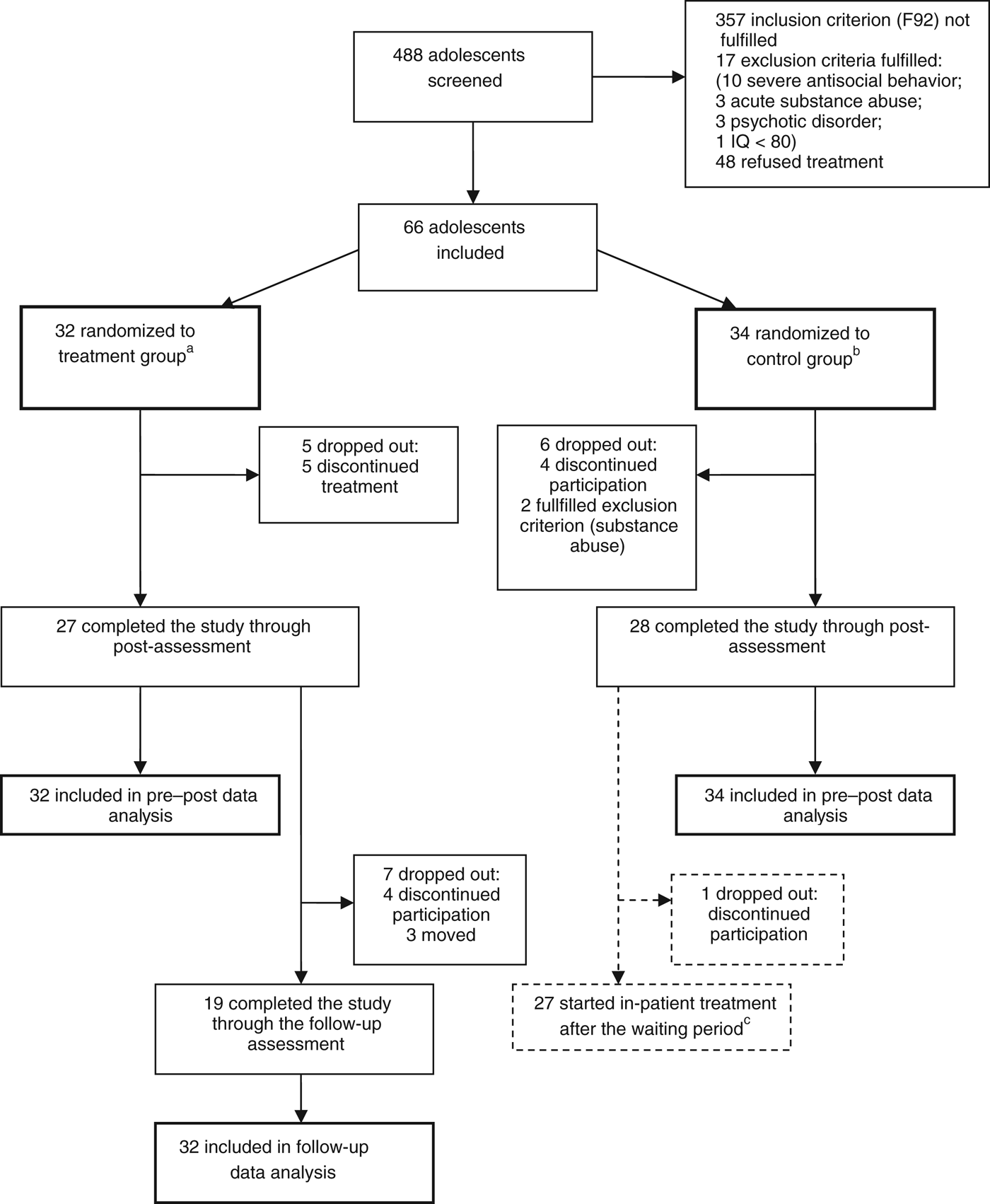
Post-assessment was conducted at the end of treatment and the end of the waiting period. To examine the stability of the treatment effects, a 6-month follow-up assessment was performed for the treatment group. Figure 1 is a flowchart for the participants in this study.
Flowchart. a Treatment group: psychodynamic psychotherapy (PDT). b Control group: waiting list/treatment-as-usual (WL/TAU) condition. c Patients from the WL/TAU condition started in-patient treatment after the waiting period; therefore, no WL/TAU condition follow-up data were available for them. The related post-treatment data after the WL/TAU condition were not included in the analyses.

Treatment
The manualized PDT was provided by six trained psychotherapists (one man, five women), with a mean age of 45.33 years (range 37–57) and professional experience of 9.17 years (range 2–25). All therapists were trained in the PDT and attended an intensive workshop that covered the treatment manual. The therapists were under weekly supervision by the manual's author. To further ensure treatment fidelity, several videotaped treatment sessions were discussed during the supervision. Treatment adherence was checked in randomly selected videotaped sessions by independent raters based on manual checklists. The mean duration of treatment was 34.15 weeks ( s.d. = 14.88).
Treatment manual
The PDT applied in this study is described in detail in an in-patient treatment manual (Streeck-Fischer & Streeck, Reference Streeck-Fischer and Streeck2010) and is based on the psychoanalytic-interactional method (PiM; Streeck & Leichsenring, Reference Streeck and Leichsenring2009; Leichsenring et al. Reference Leichsenring, Masuhr, Jaeger, Dally and Streeck2010). The PiM is a modified psychodynamic approach designed specifically for patients with developmental personality disorders (e.g. adolescents who suffer from co-morbid disorders of conduct and emotions). These patients often show trauma-related symptoms, pathological internalized object relationships and disturbances of ego functions (e.g. reality testing, impulse regulation, affect perception and differentiation, tension tolerance). The PiM is similar to transference-focused and mentalization-based psychotherapy but focuses primarily on the adolescent's interpersonal skills (i.e. the ability to form/maintain interpersonal relationships). For this purpose, the therapist presents themselves to the patient as an independent person and makes the therapeutic interaction selectively observable to the patient. The therapist uses the answering therapeutic mode, that is they selectively reveal their own experiences and feelings regarding the patient's behavior. Thus, the therapist takes an active part in the interpersonal therapeutic relationship and serves as a perceptible counterpart for the patient. Furthermore, the therapist temporarily assumes the ego functions of the structurally disturbed patient by putting themselves in the patient's place. These techniques seek to make the adolescents aware of alternative courses of action in interpersonal relationships and help them reach a state of reflective functioning rather than non-reflective acting out (Streeck-Fischer & Streeck, Reference Streeck-Fischer and Streeck2010).
The manualized PDT comprises well-defined guidelines for psychotherapists, ward managers and nursing staff (cf. Streeck-Fischer, Reference Streeck-Fischer2002, Reference Streeck-Fischer2008; Streeck-Fischer & Streeck, Reference Streeck-Fischer and Streeck2010). The treatment consists of several therapeutic components, including individual therapy (three 30-min sessions/week), group therapy (one 45-min session/week), weekly ward rounds and other additional treatment elements (e.g. occupational therapy, parent/caregiver counseling). The treatment concept comprises three stages: first, emphasis is placed on establishing a stable and secure relationship between the therapist and adolescent and on establishing precise framework conditions. If necessary, special arrangements and de-escalation procedures are defined to prevent destructive acting out (e.g. suicidal and self-harming behaviors and violence against others). In cases of serious impulse control difficulties, psychopharmacological treatment is used temporarily to prevent premature discharge. The second stage is concerned with working on the main relationship problems and the adolescent's structural deficits as described earlier. The third stage is characterized by increasing testing of the patient's ability to cope with everyday life and by finding a decision concerning life after in-patient treatment. Reaching this stage can be regarded as a precondition for the finalization of treatment.
Assessment
The primary outcome measure of this study was the rate of remission (no diagnosis of a mixed disorder of conduct and emotions according to F92 in ICD-10) after the treatment and waiting period respectively. This diagnosis is listed in ICD-10, whereas in DSM-IV (APA, 2000), two diagnoses for the combination of co-morbid conduct and emotional disorders must be used. Diagnoses according to DSM-IV are also reported.
Clinical diagnostics were based on two measurements: the Structured Clinical Interview for the DSM-IV (SCID; Wittchen et al. Reference Wittchen, Zaudig and Fydrich1997) and the ‘Diagnostic Checklist for Conduct Disorders’ of the Diagnostic System for Mental Disorders in Childhood and Adolescence (DISYPS-KJ; Doepfner & Lehmkuhl, Reference Doepfner and Lehmkuhl2000). The SCID covers present and lifetime mental disorders, including personality disorders, and is based on DSM-IV-TR (APA, 2000). The DISYPS-KJ is a diagnostic system that covers the principal disorders found in childhood and adolescence, and it consists of diagnostic checklists for clinicians and corresponding questionnaires for patients, parents and teachers. The applied diagnostic checklist for diagnosing conduct disorders refers to the diagnostic criteria of both ICD-10 and DSM-IV. The items of the diagnostic checklist were integrated into the SCID. If the diagnostic criteria of one or more emotional disorders (based on SCID-I) and the diagnostic criteria of a conduct disorder (based on the DISYPS checklist) were fulfilled, the diagnosis of a mixed disorder of conduct and emotions was assigned.
An independent, trained assessor provided all diagnoses based on a structured interview with the adolescent. This clinical psychologist completed intensive training on the SCID and was not involved in the randomization process, treatment planning or therapy. The inter-rater reliability (Cohen's κ) for the diagnosis of a mixed disorder of conduct and emotions (yes/no) between the study diagnostician and another trained rater was κ = 0.80.
The Symptom Check List 90-R (SCL-90-R; Derogatis, Reference Derogatis1992; Franke, Reference Franke2002) and the Strengths and Difficulties Questionnaire (SDQ; Goodman, Reference Goodman1997) were used as secondary measures. The SCL-90-R is a self-report instrument to assess the severity of psychological symptoms and consists of 90 items rated on a five-point Likert scale ranging from 0 (not at all) to 4 (absolutely). The single scores are used to construct nine scales and three global indices of symptomatic distress. In this study, the Global Severity Index (GSI) was used as an indicator of overall psychological distress. The internal consistency of the GSI in our sample was α = 0.96 (cf. Essau et al. Reference Essau, Groen, Conradt, Turbanisch and Petermann2001). Normative SCL-90-R data also exist for adolescents (Franke, Reference Franke2002).
The SDQ consists of 25 items that are evenly attributed to five scales (emotional problems, externalizing behavior, problems of hyperactivity and attention deficits, problems in relationships with peers and pro-social behavior). The items are rated on a three-point scale ranging from 0 (not true) to 1 (partly true) or 2 (definitely true). The scores are summed to generate five scales, each ranging from 0 to 10. Based on the four problem scales, a ‘total difficulties’ score ranging from 0 to 40 can be calculated. In the following, we refer to this score, which may be classified into three clinically relevant ranges; for the self-completed version, the ranges are ‘normal’ (0–15), ‘borderline’ (16–19) and ‘abnormal’ (20–40). These clinical ranges are based on normative data for a German sample: 80% of the sample was classified as ‘normal’, 10% as ‘borderline’ and 10% as ‘abnormal’ (Woerner et al. Reference Woerner, Becker, Friedrich, Klasen, Goodman and Rothenberger2002; Becker et al. Reference Becker, Hagenberg, Roessner, Woerner and Rothenberger2004). In our sample, the internal consistency of the total difficulties score was α = 0.73. Time points of assessment are presented in Fig. 1.
Data analysis
The required sample size was determined using a sample size calculation. Based on our experience with the conducted treatment, we estimated a remission rate of at least 50% for the treatment group and a low rate of up to 10% in the WL/TAU control group (e.g. Leichsenring & Rabung, Reference Leichsenring and Rabung2006). To detect a difference of 50% v. 10% at α = 0.05 by a two-tailed test with a power of 0.90, 29 patients are required in each group (Faul et al. Reference Faul, Erdfelder, Lang and Buchner2007).
Comparisons of the study groups regarding the baseline variables were performed using t tests for continuous variables and χ 2 tests for categorical variables. A logistic regression analysis that included pharmacotherapy (yes/no) as a covariate was performed to compare the study groups using the rate of remission as the primary outcome. For the primary outcome measure, α = 0.05 was adopted. Between-group differences were assessed using the odds ratio (OR) and 95% confidence interval (CI).
For the GSI and SDQ secondary outcome measures, the study groups were compared using ANCOVAs with the respective baseline scores and pharmacotherapy (yes/no) as covariates. For the secondary outcome measures, α = 0.05 was adopted. Between-group effect sizes were calculated according to Cohen's d (Cohen, Reference Cohen1988). For all analyses, the ITT sample was used. In case of missing scores, the last observation carried forward (LOCF) method was applied. For sensitivity analyses, complete case analyses were also conducted.
In subsequent analyses, we compared the two study groups with normative data and used repeated-measures ANOVAs to detect pre/post changes in the GSI and SDQ within the two conditions. Within-group effect sizes were calculated according to Cohen (Reference Cohen1988). Because we wanted to examine the stability of the expected effects in the treatment group, we also conducted a 6-month follow-up assessment in which a two-tailed paired t test was used to compare post-treatment and follow-up data within the treatment group.
We were also interested in possible clustering effects due to the therapists, and therefore conducted a multilevel modeling (MLM) data analysis (Raudenbush & Bryk, Reference Raudenbush and Bryk2002).
Data were analyzed using IBM SPSS Statistics version 19 (IBM, USA).
Results
Sample
The ITT sample included 66 patients. The mean age of the total sample was 16.48 years (range 14–19), and 45 patients (68.2%) were female. According to the inclusion criteria, all patients fulfilled the criteria of a mixed disorder of conduct and emotions (F92 in ICD-10) at baseline. Based on DSM-IV criteria, 49 (74.2%) of the patients exhibited an oppositional defiant disorder and 17 (25.8%) fulfilled the criteria for a conduct disorder. With regard to Axis I emotional disorders, depressive disorders (n = 53, 80.3%), anxiety disorders (n = 45, 68.2%), somatoform disorders (n = 24, 36.4%) and post-traumatic stress disorder (n = 21, 31.8%) were most prominent. Thus, in addition to the required diagnostic inclusion criteria, patients frequently met the criteria for further emotional disorders. Moreover, 59.1% of the patients also met the criteria for BPD. In our sample, 83.1% of patients had received some type of psychotherapeutic or psychiatric treatment at least once before their inclusion in the trial. A history of academic failure (poor school performance, school absence) was found in 87.9% of the patients, and 39.4% of the sample were no longer living with their parents. According to these data, the patients demonstrated severe psychosocial impairment and suffered from complex mental disorders.
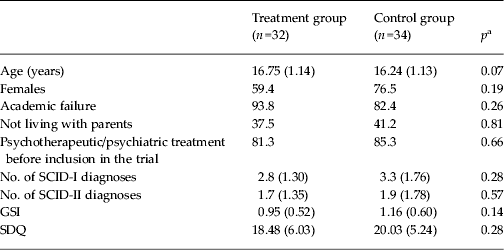
Comparisons of the baseline variables between the treatment group (n = 32) and the WL/TAU control group (n = 34) are presented in Table 1. Overall, statistically significant differences were not observed between the two groups with regard to sociodemographic characteristics, the number of co-morbid diagnoses or global psychological distress and psychosocial impairment.
Sample characteristics at baseline

GSI, Global Severity Index; SDQ, Strengths and Difficulties Questionnaire.
a Differences across groups were compared using ANOVA for continuous variables and χ 2 tests for categorical variables. None of the p values were significant.
Values given as percentage or mean (standard deviation).
Patient flow is presented in Fig. 1. The comparable drop-out rates were 15.6% (n = 5) in the treatment group and 17.6% (n = 6) in the WL/TAU condition (p = 0.71). We found no significant differences between the patients who dropped out versus those who remained within the trial regarding number of diagnoses or symptom impairment either within the conditions or in the overall sample (all p's > 0.29). By the 6-month follow-up assessment for the treatment group, seven patients had dropped out.
Half of the patients in the WL/TAU condition (17/34) received some type of treatment during the waiting period. Ten patients (29.4%) received psychotherapy, four patients (11.8%) received pharmacotherapy, and three patients (8.8%) received a combination of psychotherapy and pharmacotherapy. Pharmacotherapy could not be assessed for two patients who dropped out during the waiting period. With regard to the psychotherapeutic treatments of the WL/TAU group, eight patients received an out-patient psychodynamic treatment, four were treated psychotherapeutically in psychiatric out-patient settings, and one patient received a psychotherapeutic treatment in an in-patient youth welfare setting. Atypical neuroleptics (n = 4) and methylphenidate (n = 4) were used in the pharmacotherapy.
In the treatment group, 21 patients (65.6%) received pharmacotherapy during in-patient treatment; neuroleptics (n = 2) or atypical neuroleptics (n = 11), tricyclic antidepressants (n = 5), selective serotonin reuptake inhibitors (n = 3), methylphenidate (n = 3) and an anticonvulsant medication (n = 1) were used.
The difference between the groups in the number of subjects receiving pharmacotherapy was statistically significant (χ 2 = 12.44, df = 1, p = 0.001). Thus, pharmacotherapy (yes/no) was included as a covariate in all subsequent analyses.
Because of the wide range of the therapists' professional experience in the treatment group, we examined possible therapist clustering effects based on MLM but found no relevant influence with regard to treatment outcome [intraclass correlation coefficient (ICC) < 0.05; cf. Raudenbush & Bryk, Reference Raudenbush and Bryk2002].
Primary outcome
After treatment, 71.9% (23/32) of the patients in the treatment group no longer fulfilled the diagnostic criteria for a mixed disorder of conduct and emotions. Within the PDT condition, remission rates were 46.9% for emotional disorders and 65.6% for conduct disorders. In the WL/TAU group, 8.8% (3/34) of the patients no longer met the diagnostic criteria. A logistic regression analysis that included pharmacotherapy as a covariate yielded a significant effect for the study group (Wald χ 2 = 15.65, df = 1, p < 0.001). Neither the effect of pharmacotherapy (Wald χ 2 = 0.14, p = 0.71) nor the study group × pharmacotherapy interaction effect (Wald χ 2 = 0.21, p = 0.64) was significant. The OR for remission was 26.41 (95% CI 6.42–108.55). Complete case analysis yielded comparable results.
Secondary outcome measures
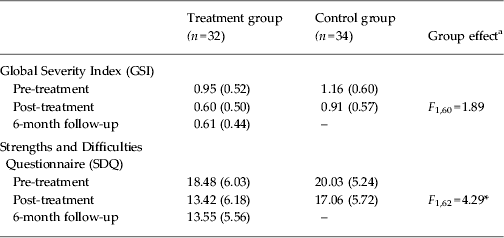
The mean scores for the GSI and SDQ secondary outcome measures are presented in Table 2. An ANCOVA for post-treatment outcome data that included baseline scores and pharmacotherapy as covariates yielded a significant group effect for the SDQ (F 1,62 = 4.29, p = 0.04) in favor of the treatment group; this was not the case for the GSI (F 1,60 = 1.89, p = 0.18) (see Table 2). There was no significant effect of pharmacotherapy (GSI: F 1,60 = 0.35, p = 0.56; SDQ: F 1,62 = 1.24, p = 0.27) and no significant study group × pharmacotherapy interaction effect (GSI: F 1,60 = 3.40, p = 0.07; SDQ: F 1,62 = 2.22, p = 0.14). Between-group effect sizes were small (d = 0.38 and d = 0.18 for the SDQ and GSI respectively). Complete case analyses yielded similar results. Compared with the normative adolescent sample (mean = 0.56, s.d. = 0.42, n = 857; Franke, Reference Franke2002), both study conditions demonstrated significantly higher GSI scores at baseline (treatment group: t 886 = 5.03, p < 0.001; control group: t 886 = 7.68, p < 0.001). This difference was maintained at the post-assessment for the control group (t 887 = 4.56, p < 0.001) but not the treatment group (t 886 = 0.52, p = 0.61). SDQ scores at baseline were in the ‘borderline’ range for the treatment condition (18.48, s.d. = 6.03) and the ‘abnormal’ range for the control condition (20.03, s.d. = 5.24) (cf. Goodman, Reference Goodman1997). At post-assessment, the WL/TAU control group was in the ‘borderline’ range (17.06, s.d. = 5.72) whereas the treatment group was within the ‘normal’ range (13.42, s.d. = 6.18).
Mean scores (standard deviations) for secondary outcome measures for psychodynamic therapy (PDT) and the waiting list/treatment-as-usual (WL/TAU) condition; intention-to-treat (ITT) sample

a At post-treatment, ANCOVA with pre-treatment scores and pharmacotherapy (yes/no) as covariates.
* p < 0.05.
Subsequent analyses
In the treatment group, repeated-measures ANOVAs to detect pre/post-treatment changes were significant for the GSI (F 1,30 = 15.36, p < 0.001) and SDQ scores (F 1,30 = 21.42, p < 0.001). We found a medium effect size for the GSI (d = 0.62) and a large effect size for the SDQ (d = 0.90). In the WL/TAU control group, the pre/post-treatment change was significant, as it was for the GSI (F 1,30 = 6.81, p = 0.01) and SDQ scores (F 1,30 = 7.79, p = 0.01). The corresponding effect sizes were small (d = 0.45) for the GSI score and medium (d = 0.53) for the SDQ score.
The rate of remission at follow-up for the treatment group was stable, with one additional remitted patient (24 out of 32) compared with the post-assessment (23 out of 32). There was one further remission in conduct disorders, but recurrence of emotional disorders from post-treatment to follow-up in six patients.
The scores on the GSI and SDQ within the treatment group demonstrated no significant changes between the post-treatment and follow-up data (GSI: t 30 = −0.10, p = 0.92; SDQ: t 30 = –0.12, p = 0.91), indicating that the effects were stable 6 months after treatment. Effects sizes for pre-treatment to follow-up changes within the treatment group were d = 0.65 for the GSI and d = 0.82 for the SDQ. Between the post-treatment and follow-up assessments, however, five patients received further psychotherapeutic treatment. These patients were characterized by high rates of co-morbidity at baseline and low rates of remission.
Discussion
This study examined the effects of a manualized in-patient PDT in adolescents with co-morbid disorders of conduct and emotions in comparison with a WL/TAU control group. To our knowledge, this study is the first RCT to evaluate a psychodynamic treatment for these rarely investigated and in many ways difficult patients. These severely disturbed adolescents do not take their problems for granted and do not show stable treatment motivation. They tend to act out instead of reflecting, re-enact traumatic scenes without mentalizing, deny their situation and look for quick satisfaction. Thus, remaining in treatment, realizing and tolerating how many problems they have and complying with the therapeutic work is already a considerable success for these patients.
The treatment group had a significantly higher rate of remission than the WL/TAU control group. As for the secondary outcome measures, PDT was significantly superior as measured by the SDQ but not the GSI, and there were only small between-group effect sizes in both measures. However, the post-treatment mean GSI scores for the treatment group were no longer significantly different from normative data, and mean SDQ scores were in the ‘normal’ range. Here, we found a medium effect size within the treatment group for the GSI (d = 0.62) and a large effect size (d = 0.90) for the SDQ. As a limiting aspect regarding these self-report-measures, it is important to mention that there is an increased possibility of inaccurate reporting in these young patients due to their conduct disorders. At follow-up, stable effects were found for the treatment condition. However, five patients in this condition received further psychotherapeutic treatment within the follow-up period.
Several aspects are relevant for the interpretation of the weak differences between the conditions in the secondary outcome measures. It is important to note that the severely impaired adolescents reported remarkably low levels of psychological distress (GSI) at baseline compared with other psychiatric samples (Franke, Reference Franke2002). We interpret this as the result of a self-report bias that corresponds with their lack of self-reflection and tendency toward external attribution, that is the tendencies to deny troubles and perceive them as originating from their environment (e.g. from parents or teachers). Thus, it is not surprising that only medium within-group effect sizes were found for the GSI. Furthermore, 50% of the patients in the control condition received some type of psychotherapeutic and/or psychopharmacological treatment. As subsequent analyses of the secondary outcome measures show, there were also significant improvements within the control condition. Given that effect sizes in untreated control groups are generally small (cf. Leichsenring & Rabung, Reference Leichsenring and Rabung2006), the improvements in the control condition are presumably related to TAU, which included mainly out-patient treatment according to the German health-care system's psychotherapy guidelines. Additionally, the patients' expectations regarding the warranted in-patient treatment option may also have had an effect on the reported improvement during the WL/TAU condition period. As 83.1% of the sample had already received (at least once) some type of psychotherapeutic or psychiatric treatment before inclusion in the trial, earlier TAU treatments were definitely not sufficiently effective. Moreover, most patients from the WL/TAU group started in-patient treatment after the waiting period. This indicates that they still suffered from severe psychological strain, which is also reflected in the corresponding low remission rates.
Several important strengths of this study can be specified. Our trial shows the feasibility of successfully treating these adolescents under study conditions. Furthermore, the presented results have strong external validity because the patients were part of the common adolescent psychiatric population. The sample showed high levels of co-morbidity, and nearly all patients reported a history of academic failure. Taking the unstable period per se and the complexity of their disturbances into account, the 15.6% drop-out rate among the treated in-patients was relatively low.
In addition to the above-mentioned improvements, 78.1% of patients regularly visited a state school during the third stage of the treatment (48.0% of the control group visited a state school), and 65.6% graduated from school. Thus, the patients were re-integrated into the educational process, which is an important precondition for long-term stabilization. Our findings demonstrate that many of these patients (59.1%) already met the criteria for BPD. For these patients, early therapeutic interventions are especially important to prevent further negative developments (cf. Chanen et al. Reference Chanen, Jovev, McCutcheon, Jackson and McGorry2008; Chanen & McCutcheon, Reference Chanen and McCutcheon2013). Specific treatments for adolescents who are at risk for this disorder are therefore very important and might prevent the chronic manifestation of BPD. Thus, the examined treatment may be understood as such a preventive step.
However, the interpretation of our findings is also limited by some characteristics of this study. One limitation is the modest sample size in our trial, a frequently found weakness in psychotherapy research RCTs, especially with monocenter designs.
As 50% of the patients received no treatment, our heterogeneous control group is a fairly weak control condition. Thus, the comparison with the mixed control group limits the interpretation of our results. Furthermore, based on the naturalistic features of our study, the duration of treatment within the PDT condition showed high variability and we also did not control for the treatment dose in TAU patients. Despite the large between-group effect on remission rates and significant differences in improvement of psychosocial impairment in favor of the manualized PDT, we cannot say whether the examined treatment would be superior to another strong active treatment.
The combination of PDT with psychopharmacotherapy in patients with low impulse control also raises further questions. Without additional pharmacotherapy, maintaining treatment for these patients would eventually have been untenable. However, the pharmacological treatment could promote impaired self-efficacy beliefs or a disease model that focuses primarily on somatic aspects.
Finally, another limitation is the use of the LOCF imputation method, and in recent years alternative methods, such as multiple imputation, have been proposed as being more appropriate (e.g. Sterne et al. Reference Sterne, White, Carlin, Spratt, Royston, Kenward, Wood and Carpenter2009).
Taken together, our findings provide first evidence that the examined PDT led to considerable improvements in these patients. The treatment led to high remission rates and medium to large within-group effects regarding improvement in psychological distress and psychosocial impairment, indicating that early treatments should be offered to these adolescents, who are often only treated as adults. Our study exemplifies several of the limiting aspects of such trials, but it also shows that it is possible to develop and investigate psychotherapeutic treatments for these severely impaired adolescents under study conditions, to hold them within treatment, and support their stabilization and reintegration. In future RCTs we need comparisons with strong active treatments, optimally under rigorous study conditions, as far as this is feasible with this specific patient group.
Acknowledgments
This trial was funded by Förderverein für analytische Kinder- und Jugendpsychotherapie e.V. Krefeld, Gesellschaft zur Förderung Analytischer Kinder- und Jugendlichen-Psychotherapie e.V., and Vereinigung Analytischer Kinder- und Jugendlichen-Psychotherapeuten in Deutschland e.V. (VAKJP).
We thank all of the patients and therapists who participated in this study. S. Salzer thanks Prof. Dr F. Leichsenring for his generous support.
Declaration of Interest
None.