Introduction
During the 2016 Kumamoto earthquake, 2 major earthquakes measuring a moment magnitude scale (Mw) of 6.2 as foreshock on April 14 and an Mw of 7.0 as the mainshock on April 16, hit the east of Kumamoto City in Kyushu Island, southwest of Japan. This event was the first time in Japanese recorded history that a shock (foreshock) was followed by a more powerful shock (mainshock), where 50 people died, approximately 2700 people were injured, and over 183000 people sought safety in places such as public schools and public offices. More than 1450 hospitalized patients from 13 hospitals were evacuated during the earthquake, suggesting as one of the largest evacuations of patients in one seismic disaster. A total of 10 hospitals took an action of complete evacuation, which included the suspension of inpatient service and transportation of all inpatients to hospitals outside the affected areas or to their houses.
Considering the huge impact of hospital evacuation on the healthcare system and on the people resident in affected areas, collecting data (including the many lessons learned), and analyzing the mechanism of evacuations are important. However, evacuations worldwide are considerably underreported. Reference Rojek and Little1,Reference Hicks and Glick2
Methods
We organized a multidisciplinary team and conducted semistructured interviews 6 months after the main-shock on October 18–19, 2016, with the aim to examine the reasons for complete hospital evacuation and to assess vulnerability and preparedness of hospitals against earthquakes. The team was composed of emergency physicians, structural engineers, a clinical engineer, hospital facility staff, and a medical information engineer.
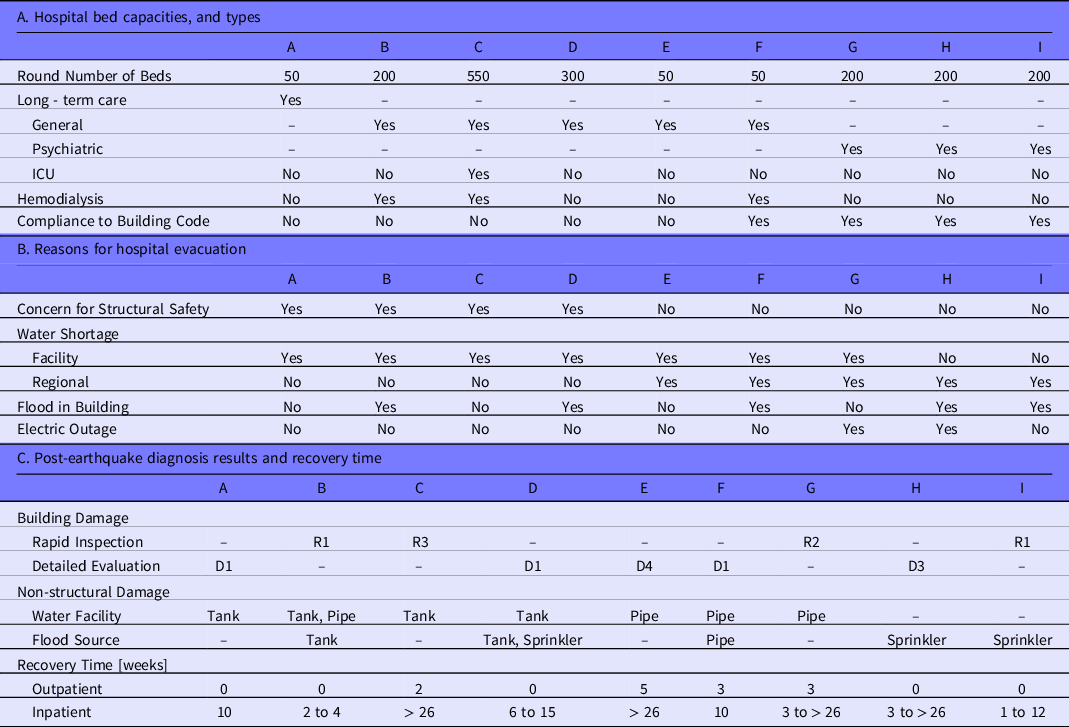
Out of 10 non-disaster-base hospitals (DBHs), 9 underwent a hearing survey in order to assess vulnerability and preparedness against earthquakes. These hospitals executed a total hospital evacuation during the earthquake in Kumamoto. Meanwhile, 1 hospital was excluded from this study due to its being permanently closed as a result of the threat of land-slide occurrences. Partial evacuations and healthcare facilities not identifiable as hospitals (i.e. nursing homes) were also excluded. The surveyed hospitals included general hospitals, psychiatric hospitals, and a hospital providing inpatients with long-term care (Table 1).
The primary reasons for hospital evacuation were the concerns on structural safety according to Hospital A to D, water shortage according to Hospital E to H, and recommendations by authorities according to Hospital I. All hospitals gave multiple reasons for evacuation. The extent of damage to buildings, which were quickly inspected by a registered architect, was categorized into 3: inspected (R1), limited entry (R2), and unsafe (R3). Meanwhile, the settlement, inclination, and damage to the structural framework of the building were investigated by the building structural engineer in order to classify the extent of damage as trivial (D1), mild (D2), moderate (D3), or severe (D4)

The semi-structured questionnaire was thematically analyzed using a framework approach that included the following:
-
(1) Emergency response and decision making process
-
(2) Damage to structural and nonstructural component
-
(3) Resource supply included in the damage of building and regional infrastructure
-
(4) Damage to medical equipment
-
(5) Operation of the electric medical record system
-
(6) Pre- and post-earthquake building diagnosis, and
-
(7) Reoccupation
Results
Primary reasons and time required for deciding hospital evacuations
The primary reasons for deciding on hospital evacuation could be categorized into 3:
-
(1) Concern for structural safety (Hospitals A to D)
-
(2) Damage to the facility water system (Hospitals A to G), and
-
(3) Suspension of regional water supply (Hospitals E to I) (Table 1)
According to 5 hospitals, extensive water damage was mainly caused by burst fire sprinklers, pipes, and/or ruptured rooftop water tanks (Hospitals B, D, F, H, I). Out of the 9 hospitals assessed, 8 decided to evacuate within 24 hours. Hospital B required 30 hours to decide on complete evacuation. They could no longer wait for the post-earthquake rapid inspection by registered structural engineers. All hospitals admitted that they had no guidelines or training for hospital evacuation against seismic disaster; they only had a fire evacuation drill. Nevertheless, no death or injury was reported during evacuation.
Concerns for structural safety
The buildings of Hospitals A to D, which decided on hospital evacuation because of structural safety concerns, were relatively old. Furthermore, they did not undergo seismic performance assessment and thus were not evaluated as seismically deficient (Table 1). Large hospitals such as DBHs had stationed facility staffs; however, most of these non-DBHs did not have.
Water shortage
Hospitals E to I decided to undergo hospital evacuation because of water shortage. They considered that a large amount of water is required to continue medical services such as sanitation and sterilization procedures. Hospital F, which provides hemodialysis services, immediately decided on hospital evacuation soon after the foreshock. The water infrastructure in the hospital buildings demonstrated various possible failure modes (Table 1) including the rocking and overturning of a rooftop water tank, disconnection of water tank and pipes, disconnection of the nearby sprinkler system, and contamination of well water due to ground shaking.
Medical equipment and electric medical record
Hospitals G and H cited electric outage (Table 1). Computed tomography scanners (Hospitals A and I) and other medical equipment were slightly damaged. Medical records were encoded via an electric system in 5 hospitals (Hospitals B to E, and G), whereas those of the remaining hospitals were documented via a paper system. The electric systems in 4 hospitals (Hospitals B, D, E, and G) had stopped for a few days, while the paper systems in 2 hospitals (Hospitals F and I) were too wet to read. Thus, tracking patients and providing medical records manually in the event of evacuations were extremely difficult for these hospitals.
Post-earthquake diagnosis results and recovery time
Decisions were mostly based on the visual inspection of buildings by the hospital owners and staffs without any input from structural engineers. Consequently, they tended to decide the evacuations according to underlying concerns for structural safety of the buildings and visually recorded damages which did not actually affect structural safety (Table 1). Although Hospitals A to D decided on evacuation because of structural safety concerns, the post-earthquake diagnosis concluded that 3 out of the 4 hospitals had sustained limited damage and were safely reoccupied. Meanwhile, Hospitals E, G, and H decided to take immediate evacuation because of water shortage; however, structural damages were later identified, resulting in medium to long-term closure. The restoration of water after a flood in buildings, repair of damaged water facilities, and resumption of inpatient care took at least a few weeks.
Discussion
A total of 4 older hospitals that had not complied with the building code (Hospitals A to D) had decided to carry out an evacuation because of structural safety concerns. In all cases, hospital workers performed the visual inspections initially, followed by registered structural engineers, because arranging building inspections in the chaotic aftermath of the major earthquakes would take at least 1 day. While 3 of those hospitals were not really affected by structural safety conditions, the concerns for structural damage might have been influenced by the successive strong ground motions caused by the foreshock and the mainshock. Thus, relatively old buildings that do not undergo seismic performance diagnosis or are evaluated as seismically deficient can be vulnerable to earthquakes and be at a high risk for immediate evacuation with concerns over structural safety. Meanwhile, 4 of the 5 hospitals (Hospitals E to I) that decided on evacuation because of water shortage had complied with the building code, however, several weeks later, 3 of these 5 hospitals were identified as having serious structural damages. Thus, hospitals in the affected area were more or less concerned about possible structural damage and building safety immediately after the earthquakes. In summary, a rapid building-inspection system reveals potential vulnerability and is identified as a research issue.
Lifelines such as water and electrical power are essential to maintain medical service, as previously reported in the survey on hospital evacuation during the Northridge earthquake. Reference Schultz, Koenig and Lewis3 Loss of electrical power would cause a difficulty to continue providing medical care because of the dysfunction of medical equipment and electric medical record system. Nonetheless, in this study, only 2 hospitals cited electric outage as a reason for evacuation. Both situations were caused by failure of electrical equipment such as the power generator. In other hospitals, emergency power generators had worked as expected. Meanwhile, hospitals require a large amount of water to continuously provide medical services. Notably, all hospitals that decided to evacuate had water shortage. This survey also showed various possible failure modes of water infrastructure, not only in the hospital facilities, but also in the regional watersupply system. Damage to sprinklers or water facilities such as pipes and tanks lead to a rapid decrease in water storage which results in not only severe water shortage, but also flood in the building. The repair of damaged water facilities or the regional water supply system took weeks, and this period would easily exceed the maximum tolerable period of water disruption even in well-prepared hospitals. Reference Suginaka, Okamoto and Hirano4 Remarkably, well water, which is 1 of the major water resources, became cloudy due to the ground shaking, thereby leaving it unusable in many medical care services such as dialysis, cooking, hygiene, and sterilization for a few weeks. Hence, preparation for seismic upgrades to water infrastructure is necessary, whether it is a building or a local water supply.
A vulnerability analysis of regional hospitals revealed the weakness of rapid building inspection systems, aging buildings, and water infrastructure. Preparedness for disaster mitigation of buildings and local water systems requires working with community partners such as architects, water utilities, various companies, and hospitals. By sharing and coordinating vulnerabilities with multiple community partners, it is possible to quickly arrange for a registered structural engineer after a disaster, determine the minimum amount of water needed by the local hospital in a day, stockpile the necessary supplies to continue medical care in the area, and smoothly transfer patients.
Acknowledgments
The writers would like to sincerely acknowledge the managers, doctors, and staffs of the hospitals that accepted our interviews. The authors would like to thank Enago (www.enago.jp) for the English language review.
Funding statement
This paper is based on the achievements of the DPRI special research program on Kumamoto Earthquake (28U-04) and the DPRI collaborative research program (29G-02) of the Disaster Prevention Research Institute of Kyoto University, and was supported in part by grant from the Mitsubishi Foundation to Dr. Kurata and Prof. Ohtsuru.