INTRODUCTION
Natural marks occurring on cetaceans can originate from parasites, predator attacks, conspecifics, anthropogenic activities and congenital conditions (e.g. Schaeff & Hamilton, Reference Schaeff and Hamilton1999; Rosso et al., Reference Rosso, Ballardini, Moulins and Würtz2011; Bertulli et al., Reference Bertulli, Cecchetti, Van Bressem and Van Waerebeek2012; Dwyer et al., Reference Dwyer, Kozmian-Ledward and Stockin2014; McCordic et al., Reference McCordic, Todd and Stevick2014). These markings are used for photo-identification (‘photo-id’) techniques and capture-mark-recapture (CMR) models in order to estimate the population size and survival rates of cetacean species (e.g. Slooten et al., Reference Slooten, Dawson and Lad1992; Durban et al., Reference Durban, Ellifrit, Dahlheim, Waite, Matkin, Barrett-Lennard, Ellis, Pitman, LeDuc and Wade2012; Nicholson et al., Reference Nicholson, Bejder, Allen, Krutzen and Polock2012). Markings are also used to investigate social interactions (e.g. Slooten et al., Reference Slooten, Dawson and Whitehead1993; Gero et al., Reference Gero, Bejder, Whitehead, Mann and Connor2005; Parra et al., Reference Parra, Corkeron and Arnold2011), movement of individuals (e.g. O'Brien et al., Reference O'Brien, Berrow, Ryan, McGrath, O'Conner, Pesante, Burrows, Massett, Klötzen and Whooley2009; Bearzi et al., Reference Bearzi, Bonizzoni and Gonzalvo2010; Robinson et al., Reference Robinson, O'Brien, Berrow, Cheney, Costa, Eisfeld, Haberlin, Mandleberg, O’Donovan, Oudejans, Ryan, Stevick, Thompson and Whooley2012; Bertulli et al., Reference Bertulli, Rasmussen and Tetley2013), to describe individual, ontogenetic and geographic variations in colouration patterns (e.g. Mitchell, Reference Mitchell1970; Tsutsui et al., Reference Tsutsui, Tanaka, Miyazaki and Furuya2001; Arnold et al., Reference Arnold, Birtles, Dunstan, Lukoschek and Matthews2005; Rosso et al., Reference Rosso, Moulins and Würtz2008; Keener et al., Reference Keener, Szczepaniak, Webber and Stern2011; Lodi & Borobia, Reference Lodi and Borobia2013) and to monitor the development of diseases in free-ranging whales and dolphins (e.g. Van Bressem et al., Reference Van Bressem, Gaspar and Aznar2003; Burdett Hart et al., Reference Burdett Hart, Wells, Adams, Rotstein and Schwacke2010; Maldini et al., Reference Maldini, Riggin, Cecchetti and Cotter2010). However, the use of natural marks to identify cetaceans has certain limitations (summarized in Hammond, Reference Hammond1986, Reference Hammond1990). Marks can change their appearance and vary in numbers as a result of both intra- and inter-specific interactions, or due to anthropogenic interactions (e.g. McCann, Reference McCann1974; Hammond, Reference Hammond1986; Lockyer & Morris, Reference Lockyer and Morris1990). As a result of their changeable nature it is essential to assess the stability over time of each mark used in photo-identification studies to avoid introducing a bias in any abundance estimate (Hammond, Reference Hammond1986, Reference Hammond1990).
Research on the suitability of natural marks used for photo-identification was solely conducted on a few species such as bottlenose dolphin Tursiops truncatus (Wilson et al., Reference Wilson, Hammond and Thompson1999), sperm whale Physeter macrocephalus (Dufault & Whitehead, 2005), Northern bottlenose whale Hyperoodon ampullatus (Gowans & Whitehead, Reference Gowans and Whitehead2001), long finned pilot whale Globicephala melas (Auger-Méthé & Whitehead, Reference Auger-Méthé and Whitehead2007), Cuvier's beaked whale Ziphius cavirostris (Rosso et al., Reference Rosso, Ballardini, Moulins and Würtz2011), pink river dolphin Inia geoffrensis (Gomez-Salazar et al., Reference Gomez-Salazar, Trujillo and Whitehead2011) and humpback whale Megaptera novaeangliae (Blackmer et al., Reference Blackmer, Anderson and Weinrich2000). No such study has ever been conducted on Atlantic common minke whales (Balaenoptera acutorostrata ; hereafter ’ minke whales ’) and white-beaked dolphins (Lagenorhynchus albirostris). Since 1980 studies along the west coast of North America have shown that combining the use of natural markings such as notched fins, oval scars, body pigmentation with photo-identification techniques occurring on Pacific minke whales would enable researchers to discriminate between individual whales (Dorsey, Reference Dorsey1983; Dorsey et al., Reference Dorsey, Stern, Hoelzel and Jacobsen1990; Joyce & Dorsey, Reference Joyce, Dorsey, Hammond, Mizroch and Donovan1990; Stern et al., Reference Stern, Dorsey and Case1990). This method was used successfully to explore the site fidelity (Dorsey et al., Reference Dorsey, Stern, Hoelzel and Jacobsen1990; Gill et al., Reference Gill, Fairbairns and Fairbairns2000; Tscherter & Morris, Reference Tscherter and Morris2005; Anderwald, Reference Anderwald2009), the movements and minimum population size of minke whales (Bertulli et al., Reference Bertulli, Rasmussen and Tetley2013). Conversely, there is very limited knowledge regarding the abundance, distribution, movements and demographics of the white-beaked dolphin (summarized in Tetley & Dolman, Reference Tetley and Dolman2013). This species has been identified using more permanent markings such as notches (Bertulli et al., in press; Brereton et al., Reference Brereton, Lewis and MacLeod2013) associated with some temporary secondary features (e.g. depigmentation, skin lesions, scars and tooth-rakes in Brereton et al., Reference Brereton, Lewis and MacLeod2013). However, these studies never conducted an assessment of the stability of these skin marks.
Even though minke whales have a worldwide distribution, much of the information regarding the biology and ecology of the species remains depauperate (summarized in Robinson et al., Reference Robinson, Stevick, MacLeod, Robinson, Stevick and MacLeod2007), and similarly even less is known about the white-beaked dolphin (Tetley & Dolman, Reference Tetley and Dolman2013). In Icelandic waters, information on photo-identification rate, small-scale distribution and movements are available on both free-ranging minke whales and white-beaked dolphins (Bertulli et al., Reference Bertulli, Rasmussen and Tetley2013; Bertulli et al., in press). However, there is a current lack of knowledge regarding the basic demographic parameters of both species. In order to produce an unbiased estimation of both populations it is pivotal that the feasibility of individual identification by photo-identification is first ascertained. Therefore, the objectives of the present study are to describe and to assess the abundance and prevalence of natural markings visible in minke whales and white-beaked dolphins photographs. Moreover, the rates of mark gain and loss have been calculated in order to identify viable long-lasting marks.
MATERIALS AND METHODS
Field methods
Photographs of individual minke whales and white-beaked dolphins were collected from whale-watching boats based in Faxaflói Bay (64°24′N 23°00′W; SW coast), Reykjavik and Skjálfandi Bay, Húsavík (66°05′N 17°33′W; NE coast), Iceland, from 2002 to 2013. Digital cameras were mainly equipped with 70–300 mm lenses (AF-S VR Nikkor lens f/4.5–5.6 IF-ED), with photographers placed on the roof of the wheelhouse (5–8 m above sea level in Faxaflói Bay, 2.7–4.5 m in Skjálfandi Bay) of each boat. When possible the vessel would be manoeuvred parallel to the whale or dolphin group encountered, allowing researchers to photograph both sides of each individual, including fin, dorsum, flanks and peduncle (Agler et al., Reference Agler, Beard, Bowman, Corbett, Frohock, Hawvermale, Katona, Sadove, Seipt, Hammond and Donovan1990; Würsig & Jefferson, Reference Würsig and Jefferson1990).
Photographic analysis
Each photo-identification picture was assigned a quality rating (Q) from the lowest Q1 to the highest Q6, considering focus, exposure, angle and proportion of the frame occupied by the body of the animal. The Q-value of each image was independent of the marks visible on each individual. Only images rated Q ≥ 5 were considered for the analysis (Gowans & Whitehead, Reference Gowans and Whitehead2001; Elwen et al., Reference Elwen, Reeb, Thornton and Best2009; Rosso et al., Reference Rosso, Ballardini, Moulins and Würtz2011).
Mark prevalence and abundance
Photos in the databases were analysed chronologically in order to describe mark types. Mark prevalence and abundance were assessed using 200 randomly selected images per species similar to Gowans & Whitehead (Reference Gowans and Whitehead2001) and Auger-Méthé & Whitehead (Reference Auger-Méthé and Whitehead2007). The size of each mark was calculated using ImageJ software (http://rsb.info.nih.gov/ij; e.g. Fearnbach et al., Reference Fearnbach, Ellifrit and Balcom2011) and available estimates of dorsal height (G. Vikingsson and S.D. Halldórsson, Marine Research Institute, Reykjavík, unpublished data) and their shape, location and colour were also defined.
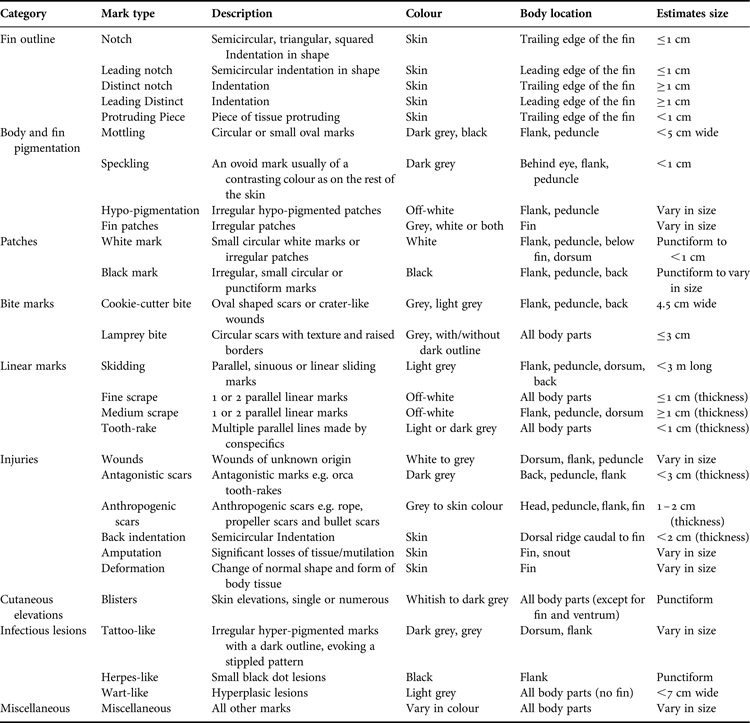
A total of 28 mark types were identified and then classified into nine categories based on morphological features (Table 1):
(1) Fin outline: Marks occurring on the leading and trailing edge of the fin were included in this category. Notches, missing pieces of tissue (Würsig & Würsig, Reference Würsig and Würsig1977) were defined as <1 cm in size. Those >1 cm and located on the trailing edge were defined as distinct notches (Dufault & Whitehead, Reference Dufault and Whitehead1993); if located on the leading edge they were defined as LE Distinct notches. Any protruding piece of tissue (Auger-Méthé & Whitehead, Reference Auger-Méthé and Whitehead2007) were also part of this category since they occurred along the outline of the fin.
(2) Body and fin pigmentation: This category included mottled pigmentation (Sears et al., Reference Sears, Williamson, Wenzel, Bérubé, Gendron and Jones1990), speckling (Arnold et al., Reference Arnold, Birtles, Dunstan, Lukoschek and Matthews2005; Krzyszczyk & Mann, Reference Krzyszczyk and Mann2012), hypo-pigmentation comprising highly pigmented patches typical of immature white-beaked dolphins, and patches of pigment on the fin. White patches resemble those described by Webber (Reference Webber1987) in his work on dusky dolphins (Lagenorhynchus obscurus) and Pacific white-sided dolphins (Lagenorhynchus obliquidens) and described as ‘a zone of light coloration found on the dorsal fin of some Lagenorhynchus’. Grey patches only appeared on the fin and/or base of the fin although without histological and microbiological examination it was not possible to know if they were phenotypical features like the white patches or infections.
(3) Patches: White or black marks, either circular or irregular (Auger-Méthé & Whitehead, Reference Auger-Méthé and Whitehead2007; Gomez-Salazar et al., Reference Gomez-Salazar, Trujillo and Whitehead2011) occurred on all observed body parts and were included in this category.
(4) Bite marks: Bite marks from cookie-cutter sharks (Isistius spp.) and lamprey (Petromyzon marinus) (Dorsey et al., Reference Dorsey, Stern, Hoelzel and Jacobsen1990; Moore et al., Reference Moore, Steiner and Jann2003; Nichols & Tscherter, Reference Nichols and Tscherter2011; Samarra et al., Reference Samarra, Fennell, Deecke and Miller2012) were included in this category.
(5) Linear marks: This category included fine scrapes (<1 cm) or medium scrapes (>1 cm) (Rosso et al., Reference Rosso, Ballardini, Moulins and Würtz2011). Scrape thickness was measured using ImageJ with a scale of reference determined previously in the study area for minke whales (28.8 cm fin height) and white-beaked dolphins (25.3 cm fin height; G. Vikingsson and S.D. Halldorsson, unpublished data). Tooth-rake produced by white-beaked dolphins (Ross & Wilson, Reference Ross and Wilson1996; Haelters & Everhaarts, Reference Haelters and Everhaart2011) and lamprey skidding bite marks (parallel light grey marks; Pike, Reference Pike1951; Bertulli et al., Reference Bertulli, Cecchetti, Van Bressem and Van Waerebeek2012, figure 3c; Ólafsdóttir & Shinn, Reference Ólafsdóttir and Shinn2013, figure 3b) were also included in this category.
(6) Injuries: Large wounds from natural causes (e.g. predator attacks) and from anthropogenic causes (e.g. net entanglement and propeller but excluding notches on the leading edge of the fin) were included in this category following Bertulli et al. (Reference Bertulli, Cecchetti, Van Bressem and Van Waerebeek2012). Measurements of tooth-rake mark interstices were within the range of 25 mm and 32 mm of killer whales (Craighead George et al., Reference Craighead, Philo, Hazard, Withrow, Carroll and Suydam1994; Visser, Reference Visser1999, figure 1b). This category also included major body indentations (Luksenburg, Reference Luksenburg2014, figure 3a), amputation and fin deformation (Van Waerebeek et al., Reference Van Waerebeek, Baker, Felix, Gedamke, Iniguez, Sanino, Secchi, Sutaria, van Helden and Wang2007, figure 6; Higdon & Snow, Reference Higdon and Snow2009; Mansur et al., Reference Mansur, Strindberg and Smith2012, ‘dorsal fin bend’; Luksenburg, Reference Luksenburg2014, figure 3k).
(7) Cutaneous elevation: Skin elevations including blisters and nodules of unknown origin, as described by Bertulli et al. (Reference Bertulli, Cecchetti, Van Bressem and Van Waerebeek2012), were part of this category.
(8) Infectious lesions: Tattoo-like, wart-like and herpes-like lesions were included in this category based on their macroscopic appearance following Bertulli et al. (Reference Bertulli, Cecchetti, Van Bressem and Van Waerebeek2012).
(9) Miscellaneous: This category was used to classify all other marks lacking diagnostic features of the previously described categories (Auger-Méthé & Whitehead, Reference Auger-Méthé and Whitehead2007; Auger-Méthé et al., Reference Auger-Méthé, Marcoux and Whitehead2010).
Mark types used to photo-identified minke whales and white-beaked dolphins.

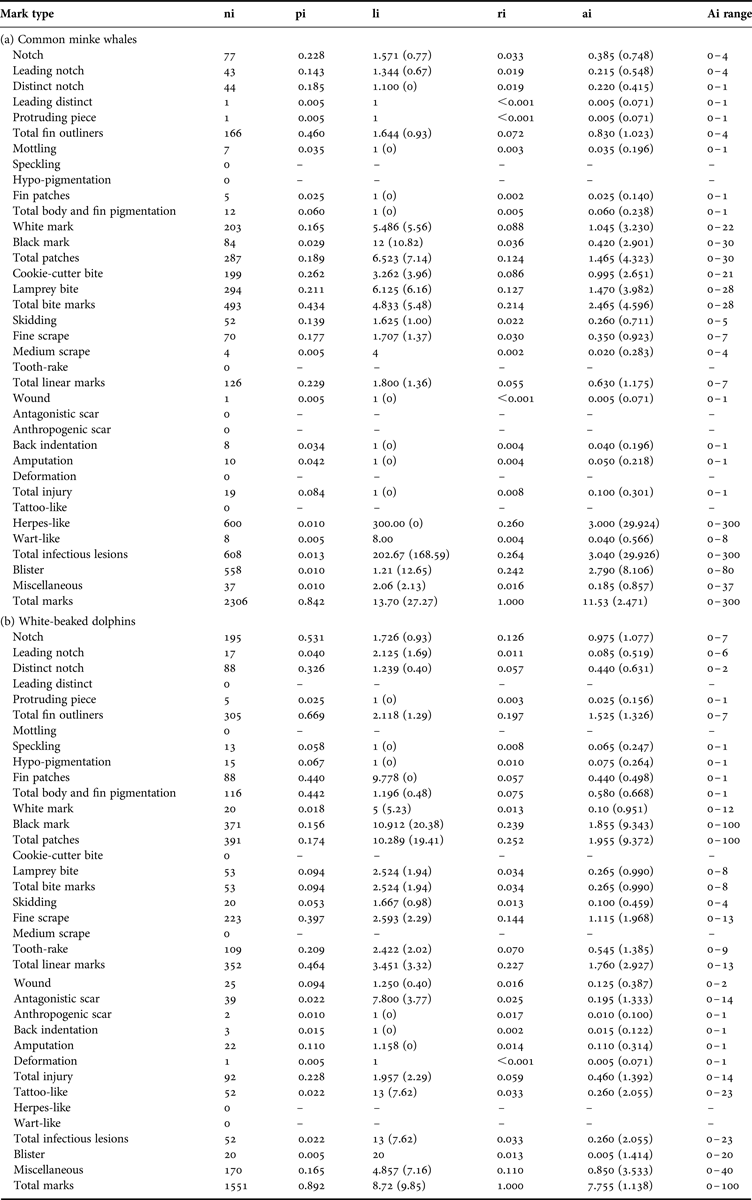
For each mark type the following parameters were calculated: (1) the total number of occurrences for each mark n i: i is the type of mark; (2) mark prevalence p i: frequency of individuals with the i mark; (3) mark severity l i: mean number of marks of i type only on individual with i occurrences; (4) relative portion r i of each mark type to the total amount of marks R; and (5) mark abundance a i: mean number of the i mark per individual. Standard deviations were calculated for mark severity and mark abundance.
Mark change – gain and loss rates
To assess changes in mark abundance and prevalence, all individuals in a photograph (same body side) in at least 2 consecutive years were selected. If numerous images were available for each year the highest quality frame was randomly chosen (Gowans & Whitehead, Reference Gowans and Whitehead2001). Photographs of sequential years were compared for presence or absence of each mark. Images containing marks below the water line and therefore not visible were not used in the analysis (Rosso et al., Reference Rosso, Ballardini, Moulins and Würtz2011). Individuals photographed during gapped bins of consecutive years (e.g. 2008–2009, 2011–2013) were analysed separately and only for the consecutive year bins (Dufault & Whitehead, Reference Dufault and Whitehead1995). To avoid pseudoreplication when both left and right sides were photographed during consecutive years, only the side with the highest number of marks was included in the analysis. Formulas to estimate gain and loss rates, ‘whale years’ as well as ‘whale years of available marks’ (WYAM) were calculated following Auger-Méthé & Whitehead (Reference Auger-Méthé and Whitehead2007). Marks showing no losses over the duration of the study were considered reliable marks for analysis (Gowans & Whitehead, Reference Gowans and Whitehead2001).
RESULTS
Our analysis contained 1670 Q ≥ 5 photographs involving 784 minke whales and 886 individual white-beaked dolphins. A subsample of 200 photos were randomly chosen for each species and the mark abundance and prevalence were assessed (Table 2). The randomly selected images for mark type analysis contained 188 minke whales and 216 white-beaked dolphins. Applying our classification system, we identified 28 mark types (Table 1).
Prevalence and abundance of marks: (a) minke whales (b) white-beaked dolphins. For each mark type the following parameters were calculated: (1) the total number of occurrences for each mark ni: i is the type of mark; (2) mark prevalence pi: frequency of individuals with the i mark; (3) the mark severity li: mean number of marks of i type only on individual with i occurrences; (4) relative portion ri of each mark type to the total amount of marks R; (5) mark abundance ai: mean number of the i mark per individual. Standard deviation are in parentheses.
Mark abundance and prevalence
In minke whales a total of 24 mark types were distinguished and categorized into nine different mark categories (Figure 1). From the subsample of 200 minke whale images 21 mark types (Figure 1, Table 2) were considered. A total of 84.2% of the population showed at least one mark with a total of 2306 distinct marks identified. The most prevalent marks encountered were cookie-cutter bite (p i = 0.262), notch (p i = 0.228) and lamprey bite (p i = 0.211) and the most abundant marks were herpes-like and blisters with a mean value of a i = 3 and a i = 2.79 marks per individual, respectively. Herpes-like lesions and black marks were the most severe mark types with a mean value of l i = 300 marks per individual and l i = 12 marks per individual, respectively.
The 24 mark types described in minke whales: (A) ans – antagonistic scars; (B) hl – herpes-like; (C) n – notch, ln – leading notch, bm – black marks; (D) dn – distinct notch, m – mottling; (E) wm – white marks, lb – lamprey bite; (F) w – wound; (G) a – amputation, sk – skidding; (H) cb – cookie-cutter bite, m – miscellaneous; (I) pp – protruding piece; (J) bi – back indentation; (K) ldn – leading distinct notch; (L) fp – fin patches, fs – fine scrape; (M) wl – wart-like; (N) d – deformation, b – blisters, (O) as – anthropogenic scars; (P) ms – medium scrape.
In white-beaked dolphins a total of 22 mark types were distinguished and categorized into nine different mark categories (Figure 2). From the subsample of 200 white-beaked dolphins images, the same amount of mark types were considered (Figure 2, Table 2). A total of 89.2% of the photographed dolphins displayed at least one mark, with a total of 1551 distinct marks identified. The most prevalent marks were notch (p i = 0.531), fin patches (p i = 0.440) and fine scrape (p i = 0.397) and the most abundant were black marks and fine scrapes, with a mean value of a i = 1.85 and a i = 1.15 marks per individual, respectively (Table 2). Blister lesions and tattoo-like were the most severe mark types with a mean value of l i = 20 marks per individual and l i = 13 marks per individual, respectively.
The 22 mark types described in white-beaked dolphins: (A) n – notch, bi – back indentation; (B) a – amputation, fp – fin patches; (C) fs – fine scrape, tl – tattoo-like; tr – tooth-rake; (D) pp – protruding piece; (E) sk – skidding, bm – black mark; (F) d – deformation; (G) dn – distinct notch, ln – leading notch; (H) w – wound; (I) lb – lamprey bite-like; (J) b – blisters, ans – antagonistic scars; (K) wm – white mark; (L) m – miscellaneous; (M) as – anthropogenic scars; (N) hp – hypo-pigmentation, sp – speckling.
Gain and loss rates
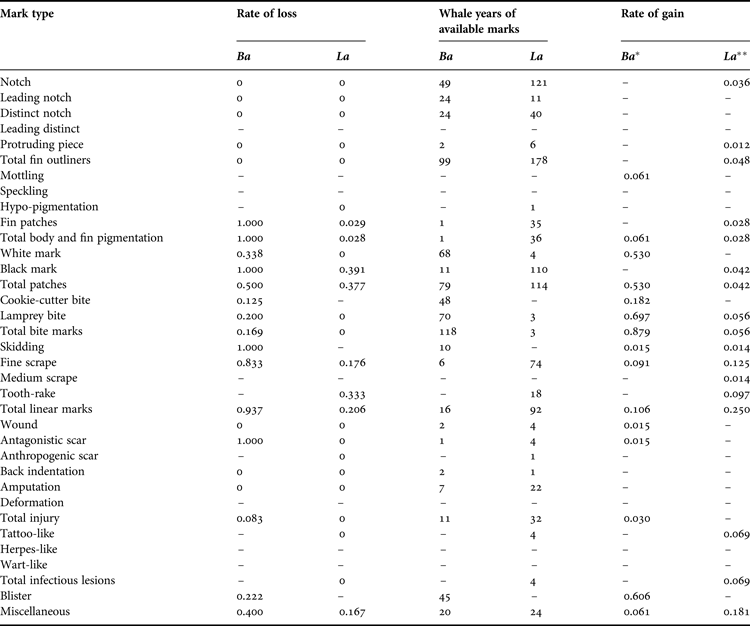
Photographs of 47 individual minke whales observed in 66 whale years had 18 mark types of the 26 described earlier showing gain and/or loss rates (Table 3). Seven mark types demonstrated no loss during a total of 110 whale years of available marks: notch, leading notch, distinct notch, protruding piece of tissue, wound, back indentation and amputation. However, the marks with higher WYAM were notch (WYAM = 49), leading notch (WYAM = 24) and distinct notch (WYAM = 24). Ten mark types (38%, N = 26) showed gains with time.
Gain and loss rates: (a) minke whales. *Total whale year of 66 (b) white-beaked dolphins. **Total whale years of 72 for all marks excluding fin outliners, amputation, deformation and back indentation with a total of 83.
Photographs of 59 individual white-beaked dolphins observed in 83 whale years had 20 mark types out of the 26 described earlier showing gain and/or loss rates (Table 3). Thirteen mark types demonstrated a loss rate of zero: notch, leading notch, distinct notch, protruding piece of tissue, hypo-pigmentation, white mark, lamprey bite, wound, antagonistic and anthropogenic marks, back indentation, amputation and tattoo-like lesion. Marks with the highest WYAM were notch (WYAM = 121), distinct notch (WYAM = 40) and amputation (WYAM = 22). Those individuals showed gains of notches over time (N = 11, 42%) (DEM54, DEM209 and DEM79), with one notch being acquired from one year to the next (Figure 3).
White-beaked dolphin DEM79 photographed in 2009 and in 2010: (A) – (nl) nick on leading edge, (n1) (n2) nicks on trailing edge, (bm) black mark, (fs) fine scrapes; (B) – same marks visible with the addition of a new nick mid posterior on the trailing edge (New).
DISCUSSION
Fin outline and injuries
Marks on fin outlines and those associated with injuries are known to reliably assist with the identification of individual cetaceans from species including minke whales and white-beaked dolphins (Lockyer & Morris, Reference Lockyer and Morris1990; Scott et al., Reference Scott, Wells, Irvine, Mate, Leatherwood and Reeves1990; Wilson et al., Reference Wilson, Hammond and Thompson1999; Auger-Méthé & Whitehead, Reference Auger-Méthé and Whitehead2007). Despite the low gain rate (<0.05 gains/individual per year) fin outline marks and injuries were generally very common (mainly notches, p iBa = 0.228, p iLa = 0.531) meaning that they are rarely acquired – that decreases the probability of mark superimposition – but permanent in time, as already noted in other cetacean populations (Agler, Reference Agler1992; Morris & Tscherter, Reference Tscherter and Morris2005; Auger-Méthé & Whitehead, Reference Auger-Méthé and Whitehead2007). Moreover, large injury marks (e.g. wounds, antagonistic and anthropogenic scars, amputations) resembling the ‘deeper and major wounds’ as described by Lockyer & Morris (Reference Lockyer and Morris1990) were significantly more common in the white-beaked dolphins than minke whales (p iLa = 0.228, p iBa = 0.084; G = 18.29, df = 1, P < 0.001) indicating that dolphins are more prone to predation and anthropogenic interactions. Large injury marks were stable in time, with the only exception in a minke whale fin where killer whale tooth-rake marks resembling the description by Visser (Reference Visser1999, figure 2b) and Craighead George et al. (Reference Craighead, Philo, Hazard, Withrow, Carroll and Suydam1994, figure 2f, left set) disappeared in 1 year. In Icelandic waters, killer whales seem to be natural predators to common minke whales and white-beaked dolphins, as shown by tooth-rake marks visible on their bodies (Bertulli et al., Reference Bertulli, Cecchetti, Van Bressem and Van Waerebeek2012). We observed single events of killer whale predation on a minke whale (July 2008) in Skjálfandi Bay during the study period. However, a white-beaked dolphin (ID no. nDEM53, Figure 2J) was photographed with stable killer whale tooth-rake bites over 5 years and another individual (ID no. nDEM68, Figure 2M) had a typical rope mark around the head over at least 4 years. Deformation was another injury mark analysed in this study which remained stable over the years which is similar to other dolphin species (Lockyer & Morris, Reference Lockyer and Morris1990; Wilson et al., Reference Wilson, Hammond and Thompson1999). These results suggest that fin outline and injury marks are among the most accurate features to use to re-capture individuals among years even for these two cetacean species.
Body and fin pigmentation
Pigmentation patterns have been shown to be stable for many consecutive years in various cetaceans (Sears et al., Reference Sears, Williamson, Wenzel, Bérubé, Gendron and Jones1990; Gowans & Whitehead, Reference Gowans and Whitehead2001; Gomez-Salazar et al., Reference Gomez-Salazar, Trujillo and Whitehead2011). Our identification of pigmentation patterns in minke whales focused largely on mottling, which had zero rate of loss. As a colouration pattern component, mottling could vary with age and/or external conditions (e.g. stress, pollution; West & Packer, Reference West and Packer2002; Marcoux, Reference Marcoux2008; Wang et al., Reference Wang, Hung, Yang, Jefferson and Secchi2008) although no such information was collected during our study. The seasonal presence of diatomaceous algae films covering the skin of whales (Sears et al., Reference Sears, Williamson, Wenzel, Bérubé, Gendron and Jones1990; Gerasimyuk & Zinchenko, Reference Gerasimyuk and Zinchenko2012) could also be a confounding factor when identifying pigmentation patterns. As a result, mottling may not be a useful secondary photo-identification feature for this species. A grey fin patch was described for the first time in both minke whales and white-beaked dolphins (Figure 1L). Our images of grey fin patches resemble Pale Skin Patches (PSP) marks observed in Peale’s (Lagenorhynchus australis) and Chilean dolphins (Cephalorhynchus eutropia) in translucent colour, shape, borders and even the location (Sanino et al., Reference Sanino, Van Bressem, Van Waerebeek and Pozo2014). They can be classified as PSP-like until verifying other similarities as time-dynamics or the evolution of the patches overtime. The aetiology of this mark is currently unknown until further tests are conducted. Fin patches were common in white-beaked dolphins (p i = 0.440) and they showed to be reliable secondary features, having a rate of loss <3% per individual per year. Furthermore, the use of this mark in photo-identification studies for this species could increase the amount of identified individuals ~5% rate (in this study from p i = 0.732 to p i = 0.772).
A single adult white-beaked dolphin showed extensive hypo-pigmented areas, on flanks, peduncle and dorsum which differed from similar patches observed in immatures (e.g. juvenile and calf; Bertulli, unpublished data). These marks were found to be stable for 1 year indicating the possible use for photo-identification studies spanning at least this amount of time.
Patches and bite marks
Patches (i.e. white and black marks) had similar prevalence in both species. They were of unknown origin and generally carried high loss and gain rates, which was also found by Gomez-Salazar et al. (Reference Gomez-Salazar, Trujillo and Whitehead2011). Therefore, secondary features like white and black marks, which were present in low numbers, are not suitable to be used as photo-identification features for this species.
Cookie-cutter bites were not recorded in the white-beaked dolphin sample while they were the most frequent mark in minke whales. Cookie-cutter bites are generally found in species resident to tropical waters or in whales migrating to these areas during the breeding season (Lillie, Reference Lillie1915; Mackintosh & Wheeler, Reference Mackintosh and Wheeler1929; Mead et al., Reference Mead, Walker and Houck1982) and they have been used previously as an identification feature for minke whales (Dorsey et al., Reference Dorsey, Stern, Hoelzel and Jacobsen1990; Gill et al., Reference Gill, Fairbairns and Fairbairns2000). In this study, cookie-cutter bites occurred with an average severity of l i = 3.26 mark/whale and a low loss rate (0.125 mark per individual per year), resulting in a very small probability of all marks being lost over time (P < 0.001 per whale per year). Moreover, the use of this mark in minke whale photo-identification studies may increase the amount of identified individuals by ~28% (in this study, from p i = 0.502 to p i = 0.641). We would suggest that cookie-cutter bites should be considered as an important secondary photo-identification feature for this species. However, as Durban et al. (Reference Durban, Ellifrit, Dahlheim, Waite, Matkin, Barrett-Lennard, Ellis, Pitman, LeDuc and Wade2012) suggested, particular attention needs to be spent with these marks as they cannot be so easily visible in low and flat light conditions.
Recently the presence of sea lampreys have been found in Icelandic coastal waters (Figure 1D, Ólafsdóttir & Shinn, Reference Ólafsdóttir and Shinn2013) and thought to be linked to the increasing sea temperatures in this area (Astþórsson & Pálsson, Reference Astþórsson and Pálsson2006). In Iceland Petromyzon marinus is the only species of lamprey observed, first found attached to fishes (Jónsson & Jóhannsson, Reference Jónsson and Jóhannson2008), then to killer whales (Samarra et al., Reference Samarra, Fennell, Deecke and Miller2012), minke whales (Bertulli et al., Reference Bertulli, Cecchetti, Van Bressem and Van Waerebeek2012; Ólafsdóttir & Shinn, Reference Ólafsdóttir and Shinn2013) and for the first time in Icelandic waters it was recorded on white-beaked dolphins in this study (Figure 2I). The absence of cookie-cutter marks on white-beaked dolphins could suggest that white-beaked dolphins may not undertake long-distance movements towards lower latitudes.
Linear body marks
Skidding marks show how lampreys change position on the body of their host by moving their mouth (i.e. oral disc) sideways creating parallel scars (Shetter, Reference Shetter1949; Pike, Reference Pike1951, figure 6; Hardisty & Potter, Reference Hardisty, Potter, Hardisty and Potter1971), likely searching for an area where the flow of water is not too strong but at the same time favourable to obtain blood (Nichols & Tscherter, Reference Nichols and Tscherter2011). More recently, a study from eastern Canada (Nichols & Tscherter, Reference Nichols and Tscherter2011), documented their presence on minke whales and two other studies from Iceland (Bertulli et al., Reference Bertulli, Cecchetti, Van Bressem and Van Waerebeek2012, figure 3b, c; Ólafsdóttir & Shinn, Reference Ólafsdóttir and Shinn2013, figure 3b) reported these linear marks associated with lamprey bites. Few other studies reported the presence of confirmed cases of lamprey marks on dolphin species (e.g. pygmy sperm whale Kogia breviceps in McAlpine, Reference McAlpine, Perrin, Würsig and Thewissen2009).
Rakes produced by conspecifics were only visible on white-beaked dolphins and were found to have a similar loss rate as similar minor wounds found on bottlenose dolphins (Lockyer & Morris, Reference Lockyer and Morris1990; Wilson et al., Reference Wilson, Hammond and Thompson1999). Their occurrence was shown to depend largely on differences between males and females (Scott et al., Reference Scott, Mann, Watson-Capps, Sargeant and Connor2005; Marley et al., Reference Marley, Cheney and Thompson2013) although this could not be tested here since sex could not be determined for the majority of the identified dolphins. Scrape marks were previously described in Icelandic white-beaked dolphins but their origin could not be determined by visual assessment alone but would require a biopsy in order to diagnose. The rate of loss was lower compared with those of other dolphin species (e.g. single linear scrape, Long-finned pilot whale Globicephala melas in Auger-Méthé & Whitehead (Reference Auger-Méthé and Whitehead2007); scrape, Pink river dolphin Inia geoffrensis in Gomez-Salazar et al., Reference Gomez-Salazar, Trujillo and Whitehead2011), but much faster than those of beaked whales (Cuvier's beaked whales, loss rate 0.010 mark per individual per year; Rosso et al., Reference Rosso, Ballardini, Moulins and Würtz2011). Fine scrapes had an average severity of l i = 2.59 mark per individuals and a loss rate of 0.176, therefore the probability of having all the fine scrape marks disappear on an individual is quite low (P = 0.01 per individual per year). The use of this mark in photo-identification studies – in addition to fin outliners, injuries and fin patches – may increase the number of identified white-beaked dolphins by a further 9% (in this study, from p i = 0.772 to p i = 0.848). However, since the loss rate is greater than 0.05, the fine scrape mark should be considered only for recaptures spanning not more than 5 years.
Other marks
Cutaneous elevations were previously described in minke whales and white-beaked dolphins in Icelandic waters (Bertulli et al., Reference Bertulli, Cecchetti, Van Bressem and Van Waerebeek2012). In the present study, blisters were found to be among the most abundant in minke whales (a i = 2.790). However, due to their high gain and loss rates they are not recommended as reliable features to identify our whale or dolphin species.
No new individual whales were found carrying wart and herpes-like marks compared with previous results (Bertulli et al., Reference Bertulli, Cecchetti, Van Bressem and Van Waerebeek2012) but in this study four more white-beaked dolphin cases of tattoo-like lesions were reported. None of these three marks was prevalent (p i ≤ 0.013) although herpes-like lesions were among the most severe marks in minke whales.
In conclusion, as noted for other cetacean species the most stable and reliable natural marks were notches and injury marks. In this study, we also identified other mark types that should be used for future photo-identification projects on these species. Particularly, cookie-cutter shark bites and fin patches resulted as reliable marks for minke whales and white-beaked dolphin, respectively. Since these marks were amongst the most prevalent in these species, their addition will significantly increase the number of identifiable animals and subsequently allow for more accurate estimates of population analysis.
ACKNOWLEDGEMENTS
We thank Elding whale-watching and North Sailing for their support to the research on whales and dolphins throughout the years and for providing vessels to collect data from. Immense gratitude goes to all Faxaflói Cetacean Research volunteers who conducted field work from 2007 to 2013 in Faxaflói and Skjálfandi Bays. Thanks are also due to the volunteers from the Húsavík Whale Museum and the Húsavík Research Center. We are very grateful to Marie-Francoise Van Bressem and Koen Van Waerebeek for their help with the identification of skin marks and Gian Paolo Sanino for his help with ‘pale skin patches’. Thank you to David Janiger for making many publications available. The use of the English in the manuscript was very much improved thanks to Niall McGinty. Thank you also to Brian Kot and an anonymous reviewer for their constructive comments.