


Introduction
Autism spectrum disorder (ASD), which is increasingly being known as autism spectrum condition (ASC), is a neurodevelopmental condition distinguished by restricted and repetitive interests and behaviours (RRIB) and also challenges in social interaction and communication(Reference Lord, Cook, Leventhal and Amaral1). In addition to the complications of autistic children, parents of autistic children have several family conflicts due to care demands, mental health challenges, difficulties with community integration for their children and financial issues of autism-related costs(Reference Rfat, Koçak and Uzun2). The prevalence of ASD has increased globally, with an estimated prevalence of 100 out of every 10 000 people in 2022(Reference Zeidan, Fombonne, Scorah, Ibrahim, Durkin and Saxena3). Despite extensive investigation, the exact aetiology of ASD remained unclear, with a consensus pointing towards a complex interplay of genetic alterations, maternal obesity, diabetes or immune system disorders, maternal history of smoking, alcohol, substance abuse(Reference Thapar, Fowler, Rice, Scourfield, Van Den Bree and Thomas4–Reference Jaitner, Vaudel, Tsaneva-Atanasova, Njølstad, Jacobsson and Bowden7), preterm birth, birth difficulty leading to periods of oxygen deprivation to the baby’s brain, fever/infections, altered zinc–copper cycles, which regulate metal metabolism in the body, and environmental factors such as diet and prenatal exposure to contaminants(Reference Fu, Satterstrom, Peng, Brand, Collins and Dong8–Reference Crump, Sundquist and Sundquist12). Moreover, the association between ASD and these risk factors can be influenced by dietary components. For example, the relationship between ASD and maternal smoking appears to be mediated by low maternal fish consumption.
In recent years, there has been an increasing focus on the impact of dietary intervention on the development and management of ASD(Reference Karhu, Zukerman, Eshraghi, Mittal, Deth and Castejon13). Among these, omega-3 fatty acids, particularly very long-chain polyunsaturated fatty acids (LC-PUFA) found in fish oil and certain plant oils, have gained more attention(Reference Jiang, Dang, Nie, Kong, Jiang and Guo14). Omega-3 fatty acids as crucial components of brain play a significant role in the development and functioning of the brain(Reference Martins, Bandarra and Figueiredo-Braga15). Eicosapentaenoic acid (EPA) and docosahexaenoic acid (DHA) as two types of very-LC-PUFA are vital for maintaining the fluidity of cell membranes, facilitating communication between neurons and supporting the growth and repair of brain tissue. Moreover, the anti-inflammatory properties of omega-3 fatty acids may improve neuroinflammation, which is considered as a pathogenic mechanism for neurological disorders(Reference Gorji16). Furthermore, the neuroprotective effects of omega-3 fatty acids are thought to be beneficial in preserving brain function and preventing cognitive decline(Reference Kerdiles, Layé and Calon17).
Children with ASD were reported to have low blood concentrations of omega-3 LC-PUFA(Reference Bell, MacKinlay, Dick, MacDonald, Boyle and Glen18,Reference Vancassel, Durand, Barthelemy, Lejeune, Martineau and Guilloteau19) . Several studies investigated the effects of omega-3 supplementation in individuals with ASD(Reference Amminger, Berger, Schäfer, Klier, Friedrich and Feucht20–Reference Le Roux23). These investigations are varied widely in terms of methodology, dosage, composition of omega-3 used and duration of supplementation(Reference Agostoni, Nobile, Ciappolino, Delvecchio, Tesei and Turolo21,Reference Bent, Bertoglio, Ashwood, Bostrom and Hendren24) , and their results were contradictory; some studies reported improvements in symptoms such as hyperactivity(Reference Bent, Hendren, Zandi, Law, Choi and Widjaja25,Reference Cheng, Tseng, Chen, Stubbs, Yang and Chen26) , communication(Reference Voigt, Mellon, Katusic, Weaver, Matern and Mellon27) and social interaction(Reference Doaei, Bourbour, Teymoori, Jafari, Kalantari and Torki28), whereas others found no significant effects(Reference Cheng, Tseng, Chen, Stubbs, Yang and Chen26,Reference Doaei, Bourbour, Teymoori, Jafari, Kalantari and Torki28,Reference de Andrade Wobido, de Sá Barreto da Cunha, Miranda, da Mota Santana, da Silva and Pereira29) . Therefore, the present umbrella review of meta-analysis was executed to assess the clinical effectiveness of omega-3 supplementation in improving ASD symptoms.
Methods
This umbrella review of meta-analyses was executed utilising the Preferred Reporting Items for Systematic Reviews and Meta-Analyses (PRISMA) guidelines(Reference Moher, Liberati, Tetzlaff and Altman30). The protocol of this meta-analysis was registered in PROSPERO (ID: CRD42024498733).
Search strategy
From 1990 up to December 2023, three international databases (PubMed, Scopus and Web of Science) were systematically searched for the existing meta-analyses on the omega-3 supplementation in participants with ASD. The search strategy was developed using the following Medical Subject Heading (MeSH) terms and keywords: ((((((“Fatty Acids, omega-3”[Mesh]) OR “Eicosapentaenoic Acid”[Mesh]) OR “Docosahexaenoic Acids”[Mesh]) OR “Linolenic Acid”[Mesh]) OR (((((((“omega 3”[Title/Abstract]) OR (“omega-3 fatty acid”[Title/Abstract])) OR (“Eicosapentaenoic Acid”[Title/Abstract])) OR (“Docosahexaenoic Acids”[Title/Abstract])) OR (“Linolenic Acid”[Title/Abstract])) OR (“lipoic acid”[Title/Abstract])) OR (“ethyl-eicosapentaenoic acid”[Title/Abstract]))) AND (((“Autism Spectrum Disorder”[Mesh]) OR “Child Development Disorders, Pervasive”[Mesh]) OR ((((((“autism”[Title/Abstract]) OR (“autism spectrum disorder”[Title/Abstract])) OR (“ASD”[Title/Abstract])) OR (“Asperger”[Title/Abstract])) OR (“Pervasive development disorder”[Title/Abstract])) OR (“PPD”[Title/Abstract])))) AND (((“Systematic Review” [Publication Type]) OR “Meta-Analysis” [Publication Type]) OR ((“Systematic Review”[Title/Abstract]) OR (“Meta-Analysis”[Title/Abstract]))). In addition, to enhance the sensitivity of search strategy, the wild-card term “*” was used. The entire search strategy is described in Supplementary Material 1.
Eligibility criteria
In this meta-analysis of meta-analyses, studies with the following conditions were included: (1) systematic reviews and meta-analyses; (2) publications exploring the effect of omega-3 supplementation in participants with ASD. Observational studies, quasi-experimental studies, case reports and case-series, animal studies, letters, reviews and commentaries were excluded from the analysis. The PICO of this umbrella review was as follows: Population/Patients (P: participants with ASD); Intervention (I: omega-3 fatty acid supplementation); Comparison (C: placebo or standard treatment); Outcome (O: social withdrawal/lethargy, cluttering speech, hyperactivity, irritability and stereotypy/RRIB).
Methodological quality assessment
The included meta-analyses were assessed by one of the researchers (H.A.) and checked by the second author (S.D.). To assess the risk of bias, the assessment of multiple systematic reviews (AMSTAR)-2 was utilised. This tool is designed to assess the quality of systematic reviews and has sixteen items with seven critical domains (containing items 2, 4, 7, 9, 11, 13 and 15) answering with ‘No meta-analysis’ or ‘No’ or ‘Partial yes’ or ‘Yes’ operators. Overall quality is rated as ‘Critically low’, ‘Low’, ‘Moderate’ and ‘High’(Reference Shea, Reeves, Wells, Thuku, Hamel and Moran31).
Data extraction
The acquired data were extracted by one of investigators (F.B.) and checked by another researcher (H.A.). The publication year, country, the included studies, study duration, quality assessment scales, the outcomes, and the first author of the study and participants’ characteristics encompassing sample size, age, range and mean of dosage of omega-3 supplementation in randomised controlled trials (RCT) were inserted in a predesigned Microsoft Word table.
Data synthesis and statistical analysis
For statistical analysis with effect sizes and confidence intervals, a random-effects restricted maximum likelihood model was utilised to execute this umbrella meta-analysis. Using the I 2 index, between-study heterogeneity was evaluated. Generally, an I 2 index exceeding 50% was considered as a high heterogeneity(Reference Higgins, Altman, Gøtzsche, Jüni, Moher and Oxman32). Subgroup meta-analysis was conducted considering sample size, study duration, age, the included articles, dosage and the study quality to identify the sources of potential heterogeneity. For estimating the impact of each study on the pooled effect size of the meta-analysis, sensitivity analysis considering the leave-one-out method was performed. The funnel plot inspection and Begg’s rank correlation and Egger’s weighted regression tests were conducted to identify any publication bias(Reference Begg and Mazumdar33,Reference Egger, Smith, Schneider and Minder34) . In cases of publication bias, Duval and Tweedie ‘trim and fill’ analysis was performed. STATA version 16 (Stata Corporation, College Station, TX, USA) was used for all statistical analyses, considering a significance level of P < 0·05.
Results
Study selection
Meta-analyses of RCT with publication years ranging from 2011 to 2021 were included in the present study. As shown in Fig. 1, through the initial systematic searches, ninety-nine eligible articles were retrieved. After removing duplications, seventy-six records were screened in the title/abstract evaluation phase, of which sixty papers were excluded. Afterwards, based on the research topic, sixteen studies were obtained for assessing the full text, of which nine studies were excluded because of miscellaneous reasons, including one systematic review without meta-analysis(Reference Bent, Bertoglio and Hendren35), one study in various populations(Reference Donovan, Dewey, Novotny, Stang, Taveras and Kleinman36), two irrelevant articles(Reference Jiang, Dang, Nie, Kong, Jiang and Guo14,Reference de Pablo, Jordá, Vaquerizo-Serrano, Moreno, Cabras and Arango37) and five studies that had no data of interest(Reference Agostoni, Nobile, Ciappolino, Delvecchio, Tesei and Turolo21,Reference de Andrade Wobido, de Sá Barreto da Cunha, Miranda, da Mota Santana, da Silva and Pereira29,Reference De Crescenzo, D’Alò, Morgano, Minozzi, Mitrova and Saulle38–Reference Li, Li and Xiang40) .
PRISMA flow chart of selected meta-analyses and systematic reviews.

Demographic characteristics of the included studies
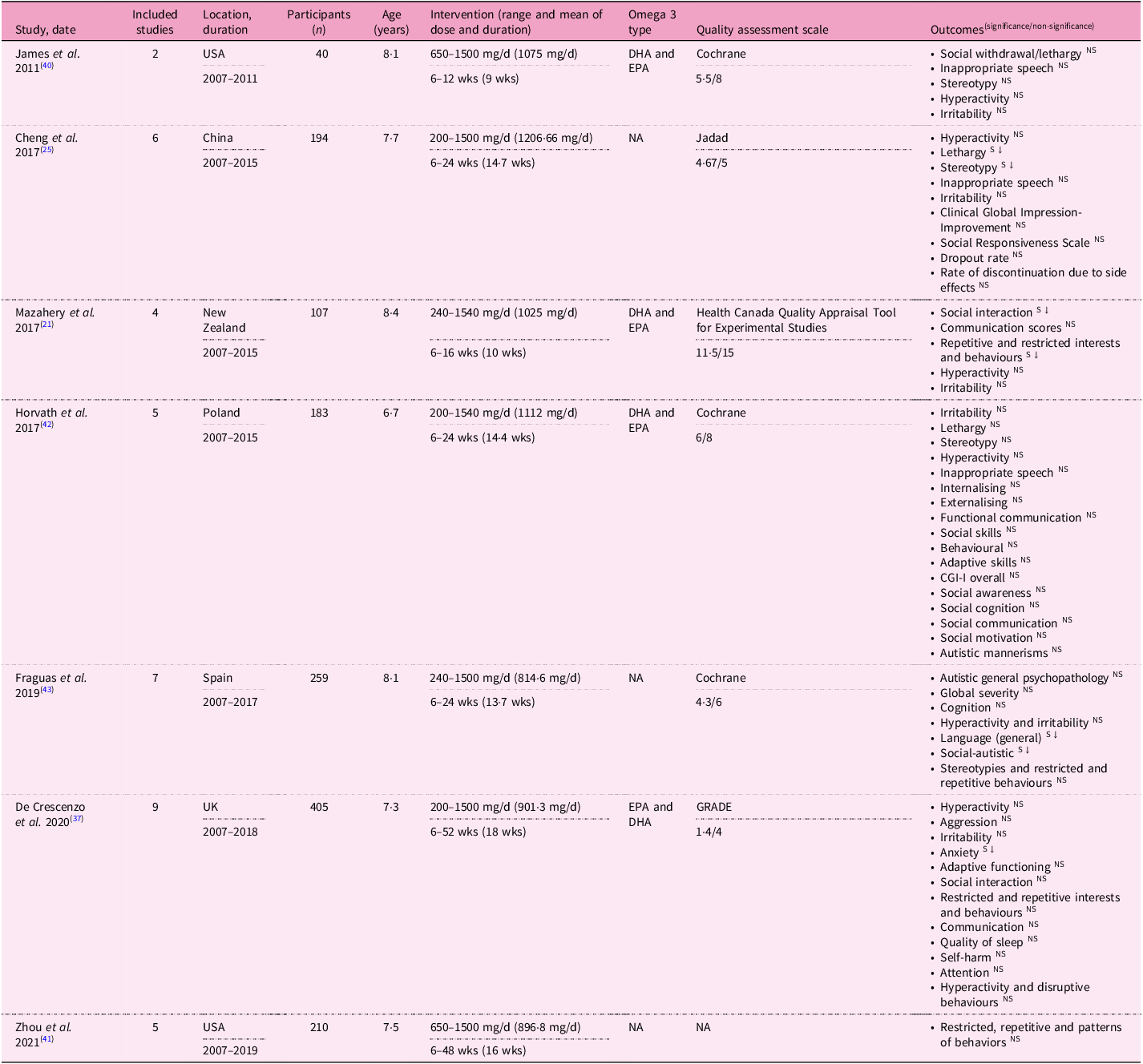
The characteristics of the included articles are presented in Table 1. The combined sample size in these meta-analyses was 1398 participants. The sample size varied from 40 to 405. The average age of meta-analyses was 7·68 years. Of seven meta-analyses selected, two studies were executed in the USA (Reference James, Montgomery and Williams41,Reference Zhou, Nasir, Farhat, Kook, Artukoglu and Bloch42) , one study in China(Reference Cheng, Tseng, Chen, Stubbs, Yang and Chen26), one study in New Zealand(Reference Mazahery, Stonehouse, Delshad, Kruger, Conlon and Beck22), one study in Poland(Reference Horvath, Łukasik and Szajewska43), one study in Spain(Reference Fraguas, Díaz-Caneja, Pina-Camacho, Moreno, Duran-Cutilla and Ayora44) and one study in the UK(Reference De Crescenzo, D’Alò, Morgano, Minozzi, Mitrova and Saulle38). Seven meta-analyses evaluated the impact of omega-3 supplementation on social withdrawal/lethargy (n = 6), cluttering speech (n = 6), hyperactivity (n = 6), irritability (n = 6) and stereotypy/ repetitive and restricted interests and/or behaviours (RRIB) (n = 7). In addition, some studies evaluated other outcomes, such as internalising, externalising, functional communication, adaptive skills, cognition, aggression, quality of sleep, self-harm or attention.
The characteristics of the included meta-analyses and systematic reviews

n, number; yrs, years; wks, weeks; DHA, docosahexaenoic acid; EPA, eicosapentaenoic acid; NS, non-significant; S, significant; down arrow, reductuin; GRADE, Grading of Recommendations Assessment, Development and Evaluation; NA, not available.
Results of methodological quality assessment
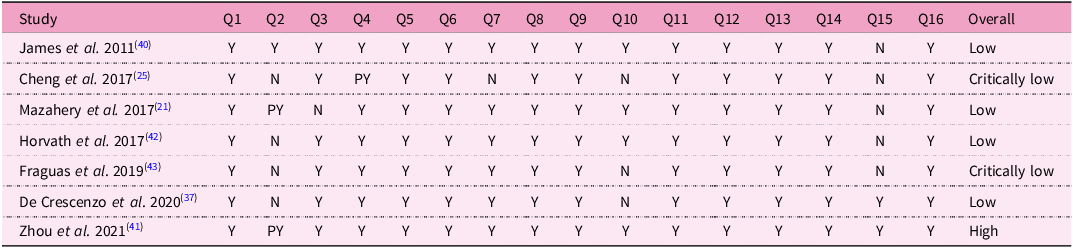
Based on the AMSTAR-2, the findings of the quality assessment are presented in Table 2. From seven meta-analyses of RCTs, one meta-analysis was of high quality(Reference Zhou, Nasir, Farhat, Kook, Artukoglu and Bloch42), four were low quality(Reference Mazahery, Stonehouse, Delshad, Kruger, Conlon and Beck22,Reference De Crescenzo, D’Alò, Morgano, Minozzi, Mitrova and Saulle38,Reference James, Montgomery and Williams41,Reference Horvath, Łukasik and Szajewska43) and two were critically low quality(Reference Cheng, Tseng, Chen, Stubbs, Yang and Chen26,Reference Fraguas, Díaz-Caneja, Pina-Camacho, Moreno, Duran-Cutilla and Ayora44) .
Results of methodological quality assessment of the included meta-analyses via AMSTAR 2

Y, yes; PY, partially yes; N, no; Questions: Q1 – Did the research questions and inclusion criteria for the review include the components of PICO? Q2 – Did the report of the review contain an explicit statement that the review methods were established prior to the conduct of the review, and did the report justify any significant deviations from the protocol? Q3 – Did the review authors explain their selection of the study designs for inclusion in the review? Q4 – Did the review authors use a comprehensive literature search strategy? Q5 – Did the review authors perform study selection in duplicate? Q6 – Did the review authors perform data extraction in duplicate? Q7 – Did the review authors provide a list of excluded studies and justify the exclusions? Q8 – Did the review authors describe the included studies in adequate detail? Q9 – Did the review authors use a satisfactory technique for assessing risk of bias (RoB) in individual studies that were included in the review? Q10 – Did the review authors report on the sources of funding for the studies included in the review? Q11 – If meta-analysis was performed, did the review authors use appropriate methods for the statistical combination of results? Q12 – If meta-analysis was performed, did the review authors assess the potential impact of RoB in individual studies on the results of the meta-analysis or other evidence synthesis? Q13 – Did the review authors account for RoB in individual studies when interpreting/discussing the review results? Q14 – Did the review authors provide a satisfactory explanation for and discussion of any heterogeneity observed in the review results? Q15 – If they performed quantitative synthesis, did the review authors conduct an adequate investigation of publication bias (small-study bias) and discuss its likely impact on the review results? Q16 – Did the review authors report any potential sources of conflict of interest, including any funding they received for conducting the review?
Effect of omega-3 fatty acid supplementation on social withdrawal/lethargy
The six meta-analyses that reported the impact of omega-3 on social withdrawal/lethargy were entered into this umbrella meta-analysis (Fig. 2a), and the results indicated no significant impact of omega-3 on social withdrawal/lethargy in participants with ASD (ES −0·22; 95% CI −0·78, 0·35; P = 0·45). However, a significant between-study heterogeneity was observed (I 2 = 76·86%, P < 0·001). Evidence of a small-study effect was not observed (Egger’s (P = 0·32) and Begg’s tests (P = 1·00)). Publication bias analysis demonstrated that the shape of the funnel plot was asymmetric (Fig. 3a). Moreover, trim-and-fill analysis, which is a method based on the addition of studies to the funnel plot so that it becomes symmetrical aimed at both identifying publication bias and adjusting results for it, was performed with six studies and found no publication bias (ES 0·04; 95% CI −0·15, 0·22; P > 0·05).
The forest plot of the effect of omega-3 fatty acid supplementation on social withdrawal/lethargy (a), cluttering speech (b), hyperactivity (c), irritability (d) and stereotypy/RRIB (e) in patients with ASD, presented as ES with 95% CI.

The funnel plot of the effect of omega-3 fatty acid supplementation on social withdrawal/lethargy (a), cluttering speech (b), hyperactivity (c), irritability (d) and stereotypy/RRIB (e) in patients with ASD, utilising the trim-and-fill method.

Effect of omega-3 fatty acid supplementation on cluttering speech
Cluttering is another language problem found in autism that can result in fast, unclear conversations Some signs of cluttering speech include rapid talk, syllables that run together, excessive filler words and repetitions, and abnormal pauses(Reference Louis and Schulte45). Cluttering may be caused by a combination of genetic factors, neurological differences and language development issues(Reference Góral-Półrola, Zielińska, Jastrzebowska and Tarkowski46). As shown in Fig. 2b, the overall effect size from six studies indicated that there was no significant link between omega-3 supplementation and cluttering speech in participants with ASD (ES −0·22; 95% CI −0·78, 0·35; P = 0·45), although there was a significant between-study heterogeneity (I 2 = 76·86%, P < 0·001). Subgroup analysis according to age revealed that cluttering speech was significantly reduced in studies conducted on participants aged ≤8 years (ES −0·30; 95% CI −0·55, −0·06; P = 0·02) (Table 3). The small-study effects were assessed by performing Egger’s and Begg’s tests (P = 0·32 and 1·00, respectively). However, visual inspection of the funnel plot showed an asymmetric shape (Fig. 3b). The trim-and-fill analysis found no publication bias (ES 0·04; 95% CI −0·15, 0·22; P > 0·05).
Subgroup analysis for omega-3 supplementation on outcomes in participants with ASD

Effect of omega-3 fatty acid supplementation on hyperactivity
The results of this umbrella meta-analysis indicated that there was no significant effect of omega-3 on hyperactivity in participants with ASD (ES −0·13; 95% CI −0·48, 0·22; P > 0·05) (Fig. 2c), although a significant between-study heterogeneity was observed (I 2 = 45·60%, P = 0·05). Subgroup analysis based on age and study duration showed significant reductions in hyperactivity in participants ≤8 years (ES = −0·30; 95% CI: −0·55, −0·06; P = 0·02) and in participants who received omega-3 fatty acid supplementation for more than 14 weeks (ES −0·30; 95% CI −0·55, −0·06; P = 0·02) (Table 3). Evidence of a small-study effect was not observed (Egger’s test P = 0·61 and Begg’s tests P = 1·00). Publication bias analysis demonstrated that the shape of the funnel plot was asymmetric (Fig. 3c). In accordance with this, the trim-and-fill analysis was performed with six studies and found no publication bias (ES −0·13; 95% CI −0·33, 0·07; P > 0·05).
Effect of omega-3 fatty acid supplementation on irritability
No significant effect of omega-3 on irritability was observed (ES 0·09; 95% CI −0·12, 0·30; P > 0·05) (Fig. 2d) with a low between-study heterogeneity (I 2 = 0%, P = 0·89). Regarding subgroup analysis, the result did not change. The Egger’s (P = 0·73) and Begg’s (P = 1·00) tests found that the overall ES did not change by the exclusion of any individual study. In addition, the asymmetric shape of the funnel plot confirmed the presence of publication bias (Fig. 3d). The trim-and-fill method found no publication bias (ES 0·09; 95% CI −0·12, 0·30; P > 0·05).
Effect of omega-3 fatty acid supplementation on stereotypy/RRIB
Based on seven included papers, the results found no significant effect of omega-3 fatty acid supplementation on stereotypy/RRIB (ES 0·01; 95% CI −0·29, 0·31; P = 0·95) (Fig. 2e) with high between-study heterogeneity (I 2 = 64·30%, P = 0·01). After analysing subgroups on the basis of various dosages which were used in the included meta-analyses, the results showed that omega-3 fatty acid supplementation with a dosage of ≤1000 mg/d led to a significant increase in the stereotypy/RRIB (ES 0·19; 95% CI 0·03, 0·35; P = 0·02) (Table 3). A small-study effect was not found using Egger’s (P = 0·45) and Begg’s (P = 1·00) tests. The shape of funnel plot was not symmetric (Fig. 3e). By using trim-and-fill analysis, no publication bias was detected (ES 0·01; 95% CI −0·29, 0·31; P > 0·05).
Discussion
This is the first umbrella review to clarify the effect of omega-3 supplementation in the ASD population. The results revealed a significant reduction in cluttering speech in studies conducted on participants aged ≤8 years. There were significant reductions in hyperactivity in participants ≤8 years and in participants who received omega-3 fatty acid supplementation for more than 14 weeks. No significant benefit was found regarding the effect of omega-3 supplementation on social withdrawal, lethargy and irritability. Similarly, a recent review found that omega-3 fatty acids are ineffective for ASD symptoms, whereas omega-3 fatty acids combined with vitamin D may improve behaviour and social interactions(Reference Jiang, Dang, Nie, Kong, Jiang and Guo14). In contrast, a 2017 study provided some evidence that omega-3 fatty acids may alleviate lethargy in children with ASD, as reported by parents in two different trials. However, these positive indications were in contrast to other trials that showed an increase in externalising behaviours and a decline in social skills. In addition, a review examining various nutritional interventions, including omega-3 supplements, found that while many studies reported improvements in the behavioural symptoms of children with ASD, the wide variability in outcomes across these studies precludes a definitive conclusion regarding the most effective nutritional intervention strategy(Reference Díaz Vargas and Leonario Rodríguez47).
Our study did not observe a significant effect of omega-3 on cluttering speech in all participants with ASD. Yet, when focusing on children aged 8 and younger, a subgroup analysis indicated significant improvements. This finding is in contrast to a meta-analysis of RCT which reported no effect of omega-3 on the symptoms of ASD such as speech function(Reference Jiang, Dang, Nie, Kong, Jiang and Guo14). However, Bent et al. in a systematic review identified a wider array of benefits, with omega-3 supplementation linked to improvements in language and learning skills, suggesting that the supplement’s effectiveness may vary across different domains and age groups(Reference Bent, Bertoglio and Hendren35).
Based on a meta-analysis, the prevalence of hyperactivity among individuals with ASL is 38·5%(Reference Rong, Yang, Jin and Wang48). In our study, we found that omega-3 supplementation did not lead to a significant change in hyperactivity levels among the general population of participants with ASD. However, positive effects were observed for specific groups including children aged 8 or younger and those who received omega-3 supplementation for more than 14 weeks. These results are in contrast to one meta-analysis of RCT which did not identify any benefits of omega-3 in reducing hyperactivity in participants with ASD (Reference Mazahery, Stonehouse, Delshad, Kruger, Conlon and Beck22). Nonetheless, some individual studies suggest that omega-3 fatty acids may help alleviate hyperactive symptoms in people with ASD, highlighting the potential for omega-3 to be beneficial in particular contexts or subgroups within the ASD population(Reference Cheng, Tseng, Chen, Stubbs, Yang and Chen26).
In the present umbrella review, we found that omega-3 supplementation did not significantly reduce irritability in participants with ASD, as suggested by the consistency of results across studies, shown by the low heterogeneity. This result remained unchanged even after performing subgroup analysis. This is in line with published meta-analyses of RCT that reported no benefits from omega-3 in alleviating irritability in participants with ASD(Reference Mazahery, Stonehouse, Delshad, Kruger, Conlon and Beck22). However, there are conflicting reports; one study highlighted that omega-3 supplementation led to improvements in general health and behaviour according to parental observations(Reference Bent, Bertoglio and Hendren35).
The results of the present study indicate that omega-3 supplementation had no effect of stereotypy or RRIB in individuals with ASD. This is in line with previous research which concluded that omega-3 fatty acids did not significantly reduce RRIB in ASD(Reference Zhou, Nasir, Farhat, Kook, Artukoglu and Bloch42). However, a small number of studies suggest that omega-3 may offer some benefit in improving symptoms of stereotypy in ASD(Reference Mazahery, Stonehouse, Delshad, Kruger, Conlon and Beck22,Reference Cheng, Tseng, Chen, Stubbs, Yang and Chen26) . Subgroup analysis of our research found that omega-3 supplementation with a dose of less than 1000 mg may increase the stereotypy or RRIB in individuals with ASD. These contradictory results may be due to the existing high heterogeneity and small sample size of the included meta-analyses and systematic reviews. In line with this result, a recent study on the association between maternal prenatal fish intake and child autism-related traits found that intake of some types of fish was associated with higher Social Responsiveness Scale (SRS) scores (indicative of higher levels of ASD traits)(Reference Vecchione, Vigna, Whitman, Kauffman, Braun and Chen49). It is possible that, in low doses of omega-3 supplements extracted from fish oil, the effects of toxicants may outweigh the beneficial effects of omega-3. Also, in some studies, the exact type of omega-3 fatty acid was not specified, and different types of omega-3 fatty acid may have different effects on brain function(Reference Bos, van Montfort, Oranje, Durston and Smeets50).
Our comprehensive review on omega-3 supplementation and ASD was implemented with stringent methodology including a detailed search across databases, selection of the most extensive meta-analyses per outcome, and strict adherence to the inclusion criteria. Focusing exclusively on randomised controlled trials ensures strong and reliable causal inference regarding the effects of omega-3 fatty acids on ASD. However, the present study has some limitations. There was high heterogeneity across meta-analyses in terms of dosage, participant age and study duration, which complicates the interpretation of results. The quality of some included studies has been reported to be highly questionable. Variations in the methodological quality of included meta-analyses, from high to critically low, may affect the quality of the results obtained. The presence of publication bias, suggested by asymmetric funnel plots, indicates a potential overrepresentation of positive findings. Furthermore, the outcomes measured may not cover all relevant ASD symptoms. Small sample sizes in some studies may reduce statistical power, and differences in populations limit the generalizability of results. In addition, the severity of ASD, the type of omega-3 fatty acids and the blood level of omega-3 fatty acids were not mentioned in the included meta-analyses, and it was not possible to perform subgroup analyses based on the severity of the disease and different types of fatty acid. This review is also reliant on the risk of bias within primary studies. There is a lack of long-term effect data and possible underreporting of adverse effects. Future research on omega-3 fatty acids in ASD should prioritise large-scale, well-designed trials with long-term follow-ups to confirm the obtained results and strengthen the evidence base for public health practice. Future studies should standardise supplementation protocols and include diverse populations to enhance generalisability. A broader range of ASD-related outcomes should be assessed, and efforts to understand the biological mechanisms of omega-3 effects on ASD are needed. Reporting the adverse effects and ensuring all results are published will reduce publication bias, providing a clearer picture of the effect of omega-3 on ASD symptoms.
Conclusion
This umbrella meta-analysis revealed that omega-3 fatty acid supplementation may be beneficial to reduce cluttering speech and hyperactivity in children with ASD who are 8 years or younger. Also, omega-3 fatty acid may improve hyperactivity in participants who receive omega-3 fatty acid supplements for more than 14 weeks. Supplementation with omega-3 does not significantly impact other symptoms of ASD, including social withdrawal, hyperactivity and irritability. Further studies with longer duration and various dosage of different types of omega-3 fatty acid are required to illuminate these particular aspects and to discover the underlying mechanisms of the effects of omega-3 fatty acids on ASD symptoms.
Data availability statement
All data generated or analysed during this study are included in this published article and its supplementary material.
Acknowledgements
None.
Author contributions
H.A.: systematic search; risk of bias assessment and preparing the figures; formal analysis, data interpretation, and writing-original draft; A.P: Conceptualisation and critically editing the manuscript; F.B., S.Kh.: study selection and data extraction; A.P., M.Gh.: conceptualisation and drafting the manuscript; S.D.: conceptualisation, supervision and critically editing the manuscript. All authors approved the final version for submission.
Competing interests
The authors declare no conflicts of interest.
Ethics approval
None.