INTRODUCTION
Cervical cancer is the second most common cancer in Thailand. 1 Radiotherapy (RT) plays a major role in the treatment of cervical cancer in primary, postoperative RT and palliative settings. For primary treatment, combination of whole pelvic radiotherapy (WPRT) plus high-dose rate intracavitary brachytherapy (HDR-ICBT) is generally used to get the curative dose of 80–90 Gy to point A [2-cm laterally and cranially from the cervical overall survival (OS)].
While administering the adequate dose is important to controlling the disease, the overall treatment time (OTT) does also affect treatment outcome. For radiotherapy alone, the adverse effects of prolonged RT are well established. Prolonged OTT increased pelvic failures and decreased OS rates.Reference Fyles, Keane, Barton and Simm 2 – Reference Ferrigno, Ribeito dos Santos Novaes and Pellizzon 6 According to the data from the literatures, the American Brachytherapy Society (ABS) recommend that the OTT should be <56 days.Reference Nag, Erickson, Thomadsen, Orton, Demanes and Petereit 7 However, these OTT recommendations are based primarily on radiotherapy alone.
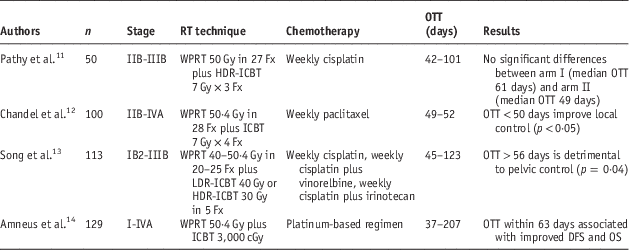
When concurrent chemo-radiotherapy (CRT) became the standard treatment for locally advanced cervical cancer, the influence of OTT in CRT was investigational.Reference Morris, Eifel and Lu 8 – Reference Whitney, Sause and Bundy 10 Many studies have reported that lengthened OTT affected outcome, however the results were controversial, Table 1.Reference Pathy, Kumar and Pandey 11 – Reference Amneus, Park and Delit 14
Studies on overall treatment time (OTT) in chemo-radiotherapy (CRT) for locally advanced cervical cancer
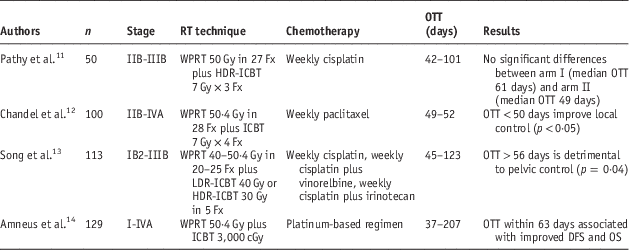
Abbreviations: WPRT, whole pelvic radiotherapy; HDR, high-dose rate; ICBT, intracavitary brachytherapy; LDR, low-dose rate; DFS, disease-free survival; OS, overall survival.
The aim of this study was to evaluate the influence of the OTT on treatment outcomes for locally advanced cervical cancer patients who were treated by CRT in our institute.
MATERIALS AND METHODS
The Institutional Review Board of the Faculty of Medicine, Chiang Mai University approved this retrospective study (ID 2845). This study retrospectively evaluated 122 cervical cancer patients who were treated between January 2009 and December 2013. All patients were biopsy-confirmed squamous cell carcinoma of cervix uteri of stage IIB or IIIB (based on The International Federation of Gynecology and Obstetrics) and received WPRT combined with weekly platinum-based regimen plus ICBT, with curative intent.Reference Pecorelli, Zigliani and Odicino 15 Treatment details regarding radiotherapy, concurrent chemotherapy regimen and follow-up programme are detailed below.
Radiotherapy technique
All patients received WPRT to a dose of 50 Gy in 25 fractions was delivered to pelvic nodes, administered with 6 or 10 MV photons using a two or four field technique. The 4-cm midline block was added after 44 Gy to WPRT, and treatment was continued to 50 Gy. After 50 Gy, the dose to the parametrium was increased to 56 Gy, in 2 Gy per fraction. Four treatments of ICBT were administered, with the first application of ICBT was performed in the 5th week after starting RT. A tandem-ovoid applicator was applied to all four treatments. X-ray-based planning was performed and a dose of 7 Gy to point A was prescribed. To report the bladder and rectal dose, the International Committee on Radiation Units and Measurements Report No. 38 (ICRU 38) was used. 16
Chemotherapy
Concurrent CRT with weekly cisplatin at a dose of 40 mg/m2 or carboplatin at a dose of the area under curve 2 to a maximum of six cycles was given during the WPRT. The maximum doses of chemotherapy per each cycle were 70 mg for cisplatin or 200 mg for carboplatin. In administering weekly cisplatin, treatment was administered when creatinine clearance was during 30–40 mL/minute. When the creatinine clearance was <30 ng/mL, concurrent chemotherapy was stopped.
Follow-up
During treatment, patients received weekly appointments to visit the radiation oncologist for chemotherapy and status evaluation. After treatment finished, the patients were seen once a month for the first 3 months, then every 3 months until 2 years after treatment and then every 6 months until 5 years after treatment. The World Health Organization (WHO) response criteria were used to evaluate treatment response.Reference Miller, Hoogstraten, Staquet and Winkler 17 Acute and late complications were measured according to the Radiation Therapy Oncology Group/European Organization of Research and Treatment of Cancer.Reference Cox, Stetz and Pajak 18
Statistical analysis
OTT of all patients were recorded from the 1st day of WPRT to the last day of HDR-ICBT. Statistical analysis was carried out using the Statistical Package for Social Sciences (SPSS) software version 17.0 for Windows. Descriptive statistics were used for patient characteristics and OTT. The Kaplan–Meier method was used to analyse PC, distant metastasis-free survival (DMFS), disease-free survival (DFS) and OS rates relating to OTT. A p-value of ≤0·05 was considered statistically significant.
RESULTS
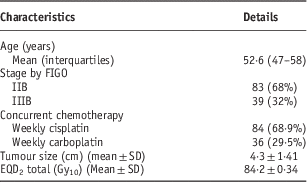
The analysis included 122 cervical cancer patients who underwent and completed CRT, of which 83 were stage IIB and 39 stage IIIB. The median tumour size was 4 cm; 26 patients (21·3%) had an enlarged pelvic node. All patients received a weekly platinum-based regimen and 84 patients (68·9%) received weekly cisplatin. OTT of all patients ranged from 44 to 88 days. The mean and median values were 55·6 and 53 days, respectively. The mean follow-up time was 36·4 months (range 3·6–79·9). The patient characteristics are shown in Table 2.
Patient characteristics and treatment factors (n=122)

Abbreviations: EQD2, equivalent dose of 2 Gy; FIGO, International Federation of Gynaecology and Obstetrics.
Treatment results and toxicities
The 3-year PC, DMFS, DFS and OS rates were 90·2, 80·3, 77·9 and 77%, respectively.
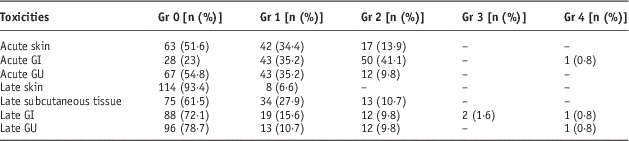
For acute complications, no patients developed grade 3 or 4 genitourinary or dermatologic toxicity. Percentage of acute and late toxicities arising in all patients was documented in Table 3. Only one patient developed grade 4 acute gastrointestinal (GI) toxicity. For late complications, no patients developed grade 3 or 4 dermatologic toxicity. Two patients developed grade 3 GI toxicities and one patient with grade 4.
Percentage of acute and late toxicities arising in all patients

Abbreviations: Gr, grade; GI, gastrointestinal; GU, genitourinary.
OTT analysis
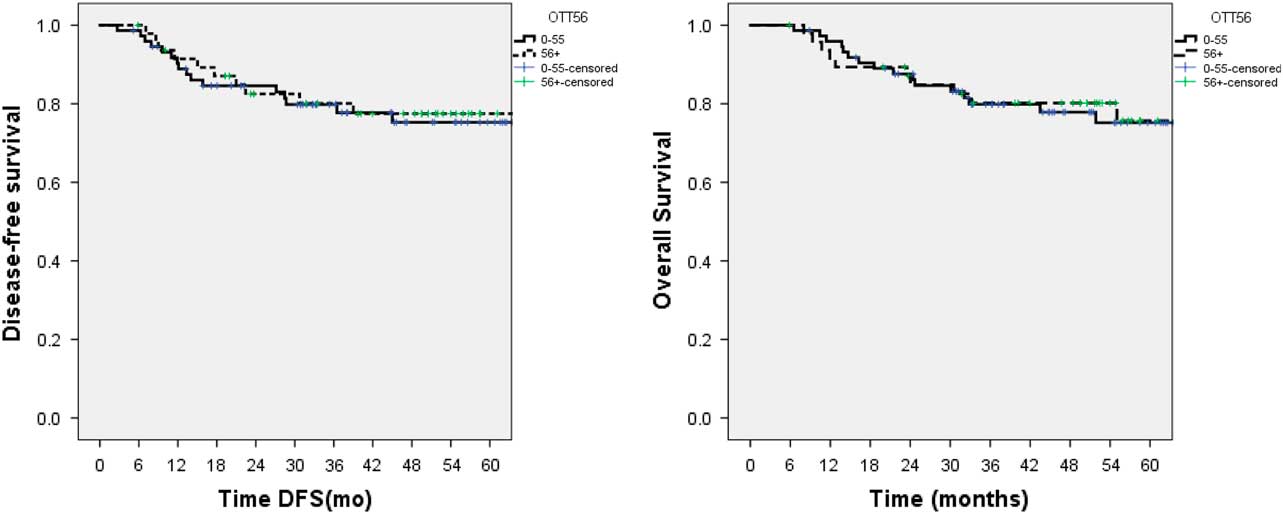
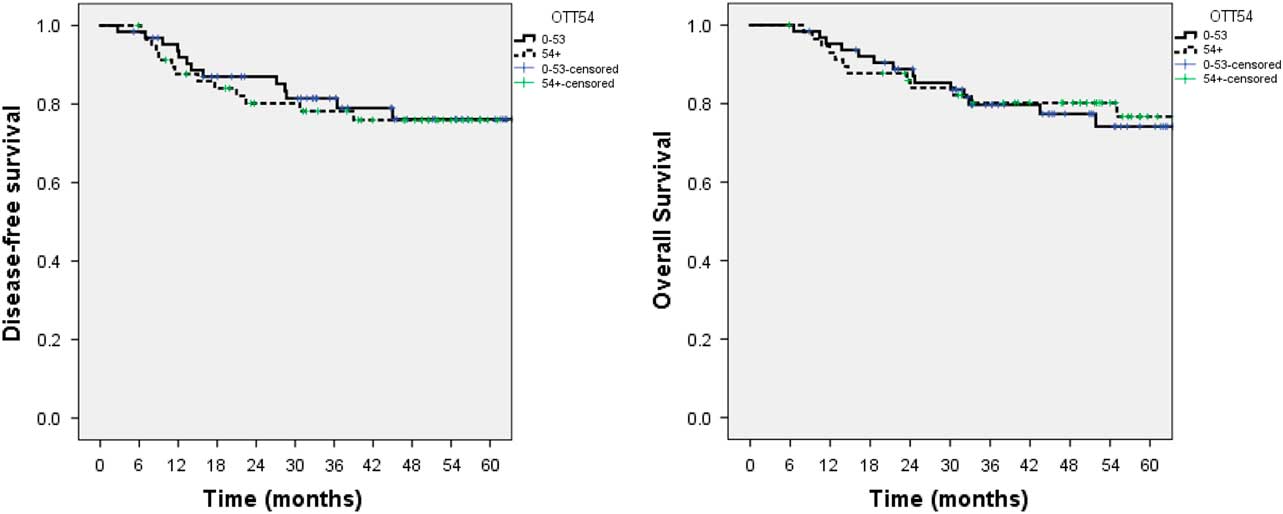
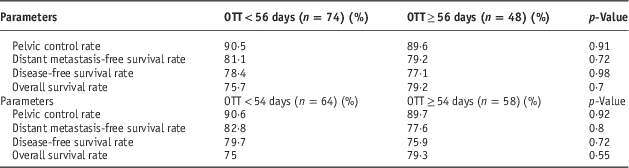
The two data-derived cut points of OTT were used in our analysis according to mean (55·8 days) and median (53 days) values. In mean-value cut point, no statistical significance of PC, DMFS, DFS and OS rates was observed. The analysis showed the same results in <54 versus ≥54 days. Table 4, Figures 1 and 2 showed the results of these analyses.
Kaplan–Meier curves showed disease-free survival and overall rate for the two groups according to the mean value of overall treatment time.

Kaplan–Meier curves demonstrated disease-free survival and overall rate for the two groups according to the median value of overall treatment time.

The 3-year pelvic control, distant-metastasis free survival, disease-free survival and overall survival rates for the evaluations of the mean and median values

Abbreviation: OTT, overall treatment time.
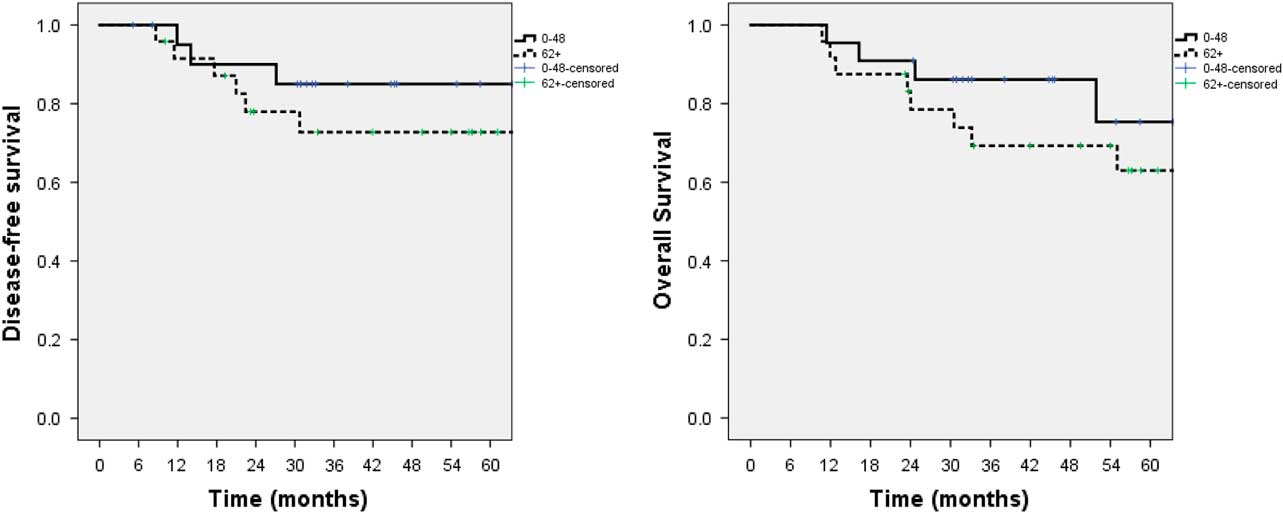
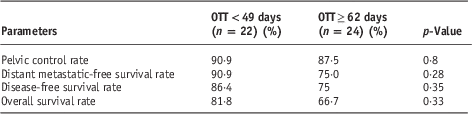
We further evaluated the results in the groups of OTT<49 days (shortest group) versus OTT≥62 days (longest group). The PC, DMFS, DFS and overall survival were not statistically significant. This data were presented in Table 5 and Figure 3.
Kaplan–Meier curves showed demonstrated disease-free survival and overall rate for the two groups according to the overall treatment time (OTT)<49 versus OTT≥62 days.

The 3-year pelvic control, distant-metastasis free survival, disease-free survival and overall survival rates in the group of overall treatment time (OTT)<49 versus OTT≥62 days

DISCUSSION
The OTT of 122 cervical cancer patients, receiving external beam and HDR ICBT, was retrospectively evaluated. Several studies found there to be a negative impact on OS rates when OTT is increased in CRT for locally advanced cervical cancer.Reference Pathy, Kumar and Pandey 11 – Reference Amneus, Park and Delit 14 Details of these studies are presented in Table 1.
In our study, the influence of increasing OTT demonstrated no negative impact on PC, DMFS, DFS and OS when patients follow-up data was analysed from data-derived cut-points by mean (55·8 days) and median (53 days) values. Our results were in agreement with the study by Pathy et al. in that there was no difference between the two groups of group I (median OTT=61 days) and group II (median OTT=49 days) while other studies demonstrated a negative impact on patient outcomes due to an increase in the OTT (Table 1). Our study further explored to the subgroups of OTT<49 versus OTT≥62 days and found no statistical significance. However, the group of OTT≥62 days had lower percentages of all survival parameters than the group of OTT<49 days. Therefore, the OTT for the whole treatment process for locally advanced cervical cancer in CRT setting should be kept as short as possible.
However, our study has some limitations. Our sample included only 122 patients. To reduce the prejudicing variables that might affect treatment, all patients in this study were biopsy-confirmed squamous cell carcinoma histology, had the same radio-therapeutic schedule, and concurrent chemotherapy with platinum-based regimen. With these criteria, our study showed no statistical difference in local PC, DMFS, DFS and OS rates of lengthen OTT in the cut points of 55·8 (mean) and 53 (median) days. This is supported by a recent study by Hong et al. that analysed the national database of cervical cancer and reported that, in the CRT setting, OTT influenced the overall survival when it is longer than 63 days in propensity-matched validation cohort of cross-validation cut point (p=0·006). Hong et al. concluded that data-derived cut point distributed around 64 days and a current 55 day recommendation might be appropriately conservative estimation.Reference Hong, Foote and Broadwater 19 Our data supported the concept that the OTT of CRT for locally advanced cervical cancer could be kept to be <63 days. Consequently, the OTT<63 days should be acceptable in our routine practice and further research should be conducted to evaluate the correlation of OTT to other factors, such as toxicities, quality of life and so on.
In conclusion, treatment outcomes of CRT for locally advanced cervical cancer were not influenced by the data-derived cut points of 55·8 and 53 days in our study. However, the treatment schedule should be kept as short as possible in routine practice.
Acknowledgements
The authors thank the staff of the Research Unit of the Faculty of Medicine, Chiang Mai University and the Division of Radiation Oncology, Department of Radiology, Faculty of Medicine, Chiang Mai University.
Financial support
No funding support.
Conflicts of Interest
No conflicts of interest was declared.