I. INTRODUCTION
For the problem of the environment and the need of medial application, biodegradable polymers are extensively investigated. Reference Yang, Liu, Yang and Li1,Reference Javadi, Srithep, Pilla, Lee, Gong and Turng2 Aliphatic polyesters such as poly(L-lactide) (PLLA), poly(ε-caprolactone) (PCL), poly(para-dioxanone) (PPDO), poly(glycolic acid) (PGA) as well as their copolymers are biodegradable and have attracted the attention of researchers. Reference Nair and Laurencin3
Among aliphatic polyesters, PLLA has been studied most extensively because it is biodegradable, biocompatible, bioabsorbable, and renewable and has high tensile strength and modulus. Reference Yang, Liu, Yang and Li1,Reference Liu, Chen, Liu, Estep and Zhang4–Reference Wu, Yen, Kuo and Chen6 However, PLLA is brittle with elongation at break (EAB) <10%, Reference Rasal, Janorkar and Hirt7 which restricts its wide application in many fields. Reference Wang, Ma, Wang, Wang, Zhang and Zhang8
To toughen PLLA, many methods, including copolymerization, blending, plasticity, and filling modification, have been reported. Reference Meng, Tao, Deng, Wu and Yang9,Reference Lu, Qiu and Yang10 Even though copolymerization of L-lactide and other monomers can tailor the mechanical properties of PLLA-based material, this method is complex and difficult to synthesize in mass production. For plasticity, the addition of plasticizers into PLLA can increase the breaking elongation, which is accompanied by decreased EAB and elastic moduli. Reference Gramlich, Robertson and Hillmyer11 However, the plasticizer in PLLA intends to migrate to the surface of the material with time, which will result that the material mechanical properties become poor. Reference Shibata, Teramoto and Inoue12,Reference Arias, Hoglund, Odelius and Albertsson13 Filling inorganic particles into PLLA will destroy the degradability of the material. Blending PLLA and flexible polymers is a good method and used widely because it is practical and economic. Reference Arias, Hoglund, Odelius and Albertsson13–Reference Gallego, López-Quintana, Basurto, Núñez, Villarreal and Merino15
PPDO is a biodegradable polyester used in tissue engineering, fixation of bone fractures, and controlled delivery of drugs due to its excellent bioabsorbability, biocompatibility, and mechanical flexibility. Reference Bai, Chen, Zhang, Li, Zhang and Xiong16–Reference Bai, Chen, Li, Chen, Zhang, Huang and Xiong19 In our previous study, Reference Xie, Bai, Chen, Xiong and Pang20 PLLA/PPDO blends of various weight ratios were prepared and studied. We found that PLLA and PPDO are immiscible and there is phase separation between PLLA and PPDO. In former articles, Reference Pezzin, Alberda van Ekenstein, Zavaglia, Brinke and Duek21,Reference Pezzin and Duek22 it was also demonstrated that PLLA and PPDO are immiscible. Thus, the mechanical properties of PLLA/PPDO blends are quite poor.
Compatibilization can be applied by the addition of tailored copolymers. Reference Ma, Cai, Zhang, Wang, Dong, Chen and Lemstra23 To improve the mechanical properties of PLLA/PPDO blends, we added different contents of poly(para-dioxanone-co-L-lactide) (PDOLLA) into the PLLA/PPDO (85/15 w/w) blend. We found that PLLA/PPDO (85/15 w/w) with 3 wt% PDOLLA showed good mechanical properties. Reference Xie, Bai, Wu, Chen, Xiong, Tang and Pang24 This blend is potential to be used as a medical material. The rate of hydrolytic degradation (HD), surface morphology, and mechanical properties of blends during HD are vital to their application in medical field. In vitro HD is an easy and reliable way to measure the HD of polymers. Therefore, we studied the in vitro HD of a PLLA/PPDO 85/15 blend compatibilized with PDOLLA. To estimate the degradation behaviors of the blend bars, the weight loss (WL), water absorption (WA), thermal properties, surface morphology, and mechanical properties of the blend bars were studied for 8 wk of HD, as well as the pH value changes of the PBS.
II. EXPERIMENTAL
A. Materials
PLLA and PPDO polymers used in the present study were synthesized by the ring-opening polymerization of L-lactide (LLA) and para-dioxanone (PDO) as described in our previous studies. Reference Zhang, Xiong and Deng25,Reference Wang, Ma, Xiong, Zhou, Zhou and Chen26 The intrinsic viscosity [η] of PLLA and PPDO was 5.6 and 1.4 dL/g, respectively. The viscosity average molecular weight (M v) of PLLA and PPDO was 313,100 and 51,700 g/mol, respectively, and was calculated from [η] using Eqs. (1) and (2) reported for PLLA by Garlotta Reference Garlotta27 and for PPDO by Chen et al. Reference Chen, Wang, Wang, Yang, Zhou and Wu28 :
 $$\left[ \eta \right] = \mathop {K{M_{\rm{V}}}}\nolimits^\alpha \quad {\rm{,}}$$
where α = 0.73 and K = 5.45 × 10⁻⁴ dL/g (PLLA in chloroform at 25 °C).
 $$\left[ \eta \right] = \mathop {K{M_{\rm{V}}}}\nolimits^\alpha \quad {\rm{,}}$$
where α = 0.69 and K = 79 × 10−3 cm3/g (PPDO in hexafluoroisopropanol (HFIP) at 25 °C).
HFIP was purchased from Sinochem Lantian Co., Ltd. (Hangzhou, China). Other analytical reagent-grade solvents were purchased from Guangdong Guanghua Sci-Tech Co., Ltd. (Shantou, China). All solvents were used without further purification.
Amorphous PDOLLA used as a compatibilizer for PLLA/PPDO blends was synthesized and characterized as described in our previous study. Reference Zhao, Hao, Xiong and Deng29 The number average molecular weight (M n) and weight average molecular weight (M w) of the random copolymer measured with gel-permeation chromatography (1515-Styragel HT4 and 5-2414; Waters Corp., Milford, MA) were 85,400 and 150,300, respectively (chloroform as mobile phase). The glass transition temperature (T g) of PDOLLA was determined by differential scanning calorimetry (DSC) to be 3.06 °C. DSC also demonstrated that PDOLLA studied was amorphous, since there was no crystal and melting peaks during the second heating. The ratio of PDO-to-LLA units in PDOLLA used in this work was calculated from the 1H NMR spectrum to be 1.17 (PDO/LLA).
B. Preparation of blends
The ratio of PLLA and PPDO of all blends was fixed at 85/15 (PLLA/PPDO) by weight. PLLA/PPDO/PDOLLA blends with 0, 1, 3, and 5 wt% PDOLLA as a compatibilizer were prepared by solution coprecipitation. That is to say the blends of PLLA/PPDO/PDOLLA (85/15/0, 84.15/14.85/1, 82.45/14.55/3, and 80.75/14.25/5 w/w/w) were prepared and studied. PLLA was dissolved in dichloromethane to produce a 5 w/w% solution. PPDO and PDOLLA were dissolved together in HFIP to produce a 2.5 w/w% solution. The two solutions were then mixed in a beaker. The resultant mixture was stirred for 20 min, and the blends precipitated by addition of excess alcohol. The resulting materials were dried under vacuum at 40 °C for 48 h to remove the remaining solvent and establish phase equilibrium before the physical property measurements.
Blends were formulated based on parameters outlined in ASTM D638. Bars with 50 mm × 5 mm × 0.5 mm dimensions were prepared using a platen vulcanizing press (Model XLB, Shanghai Light Industry Machinery Co., LTD, Shanghai, China) at 200 °C and 5.5 MPa for 12 min. The bars were then quenched to room temperature by immersion in water.
C. Hydrolysis experiments
Hydrolysis experiments were conducted in 24 mL bottles filled with a buffer solution (based on Na2HPO4 and KH2PO4) with an initial pH of 7.49 (which is close to the pH of human blood). Five of the bars were classified as a group and immersed in the buffer solution. The bottles containing samples were placed in a constant temperature oven maintaining the temperature at 37 °C for periods between 0 and 8 wk. Each week, samples were removed from the hydrolysis medium, washed, and dried until they achieved a constant weight using a vacuum oven at 40 °C. The hydrolysis rate was monitored by determination of the WL and WA of the bars, as well as the change in pH of the buffer solutions. The WA and WL were calculated using Eqs. (3) and (4) (Refs. Reference Bai, Zhang, Li, Chen and Xiong17 and Reference Xie, Bai, Chen, Xiong and Pang20), respectively, where m i is the initial dry mass, and m w and m d are the wet and dry mass after degradation, respectively.
 $${\rm{WL}}(\% ) = {{{m_{\rm{i}}} - {m_{\rm{d}}}} \over {{m_{\rm{i}}}}} \times 100\quad {\rm{,}}$$
 $${\rm{WL}}(\% ) = {{{m_{\rm{w}}} - {m_{\rm{d}}}} \over {{m_{\rm{i}}}}} \times 100\quad {\rm{.}}$$
D. DSC
DSC was conducted with a TA Differential Scanning Calorimeter (CMT 4503; Shanghai Light Industry Machinery Co., Ltd., Shanghai, China). Samples were loaded carefully into aluminum pans, heated to 200 °C at 10 °C min−1, maintained for 3 min to erase thermal history, cooled to −40 °C at 50 °C min−1, and heated to 200 °C at 10 °C min−1.
E. Scanning electron microscopy (SEM)
The morphology of sample surfaces was examined using a SEM (Model Inspect F) after coating the sample with a thin layer of gold by vacuum deposition.
F. Tensile testing
Blends were tested based on parameters outlined in ASTM D882-2010. Bars with 50 mm × 5 mm × 0.5 mm dimensions were measured at a drawing speed of 10 mm/min at the environment with the temperature of 25 °C and the relative humidity of 60%, using a SANS tensile tester (Model CMT 4503; MTS Systems Co., Ltd., Shenzhen, China). Each reported value is the mean of three replicate samples.
III. RESULTS AND DISCUSSION
A. In vitro HD
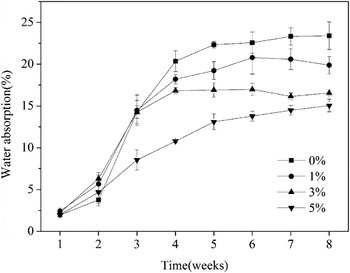
The HD steps of the aliphatic polyesters have been analyzed in detail by Diaz et al. Reference Díaz, Sandonis, Puerto and Ibáñez30 and Zhou et al. Reference Zhou, Deng and Yang31–Reference Deng, Zhou, Li, Zhao and Yuan33 Figure 1 shows the WA of PLLA/PPDO blends with different contents of PDOLLA as in vitro HD proceeded. WA increased at 5 wk of HD. Then, the WA of blend bars with 0, 1, 3, and 5 wt% PDOLLA plateaued at 22, 19, 17, and 14%, respectively, at 6–8 wk. This phenomenon can be attributed to water entering the voids of the blend bars resulting from phase separation. We reported Reference Bai, Zhang, Li, Chen and Xiong17,Reference Xie, Bai, Chen, Xiong and Pang20,Reference Bai, Luo, Wang, Bai, Xiong and Tang34 defects in blends that could absorb water. After 5 wk of HD, voids were full of water. Simultaneously, part of the blend separated from the blend and diffused into water, so the same volume of water entered the blend. In this case, absorption of the blends plateaued 5 wk after HD. Figure 1 shows that the WA of the blend decreased with increasing PDOLLA content, which was in accordance with our previous report. Reference Bai, Luo, Wang, Bai, Xiong and Tang34 As we reported previously, Reference Pezzin, Alberda van Ekenstein, Zavaglia, Brinke and Duek21,Reference Pezzin and Duek22 there was obvious phase separation between PLLA and PPDO. Addition of PDOLLA decreased this phase separation, resulting in a decrease in void density. Reference Xie, Bai, Wu, Chen, Xiong, Tang and Pang24 Therefore, less water entered into blends with increasing PDOLLA content.
WA of PLLA/PPDO blends with different contents of PDOLLA as in vitro HD progressed.

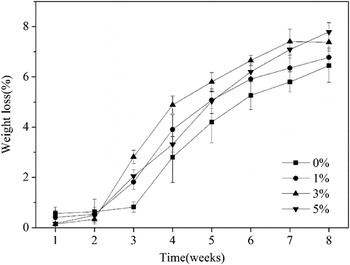
Figure 2 shows the WL of blends with different contents of PDOLLA with in vitro HD. The WL of blends increased throughout the HD period. The WL of blend bars with 0, 1 wt, 3 wt, and 5 wt% PDOLLA was 6.4, 6.8, 7.4, and 7.8%, respectively, after 8 wk of HD. This phenomenon can be attributed to the separation of small particles/small molecules resulting from HD from the blend bars. Reference Bai, Zhang, Li, Chen and Xiong17,Reference Bai, Chen, Li, Chen, Zhang, Huang and Xiong19,Reference Xie, Bai, Chen, Xiong and Pang20,Reference Bai, Luo, Wang, Bai, Xiong and Tang34,Reference Dai, Li and He35 The WLs of blends with PDOLLA as a compatibilizer were greater than PLLA/PPDO blends without PDOLLA. As we stated previously, Reference Bai, Luo, Wang, Bai, Xiong and Tang34 this phenomenon can be attributed to the faster rate of HD of PDOLLA. As is well known, the HD of the amorphous segment of a polymer is faster than that of the crystalline segment. PDOLLA is amorphous, which was demonstrated by DSC, so PDOLLA exhibited faster HD rate.
WL of PLLA/PPDO blends with different contents of PDOLLA as in vitro HD progressed.

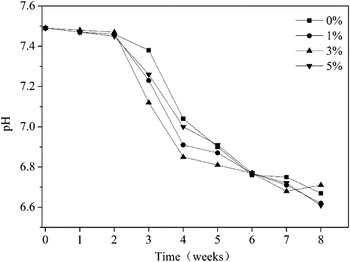
Figure 3 shows the changes in pH of the PBS immersing the blend bars with different contents of PDOLLA. The pH value decreased as HD progressed, which can be attributed to the hydrolysis of the ester bonds in the PLLA, PPDO, and PDOLLA chains. Hydrolysis of ester bonds produced low-molecular-weight molecules with acidic characteristics. Reference Xie, Bai, Chen, Xiong and Pang20,Reference Sriromreun, Petchsuk, Opaprakasit and Opaprakasit36 Then, the acid molecules entered into PBS, resulting in a decrease in pH. Reference Bai, Chen, Li, Chen, Zhang, Huang and Xiong19,Reference Wan, Yuan, Tan, Li and Yang37 The pH of the PBS immersing the blend bars with PDOLLA as a compatibilizer decreased faster than that of the PBS immersing the blend bars without PDOLLA (Fig. 3). This phenomenon was in accordance with the WL with HD because the decrease in pH was due to acid molecules separating from the blend bars to the PBS. As PDOLLA showed a faster rate of HD, the blend bars with some content of PDOLLA would show a faster HD rate.
pH values of the PBS immersing the PLLA/PPDO blend bars with different contents of PDOLLA as in vitro HD progressed.

B. Thermal properties
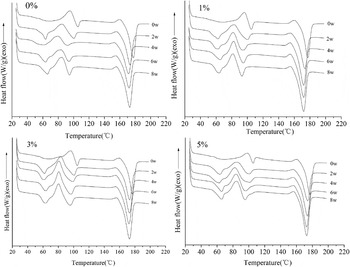
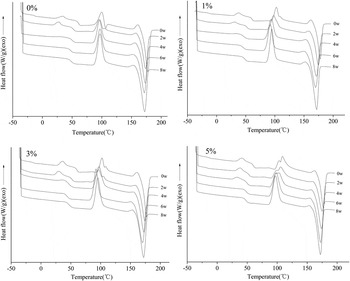
Figures 4 and 5 show the DSC curves of PLLA/PPDO blends with different contents of PDOLLA with degradation obtained from the first and second heating. As is well known, the crystalline of the polymer material has a large influence on its mechanical properties. Thus, the DSC curves obtained from the first heating were used to trace the changes of the crystalline of the blend samples during the HD. The changes of the molecular weight can be demonstrated by the changes of T g and T m. Thus, to study the decrease of the molecular weight, the DSC curves obtained from the second heating were used to study the changes in T g and T m of the blend material with the HD. Table I and Fig. 6 show the thermal properties derived from Figs. 4 and 5, respectively.
DSC curves of PLLA/PPDO blends with different contents of PDOLLA with degradation obtained from the first heating.

DSC curves of PLLA/PPDO blends with different contents of PDOLLA with degradation obtained from the second heating.

DSC data for PLLA/PPDO/PDOLLA blends after different times of HD, showing the cold crystallization enthalpy (ΔHc1) and melting enthalpy (ΔHm1) obtained from the first heating.

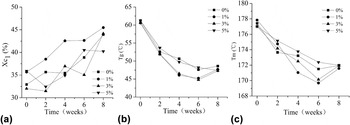
Changes in the (a) crystalline content of blend bars, (b) glass transition temperature, and (c) melting temperature with degradation.

Table I shows the cold crystallization enthalpy (ΔHc1) and melting enthalpy (ΔHm1) of the blend bars with degradation obtained from the first heating. The crystalline content of PLLA (Xc1) in the blend bars at different degradation times was calculated according to Eq. (5), Reference Huang, Zhang, Pan, Zhou, Jiang and Dan38 where ΔHm0 is the melting enthalpy of completely crystalline PLLA and was assumed to be 93 J/g. Reference Díaz, Sandonis, Puerto and Ibáñez30 X(PLLA) is the weight fraction of PLLA in the blend calculated by Eq. (6). The weight fraction of LLA in PDOLLA in Eq. (6) was calculated from the 1H NMR spectrum and found to be 0.38. It is well known that the crystalline content of a polymer material is vital to its properties, including mechanical properties. Therefore, the crystalline content of blends with degradation was studied. Figure 6(a) shows that the crystalline content of blends with 0, 1, 3, and 5% PDOLLA increased from 33, 36, 33, and 36% to 44, 45, 44, and 40%, respectively, after 8 wk of HD. This phenomenon was attributed to the PLLA segment movement and crystallization plasticized by producing water and small molecules with HD. The amorphous portion degrades faster compared with the crystalline portion and the degrading products segregate from the blend bars and enter into the PBS, so the crystalline content in the blend bars increases with degradation. This result was consistent with the findings of other studies. Reference Arias, Hoglund, Odelius and Albertsson13,Reference Bai, Zhang, Li, Chen and Xiong17,Reference Bai, Chen, Li, Chen, Zhang, Huang and Xiong19,Reference Liu, Huang, Kienzle, Muller and Feng39–Reference Li, Li, Ji, He and Gu41
 $$X{c_1} = {{\Delta H{{\rm{m}}_1} - \Delta H{{\rm{c}}_1}} \over {\Delta H{{\rm{m}}^0} \times X\;({\rm{PLLA}})}}\quad {\rm{,}}$$
 $$X({\rm{PLLA}}) = {{{\rm{m}}({\rm{PLLA}}) + 0.38 \times {\rm{m}}({\rm{PDOLLA}})} \over {{\rm{m}}({\rm{PLLA}}) + {\rm{m}}({\rm{PPDO}}) + {\rm{m}}({\rm{PDOLLA}})}}\quad {\rm{.}}$$
From Figs. 6(b) and 6(c), we can see that the T g and melting temperature (T m) of the blends obtained from Fig. 5 decreased with degradation. The T g of blends with 0, 1, 3, and 5% PDOLLA decreased from 61, 61, 61, and 61 °C to 49, 48, 47, and 47 °C, respectively, and the T m of blends with 0, 1, 3, and 5 wt% PDOLLA decreased from 177, 178, 177, and 177 °C to 172, 172, 172, and 172 °C, respectively, after 8 wk of HD. The decrease in the T g and T m was attributed to the increase in mobility of chains due to the decrease in the molecular weight of PLLA and plastification of the small molecules produced during HD, as reported previously. Reference Arias, Hoglund, Odelius and Albertsson13,Reference Bai, Chen, Li, Chen, Zhang, Huang and Xiong19,Reference Bai, Luo, Wang, Bai, Xiong and Tang34,Reference Atkinson and Vyazovkin40,Reference Mattioli, Kenny and Armentano42 From Figs. 6(b) and 6(c), both the T g and T m increase after 6 wk. These results may result from the leaching of PPDO and PDOLLA with decreased molecular weight during HD. Thus, the plasticizing effect on PLLA decreased with decrease in the contents of PPDO and PDOLLA.
C. Morphology
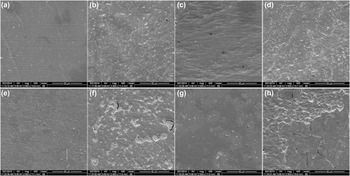
Analyzing sample surfaces with SEM provided further information on the degradation of the samples. Figure 7 shows scanning electron micrographs (x2000 magnification) of the surfaces of blend bars with different contents of PDOLLA after 2 and 8 wk of HD. The surfaces of all blend bars were smooth and homogeneous after even 2 wk of HD, and the surfaces became coarse after 8 wk of HD. These changes on the surfaces of blend bars were attributed to HD. After 8 wk of HD, the surfaces of blend bars suffered eroded [Figs. 7(b), 7(d), 7(f), and 7(h)]. The WL of blend bars after 8 wk of HD was ≈7%, whereas the morphology of the surfaces of all blend bars changed slightly. Therefore, it can be concluded that the PLLA/PPDO 85/15 blend bars with different contents of PDOLLA suffered bulk erosion in PBS, a result that was consistent with another report. Reference Wan, Yuan, Tan, Li and Yang37 Morphological defects can be the cause of a decrease in tensile properties. Reference Bai, Chen, Li, Chen, Zhang, Huang and Xiong19 Figure 7 shows that the surfaces of blends with PDOLLA suffered more erosion, which can be attributed to the faster HD of PDOLLA compared with other components. Therefore, PLLA/PPDO 85/15 blend bars with more PDOLLA exhibited a faster rate of HD that was consistent with analyses of WL with HD.
Scanning electron micrographs of the surfaces of blend bars with different contents of PDOLLA after 2 and 8 wk of HD: (a) 0, (c) 1, (e) 3, and (g) 5% after 2 wk; (b) 0, (d) 1, (f) 3, and (h) 5% after 8 wk.

D. Mechanical properties
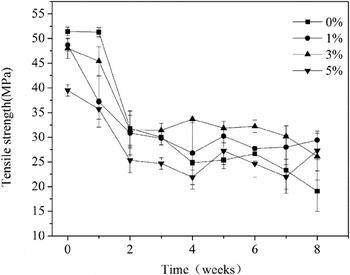
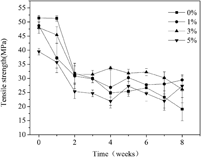
Figure 8 shows the tensile strength of PLLA/PPDO blend bars with different contents of PDOLLA with HD. The tensile strength of all blend bars decreased rapidly after 2 wk of HD. The tensile strength of blend bars with 1, 3, and 5 wt% was, on average, 29, 31, and 25 MPa, respectively, at 3–8 wk of HD. The tensile strength of the PLLA/PPDO 85/15 blend without PDOLLA was, on average, 25 MPa at 3–6 wk of HD and decreased to 19 MPa after 8 wk of HD. Increase of the blend crystalline with HD, as discussed in the “Thermal property” section, is favor for enhancing the tensile strength. However, the decrease in molecular weight of components and increases in defects in bars resulting from HD decreased the tensile strength. Reference Díaz, Sandonis, Puerto and Ibáñez30 The tensile strength of the PLLA/PPDO 85/15 blend with different contents of PDOLLA is related to PDOLLA content as well as the inner structure and molecular weight of the component. SEM is a good equipment to study the inner structure of the polymer blends. The SEM micrographs had been reported in our previous article. Reference Xie, Bai, Wu, Chen, Xiong, Tang and Pang24 The SEM micrographs of PLLA/PPDO 85/15 (w/w) with 0, 1, 3, and 5 wt% PDOLLA were supplied in the supporting information. Without HD, the tensile strength of the blend decreased with increasing PDOLLA content, which can be attributed to the flexibility of PDOLLA. After the same duration of immersion in the PBS, the blend with 3% PDOLLA had almost the highest tensile strength compared with other blends, which can be attributed to addition of the ideal content of PDOLLA to increase two-phase adhesion. We found that 1% PDOLLA was not sufficient to decrease phase separation. However, 5% PDOLLA exceeded the ideal content, resulting in a new dispersed phase. Thus, blends with a more continuous inner structure tended to exhibit higher tensile strength during HD. Therefore, the tensile strength of PLLA/PPDO 85/15 blends during HD can be tailored by adding the appropriate content of PDOLLA.
Tensile strength of PLLA/PPDO blend bars with different contents of PDOLLA with degradation.

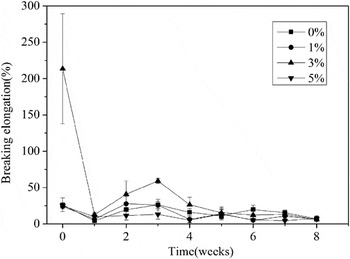
To study flexibility, the EAB of blend bars during HD was studied. Figure 9 shows the EAB of PLLA/PPDO blend bars with different contents of PDOLLA with HD. The EAB of blend bars with 3% PDOLLA was 214%, and that of the other three was ≈25%. Reference Xie, Bai, Wu, Chen, Xiong, Tang and Pang24 Hence, the blend bars were much more flexible than neat PLLA, Reference Rasal, Janorkar and Hirt7 which can be attributed to the addition of flexible PPDO and PDOLLA. After 1 wk of HD, the EAB declined rapidly and can be attributed to increasing structural defects, as reported previously. Reference Bai, Chen, Li, Chen, Zhang, Huang and Xiong19,Reference Bai, Luo, Wang, Bai, Xiong and Tang34,Reference Wanamaker, Tolman and Hillmyer43 It is well known that the EAB is closely related to structural defects. Then, at 2–3 wk of HD, the EAB of blends increased, which was due to plasticization of small molecules from HD. As HD progressed, more structural defects appeared. Therefore, the EAB decreased again despite the plasticization of small molecules. At 2–7 wk of HD, blend bars with 0, 1, and 3% PDOLLA had an EAB of >10% whereas, blend bars with 5% PDOLLA had the lowest EAB compared with the other blends. Therefore, blend bars with 0, 1, and 3% PDOLLA were flexible for 7 wk of HD and could be used as a biodegradable implantation material.
EAB of PLLA/PPDO blend bars with different contents of PDOLLA with degradation.

IV. CONCLUSIONS
PLLA/PPDO 85/15 blends with 0, 1, 3, and 5% PDOLLA were prepared by solution coprecipitation. Their HD behavior was investigated in PBS for 8 wk. With HD, addition of PDOLLA increased WL and decreased WA; the crystalline content of sample bars increased, and the T g and T m of blends decreased; addition of PDOLLA had virtually no effect on the thermal properties of the PLLA/PPDO 85/15 blends; with increasing PDOLLA content, the surface morphology became coarser; the mechanical properties of blends during HD can be tailored by adding the appropriate amount of PDOLLA. Blends with 1 and 3% PDOLLA had higher tensile strength (about 30 MPa) and EAB (>10%) during HD of 8 wk. Considering their good mechanical properties and HD rate, the PLLA/PPDO (85/15 w/w) blends with 1 and 3 wt% PDOLLA are potential to be used in medical implant field.
Supplementary Material
To view supplementary material for this article, please visit http://dx.doi.org/jmr.2015.31.
ACKNOWLEDGMENTS
This work was supported by grants from the National Natural Science Foundation of China (51103156) and the West Light Foundation of The Chinese Academy of Sciences.