EfS in Preservice Teacher Education
While the role of preservice teacher education in developing teachers who are ‘ready, willing and able to teach for sustainability when they begin their teaching careers’ is recognised as being fundamental to sustainable development, it is also acknowledged that, in an effort to achieve this, ‘initial teacher education has not been used to its full potential’ (Ferreira, Ryan, & Tilbury, Reference Ferreira, Ryan and Tilbury2006, p. 226; see also Miles, Harrison, & Cutter-Mackenzie, Reference Miles, Harrison and Cutter-Mackenzie2006). Multiple studies, for example, have reported both teachers’ and preservice teachers’ poor knowledge and understanding of sustainability issues and concepts (see Boon, Reference Boon2010; Summers, Corney, & Childs, Reference Summers, Corney and Childs2004; Taylor, Nathan, & Coll, Reference Taylor, Nathan and Coll2003). For preservice teachers in particular, these findings suggest a ‘widespread confusion’ about sustainability (Dove, Reference Dove1996, p. 97) that may be attributed to a lack of complete and/or first-hand knowledge of sustainability concepts (Tuncer et al., Reference Tuncer, Tekkaya, Sungur, Cakirogula, Ertepinar and Kaplowitz2009). Preservice teacher education programs, therefore, play a critical role in beginning teachers’ preparedness to educate for sustainability.
For the purposes of this study, EfS is viewed as teaching and learning that seeks to develop the knowledge, skills and understanding necessary to make decisions and implement actions informed by ‘a consideration of their full environmental, social and economic implications’ (Australian Government Department of the Environment, Water, Heritage and the Arts [AGDEWHA], 2009, p. 4). In this way, EfS aims to develop students’ ‘capacity to contribute to a more sustainable future in terms of environmental integrity, economic viability, and a just society for present and future generations’ (UNESCO Education Sector, 2005, p. 5). In the School of Education at JCU, the term ‘EfS’ (rather than Environmental Education) has been purposefully adopted given that multiple dimensions of sustainability — including social, economic and ecological — are prioritised within the curriculum (see Stevenson, Reference Stevenson2007).
Currently, stand-alone subjects represent the most commonly reported method by which to include EfS in preservice teacher education programs (e.g., Hegarty, Thomas, Kriewaldt, Holdsworth, & Bekessy Reference Hegarty, Thomas, Kriewaldt, Holdsworth and Bekessy2011; Kennelly & Taylor, Reference Kennelly and Taylor2007; Nielsen et al., Reference Nielsen, Andersen, Hurley, Sabljak, Petereit, Hoskin and Hoban2012), which is largely incongruent with emerging research that calls for more systemic and transdisciplinary approaches (Ferreira, Ryan, Davis, Cavanagh, & Thomas, Reference Ferreira, Ryan, Davis, Cavanagh and Thomas2009; Hopkins & McKeown, 2005). Studies have also found that teacher educators integrate EfS in their teaching practice in a number of ways, through curriculum activities and/or assessment (Buchanan, Reference Buchanan2012; Karpudewan, Ismail, & Mohamed, Reference Karpudewan, Ismail and Mohamed2009; Wilson, Reference Wilson2012); workshops (Jenkins Reference Jenkins1999/Reference Jenkins2000; Paige, Lloyd, & Chartres, Reference Paige, Lloyd and Chartres2008); and partnerships or networks between groups, agencies and stakeholders (Ferreira et al., Reference Ferreira, Ryan, Davis, Cavanagh and Thomas2009; Varga, Koszo, Mayer, & Sleurs, Reference Varga, Koszo, Mayer and Sleurs2007; Wilson, Reference Wilson2012).
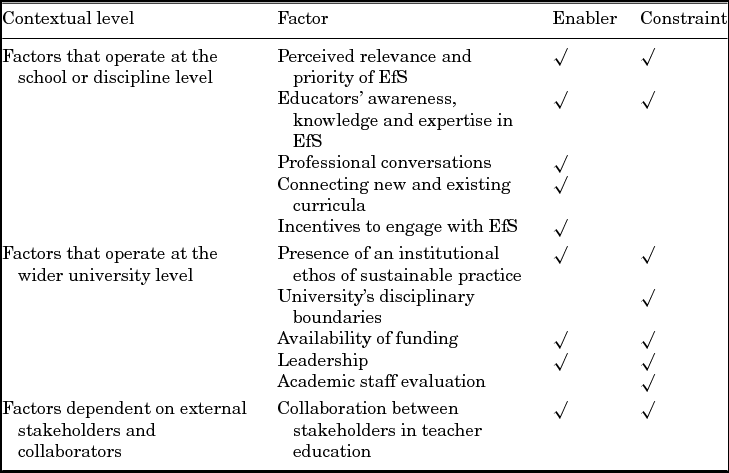
These approaches to the integration of EfS in preservice teacher education may be enabled or constrained by a number of factors, as identified by researchers across a variety of contexts in higher education (Buchanan, Reference Buchanan2012; Down, 2006; Ferreira, Ryan, & Tilbury, Reference Ferreira, Ryan and Tilbury2007; Harpe & Thomas, Reference Harpe and Thomas2009; Hopkins & McKeown, 2005; Miles et al., Reference Miles, Harrison and Cutter-Mackenzie2006; Moore, Reference Moore2005; Scott & Gough, Reference Scott and Gough2007; Steele, Reference Steele2010; Thomas, Reference Thomas2004; Wilson, Reference Wilson2012). Table 1 presents a summary of these factors and the level at which they operate within the institution (i.e., at the School or Discipline level, and the wider University level). Other factors are dependent on external stakeholders and collaborators in teacher education. While some factors clearly work to either support or challenge the inclusion of EfS, some can do both, depending on the way in which they play out in particular contexts (e.g., leadership at the university level can work to either enable or constrain EfS policies and practices at the school level, according to the institution's strategic priorities).
A Summary of Enablers and Constraints to the Integration of EfS in Higher and Preservice Teacher Education, as Identified in the Literature

Sustainability at James Cook University
JCU is a multi-campus institution with a strong focus on embedding sustainability in teaching and learning. The university's Strategic Intent describes its commitment to producing graduates with the expertise required for the sustainable development of tropical communities (JCU, 2011a), and research within the university is focused on meeting the challenges facing the tropical region (JCU, 2011b). In 2008, the university's faculties participated in a Curriculum Refresh Project, funded by the Department of Education, Employment and Workplace Relations through its Diversity and Structural Adjustment Fund (JCU, 2011c). A critical aim of the project was to systemically incorporate a distinctive focus on sustainability in the university's programs (JCU, 2011c). As part of the project, the School of Education undertook a number of initiatives to address three key themes: an embedded awareness of sustainability issues; curriculum that integrates Aboriginal and Torres Strait Islander knowledge and perspectives; and internationalisation of the curriculum (JCU, 2011b). In relation to the first of these themes, the school implemented a range of strategies to support its focus on sustainability in both research and teaching, including the introduction of undergraduate and postgraduate study options in EfS in 2010, and a commitment to embed EfS across its programs.
Research Problem
Given the School of Education's focus on EfS, this study explored teacher educators’ practices and perceptions regarding its integration in their teaching and in the BEd (Primary) program. In doing so, the following research questions were investigated:
1. In what ways do teacher educators at JCU integrate EfS in their teaching?
2. What do teacher educators at JCU perceive to be factors that enable or constrain the integration of EfS in the BEd (Primary)?
In response to the call for researchers ‘to contribute their ideas to the discussion over how to best incorporate EfS in preservice teacher education in Australia’ (Kennelly & Taylor, Reference Kennelly and Taylor2007, p. 3), this study illuminates the ways in which teacher educators at JCU embed EfS in their teaching practice. Likewise, the investigation of factors that are perceived to enable or constrain the inclusion of EfS in preservice teacher education responds to Hopkins and McKeown's (2005) urge for new knowledge in this field to be ‘developed and widely shared’ (p. 9).
Research Methodology and Procedures
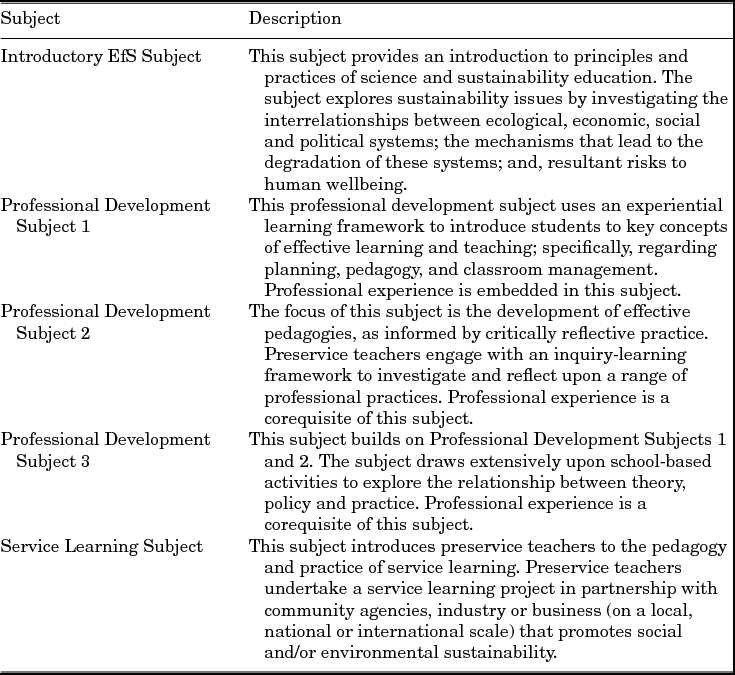
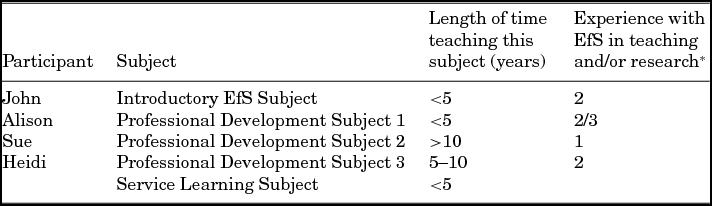
To gain an insight into the integration of EfS in the BEd (Primary) at JCU, four subject coordinators from the university's School of Education participated in semi-structured interviews. Heidi, John, Sue and Alison (pseudonyms) were invited to participate as an outcome of critical sampling methods (Patton, Reference Patton2002). Collectively, they coordinated and lectured five subjects in the BEd (Primary) at the time this study was conducted (Heidi coordinated two subjects). These subjects were selected for their: (a) representativeness of the 4-year program, and (b) likelihood to contain EfS. An overview of these subjects is provided in Table 2. A summary of Heidi, John, Sue and Alison's teaching experience at JCU and experiences with EfS in their teaching and/or research is provided in Table 3.
A Description of the Subjects in the BEd (Primary) at JCU Coordinated by the Study Participants
Participants’ Teaching Experience at JCU and Their Experience With EfS in Teaching and/or Research
Note: *To ensure participants’ confidentiality, their experience with EfS in teaching and/or research was rated on a scale of 1–3, whereby 1 represents no or little experience, 2 represents some experience and 3 represents extensive experience. Participants self-nominated a category.
In this study, semi-structured interviews conducted with Heidi, John, Sue and Alison represent the primary source of qualitative data. Subject outlines were also analysed to triangulate the interview data and to provide further insight into the intended curriculum of each subject (Creswell, Reference Creswell2007). At interview, participants were asked about their understanding of EfS, its relevance to the teaching of their subject/s, whether they incorporated EfS in their teaching practice, and, if so, in what ways; the successes or challenges they experienced embedding EfS in their teaching; the factors that may have contributed to these experiences; and any other insights they may have had into embedding EfS in their teaching practice. Transcription and coding of the interview data were performed manually in a process consistent with that described by Creswell (Reference Creswell2007). The researchers solicited participants’ views on data interpretation via member checking to ensure the validity of findings.
Findings and Discussion
In this section, an analysis of the experiences and perceptions of four subject coordinators teaching in the BEd (Primary) shared at interview provide evidence to support two key findings:
1. Teacher educators at JCU integrate EfS in different ways through the curriculum (specifically, through assessment, content and/or pedagogy); and
2. Constraints operating at the School of Education level, namely teacher educators’ perceptions and understanding of EfS, were perceived as salient challenges to the integration of EfS in the BEd (Primary) at JCU.
Evidence pertaining to each of these findings is presented and discussed below.
How Do Teacher Educators Integrate EfS in Their Teaching Practice at JCU?
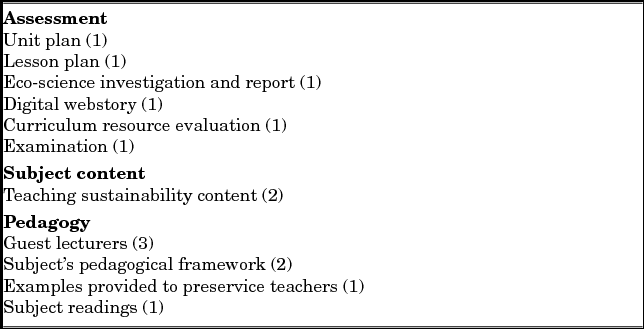
During the interviews, Heidi, John, Alison and Sue were asked whether they integrated EfS in their subjects, and if so, how. An analysis of the interviews found that Heidi, John and Sue did so in multiple ways through the curriculum, assessment, subject content and pedagogies they employed (Table 4). Although Alison identified that ‘there might be space in the near future to consider sustainability issues in a substantive way’, she explained that EfS was not included in Professional Development Subject 1, as she did not perceive it as a priority in the context of the subject's intended outcomes. Accordingly, this was reflected in her subject outline, where no references to sustainability were found.
A Summary of Subject Coordinators’ Responses at Interview Regarding Their Approaches to Integrating EfS in Their Teaching
Note: Numbers in parentheses indicate the number of times a particular approach was claimed to be employed.
Integrating EfS Through Assessment
Heidi, John and Sue all integrated EfS in their teaching through their assessment regime. While Heidi and Sue both integrated EfS into a broader assessment task (i.e., a unit plan and a sequence of lessons in Professional Development Subjects 2 and 3, respectively), John's assessment regime had an explicit focus on EfS, which reflected the purpose of the Introductory EfS Subject he taught. The latter was also true of Heidi's assessment in the Service Learning Subject, as it, too, dealt explicitly with EfS content.
Heidi, in Professional Development Subject 3, required preservice teachers to create a unit plan that demonstrated their engagement with EfS principles. They were expected to utilise an action-oriented framework (e.g., project-based or problem-based learning) that integrated key learning areas and demonstrated a commitment to educational partnerships beyond school boundaries. In this way, Heidi's approach to implementing EfS through assessment was transdisciplinary and holistic (Australian Government Department of Environment and Heritage [AGDEH], 2005; AGDEWHA, 2009). In contrast, Sue, in Professional Development Subject 2, required preservice teachers to plan a sequence of lessons that focused on a sustainability concept, an approach that appeared to be opportunistic. This was perhaps a reflection of her personal interest in and commitment to EfS; it aligned with her personal ‘philosophy’. It has been suggested that this approach can be problematic, as integrating EfS in such a way that does not require preservice teachers to engage deeply with underlying principles can lead to them becoming fatigued with sustainability (Hegarty et al., 2008).
In the Service Learning Subject, preservice teachers undertook service learning projects that focused on social and/or ecological sustainability, and completed pre- and post-placement assessment tasks. The service learning project was designed to ‘broaden preservice teachers’ world view’ and provide an experience that illustrates ‘their local actions’ impact on global perspectives’, a concept that Heidi identified at interview as fundamental to her understanding of sustainability. According to the subject outline, the pre-placement task required preservice teachers to explore notions of service learning and sustainability, and provide a rationale that justified how their project contributed to the development of a sustainable community. The post-placement task called for a critical reflection on how this played out, in practice.
In the Introductory EfS Subject, the assessment tasks comprised of an eco-science investigation and report, a digital webstory and curriculum resource evaluation, and an end-of-semester examination. The eco-science investigation called for preservice teachers to design, conduct and report on an investigation into a sustainable method used to purify water. The second assessment task required them to create a webstory about a local sustainability issue and evaluate a relevant supporting curriculum resource in accordance with the ‘Principles of good practice for education resources’, as outlined in Educating for a Sustainable Future: A National Environmental Education Statement for Australian Schools (AGDEH, 2005, p. 22). Finally, the examination combined short- and extended-answer questions to assess preservice teachers’ knowledge and understanding of sustainability concepts, their ability to apply their understandings in given contexts, and their critical evaluation skills.
Integrating EfS Through Subject Content
As evident in their subject outlines, John and Heidi were the only subject coordinators who explicitly taught EfS content. While Heidi included subject readings with an explicit focus on social and environmental sustainability in the Service Learning Subject, John organised the Introductory EfS Subject's content in discrete modules. Collectively, these modules introduced preservice teachers to key sustainability and EfS concepts and principles; the implementation of EfS in schools; key policy and curriculum documents; and critical sustainability issues (e.g., human population and urbanisation, water resource management, and climate change). As John explained, each module had a ‘deliberate science focus’ to help preservice teachers engage with the issues. He explained that this was derived from the Queensland College of Teachers’ (QCT) proposed preregistration testing of primary teachers in Queensland, in the areas of literacy, numeracy and science (QCT, 2012).
Integrating EfS through Pedagogy
Heidi, John and Sue each revealed that they integrated EfS in their pedagogy. Heidi identified that in Professional Development Subject 3, she explicitly incorporated EfS in examples provided to preservice teachers. Heidi explained that she provided them with sample unit plans centred on issues relevant to social or environmental sustainability (e.g., refugees).
Sue and John both identified that they invite guest lecturers (such as classroom teachers, principals and scientists) in Professional Development Subject 2 and the Introductory EfS Subject to speak to preservice teachers about EfS initiatives occurring in schools, and to provide applied examples of sustainability principles (both social and ecological) examined in class.
Heidi and John both indicated at interview that they explicitly modelled pedagogical frameworks congruent with EfS, service learning and inquiry, with a view that preservice teachers could employ them in their own classroom practice. These frameworks were also explicated in their subject outlines. John utilised an inquiry framework in the delivery of the Introductory EfS Subject, whereby preservice teachers engaged with the weekly topic, acquired and processed new information, and reflected on the implications of what they had learnt for their personal and professional practice. Heidi utilised a service learning framework, in which preservice teachers undertook a service learning project in partnership with community agencies, industries or businesses that promoted social and/or environmental sustainability. Engaging preservice teachers in service learning projects also supports the call for integrating EfS by way of experiential learning (Steele, Reference Steele2010). At interview, Heidi described the conceptual congruence between service learning and EfS, and noted that the aim of the subject was to enrich preservice teachers’ understanding of their own teaching role through their service learning placement: ‘In order for them to contribute to more sustainable futures they must have broader ranges of experiences and they must engage with a broader range of groups [and] environments. And they must bring these experiences into the classroom . . . to enrich their own students’ learning.’
What Do Teacher Educators at JCU Perceive to be Factors That Enable or Constrain the Integration of EfS in the BEd (Primary)?
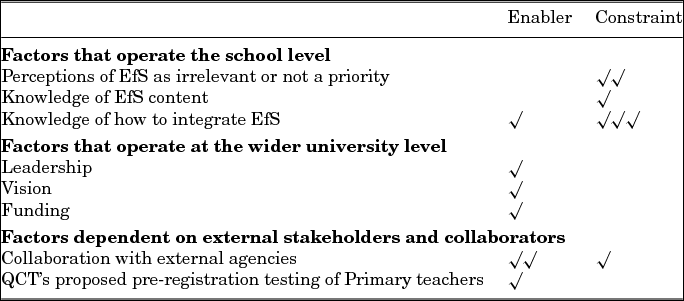
As well as examining the integration of EfS in their teaching practice, this study also invited teacher educators to articulate their perceptions of factors that enable or constrain the integration of EfS in the BEd (Primary). Three themes arose from the analysis of these data: enablers and constraints cited by subject coordinators related to factors that operate at the school level (namely, teacher educators’ perceptions of EfS, and their understanding of how to best integrate EfS in their teaching practices); factors that operate at the wider university level (the university's vision for graduates, leadership and resources); and factors dependent on external stakeholders and collaborators (partnerships with external agencies and other members of the community; Table 5).
A Summary of Subject Coordinators’ Responses at Interview Regarding Their Perceptions of Enablers and Constraints to the Inclusion of EfS in the Bachelor of Education (Primary) at JCU
Note: The number of ticks indicates the number of times each factor was cited as either an enabler or constraint.
Factors that Operate at the School Level
Heidi and Alison both identified staff perceptions of EfS as a constraint to its integration in the BEd (Primary) at JCU. In particular, Heidi described how some staff did not perceive EfS as being relevant, preferring instead to teach ‘content and pedagogies for their curriculum area’.
As noted earlier, Alison did not integrate EfS in Professional Development Subject 1, as she did not perceive it to be a priority in the subject. She explained that she was committed to exiting a cohort of preservice teachers who had fundamental knowledge and skills in planning and behaviour management, were establishing a repertoire of teaching strategies, and had sound ‘academic literacies’. She also noted that in Professional Development Subject 2 she taught second-year preservice teachers who were ‘still trying to find their feet in a professional program’. These factors led Alison to question whether EfS was a priority in her subject. Notably, Alison emphasised that her decision not to integrate EfS was not because she ‘can't think of clever ways of building sustainability themes into Professional Development Subject 1’. These findings support existing research that reports academic staff perceptions as a constraint to the integration of EfS in both preservice teacher education programs (Down, 2006; Scott & Gough, Reference Scott and Gough2007), and other undergraduate programs (Cotton, Warren, & Maiboroda, Reference Cotton, Warren and Maiboroda2007; Reid & Petocz, Reference Reid and Petocz2006; Thomas, Reference Thomas2004).
Sue cited staff knowledge of EfS content as both an enabler and constraint, as evidenced in the following excerpt:
I probably think that is an enabling factor, although I can see how it could be potentially inhibitive for somebody who didn't have any kind of commitment or interest in EfS. I think, for me, it works as an enabling factor because I can see how it related to the philosophy of what I do. Whereas if you had a different philosophical approach or different priorities, it could be quite challenging; you might need things to be spelled out more clearly to understand how it relates. We're doing teamwork [in Professional Development Subject 2]. Teamwork is an element of social sustainability. Because I can see that connection I can make [it] explicit. If someone was struggling to understand the content of EfS, then that might be more difficult.
Another constraint, arising from three teacher educators’ comments, was a lack of knowledge of how to best integrate EfS, both in academic staff's teaching practices and across the program. Alison, for example, commented on the difficulty of integrating EfS without it seeming ‘artificial’.
Factors That Operate at the Wider University Level
Only Heidi reported on factors unique to the university context. She cited leadership, resources and the university's vision as enablers. Heidi commented that the most significant enabler was that the faculty's Pro-Vice Chancellor provided a directive and rationale for the integration of EfS in the program, providing the School of Education with a vision of graduating teachers who were committed to sustainable futures and improving educational outcomes for the region's communities. Heidi also described that the funding provided by the federal government to support the university's Curriculum Refresh Project acted as an enabling factor.
At the time this study was conducted, Heidi held a leadership position within the School of Education. It is likely that this position gave her a broader insight into factors that operated beyond the school. As Heidi was the only teacher educator to identify factors operating at the wider university level, further research is required to establish the implications of these factors on teaching practices within the School of Education.
Given JCU's systemic approach to integrating EfS in curriculum through its Curriculum Refresh Project, it is not surprising that supporting factors operating at the university level were identified by Heidi, as they provided a ‘directive’ for the School of Education staff to integrate EfS in their teaching. For Sue, who had endeavoured to incorporate EfS in her teaching for a number of years, the project served as a ‘validation’ and ‘encouragement’ to continue to do so. Moreover, the systemic nature of the project aligns with the emerging research that suggests such an approach is the most effective way to integrate EfS in preservice teacher education (Ferreira et al., Reference Ferreira, Ryan and Tilbury2006). Furthermore, these preliminary findings support existing research that suggests an ethos of sustainability and sustainable practice is conducive to the integration of EfS in preservice teacher education (Harpe & Thomas, Reference Harpe and Thomas2009; Steele, Reference Steele2010). Likewise, these findings align with existing literature that reports leadership and funding as enablers in both preservice teacher education and other undergraduate programs (Harpe & Thomas, Reference Harpe and Thomas2009).
Factors Dependent on External Stakeholders and Collaborators
Collaboration with external agencies was cited as both an enabler and a constraint to the integration of EfS in the BEd (Primary) at JCU. John explained that collaborating with external agencies such as the Commonwealth Scientific and Industrial Research Organisation (CSIRO) and members of the Indigenous community enabled him to provide preservice teachers with applied examples of the social and environmental sustainability principles examined in his subject. He also commented that the proposed introduction of preregistration testing for primary teachers in Queensland was a driver for the introduction of the Introductory EfS Subject into the BEd (Primary) (QCT, 2012). Heidi identified that establishing partnerships with volunteer travel programs strengthened the Service Learning subject and allowed for preservice teachers to undertake international placements. In stark contrast, however, Heidi also described that she had to liaise with the QCT in order to include the Service Learning subject in the BEd, as part of the program's accreditation process. As sustainability is not explicit in the current standards forwarded by the teacher registration authority, Heidi noted that this process was challenging.
Conclusion
The current study investigated the integration of EfS in a primary preservice teacher education program at JCU; specifically, the ways in which teacher educators integrate EfS in their teaching, and their perceptions of factors that enable or constrain its integration in the BEd (Primary). Qualitative analysis of interviews conducted with four teacher educators who teach in the program found that EfS is integrated in different ways through the curriculum. While factors that operate at the school level, namely teacher educators’ perceptions and understanding of EfS, were identified as salient challenges to the integration of EfS in the program by all four participants, enabling factors operating at the university level were identified by only one teacher educator.
These findings present a number of implications for EfS policy and practice in preservice teacher education at JCU, and universities more broadly. In light of the finding that teacher educators may not perceive EfS to be relevant to their particular subjects or curriculum areas, or know how to best integrate EfS in their teaching, it appears that there is a need for professional development at the School of Education level to develop teacher educators’ understandings of EfS and build their capacity to incorporate EfS concepts, principles and practices in their teaching. The continued development of resources for teacher educators that support the integration of EfS across the curriculum would also help to alleviate these constraints. Given that teacher educators are ‘perfectly poised’ to promote EfS (Hopkins & McKeown, 2005, p. ii) the provision of professional development and resources are important enablers to its integration in preservice teacher education (Steele, Reference Steele2010).
Factors operating at the wider university level (specifically, vision, leadership and funding) were cited by one teacher educator as being important enabling factors that supported the integration of EfS in the BEd (Primary) at JCU. Although this preliminary finding warrants further research, it supports existing literature that suggests that a systemic approach at a wider university level is required to effect change at the school level (Ferreira et al., Reference Ferreira, Ryan and Tilbury2006).
While this study is limited by its small sample size, it has begun to illuminate the ways in which teacher educators at one Australian university embed EfS in their teaching practice, and the factors perceived to enable or constrain this integration. Further research is necessary to identify potentially useful practices more broadly, so as to further the discussion around how to effectively incorporate EfS in Australian preservice teacher education.
Acknowledgment
The authors wish to thank Professor Bob Stevenson for his support, mentorship and constructive discussions during this research project.
Author Biographies
Reece Mills is a secondary Earth Science educator and teacher-researcher at North Lakes State College, Brisbane. His research interests include EfS in preservice teacher education, and innovative pedagogies for Earth Science education.
Louisa Tomas is a Senior Lecturer in Science and Sustainability Education, and a member of the Centre for Research & Innovation in Sustainability Education, at James Cook University, Townsville. Louisa's ongoing work in the development and teaching of a foundational sustainability subject in the BEd has provided rich opportunities to research innovative curricula and pedagogical approaches that support preservice teachers’ engagement and learning in EfS.