



1 Introduction
Let n be a natural number, and let
 $\omega (n)$
count its number of distinct prime divisors. In [Reference Erdős and Kac5], Erdős and Kac used probabilistic means to establish that
 $\omega (n)$
obeys the Gaussian distribution with mean
 $\log \log n$
and variance
 $\log \log n$
over natural numbers. In particular, for any
 $\gamma \in \mathbb {R}$
, they proved
 $$ \begin{align*}\lim_{x \rightarrow \infty} \frac{1}{x} \left| \left\{ n \leq x \ : \ n \geq 3, \ \frac{\omega(n) - \log \log n}{\sqrt{\log \log n}} \leq \gamma \right\} \right| = \Phi(\gamma),\end{align*} $$
where
 $$ \begin{align} \Phi(\gamma) = \frac{1}{\sqrt{2 \pi}} \int_{-\infty}^\gamma e^{-u^2/2} \ du, \end{align} $$
and where
 $|{\mathcal S}|$
denotes the cardinality of the set
 ${\mathcal S}$
. Following their work, various approaches to the Erdős–Kac theorem have been pursued. For example, in [Reference Murty, Murty and Pujahari13], Murty, Murty, and Pujahari proved an all-purpose Erdős–Kac theorem which applies to diverse settings. In [Reference Das, Kuo and Liu1], the authors provided a generalization of the Erdős–Kac theorem in number fields. Moreover, the third author, in [Reference Liu10], provided a generalization of the Erdős–Kac theorem over any countably generated abelian monoid. We extend this work to provide another generalization of the Erdős–Kac theorem over any subset of such abelian monoids satisfying some additional conditions.
Let
 ${\mathcal P}$
be a countable set of elements with a map
 $$ \begin{align*}N: {\mathcal P} \rightarrow \mathbb{Z}_{>1}, \quad {\mathfrak p} \mapsto N({\mathfrak p}).\end{align*} $$
We call this map the Norm map. Let
 ${\mathcal M}$
be a free abelian monoid generated by elements of
 ${\mathcal P}$
. For each
 ${\mathfrak m} \in {\mathcal M}$
, we write
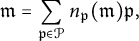 $$ \begin{align*}{\mathfrak m} = \sum_{{\mathfrak p} \in {\mathcal P}} n_{\mathfrak p}({\mathfrak m}) {\mathfrak p},\end{align*} $$
with
 $n_{\mathfrak p}({\mathfrak m}) \in \mathbb {Z}_{>0} \cup \{ 0 \}$
and
 $n_{\mathfrak p}({\mathfrak m}) =0$
for all but finitely many
 ${\mathfrak p}$
. We extend the map N to
 ${\mathcal M}$
as the following:
 $$ \begin{align*} N : {\mathcal M} & \rightarrow \mathbb{Z}_{>0} \\ {\mathfrak m} = \sum_{{\mathfrak p} \in {\mathcal P}} n_{\mathfrak p}({\mathfrak m}) {\mathfrak p} & \longmapsto N({\mathfrak m}) := \prod_{{\mathfrak p} \in {\mathcal P}} N({\mathfrak p})^{n_{\mathfrak p}({\mathfrak m})}. \end{align*} $$
Thus, N can be extended to a monoid homomorphism from
 $({\mathcal M},+)$
to
 $(\mathbb {Z}_{>0},\cdot )$
. Let X be a countable subset of
 $\mathbb {Q}$
that contains the image
 $\text {Im}(N({\mathcal M}))$
with an extra condition: if
 $x_1,x_2 \in X$
, the fraction
 $x_1/x_2$
belongs to X, too. Without loss of generality, we assume
 $X = \mathbb {Q}$
or
 $X = \{ q^z : z \in \mathbb {Z} \}$
for some
 $q \in \mathbb {Z}_{>0}$
. For interested readers, the details behind X being limited to these two choices are presented in [Reference Liu10, Theorem 2].
Given
 ${\mathcal P}$
,
 ${\mathcal M}$
, X, and for sufficiently large
 $x \in X$
, we assume that the following condition holds:
 $$ \begin{align} {\mathcal M}(x) := \sum\limits_{\substack{{\mathfrak m} \in {\mathcal M} \\ N({\mathfrak m}) \leq x}} 1 = \kappa x + O(x^\theta), \quad \text{ for some } \kappa> 0 \text{ and } 0 \leq \theta < 1. \end{align} $$
Let
 $\mathcal {{\mathcal S}}$
be a subset of infinitely many elements in
 ${\mathcal M}$
. For
 $x \in X$
,
 $x>1$
, we define
 $$ \begin{align*}{\mathcal S}(x) = \{ {\mathfrak m} \in {\mathcal S} \ : \ N({\mathfrak m}) \leq x \}.\end{align*} $$
We assume that
 ${\mathcal S}$
satisfies the following condition:
 $$ \begin{align} |{\mathcal S}(x^{1/2})| = o(|{\mathcal S}(x)|) \quad \text{as } x \rightarrow \infty. \end{align} $$
Let
 $\kappa '> 0$
,
 $0 < \alpha < 1$
, and
 $\gamma \in \mathbb {R}$
. Note that,
 $|S(x)| \ll x$
, (1.2) is satisfied when
 ${\mathcal S}(x) \sim \kappa ' x^\alpha (\log x)^\gamma $
, and (1.2) fails if
 ${\mathcal S}(x) \sim \kappa ' (\log x)^\gamma $
. Thus,
 ${\mathcal S}(x) \sim \kappa ' x^\alpha (\log x)^\gamma $
would be a good choice for the asymptotic size of
 ${\mathcal S}(x)$
so that (1.2) holds.
Let f be a map from
 ${\mathcal S}$
to
 ${\mathcal M}$
. For each
 $\ell \in {\mathcal P}$
, we write
 $$ \begin{align} \frac{1}{|{\mathcal S}(x)|} \left| \{ {\mathfrak m} \in {\mathcal S}(x) \ : \ n_\ell(f({\mathfrak m})) \geq 1 \} \right| = \lambda_\ell + e_\ell(x), \end{align} $$
where
 $\lambda _\ell $
denotes the main term (and is independent of x) and
 $e_\ell = e_\ell (x)$
is the error term. For any sequence of distinct elements
 $\ell _1, \ell _2, \ldots , \ell _u \in {\mathcal P}$
, we write
 $$ \begin{align} \frac{1}{|{\mathcal S}(x)|} \left| \{ {\mathfrak m} \in {\mathcal S}(x) \ : \ n_{\ell_i}(f({\mathfrak m})) \geq 1 \text{ for all } i = 1, \ldots, u \} \right|= \lambda_{\ell_1} \ldots \lambda_{\ell_u} + e_{\ell_1 \ldots \ell_u}(x). \end{align} $$
In this article, we will use
 $e_{\ell _1 \ldots \ell _u}$
to abbreviate
 $e_{\ell _1 \ldots \ell _u}(x)$
.
Suppose there exists a
 $\beta $
with
 $0 < \beta \leq 1$
and
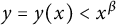 $y = y(x) < x^\beta $
such that the following conditions are satisfied:
-
(a)
 $\left |\{ \ell \in {\mathcal P} \ : \ N(\ell )> x^\beta , n_\ell (f({\mathfrak m})) \geq 1 \} \right | = O_\beta (1)$
for each
${\mathfrak m} \in {\mathcal S}(x)$
. Here,
$O_{Y}$
denotes that the big-O constant depends on the variable set Y.
-
(b)
$\sum _{y < N(\ell ) \leq x^\beta } \lambda _\ell = o \left ( (\log \log x)^{1/2} \right )$
. -
(c)
$\sum _{y < N(\ell ) \leq x^\beta } |e_\ell | = o \left ( (\log \log x)^{1/2} \right )$
. -
(d)
$\sum _{N(\ell ) \leq y} \lambda _\ell = \log \log x + o \left ( (\log \log x)^{1/2} \right )$
. -
(e)
$\sum _{N(\ell ) \leq y} \lambda _\ell ^2 = o \left ( (\log \log x)^{1/2} \right )$
. -
(f) For
$r \in \mathbb {Z}_{>0}$
, let u be any integer picked from
$\{ 1, 2, \ldots , r \}$
. We have where
$$ \begin{align*}\sum{\vphantom{\sum}}" |e_{\ell_1 \ldots \ell_u}| = o \left( (\log \log x)^{-r/2} \right),\end{align*} $$
$\sum {\vphantom {\sum }}"$
extends over all u-tuples
$(\ell _1,\ell _2,\ldots ,\ell _u)$
with
$N(\ell _i) \leq y$
for all
$i \in \{ 1, 2, \ldots , u\}$
and all
$\ell _i$
’s are distinct.















For each
 ${\mathfrak m} \in {\mathcal M}$
, we define
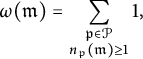 $$ \begin{align*}\omega({\mathfrak m}) = \sum_{\substack{{\mathfrak p} \in {\mathcal P} \\ n_{\mathfrak p}({\mathfrak m}) \geq 1}} 1,\end{align*} $$
the number of elements of
 ${\mathcal P}$
that generates
 ${\mathfrak m}$
, counted without multiplicity. Using this definition and the above conditions, we obtain the following subset generalization of the Erdős–Kac theorem.
Theorem 1.1 Let
 ${\mathcal P}$
,
 ${\mathcal M}$
, and X satisfy (⋆). Let
 ${\mathcal S}$
be a subset of
 ${\mathcal M}$
. For any
 $x \in X$
, let
 ${\mathcal S}(x)$
be the set of elements in
 ${\mathcal S}$
with norm less than or equal to x. Assume that
 ${\mathcal S}$
satisfies condition (1.2). Let
 $f : {\mathcal S} \rightarrow {\mathcal M}$
. Suppose there exists a
 $\beta $
with
 $0 < \beta \leq 1$
and
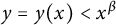 $y = y(x) < x^\beta $
such that the conditions (a)–(f) above hold. Then, for
 $\gamma \in \mathbb {R}$
, we have
 $$ \begin{align*}\lim_{x \rightarrow \infty} \frac{1}{|{\mathcal S}(x)|} \left| \left\{ {\mathfrak m} \in {\mathcal S}(x) \ : \ N({\mathfrak m}) \geq 3, \ \frac{\omega(f({\mathfrak m})) - \log \log N({\mathfrak m})}{\sqrt{\log \log N({\mathfrak m})}} \leq \gamma\right\} \right| = \Phi(\gamma),\end{align*} $$
where
 $\Phi (\gamma )$
is defined in (1.1).
We list some well-studied applications of this general setting.
Example 1.2 Let
 ${\mathcal P}$
,
 ${\mathcal M}$
, and X satisfy (⋆). Let
 ${\mathcal S} = {\mathcal M}$
and f be the identity map. Then, by Theorem 1.1, we recover the Erdős–Kac theorem over abelian monoids as studied by the third author in [Reference Liu10, Theorem 1].
Example 1.3 Let
 $K/\mathbb {Q}$
be a number field. Let
 ${\mathcal P}$
be the set of prime ideals of K. For an ideal I of K, let the map
 $N(I)$
be the absolute norm of I. Let
 ${\mathcal S}={\mathcal M}$
,
 $X= \mathbb {Q}$
, and f be the identity map. If
 $K = \mathbb {Q}$
, by Theorem 1.1, we recover the classical Erdős–Kac theorem. Moreover, in [Reference Das, Kuo and Liu1, Theorems 1.3 and 1.4], the authors apply Theorem 1.1 to establish the Erdős–Kac theorems over the subsets of h-free and h-full ideals in any number field K.
Remark 1.4 We would like to highlight a result from the literature that bears close resemblance to Theorem 1.1. In [Reference Murty, Murty and Pujahari13, Theorems 3 and 4], Murty, Murty, and Pujahari establish a general Erdős–Kac theorem applicable to a broad range of settings. Their framework involves a sequence
 $a_m$
of nonzero integers with polynomial growth, defined over an infinite subset
 $\mathcal {S}$
of the natural numbers. To ensure the validity of their results, they impose three additional conditions: one coinciding with (1.3) and (1.4); a second implying that
 $\limsup _{\ell \to \infty } \lambda _\ell < 1$
(where
 $\ell $
ranges over rational primes); and a third stipulating that, for any
 $B>0$
, there exists
 $\eta $
such that for any rational number x,
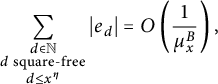 $$ \begin{align*}\sum_{\substack{d \in \mathbb{N} \\ d \text{ square-free} \\ d \leq x^{\eta}}} |e_d| = O \left(\frac{1}{\mu_x^{B}} \right),\end{align*} $$
where  , and
 $$ \begin{align*}\mu_x = \sum_{\ell \leq x^\epsilon} \lambda_\ell \rightarrow \infty \quad \text{ as } x \rightarrow \infty,\end{align*} $$
with
 $0 < \epsilon < 1$
. Their Theorem 4 is formulated in terms of
 $\mu _x$
, and, invoking the distribution of primes, they derive Theorem 3.
In our setting, the sequence
 $a_m$
in [Reference Murty, Murty and Pujahari13] corresponds to
 $f(m)$
in our work, though we do not impose the explicit polynomial growth condition. Indeed, all of the conditions in [Reference Murty, Murty and Pujahari13] imply our conditions. For instance, polynomial growth for
 $a_m$
implies condition (a). Assuming their second condition and that
 $\lambda _\ell $
is asymptotic to
 $1/\ell $
and
 $\mu _x$
asymptotic to
 $\log \log x$
, a condition required to go from [Reference Murty, Murty and Pujahari13, Theorem 4] to [Reference Murty, Murty and Pujahari13, Theorem 3], we can deduce our conditions (b)–(e), where
 $y = x^\epsilon $
. Furthermore, their third condition implies our condition (f). Thus, Theorem 1.1 is a generalization of [Reference Murty, Murty and Pujahari13, Theorem 3]. In Remark 1.5, we present an application of our main theorem over natural numbers that cannot be obtained from the work in [Reference Murty, Murty and Pujahari13].
The article [Reference Murty, Murty and Pujahari13] offers a broad generalization of the Erdős–Kac theorem with far-reaching applicability, covering contexts, such as ideals in number fields, sums of modular forms, and the Ramanujan
 $\tau $
-function. Our results extend these ideas to a wider class of abelian monoids and their subsets. In Theorems 1.9 and 1.10, we apply Theorem 1.1 to new, proper subsets of abelian monoids. Moreover, in Theorems 1.11 and 1.12, we establish Erdős–Kac theorems for refined
 $\omega $
-functions, and in Theorems 1.13 and 1.14, we extend these results to generalized weighted
 $\omega $
-functions. These contributions, to the best of our knowledge, are new to the literature.
Remark 1.5 Let
 ${\mathcal S} = \mathbb {N}$
,
 ${\mathcal P}$
be the set of rational primes,
 $X = \mathbb {Q}$
, and
 $N(\ell )=\ell $
. For each
 $n \in \mathbb {N}$
, fix an increasing sequence of primes
 $q_n$
satisfying
 $q_n \ge e^{n^3}$
and define
 $$\begin{align*}f(n) := n \cdot q_n. \end{align*}$$
As in the classical case, take
 $\beta =1$
and
 $y = x^{1/\log \log x} < x^\beta $
. For any
 $m \le x$
, all primes dividing
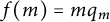 $f(m)=m q_m$
are those dividing m and the single prime
 $q_m$
. Since no primes
 $> x$
divides m and
 $q_m$
adds at most one more prime, we have
 $$\begin{align*}\big|\{ \ell \in {\mathcal P} : \ell> x^\beta,\, n_\ell(f(m)) \ge 1 \}\big| = O_\beta(1), \end{align*}$$
verifying (a).
Since each
 $q_m$
is distinct and sufficiently large, it does not affect the sums in conditions (b)–(f). In particular, for every prime
 $\ell \le x$
, divisibility of
 $f(m)$
by
 $\ell $
coincides with that of m, so that
 $\lambda _\ell = 1/\ell $
and
 $e_\ell (x) = O(1/x)$
, just as in the classical case. Consequently, summing over all
 $\ell \le y$
and applying standard estimates for
 $\sum _{\ell \le y} 1/\ell $
and
 $\sum _{\ell \le y} 1/\ell ^2$
ensures that conditions (b)–(f) are satisfied.
Thus, Theorem 1.1 holds for such an f discussed in this example.
Finally, we demonstrate that this example is not covered by [Reference Murty, Murty and Pujahari13, Theorem 3] by showing that
 $f(m)$
grows faster than any polynomial.
Since
 $q_n \ge e^{n^3}$
, we have
 $$\begin{align*}\log f(n) = \log n + \log q_n \ge n^3, \end{align*}$$
so for any fixed
 $A>0$
and all sufficiently large n,
 $$\begin{align*}\log f(n)> A \log n \quad \Longrightarrow \quad f(n) > n^A. \end{align*}$$
In the following part, we discuss several other instances where Theorem 1.1 can be applied. Note that, moving forward, we shall always assume that
 $\mathcal {P}, \ {\mathcal M}$
, and X satisfy the condition (⋆).
For a nonzero element
 $\mathfrak {m} \in \mathcal {M}$
, let the prime element factorization of
 $\mathfrak {m}$
be given as
 $$ \begin{align*} \mathfrak{m} = s_1 {\mathfrak p}_1 + \cdots + s_r {\mathfrak p}_r, \end{align*} $$
where
 ${\mathfrak p}_i'$
s are its distinct prime elements and
 $s_i'$
s are their respective nonzero multiplicities. Here,
 $$ \begin{align*}N({\mathfrak m}) = N({\mathfrak p}_1)^{s_1} \ldots N({\mathfrak p}_r)^{s_r}.\end{align*} $$
Let
 $h \geq 2$
be an integer. We say that
 $\mathfrak {m}$
is an h-free element if
 $s_i \leq h-1$
for all
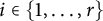 $i \in \{1, \ldots , r\}$
, and we say that
 $\mathfrak {m}$
is an h-full element if
 $s_i \geq h$
for all
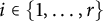 $i \in \{1, \ldots , r\}$
. Let
 $\mathcal {S}_h$
denote the set of h-free elements and
 $\mathcal {N}_h$
denote the set of h-full elements. The distributions of these elements are well-studied in the literature, and to demonstrate this, we introduce some terminologies.
Let the generalized
 $\zeta $
-function which is an analog of the classical Riemann
 $\zeta $
-function be given as
 $$\begin{align*}\zeta_{\mathcal M}(s) := \sum_{\substack{\mathfrak{m}}} \frac1{(N(\mathfrak{m}) )^s} = \prod_{{\mathfrak p}} \Big( 1- N ({\mathfrak p})^{-s}\Big)^{-1} \ \text{for } \Re (s)>1, \end{align*}$$
where
 $\mathfrak {m}$
and
 ${\mathfrak p}$
, respectively, range through the nonzero elements in
 ${\mathcal M}$
and the prime elements in
 ${\mathcal P}$
. The absolute convergence of the above series is explained in [Reference Das, Kuo and Liu2].
Let
 $x \in X$
and let
 $\mathcal {S}_h(x)$
denote the set of h-free elements in
 ${\mathcal M}$
with norm less than or equal to x. Since condition (⋆) satisfies [Reference Knopfmacher7, Chapter 4, Axiom A], thus, by [Reference Knopfmacher7, Chapter 4, Proposition 5.5], we have
 $$ \begin{align} |\mathcal{S}_h(x)| = \frac{\kappa}{\zeta_{\mathcal M}(h)} x + O_h \big( R_{\mathcal{S}_h}(x) \big), \end{align} $$
where
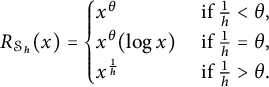 $$ \begin{align} R_{\mathcal{S}_h}(x) = \begin{cases} x^\theta & \text{ if } \frac{1}{h} < \theta, \\ x^\theta (\log x) & \text{ if } \frac{1}{h} = \theta, \\ x^{\frac{1}{h}} & \text{ if } \frac{1}{h}> \theta. \end{cases} \end{align} $$
Remark 1.6 In this article, for convenience, we shall use
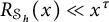 $R_{\mathcal {S}_h}(x) \ll x^{\tau }$
for some
 $\tau < 1$
, which is evident from the above result.
Let
 $\gamma _h$
be a constant given by

Let
 $\mathcal {N}_h(x)$
denote the set of h-full elements in
 ${\mathcal M}$
with norm less than or equal to x. For the distribution of h-full elements, we have (see [Reference Das, Kuo and Liu2, Theorem 1.1])

where  is the constant defined in (1.7), and where
 $$ \begin{align} R_{\mathcal{N}_h}(x) = \begin{cases} x^{\theta/h} & \text{ if } \frac{h}{h+1} < \theta, \\ x^{\frac{1}{h+1}} (\log x) & \text{ if } \frac{h}{h+i} = \theta \text{ for some } i \in \{ 1, \ldots, h-1 \}, \\ x^{\frac{1}{h+1}} & \text{ if } \frac{h}{h+1}> \theta \ \& \ \frac{h}{h+i} \neq \theta \text{ for any } i \in \{ 1, \ldots, h-1 \}. \end{cases} \end{align} $$
Remark 1.7 In this article, again for convenience, we shall use
 $R_{\mathcal {N}_h}(x) \ll x^{\nu /h}$
for some
 $\nu < 1$
.
Let
 $x \in X$
. Let
 $\mathfrak {A}$
and
 $\mathfrak {B}$
be constants defined as
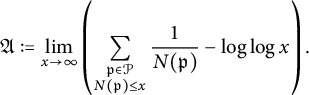 $$ \begin{align} {\mathfrak A}:= \lim_{x \rightarrow \infty} \left( \sum_{\substack{{\mathfrak p} \in \mathcal{P} \\ N({\mathfrak p}) \leq x}} \frac{1}{N({\mathfrak p})} - \log \log x \right). \end{align} $$
The existence of the constant
 $\mathfrak {A}$
is explained in [Reference Liu11, Lemma 2]. We define the constants
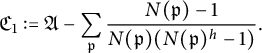 $$ \begin{align} \mathfrak{C}_1 := {\mathfrak A} - \sum_{{\mathfrak p}} \frac{N({\mathfrak p})-1}{N({\mathfrak p})(N({\mathfrak p})^h -1)}. \end{align} $$
Let
 $\mathfrak {L}_h(r)$
be the convergent sum defined for
 $r> h$
as
 $$ \begin{align} \mathfrak{L}_h(r) := \sum_{\mathfrak p} \frac{1}{N({\mathfrak p})^{(r/h)-1} \left( N({\mathfrak p}) - N({\mathfrak p})^{1-1/h} + 1 \right)}, \end{align} $$
and let
 $$ \begin{align} \mathfrak{D}_1 := \mathfrak{A} - \log h + \mathfrak{L}_h(h+1) - \mathfrak{L}_h(2h). \end{align} $$
For the distribution of
 $\omega ({\mathfrak m})$
over h-free and h-full elements, in [Reference Das, Kuo and Liu2, Theorems 1.2 and 1.3], we proved
 $$ \begin{align*}\sum_{\mathfrak{m} \in \mathcal{S}_h(x)} \omega({\mathfrak m}) = \frac{\kappa}{\zeta_{\mathcal M}(h)} x \log \log x + \frac{\kappa {\mathfrak C}_1}{\zeta_{\mathcal M}(h)} x + O_h \left( \frac{x}{\log x}\right)\end{align*} $$
and
 $$ \begin{align*} \sum_{{\mathfrak m} \in \mathcal{N}_h(x)} \omega({\mathfrak m}) & = \kappa \gamma_{h} x^{1/h} \log \log x + \kappa \gamma_h \mathfrak{D}_1 x^{1/h} + O_h \left( \frac{x^{1/h}}{\log x} \right). \end{align*} $$
This proves that
 $\omega ({\mathfrak m})$
has average order
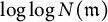 $\log \log N({\mathfrak m})$
over h-free and over h-full elements. Using the study of moments, in [Reference Das, Kuo and Liu2], we showed that
 $\omega ({\mathfrak m})$
has normal order
 $\log \log ({\mathfrak m})$
over h-free and over h-full elements. In this article, we prove that
 $\omega ({\mathfrak m})$
obeys the Gaussian distribution over h-free and over h-full elements as well. We achieve this as applications of the following theorem which is a consequence of Theorem 1.1.
Theorem 1.8 Let
 ${\mathcal P}$
,
 ${\mathcal M}$
, and X satisfy condition (⋆). Let
 ${\mathcal S}$
be a subset of
 ${\mathcal M}$
. For any
 $x \in X$
, let
 ${\mathcal S}(x)$
be the set of elements in
 ${\mathcal S}$
with norm less than or equal to x. Let
 $f : {\mathcal S} \rightarrow {\mathcal M}$
. Suppose
 ${\mathcal S}$
satisfy
 $$ \begin{align*}|\mathcal{S}(x)| = C_\beta x^{\beta} + O_\beta \big( x^{\xi \beta} \big),\end{align*} $$
for some
 $0 < \beta \leq 1$
, for some
 $0 \leq \xi < 1$
, and for some fixed constant
 $C_\beta $
. Additionally, for a fixed prime ideal
 ${\mathfrak p}$
, we assume that the set
 $$ \begin{align*}\mathcal{S}_{\mathfrak p}(x) := \left\{ \mathfrak{m} \in {\mathcal S}(x) \ : \ n_{\mathfrak p} (f(\mathfrak{m})) \geq 1 \right\}\end{align*} $$
satisfies
 $$ \begin{align} |\mathcal{S}_{\mathfrak p}(x)| & = \frac{C_{\beta} x^\beta}{N({\mathfrak p})} + \frac{C_{{\mathfrak p},\beta}' x^\beta}{N({\mathfrak p})^{1+\eta}} + O_\beta \left( \frac{x^{\xi \beta}}{N({\mathfrak p})^\xi}\right), \end{align} $$
for some
 $\eta> 0$
and where the constant
 $C_{{\mathfrak p},\beta }'$
is uniformly bounded in
 ${\mathfrak p}$
. Then, for
 $\gamma \in \mathbb {R}$
, we have
 $$ \begin{align*}\lim_{x \rightarrow \infty} \frac{1}{|{\mathcal S}(x)|} \left| \left\{ {\mathfrak m} \in {\mathcal S}(x) \ : \ N({\mathfrak m}) \geq 3, \ \frac{\omega(f({\mathfrak m})) - \log \log N({\mathfrak m})}{\sqrt{\log \log N({\mathfrak m})}} \leq \gamma\right\} \right| = \Phi(\gamma),\end{align*} $$
where
 $\Phi (\gamma )$
is defined in (1.1).
As applications of the above theorem, we prove the Erdős–Kac theorem over h-free and over h-full elements as the following.
Theorem 1.9 Let
 ${\mathcal P}$
,
 ${\mathcal M}$
, and X satisfy condition (⋆). Let
 $x \in X$
and
 $h \geq 2$
be any integer. Let
 $\mathcal {{\mathcal S}}_h(x)$
denote the set of h-free elements in
 ${\mathcal M}$
with norm less than or equal to x. Then, for
 $a \in \mathbb {R}$
, we have
 $$ \begin{align*}\lim_{x \rightarrow \infty} \frac{1}{|\mathcal{{\mathcal S}}_h(x)|} \bigg| \left\{ {\mathfrak m} \in \mathcal{{\mathcal S}}_h(x) \ : N({\mathfrak m}) \geq 3, \ \ \frac{\omega({\mathfrak m}) - \log \log N({\mathfrak m})}{\sqrt{\log \log N({\mathfrak m})}} \leq a \right\} \bigg| = \Phi(a).\end{align*} $$
Theorem 1.10 Let
 ${\mathcal P}$
,
 ${\mathcal M}$
, and X satisfy condition (⋆). Let
 $x \in X$
and
 $h \geq 2$
be any integer. Let
 $\mathcal {N}_h(x)$
denote the set of h-full elements in
 ${\mathcal M}$
with norm less than or equal to x. Then, for
 $a \in \mathbb {R}$
, we have
 $$ \begin{align*}\lim_{x \rightarrow \infty} \frac{1}{|\mathcal{N}_h(x)|} \bigg| \left\{ {\mathfrak m} \in \mathcal{N}_h(x) \ : \ N({\mathfrak m}) \geq 3, \ \frac{\omega({\mathfrak m}) - \log \log N({\mathfrak m})}{\sqrt{\log \log N({\mathfrak m})}} \leq a \right\} \bigg| = \Phi(a).\end{align*} $$
Next, we show that Theorem 1.8 has more applications in the general context, by taking f to be a non-identity function.
Let
 $k \geq 1$
be any integer. For each
 ${\mathfrak m} \in {\mathcal M}$
, we define the
 $\omega _k$
-function as
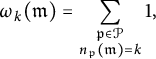 $$ \begin{align*}\omega_k({\mathfrak m}) = \sum_{\substack{{\mathfrak p} \in {\mathcal P} \\ n_{\mathfrak p}({\mathfrak m}) = k}} 1,\end{align*} $$
the number of elements of
 ${\mathcal P}$
that generates
 ${\mathfrak m}$
, with multiplicity k.
For an element
 ${\mathfrak m} \in {\mathcal M}$
, let
 ${\mathfrak m}_k$
be defined as
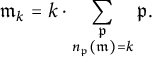 $$ \begin{align} {\mathfrak m}_k = k \cdot \sum_{\substack{{\mathfrak p} \\ n_{\mathfrak p}({\mathfrak m}) = k}} {\mathfrak p}. \end{align} $$
Thus,
 $$ \begin{align*}{\mathfrak m} = \sum_{k \geq 1} {\mathfrak m}_k.\end{align*} $$
We define the map
 $f_k : {\mathcal S} \rightarrow {\mathcal M}$
as
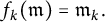 $$ \begin{align*}f_k({\mathfrak m}) = {\mathfrak m}_k.\end{align*} $$
Note that, with the above definition, we have
 $$ \begin{align*}\omega(f_k({\mathfrak m})) = \omega({\mathfrak m}_k) = \sum_{\substack{{\mathfrak p} \\ n_{\mathfrak p}({\mathfrak m}_k) \geq 1}} 1 = \sum_{\substack{{\mathfrak p} \\ n_{\mathfrak p}({\mathfrak m}) = k} } 1 = \omega_k({\mathfrak m}).\end{align*} $$
As more applications of Theorem 1.8, we deduce that
 $\omega _1({\mathfrak m})$
satisfies the Erdős–Kac theorems over the subset of h-free elements, where
 $h \geq 2$
. We prove the following theorem.
Theorem 1.11 Let
 ${\mathcal P}$
,
 ${\mathcal M}$
, and X satisfy condition (⋆). Let
 $x \in X$
and
 $h \geq 2$
be any integer. Let
 $\mathcal {{\mathcal S}}_h(x)$
denote the set of h-free elements in
 ${\mathcal M}$
with norm less than or equal to x. Then, for
 $a \in \mathbb {R}$
, we have
 $$ \begin{align*}\lim_{x \rightarrow \infty} \frac{1}{|\mathcal{{\mathcal S}}_h(x)|} \bigg| \left\{ {\mathfrak m} \in \mathcal{{\mathcal S}}_h(x) \ : N({\mathfrak m}) \geq 3, \ \ \frac{\omega_1({\mathfrak m}) - \log \log N({\mathfrak m})}{\sqrt{\log \log N({\mathfrak m})}} \leq a \right\} \bigg| = \Phi(a).\end{align*} $$
In the following, for convenience, we use
 $\mathcal {N}_1 = {\mathcal M}$
and
 $\mathcal {N}_1(x)$
to denote the set of elements in
 ${\mathcal M}$
with norm less than or equal to x. We call
 $\mathcal {N}_1$
the set of
 $1$
-full elements. To encompass the set of h-full elements defined above and
 ${\mathcal M}$
under one notation, we use
 $\mathcal {N}_k$
where
 $k \geq 1$
to denote the set of k-full elements. We show that
 $\omega _k({\mathfrak m})$
satisfies the Erdős–Kac theorem over the subset of k-full elements in the following.
Theorem 1.12 Let
 ${\mathcal P}$
,
 ${\mathcal M}$
, and X satisfy condition (⋆). Let
 $x \in X$
and
 $k \geq 1$
be any integer. Let
 $\mathcal {N}_k(x)$
denote the set of k-full elements in
 ${\mathcal M}$
with norm less than or equal to x. Then, for
 $a \in \mathbb {R}$
, we have
 $$ \begin{align*}\lim_{x \rightarrow \infty} \frac{1}{|\mathcal{N}_k(x)|} \bigg| \left\{ {\mathfrak m} \in \mathcal{N}_k(x) \ : \ N({\mathfrak m}) \geq 3, \ \frac{\omega_k({\mathfrak m}) - \log \log N({\mathfrak m})}{\sqrt{\log \log N({\mathfrak m})}} \leq a \right\} \bigg| = \Phi(a).\end{align*} $$
We extend our study to the generalized
 $\omega $
-function related to a sequence, inspired by the work of Elma and Martin [Reference Elma and Martin4] over natural numbers. Let
 ${\mathcal A} = (a_1,a_2,\ldots )$
be a sequence of complex numbers, and for some integer
 $k \geq 1$
, the following property is satisfied:
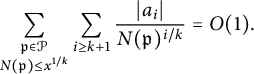 $$ \begin{align} \sum_{\substack{{\mathfrak p} \in {\mathcal P} \\ N({\mathfrak p}) \leq x^{1/k}}} \sum_{i \geq k+1} \frac{|a_i|}{N({\mathfrak p})^{i/k}} = O(1). \end{align} $$
The above relation produces a growth condition on
 $a_i$
’s depending on the minimum value of the norm map. In particular, if we assume that
 $N({\mathfrak p}) \geq b$
for all
 ${\mathfrak p} \in {\mathcal P}$
, then a sufficient condition for (1.16) to hold is
 $$ \begin{align*}a_i \ll B^i \quad \text{ as } i \rightarrow \infty, \quad \text{ where } \quad 0 < B \leq b^{\frac{1}{k} - \alpha} \quad \text{ for some } \alpha> 0.\end{align*} $$
For this article, we shall assume
 $b = 2$
, that is, the minimum possible value of the norm of a prime element.
Let the generalized
 $\omega $
-function,
 $\omega _{\mathcal A}$
attached to the sequence
 ${\mathcal A}$
be defined as
 $$ \begin{align*}\omega_{\mathcal A} ({\mathfrak m}) = \sum_{k \geq 1} a_k \ \omega(f_k({\mathfrak m})) = \sum_{k \geq 1} a_k \ \omega_k({\mathfrak m}),\end{align*} $$
where the sum is finite for each
 ${\mathfrak m}$
.
With the above definitions and restrictions, for an integer
 $k \geq 1$
, we prove the following Erdős–Kac theorem for
 $\omega _{\mathcal A}({\mathfrak m})$
over k-full elements in
 ${\mathcal M}$
.
Theorem 1.13 Let
 ${\mathcal P}$
,
 ${\mathcal M}$
, and X satisfy condition (⋆). Let
 $x \in X$
. Let
 ${\mathcal A} = (a_1,a_2,\ldots )$
be a sequence of complex numbers. Let
 $k \in \mathbb {Z}_{>0}$
be such that
 $a_k \neq 0$
and the following property holds:
 $$ \begin{align*}a_i \ll B^i \quad \text{ as } i \rightarrow \infty, \quad \text{ where } \quad 0 < B \leq 2^{\frac{1}{k} - \alpha} \quad \text{ for some } \alpha> 0.\end{align*} $$
Let
 $\mathcal {N}_k(x)$
denote the set of k-full elements in
 ${\mathcal M}$
with norm less than or equal to x. Then, for
 $a \in \mathbb {R}$
, we have
 $$ \begin{align*}\lim_{x \rightarrow \infty} \frac{1}{|\mathcal{N}_k(x)|} \bigg| \left\{ {\mathfrak m} \in \mathcal{N}_k(x) \ : \ N({\mathfrak m}) \geq 3, \ \frac{\frac{1}{a_k} \omega_{\mathcal A}({\mathfrak m}) - \log \log N({\mathfrak m})}{\sqrt{\log \log N({\mathfrak m})}} \leq a \right\} \bigg| = \Phi(a).\end{align*} $$
In the next result, we state the Erdős–Kac theorem for
 $\frac {1}{a_1} \omega _{\mathcal A}({\mathfrak m})$
over h-free elements. The set of h-free elements in
 ${\mathcal M}$
has a positive density and thus the proof of the theorem follows similarly to the case of
 $1$
-full elements in Theorem 1.13. To avoid repetition, we do not provide the proof in this article.
Theorem 1.14 Let
 ${\mathcal P}$
,
 ${\mathcal M}$
, and X satisfy condition (⋆). Let
 $x \in X$
. Let
 $h \geq 2$
be any integer and let
 $\mathcal {S}_h(x)$
denote the set of h-free elements in
 ${\mathcal M}$
with norm less than or equal to x. Let
 ${\mathcal A} = (a_1,a_2,\ldots )$
be a sequence of complex numbers, satisfying
 $a_1 \neq 0$
and
 $$ \begin{align*}a_i \ll B^i \quad \text{ as } i \rightarrow \infty, \quad \text{ where } \quad 0 < B \leq 2^{1 - \alpha} \quad \text{ for some } \alpha> 0.\end{align*} $$
Then, for
 $a \in \mathbb {R}$
, we have
 $$ \begin{align*}\lim_{x \rightarrow \infty} \frac{1}{|\mathcal{S}_h(x)|} \bigg| \left\{ {\mathfrak m} \in \mathcal{S}_h(x) \ : \ N({\mathfrak m}) \geq 3, \ \frac{\frac{1}{a_1} \omega_{\mathcal A}({\mathfrak m}) - \log \log N({\mathfrak m})}{\sqrt{\log \log N({\mathfrak m})}} \leq a \right\} \bigg| = \Phi(a).\end{align*} $$
We provide applications of Theorem 1.13 to other well-known functions, in particular, the prime counting
 $\Omega $
-function and the divisor counting function. Note that our method provides a novel approach to study the prime divisor counting functions, that is, the
 $\omega $
-function and the
 $\Omega $
-function, and the divisor counting function in a single framework. As these functions are of prime importance to the various mathematicians, our work contributes significantly to the literature.
For each
 ${\mathfrak m} \in {\mathcal M}$
, we define
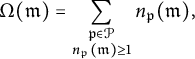 $$ \begin{align*}\Omega({\mathfrak m}) = \sum_{\substack{{\mathfrak p} \in {\mathcal P} \\ n_{\mathfrak p}({\mathfrak m}) \geq 1}} n_{\mathfrak p}({\mathfrak m}),\end{align*} $$
the number of elements of
 ${\mathcal P}$
that generates
 ${\mathfrak m}$
, counted with multiplicity. We say that
 ${\mathfrak d} \in {\mathcal M}$
is a divisor of
 ${\mathfrak m}$
and denote it as
 ${\mathfrak d} | {\mathfrak m}$
if
 $n_{\mathfrak p}({\mathfrak d}) \leq n_{\mathfrak p}({\mathfrak m})$
for all
 ${\mathfrak p} \in {\mathcal P}$
. We define
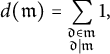 $$ \begin{align*}d({\mathfrak m}) = \sum_{\substack{{\mathfrak d} \in {\mathfrak m} \\ {\mathfrak d} | {\mathfrak m}}} 1,\end{align*} $$
the number of divisors of
 ${\mathfrak m}$
. When
 ${\mathcal M} = \mathbb {Z}_{>0}$
,
 $\Omega (n)$
counts the total number of primes diving the natural number n, and
 $d(n)$
counts the total number of divisors of n.
Notice that
 $$ \begin{align*}\Omega({\mathfrak m}) = \sum_{k \geq 1} k \left(\sum_{\substack{{\mathfrak p} \in {\mathcal P} \\ n_{\mathfrak p}({\mathfrak m}) = k}} 1 \right) = \sum_{k \geq 1} k \cdot \omega_k({\mathfrak m}).\end{align*} $$
For
 ${\mathcal A} = (1,2,3,\ldots ,n,\ldots )$
and for any integer
 $k \geq 1$
, we have
 $a_i = i \ll 2^{i/(2k)}$
as
 $i \rightarrow \infty $
, satisfying the hypothesis of Theorem 1.13. Thus, we obtain the following corollary, called the Erdős–Kac theorem for
 $\Omega ({\mathfrak m})$
over k-full elements.
Corollary 1.15 Let
 ${\mathcal P}$
,
 ${\mathcal M}$
, and X satisfy condition (⋆). Let
 $x \in X$
and
 $k \geq 1$
be any integer. Let
 $\mathcal {N}_k(x)$
denote the set of k-full elements in
 ${\mathcal M}$
with norm less than or equal to x. Then, for
 $a \in \mathbb {R}$
, we have
 $$ \begin{align*}\lim_{x \rightarrow \infty} \frac{1}{|\mathcal{N}_k(x)|} \bigg| \left\{ {\mathfrak m} \in \mathcal{N}_k(x) \ : \ N({\mathfrak m}) \geq 3, \ \frac{\frac{1}{k} \Omega({\mathfrak m}) - \log \log N({\mathfrak m})}{\sqrt{\log \log N({\mathfrak m})}} \leq a \right\} \bigg| = \Phi(a).\end{align*} $$
Note that, using the study of moments, in [Reference Das, Kuo and Liu3], we showed that
 $\Omega ({\mathfrak m})$
has normal order
 $\log \log ({\mathfrak m})$
over h-free and normal order
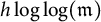 $h \log \log ({\mathfrak m})$
over h-full elements.
For the
 $d({\mathfrak m})$
function, one can easily deduce that
 $$ \begin{align*}d({\mathfrak m}) = \sum_{\substack{{\mathfrak d} \in {\mathfrak m} \\ {\mathfrak d} | {\mathfrak m}}} 1 = \prod_{\substack{{\mathfrak p} \\ n_{\mathfrak p}({\mathfrak m}) \geq 1}} (n_{\mathfrak p}({\mathfrak m}) + 1).\end{align*} $$
Thus,
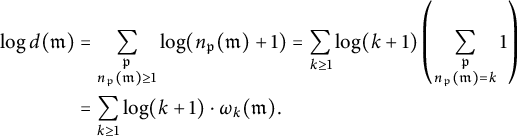 $$ \begin{align*}\log d({\mathfrak m}) &= \sum\limits_{\substack{{\mathfrak p} \\ n_{\mathfrak p}({\mathfrak m}) \geq 1}} \log (n_{\mathfrak p}({\mathfrak m}) + 1) =\sum_{k \geq 1} \log(k+1) \left(\sum\limits_{\substack{{\mathfrak p} \\ n_{\mathfrak p}({\mathfrak m}) = k}} 1 \right)\\ & = \sum_{k \geq 1} \log(k+1) \cdot \omega_k({\mathfrak m}).\end{align*} $$
Taking
 ${\mathcal A} = (\log 2, \log 3, \log 4, \ldots , \log (n+1), \ldots )$
and for any integer
 $k \geq 1$
, we have
 $a_i = \log (i+1) \ll 2^{i/(2k)}$
as
 $i \rightarrow \infty $
, satisfying the hypothesis of Theorem 1.13. Thus, we obtain the following corollary, called the Erdős–Kac theorem for
 $\log d({\mathfrak m})$
over k-full elements.
Corollary 1.16 Let
 ${\mathcal P}$
,
 ${\mathcal M}$
, and X satisfy condition (⋆). Let
 $x \in X$
and
 $k \geq 1$
be any integer. Let
 $\mathcal {N}_k(x)$
denote the set of k-full elements in
 ${\mathcal M}$
with norm less than or equal to x. Then, for
 $a \in \mathbb {R}$
, we have
 $$ \begin{align*}&\lim_{x \rightarrow \infty} \frac{1}{|\mathcal{N}_k(x)|} \bigg| \bigg\{ {\mathfrak m} \in \mathcal{N}_k(x) : N({\mathfrak m}) \geq 3, \ \frac{\frac{1}{\log (k+1)} \log d({\mathfrak m}) - \log \log N({\mathfrak m})}{\sqrt{\log \log N({\mathfrak m})}} \leq a \bigg\} \bigg|\\&\quad = \Phi(a).\end{align*} $$
Next, we show that Theorem 1.13 can also be applied to some new functions. Let
 $\omega _T({\mathfrak m})$
denote the difference in the number of prime elements in the factorization of
 ${\mathfrak m}$
with odd multiplicity and the number of prime elements in the factorization of
 ${\mathfrak m}$
with even multiplicity, that is,
 $$ \begin{align} \omega_T({\mathfrak m}) = \sum_{\substack{{\mathfrak p} \\ n_{\mathfrak p}({\mathfrak m}) \ \text{odd}}} 1 - \sum_{\substack{{\mathfrak p} \\ n_{\mathfrak p}({\mathfrak m}) \ \text{even}}} 1 = \sum_{{\mathfrak p}} (-1)^{n_{\mathfrak p}({\mathfrak m}) - 1} = \sum_{k \geq 1} (-1)^{k-1} \omega_k({\mathfrak m}). \end{align} $$
Taking
 ${\mathcal A} = (1, -1, 1, -1, \ldots , (-1)^{n-1}, \ldots )$
and for any integer
 $k \geq 1$
, we have
 $(-1)^{i-1} \ll 2^{i/(2k)}$
as
 $i \rightarrow \infty $
. Thus, as another application of Theorem 1.13, we obtain the following corollary.
Corollary 1.17 Let
 ${\mathcal P}$
,
 ${\mathcal M}$
, and X satisfy condition (⋆). Let
 $x \in X$
and
 $k \geq 1$
be any integer. Let
 $\mathcal {N}_k(x)$
denote the set of k-full elements in
 ${\mathcal M}$
with norm less than or equal to x. Then, for
 $a \in \mathbb {R}$
, we have
 $$ \begin{align*}&\lim_{x \rightarrow \infty} \frac{1}{|\mathcal{N}_k(x)|} \bigg| \bigg\{ {\mathfrak m} \in \mathcal{N}_k(x) : N({\mathfrak m}) \geq 3, \ \frac{(-1)^{k-1} \omega_T({\mathfrak m}) - \log \log N({\mathfrak m})}{\sqrt{\log \log N({\mathfrak m})}} \leq a \bigg\} \bigg|\\&\quad = \Phi(a).\end{align*} $$
Finally, in Section 7, we provide various applications of our general setting. Let
 ${\mathcal A} = (a_1, a_2, \ldots )$
be a sequence of complex numbers satisfying any of the following types:
-
(1) if
$a_i = 1$
for all
$i \in \mathbb {Z}_{>0}$
, that is,
$\omega _{\mathcal A}({\mathfrak m}) = \omega ({\mathfrak m})$
; -
(2) if
$a_i = i$
for all
$i \in \mathbb {Z}_{>0}$
, that is,
$\omega _{\mathcal A}({\mathfrak m}) = \Omega ({\mathfrak m})$
; -
(3) if
$a_i = \log (i+1)$
for all
$i \in \mathbb {Z}_{>0}$
, that is,
$\omega _{\mathcal A}({\mathfrak m}) = \log d({\mathfrak m})$
; -
(4) if
$a_i = 1$
for all odd i and
$a_i = - 1$
for all even i, that is,
$\omega _{\mathcal A}({\mathfrak m}) = \omega _T({\mathfrak m})$
; -
(5) if
$a_i = 0$
for all
$i \neq k$
and
$a_k = 1$
, that is,
$\omega _{\mathcal A}({\mathfrak m}) = \omega _k({\mathfrak m})$
.















For such
 ${\mathcal A}'$
s, we apply Theorems 1.13 and 1.14 to prove the Erdős–Kac theorems for the
 $\omega _{\mathcal A}$
-function in number fields, global function fields, and geometrically irreducible projective varieties, demonstrating the broad applicability of our approach.
2 Review of probability theory
In this section, we review some results from probability theory that are essential for our study. We repeat [Reference Das, Kuo and Liu1, Section 2] here for the easiness of the readers. Interested readers can find a more detailed version of the results mentioned in this section in [Reference Liu10, Section 2].
Let X be a random variable with a probability measure P. For a real number t, let
 $F(t)$
be the distribution function of X defined as
 $$ \begin{align*}F(t) := P(X \leq t).\end{align*} $$
The expectation of X is defined as
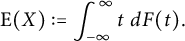 $$ \begin{align*}\text{E}(X) := \int_{-\infty}^\infty t \ d F(t).\end{align*} $$
The variance of X, denoted as Var(X), which measures the deviation of X from its expectation is defined as
 $$ \begin{align*}\text{Var}(X) := \text{E}(X^2) - (\text{E}(X))^2.\end{align*} $$
Moreover, if Y is another random variable with the same probability measure P, we have
 $$ \begin{align*}\text{E}(X+Y) = \text{E}(X) + \text{E}(Y).\end{align*} $$
The above property is called the linearity of expectation. Additionally, if X and Y are independent, that is, for all
 $x \in X$
and for all
 $y \in Y$
,
 $$ \begin{align*}P(X \leq x, Y \leq y) = \text{P}(X \leq x) \cdot \text{P}(Y \leq y),\end{align*} $$
then we have
 $$ \begin{align*}\text{E}(X \cdot Y) = \text{E}(X) \cdot \text{E}(Y)\end{align*} $$
and
 $$ \begin{align*}\text{Var}(X+Y) = \text{Var}(X) + \text{Var}(Y).\end{align*} $$
Given a sequence of random variables
 $\{X_n\}$
and
 $\alpha \in \mathbb {R}$
, we say that
 $\{X_n\}$
converges in probability to
 $\alpha $
if for any
 $\epsilon> 0$
,
 $$ \begin{align*}\lim_{n \rightarrow \infty} P(|X_n - \alpha|> \epsilon) = 0.\end{align*} $$
We denote this by

Using the above definitions, we list the following facts from probability theory as mentioned in the third author’s work [Reference Liu10, pp. 595–596].
Fact 2.1 Given a sequence of random variables
 $\{X_n\}$
, if
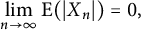 $$ \begin{align*}\lim_{n \rightarrow \infty} \text{E} (|X_n|) = 0,\end{align*} $$
we have

Fact 2.2 Let
 $\{ X_n \}$
,
 $\{ Y_n \}$
, and
 $\{ U_n \}$
be sequences of random variables with the same probability measure P. Let U be a distribution function. Suppose

For all
 $\gamma \in \mathbb {R}$
, we have
 $$ \begin{align*}\lim_{n \rightarrow \infty} P(U_n \leq \gamma) = U(\gamma)\end{align*} $$
if and only if
 $$ \begin{align*}\lim_{n \rightarrow \infty} P\left( (X_n U_n + Y_n) \leq \gamma \right) = U(\gamma).\end{align*} $$
Let
 $\Phi (\gamma )$
denote the Gaussian normal distribution as defined in (1.1). For
 $r \in \mathbb {Z}_{>0}$
, the rth moment of
 $\Phi $
is defined as
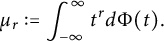 $$ \begin{align*}\mu_r := \int_{-\infty}^\infty t^r d \Phi(t).\end{align*} $$
Then, we have the following fact.
Fact 2.3 Given a sequence of distribution functions
 $\{F_n\}$
, if for all
 $r \in \mathbb {Z}_{>0}$
,
 $$ \begin{align*}\lim_{n \rightarrow \infty} \int_{-\infty}^\infty t^r d F_n(t) = \mu_r,\end{align*} $$
then for all
 $\gamma \in \mathbb {R}$
, we have
 $$ \begin{align*}\lim_{n \rightarrow \infty} F_n(\gamma) = \Phi(\gamma).\end{align*} $$
As a converse of the above fact, we have the following fact.
Fact 2.4 Let
 $r \in \mathbb {Z}_{>0}$
. Given a sequence of distribution functions
 $\{F_n\}$
, if
 $$ \begin{align*}\lim_{n \rightarrow \infty} F_n(\gamma) = \Phi(\gamma), \quad \text{for all } \gamma \in \mathbb{R,}\end{align*} $$
and
 $$ \begin{align*}\sup_n \left\{ \int_{-\infty}^\infty |t|^{r+\delta} dF_n(t) \right\} < \infty, \quad \text{for some } \delta = \delta(r)> 0,\end{align*} $$
we have
 $$ \begin{align*}\lim_{n \rightarrow \infty} \int_{-\infty}^\infty t^r d F_n(t) = \mu_r.\end{align*} $$
The next fact is a special case of the Central Limit Theorem.
Fact 2.5 Let
 $X_1,X_2,\ldots , X_i, \ldots $
be a sequence of independent random variables and
 $\text {Im}(X_i)$
is the image of
 $X_i$
. Suppose
-
(1)
$\sup _{i} \{ \text {Im}(X_i) \} < \infty $
; -
(2)
$\text {E}(X_i) = 0$
and
$\text {Var}(X_i) < \infty $
for all i.



For
 $n \in \mathbb {Z}_{>0}$
, let
 $\Phi _n$
be the normalization of
 $X_1,X_2,\ldots ,X_n$
defined as
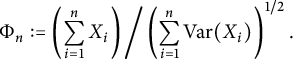
If
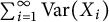 $\sum _{i=1}^\infty \text {Var}(X_i)$
diverges, then we have
 $$ \begin{align*}\lim_{n \rightarrow \infty} P(\Phi_n \leq \gamma) = \Phi(\gamma).\end{align*} $$
3 Essential lemmas
In this section, we list all the lemmas required to prove our theorems. The first three lemmas establish statements equivalent to Theorem 1.1, and thus proving any equivalent statement would be sufficient in proving the theorem. The next two lemmas establish results necessary to prove one of the equivalent conditions mentioned in the third lemma of this section. Together, these lemmas prove Theorem 1.1 in the next section. These results bear a close resemblance to the results from [Reference Das, Kuo and Liu1, Section 3]. However, because of subtle changes to the arguments that involve a new function f, we present the results in detail here.
The final set of three lemmas in this section establishes results involving prime elements required to complete the proofs of all other theorems mentioned in Section 1.
Let
 ${\mathcal P}$
,
 ${\mathcal M}$
,
 ${\mathcal S}$
, X, and f be defined as in Section 1 and assume that they satisfy (⋆), (1.2), and the conditions (a)–(f). For
 ${\mathfrak m} \in {\mathcal S}$
and
 $x \in X$
, we define
 $$ \begin{align*}P_{{\mathcal S},x} \{ {\mathfrak m} \ : \ {\mathfrak m} \text{ satisfies some conditions} \}\end{align*} $$
to be the quantity
 $$ \begin{align*}\frac{1}{|{\mathcal S}(x)|} \left| \{ {\mathfrak m} \in {\mathcal S}(x) \ : \ {\mathfrak m} \text{ satisfies some conditions} \} \right|.\end{align*} $$
Note that
 $P_{{\mathcal S},x}$
is a probability measure on
 ${\mathcal S}$
. Let g be a function from
 ${\mathcal S}$
to
 $\mathbb {R}$
. The expectation of g with respect to
 $P_{{\mathcal S},x}$
is denoted by
 $$ \begin{align*}\text{E}_{{\mathcal S},x} \{ {\mathfrak m} : g({\mathfrak m}) \} := \frac{1}{|{\mathcal S}(x)|} \sum_{{\mathfrak m} \in {\mathcal S}(x)} g({\mathfrak m}).\end{align*} $$
The first lemma gives an equivalent statement of Theorem 1.1.
Lemma 3.1
 $$ \begin{align*}\lim_{x \rightarrow \infty} P_{{\mathcal S},x} \bigg\{ {\mathfrak m} \ : \ N({\mathfrak m}) \geq 3, \ \frac{\omega(f({\mathfrak m})) - \log \log N({\mathfrak m})}{\sqrt{\log \log N({\mathfrak m})}} \leq \gamma \bigg\} = \Phi(\gamma)\end{align*} $$
if and only if
 $$ \begin{align*}\lim_{x \rightarrow \infty} P_{{\mathcal S},x} \bigg\{ {\mathfrak m} \ : \ \frac{\omega(f({\mathfrak m})) - \log \log x}{\sqrt{\log \log x}} \leq \gamma \bigg\} = \Phi(\gamma).\end{align*} $$
Proof The proof closely follows the steps of the proof of [Reference Liu10, Lemma 3]. First note that
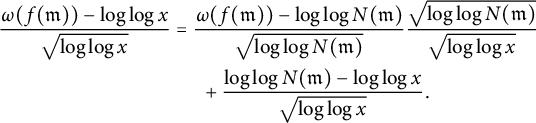 $$ \begin{align*} \frac{\omega(f({\mathfrak m})) - \log \log x}{\sqrt{\log \log x}} & = \frac{\omega(f({\mathfrak m})) - \log \log N({\mathfrak m})}{\sqrt{\log \log N({\mathfrak m})}} \frac{\sqrt{\log \log N({\mathfrak m})}}{\sqrt{\log \log x}} \\ & \hspace{.5cm} + \frac{\log \log N({\mathfrak m}) - \log \log x}{\sqrt{\log \log x}}. \end{align*} $$
Thus, by Fact 2 and our assumption that
 $\mathcal {S}$
is infinite, to prove the lemma, it suffices to show that for any
 $\epsilon>0$
,
 $$ \begin{align*}\lim_{x \rightarrow \infty} P_{\mathcal{S},x} \bigg\{ \mathfrak{m} \ : \ N(\mathfrak{m}) \geq 3, \ \bigg| \frac{\sqrt{\log \log N(\mathfrak{m})}}{\sqrt{\log \log x}} - 1 \bigg|> \epsilon \bigg\} = 0\end{align*} $$
and
 $$ \begin{align*}\lim_{x \rightarrow \infty} P_{\mathcal{S},x} \bigg\{ \mathfrak{m} \ : \ N(\mathfrak{m}) \geq 3, \ \bigg| \frac{\log \log N(\mathfrak{m}) - \log \log x}{\sqrt{\log \log x}} \bigg|> \epsilon \bigg\} = 0.\end{align*} $$
We show this by repeating the steps in [Reference Das, Kuo and Liu1, Lemma 3.1, p. 10], which employs (1.2), and thus complete the proof.
Let
 $\beta $
be a constant with
 $0 < \beta \leq 1$
and
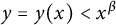 $y = y(x) < x^\beta $
satisfying the conditions (a)–(f) as mentioned in Section 1. For
 ${\mathfrak m} \in {\mathcal M}$
, we define the truncated function
 $$ \begin{align*}\omega_y(f({\mathfrak m})) = \left| \{ \ell \in {\mathcal P} \ : \ N(\ell) \leq y, \ n_\ell(f({\mathfrak m})) \geq 1 \} \right|.\end{align*} $$
The next result establishes another equivalent formulation of the Erdős–Kac theorem in terms of
 $\omega _y$
.
Lemma 3.2
 $$ \begin{align*}\lim_{x \rightarrow \infty} P_{{\mathcal S},x} \bigg\{ {\mathfrak m} \ : \ \frac{\omega(f({\mathfrak m})) - \log \log x}{\sqrt{\log \log x}} \leq \gamma \bigg\} = \Phi(\gamma)\end{align*} $$
if and only if
 $$ \begin{align*}\lim_{x \rightarrow \infty} P_{{\mathcal S},x} \bigg\{ {\mathfrak m} \ : \ \frac{\omega_y(f({\mathfrak m})) - \log \log x}{\sqrt{\log \log x}} \leq \gamma \bigg\} = \Phi(\gamma).\end{align*} $$
Proof Note that
 $$ \begin{align*}\frac{\omega_y(f({\mathfrak m})) - \log \log x}{\sqrt{\log \log x}} = \frac{\omega(f({\mathfrak m})) - \log \log x}{\sqrt{\log \log x}} + \frac{\omega_y(f({\mathfrak m})) - \omega(f({\mathfrak m}))}{\sqrt{\log \log x}}.\end{align*} $$
Thus, by Facts 1 and 2, to prove the lemma, it suffices to prove
 $$ \begin{align*}\lim_{x \rightarrow \infty} \text{E}_{{\mathcal S},x} \bigg\{ {\mathfrak m} \ : \ \bigg| \frac{\omega(f({\mathfrak m})) - \omega_y(f({\mathfrak m}))}{\sqrt{\log \log x}} \bigg| \bigg\} = 0.\end{align*} $$
Notice that
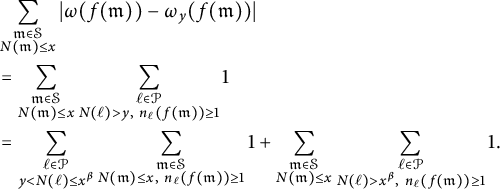 $$ \begin{align*} & \sum_{\substack{{\mathfrak m} \in {\mathcal S} \\ N({\mathfrak m}) \leq x}} |\omega(f({\mathfrak m})) - \omega_y(f({\mathfrak m}))| \\ & = \sum_{\substack{{\mathfrak m} \in {\mathcal S} \\ N({\mathfrak m}) \leq x}} \sum_{\substack{\ell \in {\mathcal P} \\ N(\ell)> y, \ n_\ell(f({\mathfrak m})) \geq 1 }} 1 \\ & = \sum_{\substack{\ell \in {\mathcal P} \\ y < N(\ell) \leq x^\beta }} \sum_{\substack{{\mathfrak m} \in {\mathcal S} \\ N({\mathfrak m}) \leq x, \ n_\ell(f({\mathfrak m})) \geq 1}} 1 + \sum_{\substack{{\mathfrak m} \in {\mathcal S} \\ N({\mathfrak m}) \leq x}} \sum_{\substack{\ell \in {\mathcal P} \\ N(\ell)> x^\beta, \ n_\ell(f({\mathfrak m})) \geq 1 }} 1. \end{align*} $$
Using the definition of
 $\lambda _\ell $
and
 $e_\ell $
, and the conditions (a)–(c), we obtain
 $$ \begin{align*} \sum_{\substack{{\mathfrak m} \in {\mathcal S} \\ N({\mathfrak m}) \leq x}} |\omega(f({\mathfrak m})) - \omega_y(f({\mathfrak m}))| & = \sum_{\substack{\ell \in {\mathcal P} \\ y < N(\ell) \leq x^\beta }} |{\mathcal S}(x)|(\lambda_\ell+ e_\ell) + O(|{\mathcal S}(x)|) \\ & = o(|{\mathcal S}(x)|(\log \log x)^{1/2}) + O(|{\mathcal S}(x)|). \end{align*} $$
Thus, we have
 $$ \begin{align*}\text{E}_{{\mathcal S},x} \bigg\{ m \ : \ \bigg| \frac{\omega(f({\mathfrak m})) - \omega_y(f({\mathfrak m}))}{\sqrt{\log \log x}} \bigg| \bigg\} = \frac{o(|{\mathcal S}(x)|(\log \log x)^{1/2})}{|{\mathcal S}(x)|(\log \log x)^{1/2}} = o(1),\end{align*} $$
which completes the proof.
For
 $\ell \in {\mathcal P}$
, we define the independent random variable
 $X_\ell $
by
 $$ \begin{align*}P(X_\ell =1) = \lambda_\ell\end{align*} $$
and
 $$ \begin{align*}P(X_\ell=0) = 1 - \lambda_\ell.\end{align*} $$
We define a new random variable
 ${\mathcal S}_y$
by
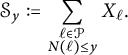 $$ \begin{align*}{\mathcal S}_y := \sum_{\substack{\ell \in {\mathcal P} \\ N(\ell) \leq y}} X_\ell.\end{align*} $$
Note that, by conditions (d) and (e), we have the expectation and variance of the random variable
 ${\mathcal S}_y$
as
 $$ \begin{align*}\text{E}({\mathcal S}_y) = \sum_{N(\ell) \leq y} \lambda_\ell = \log \log x + o \left( (\log \log x)^{1/2} \right)\end{align*} $$
and
 $$ \begin{align*}\text{Var}({\mathcal S}_y) = \sum_{N(\ell) \leq y} \lambda_\ell(1 - \lambda_\ell) = \log \log x + o \left( (\log \log x)^{1/2} \right).\end{align*} $$
Note that we will use the notation
 $\text {E}(\cdot )$
and
 $\text {E}_{{\mathcal S},x}\{\cdot \}$
, respectively, to distinguish the expectation of a random variable from the expectation of a function with respect to
 $P_{{\mathcal S},x}$
. However, in most cases, they will represent the same values.
The above setup leads us to another reformulation of Theorem 1.1 in terms of
 $\text {E}({\mathcal S}_y)$
.
Lemma 3.3
 $$ \begin{align*}\lim_{x \rightarrow \infty} P_{{\mathcal S},x} \bigg\{ {\mathfrak m} \ : \ \frac{\omega_y(f({\mathfrak m})) - \log \log x}{\sqrt{\log \log x}} \leq \gamma \bigg\} = \Phi(\gamma)\end{align*} $$
if and only if
 $$ \begin{align*}\lim_{x \rightarrow \infty} P_{{\mathcal S},x} \bigg\{ {\mathfrak m} \ : \ \frac{\omega_y(f({\mathfrak m})) - \text{E}({\mathcal S}_y)}{\sqrt{\text{Var}({\mathcal S}_y)}} \leq \gamma \bigg\} = \Phi(\gamma).\end{align*} $$
Proof Note that
 $$ \begin{align*}\frac{\omega_y(f({\mathfrak m})) - \text{E}({\mathcal S}_y)}{\sqrt{\text{Var}({\mathcal S}_y)}} = \frac{\omega_y(f({\mathfrak m})) - \log \log x}{\sqrt{\log \log x}} \frac{\sqrt{\log \log x}}{\sqrt{\text{Var}({\mathcal S}_y)}} + \frac{\log \log x - \text{E}({\mathcal S}_y)}{\sqrt{\text{Var}({\mathcal S}_y)}}.\end{align*} $$
Since
 $$ \begin{align*}\text{Var}({\mathcal S}_y) = \sum_{N(\ell) \leq y} \lambda_\ell(1 - \lambda_\ell) = \log \log x + o \left( (\log \log x)^{1/2} \right),\end{align*} $$
we have
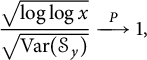
where  denotes the convergence in probability. Moreover, since
 $$ \begin{align*}\text{E}({\mathcal S}_y) = \sum_{N(\ell) \leq y} \lambda_\ell = \log \log x + o \left( (\log \log x)^{1/2} \right),\end{align*} $$
we obtain
 $$ \begin{align*}\lim_{x \rightarrow \infty} \text{E}_{{\mathcal S},x} \bigg\{ {\mathfrak m} \ : \ \bigg| \frac{\text{E}({\mathcal S}_y) - \log \log x}{\sqrt{\text{Var}({\mathcal S}_y)}} \bigg| \bigg\} = 0.\end{align*} $$
Finally, by using Facts 1 and 2, we complete the proof of the equivalence mentioned in the lemma.
Next, we introduce another set of random variables. For
 $\ell \in {\mathcal P}$
, we define a random variable
 $\delta _\ell :{\mathcal M} \rightarrow \mathbb {R}$
by
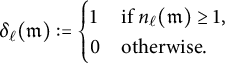 $$ \begin{align*}\delta_\ell({\mathfrak m}) := \begin{cases} 1 & \text{if } n_\ell({\mathfrak m}) \geq 1, \\ 0 & \text{otherwise.} \end{cases}\end{align*} $$
Thus, we can write
 $$ \begin{align*}\omega_y(f({\mathfrak m})) = \sum_{\substack{\ell \in {\mathcal P} \\ N(\ell) \leq y, \ n_\ell(f({\mathfrak m})) \geq 1 }} 1 = \sum_{\substack{\ell \in {\mathcal P} \\ N(\ell) \leq y}} \delta_\ell(f({\mathfrak m})).\end{align*} $$
Notice that for a fixed
 $\ell \in {\mathcal P}$
and
 $x \in X$
, by definition, we have
 $$ \begin{align*}P_{{\mathcal S},x} \{ m \ : \ \delta_\ell(f({\mathfrak m})) = 1 \} = \lambda_\ell + e_\ell.\end{align*} $$
Since the expectations of random variables
 $X_\ell $
and
 $\delta _\ell $
are close, the sum
 ${\mathcal S}_y$
is a good approximation of
 $\omega _y$
. Indeed, the rth moments of their normalizations are equal as
 $x \rightarrow \infty $
, which we prove in the following result.
Lemma 3.4 Let
 $r \in \mathbb {Z}_{>0}$
. We have
 $$ \begin{align*}\lim_{x \rightarrow \infty} \bigg| \text{E}_{{\mathcal S},x} \bigg\{ \bigg( \frac{\omega_y(f({\mathfrak m})) - \text{E}({\mathcal S}_y)}{\sqrt{\text{Var}({\mathcal S}_y)}} \bigg)^r \bigg\}- E\bigg( \bigg( \frac{{\mathcal S}_y - \text{E}({\mathcal S}_y)}{\sqrt{\text{Var}({\mathcal S}_y)}} \bigg)^r\bigg) \bigg| = 0.\end{align*} $$
Proof The proof follows from repeating the exact steps of the proof of [Reference Das, Kuo and Liu1, Lemma 3.4] with
 $\omega _y({\mathfrak m})$
replaced with
 $\omega _y(f({\mathfrak m}))$
.
The next result is about the rth moment of the random variable
 ${\mathcal S}_y$
.
Lemma 3.5 For
 $r \in \mathbb {Z}_{>0}$
,
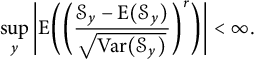 $$ \begin{align*}\sup_y \bigg| \text{E} \bigg( \bigg(\frac{{\mathcal S}_y - \text{E}({\mathcal S}_y)}{\sqrt{\text{Var}({\mathcal S}_y)}} \bigg)^r \bigg) \bigg| < \infty.\end{align*} $$
Proof The proof follows from repeating the exact steps of the proof of [Reference Das, Kuo and Liu1, Lemma 3.5].
Next, we recall the following results regarding sums over prime elements necessary for our study.
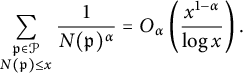
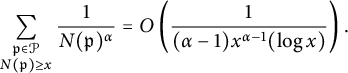
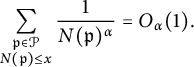
Lemma 3.6 [Reference Das, Kuo and Liu2, Lemma 2.2]
Let
 $\mathcal {P}, {\mathcal M}$
, and X satisfy the condition (⋆). Let
 $x \in X$
and
 $\alpha $
be a real number. We have
-
(1) If
$0 \leq \alpha < 1$
,
$$ \begin{align*}\sum_{\substack{{\mathfrak p} \in \mathcal{P} \\ N({\mathfrak p}) \leq x}} \frac{1}{N({\mathfrak p})^\alpha} = O_\alpha \left( \frac{x^{1- \alpha}}{\log x} \right).\end{align*} $$
-
(2) If
$\alpha> 1$
, then
$$ \begin{align*}\sum_{\substack{{\mathfrak p} \in \mathcal{P} \\ N({\mathfrak p}) \geq x}} \frac{1}{N({\mathfrak p})^\alpha} = O \left( \frac{1}{(\alpha-1)x^{\alpha-1} (\log x)} \right).\end{align*} $$
-
(3) If
$\alpha> 1$
, then
$$ \begin{align*}\sum_{\substack{{\mathfrak p} \in \mathcal{P} \\ N({\mathfrak p}) \leq x}} \frac{1}{N({\mathfrak p})^\alpha} = O_\alpha(1).\end{align*} $$
-
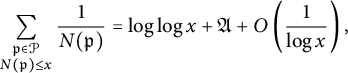
(4) As a generalization of Mertens’ theorem, we have
where
$$ \begin{align*}\sum_{\substack{{\mathfrak p} \in \mathcal{P} \\ N({\mathfrak p}) \leq x}} \frac{1}{N({\mathfrak p})} = \log \log x + {\mathfrak A} + O \left( \frac{1}{\log x} \right),\end{align*} $$
${\mathfrak A}$
is some constant that depends only on
${\mathcal P}$
.





Finally, we recall the following results regarding the density of particular sequences of h-free and h-full elements in
 ${\mathcal M}$
.
Lemma 3.7 [Reference Das, Kuo and Liu2, Lemma 3.1]
Let
 $\mathcal {P}, {\mathcal M}$
, and X satisfy the condition (⋆). Let
 $x \in X$
,
 $h \geq 2$
and
 $r \geq 1$
be integers. Let
 $\ell _1,\ldots ,\ell _r$
be fixed distinct prime elements and
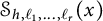 $\mathcal {S}_{h,\ell _1,\ldots ,\ell _r}(x)$
denote the set of h-free elements
 ${\mathfrak m} \in {\mathcal M}$
with norm
 $N({\mathfrak m}) \leq x$
and with
 $n_{\ell _i}({\mathfrak m}) = 0$
for all
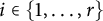 $i \in \{1,\ldots , r\}$
. Then, we have
 $$ \begin{align*}|\mathcal{S}_{h,\ell_1,\ldots,\ell_r}(x)| = \prod_{i=1}^r \left( \frac{N(\ell_i)^h - N(\ell_i)^{h-1}}{N(\ell_i)^h - 1} \right) \frac{\kappa}{\zeta_{\mathcal M}(h)} x + O_{h,r} \left( R_{\mathcal{S}_h}(x) \right),\end{align*} $$
where
 $R_{\mathcal {S}_h}(x)$
is defined in (1.6).
Lemma 3.8 [Reference Das, Kuo and Liu2, Lemma 4.2]
Let
 $\mathcal {P}, {\mathcal M}$
, and X satisfy the condition (⋆). Let
 $x \in X$
,
 $h \geq 2$
and
 $r \geq 1$
be integers. Let
 $\ell _1, \ldots , \ell _r$
be fixed distinct prime elements and
 $\mathcal {N}_{h,\ell _1,\ldots , \ell _r}(x)$
denote the set of h-full elements
 ${\mathfrak m} \in {\mathcal M}$
with norm
 $N({\mathfrak m}) \leq x$
and with
 $n_{\ell _i}({\mathfrak m}) = 0$
for all
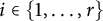 $i \in \{1,\ldots , r\}$
. Then, we have

where  is defined in (1.7) and
 $R_{\mathcal {N}_h}(x)$
is defined in (1.9).
4 The Erdős–Kac theorem over subsets
In this section, we prove the Erdős–Kac theorem over any subset of any abelian monoid satisfying the set of conditions mentioned in Theorem 1.1.
Proof of Theorem 1.1
Given
 ${\mathcal P}, {\mathcal M}, X, {\mathcal S}$
, and f as in the statement of the theorem, suppose for all
 $x \in X$
, there exists a constant
 $\beta $
with
 $0 < \beta \leq 1$
and
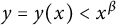 $y = y(x) < x^\beta $
such that the conditions (1.2) and (a)–(f) satisfy. For
 ${\mathfrak m} \in {\mathcal S}$
, we want to show the quantity
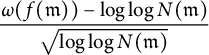 $$ \begin{align*}\frac{\omega(f({\mathfrak m})) - \log \log N({\mathfrak m})}{\sqrt{\log \log N({\mathfrak m})}}\end{align*} $$
satisfies the normal distribution. By the equivalent statements in Lemmas 3.1–3.3, to prove Theorem 1.1, it suffices to prove
 $$ \begin{align*}\lim_{x \rightarrow \infty} P_{{\mathcal S},x} \bigg\{ {\mathfrak m} \ : \ \frac{\omega_y(f({\mathfrak m})) - \text{E}({\mathcal S}_y)}{\sqrt{\text{Var}({\mathcal S}_y)}} \leq \gamma \bigg\} = \Phi(\gamma).\end{align*} $$
The distribution function
 $F_y$
with respect to
 $P_{{\mathcal S},x}$
is defined by
 $$ \begin{align*}F_y(\gamma) := P_{{\mathcal S},x} \bigg\{ {\mathfrak m} \ : \ \frac{\omega_y(f({\mathfrak m})) - \text{E}({\mathcal S}_y)}{\sqrt{\text{Var}({\mathcal S}_y)}} \leq \gamma \bigg\}.\end{align*} $$
Notice that the rth moment of
 $F_y$
can be written as
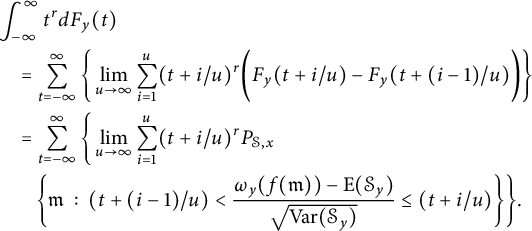 $$ \begin{align*} & \int_{-\infty}^\infty t^r dF_y(t) \\ &\quad = \sum_{t = -\infty}^\infty \bigg\{ \lim_{u \rightarrow \infty} \sum_{i=1}^u (t+i/u)^r \bigg( F_y(t+i/u) - F_y(t+(i-1)/u) \bigg) \bigg\} \\ &\quad = \sum_{t = -\infty}^\infty \bigg\{ \lim_{u \rightarrow \infty} \sum_{i=1}^u (t+i/u)^r P_{{\mathcal S},x}\\&\qquad \bigg\{ {\mathfrak m} \ : \ (t+(i-1)/u) < \frac{\omega_y(f({\mathfrak m})) - \text{E}({\mathcal S}_y)}{\sqrt{\text{Var}({\mathcal S}_y)}} \leq (t + i/u) \bigg\} \bigg\}. \end{align*} $$
Thus, by the definition of
 $P_{{\mathcal S},x}$
, we have
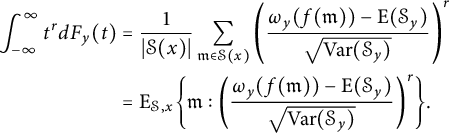 $$ \begin{align*}\int_{-\infty}^\infty t^r dF_y(t) &= \frac{1}{|{\mathcal S}(x)|} \sum_{{\mathfrak m} \in {\mathcal S}(x)} \left( \frac{\omega_y(f({\mathfrak m})) - \text{E}({\mathcal S}_y)}{\sqrt{\text{Var}({\mathcal S}_y)}} \right)^r \\&= \text{E}_{{\mathcal S},x} \bigg\{ {\mathfrak m} : \bigg( \frac{\omega_y(f({\mathfrak m})) - \text{E}({\mathcal S}_y)}{\sqrt{\text{Var}({\mathcal S}_y)}} \bigg)^r \bigg\}.\end{align*} $$
Hence, to prove
 $$ \begin{align*}\lim_{x \rightarrow \infty} F_y(\gamma) = \Phi(\gamma),\end{align*} $$
by Fact 3, it suffices to show that for all
 $r \in \mathbb {Z}_{>0}$
,
 $$ \begin{align*}\lim_{x \rightarrow \infty} \text{E}_{{\mathcal S},x} \bigg\{ {\mathfrak m} : \bigg( \frac{\omega_y(f({\mathfrak m})) - \text{E}({\mathcal S}_y)}{\sqrt{\text{Var}({\mathcal S}_y)}} \bigg)^r \bigg\} = \mu_r.\end{align*} $$
By Lemma 3.4, we observe that the last equality holds if
 $$ \begin{align*}\lim_{x \rightarrow \infty} \text{E} \bigg( \bigg( \frac{{\mathcal S}_y(f({\mathfrak m})) - \text{E}({\mathcal S}_y)}{\sqrt{\text{Var}({\mathcal S}_y)}} \bigg)^r \bigg) = \mu_r.\end{align*} $$
We define a new random variable
 $\Phi $
by
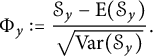 $$ \begin{align*}\Phi_y := \frac{{\mathcal S}_y - \text{E}({\mathcal S}_y)}{\sqrt{\text{Var}({\mathcal S}_y)}}.\end{align*} $$
Note that Lemma 3.5 ensures that any sequence of
 $\Phi _y$
’s satisfies the hypothesis of Fact 5. Thus, by the Central Limit theorem given in Fact 5, we have
 $$ \begin{align*}\lim_{x \rightarrow \infty} P(\Phi_{y} \leq \gamma) = \Phi(\gamma), \quad \text{for all } \gamma \in \mathbb{R}.\end{align*} $$
Also, Lemma 3.5 implies that for each
 $r \in \mathbb {Z}_{>0}$
, there exists
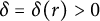 $\delta = \delta (r)> 0$
such that
 $$ \begin{align*}\sup_y \left\{ \int_{-\infty}^\infty |t|^{r+\delta} d\Phi_y(t) \right\} < \infty.\end{align*} $$
Combining the last two observations with Fact 4, we obtain
 $$ \begin{align*}\lim_{x \rightarrow \infty} \text{E} \bigg( \bigg( \frac{{\mathcal S}_y(f({\mathfrak m})) - \text{E}({\mathcal S}_y)}{\sqrt{\text{Var}({\mathcal S}_y)}} \bigg)^r \bigg) = \mu_r,\end{align*} $$
and thus establish
 $$ \begin{align*}\lim_{x \rightarrow \infty} F_y(\gamma) = \Phi(\gamma).\end{align*} $$
This completes the proof of Theorem 1.1, that is, we obtain that for any
 $\gamma \in \mathbb {R}$
, we have
 $$ \begin{align*}\lim_{x \rightarrow \infty} \frac{1}{|{\mathcal S}(x)|} \bigg| \left\{ {\mathfrak m} \in {\mathcal S}(x) \ : \ \frac{\omega(f({\mathfrak m})) - \log \log N({\mathfrak m})}{\sqrt{\log \log N({\mathfrak m})}} \leq \gamma\right\} \bigg| = \Phi(\gamma).\end{align*} $$
Next, as an application of Theorem 1.1, we prove a weaker version of the general result as the following.
Proof of Theorem 1.8
Since the subset
 ${\mathcal S}$
satisfies
 $$ \begin{align*}|\mathcal{S}(x)| = C_\beta x^{\beta} + O_\beta \big( x^{\xi \beta} \big),\end{align*} $$
for some
 $0 \leq \xi < 1$
, thus
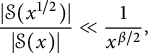 $$ \begin{align*}\frac{|\mathcal{S}(x^{1/2})|}{|\mathcal{S}(x)|} \ll \frac{1}{x^{\beta/2}},\end{align*} $$
and hence,
 $|\mathcal {S}(x^{1/2})| = o \left ( |\mathcal {S}(x)| \right )$
is satisfied.
Moreover, since
 $$ \begin{align*}\mathcal{S}_{\mathfrak p}(x) := \left\{ \mathfrak{m} \in {\mathcal S}(x) \ : \ n_{\mathfrak p} (f(\mathfrak{m})) \geq 1 \right\}\end{align*} $$
satisfy (1.14) given as
 $$ \begin{align*} |\mathcal{S}_{\mathfrak p}(x)| & = \frac{C_{\beta} x^\beta}{N({\mathfrak p})} + \frac{C_{{\mathfrak p},\beta}' x^\beta}{N({\mathfrak p})^{1+\eta}} + O_\beta \left( \frac{x^{\xi \beta}}{N({\mathfrak p})^\xi}\right), \end{align*} $$
for some
 $\eta> 0$
and where the constant
 $C_{{\mathfrak p},\beta }'$
is uniformly bounded in
 ${\mathfrak p}$
, thus,
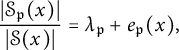 $$ \begin{align*} \frac{|\mathcal{S}_{\mathfrak p}(x)|}{|\mathcal{S}(x)|} & = \lambda_{\mathfrak p} + e_{\mathfrak p}(x), \end{align*} $$
where
 $\lambda _{\mathfrak p} = \frac {1}{N({\mathfrak p})} + \frac {C_{{\mathfrak p},\beta }'}{ C_\beta } \frac {1}{N({\mathfrak p})^{1+\eta }}$
and
 $e_{\mathfrak p}(x) = O_h \left ( \frac {1}{x^{(1 - \xi )\beta } N({\mathfrak p})^{\xi }} \right )$
.
Next, we choose
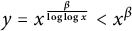 $y = x^{\frac {\beta }{\log \log x}} < x^\beta $
, and check again that all the conditions in Theorem 1.1 hold true. Note that the set in Condition (a) is empty and thus the condition holds trivially. By Part 4 of Lemma 3.6, we obtain
 $$ \begin{align*} \sum_{x^{\frac{\beta}{\log \log x}} < N({\mathfrak p}) \leq x^{\beta}} \lambda_{\mathfrak p} \ll \sum_{x^{\frac{\beta}{\log \log x}} < N({\mathfrak p}) \leq x^{\beta}} \frac{1}{N({\mathfrak p})} \ll \log \log \log x, \end{align*} $$
which makes Condition (b) true. Using Part 1 of Lemma 3.6, we have
 $$ \begin{align*}\sum_{x^{\frac{\beta}{\log \log x}} < N({\mathfrak p}) \leq x^{\beta}} |e_{\mathfrak p}(x)| \ll_h \frac{1}{x^{(1-\xi)\beta}} \sum_{N({\mathfrak p}) \leq x^{\beta}} \frac{1}{N({\mathfrak p})^{\xi}} \ll_k \frac{1}{\log x},\end{align*} $$
which makes Condition (c) true. Moreover, by Parts 3 and 4 of Lemma 3.6 again, we obtain
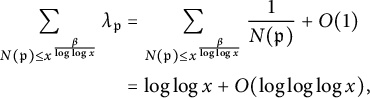 $$ \begin{align*} \sum_{N({\mathfrak p}) \leq x^{\frac{\beta}{\log \log x}}} \lambda_{\mathfrak p} & = \sum_{N({\mathfrak p}) \leq x^{\frac{\beta}{\log \log x}}} \frac{1}{N({\mathfrak p})} + O(1) \\ & = \log \log x + O (\log \log \log x), \end{align*} $$
which makes Condition (d) true. Finally, again using Part 3 of Lemma 3.6 with
 $\alpha =2$
, we have
 $$ \begin{align*}\sum_{N({\mathfrak p}) \leq x^{\frac{\beta}{\log \log x}}} \lambda_{\mathfrak p}^2 \ll \sum_{N({\mathfrak p}) \leq x^{\frac{\beta}{\log \log x}}} \frac{1}{N({\mathfrak p})^2} \ll O(1).\end{align*} $$
This makes Condition (e) true. Finally, we are only required to verify Condition (f). Using (1.14) and the Chinese Remainder Theorem, we obtain, for distinct prime ideals  ,
 $$ \begin{align*} & \left| \left\{ \mathfrak{m} \in \mathcal{S}(x) \ : \ n_{{\mathfrak p}_i} (f(\mathfrak{m})) \geq 1 \text{ for all } i \in \{ 1, 2 ,\ldots, u\} \right\} \right| \\ & \quad= \left( \prod_{i=1}^u \left( C_\beta + \frac{C_{{\mathfrak p}_i,\beta}'}{N({\mathfrak p}_i)^\eta} \right) \frac{1}{N({\mathfrak p}_i)} \right) x^{\beta} + O_h \left( \frac{x^{\xi \beta}}{\prod_{i=1}^u N({\mathfrak p}_i)^{\xi}} \right). \end{align*} $$
Thus,
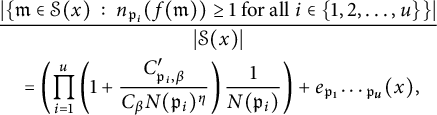
where

Let
 $r \in \mathbb {Z}_{>0}$
. By the definition of
 $\sum {\vphantom {\sum }}"$
in the conditions mentioned before Theorem 1.1, and using Part 1 of Lemma 3.6 and
 $x^{(1-\xi )\beta /\log \log x} = o(x^\epsilon )$
for any small
 $\epsilon> 0$
, we have

for any small
 $\epsilon '> 0$
. Since,
 $x^{-(((1-\xi )\beta ) - \epsilon ')} = o \left ( (\log \log x)^{-r/2} \right )$
, thus Condition (f) holds true as well. Since all the conditions of Theorem 1.1 hold with
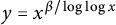 $y = x^{\beta /\log \log x}$
, thus applying Theorem 1.1 completes the proof.
5 The Erdős–Kac theorems over h-free and h-full elements
In this section, we prove the Erdős–Kac theorem for
 $\omega ({\mathfrak m})$
over h-free and h-full elements. We intend to prove the case of h-free elements given in Theorem 1.9 as an application of Theorem 1.8. We prove the following.
Proof of Theorem 1.9
Consider the set
 $\mathcal {S} = \mathcal {S}_h$
. By (1.5) and Remark 1.6, we have
 $$ \begin{align*}|\mathcal{S}(x)| = \frac{\kappa}{\zeta_{\mathcal M}(h)} x + O \big( R_{\mathcal{S}_h}(x) \big),\end{align*} $$
where
 $R_{\mathcal {S}_h}(x)$
is defined in (1.6) and satisfies
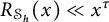 $R_{\mathcal {S}_h}(x) \ll x^\tau $
, where
 $0 \leq \tau < 1$
.
Let f be the identity map. For a fixed prime element
 ${\mathfrak p}$
, let
 $$ \begin{align*}\mathcal{S}_{\mathfrak p}(x) := \left\{ \mathfrak{m} \in \mathcal{S}_h (x) \ : \ n_{\mathfrak p}(f(\mathfrak{m})) \geq 1 \right\} = \left\{ \mathfrak{m} \in \mathcal{S}_h (x) \ : \ n_{\mathfrak p}(\mathfrak{m}) \geq 1 \right\}.\end{align*} $$
Using Lemma 3.7 with
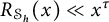 $R_{\mathcal {S}_h}(x) \ll x^\tau $
, and the identity
 $$ \begin{align*}\frac{N({\mathfrak p})^{h-1} - 1}{N({\mathfrak p})^h - 1} = \frac{1}{N({\mathfrak p})} - \frac{N({\mathfrak p})-1}{N({\mathfrak p})(N({\mathfrak p})^h -1)},\end{align*} $$
we obtain
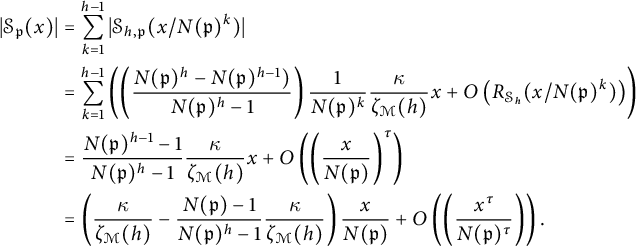 $$ \begin{align*} |\mathcal{S}_{\mathfrak p}(x)| & = \sum_{k=1}^{h-1} |\mathcal{S}_{h,{\mathfrak p}} (x/N({\mathfrak p})^k)| \notag \\ & = \sum_{k=1}^{h-1} \left( \left( \frac{N({\mathfrak p})^h - N({\mathfrak p})^{h-1})}{N({\mathfrak p})^h - 1} \right) \frac{1}{N({\mathfrak p})^k} \frac{\kappa}{\zeta_{\mathcal M}(h)} x + O \left( R_{\mathcal{S}_h}(x/N({\mathfrak p})^k) \right) \right) \notag \\ & = \frac{N({\mathfrak p})^{h-1} - 1}{N({\mathfrak p})^h - 1} \frac{\kappa}{\zeta_{\mathcal M}(h)} x + O \left( \left( \frac{x}{N({\mathfrak p})} \right)^\tau \right) \notag \\ & = \left( \frac{\kappa}{\zeta_{\mathcal M}(h)} - \frac{N({\mathfrak p})-1}{N({\mathfrak p})^h -1} \frac{\kappa}{\zeta_{\mathcal M}(h)} \right) \frac{x}{N({\mathfrak p})} + O \left( \left( \frac{x^\tau}{N({\mathfrak p})^\tau} \right) \right). \end{align*} $$
Thus,
 ${\mathcal S}(x)$
and
 ${\mathcal S}_{\mathfrak p}(x)$
satisfy the conditions of Theorem 1.8 with
 $f = \text {identity}$
,
 $\mathcal {S} = \mathcal {S}_h$
,
 $\beta = \eta = 1$
,
 $\xi = \tau $
,
 $C_\beta = \kappa /\zeta _{\mathcal M}(h)$
, and
 $$ \begin{align*}C_{{\mathfrak p},\beta}' = - C_\beta \frac{N({\mathfrak p})^2-N({\mathfrak p})}{N({\mathfrak p})^h -1} \quad \text{ with } \quad |C_{{\mathfrak p},\beta}'| \leq C_\beta.\end{align*} $$
Thus, applying Theorem 1.8 completes the proof.
Next, for the case of h-full elements given in Theorem 1.10, we prove the following.
Proof of Theorem 1.10
Consider the set
 $\mathcal {S} = \mathcal {N}_h$
. By (1.8) and Remark 1.7, we have

where
 $R_{\mathcal {N}_h}(x) \ll x^{\nu /h}$
for some
 $0 \leq \nu < 1$
. Let f be the identity map. For a fixed prime ideal
 ${\mathfrak p}$
, let
 $$ \begin{align*}\mathcal{S}_{\mathfrak p}(x) := \left\{ \mathfrak{m} \in \mathcal{N}_h(x) \ : \ n_{\mathfrak p} (f(\mathfrak{m})) \geq 1 \right\} = \left\{ \mathfrak{m} \in \mathcal{N}_h(x) \ : \ n_{\mathfrak p} (\mathfrak{m}) \geq 1 \right\}.\end{align*} $$
Using Lemma 3.8 with
 $R_{\mathcal {N}_h}(x) \ll x^{\nu /h}$
and the identity
 $$ \begin{align*}\frac{1}{N({\mathfrak p})(1- N({\mathfrak p})^{-1/h} + N({\mathfrak p})^{-1})} = \frac{1}{N({\mathfrak p})} + \frac{N({\mathfrak p})^{-1/h}-N({\mathfrak p})^{-1}}{N({\mathfrak p})(1 - N({\mathfrak p})^{-1/h} + N({\mathfrak p})^{-1})},\end{align*} $$
we obtain
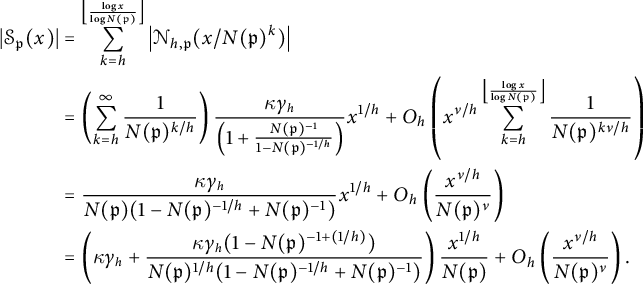
Thus,
 ${\mathcal S}(x)$
and
 ${\mathcal S}_{\mathfrak p}(x)$
satisfy the conditions of Theorem 1.8 with
 $f = \text {identity}$
,
 $\mathcal {S} = \mathcal {N}_h$
,
 $\beta = \eta = 1/h$
,
 $\xi = \nu $
,
 , and
 $$ \begin{align*}C_{{\mathfrak p},\beta}' = C_\beta \frac{1-N({\mathfrak p})^{-(h-1)/h}}{1 - N({\mathfrak p})^{-1/h} + N({\mathfrak p})^{-1}} \quad \text{ with } \quad |C_{{\mathfrak p},\beta}'| \leq C_\beta \frac{1-2^{-(h-1)/h}}{1 - 2^{-1/h} + 2^{-1}}.\end{align*} $$
Thus, applying Theorem 1.8 completes the proof.
6 Other generalizations of the Erdős–Kac theorem
For an integer
 $k \geq 1$
, recall that
 $\omega _k({\mathfrak m})$
counts the distinct prime elements generating
 ${\mathfrak m}$
with multiplicity k.
For an element
 ${\mathfrak m} \in {\mathcal M}$
and an integer
 $k \geq 1$
, let
 ${\mathfrak m}_k$
be defined in (1.15) as
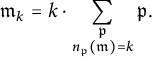 $$ \begin{align*} {\mathfrak m}_k = k \cdot \sum_{\substack{{\mathfrak p} \\ n_{\mathfrak p}({\mathfrak m}) = k}} {\mathfrak p}. \end{align*} $$
We define the map
 $f_k : {\mathcal S} \rightarrow {\mathcal M}$
as
 $$ \begin{align*}f_k({\mathfrak m}) = {\mathfrak m}_k.\end{align*} $$
Recall that, we have
 $$ \begin{align*}\omega(f_k({\mathfrak m})) = \omega_k({\mathfrak m}).\end{align*} $$
For a sequence
 $\mathcal {A} = (a_1, a_2, \ldots )$
of complex numbers, recall that
 $\omega _{\mathcal A}: {\mathcal M} \rightarrow \mathbb {R}$
is defined as
 $$ \begin{align} \omega_{\mathcal A} ({\mathfrak m}) = \sum_{k \geq 1} a_k \ \omega(f_k({\mathfrak m})) = \sum_{k \geq 1} a_k \ \omega_k({\mathfrak m}), \end{align} $$
where the sum is finite for each
 ${\mathfrak m}$
. In this section, we prove the following generalizations of the Erdős–Kac theorem in the order mentioned:
-
(1) Erdős–Kac theorem for
$\omega _1({\mathfrak m})$
over h-free elements with
$h \geq 2$
, -
(2) Erdős–Kac theorem for
$\omega _k({\mathfrak m})$
over k-full elements with
$k \geq 1$
, and -
(3) if
$a_k \neq 0$
, then
$\frac {1}{a_k}\omega _{\mathcal A}$
satisfies the Erdős–Kac theorem over k-full elements.


The first two results are proved as applications of Theorem 1.8, and the final result is deduced from the first two results.
We intend to prove the Erdős–Kac theorem for
 $\omega _1({\mathfrak m})$
over h-free elements given in Theorem 1.11 by applying Theorem 1.1 with
 $f = f_1$
,
 ${\mathcal S} = \mathcal {{\mathcal S}}_h$
,
 $\beta = \eta = 1$
, and
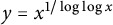 $y = x^{1/\log \log x}$
.
Proof of Theorem 1.11
Consider the set
 $\mathcal {S} = \mathcal {S}_h$
. Recall that, by (1.5) and Lemma 1.6, we have
 $$ \begin{align*}|\mathcal{S}(x)| = \frac{\kappa}{\zeta_{\mathcal M}(h)} x + O_h \big( R_{\mathcal{S}_h}(x) \big),\end{align*} $$
where
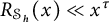 $R_{\mathcal {S}_h}(x) \ll x^\tau $
and
 $0 \leq \tau < 1$
. For a fixed prime element
 ${\mathfrak p}$
, let
 $$ \begin{align*}\mathcal{S}_{\mathfrak p}(x) := \left\{ \mathfrak{m} \in \mathcal{S}_h (x) \ : \ n_{\mathfrak p}(f_1(\mathfrak{m})) \geq 1 \right\} = \left\{ \mathfrak{m} \in \mathcal{S}_h (x) \ : \ n_{\mathfrak p}(\mathfrak{m}) = 1 \right\}.\end{align*} $$
Using Lemma 3.7 with
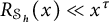 $R_{\mathcal {S}_h}(x) \ll x^\tau $
, and the identity
 $$ \begin{align*}\frac{N({\mathfrak p})^{h} - N({\mathfrak p})^{h-1}}{N({\mathfrak p})^h - 1} = 1 - \frac{N({\mathfrak p})^{h-1}-1}{N({\mathfrak p})^h -1},\end{align*} $$
we obtain
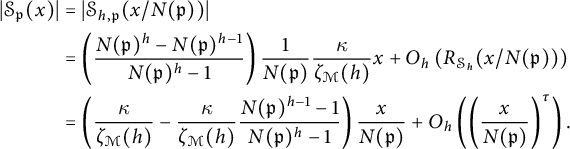 $$ \begin{align*} |\mathcal{S}_{\mathfrak p}(x)| & = |\mathcal{S}_{h,{\mathfrak p}} (x/N({\mathfrak p}))| \notag \\ & = \left( \frac{N({\mathfrak p})^h - N({\mathfrak p})^{h-1}}{N({\mathfrak p})^h - 1} \right) \frac{1}{N({\mathfrak p})} \frac{\kappa}{\zeta_{\mathcal M}(h)} x + O_h \left( R_{\mathcal{S}_h}(x/N({\mathfrak p})) \right) \notag \\ & = \left( \frac{\kappa}{\zeta_{\mathcal M}(h)} - \frac{\kappa}{\zeta_{\mathcal M}(h)} \frac{N({\mathfrak p})^{h-1}-1}{N({\mathfrak p})^h -1} \right) \frac{x}{N({\mathfrak p})} + O_h \left( \left( \frac{x}{N({\mathfrak p})} \right)^\tau \right). \end{align*} $$
Thus,
 ${\mathcal S}(x)$
and
 ${\mathcal S}_{\mathfrak p}(x)$
satisfy the conditions of Theorem 1.8 with
 $f = f_1$
,
 $\mathcal {S} = \mathcal {S}_h$
,
 $\beta = \eta = 1$
,
 $\xi = \tau $
,
 $C_\beta = \kappa /\zeta _{\mathcal M}(h)$
, and
 $$ \begin{align*}C_{{\mathfrak p},\beta}' = - C_\beta \frac{N({\mathfrak p})^h-N({\mathfrak p})}{N({\mathfrak p})^h -1} \quad \text{ with } \quad |C_{{\mathfrak p},\beta}'| \leq C_\beta.\end{align*} $$
Thus, applying Theorem 1.8 and noticing that
 $\omega (f_1({\mathfrak m})) = \omega _1({\mathfrak m})$
completes the proof.
Next, for an integer
 $k \geq 1$
, we prove the Erdős–Kac theorem for
 $\omega _k({\mathfrak m})$
over k-full elements given in Theorem 1.12 by applying Theorem 1.1 with
 $f = f_k$
,
 ${\mathcal S} = \mathcal {N}_k$
,
 $\beta = \eta = 1/k$
, and
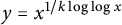 $y = x^{1/k \log \log x}$
. We prove the following.
Proof of Theorem 1.12
First, we deal with the case
 $k = 1$
, that is, when
 ${\mathcal S} = \mathcal {N}_1 = {\mathcal M}$
. By condition (⋆), we have
 $$ \begin{align*}|\mathcal{S}(x)| = \kappa x + O \big( x^\theta \big),\end{align*} $$
where
 $0 \leq \theta < 1$
. For a fixed prime element
 ${\mathfrak p}$
, let
 $$ \begin{align*}\mathcal{S}_{\mathfrak p}(x) := \left\{ \mathfrak{m} \in {\mathcal M}(x) \ : \ n_{\mathfrak p}(f_1(\mathfrak{m})) \geq 1 \right\} = \left\{ \mathfrak{m} \in {\mathcal M} (x) \ : \ n_{\mathfrak p}(\mathfrak{m}) = 1 \right\}.\end{align*} $$
Using (⋆), we have
 $$ \begin{align*} |\mathcal{S}_{\mathfrak p}(x)| = |\mathcal{S}(x/N({\mathfrak p}))| - |\mathcal{S}(x/N({\mathfrak p})^2)| = \left( \kappa - \frac{\kappa}{N({\mathfrak p})} \right) \frac{x}{N({\mathfrak p})} + O\left( \left( \frac{x}{N({\mathfrak p})} \right)^\theta \right). \end{align*} $$
Thus,
 ${\mathcal S}(x)$
and
 ${\mathcal S}_{\mathfrak p}(x)$
satisfy the conditions of Theorem 1.8 with
 $f = f_1$
,
 $\mathcal {S} = \mathcal {M} = \mathcal {N}_1$
,
 $\beta = \eta = 1$
,
 $\xi = \theta $
, and
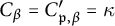 $C_\beta = C_{{\mathfrak p},\beta }' = \kappa $
. Thus, applying Theorem 1.8, for
 $\gamma \in \mathbb {R}$
, we have
 $$ \begin{align*}\lim_{x \rightarrow \infty} \frac{1}{|\mathcal{N}_1(x)|} \left| \left\{ {\mathfrak m} \in \mathcal{N}_1(x) \ : \ N({\mathfrak m}) \geq 3, \ \frac{\omega(f_1({\mathfrak m})) - \log \log N({\mathfrak m})}{\sqrt{\log \log N({\mathfrak m})}} \leq \gamma\right\} \right| = \Phi(\gamma).\end{align*} $$
Finally, noticing that
 $\omega (f_1({\mathfrak m})) = \omega _1({\mathfrak m})$
completes the proof for the case
 $k = 1$
.
Next, we consider the case
 $k = h \geq 2$
, that is, the case of h-full elements. Consider the set
 $\mathcal {S} = \mathcal {N}_h$
. By (1.8) and Remark 1.7, we have

where
 $R_{\mathcal {N}_h}(x) \ll x^{\nu /h}$
for some
 $0 < \nu < 1$
. For a fixed prime ideal
 ${\mathfrak p}$
, let
 $$ \begin{align*}\mathcal{S}_{\mathfrak p}(x) := \left\{ \mathfrak{m} \in \mathcal{N}_h(x) \ : \ n_{\mathfrak p} (f_h(\mathfrak{m})) \geq 1 \right\} = \left\{ \mathfrak{m} \in \mathcal{N}_h(x) \ : \ n_{\mathfrak p} (\mathfrak{m}) = h \right\}.\end{align*} $$
Using Lemma 3.8 with
 $R_{\mathcal {N}_h}(x) \ll x^{\nu /h}$
, and the identity
 $$ \begin{align*}\frac{1-N({\mathfrak p})^{-1/h}}{N({\mathfrak p}) (1-N({\mathfrak p})^{-1/h}+N({\mathfrak p})^{-1})} = \frac{1}{N({\mathfrak p})} - \frac{N({\mathfrak p})^{-1}}{N({\mathfrak p})(1 - N({\mathfrak p})^{-1/h} + N({\mathfrak p})^{-1})},\end{align*} $$
we obtain
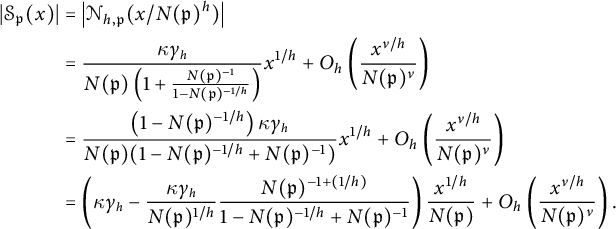
Thus,
 ${\mathcal S}(x)$
and
 ${\mathcal S}_{\mathfrak p}(x)$
satisfy the conditions of Theorem 1.8 with
 $f = f_h$
,
 $\mathcal {S} = \mathcal {N}_h$
,
 $\beta = \eta = 1/h$
,
 $\xi = \nu $
,
 , and
 $$ \begin{align*}C_{{\mathfrak p}, \beta}' = - C_\beta \frac{N({\mathfrak p})^{-(h-1)/h}}{1 - N({\mathfrak p})^{-1/h} + N({\mathfrak p})^{-1}} \quad \text{ with } \quad |C_{{\mathfrak p},\beta}'| \leq C_\beta \frac{2^{-(h-1)/h}}{1 - 2^{-1/h} + 2^{-1}}.\end{align*} $$
Thus, applying Theorem 1.8 and using
 $\omega (f_h({\mathfrak m})) = \omega _h({\mathfrak m})$
establishes the announced result for
 $k = h \geq 2$
. This completes the proof.
Next, for a sequence
 ${\mathcal A} = (a_1, a_2, \ldots )$
with
 $a_k \neq 0$
, we prove that
 $\frac {1}{a_k}\omega _{\mathcal A}$
satisfies the Erdős–Kac theorem over k-full elements in
 ${\mathcal M}$
.
Proof of Theorem 1.13
For a function
 $g : {\mathcal M} \rightarrow \mathbb {C}$
and an element
 ${\mathfrak m} \in {\mathcal M}$
with
 $N({\mathfrak m}) \geq 3$
, let
 $G_g({\mathfrak m})$
be the ratio
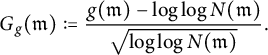 $$ \begin{align} G_g({\mathfrak m}) := \frac{g({\mathfrak m}) - \log \log N({\mathfrak m})}{\sqrt{\log \log N({\mathfrak m})}}. \end{align} $$
By hypothesis,
 $a_k \neq 0$
. In this proof, we will use g to represent
 $\frac {1}{a_k} \omega _{\mathcal A}$
or
 $\omega _k$
when necessary. For
 $a \in \mathbb {R}$
and a subset
 ${\mathcal S}$
of
 ${\mathcal M}$
, let
 ${\mathcal S}(x)$
denote the set of elements of
 ${\mathcal S}$
with norm less than or equal to x, and
 $$ \begin{align} D(g,{\mathcal S},x,a) := \frac{1}{|{\mathcal S}(x)|} \left| \{ {\mathfrak m} \in {\mathcal S}(x) \ : \ G_g({\mathfrak m}) \leq a \} \right| \end{align} $$
be the density function for sufficiently large x. Note that if
 $k \geq 1$
and
 ${\mathfrak m}$
is a k-full element, then
 $\omega _i({\mathfrak m}) = 0$
for all
 $i \in {1, 2, \ldots , k-1}$
. Thus,
 $\frac {1}{a_k}\omega _{\mathcal A}({\mathfrak m}) = \omega _k({\mathfrak m}) + \sum _{i \geq k+1} \frac {a_i}{a_k} \omega _i({\mathfrak m})$
. Moreover, by Theorem 1.12, we have
 $$ \begin{align*}\lim_{x \rightarrow \infty} D(\omega_k, \mathcal{N}_k,x,a) = \Phi(a).\end{align*} $$
We intend to show
 $$ \begin{align*}\lim_{x \rightarrow \infty} D\left( \frac{1}{a_k} \omega_{\mathcal A}, \mathcal{N}_k,x,a \right) = \Phi(a).\end{align*} $$
For any
 $\epsilon> 0$
, we define the set
 $$ \begin{align*}A(\mathcal{N}_k,x,\epsilon) := \left\{ {\mathfrak m} \in \mathcal{N}_k(x) \ : \ \frac{\left| \frac{1}{a_k} \omega_{\mathcal A}({\mathfrak m}) - \omega_k({\mathfrak m}) \right|}{\sqrt{\log \log N({\mathfrak m})}} \leq \epsilon \right\}.\end{align*} $$
Let
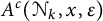 $A^c(\mathcal {N}_k,x,\epsilon )$
denote the complement of
 $A(\mathcal {N}_k,x,\epsilon )$
inside
 $\mathcal {N}_k(x)$
. We first deduce that
 $|A^c(\mathcal {N}_k,x,\epsilon )| = o(\mathcal {N}_k(x))$
. Notice that
 $$ \begin{align*} & \sum_{\substack{ {\mathfrak m} \in A^c(\mathcal{N}_k,x,\epsilon) \\ x/\log x \leq N({\mathfrak m})}} \left| \frac{1}{a_k} \omega_{\mathcal A}({\mathfrak m}) - \omega_k({\mathfrak m}) \right| \\ & \geq \epsilon \sqrt{\log \log (x/\log x)} \ |\{ {\mathfrak m} \in A^c(\mathcal{N}_k,x,\epsilon) \ | \ N({\mathfrak m}) \geq x/\log x \}|. \end{align*} $$
Moreover,
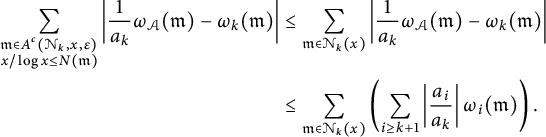 $$ \begin{align*} \sum_{\substack{ {\mathfrak m} \in A^c(\mathcal{N}_k,x,\epsilon) \\ x/\log x \leq N({\mathfrak m})}} \left| \frac{1}{a_k} \omega_{\mathcal A}({\mathfrak m}) - \omega_k({\mathfrak m}) \right| & \leq \sum_{{\mathfrak m} \in \mathcal{N}_k(x)} \left| \frac{1}{a_k} \omega_{\mathcal A}({\mathfrak m}) - \omega_k({\mathfrak m}) \right| \\ & \leq \sum_{{\mathfrak m} \in \mathcal{N}_k(x)} \left( \sum_{i \geq k+1} \left| \frac{a_i}{a_k} \right| \omega_i({\mathfrak m}) \right). \end{align*} $$
Moreover, by condition (⋆) for
 $k =1$
and (1.8) for
 $k \geq 2$
, we have
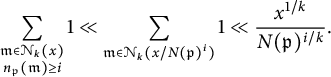 $$ \begin{align*}\sum_{\substack{{\mathfrak m} \in \mathcal{N}_k(x) \\ n_{\mathfrak p}({\mathfrak m}) \geq i}} 1 \ll \sum_{\substack{{\mathfrak m} \in \mathcal{N}_k(x/N({\mathfrak p})^i)}} 1 \ll \frac{x^{1/k}}{N({\mathfrak p})^{i/k}}.\end{align*} $$
Note that the rate of growth of
 $a_i'$
s given in the hypothesis of the theorem ensures that (1.16) holds. Thus, by interchanging sums and applying (1.16), we obtain
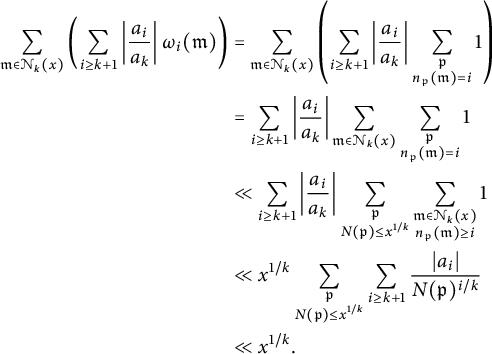 $$ \begin{align*} \sum_{{\mathfrak m} \in \mathcal{N}_k(x)} \left( \sum_{i \geq k+1} \left| \frac{a_i}{a_k} \right| \omega_i({\mathfrak m}) \right) & = \sum_{{\mathfrak m} \in \mathcal{N}_k(x)} \left( \sum_{i \geq k+1} \left| \frac{a_i}{a_k} \right| \sum_{\substack{{\mathfrak p} \\ n_{\mathfrak p}({\mathfrak m}) = i}} 1 \right) \\ & = \sum_{i \geq k+1} \left| \frac{a_i}{a_k} \right| \sum_{{\mathfrak m} \in \mathcal{N}_k(x)} \sum_{\substack{{\mathfrak p} \\ n_{\mathfrak p}({\mathfrak m}) = i}} 1 \\ & \ll \sum_{i \geq k+1} \left| \frac{a_i}{a_k} \right| \sum_{\substack{{\mathfrak p} \\ N({\mathfrak p}) \leq x^{1/k}}} \sum_{\substack{{\mathfrak m} \in \mathcal{N}_k(x) \\ n_{\mathfrak p}({\mathfrak m}) \geq i}} 1 \\ & \ll x^{1/k} \sum_{\substack{{\mathfrak p} \\ N({\mathfrak p}) \leq x^{1/k}}} \sum_{i \geq k+1} \frac{|a_i|}{N({\mathfrak p})^{i/k}} \\ & \ll x^{1/k}. \end{align*} $$
Combining the above results, we obtain
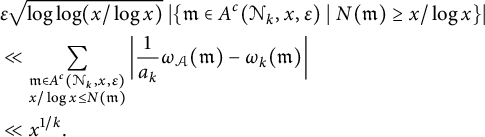 $$ \begin{align*} & \epsilon \sqrt{\log \log (x/\log x)} \ |\{ {\mathfrak m} \in A^c(\mathcal{N}_k,x,\epsilon) \ | \ N({\mathfrak m}) \geq x/\log x \}| \\ & \ll \sum_{\substack{{\mathfrak m} \in A^c(\mathcal{N}_k,x,\epsilon) \\ x/\log x \leq N({\mathfrak m})}} \left| \frac{1}{a_k} \omega_{\mathcal A}({\mathfrak m}) - \omega_k({\mathfrak m}) \right| \\ & \ll x^{1/k}. \end{align*} $$
Thus,
 $$ \begin{align*}|\{ {\mathfrak m} \in A^c(\mathcal{N}_k,x,\epsilon) \ | \ N({\mathfrak m}) \geq x/\log x \}| \ll \frac{x^{1/k}}{\epsilon \sqrt{\log \log (x/\log x)}} = o(x^{1/k}).\end{align*} $$
Moreover, by (1.8),
 $$ \begin{align*}|\{ {\mathfrak m} \in A^c(\mathcal{N}_k,x,\epsilon) \ | \ N({\mathfrak m}) < x/\log x \}| \ll \mathcal{N}_k(x/\log x) \ll_k \frac{x^{1/k}}{\log x} = o(x^{1/k}).\end{align*} $$
Combining the above two results, we deduce
 $$ \begin{align*}|A^c(\mathcal{N}_k,x,\epsilon)| = o(x^{1/k}).\end{align*} $$
Since, by Condition
 $(\star )$
and (1.8) again,
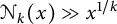 $\mathcal {N}_k(x) \gg x^{1/k}$
, thus
 $|A^c(\mathcal {N}_k,x,\epsilon )| = o(\mathcal {N}_k(x))$
follows.
Note that if
 ${\mathfrak m} \in A(\mathcal {N}_k,x,\epsilon )$
, we have
 $$ \begin{align*}G_{\omega_k}({\mathfrak m}) - \epsilon \leq G_{\frac{1}{a_k}\omega_{\mathcal A}}({\mathfrak m}) \leq G_{\omega_k}({\mathfrak m}) + \epsilon.\end{align*} $$
Thus, for any
 $a \in \mathbb {R}$
, if
 ${\mathfrak m} \in A(\mathcal {N}_k,x,\epsilon )$
, we have
 $$ \begin{align} G_{\omega_k}({\mathfrak m}) \leq a - \epsilon \implies G_{\frac{1}{a_k}\omega_{\mathcal A}}({\mathfrak m}) \leq a \end{align} $$
and
 $$ \begin{align} G_{\frac{1}{a_k}\omega_{\mathcal A}}({\mathfrak m}) \leq a \implies G_{\omega_k}({\mathfrak m}) \leq a + \epsilon. \end{align} $$
By (6.4), we have
 $$ \begin{align*}\{ {\mathfrak m} \in A(\mathcal{N}_k,x,\epsilon) \ : \ G_{\omega_k}({\mathfrak m}) \leq a - \epsilon \} \subseteq \{ {\mathfrak m} \in A(\mathcal{N}_k,x,\epsilon) \ : \ G_{\frac{1}{a_k}\omega_{\mathcal A}}({\mathfrak m}) \leq a \},\end{align*} $$
which implies
 $$ \begin{align*} & \{ {\mathfrak m} \in A(\mathcal{N}_k,x,\epsilon) \ : \ G_{\omega_k}({\mathfrak m}) \leq a - \epsilon \} \cup \{ {\mathfrak m} \in A^c(\mathcal{N}_k,x,\epsilon) \ : \ G_{\omega_k}({\mathfrak m}) \leq a - \epsilon \} \\ &\quad = \{ {\mathfrak m} \in \mathcal{N}_k(x) \ : \ G_{\omega_k}({\mathfrak m}) \leq a - \epsilon \} \\ &\quad \subseteq \{ {\mathfrak m} \in \mathcal{N}_k(x) \ : \ G_{\frac{1}{a_k}\omega_{\mathcal A}}({\mathfrak m}) \leq a \} \cup \{ {\mathfrak m} \in A^c(\mathcal{N}_k,x,\epsilon) \ : \ G_{\omega_k}({\mathfrak m}) \leq a - \epsilon \}. \end{align*} $$
Thus,
 $$ \begin{align*}|\{ {\mathfrak m} \in \mathcal{N}_k(x) \ : \ G_{\omega_k}({\mathfrak m}) \leq a - \epsilon \}| \leq |\{ {\mathfrak m} \in \mathcal{N}_k(x) \ : \ G_{\frac{1}{a_k}\omega_{\mathcal A}}({\mathfrak m}) \leq a \}| + |A^c(\mathcal{N}_k,x,\epsilon)|.\end{align*} $$
Therefore, by the definition of
 $D(g,\mathcal {N}_k,x,a)$
, Theorem 1.12, and the result
 $|A^c(\mathcal {N}_k,x,\epsilon )| = o(\mathcal {N}_k(x))$
above, we have
 $$ \begin{align} \Phi(a-\epsilon) \leq \liminf_{x \rightarrow \infty} D\left(\frac{1}{a_k}\omega_{\mathcal A},\mathcal{N}_k,x,a \right). \end{align} $$
Moreover, by (6.5), we have
 $$ \begin{align*}\{ {\mathfrak m} \in A(\mathcal{N}_k,x,\epsilon) \ : \ G_{\frac{1}{a_k}\omega_{\mathcal A}}({\mathfrak m}) \leq a \} \subseteq \{ {\mathfrak m} \in A(\mathcal{N}_k,x,\epsilon) \ : \ G_{\omega_k}({\mathfrak m}) \leq a + \epsilon \},\end{align*} $$
which implies
 $$ \begin{align*} & \{ {\mathfrak m} \in A(\mathcal{N}_k,x,\epsilon) \ : \ G_{\frac{1}{a_k}\omega_{\mathcal A}}({\mathfrak m}) \leq a \} \cup \{ {\mathfrak m} \in A^c(\mathcal{N}_k,x,\epsilon) \ : \ G_{\frac{1}{a_k}\omega_{\mathcal A}}({\mathfrak m}) \leq a \} \\ &\quad\qquad\qquad\qquad\quad = \{ {\mathfrak m} \in \mathcal{N}_k(x) \ : \ G_{\frac{1}{a_k}\omega_{\mathcal A}}({\mathfrak m}) \leq a \} \\ &\quad \subseteq \{ {\mathfrak m} \in \mathcal{N}_k(x) \ : \ G_{\omega_k}({\mathfrak m}) \leq a + \epsilon \} \cup \{ {\mathfrak m} \in A^c(\mathcal{N}_k,x,\epsilon) \ : \ G_{\frac{1}{a_k}\omega_{\mathcal A}}({\mathfrak m}) \leq a \}. \end{align*} $$
Thus,
 $$ \begin{align*}|\{ {\mathfrak m} \in \mathcal{N}_k(x) \ : \ G_{\frac{1}{a_k}\omega_{\mathcal A}}({\mathfrak m}) \leq a \}| \leq |\{ {\mathfrak m} \in \mathcal{N}_k(x) \ : \ G_{\omega_k}({\mathfrak m}) \leq a + \epsilon \}| + |A^c(\mathcal{N}_k,x,\epsilon)|.\end{align*} $$
Again, by the definition of
 $D(g,\mathcal {N}_k,x,a)$
, Theorem 1.12, and the result
 $|A^c(\mathcal {N}_k,x,\epsilon )| = o(\mathcal {N}_k(x))$
above, we have
 $$ \begin{align} \limsup_{x \rightarrow \infty} D\left(\frac{1}{a_k}\omega_{\mathcal A},\mathcal{N}_k,x,a \right) \leq \Phi(a+\epsilon). \end{align} $$
Combining (6.6) and (6.7), we obtain
 $$ \begin{align*}\Phi(a-\epsilon) \leq \liminf_{x \rightarrow \infty} D\left(\frac{1}{a_k}\omega_{\mathcal A},\mathcal{N}_k,x,a \right) \leq \limsup_{x \rightarrow \infty} D\left(\frac{1}{a_k}\omega_{\mathcal A},\mathcal{N}_k,x,a \right) \leq \Phi(a+\epsilon).\end{align*} $$
Since
 $\epsilon> 0$
is arbitrary, thus we obtain
 $$ \begin{align*}\lim_{x \rightarrow \infty} D\left(\frac{1}{a_k}\omega_{\mathcal A},\mathcal{N}_k,x,a \right) = \Phi(a).\end{align*} $$
This completes the proof.
7 Applications of the general setting
In this section, we provide various applications of our general setting. In each case, we show that condition (⋆) holds, and thus deduce the Erdős–Kac theorem for the
 $\omega _{\mathcal A}$
-function over h-free and k-full elements, for some integers
 $h \geq 2$
and
 $k \geq 1$
, where
 ${\mathcal A} = (a_1, a_2, \ldots )$
satisfies some of the following types:
-
(1) if
$a_i = 1$
for all
$i \in \mathbb {Z}_{>0}$
, that is,
$\omega _{\mathcal A}({\mathfrak m}) = \omega ({\mathfrak m})$
; -
(2) if
$a_i = i$
for all
$i \in \mathbb {Z}_{>0}$
, that is,
$\omega _{\mathcal A}({\mathfrak m}) = \Omega ({\mathfrak m})$
; -
(3) if
$a_i = \log (i+1)$
for all
$i \in \mathbb {Z}_{>0}$
, that is,
$\omega _{\mathcal A}({\mathfrak m}) = \log d({\mathfrak m})$
; -
(4) if
$a_i = 1$
for all odd i, and
$a_i = - 1$
for all even i, that is,
$\omega _{\mathcal A}({\mathfrak m}) = \omega _T({\mathfrak m})$
(see (1.17)); -
(5) if
$a_i = 0$
for all
$i \neq k$
and
$a_k = 1$
, that is,
$\omega _{\mathcal A}({\mathfrak m}) = \omega _k({\mathfrak m})$
.















7.1 The case of ideals in number fields
Let
 $K/\mathbb {Q}$
be a number field of degree
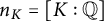 $n_K = [K: \mathbb {Q}]$
and
 $\mathcal {O}_K$
be its ring of integers. Let
 $\mathcal {P}$
be the set of prime ideals of
 $\mathcal {O}_K$
and
 $\mathcal {M}$
be the set of ideals of
 $\mathcal {O}_K$
. Let the norm map be
 $N: \mathcal {M} \rightarrow \mathbb {Z}_{>0}$
be the standard norm map, that is,
 $\mathfrak {m} \mapsto N(\mathfrak {m}) := |\mathcal {O}_K/ \mathfrak {m}|$
. Let
 $X = \mathbb {Q}$
.
Let
 $\kappa _K$
be given by
 $$ \begin{align*} \kappa_K = \frac{2^{r_1}(2 \pi)^{r_2} h R}{\nu \sqrt{|d_K|}}, \end{align*} $$
with
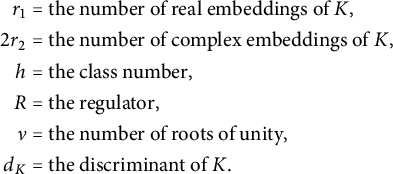 $$ \begin{align*} r_1 & = \text{the number of real embeddings of } K,\\ 2 r_2 & = \text{the number of complex embeddings of } K,\\ h & = \text{the class number},\\ R & = \text{the regulator}, \\ \nu & = \text{the number of roots of unity}, \\ d_K & = \text{the discriminant of } K. \end{align*} $$
Landau in [Reference Landau9, Satz 210] proved that
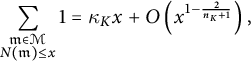
which satisfies condition (⋆) with
 $\kappa = \kappa _K$
and
 . Thus, Theorems 1.14 and 1.13 give the Erdős–Kac theorem for
 $\omega _{\mathcal A}({\mathfrak m})$
over h-free and k-full ideals, respectively, as the following.
Corollary 7.1 Let
 $x> 2$
be a rational number. Let
 $h \geq 2$
be an integer. Let
 $\mathcal {S}_h(x)$
be the set of h-free ideals with norm less than or equal to x. Let
 ${\mathcal A}$
be any sequence from Types 1–4 and Type 5 with
 $k = 1$
. Then, for
 $a \in \mathbb {R}$
, we have
 $$ \begin{align*}\lim_{x \rightarrow \infty} \frac{1}{|\mathcal{S}_h(x)|} \bigg| \left\{ {\mathfrak m} \in \mathcal{S}_h(x) \ : \ |\mathcal{O}_K/ \mathfrak{m}| \geq 3, \ \frac{\frac{1}{a_1} \omega_{\mathcal A}({\mathfrak m}) - \log \log |\mathcal{O}_K/ \mathfrak{m}|}{\sqrt{\log \log |\mathcal{O}_K/ \mathfrak{m}|}} \leq a \right\} \bigg| = \Phi(a).\end{align*} $$
Corollary 7.2 Let
 $x> 2$
be a rational number. Let
 $k \geq 1$
be an integer. Let
 $\mathcal {N}_k(x)$
be the set of k-full ideals with norm less than or equal to x. Let
 ${\mathcal A}$
be any sequence from Types 1–5. Then, for
 $a \in \mathbb {R}$
, we have
 $$ \begin{align*}\lim_{x \rightarrow \infty} \frac{1}{|\mathcal{N}_k(x)|} \bigg| \left\{ {\mathfrak m} \in \mathcal{N}_k(x) \ : \ |\mathcal{O}_K/ \mathfrak{m}| \geq 3, \ \frac{\frac{1}{a_k} \omega_{\mathcal A}({\mathfrak m}) - \log \log |\mathcal{O}_K/ \mathfrak{m}|}{\sqrt{\log \log |\mathcal{O}_K/ \mathfrak{m}|}} \leq a \right\} \bigg| = \Phi(a).\end{align*} $$
Remark 7.3 The Erdos-Kac theorems for
 $\omega ({\mathfrak m})$
over h-free and h-full ideals were first proved in [Reference Das, Kuo and Liu1, Theorems 1.3 and 1.4], which employed a similar proof strategy as in this article.
7.2 The case of effective divisors in global function fields
Let q be a prime power and
 $\mathbb {F}_q$
be the finite field with q elements. Let
 $K/\mathbb {F}_q$
be a global function field. Let
 $G_K$
be its genus and
 $C_K$
be its class number. A prime
 ${\mathfrak p}$
in K is a discrete valuation ring R with maximal ideal P such that
 $P \subset R$
and the quotient field of R is K. The degree of
 ${\mathfrak p}$
, denoted as
 $\deg {\mathfrak p}$
, is defined as the dimension of
 $R/P$
over
 $\mathbb {F}_q$
, which is finite. Let
 ${\mathcal P}$
be the set of all primes in K. Let
 ${\mathcal M}$
be the free abelian monoid generated by
 ${\mathcal P}$
. More precisely, for each
 ${\mathfrak m} \in \mathcal {M}$
, we write
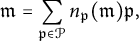 $$ \begin{align*}{\mathfrak m} = \sum_{{\mathfrak p} \in \mathcal{P}} n_{\mathfrak p}({\mathfrak m}) {\mathfrak p},\end{align*} $$
with
 $n_{\mathfrak p}({\mathfrak m}) \in \mathbb {Z}_{>0} \cup \{ 0 \}$
and
 $n_{\mathfrak p}({\mathfrak m}) =0$
for all but finitely many
 ${\mathfrak p}$
. We call elements in
 ${\mathcal M}$
as effective divisors. For an element
 ${\mathfrak m} \in {\mathcal M}$
, we define the degree of
 ${\mathfrak m}$
as
 $$ \begin{align*}\deg {\mathfrak m} = \sum_{{\mathfrak p} \in \mathcal{P}} n_{\mathfrak p}({\mathfrak m}) \deg {\mathfrak p}.\end{align*} $$
By [Reference Rosen14, Lemma 5.5], for any integer
 $n \geq 0$
, there are finitely many effective divisors of degree n. This proves that
 ${\mathcal P}$
is a countable set that satisfies the hypothesis of our main theorems. Let the norm map
 $N: \mathcal {M} \rightarrow \mathbb {Z}_{>0}$
be the q-power map defined as
 $\mathfrak {m} \mapsto N({\mathfrak m}) := q^{\deg \mathfrak {m}}$
. Let
 $X = \{ q^z : z \in \mathbb {Z} \}$
.
By [Reference Rosen14, Lemma 5.8 and Corollary 4 to Theorem 5.4], for a nonnegative integer n satisfying
 $n> 2 G_K - 2$
, the number of effective divisors of degree n is
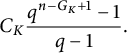 $$ \begin{align*}C_K \frac{q^{n- G_K+1} -1}{q-1}.\end{align*} $$
Thus, for sufficiently large n, we obtain
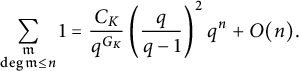 $$ \begin{align*}\sum_{\substack{{\mathfrak m} \\ \deg {\mathfrak m} \leq n}} 1 = \frac{C_K}{q^{G_K}} \left( \frac{q}{q-1} \right)^2 q^n + O(n).\end{align*} $$
This satisfies condition (⋆) with
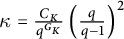 $\kappa = \frac {C_K}{q^{G_K}} \left ( \frac {q}{q-1} \right )^2$
and
 $\theta = \epsilon $
for any
 $\epsilon \in (0,1)$
. Thus, Theorems 1.14 and 1.13 give the Erdos–Kac theorems for
 $\omega _{\mathcal A}({\mathfrak m})$
over h-free and k-full effective divisors in a global function field, respectively, as the following.
Corollary 7.4 Let
 $n, h \in \mathbb {Z}_{>0}$
with
 $h \geq 2$
. Let
 $K/\mathbb {F}_q$
be a global function field with genus
 $G_K$
and class number
 $C_K$
. Let
 $\mathcal {S}_h(n)$
be the set of h-free effective divisors in K of degree less than or equal to n. Let
 ${\mathcal A}$
be any sequence from Types 1–4 and Type 5 with
 $k = 1$
. Then, for
 $a \in \mathbb {R}$
, we have
 $$ \begin{align*}\lim_{n \rightarrow \infty} \frac{1}{|\mathcal{S}_h(n)|} \bigg| \left\{ {\mathfrak m} \in \mathcal{S}_h(n) \ : \ q^{\deg \mathfrak{m}} \geq 3, \ \frac{\frac{1}{a_1} \omega_{\mathcal A}({\mathfrak m}) - \log \log q^{\deg \mathfrak{m}}}{\sqrt{\log \log q^{\deg \mathfrak{m}}}} \leq a \right\} \bigg| = \Phi(a).\end{align*} $$
Corollary 7.5 Let
 $n, h \in \mathbb {Z}_{>0}$
. Let
 $K/\mathbb {F}_q$
be a global function field with genus
 $G_K$
and class number
 $C_K$
. Let
 $\mathcal {N}_k(n)$
be the set of k-full effective divisors in K of degree less than or equal to n. Let
 ${\mathcal A}$
be any sequence from Types 1–5. Then, for
 $a \in \mathbb {R}$
, we have
 $$ \begin{align*}\lim_{n \rightarrow \infty} \frac{1}{|\mathcal{N}_k(n)|} \bigg| \left\{ {\mathfrak m} \in \mathcal{N}_k(n) \ : \ q^{\deg \mathfrak{m}} \geq 3, \ \frac{\frac{1}{a_k} \omega_{\mathcal A}({\mathfrak m}) - \log \log q^{\deg \mathfrak{m}}}{\sqrt{\log \log q^{\deg \mathfrak{m}}}} \leq a \right\} \bigg| = \Phi(a).\end{align*} $$
Remark 7.6 For the special case when
 $K = \mathbb {F}_q(x)$
, whose genus and class number are 0 and 1, respectively, we can consider the abelian monoid
 $Z = \mathbb {F}_q[x]$
, the ring of monic polynomials in one variable over
 $\mathbb {F}_q$
. The prime elements of Z are the monic irreducible polynomials in Z. The localizations of Z at these prime elements exhaust the set of all primes of K except one, the prime at infinity. Using the fact that there are
 $q^n$
monic polynomials of degree n, we obtain
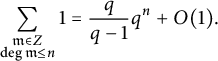 $$ \begin{align*}\sum_{\substack{{\mathfrak m} \in Z \\ \deg \mathfrak{m} \leq n}} 1 = \frac{q}{q-1} q^n + O(1).\end{align*} $$
This satisfies condition (⋆) with
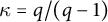 $\kappa = q/(q-1)$
and
 $\theta = 0$
. Thus, the Erdős–Kac theorems for
 $\omega ({\mathfrak m})$
over h-free and h-full polynomials over finite fields can be deduced from Theorems 1.14 and 1.13. Such a result will be equivalent to the ones studied by Lalín and Zhang [Reference Lalín and Zhang8, Theorems 4.2 and 6.2].
Similarly, we can deduce the Erdős–Kac theorems for
 $\Omega ({\mathfrak m})$
over h-free and h-full polynomials, which will be equivalent to the results of Lalín and Zhang [Reference Lalín and Zhang8, Theorems 1.3 and 1.6]. We can also deduce the Erdős–Kac theorems for
 $\omega _1({\mathfrak m})$
over h-free polynomials and
 $\omega _h({\mathfrak m})$
over h-full polynomials, which will be equivalent to the results of Goméz and Lalín [Reference Gómez and Lalín6, Theorems 1.2 and 1.6].
Note that, in this special case,
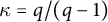 $\kappa = q/(q-1)$
instead of
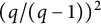 $(q/(q-1))^2$
to account for the lack of the prime at infinity analog in its construction.
Remark 7.7 The study of global function fields over
 $\mathbb {F}_q$
is geometrically equivalent to the study of irreducible projective varieties of dimension 1 over
 $\mathbb {F}_q$
. Such varieties are also called irreducible curves. We can apply our main theorems to irreducible projective varieties of dimension r over
 $\mathbb {F}_q$
, where r is any positive integer. We study this in the following section.
7.3 The case of effective
$0$
-cycles in geometrically irreducible projective varieties of dimension r

In this section, we adopt notation from [Reference Liu11, Example 4 of Section 4].
Let q be a prime power and
 $\mathbb {F}_q$
be the finite field with q elements. Let r be a positive integer. Let
 $V/\mathbb {F}_q$
be a geometrically irreducible projective variety of dimension r. Let
 ${\mathcal P}$
be the set of closed points of
 $V/\mathbb {F}_q$
, which is in bijection with the set of orbits of
 $V/\mathbb {F}_q$
under the action of
 $\text {Gal}(\bar {\mathbb {F}}_q/\mathbb {F}_q)$
(see [Reference Lorenzini12, Proposition 6.9]). For each
 ${\mathfrak p} \in {\mathcal P}$
, we define the degree of
 ${\mathfrak p}$
,
 $\deg {\mathfrak p}$
, to be the length of the corresponding orbit. Let
 ${\mathcal M}$
be the free abelian monoid generated by
 ${\mathcal P}$
. We call elements in
 ${\mathcal M}$
as effective 0-cycles. For
 ${\mathfrak m} \in {\mathcal M}$
, we have
 ${\mathfrak m} = \sum _{{\mathfrak p} \in \mathcal {P}} n_{\mathfrak p}({\mathfrak m}) {\mathfrak p}$
with
 $n_{\mathfrak p}({\mathfrak m}) \in \mathbb {Z}_{>0} \cup \{ 0 \}$
and
 $n_{\mathfrak p}({\mathfrak m}) =0$
for all but finitely many
 ${\mathfrak p}$
. We define the degree of
 ${\mathfrak m}$
as
 $$ \begin{align*}\deg {\mathfrak m} = \sum_{{\mathfrak p} \in \mathcal{P}} n_{\mathfrak p}({\mathfrak m}) \deg {\mathfrak p}.\end{align*} $$
By [Reference Lorenzini12, Lemma 3.11], we deduce that
 ${\mathcal P}$
is countable and satisfies the hypothesis of our main theorems. Let the norm map
 $N: \mathcal {M} \rightarrow \mathbb {Z}_{>0}$
be the
 $q^r$
-power map defined as
 $\mathfrak {m} \mapsto N({\mathfrak m}) := q^{r \deg \mathfrak {m}}$
. Let
 $X = \{ q^{rz} : z \in \mathbb {Z} \}$
. In [Reference Liu11, Remark 1 of Section 4], the third author proved that
 $$ \begin{align*}\sum_{\substack{{\mathfrak m} \\ \deg \mathfrak{m} \leq n}} 1 = \kappa' \left( \frac{q^r}{q^r-1} \right) q^{rn} + O \left( n \cdot q^{(r-1)n} \right),\end{align*} $$
where
 $\kappa '$
is some positive constant defined explicitly in [Reference Liu11, Lemma 7 of Section 4]. This satisfies condition (⋆) with
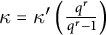 $\kappa = \kappa ' \left ( \frac {q^r}{q^r-1} \right )$
and
 $\theta = \epsilon $
for any
 $\epsilon \in (1-1/r,1)$
. Thus, Theorems 1.14 and 1.13 give the Erdős–Kac theorems
 $\omega _{\mathcal A}({\mathfrak m})$
over h-free and k-full effective 0-cycles in a geometrically irreducible projective variety of dimension r as the following.
Corollary 7.8 Let
 $r, n \in \mathbb {Z}_{>0}$
. Let
 $h \geq 2$
be an integer. Let
 $V/\mathbb {F}_q$
be a geometrically irreducible projective variety of dimension r. Let
 $\mathcal {S}_h(n)$
be the set of h-free effective
 $0$
-cycles in V of degree less than or equal to n. Let
 ${\mathcal A}$
be any sequence from Types 1–4 and Type 5 with
 $k = 1$
. Then, for
 $a \in \mathbb {R}$
, we have
 $$ \begin{align*}\lim_{n \rightarrow \infty} \frac{1}{|\mathcal{S}_h(n)|} \bigg| \left\{ {\mathfrak m} \in \mathcal{S}_h(n) \ : \ q^{r \deg \mathfrak{m}} \geq 3, \ \frac{\frac{1}{a_1} \omega_{\mathcal A}({\mathfrak m}) - \log \log q^{r \deg \mathfrak{m}}}{\sqrt{\log \log q^{r \deg \mathfrak{m}}}} \leq a \right\} \bigg| = \Phi(a).\end{align*} $$
Corollary 7.9 Let
 $r,n \in \mathbb {Z}_{>0}$
. Let
 $k \geq 1$
be an integer. Let
 $V/\mathbb {F}_q$
be a geometrically irreducible projective variety of dimension r. Let
 $\mathcal {N}_k(n)$
be the set of k-full effective
 $0$
-cycles in V of degree less than or equal to n. Let
 ${\mathcal A}$
be any sequence from Types 1–5. Then, for
 $a \in \mathbb {R}$
, we have
 $$ \begin{align*}\lim_{n \rightarrow \infty} \frac{1}{|\mathcal{N}_k(n)|} \bigg| \left\{ {\mathfrak m} \in \mathcal{N}_k(n) \ : \ q^{r \deg \mathfrak{m}} \geq 3, \ \frac{\frac{1}{a_k} \omega_{\mathcal A}({\mathfrak m}) - \log \log q^{r \deg \mathfrak{m}}}{\sqrt{\log \log q^{r \deg \mathfrak{m}}}} \leq a \right\} \bigg| = \Phi(a).\end{align*} $$
Acknowledgements
We sincerely thank the referee for their time and effort in reviewing our manuscript, and for directing us to relevant details in the literature. Their insightful feedback has greatly helped shape and improve the current version of our article.



