Implications
High-fibre diets generally limit energy intake and growth performance in restrictedly-fed finishing pigs. This study showed that not all fibres influence energy intake equally in ad libitum-fed pigs. Moreover, growth performance was overall not reduced, and feed efficiency was enhanced in pigs fed resistant starch, despite lower digestibility. This implies that energy utilization of resistant starch may be similar to that of digestible starch. For diets formulation and manufacturing, this could mean reduced need for starch gelatinization, whereas in net energy systems used for feed ingredients evaluation, the incremental efficiency of conversion of resistant starch into retained energy could be reconsidered.
Introduction
Dietary fibre is a generic term for a range of non-starch polysaccharides (Topping and Clifton, Reference Topping and Clifton2001) that vary considerably in their physicochemical properties and may affect energy intake by different mechanisms (Wanders et al., Reference Wanders, van den Borne, de Graaf, Hulshof, Jonathan, Kristensen, Mars, Schols and Feskens2011). Viscous and gelling fibres have been associated with earlier satiation, that is, meal termination (Georg Jensen et al., Reference Georg Jensen, Pedersen, Kristensen, Frost and Astrup2013), which is related to a reduced rate of gastric emptying and to a reduced postprandial glucose response (Hoebler et al., Reference Hoebler, Guillon, Darcy-Vrillon, Vaugelade, Lahaye, Worthington, Duée and Barry2000). Fibres that are fermented in the caecum and colon have been associated with prolonged satiety, that is, postprandial inhibition of feeding motivation (Souza da Silva et al., Reference Souza da Silva, Van den Borne, Gerrits, Kemp and Bolhuis2012 and Reference Souza da Silva, Bolhuis, Gerrits, Kemp and Van den Borne2013), which is often attributed to a more gradual energy supply to the body during the day (Regmi et al., Reference Regmi, van Kempen, Matte and Zijlstra2011).
Satiating properties of fibres may potentially be used to limit energy intake in breeding sows or finishing pigs without the need for quantitative feed restriction, while improving welfare by reducing hunger feeling. However, given that increasing dietary fibre level generally reduces dietary digestible energy (DE) content, and decreases nutrient and energy digestibility (Noblet and Le Goff, Reference Noblet and Le Goff2001), pigs may increase their voluntary feed intake to try to meet their energy requirements (Cole et al., Reference Cole, Duckworth, Holmes and Cuthbertson1968; Torrallardona and Roura, Reference Torrallardona and Roura2009). Anticipated satiating properties of viscous and fermentable fibres originate mainly from short-term studies in restrictedly-fed adult pigs fed two daily meals during 8 weeks (Souza da Silva et al., Reference Souza da Silva, Van den Borne, Gerrits, Kemp and Bolhuis2012 and Reference Souza da Silva, Bolhuis, Gerrits, Kemp and Van den Borne2013). It is yet unclear if satiating properties of these fibres lead to a reduced energy intake in pigs fed ad libitum during a prolonged period.
The objective of the present study was to assess the potential of a gelling fibre (alginate (ALG)), a fermentable fibre (resistant starch (RS)), and the combination of both, to modify feeding patterns (via satiation and satiety), and thereby long-term feed intake and growth performance of growing pigs fed ad libitum during 12 weeks. In addition, the extent to which pigs compensated for the reduced DE content of the fibre diets was evaluated.
Material and methods
Experimental design
The experiment was set up as a 2×2 factorial arrangement: inclusion of ALG (yes or no) and inclusion of RS (yes or no) in the control diet, resulting in four dietary treatments, that is, ALG−RS− (control), ALG+RS−, ALG−RS+, and ALG+RS+. The experiment was carried out in two successive batches. Forty pens in total were allocated to treatments (n=10 pens per treatment) with an equal number of barrows and gilts in each pen (n=6 pigs per pen). Pigs had ad libitum access to their dietary treatments for 12 weeks. The Animal Care and Use Committee of Wageningen University (Wageningen, The Netherlands) approved the protocol for this experiment.
Animals, housing and diets
Per batch, 120 growing Shade Oak Duroc×Hypor gilts and barrows with an initial BW of 37.8±0.3 kg (age: 3 months) were used. Pigs were selected 4 weeks before the start of the experiment and were allocated to groups of eight (four barrows and four gilts) balanced for BW at birth, BW at weaning (age: 3 weeks), gender, and litter. One week before the start of the experiment one barrow and one gilt were removed from each pen in order to increase BW uniformity within and between pens. Pens (12 m2) had partly slatted floors, and were evenly distributed over three climate-controlled rooms at the experimental facilities of the Nutreco Swine Research Centre (Sint Anthonis, The Netherlands). The room temperature was maintained at 20±2°C, and artificial lights were on from 0600 until 2200 h and dimmed during the night. Pens were equipped with an electronic feeding station (Compident MLP, Model 1; Schauer Agrotronic GmbH, Prambachkirchen, Austria) to monitor individual feed intake. Water was continuously available throughout the experiment, via two nipple drinkers located opposite to the feeding station. Pigs were provided with a variety of toys, including a hanging metal chain with small ball, a metal chain with screws provided on the floor and a rubber ball, which remained in the pen throughout the experiment.
The composition of the diets is presented in Supplementary Table S1. A wheat- and soya bean meal-based control diet containing 40% pregelatinized potato starch (PaselliTM WA4; Avebe Food, Veendam, The Netherlands) was formulated. In the ALG+RS−, ALG−RS+, and ALG+RS+ diets, pregelatinized potato starch from the control diet was replaced on a dry matter (DM) basis by either 5% sodium alginate (Pectacon M-5761; Acatris, Bunschoten, The Netherlands), or 34% retrograded tapioca starch (C*Actistar 11700; Cargill, Amsterdam, The Netherlands), or both, respectively. The fibre levels used were the maximum that could be provided to the pigs without causing digestive problems, and were based on a previous study (Souza da Silva et al., Reference Souza da Silva, Bolhuis, Gerrits, Kemp and Van den Borne2013). Moreover, effective dosages for inducing satiation or satiety were expected to differ between fibre sources, due to different mechanisms (gelling, fermentable). Therefore, levels were specific for each fibre type. Diets were designed to meet nutrient requirements according to the Centraal Veevoeder Bureau (2007), and were isoenergetic in their gross energy (GE) content. Diets were given a flavour (1.5 g/kg, Luctarom Advance Cherry Honey; Lucta S.A., Barcelona, Spain) to mask differences in palatability as much as possible, and titanium dioxide (2.5 g/kg) was added as an indigestible marker. Diets were pelleted to guarantee homogeneous distribution of ingredients and marker, and to avoid malfunctioning of the feeding stations. Pigs had ad libitum access to feed throughout the experiment.
Before the start of the experiment, all pigs were fed a commercial pelleted feed, and were allowed a 3-week habituation to their pen, group, and electronic feeding station, followed by a period of gradual adaptation to the experimental diets to prevent feed neophobia during the experiment. The change to the experimental diets took place during 5 days in which the commercial feed was gradually exchanged for one of the experimental diets. The experiment was carried out over a 12-week period.
Chemical analyses
The diets were analysed for DM, ash, starch, sugar, CP, crude fat, ADF, ADL, GE, and titanium, see Supplementary Material S1 for details. The content of dietary fibre was calculated by subtracting the ash, starch, sugar, CP, and crude fat content from the DM content.
Feeding patterns
Feed intake was recorded via the electronic feeding station, see Supplementary Material S2 for details. Intervals between successive visits of the same pig shorter than 5 min (which was used as meal criterion) were grouped into the same meal (De Haer and Merks, Reference De Haer and Merks1992), and then used to estimate mean values for cumulative feed intake (kg) during the whole experiment, daily feed intake (kg), feed intake per meal (g), meal duration (min; time from start first visit to end last visit belonging to a meal), inter-meal interval (min; time between the end of one meal and the initiation of next), daily time feeding (min; sum of duration of all meals on a day), and number of meals per day.
Apparent total tract digestibility
Faeces were collected from three randomly selected pigs in each pen during 3 days in week 6 of each batch for the determination of apparent total tract digestibility of energy, DM and CP. Faecal samples were collected directly from the rectum of each pig twice a day and weighed. All collected faeces were stored at −20°C until further analyses. The total faeces of each pen within each batch (n=10 pens per treatment) was dried (70°C), pooled, mixed, sampled and analysed for DM, CP, GE and titanium as described earlier. Apparent total tract digestibility for energy and CP was calculated as previously described (Bosch et al., Reference Bosch, Verbrugghe, Hesta, Holst, van der Poel, Janssens and Hendriks2009). The DE content of the diet was calculated as its GE content multiplied by the digestibility coefficient for the energy.
Growth performance
Pigs were weighed throughout the experiment in weeks 1, 2, 4, 6, 8, 10, 11 and 12, and had backfat and muscle thickness estimated in week 12. Backfat and muscle estimates were recorded ~6.5 cm off the dorsal midline near the last rib (P2 location) using a portable real-time ultrasound scanner (Vetko Plus; Noveko, Quebec, Canada). The growth rate data combined with information about cumulative feed intake were used for calculations of feed efficiency, which was expressed in two ways: gain to feed ratio (gain : DM intake), based on DM intake, and gain to energy ratio (gain : DE intake), based on DE intake calculated in gigajoules (GJ).
All pigs (age: 6 months) were slaughtered at a commercial abattoir at the end of the 12-week period of each batch. Pigs were electrically stunned, exsanguinated, scalded, dehaired and eviscerated according to standard procedures. After evisceration, carcasses were weighed. The carcass growth was defined as the final carcass weight measured for a pig at slaughter minus the estimated initial carcass weight (week 1) of that pig. Initial carcass weight was estimated as the initial BW multiplied by the final carcass : BW ratio, assuming the carcass : BW ratio of all pigs at the start of the experiment to be similar to that of the control-fed pigs at slaughter. This assumption was made because there was no reference group of pigs being slaughtered at the start of the experiment, and because as based on previous studies (Shields et al., Reference Shields, Mahan and Graham1983; Wiseman et al., Reference Wiseman, Mahan, Peters, Fastinger, Ching and Kim2007) carcass : BW ratio tends to only increase with age. The carcass growth combined with information about cumulative feed intake were used for calculations of carcass efficiency, which was expressed as carcass gain to feed ratio (carcass gain : DM intake), based on DM intake, and carcass gain to energy ratio (carcass gain : DE intake), based on DE intake calculated in GJ.
Empty weights of the gastrointestinal tract
From 48 pigs (12 pigs per dietary treatment in a 1 : 1 gender ratio) in batch 2, the gastrointestinal tract was separated into stomach, small intestine, caecum and colon after slaughter. These parts were cut open and emptied by gently squeezing digesta out. The colon was also washed with water to remove remaining digesta. The empty weights of the different parts were recorded and expressed in g/kg BW. The weight of mesenteric tissue was also recorded as a separate part.
Behavioural observations
Pigs were observed in their home pen during 1 day at the start of weeks 7 and 12 in each batch during 6 intervals of 1 h using 4 min-instantaneous scan sampling. Live observations started at 0800, 0915, 1030, 1400, 1515 and 1630 h. Every 4 min, the posture of each pig and its behaviour were scored. Postures were lying, standing, walking, sitting and kneeling. Standing and walking were summed as ‘standing and walking’, and sitting and kneeling were also summed as ‘sitting and kneeling’. Behavioural activities scored were positive social behaviour (touching or sniffing any part of the body or head of a pen mate without aversive reaction of the receiver), play behaviour (pivoting, rolling, sliding, gambolling, with or without other pen mates), aggressive behaviour (head knocking, biting or pushing done by an initiator towards a pen mate) given at feeder (scored in an area of one pig length around the feeding station) or at other place than feeder, manipulative behaviour (belly nosing or nibbling, sucking or chewing any other part of the body of a pen mate), explorative behaviour (rooting or sniffing floor, toys or pen fixtures), chewing (repetitively chewing of toys or pen fixtures, or sham chewing) (De Leeuw et al., Reference De Leeuw, Bolhuis, Bosch and Gerrits2008), feeder-directed behaviour (sniffing or touching the feeding station, with or without eating), drinking, and other (all other behavioural activities). Explorative behaviour, chewing, feeder-directed behaviour and drinking were summed as ‘total oral behaviour’. For all behavioural observations, observers were blind to the dietary treatment that the pigs had. The Observer Software Package (Noldus Information Technology B.V., Wageningen, The Netherlands) installed on a handheld computer (Psion Workabout MX; Psion PLC, London, UK) was used for behavioural recordings. Behaviours were averaged per pen per observation h and expressed as percentages of observation time.
Blood sampling and plasma analyses
Three days after the behavioural observations in weeks 7 and 12 of each batch, a blood sample (9 ml) was collected by jugular venipuncture from two pigs (one barrow and one gilt) per pen using disposable vacuum containers containing liquid K3EDTA (Becton Dickinson; Franklin Lakes, NJ, USA) and protease inhibitor cocktail (Complete; Roche Diagnostics GmbH, Mannheim, Germany). The two pigs from each pen were selected with a BW close to the average of the pen at the start of the experiment (10 pigs per dietary treatment per batch). Blood samples were taken at 0830 h after an overnight fast. After centrifugation (1300×g for 10 min at 4°C), plasma samples were stored at −80°C and later analysed for concentrations of glucose, insulin, and leptin (see Supplementary Material S1 for details). The choice of blood parameters was based on their involvement in energy balance (short term) and ultimately BW maintenance (long term).
Additional blood samples (9 ml) were collected using disposable vacuum containers containing liquid K3EDTA in week 12 to measure levels of serotonin (5-hydroxytryptamine (5-HT)) in blood platelets, and monoamine oxidase (MAO) activity in whole blood as previously described (Souza da Silva et al., Reference Souza da Silva, Haenen, Koopmans, Hooiveld, Bosch, Bolhuis, Kemp, Müller and Gerrits2014). Intestinal 5-HT release affects colonic motility and transit time, which may also contribute to satiety regulation. Moreover, intestinal 5-HT release may be related to the activity of the gastrointestinal immune system (Haenen et al., Reference Haenen, Souza da Silva, Zhang, Koopmans, Bosch, Vervoort, Gerrits, Kemp, Smidt, Müller and Hooiveld2013; Souza da Silva et al., Reference Souza da Silva, Haenen, Koopmans, Hooiveld, Bosch, Bolhuis, Kemp, Müller and Gerrits2014). The majority of 5-HT is catabolized by MAO.
Statistical analyses
Three pigs died during the experiment due to respiratory problems. Data were analysed as a 2×2 factorial arrangement using PROC MIXED in SAS 9.2 (SAS Institute, Cary, NC, USA). For the feeding patterns and growth performance data measured throughout the experiment, the model included ALG (yes or no), RS (yes or no), their interaction, and batch as fixed effects, and pen within ALG, RS and batch as random effect. Thus, effects of dietary treatments, batch and their interaction were tested against the random effect of pen. For the behaviours and plasma metabolites data measured in weeks 7 and 12 of the experiment, the model was extended with week of sampling as fixed effect, and pen within ALG, RS, batch and week as random effect. For the energy and CP digestibility data measured once in week 6 of the experiment, the model included ALG (yes or no), RS (yes or no), their interaction and batch as fixed effects, and pen within ALG, RS and batch as random effect. For the gastrointestinal tract weights data measured only in batch 2, the model included ALG (yes or no), RS (yes or no), and their interaction as fixed effects, and pen within ALG and RS as random effect. In all models, interactions between dietary treatments and batch were removed from the final model if not significant (P>0.10). Data are presented as least square means±s.e.m. on pen averages. Differences were considered significant if P<0.05, whereas P⩽0.10 was considered a trend.
Results
Feeding patterns
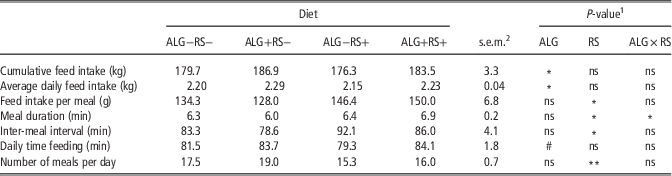
Adding ALG to the diets increased daily and cumulative feed intake (both P<0.05), and tended to increase daily time spent feeding (P=0.06), see Table 1. Adding RS to the diets increased feed intake per meal and meal duration (both P<0.05), and tended to increase inter-meal intervals (P=0.05). This resulted in a decreased number of meals per day for the RS diets compared with ALG and control diets (P<0.01). ALG and RS tended to interact to affect the meal duration (P=0.05), which was greatest in the combination treatment (ALG+RS+) compared with other treatments, and lowest when only ALG was present.
Feeding patterns of growing pigs fed a control diet (ALG−RS−), a diet containing a gelling fibre (ALG+RS−), a diet containing a fermentable fibre (ALG−RS+), and a diet containing both gelling and fermentable fibres (ALG+RS+) ad libitum during 12 weeks

ALG=alginate; RS=resistant starch.
Results are expressed as least square means±s.e.m. on pen averages (n=10 pens per dietary treatment).
1 Statistical significance of effects of alginate inclusion in the diet (ALG), resistant starch inclusion in the diet (RS), and their interaction (ALG×RS) is indicated: #P⩽0.10, *P⩽0.05, **P⩽0.01, ns=non-significant.
2 Pooled standard error of least square means.
Apparent total tract digestibility
Diets with ALG had a lower digestibility of DM and GE (both P<0.01) than diets without ALG (Table 2). Diets with RS had a lower digestibility of DM, CP, and GE than diets without RS (all P<0.01). ALG and RS did not interact to affect digestibility of DM, CP or GE.
Total tract coefficients of apparent digestibility measured in week 6 in growing pigs fed a control diet (ALG−RS−), a diet containing a gelling fibre (ALG+RS−), a diet containing a fermentable fibre (ALG−RS+), and a diet containing both gelling and fermentable fibres (ALG+RS+) ad libitum during 12 weeks

ALG=alginate; RS=resistant starch; DM=dry matter; GE=gross energy.
Results are expressed as least square means±s.e.m. on pen averages (n=10 pens per dietary treatment).
1 Statistical significance of effects of alginate inclusion in the diet (ALG), resistant starch inclusion in the diet (RS), and their interaction (ALG×RS) is indicated: #P⩽0.10, *P⩽0.05, **P⩽0.01, ns=non-significant.
2 Pooled standard error of least square means.
Growth performance
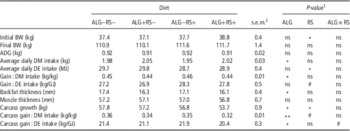
Final BW, and average daily gain (ADG) did not differ between treatments (Table 3). Pigs fed RS-containing diets were heavier (P<0.05) than those fed ALG and control diets at the start of the experiment (day 0), which was not sustained and final BW was similar for all treatments. Average daily DM intake was greater and gain : DM intake ratio was lower for pigs fed ALG-containing diets than for pigs fed diets without ALG (both P<0.05). The DE intake or gain : DE intake ratio did not differ between pigs fed diets with or without ALG. RS did not affect DM intake or gain : DM intake ratio. Average daily DE intake was lower (P<0.05) and gain : DE intake ratio tended to be greater (P=0.07) for pigs fed RS-containing diets than for pigs fed diets without RS. Muscle thickness did not differ between treatments. At the end of the experiment, pigs fed ALG-containing diets had thinner backfat than those fed diets without ALG (P<0.05). Pigs fed ALG-containing diets had a lower carcass growth (P<0.05) and a lower carcass gain : DM intake ratio (P<0.01) than pigs fed diets without ALG. Pigs fed RS-containing diets had a lower carcass growth (P<0.05) and tended to have a lower carcass gain : DM intake ratio (P=0.08) than pigs fed diets without RS. The carcass gain : DE intake ratio was lower for pigs fed ALG-containing diets than for pigs fed diets without ALG (P<0.05), and tended to be lower for pigs fed diets containing both ALG and RS than for pigs fed other diets (ALG×RS interaction, P=0.09).
Growth performance of growing pigs fed a control diet (ALG−RS−), a diet containing a gelling fibre (ALG+RS−), a diet containing a fermentable fibre (ALG−RS+), and a diet containing both gelling and fermentable fibres (ALG+RS+) ad libitum during 12 weeks

ALG=alginate; RS=resistant starch; ADG=average daily gain; DM=dry matter; DE=digestible energy; GJ=gigajoules.
Results are expressed as least square means±s.e.m. on pen averages (n=10 pens per dietary treatment).
1 Statistical significance of effects of alginate inclusion in the diet (ALG), resistant starch inclusion in the diet (RS), and their interaction (ALG×RS) is indicated: #P⩽0.10, *P⩽0.05, **P⩽0.01, ns=non-significant.
2 Pooled standard error of least square means.
RS and batch interacted to affect muscle thickness (P<0.01). Muscle thickness was lower for pigs fed RS-containing diets (56.3±0.6 mm) than for pigs fed diets without RS in batch 2 (58.9±0.6 mm), whereas in batch 1 muscle thickness was not affected by RS (57.5±0.6 mm for diets with RS v. 55.5±0.6 mm for diets without RS).
Empty weights of the gastrointestinal tract
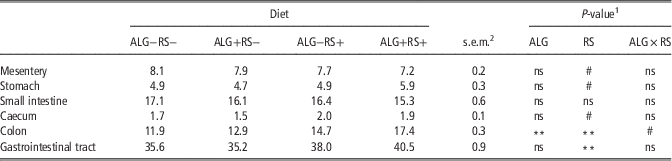
The ALG-containing diets increased the empty weight of the colon compared with diets without ALG (P<0.01), see Table 4. The RS-containing diets increased the empty weight of the colon and total gastrointestinal tract compared with diets without RS (P<0.01 and P<0.05, respectively). There was also a trend for decreased weight of mesenteric tissue (P=0.06), and increased empty weights of the stomach and caecum with RS-containing diets (P=0.10 and 0.07, respectively). ALG and RS tended to interact to affect the empty weight of the colon (P=0.06), which was greatest in the combination treatment (ALG+RS+) compared with other treatments.
Empty weights of the gastrointestinal tract parts (in g/kg BW) of growing pigs fed a control diet (ALG−RS−), a diet containing a gelling fibre (ALG+RS−), a diet containing a fermentable fibre (ALG−RS+), and a diet containing both gelling and fermentable fibres (ALG+RS+) ad libitum during 12 weeks

ALG=alginate; RS=resistant starch.
Results are expressed as least square means±s.e.m. on pen averages (n=2 pens per dietary treatment).
1 Statistical significance of effects of alginate inclusion in the diet (ALG), resistant starch inclusion in the diet (RS), and their interaction (ALG×RS) is indicated: #P⩽0.10, *P⩽0.05, **P⩽0.01, ns=non-significant.
2 Pooled standard error of least square means.
Behavioural observations
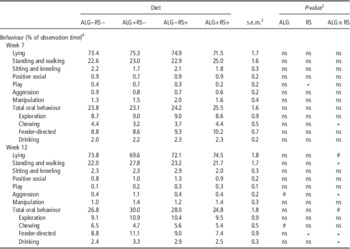
Dietary treatments and week interactions were found for most behavioural traits. Therefore the behavioural traits for each dietary treatment are presented per week in Table 5. Two-way interaction between RS and week was found for play behaviour (P<0.05). Analysis per week revealed that pigs fed diets with RS (i.e. ALG−RS+ and ALG+RS+) tended to spend less time playing than pigs fed diets without RS (0.23±0.12% v. 0.56±0.12%) in week 7 (P=0.05), whereas in week 12 play behaviour was not affected by RS (0.29±0.08% for diets with RS v. 0.16±0.08% for diets without RS). Three-way interactions between ALG, RS and week were found for lying (P<0.01), standing and walking (P<0.05), total oral behaviours (P<0.05), feeder-directed behaviours (P<0.01), and drinking (P=0.08). Generally, differences between ALG+RS− and other treatments were more pronounced in week 12 compared with week 7. Analysis per week revealed that in week 12 (see Table 5), pigs fed ALG+RS− spent less time lying (P=0.08) than pigs fed ALG+RS+, and less time standing and walking (P<0.05) than pigs fed other diets. In addition, pigs fed ALG+RS− showed more aggressive behaviours (P<0.05) than pigs fed other diets, and more oral behaviours (P=0.08) than pigs fed ALG+RS+, particularly more feeder-directed oral behaviours (P<0.05) than pigs fed other diets and more drinking (P<0.05) than pigs fed ALG+RS+ and ALG−RS−, with the pigs fed ALG−RS+ being intermediate.
Daily behaviourFootnote 1 measured in weeks 7 and 12 in growing pigs fed a control diet (ALG−RS−), a diet containing a gelling fibre (ALG+RS−), a diet containing a fermentable fibre (ALG−RS+), and a diet containing both gelling and fermentable fibres (ALG+RS+) ad libitum during 12 weeks

ALG=alginate; RS=resistant starch.
Results are expressed as least square means±s.e.m on pen averages. (n=10 pens per dietary treatment).
1 Pigs were observed in their home pen during 1 day at the start of weeks 7 and 12 using 4 min-instantaneous scan sampling (six intervals of 1 h during daytime). All behaviours were averaged per pen before data analysis.
2 Statistical significance of effects of alginate inclusion in the diet (ALG), resistant starch inclusion in the diet (RS), and their interaction (ALG×RS) is indicated: #P⩽0.10, *P⩽0.05, **P⩽0.01, ns=non-significant.
3 Pooled standard error of least square means.
4 Aggression=sum of aggressive behaviours given at feeder (scored in an area of one pig length around the feeding station) or at other place than feeder; Manipulation=sum of belly nosing and nibbling, sucking or chewing any other part of the body of a pen mate; Total oral=sum of exploration, chewing, feeder-directed and drinking; Exploration=sum of rooting and sniffing floor, toys or pen fixtures; Chewing=sum of chewing toys or pen fixtures, and sham chewing; Feeder-directed=sum of sniffing and touching the feeding station, and eating.
Sitting and kneeling (2.4±0.1% v. 1.9±0.1%, P<0.05), exploration (10.0±0.3% v. 8.8±0.3%, P<0.05), and chewing (5.5±0.2% v. 3.9±0.2%, P<0.01) were increased in week 12 compared with week 7. ALG and RS interacted to affect chewing (P<0.05): pigs fed ALG+RS+ (4.9±0.3%) spent more time chewing than pigs fed ALG+RS− (4.0±0.3%), but less than control-fed pigs (5.4±0.3%). Positive social and manipulative behaviours did not differ between treatments or weeks.
Plasma metabolites
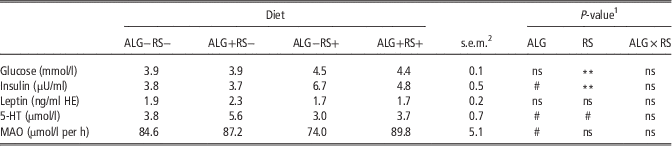
Treatment effects were consistent for both weeks. Moreover, no interactions were found between treatments and week. Therefore, the plasma metabolites fasting concentrations for each dietary treatment were averaged over weeks in Table 6. The ALG-containing diets tended to decrease insulin levels (P=0.06) and increase MAO levels compared with diets without ALG (P=0.08). The RS-containing diets increased plasma glucose and insulin levels (both P<0.01) compared with diets without RS. Moreover, RS-containing diets tended to lower 5-HT levels compared with diets without RS (P=0.07). In batch 1 only, MAO levels were lower in RS-fed pigs than in pigs fed diets without RS (74.56±4.25 µmol/l per h v. 89.24±4.72 µmol/l per h, RS×batch interaction, P<0.05). Plasma leptin levels did not differ between treatments, but increased in week 12 compared with week 7 (2.09±0.12 v. 1.71±0.11, mmol/l, P<0.01).
Concentrations of glucose, insulin, leptin, serotonin (5-hydroxytryptamine (5-HT)), and monoamine oxidase (MAO) in peripheral blood collected after an overnight fast in growing pigs fed a control diet (ALG−RS−), a diet containing a gelling fibre (ALG+RS−), a diet containing a fermentable fibre (ALG−RS+), and a diet containing both gelling and fermentable fibres (ALG+RS+) ad libitum during 12 weeks

ALG=alginate; RS=resistant starch.
Results are expressed as least square means±s.e.m. on pen averages (n=10 pens per dietary treatment).
1 Statistical significance of effects of alginate inclusion in the diet (ALG), resistant starch inclusion in the diet (RS), and their interaction (ALG×RS) is indicated: #P⩽0.10, *P⩽0.05, **P⩽0.01, ns=non-significant.
2 Pooled standard error of least square means.
Discussion
Satiety and satiation
ALG and RS were used as fibres with putative satiation and satiety enhancing properties, respectively.
RS
In adult restrictedly-fed pigs, RS was reported to be more satiating than other types of fermentable fibres with different fermentation or physicochemical properties up to 7 h after the meal (Souza da Silva et al., Reference Souza da Silva, Bolhuis, Gerrits, Kemp and Van den Borne2013). As expected, adding RS to the diet resulted in a lower number of meals per day and tended to increase inter-meal intervals, which could be related to prolonged satiety after a RS-meal. Nevertheless, pigs fed RS-containing diets also increased feed intake per meal and meal duration, which also contributed to greater inter-meal intervals and suggests reduced satiation. This means that delayed satiation observed in pigs fed RS-containing diets may have coincided with prolonged duration of satiety. This agrees with observations in meal-fed humans who reported reduced satiation in the immediate post-ingestive period and up to 5 h after a first meal of resistant corn starch, and then enhanced satiety 10 to 13 h after another meal of resistant corn starch compared with digestible corn starch (Achour et al., Reference Achour, Flourie, Briet, Franchisseur, Bornet, Champ, Rambaud and Messing1997). RS is less bulking than digestible starch (Nugent, Reference Nugent2005) and other types of fibre, such as viscous and gelling fibres, that have been reported to enhance satiation (Georg Jensen et al., Reference Georg Jensen, Pedersen, Kristensen, Frost and Astrup2013). Short-term feed intake, which reflects satiation, may be closely related to postprandial blood glucose levels (Higgins, Reference Higgins2004). In humans, it has been demonstrated that blood glucose levels are inversely correlated with appetite and food intake up to 60 min after different carbohydrate meals (Anderson et al., Reference Anderson, Catherine, Woodend and Wolever2002). Thus, reduced blood glucose levels directly after a high-RS meal (Souza da Silva et al., Reference Souza da Silva, Haenen, Koopmans, Hooiveld, Bosch, Bolhuis, Kemp, Müller and Gerrits2014), as has been reported for humans (Raben et al., Reference Raben, Tagliabue, Christensen, Madsen, Holst and Astrup1994; Achour et al., Reference Achour, Flourie, Briet, Franchisseur, Bornet, Champ, Rambaud and Messing1997), may have delayed the onset of satiation, thereby leading to larger meals in pigs fed RS-containing diets in the present study. Regmi et al. (Reference Regmi, van Kempen, Matte and Zijlstra2011) reported that RS increases absorption of short-chain fatty acids (SCFA) in portal vein-catheterized pigs. Production of SCFA in the colon prolongs the energy supply to the body, which may bridge the energy gap during the interprandial period (Rérat, Reference Rérat1996; Darzi et al., Reference Darzi, Frost and Robertson2011). Throughout the day, a combination of a reduced glucose supply and an increased SCFA production (Regmi et al., Reference Regmi, van Kempen, Matte and Zijlstra2011) supports the less pronounced satiation, but enhanced satiety after the RS-containing diets. In the present study, microbial production of SCFA was not quantified, but an increase in fermentation activity, and thereby an increase in SCFA production (Haenen et al., Reference Haenen, Souza da Silva, Zhang, Koopmans, Bosch, Vervoort, Gerrits, Kemp, Smidt, Müller and Hooiveld2013; Souza da Silva et al., Reference Souza da Silva, Haenen, Koopmans, Hooiveld, Bosch, Bolhuis, Kemp, Müller and Gerrits2014) could be confirmed by adaptations found in the gastrointestinal tract of pigs fed diets with RS. The empty weight of the colon and total gastrointestinal tract were greater in pigs fed diets with RS than in pigs fed diets without RS, in line with previous studies (Martinez-Puig et al., Reference Martinez-Puig, Perez, Castillo, Andaluz, Anguita, Morales and Gasa2003; Bolhuis et al., Reference Bolhuis, van den Brand, Staals and Gerrits2007).
ALG
ALG was expected to yield more pronounced effects on satiation rather than satiety, due to its physicochemical properties, such as viscosity and gelling in the stomach, leading to increased gastric distension, reduced gastric emptying rate, slowed passage rate, and slowed overall nutrient absorption in the small intestine (see Georg Jensen et al., Reference Georg Jensen, Pedersen, Kristensen, Frost and Astrup2013 for review). This is in line with the observed numerical decrease in feed intake per meal and shorter meal duration. Moreover, although all diets were given a cherry–honey flavour to mask differences in palatability as much as possible, the possibility that ALG may have reduced palatability in the fibre diets cannot be discarded (Wanders et al., Reference Wanders, Jonathan, van den Borne, Mars, Schols, Feskens and de Graaf2013). A reduced palatability could have further contributed to earlier satiation after ALG-containing diets. However, pigs fed ALG-containing diets increased their daily and cumulative feed intake, which indicates a compensatory mechanism to overcome the reduction in dietary DE content associated with the exchange of starch for ALG. This corresponds with the theory of Cole et al. (Reference Cole, Duckworth, Holmes and Cuthbertson1968), which asserts that when reducing dietary energy content, pigs may increase their voluntary feed intake to meet their energy requirements.
Combination of ALG and RS
In the present study, the combination treatment (ALG+RS+) was hypothesized to have greatest satiety enhancing effects as compared with the other treatments. However, this appeared not to be the case, as ALG and RS rarely interacted to affect the feeding pattern variables. In spite of that, some behaviours related to reduced satiety (see De Leeuw et al., Reference De Leeuw, Bolhuis, Bosch and Gerrits2008), including active behaviours such as standing and walking, aggressive behaviours, and oral behaviours, particularly feeder-directed and drinking, were generally reduced in pigs fed ALG+RS+ compared with pigs fed ALG+RS−. Particularly in week 12, there were indications that RS counteracted the increased activity found in pigs fed ALG+RS−. A similar change in behavioural patterns was observed in restrictedly-fed growing pigs when RS was added to their diet (Schrama and Bakker, Reference Schrama and Bakker1999; Bolhuis et al., Reference Bolhuis, van den Brand, Bartels, Oostindjer, van den Borne, Kemp and Gerrits2010), but in the present study RS was not able to change behavioural traits much compared with control. Notably, in the present study, the effect of RS on behavioural patterns depended strongly on ALG. Thus, a combination of the viscous and gelling properties of ALG in the stomach, and the more gradual supply of energy from fermentation processes, as previously discussed for RS, seemed to better compensate for the increased activity in pigs fed ALG+RS− diet. Alternatively, a substantial reduction in physical activity may be observed only in response to high inclusion level of fibres in the diet.
Growth performance
From previous studies in restrictedly-fed pigs, growth performance is expected to be reduced in pigs fed high-fibre diets due to the reduced digestibility and metabolisability of these diets (see Bindelle et al., Reference Bindelle, Leterme and Buldgen2008 for review). Indeed, in the present study, RS-diets reduced digestibility of DM, GE and CP (linked to a shift of N excretion from urine to faeces via the microbial growth, see Shriver et al., Reference Shriver, Carter, Sutton, Richert, Senne and Pettey2003) compared with ALG and control diets, whereas ALG-diets reduced digestibility of DM and GE, but not of CP. Despite lower digestibility coefficients, final BW and ADG were not affected by diet. Moreover, DE intake was similar, but the carcass gain : DE intake ratio was lower for pigs fed ALG-containing diets than for pigs fed diets without ALG, whereas DE intake was lower, but the carcass gain : DE intake ratio was similar for pigs fed RS-containing diets than for pigs fed diets without RS. This suggests a more efficient use of DE in RS-fed pigs compared with ALG-pigs and control-pigs. Although it is unknown how RS-containing diets affected gut fill in RS-fed pigs, a greater gain : DE intake ratio found for pigs fed RS would be consistent with increased gut fill in these pigs.
ALG
In accordance with Cole et al. (Reference Cole, Duckworth, Holmes and Cuthbertson1968), pigs fed ALG-containing diets compensated for the dietary DE dilution by increasing their DM intake, achieving a similar daily DE intake as the control diet. Consequently, ADG and final BW were also not affected by ALG. Nevertheless, backfat thickness and carcass efficiency were reduced in pigs fed ALG-containing diets compared with pigs fed diets without ALG. Generally, high-fibre diets may reduce growth performance, not only due to reduced digestibility, but also due to constraints on food processing by the gastrointestinal tract, for example because of the greater volume or slower digestion of such diets (Henry, Reference Henry1985). Furthermore, besides reducing ileal fat absorption (Aller et al., Reference Aller, de Luis, Izaola, La Calle, del Olmo, Fernandez, Arranz and Hernandez2004), highly viscous ALG could reduce or delay intestinal absorption of glucose, as previously shown in pigs fed seaweed fibres of different viscosities (Vaugelade et al., Reference Vaugelade, Hoebler, Bernard, Guillon, Lahaye, Duee and Darcy-Vrillon2000). These authors showed that over an 8 h period, glucose absorption expressed as a percentage of ingested starch was reduced by half after highly viscous ALG supplementation. An overall reduction in nutrient absorption in the small intestine of pigs fed ALG-containing diets would result in less energy available for fat deposition in these animals, in line with the reduced backfat thickness and carcass efficiency. Fermentation did not seem to contribute substantially to nutrient supply in pigs fed ALG-containing diets. Although ALG has been reported to lead to a significant increase in fermentation activity and SCFA production in pigs (Hoebler et al., Reference Hoebler, Guillon, Darcy-Vrillon, Vaugelade, Lahaye, Worthington, Duée and Barry2000), likely related to an increase in the flow of digesta in the large intestine, according to in vitro fermentation measurements, ALG is slowly fermented by faecal microbiota from pigs (Jonathan et al., Reference Jonathan, van den Borne, van Wiechen, Souza da Silva, Schols and Gruppen2012). Moreover, a low inclusion level of ALG in the diets may have further contributed to its lower SCFA supply. In the present study, the empty weight of the colon was increased in pigs fed the ALG diet, which is probably an adaptation of the gastrointestinal tract to fermentation, but not as much as found in pigs fed RS diets. Alternatively, reduced backfat thickness and carcass efficiency could be related to an increase in physical activity found in pigs fed the ALG+RS− diet, which showed the least lying, and the most standing and walking, aggressive, feeder-directed and drinking behaviours compared with pigs fed other diets. These changes could be related to the numerically increased number of meals per day or to the increased daily feed intake that might have predisposed ALG-pigs to social constraints at the feeding station, and thereby increasing energy expenditure on physical activity.
RS
Although adding RS to the diet resulted in larger meals and longer inter-meal intervals, pigs fed diets with RS did not increase their DM intake to compensate for the dietary DE dilution associated with the exchange of starch for RS. Surprisingly, despite the lower DE intake, ADG and final BW were not reduced in pigs fed RS-containing diets. Contrary to pigs fed ALG-containing diets, pigs fed RS-containing diets enhanced efficiency in the use of DE. Although carcass growth was reduced, colon and total gastrointestinal tract empty weight were heavier in pigs fed diets with RS, reflecting increased stimulation of fermentation in the gastrointestinal tract (Bolhuis et al., Reference Bolhuis, van den Brand, Staals and Gerrits2007). Moreover, it is also remarkable that the carcass gain : DE intake ratio was not affected by RS. The latter would imply a similar efficiency of utilization of fermentable starch for energy retention compared with that of enzymatically digestible starch, which may be considerably greater than the 70% assumed for fermentable fibres in some NE systems (Jørgensen et al., Reference Jørgensen, Zhao and Eggum1996; Noblet and van Milgen, Reference Noblet and van Milgen2004), and the 83% recently reported by Gerrits et al. (Reference Gerrits, Bosch and van den Borne2012) for fermentable corn starch in restrictedly-fed growing pigs.
The efficiency of utilization of fermentable fibres for energy retention in restrictedly-fed growing pigs has been reported to be close to that of enzymatically digestible starch in previous studies with sugar beet pulp (Schrama et al., Reference Schrama, Verstegen, Verboeket, Schutte and Haaksma1996 and Reference Schrama, Bosch, Verstegen, Vorselaars, Haaksma and Heetkamp1998) and fermentable starch (Gerrits et al., Reference Gerrits, Bosch and van den Borne2012), but these values were to a large extent related to a reduction in physical activity caused by these fibres, in line with previous studies (Schrama and Bakker, Reference Schrama and Bakker1999; Bolhuis et al., Reference Bolhuis, van den Brand, Staals, Zandstra, Alferink, Heetkamp and Gerrits2008). However, this reduction in physical activity in restrictedly-fed pigs, which likely reflects increased satiety (De Leeuw et al., Reference De Leeuw, Bolhuis, Bosch and Gerrits2008), was not observed in the pigs fed the RS-containing diets ad libitum in the present study. The behavioural patterns of pigs fed ALG+RS− and ALG+RS+ diets differed the most, whereas the behaviours of pigs fed ALG−RS+ and control diets were very similar. Thus, the reduction in physical activity caused by RS found in restrictedly-fed pigs is apparently absent in ad libitum-fed pigs (ALG−RS+ v. ALG−RS−), likely because pigs can consume feed when their feeding motivation increases, instead of becoming more active performing foraging behaviours.
Furthermore, a difference in energy retention, as affected by a reduction in activity-related heat production in relation to RS, was expected to be reflected in fat retention (Gerrits et al., Reference Gerrits, Bosch and van den Borne2012). However, this was not observed in pigs fed RS-containing diets, as fat deposition, measured by backfat thickness and weight of mesenteric tissue at slaughter, was not affected by RS. Also leptin levels, secreted proportionally to adiposity over long periods of time (see Woods et al., Reference Woods, Seeley, Porte and Schwartz1998 for review), were not significantly different between diets. An alternative explanation for the similar efficiency of utilization of RS v. enzymatically digestible starch would be an increased availability of SCFA, which prolongs energy supply to the body throughout the day. Previous findings in pigs restrictedly fed native potato starch, compared with digestible starch, revealed relatively small fluctuations in heat production and respiratory quotient (RQ) within the 24 h cycle, and an increase in RQ particularly during the nightly hours before the morning meal, which likely relates to a general increase in the oxidation of absorbed SCFA (Bolhuis et al., Reference Bolhuis, van den Brand, Staals, Zandstra, Alferink, Heetkamp and Gerrits2008; Gerrits et al., Reference Gerrits, Bosch and van den Borne2012). This may have increased the de novo gluconeogenesis in pigs fed diets with RS, in line with increased fasting levels of glucose and insulin found in these animals. Thus, in spite of the reduced glucose supply from enzymatic digestion directly after the meal, RS provides a large amount of SCFA to be oxidized in the postabsorptive phase (Haenen et al., Reference Haenen, Souza da Silva, Zhang, Koopmans, Bosch, Vervoort, Gerrits, Kemp, Smidt, Müller and Hooiveld2013; Souza da Silva et al., Reference Souza da Silva, Haenen, Koopmans, Hooiveld, Bosch, Bolhuis, Kemp, Müller and Gerrits2014). According to Zijlstra et al. (Reference Zijlstra, Jha, Woodward, Fouhse and van Kempen2012), absorbed SCFA are metabolized in various cell types, including colonocytes, hepatocytes, and skeletal and cardiac muscle cells. A prolonged energy supply from SCFA throughout the day may have reduced the mobilization of glucose from cell storage and likely led to a more efficient mechanism for maintenance of blood glucose between meals in pigs fed RS-containing diets. This would be consistent with the enhanced efficiency in these pigs, although it is yet unclear whether and to what extent SCFA may affect rates of glucose mobilization from cell storage in pigs.
Moreover, a reduced energy expenditure on immune responses may have partly contributed to the similar efficiency of RS-fed pigs when compared with the control pigs. In the present study, white blood cell count determined with a Sysmex F-820 Counter tended to be lower in pigs fed with ALG−RS+(16.1±1.0×10⁹ cells/l) compared with ALG+RS−(18.2±1.0×10⁹ cells/l) and ALG−RS− (18.9±1.0×10⁹ cells/l) diets (P=0.09), with the ALG+RS+ diet being intermediate (17.8±1.0×10⁹ cells/l). This is in line with Haenen et al. (Reference Haenen, Souza da Silva, Zhang, Koopmans, Bosch, Vervoort, Gerrits, Kemp, Smidt, Müller and Hooiveld2013), who reported lowered immune-related gene expression in the colon of 58 kg growing pigs fed the same source and quantity of RS as in the present study, and Nofrarías et al. (Reference Nofrarías, Martínez-Puig, Pujols, Majó and Pérez2007), who found lower proliferation and production of anti-inflammatory cytokines in RS-fed pigs. Further, RS-containing diets tended to lower blood 5-HT levels compared with diets without RS, which may be related to a reduced activity of the gastrointestinal immune system, as previously suggested (see Manocha and Khan, Reference Manocha and Khan2012 for review). Although it remains to be described, changes in microbiota composition observed in RS-fed pigs by Haenen et al. (Reference Haenen, Souza da Silva, Zhang, Koopmans, Bosch, Vervoort, Gerrits, Kemp, Smidt, Müller and Hooiveld2013) may indirectly play a role in immune regulation in the intestine (Wikoff et al., Reference Wikoff, Anfora, Liu, Schultz, Lesley, Peters and Siuzdak2009; Collins et al., Reference Collins, Surette and Bercik2012).
In conclusion, dietary fibres did not reduce voluntary feed intake in ad libitum-fed growing pigs. Pigs fed ALG, a gelling fibre, compensated for the reduced DE content of their diet by increasing feed intake and, thereby, achieved similar DE intake and ADG as pigs fed control. Backfat thickness and carcass efficiency were reduced by ALG. A combination of ALG and RS counteracted the increased activity caused by ALG. Pigs fed RS changed feeding patterns, but did not increase feed intake. Despite a reduction in DE intake, pigs fed RS achieved similar ADG as pigs fed control suggesting a more efficient use of DE. Although carcass growth was reduced, colon and total gastrointestinal tract empty weight were increased in pigs fed RS, reflecting increased fermentation. A more gradual energy supply via the increased availability of SCFA may underlie the increased efficiency found in pigs fed RS, but requires further study.
Acknowledgements
The authors gratefully acknowledge Lucta S.A. (Barcelona, Spain) for providing the flavour used in the diets, Fleur Bartels and Monique Ooms for their assistance with behavioural observations, Rudie Koopmanschap, Saskia van Laar-Schuppen and Ger Reilingh for assistance with laboratory analyses. They are grateful to Sven Alferink, Dennis Bijl, Anne Burgers, Devi Hermsen, Mascha Sappok, and Tamme Zandstra for their assistance during data collection. In addition, they would like to acknowledge Anke Balemans, Tien Janssen, Jan Lamers, and skilled personnel of the Nutreco Swine Research Centre in Sint Anthonis for their assistance.
Supplementary material
To view supplementary material for this article, please visit http://dx.doi.org/10.1017/S1751731114001840