INTRODUCTION
The psychosocial experiences of breast cancer patients are well documented, but very little research has focused exclusively on the experiences of women with metastatic breast cancer, perhaps because of the difficulties of recruiting them for research studies (Edelman et al., Reference Edelman, Bell and Kidman1999; Bottomley & Therasse, Reference Bottomley and Therasse2002; Aranda et al., Reference Aranda, Schofield and Weih2005). Metastatic breast cancer is cancer that originates in the breast and spreads to one or more distant sites. Most women find the diagnosis of metastatic disease to be more distressing than the diagnosis of primary breast cancer (Mahon et al., Reference Mahon, Cella and Donovan1990; Edelman et al., Reference Edelman, Bell and Kidman1999). The prognosis for metastatic disease is, in general, poor (Price, Reference Price, Bland and Copeland2004), so women with metastatic disease must live with the prospect of imminent death. Treatments such as surgery, radiation, hormone therapy, and chemotherapy are used to control symptoms, improve quality of life, and prolong survival, but these can result in perceived disfigurements and debilitating side effects.
Most studies that focus exclusively on metastatic breast cancer patients have focused on differences in quality of life or psychosocial symptoms when different medical treatments (Ingham et al., Reference Ingham, Seidman and Yao1996; Kieren et al., Reference Kieren, Nabholtz and Makar1997; Costantino, Reference Costantino2002; Weinfurt et al., Reference Weinfurt, Castel and Li2004) or psychotherapy interventions are used (Spiegel et al., Reference Spiegel, Bloom and Yalom1981; Duncan & Cumbia, Reference Duncan and Cumbia1987; Kidman & Edelman, Reference Kidman and Edelman1997; Edelman et al., Reference Edelman, Bell and Kidman1999; Classen et al., Reference Classen, Butler and Koopman2001; Goodwin et al., Reference Goodwin, Leszcz and Ennis2001), rather than on how metastatic disease affects women. The few quantitative studies that have examined quality of life in women with metastatic breast cancer indicate that they are prone to psychiatric morbidity (Kissane et al., Reference Kissane, Grabsch and Love2004) and problems related to sexuality, body image (Kieren et al., Reference Kieren, Nabholtz and Makar1997), physical, social, and role functioning, pain, fatigue, insomnia, concern about people close to them, and uncertainty about the future (Aranda et al., Reference Aranda, Schofield and Weih2005). Many experience traumatic stress symptoms (Butler et al., Reference Butler, Koopman and Classen1999).
Although quantitative studies provide important information about areas in which women's quality of life might be compromised, they do not capture many issues of concern to women (Luoma & Hakamies-Blomqvist, Reference Luoma and Hakamies-Blomqvist2004). Qualitative studies are needed to provide rich, detailed information about how metastatic breast cancer affects women's lives. Interview data, for example, can provide information that may not be revealed through psychometric tests (Edmonds et al., Reference Edmonds, Lockwood and Cunningham1999; Groenvold, Reference Groenvold1999). To my knowledge, no interview studies have yet been done on this topic.
Qualitative research can give medical professionals valuable information about the kind of support women with metastatic disease need. Women with advanced breast cancer have different needs than the general category of people with cancer (Aranda et al., Reference Aranda, Schofield and Weih2005). Unmet needs are greater in people with advanced disease, particularly those related to psychological and physical functioning and daily living (Sanson-Fisher et al., Reference Sanson-Fisher, Girgis and Boyes2000; Cossich et al., Reference Cossich, Schofield and McLachlan2004). Women with advanced breast cancer have more need of counseling and support services than people with cancer in general (Aranda et al., Reference Aranda, Schofield and Weih2005). A fuller understanding of these women's concerns can help in the design of interventions to improve quality of life (Bull et al., Reference Bull, Meyerowitz and Hart1999). Addressing the concerns of women with metastatic disease may also reduce the extent to which they use the health care system. Research shows that medical patients with psychological problems like depression and anxiety use more medical services and have more medical costs and longer hospital stays than those who do not (Levenson et al., Reference Levenson, Hamer and Rossiter1990; Simon et al., Reference Simon, Vonkorff and Barlow1995).
I report here on a qualitative analysis of interviews carried out with a sample of women with metastatic breast cancer. The women were drawn from a larger, mixed-method study whose purpose was to examine online support group participation by women with this disease. The larger study had both a quantitative (to be reported elsewhere) and a qualitative component. The qualitative component was ethnographic, combining direct observation with interviews. This report focuses on data derived from interviews. Interviews occurred before the women began participating in the online groups.
METHOD
Participants
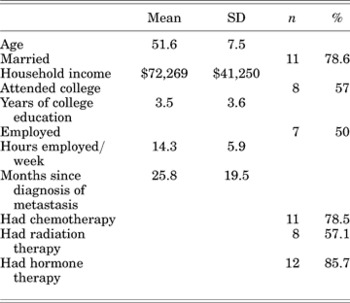
Study participants were 14 Caucasian women with metastatic breast cancer who were recruited for a larger study on the use of online support groups. Demographic and clinical data, gathered through a questionnaire given after participants entered the study, are summarized in Table 1.
Demographic and clinical data

Recruitment
Participants were recruited through letters to oncologists and personnel at community support centers and breast cancer clinics and organizations nationwide and through flyers posted at cancer clinics. Women were eligible for inclusion if they had been diagnosed with a metastasis of breast cancer, were free of any concurrent chronic illness or medical condition that was likely to affect quality of life, and had no diagnosis of psychiatric illness prior to diagnosis of metastasis. Because we were recruiting women for a study of online support, we only included women who also had continuous access to a computer and e-mail, were familiar with using e-mail, and were not regular users of other online metastatic breast cancer support groups. Recruitment yielded 42 women, and brief phone interviews determined that 31 of these were eligible.
All participants gave written informed consent for participation in the study protocol, which was approved by the IRB at the University of Chicago, where the study was carried out.
Interviews
I interviewed a convenience sample of 14 of the participants by phone before they began participating in the online support groups to which they were assigned, shortly after they entered the study. Interviews lasted 30–90 min and were open-ended, with a view to gathering data on the ways that women's experience may have changed after being diagnosed with a metastasis. Interviews were audiotaped with the women's consent and transcribed by a professional transcriptionist. Transcripts were compared to audiotapes to ensure accuracy.
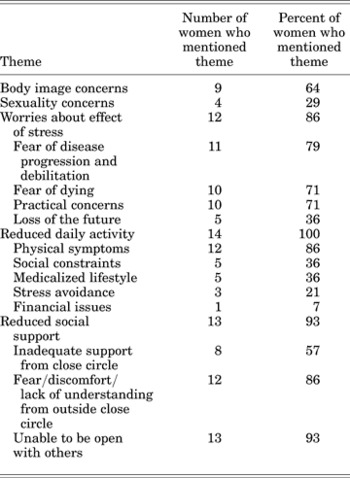
I used a content analysis approach when analyzing interviews (Bernard, Reference Bernard2000; Frankfort-Nachmias & Nachmias, Reference Frankfort-Nachmias and Nachmias2008). The objective of content analysis is to make inferences by systematically identifying the themes present in a text. Because my goal was to integrate quantitative and qualitative analyses, interviews were coded for themes in five categories that corresponded to areas that were also assessed quantitatively in the larger study: body image, sexuality, worries about the effect of stress, daily activity, and social support. I first marked the portions of interview text that related to these categories. I then coded for subthemes within those thematic categories. The number and percentage of women who mentioned themes within each category were noted (Table 2). I also looked for statements women made that identified links between themes.
Frequency of themes

RESULTS
Body Image
The physical appearance of women is often affected both by breast cancer and its treatment. Chemotherapy usually results in hair loss, as does radiation treatment for brain metastases. Hair that regrows between courses of treatment is often of a different texture, color, and fullness. Many women gain weight because of chemotherapy, although some experience weight loss, especially when cancer recurs in the digestive tract. Mastectomy is another cause of change in physical appearance. Women often perceive these changes in appearance to be disfiguring.
As signs of severe illness, hair loss, loss of one or both breasts, and extreme weight loss can also make others uncomfortable, which then may lead to women feeling alienated. For example, one woman, who was divorced, found that her ability to form intimate relationships with men was greatly affected by reconstructive surgery after a bilateral mastectomy. She feels embarrassed about her body and fearful of others' reactions to it:
Then with the second [breast], … it didn't turn out well and I'm embarrassed. I'm embarrassed about my body. And I guess the fear of rejection, the fear that a man will go, “Oh, my God!” I just couldn't deal with it. That would hurt a lot. So I just don't get in those situations.
Sexuality
Women often feel less sexually attractive because of these changes in appearance. Sexuality can change for other reasons as well. Intercourse may be difficult because pain can reduce physical mobility. Enjoyable physical sensations may be reduced after breast surgery. Some women who are in chemotherapy find that intercourse is uncomfortable because of reduced vaginal lubrication. Some also experience a disturbing loss of libido:
After chemotherapy the first time, I lost my libido. Gone! Just gone. … It's an essence of me that's gone. … The misunderstanding of it is not so much that I need sex. It wasn't that. It was me! It was a sense of me that was no longer there.
Although sexual partners may on occasion be less comfortable about continuing an active sexual life because of these changes in women, a more pervasive hindrance is the women's own perception of these changes. A corresponding decrease in sexual intimacy with partners may contribute to alienation from them.
Only four of the women mentioned concerns about deterioration in sexual attractiveness or in their sense of sexuality. However, because sexuality is a particularly private subject, it is possible that other women may not have broached it during the interview even if they had concerns related to it.
Worries about the Effect of Stress
Most of the women were worried about the effect that stress might have on their illness. Women hear about studies and theories on the effects of stress on disease progression from medical professionals and the popular press. The idea that coping capability can affect illness progression gives women the welcome sense of having some control over their breast cancer. However, it also makes women feel responsible for keeping their illness in check by reducing their stress levels:
I realize that the stress … I learned that it wasn't good for my immune system. … Anything that causes stress in my life, I really try to … be that a situation, be that a person … I just … my number one priority is me, to live. I want to live, and so anything that may threaten that, I will just get it out of my life.
Although many women strive to maintain a positive attitude, this does not come easily to them, because they have many everyday concerns that make them feel that they have little control over their lives. Four broad themes emerged when analyzing comments that women made about stressors they feel could affect their prognosis. These themes are discussed below.
Fear of Disease Progression and Debilitation
Most of the women fear disease progression and possible debilitation. The prospect of losing bodily functions, being bedridden and completely dependent on others is terrifying for many women:
You know, it's a terrible feeling. And if I can be frank, someday I might need someone to wipe my nose or wipe my butt—a stranger. And that's a hard thing to think.
This prospect is particularly difficult for those who feel that they do not have someone who would care for them ungrudgingly in such circumstances. Although a diffuse form of this fear is constantly present, it comes into sharp focus when tumor marker levels rise, or when women are awaiting a test result:
You just kind of wonder what's next and where it's going to spread to and even as it is now, every three to four months I get my CAT scans and my MRIs, my bone scans, and you just pray that everything is clear.
Fear of Dying
Many mentioned a periodic preoccupation with fear of death. Women face a dilemma here: on the one hand, media and medical representations of metastatic disease as a terminal illness constantly remind them of their mortality, whereas on the other hand, cultural taboo prevents them from really talking about their fear of dying:
I know if you catch it in time you've got a pretty good chance, but the metastasis part, it's a different disease. … Unfortunately I think one of the reasons it's so difficult is because I think our culture really doesn't teach us about death. … And when faced with it the fear is just unbelievable.
The women who reported being afraid of dying had, at least to some extent, accepted the possibility of dying from their illness. These women sometimes experience conflict about having accepted this possibility. They worry that they may die sooner as a result. One woman noted:
Having a recurrence I knew then that I was stage IV and then I knew that there was no hope of a cure and I realized that this was the beginning of the end. … I'm just more accepting of death now. And I kind of struggled with that because I don't want to feel like I'm giving in.
Some women strongly rejected the idea of dying from their illness. Rejection of this idea can also be a source of stress, because they cannot then even admit their fear to themselves. For example, one woman, who was resistant to any “negative” ideas about the illness in herself or others, seemed to find it difficult maintain this stance of rejection:
I almost have a fear of giving in. You know? I just this morning found out about another one of the friends that I made down there that hasn't made it. She passed away within the last couple of weeks. And I said I was afraid of that. … I would never give up fighting and never give in to it.
Practical Concerns
Many women brought up practical concerns that cause stress. These were related to inability to ensure the security of dependents, decreased capacity for work and other activities because of the symptoms of illness, and dealing with medical insurance providers:
We're fighting with the insurance company to try to get them to pay. … I think that the fight with the insurance company has been the worst thing—even last year and this year—that I've had to experience. It was worse than the whole diagnosis.
Loss of the Future
Some women are troubled by the extreme unpredictability of the future. They feel a deep sense of loss about not being able to be present as their children grow up and regret not being able to make plans or enjoy the fruits of their past achievements:
I remember lying in bed and crying when I was first diagnosed and thinking, I've worked all my adult life and I'm never going to collect social security. I had pictured myself lying on that beach in Florida at 62 or 65 and I thought, it's not going to happen now. I'm not going to be able to do it. And it made me a little bit angry. It made me sad.
Daily Activity
Having metastatic breast cancer often makes women participate less in work and leisure activities. Five themes emerged that were related to level of daily activity. These are discussed below.
Physical Symptoms
Most of the women mentioned that they are less active because of pain from the cancer or organ-specific complaints such as insufficient vision because of a tumor in the eye. Chemotherapy side effects such as fatigue and shortness of breath also affect activity level:
I can't lift anything. If I lift anything heavy or even try to attempt to drag it, the bone pain in the lower back and the left hip area, … for a few days afterward you're going to know it. So the things you can't do, the energy level too that you don't have, tends to be very frustrating.
Social Constraints
Some women were reluctant to engage in leisure or work activities because of the attitude of others toward them as cancer victims. Women often reported that they experienced reactions of fear and discomfort from others:
If somebody is going to have a get-together, do I kind of want to be the specimen or stay at home and lay low. … I mean like I said though, these people are kind of caught in the middle because they don't want to seem unconcerned so I know where they are coming from too.
Some women found that people have difficulty drawing an appropriate balance between being concerned and prying:
You know, some people will say things like well, don't do too much. Or if they come over to my house and I'm doing things or whatever, I think they think I'm just supposed to sit around and do nothing.
Medicalized Lifestyle
Many women see their doctors or have tests done on a monthly or bimonthly basis. For those undergoing courses of chemotherapy, treatments usually occur weekly, with a 1- or 2-day recovery period required for each weekly treatment. In addition to the time spent making medical appointments and visiting doctors and clinics, women may spend time seeking or participating in complementary therapies such as acupuncture, massage, meditation, and herbal therapy, to name but a few. Because of these time demands, working at a regular job is difficult for many women, even if they are physically able to do so:
Well, in the beginning, of course, I couldn't work at all. And then after four months I went back to teaching my private lessons, maybe just one or two hours a day, lying down in between. And then I was able to gradually build up, so that now I'm teaching two full days here at home. And then the medical treatments sometimes take one to two days a week. On the days that I'm in chemotherapy, that takes care of the day. And then I'm also doing IV infusions of a drug called Iridia, which helps build up healthy bones. … And then all my alternative therapies also: I do a special yoga class for women with cancer, and I see an acupuncturist. And so all of those complementary therapies also take time. And I'm finding that about three days of the week are taken up with various forms of medical treatments.
Stress Avoidance
A few women stated that they tended to limit their work activities because they wanted to reduce the stress that they experienced:
And then when things got really hectic here [at work] last spring, it was just a real stressful time and then when I went to the doctor in April, the spots on my bone had flared again. … So now I've really pulled back.
Financial Issues
Because the medical treatment for cancer is costly, women with metastatic disease are often under severe financial stress, but they are often unable to keep working. Even if they are physically able to carry on their jobs, the medicalization of their lifestyle makes it difficult for them to be reliable employees. Once they give up their jobs, they are usually eligible for disability benefits. Many women find that stopping work has a negative effect on their state of mind, but they may be unwilling to resume employment and give up disability benefits because they do not feel confident that they will continue to be free of debilitating symptoms:
I'm on disability now and I thought if I went back I would lose the disability and then if I have to go out again I'd have to reapply and you know, I have good days … but on my bad days, I don't feel like going to work. So I've decided that I'll probably never go back to work.
Only one woman mentioned concern about disability benefits. However, women in the study were understandably wary about disclosing the financial details of their lives to me, perhaps because they did not wish to jeopardize the possibility of receiving much needed financial aid.
Social Support
Because metastatic breast cancer affects women's lives so deeply, they often find themselves preoccupied with concerns related to their illness. Despite their need for support, more than half of the women reported they could not confide freely in partners, family members, and very close friends because their responses were inadequately supportive. Some reported that people who were close to them tended to minimize their concerns, because of an inability to face the possibility that the women could become severely debilitated and/or die:
I have told him, you know, … I just want you to be my husband. I would like maybe a little hug or, you know, some sympathy. It's hard for him to do. He's very worried about it and it's very difficult for him to face what's going on with me and what might happen, so he'd rather not deal with it.
Some women held back from discussing their concerns with their husbands and family members in order to protect them, and also because of the stress of dealing with their grief and anxiety:
My husband practically had a nervous breakdown which was hard on all of us. … He just couldn't handle it. … Well, this last spring when I knew that, when I saw my bone scan and I saw that it had flared again, I didn't even tell him about it. It was just easier to talk to my friends, who are now mostly survivors.
The women interviewed often attempted to find emotional support from other sources when they perceived support from well-known people to be inadequate. However, getting support from people outside the circle of family and close friends is also difficult, for different reasons. Because of the public perception of metastatic breast cancer as a terminal illness, women with this diagnosis may feel that they occupy a liminal position between life and death in the eyes of others:
I think that's the hardest thing. You hear cancer and everybody thinks you're going to die.
It was relatively common for women to experience reactions of fear or discomfort from others. People respond in this way not only because women with metastatic disease are in circumstances that are frightening to contemplate being in, but also because they are unwanted reminders of the brutal fact of everyone's mortality:
I think it's with being diagnosed with cancer, … People don't know what to say or do. … And you know, they're your age or around your age and it could happen to them, and I guess not being around you or thinking about you or talking to you or whatever, it's almost as if they think they're not going to get it.
Some women avoid talking about their illness because they feel that others are disinterested in the illness-related issues that they themselves find to be an important part of their experience:
Sometimes I think I might bore people with it, so I might not say too much.
On the other hand, other women avoid talking about their illness because for fear of being under too much scrutiny. These women reported that their feelings of not being “normal” were accentuated by the way that people focused on their illness:
Sometimes you just want to be normal. You know, I haven't gone to functions, to be honest with you, because I don't want to be the, well, how do you feel? 50 people, that's what you're doing all night long. And I can understand where they're coming from because they don't want to act like they don't care. But you can't get through the function without basically just standing there and basically going down almost a reception line. And everybody wanting to know and sometimes you just want to be there with the rest of them and be normal and not have to go through, well, this is what we are doing and … It's great that they're concerned but … and at the same time, though, they don't know. They don't know where to draw the line I think.
It is difficult to know how to respond to a woman with metastatic disease; there is a fine line between not showing so much sympathy that the illness is emphasized and not ignoring the illness so much that the woman is slighted or inconvenienced:
People are uncomfortable. And it's not easy to talk to someone, you know. And when I hear about that I try to think of when I go to someone's wake, it's so hard to. … I want to say the right thing and I don't know what to say. So I kind of forgive some people.
The women's need for support varies from day to day. On days when they receive disheartening test results or experience unfamiliar symptoms, they are often more anxious and more in need of a supportive listener. On the other hand, on days when they feel relatively well, they want to ignore their illness as much as possible and be treated as “normal.” People who do not understand the cyclical nature of the women's anxieties may be unable to support them appropriately, because prior interactions with a woman may not always be a good indicator of the present need for support.
A desire to be normal often draws women with metastatic disease to each other. Several women mentioned that they could be most open with other women who have the illness because only they would be able to truly understand their situation:
For one, I can joke with them about … really you can be gruesome. … Yeah, because they know it goes through their mind. Yeah, without frightening or shocking them. I mean, even with my kids or my husband, I would have to reassure them that I'm just kidding, whether I am or not. You know, there's a real fine line between kidding and trying to make light of the truth.
Having people in your situation helps more than anything because we can sit down and discuss, well, I'm not doing chemo anymore. The quality of life versus the quantity of life and things other people wouldn't understand.
As the quotes above illustrate, women have less social support than they need because of the bidirectional interaction of two factors: the women's fear of being open and the response of others. When the response of others is appropriate, women are able to express themselves freely, as they do among others who also have metastatic disease. Likewise, some women reported that on occasions when they had been more open to people in their lives, they had received abundant support:
I just reached out and called my friends. … And they were amazing. And I discovered that people really want to help, but often they don't know how. And because I reached out and asked them, they were very grateful and more than happy to do anything they could.
Interrelated Concerns
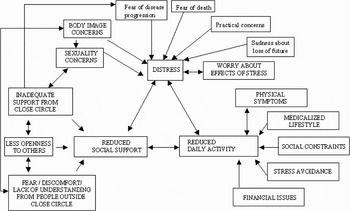
There are many interrelationships between the themes described here (Figure 1). For instance, worry can cause women to focus more on fatigue or pain and consequently become less active:
Relationships between themes.

I think a lot of the fatigue was the fear. … And I think where I am concerned that the tiredness I do have from time to time comes from my anxieties and fears.
Conversely, inactivity can result in the perception of more pain, and therefore more worry, which can in turn result in more concerns about the effect of stress on disease:
The days I'm home, I stay home because I just don't feel up to par because of my chemo treatment, I have so many more aches and pains and if I get to work, you forget about them. You have too much time to focus when you're at home.
As discussed earlier, women can become less active because sensitivity to others' reactions makes them reluctant to engage in social activities. The converse relationship between activity and social support can also hold true. As their daily activity is curtailed by fatigue, physical symptoms, and the frequent treatments they undergo, they may be able to venture out less into their social world, and thus they may be inhibited from building new social relationships or from maintaining existing ones:
And I think maybe one of the crushing blows when I was diagnosed, I had planned on going back into the work field. My son was old enough. … I thought ok, I'll get back into the work field, get out, meet people, feel halfway human again, and then I was diagnosed.
DISCUSSION
A diagnosis of metastatic breast cancer results in profound psychological and social changes. The analysis of interviews from these 14 women indicate that they experience distress because of concerns about body image, declines in aspects of their sexual lives, and worries about the effect of stress on their illness. The stress that worries these women comes from fear of dying, fear of disease progression and debilitation, the loss of their future, and practical concerns. Women are also likely to experience a decline in daily activity after being diagnosed with metastatic disease. They become less active because of the physical symptoms of the illness and the side effects of treatments, the medicalization of their lifestyle, their desire to avoid stressful situations, the constraints imposed by their social world, and the need to maintain disability benefits. Although women are often in great need of emotional and material support from others after they are diagnosed, social support can decrease, both because women find it difficult to be open about the difficulties they face and because the responses of others are not adequately supportive. Distress, declines in daily activity and declines in social support can feed into each other to create a vicious circle.
Although this study provides rich information about the experiences of women with metastatic breast cancer, it has some limitations. First, my sample may not be representative of all women with metastatic breast cancer. Because the women interviewed were all part of a study on the use of online support groups, they may have felt more in need of support than women who are not seeking to participate in such a group. However, as I found and as others have noted previously (Edelman et al., Reference Edelman, Bell and Kidman1999; Bottomley & Therasse, Reference Bottomley and Therasse2002; Aranda et al., Reference Aranda, Schofield and Weih2005), it is difficult to recruit women with metastatic breast cancer for research studies, and so qualitative studies of their experience may only be possible when they enter an intervention study. Education and income level may also have been higher than average in my sample, because inclusion criteria included access to a computer and familiarity with e-mail. Second, all the women who entered the study were Caucasian, despite concerted efforts to recruit from geographic areas where cultural and ethnic diversity was high. Qualitative research with more diverse samples is needed to capture potential differences between the breast cancer experiences of different cultural groups (Spencer et al., Reference Spencer, Lehman and Wynings1999; Ashing-Giwa et al., Reference Ashing-Giwa, Padilla and Tejero2004). Third, because interview data were used to supplement quantitative analyses, I focused only on certain categories of themes during my analysis. Other themes that may be present were not analyzed, such as the transformative aspect of having a diagnosis of metastatic breast cancer. Further analysis of the qualitative data or data from other qualitative studies is needed to provide a complete picture of the experience of women with this disease.
ACKNOWLEDGMENTS
This research was supported by Grant RO3 HS10565 from the Agency for Healthcare Research and Quality.