Introduction
Balance and dizziness disorders are common, and are often seen as ‘hidden handicaps with profound personal, occupational and economic consequence’. 1 Dizziness ranks among the most common complaints in medicine, affecting approximately 20–30 per cent of the general population at some time in their lives.Reference Kroenke and Price 2 – Reference Davis, Moorjani and Luxon 4 The occurrence rises with age, with balance problems at age 70 years affecting 36 per cent of women and 29 per cent of men. Fifteen in 1000 people visiting their general practitioner complain of dizziness in the UK.Reference Jonsson, Sixt, Landahl and Rosenhall 5
The professional body ENT-UK have encouraged ‘new models of care, which should be based on team delivery and multi professional care pathways’ to ensure best possible patient care. 6 Physiotherapy-led balance clinics have been shown to be an effective way to manage patients referred to hospital-based ENT clinics with dizziness and balance problems.Reference Lee, Jones, Corcoran, Premachandra and Morrison 7 , Reference Kasbekar, Mullin, Morrow, Youssef, Kay and Lesser 8 Reduced waiting times and fewer follow-up appointments suggest this is an effective management model, with high levels of patient satisfaction,Reference Kasbekar, Mullin, Morrow, Youssef, Kay and Lesser 8 meeting NHS England's goal of ‘improving peoples’ experience of outpatient care’.Reference Chew-Graham, Hunter, Langer, Stenhoff, Drinkwater and Guthrie 9
Leong et al. reported that a pre-ENT clinic enabled effective management of benign paroxysmal positional vertigo (BPPV), negating the need for an ENT consultant appointment.Reference Leong, Barker and Bleach 10 Extended role duties only work effectively and safely when closely dovetailed with local ENT specialists in a true multidisciplinary service. 6 There is a trend toward the development of ‘clinical assessment and treatment services’, which build on this model. Consultant vestibular physiotherapists (band 8a), audiologists and ENT consultants working together through innovative care pathways have reduced the number of referrals onto other services.Reference Kasbekar, Mullin, Morrow, Youssef, Kay and Lesser 8 Consultant vestibular physiotherapists can add a different dimension to ENT departments, matching skills to the needs of services and patients attending with dizziness and balance problems. Identifying treatment modalities used in such settings supports and establishes alternative ways to staff services, as recommended by the Department of Health review of productivity, performance and workforce planning. 11
Materials and methods
Foundations for service redesign
The ENT-UK document on balance (2008) began to encourage changes, stating ‘The vision for services for people with balance disorders is for high quality, efficient and integrated services which respond well to individuals’ needs…’. 6
ENT consultations accounted for 4.8 per cent of all National Health Service out-patient attendances in 2006/07. Aintree University Teaching Hospital statistics revealed that 40 per cent of referrals into the Trust's ENT department were for hearing, balance and tinnitus problems.
A review of productivity and performance, 11 and the Department of Health, 12 advocate better use of allied health professions in service provision and workforce planning ‘blurring professional boundaries’. Health Education North West identifies, in a non-medical prescribing economic evaluation report, that the cost of prescription writing is lower for physiotherapists than pharmacists or other prescribing allied health professions and medics. 13 Therefore, it is useful to understand the treatment options for this patient group.
New clinic template
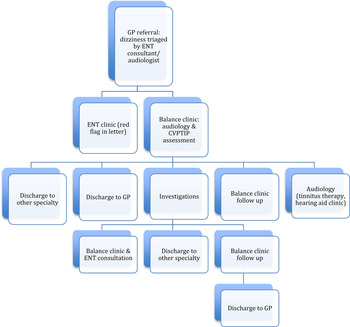
The pathway employed at Southport and Ormskirk NHS Trust was implemented in ENT clinics on both sites and is summarised in Figure 1. The first clinic in Southport was an initiative, introduced in February 2012, aimed at reducing the number of referral and ‘did not attend’ rates within physiotherapy services. It soon demonstrated how a consultant vestibular physiotherapist could free up ENT consultant clinic time and improve quality of care in the out-patient setting. A second balance clinic started at the Ormskirk hospital in September 2013 following the success of the Southport Balance Clinic.
Southport and Ormskirk Balance Clinic referral pathway. CVPTIP = consultant vestibular physiotherapist independent prescriber; GP = general practitioner

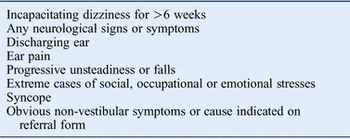
ENT referrals are triaged by the head audiologist from the ‘choose and book’ appointment system. ENT consultants triage the letters, identifying balance and dizziness patients for the consultant vestibular physiotherapist independent prescriber led clinic. These referrals are for all dizziness and/or balance problems. This utilises existing triage methods and requires no extra input. Red flags for excluding assessment in this clinic are listed in Table I.
Red flags for excluding assessment in the balance and dizziness clinic*

* Indicators for immediate referral to ENT consultant
Initially, a band 7 vestibular specialist physiotherapist covered the Southport Balance Clinic, but it was recognised that the skills and responsibility of this role are above traditional physiotherapy positions. This extended physiotherapy role is thus currently under review, with plans to change it to a band 8a in line with similar roles around the country.Reference Lee, Jones, Corcoran, Premachandra and Morrison 7 , Reference Kasbekar, Mullin, Morrow, Youssef, Kay and Lesser 8
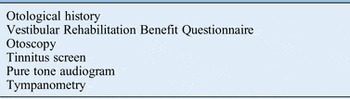
Seven patients (four new and three follow up) are seen per 3.5 hour session, which includes time for paperwork and discussion with a consultant (if required). For improved patient management, a consultant with a special interest in vestibular disorders runs a clinic alongside this, negating the need for weekly meetings. Patient appointments last for 1 hour, allowing 30 minutes with an audiologist, who undertakes otoscopy, a pure tone audiogram and a tympanogram. The audiologist arranges any follow-up audiology appointments if needed (Table II). The second 30 minutes constitutes a balance assessment conducted by the consultant vestibular physiotherapist independent prescriber. This assessment includes BPPV testing and examination of: cranial nerves, oculomotor control, head thrust, cervical spine, co-ordination, balance and gait. However, examination varies depending on the patient history and examination findings. When further investigations are required (e.g. cervical vestibular-evoked myogenic potentials test, vestibular function test, magnetic resonance imaging (MRI), computed tomography (CT)), it is arranged by the consultant vestibular physiotherapist independent prescriber. If necessary, the patient is seen by an ENT consultant after this assessment.
Audiological assessment checklist at the balance and dizziness clinic

The consultant vestibular physiotherapist independent prescriber integrates all findings with the audiology assessment results. This is followed by a discussion with the patient, during which they describe the diagnosis, agree a management plan, and give appropriate advice and treatment. If onward referrals are indicated, the consultant vestibular physiotherapist independent prescriber does this via letter. The patient and general practitioner and/or referrer are informed about all management strategies. A series of leaflets have been produced to educate and advise on the main vestibular disorders and treatments, and these are used to support what was said in the initial visit. These are available on the Trust intranet.
Most patients are actively treated (e.g. repositioning manoeuvre for BPPV) and are reviewed to confirm the diagnosis. However, patients are given the option of cancelling the appointment if the symptoms have resolved within a few weeks. All patients who have medication introduced or stopped are reviewed in clinic.
The initial balance clinic planning meetings agreed that there should be clear guidelines on the new pathway that are dependent on patient findings (Figure 1). National and local guidelines on when to investigate further are followed.
Consultant input
Few patients still need input from an ENT consultant after the assessment and any abnormal investigation findings. After being seen in the balance clinic, a small proportion of patients required a further clinic appointment with the ENT consultant. This was for various audiology or vestibular reasons. One patient requested specifically to see a doctor. This does not include the mentorship programme discussions regarding management strategies that take place between the consultant vestibular physiotherapist independent prescriber, ENT consultant and audiologist. Rarely, the ENT consultant performs an otoscopy or wax removal to allow patient assessment.
Patient satisfaction questionnaires
Patient satisfaction questionnaires about the initial visit were handed out to 100 consecutive patients (50 per site). The questionnaire was handed out in clinic as the patient registered at the front desk, and then completed by the patient in the waiting room before they left. Questionnaires were anonymous and placed in a box by the out-patient reception.
Results
Data have been compiled from both sites of the Southport and the Ormskirk Balance Clinic. A total of 413 new patients were referred between December 2014 and December 2015; 45 patients did not attend. Of the 368 patients seen, the average patient age was 62 years, and the male-to-female ratio was almost 1:2 (37 per cent male and 63 per cent female).
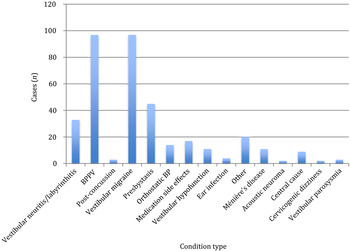
Figure 2 shows the range of diagnoses made in the balance clinic. Benign paroxysmal positional vertigo was the most frequent diagnosis, followed closely by vestibular migraine and then presbystasis. Nine patients had MRI results that highlighted central causes, including cerebrovascular accident, cerebellar degeneration, head injury, multiple sclerosis, a brain cyst and acoustic neuroma (two patients). The consultant vestibular physiotherapist independent prescriber discussed the diagnosis with the patients, and then transferred care to a neurologist or skull base surgeon via a letter, which was copied to the general practitioner.
Column graph showing the number and variety of conditions diagnosed in the balance and dizziness clinics. BPPV = benign paroxysmal positional vertigo; BP = blood pressure

Fourteen patients presented with orthostatic hypotension, and five patients had cardiac problems such as mitral valve dysfunction and arrhythmias requiring a pacemaker. Liaison and referrals to a cardiologist were undertaken in these cases by the consultant vestibular physiotherapist independent prescriber.
Seventeen patients (4 per cent) were identified as having dizziness attributed to medication. In 15 out of 17 cases, the symptoms resolved or improved when the medication (ranolazine, fexofenadine, verapamil, Spiriva®, phenytoin, propranolol, atenolol, tramadol, Zoladex®, oxycodone, candesartan, gabapentin or perindopril) was stopped or the dose modified. In the remaining two cases, medication (Zoladex and candesartan) could not be stopped.
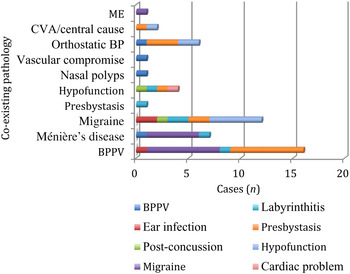
Fourteen per cent of patients were diagnosed with co-existing vestibulopathy (Figure 3).
A bar graph highlighting co-existing pathologies. ME = myalgic encephalomyelitis; CVA = cerebrovascular accident; BP = blood pressure; BPPV = benign paroxysmal positional vertigo

One patient was initially diagnosed with probable vestibular migraine while other tests were performed, but was re-diagnosed by the consultant vestibular physiotherapist independent prescriber on follow up as having phenytoin toxicity following blood test results. An onward referral to a neurologist and successful medication management confirmed the diagnosis.
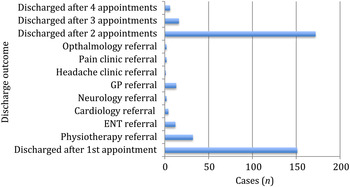
Figure 4 displays the outcomes for the 413 patients who were referred. Thirty-five per cent (n = 148) were discharged after the first appointment, without need for further intervention. Forty-seven per cent (n = 194) were followed up in clinic; of those, only 3 per cent (n = 16) needed a third appointment, and only 1 per cent (n = 6) required a fourth appointment. Eight per cent (n = 32) were referred to physiotherapy services for balance and falls rehabilitation. Three per cent (n = 12) were referred to ENT (4 of whom were seen the same day, taking 5 minutes each). The ENT conditions included acoustic neuroma (n = 2), perilymph fistula, parotid gland lesion, voice changes, deviated septum (identified during consultation), pars tensor retraction pocket (n = 2), perforated ear drum (n = 2) and infection (n = 2); an additional 4 patients had wax removal for otoscopy. Three per cent of patients (n = 13) were referred back to their general practitioner for treatment (e.g. blood pressure medication review). Two patients were referred to a neurologist, one to a headache clinic, four to cardiology, two to a pain clinic and two to ophthalmology (less than 1 per cent each).
Bar graph illustrating hospital discharge outcomes. Appts = appointments; GP = general practitioner

Interventions (Figures 5 and 6) involved single or multimodal treatments, including: medication intervention (48 per cent); referral to a specialist for medication management (7 per cent); canal repositioning manoeuvres (e.g. Epley, Semont) (24 per cent); vestibular and balance rehabilitation exercises, such as vestibular and/or cervical ocular retraining, and sensory balance (50 per cent); diet and lifestyle advice (30 per cent): self-management strategies (84 per cent); advice only (7 per cent); solution focus therapy (1 per cent); spinal mobilisation and posture correction (1 per cent); fatigue management (0.5 per cent); acupuncture (0.5 per cent); relaxation (0.5 per cent); and falls management, gait re-education and posture correction (3 per cent).
Pie chart illustrating the nature of medication intervention.

Pie chart showing the treatment interventions across all conditions.

Figure 7 compares the treatment interventions used for vestibular migraine.
Pie chart showing the treatment interventions for vestibular migraine.

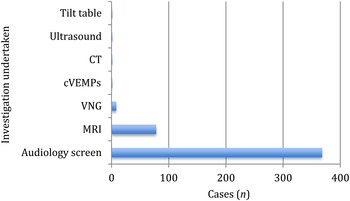
Investigations were requested by the consultant vestibular physiotherapist independent prescriber for 23 per cent of patients (Figure 8). These investigations included: 78 MRIs, of which 38 were for asymmetry highlighted on audiology testing, 35 were for signs of central causes on objective testing, 1 was for anxiety (and patient request), 3 were for suspected vestibular paroxysmia and 1 was conducted to exclude Arnold–Chiari malformation; 8 vestibular function tests; 1 cervical vestibular-evoked myogenic potentials test; 1 temporal bone CT (for suspected superior semicircular canal dehiscence); and 1 neck ultrasound. The ultrasound was requested following findings of a parotid gland lesion on MRI, which needed further clarification; the patient was also referred for an ENT opinion.
A bar graph showing the number and type of investigations undertaken (total n = 368). CT = computed tomography; cVEMPS = cervical vestibular-evoked myogenic potentials; VNG = videonystagmography; MRI = magnetic resonance imaging

There was an 88 per cent return rate for the patient satisfaction questionnaires. Of the patients who replied, 100 per cent said they would recommend the service to family and friends, 99 per cent who did not see an ENT consultant were happy with the level of expertise they received in clinic, and 100 per cent felt they had had sufficient time to express their concerns and needs.
Discussion
In general, an individualised vestibular, balance and strength exercise prescription is the basis of a holistic treatment package. There is good evidence to support the treatments used.Reference Kaski and Bronstein 14 – Reference Lamb 21 To provide these treatments, a consultant vestibular physiotherapist independent prescriber is the most suitable, cost-effective staffing solution.Reference Leong, Barker and Bleach 10
Medication advice was the highest intervention across all conditions after self-management strategies; the findings highlight the importance of medication advice in the treatment of patients with dizziness and balance disorders. The consultant vestibular physiotherapist independent prescriber in this clinic had successfully completed training as an independent prescriber. This involves taking a non-medical prescriber (V300) course and mentorship from a medical doctor. An independent prescriber can prescribe any medications within their scope of practice. 22 Without this qualification, a physiotherapist cannot prescribe or offer advice on medication (use or prescription) to patients or other professionals, but is able to recognise when medication management may be of benefit, and can refer onwards.
Our clinic had lower levels of onward referral to ENT (3 per cent) compared with Kasbekar et al. (22 per cent).Reference Kasbekar, Mullin, Morrow, Youssef, Kay and Lesser 8 Many commonly used drugs are recognised to cause dizziness,Reference Weiss, Parham, Dispenza and De Stefano 23 and this may or may not be dose-dependent.Reference Sirven, Fife, Wingerchuk and Drazkowski 24 , Reference Black, Pesznecker and Stallings 25 Medication-induced migraineReference Lempert, Olesen, Furman, Waterston, Seemungal and Carey 26 , 27 was not included as a separate diagnosis from vestibular migraine, but we are currently considering data collection on the prevalence of medication-induced vestibular migraine to understand more about this condition. Highlighting the need for medication management can help ENT services provide training and support for vestibular physiotherapists.
Of the 3 per cent of patients referred to ENT (n = 12), four were seen the same day to clarify otoscopy or audiology findings. An additional four patients were seen by ENT doctors for wax removal, to allow otoscopy examination and subsequent discharge from hospital, taking 5 minutes per patient.
The increased incidence in the diagnosis of vestibular migraine compared to the paper by Kasbekar et al.Reference Kasbekar, Mullin, Morrow, Youssef, Kay and Lesser 8 is most likely linked to the more recent publications of diagnostic criteria. 16 , Reference Lempert, Olesen, Furman, Waterston, Seemungal and Carey 26 , 27 The low onward referral rate to the headache clinic and ENT is possibly linked to accurate triage and prescribing capacity. This includes exercise prescription, with 50 per cent receiving exercise therapy optimally provided by a physiotherapist.
Our follow-up appointment rate is higher than that reported by Kasbekar et al.,Reference Kasbekar, Mullin, Morrow, Youssef, Kay and Lesser 8 and may be attributed to a higher percentage of vestibular migraine diagnoses and the follow up of medication intervention (in line with prescribing guidelines). 22 Patients were reviewed in clinic to confirm the diagnosis, and to facilitate learning and prescribing confidence for the consultant vestibular physiotherapist independent prescriber. The rate of discharge with no further intervention required was high after two appointments (81 per cent), suggesting effective management without the need for involvement of other health professionals or services, thereby improving cost efficiency. 13
In line with other research, BPPV had the highest number of co-existing diagnoses, often requiring multimodal management and follow-up appointments.Reference Gazzola, Ganança, Aratani, Perracini and Ganança 28 – Reference Fernández, Breinbauer and Delano 31 Health habits and sedentary lifestyles are risk factors for the onset of dizziness,Reference De Stefano, Dispenza, Suarez, Perez-Fernandez, Manrique-Huarte and Ban 30 and contribute to increased bed rest, the inhibition of vestibular reflexes, fear, reduced confidence, altered postural control, falls and BPPV recurrence.Reference Gazzola, Ganança, Aratani, Perracini and Ganança 28 – Reference Kasse, Santana, Branco-Barreiro, Scharlach, Gazzola and Ganança 32 Consultant vestibular physiotherapists are skilled to address these issues.Reference Herdman and Clendaniel 20
The patient satisfaction survey results suggest high patient satisfaction, with 100 per cent of patients willing to recommend the service to family and friends.
Low numbers of investigations highlight the importance of thorough clinical assessment, including a detailed patient history. Although we are unaware of any misdiagnoses, we continually monitor over longer periods to assess efficacy. Imaging and vestibular function tests were carried out on 78 and 9 patients respectively; this highlights our ethos of managing these patients clinically, without relying on expensive tests.Reference Kerber and Newman-Toker 33 The diagnosis of labyrinthitis and vestibular neuritis (without vestibular function tests) was made based on audiology assessment, symptom presentation, patient history and clinical examination findings. We are in the process of securing funding so the audiologist at the initial assessment can in the future perform video head impulse testing and cervical vestibular-evoked myogenic potentials testing.
-
• A multidisciplinary approach is advantageous for patients with dizziness and balance disorders
-
• An independent prescriber physiotherapist led balance clinic develops this further, and matches skills to patients’ needs when referred to ENT
-
• This clinic template has proved successful for diagnoses that require many interventions and has kept onward referral rates low
-
• The frequency of drug-induced dizziness and increase in vestibular migraine highlight the need for medicine management as part of the skill set
-
• Close liaison with an ENT specialist is key to balance clinic success
This model of clinical assessment and treatment has allowed less administration, reduced ENT and physiotherapy onward referrals, and freed up ENT consultation time.
Conclusion
Our balance clinic is an integrated and patient-centred service. The service redesign achieves the ENT-UK aim: ‘collaborative work between ENT specialists, audiologists and physiotherapists managing balance disorders and running vestibular laboratories enhances the success of management of vestibular and balance problems’. 6 It provides further evidence in support of Kasbekar and colleagues’ service redesign.Reference Kasbekar, Mullin, Morrow, Youssef, Kay and Lesser 8 We have added a prescribing capacity with a consultant vestibular physiotherapist independent prescriber to the Southport and Ormskirk Balance Clinic, and have had fewer onward referrals. Vestibular physiotherapists are essential to a balance clinic, with skills matched to this role, adding value, efficacy and cost-effectiveness. Providers of balance clinics can support professional development (including independent prescribing) that delivers benefits to patients and ENT services.
The Southport and Ormskirk Balance Clinic is a streamlined approach for patients associated with a reduction in the number of onward referrals and the provision of all round care including medication management. It applies multidisciplinary care to ensure the best possible patient care, as recommended by the Royal College of Physicians. 1
Acknowledgements
The authors would like to thank Nicola Ivanovic and Sean McCann, Therapy Managers, who supported the independent prescribing role, both financially and professionally.