Over the past decade, considerable scholarly effort has gone into outing Elizabethan authors from their prayer closets; Shakespeare's secret Catholicism occupies a shelf of recent books, and some very eminent critics have made similar claims for John Stow, Anthony Munday, and, amazingly, Sir Philip Sidney.Footnote 1 Although the evidence tends to be both thin and fuzzy, the initial conjectures do not seem unwarranted, given how little the religion of these Elizabethans resembles the Calvinist consensus picture drawn by the best and brightest Tudor church historians over the past three decades, going back to Nicholas Tyacke's 1973 thesis that the clergy and educated laity throughout the period were solid doctrinal Calvinists. If, as scholars as otherwise different as Diarmaid MacCulloch and Christopher Haigh argue, the “mainstream of the [English] protestant reformation” was by and large “a puritan mainstream,” then men whose religion swam against this current may well have been heading toward the see of Rome.Footnote 2 Of course, it is difficult to prove Catholic beliefs, but the reticence meant to conceal an outlawed faith from Elizabeth's pursuivants will also shield it from the historian's gaze.
Recently, Gerard Kilroy has considered the crypto-Catholicism of another Elizabethan writer, Sir John Harington (1560–1612), the translator of Ariosto and author of The Metamorphosis of Ajax, a posthumous volume of epigrams, and the infamous letter on the drunken masque celebrating the King of Denmark's visit. A courtier and country gentleman, Harington was the queen's godson, an affectionate husband, the father of eleven children, and the inventor of the flush toilet. In addition, Harington left several manuscripts, most unknown until long after his death, and these, together with his marginalia, provide an evidential treasure trove for his religious beliefs—at least some of the evidence indicating that despite his “public face of conformity” he privately held with Rome.Footnote 3 Kilroy himself stops short of drawing this conclusion, although he certainly implies it—and, in truth, it is not at first glance clear what other conclusion could be drawn. Whether Harington was a church papist, however, remains to be seen; what makes the question worth asking (since, in contrast to Shakespeare, no one really cares what Harington believed) is that, for once, the evidence will sustain the burden of an answer, and that answer calls into question the Calvinist/crypto-Catholic binarism structuring the current historiographic picture of the English church in the decades before and after the death of Elizabeth I.
A Jax or a Priest Hole?
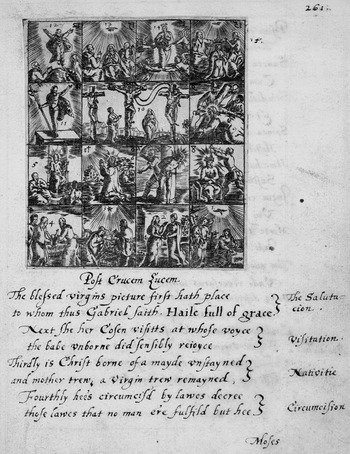
The first section of this article, which lays out the case for Harington's Catholicism, is heavily indebted to Kilroy, whose startling exhibits include the engraving and poem on the Fifteen Mysteries of the Rosary that make up the closing pages of a beautiful 1605 gift manuscript of Harington's epigrams, with facing versions in Latin and English (fig. 1). As Kilroy notes with some understatement, this Marian composition, with its final stanza on the Assumption of the Virgin, “suggest[s] a Catholic reading.”Footnote 4 Several of the manuscript's epigrams point in the same direction. Two in particular, both absent from all seventeenth-century published editions of Harington's verse, stage a confrontation between Protestant and Catholic and resolve it in the latter's favor. The epigram “Of trying spirits” recounts a “conference” between “a Catholic” and “one of our great Prelates of the state.”Footnote 5 To the former's lament over the decay of the church fabric following the English “schism,” the prelate rudely responds, “what's that to you, for you have lost it all.” The Catholic acknowledges the loss, yet adds that “we do wish in heart” that the Protestants would cherish their newly acquired church. At this point, Harington invokes Solomon to judge which of these two “is the harlot, which the lawful mother,” the one who “saith, ‘Spare my child alive and take it / Let it not
Fifteen Mysteries of the Rosary from a 1605 gift manuscript of Harington's epigrams, Folger MS V.a.249, 261 (by permission of the Folger Shakespeare Library).

perish though I must forsake it,’” or she who “feeling no remorse of grace nor nature, / Saith, ‘Neither thine nor mine, but dividatur.’” The Catholic's selfless love proves him the true mother, in contrast to the new prelates, who, by permitting the church's patrimony to be divvied up so long as they “retain a portion,” betray the illegitimacy of their claim.
The second epigram, “Of two religions,” looks like an argument for church papistry. The poem begins with a father asking his university-educated son whether the “Church of Geneva” or the “old Catholic” were “the sounder Church.” To which comes the reply: “‘Sure,’ quoth the son, ‘a man had needs be crafty / To keep his soul and body both in safety. / But both to save, this is best way to hold: / Live in the new, die if you can in th’old’” (376). That is, since the Roman Church held that Protestants were damned, while Protestants generally held out better prospects for Catholics, it would be safer—a better bet, in Pascal's sense—to die in the old religion. It was a favorite argument of the Jesuit mission clergy.Footnote 6
Three years before Harington crafted this gift manuscript, he set down his thoughts on the impending regime change. The Tract on the Succession, intended to be published after the queen's death had the succession been disputed, defends James VI's claim. As this implies, Harington distances himself from the Jesuit hard-liners plotting to bring in the infanta. Yet the work is throughout deeply sympathetic to the plight of English Catholics, whose “number smallest, and power weakest,” are only “feared most, because they fear most.”Footnote 7 The Tract addresses Catholic, Protestant, and Puritan readerships (the terms are Harington’s), quoting supporters of James's claim from the three camps, in the hope of persuading all parties that, “howsoever estranged … [in] faith … yet in this matter of State … we may all hold together.”Footnote 8 Harington's aim is irenic, but, as Kilroy notes, the Tract's velvet rhetoric sheaths some fairly edgy critique: Harington “scathingly sums up” the English Reformation as “mixed with private and politique respects, of gain, of revenge, of fancy,” so that even Protestants consider it “not worthy the name of a Reformation.” Henry VIII “whipped off heads of both sides,” so that the only way “to have 'scaped the fagot or the halter … [was] to be just of the King's religion.”Footnote 9 Harington's picture of Elizabeth's reign foregrounds both the clergy's “manifold and open abuses” and the increasingly cruel persecution of Catholics, against whom “laws were made sharper and sharper … [until] in the end, acts of religion became to be treasons.”Footnote 10 The Tract's final chapter pleads for a new religious settlement that would revoke the anti-Catholic penal statutes, it being “greatly to be wished that matter of religion were divided from matter of state,” since “long, lamentable, & bloody experience … hath proved that rigor of laws doth little good,” and “men's minds remain rather the less satisfied of the uprightness of the cause, where racks serve for reasons.”Footnote 11
The only original work Harington published in his lifetime was the witty, erudite, and wildly digressive treatise on water closets, The Metamorphosis of Ajax (1596), whose surface was innocuous enough to be licensed but the underside sufficiently transgressive to get the author banished from court for three years. The crypto-Catholic subtext can easily escape detection. However, Harington added handwritten glosses to several presentation copies, and these, Kilroy argues, give the work “a completely different meaning,” available only to an inner circle with whom Harington's secrets were safe.Footnote 12 Three sets of annotations point to the work's true intent. The printed text states that there were five unnamed honorable persons present when the device (the aforementioned toilet) was first thought of. Harington's marginalia identify them; not surprisingly, at least half are Catholics.Footnote 13 The second set follows the narrator's dream that he has been indicted for satirizing godly preachers and now must pick his jury. He requests certain noblemen, again unnamed except in the presentation copies, and again, Kilroy notes, the individuals turn out to be “the leaders of the Catholic community in England.”Footnote 14 The third set glosses a satire on the recusant catcher Thomas Norton, who is described as having “some young scholars.” Harington notes in the margin that the “young” is a dig at “Justice Young a promoter,” that is, Richard Young, JP, whose style of interrogating Catholic suspects gave the rack its Elizabethan nickname—Young's fiddle.Footnote 15 In satirizing this hated informant by name, as, earlier, in honoring the Catholic noblemen by name, these marginalia, Kilroy concludes, transform Harington's “innocuous-sounding printed text into a savage and personal invective against the whole army of spies and pursuivants,” revealing “for a selected audience” that the Metamorphosis was not really an encomium to indoor plumbing; rather, “the excrement to be washed away” were anti-Catholic bigots like Young. At bottom, the work is “a savage attack” on the “corruption and cruelty” of the Protestant persecutory state. “It is hardly surprising,” Kilroy adds, “that there was a strong reaction at court” or that Harington was rumored to be a papist.Footnote 16
For Kilroy, these annotations prove that Elizabethan Catholics used “coded statement.” As such, they are crucial evidence for his thesis that the Elizabethan age was “far from golden” for its Catholic population “living in nightly fear of arrest and imprisonment … [whose] manuscripts, circulating in secret, offer us torch-lit glimpses of the dark underside of early modern England,” where, “beneath the glittering surface … the management of fear” by men “such as Burghley … produced misery and suffering on a scale which has always been underestimated,” and where the state's “attempt to penetrate the inner mystery of men's hearts” drove writers like Harington to create a language “refined by oppression” into “complex and coded forms … invented to preserve the inner self.”Footnote 17 Less than a month after Elizabeth's death, Harington, who had high hopes that James would introduce a new, more tolerant, order of things, renounced the indirection of poetry (in Latin elegaics), for “Iam dabitur veras audire ac reddere voces / Nostra sat est pietas dissimulata diu”—or, as he himself translated the lines, “Now we may tell plain truth to all that ask, / Our love [pietas] may walk bare-faced without a mask.”Footnote 18 In taking leave of his Muse, Harington was also, in Kilroy's words, “bidding farewell to disguising one's religious belief.”Footnote 19
The evidence amassed thus far points in one direction, and I have not even mentioned Harington's disapproval of clerical marriage; his allowance of prayers for the dead; or his two run-ins with the Privy Council, first in 1584 for involvement in distributing Campion's books, again in 1592 for trying to set up a private press.Footnote 20 And yet Kilroy's reluctance to draw the obvious conclusion is well founded, since Harington was not a Roman Catholic.
For one thing, he himself twice brings up the rumors of his Catholic leanings, both times unbidden, and both times denies them. At the end of the dream-vision arraignment in the Metamorphosis, two Puritan ministers accuse the narrator (i.e., Harington) of being “a Papist”; he at once searches “every corner of my heart” and reports “finding no such thought in it.”Footnote 21 It is a disclaimer he repeats in a 1601 letter to Robert Cecil, “protest[ing] before God … I am no papist neither in life or thought.”Footnote 22 These denials cannot be brushed aside; to deny one's faith is a mortal sin: a sin that, if unrepented, suffices for damnation. Had Harington, like the early Christians, been compelled to disclose his beliefs, he might have lied; others have done so. It is, however, hard to conceive why he would invent an occasion for apostasy.
Moreover, the evidence presented thus far has problems. The handwritten glosses to the Metamorphosis of Ajax, for example, do not really reveal the text's hidden meaning, since two of the three “coded” passages are about as hard to figure out as pig latin. Thus, although the printed text does not name the Catholic noblemen the narrator initially wants on his jury, it identifies them by their ancestral manors; few Elizabethans would have had difficulty linking Petworth with the Percies, and so forth. This is synecdoche, not code. The pun on Young's name was apparently equally transparent; at least it presented no difficulty to the author of a pamphlet attacking the Metamorphosis published the same year; the author, who also seems to have been named “Young,” thus taunts Harington with the dire consequences he is likely to suffer for his nasty cracks at Justice Young's expense: “a Young that will be old (saith thus) in behalf of old Young, that except you presently put on a habit of more conformity, if some his enemies may promote [i.e., inform against] you, you shall be the next dog shall be sacrificed in the Lupercalia.”Footnote 23 Nor, in fact, does the Metamorphosis encode Harington's religious affiliation; it addresses the matter straight on. The jurors in his dream-vision arraignment ask “what Religion I was of,” to which the narrator responds: “neither Papist, Protestant, nor Puritan.” Unamused, they demand a better answer. “Then I said, ‘I am a protesting Catholic Puritan.’”Footnote 24 It is a self-description Harington will use for the rest of his life, and since he so explicitly refuses these pigeonholes, who are we to interpellate him?
There are likewise problems with construing the Tract on the Succession as a Catholic apologia. It does explicitly argue that “the sword is no good decider in questions in religion,” but Kilroy's summary fails to note that Harington's censure also falls on “the great cruelty in Queen Mary's time.” The work is a plea for greater (although not absolute) religious toleration across the board, experience having “taught that neither the burning used in Queen Mary's time, nor the hanging used in this time, nor both used in King Henry's time, did any good at all.”Footnote 25 Moreover, in its survey of the Tudor monarchs, the Tract reserves its highest praise for Edward VI, of whose “years was never a more towardly nor a better natured Prince, nor more zealous to the service of God.”Footnote 26
In the Tract's final chapter, Harington lays out what he finds “blameworthy on both sides.” His criticisms of Tudor Protestantism are those which recur throughout his writings: the greedy despoliation of the church by clergy and laity alike and the harsh anti-Catholicism of the law. His objections to the Roman church, by contrast, concern doctrine: “the notable superstition used in worshipping of images,” the “noble merchandise of selling pardons & redeeming souls out of Purgatory,” and the papal supremacy—which rightly understood “is a mere temporal and politique constitution, and may accordingly be retained or transferred or assigned by a Christian prince.”Footnote 27 This last objection is the crucial one, since it would be an odd sort of Roman Catholic who could accept the subordination of papal to royal authority. It also seems to be Harington's principal justification for England's break with the Church of Rome. A brief, unfinished defense of episcopacy from 1608 elaborates a politique account of the church's relation to secular power, arguing that the notion of a single universal chief bishop developed as the counterpart to the Roman emperor; the division of the Empire led to a corresponding split between the Greek and Latin churches; with the subsequent fragmentation of the Western Empire into monarchic states, the jurisdiction of “the western Patriarch” breaks up into the autonomous national churches of the Protestant post-Reformation.Footnote 28 It is to this model of church-state relations that James will appeal at the Hampton Court Conference, “no bishop, no king” being simply the reciprocal of Harington's “no empire, no pope.”
The suspiciously Catholic-sounding epigrams discussed above likewise admit of more open-ended readings. Taken in context, the “pietas dissimulata” of Harington's 1603 farewell to poetry refers not to his religious beliefs but to his allegiance to James Stuart, which he had to mask during the queen's lifetime; the lines that follow make it impossible to read “pietas” as “piety.”Footnote 29
Nostra sat est pietas dissimulata diu.
Quod reliquum est aevi patriae patriaeque parenti,
Dedico nec levibus jam vacat hora jocis. …
Seu libet Hispano bella immovere potenti
Justa sub invicto principe bello sequar.
[Our love may walk bare-faced without a mask.
My future age to realm and king I vow,
I may no time for wanton toys allow. …
If he be pleased war to proclaim with Spain,
With such a prince I’ll follow wars again.]
By contrast, the epigram “Of trying spirits,” with its condemnation of the “great Prelates of the state” for abusing the church they wrested from its more careful Catholic mother, admits of no alternative interpretation, nor does it require one. Throughout his life Harington denounced the post-Reformation neglect of the ecclesiastical fabric. He means it, and meaning it does not make him a Catholic. “Of two religions” is likewise not the apologia for church papistry it initially seems, since the father's question is not whether the English or Roman is “the sounder church”; the choice lies between “this Church of Geneva” and “that old Catholic.” These are not, however, the only alternatives, since, as will shortly become evident, Harington's writings delineate a profoundly un-Genevan vision of the ecclesia Anglicana. Yet the epigram suggests that had such an alternative vision not been available, had the choice lain between Geneva and Rome, Harington might well have taken the son's advice.
Nothing thus far justifies viewing an engraving and poem on the Fifteen Mysteries of the Rosary as any less flagrantly Catholic than the “Spiritual Testament” of John Shakespeare, the playwright's father. There is, however, a crucial difference between them: unlike the elder Shakespeare, Harington did not hide his text in the rafters but in 1602 sent it, bound with his epigrams (including those discussed above), to James VI, soon to be James I.Footnote 30 In 1605 he had a duplicate manuscript made for Prince Henry. Both recipients were apparently happy with the gift. James sent a gracious thank-you note; Henry's response was warm enough for Harington to compose two more works for the young prince, including a book-length survey of England's Protestant bishops, a fair number of whom Harington knew personally.Footnote 31
Nor is this the only surprising episode in the reception history of Harington's works. Shortly after finishing the Tract on the Succession, Harington lent a copy to a friend, who must have thought reasonably well of the piece since a few years later Harington described himself as being “much in [the same friend’s] … company” and a regular guest at his table.Footnote 32 The friend was the Bishop of Durham (soon-to-be Archbishop of York), Tobie Matthew, a staunchly Protestant prelate. Matthew's is the only extant copy of the Tract, but there also survives a summary in tiny handwriting under the title “Some notes for remembrance out of his Sir Jo. Harrington's book on the behalf of the K. of Sc. succession”—almost certainly done by Robert Cecil's secretary.Footnote 33 One cannot quite describe Cecil and Harington as close friends: the latter was a country gentleman; the former, the most powerful man in late Elizabethan England. Yet in the year the Tract was written, Cecil stood godfather to Harington's son. The two corresponded regularly, and Cecil's letters to Harington, particularly around 1603, betray a real intimacy.Footnote 34 The relationship lasted until their deaths, a few months apart, in 1612: Harington, himself gravely ill, traveled to Bath to be with Cecil, who had less than a week to live.Footnote 35
As for the Metamorphosis, Harington read the manuscript aloud to the redoubtable Protestant Lady Russell and had her send the print version to Cecil, her nephew.Footnote 36 We learn from a letter of Sir Thomas Cornwallis (a longtime recusant friend of Burghley) that, soon after publication, it was “read to her Majesty, who laughed well at it.”Footnote 37 Writing to Harington about two years later, his cousin Robert Markham confirmed that the book did get Harington in trouble, but the offense seems to have been a secular one, the queen having conceived “much disquiet on being told you had aimed a shaft at Leicester,” and even that disquiet appears not to have amounted to much, since, according to Markham, “tho’ her Highness signified displeasure in outward sort, yet did she like the marrow of your book.”Footnote 38 He was restored to favor shortly thereafter—so much so that in December 1602, Elizabeth, her health visibly failing, bid him come and asked him to “read [her] some verses, whereat she smiled once” but was too sick to be distracted.Footnote 39
Harington belonged to a circle that included two monarchs, a Prince of Wales, a leading statesman, and the Archbishop of York. They knew his writings, including those—for example, the Tract and the Rosary poem—that one might have thought far outside the magic circle of orthodoxy. That Harington found such warm reception among its guardians raises interesting questions about the size of that circle—questions to which the second half of this essay will return.
First, however, there remains the puzzle of Harington's own religion. It seems reasonably certain that he was not a Catholic. But what are the other options? The Tract on the Succession defines “Protestant” as including “the more moderate” Catholics and Puritans, as well as “all the careless and indifferent sort, and all the simple and ignorant.”Footnote 40 So defined, Harington is a Protestant, but since by “Protestant” he means simply “conformist,” this is not terribly helpful. No one has ever doubted Harington's conformity. His own self-description as “protesting Catholic Puritan” seems even less informative.
Yet it does point toward a basic truth about Harington's religion: if he was not a Roman Catholic, neither was he in any doctrinal sense a Protestant. When, at the end of the Metamorphosis, Harington finally does disclose to the jurors his understanding of “true religion,” it requires a single sentence: “to visit orphans and widows in their afflictions, and to keep your self undefiled from the world.”Footnote 41 It is a quotation from the Epistle of James, the Epistle that Luther at one point wanted to drop from the New Testament for its un-Pauline valuation of works over faith. It is also the same definition of “true religion” Harington offers in the Tract, adding that, since he does not find the terms “papist” and “protestant” in Scripture or the church fathers, he prefers to say, “Christian is my name, Catholic my surname. … Further I confess I do heartily believe all the Holy Scripture and the Creed; I pray the Lord's prayer and other good prayers of the Communion book, I observe the Ten Commandments as well as I can, though not so well as I would, and I hear many sermons & am edified but by a few.”Footnote 42
The creed, Lord's Prayer, and Ten Commandments were the texts displayed on the walls of Elizabethan parish churches where painted saints had once kept watch, the texts forming the core of the Prayer Book catechism. Harington's confession of faith simply affirms the minimalist orthodoxy of the English church, omitting all mention of distinctively Protestant teachings. Harington's epigrams do mention these, but with considerable sarcasm. “Of only faith” takes a typically Haringtonian stance: “Pure Cinna evermore disputing saith / That Christians saved are by only faith. / But herein Cinna's speeches are abusive, / To foist unto our faith a word exclusive; / For we do find, marking the Scripture's scope, / Salvation comes by grace, love, fear, and hope. / Wherefore, when Cinna speaks `faith saveth only,’ / Tell him, Misacmos [Harington's alter ego] saith, he speaketh onely.”Footnote 43Another epigram concerns “pure Lalus,” who preaches exceedingly long sermons “to prove that works are needless to salvation,” a feat that ends with his congregation slipping one by one out the door and with Harington's bleak couplet on post-Reformation Europe: “while you make St. Paul fall out with James, / You trouble ours and all our neighbor realms.”Footnote 44 “Of Cinna's Election” denies the possibility of assurance not accompanied by holiness of life, and is none too certain about its possibility even when so accompanied, for “an holy, true and long preserved purity / May hap, and but perhaps breed such security” (75). “Of free will” takes an equally dim view of predestination (128). In place of these Reformed credenda, Harington stresses the obligations of charity (135), contrition (90), almsgiving (91), and fasting (186). In his sketch of the post-Reformation episcopate written for Prince Henry, Harington gives highest marks to Lancelot Andrewes for urging “amendment of life and good works, the fruits of true repentance”; he likewise praises the sermon that, while still a schoolboy, he heard William Day preach on the necessity of cooperation with grace.Footnote 45 The homily Harington remembered after thirty years taught that it was not “a praying to God, but a tempting of God, to beg his blessing without doing also our own endeavor; shall a scholar pray to God to make him learned, and never go to his book? shall a husbandman pray for a good harvest and let his plow stand still?” The preacher then launches into a delightful story about a pagan carter who, his wagon having tipped over, invokes Hercules to set the thing back on its wheels. As requested, the god comes, but instead of helping gives the carter a swift kick in the pants, telling him, “Arise, set to thy shoulder, and heave thy part, and then pray me to help thee, and I will do the rest.”Footnote 46
In his one foray into theology proper (an unfinished essay on the second coming of Elijah), Harington defends the authority of the church fathers, with a few contemptuous asides on Protestant exegesis. His respect for tradition is high enough to allow belief, if not in purgatory and the Assumption, at least in their possibility. Against the Roman position, he argues that, while such traditions do not “bind our belief as infallible truths,” yet, if supported by the witness of the church fathers, possess a real, although qualified, authority.Footnote 47 Thus his versification of the Mysteries of the Rosary uses “credimus” for the Resurrection but for the Assumption switches to the more reserved “creditur,” which in English becomes “it is presumed, / The blessed virgin was to heaven assumed.”Footnote 48
Harington's main quarrel with the Reformation, however, is not doctrinal but rather what Spenser personified under the name Kirkrapine.Footnote 49 He spent much of his adult life trying to garner contributions for the restoration of Bath Abbey, which Cromwell's commissioners had sold to a group of merchants, who left it, Harington reports, a roofless, ruinous shell; five years later “went the axes and hammers to work at Wells,” where “the chapel of Our Lady … a place of great reverence and antiquity was likewise defaced, and such was their thirst after lead (I would they had drunk it scalding) that they took the dead bodies of bishops out of their leaden coffins and cast abroad the carcasses.”Footnote 50 More than once, Harington expresses his suspicion that the forces behind the Reformation were, on the whole, less interested in planting a new church than in the profits to be reaped from destroying the old one. Rapacious noblemen, Raleigh and Leicester in particular, egg on Puritan extremists in the hope of further gain, working in combination “like Pilate and Herod to condemn Christ.”Footnote 51 The Metamorphosis of Ajax offers the same assessment in print: such gentlemen pretend “zealous reformation … [and yet] care neither for good letters nor good lives, but only out of the spoils to get good livings; our good Lord Bishops must be made poor Superintendents, that they might superintend the goodly Lordships of the rich bishoprics.”Footnote 52
If the greed of “favorites and courtly minions” was primarily responsible for “devour[ing] whole churches and their rents,” their predations could not have succeeded if the bishops had not cravenly yielded to pressures both political and domestic.Footnote 53 Like Elizabeth, Harington took a dim view of clerical marriage. As he explains in a letter to Joseph Hall, such marriages are not unlawful, but he does consider them inexpedient, mostly because children (as every father of eleven knows) are a costly proposition. In the Supplie he mentions hearing of a married bishop who “keepeth good hospitality for the poor … [and] his houses in good reparation,” adding that if the rest did so, his objection to clerical wedlock would vanish.Footnote 54
Harington's distaste for Protestant doctrine and his zeal for the glory of Christ's visible church are of a piece with his sense of the deep continuities binding the post-Reformation English church to Rome, “our mother,” who “gave us our first milk.”Footnote 55 This vision of the Elizabethan church as part of the unbroken tradition of English Christianity finds its clearest expression in a remarkable letter of 1605 that Harington wrote Cecil and Mountjoy, the then lord deputy in Ireland, humbly seeking appointment as chancellor of Ireland and, since that position had traditionally gone to a bishop, episcopal ordination as well. As part of this job application, Harington described the sort of churchmanship he would bring to Ireland, where he had twice been, the last time as a commander in Essex's army. Essex's chaplain, he notes, tended to forgo the Prayer Book and instead to kneel “down in the middest of a room, and there made a prayer ex tempore of near half an hour,” with results that on occasion were sufficiently “ridiculous that it was almost impious.” The Protestant clergy in Ireland, he adds, sought to recommend their faith to the Catholic Irish “by violent hewing down their crosses, burning and defacing their images … going to plow on their Christmas Days, and pronouncing that all their ancestors are damned that did but pray to our Lady.” These efforts, as might be predicted, met with universal hostility, so that “in 44 years preaching there was scant forty-four men out of the English Pale that would willingly come to service.”Footnote 56 By contrast, Harington writes, during his time in Ireland, whenever he saw “crosses or images remaining in any of their churches or houses, I told them our church did not condemn the use, but the abuse, of these, when through a negligent and affected ignorance the people creep to them and are prostrate afore them as to deities. But for those that would break them and deface them … I assured them our church held them as worthy punishment as our state held their countryman that trailed Queen Elizabeth's picture at his horse's tail.” In its sacraments and ceremonies, too, he reassured them that the English church largely kept the ancient forms:
For confession … our communion book, our learnedest divines, and our wisest statesmen do highly approve it, only they are loathe … to snare men's consciences by imposing a necessity. … For fasting in Lent and other appointed days, our prayers in the book … show we approve them. … [For] the Lord's Supper, though we use not words of realities and transubstantiation, words not known to the primitive church, yet we have a most reverent opinion of it; we received it kneeling, and that the Queen did wish men would leave disputing of it and believe of it everyone as God should give him grace.
Harington adds that he often managed to overcome Irish scruples about attending Protestant services simply by showing them “how the same we read in English they read in Latin.”Footnote 57 Such arguments were not mere strategy for converting the Irish; Harington made the same claim for the fundamental catholicity of the post-Reformation church in writing to Prince Henry. We have, he argued, all that the Roman church has, but “in English”: “we have true and reverend bishops, succeeding by imposition of hands; we have the sacraments and ceremonies of the church,” as well as preaching, “true faith,” “acceptable works,” “fervent prayer,” “devout fasts,” “charitable alms.”Footnote 58 The epigram addressed to his wife, allowing the devotional use, although not adoration, of “some saint's picture, or the Crucifix” likewise bears witness to this minimalist vision of the Reformation.Footnote 59
There is, moreover, something deeply traditional about Harington's emphasis on peace making, hospitality, friendship, and, in general, what Alan Bray calls the “socially unitative role of Christianity in the world about it,” a role that “for some seemed like the religion of the lukewarm” but for “traditional-minded Christians” was “its very point, why Christianity mattered and how it had earned its keep.”Footnote 60 The most striking instance is, again, the 1605 letter to Cecil and Mountjoy, where Harington speaks directly about his own ecclesio-political ideals. What qualifies him for the chancellorship, Harington avers, is a talent for resolving “feuds and quarrels,” as “it hath pleased God sometime to give [him] a success beyond vulgar expectation,” both in Ireland, where “the Governor of Connoght employed me to end a long suit and deep grudge between some of good sort in Galloway,” and in England, where he brought “two of the greatest Earls of this realm, being then at very great variance … to meet at my poor house, and there perfectly to reconcile themselves.” We might call this arbitration. For Harington it remains the work of religion, as signaled by the Gospel fragment he puts at the beginning of this portion of the letter: “Beati pacifici.”Footnote 61
The Metamorphosis likewise bears the impress of this traditional sense that religion earned its keep by helping people who might otherwise be at each others’ throats “live together in peace and friendship.”Footnote 62 Of the jurors chosen for its dream-vision trial, a fair number were Roman Catholics—but not all of them. Indeed one of the jurors, a cousin of Harington's and a firm Protestant, had two years earlier taken part in searching another juror's home for illegal popish paraphernalia. Yet Harington brings them to sit together. He selects both, as he selects all his jurors, for their “good housekeeping”: they relieved the poor, “kept good hospitality,” and built “not only … [their] own houses but colleges and hospitals”—this final criterion being yet another instance of Harington's emphatically material and social ideal of Christian edification.Footnote 63 By bringing together those whom the Reformation divided, as by honoring those on both sides for their practice of the old virtues of almsgiving, housekeeping, and noble largesse, Harington affirms the small-c catholicity that reaches back to the Catholicism of pre-Reformation England and out to the Catholic and Protestant gentry of Elizabethan England.Footnote 64
This double motion, one might add, complicates the traditionalism of Harington's Christianity with a rather unmedieval tolerance of religious pluralism: the tolerance of the Tract on the Succession, which memorably concludes that “the communion is good, and the mass is good; they be both good; 'tis pity we should fall out about them. … Seeing all of us profess one Christ and differ but in the fashion of serving Him,” and that the disputed points mean little to “the good plain farmer, yea or Mr. Justice of the Peace.”Footnote 65 Harington's epigram on the whereabouts of Lazarus's soul suggests his preferred response to such controversies:
Once on occasion two good friends of mine
Did meet at meat, a lawyer and divine.
Both having eaten well to help digestion,
To this divine, the lawyer put this question:
When Lazarus in grave for days did stay,
Where was his soul? in heaven, or hell, I pray?
Was it in hell? Thence no redemption is.
And if in heaven: would Christ abate his bliss?
Sir, said the preacher, for a short digression,
First answer me one point, in your profession:
If so his heirs and he had fall’n to strife,
Whose was the land, if he came back to life?
This latter question mov’d them all to laughter,
And so they drunk one to another after.
The question has a polemical bite, since the Catholic answer would have been the limbus patrum, but the Protestant is on the horns of a dilemma, which is clearly where the lawyer intends him to be. Unlike most divines, however, this one has a sense of humor, and his riposte, which shifts the issue from the limitations of Protestant soteriology to those of human knowledge, and thus from the two men's theological differences to their shared uncertainty, restores the good fellowship of laughter and liquor. The Tract makes a similar point about families, noting that although “controversies” now divide “brothers and brothers, fathers and sons, husbands and wives one from another in opinions and belief,” yet “many times as myself have seen,” these still “live in house and bed and board together very lovingly.”Footnote 66 As is evident from their taking sides, the religious disputes of the age matter to these lay people (as they mattered to Harington)—just not as much as loving friendships and families. This is not a secular scale of value, but it was not how most clergy saw things.
Harington's England: The Traditionalism of the (Avant) Avant Garde
It is one thing to describe Harington's religion; it is another thing to assess its significance. Was he an odd duck, maybe with some Catholic or even libertine tail feathers? Was he a marginal, even threatening, figure, in his (creedal) polymorphous perversity, in his shockingly un-Foxean view of Elizabeth—not a new Constantine but just another bloody Tudor—and in his unusual interest in toilets? Yet this cannot be right, since the reception of his work points in the exact opposite direction. Moreover, as this section shall try to show, a goodly number of his contemporaries, great and small, apparently shared a similar religious profile. “Similar” is, of course, a capacious term, given that any two things are similar in some respect: William Shakespeare and George Babbit were, for example, both conformists. Yet, since no two things are identical, it is also indispensible. All groupings are at bottom claims of likeness. If we can find among Harington's contemporaries stances exhibiting much the same cluster of distinctive ideals that set his religion apart from Reformed Protestantism, there would be grounds for thinking that Harington's protesting Catholic Puritanism is not idiosyncratic post-Reformation bricolage but a type of Elizabethan Christianity.
We may start with Harington's own name for his religious position. One is inclined to take “protesting Catholic Puritan” as deliberate mumbo jumbo, which it largely is. Yet Harington once uses similar phrasing to describe someone else's position: the Supplie terms Bishop Gardiner “a Catholic Protestant, or a protesting Catholic” on the grounds that in the 1530s he had espoused a Catholicism minus papal supremacy, superstitious images, and communion in one kind. As “protesting Catholic” resembles “protesting Catholic Puritan,” so Gardiner's departures from the old religion overlap with Harington’s. Harington did not like Gardiner, whose role in the Marian persecutions was considerable, and he would scarcely have modeled his own religious position on the Bishop of Winchester’s, but when he came to write the Supplie, he seems to have recognized a structural kinship with Gardiner's theology. Why else would he have reworked his own self-description to characterize it? By calling attention to this kinship, moreover, Harington would seem to locate himself in the spiritual genealogy of Henrician Catholicism.Footnote 67
Yet Harington's usual take on the Henrician Reformation is negative. This is an isolated passage, a tenuous resemblance. By contrast, Harington's religion betrays a pervasive likeness to what in 1581 the Puritan minister George Gifford termed “country divinity,” and Christopher Haigh, more recently, “parish anglicanism.” Haigh, who considers this the majority religion in late Elizabethan England, describes it as content to do without popes and purgatory but also “not recognizably Protestant.”Footnote 68 Like Gifford, whose godly perspective he adopts, Haigh tends to view such religion as evidence of the Reformation's failure.Footnote 69 Christopher Marsh, from a less hostile vantage point, finds it “warm, positive, and robustly Christian,” yet he reaches the same conclusion as Haigh: that the English became Protestant “precisely because they were often allowed, in reality, not to be.” Both scholars thus note how much of the old ritual remained and how much it was valued: the Marian feasts, churching, vestments, bowing at the name of Jesus, kneeling for communion, the cross in baptism, the wedding ring. Clergy who omitted these rites time and again ran afoul of the “enthusiastic traditionalism” of the English majority.Footnote 70
Yet, Marsh adds, however valued these rituals, “at the very core of popular religion in the sixteenth century lay … a hope and a dream, conceived very much in spiritual terms, that Christians might be able to live together in a state of concord or ‘charity.’” Such aspirations found expression in the common worship of the parish but also (and sometimes, immediately afterward) in the good fellowship of the alehouse. For Marsh, as for Bray, “traditional religion” was thus far less a matter of ritual observance than social praxes: reconciling enemies, sanctifying and strengthening bonds among kin and neighbors, restoring defective relationships. And although the Reformation disturbed, and at times destroyed, such solidarities, by and large ordinary people refused to relinquish this dream.Footnote 71 These were parish anglicans because, like Harington, “they stressed communal values of village harmony and worship and objected to the divisiveness of the godly.”Footnote 72 So Atheos, Gifford's endearing spokesman for such country divinity, mounts a spirited defense of his parish priest against the godly Zelotes's skeptical questioning whether this old-school curate “reprove[d] naughtiness”: “Yea, that he doth … for if there be any that do not agree, he will seek for to make them friends: for he will get them to play a game or two at bowls or cards, and to drink together at the alehouse. I think it a godly way to make charity.”Footnote 73 In 1605 some nonfictional parish anglicans invoked the same values to commend their longtime minister; he is, they wrote, “very charitable to all: a painful peace-maker amongst all men.”Footnote 74 These were not, of course, the values urged by Puritan ministers like Gifford, for whom the preacher's job was to “divide the godly from the profane and set them against one another”—a model of ministry that drives Gifford's Atheos to protest, “I know towns myself which are even divided one part against another since they had a preacher … whereas before they loved together.”Footnote 75 Indeed, it drives him at one point to a spasm of Catholic nostalgia; faced with Zelotes's contempt for his ethic of neighborhood, Atheos responds bitterly that he will “follow our forefathers. Now there is no love, then they lived in friendship and made merry together; now there is no good neighbourhood.”Footnote 76
Recent work by social historians indicates that Atheos's view commanded wide assent. A large number of English conformists were thus apparently unwilling to privilege doctrinal difference over communal harmony by informing on their recusant neighbors. Muriel McClendon reports that in the 1570s and 80s the Norwich magistrates did not seek to enforce Parliament's increasingly harsh laws against Catholics, nor did recusants who came to their attention find themselves much the worse for the encounter.Footnote 77 In general, people gave priority to the bonds of friendship and community. Catholic testators often asked conformist neighbors to witness their wills; Protestants chose recusants as godparents for their children; Catholics got married, baptized their children, and buried their dead in the parish churches.Footnote 78 Puritans had more reservations about such unclean mixtures, yet they too, despite occasional conflicts, lived, worked, and worshipped with their neighbors, who all “usually managed to get along with each other.”Footnote 79 If rigorist clergy denounced such cross-confessional fellowship, along with its Haringtonian premise that all professed one Christ and differed only in their fashion of serving Him, it accorded with the teaching of the Homilies: “We cannot be joined to Christ our head, except we be glued with concord and charity one to another. … There is but one faith, and how can we then say, he is of the old faith, and he is of the new faith?”Footnote 80
The substance of country divinity, like its style, has a distinctly Haringtonian cast. Indeed, accounts of the former characterize “true religion” in virtually the same terms Harington uses at the end of the Metamorphosis and Tract: believing Scripture and creed, praying the Lord's Prayer, attempting to obey the Ten Commandments, visiting widows and orphans. With respect to doctrine, it is enough, as Asunetus (the counterpart to Gifford's Atheos) tells the godly minister Theologus in Arthur Dent's spectacularly popular A Plain Man's Pathway to Heaven, “if a man say his Lord's Prayer, his Ten Commandments, and his Belief, and keep them.” As for the rest, salvation requires “a good faith to God-ward,” but not faith alone; a man must “say nobody harm, nor do nobody harm and so do as he would be done to,” and if he be also “a man of God's belief,” then “no doubt he shall be saved without all this running to sermons and prattling of the Scriptures.”Footnote 81 Godly ministers across early modern England reported that this pretty much summed up the religion of their parishioners, who, despite a hundred sermons teaching otherwise, held it sufficient to “live peaceably amongst my neighbours,” “love God above all, and my neighbour as myself,” without troubling about “high points.”Footnote 82 The aversion to “high points” did not imply devotional torpor or indifference to the worship of the church. Asunetus is emphatic about being a regular churchgoer, “and [I] mind my prayers as well when I am there. … Though I say it myself, I have been always well given, and have loved God's word with all my heart, and it does me good to hear the Epistles and Gospels read every Sunday by our vicar.”Footnote 83 Theologus was not impressed, nor was the Kentish minister who complained in 1596 that “there was scarce one” of his parishioners but “trusted he did so live, that by God's grace he would obtain everlasting life by serving of God and good prayers.”Footnote 84 One suspects that Sir John Harington would have gladly said “amen” to the prayers of these parish anglicans, who shared his emphases on the love of God and neighbor, on the unspectacular orthodoxy of creed and commandments, and on doing unto others rather than listening unto sermons. Yet it seems equally hard to view him as a parish anglican precisely because he was Sir John Harington. Haigh assumes throughout that parish anglicanism was the “residual religion” of simple villagers, people whose resistance to Bible reading had something to do with their inability to read, their piety embodying the reflex conservatism of country folk too stuck in the mud to get on the official Protestant bandwagon.Footnote 85 Alexandra Walsham refers to the same cluster of (Haringtonian) beliefs and values as “residual rural Catholicism.”Footnote 86 Both, that is, accept the standard view that Elizabethan official religion, the religion of the clergy and educated laity, was Calvinist: the religion of Zelotes and Theologus, not Asunetus and Atheos. The final section of this essay will return to the implications of this class bias, which excludes Harington from the only spiritual niche that Tudor-Stuart church history currently provides for his sort of Christian.
Yet what about the clergy and more educated laity? Can one find elite counterparts to the “enthusiastic traditionalism” of the illiterate, or does one have to wait until the 1620s for the emergence of a significant alternative to the Calvinist consensus at these higher sociological altitudes? The key term here is “significant,” since no one denies that people like Harington existed; the question is whether, in the end, they amount to more than a handful of exceptions, invisible in the larger picture. They are certainly invisible in the seminal accounts of Elizabethan religion published over the past three decades.Footnote 87 Yet time and again one does find them in both the primary and secondary sources—in texts that, laid together, present a spiritual chorography that spans the principal cultural loci of Elizabethan England: Westminster and Whitehall, Cambridge and Canterbury, Lambeth and Hatfields, the great houses and the Globe. We will begin, however, in London—with its chorographer, John Stow (1525–1605), who, as a tallow-chandler's son turned learned antiquary, provides a link between country divinity and Harington's world.
No one, I suppose, has ever mistaken Stow for a Calvinist. He was, however, like Harington accused of popery both in his own lifetime and in recent scholarship, and again, as in Harington's case, although the accusation was not groundless, it was almost certainly wrong, given that Stow's principal patrons were Archbishops Parker and Whitgift. Moreover, the Privy Council investigation sparked by the discovery of his impressive collection of Catholic books must have found nothing, since nothing came of it.Footnote 88 Yet, as Patrick Collinson observes, although Stow conformed to the Church of England, like Harington, he did not convert “exactly to a religion known as Protestantism.”Footnote 89
What then was it exactly? Recent studies of Stow's religion identify two recurrent motifs threading across the Survey of London and the chronicle histories. We have seen both before in Harington. There is, first, the stress on the “socially unitative” work of religion, the redemptive synergy of ritual, community, and peacemaking memorably articulated in Stow's account of the pre-Reformation Midsummer festivities, where the neighborhood came together around bonfires in the street, the wealthier setting out sweet bread and drink for all comers “to sit and be merry with them” and praise God for His blessing, and around which bonfires of “good amity” quarreling neighbors were “by the labour of others, reconciled and made, of bitter enemies, loving friends.”Footnote 90 The same commitment, with its implicit “`catholic’ interpretation of the medieval past as a time of ‘charity, hospitality, and plenty,’” suffuses Stow's description of how in former days it had been the custom to visit the cottages of the bedridden in Houndsditch, reaching in through the windows to leave alms.Footnote 91 The nostalgia for a bygone piety comes through even more strongly in the second of Stow's distinctive motifs: the condemnation of Protestant iconoclasm and the “wanton destruction of dumb monuments” wrought by the Zelotes of the age: the “fair monuments” of St. Botolph's church, “now defaced and gone”; the tower of St. John's Priory, with its bell “grave, gilt, and enamelled, to the great beautifying of the city,” blown up, the stones appropriated by Somerset for his own palace; the “image of the Blessed Virgin” on the Cheapside Cross “robbed of her Son, and her arms broken, by which she stayed Him on her knees.”Footnote 92
Stow was seventy-three when he wrote the Survey of London, and his religious outlook may simply be the nostalgia of an old man.Footnote 93 Yet Ian Archer suspects that Stow gave voice to “the conservative ceremonialist sentiments of the silent majority.”Footnote 94 His commitment to the spiritual centrality of fellowship and forgiveness among neighbors as well as his horror at the destructiveness of the Reformation were certainly shared by Harington. Moreover, if one shifts focus to the northeast, one finds evidence for the survival of both of Stow's principal motifs in the most unexpected of places: Elizabethan Cambridge, the renown seedbed of godly ministers but also, it turns out, nursery of traditionalists: among them Harington himself, who matriculated at King's in 1576, receiving his BA in 1578, his MA in 1581.
In exploring the religious climate of Elizabethan Cambridge (with a brief glance at Oxford toward the end), we will proceed by looking for evidence of the two motifs noted above in Stow, taking each in its turn. As will become apparent, the sites where these motifs predominate also betray tepid antipopery, a resistance to doctrinal Protestantism, affirmation of the Elizabethan church's patristic and medieval lineage, an unusually high regard for the authority of the institutional church, and an openness to the ceremonial and sensory aspects of worship. Hence, although the discussion will follow Stow's twofold emphases, it will return us to the more complex cluster of beliefs and values that make up Harington's religion. Yet the collegiate varieties of religious experience do have a stronger theological component than one finds in laymen like Harington and Stow. This component needs to be taken into account, although at the cost of some digressiveness, in order to respond to the standard view of Elizabethan Cambridge as a den of Calvinists but also to determine what links, if any, connect Harington-style traditional religion to the Cambridge anti-Calvinism that Peter Lake terms “avant garde” and Roy Porter associates with Enlightenment liberalism.
In Dr. John Caius (1510–73), the maecenas and master of Gonville and Caius College, Stow would have found a kindred spirit. As Christopher Brooke, the college's modern historian, describes him, Caius too was “a great admirerer of an imaginary past,” who shared Stow's dangerous habit of holding on to old Catholic books, although Caius compounded the offense by also preserving the college's copes, crosses, and candlesticks, until in 1572 some fellows alerted the authorities to the forbidden cache, at which point the vice-chancellor had them summarily destroyed. Yet Caius remained master, probably thanks to the same man who a couple of years earlier had rescued Stow from the antipopery police: namely, Matthew Parker, the Archbishop of Canterbury, but also Caius's close friend and his literary executor. As Brooke points out, Parker would scarcely have “protected the old man” had he thought him “to harbour popish doctrines.” Like Harington and Stow, Caius, although evidently inclined to “theological conservatism,” seems to have been “an entirely conforming Christian.”Footnote 95
During the early months of 1573, Caius finished his revision of the college statutes. In June, his health failing, he handed over mastership to Thomas Legge. The new master was a practicing civilian and fellow of Jesus College, as well as the author of the first English history play. Like virtually all the figures discussed thus far (and he will not be the last), Legge was denounced as a cryptopapist, the charges plausible enough to prompt a full investigation in 1582, which, as before, found nothing. That the accusations had come from a group of his own fellows, presumably the more Protestant ones, did not, as Alan Bray observes in his wonderful chapter on Legge, “cure him of his tolerance”—a tolerance conspicuous in his selection of fellows, whose number included both Catholic idealists (sixteen of whom became Roman priests) and committed Protestants.Footnote 96 Except for the 1582 investigation just mentioned, during Legge's thirty-four-year mastership all parties seem to have lived and studied together in “good amity.” Brooke describes Legge as “a man of genuine tolerance” who enjoyed “a lively, active, contentious community about him.” The specific charges leveled against him corroborate this view, for they complain of refectory debates on the permissibility of dissimulation, card playing on Sundays, and altogether too much singing. Yet Legge remained master from 1573 to his death in 1607 and enjoyed sufficient respect in the larger university to be twice elected vice-chancellor. What we know of his religious position must be based on the strong impression the surviving evidence gives of his efforts in his own college to reweave a community rent by the sectarian divisions of the post-Reformation, and in addition—traditional religion here entering the antechambers of the avant garde—on his choice of William Barrett as college chaplain, the same Barrett who in 1595 would preach the anti-Calvinist sermon that precipitated the Lambeth Articles.
One also senses Legge's spirit in the dying words of his beloved friend, John Gostlin, whose body lies next to Legge's under their shared monument in Gonville's chapel. Legge was already master in 1582 when the sixteen-year-old Gostlin entered Gonville; in 1619, twelve years after Legge's death, Gostlin himself became master, a position he held until his own death in 1626. Shortly before and in anticipation of that event, Gostlin asked the fellows to join with him in receiving Communion, but first, as one of them wrote, “in the presence of us all,” he spoke of how the day before “it pleased God … to send his Angel unto me, for so I term his priest upon earth,” to whom he confessed and from whose absolution he “received much spiritual comfort.” They all then took Communion, after which Gostlin went on, in words that powerfully recapitulate the themes at the heart of traditional religion, to confess his sinfulness to the assembled fellows and “desire you all to forgive me,” urging them “nemini injuriam facere” (Asunetus's “do nobody harm”), even if first injured, and to “observe strictly the prescript form of the liturgy,” for it is true “service to God, to observe what the Church hath commanded.” His final request was again the entreaty “to love one another, to bear with one another's infirmities, & not to retain malice in your hearts.” Alan Bray, who recounts this scene, suggests its import: “The Eucharist of traditional Christianity was designed to restore defective human relations in the world about it, and that work was the work of kinship and of friendship. … It is that traditional conviction that John Gostlin was enunciating.”Footnote 97
Although Gostlin was only a few years older than Harington, 1626 falls outside our parameters. Let us return to Elizabethan Cambridge, where down the road from Legge's college, Andrew Perne presided as master of Peterhouse, where he had been since the days of Queen Mary. He too enjoyed a remarkable lifelong friendship, this with Archbishop Whitgift, at whose palace he died in 1589, only to be posthumously savaged by Gabriel Harvey, exposed as a Nicodemite papist by Father Gerard, and forgotten until four centuries later, when Patrick Collinson took a second look in the archives.Footnote 98 What he discovered was that Perne, although preserving an eloquent silence on core Protestant doctrines like justification by faith, argued before the queen and the university that the church's authority was far more ancient and exalted than that of Scripture, that the Prayer Book's Eucharist derived in all essential respects from the Mass, and that Rome, for all its errors, remained the “apostolica et matrix ecclesia,” from whom “the creeds and even the Holy Scriptures themselves had been received.”Footnote 99 What Collinson also found, however, was that Perne's Peterhouse did not shelter a conservative cabal but gave local habitation to something remarkably like Stow's dream of “good amity.” During his long tenure as master (1553–89), “Papists, Protestants and Puritans all contriv[ed] to coexist without any of the factional turmoil which periodically distracted … some other colleges.”Footnote 100 If Perne supported the anti-Calvinist Peter Baro from his arrival at Cambridge in 1574, he also won the affection of the zealous Protestant Thomas Norton, who lauded him as the best of the masters for advancement of learning and cherishing of good students, especially in divinity and true religion. His colleagues elected him five times vice-chancellor, a position of real power. In 1584, Whitgift, whom Perne had protected during the Marian troubles, recommended him for the episcopate. Perne's impressive library, then one of the finest in England, reveals a characteristic openness to differing viewpoints, a strong sense of the authority of the church fathers, and an intellectual curiosity that extended beyond the confines of theology into such fields as civil engineering and cartography.Footnote 101 Like Legge and Gostlin, he seems an unexpected presence in Elizabethan Cambridge, whose non-Calvinist population is generally confined to the handful of usual suspects: William Barrett, Peter Baro, Lancelot Andrewes, John Overall, and Samuel Harsnett. Perne, however, while he may have been “some kind of Catholic,” championed not Arminianism but coexistence, yet from a theological position more conservative than protoliberal, closer to Atheos with an education than to John Locke in a ruff.Footnote 102 His long mastership, like Legge’s, testifies to the survival of traditional religion in a circle far removed from the backwater parishes of country divinity.
From 1576 to 1581, Harington can be placed, quite literally, within this circle, since his own college, King’s, has Caius a stone's throw to the north and Peterhouse a block to the south. He belongs to the Cambridge of Legge and Perne. Yet two colleges do not a university make. Are there also grounds for rethinking the standard view of Cambridge as the heartland of a “broad Calvinist consensus” from the 1580s to the 1620s?Footnote 103 Detailed reexamination of the religious currents shaping the university over these decades would require a separate study, but it is easy enough to raise questions about the existence of any such consensus by looking at the heads of the several colleges.Footnote 104 These were elected by the fellows but with intervention from above as circumstances mandated—usually when a college was riven by personal or factional strife.Footnote 105 The role of both faculty and state in their selection, plus the very considerable authority the heads exercised in their own colleges and as the vice-chancellor's advisory board, means that their religious profile both reflected and shaped that of the university as a whole.
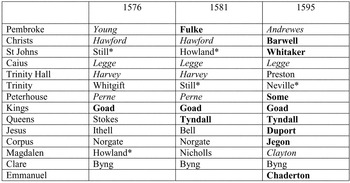
When Harington arrived in 1576, Cambridge had thirteen principal colleges and halls. Only one had a head on record as a Calvinist (Roger Goad at King’s). By contrast, five of the heads appear to have been theological conservatives: Perne and Legge, obviously, but also Young, Hawford, and Harvey.Footnote 106 The final seven,
Masters of Cambridge colleges. Figure key: italics = traditionalist, anti-Calvinist, avant garde; * = traditionalist/anti-Calvinist sympathies (and perhaps better placed under that heading, but the evidence is too fragmentary to be sure); roman = strong conformist, nondescript, or unknown; bold = moderate Puritan, strong Calvinist.

including Whitgift at Trinity, give the impression of being strong centrist conformists, although two show traditionalist leanings (see fig. 2). By the time Harington left five years later, the balance had shifted somewhat: three heads were recognizable Calvinists: Goad, who hung on at King's until 1610, but also Fulke at Pembroke and Tyndall at Queen’s. The number of traditionalist heads had declined by one—leaving six, including the same two traditionalist sympathizers, belonging to neither party. Thus far, the case for Calvinist dominance would be hard to make.
Yet by 1595 the situation had altered. As John Strype noted, Calvinism “was not entertained by many learned men in the University of Cambridge … [until] about the latter times of the Queen's reign, it prevailed strongly there: having the countenance of some of the chief Heads.”Footnote 107 The foundation of Emmanuel in 1584 brought the number of colleges to fourteen. Of these, eight were governed by Calvinists, who thus constituted a majority, albeit a slim one. Three of the heads were either traditionalist or avant garde, depending on one's terminology. Three more are harder to classify, but there are reasons, which we will get to shortly, for placing them closer to the traditionalists.
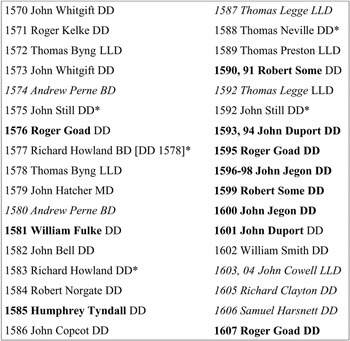
The list of vice-chancellors tells a similar story. The vice-chancellorship was an annual elective office: the heads nominated two candidates from among themselves, and the University Senate cast the final vote between them.Footnote 108 Between 1570 and 1592 the conformist and/or nonaligned heads dominated, intermixed with traditionalists and Calvinists (see fig. 3). From 1593 to 1601, however, Calvinists governed in an unbroken series. Excepting only 1592, when Legge was vice-chancellor, from 1590 through 1601 four men, all resolute Calvinists, ran the university. The Calvinist dominance at Cambridge was real. It was also, however,
Cambridge vice-chancellors, 1570–1607. Figure key: italics = traditionalist, anti-Calvinist, avant garde; * = traditionalist/anti-Calvinist sympathies (and perhaps better placed under that heading, but the evidence is too fragmentary to be sure); roman = strong conformist, nondescript, or unknown; bold = moderate Puritan, strong Calvinist.

confined to a single decade. After 1601, the list of vice-chancellors returns to the alternating pattern of the 1570s and 80s: the canonist John Cowell in 1603–4; Clayton, who sided with Baro, in 1605; Harsnett, a passionate anti-Calvinist, in 1606; and then, once again, the Calvinist Goad in 1607.
Indeed, even in the 1590s there are signs that the Calvinist triumphal procession had turned into a slow retreat. As Lake observes, the 1595 Lambeth Articles were no sooner framed then quashed, and with their collapse “the Calvinist claim to represent the sole fount of orthodoxy in the church of England was definitively discredited.”Footnote 109 Moreover, concurrent with this debacle, the Regius Professor of Theology, William Whitaker, died. Whitaker was, of course, the university's leading Calvinist theologian, as well as the driving force behind the Lambeth Articles. His replacement as Regius Professor was not, however, another Calvinist but Baro's foremost supporter in the university: John Overall.Footnote 110 Neville, the master of Trinity, had recommended Overall to Whitgift in December of 1595, but Overall owed his appointment to his colleagues, who elected the anti-Calvinist to the old Puritan's chair early in 1596.Footnote 111 Lake, who notes this astonishing choice, qualifies its significance by adding that among “the leading members of the university” involved in the Baro affair, Overall alone broke ranks with the Calvinists.Footnote 112 Yet Baro himself noted gratefully the support of Richard Clayton, who would shortly exchange his mastership of Magdalene for that of St. John's: a second astonishing Whitaker replacement.Footnote 113 Moreover, if one looks at the responses to Barrett's sermon a year before, the notion of Overall's Abdiel-like isolation seems less and less plausible. Over the summer of 1595 a series of official university letters denouncing Barrett and seeking his expulsion had gone out to Whitgift and Burghley, signed by the vice-chancellor and a majority of the heads. Each letter ends with the same eight signatures: Duport (VC), Goad, Some, Tyndall, Whitaker, Barwell, Jegon, and Chaderton. There should, however, have been fourteen. The missing include the traditionalists Andrewes, Legge, and Clayton, but also the two civilians, Preston and Byng, as well as Thomas Neville, the rebuilder of Trinity who recommended Overall to Whitgift but whose theological profile remains otherwise indistinct. These heads apparently declined to lend their names to the action against Barrett.Footnote 114 Hence, even the decade of Calvinist political dominance at Cambridge shows nothing approaching consensus.
How might Harington fit into this divided but only intermittently divisive arena? During his years at Cambridge, and for decades thereafter, his own college, King's, had a Calvinist master—the long-lived Roger Goad. Yet Goad's commitments did not have a great impact on the fellows of King's, who “cultivated music with much assiduity and success, but evinced little inclination either for polemics or for active work in the ministry.”Footnote 115 A more promising line of inquiry as to the role Cambridge might have played in Harington's theological formation goes through his tutor, Samuel Fleming, whose younger brother, Abraham, was a student at Peterhouse. That Harington stood at only one degree of separation from Abraham Fleming is suggestive. In 1580 Fleming translated one of the key source texts for Elizabethan anti-Calvinism: the Ephesians commentary by the Lutheran Niels Hemmingsen.Footnote 116 Moreover, Hemmingsen's closest Cambridge friend was the émigré Lady Margaret Professor of Divinity Peter Baro. In 1579–80, while Harington was studying for his MA, Baro published his own un-Calvinist views on predestination, which at once drew censure from the Puritan leadership.Footnote 117 Already by 1580, “theological conflict within the English universities over grace and its dimensions had begun.”Footnote 118 Given these tensions swirling through the Cambridge fens, it seems hard to imagine that Fleming's translation aroused no interest or that Harington's connection to Samuel Fleming had not drawn him at least to the fringes of the controversy.
One should not equate “traditional religion” with this anti-Calvinist academic theology, yet they are linked, and so it does seem significant that Harington almost certainly knew of the Lutheran objections to high Calvinism fifteen years before the public explosion set off by Barrett's challenge sermon. Traditional religion, however, enters the picture with a second Fleming publication: his 1576 Of Englishe Dogges. This does not treat theology but, rather, translates a Latin treatise on dogs by John Caius, the master of Gonville and Caius. Fleming dedicates the translation to Perne, his own master at Peterhouse. The preface makes clear that Caius and Perne were friends, familiaritatis nexu coniunctissimi, and warmly celebrates Caius as the university's “lumen, gemma, et gloria”—and this a mere four years since the official bonfire of his popish trinkets.Footnote 119 That the same man who translated Baro's beloved Hemmingsen also chose to honor Caius and to celebrate his friendship with Perne bespeaks the spiritual affinities linking the traditionalism of these two masters to the anti-Calvinist divinity that surfaces in the mid-1590s. The personal relationship between Caius and Perne that Fleming's preface reveals reinforces one's sense of their theological kinship, and it also returns us, at the conclusion of this section, to the topic with which it began: the persistence in an educated, clerical milieu of the Haringtonian emphasis on the “socially unitative” role of religion and its sanctification of the bonds of “good amity.”
Following out this first of Stow's motifs led us down the well-worn paths of Cambridge Calvinism and the anti-Calvinist reaction. Some of this discussion had rather little to do with Harington's religion per se but made what seemed an essential preliminary point that Calvinism was never so dominant as to crowd other visions of the English church to the margins. In turning now to the voicings of Stow's second motif—the sacrilegious violence unleashed by the Reformation—within a university context, we are also returning to the complex of liturgical, historical, and ecclesiological commitments defining Harington's Christianity.
When Richard Neile arrived at St. John's in 1580, he would have encountered, Peter Lake writes, “an intellectual milieu very different from the style of Calvinism then predominant in the university.”Footnote 120 Although one might take issue with “predominant,” it would seem the case that during Howland's ten years as master of St. John's (1577–87), the fellows enjoyed unusual concord and speculative freedom, both of which abruptly ended when the very Calvinist William Whitaker was imposed on the college in 1587. Whitaker expelled Everard Digby, a senior fellow for two decades, on charges so trivial that Whitaker's patrons, Whitgift and Burghley, overrode the new master and restored Digby to his fellowship, although a year later he had left, whether forced out or simply fed up is unclear, to become a country parson. Whitaker's real objection to Digby was not the alleged minor infractions but what the master considered Digby's “popish” views. Lake, who recounts the episode, notes that in fact Digby was not a Roman Catholic.Footnote 121 Yet Whitaker was not mistaken about the gulf separating Digby's position from his own moderate Puritanism. Digby's treatise the Dissuasive (published in 1590) contained “not one reference to the popish Antichrist,” took a positive view “of the mediaeval heritage of the church,” and seemed to allow individual choice a role in justification.Footnote 122 The work, moreover, crackles with Haringtonian outrage at the post-Reformation destruction of churches, the pillaging of their revenues, the spoiling of their ornaments. The nobility “take the squared stones of the temple to build … [their] pompous palaces withall,” devour “the bread of the poor” and “the simple estate of the ministers”—and all this done under pretext of religion, although “Christian Princes” ought not “think that reformation good and religious, which … turneth the church goods to the use and possessions of laymen.” Yet now “sacrilegious zeal hath spread itself so largly over our horizon … that instead of the Dayspring, which from on high hath visited us with true light unto salvation, the wiser sort do plainly perceive that the hour of darkness now hangeth over our heads.”Footnote 123
Digby's loathing of Whitaker and all his kind makes itself felt from the opening pages, which warn of the “ridiculous generation newly come ashore” that would “dig up the garden anew” to plant their own “stinking weeds” where once grew the “sweet lilies named by our Saviour Christ” and “the sweet ancient well-blown rose of England.” Such figurations of the true English church as lily and rose, like the recurrent images of “holy Church” as Christ's “beloved spouse … her costly garments made of needle work, all glorious within,” are utterly and pointedly traditional. Yet, because Digby is writing about the English situation, the sensuous and romantic loveliness of the flower bride who is corpus mysticum spills over to invest the national church that is architectural, material, liturgical. The “costly garments made of needle work” trope spiritual realities but they also suggest embroidered copes—an item of which Digby approved; liking copes was one of Whitaker's complaints against him. Digby's horror at sacrilege is, as it were, the photographic negative of this attachment to “the beauty of the temple of God” and to its holiness.Footnote 124
This reverence for the sacredness inherent in physical objects and acts remains within the bounds defined by the Elizabethan Settlement. The Dissuasive betrays no interest in purgatory, relics, or transubstantiation. As for copes, Digby reminded Whitaker, they were “used in her majesty's chapel and cathedral churches.”Footnote 125 Digby was no more a doctrinal Romanist than doctrinal Protestant. His brand of churchmanship, with its unusual aesthetic sensitivity, has, however, affinities with that of his Cambridge colleague, Lancelot Andrewes (for whom, one recalls, Harington's Supplie reserves its highest praise). In the same year Digby published the Dissuasive, Andrewes preached his Cambridge doctoral sermon against the sin of sacrilege, the “wicked custom … [that] grows daily more and more, of laying hands upon HOLY things”; he called for the “conservation of the Sacred Patrimony” and the reendowment of the church with “carved works and cedar,” with “marble, precious stones and metals.”Footnote 126 Harington himself was less concerned with beautifying Bath Abbey than with roofing it. Yet all three men share an overriding commitment to the reconstruction of the material fabric of the English church, to restoring its ancient role as principal locus of hospitality, patronage, and charity within communities, as they share the same open dismay at the social and spiritual cost of the Reformation.
We may now continue on to Oxford, where we will pause only briefly. Cambridge required a longer stay because of its central role in modern histories of the Elizabethan church. Oxford, which witnessed nothing so spectacular as the Barrett-Baro controversies, has attracted less attention. It was certainly home to some traditionalists. Hooker matriculated at Corpus in 1569, although his distinctive theological outlook may postdate his Oxford days. Buckeridge entered St. John's nine years later, staying on to tutor William Laud at his arrival in 1589. These three are probably too well known to require comment and, precisely because they are so well known, feel like exceptions: figures who stand out because they are not typical.
Far less well known is Harington's exact contemporary, the Oxonian Richard Field, who received his BA from Magdalen Hall in 1581 and his MA in 1584. In 1598, two years after proceeding DD from Queen's, he became one of Elizabeth's chaplains and went on to a successful career as a theologian, controversialist, and preacher. At his death in 1616 he left a manuscript on the religious controversies of the age. Only its preface survives, and here again we find a sweeping attack on the post-Reformation's “sacrilegious bereaving and spoiling of the Church,” whereby “the mighty Men of the World … [took] into their possessions the Habitations of God,” Field adding wearily that it would be easier to take prey from a lion's mouth than “cause Restitution to be made.” As in Harington, this reverence for ancient buildings and ornaments belongs to a larger ecclesiology that views the Church of England as continuous with and heir to pre-Reformation Christianity. We are therefore, Field maintains, to respect the “ancient bounds set by the holy Fathers, both for doctrine and practice” and to follow the “constant uniform and resolved tradition of those great masters of our Christianity which lived in the former ages of the Church.” His use of the plural “ages” underscores the literal force of “tradition” as “traditio,” a handing down from one age to another over the centuries—an understanding of Christian history premised on the continuities binding past and present and therefore one that rejects, because it denies its basic assumption, the forward Protestant call to restore God's church by sweeping away the traditions of men. Field's traditio model of church history proves likewise incompatible with apocalyptic antipopery. In the biographical sketch written by his son, we are told that Field sought “to make up the breaches of the Church, not to widen differences,” and, unlike some, was not so afraid of Catholic errors as to “run into contrary extremes” but to “heal the Breaches of Christendom … was ready to embrace Truth wheresoever he found it.”Footnote 127
Echoing the incendiary thesis Perne had upheld in his 1564 disputation before Elizabeth concerning the superior authority of the church vis-à-vis Scripture, Field argues that “it pertaineth to the Church to discern what books are worthy acceptation”; to “find out the truth of the Scriptures” requires “guidance and direction of the Church that now presently is deriving her knowledge from the ages that were before.” Field also came to believe that there were “necessary and essential rites, ceremonies, observations, and complements of piety and religion.” This emphasis on the ceremonial counterpoises the demotion of predestination to the ranks of the inessential: a reweighting typical of Tudor-Stuart anti-Calvinists, who were far less likely to espouse an Arminian soteriology than to share Field's wish that men not “be so busy in determining what God decrees in Heaven, whose counsels are unsearchable,” and since “in those high points of predestination, the difficulties are so great that we may well give them over as insuperable,” let us rather “be content to leave [doubtful things] doubtful, and yet bear charitable minds unto those which dissent.” This, Field's son and biographer adds, was also the position of Lancelot Andrewes going back to the 1580s.Footnote 128
Yet Andrewes, who was forty-eight when Elizabeth died, witnessed the coronation of Charles I. One normally associates him with the Stuart era, but his similarity to Field—and to Digby—calls attention to the avant garde profile of these contemporaries of Spenser and Shakespeare. Field himself, it should be added, was the intimate friend of Richard Hooker, and while his name rarely appears in modern scholarship on Laudianism, the connection was sufficiently obvious to contemporaries that Laud was accused of having written the new material in the 1628 edition of Field's 1606 magnum opus, On the Church. Field and Laud would have overlapped briefly at Oxford, but their theological similarities scarcely require personal contact. Digby, writing twenty years earlier, and a Cambridge man to boot, needed no tutor from Durham House to grasp the beauty of holiness. However, Robert Shelford, the intensely Laudian rector of Ringsfield Church in Suffolk, did have a tutor. As MacCulloch points out, he had been the amanuensis and disciple of Andrew Perne during his student days at Peterhouse.Footnote 129 The exact relation of Elizabethan traditionalists like Perne and Digby to Caroline developments is unclear, but that there was a connection helps explain the sense one sometimes gets in reading Harington that, were it not for chronology, the most obvious label for his religious orientation would be “Laudian.”
Indeed, Walsham hypothesizes that the “origins of Laudianism” extend back to the “religious conservatism” of the Elizabethan period.Footnote 130 Laud and Harington were both committed to undoing the despoliations and dilapidations of the Tudor era.Footnote 131 Both Laud and Harington permitted sacred images, including the crucifix, as devotional aids, although not objects of veneration. Both saw Rome as a true church and viewed the post-Reformation English church as remaining in fundamental continuity with its Catholic past. Neither was a doctrinal Protestant. Moreover, if Harington's plans for his Irish bishopric are any indication, he would have been no less willing than Laud to impose his vision of worship on a population long accustomed to something quite different. And yet both held that, as far as salvation was concerned, it was enough to believe the fundamentals all Christians shared; in Laud's words, if “Christian men do differ” in matters not fundamental, “it is no more than they have done, more or less, in all ages of the Church; and they may differ, and yet preserve the ‘one necessary faith’ and charity entire.”Footnote 132 Seventeenth-century Calvinism and Catholicism, Trevor-Roper observes, were “theologically intolerant. Laudianism was not. Laud harried men for practical non-conformity, but not for intellectual deviation.”Footnote 133 As Laud himself put it, he refused to “ever take upon me to express that tenet or opinion, the denial of the foundation only excepted, which may shut any Christian, the meanest, out of heaven.”Footnote 134 A similarly latitudinarian spirit infuses the ending of Harington's Tract: “Every man mend one, and all shall be mended. But while every man seeks to mend another, we mar all, and therefore God send us one to mend us all,” a passage anticipating the Peterhouse Laudian Shelford's plea that “Christians cover one another's infirmities, and help each other, till Christ mend us all”—both, one would like to imagine, echoing something heard long ago from Perne.Footnote 135
Yet Harington did not attend Peterhouse and never mentions Perne, which makes his Laudianesque posture even more curious, since not only did he come by it three decades early but without clerical inspiration. According to the received view, Laudianism was a clerical movement; prior to the 1620s, little more than “the Catholic hankerings of a handful of clergy.”Footnote 136 The problem, however, may lie with the received view, for if one continues on from the universities of Elizabethan England to Whitehall Palace, and even Lambeth, here too one sees, gazing back from down the corridors of power, faces that look like Harington’s.
One face would seem to be that of the queen, whom Collinson describes as the great exception to the Calvinism of the English Protestant elite. Elizabeth, he concedes, was “some kind of Protestant,” but the kind that, like Harington, preferred a celibate clergy; took a dim view of preaching; preserved considerable ritual elaboration, including images of the Trinity, the Blessed Virgin, and various saints, plus a famously controversial crucifix on her chapel altar; believed in the real presence; and dismissed the great controversies over predestination and sacraments as “questiones contentiosas et inutiles.”Footnote 137 Moreover, Collinson's extraordinary scholarship presents evidence that calls in question his own claims for Elizabeth's singularity. Although Nicholas Bacon and William Cecil threw their weight behind the fledgling Protestantism of the early Elizabethan church, their private religion bears no discernible imprint of Reformed doctrine.Footnote 138 Bacon's piety, Collinson concludes, “can be best characterized as ‘mere Christian,’” and Burghley apparently first encountered Calvinist doctrine at age seventy-five, when Whitaker showed him the Lambeth Articles. He was appalled, informing Whitaker that its doctrine of predestination “charged God with cruelty, and might cause men to be desperate in their wickedness,” to which the Puritan divine “thought fit to say but little.”Footnote 139 When the heads then informed Burghley of Baro's anti-Calvinist sermon, the lord treasurer wrote back that he rather doubted they were in the right: “As good and as ancient are of another judgment. … Ye may punish him, if ye will; but ye shall do it for well doing, &c. in holding the truth, in mine opinion.”Footnote 140 He evidently protected Baro thereafter, as he had earlier protected Digby.Footnote 141
Moreover, Burghley was the lifelong friend and patron of the remarkable Gabriel Goodman (1528–1601). Burghley secured Goodman's appointment as dean of Westminster Abbey, a position that, with the support of both Cecils, he held from 1561 until his death forty years later. An anti-Calvinist, Goodman's theology seems close to Hemingsen’s, whose commentary on Ephesians he cites.Footnote 142 Moreover, as Julia Merritt has shown, during his tenure the abbey became the “major centre of ceremonialism” in the nation, its worship proclaiming the Elizabethan church's “powerful continuities with the past.” Goodman retained a full choir, vestments, altar cloths, stained glass, and eucharistic wafers. (In 1614, the Commons refused to hold its communion in the abbey because of the wafers.) Whether or not Westminister was the “cradle of Laudianism,” Merritt concludes, “it certainly acted as one of the midwives at the birth.”Footnote 143
Burghley made Goodman his own chaplain and chose him as his children's tutor. What this implies about his theological position is harder to say. How might one characterize the religion of a man responsible both for Goodman's promotion to Westminster and Whitaker's to St. John's (although in the long run he seems to have been happier about the former decision)? Is its core Bray's “traditional” view that religion earned its keep by helping people who might else be at each others’ throats “live together in peace and friendship”? If Burghley never tried to broker a friendship between Whitaker and Goodman, he did, like Legge and Perne in their respective colleges, work ceaselessly to frame a church in which both sorts of men could dwell in peace. The record of his chancellorship, Porter concludes, “bear[s] witness to his moderate, wise and unselfish guidance. … Throughout his forty years of office, [he] was a brake on the severity of others. … He had an obvious and open-minded charity.”Footnote 144
Harington was likewise averse to severe measures and hoped that all Englishmen, although differing “in the fashion of serving” God, might nonetheless “hold together.” He knew Burghley, and his impression of the man bears no resemblance to the Machiavellian persecutor denounced by Kilroy and the Catholic polemicists of the Elizabethan era. In his somewhat erratic attempt at a diary, Harington in fact pays high tribute to the elder statesman's piety, recalling his admonition to Walsingham, who had confessed skipping church, about the importance of seeking God's grace “to keep us sound of heart, who have so much in our power, and to direct us to the well doing of all people, whom it is easy for us to injure and ruin.”Footnote 145 A letter Harington wrote in 1598 recounts having just been present at a conversation between his cousin and Burghley, both gravely ill, and the comfort he received from “their religious discourse,” for “each did despise his own malady and hold death in derision, because both did not despair of life eternal.”Footnote 146
William Cecil was apparently not a Calvinist, but there is too much counterevidence, too many ties to godly Protestantism, to place him among the traditionalists.Footnote 147 Yet his son and successor would seem to belong there. The picture that emerges from Pauline Croft's “The Religion of Robert Cecil” bears a remarkable likeness to Harington, Cecil's senior by only two years and his lifelong friend, although a friendship complicated by the vast disparity of status between them.Footnote 148 Cecil's insistence on distinguishing political loyalty from religious belief and his opposition to the aggressive anti-Catholicism of the Calvinist internationale are consistent with Harington's stance in the Tract, as is the dislike of religious persecution visible in Cecil's efforts to shield both recusants and godly ministers from the harsher penalties of the law.Footnote 149 As with Harington, many of his close friends were Roman Catholics, or of Catholic families; Worcester, part of Cecil's intimate circle, is among those Harington names in his private glosses to the Metamorphosis; Shrewsbury, likewise a Cecil intimate, had been close to Harington for years and contributed handsomely to restoring Harington's beloved Bath Abbey.Footnote 150 Cecil himself, it should be added, pronounced a “sweeping condemnation of Henry VIII as the despoiler of the monasteries,” a verdict that echoed Harington's but elicited outrage from other quarters.
Most of what we know of Cecil's religion comes from his chapel at Hatfield House and the confession of faith he included in his will. The chapel blazed “with colour, gold leaf, painting and stained glass”—the first religious stained glass windows set up in England since the Reformation—and its walls were adorned with paintings on the life of Christ that Sir Henry Wootton sent from Italy.Footnote 151 Cecil's confession of faith, written shortly before his death in 1612, makes no mention of any distinctively Reformed doctrine; he affirms that Christ died for all men and that the Apostles’ Creed provided “the best rule of necessary faith and points of salvation.” The dying Cecil says nothing about assurance of election but pleads for forgiveness of sins. Silent on the topic of predestination, he proclaims his belief in “the saving community of the Church” and its sacraments.Footnote 152
The Archbishop of Canterbury, John Whitgift, shared with both Cecils an overriding commitment to the national church, to its unity. Historians have taken Whitgift's alleged Calvinism as evidence for the bedrock Calvinism of the Elizabethan church even at its highest and most conformist echelon.Footnote 153 There is abundant evidence that Whitgift played a major role in the production of that manifesto of Elizabethan Calvinism, the Lambeth Articles. Yet the bigger picture is more complicated. Whitgift's insistence on conformity went hand in glove with endless attempts at conciliation and reconciliation. Prior to late 1595, the evidence that we have for Whitgift's theology of grace is slender indeed, but it also suggests that he was not a Calvinist.Footnote 154 Morever, his initial reaction to Barrett's May 1595 anti-Calvinist sermon was, like Burghley’s, guardedly favorable. He declared his agreement with Barrett on some points, informing the Calvinist heads that “the doctrine of the Church of England” did not depend on Calvin and that their own countersermon, which they had forced Barrett to preach, affirmed views “contrary to the doctrine holden and expressed by many sound and learned Divines in the Church of England,” and that he himself considered some of its claims “false and contrary to the Scriptures,” while others he thought merely one possible stance on a matter about which “learned men did and might dissent without impiety.”Footnote 155 Even as late as September, Whitgift still held that “the question was of that nature, that men might answer unto it, pro et con, without impiety,” opposing the Calvinist heads’ insistence on closely defined doctrinal orthodoxy with his own vision of the Church of England as embracing “all who would subscribe to a limited number of essential doctrines”—a vision he shared with Harington, and also with Atheos, Hooker, and Laud.Footnote 156
Given all this, his support for the Lambeth Articles in November of 1595 takes one by surprise. One's initial reaction is that Whitgift had thrown his full weight into the Calvinist pan. Yet a brief note Whitgift appended to the revised version of the Lambeth Articles he sent back to Cambridge restores ambiguity. To grasp the note's significance, one needs to recall precisely what it was the Calvinist heads had sought from the Archbishop: namely, that Whitgift declare their position to be “the doctrine of our Church, by continuance of practice and custom confirmed, and by authority established,” and that he therefore forbid all “contrary doctrines.”Footnote 157 Whitgift's note begins by asking that nothing “be publicly taught” contrary to the articles, thus apparently granting the heads’ petition. What follows, however, must have caused perplexity, if not consternation. The note informs the heads that “the propositions nevertheless must be so taken and used as their private judgments; thinking them to be true, and correspondent to the doctrine professed in the Church of England, and established by the laws of the land: and not as laws and decrees.”Footnote 158 The Calvinist heads, that is, might think the Lambeth Articles set forth the doctrine of the English church, but in fact they merely state certain individuals’ “private judgments.” The heads, however, did not need Whitgift to tell them that they thought the Lambeth Articles were true. They wanted their position declared “the doctrine of our church … by authority established,” and this Whitgift explicitly denied.Footnote 159
The precise mix of theological reservations, political constraints, and rhetorical carelessness that stands behind the ambiguities in Whitgift's handling of the Cambridge crisis eludes conjecture. Yet his subsequent protection of Baro and Overall does suggest reservations. Even more revealing is his choice of domestic chaplains. Elizabeth Gilliam has recently pointed out that at least half came from the Haringtonian wing of the Elizabethan church: Andrewes, Saravia, Buckeridge, Barlow, and Carier. Whitgift could scarcely have found more committed standard bearers for a ceremonial, patristic divinity. Moreover, when death approached, it was Carier, Barlow, and Buckeridge whom Whitgift chose to minister to him. Gilliam cautions against inferring Whitgift's theology from that of his chaplains—and perhaps an archbishop would select chaplains of diverse theological stripes—yet with respect to those he wanted beside him in his last hours, it is hard to think what other inference could be made. Footnote 160
The praeparatio mortis of his successor, Richard Bancroft, raises similar difficulties for the Calvinist consensus view. Four days before his death on 2 October 1610, Archbishop Bancroft made his will. Along with bequests to church, charity, and family, he left a gold ring with the inscription “Sic sanctorum communio” to each of four fellow bishops: Montagu, Barlow, Neile, and Harsnett, the latter three exponents of the churchmanship known under the amusingly contradictory labels of “conservative” and “avant garde.” The final name is of particular interest. Recent work on Harsnett has discovered information that would seem to cast new light not only on Bancroft's religious commitments but also on the English church circa 1595, the year of the Lambeth Articles, when Harsnett became Bancroft's chaplain and intimate friend. Until very recently Harsnett figured in accounts of the Calvinist consensus as the preacher of a fiercely antipredestinarian 1584 Paul's Cross sermon that earned him a rebuke from Whitgift and, in Tyacke's words, “nearly ruined … [his] career.”Footnote 161 That Harsnett had spent over a decade in the wilderness for opposing predestination offered strong evidence for the doctrine's de facto orthodoxy in the Elizabethan church.Footnote 162 However, it is now virtually certain that the sermon was not preached in 1584 but 1594 and hence two rather than twelve years before Harsnett became Bancroft's chaplain and started his ascent up the ecclesiastical ladder: an interval short enough to make it likely that Bancroft was drawn to the young preacher because of this anti-Calvinist manifesto.Footnote 163 Whatever the basis of their friendship, the redating makes hay of the claim that in Elizabethan England “no one directly challenged this Calvinist predominance and emerged unscathed,” a claim for which Harsnett's alleged fate has typically provided the centerpiece.Footnote 164
With respect to men like Burghley, Whitgift, and Bancroft, whose ecclesiastical policy centered on conformity and comprehension, affixing a label to their churchmanship requires discreet cherry-picking of the evidence. That Bancroft chose Harsnett to oversee his will has such obvious implications that one prefers not to confuse matters by adding that he also chose George Abbott. Tyacke urges Bancroft's Calvinism on the grounds that his chaplain, Thomas Rogers, authored a Calvinist commentary on the Thirty-Nine Articles.Footnote 165 The Oxford Dictionary of National Biography article on Bancroft also mentions Rogers but to quite different effect: noting that Bancroft used his chaplains to write “on matters close to his heart,” as, for example, “Thomas Rogers defended kneeling at communion in 1608.” Collinson lists Rogers among the few “divines of his generation” to have a strong “conviction of the catholicity of the reformed Church of England.”Footnote 166 From certain angles, that is, Bancroft looks like Harington. The same might be said of Burghley, seen as patron of Goodman, although not as a supporter of Whitaker; or Whitgift, seen as a friend of Perne, but not as signatory to the Lambeth Articles. In the case of all three men, however, it does seem significant that their traditionalist commitments are particularly conspicuous in their private lives: in their closest friendships, domestic chaplains, and deathbed comforters.
Harington's name has made its way back into the discussion, but not without some contrivance, since he truly is peripheral to the currently dominant narrative in which the Calvinist consensus first crushes and then is slowly forced to retreat before an Arminian insurgency. Harington does not figure in this story, yet it had to be addressed, since claims for his significance make no sense if “the dominance of a ‘Calvinist’ doctrine of absolute predestination … from circa 1570 to the 1620s … [lies] beyond reasonable doubt.”Footnote 167 Nor is it just Harington's significance that is at stake. Focusing on predestination showcases Calvinists, who wrote extensively on the topic, while their opposites, not fighting back, seem cowed and outnumbered. Yet, as Lake points out, predestination mattered far less to “the rival claimant for the heritage of English Protestant orthodoxy.”Footnote 168 Avant garde divines like Andrewes, Hooker, Neile, and Laud neither adopted Arminius's ex praevisa fide account of election nor worked out an alternative sequencing of the divine decrees and may well have remained within the Augustinian traditions of Western Christianity.Footnote 169 Their characteristic response to predestination, however, was to fall silent before the unsearchable mystery.
The main reason for taking Harington, rather than Cambridge, as the point of entry into the late Elizabethan religious scene was precisely to get a more revealing perspective on Lake's “rival claimant for the heritage of English Protestant orthodoxy” than that afforded by the controversies over predestination. Harington's years at Cambridge put him within earshot of that debate, yet the center of “Haringtonism” lies elsewhere: above all, in a sense of the continuities still binding a church that has cut ties with the Roman communion to the traditions of patristic and medieval Christianity—the identification with a pre-Reformation past whose manifestations range from Atheos's country divinity to the humanist historicism of Hooker and Field. In Harington, as in so many of those who have figured in the preceding pages, this conservative vision of diachronic continuity appears braided together with the claim that the catechistical basics of creed, paternoster, and decalogue contain all that a Christian must believe. This minimalist version of saving faith underwrites the inclusive understanding of the visible church as “comprehending all Christians who outwardly professed the bare essentials of Christian belief ” that Laud and Field share with Whitgift and Harington with Asunetus.Footnote 170 But it also finds expression in the private friendships and communal solidarities across the post-Reformation equivalent of party lines: in Harington's confraternity of good housekeepers, in the confessional polyglot of Gonville and Peterhouse, as in the neighborly reciprocities among Catholics, Protestants, and even Familists that social historians have remarked in so many late Elizabethan rural parishes. This emphasis on the “socially unitative” role of religion, on “good amity,” on the need for forgiveness and the duty to forgive, which both social historians like Haigh and Marsh as well as Catholic historians like Bray and Bossy locate at the core of “traditional religion,” links its manifestations across the class lines separating parish anglicans from Robert Cecil and across the decades separating Stow from Shelford. It was against precisely this traditional religion that Gifford and Dent took aim. Although the stress on social unity implies a devaluation of credal orthodoxy, Haringtonism veers off the path of secularism, drawn by a reverence for the visible church, for its authority, dignity, and beauty. In Harington, the first two take precedence; he cares far more about the reendowment of the English church and its ancient privileges than for ritual splendor. Nor is this atypical; one finds a similar weighting in Stow, Field, and Andrewes.Footnote 171 Among the Elizabethans, Digby alone celebrates the sheer beauty of holiness. This became more common later, and yet the impulse behind the liturgical elaborations of the 1630s may have had less to do with aesthetics than with the visual affirmation of historical continuity. The Laudian style is not baroque but what Graham Parry calls “Gothic survivalism,” where the continuation of late medieval visual forms gives outward expression to the continuity between the Stuart church and “the best aspects of pre-Reformation liturgy and devotional practice.”Footnote 172 Such outward expression clearly has greater importance for the Carolines than it did for Elizabethan traditionalists like Harington, yet the concern with restoring ecclesiastical authority and dignity abides, as does the tendency to value the church's ceremonies and ornaments primarily as tokens of its identity over time.Footnote 173
In rural parishes, Stow's London, the universities, and Whitehall, Westminster, and Lambeth, one finds traces of a religion resembling Harington’s. There are certainly differences among them, just as the moderate Puritanism of a Cambridge don differs from the aristocratic warrior Protestantism of a Leicester or Essex. Harington, for example, obviously differs from all his aforementioned coreligionists in being a wit, a poet, and, judging by his impressive collection of early printed drama, a great frequenter of plays.Footnote 174 Yet if Harington's literary tastes align him rather with Dent's Antilegon, who embraces secular poetry to escape Puritan seriousness, than with the parish anglican Asunetus, it is worth remembering that Dent makes the two allies up to the final moments of the Pathway. Dent, however, is writing fiction. That there might actually be a connection between the Elizabethan literary scene and traditionalist Christianity is scarcely self-evident. Nonetheless, Harington first enters Tudor-Stuart church history in Jeff Knapp's work on the religion of London dramatists circa 1590–1641, a remarkable number of whom ended up in holy orders. Describing the theater's “via media between wit and piety,” Knapp pauses to note its likeness to the religion of Sir John Harington.Footnote 175 The Harington-like religion Knapp discovers in the playhouses is that of the early Tudor reformers who sought “only a moderate, Erasmian reform of the Catholic church in the first place,” and of their successors, the “conformist churchmen” who recoiled from godly Protestantism as violating “the deep consensus among Christians of all sects on the doctrine that mattered,” or what Knapp calls Harington's “Atheos-like faith in fundamentals.” The drama was, like Harington, often gleefully anti-Puritan, an animus bound up with its “robust conception of communion,” partaking of both church and tavern—and, by finding “a spiritual virtue in good-fellowship,” bridging the distance between these sites. This was “a religion of sociability rather than learning,” a variant, as Knapp himself points out, of Gifford's country divinity with its old-fashioned curate who, like so many Shakespearean friars, works hard at making peace among his parishioners and is willing to meet the feuding parties at the alehouse to patch things up over a drink. The religion that attracted theater people “elevated Christian fundamentals and fellowship over doctrinal precision and sectarian zeal.” Stubbes called it “pseudo christianity”; Bossy and Bray, “traditional religion.” Knapp, interestingly, regards it as the “mainstream theology of the established church.”Footnote 176
Support for this final claim comes from yet another unexpected quarter: G. H. M. Posthumus Meyjes's study of religious toleration among the leading scholars of the Continental respublica litterarum circa 1600—men like Hotman, Sarpi, Grotius, and Casaubon. These Continental scholars, Meyjes comments, saw their own “endeavour to allay or to reconcile tensions or divisions between the confessions in a peaceful way” embodied in England, which became for them “the great example of a successful realization of the common corps of Christendom.” In their eyes, the English Reformation, unlike Continental Protestantism, had “avoid[ed] extremes, merely removing some excrescences and abuses, but otherwise keeping to the catholic groundwork. The early Christian tradition had been honoured and constantly taken as a guide.”Footnote 177 This impression may well have owed a good deal to Westminster Abbey, where then as now most foreigners first encountered the Church of England, and where, thanks to Dean Goodman and his successors (Andrewes [1601–5] and Neile [1605–10]), they encountered it “in its full glory.” The abbey's “sumptuous form of worship” was scarcely typical, and yet it was not the deans alone who meant it to be representative. Given that the abbey served as the kingdom's “centre for religious and secular ceremonial,” those in authority must have seen its traditionalism as embodying their own vision (at least the royal vision) of the national church.Footnote 178 The Continental scholars who viewed such worship as evidence of English exceptionalism were thus not altogether wrong.Footnote 179 Their image of the English church as seeking to reconcile confessional divisions and to retain its “catholic groundwork” is, of course, also Harington’s, but the fact that they perceived these commitments not merely as an image but as the reality of the Elizabethan Settlement is striking. Their perception was not, to be sure, altogether right, as de Dominis learned the hard way; yet the picture of the English Reformation they saw from across the Channel would seem to corroborate Knapp's sense that a commitment to “moderate, Erasmian reform” and “Atheos-like faith in fundamentals” characterized the “mainstream theology of the established church.”
Haringtonism?
This picture forces the question that has been waiting in the wings for some time: if a Harington-like religion is at least part of this mainstream, why is it invisible in the scholarship? Why does it not even have a name? Essays on Elizabeth's religion make no mention of Cecil’s, studies of parish anglicanism do not engage traditionalist proclivities among the Cambridge heads, and so on down the list. These are presented as discrete phenomena, as in the old story of the blind men who touch different parts of an elephant (I think it was an elephant) without realizing that they are handling the same beast. In the present case, however, the situation is more complicated, since current scholarship also holds that no such beast exists.
The denial is implicit in the Calvinist-consensus thesis that double predestination, iconophobia, and apocalyptic anti-Romanism constituted “the orthodoxy of the English church”—an orthodoxy “radically, 180 degrees different from Catholicism”—until the “middle years of the seventeenth century.”Footnote 180 As noted above, this view of Elizabethan orthodoxy raised suspicions that other sorts of seeming conformists might well be, as the godly feared, church papists: if not Nicodemites “wish[ing] for the Old Religion again with all their heart, and follow[ing] the new only for fear,” at least Miniver Cheevys yearning with “vague nostalgia” for auld lang syne.Footnote 181 Such reclassification allowed the Calvinist consensus model to offload inconvenient exceptions—among them, Sir John Harington—but Kilroy's reluctance to use the label for Harington acknowledges the implausibility of calling men who would have disavowed eleven of the Tridentine Creed's twelve articles “papists.”Footnote 182 None of the Harington-like conformists discussed above can meaningfully be termed “church papists.”
Yet, apart from “church papist,” early modern England had no term for what, as a stopgap measure, I have been calling “traditional,” “conservative,” “avant garde,” and, more whimsically, “Haringtonian” religion. Indeed, the revival of “church papist” was partly an attempt to compensate for the loss of the familiar, but anachronistic, label for “the orthodoxy of the [pre-1660] English church.” This was, of course, “Anglican,” which fell victim to the unanswerable argument that “bar a few separatists, all English protestants were ‘Anglican’ before 1642.”Footnote 183 Once nameless, the spectrum of Tudor-Stuart Christianity that seemed not “quite sure whether to label itself Catholic or Protestant”—MacCulloch's Harington-like definition of “Anglican”—became hard to pick out, hard to see. “Conformity,” the term that supplanted it, designates a behavioral category, not a species of religious conviction.Footnote 184 The word does not make windows into men's souls. This external focus has its virtues, but the result is a picture of Tudor-Stuart religion whose center is a black hole. It is the picture one finds in Lake's “Religious Identities in Shakespeare's England,” which vividly depicts the contrasting pieties available on the godly and recusant wings. But a passing remark about matters “the most enthusiastically conformist of bishops could not always control” jolts the realization that one has been given no clue as to what such conformists might conceivably have been enthusiastic about: nothing even hinting at their vision of Christ's body, of holy living, of true worship, saving faith, or sacramental presence.Footnote 185 It is darkness visible.
Twice Lake does attempt to give substantive content to conformity. Conformists are defined as “the self-consciously non-popish—indeed anti-popish—politically loyal, participant membership of the national Protestant Church,” whose “secularized, or rather Protestantized, holy days” staged the intertwined values of “Englishness, non-popishness, loyalty to legitimate monarchical authority, and the providential preservation of the national community … from foreign popish threat,” which for Lake constitute the official religion of Shakespeare's England.Footnote 186 I will not try to guess what Shakespeare thought of this impoverished cult of national self-congratulation, but Harington's response yields one of his bitterest epigrams:
Against an extreme flatterer that
preached at Bath on the Queen's day,
the fortieth year of her reign
You that extol the bliss of this our nation
And lade our ears with stale and loathsome praise
Of forty years’ sweet peace and restful days,
Which you advance with feigned admiration,
Much better would it suit your high vocation
To beat down that your flattering tongues do raise
And rather seek some words of commination
For times abounding with abomination.
…
For law with lust, and rule with rape is yoked,
And zeal with schism and simony is choked.
Harington was not a Lake-style conformist, nor does current scholarship provide a more suitable pigeonhole elsewhere.Footnote 187 Yet earlier generations would have had no trouble naming the beast. (Its name, in fact, will have been blindingly obvious to most readers for a while.) The strand of post-Reformation English Christianity that connects, however loosely, Henrician Catholicism, Laudianism, Gifford's country divinity, Queen Elizabeth, Perne, Cecil, Andrewes, Legge, Harington, and perhaps Shakespeare is what is meant by “high churchmanship” or “Anglo-Catholicism.”Footnote 188 The former is, in fact, the term Croft settles on for Cecil's religion.Footnote 189 For Perne, MacCulloch risks the lovely but less familiar “Catholic Anglicanism,” while Collinson splits the difference with “high Anglicanism.”Footnote 190
It is important to be clear. These labels, which I take to be synonymous, do not refer to a party. The Anglo-Catholicism of the post-Reformation era, in contrast to the Oxford Movement of the 1830s, lacked the internal structure that transforms shared commitments into a collective entity.Footnote 191 We are dealing with something more diffuse: a constellation of ideals and values whose influence can be discerned across wide stretches of the cultural landscape: in the theaters of Shakespeare's London, the Hatfield House chapel, Elizabethan Peterhouse, a Somerset manor; in cathedrals and country parishes; in the Watling Street home of a prosperous London merchant where in the 1590s Richard Hooker wrote the Laws and married the daughter; and across the city in the richly liturgical worship of Goodman's Westminster Abbey.Footnote 192 Whether or not it was “the traditionalist religion of the majority,”Footnote 193 it was sufficiently visible by the early seventeenth century to look to scholars on the other side of the channel like the Christianity of the English church.
To call such traditionalism “the mainstream” seems untenable given the evidence amassed over the past thirty years for Calvinism's deep imprint. Indeed, the whole question of what is or is not mainstream religion may be mal posé, since it would seem to be premised on the dubious assumption that, in any given domain, one stream will be significantly larger than all the others.Footnote 194
The Catholic mainstream of the English church was, like Harington, of a protesting rather than a crypto stripe. Moreover, again like Harington, its commitment was not simply, or even primarily, to the beauty of holiness. There is, I suspect, no one necessary and sufficient mark of Anglo-Catholicism, yet, of the interrelated commitments that, with shifting patterns of stress, constitute it, the most significant was probably the sense of continuity binding the Church of England to the church before Luther.Footnote 195 Such continuity would, of course, have meant different things in different places. In the parishes, it probably had much to do with bell ringing, church ales, and “a gut conviction that salvation came from prayer and charity,” not faith alone; for Harington with rebuilding churches; for Perne and Field with the authority of tradition.Footnote 196
Yet if high churchmanship was not invented by a few Cambridge dons, why did no one articulate this vision of the English church before the 1590s? On this question, too, Harington sheds some light. Given that he rejected justification sola fide, saw no great difference between the Mass and Holy Communion, and approved clerical celibacy, it seems reasonable to ask why he did not return to the Old Religion. His writings suggest the answer: “the bull of Pius Quintus (in this Pius Impius)” excommunicating Elizabeth, the threat posed by the “Jesuited Spaniard,” “the Pope's usurped rule,” and similar “intolerable practices in matters of state.”Footnote 197 Harington's difficulty was not with Catholicism but with the Counter-Reformation push back. The actions (real or imagined) of the papacy in support of or supported by the Spanish monarchy, the brothers Guise, and the Jesuit mission during the latter half of Elizabeth's reign made it possible for him, and one suspects for others as well, to abjure Protestantism without drifting back across the Rubicon to Rome.
There were divines and statesmen of an earlier generation who shared Harington's high churchmanship, but they mostly kept silent and did not put stained glass in their chapels.Footnote 198 Harington, however, made his opinions known: some in print, some to Robert Cecil, some to Queen Elizabeth, some to King James and Prince Henry. His writings have a playful and insouciant openness that calls to mind the Catholic humanism of that halcyon moment before all hell broke loose, the Catholic humanism of In Praise of Folly and Utopia—a likeness that Harington's defense of religious tolerance only reinforces. The inhibitions of the mid-Elizabethan decades have relaxed. For them to relax, for the state to allow and for individuals to allow themselves to walk away from Reformed orthodoxy, there had to exist other grounds strong enough to prevent free fall into the nightmare of divided loyalties. At least for Harington, but probably for others as well, the aggressive mischief sponsored by the Catholic powers constituted solid political grounds for refusing to shift allegiance.
Unlike most high churchmen of the 1590s, and indeed unlike virtually every religious writer in England prior to the 1620s, Harington never took holy orders.Footnote 199 The first book of Spenser's Faerie Queene is the only important piece of Elizabethan religious literature by a layman. Even Harington did not publish on religion—but he did write about it, and his name retained just enough cachet to preserve the manuscripts that make a window into an Elizabethan layman's soul. Herein lies his historiographical significance—for Harington's unmistakably high church soul does not fit any current narrative of the birth of Laudianism, all of which trace its conception to the same tiny group of avant garde clergy. Harington, however, never mentions Hooker, Neile, Buckridge, or Harsnett. Yet he was extraordinarily well connected, with ties to the universities, to the court, to several bishops, and to the old Catholic nobility. He was a poet, inventor, soldier, courtier, and Shakespeare aficionado—an echt Elizabethan, but an unfamiliar sort of Anglo-Catholic. His temperament, however, scarcely suggests a theological eccentric, and so one is amazed but not really surprised to discern reflections of his moderate Catholic Protestantism across the spectrum of Elizabethan society. Harington's vision of the English church speaks to and of the aspirations and actualities of post-Reformation England and, in so doing—for it is a vision of some theological substance and complexity—calls attention to the distortions in the current historiography of Tudor-Stuart religion, where a richly particularized world of Puritan idealists, godly preachers, disguised Jesuits, and crypto-Catholics pray and polemicize against a sketchy and ill-lit backdrop of conformity. Harington himself was a minor figure, but an account of the Tudor-Stuart church that has no place for him is—to borrow the title of MacCulloch's essay—yet another myth of the English Reformation.