Introduction
Aquatic weeds commonly have high growth rates, high vegetative and physiological plasticity, produce many seeds, and possess several methods of propagation including sexual and clonal propagules (e.g., vegetative fragments and rhizomes). These characteristics make them successful colonizers and difficult to control (Charudattan Reference Charudattan2001). Aquatic weeds are commonly water bound. However, several species are capable of living in both aquatic and terrestrial environments, often escaping and establishing in managed turfgrass stands, especially in areas adjacent to bodies of water. Two traditional aquatic grass weeds that are capable of colonizing managed turfgrass stands are torpedograss and Southern watergrass. Their highly invasive growth habits, perennial life cycle, and ability to tolerate low mowing heights make them especially difficult to control mechanically in turfgrass. Furthermore, chemical control of perennial C4 grass weeds like these is extremely difficult without causing significant turf injury.
Up to 80% of torpedograss biomass is underground as roots and rhizomes, but it can also produce and spread via seed (Brecke et al. Reference Brecke, Unruh and Dusky2001). Torpedograss rhizomes are coarse, with a pointed end reminiscent of a torpedo. Rhizomes are capable of regenerating, creating large, dense stands from relatively small fragments (Brecke et al. Reference Brecke, Unruh and Dusky2001). Torpedograss is commonly found in canals, irrigated crops, bays, marshes, wet roadsides, ponds, lawns, groves, wet disturbed habitats, wet ditches, swamps, prairies, and cultivated land. It occurs from the Carolinas to the Gulf states and west to Texas, and throughout global tropical and subtropical regions, including Hawaii (McCarty and Hall Reference McCarty and Hall2018).
Torpedograss is a particularly challenging weed to control, as it can survive in many environmental conditions (Hanlon and Langeland Reference Hanlon and Langeland2000). It survives flooding to a depth of several meters, but its extensive belowground root and rhizome system enables survival of droughty conditions as well. Difficulty in controlling torpedograss is attributed to a lack of apical dominance of rhizomes, rapid rhizome regeneration after damage, and an ability to store water and nutrients during times of stress (Wilcut et al. Reference Wilcut, Dute, Truelove and Davis1988).
Torpedograss is tolerant of many selective herbicides used in warm-season turfgrasses; thus, control has been limited to nonselective herbicides such as glyphosate (Brecke et al. Reference Brecke, Unruh and Dusky2001; McCarty et al. Reference McCarty, Higgins and Colvin1993). McCarty et al. (Reference McCarty, Higgins and Colvin1993) and Brecke et al. (Reference Brecke, Unruh and Dusky2001) indicated quinclorac to be a somewhat effective selective herbicide, but multiple applications at higher labeled rates are required for control.
Southern watergrass also is a branched C4 perennial grass forming dense, floating colonies in shallow water; however, it can escape to become a weed in wet turfgrass. It is native to the southern and eastern United States and Mexico and ranges from the coastal plains in Texas to North Carolina and into Mexico and Guatemala (McCarty and Hall Reference McCarty and Hall2018). When in a terrestrial environment, Southern watergrass forms dense mats with an erect growth habit and can be found in moist soils, lawns, wet grasslands, along streams, ditches, and other disturbed sites. Southern watergrass is problematic in rice (Oryza sativa L.) and pastures in Louisiana but is considered a forage crop in Mexico (Braverman Reference Braverman1996). It rarely produces an inflorescence, making it difficult to identify, and it is often confused with various Digitaria spp. or possibly stiltgrass [Microstegium vimineum (Trin.) A. Camus].
Limited research has been conducted investigating selective Southern watergrass control. Its susceptibility to herbicides is largely undocumented, with only nonselective control methods previously reported. In rice, mechanical control of Southern watergrass can be achieved through mowing or flooding to a depth of 1.2 m (Braverman Reference Braverman1996). Greater than 79% control was achieved 5 wk after treatment with 4.5 kg ai ha−1 sulfosate (glyphosate-trimesium) and 1.0 kg ai ha−1 glyphosate treatments, whereas other herbicides provided less than 55% control. In contrast with torpedograss, Southern watergrass has only recently been identified as a problematic turfgrass weed in the southeastern United States (L.B. McCarty, personal observation); thus, control options for this weed in turf are largely unknown. Though torpedograss has been a problematic turfgrass weed for many years, an update is needed on potential control options. Thus, the objective of this research was to investigate POST herbicides for torpedograss and Southern watergrass control in bermudagrass.
Materials and methods
Two field experiments were conducted to evaluate torpedograss and Southern watergrass control in ‘Tifway’ bermudagrass in 2016 and 2017. The torpedograss control study was located on a driving range at Savannah Quarters Country Club, Pooler, GA (32.078493°N, 81.289010°W), on an Ocilla loamy fine sand (loamy, siliceous, semiactive, thermic Aquic Arenic Paleudults). The Southern watergrass control study was located on a golf course rough at the County Club of Lexington, Lexington, SC (33.944116°N, 81.289606°W), on a Lakeland sand (thermic, coated Typic Quartzipsamments). Torpedograss infestations were (mean ± SE) 87.1% ± 1.4. Southern watergrass infestations were considered 100%, as the weed completely covered all plots.
Treatment rates and timings are presented in Tables 1 and 2. All treatments were applied using a CO2-pressurized backpack sprayer calibrated to deliver 187 L ha−1 through 8003 flat-fan nozzles (TeeJet Spraying Systems Co., Wheaten, IL). Plot areas were maintained by the golf course maintenance staff including mowing three times weekly at 3.8 cm and fertilization with 98 kg N ha−1 annually. Plot areas were irrigated as needed to maintain acceptable bermudagrass turf quality.
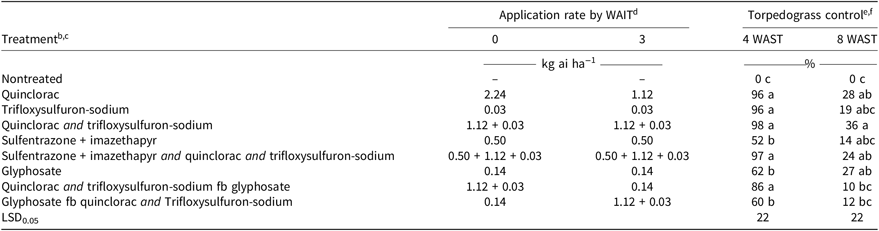
Torpedograss control 4 and 8 wk after sequential treatment (WAST) at Savannah Quarters Country Club, Pooler, GA, from 2016 to 2017. a

a Abbreviations: fb, followed by; WAIT, wk after initial treatment.
b Herbicide trade names and manufacturers: quinclorac, (Drive XLR8; BASF Co., Florham Park, NJ); trifloxysulfuron-sodium, (Monument; Syngenta Co., Wilmington, DE); sulfentrazone + imazethapyr, (Dismiss South; FMC Co., Philadelphia, PA); glyphosate (RoundUp Pro; Monsanto Co., St. Louis, MO).
c All treatments included a surfactant as designated by the product label.
d Treatments were made on May 24, 2016 and June 5, 2017.
e Torpedograss control was evaluated using line-intersect analysis.
f Column values followed by different letters are significantly different according to Fisher’s protected LSD at P < 0.05.
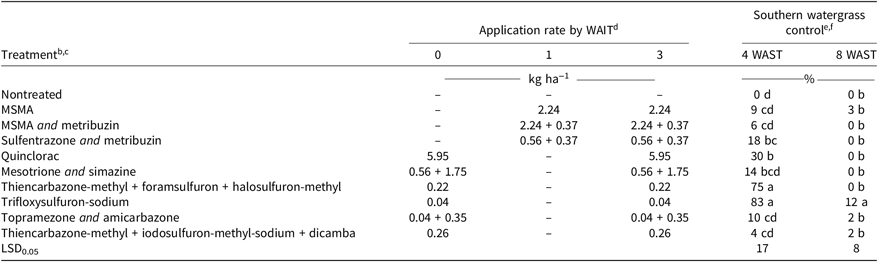
Southern watergrass control 4 and 8 wk after sequential treatment (WAST) at County Club of Lexington, Lexington, SC, from 2016 to 2017. a

a Abbreviations: fb, followed by; WAIT, wk after initial treatment.
b Herbicide trade names: MSMA (MSMA; Drexel, Memphis, TN); metribuzin (Sencor; Bayer Co., Whippany, NJ); sulfrentrazone (Dismiss; FMC Co., Philadelphia, PA); quinclorac (Drive XLR8; BASF Co., Florham Park, NJ); mesotrione (Tenacity; Syngenta Co., Wilmington, DE); simazine (Princep; Syngenta Co., Wilmington, DE); thiencarbazone-methyl + foramsulfuron + halosulfuron-methyl (Tribute Total; Bayer Co., Whippany, NJ); trifloxysulfuron-sodium (Monument; Syngenta Co., Wilmington, DE); topramezone (Pylex; BASF Co., Florham Park, NJ); amicarbazone (Xonerate; FMC Co., Philadelphia, PA); thiencarbazone-methyl + iodosulfuron-methyl-sodium + dicamba (Celsius; Bayer Co., Whippany, NJ).
c All treatments included a surfactant as designated by the product label.
d Initial treatments were made on June 20, 2016 and June 5, 2017.
e Southern watergrass control was evaluated using line-intersect analysis.
f Column values followed by different letters are significantly different according to Fisher’s protected LSD at P < 0.05.
Control ratings were taken 4 and 8 wk after sequential treatments (WAST). At each rating date, control was evaluated visually and quantified using the line-intersect method using a 1.5- by 1.5-m grid with 64 intersects. Turfgrass injury was visually evaluated on a 0 to 100% scale (0 = no injury to turfgrass, 30 = maximum acceptable turf injury, 100 = complete death of turfgrass).
The experimental design for both studies was a randomized complete block design consisting of 1.5- by 1.5-m plots and four replications. Torpedograss and Southern watergrass control data were analyzed to evaluate main effects and interaction of treatment and year. Where treatment-by-year interactions were not detected, data were combined for analysis and are presented over years. Mean comparisons between treatments were performed using Fisher’s protected LSD. All analyses were conducted using JMP Pro version 12 (SAS Institute Inc., Cary, NC). Significant effects and differences were based on P = 0.05.
Results and discussion
Several treatments included in these studies are documented to injure bermudagrass to a certain degree for a period of time following treatment. However, at our evaluation dates for both studies and years, bermudagrass injury was <20% and considered acceptable. Therefore, turf injury data are not presented. Both visible and line-intersect control estimations were highly correlated: torpedograss 4 WAST = 0.9810, torpedograss 8 WAST = 0.7899; Southern watergrass 4 WAST = 0.8898, Southern watergrass 8 WAST = 0.8570 (P < 0.0001). Thus, for brevity, only line-intersect data are presented and discussed. No treatment-by-year interaction was detected for weed control at any rating date for either study; therefore, data for each year were combined for further analysis and are presented across years.
Torpedograss
Torpedograss control/suppression was achieved 4 WAST with several treatments (Table 1). Greater than 86% control was achieved with quinclorac, trifloxysulfuron-sodium, quinclorac and trifloxysulfuron-sodium, sulfentrazone + imazethapyr and quinclorac and trifloxysulfuron-sodium, and quinclorac and trifloxysulfuron-sodium followed by (fb) glyphosate. Treatments providing lower control (<62%) 4 WAST were sulfentrazone + imazethapyr, glyphosate, and glyphosate fb quinclorac and trifloxysulfuron-sodium.
Torpedograss exhibited significant recovery and regrowth by 8 WAST. Greatest control (36%) was observed with quinclorac and trifloxysulfuron-sodium. Control with quinclorac and trifloxysulfuron-sodium fb glyphosate and glyphosate fb quinclorac and trifloxysulfuron-sodium was reduced to 10% and 12%, respectively.
These results are similar to those of McCarty et al. (2003), who investigated torpedograss control in bermudagrass turf using quinclorac. Best torpedograss control (≥80%) was achieved with rates higher than 2.2 kg ha−1 quinclorac, and sequential applications provided greater control than single applications. However, as with the present study, control was reduced to <80% beyond 12 wk. Brecke et al. (Reference Brecke, Unruh and Dusky2001) also reported similar results, with three sequential applications of quinclorac providing greater control (88%) than a single application at a higher rate (69%). The study also evaluated repeated yearly applications and found increased torpedograss control in most plots after 2 yr.
Longer term torpedograss control was observed by Hanlon and Langeland (Reference Hanlon and Langeland2000) using imazapyr. Greater than 70% control occurred for >1 yr following a single aerial application, depending on study site. However, the study was conducted on plants located in the littoral zone as opposed to a maintained turfgrass stand. Stephenson et al. (Reference Stephenson, Brecke and Unruh2006) evaluated single and sequential applications of trifloxysulfuron-sodium and found that repeat applications provided greater control. Research in that study reported lower initial control than was observed in this study, but achieved greater long-term (15 wk after initial treatment) control (29% to 61%).
Control of torpedograss has traditionally been achieved with multiple applications of quinclorac and trifloxysufluron-sodium; these herbicides were combined with each other and other herbicides in hopes of increasing long-term control. The trend of torpedograss regrowth continued regardless of herbicide combination. Thus, at minimum, treatments over multiple years will be essential to reduce torpedograss infestations.
Southern watergrass
Greatest Southern watergrass control was achieved with trifloxysulfuron-sodium (83%), and thiencarbazone-methyl + foramsulfuron + halosulfuron-methyl (75%) 4 WAST (Table 2). Quinclorac provided 30% control, whereas all other treatments provided <18% control.
At 8 WAST, Southern watergrass control was significantly reduced. Trifloxysulfuron-sodium provided greatest control (12%) at this time, with all other treatments providing <3% control. Even though the rhizome system of Southern watergrass is not so extensive as torpedograss, these data suggest that it still possesses sufficient energy reserves to recover following herbicide treatment.
Though Braverman (Reference Braverman1996) reported an increase in Southern watergrass control with time, this was on a shorter time scale using nonselective herbicides. Greatest control in that study was at 5 WAT (89%) with sulfosate. As nonselective herbicides provided poor control of Southern watergrass, the results of the present study are not surprising and follow trends with other aquatic weeds in turf.
Poor long-term control of aquatic weeds capable of invading terrestrial environments is common. Schooler et al. (Reference Schooler, Cook, Bourne, Prichard and Julien2008) reported that measurements of aboveground biomass of alligatorweed [Alternanthera philoxeroides (Mart.) Griseb.] in plots treated with glyphosate increased to levels similar to untreated control plots 64 d after the final treatment. Zhang et al. (Reference Zhang, Webster, Blouin and Leon2005) investigated control of barnyardgrass [Echinochloa crus-galli (L.) P. Beauv.] in rice. The study reported a reduction in barnyardgrass control between 10 and 30 d after treatment (DAT) with fenoxaprop in combination with various broadleaf and sedge herbicides. Chemical control of tropical sprangletop [Leptochloa virgata (L.) P. Beauv.] was investigated by Perez-Lopez et al. (Reference Pérez-Lopez, González-Torralva, Cruz-Hipólito, Santos, Domínguez-Valenzuela and De Prado2014), and reduced control was observed as the study progressed from 15 DAT to 60 DAT. Little control resulted from applications of glyphosate at 720 g ai ha−1, but improved control occurred with indaziflam + glufosinate in combinations between 50 + 455 and 75 + 682 g ai ha−1, glufosinate at 682 g ai ha-1, and paraquat + diuron at 400 + 200 g ai ha−1.
The above reports from literature speak to the difficulty of controlling certain aquatic weeds, even with nonselective herbicides. Once these species establish themselves adjacent to aquatic areas on golf courses, they escape into maintained turf with poor drainage. Data from the present study support this. Though short-term suppression of both torpedograss and Southern watergrass was achieved with several treatments, long term control was not acceptable.
Quinclorac and trifloxysulfuron-sodium continue to be the best selective control options for torpedograss in bermudagrass. Because combinations of these two active ingredients did not increase long-term control, perhaps multiple applications could be made alternating these two chemistries over a longer period of time.
In a first investigation of Southern watergrass control using available herbicides in bermudagrass, suppression was achieved with several treatments including thiencarbazone-methyl + foramsulfuron + halosulfuron-methyl, and trifloxysulfuron-sodium. An approach similar to torpedograss is probably needed where products are rotated and applied over a longer period of time. The results of this research also support the need for appropriate agronomic practices to prevent infestations of aquatic invasive weeds into managed turfgrass stands. This includes maintaining weed-free aquatic environments and improving drainage in turf areas adjacent to bodies of water. Future research should investigate control programs where applications can be extended by using multiple chemistries spread out over several applications. Furthermore, additional herbicides, combinations, and timings should be considered, especially as ecological shifts occur with new weed species.
Author ORCIDs
Philip J. Brown, https://orcid.org/0000-0003-4490-5584
Acknowledgments
No conflicts of interest have been declared. This research received no specific grant from any funding agency, commercial, or not-for-profit sectors.