Introduction
The concept of “comorbidity” was introduced and defined by Alvan R. Fenstein as “those cases in which a distinct additional clinical entity occurred during the clinical course of a patient having an index disease” (Feinstein, Reference Feinstein1970, pp. 456–457), although this definition has been subsequently discussed (Fried et al., Reference Fried, Ferrucci, Darer, Williamson and Anderson2004; Valderas et al., Reference Valderas, Starfield, Sibbald, Salisbury and Roland2009). There is some degree of confusion between the terms comorbidity and multimorbidity, which are not interchangeable (Fried et al., Reference Fried, Ferrucci, Darer, Williamson and Anderson2004). In this study, comorbidity is defined as the co-occurrence of pre-existing age-related health conditions or diseases in one person (Yancik et al., Reference Yancik, Ershler, Satariano, Hazzard, Cohen and Ferrucci2007) in a way that symptoms, progress, and treatment interact, making health and social care of older adults a challenging issue.
There is in agreement regarding the high prevalence of comorbidity in people older than 65 years of age, ranging between 40% and 56% depending on the study, and that it increases with age (Marengoni et al., Reference Marengoni2011). The aging of the population in Western countries makes the study of comorbidity a priority due to the implications for quality of care, care management, and costs (Vogeli et al., Reference Vogeli2007).
Dementia, a syndrome characterized by cognitive impairment with functional impact, has a prevalence of 5.2–14.9% in people aged 65 years and older, depending on the study methodology and sample (García García et al., Reference García García2001). Prevalence increases with age, reaching 23.5% in adults older than 84 years of age (García García et al., Reference García García2001). Dementia is one of the most important causes of functional disability in older people and the presence of frequently found comorbidities, such as hypertension, diabetes, and cardiovascular problems (Formiga et al., Reference Formiga, Fort, Robles, Barranco, Espinosa and Riu2007), substantially complicates its management. Not surprisingly, dementia is an important predictor of institutionalization in the elderly people (Luppa et al., Reference Luppa, Luck, Weyerer, König, Brähler and Riedel-Heller2010).
An essential aspect of comorbidity is its relationship with older people's health-related quality of life (QoL) and health status (Yancik et al., Reference Yancik, Ershler, Satariano, Hazzard, Cohen and Ferrucci2007). It is also important to ascertain what conditions and characteristics negatively affect QoL and health status. Previous studies have analyzed the relationship between comorbidity and QoL, with no conclusive results (Fortin et al., Reference Fortin, Lapointe, Hudon, Vanasse, Ntetu and Maltais2004). Generally, a negative association between these two concepts has been found (Fortin et al., Reference Fortin, Lapointe, Hudon, Vanasse, Ntetu and Maltais2004), but studies differ in the relative importance of each pathology and the role that disease progression and specific symptoms, such as pain, play in this relationship. Moreover, most studies on comorbidity, QoL, and health status are focused on community-dwelling older adults, but fewer have included elderly adults living in nursing homes (Cuijpers et al., Reference Cuijpers, van Lammeren and Duzijn1999) or people with dementia.
Functional status is another important aspect of QoL and health status in older people, but there are few studies on the relationship between functional status, dementia, and other pathologies (Drewes et al., Reference Drewes, den Elzen, Mooijaart, Assendelft and Gussekloo2011). In this sense, comorbidity is conceptualized as an intermediate factor between physiological processes and health outcomes, mainly functional status and QoL (Sullivan et al., Reference Sullivan, Kempen, Van Sonderen and Ormel2000; Yancik et al., Reference Yancik, Ershler, Satariano, Hazzard, Cohen and Ferrucci2007).
In the coming decades, prevalence rates of dementia and comorbidity will increase considerably leading to a rising need of health and social care resources to preserve the individuals’ QoL and health status. The objectives of the present study are: (1) to analyze the differences in comorbidity between institutionalized older people with and without dementia; and (2) to analyze the interrelationships between dementia and comorbidity, health status, and QoL.
Methods
Study sample
Data were collected from two nationwide, cross-sectional surveys on global QoL in older people, living in residential care settings across Spain, 60 years of age and older. One survey consisted of people with normal cognitive function (non-dementia group) and the other included people with dementia (dementia group). In the first survey, participants were 234 persons living in 14 residential care settings nationwide. An exclusion criterion was moderate cognitive impairment operationally defined as five or more errors, adjusted by education level, in the Short Portable Mental State Questionnaire (Pfeiffer, Reference Pfeiffer1975).
In the second study, a sample of 525 people who fulfilled dementia criteria according to DSM-IV-TR and lived in 13 of the same residential care settings as in the previous study was evaluated by health and social personnel staff. Residents or their caregivers gave informed consent for both studies. The Institutional Review Board of Institute of Health Carlos III, Madrid, Spain, approved both studies.
Assessments
Both surveys collected information on sex, age, level of education, and marital status of the participants. The following validated and recommended scales for older people were applied: the Short Portable Mental State Questionnaire (SPMSQ; Pfeiffer, Reference Pfeiffer1975) to ascertain cognitive impairment; the Barthel Index (Mahoney and Barthel, Reference Mahoney and Barthel1965) for assessing the ability to perform activities of daily living; the EQ-5D (EuroQol Group, 1990) for evaluating health status and health-related QoL, and the number of chronic medical conditions (comorbidity), derived from the Cumulative Illness Rating Scale for Geriatrics (Miller et al., Reference Miller1992; Fernandez-Mayoralas et al., Reference Fernandez-Mayoralas, Giraldez-Garcia, Forjaz, Rojo-Perez, Martinez-Martin and Prieto-Flores2012). Higher scores in the applied instruments reflected a better performance or status on the measured construct.
The EQ-5D (EuroQol Group, 1990) is a generic health status and QoL measure. The following EQ-5D components were used: (1) the descriptive system that asks for current (“today”) personal care, daily activities, mobility, pain or discomfort, and anxiety or depression. Each item score ranged from 1 (no problems or symptoms) to 3 (serious problems or symptoms); (2) the EQ-Visual Analogue Scale (EQ-VAS) that evaluates current health state (from 0, worst imaginable, to 100, best imaginable). An EQ-5D index (from 1, full health, to 0, death, although negative values are possible for health states considered worse than death) was calculated from the descriptive system scores and used as a measure of QoL. Normative data for the EQ-5D are available, allowing for comparisons between health profiles in specific conditions and populations. For residents without dementia, the EQ-5D was self-administered. For residents with dementia, who could not give self-assessments, the EQ-5D was completed by proxy.
Comorbidity was measured with the modified Cumulative Illness Rating Scale for Geriatrics (Miller et al., Reference Miller1992), which assesses the number of chronic medical conditions. It includes 20 chronic medical conditions, and one open option, “others.” It was completed by the healthcare staff of the residential settings, based on chart review and the clinical condition of the resident.
The Barthel Index (Mahoney and Barthel, Reference Mahoney and Barthel1965) is composed of ten domains assessing the person's performance in activities of daily living and mobility. Domains are scored 0 (unable or dependent), 5 (occasional assistance needed), or 10 (able or independent), with two items (transfer and mobility) scored up to 15. Score ranges from 0 (dependence) to 100 (independence). The Barthel Index, which is recommended for routine use in the assessment of older people, was administered by nurses or occupational therapists in both surveys.
Data analysis
The main outcome variables were: health status, measured with the EQ-VAS; QoL, measured with the EQ-5D index; and comorbidity, assessed by means of the number and presence of chronic medical conditions. Descriptive statistics were employed to determine characteristics of the sample. The Mann-Whitney test was applied to analyze differences between groups with and without dementia by socio-demographic characteristics, SPMSQ score, and Barthel and EQ-5D indices. Analysis of variance (ANOVA) was employed for comorbidity and EQ-VAS, after testing the data for normality assumptions.
Prevalence of specific chronic medical conditions was calculated for the total sample and separately for the dementia and non-dementia groups. Chi-square tests with Bonferroni correction were used to compare both groups for each chronic medical condition. When differences between both groups were found, the influence of age and sex on EQ-5D index and VAS was controlled by means of analysis of covariance (ANCOVA).
Comorbidity, measured by the number of medical conditions (excluding memory complaints and dementia items), was split in two equivalent groups by the median: up to five diseases versus six diseases or more. ANCOVA models were performed (dependent variables: EQ-5D Index and VAS, respectively) to compare groups with low and high comorbidity, and with and without dementia, while controlling for age and sex.
Results
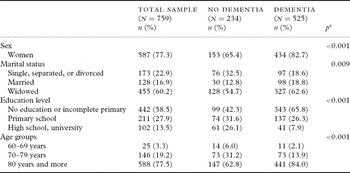
The total sample was composed of 759 residents, 77.3% women (Table 1), and a mean age of 84.2 years (standard deviation: 7.2). Groups of residents with and without dementia showed differences by sex, age, marital status, and education level (Mann-Whitney test, p < 0.05). There were significantly more women, people aged 80 years or more, widows, and people with no education in the group with dementia than in the non-dementia group.
Socio-demographic characteristics of the sample

*Mann-Whitney test to compare between non-dementia and dementia subsamples.
SD: standard deviation.
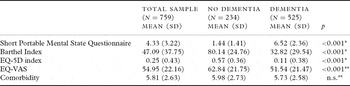
Table 2 shows the descriptive statistics of the applied scales. All scales, except number of chronic medical conditions (excluding items related to memory problems and dementia), showed statistically significant differences between groups (Mann-Whitney and ANOVA, p < 0.001): people with dementia had significantly worse health status and QoL (EQ-5D) and higher functional dependence (Barthel Index) than people without dementia.
Descriptive statistics of applied scales

*Mann-Whitney test; **ANCOVA, controlling by age and gender, to compare between non-dementia and dementia subsamples.
SD, standard deviation; VAS, Visual Analogue Scale; n.s., non-significant.
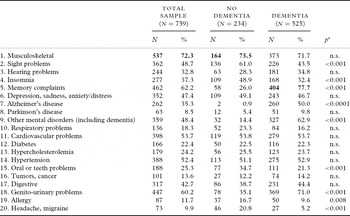
Two or more chronic medical conditions were present in 96.8% of the sample, with 14.4% of people showing four conditions and 17.1% with five conditions. Prevalence rates of chronic medical conditions in the total sample and by dementia group are displayed in Table 3. The most prevalent condition in the total sample was musculoskeletal diseases (72.3%), followed by genito-urinary disorders (60.2%). The least prevalent conditions were Parkinson's disease (8.5%) and headache/migraine (9.9%). Musculoskeletal diseases were the most frequent condition in the non-dementia group (73.5%) whereas memory complaints were the most prevalent condition in the sample with dementia (77.7%), followed by musculoskeletal and genito-urinary problems. People with dementia showed significantly fewer sight problems, insomnia, allergy, and headaches, but more genito-urinary problems than people without dementia (Chi-square, p < 0.008).
Prevalence of chronic medical conditions in the sample

*Chi-square test to compare between non-dementia and dementia subsamples with Bonferroni correction (p < 0.0025).
In bold, the most prevalent condition in each group; n.s., non-significant.
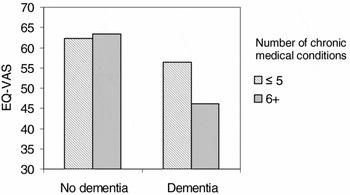
Figure 1 displays the significant interaction found between dementia and comorbidity (excluding memory complaints and dementia items; ANCOVA, p < 0.001). In the group without dementia, the EQ-VAS was not significantly different by number of medical conditions. EQ-VAS scores were significantly lower for people with dementia and six or more chronic conditions, controlling by age and sex, than for people with dementia but fewer than six chronic health conditions. The interaction was not significant when using the EQ-5D index as the dependent variable.
EQ-VAS scores by group (non-dementia vs. dementia) and number of medical conditions, controlling by age and sex. Non-dementia group: p = 0.72; dementia group: p < 0.001 (Student's t-test).

Results by specific conditions illustrate that the group of people with dementia showed significantly lower EQ-VAS scores than people without dementia when sight, oral, or genito-urinary problems were present (ANCOVA, p < 0.05), controlling by age and sex. The EQ-5D index did not show a significant interaction when compared by dementia status and chronic medical condition.
Discussion
This study compared older people with and without dementia living in residential care settings. The first objective was to describe the differences in the number of chronic medical conditions and in the prevalence rates of specific conditions. The study also aimed at examining how comorbidity, dementia, health status, and QoL are interrelated in this older population. There is a lack of studies on the effect of dementia on comorbidity and health status and QoL. In the future, the prevalence of dementia will increase due to population aging. Therefore, the development of adequate and specialized care for this condition will be a priority for the health and social systems.
In our study, comorbidity prevalence reached 96.77%, slightly higher than that reported in older people living in residential settings in other countries (Asakawa et al., Reference Asakawa, Feeny, Senthilselvan, Johnson and Rolfson2009). Discrepancies in prevalence rates between studies can be due to differences in population age and characteristics, medical conditions, methodology, and assessment instruments (Marengoni et al., Reference Marengoni2011).
The most prevalent conditions in our sample were musculoskeletal and genito-urinary problems. Musculoskeletal problems, mainly arthritis and osteoarthritis, and genito-urinary disorders, especially urinary incontinence, have been previously reported as prevalent in older people, representing risk factors for institutionalization, disability, and lower QoL (Schubert et al., Reference Schubert2006). High rates of urinary incontinence in people with dementia have been also found in other studies (Schubert et al., Reference Schubert2006).
In our study, sight problems, insomnia, allergy, and headache were reported less frequently in the dementia subsample than in the non-dementia group. These disorders may be under-reported in people with dementia as caregivers might not notice their presence or, in the case of insomnia, caregivers and medical staff might perceive it as a consequence of dementia.
An interaction was found between dementia and comorbidity in EQ-VAS scores, as displayed in Figure 1. Older people with dementia and six or more chronic medical conditions showed worse health status than older adults with fewer than six chronic medical conditions, regardless of having dementia or not. Studies have found that, although people with dementia have a high prevalence of physical symptoms (Formiga et al., Reference Formiga, Fort, Robles, Barranco, Espinosa and Riu2007), they often rate their overall health as good (Waldorff et al., Reference Waldorff, Nielsen and Waldemar2010). In the sample of older adults with dementia, the EQ-5D questionnaire was answered by proxy. The reason for this was that people with significant cognitive impairment are not able to complete the EQ-5D themselves. There is evidence that caregivers tend to assign lower QoL ratings than the patients themselves (Jönsson et al., Reference Jönsson2006); thus, reports by proxy tend to introduce a bias: the presence of more comorbidity in association with dementia would lead the caregiver to rate the resident's health as being poorer. However, a previous study has found no discrepancies between self- and family reports in global ratings of health (Kiyak et al., Reference Kiyak, Teri and Borson1994), such as the EQ-VAS. For the EQ-5D index, the magnitude of the difference between both rating methods is unknown. There is support for the use of interviewer-administered EQ-5D (Coucill et al., Reference Coucill, Bryan, Bentham, Buckley and Laight2001), and the difference between family and clinician raters depends on whether the dimensions to be compared are observable or not (Bryan et al., Reference Bryan, Hardyman, Bentham, Buckley and Laight2005). Further studies are needed to clarify these issues.
People with dementia who suffered from sight, oral, and genito-urinary problems also presented worse health status (EQ-VAS) scores than their counterparts without dementia. The presence of these kinds of problems, related to basic functions, contributes to the perception of worse health status. Despite the above-mentioned concerns regarding the use of proxy reports in the dementia group, previous studies have documented the importance of taking into account the impact of sight, oral, and genito-urinary problems in health and QoL decline and the social participation of older adults (Keilman, Reference Keilman2005; Nutheti et al., Reference Nutheti2006; Makhija et al., Reference Makhija, Gilbert, Clay, Matthews, Sawyer and Allman2011). Older adults with sight, oral, or genito-urinary problems may feel more socially isolated and dependent upon others, which, in turn, could be reflected in a lower health status. People with oral problems cannot eat and communicate as well as others, and might feel more socially isolated. In Spain, eating is a social event and social relationships are strengthened around the table during meals. Similarly, people with vision problems may feel unsafe and dependent on others. Sphincter control problems might result in social stigma and social isolation. The presence of high number of chronic conditions, specifically sight, oral, or genito-urinary problems in people without dementia, did not have a significant impact on their health status. A possible reason for this could be that people with no dementia have better coping skills and can compensate for these deficits (Antonovsky, Reference Antonovsky1979).
This study presents some limitations. First, it is based on a non-random, convenience sample, which makes it difficult to generalize to the population of institutionalized older adults in Spain. However, residential care settings were drawn from several regions of Spain, including rural and urban settings, with a total sample size (n = 759) larger than previous studies. Second, the two groups of older adults, with and without dementia, show significant differences in several characteristics. Nevertheless, differences in age and sex were controlled for in the statistical analyses. Third, there are some limitations regarding the measures. We used a screening measure rather than an assessment scale, the SPMSQ, to assess cognitive impairment. For comorbidity, we used an adapted version of the Cumulative Illness Rating Scale-Geriatrics (CIRS-G), instead of other measures of comorbidity, such as the Charlson Index (Charlson et al., Reference Charlson, Pompei, Ales and McKenzie1987). However, our measure of comorbidity has shown good results in previous older adult surveys in Spain (Delgado-Sanz et al., Reference Delgado-Sanz2011; Fernandez-Mayoralas et al., Reference Fernandez-Mayoralas, Giraldez-Garcia, Forjaz, Rojo-Perez, Martinez-Martin and Prieto-Flores2012). Our study fails to measure depression, a significant determinant of QoL. Although the initial surveys did include measures of depression, two different scales were used: the Cornell Scale for Depression in Dementia for the group with dementia, and Hospital Anxiety and Depression Scale (HADS) for the one without. This prevented a direct comparison and, thus, inclusion of depression in the analyses. The presence of depression, when present at the time of assessment, would also influence perception of health status.
Our results have several clinical implications. The progressive population aging, the increase in life expectancy, and the raise in comorbidity prevalence rates increase health resources costs and complexity. Effective healthcare development is needed to ensure its viability and sustainability (Lehnert et al., Reference Lehnert2011). Regarding research implications, the use of QoL measures other than the EQ-5D index might lead to a better understanding of the relationship between dementia, comorbidity, and QoL.
Healthcare for older people with comorbidity represents 78% of the total health expenditure in the USA (Vogeli et al., Reference Vogeli2007), and the coexistence of several diseases increases the cost of treatment for each one (Zhang et al., Reference Zhang2003). Approximately, 30% of people with comorbidity suffer from four medical conditions requiring complex management. However, most clinical guidelines, healthcare programs, and clinical research focus on single conditions, excluding people with multiple chronic conditions (Vogeli et al., Reference Vogeli2007). Therefore, the development of clinical management strategies and specific clinical guidelines for people with comorbid diseases is needed to reduce costs and to improve the quality of care and health outcomes of these patients.
The results of this study suggest the need for more research on the medical conditions with the greatest influence on the health status and QoL of the elderly people, especially in older people with dementia. Those conditions related to basic needs, such as feeding or excretory functions, or those that allow people to interact with their environment such as sight, influenced health status to a greater extent in this study than did other health conditions. Such findings would help to establish priorities in the care of older people in residential settings, taking into account their consequences in health outcomes.
Conflict of interest
None.
Description of authors’ roles
S. Martín-García and I. Martínez-López acquired the data and drafted the paper; C. Rodríguez-Blázquez and M.J. Forjaz analyzed and interpreted the data and drafted the paper; P. Martínez-Martín critically reviewed the paper for important intellectual content; all authors contributed to developing the study concept and design and final approval of the paper.
Acknowledgments
This study was supported by the CIEN Foundation, Carlos III Institute of Health [PI 017/09]. The CIEN Foundation played no role in the design, execution, analysis, or interpretation of data or writing the study. The following members of the Spanish Group on Quality of Life and Ageing are also acknowledged: M. João Forjaz, Carmen Rodríguez-Blázquez and Alba Ayala at the Institute of Health Carlos III; Gloria Fernández-Mayoralas and Fermina Rojo-Pérez at the Spanish National Research Council (CSIC); Pablo Martínez-Martín, Belén Frades-Payo, Beatriz León-Salas and Marina Ávila at the Research Unit, CIEN Foundation, Institute of Health Carlos III, Alzheimer Center Reina Sofia Foundation; Salomé Martín-García and Iluminada Martínez-Lopez at EULEN Socio-sanitary services; and María Eugenia Prieto-Flores at UNED University.