INTRODUCTION
We would like to start with the following thought from John Marshall: “What we forget all too often is the person sitting next to the patient. (. . .) Love that caregiver just as much as you love that patient” (Marshall, Reference Marshall2011). With more than 1.5 million new cancer diagnoses each year and more than 12 million cancer survivors (American Cancer Society, 2012), it is estimated that two of every three American families will have at least one member diagnosed with cancer at some point.
In 2012, 364.000 new cancers (excluding skin carcinomas) were diagnosed in Italy, and there were more than 2 million Italians who had a previous diagnosis of cancer (AIOM–AIRTUM, 2012). In response to these impressive data, the National Comprehensive Cancer Network (NCCN) Guidelines on Survivorship recently provided the following definition of a cancer survivor: “An individual is considered a cancer survivor from the time of diagnosis, through the balance of his or her life. Family members, friends, and caregivers are also impacted” (NCCN, 2013). According to the definition by Moroni and coworkers, a caregiver is someone who provides assistance to a loved one with whom they have an emotional and/or family bond, and whose own quality of life (QoL) and psychological well-being are impacted by the disease of the loved one (Moroni et al., Reference Moroni, Sguazzin and Filipponi2008). Family caregivers (FCs) provide the majority of patient care (Levine et al., Reference Levine, Halper and Peist2010; Given & Sherwood, Reference Given and Sherwood2006; Institute of Medicine, 2008; Schumacher et al., Reference Schumacher, Stewart and Archbold2008; National Cancer Institute, 2013) and typically put the needs of their loved ones before their own (Rabow et al., Reference Rabow, Hauser and Adams2004; Coristine et al., Reference Coristine, Crooks and Grunfeld2003). Patients with cancer and their FCs have an interdependent relationship. Yet, FCs assume their new role with little or no expertise, and support regarding effective coping strategies is often lacking and desperately needed (Coristine et al., Reference Coristine, Crooks and Grunfeld2003; Northouse et al., Reference Northouse, Katapodi and Song2010; Northfield & Nebauer, Reference Northfield and Nebauer2010). Caregivers play a crucial role in the management of cancer patients because they have to establish the best approach to caring for these patients. In most cases, the patient will only receive supportive care.
Moreover, due to the chronicity of many cancers and the increasing number of long-term survivors, caregiving can extend for several years and be the equivalent of a full-time job (Kim & Schulz, Reference Kim and Schulz2008; Hayman et al., Reference Hayman, Langa and Kabeto2001; Girgis et al., Reference Girgis, Lambert and Johnson2013). In recent years, the impact of cancer on the entire family has received greater research attention. In addition, the relationship among QoL, psychological well-being, and economic burden with caregiving have been analyzed in detail. Only a few studies have examined the QoL and mental health (MH) of caregivers for outpatients with advanced cancer. Caregiver QoL is subjective by definition, and we need to identify more accurate parameters that could be targets for intervention (Northouse et al., Reference Northouse, Katapodi and Song2010). The lack of uniformity in terminology and conflicting findings also make it difficult to conclusively assess the impact of the caregiving experience on the health behaviors of cancer FCs (Ross et al., Reference Ross, Sundaramurthi and Bevans2012). A study by Vanderwerker and colleagues found that many caregivers (13%) for advanced cancer patients either met the criteria for psychiatric problems or were being treated for those problems, including panic disorder (8%), major depressive disorder (4.5%), posttraumatic stress disorder (4%), and generalized anxiety disorder (3.5%). Additionally, fewer than half of the caregivers with a DSM–IV (Diagnostic and Statistical Manual of Mental Disorders–Fourth Edition) disorder had discussed their mental health with a clinician since time of the patient's cancer diagnosis (Vanderwerker et al., Reference Vanderwerker, Laff and Kadan-Lottick2005).
Moreover, there is an association between cognitive impairment in advanced cancer patients and psychiatric disorders in their caregivers. The caregivers of cognitively impaired advanced cancer patients have a heightened risk for major depression, which resolves after the patient's death (Meyer et al., Reference Meyer, Zhang and Gao2013). Depression and sleep disturbances are also highly prevalent among cancer patient FCs, and care burden is the best predictor of these conditions. In particular, caregivers who are women, the spouse of the patient, in poor health, feeling burdened, adapting poorly, unable to function normally, or caring for a patient with poor Eastern Cooperative Oncology Group (ECOG) status are more likely to experience depression (Grov et al., Reference Grov, Dahl and Moum2005; Rhee et al., Reference Rhee, Yun and Park2008; Braun et al., Reference Braun, Mikulincer and Rydall2007; Dhruva et al., Reference Dhruva, Lee and Paul2012; Langford et al., Reference Langford, Lee and Miaskowski2012).
A recent study by Wadhwa et al. (Reference Wadhwa, Burman and Swami2013) demonstrated that better caregiver QoL is associated with better caregiver MH and better patient physical well-being. The close relationship between caregiver QoL and MH and the patient's well-being indicates that early palliative care supports for the patient might also benefit the caregiver. Interestingly, one study reported that patients frequently underestimate how difficult caregivers perceive the psychosocial aspects of caregiving to be (Deshields et al., Reference Deshields, Rihanek and Potter2012). Another relevant issue is the economic burden of caregiving, as discussed in a review by Hanratty and coworkers (Reference Hanratty, Holland and Jacoby2007), which found that many families lost most or all of their savings and that up to 40% of families reported that someone had to quit working to provide care. Mosher and colleagues stressed that nearly three quarters of the caregivers of lung cancer patients reported one or more adverse economic or social changes since the patient's illness (Mosher et al., Reference Mosher, Champion and Azzoli2013 a). There is also the “biological cost” of caring for a cancer patient, which may include relevant changes in neurohormonal and inflammatory processes that may place the caregivers at risk for morbidity and mortality from diseases fostered by excessive inflammation (Rohleder et al., Reference Rohleder, Marin and Ma2009).
MATERIALS AND METHODS
In an attempt to better identify the needs and lifestyle changes of caregivers and to plan an early targeted support intervention to decrease caregiver burden, we administered the Caregiver Quality of Life Index–Cancer (Pugliese et al., Reference Pugliese, Garufi and Perrone2004) to 200 consecutive caregivers of cancer patients seen at our department from February 20, 2012 to January 31, 2013 (see Appendix 1).
The Caregiver's QoL Index–Cancer (CQoLC) is a 35-item, self-administered questionnaire that can be completed in approximately 15 minutes, and it has been employed to assess QoL in the FCs of cancer patients (Weitzner et al., Reference Weitzner, Jacobsen and Wagner1999). The items are answered using a 5-point Likert-type scale, with each item rated from 0 to 4 (0 = not at all, 1 = a little bit, 2 = somewhat, 3 = quite a bit, 4 = very).
The questionnaire included the following domains: mental/emotional burden (i.e., fear of the patient's death, level of stress, sadness, guilt, frustration, nervousness, impact of illness on family, adverse effects of treatment, deterioration of patient, and management of patient's pain), lifestyle disruption (i.e., alterations in daily routine, impact on daily schedule and outside activities, patient's eating habits, transportation needs, responsibility for patient care, and changes in priorities), positive adaptation (i.e., outlook on life, spirituality, social support, closeness of relationship with patient, ability to focus on caregiving, family communication, and family support), and financial concerns (i.e., financial strain, insurance, and economic future).
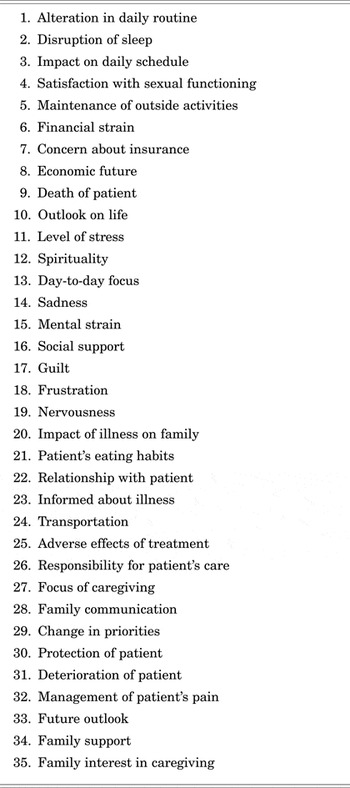
Eight additional items were included in the total CQoLC score: disruption of sleep, satisfaction with sexual functioning, day-to-day focus, mental strain, information about the illness, protection of the patient, management of the patient's pain, and family interest in caregiving. Table 1 presents the content of each item. The maximum total score for the instrument was 140, and higher scores reflected a better QoL. The CQoLC has been shown to be both valid and reliable (Weitzner et al., Reference Weitzner, Jacobsen and Wagner1999), and the Italian version has been validated (Pugliese et al., Reference Pugliese, Garufi and Perrone2004).
Content of each item on the CQoLC (Pugliese et al., Reference Pugliese, Garufi and Perrone2004)

The caregiver was either self-identified or identified as a caregiver by the patient and the primary caregiver. The caregiver could have been a spouse, brother or sister, adult child, lover, or close friend. All caregivers provided a written informed consent. After informed consents were obtained, the CQoLC questionnaire was presented by a trained psychologist interviewer, and caregivers completed the self-administered questionnaire during a patient's routine visit or while the patient was undergoing chemotherapy.
To be eligible for the study, potential participants had to be the identified or self-identified primary caregiver of the patient, be at least 18 years of age, be proficient in Italian, have cared for the patient for at least two cycles of chemotherapy, and not have a history of prior or current psychiatric or neuropsychological disorders.
DATA ANALYSIS
The data for every item on the questionnaire were analyzed using a chi-square test. We performed a 2 × κ analysis with one degree of freedom. We performed a chi-square test for every domain, calculating the total score from the sum of scores for the items pertaining to that domain. We considered a p value less than 0.05 to be significant. All tests were performed with the SPSS statistical package for Windows-based computers (SPSS Inc., released 2009, PASW Statistics for Windows, v. 18.0, Chicago).
RESULTS
The questionnaire was offered to 206 consecutive caregivers. However, six caregivers refused to participate, the major reasons for study refusal being a lack of time to complete the items and too much stress.
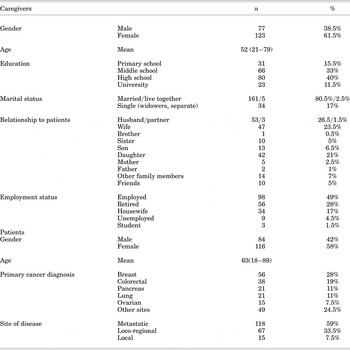
Table 2 provides a description of the caregivers' main characteristics. Most of the caregivers were women (61.5 vs. 38.5% men), and the median age was 52 years (range 21–79). The participants were mainly spouses (24% wives and 26% husbands) or adult children (21% daughters and 6.5% sons), worked (49%), and had a high school education (40%). The mean time from diagnosis was 19.63 months, with a range from 0.73 to 257.83 months. The majority of patients were women (58%), with a median age of 63 years (range 18–89), mostly with metastatic disease (59%). The most common cancers in our sample were breast (28%), colorectal (19%), and lung (11%).
Caregivers' and patients' characteristics (n = 200)

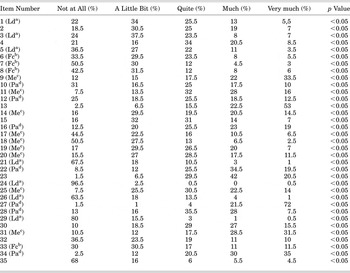
We quantified subjective burden using CQoLC scores. By analyzing one item at a time, we found that the answers were distributed normally. The results of the single-item analysis are reported in Table 3.
Results for each CQoLC item

aLd = lifestyle disruption; bFc = financial concern, cMe = mental emotional burden, dPa = positive adaptation.
To obtain the final score in each category for each caregiver, we summed the scores for each item related to the main topic. Finally, we divided the totals into four groups and analyzed them to identify statistically significant differences in the distribution between women and men. We considered the lowest scores in each group as “not at all,” the highest scores as “very,” the second-lowest scores as “somewhat,” and the second-highest scores as “quite a bit.”
In general, our data showed that 12.2% of our caregivers reported their mental and emotional burden as “very” heavy. Additionally, we found a significant difference between women and men in terms of mental and emotional burden, with women being more strongly affected (61.9 vs. 38.1%).
Specifically, 13 women and 16 men were “not at all” concerned, 46 women and 37 men were “somewhat” concerned, 42 women and 19 men were “quite a bit” concerned, and 21 women and 3 men were “very” concerned (p < 0.01). These differences were significant (p < 0.001).
We did not find any difference between women and men in terms of financial concerns and positive adaptation. With regard to financial issues, 8 women and 2 men reported that they were “not at all” concerned, 15 women and 8 men reported that they were “somewhat” concerned, 46 women and 30 men reported that they were “quite a bit” concerned, and 54 women and 36 men reported that they were “very” concerned (p = NS). Overall, we noted that 83.4% (166 persons) of participants were “quite a bit” or “very” concerned about financial difficulties, as opposed to 16.6% (33 subjects) who were “not at all” or “somewhat” concerned.
We also found that our caregivers generally demonstrated positive adaptation. In response to the question about positive adaptation, 2 women and 1 man answered “not at all,” 30 women and 25 men answered “somewhat,” 72 women and 40 men answered “quite a bit,” and 16 women and 9 men answered “very” (p = NS). Moreover, caregiving negatively affected the men mostly in terms of diminishment of sexual activity (42.3 vs. 33.6% being “not at all” or “a little” satisfied with their sexual life), even though this result was not significant.
Women were more worried about lifestyle disruption than men, though this difference was not statistically significant (“not at all”: 1 woman vs. 0 men; “somewhat”: 9 women vs. 1 man; “quite a bit”: 36 women vs. 16 men; and “very”: 77 women vs. 59 men, p < 0.08). Finally, 93.5% of caregivers reported being “quite a bit” or “very” pleased with their role.
DISCUSSION
In summary, we have evaluated the subjective burden of caring among caregivers of outpatients with advanced cancer. In agreement with previously published literature on this topic, our results indicate that these caregivers experienced substantial distress. In our study, women expressed a greater emotional burden than men. This result is similar to the findings of another study, which showed that women developed higher levels of psychological distress than men (Grov et al., Reference Grov, Dahl and Moum2005). Other studies of cancer caregivers have also reported that female sex is associated with worse mental health (Rhee et. al., Reference Rhee, Yun and Park2008; Braun et al., Reference Braun, Mikulincer and Rydall2007; Dhruva et al., Reference Dhruva, Lee and Paul2012; Langford et al., Reference Langford, Lee and Miaskowski2012; Wadhwa et al., Reference Wadhwa, Burman and Swami2013). Furthermore, it can be assumed that within our culture, women might perceive themselves as having less choice in assuming the role of a caregiver than men, or they may set higher standards for their caregiving ability. It may also be that women are more able to perceive and express severe emotional distress than men.
Although not statistically significant, there was a difference between men and women with respect to their perception of lifestyle disruption, and women seemed to perceive greater deterioration in this domain. These results could be explained by fact that the women often had other caregiving responsibilities in addition to caring for the cancer patients, including working and taking care of children.
Our results seem to show that caregivers developed a good response (i.e., positive adaptation) and that this response was not related to gender. In fact, the differences between women and men did not reach statistical significance. A possible interpretation of this relatively enhanced adaptation could be the time to diagnosis. In our population, as previously stated, the mean time to diagnosis was more than two years, and this relatively long time might have been long enough for caregivers to adapt positively.
On the other hand, almost all caregivers reported being proud and pleased with their caregiving role. As such, it is plausible to assume that caregivers may tend to underestimate their difficulties and that they may consider it more important to focus on the patient's needs, and, as a result, they may neglect their own.
Our observational study of 200 cancer family caregivers confirms findings in the recent literature on the key role played by FCs and the psychosocial difficulties they face. However, psychosocial support services are often inadequate, and there is a critical need to improve support for cancer FCs.
To understand the needs of family caregivers so that better preparation and care protocols can be developed, Northouse and colleagues analyzed five metaanalyses to determine the effect of interventions with caregivers on patient and caregiver outcomes. While these metaanalyses had several limitations, the research findings indicated that interventions targeted to caregivers alone or to caregivers and patients jointly had positive effects on both caregiver and patient outcomes. In particular, the interventions significantly improved caregivers' coping skills, knowledge, mental well-being, and QoL (Northouse et al., Reference Northouse, Katapodi and Song2010; Sorensen et al., Reference Sorensen, Pinquart and Duberstein2002; Hartmann et al., Reference Hartmann, Bazner and Wild2010; Martire et al., Reference Martire, Lustig and Schulz2004; Candy et al., Reference Candy, Jones and Drake2011; Ferrell et al., Reference Ferrell, Hanson and Grant2013). The three following types of interventions were identified: (1) psychoeducational, (2) skills training, and (3) therapeutic counseling. When possible, the majority of interventions were simultaneously delivered to patients and their caregivers, suggesting that the patient and the caregiver should be treated as a single unit of care.
Hudson and coworkers (Reference Hudson, Trauer and Kelly2013) underlined the importance of preparing FCs for their role in supporting patients receiving home-based palliative care by offering one-on-one psychoeducational interventions. This research, despite several limitations, showed that targeted, relatively short-term psychoeducational interventions can enable FCs to feel more prepared and competent in supporting a dying relative. However, there was no significant reduction in their unmet needs or improvements in the positive aspects of caregiving (Cipolletta et al., Reference Cipolletta, Shams and Tonello2013). An educational program for FCs, with nurses as the mainstay, enhanced QoL for both patients and caregivers, and also alleviated caregiver burden. A triangular relationship among patients, caregivers, and healthcare providers should be considered when organizing basic care (Hudson et al., Reference Hudson, Trauer and Kelly2013).
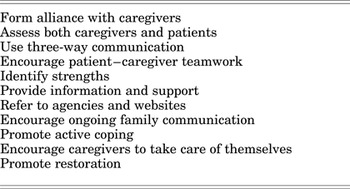
Table 4 lists the interventions for helping patients and their caregivers that have been supported by research evidence (Belgacem et al., Reference Belgacem, Auclair and Fedor2013). However, work by Mosher and coworkers found that distressed FCs of lung cancer patients underused health services, and that a sizable minority were interested in obtaining professional help for psychosocial and practical needs (Mosher et al., Reference Mosher, Champion and Azzoli2013a, Reference Mosher, Champion and Hannab; Northouse, Reference Northouse2012). These results were confirmed in a study by Merckaert and colleagues (Reference Merckaert, Libert and Lieutenant2013), which showed that only one of five caregivers of patients with cancer desires formal psychological support, though one in two caregivers experiences significant levels of distress. These findings emphasize the need to further investigate caregivers' help-seeking processes and the associated factors (Mosher et al., Reference Mosher, Champion and Hanna2013b).
Interventions to help patients with cancer and their FCs (Hudson et al., Reference Hudson, Trauer and Kelly2013)

The strengths of our study include a sufficiently large sample size and the use of a quality-of-life measure specific to caregivers of cancer patients. However, there are several limitations that prevent generalizing our results to all caregivers of cancer patients. For example, our caregiver population was entirely comprised of Italians, the majority of whom were female, well-educated, employed, and had a close relationship with the patient. Furthermore, we included patients with different types of cancer, and there might be factors affecting caregiver QoL that are specific to caring for patients with particular cancer diagnoses, although the tumor site was not associated with caregiver QoL in our sample.
Even so, the generalizability of our results is limited, but they suggest that FCs are not yet fully recognized for the enormous burden of care they shoulder and for their interdependent relationship with the patients. The physical and psychological well-being of FCs lead to better outcomes for patients, and so there is a critical need to improve support for cancer FCs.
In our setting, we are currently developing a new project, called “Bussola,” which aims to direct and support the caregivers of metastatic patients through a brief, multidisciplinary counseling protocol involving an oncologist, a nurse, a psychologist, and a social worker. Our intervention is based on the oncology family caregiver project of Ferrell and colleagues (Reference Ferrell, Hanson and Grant2013), and includes three two-hour meetings. The purpose of the first meeting is to give caregivers information about cancer, treatments, and the social and psychological needs of patients. The second and third sessions are focused on psychoeducational and adaptive coping skills training. Our purpose is to decrease the caregiving-associated burden for family caregivers using an early targeted psychosocial support intervention.
APPENDIX 1. CQoLC (ITALIAN TRANSLATION AND ADAPTATION)
SESSO □ M □ F
ETÁ: _______________ DATA COMPILAZIONE _____________________
NOME PERSONA ASSISTITA
__________________________________________________
Sono qui di seguito riportate delle affermazioni giudicate importanti da alcune persone che, come Lei, si prendono cura del proprio caro ammalato. Indichi quanto è stata vera per Lei durante gli ultimi sette giorni ciascuna delle seguenti affermazioni. Tenga presente che i numeri hanno i seguenti valori:
0 = per niente 1 = un po' 2 = abbastanza 3 = molto 4 = moltissimo
Negli ultimi 7 giorni, o periodo:
-
1. Ho dovuto, purtroppo, cambiare le mie abitudini quotidiane. 0 1 2 3 4
-
2. Il mio sonno è meno riposante. 0 1 2 3 4
-
3. La mia vita giornaliera è disturbata. 0 1 2 3 4
-
4. Sono soddisfatto della mia vita sessuale. 0 1 2 3 4
-
5. Trovo molto difficile mantenere i miei interessi. 0 1 2 3 4
-
6. Devo sostenere molte spese. 0 1 2 3 4
-
7. Sono preoccupato per le spese sanitarie. 0 1 2 3 4
-
8. Sento che il mio futuro economico è incerto. 0 1 2 3 4
-
9. Ho paura che il mio caro possa morire. 0 1 2 3 4
-
10. Da quando il mio caro si è ammalato ho una visione più positiva della vita. 0 1 2 3 4
-
11. Il mio livello di stress e preoccupazione è aumentato. 0 1 2 3 4
-
12. Il mio senso di spiritualità è aumentato. 0 1 2 3 4
-
13. Mi dà fastidio dover programmare la mia vita giorno per giorno. 0 1 2 3 4
-
14. Mi sento triste. 0 1 2 3 4
-
15. Sento che il mio stress mentale sta aumentando. 0 1 2 3 4
-
16. I miei amici e vicini di casa mi sostengono. 0 1 2 3 4
-
17. A volte mi sento in colpa verso il mio caro o verso altre persone. 0 1 2 3 4
-
18. Mi sento frustrato. 0 1 2 3 4
-
19. Mi sento nervoso. 0 1 2 3 4
-
20. Sono preoccupato per gli effetti che la malattia del mio caro può avere sui miei figli o altri membri della famiglia. 0 1 2 3 4
-
21. Ho difficoltà ad affrontare i cambiamenti delle abitudini alimentari del mio caro. 0 1 2 3 4
-
22. Ho sviluppato un rapporto più stretto con il mio caro. 0 1 2 3 4
-
23. Mi sento adeguatamente informato sulla malattia del mio caro. 0 1 2 3 4
-
24. Mi infastidisce dover essere disponibile ad accompagnare il mio caro agli appuntamenti. 0 1 2 3 4
-
25. Temo gli effetti negativi che i trattamenti possono causare al mio caro. 0 1 2 3 4
-
26. La responsabilità che ho per la cura del mio caro a casa è opprimente. 0 1 2 3 4
-
27. Sono contento di fare qualcosa per il bene del mio caro. 0 1 2 3 4
-
28. In famiglia è aumentato il dialogo. 0 1 2 3 4
-
29. Mi infastidisce che le mie priorità siano cambiate. 0 1 2 3 4
-
30. A volte ho l'impressione di dover proteggere il mio caro. 0 1 2 3 4
-
31. Mi sconvolge veder deperire il mio caro. 0 1 2 3 4
-
32. Mi affatica dover gestire il dolore del mio caro. 0 1 2 3 4
-
33. Sono pessimista per il futuro. 0 1 2 3 4
-
34. Sono soddisfatto del sostegno che ricevo dagli altri membri della famiglia. 0 1 2 3 4
-
35. Mi infastidisce che gli altri membri della famiglia non abbiano dimostrato interesse nel prendersi cura del mio caro. 0 1 2 3 4
Grazie per la collaborazione.