Similar to other human languages, the grammar of learner speech (Interlanguage) is characterized by a rule-governed system (e.g., Adamson, Reference Adamson1988; Preston, Reference Preston1989; Reference Preston, Bayley and Preston1996) that is inherently (and in the case of learner speech highly) variable. The availability of studies that combine variable second language acquisition (SLA) data with sociolinguistic methodology for data collection and analysis are still scarce, aside from a few studies conducted over the last three decades in which variation is expressed in the form of variable rules (à la Labov Reference Labov1969; e.g., Fasold, Reference Fasold and Trudgill1984, see also Bayley & Preston, Reference Bayley and Preston1996), or accounted for in terms of Bickerton's (Reference Bickerton, Bailey and Shuy1973) Dynamic Paradigm (e.g., Gatbonton, Reference Gatbonton1978). In recent years, however, these approaches have been deemed inadequate for the explanation of variable phenomena (e.g., Cardoso, Reference Cardoso2003; Reynolds, Reference Reynolds1994; Taler, Reference Taler1997), and have thus been discarded in favor of a constraint-based framework: Optimality Theory (OT) (Prince & Smolensky, Reference Prince and Smolensky1993). Within this theoretical framework, the present study incorporates theoretical and methodological tools from three linguistic disciplines (i.e., sociolinguistics, second language acquisition, and formal phonology) to provide a more comprehensive analysis of variation in the speech of second language learners, in an attempt to develop a “socially realistic linguistics” (Wilson & Henry, Reference Wilson and Henry1998). For the analysis of variation, this article adopts a stochastic version of OT: the Gradual Learning Algorithm (GLA), proposed by Boersma (Reference Boersma1998) et seq. and Boersma & Hayes (Reference Boersma and Hayes2001). The main advantage of this approach is that it allows the encoding of variability and its frequency effects (i.e., quantitative values) within a language by means of a single grammar.
Following a sociolinguistic methodology for data collection, this article provides an analysis for the variable acquisition of English (L2) singleton word-final stops (codas) by Brazilian Portuguese (BP) native speakers learning English as a foreign language in a classroom environment. The study is cross-sectional and includes data from six English learners in three proficiency levels: beginners, intermediate, and advanced. The general questions that I address in this article are:
(1) General questions:
a. How systematic is the variation that is observed in the development of word-final singleton stops by BP speakers? How does it change during the development of English and how does it compare to other interlanguages and “full-fledged” languages?
b. What are the relative contributions of the linguistic and extralinguistic independent variables included in this study?
c. How can the variation observed be accounted for in light of current developments in phonological theory (e.g., Optimality Theory)?
Answers to the first question will be provided in the section titled Data Collection Procedures and Quantitative Results. I will show the systematic development of English word-final codas by BP speakers across three proficiency stages, and compare these results with those obtained in cross-linguistic studies and in first and second language acquisition research.
The second question will also be addressed in that section. goldvarb 2001 statistical results indicate that variation in coda acquisition by BP speakers is triggered by a combination of linguistic (e.g., codas are more likely to appear in polysyllabic—as opposed to monosyllabic—words) and extralinguistic factors (e.g., codas appear more frequently in more formal speech).
Finally, the third question will be the topic of the section titled “The Stochastic OT Analysis”, in which I will show how a stochastic, GLA-based approach to the analysis of variation is preferable to standard, ordinal OT to analyze the type of variation described in this study: It presupposes a simpler grammar, governed by the same constraints and principles that govern categorical phenomena.
The article is organized as follows. in the section titled “Codas in Brazilian Portuguese and Brazilian Portuguese English”, I will provide an introduction to codas in Brazilian Portuguese and BP English. The section titled “Data Collection Procedures and Quantitative Results” will address the data collection procedures as well as discuss the goldvarb 2001 quantitative results. This will be followed by the section titled “The Stochastic OT Analysis,” in which I will provide the stochastic analysis for the variable results obtained within Boersma and Hayes' (Reference Boersma and Hayes2001) approach to variation. Finally, the last session presents my concluding remarks of the study.
CODAS IN BRAZILIAN PORTUGUESE AND BRAZILIAN PORTUGUESE ENGLISH (BPE)
In Brazilian Portuguese, only four consonants can potentially appear in coda position: /l N r s/. However, /l/ and /N/ (an underspecified nasal consonant) never surface as codas in most varieties of BP, triggering either the diphthongization of the preceding vowel in the case of /l/, or the nasalization of the vowel in the case of /N/, as illustrated in (2a) (in which“.” indicates syllable boundaries). On the other hand, /r/ and /s/, are the only consonants that syllabify as codas in the language (see (2b)). Word-finally, however, these two consonants may variably undergo deletion in informal styles, some of which are stigmatized in the language (see Cardoso (Reference Cardoso1999) for a variable investigation of /r/-deletion in the same variety of Portuguese under investigation).
(2) Codas in BP
a. Consonants that do not surface as codas
/l/: /brazil/ → [bra.ziw] ‘Brazil’ (cf. [bra.zi.lej.ru] ‘Brazilian’)
/papel/ → [pa.pεw] ‘paper’ (cf. [pa.pe.la.da] ‘paperwork’)
/N/: /boN/ → [bõ] ‘good’ (cf. [bõ.na.∫ãw] ‘good person’)
/be.leN/ → [be.l˜j] ‘Belém’ (cf. [be.le.n˜).si] ‘person from Belém’)
b. Consonants that may variably surface as codas
/r/:/dor/ → [dor]Footnote 1 ∼ [do_] ‘pain’
/falar/ → [fa.lar] ∼ [fa.la_] ‘to speak’
/s/:/kazas/ → [ka.zas] ∼ [ka.za_] ‘houses’
/lapis/ → [la.pis] ∼ [la.pi_] ‘pencil’
If the syllable-final consonant is an obstruent stop (i.e., [p, t, k, b, d, g]), BP opts for the syllabification of the illicit consonant as the onset of the epenthetic vowel [i]— henceforth referred to as i-epenthesis. This applies to both native (3a) and loan (3b) words:
(3) i-epenthesis in BP
a. In BP native words
/sub +
 ugar/ → [su.bi.u.gar] ‘to subjugate’ (cf. [su.bes.t∫i.mar] ‘to underestimate’)
/sub + ∫εfe/ → [su.bi.∫ε.fi] ‘sub-chief’ (cf. [su.baw.teh.nu] ‘subordinate’)
/sub + solo/ → [su.bi.s
.lu] ‘subsoil’b. In borrowings
/h
t dg/ → [ht∫i dgi]Footnote 2 ‘hot dog’/p
p/→ [p.pi] ‘pop’/lajt/ → [laj.t∫i] ‘light’


During the acquisition of L2 English, the language learner goes from an initial stage in which the grammar directly reflects the phonology of BP (i.e., illicit codas surface as onsets of epenthetic vowels, as shown in (3b)), to a stage that resembles that of the target language and in which codas may appear freely. From the outset of coda acquisition to its target-like production, the development of English codas by BP speakers is a variable process: the coda [g] in the English word “dog” /d g/, for example, may surface identical to its English counterpart (i.e., [d
 g]), or followed by an epenthetic [i] (i.e., [d
 .gi]), as was illustrated in (3b).Footnote 3 Based on the aforementioned discussion, the most obvious explanation for i-epenthesis is to assume that the phenomenon results from the direct interference of BP phonology. However, a closer examination of the data indicates that the phenomenon can be described as an “error” that reflects not only the phonology of BP (transfer), but also more general and universal principles. In the following sections, I will demonstrate that variability in coda production results from the interaction of both linguistic and extralinguistic factors as well as transfer from BP phonology.
DATA COLLECTION PROCEDURES AND QUANTITATIVE RESULTS
This study consisted of 1,859 tokens of word-final stops, collected in the field by the author in the city of Belém, Brazil, and included two dependent variables: target-like production of word-final stops (coda) and i-epenthesis. The data collected were stratified among eight independent variables and later analyzed by the goldvarb 2001 (Robinson et al., Reference Robinson, Lawrence and Tagliamonte2001) statistical program. Five linguistic factor groups were considered: (1) word status (content—e.g., ‘cat’, or function word—e.g., “it”); (2) place of articulation of the word-final stop (coronal [t d], labial [p b], or dorsal [k g]); (3) word size (one versus more than one syllable); (4) stress placement within the word (i.e., on the syllable where the coda occurs—Coda σ, versus elsewhere—Other σ); and (5) preceding vowel (the tense vowels /i u  o e/—as [i] in ‘beet’ [bit], sometimes represented phonetically by a following “:” to indicate tenseness and length, and the lax vowels /i
 ε æ
 /—as [I] in ‘bit’ [bIt]). Also there were three extralinguistic factor groups: (1) level of proficiency (Beginners, with approximately 20 hours of in-classroom ESL instruction—Level 1; Intermediate, with approximately 150 hours of classroom exposure to English—Level 2; and Advanced, with more than 400 hours—Level 3), (2) style (Word List, Passage, and Interview—see forthcoming discussion); and (3) participants (six English students). For the sake of convenience, the motivations for the inclusion of these independent variables in the study will only be addressed in the discussion and analyses of the relevant results. A summary of the factor groups included in this study is displayed in Table 1.
(4)
Factor groups for goldvarb 2001 analysis

The participants were three male and three female native speakers of Brazilian Portuguese, with an average age of twenty-one. Four of the participants were in the process of completing a university degree in the social sciences, whereas the other two had high school diplomas and worked full-time (one as an office secretary and the other as a nursing assistant at a hospital). As indicated in the participants' responses in a written background questionnaire, they had no access to spoken English beyond the language classroom, and did not speak any other foreign language besides English.Footnote 4
To collect tokens from a wide range of stylistic levels and to ensure that the data are reliable and representative, the data collection methodology used in this study provides a three-level distinction in a formality hierarchy: (1) reading of frequently-used words and two-word sequences (Word Lists—see Appendix 1); (2) reading of short passages (Passages—see Appendix 2); and (3) informal (Interview), which consisted of an open-ended oral interview with the researcher (see Appendix 3.A).Footnote 5 To elicit an adequate number of the target codas and the relevant linguistic environments in informal speech, a picture-based task was included in the oral interview, in which images representing relatively frequent words such as ‘dog’, ‘music’, and ‘wallet’ were used as starting points for conversation (see Appendix 3.B for a sample of the pictures used). In the task, participants were asked questions related to the image presented (e.g., the picture of a dog: “What's this?”, “Do you have one?”, “Do you like pets?”, “What's your favorite pet?”, etc.), which often triggered discussions that went beyond the picture. The tasks and interviews were audio recorded via a Marantz CDR300 CD/RW Recorder and an Audio-Technica AT831b lavaliere microphone, and later transcribed (using the software Transcriber 1.4) independently by two research assistants and myself for goldvarb 2001 analysis.Footnote 6 For the quantitative study, only tokens realized with word-final codas or followed by i-epenthesis were coded and analyzed.Footnote 7 The transcriptions were compared for consistency with respect to the feature under investigation (intertranscriber reliability was of approximately 88%), and whenever we encountered discrepancies, the disputed items were listened to repeatedly until an agreement was reached. If, however, we could not arrive at a consensus, the dubious items were removed from the corpus.
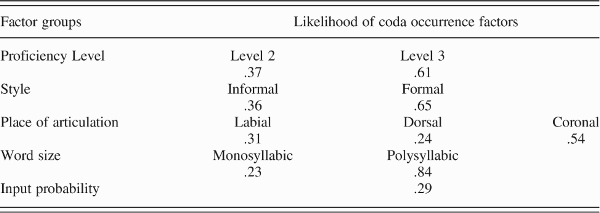
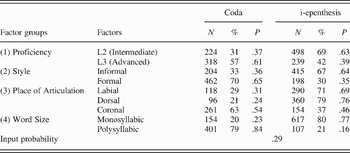
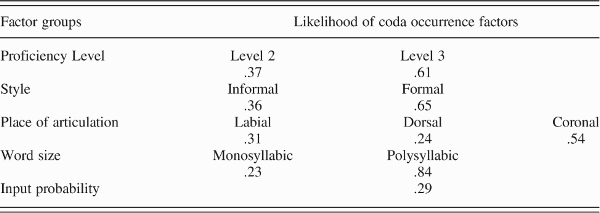
From the factors included in this study, goldvarb’s probabilistic results indicate that the internal variables place of articulation and word size and the external variables level of proficiency and style have significant conditioning effects on variability in English coda acquisition by BP speakers. The factor Level 1 (beginners) was excluded from subsequent goldvarb analyses because of the near-categorical results towards i-epenthesis obtained in this group, and to prevent its interference in the results for other proficiency levels.Footnote 8 The stylistic factors word list and passages, on the other hand, displayed no significant difference and were therefore regrouped into a single group: Formal (which will from now on contrast with Informal—the informal oral interview task). Finally, goldvarb’s step-up and step-down regression analyses indicated that the internal factor groups word status, stress placement, and preceding vowel were not contributing factors on variable coda production; consequently, these three groups were removed from subsequent statistical analyses.Footnote 9 The final goldvarb results are illustrated in (5)—see also Appendix 4 for a more detailed illustration of the statistical results. In general, these results indicate that codas are more likely to appear in the speech of more proficient speakers (.61), in more formal styles (.65), in the context of coronal consonants (.54), and in words larger than one syllable (.84).
(5)
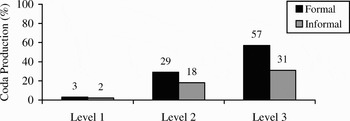
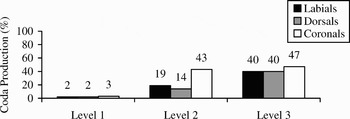
Table 2 illustrates the weight that each independent factor has on coda production considering the entire data set, without taking into account the interaction of proficiency and style; for example, these results do not show that codas are more likely to surface as such in more formal stylistic environments across the two levels of proficiency deemed significant in the study. To confirm the hypothesis that the likelihood of coda production across different levels of proficiency would be higher in more formal stylistic environments (e.g., word list and passage reading tasks), cross-tabulations of the factors proficiency level and style were conducted (note that results of cross-tabulations are provided in percentages, see Figure 1).
Final goldvarb probabilistic results (Level 2 and Level 3)
Chi-square/cell: 0.978
Coda development by Proficiency & Style (%).

Before proceeding with the discussion of the cross-tabulations described earlier, we now need to introduce some of the assumptions that were adopted in the analysis of the variable data under investigation. In this study, I assume the following standard views on the nature of grammar: (1) that proficiency levels correspond to different interlanguages and, by definition, to different grammars characterized by a series of transitional and permeable systems (Adamson, Reference Adamson1988; Adjémian, Reference Adjémian1976; Escartin, Reference Escartin2005; John, Reference John2005; Preston, Reference Preston, Bayley and Preston1996; Selinker, Reference Selinker1972; White, Reference White1989); and (2) that stylistic levels constitute separate grammars (Boersma, Reference Boersma2001; Cardoso, Reference Cardoso2001, Reference Cardoso2003; Chomsky, Reference Chomsky1988; Morris, Reference Morris1998; Selkirk, Reference Selkirk1972; van Oostendorp, Reference van Oostendorp, Hinskens, van Hout and Wetzels1997, Reference van, Oostendorp2005a). Note that there are certain similarities between the assumptions made here and those inherent to the Multiple Grammar approach proposed by Kroch (Reference Kroch, Beals, Denton, Knippen, Melnar, Suzuki and Zeinfeld1994) and Kroch & Taylor (Reference Kroch, Taylor, van Kemenade and Vincent1997), for whom variation is the result of distinct grammars in operation and in competition with each other (see also Roeper, Reference Roeper1999; Yang, Reference Yang2003). The view adopted here, however, differs from that of Kroch (Reference Kroch, Beals, Denton, Knippen, Melnar, Suzuki and Zeinfeld1994) and Kroch & Taylor (Reference Kroch, Taylor, van Kemenade and Vincent1997) in a crucial way. In their Multiple Grammar approach, competing grammars are invoked to explain variable phenomena that are intrinsically internal to the grammar, as is the case in the morphosyntactic variation encountered in the use of periphrastic do in English (e.g., “How great tribulations suffered the Holy Apostle?” and “How great tribulations did the Holy Apostle suffer?”—See Henry (Reference Henry, Chambers, Trudgill and Schilling-Estes2002) for a criticism of Kroch's Multiple Grammar approach). In this respect, Kroch's view on variation is similar to that of the Cophonology approach, a controversial proposal according to which phonological constituents (e.g., a prosodic word, a syllable), morphological components (e.g., a root, an affix), or even classes of specific morphemes (e.g., periphrastic do) may be associated with their own OT-based subgrammars or cophonologies (e.g., Inkelas, Reference Inkelas, Booij and van Marle1998; Inkelas et al., Reference Inkelas, Orgun, Zoll and Roca1997; Inkelas & Orgun, Reference Inkelas and Orgun1995; Inkelas & Zoll, Reference Inkelas and Zoll2000; Itô & Mester, Reference Itô, Mester, Beckman, Walsh-Dickey and Urbanczyk1995a, Reference Itô, Mester and Goldsmith1995b; Orgun, Reference Orgun1996).Footnote 10 In this study, however, the adoption of separate grammars is exclusive to external factors such as proficiency and style, as is well established in standard (variationist) generative linguistics (see some references at the outset of this paragraph). By these assumptions, we may then conclude that the data investigated comprise five distinct grammars: one (near-) categorical grammar for Level 1, in which codas are unlikely to occur in both formal and informal environments; two variable grammars for Level 2 (formal and informal); and two variable grammars for Level 3 (formal and informal). The results in percentage are illustrated in Figure 1.
Figure 1 illustrates that the occurrence of codas in L2 speech increases as the BP learner becomes more proficient in English.Footnote 11 It also shows that the likelihood of coda occurrence is higher in more formal stylistic environments, a pattern that is compatible with a variety of studies in second language acquisition (e.g., Gatbonton, Reference Gatbonton1978; Major, Reference Major1986, Reference Major2005; cf. Beebe, Reference Beebe1980; Major, Reference Major1994) and with the standard view that more formal styles require more “prestigious” and faithful forms (e.g., Cardoso, Reference Cardoso2001, Reference Cardoso2003; Labov, Reference Labov1966; van Oostendorp, Reference van Oostendorp, Hinskens, van Hout and Wetzels1997). Finally, these results conform to Major's (Reference Major2001) model for interlanguage phonology, who coined the Ontogeny Phylogeny Model—OPM, a revised version of Major's (Reference Major, Ioup and Weinberger1987) Ontogeny Model, which posits that learners progress from an initial stage with a prevalence of L1 features, to a final stage with a prevalence of L2 features, via medial stages, during which L1 features (i.e., i-epenthesis) gradually decline and L2 features (i.e., codas) gradually rise.
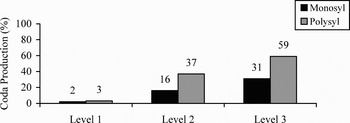
The results involving the factor group word size (by proficiency level) are illustrated in Figure 2. Observe that in intermediate and advanced proficiency levels, word-final stops are more likely to surface as codas if they appear in words with more than one syllable—polysyllabic words (e.g., [ .tæk] is more likely than [
 .tæ.ki] ‘attack’ because the former constitutes a disyllabic word). A corollary of this observation is to say that i-epenthesis is more frequent in monosyllabic words (e.g., [d
 .gi] is more likely than [d
 g] ‘dog’), a pattern that clearly reflects the cross-linguistic tendency for words to be minimally disyllabic (Word Minimality; e.g., Bernhardt & Stemberger, Reference Bernhardt and Stemberger1998; Broselow et al, Reference Broselow, Chen and Wang1998; Demuth & Fee, Reference Demuth and Fee1995; Everett, Reference Everett1996; McCarthy & Prince, Reference McCarthy and Prince1993; Wang, Reference Wang1995). Interestingly, BP does not enforce this tendency because the language gives shelter to a considerable number of monosyllabic words, some of which are highly frequent in the language (e.g., [pε] ‘foot’, [∫a] ‘tea’, [li] ‘I-read-PAST’, [p
 ] ‘powder’, [sε] ‘cathedral’). In addition, we cannot presuppose that this tendency is triggered by the phonology of the target language, because English also allows monosyllabic words to appear freely (e.g., [si:] ‘see’, [bεd] ‘bed’) as long as they obey a mora-specific version of Word Minimality requiring all words to be minimally bimoraic (e.g., the monosyllabic words [si:] ‘see’ and [sit] ‘sit’ each contains two morae in their rhymes).Footnote 12 What is worthy of note is the fact that the language learner opts for minimal word disyllabicity, a structure that is enforced neither in BP nor in English, over bimoraicity, which represents the target-like structure. It is beyond the scope of this investigation to extend the discussion regarding the apparent ambiguity between bimoraicity and disyllabicity for minimal word requirements (see McCarthy & Prince, Reference McCarthy and Prince1993 and Kager, Reference Kager, Nespor and Smith1996 for a more detailed examination of the issue). What is crucial here is the fact that disyllabicity as a minimal word requirement is a feature that is not observed in either the native language (L1) or the target language. As predicted by Major's (Reference Major2001) OPM, the developmental effects of Word Minimality should increase and decrease over the course of language acquisition. To summarize, we may conclude that the effect of Word Minimality (at least with respect to disyllabicity), a markedness constraint that is not visible in either the native language (BP) or the target language (English), only becomes apparent in Interlanguage—a clear illustration of the emergence of the unmarked Word Minimality constraint in BP English. Accordingly, this result is not an idiosyncrasy of second language speech, in that the enforcement of Word Minimality via disyllabicity has been observed across languages (e.g., McCarthy & Prince, Reference McCarthy and Prince1993; Ussishkin, Reference Ussishkin2000; Zec, Reference Zec2005), in first language acquisition (e.g., Tzakosta, Reference Tzakosta2003), and in second language acquisition (e.g., Broselow et al., Reference Broselow, Chen and Wang1998; Wang, Reference Wang1995).
Coda development by Proficiency & Word Size.

Let us now examine the quantitative results for the factor group place of articulation of the word-final consonant (by proficiency level), illustrated in Figure 3. The figure shows that coronal word-final consonants (i.e., [t d]) are more likely to surface as codas in BP English, more evidently so in intermediate proficiency levels (Level 2). Labials (i.e., [p b]) and dorsals (i.e., [k g]), on the other hand, are less likely to syllabify as codas. Because consonant deletion is not an option in the phonology of BP English, these consonants undergo i-epenthesis in order to surface in Interlanguage. In Optimality Theory, this observation can be captured by the markedness subhierarchy of place of articulation (Prince & Smolensky, Reference Prince and Smolensky1993): NoCoda[labial], NoCoda[dorsal] >> NoCoda[coronal], which maintains that labial (e.g., [p, b]) and dorsal (e.g., [k, g]) consonants are more marked codas than coronals (e.g., [t, d]). Being less marked than labials and dorsals, coronal segments are more likely to syllabify as codas in BP-based Interlanguage (cf. Kim & Zsiga, Reference Kim and Zsiga2002).
Coda development by Proficiency & Place of Articulation.

To conclude, I have shown in this section that variation in the L2 acquisition of English codas is conditioned by a combination of linguistic (i.e., word size and place of articulation) and extralinguistic (i.e., proficiency and style) factors. In the following section, I will demonstrate how the tools provided by current developments in phonological theory can be used to account for the variable results illustrated earlier.
THE STOCHASTIC OT ANALYSIS
To analyze the variable data presented and discussed in the previous section, I adopt Boersma's (Reference Boersma1998, Reference Boersma, Dekkers, van der Leeuw and van der Weijer2000) and Boersma & Hayes' (Reference Boersma and Hayes2001) methodology for investigating and representing variability in the framework of Optimality Theory (Prince & Smolensky, Reference Prince and Smolensky1993): Stochastic OT (StOT). StOT employs an associated learning algorithm: the Gradual Learning Algorithm (GLA). The GLA is in some aspects a development of Tesar and Smolensky's (Reference Tesar and Smolensky1993) Constraint Demotion algorithm, which was not originally designed to handle variation and gradient grammaticality.
Within the StOT approach, variation and gradient well-formedness are accounted for by a probabilistically determined reranking of constraints at certain intervals during evaluation time (i.e., during the process of speaking). Briefly, StOT postulates a continuous scale of constraint strictness in which constraints (e.g., Con1 and Con2 in (6)) are annotated with arbitrary numerical strictness values established by a GLA (e.g., Boersma & Weenink's (Reference Boersma and Weenink2000) Praat program, Hayes et al.'s (Reference Hayes, Tesar and Zuraw2003) OTSoft software). The probability of reranking (i.e., variation) is determined by the distance between Con1 and Con2 on the strictness scale and by the amount of evaluation noise (i.e., standard deviation, typically 2.0) added to the strictness values. A standard deviation of 2.0, the amount of noise used in this study, ensures that the distance of 10 or more values between two constraints will yield categorical rankings, as the hypothetical hierarchy in (6) illustrates. Under StOT, constraints not only dominate other constraints (as is the case in standard OT), but they are also specific distances apart. The two figures in (6) and (7) illustrate the distinction between a categorical grammar (in which crucially ranked constraints are distant on the strictness scale) and a variable one (in which crucially ranked constraints overlap in their distribution). Note that the superposition of Con2 above Con1 in (7) (and in forthcoming variable grammars) is merely to illustrate the boundaries that separate the overlapping constraints, whose distances are computed in the horizontal dimension only.
(6) Categorical ranking
(7) Variable ranking


In the context of a variable ranking, as shown in (7), the grammar might select for evaluation any point within the overlap of Con1 and Con2. Most likely, the grammar will select the ranking Con1 >> Con2 because of the higher ranking of Con1 over Con2. However, it is also possible for the grammar to select a point within the leftmost (higher ranked) area of Con2 (i.e., x) and the rightmost (lower ranked) area of Con1 (i.e., y). In this case, Con2 is ranked higher than Con1 (i.e., Con2 >> Con1) and a different candidate is selected. In sum, the distance between two or more constraints determines variability (e.g., outputs a and b) and, more importantly, it encodes predictability of variant occurrence into the grammar (e.g., output a's likelihood of occurrence is 12% whereas output b's is 88%).
For the analysis of variation, the main advantages of this approach are twofold. (1) We are able to obtain a simpler grammar, with fewer constraints (cf. Anttila, Reference Anttila, Hinskens, van Hout and Wetzels1997; Cardoso, Reference Cardoso2001, Reference Cardoso2003; Reynolds, Reference Reynolds1994), and still predict the same frequency data, that is, variation is governed by the same linguistic constraints and principles that govern categorical phenomena (e.g., the crucial ranking of constraints). (2) Other approaches to variation (i.e., Reynolds' 1994 “floating constraints” and Anttila's 1997 “crucial nonranking of constraints”) predict that quantities of variation should be in small integer fractions (e.g., 2/3, 1/2, 1/3). The data in this study do not always show this type of variation (see also Pater & Werle, Reference Pater and Werle2001, for a similar view).Footnote 13
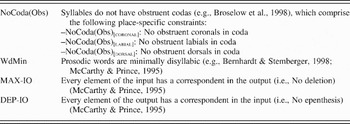
The relevant OT constraints adopted in this analysis are provided in (8). NoCoda Obstruent (NoCoda(Obs) henceforth) constitutes a family of markedness constraints comprised of its place-specific counterparts, namely, NoCoda(Obs)[coronal], NoCoda(Obs)[labial], NoCoda(Obs)[dorsal], as discussed in the previous section. It is violated whenever one of the obstruent stops [p, t, k, b, d, g] surfaces as a coda (e.g., [d g]) in interlanguage. NoCoda(Obs) is motivated by the cross-linguistic observation that several languages allow some (or only) sonorant consonants to syllabify as codas but not obstruents (e.g., Brazilian Portuguese, Carib, Kiriwina, Manam, Mandarin, Japanese; see Gordon (Reference Gordon2002) and Paradis & Prunet (Reference Paradis and Prunet1991) for a detailed discussion and a larger selection of languages, see Broselow et al. (Reference Broselow, Chen and Wang1998) and Villafaña (Reference Villafaña and Villafaña2000) for discussions of the effect of NoCoda(Obs) in interlanguage, and Goad (Reference Goad1997) for the same effect in first language acquisition). Because the effect of place of articulation of codas is relatively similar across the four variable grammars (i.e., while coronals favor coda production, labials and dorsals have no significant effect in the pronunciation of this syllable constituent—see Table 2 for the goldvarb weights), I will adopt the general version of NoCoda(Obs) in the forthcoming StOT analyses. It should be understood, however, that both the markedness subhierarchy of place of articulation NoCoda[labial], NoCoda[dorsal] >> NoCoda[coronal] and their respective ranking values are embedded into the constraint to ensure that coronals are favored as codas across the four grammars (see also forthcoming discussion in endnote 14).
Another markedness constraint relevant for the analysis is Word Minimality (WdMin henceforth), discussed in the previous section, which reflects the tendency for words to be minimally disyllabic across languages, and in first and second language acquisition. WdMin is violated whenever a consonant-final monosyllabic word surfaces as one syllable, that is, without i-epenthesis (e.g., [d g] ‘dog’) according to the interlanguage data under investigation. Note that the constraint is redundant in the context of monosyllabic words, as its effect is similar to that of NoCoda(Obs) discussed earlier. On the other hand, in the context of polysyllabic words such as [træ.fIk] ‘traffic’, WdMin operates vacuously because the requirement for minimal disyllabicity has been fulfilled.
The third constraint, MAX-IO, is one that requires a faithful input-output correspondence in which every input segment must be present in the output. It is therefore violated in cases in which the word-final stop is deleted from the output (e.g., [d ]). The effect of this constraint, however, is not robust in BPE because the codas under investigation never undergo deletion (cf. Mandarin Chinese; Wang, 1996; Broselow et al., Reference Broselow, Chen and Wang1998).
Finally, the faithfulness constraint DEP-IO bans segmental epenthesis by requiring that every element in the output have a correspondent in the input. The constraint is thus violated in instances of i-epenthesis (e.g., [d .gi]).
(8) OT constraints
With these constraints at hand (along with a set of inputs, surface forms and their respective quantitative values established by goldvarb in the previous section, incorrect rival candidates, and constraint violations—just like in a standard OT analysis), a series of computer simulations was performed using the OTSoft 2.1 software package (Hayes et al., Reference Hayes, Tesar and Zuraw2003). In brief, the simulations proceeded as follows. As indicated in the pevious section, the data set investigated represents five distinct developing grammars (i.e., (1) Level 1, (2) Level 2 Informal, (3) Level 2 Formal, (4) Level 3 Informal, and (5) Level 3 Formal). Each of these grammars was individually “learned” by OTSoft, which was supplied with the following information (all numbers are arbitrary) for the learning simulation to take place.
Number of times to go through forms (or total of learning trials): This number was set to 1,000,000. It indicates how many learning trials the GLA will perform. The higher the number, the more likely the observed and predicted probabilities will match. Notice that the rationale behind this procedure corresponds to Bybee's (2001:13) concept of frequency effects, for whom “the productivity of a pattern […] is largely determined by its type frequency: the more items encompassed by a schema, the stronger it is, and the more available it is for application to new items.” In the context of the L2 acquisition data analyzed here, the more frequent a form is present in the environment of learning, the more likely and faster it will be acquired.
The initial state: The intial state for both markedness and faithfulness was set to 100 (the concrete value is inessential). By default, the initial state is set with the arbitrary number of 100 for markedness and faithfulness constraints, a value that ensures that the ranking values will be always positive. This value can be manipulated by the researcher, depending on his/her views regarding language learning. For instance, one might decide that the learning process starts with a grammar in which markedness (e.g., 100) is ranked above faithfulness (e.g., 50)—a standard hypothesis for first language acquisition (e.g., Davidson, Jusczyk, & Smolensky, Reference Davidson, Jusczyk, Smolensky, Kager, Pater and Zonneveld2004; Hayes, Reference Hayes, Kager, Pater and Zonneveld2004, Prince & Tesar, Reference Prince, Tesar, Kager, Pater and Zonneveld2004; Smolensky, Reference Smolensky1996). Because the acquisition of codas by BP speakers involve violations of both markedness (NoCoda(Obs)) and faithfulness (DEP-IO), I adopt an equal value of 100 for the two types of constraints.
Initial/final plasticity: The plasticity value was 2/.002, initial and final, respectively, which are the default values in OTSoft 2.1. They serve to adjust the GLA results by comparing the outcome of the learning algorithm with the results entered for each pair of input-output. In Hayes' (Reference Hayes2007:21) own words, “[p]lasticity is the size of the change in the grammar that the GLA makes every time its own guess [does not] match the learning datum it encounters.” Note that the algorithm will only make adjustments to the simulated grammar if it detects discrepancies between what is observed and what it predicts—it is error-driven. The plasticity values are usually set high in the beginning to accelerate learning, and set low late in the learning process, for more refined results.
Number of times to test grammar: The default number of times to test grammar is 2,000 cycles. This number indicates the number of times the GLA will repeat the process of stochastic evaluation and compare the results to the relative frequencies that were observed in the data (the goldvarb results in our particular case). As will be shown later, the predictions established by the algorithm will closely match the frequencies observed in the corpus analyzed.
At the end of the simulations, the algorithm arrived at a final grammar that attempted to mimic the relative frequency of variants in the data, by assigning a ranking value for each of the constraints included in the analysis. Note that there is a degree of randomness in the learning, suggesting that separate GLA simulations will never generate the exact same ranking values and match-up to input frequencies. The procedure described earlier was repeated for each one of the five grammars established in the investigation (for an illustration of the results of a typical GLA simulation in OTSoft, see Appendix 5).
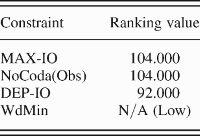
To illustrate how the GLA works in the context of categorical phenomena, consider the results obtained in Level 1 grammar (i.e., categorical i-epenthesis) which, according to the statistical results, is a mere reflection of the L1 phonology, Brazilian Portuguese. Based on these results, I assume here that the initial state for L2 acquisition coincides with the final state of the L1 grammar, as is standard in the generative L2 literature (e.g., Archibald, Reference Archibald1993; Broselow et al., Reference Broselow, Chen and Wang1998; Broselow & Finer, Reference Broselow and Finer1991; Davidson et al., Reference Davidson, Jusczyk, Smolensky, Kager, Pater and Zonneveld2004; Hancin-Bhatt & Bhatt, Reference Hancin-Bhatt and Bhatt1998; Pater, Reference Pater, Hannahs and Young-Scholten1997). After being exposed to a data set in which the occurrence of i-epenthesis is categorical, the GLA located an empirically appropriate ranking value for each constraint, as illustrated in (9) and depicted graphically in (10). Because the standard deviation typically assumed by the GLA is 2.0 and the distance between MAX-IO and NoCoda(Obs) (which have equal ranking values, i.e., 104) from DEP-IO is higher than ten units, we may safely assert that this ranking is effectively categorical (see Boersma & Hayes, Reference Boersma and Hayes2001 for more details). The constraint WdMin, which only operates later in interlanguage, remains dormant in the early phonology of BPE and therefore will not be considered in the discussion and analysis of Level 1 grammar. The ranking described earlier and candidate evaluation are represented in a standard OT tableau in (11), which categorically selects the candidate in which i-epenthesis took place as the optimal form, similar to what was observed in the corpus under investigation (N/A (Low) indicates that the ranking value for the constraint is unavailable, because its effect was not observed in the data; consequently, it is assumed that the constraint is ranked at the lower end of the hierarchy).
(9) Level 1: ranking values
(10) Level 1 grammar
(11) Tableau 1: Categorical i-epenthesis in Level 1


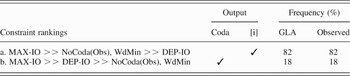
I will now demonstrate how the same approach adopted for the analysis of categorical phenomena can be utilized in the analysis of variation. Consider the results obtained in the interlanguage Level 2 Informal (see Figure 1), in which word-final obstruents are likely to be produced as codas 18% of the time, whereas the likelihood of i-epenthesis to occur is 82%. These frequencies in the data were learned by the GLA (OTSoft), which generated the following ranking values for Level 2 Informal grammar (shaded constraints indicate that they overlap in their distribution and consequently result in variation). The graphical representation of these constraints and their ranking values are shown in (13). See Appendix 5 for more information on the GLA simulations conducted for this grammar and the outcome of a typical OTSoft analysis.
(12) Level 2 Informal: ranking valuesFootnote 14
(13) Leval 2 Informal grammar

Because MAX-IO is ranked more than ten units higher than the other constraints, Level 2 Informal grammar will always rank MAX-IO at the higher end of the hierarchy and therefore coda deletion will never take place. The set of two equally ranked constraints, NoCoda(Obs) and WdMin, and the relatively lower ranked DEP-IO, however, overlap in their distribution as illustrated in (13). According to the ranking values assigned to these two sets of constraints, it is predicted by the GLA that the set comprised of NoCoda(Obs) and WdMin will outrank DEP-IO in most evaluations (i.e., 82% of the time) because it has a higher ranking value; consequently, the outcome will be i-epenthesis (see (14)). The opposite ranking will occasionally hold (i.e., 18% of the time) because of the overlap between these two constraints, that is, the grammar will sometimes select a point within the leftmost (higher ranked) distribution of DEP-IO and the rightmost (lower ranked) area of NoCoda(Obs)/WdMin. In this case, the outcome will be the production of word-final obstruents as codas, as shown in (15).
(14) Tableau 2: Variable coda production in Level 2 informal: i-epenthesis
(15) Tableau 3: Variable coda production in Level 2 informal: coda production
In (16), compare the results predicted by the GLA (under GLA) with the ones encountered in the data (under Observed): The grammar learned by the GLA generates output frequencies that are identical to those observed in the corpus under investigation (results repeated from Figure 1).
(16)
Table 3.Output selection for Level 2 Informal grammar (from (12) and (13))

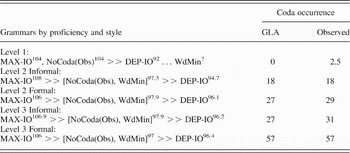
For convenience, I will not discuss the rankings assigned for each grammar assumed in this study. Instead, I summarize in (17) the stochastic analyses for the five distinct grammars that characterize the development of English codas by Brazilian Portuguese speakers (where the superscripted numbers indicate the ranking value assigned by the GLA). Observe under Coda Occurrence that each grammar learned by the GLA generates output frequencies that are strikingly close or identical to those observed in the data, as illustrated in Figure 1. Note also that what distinguishes these five grammars from each other is the distance between the sets of constraints NoCoda(Obs)/WdMin and DEP-IO in each hierarchy. For instance, in Level 1 NoCoda(Obs)/WdMin and DEP-IO have a ranking distance of 12 units (which yields categorical i-epenthesis), whereas in Level 2 Informal the distance is reduced to 2.6 (and consequently variation is the outcome), and so forth until the two constraints are reranked in opposite ends of the hierarchy (e.g., in the speech of native-like English learners), as I illustrate in (19). In addition, observe that as the distance between NoCoda(Obs)/WdMin and DEP-IO decreases, the likelihood of coda occurrence increases. Note also that, according to the GLA, the grammar of Level 3 Informal is strikingly similar to that of Level 2 Formal.
(17)
Table 4.Summary of grammars by proficiency and style
Evaluation noise (standard deviation): 2.0
Learning trials: 1,000,000
Initial state (markedness and faithfulness): 100
Initial/final plasticity: 2/.002
Number of stochastic evaluations: 2,000 cycles

In sum, we may conclude that the acquisition of English codas by BP native speakers can be described as a mere reranking of NoCoda(Obs) with respect to DEP-IO. As a result of L1 transfer, the English learner starts off with a grammar that resembles that of Brazilian Portuguese, in which case NoCoda(Obs) is ranked above (and in this version of OT more than ten units distant from) DEP-IO (see (18); cf. Level 1 grammar in (10)). The learner is then exposed to L2 English (e.g., via classroom exposure), a language that is characterized by the opposite ranking of these two constraints, as shown in (19). Note that in the two grammars, the ranking of WdMin is undefined because of its null effect in both BP and English.
(18) The grammar of Brazilian Portuguese (adapted from Cardoso, Reference Cardoso1999)
(19) The grammar of English (adapted from Archangeli, Reference Archangeli, Archangeli and Langedoen1997)


In addition to the effects of L1 transfer and exposure to the target language, the developing grammar is characterized by certain innate principles such as those that comprise the version of the MdMin constraint adopted in the analysis, whose effect is observed neither in the target language, nor in the phonology of the L1 (this analysis supports Schwartz & Sprouse's (Reference Schwartz, Sprouse, Hoekstra and Schwartz1994, Reference Schwartz and Sprouse1996) Full Transfer/Full Access hypothesis for L2 acquisition). During the development of codas in BP English, within this stochastic version of OT, the initial distance between NoCoda(Obs) and DEP-IO illustrated in (18) gradually decreases (i.e., the two constraints are reranked) towards the opposite target-like ranking shown in (19), and the dormant WdMin “surfaces” and becomes active in the interlanguage, albeit temporarily, until the target language grammar is acquired (the end state). In the process of reranking, however, the different proficiency stages through which the language learner proceeds (i.e., interlanguages) are characterized by grammars in which the distribution of these sets of constraints overlap and the outcome is variation, as illustrated in (20).
(20) The grammar of an Interlanguage (e.g., Level 2 Informal)

CONCLUSIONS
I have demonstrated in this study that the development of codas in Brazilian Portuguese English across three proficiency stages is systematic and, in most aspects, comparable to results obtained in the investigation of “full-fledged” languages and in first and second language acquisition research. For example, the statistical results involving word size (i.e., that i-epenthesis is more likely to occur in monosyllabic words) support the cross-linguistic tendency for words to be minimally disyllabic, a pattern that has also been observed in the development of first (e.g., Bernhardt & Stemberger, Reference Bernhardt and Stemberger1998; Tzakosta, Reference Tzakosta2003) and second languages (e.g., Broselow et al., Reference Broselow, Chen and Wang1998; Villafaña, Reference Villafaña and Villafaña2000; Wang, Reference Wang1995).
The goldvarb statistical results have shown that variation in the acquisition of English word-final codas by BP speakers is triggered by a combination of both linguistic and extralinguistic factors. The study has shown that codas are more likely to occur in the speech of more proficient speakers, in more formal stylistic environments, in polysyllabic words, and in contexts in which the word-final coda is a coronal. The group factors word status, following vowel, and stress placement, on the other hand, did not have a significant effect on coda production during the development of English phonology.
For the analysis of variation in learner speech, this article adopted a stochastic version of the framework of Optimality Theory: The Gradual Learning Algorithm proposed by Boersma (Reference Boersma1998) et seq. and Boersma & Hayes (Reference Boersma and Hayes2001). I have argued in the context of the variable data utilized in this study that this approach is advantageous because it accounts for variation and its predictability via the same linguistic constraints and principles that govern categorical phenomena. This results in a simpler grammar, with fewer constraints (cf. Anttila, Reference Anttila, Hinskens, van Hout and Wetzels1997; Cardoso, Reference Cardoso2001, Reference Cardoso2003; Reynolds, Reference Reynolds1994): “a grammar with fewer constraints should in principle be preferred to a grammar with more constraints, providing they make identical predictions” (Asudeh, Reference Asudeh and Sells2001:265). In addition, the GLA allows the encoding of variability and its frequency effects (i.e., quantitative values) within a language by means of a single crucially ranked grammar.
Appendix 1: Sample of words and short phrases (word list task)
don't smoke
big cat
traffic
invite them
black dog
cab
gas attack
lipstick
desktop
bad cop
relate
at the party
hotdog
grab it
music
at night
cup
pancake
pirate
had bought
make sense
picnic
trip
bed
Appendix 2: Sample of sentences and passages
The bad traffic had good effect on spending.
Cash the check, said Pete.
Bill and I have each been looking for Puff all day long. Puff is a black cat with big blue eyes. He usually stays inside, but this morning he got out and we can't catch him!
The judge looked like he was in a bad mood. John got a much longer sentence than usual for robbing the bank. The judge gave him twenty-eight years.
Pat, could you get me the items on this list, please?
• One big pineapple
• A cookbook
• A pot of hot coffee
• A big cheesecake with any fruit on top
• A cup of goat milk
Appendix 3.A: Informal interview—sample questions
01. How old are you?
02. Do you have any brothers or sisters? How old are they? What do they do?
03. Where were you born? (When did you move to Belém? Why did you come here?)
04. Why are you studying English? Do you enjoy studying English?
05. For how long have you studied English?
06. Do you like Belém? Why/why not?
07. What's your favourite city in Brazil?
08. Where are your parents from? (When did they move here? Why did they come here?)
09. What do you do when you aren't at the language school?
• Do you work? (What kind of work do you do?)
• Are you looking for work? (What kind of work? What kind of work have youdone in the past?)
• Are you a student? (What are you studying? What kind of work would you like to do in the future?)
10. What do you like to do in your free time?
• Do you have any special interests or hobbies?
• Do you enjoy listening to music or watching films or playing sports or reading or surfing the internet or clothes shopping? What is your favouritefilm/TV program/book/CD?
• What do you usually do with your friends?
11. What did you do last weekend? What are you going to do next weekend?
12. What is your favourite food? Do you like sweet things? Spicy food? Chinese food? Seafood/meat?
Appendix 3.B: Informal interview—sample pictures
From WPClipArt @ http://www.wpclipart.com (Public domain; not subject to copyright)

Appendix 4: Final goldvarb results for the significant factor groups*

* The probability weights (rounded off to the nearest two-digit value) result from the final goldvarb analysis conducted without the proficiency group L1 (Beginners) and the three nonsignificant factor groups (i.e., word status, preceding vowel, stress placement), and with the recoding of the two reading tasks (word list and passage) into one single group (Formal) (N = 1,279).
Appendix 5: Results of a GLA simulation in OTSoft 2.1—Level 2 Informal