Tuberous sclerosis complex (TSC) is a rare autosomal dominant genetic disorder characterised by over-activation of the mammalian target of rapamycin (mTOR) pathway.Reference Franz and Capal1 This genetic disorder leads to the growth of hamartomas in multiple organs, such as the skin, central nervous system, angiofibromas, renal angiomyolipoma and cardiac rhabdomyomas.Reference Bevacqua, Baldo and Pastore2 Recent studies estimate a frequency of 1/6000–1/10,000 live births and a population prevalence of around 1/20,000.Reference Castro-Monsalve, Alvarado-Socarras, Mantilla, Forero, Moreno and Prada3
Cardiac rhabdomyoma is the most common primary cardiac paediatric tumour and is a major criterion of tuberous sclerosis.Reference Northrup and Krueger4 Cardiac rhabdomyomas represents up to 90% of cardiac tumours in the paediatric population before the age of 1 year,Reference Aw, Goyer, Raboisson, Boutin, Major and Dahdah5 and it is associated with TSC in 60–80% of the cases.Reference Bevacqua, Baldo and Pastore2
Most patients with cardiac rhabdomyoma and TSC are asymptomatic, and cardiac rhabdomyomas slowly and spontaneously regress in the first 2 years of life in half of the cases, but some patients become symptomatic and need treatment. Symptoms include arrhythmias, intracardiac blood flow obstruction and congestive heart failure depending on the tumour size, number, and location.Reference Bevacqua, Baldo and Pastore2,Reference Aw, Goyer, Raboisson, Boutin, Major and Dahdah5 Heart failure is the most common cause of death in patients aged less than 10 years having TSC.Reference Bevacqua, Baldo and Pastore2
Current standard of therapy for symptomatic patients is supportive care (diuretics, intravenous (iv) inotropic drugs, antiarrhythmic). Surgery is indicated in severe cases, for large tumours that generate obstruction to the outflow tracts of the great arteries or for arrhythmias of very difficult medical management (generated by infiltration of the tumour and compromising the nervous conduction).Reference Hinton, Prakash, Romp, Krueger and Knilans6 Cardiac surgery involves a number of potential complications as the difficulty to resect all tumours, long stay in intensive care unit and high risk of mortality.Reference Hinton, Prakash, Romp, Krueger and Knilans6 Moreover, in some cases, considering the size, location and relation with coronary arteries or intracardiac valves, tumours are inoperable.
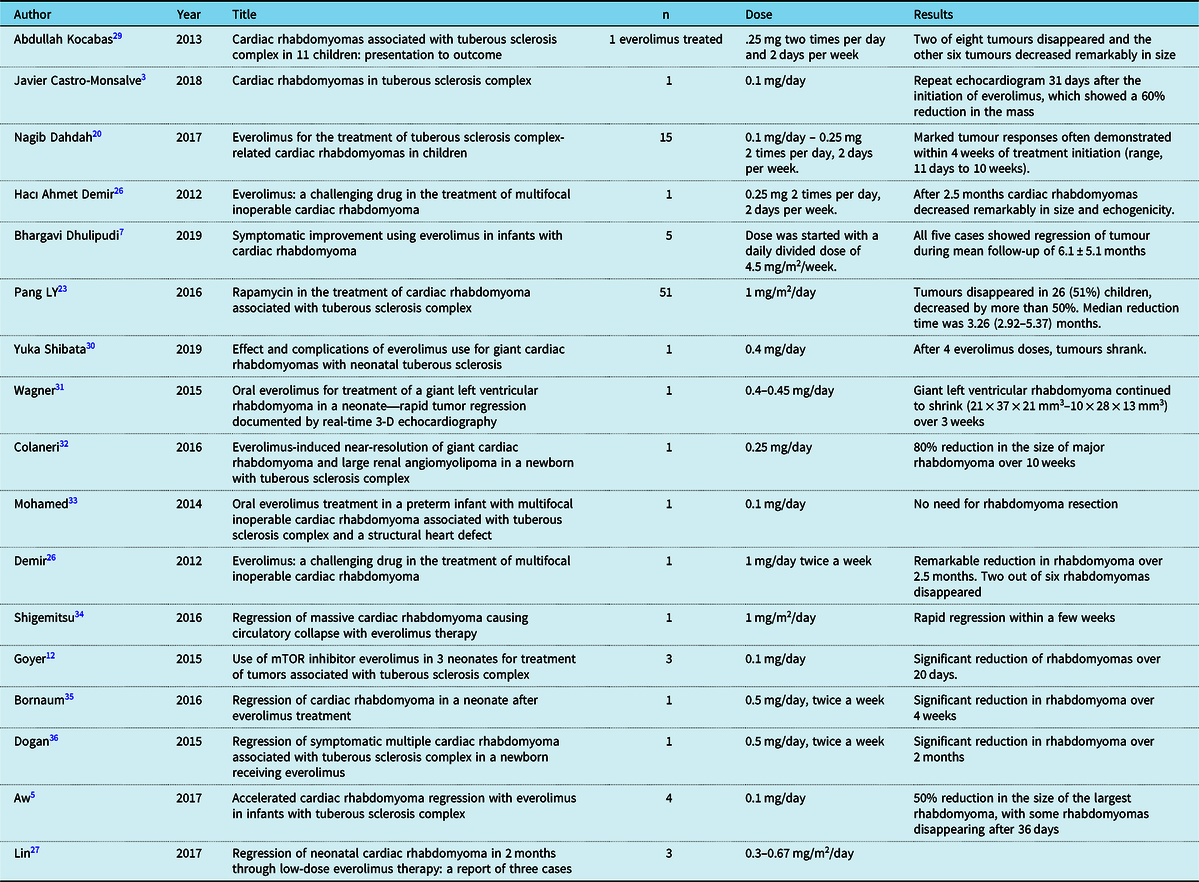
Everolimus has been successfully used off-label in case reports of symptomatic cardiac rhabdomyomas associated to TSCReference Bevacqua, Baldo and Pastore2,Reference Castro-Monsalve, Alvarado-Socarras, Mantilla, Forero, Moreno and Prada3,Reference Hinton, Prakash, Romp, Krueger and Knilans6–Reference Tiberio, Franz and Phillips10 (Table 1). Everolimus currently approved by the Food and Drug Administration (FDA) and the European Medicines Agency for Tuberous Sclerosis Complex associated partial-onset seizures, subependymal giant cell astrocytoma, and renal angiomyolipoma in children.Reference Kim, Chen and Cheng11,Reference Krueger, Care, Agricola, Tudor, Mays and Franz13–Reference Duerr, Glander, Diekmann, Dragun, Neumayer and Budde16 It is safe for children less than 3 years old.Reference Jozwiak, Kotulska, Berkowitz, Brechenmacher and Franz17,Reference Kirchner, Meier-Wiedenbach and Manns18 However, there is no randomised controlled trial to evaluate the efficacy of everolimus in the treatment of symptomatic rhabdomyomas that do not need immediate surgery.
Case reports and case series in the literature

Need for a trial (innovation aspects)
The objective of this randomised multicentre placebo-controlled, double-blind, phase II protocol is to determine the efficacy, in terms of tumour size reduction after 3 months of treatment of everolimus in children with TSC and symptomatic cardiac rhabdomyomas that do not need immediate surgery.
Material and methods
Research question
Does 3 months of treatment with everolimus reduce the size of symptomatic cardiac rhabdomyomas in children with tuberous sclerosis?
Primary and secondary aims
Primary aim
- To compare the percentage of patients who had more than 50% size reduction in cardiac rhabdomyomas treated with everolimus versus placebo in a pediatric population with tuberous sclerosis during a 3-month treatment period.
Secondary aims
- To assess the change from baseline at 1, 2, 3, 4, 5, 6, 8, 10 and 12 months in arrhythmias, pericardial effusion and intracardiac blood flow obstruction.
- To determine the safety and tolerability of everolimus in the study population assessed by adverse events.
- To compare the progression of tumour reduction between the treatment and placebo arms.
- To assess the effect of treatment on heart failure after 3 months of treatment.
Hypotheses
Cardiac rhabdomyoma in children treated with everolimus will show more than 50% of size reduction after 3 months compared with the placebo arm. In addition, the everolimus-treated arm will have symptom improvements related to arrhythmias, pericardial effusion and outflow obstruction compared with the placebo arm in the 1-year follow-up.
H0: there is no difference in 50% size reduction between everolimus and placebo arms.
Ha: there is a difference in 50% size reduction between everolimus and placebo arms.
Trial design
Randomised, parallel groups, double-blind, placebo-controlled multicentre trial. Patients will be allocated to the intervention (everolimus) or placebo in a 1:1 ratio.
Study setting
Tertiary centres treating TSC and specialised paediatric cardiology and cardiac surgery centres in different nations will be included (24 centres).
Randomisation – sequence generation
Allocation sequence will be done using computer-generated randomisation schedule using randomisation by blocks of four patients, with 1:1 allocation ratio, regardless of the site where they are recruited.
Randomisation – allocation concealment
Interactive Internet response system will be used to ensure a random assignment of patients in a 1:1 ratio to intervention and placebo. This system will provide allocation concealment and assure blinding to the patient and investigator in the centre.
Implementation
Enrolment of each patient will start by the signing of the informed consent by the parents and the consent assessment of the child if older than 8 years. This will be followed by incorporation of the patient to the database and the randomisation process.
Blinding
Trial patients, care providers, outcome assessors, and data analysts will be blinded. Code of the intervention will match the code name of the patient. Outcome assessors only have access to the code name and the clinical data. This blinding period will last until the trial is finished. Only the study pharmacist at each centre will be unblinded.
Emergency unblinding
Emergency unblinding will be provided to the treating physician and patient/caregiver if any of the following situations:
- Critical medical condition defined by the treating physician
- Death of the patient by any causation
- Worsening of symptomatic complication of cardiac rhabdomyoma (arrhythmia, obstruction to blood flow, pericardial effusion or cardiac tamponade, or heart failure)
- Allergic reaction
Inclusion criteria
Patients are eligible for the trial if they comply with all the following before randomisation:
I 01 Parents (or legal tutor) has signed written informed consent for their child to participate in the study and are able to administer the drug to the patient.
I 02 Diagnosis of definite tuberous sclerosis based on the Tuberous Sclerosis Complex Diagnostic Criteria Update: Recommendations of the 2012 International Tuberous Sclerosis Complex Consensus Conference.Reference Northrup and Krueger4
I 02 Diagnosis of cardiac rhabdomyoma based on appropriate imaging findings: Transthoracic echocardiogram.
I 03 Symptoms related to cardiac rhabdomyoma, that is, at least one of the following findings:
Severe ventricular or supraventricular arrhythmia
Moderate to severe obstruction of the outflow tracts (aorta or pulmonary artery)
Heart failure, heart failure with preserved ejection fraction or heart failure with reduced ejection fraction
Any pericardial effusion
I 04 Patient is haemodynamically stable, which is defined as adequate tissue perfusion (blood pressure, oxygenation). Stable vital signs (spontaneously or with medical intervention).
I 05 Stable neurologic condition (defined as no epileptic encephalopathy, stable doses of antiepileptic drugs for 6 weeks, no clinical endocranial hypertension).
Exclusion criteria
E 01 Patients with cardiac rhabdomyoma not related to tuberous sclerosis.
E 02 Urgent need for surgical resection of cardiac rhabdomyoma indicated by medical criteria.
E 03 Impossibility to receive oral treatment.
E 04 Life expectancy of less than 6 months.
E 05 Severely impaired lung function.
E 06 Severe liver dysfunction Child-Pugh class C.
E 07 History of organ transplant.
E 08 Surgery within 2 months prior to study enrolment.
E 09 Radiotherapy within 6 weeks before entering the trial.
E 10 Presence of any other conditions that might compromise the patient’s ability to participate or compliance with the therapy.
E 11 Patients who are haemodynamically unstable with arterial hypotension refractory to inotropic and vasodilator treatment.
E 12 Patients with hepatitis B or C.
E 13 Patients with HIV seropositives.
E 14 Significant haematological or hepatic abnormality (i.e., transaminase levels >2.5 × upper limit of normal or serum bilirubin >1.5 × upper limit of normal, haemoglobin <9 g/dl, platelets <80,000/mm3, absolute neutrophil count <1000/mm3).
E 15 Uncontrolled hyperlipidaemia: Fasting serum cholesterol >300 mg/dl and fasting triglycerides >2.5 × upper limit of normal.
E 16 Uncontrolled diabetes.
Exclusion criteria related to the current knowledge of everolimus
E 17 Non-infectious pneumonitis.
E 18 Proven infection defined as requiring intravenous antibiotics and/or with fever, defined as a temperature >38.
E 19 Known allergy or intolerance to everolimus or component.
E 20 Simultaneous use of other pharmacological treatment known to severely interfere with kinetics of everolimus. (e.g., CYP3A4).
Recruitment strategy
The ORACLE trial is an international multicentre trial. Patients with cardiac rhabdomyomas related to TSC are usually controlled and treated in tertiary medical centres, with advanced cardiological medical teams. Paediatric cardiologist and cardiac surgeons in centres treating TSC patients will be invited to participate. Each centre will have a principal investigator who will be in charge of recruitment and data registration. Given the rarity of this disease, a number of potential strategies have been identified to promote recruitment, including a study website to provide information and contacts for patients, advertisement on Google Ads and/or at the official site of the Tuberous Sclerosis Alliance website (www.tsalliance.org), presentation at congresses, for example, International Tuberous Sclerosis Complex Research Conference in November 12–14, 2020, in London, UK, or educational conferences hosted by the Tuberous Sclerosis Alliance for families’ registration on the clinical trial finder for tuberous sclerosis (https://trials.tsalliance.org/).
Patients are recruited continuously until the desired sample size is achieved.
Adherence
If the patient is receiving ambulatory treatment
At the start of the study, parents or legal tutors and patient caregivers will be instructed about the importance to follow the study guidelines and to administer the drug as prescribed. Also, parents and caregivers will be instructed about how to take the dispersible tablets, store and what to do if a dose is missed. Parents will be notified that a tablet count will be performed at every study visit. Also, parents will be reminded about the importance of reporting/calling the clinic, if any problems that might be related to the study drug.
Compliance and adherence will be performed at any visit. Measurements taken to check for compliance and adherence are as follows:
The investigator will dispense the treatment kit to the patient according to randomisation.
The unused tablets should be brought at every visit.
The tablets are counted and entered and checked for consistency.
If compliance and adherence is inadequate, parents and the patient caregivers will be trained again.
Medication card
The card for reminder will be placed in medicine box, including time, dose of medication and visit. The card can be presented as a calendar, which will be convenient for their family to see relevant information and provide assistance.
If the patient is admitted in a hospital site centre
At the start of the study, parents or legal tutors and caregiver hospital staff will be instructed about the importance to follow the study guidelines and to administer the drug as prescribed. Also, caregiver staff will be instructed about how to give the dispersible tablets, store and what to do if a dose is missed. Caregivers should have a tablet count permanently actualised. Also, caregiver will be trained to report adverse events related to study drug and communicate it to the treatment physicians and parents.
Compliance and adherence will be performed at any visit. Measurements taken to check for compliance and adherence are as follows:
The investigator will dispense the treatment kit to the patient according to randomisation.
The unused tablets should be reported in the medical history of patient.
The tablets are counted and entered and checked for consistency.
If compliance and adherence is inadequate, parents and the patient caregivers will be trained again.
Medication card
The card for reminder will be placed in medicine box, including time, dose of medication, and visit. The card can be presented as a calendar, which will be convenient for their family to see relevant information and provide assistance.
Interventions
Study drug
The investigational drug used in the course of this trial is everolimus, orally, in dispersible tablets; the control drug used in this trial is matching placebo.
Prior to the initiation of the treatmentReference French, Lawson and Yapici19
- Perform hepatitis screen
- Advise on the appropriate management recommendations for anticipated adverse effects as stomatitis and rash
- Vaccines should be applied before the use of everolimus
- Check for glucose blood serum, hepatic function, renal function, liver function, fasting lipid profile, blood pressure
Dose
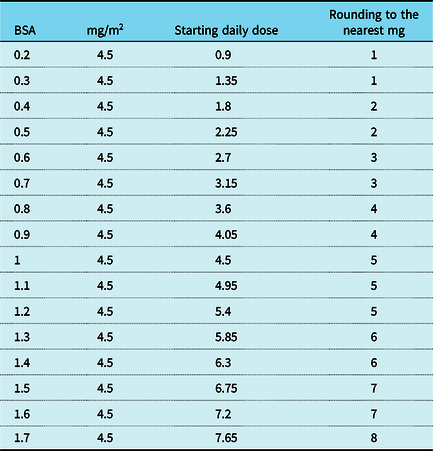
The starting dose will be 4.5 mg/m2 body surface area (BSA) per day orally and will be adjusted according to everolimus blood level concentration of 5–15 ng/ml, after the evaluation of the concomitant use of Potent CYP3A4 and/or P-gp inhibitors, Moderate CYP3A4 and/or P-gp inhibitors or potent and moderate CYP3A4 inducers.Reference French, Lawson and Yapici19,Reference Dahdah20
Dosing is individualised based on BSA using the Dubois formula, where weight (W) is in kilograms and height (H) is in centimetres: BSA = (W0.425 × H0.725) × 0.007184Reference Franz21 (Table 2).
Example of starting daily dose according to body surface area (BSA)

Duration of treatment
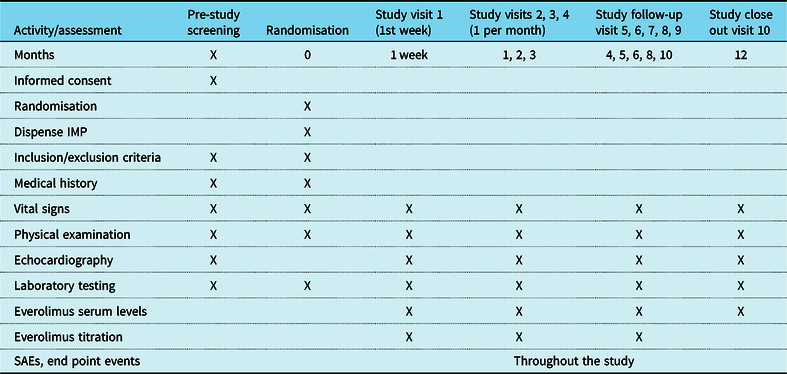
The treatment will be administered for 3 months, with follow-up until 12 months (Table 3).
Timeline

IMP = investigational medicinal product; SAEs = serious adverse events.
Most frequent adverse events described with everolimus in paediatric population are stomatitis, upper respiratory tract infection, transient hypercholesterolaemia and transient leucopenia.Reference Jozwiak, Kotulska, Berkowitz, Brechenmacher and Franz17,Reference Saffari, Brosse and Wiemer-Kruel22
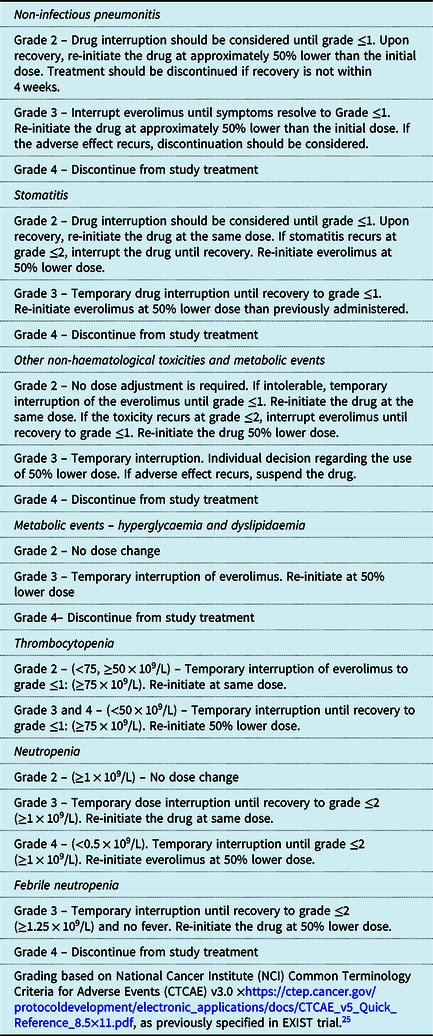
Titration, dose adjustments due to adverse events (Table 4), evaluation of interaction with food and other drugs, and method of administration will be performed according to the prescribing information of the product used during the trial.
Dose adjustments according to adverse effects

Modification/discontinuation
Criteria for discontinuing or modifying allocated interventions:
Patients voluntarily withdraw from the study
Patients dropped from the study at any time by discretion of the investigator
Loss to follow-up
Protocol deviation
Administrative problems
Death
Necessity of another treatment, worsening disease.
Unacceptable adverse effects
Progressive decrease in renal function or proteinuria
Failure to deliver outcomes
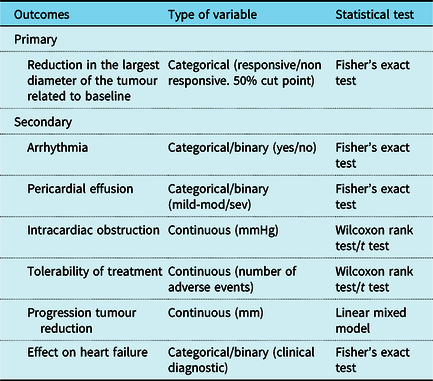
Outcomes (Table 5)
Outcomes, variables and statistical test

The primary outcome will be reduction of 50% or greater in the tumour size related to the baseline after 3 months’ period compared with the placebo arm, which is a clinical significant parameter and a significant margin to differentiate the spontaneous regression versus the reduction due to the intervention.
Prior trials considering the use of everolimus in TSC showed major tumour reduction at 3 months, considering a 6-month duration of core phase treatment.Reference Aw, Goyer, Raboisson, Boutin, Major and Dahdah5,Reference Dahdah20 , Reference Pang, Zou and Huang23,Reference Chang, Chiou, Yao, Chou and Lin24 Therefore, 3 months was the ideal selected follow-up period to assess the outcome for the present study.
The largest diameter of the tumour will be measured in millimetres (mm) from the echocardiographic view that allows it to be seen in its largest size. In case of several tumours, we will add the largest diameter of each. The 2-D echocardiography will be used with paediatric transducers according to age. The evaluation will be carried out by paediatric cardiologists with experience in echocardiography. Two different operators will perform both measurements (pre and post treatment), and the average of both measurements will be taken. Echocardiography images will be revised by a central adjudication committee.
The outcome will be categorised as “responders” if the reduction in the tumour size is 50% or more related to baseline and as “nonresponders” if the reduction in the tumour size is less than 50% related to baseline.
Echocardiography will be performed at baseline and at 1, 2, 3, 4, 5, 6, 8, 10 and 12 months.
Secondary outcomes
- Arrhythmias will be evaluated with electrocardiograph and 24-hour Holter at baseline and at 1, 2, 3, 4, 5, 6, 8, 10 and 12 months.
- Pericardial effusion will be evaluated in echocardiography 2-D and the largest size will be measured in millimetre at baseline, and depending on the degree of pericardial effusion.
1: posterior in systole (mild)
2: posterior in systole and diastole (moderate)
3: anterior and posterior in systole and diastole (severe)
4: cardiac tamponade with ventricular free wall collapse and right atrium
Echocardiography will be performed:
grades 1 and 2: at 1, 2, 3, 4, 5, 6, 8, 10 and 12 months
grade 3: every week
grade 4 indicates surgical drainage
- Intracardiac obstruction will be assessed with echocardiography 2-D at baseline and 1, 2, 3,4, 5, 6, 8, 10 and 12 months and will be measured in millimetres of mercury.
- Heart failure will be evaluated clinically (hepatomegaly, tachycardia, sweating, difficulty gaining weight or feeding).
Sample size calculation
Sample size calculation was made based on previous results from the EXIST-1 study,Reference Demir, Ekici, Yazal Erdem, Emir and Tunc26 with a described difference between two proportions of 35% for a reduction of at least 50% in the volume of astrocytomas associated with TSC complex, we expect a similar statistical behaviour, given the pharmacodynamics of everolimus. The sample size required to achieve a power of 1−β = 0.80 was calculated for a two-sided statistical assumption for a categorical outcome at level α = 0.05, to create the distribution between two equally numbered groups with 1:1 proportion. Without the dropout rate taken into account, the result would be 18 patients for both groups (control and intervention arm), summing up a total of 36. We are expecting a dropout rate of 10% due to the nature of the patients and the short-time intervention; therefore, 20 patients will be recruited per arm, 40 in total.
Statistical analysis for primary and secondary outcomes
All analyses will be performed using STATA v.15 software (StataCorp, Texas, United States of America).
Analyses will follow the intention-to-treat principle. Baseline characteristics will be analysed based on respective distributions reported as percentages, mean and standard deviation (SD), or median and interquartile range (IQR). Hypothesis tests are two sided. The primary outcome (reduction in the largest diameter of the tumour related to baseline) will be assessed on a categorical variable representation showing response and not responding to treatment, with a <50% reduction as a cut point being compared by treatment group through Fisher’s exact test.
The secondary analysis will be:
Presence or not of arrhythmia through a binomial variable presentation against treatment group by Fisher’s exact test.
Pericardial effusion through a categorical binomial variable presentation (mild-moderate versus severe-cardiac tamponade) against treatment group by Fisher’s exact test.
Intracardiac obstruction through a continuous variable presentation (millimetres of mercury) against treatment group by a Wilcoxon rank test or t test depending on data distribution.
Secondary outcomes will be categorical variables with risk ratios and 95% confidence intervals. The groups to be compared are the intervention against the placebo in both primary and secondary outcome analyses.
Tolerability of treatment though a continuous variable from the number of adverse effects presented by a Wilcoxon rank test or an unpaired two sided t test depending on the data distribution.
Progression of tumour reduction is a continuous variable (mm). We will use linear mixed model.
Effect on heart failure through a binomial variable presentation based on the clinical diagnosis of heart failure by Fisher exact test.
Missing data
We will consider all the missing data, detailing by group the reason and the time in which the losses happened. We will include patient dropout (adverse event, lack of improvement, death), parents’ refuse treatment after allocation, patients do not attend an exam and lost to follow-up. After randomisation, all the assigned patients will be taken into account according to the intention-to-treat modality. The method of handling with missing data will be the worst (and best) case scenario carried forward to obtain maximum efficiency on the low expected count of missing data. Sensitive analysis will be performed afterwards to estimate the impact of the missing data in the final result and its outcome will be annexed to the findings’ report.
Discussion
Symptomatic cardiac rhabdomyomas associated with TSC is a rare disease that affects paediatric population, with the major incidence in patients younger than 3 years.Reference Aw, Goyer, Raboisson, Boutin, Major and Dahdah5,Reference Dhulipudi, Bhakru, Rajan, Doraiswamy and Koneti7
Currently, there is no standard pharmacological treatment for this disease and in severe cases, surgery is indicated but with a high risk of mortality.Reference Hinton, Prakash, Romp, Krueger and Knilans6,Reference Lin, Lanpig and Huijuan27
Everolimus is an mTOR inhibitor and has been proved effective in reducing astrocytomas associated with TSC.Reference Franz, Belousova and Sparagana28 The mechanism of the disease is the same in both pathologies (astrocytoma and cardiac rhabdomyoma), so the benefit would be similar to astrocytomas. Everolimus is a known drug for children, and it is used in cardiac and hepatic transplantation with mild and moderate adverse events.Reference Jozwiak, Kotulska, Berkowitz, Brechenmacher and Franz17,Reference Saffari, Brosse and Wiemer-Kruel22
A positive randomised controlled study that proves that everolimus is a safe option for symptomatic cardiac rhabdomyomas in TSC, will be of a great value for these patients as a novel treatment to avoid cardiovascular surgery with the risk of major morbidity and mortality. This trial would lay the foundation for further phase III trials and raise interest in developing treatment alternatives for paediatric TSC, which being a rare disease.
The main limitation of our study protocol is the difficulty in the recruitment of the patients, which is inherent to a rare and paediatric disease. In order to minimise this, we propose a multicentre study with the same centres that have been involved in the previous trial and that have proved the efficacy of everolimus in astrocytomas associated with TSC [EXIST trialReference Franz, Belousova and Sparagana28] as they have the expertise with this disease, population and drug.
ORACLE trial would be the first randomised clinical trial for cardiac rhabdomyomas and could assess the effectiveness of everolimus as the first pharmacological therapy for this disease. Moreover, it would be a new indication for a safe and approved drug in a known disease and mechanism of action.
Acknowledgments
The authors independently developed the present work in the context of the collaborative clinical research program “Principles and Practice of Clinical Research” of the Harvard T.H. Chan School of Public Health. We would like to thank Prof. Felipe Fregni, Alma Sanchez MD, Paulo Teixeira and Abdul Haseeb for their great support during this project.
Financial Support
This research received no specific grant from any funding agency, commercial or not-for-profit sectors.
Conflict of Interest
None.
Ethical Standards
The trial will be conducted in accordance with the principles established in the Declaration of Helsinki and the International Conference on Harmonization guidelines for good clinical practice. All trial documents and procedures will be approved by the appropriate ethics committees at each site.