1. Introduction
As urban development and construction continue to progress, an increasing number of tall cylindrical poles, such as utility poles, streetlights, and billboards, emerge within city. With the continual expansion of cities, tasks related to the inspection, repair, and cleaning of these structures have become more complex and challenging. Traditional manual operation not only consumes time and labor but also poses safety risks, with higher expenses.
To overcome these limitations and enhance operational efficiency, climbing robots (CRs) [Reference Grieco, Prieto and Armad1–Reference Minor, Dulimarta, Danghi, Mukherjee, Lal Tummala and Aslam5] have become a viable solution. These robots are able to move on external surfaces of pipelines or walls and can perform tasks including inspection, maintenance, and cleaning. Based on their motion mechanism structures, CRs can be broadly categorized into four types: the first type is the wheeled type, for example, Ahmadabadi M N et al. [Reference Baghani, Ahmadabadi and Harati6–Reference Yuan, Chang, Song, Lin and Jing9] developed a hoop-type wheeled CR University of Tehran-Pole Climbing Robot (UT-PCR), which utilized three wheels to encircle the pipe to generate frictional force. The second type uses serial mechanism structures for movement, these CRs exhibit high flexibility and large workspace. For example, Kushihashi et al. [Reference Kushihashi, Yoshikawa, Imai, Terashima and Miwa10, Reference Kawasaki, Murakami, Kachi and Ueki11] developed the WOODY-1 with a serial robotic arm structure, which was utilized to transport logging workers to the workspace. The third type is parallel type, which uses the parallel mechanism for movement. For example, Saltaren R et al. [Reference Saltaren, Aracil, Reinoso and Scarano12, Reference Saltarén, Aracil, Sabater, Reinoso and Jimenez13] proposed a CR with a motion system based on a six degrees of freedom (DOFs) Stewart–Gough parallel platform. The fourth is hybrid type, which uses a combination of series and parallel mechanisms for movement, for example, Tavakoli et al. [Reference Tavakoli, Marques and Almeida14–Reference Tavakoli, Lopes, Sgrigna and Viegas16] developed a four DOFs CR that combined a 3-RRR (R denotes a revolute joint) robotic arm with a rotating axis device, enabling it to cross obstacles on the pipeline.
In practical applications, the CRs discussed earlier have certain limitations. To elaborate, wheeled CRs [Reference Eto and Asada17–Reference Noohi, Mahdavi, Baghani and Ahmadabadi19] need to maintain contact between wheels and pipelines, resulting in an inability to cross obstacles. Serial CRs [Reference Jiang, Guan, Zhou, Zhang and Zhang20–Reference Hong, Peisun and Guangrong25] exhibit weak terminal bearing capacity and overall rigidity due to their serial mechanical structures. Parallel CRs [Reference Wilson, Sabater, Saltarén, Aracil, Yime and Azorín26] have disadvantages of redundant DOF, complex control, and small workspace. Most of the above CRs lack the DOF to rotate around the axis of pipe, which is significant for CRs to cross obstacles. The characteristics of the above types of CRs are summarized in Table I.
Comparison of different types of climbing robots.

Considering the limitations of existing CRs, this paper presents a novel CR that incorporates a combination of parallel mechanisms and remote center of motion (RCM) linkage mechanisms as climbing mechanism. Compared with above CRs, this CR has several advantages, including good load-bearing capacity, no redundant DOF, and the capability of obstacle crossing. Remainder of the paper is arranged as follows: Section 2 analyzes the minimum DOF required for climbing movement and determines the configuration of the CR. In Section 3, the closed-loop vector approach is employed for position analysis, followed by a numerical search to calculate the CR’s workspace. Velocity and singularity analyses are executed using screw theory. In Section 4, the performance analysis and dimensional optimization are carried out. In Section 5, a prototype is designed and constructed based on the optimization results, followed by the execution of several foundational experiments to validate CR’s climbing capability. Section 6 provides a conclusion to the study.
2. Problem formulation
The existing CRs have limitations in terms of complex structure, excessive weight, and inadequate flexibility, etc. In this research, the main objective is to develop a compact CR that possesses good load capacity and obstacle crossing ability. To achieve this goal, we will propose a new type of CR that combines a parallel mechanism and a RCM linkage. The parallel part executes the main function of climb, while the RCM linkage allows the rotational motion around the target object. Performance analysis and dimensional optimization will be carried out to ensure that the CR has good performance. Prototype will be fabricated on which primary experiments are carried out, which verify the feasibility of the proposed CR.
In this research, the members in the mechanism are treated as rigid bodies, that is, their elastic deformations during motion are not considered. Moreover, the gaps in joints are also neglected. In summary, all the analyses including kinematics, performance, optimization, and simulati1on, etc., are based on above assumptions, which significantly reduces the analysis complexity and is reasonable in primary design stage.
3. Design of the CR
In order to determine the configuration of CR, it is essential to analyze the climbing environments. Cross-interface pipeline environment is relatively common, and if a CR can climb smoothly in such environment, it can likely adapt to most other climbing environments. The most fundamental DOFs required for climbing cross-interface pipeline are the axial movement along the pipeline, denoted as DOF TZ, as shown in Figure 1(b). To cross interface, the robot requires radial rotation and translational DOFs along the pipeline, specifically the RX and TY, as shown in Figure 1(e), (f). These three DOFs are adequate for crossing through two-dimensional cross-type pipelines.
The minimum DOF required for climbing motion: (a) climbing environment 1; (b) TZ climbing DOF; (c) RZ climbing DOF; (d) climbing environment 2; (e) RX climbing DOF; and (F) TY climbing DOF.

By adding an additional DOF for pipe axial rotation, denoted as RZ and as shown in Figure 1(c), climbing capability of CR can be extended into three-dimensional space. This enhancement endows the CR with the capability to cross obstacles. Such an expansion not only broadens CR’s workspace but also enhances adapt capability and effectiveness when facing complex pipeline structures.
Using parallel CR with four DOFs mentioned above can address the issue of redundant DOFs inherent to parallel CRs, and it can avoid the drawbacks of poor load-bearing in serial CRs and inability of crossing obstacles in wheeled CRs. However, after extensive research, no suitable parallel mechanisms with such four DOFs were found. Therefore, this paper proposes breaking down the four DOFs required into two part and introduces a novel hybrid CR. The structure of the CR is shown in Figure 2, and the 3-RPR parallel mechanism provides the TZ, TY, RX, and RCM linkage mechanism that supplies the RZ component.
The structure of CR.

The CR is composed in the following order: the upper gripping mechanism, the parallel mechanism, the RCM linkage mechanism, and the lower gripping mechanism as shown in Figure 2. The gripper mechanisms have centering and positioning functions. In the process of climbing movement, one of the grippers will grip the pipe to provide positioning function. The axis Z of the RCM linkage and parallel mechanisms is collinear with the center axis of the upper and lower gripper mechanisms, respectively, which ensures that the CR’s rotational DOF RZ coincides with the axis of the pipe.
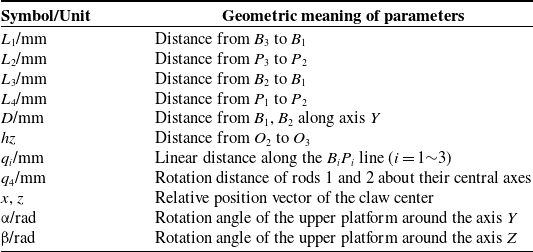
As shown in Figure 3, the parallel mechanism is a 3-RPR mechanism composed of three identical RPR limbs connecting the upper and lower platforms. The centers of the R joints connected to the upper platform are denoted as P 1, P 2, and P 3, and the centers of the R joints connected to the lower platform are denoted as B 1, B 2, and B 3. All R joints on the upper platform are parallel and axis of P 2 is denoted as y axis, and all R joints on the lower platform are parallel and axis of B 1 is denoted as Y axis. To eliminate singularities, axis B 2 is located between axes B 1 and B 3, while axis P 1 is located between axes P 2 and P 3. The distance from the rotational joint P 1 to the axis y is denoted as L 4, while the distance from the rotational joint B 2 to axis Y is denoted as L 3. P 3 is located at the midpoint of the perpendicular bisector of the line segment between the projection of point P 1 onto the axis of y and point P 2, while B 3 is located at the midpoint of the perpendicular bisector of the line segment between the projection of point B 2 onto the axis of Y and point B 1. The projection of points P 1, P 2 and B 1, B 2 onto the x-axis is 2D apart. The distance from P 3 to the axis y is denoted as L 2, while the distance from B 3 to the axis Y is denoted as L 1. Using the midpoint of the line connecting the projection of point P 1 onto the axis y and point P 2 as the origin, a coordinate system O 2-xyz is established, where the axis y is along the direction of the P 2 axis, the axis x is parallel to the axis of R joint, and the axis z is determined according to the right-hand rule. The coordinate system O 1 -XYZ is set up in the same way as the coordinate system O 2-xyz.
Motion mechanism structure of CR: (a) main motion structure of CR and (b) schematic diagram.

The motion screw system of limb i expressed in the global coordinate system is given as:

where pi is the position vector of Pi, bi is the position vector of Bi, and y is the unit vector along axis u. Then, three reciprocal motion screws of limb i can be yielded as:

According to the screw theory, the reverse screw of the motion screw in the parallel mechanism corresponds to the constraint screw:

The three motion screws represent the motions that the parallel mechanism can achieve under the constraints of the constraint screws. Therefore, the parallel mechanism has three DOFs, rotation around the axis Y, and translation along the axis X and Z.
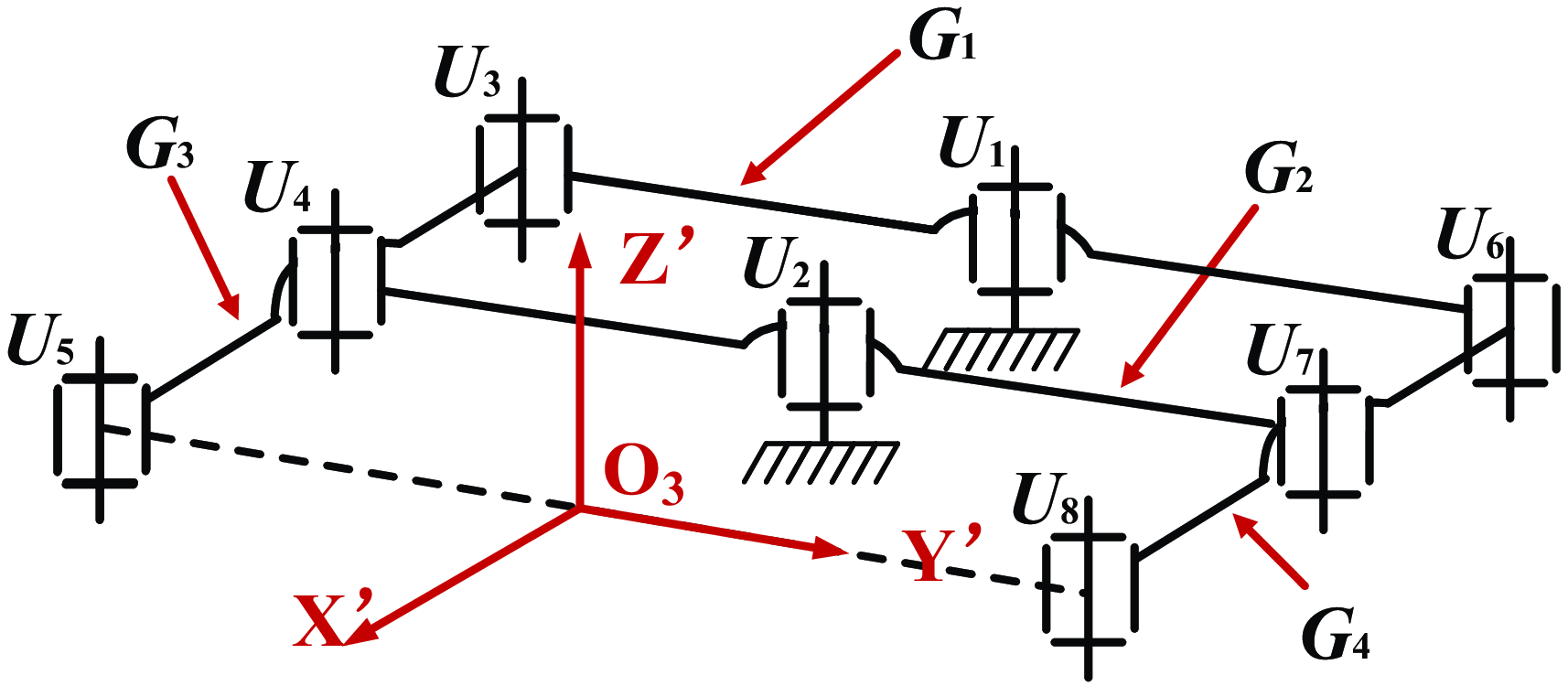
The remote center linkage mechanism is a type of parallelogram linkage mechanism, as shown in Figure 4. In the links G 1 and G 2, R joints at both ends of links are utilized to connect the links G 3 and G 4, while R joints in middle of links are utilized to connect the gripping mechanism. In the links G 3 and G 4, two R joints are utilized to connect link G 1 and G2, while one R joint connected to the platform of the parallel mechanism. All rotational joint axes are parallel to the z-axis direction of the lower platform coordinate system O 2-xyz. The coordinate system O 3-X’Y’Z’ was established by copying the O 2-xyz coordinate system vertically down to the plane of the RCM linkage mechanism.
Schematic diagram of the linkage mechanism.

Then, according to the modified Kutzbach–Grübler formula the DOF of RCM linkage mechanism was calculated:
 \begin{align} M=d\!\left(n-g-1\right)+\sum _{i=1}^{g}f_{i}+\nu \end{align}
Given the order of mechanism d = 3, the number of linkage n = 6, the number of the moving pairs g = 8, and the redundancy constraints v = 2, the DOF M is equal to1. By integrating the parallel mechanism with RCM linkage mechanism, the CR’s main motion mechanism is formed. The motion mechanism possesses two rotational and two translational DOFs.
4. Kinematic analysis
4.1. Inverse position modeling
A position analysis is conducted to determine the relationship between the relative position of the CR’s gripper centre and the actuator inputs. First, the dimensional parameters of the CR are provided in Table II.
Motion mechanism structure dimensional parameters.

Expressing the position vectors of point B i (i = 1, 2, 3) in the global coordinate system as:
 \begin{align} \left\{\begin{array}{l} \boldsymbol{{r}}_{b1}=\left[\begin{array}{l@{\quad}l@{\quad}l} 0 & -D & 0 \end{array}\right]^{T}\\[3pt] \boldsymbol{{r}}_{b2}=\left[\begin{array}{l@{\quad}l@{\quad}l} {-}L_{1} & D & 0 \end{array}\right]^{T}\\[3pt] \boldsymbol{{r}}_{b3}=\left[\begin{array}{l@{\quad}l@{\quad}l} {-}L_{3} & 0 & 0 \end{array}\right]^{T} \end{array}\right. \end{align}
Similarly, position vectors of point P i (i = 1, 2, 3) expressed in the local coordinate system can be written as:
 \begin{align} \left\{\begin{array}{l} \boldsymbol{{r}}_{p1}^{cs2}=\left[\begin{array}{l@{\quad}l@{\quad}l} {-}L_{4} & -D & 0 \end{array}\right]^{T}\\[3pt] \boldsymbol{{r}}_{p2}^{cs2}=\left[\begin{array}{l@{\quad}l@{\quad}l} 0 & D & 0 \end{array}\right]^{T}\\[3pt] \boldsymbol{{r}}_{p3}^{cs2}=\left[\begin{array}{l@{\quad}l@{\quad}l} {-}L_{2} & 0 & 0 \end{array}\right]^{T} \end{array}\right. \end{align}
A constraint equation can be established for limb i as:
 \begin{align} \left\{\begin{array}{l} \left| \boldsymbol{{r}}_{p1}-\boldsymbol{{r}}_{b1}\right| =q_{1}\\[3pt] \left| \boldsymbol{{r}}_{p2}-\boldsymbol{{r}}_{b2}\right| =q_{2}\\[3pt] \left| \boldsymbol{{r}}_{p3}-\boldsymbol{{r}}_{b3}\right| =q_{3} \end{array}\right. \end{align}
Now, through the closed-loop vector method, combined with the above equations, the inverse solution for the position can be obtained as:
 \begin{align} \left\{\begin{array}{l} q_{1}=\sqrt{\left(D\cos \beta -D+L_{4}\cos \alpha \sin \beta \right)^{2}+\left(z-hz+L_{4}\sin \alpha \right)^{2}+\left(x+D\sin \beta -L_{4}\cos \alpha \cos \beta \right)^{2}}\\[3pt] q_{2}=\sqrt{\left(D-D\cos \beta \right)^{2}+\left(x-D\sin \beta +L_{1}\right)^{2}+\left(z-hz\right)^{2}}\\[3pt] q_{3}=\sqrt{\left(L_{2}\cos \alpha \sin \beta \right)^{2}+\left(x-L_{2}\cos \alpha \cos \beta +L_{3}\right)^{2}+\left(z-hz+L_{2}\sin \alpha \right)^{2}} \end{array}\right. \end{align}
4.2. Forward position modeling
Forward kinematics involves using a set of actuation variables (q 1, q 2, q 3) as inputs to solve the position and orientation parameters (x, z, α) of the moving platform. Based on Eq. (8), we have
 \begin{align} \left\{\begin{array}{l} \left(x+A_{1}\right)^{2}+A_{2}^{2}+\left(z+A_{3}\right)^{2}-q_{1}^{2}=0\\[3pt] \left(x+C_{1}\right)^{2}+\left(z-hz\right)^{2}+C_{2}^{2}-q_{2}^{2}=0\\[3pt] D_{1}^{2}+\left(x+D_{2}\right)^{2}+\left(z+D_{3}\right)^{2}-q_{3}^{2}=0 \end{array}\right. \end{align}
in which
 \begin{align*} \begin{array}{l} A_{1}=D\sin \beta -L_{4}\cos \alpha \cos \beta ;\, A_{2}=D\cos \beta -D+L_{4}\cos \alpha \sin \beta ;\,A_{3}=L_{4}\sin \alpha - hz;\\[3pt] C_{1} = L_{1}-D\sin \beta ;\, C_{2}=D-D\cos \beta ;\,D_{1}=L_{2}\cos \alpha \sin \beta ;\,D_{2}=L_{3}-L_{2}\cos \alpha \cos \beta ;\,D_{3}=L_{2}\sin \alpha - hz \end{array} \end{align*}
Eq. (9) can be rewritten in the following forms as:
 \begin{align} \left\{\begin{array}{l} x^{2}+z^{2}+2A_{1}x+2A_{3}z+E_{1}=0\\[3pt] x^{2}+z^{2}+2C_{1}x-2hz\cdot z+E_{2}=0\\[3pt] x^{2}+z^{2}+2D_{2}x+2D_{3}z+E_{3}=0 \end{array}\right. \end{align}
where
 \begin{align*} E_{1}=A_{1}^{2}+A_{2}^{2}+A_{3}^{2}-q_{1}^{2};\,E_{2}=C_{1}^{2}+C_{2}^{2}+hz^{2}-q_{2}^{2};\,E_{3}=D_{1}^{2}+D_{2}^{2}+D_{3}^{2}-q_{3}^{2} \end{align*}
In Eq. (10), subtracting the first equation from the second, and the first from the third, respectively, we have
 \begin{align} \left\{\begin{array}{l} 2\left(A_{1}-C_{1}\right)x+2\left(A_{3}+hz\right)z+E_{1}-E_{2}=0\\[3pt] 2\left(A_{1}-D_{2}\right)x+2\left(A_{3}-D_{3}\right)z+E_{1}-E_{3}=0 \end{array}\right. \end{align}
Expressions of x and z can be obtained as:
 \begin{align} \left\{\begin{array}{l} x=\frac{\delta _{1}}{\delta }\\[3pt] z=\frac{\delta _{2}}{\delta } \end{array}\right. \end{align}
where
 \begin{align*} \begin{array}{l} \delta =2\left[\left(A_{1}-C_{1}\right)\left(A_{3}-D_{3}\right)-\left(A_{1}-D_{2}\right)\left(A_{3}+hz\right)\right];\,\delta _{1}=\left(E_{1}-E_{2}\right)\left(D_{3}-A_{3}\right)+\left(E_{1}-E_{3}\right)\left(A_{3}+hz\right);\\[3pt] \delta _{2}=\left(E_{1}-E_{2}\right)\left(A_{1}-D_{2}\right)+\left(E_{1}-E_{3}\right)\left(A_{1}-C_{1}\right) \end{array} \end{align*}
Substituting Eq. (12) into the first equation of Eq. (10) yields
 \begin{align} \delta _{1}^{2}+\delta _{2}^{2}+2A_{1}\delta \delta _{1}+2A_{3}\delta \delta _{2}+E_{1}\delta ^{2}=0 \end{align}
Eq. (13) contains only one unknown parameters α. It is actually a 12th-degree polynomial, through which α can be calculated. Substituting the solution of α into Eq. (12), the final solutions for x and z can be obtained, and the direct position analysis is finished.
4.3. Workspace analysis
The reachable workspace of the CR refers to the positions that the gripping mechanism can reach. The structural parameters of the mechanism are given as follows: L1 = 100 mm, L2 = 100 mm, L3 = 75 mm, L4 = 75 mm, driving range q1/q2/q3 = 120∼240 mm, and q4 = −45°∼45°, and the rotational range of the joints is −30°∼30°.
Based on the inverse kinematics, using numerical search method, the orientation workspace and translational workspace are calculated and shown in Figures 5 and 6.
Orientation workspace of the PM.

Translational workspace of the PM.

The orientation workspace is the orientation positions that parallel mechanism can reach [Reference Pacheco Quiñones, Maffiodo and Laribi27], and overall workspace of the mechanism is formed by the RCM linkage mechanism and the parallel mechanism. The CR may have both upper and lower platforms as moving platforms during operation. However, the workspace is corresponding one-to-one, with only a modification in the reference coordinate; therefore, it is no need to further illustrated.
4.4. Velocity analysis
Based on the screw theory, velocity analysis of the mechanism is performed. By locking all branches except for the screw corresponding to the driving joint, a new set of constraint screw systems is obtained. This screw system compared to the original screw system has an additional screw, which is the transmission force screw of the driving joint. Then, transmission force screws of each branch can be represented as follows:

According to the screw theory, the linear combination of the motion screws of the branches is equivalent to the motion screw of the moving platform. Then, the motion screw of the moving platform is represented as:

where
 is the motion screw of the moving platform with respect to the reference at the origin of the upper platform. v
p
T
and w
p
T
represent the linear velocity and angular velocity vectors of the platform in the global coordinate system. The w
ij
represents the motion quantity of the j-th joint on the i-th branch. The reciprocal product of the transmission screw is performed on both sides of Eq. (15):

By representing the above equation with a matrix, it can be concluded that

The matrixes J T and J q can be express as follows:

Moving the J q term to other side of the Eq. (17) and substituting the expression for the branch velocity screw, the relationship between the branch joint velocity and the drive joint velocity was obtained:
 \begin{align} \boldsymbol{\omega }_{i}=\left(\boldsymbol{{J}}_{T}^{-1}\boldsymbol{{J}}_{q}\boldsymbol{{J}}_{i}\right)^{-1}\dot{\boldsymbol{{d}}}=\boldsymbol{{G}}_{i}\dot{\boldsymbol{{q}}} \end{align}
where Gi is called the first-order influence coefficient matrix [Reference Huang, Li and Ding28] of branch i:
 \begin{align} \boldsymbol{{G}}_{i}=\left[\begin{array}{l@{\quad}l@{\quad}l} \boldsymbol{{G}}_{\omega i1}^{1} & \boldsymbol{{G}}_{\omega i1}^{2} & \boldsymbol{{G}}_{\omega i1}^{3}\\[3pt] \boldsymbol{{G}}_{\omega i2}^{1} & \boldsymbol{{G}}_{\omega i2}^{2} & \boldsymbol{{G}}_{\omega i2}^{3}\\[3pt] \boldsymbol{{G}}_{\omega i3}^{1} & \boldsymbol{{G}}_{\omega i3}^{2} & \boldsymbol{{G}}_{\omega i3}^{3} \end{array}\right] \end{align}
The motion screw of the j-th joint of the i-th branch can be expressed by the above equation combined with the drive joint velocities:

where
 ij
k
represents the assisting motion screw of the k-th drive on the j-th joint of the i-th branch:

4.5. Acceleration analysis
Based on the velocity analysis, the acceleration screw
 $\boldsymbol{{A}}_{o}$
of the moving platform can be expressed as:

where

The acceleration for the joints in i-th branch is given by:

Therefore, the acceleration screw of the j-th joint in i-th branch is
 \begin{align} \boldsymbol{{A}}_{ij}=\left[\begin{array}{l@{\quad}l} {\dot{\boldsymbol{\omega }}^{T}}_{ij} & \left(\boldsymbol{{a}}_{ij}-\boldsymbol{\omega }_{ij}\times \boldsymbol{{v}}_{ij}\right)^{T} \end{array}\right]^{T} \end{align}
4.6. Singularity analysis
When the parallel mechanism moves to a specific configuration, its DOF may differ from the theoretically calculated DOF and the motion characteristics of the mechanism change. Such configurations are referred to as singular configurations.
The occurrence of singularities can be found by examining the rank of matrices in Eq. (17). When the rank of
 $\boldsymbol{{J}}_{T}$
is reduced, inverse kinematic singularity occurs, and when the rank of
 $\boldsymbol{{J}}_{q}$
is reduced rank matrix, a forward kinematic singularity occurs. If both matrices have reduced ranks, a mixed singularity occurs.
Considering the mutual orthogonality between the motion screw and the transmission force screw, neither inverse kinematic singularities nor mixed singularities will occur. According to the screw theory [Reference Minguzzi29–Reference Davidson, Hunt and Pennock31] and Grassmann line geometry theory [Reference Fearnley-Sander32–Reference Wei, Yu, Liu, Song, Zhang and Meng34], the rank decreases in two specific cases. The first case is when transmission force screws intersect at one point, as shown in Figure 7(a). The second case is when transmission force screws are parallel, which results in a rank deficiency, as shown in Figure 7(b), and leading to forward kinematic singularity. During the movement of the robot, it is necessary to try to stay away from these two postures.
Singular configurations: (a) singular configuration 1 and (b) singular configuration 2.

To visually show the singularities, numerical search method is used here, which yields the singular surface of this parallel mechanism as in Figure 8.
Singular surface.

4.7. Simulation
In order to verify the correctness of the kinematic modeling, simulations will be carried out in this part. Without loss of generality, the motion trajectory of the upper platform is defined as:
 \begin{align} \left\{\begin{array}{l} \alpha =\frac{\pi }{180}\left(27\frac{t^{5}}{10000}-27\frac{t^{4}}{400}+9\frac{t^{3}}{80}\right)\\[3pt] \begin{array}{l} \beta =\frac{\pi }{180}\left(9\frac{t^{5}}{10000}-9\frac{t^{4}}{400}+3\frac{t^{3}}{20}\right)\\[3pt] x=\left(9\frac{t^{5}}{2500}-9\frac{t^{4}}{100}+3\frac{t^{3}}{5}\right)+20 \end{array}\\[3pt] z=\left(21\frac{t^{5}}{2500}-21\frac{t^{4}}{100}+7\frac{t^{3}}{5}\right)+200 \end{array}\left(t=0\sim 10s\right)\right. \end{align}
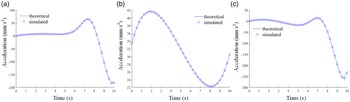
The simulation results about inverse position, velocity, and acceleration are represented by circles in Figures 9, 10, and 11, respectively. In comparison, the theoretical results are represented by solid lines. It can be found the simulation results match well with the theoretical results, which verifies the kinematics analysis.
Comparison of theoretical and simulated results of position analysis: (a) drive joint 1; (b) drive joint 2; and (c) drive joint 3.

Comparison of the theoretical and simulated results of the velocity analysis: (a) drive joint 1; (b) drive joint 2; and (c) drive joint 3.

Comparison of the theoretical and simulated results of the acceleration analysis: (a) drive joint 1; (b) drive joint 2; and (c) drive joint 3.

5. Performance analysis and optimization
5.1. Kinematic performance evaluation
In order to evaluate the kinematic performance of the CR, it is necessary to conduct a performance evaluation. There are many indexes for performance evaluation, including kinematic, stiffness, and dynamic indices that can be utilized to measure the performance of parallel mechanisms. Among various performance indices, the motion/force transmission index [Reference Wang, Wu and Liu35–Reference Yang, Ye and Li38] is independent with reference and dimensionless, which belongs to the category of kinematic performance that will be utilized here.
The LTI includes three indexes: input transmission index (ITI), output transmission index (OTI), and local transmission index (LTI), and the physical significance of these indexes is the instantaneous power of the actuating force in the direction of motion. The larger the index, the higher the instantaneous power and the superior kinematic performance. In order to evaluate the ITI of the input end, the i-th branch input transmission performance index is defined as:

where
 represents the force transmission screw corresponding to the driving joint on the i-th branch and
 represents the motion screw corresponding to the driving joint on the branch i. Then, the definition of OTI is as follows:

where
 is the output motion screw corresponding to the driving force screw
 , which refers to the motion screw of platform when all other driving joints are locked. Once the ITI and OTI of the parallel mechanism are obtained, in order to evaluate the overall transmission performance, LTI is introduced and calculated as following Eq. (29):
 \begin{align} \Gamma =\min \left\{\begin{array}{l@{\quad}l} \lambda _{i} & \eta \end{array}_{i}\right\} \end{align}
The range of values for the LTI is 0 to 1, which is independent of coordinate systems and dimensions. Based on the defined indexes, the distribution of the LTI for the 3-RPR parallel mechanism is shown in Figure 12(b). To facilitate the observation of the distribution of LTI values throughout the entire workspace, the workspace is discretized into multiple planes at the angle θ values. The distribution of LTI values on these planes is illustrated in Figure 12(a).
LTI distribution of CR: (a) in three dimensional workspace and (b) in prescribe workspace with α = 0°.

Each plane in Figure 12(a) represents the LTI in the workspace of the parallel mechanism for different α values, which can be utilized for subsequent dimensional optimization based on LTI. It can be observed that the workspace changes with the variations of α.
For the CR, both the upper and lower platforms along with their coordinates can serve as the fix platform and reference coordinate system. Thus, their LTI in that coordinate system need to be considered. However, the LTI is independent of the coordinate system and depend only on the parallel mechanism’s configuration. Therefore, whether the lower platform or the upper platform coordinate system is utilized as the reference, the calculated LTI results of will be the same, and there is no need to repeat the calculation of LTI.
5.2. Dimensional optimization
Based on the LTI in the previous section, the Performance Chart-based Design Methodology [Reference Liu and Wang39–Reference Lou, Zhang, Huang, Chen and Li42] (PCbDM) can be utilized to optimize the dimension with LTI as the optimization target. To further reduce the number of parameters, the Parameter Finiteness Normalization Method (PFNM) is utilized, considering L 1, L 2, L 3, and L 4 as the characteristic parameters of the parallel mechanism:
 \begin{align} L_{2}=kL_{1}\quad k=\left(0\sim 1\right) \end{align}
Let the normalized parameters is set as:
 \begin{align} r_{i}=L_{i}/D_{i}=\left(1,2,3\right) \quad r_{4}=1-\left(r_{1}+r_{2}+r_{3}\right) \end{align}
The constraints condition is set as:
 \begin{align} \left\{\begin{array}{l} r_{1}\geq r_{3}\\[3pt] r_{2}\geq r_{4}\\[3pt] r_{1}\geq r_{2} \end{array}\right. \end{align}
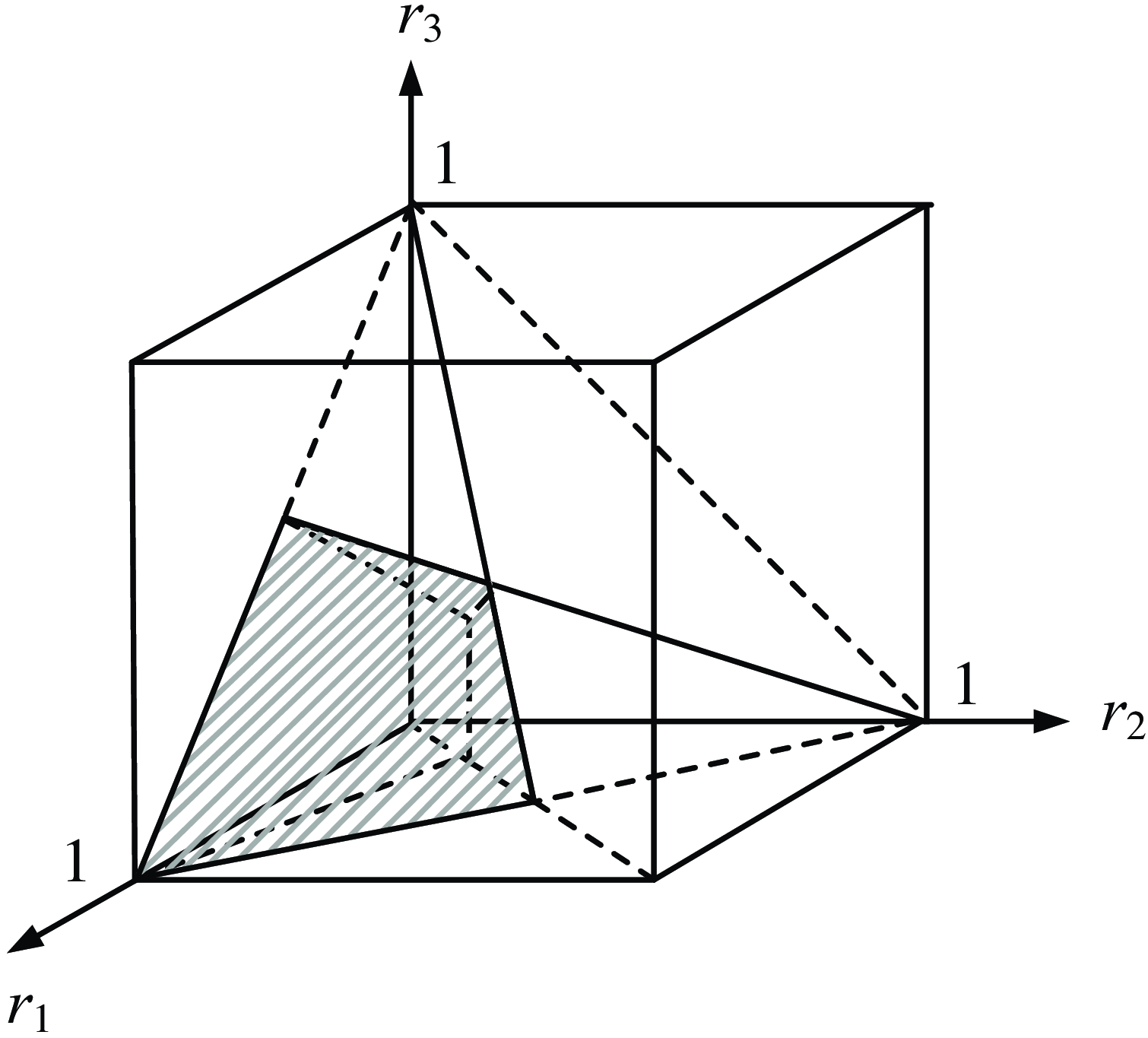
Equations (32) and (33) together with these conditions define a three-dimensional space, which is referred to as the Parameter Design Space (PDS) and is illustrated in Figure 13.
PDS of the CR.

If the value of k is fixed, the PDS becomes a plane that is cut by a plane perpendicular to r 1 and r 2 within the cube. When k = 1, r 1= r 2, and the PDS is shown in Figure 14(a). The three-dimensional PDS can then be visualized as a two-dimensional image, as shown in Figure 14(b).
Two-dimensional image of PDS: (a) PDS in three dimension space and (b) PDS in two-dimensional space.

After PFNM, a series of similar mechanisms can be obtained through different proportion coefficients D. These mechanisms exhibit similarity in specific indexes, such as LTI, and are referred to as similarity mechanisms (SMs). By calculating the performance of a mechanism, its performance as well as the performance of SM can be obtained. Therefore, PCbDM can simplify the optimization process and improve optimization efficiency.
The above proposed LTI reflects only the kinematic performance of the mechanism in a single configuration. In order to evaluate the overall performance of the workspace, let the
 $\Gamma \geq 0.5$
region be defined as high-quality kinematic space. Subsequently, the global transmission index (GTI) is set as:
 \begin{align} \sigma _{t}=\frac{\int _{{S_{\mathrm{G}}}}dW_{s}}{\int _{S}dW_{s}} \end{align}
where
 $W_{s}$
represents the given workspace of the mechanism and
 $S_{\mathrm{G}}$
represents the area of high-quality kinematic space. The range of GTI values is 0∼1, where the larger value indicates the better kinematic performance of the CR.
Since LTI does constant regardless of the reference coordinate system, it only needs to be optimized and calculated once. Optimized images are obtained for various values k values, and the best optimal result image was obtained when k = 1, as illustrated in Figure 15.
GTI distribution map.

After comprehensively considering the optimization result, the chosen optimized result is L 1 : L 2 : L 3 : L 4 = 1 :1 :0.75 :0.65. To verify the efficiency of the optimization, the LTI distribution graph for both the optimized and the original mechanism were created and the result was shown in Figure 16.
LTI distribution before and after optimization.

From the optimization results, it can be seen that after optimization, the performance of the mechanism has been optimized and the workspace range has also increased. These improvements proved the effectiveness of the optimization.
6. Prototype design and experimentation
According to the optimized characteristic parameters obtained in the previous section, a prototype was designed and built, as shown in Figure 17.
CR prototype.

As shown in Figure 17, the prototype’s actuation consists of three electric cylinders (LA150-032D), an electric cylinder drive board (AET-LA-85), three bus servos (HTS-20L), a servo drive board (DPs-0313), and a computer. The parallel mechanism is driven by the electric cylinder acting as R joint and controlled by both drive board and computer. Each electric cylinder has a mass of 110 g, a stroke length of 50 mm, and a maximum speed of 17 mm/s and can withstand a maximum force of 50 N. The RCM linkage mechanism is driven by the bus servos, with a rotation range of ±30°, which is controlled by the corresponding drive board and computer. The gripper mechanism is also controlled by a bus motor, with a maximum torque of 0.20 N.m. Theoretically, it can generate a maximum clamping force of 40 N, and the driving method is the same as the linkage mechanism. The total mass of the prototype is approximately 2 kg.
To study the kinematic performance of the CR, several climbing motion experiments were conducted, and the results are shown in Figures 18, 19, and 20. It can be observed that the prototype climbs 50 mm in each straight climb, and it takes 5 s to complete one straight climb task. Therefore, the climbing speed of the CR is about 8.33 mm/s. The robot’s capability to rotate around the pipe axis was also verified, as shown in Figure 19, with the rotation range of 30° per movement. Finally, to validate the motion capability of the CR, a climbing experiment on a curved pipe was conducted, as shown in Figure 20, and the CR smoothly completed the climbing experiment. From the above experimental research, it is verified that the CR has at least four DOFs and its climbing capability.
Experiment of straight line climbing.

Experiment of move around the pipe.

Experiment of climbing curved pipe.

7. Conclusion
This paper proposes a four DOFs CR which combines a parallel mechanism and RCM linkage mechanism as the motion mechanism. First, the required DOFs for climbing movement were analyzed, and the configuration of the CR was determined. Subsequently, kinematic analysis of the mechanism was conducted, which included analyses of DOF, velocity, acceleration, and workspace. Then, focused on the CR’s performance, the LTI was calculated, and performance distribution charts were plotted. Based on the goal of improving the LTI, the mechanism’s dimension was optimized using the PCbDM method. Finally, a prototype was designed and built according to the optimization results, and several climbing experiments were conducted to validate the motion performance of the mechanism. The prototype is composed of simple mechanical and driving components, and future improvements can be made to enhance its kinematic performance for practical applications.
Author contributions
Wei Ye, Tongwang Huo, and Zhihong Chen conceived and designed the study, Chaoxin Gong underwent an experimental setup, and Zhihong Chen did a text proofreading.
Financial support
The work is supported by the National Natural Science Foundation of China (NSFC) under Grant No. 52375033 and the Natural Science Foundation of Zhejiang Province under Grant No. ZCLZ24E0501.
Competing interests
The author(s) declare(s) that there are no conflicts of interest of this paper.
Ethical approval
None.