All businesses leave an ecological footprint. Bigger businesses attract attention as their footprint can be readily seen (Bowen, Reference Bowen2002; Lepoutre & Heene, Reference Lepoutre and Heene2006; Luetkenhorst, Reference Luetkenhorst2004). In almost every country though, up to 99% businesses will be small-to-medium enterprises (SMEs), which are those employing fewer than 200 people (Lundström & Stevenson, Reference Lundström and Stevenson2002), and the vast majority will be small businesses, those employing fewer than 20 people (Australian Bureau of Statistics [ABS], 2004). It is these small enterprises that have, thus far, escaped close scrutiny on this issue. So, while internal policies to manage the environmental impact exist in large businesses, in the vast majority of small businesses little or nothing is happening to address this situation (Cassells & Lewis, Reference Cassells and Lewis2009; Walker, Redmond, Sheridan, Wang, & Goeft, Reference Walker, Redmond, Sheridan, Wang and Goeft2008). There is scant empirical information regarding Australian small businesses and, in particular, the views and perceptions of owner-managers, regarding their environmental management practices.
Based on their ecological footprint, it is becoming increasingly critical for Australian small businesses to engage in the issue of climate change. According to the most recently available statistics, there are over 2 million registered small businesses in Australia, which equates to nearly 96% of all businesses (ABS, 2013). These small businesses provide employment for almost half (46%) of private sector employment and generate an estimated 39% of Australia's economic production (Department of Industry, Innovation, Science and Research [DIISR], 20011). So, while bigger businesses are ‘doing something’, they are numerically a small group (some 86,000 firms) in the Australian economy (DIISR, 2011). If any real change is to occur in the business sector as a whole, then small businesses have to be engaged. This article presents empirical evidence that shows that small businesses can be engaged in changing their environmental behaviours. The next section provides an overview of the literature to date on the issue of small business and the challenges they face in being environmentally friendly, followed by the empirical data and a discussion section. The paper concludes with some overall observations.
Review of the Literature
Previous research shows three key problems in getting small business owner-managers engaged in environmental management practices, which are their inability to relate to the issue as a whole, the lack of a business case, and the fact that small business is not a homogenous group, despite the common practice, used for convenience, of grouping them together.
The first problem is that most owner-managers do not perceive their business to have a substantial (negative) impact on the environment (Hillary, Reference Hillary2000; Redmond, Walker, & Wang, Reference Redmond, Walker and Wang2008; Vernon, Esses, Pinder, & Curry, Reference Vernon, Essex, Pinder and Curry2003). This may be because the environmental impact of an individual business tends to be small scale and highly dispersed. Yet it has been shown that, especially in developing countries, small businesses are more ‘pollution-intensive’ than larger ones (Blackman, Reference Blackman and Blackman2006), and although the actual environmental impact is difficult to assess, estimates suggest that the contribution of this sector to total industrial pollution may be as high as 60–70% (Stokes, Chen, & Revell, Reference Stokes, Chen and Revell2007). The UK Marshall Report (1998, p. 2) states that ‘taken together, SMEs (small and medium enterprises) account for around 60 per cent of total carbon dioxide emissions from business and may offer scope for significant improvements in energy efficiency and reductions in emissions’.
The second issue is that there is a lack of a convincing business case for change (Luetkenhorst, Reference Luetkenhorst2004; Revell, Reference Revell2006). So, what do we mean by a business case? According to Revell, Stokes, and Chen (Reference Revell, Stokes and Chen2010, p. 275):
The ‘business case for sustainability’ is stressed in key policy documents such as the Department of Trade and Industry's Sustainable Development Strategy (2000), which expounds encouragingly on the opportunities arising from green consumerism, the development of green technology markets, the cost benefits of efficiency gains and the good publicity that can result from environmentally sound business practices.
Put simply, if businesses can see the financial benefit of making changes, they are more likely to do so, rather than if the argument is from an environmental perspective.
While proponents argue that resource allocation efficiencies and productivity gains can accrue from formal environmental management systems, small business owner-managers have remained largely unconvinced of their ability to reap such potential benefits (Revell & Blackburn, Reference Revell and Blackburn2004; Nishanti, Kaneko, Fujii, & Komatsu, Reference Nishitani, Kaneko, Fujii and Komatsu2012). Few have sufficient scale to achieve such gains, while many are unable to translate investment into changes to current environmental management practices that give the business a sustainable long-term competitive advantage (Cassells & Lewis, Reference Cassells and Lewis2009; Simpson, Taylor, & Barker, Reference Simpson, Taylor and Barker2004). The difficulty of smallness is such that owner-managers are intensely aware of the small margins they often make, because of the need to be able to compete with others in their industry (Revell, Reference Revell2006). This is often compounded by a lack of capital and other resources, such as knowledge and staff, as well as infrastructure, which would allow them to implement and monitor new techniques (Raynard & Forstater, Reference Raynard and Forstater2002). Because of these real (and perceived) barriers, environmental management is often reduced to a peripheral function and is accorded less importance than core business activities that compete for time and resources (Condon, Reference Condon2004; Mir & Feitelson, Reference Mir and Feitelson2007).
The final issue is that the small business sector is heterogeneous, not homogeneous. Small businesses in Australia are owned and operated by people of both genders, all ages, from different cultural and educational backgrounds, originating from all corners of the globe, and bringing a myriad of business and personal experiences to the business. Further, small businesses are not simply ‘scaled-down’ versions of larger businesses (Battisti & Perry, Reference Battisti and Perry2011; Beaver, Reference Beaver2002). Therefore, the tools used in larger businesses to manage their environmental impact may not apply to, or be replicable in, smaller businesses (Cagliano, Blackmon, & Voss, Reference Cagliano, Blackmon and Voss2001; McKeiver & Gadenne, Reference McKeiver and Gadenne2005). This can be seen by the low uptake by small businesses of the two main environmental management certification programs — International Standard (ISO) 14001 and the Eco-management and Audit Scheme (EMAS; Gerstenenfeld & Roberts, Reference Gerstenenfeld, Roberts and Hillary2000; Halila, Reference Halila2007). Fewer than 1% have ISO14001 certification, and ‘miniscule proportions’ of small businesses in the United Kingdom and European Union are EMAS qualified (Hillary, Reference Hillary2000; Iraldo, Testa, & Frey, Reference Iraldo, Testa, Frey and Sarkar2010). Given the known challenges stated above, there have been attempts made to overcome these barriers, and the two main options are to use either education to assist business owners to overcome both the real and perceived barriers, or to use legislation; put more simplistically, using either the ‘carrot’ or the ‘stick’ approach.
The ‘carrot’: Education can be a powerful tool and can be used to create change in all levels of human activity, including business (Knowles, Swanson, & Holton, Reference Knowles, Swanson and Holton2005, Goldney, Murphy, Fien, & Kent, Reference Goldney, Murphy, Fien and Kent2007; Redmond & Walker, Reference Redmond and Walker2010). However, small business owner-managers face time and cost issues as well as the preference for applied, just-in-time and experiential learning rather than formalised training (Dawe & Nguyen, Reference Dawe and Nguyen2007; Webster, Walker, & Barrett, Reference Webster, Walker and Brown2005; Webster, Walker, & Brown, Reference Webster, Walker and Brown2005). Moreover, environmental management education aimed at small firms has been criticised for lacking specificity, the use of inappropriate language, and as being too difficult to access (National Centre for Business and Sustainability, 2006; Parker, Redmond, & Simpson, Reference Parker, Redmond and Simpson2009; Redmond & Walker, Reference Redmond and Walker2010; Tilbury, Adams, & Keogh, Reference Tilbury, Adams and Keogh2005).
The ‘stick’: Legislation can motivate engagement (Masurel, Reference Masurel2007; Williamson, Lynch-Wood, & Ramsay, Reference Williamson, Lynch-Wood and Ramsay2006). However, compliance can be low if small business owner-managers are unaware of its existence, are unable to interpret the effect on their firm (Revell & Blackburn, Reference Revell and Blackburn2007) or if governments do not enforce the legislation (Parker et al., Reference Parker, Redmond and Simpson2009). So, given the obvious difficulty of taking a legislative approach to small business engagement, an educational approach would seem to be preferable. This is because lasting behaviour change only occurs when there is a real willingness and ability to make change (i.e., the basis of Ajzen's [Reference Ajzen1991] theory of planned behaviour), rather than it being imposed or forced. This theory of planned behaviour is the basis of our model, as shown in Figure 1.
Conceptual model.

Even though small business owner-managers have indicated a preference for education (Redmond & Walker, Reference Redmond and Walker2010), in order to bring about any behaviour change there is still the need to engage them in the issue in the first instance. As has been noted above, the need for the business case has not yet clearly been made to many small business owners in regard to the role they can play in better environmental management in their businesses. The second issue is, even if they are successfully engaged, will that bring about the hoped for behaviour change?
Changing behaviours is difficult, especially without good reason. As Wolfram-Cox, Redmond, Curtis, Kirk-Brown, and Walker (Reference Wolfram-Cox, Redmond, Curtis, Kirk-Brown and Walker2013) state in relation to this issue:
Just because certain habits or routines have become disrupted does not necessarily mean that businesses are subsequently ready to adopt the full spectrum of changes recommended in environmental sustainability business program initiatives, some of which might entail a significant departure from previous organisational routines. (p. 7)
It would appear that the best way to bring about both organisational and personal behaviour change is to have a range of drivers. This research sought to use an intensive and individualised educational approach to assist in bringing about the required behaviour change, using energy efficiency as the main tool. This is represented in the model shown in Figure 1.
The research set out to answer the following two research questions:
1. How do small business owners perceive environmental issues in general and in relation to their business operations?
2. Does an education intervention that engages, informs, supports and rewards small businesses in implementing good environmental management practices change behaviours?
Methodology
The research design incorporated survey data and an intervention program. The data was collected directly from the small business owner-manager at two points in time over a 12-month period. The broad scope of the research design sought to gain an understanding of the owner-managers’ current attitudes toward the environment, and whether the owner-managers were willing to participate in an education support program aimed at reducing the environmental impact of small businesses.
A database was derived from various sources that randomly identified a total of 228 potential businesses from one geographic area in Western Australia. Due to historically low rates of participation by small business owner-managers to online and mail-out surveys, telephone calls were first made to the owner-managers to secure an appointment for survey completion. Visiting each business allowed the researchers to complete the survey with the owner-manager: first, to ensure consistency and accuracy of the survey information; and second, to establish a rapport with the owner-manager for the future intervention. From the initial 228 businesses contacted, 111 pre-intervention surveys were completed, giving a response rate of 49%.
All of the businesses were invited to participate in the intervention, with 55 agreeing to do so, and 56 declining. The four main reasons given for not participating were: too busy; the business was in leased premises, so the owner-manager felt they had little or no control over environmental issues; not interested in changing any of their business practices; or simply not interested in anything to do with the environment issues as they did not think their business had any impact. The businesses that declined to participate in the intervention became the control group.
For the post-intervention survey, 83 businesses in total completed the survey — 45 from the intervention group and 38 from the control group — giving a response rate of 75% for the post-intervention and a 36% response rate overall. Given that small business is notoriously difficult to engage with for any sort of training and development (Dawe & Nguyen, Reference Dawe and Nguyen2007; Webster et al., Reference Webster, Walker and Brown2005), this response rate was gratifying. The quantitative data was analysed using SPSS Statistics 20 (http://ibm-spss-statistics.soft32.com), and is reported below.
Results and Discussion
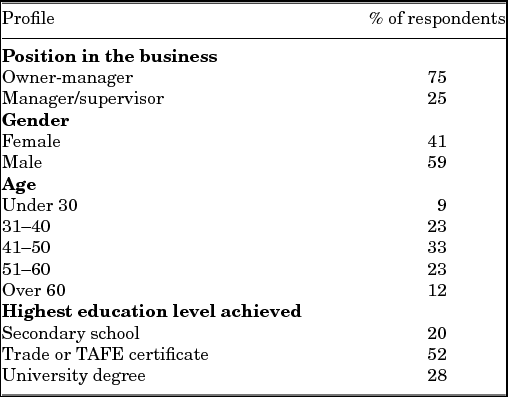
The characteristics of the business operator in the study area are presented in Table 1. Most of the participants owned the businesses and had achieved some sort of tertiary qualification. This profile is reasonably consistent with most small business populations in regard to participation in research regarding training activities, with the exception that in this sample, there were more women than the general population of small business owners — 41% in this sample compared with ABS data (2013) that has the number of women small business owners as approximately 33%.
Participant Profile
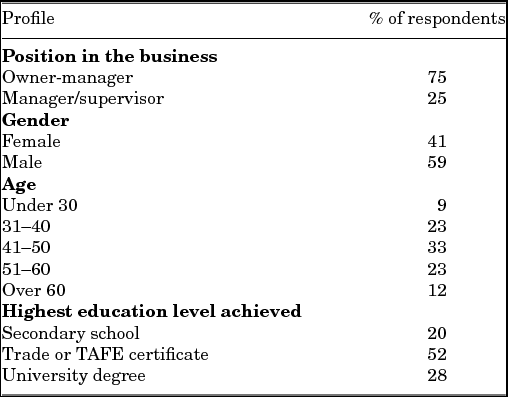
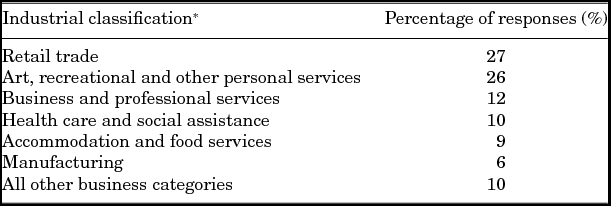
Table 2 shows the types of businesses in the geographic area. As can be seen, the vast majority are service based rather than manufacturing. This presents both challenges and opportunities, as much previous research has focused on bigger businesses and the manufacturing sector. Very little research has looked at small, service-based businesses. Additionally, because they were predominantly service based, the relative scale of any financial benefit being achieved by changing work practices had the potential to be less than for businesses using raw materials. Service-based businesses include businesses such as accountants, legal professionals, personal services or other professional services. The main difference is that most service-based businesses only have offices, rather than machinery, and as such are less energy intensive.
Business Type
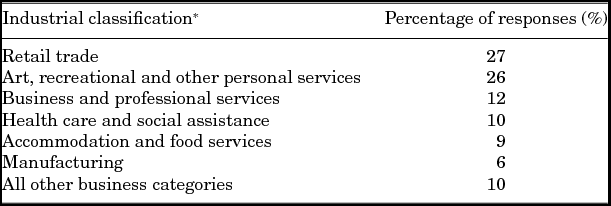
Note: *Based on Australian New Zealand Standard Industrial Classification (ANZSIC) codes.
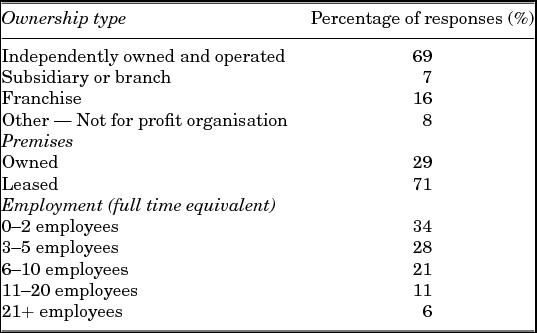
The final table on the general characteristics of the businesses (Table 3) relates to their structure and composition. The most important piece of data here is the very high percentage of businesses in leased premises, because this significantly reduces the ability of those in the businesses to make structural change, such as internal or external refitting (retrofitting) that could assist in changing business behaviours, such as with energy usage.
Structure
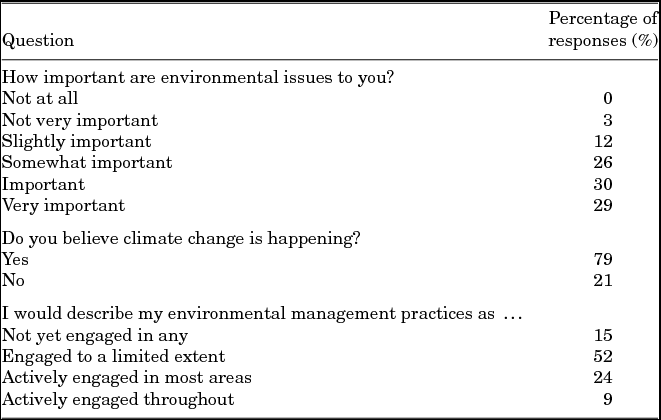
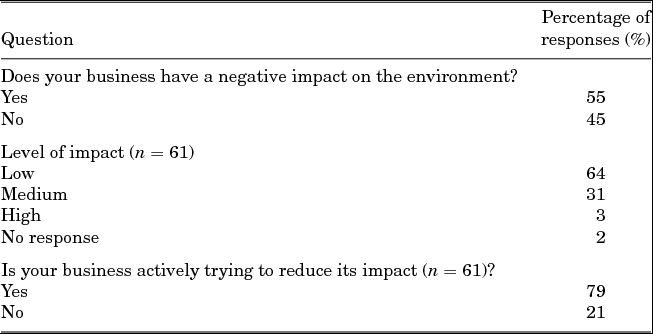
Having presented a broad overview of the characteristics of the business sample, Tables 4 and 5 address the first research question: How do small business owners perceive environmental issues in general and in relation to their business operations?
Environmental Concern
Environmental Impact
The environmental perceptions of the participants are shown in Table 4. Just over half (59%) of the participants felt the environment was an important or very important issue to them, with a greater percentage (79%) believing that climate change was happening. Conversely, this means that 21% do not think climate change is happening, so one in five small business owners appear to be climate sceptics.
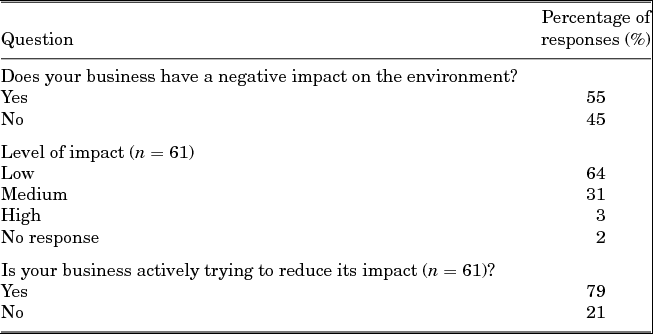
Although 67% of the participants reported they were either not yet engaged or only engaged to a limited extent in environmental management practices, Table 5 shows that over half (55%) believed their business had some negative impact on the environment. However, of these participants, 64% deemed their impact to be low, and 21% were not actively trying to reduce their impact.
The responses to the questions clearly demonstrate that there is still a reasonably high level of ambivalence in some small businesses in regard to their business practices and the resulting environmental impact, based on the response to the assumed level of impact. This is compounded by the reasonably high percentage (21%) of businesses that are simply not actively trying to alter any behaviours or practices. The respondents who were not actively engaged were in the control group, rather than in the group that participated in the intervention.
To summarise, three quarters of the respondents believed that climate change was happening, over half stated that environmental issues were important to them, and over half also believed that their business had a negative environmental impact. This shows that there is a reasonably high level of awareness and concern among small business owner-managers about the environment in general. However, this does not then appear to translate into embracing better business environmental practices or for any business behaviour change, given that three quarters of the respondents also stated that they were either not engaged or only engaged to a limited extent in good practices. Therefore, the answer to the first research question is that even though there is a level of awareness, there is little translation to action for change among this business cohort.
Between the two data collection periods an intervention program was undertaken that included: an individual energy audit and report, a forum on maximising energy savings, a forum on strategies to ensure businesses were future fit, a lighting review, and free access to a website providing environmental management information for small business owners. Full details of the intervention strategy are in the final project report (Walker & Redmond, Reference Walker and Redmond2014). The different intervention opportunities were conducted over a 12-month period, with the majority of businesses in the intervention group (49 out of a total of 55) agreeing to the energy audit, and most businesses engaging in at least one other strategy; for example, only 9 businesses opted for a lighting review, but 35 attended the energy forum, and 15 attended the future fit forum. No businesses participated in all four intervention opportunities.
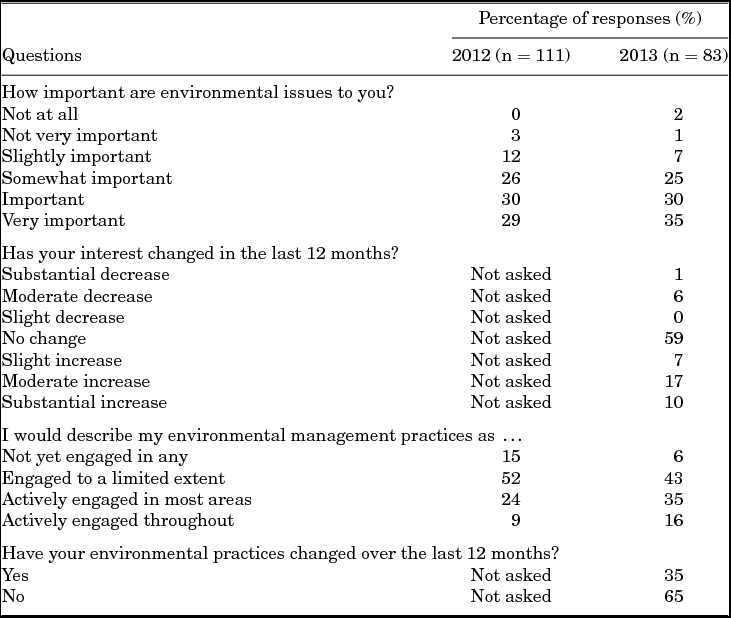
At the end of the intervention period, businesses in both the participation group and the control group were resurveyed. The respondents were again asked about their environmental perceptions, using the same bank of questions that were posed in the original survey, and also whether there had been any demonstrable change over the 12-month period. The results are shown in Table 6.
Pre and post intervention environmental perceptions
The data shows a slight increase in the importance of environmental issues reported by the participants in the second data collection. However, when asked specifically if their interest had changed, the majority reported no change had occurred, although a significant number did indicate a moderate-to-substantial increase. The main reason for the increase related to more awareness about environmental issues, as the following participants describe: ‘Hearing about environmental issues has made me more aware’ (Accountant, #45); ‘I am more aware and appreciative of what we have and now in a better position to make changes’ (Cafe Owner, #40).
Others felt changes in regulations and company focus were the reasons for an increased concern: ‘There have been changes in the regulations requiring more emphasis on sustainability’ (Childcare #109).
When asked to describe the level of engagement in environmental management practices in 2012, the majority stated they were engaged to a limited extent. A significant shift in engagement was noticed in the 12-month period between the two data collection periods. In 2012, 52% were engaged to a limited extent compared to 43% in 2013. Being actively engaged grew from 24% to 35%, and actively engaged throughout the business also grew from 9% to 16%. These results indicate a positive shift in the participants’ environmental management practices that can be attributed to this project. This is significant, considering the high percentage of leased premises in the sample. However, when specifically asked whether any changes had been made, only one third (35%) said they had made changes: ‘Your report provoked more interest and we established our own recycling project this year’ (Education Facility, #63); ‘Since you have come on board and educated me, I have approached the contractors to provide us with a recycling bin’ (Retail, #21).
The responses to the post-intervention survey do indicate a positive result in regard to the first two elements of the second research question, engagement and information. This supports the general small business training and development literature, which posits that small businesses only respond to any type of training or education if it is relevant and is applied in nature. The intervention touch-points included an individual energy audit, which meant that the business was shown information and evidence related to their specific business as to how they could reduce their energy usage and therefore energy costs. Both the surveys and energy audit engaged the business owner, as they had to actively participate in that touch-point. To iterate, the research question was: Does an education intervention that engages, informs, supports and rewards SMEs in implementing good environmental management practices change behaviour? The second two elements of the research question, support and reward, can be answered by other questions and data that was collected.
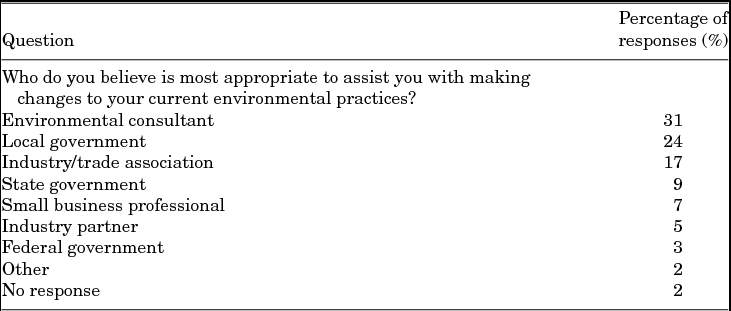
In terms of support for small businesses, there are different opinions on how best to assist small businesses to improve their environmental performance. As the literature stated, there is evidence to suggest that improvements would be best driven from the businesses, while others advocate increased legislation, education and/or support. This question was put to the business owner/managers in the pre-intervention survey to find out what they thought was the most appropriate method of support and assistance to help with improvements to environmental management practices. Table 7 shows that a third (31%) felt an environmental consultant was the best person to assist with such changes, followed by local government (24%) and industry associations (17%).
Environmental Support and Assistance for SMEs
What is interesting about who is best able to support small business owner-managers in their quest for change is that whereas environmental consultants were deemed the most able, if all three tiers of government are combined, giving a total of 36%, this shows that many businesses believe that ‘government’ has some responsibility to support them. This could be interpreted in two ways, the first being that there is some abdication of responsibility by the small business owner back to ‘the government’, as ‘the government’ is perceived to impose the regulations. The second is that if ‘government’ is responsible then they are more likely to be providing this support at no cost or very little cost, compared to an environmental consultant, who will most definitely be charging commercial rates for their services. It should be noted that the intervention, including the energy audits, were free to the small business owner-managers, and many of the businesses stated that they would not have been willing and/or able to pay for the audits.
The final element of the intervention model was reward. From the results of the post-intervention survey, just over one third (39%) had experienced a decrease in their energy bill as a result of changes to their energy usage. For the majority, this was a small or less than 10% decrease, although one participant did report a large (30–50%) decrease. Of the businesses that did make changes, the annual savings ranged from A$847 to A$110,871, depending on the size of the business. Some businesses reported very small or no change to the energy bills even when some changes had been implemented; however, the majority of participants attributed that to an increase in the unit cost of electricity as their actual energy usage had decreased. So, in real terms, the businesses were not worse off, and if local energy costs had not increased, there would have been cost savings.
To summarise, small businesses will engage in behaviour change for economic and environmental gains, if the business case to do so is presented to them. It should be acknowledged that operating a small business is tough, and for many small businesses, their priority is survival. In addition, there are many small business owners who are resistant to changing their operating practices, despite having demonstrable evidence that small changes could reduce their annual energy consumption. A reduction of 3,000 kWh of energy usage per year equates to a saving of approximately $1,000 (at time of writing and applying current tariffs), which may not appear to some businesses to be worth making any changes for. However, if that is extrapolated by the number of businesses in a specific geographic area, then that amount of energy reduction is significant. Further, the energy reduction could assist local communities in any energy saving targets they are aspiring to, as well as help small businesses to maintain whatever competitive advantage they might gain by being able to keep costs low. It could be argued that small businesses are not being encouraged to save money by energy reduction as it is not in energy company's best interests to do so.
Conclusion
The results of this research demonstrate that the combination of specific information and individual assistance, and a willingness on the part of the individual small business owner can make a difference to engaging small businesses in proactive environmental management. Our conceptual model, based on the theory of planned behaviour, demonstrates that if the four stages noted are implemented, change can occur. As the main ‘tool’ for the research was an energy audit, which nearly 80% of the businesses found useful to some degree, it would appear to be a good first step in engaging small business owners in better environmental management practices.
The results also show that this is still a very challenging area, and even with individual tailored assistance, many businesses appear to still be apathetic towards changing their current practices, given the answers to many of the questions asked. The barriers to making change are both real and perceived. Time is real, and for small businesses with limited resources, the lack of time is often the reason posited for not doing any operational changes in all management areas. However, when absolutely necessary, or required to do so legally, then small business owners do make the time, so the lack of time to be able to make any change is also a perception.
The second most often cited reason not to make any changes is that the cost benefit is not sufficient, so small business owners perceive that the small changes they might make will not make any real difference to either the environment, but more importantly to them, to their bottom line. This is also compounded by the fact that many business owners did not feel they had the ability to influence staff to make any changes, so took the easier option of doing nothing. Whereas this may be understandable, it is not an appropriate response, because with small business ownership come both rewards and responsibilities. Small business owners could take the lead in this area if they were prepared to accept that they are not only part of the problem, but they are also part of the solution. The results have shown that change can occur, and that the benefits of that change can be significant, both at an individual and collective level.
This is an ongoing battle, and needs a combined approach, especially as nearly a quarter of participants believed that local government should be part of the solution. There is no silver bullet to the issue of poor environmental practices in small businesses and how to change the operational behaviours. It appears that the business case has not been successfully ‘sold’ to small business regarding the environment and their part in it. Yet, when the financial facts are demonstrated and show that small changes can result in real savings (Walker & Redmond, Reference Walker and Redmond2014), some businesses still choose not to make those changes. The implication here is exactly how first-world countries are going to engage small businesses in the environmental debate. If ‘carrots’ (i.e., individualised educational programs) are only effective when they themselves are not cost effective, then they are not practical.
Finally, there is still a perception among some small businesses that they are individually insignificant; however, as a collective, we know their environmental footprint is significant. To make progress, it is important to continue to engage with them and to keep chipping away.
Acknowledgments
This research was from an Australian Research Council Linkage Grant, in partnership with the City of Joondalup and West Coast Institute of Training. The funding bodies had no role in the decision to submit the article for publication.
Author Biographies
Dr Janice Redmond is a Senior Lecturer at Edith Cowan University in Western Australia. Dr Redmond has been involved in a number of large research projects including an Australian Research Council grant focussed on the environmental management of SMEs. Dr Redmond has an established track record with many publications regarding SME environmental management, education and behaviour.
Dr Beth Walker is a Senior Honorary Research Fellow at the University of Western Australia. Previously she was Professor of Business Enterprise and the Director of the Small & Medium Enterprise Research Centre at ECU. Dr Walker has published extensively on the research areas of small business, environmental management and small business, the training needs of small business, self-employed women and leadership in local government.