INTRODUCTION
Remarkable finds very often pose puzzling questions and demand synthetic answers that merely constitute suggestions for conceptualising the past. The exceptional fourth century bc burials discovered in 2008 and 2009 at the sanctuary of Eukleia at Aegae (modern Vergina) are easily recognised as complicated and intriguing assemblages. Although research is not yet complete, one of the components of these finds which is undoubtedly a, if not the, dominant element, is presented here: a gold oak wreath.Footnote 1 The varied contexts of the precious artefact are key to its interpretation and therefore become the subject of extended analysis. The aim of this paper is to provide the scientific community with the data and first evaluations, with a view to initiating a dialogue.
I. METHODOLOGY
Elements of the archaeological material that strike us with wonder are sometimes considered through the slippery paths of art history and of ‘self-evident’ social connotations. The recently found gold wreath from Vergina is envisaged as an opportunity to attempt a holistic approach that will highlight as many of the artefact's facets as possible. In this respect context is deemed the most important theoretical framework through which to approach these. By context I mean not only the precise environment in which the wreath was discovered, but also the larger scale of the archaeological site. And if these form the first and most crucial web of relationships, I additionally seek to bring to the fore deeper and more complex meanings. Thus semiotics is closely involved in the attempt to interpret the artefact and the assemblage to which it belongs (Preucel Reference Preucel2006).
Consequently, the spatial and temporal communities of the objects (e.g. Knappett Reference Knappett, Malafouris and Renfrew2010) related to the wreath, as well as the landscape as an interactive pole of agency, are carefully considered both at the beginning of the study and in its closing sections. Adhering to such a theoretical orientation results in selected comparisons on stylistic grounds and favours enquiries based on the features of whole assemblages or cultural entities. Similar objects have different meanings in different contexts.Footnote 2 Of course it goes without saying that typology and associations with similar items are part of the archaeological work and in fact constitute the first step towards understanding the object in a cognitive procedure between scholar and find. Therefore the analytical description, technical features and comparison with other wreaths represent a significant part of the analysis. In addition, the materiality of the wreath imposes itself on the viewer and offers fertile ground for thinking about the co-dependency of mind and matter (e.g. Boivin Reference Boivin2008; Ingold Reference Ingold2007; Knappett Reference Knappett2005).
Finally, the historical period of the object's production and primary consumption may contribute valuable insights. For this reason I turn inevitably to literary sources referring to historical figures who may have played a crucial role in the life history of the object in question and may also have felt its impact.
II. DESCRIPTION OF THE ARCHAEOLOGICAL SITE
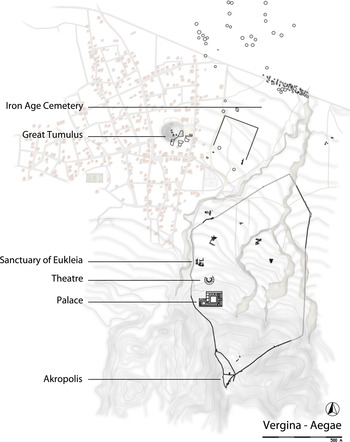
The ruins discovered to the east of the modern village of Vergina are considered by most scholars to belong to Aegae, the ancient capital of the Macedonian kingdom.Footnote 3 The archaeological site that bears the conventional name ‘sanctuary of Eukleia’ is in the best-known part of the ancient city of Aegae: north of the palace and the theatre, it includes public buildings in the western part of the city, alongside the western wall, now lost, of the fortification (Fig. 1). The excavation started in 1982 and continues as a project of the Aristotle University of Thessaloniki.Footnote 4 The excavation area owes its name to dedicatory inscriptions referring to the goddess Eukleia. According to literary and archaeological evidence temples dedicated to this deity of glory and good repute were located in the agoras of ancient Greek cities. Consequently, this public area of the ancient city may have been part of the agora, the complete plan and organisation of which has yet to be discovered (Saatsoglou-Paliadeli Reference Saatsoglou-Paliadeli1987; 1993; Reference Saatsoglou-Paliadeli2000).
Topographic plan of the archaeological site of Aegae (Vergina).

The main terrace
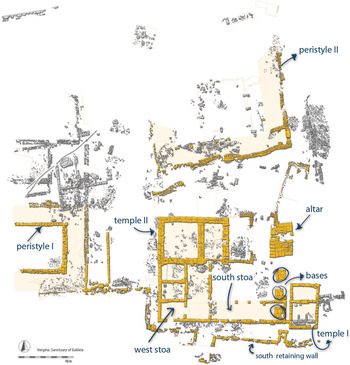
The ancient city was organised in terraces to facilitate the erection of the buildings on the hillside of Mount Pieria (Drougou Reference Drougou2003). The main terrace in the excavation area held a Doric temple on an east–west axis (Fig. 2, temple II), with an annexed stoa and an altar to the east. On the same axis (north–south) as the altar three rectangular podia once supported bases of anathemata. One of them has been preserved and bears an inscription with the name of Eukleia as the receiving deity and of Eurydice, mother of Philip II, as dedicator (Saatsoglou-Paliadeli Reference Saatsoglou-Paliadeli1987; Reference Saatsoglou-Paliadeli2000). The constructions seem to belong to the same building programme as the palace and the theatre and should be dated to the second half of the fourth century bc. A second temple was added in the third century bc, adopting a totally different orientation (north–south) (Fig. 2, temple I). Further changes took place with the erection of a new stoa at the beginning of the second century bc. Destruction layers of the mid second century bc indicate the Roman conquest as the reason for the final large-scale destruction of the city. Nevertheless, life did not cease. Modest constructions on top of the ruined ones were used until the first century ad.
Plan of the ‘sanctuary of Eukleia’ at Aegae.

The rest of the buildings
More public buildings have come to light in the large area extending to the north and west of the main terrace. Our knowledge of their function and character is rather limited, since very few finds were discovered due to the continuous use of this part of the city. In some cases, though, the size and quality of construction is truly impressive, as in the case of the well-built peristyle west of the main terrace (Fig. 2, peristyle I). The chronological phases of those buildings begin in the fourth century bc and continue to early imperial times. An extremely interesting find proved to be a construction with mud walls that was identified as a storeroom for pithoi. A number of potsherds indicate that it should possibly be dated to the Geometric or early Archaic period (Saatsoglou-Paliadeli Reference Saatsoglou-Paliadeli2002).
III. THE EXCAVATION DATA
The area in question, with the outstanding finds, was the object of investigation during several excavation periods. The area extends over the lower terrace, to the north of the main one, about 15 m north of temple II, and covers a large surface. The archaeological research, although not yet complete, has yielded valuable information that enables us to give a tentative account of the successive phases as deduced from the architectural remains (Saatsoglou-Paliadeli et al. Reference Saatsoglou-Paliadeli, Kyriakou, Mitsopoulou and Tourtas2008a; Reference Saatsoglou-Paliadeli, Papageorgiou, Maniatis, Triantafyllou, Kyriakou and Tourtas2008b; Reference Saatsoglou-Paliadeli, Kyriakou, Mitsopoulou and Tourtas2009a; Reference Saatsoglou-Paliadeli, Papageorgiou, Maniatis, Triantafyllou, Vavelidis, Kyriakou and Tourtas2009b; Reference Saatsoglou-Paliadeli, Kyriakou, Tourtas, Papageorgiou and Triantafyllou2010a forthcoming; Saatsoglou-Paliadeli Reference Saatsoglou-Paliadeli and Galanakis2011).
The three building phases
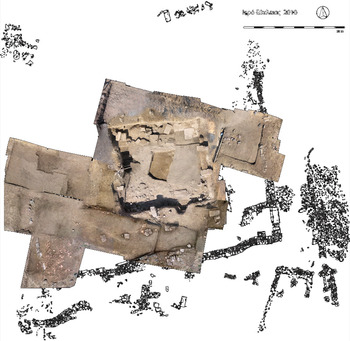
It seems so far that the first use of this part of the archaeological site was marked by a rectangular pit of impressive dimensions (approximately 8 m × 8.5 m) dug in the virgin soil for the creation of an open-air construction (Fig. 2, inside peristyle II). Its function is difficult to define until it has been fully explored. The only architectural elements that were spotted in situ in 2010 form part of the floor: poros blocks covered with waterproof plaster consisting of an underlay of pebbles and a smooth final coat, which indicate a well-built construction (Fig. 3). Probably the vertical walls in the virgin soil were reinforced with stone walling of similar structure. A possible interpretation would connect the construction with some sort of cistern or swimming pool; however, the evidence is not adequate to confirm identification. No pipes for water supply, nor drainage system, nor staircases for descending have, as yet, been found.
Photogrammetric plan of the ditch and surrounding area.

Later on, this construction stopped being used. The plaster was scraped away and the stones were removed. The ditch was filled up with homogeneous earth with remains of the destruction and a new construction appeared on top of it, sealing for good all prior remains. Architectural elements in secondary use, a clay floor and roof tiles were parts of the new construction, but no real walls have been discovered. It is worth pointing out that during the excavation there were no traces of intrusion detected on the clay floor.
In the third phase the debris of that second construction was covered by a clay floor in the atrium of a much bigger peristyle building (Fig. 2, peristyle II).
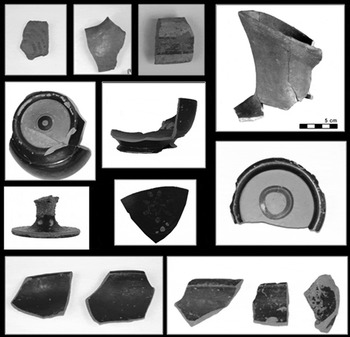
The ceramic evidence combined with the interrelation of the buildings seems to give the following chronological sequence. The first construction is impossible to date, since the excavation under its level of use has not yet taken place. What is, though, within our knowledge is the dating of the potsherds found in its fill. It corresponds to a very wide time span: from the Early Iron Age to the last quarter of the fourth century bc, which is also a terminus post quem for the end of use of the construction (Fig. 4). The potsherds from the second construction are very fragmentary and of limited quantity and belong to the third century bc. The last building was created at the beginning of the second century bc and destroyed in the middle of that century.
Indicative pottery from the fill of the ditch (Early Iron Age–late 4th century bc).

The find of 2008
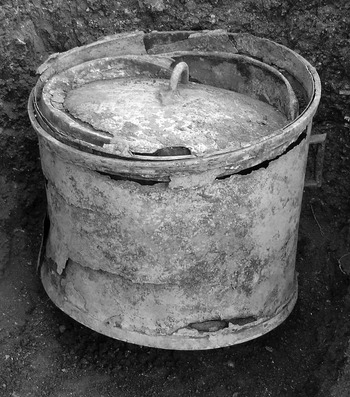
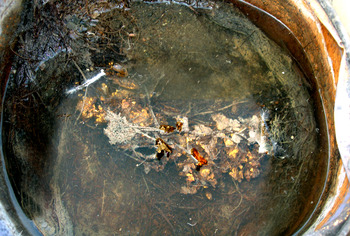
In August 2008, during the exploration of the rectangular pit, an unexpected find came to light. Near the north-east corner of the pit, in its fill, which corresponded to the end of the first construction, a large bronze vessel was discovered (Fig. 5). Cylindrical in shape, green in colour, with vertical handles bearing heart-shaped leaves at the joins with the body, it had a slightly conical lid supported by a cylindrical sheet of metal and topped by a handle ornamented with matching leaves. Through the cracks shone another metal item inside. When the lid was removed the content was astonishing. A gold pyxis, a plain cylindrical vase, also covered by a lid, had been fitted exactly inside the bronze vessel. And following a series of surprises, the opening of the second lid revealed a mass of mud or organic material, roots and bones in the water that had filled the vase. The elegant leaves of a gold wreath crowned the mass, half inside it, half emerging from the water (Fig. 6).
The bronze vessel that contained the burial.

The gold wreath inside the gold pyxis as found.

It was obvious that the gold pyxis contained a burial. The correct handling of the delicate materials that would keep them in the best possible condition was of top priority. Immediately after the transport of the find to the laboratory the water was poured into a plastic vessel and kept apart, and the gold wreath was extracted carefully from the mass.Footnote 5 The latter was kept in a plastic container in a refrigerator under controlled conditions.
Through the careful and meticulous examinationFootnote 6 of the mass in the vessel valuable information was gathered: roots and water must have penetrated the vase or developed in recent years. Their activity as living organisms proved to be destructive to the preservation of the bones and the remains of other materials. Nevertheless, the presence of a gold and purple fabric was substantiated (numerous minute gold lamellae and the remains of purple were found), as well as parts of silver and gold elements. The conclusions of the osteological report were very interesting: the dead person who was cremated and whose remains were deposited in the gold vessel must have been a boy, an adolescent around 14–18 years old.
The find of 2009
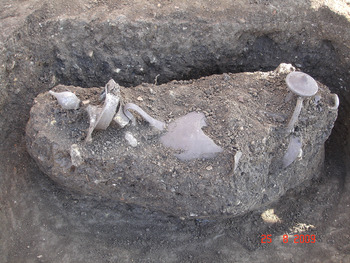
The assemblage of 2008 was still in the laboratory – the conservation of the bronze and gold vessels will be an especially long-term one, especially since the gold pyxis bears remnants of purple fabric inside and of another fabric on the exterior, which should not be removed, and as full examination of all the materials detected inside the mass demands more time – when, in the course of the excavation period of 2009, another assemblage was discovered, in the same ditch, in the same fill, about 5 m south of the first one. This time two vessels were found: a silver funerary hydria and next to it a Panathenaic amphora, made of silver and decorated with gold ornaments (Fig. 7). The investigation in the laboratory has shown that the hydria contained the cremated bones of an adult, which in this case were covered with a purple fabric. No specific statements can be made about the sex and precise age of the deceased because of the poor state of preservation of the skeletal material.
The find of 2009 (two silver cinerary vessels).

The content of the Panathenaic amphora proved to be analogous to those of the other two vessels. Once again the skeletal remains of an individual had been deposited in it: a child aged 3–7 years. Anthropological study cannot determine the sex of an individual at such an early age. Gold ornaments were discovered in the vessel, namely small discs bearing rays and a Gorgon's head, which are possibly parts of a diadem, and two small winged Nikai, as well as an ivory item decorated with inlaid gold wire. A gold olive wreath indicates the high status of the deceased.
IV. THE GOLD OAK WREATH
Description
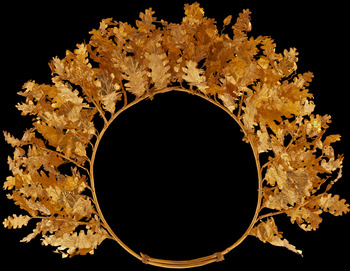
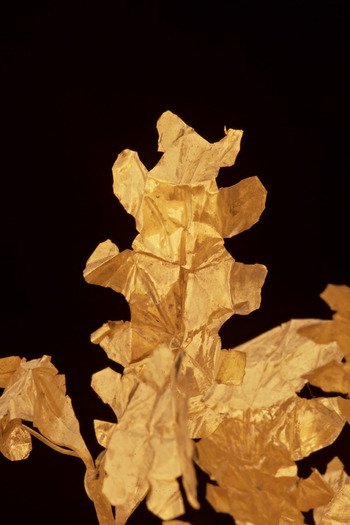
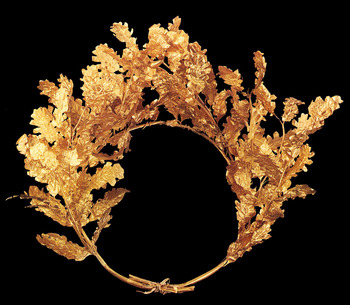
The oak wreath of the first burial is preserved in excellent condition (Fig. 8). Despite the water that surrounded it and the vegetal material that rolled and twisted between its branches, the artistic work and the fine lines of the precious artefact were evident from the moment of its discovery. It was carefully removed from the soft moist mass of that vegetal–organic material, and cleaned with water and then with formic acid. The branches and leaves were disentangled and rearranged in order to render back to the wreath its original volume and impressive image.
The gold oak wreath from the sanctuary of Eukleia.

The wreath weighs 207.42 g and has an elliptical shape with an internal diameter of between 18.5 and 16.5 cm. It is composed of two tubular stems, branches, leaves and acorns. Eighteen branches alternate with 48 single leaves organised in triads that grow directly from the stem on a thin stalk. Each branch bears eight leaves on its thin tendrils and two acorns. In total there are 144 leaves on the branches.
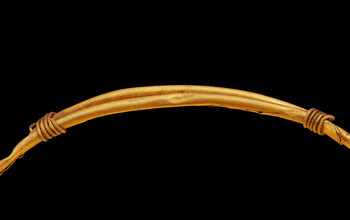
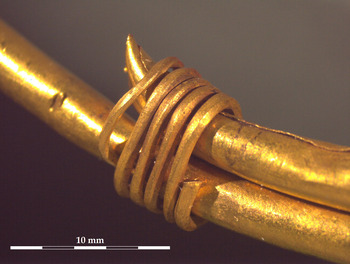
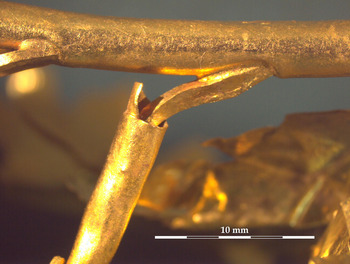
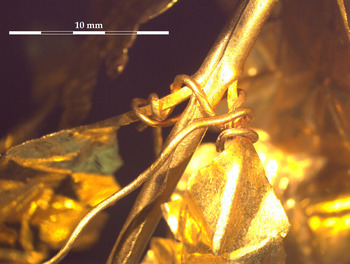
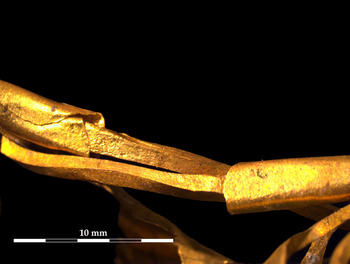
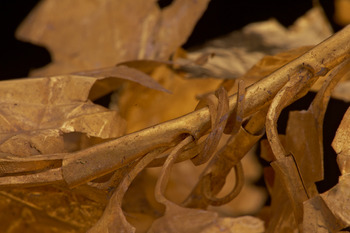
The stems have a circular section (diameter 0.4 cm) and are constructed of a thin bent gold sheet – the seam line is discernible. At the rear the edges of the stems have been pressed and compacted to form a flat, ‘closed’ end (Fig. 9). The two stems overlap and in two places plain gold wires of an almost circular section bind them safely together. The wires sprout from holes in the stems and twine five times around the two tubes (Fig. 10). Branches and stalks emerge in the same way from the stems (Fig. 11).
The rear part of the oak wreath from the sanctuary of Eukleia.

Gold oak wreath from the sanctuary of Eukleia: one of the finials on the rear part seen through the microscope.

Gold oak wreath from the sanctuary of Eukleia: the lowest part of a branch growing from the stem seen through the microscope.

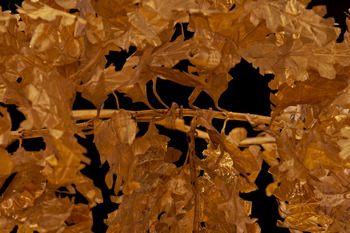
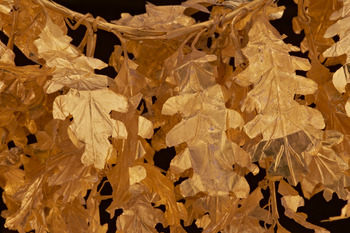
Viewing from the rear to the front the spectator notices first configurations of three oak leaves with integral hammered stalks of a rather square section inserted in three holes next to one another (Fig. 12). The central leaf follows the axis of the tube, whereas the two flanking it open up outwards and inwards respectively. The length of the single leaves is 0.06 m.
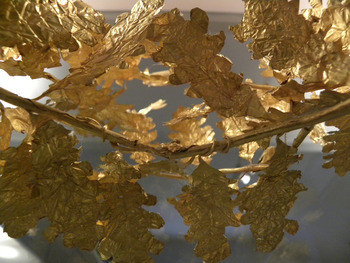
Gold oak wreath from the sanctuary of Eukleia: branches and leaves on the wreath.

The length of most of the branches is 8–8.5 cm, but two measure 10 cm. The construction is complicated. A short square-sectioned spike made of thin gold sheet grows from the tube and functions as the stable element holding the whole branch (Fig. 11). Another sheet is wrapped around that spike and extends the branch upwards. The ending of the initial spike, in the form of a wire, passes through the new sheet and twists around it for better stability. On the new stem eight oak leaves emerge in pairs with integral square-sectioned tendrils. As they grow higher, they gradually diminish in size: 4.8, 4.5 and 3.7 cm in length.
The leaves are made of very thin gold foil and have been cut to a characteristic dentate outline by using templates (Fig. 13). They all bear a low-relief central spine, as well as symmetrical veining in a repetitive V-shaped pattern that develops towards the outer lines of the leaves.
Gold oak wreath from the sanctuary of Eukleia: leaf.

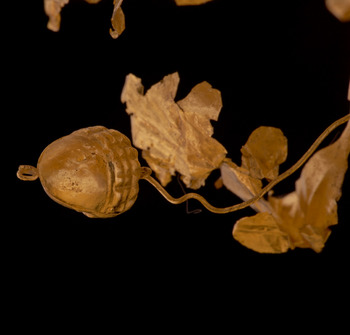
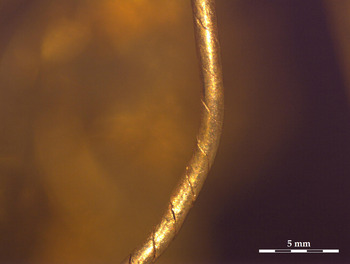
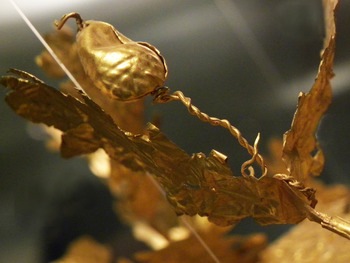
The acorns are made in left and right die-formed halves (Fig. 14) and the seam is evident in all of them. Their cups, half the size of the whole acorn, bear a tentative form of the fruit. A very thin wire, produced from a tightly twisted strip of gold sheet (Fig. 15), passes through the acorn: at its lower part it twists around two tendrils of leaves, whereas at its top it passes through a small hole in the nut and twines around itself so that it secures the acorn in its position. The tendrils of the acorns always twine around the sprouting spot before the last one at the upper ending of the branches (Fig. 16).
Gold oak wreath from the sanctuary of Eukleia: acorn.

Gold oak wreath from the sanctuary of Eukleia: twisted strip forming the tendril of the acorn as seen through the microscope.

Gold oak wreath from the sanctuary of Eukleia: the lower part of the acorn tendrils twined round the leaf twigs.

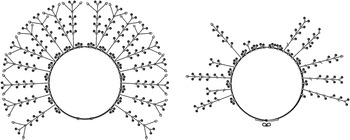
This configuration of branches and single leaves repeats itself in both tubes in a skilful and harmonious manner. In the tenth and fourteenth sprouting spot of each tube two branches emerge instead of one. In total there are 15 sprouting spots for each tube, which means 30 in the whole wreath (Fig. 17).
Diagrammatic drawing of the oak wreaths from the sanctuary of Eukleia on the left and from Amphipolis on the right.

At the front the two stems taper and are inserted one inside the other (Figs. 18, 19). The join is not visible, hidden behind the dense stalks and leaves in the most visible and thus culminating part of the wreath. From one tube sprouts a square-sectioned sturdy stem that twists around the other tube so that one holds the other. In one case it winds around a hole with three leaves, in the other case around a hole with branches (Fig. 20).
Gold oak wreath from the sanctuary of Eukleia: the front join.

Gold oak wreath from the sanctuary of Eukleia: the front join as seen through the microscope.

Gold oak wreath from the sanctuary of Eukleia: one of the endings of the front join.

When evaluating the artistic workmanship of the wreath we can see that it is the product of very detailed but not particularly innovative work. The vegetal decoration of the two tubes is developed in absolute symmetry (Fig. 17). The alternation of single leaves and branches, the regular intervals between the holes for the sprouts (1–1.5 cm) and the way leaves grow on the branches, always in pairs and at symmetrical distances, are identical. The outcome is that the picture repeats itself in a scrupulous way. The goldsmith must have been experienced, working carefully and systematically. In view of these features the value of the wreath lies in the material, the solidity of the structure, the density of leaves at the front which produce an impressive result, and the meticulous work.
Construction – Technical details
The material used for the construction of the wreath was pure gold. It is thus difficult to determine the origin of the metal.Footnote 7
The main element used was sheets of gold in various sizes and shapes to form the different vegetal parts. Leaves were cut from hammered sheets, obviously using templates. In the case of the tubes, the sheets were rolled. Acorns were pressed in a die from a sheet. Wires were also extensively used as tendrils or as reinforcing elements that contributed to the fastening of the different parts (Williams and Ogden Reference Williams and Ogden1994, 10–33).
Dating
It is certainly not easy to date gold wreaths, especially within a narrow time span. However, there are enough dated examples extending from the fourth to the second century bc that facilitate dating and permit a grosso modo chronology. Gold wreaths with branches, leaves and fruits are dated in the second half of the fourth century bc. It should be mentioned that third century wreaths have no branches at all and only one bears fruits (Tsigarida Reference Tsigarida1988, 92).
If we compare our wreath to the ones from the other two royal graves at Vergina, it seems quite similar to the wreath found in the ‘Tomb of the Prince’ which is dated to the last quarter of the fourth century bc.
The external archaeological data are also interesting, without being conclusive for the dating of the wreath. According to the ceramic evidence, the filling of the ditch and the deposition of the three burials must have taken place in the late fourth century bc.
V. COMPARANDA: OTHER OAK WREATHS FROM MACEDONIA
Associating our wreath with other wreaths dated to the fourth century and discovered in the ancient kingdom of Macedonia offers further insights into its production. It should be noted that oak wreaths of the same period have also been found in other parts of the ancient world: in the Dardanelles (Williams and Ogden Reference Williams and Ogden1994, 106–7), in the Taman Chersonese (Williams and Ogden Reference Williams and Ogden1994, 178–9), in Pergamum (Jacobsthal Reference Jacobsthal1908) and in Armento (Lullies Reference Lullies1982; Juliis Reference Juliis1984, 100–1). They bear branches, acorns, discs and central figures and have stylistic features which indicate different traditions (Tsigarida Reference Tsigarida1993, 1636). Beyond the technical traits that possibly point to different workshops and places of production and consumption, in this text focus is placed on Macedonia, since even similar objects have different meanings in different contexts. Additionally there are examples of wreaths out of context, in private collections or museums,Footnote 8 but it is very difficult to articulate a framework for them. Therefore, the search is located in the area of the ancient Macedonian kingdom, where a very limited number of examples are to be found. It would be useful to examine each one of the wreaths separately in comparison to the recently discovered artefact. All the wreaths belong to the first type, category I, as defined by B. Tsigarida (Tsigarida Reference Tsigarida1993, 1634): they are made of gold, they have branches, or branches and leaves, their stem consists of one or two cylindrical tubes and they are dated to the second half of the fourth century bc. Taking into consideration the fact that all gold wreaths of this type were discovered in Central Macedonia it is concluded that they were possibly created in workshops of that area – only two wreaths, an oak and a myrtle one, were found in Eastern Macedonia, namely in the area of Amphipolis (Tsagezi). The wreaths of this category are rather minimal, but look lavish thanks to the material and the skilful rendering of branches, leaves and fruits.
1. The gold oak wreath from the ‘Tomb of Philip II’ at Vergina/Aegae
This is surely the most renowned gold wreath, because it was found in the Macedonian tomb in the Great Tumulus at Vergina that is attributed to Philip II.Footnote 9 At the same time it is the most elaborate and rich in every detail that has been discovered to date. Weighing 714 g and including 313 preserved leaves and 68 acorns it constitutes an exquisite item that discourages any comparison (Andronicos Reference Andronicos1984, 170–1, 217). On the stem, with a maximum diameter of 18 cm, 57 preserved single leaves alternate with 32 branches which bear 12 to 15 leaves each (Despoini Reference Despoini1996, 210). Among the leaves the viewer can discern some elegant seed-pods in addition to the acorns. The wreath started to burn in the funeral pyre, since in the frontal part there are intense traces of fire and some of its acorns were found among the pyre debris.
2. The gold oak wreath from the ‘Tomb of the Prince’ at Vergina/Aegae
The Macedonian tomb next to the ‘Tomb of Philip II’, called the ‘Tomb of the Prince’, was also found intact. The cinerary hydria was crowned with a gold oak wreath (Andronicos Reference Andronicos1984, 212–7; Despoini Reference Despoini1996, 210).Footnote 10
The diameter of the precious wreath ranges from 18 to 22 cm. Two tubes compose the circular stem. At the back they overlap and are well bound together with two wires. In the front one end is inserted in the other tube and a wire twines around. Thirteen preserved branches alternate with 20 triads of leaves (10 on each tube). On every branch seven leaves are attached. 25 acorns are still in their places, but there must have been more. In total we count 60 single leaves and 91 on the branches.
3. The gold oak wreath from Amphipolis (Tsagezi)
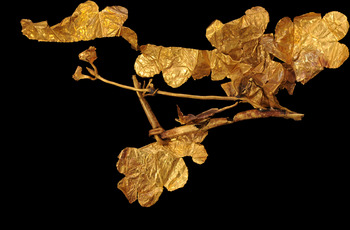
In 1940 three graves were excavated in the area of Tsagezi, near Amphipolis, and, despite their previous looting, very interesting finds came to light. In the Macedonian-type tomb a gold oak wreath was discovered (Makaronas Reference Makaronas1940, 495, figs. 30–1) (Fig. 21).Footnote 11 On the stem there are traces of fire.
The gold oak wreath from Amphipolis (Tsagezi).

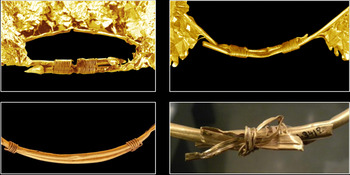
The diameter of the wreath is 15 cm. It is composed of two tubes with a 0.4 cm section. At the back the tubes cross and a plain wire binds them together at the joint (Fig. 22). An additional, evidently decorative, element adorns this part: a bow made of a narrow gold sheet bearing a plain decoration is attached to the junction point of the two tubes with a gold wire. At the front a spike from one tube is inserted in the other and a wire sprouting from the second tube entwines around the first (Fig. 23).
The rear part of the wreath from Amphipolis.

The front part of the wreath from Amphipolis.

The foliage emerges at equal distances from the rear binding, approximately 0.7 cm. Configurations with three leaves alternate with branches bearing leaves. Whereas there is consistency in the way the single leaves grow from the stem and develop towards the front, the goldsmith seems to have taken the liberty to create varying forms of branches and leaves. On big long branches (10, 11, 13 cm) or rather smaller branches (8 cm) oak leaves are attached without regularity. In most cases there are, or were (since some are missing, with the hole as evidence that they were once there), eight leaves, but we also find branches with nine, seven and four leaves. The leaves do not emerge necessarily in pairs, or at regular distances (Fig. 17). What is the rule though, is the ending, always formed by two leaves on the top of the branch (Fig. 24). At the front there are no branches attached to the frontal part of the wreath, only a short spike on top of which grow two leaves, whereas a stalk at the same sprouting spot suggests the existence of a leaf. In total there are four configurations with three leaves, one with two leaves and the spike. Possibly the intention was that the big branches on right and left would bend towards the centre. Three branches bear an acorn standing on two twisted wires. They were manufactured with a die and the cup reproduces only generally the form of the fruit.
The furthest ending of a branch in the oak wreath from Amphipolis with two leaves and an acorn.

The impression that one acquires when looking carefully at the wreath is an effort to imitate, at least up to a point, the features of the tree in nature. The lack of order in the sprouting of the leaves is very characteristic of the notion of the goldsmith. The choice of attaching a short spike among the single leaves also reveals the inspiration behind the manufacture. The element that best expresses the tendency towards a realistic rendering is undoubtedly the bow at the rear. It is a non-functional piece adorning the back of the head and alluding to the real wreaths made of plants and flowers that were held at that point with a ribbon. However, we can discern an internal organisation and balance. 36 single leaves and 67 leaves on the branches have survived. Including the stalks and holes indicating the existence of leaves, we count 42 leaves directly on the stem and 84 on the 10 branches (each tube has five branches). The single leaves are 6 cm long and the leaves on the branches 4.5 and 5 cm.
Table 1 summarises the data on the wreath from the sanctuary of Eukleia and the other three wreaths described above.
The intact fourth century bc gold oak wreaths in Macedonia (published data).

4. The fragmented gold oak wreath from tomb A at Derveni
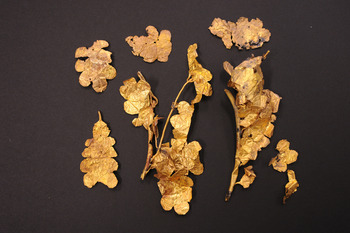
In the cist grave A at Derveni, in the area of Thessaloniki, the fragments of an oak wreath were spotted among the grave goods (Fig. 25). It had been burnt in the funeral pyre and the surviving pieces were put in the grave (Themelis and Touratsoglou Reference Themelis and Touratsoglou1997, 57). The effect of the burning is most evident in the colour of the metal and the melting of parts of the leaves. The section of the stem is 0.4 cm. Apart from single leaves two big fragments survive that reproduce at least partly the image of the wreath.
Fragments from the gold oak wreath from Derveni.

Fragment I
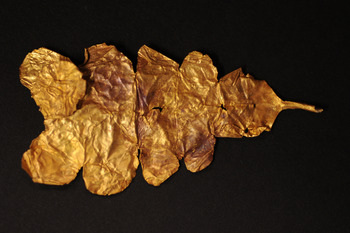
The front part is retained (Fig. 26). The ending of one tube is shaped as a loop, whereas the other one takes the form of a hook. Four holes for branches survive from one tube, two of which bear the attached elements as well: two big single leaves coming out of two holes and then a branch – possibly together with a single leaf, judging from the preserved fragment II. A single spike of round section sprouts from the stem and reaches the top. 1.6 cm above the sprouting spot two leaves grow in a pair with twigs quite similar in form to the spike. The joints are all black in colour, possibly from soldering. At a distance of 3.3 cm on the stem another pair of leaves appears, which must have been smaller – their greater part is missing. Around this area a wire cross-twines to hold a leaf. At a distance of 2.5 cm another hole also marks the ending: a twig ends in a decorative system composed of a central spiral-conical motif and two leaves flanking it. It seems that the central motif plays the role of a seed-pod. Near the hook there are two more holes, possibly for leaves. The length of the single leaves is 6 cm and the maximum width 3 cm. The leaves on the branches are 5 cm long. It should be noticed that the outline of the outer parts of the leaf is lobed in shape (Fig. 27).
Fragment I from the Derveni wreath.

Leaf from the Derveni wreath.

Fragment II
Part of a tube with the attached elements is preserved (Fig. 25). If we give numbers to the sprouting spots we have the following sequence: (1) a rather small, partially preserved, leaf growing from a hole; (2) two holes for two partially preserved leaves and a third hole in the under face of the tube; (3) a leaf; (4) a hole for a leaf, a hole for a preserved branch with spiral motif at the top and a hole underneath, possibly for a leaf; (5) two leaves growing from two holes.
Similarities and differences
All the wreaths reveal experience and knowledge of technical solutions. It is believed that oak wreaths required more metal to be manufactured than other wreaths and consequently must have been expensive (Tsigarida Reference Tsigarida1988, 210). It is obvious that the general idea of the composition entails the same basic characteristics: the aim is to present an elegant, beautifully manufactured item with leaves and branches, while additional details enrich the artefact. All the wreaths have a stem consisting of two tubes which are carefully fixed together and thus are quite steady (Fig. 28). They all bear branches and single leaves which alternate in a balanced way and are further adorned with fruits.
The rear parts of the wreaths from the so-called tombs of Philip II (top left) and the Prince (top right), from the sanctuary of Eukleia (bottom left) and from Amphipolis (bottom right).

Differences, however, can be noticed by the careful viewer. Our wreath and the one from Amphipolis (Tsagezi) seem to draw on different inspirations. Harmonious and absolutely symmetrical, the former contrasts with the latter, which is nature-inspired and displays a more playful attitude. The fragment from Derveni offers an alternative form of seed-pod and, at the same time, different technical solutions. The wreath found in the ‘Tomb of the Prince’, on the other hand, seems quite like our wreath.
If the aim is to recognise artists, and possibly workshops, then we need to define the criteria. Technical details, stylistic features and general rendering would be the categories in which to look for similarities and differences. We should always keep in mind that it is questionable whether a choice of linking two tubes should be considered as indicative of the artist or the workshop. Evolution or experimentation is welcome, indeed indispensable, in a work of art. Therefore, a combination of technological and stylistic traits could be indicative of craftsmen, workshops or generally of places of production (Williams Reference Williams and Williams1998; Dági Reference Dági2011).
The maker of the Derveni wreath chose the loop and hook solution for joining the two tubes in the frontal part. Furthermore, bearing in mind that it is quite reasonable that templates were used for the manufacture of leaves and that there would not be a variety of templates in one workshop for a small output, the semicircular outline of the lobes of the leaves on the wreath from Derveni would surely indicate a different goldsmith. On the technical side, the bow at the back of the wreath from Amphipolis certainly stands out. Additionally, the way nature is perceived and represented through an artefact may also provide clues about the maker – even if we accept that there is a certain conventionality in the imitation of nature. Once again the wreath from Amphipolis (Tsagezi), as already discussed, communicates a special notion of the tree.
In all aspects the wreaths from Vergina present significant analogies. The one that certainly attracts attention is the wreath discovered in the ‘Tomb of Philip II’. The workmanship is impressive and the result almost surpasses nature: long branches heavy with leaves, large single leaves, numerous acorns, unique seed-pods, and elaborate endings. It can be argued that the wreath reflects in a way the personality of the man who ordered it and the craftsman did his best to meet his demands. The wreath from the ‘Tomb of the Prince’ displays the same balance in organisation as ‘Philip's’, the same outline and veining of the leaves, the same structure of the spikes of the branches, and the same good fastenings, with only the leaves and acorns being fewer. The wreath recently found in the sanctuary of Eukleia clearly lies in the same tradition. The leaves are similar to those of the other two wreaths, except they are a little narrower, and the acorns look much like the ones in the wreath from the ‘Tomb of the Prince’. A difference, though, is that the new wreath has more leaves on the branches, whereas the wreath from the ‘Tomb of the Prince’ is richer in single leaves. In fact, in the latter pairs of three-leaf configurations, instead of one configuration, alternate with branches.
The new find conveys a consistency with the other two wreaths from the same archaeological site and the three of them should be regarded as creations of craftsmen sharing the same tradition. Furthermore, it should be underlined that it seems as if the first wreath inaugurates, in a time span of at most two generations, a way of presenting oak wreaths which is imitated in the next two wreaths, without, however, reaching the glamour of that first one.
VI. THE SEMIOTICS OF THE FIND: INTERNAL BALANCES
The recently found oak wreath is undoubtedly a precious object. It is one of the three oak wreaths discovered in the ancient capital of the Macedonians, and one of the five fourth century oak wreaths unearthed in Macedonia. It is one of the many gold wreaths displayed in museums and exhibition catalogues, thereby transmitting the splendour of a whole era. Apart from its artistic value, is there a symbolic meaning?
It is very important to consider carefully the funerary assemblage. A point that should be made clear is that it seems as though we have a minimal burial, where only the most indispensable components have been retained: a gold ossuary reminding us, as far as the material is concerned, of the gold caskets from the ‘Tomb of Philip II’; a special fabric that encompasses the cremated remains, similar to the one found inside the larnax of the antechamber of the same tomb (Drougou Reference Drougou1987) (although the decoration with the gold lamellae must have been more limited), but also to the purple cloth in which the cremated remains were wrapped in the main chamber as well as in the hydria of the ‘Tomb of the Prince’; and an oak wreath, the one and only item accompanying the deceased, which brings to mind the two oak wreaths discovered in the royal tombs of the Great Tumulus.
A pattern connected with men of high status is emerging: a receptacle made of gold or silver, a purple cloth containing the bones and a gold oak wreath as the only offering deposited with the bones. These communicate aspects of their identity in life and escort them in the afterlife with honour in a metonymic sense.
VII. MEANING AND SYMBOLISM
Generally on wreaths in funerary context
Wreaths, flowers and sprays, sources of smell and colour, embellished and formed part of the rites of passage concerning death. Mortal and perishable, they can be revived by the accounts of ancient writers or in vase paintings (Blech Reference Blech1982, 81–5; Kefalidou Reference Kefalidou1996, 74; Themelis and Touratsoglou Reference Themelis and Touratsoglou1997, 139–40 n. 34). Artistic imitations of natural wreaths are often present, as grave goods, as remains from the burial pyre, or even painted on the walls of the tomb.
During the prothesis relatives and friends would reach the kline where the deceased rested, holding flowers or sprays in their hands which they would leave on the body. The deceased himself bore a wreath on his head. Flowers and sprays make visible the action of farewell by the living towards the dead; they express the sentiments of sadness, refer to the belief in the eternal power of nature and entail a desire for rebirth and relief (Schauenburg Reference Schauenburg1957; Smith Reference Smith1976; Vokotopoulou 1990, 35–40; Miller Reference Miller1993, 46–8; Kefalidou Reference Kefalidou1996, 72–3; Huguenot Reference Huguenot2008, 82–3, 189; Kyriakou Reference Kyriakou2008, 224–6).
Additionally, wreaths and ribbons were connected with the promotion of the image of the deceased as a winner in the struggle of life being honoured by the members of the community. At the same time there was an allusion to victory over death (Kefalidou Reference Kefalidou1996, 76–7). Wreaths and ribbons with the very characteristic form of binding, by circling, ‘marked’ the deceased and guaranteed a secure passage from one cycle, that of life, to a new, unknown world. It is not accidental that both wreaths and ribbons were necessary components for all rites of passage, marriage, death, victory etc. (Blech Reference Blech1982; Kefalidou Reference Kefalidou1996, 76–9). Besides, as part of the decoration in the domestic sphere, they were suitable for the creation of a comforting environment for the dead (Miller Reference Miller1993, 48 n. 75; Huguenot Reference Huguenot2008, 82).
Wreaths in life, especially in Macedonia
Wreaths in particular were used, according to literary sources and archaeological evidence, in life on several occasions connected mainly with religious rites: religious feasts, parades, sacrifices, weddings, banquets (Williams and Ogden Reference Williams and Ogden1994, 31–3, 37; Cancik and Schneider Reference Cancik and Schneider1999, 805–6 s.v. Kranz). They also served as prizes in athletic games or for achievements in public life, as well as offerings in sanctuaries (Blech Reference Blech1982; Huguenot Reference Huguenot2008, 190). Metal wreaths constituted valuable artefacts that augmented every act of offering and underpinned the religious, political or social role of the recipient or the owner.
Wreaths were often associated with gods. For example, ivy wreaths are invariably connected by scholars with the cult of Dionysos (Despoini Reference Despoini1996, 26; Grammenos Reference Grammenos2007, 138). Literary sources mention that during the battle in the Crocus Field against the Phokians in 352 bc Philip II sent his soldiers into battle with laurel wreaths, as though Apollo himself were the commander, in order to provoke terror in the enemy (Justin 8.2.3–6; Diodorus Siculus 16.35.5).
Wreaths were considered as gifts demonstrating honour. The fatal day that Philip II met his death in the theatre of Aegae, while celebrating the marriage of his daughter and at the same time his powerful position in Greece and the preparation for the campaign against the Persians, he was offered gold crowns (“ἐστεφάνωσαν αὐτόν χρυσοĩς στεφάνοις”) by notable individuals and by important cities, including Athens (Diodorus Siculus 16.92.1).
When trying to elucidate the meaning and function of wreaths particularly in Macedonia, it seems that in this part of the Greek world the image of a victorious warrior must have been a dominant one. Manhood and bravery were underlined and promoted in every way among the noblemen. In this framework, in the painting of the occupant of the Macedonian grave of Toumba Bella he is crowned by a woman, maybe Arete, the personification of virtue (Andronicos Reference Andronicos1984, 36). The central figure in the hunting frieze decorating the façade of the ‘Tomb of Philip II’ is identified with Alexander the Great and the wreath on his head is considered to be a symbol attributing to him the property of the victor (Saatsoglou-Paliadeli Reference Saatsoglou-Paliadeli2004, 77–80).
Items used during life or produced for the grave?
To elaborate on wreaths found in the grave, an interesting topic – which requires a multifaceted approach that cannot be developed here – focuses on the use of wreaths during life and their burial function. Should we recognise only wreaths produced for funeral purposes? Were there others worn in life during ceremonies, which also accompanied the deceased in the afterlife? It is quite certain that some gilded wreaths were artefacts destined for the grave (Tsigarida Reference Tsigarida1988, 180). For instance, the gilded bronze wreath in the ‘Tomb of the Prince’ has a large diameter and could never have been used in life.
Gold and silver wreaths, on the other hand, must have been worn during life (Tsigarida Reference Tsigarida and Nicolini2006, 140). It is thought they were used in religious ceremonies or banquets and finally, in some cases, became grave offerings. Repairs detected on wreaths corroborate this argument (Tsigarida Reference Tsigarida2010; Dági Reference Dági2011, 13–15).
Gold wreaths in context in the land of Macedonia
The fact that in most cases metal wreaths are found in graves makes things complicated, since lifetime and burial use are intermingled in the eyes of the archaeologist. It is certainly not easy to detect the episodes in the biography of an artefact. Are there any clues that might indicate a differentiation between a grave good marking the passage from life to the fields of Hades, an honorific item and an insigne characterising the person in question? I am certainly not in a position to give a secure, fully documented answer. I can, however, put forward some remarks that contribute to the discussion.
A general consideration of the contexts of eminent fourth century graves would undoubtedly be useful. Difficulties in extracting information from the archaeological material, and the limited number of published assemblages, are naturally factors that we should always bear in mind. In the ‘Tomb of Philip II’ the burial in the main chamber comprised the gold casket with the bones wrapped in a purple cloth and a partially burnt gold oak wreath on top of them, on one side, while a cylindrical gilded silver diadem considered to be a symbol of priesthood was found on the floor of the main chamber, where it had probably fallen from a higher spot (Tsigarida Reference Tsigarida and Nicolini2006, 141). The remains of the pyre, on the other hand, included a gilded copper and clay wreath. The gold receptacle in the antechamber of the same tomb contained the bones of a woman wrapped in a gold and purple fabric and an elaborate diadem on top of them, to one side (Tsigarida Reference Tsigarida and Nicolini2006, 141). This impressive piece of jewellery may have also been on the pyre at the beginning of the cremation, since some of its parts are missing (Andronicos Reference Andronicos1984, 179). At the same time a gold myrtle wreath was found on the floor of the antechamber with some of its elements scattered around, probably due to its fall from the wall where it was hung (Tsigarida Reference Tsigarida1987). In the nearby ‘Tomb of the Prince’ the silver hydria that contained the bones of the young boy was ‘crowned’ by a gold oak wreath. A gilded wreath, which originally hung on the wall of the chamber, had fallen to the floor (Andronicos Reference Andronicos1984, 217). Its large diameter speaks for its burial function.
Contexts are similar in other cases. In tomb A at Derveni near Thessaloniki a gold oak wreath was found in the bronze crater–urn, together with the bones of the deceased. It had been burnt along with the body. Parts of it were found above the grave, in the remains of the pyre (Themelis and Touratsoglou Reference Themelis and Touratsoglou1997, 28, 57–8). Parts of gilt wreaths were spotted in one corner of the tomb, as well as in the pyre remains.Footnote 12 In tomb B at Derveni, a gold myrtle wreath was deposited on top of the superb bronze crater with relief decoration inspired by the cycle of Dionysos, while inside the vessel, together with the cremated bones, there were the remains of a gilded or gold wreath (it is not referred to as burnt) (Themelis and Touratsoglou Reference Themelis and Touratsoglou1997, 62, 89 – on one page it is described as gilded and on the other as gold). In tomb Δ from the same plot, a fine gold myrtle wreath was discovered on the floor of the grave, next to cranium bones from a burial that may have been put aside to make room for a new one (Themelis and Touratsoglou Reference Themelis and Touratsoglou1997, 100, 110).
In Eastern Macedonia, in the Macedonian-type tomb in the area of Tsagezi with the gold oak wreath, more pieces of jewellery were discovered along with a gilded copper olive wreath (Makaronas Reference Makaronas1940, 495–6, figs. 30–31). In the centre of the ancient city of Amphipolis the cist grave that contained a male burial constitutes a special case. Despite the plain character of the grave's construction and of the grave goods, the location of the grave denotes the high status of the deceased. It has been suggested that it could be identified with the founder of the city (Koukouli-Chrysanthaki Reference Koukouli-Chrysanthaki, Stamatopoulou and Yeroulanou2002, 66–72). The burnt remains were deposited in a silver larnax along with a gold olive wreath.
To the south, in the cemetery of ancient Pydna, in the area of Pieria around Mount Olympus, in a cist grave of the fourth century bc a wooden chest containing the remains of the deceased and a gold myrtle wreath had been placed in the centre of the floor. The casket was decorated with gilded clay figures of gods and on the lid a silver gilt oak wreath had been fitted (Besios Reference Besios1985, 54; Tsigarida and Ignatiadou Reference Tsigarida and Ignatiadou2000, fig. 45). In this case this wreath was manufactured for the decoration of the casket, whereas the myrtle wreath had the symbolic role of safeguarding the deceased.
In the tumulus of Alikes Kitrous, once again in Pieria, a small cist grave of the end of the fourth century bc had a stone base on which a wooden chest had been placed with the remains of a child. A gold diadem accompanied the bones inside the larnax. On the wall, among other things, a gilded copper wreath with clay flowers originally hung from a nail. Worthy of mention is a second gold diadem, half melted by the fire, that was included in the remains of the pyre on the roof of the grave (Besios Reference Besios1986, 55). In a small cist grave in the same area a female burial consisted of a wooden larnax with golden jewellery and a copper gilt wreath (Besios Reference Besios1992, 246).
The instances described above strongly indicate the need for their incorporation in wider contexts that would also place emphasis on information about the specific communities with which the funerary assemblages interacted. The next step would be to gain a wider overview of practices observed in the Macedonian kingdom and attempt to reach some conclusions in accordance with period, region and intrasocietal relations. In the framework of the present study a first and rather rough evaluation deriving from this brief consideration of funerary contexts would be that in most cases the cremated skeletal remains in the fourth century bc are closely associated with items adorning the head, such as wreaths or diadems. They can be gold or gilded or both. In most cases they were formerly on the pyre: hence some were seriously damaged by the fire, whereas others were hardly affected. In most cases, apart from the item in the cinerary receptacle, there was another wreath or diadem in the grave, made of gold or gilded copper. It is worth pointing out that wreaths also play a significant role in inhumations. For example, in a pit grave containing an inhumation in the tumulus of Alikes Kitrous the dead person had been placed on a wooden bed and to right and left of his/her cranium the remains of two gilded copper wreaths were found.
The reasons for selection of the artefact to accompany the dead can be outlined only hypothetically.Footnote 13 Either it was significant to the deceased, a status symbol or a cherished belonging, or it was a ritual item expressing aspects of the burial ideology. The archaeological evidence demonstrates that these functions can be also fulfilled by items other than wreaths. Very characteristic is the case of the female burial in the antechamber of the ‘Tomb of Philip II’. The gold myrtle wreath hanging on the wall possibly constituted an item denoting the status of the deceased and at the same time was accorded the role of safeguarding her on the way to the chambers of Hades and thus was related to the rite of passage, whereas the diadem, most probably an insigne for the deceased, was chosen as the object to be attached to the remains of the body. However, the diadem certainly had many references to burial ideology with its vegetal decoration, its circular form and the Herakles knot.Footnote 14
From this perspective I would argue that the gold wreath from the sanctuary of Eukleia was an item closely associated with the young boy buried in the gold vessel. It might have been used prior to his death, since scholarship generally accepts that gold wreaths were used during life, based on literary accounts and archaeological evidence.Footnote 15 Furthermore, it might have held a symbolic value for him and the people around him.
Oak, Zeus, Herakles and the Temenids
When it comes to the plant selected for the wreath, there are points that call for discussion. Firstly, oak wreaths are considered to be associated with male occupants because of the masculine connotations of the shape of acorns.Footnote 16 Secondly, apart from the rarity of oak wreaths, we should note the meaning and possible symbolism of the oak tree in the ancient Greek world and especially in Macedonia. Taking into account the fact that, within this limited number of fourth century bc oak wreaths, that three formed part of funerary assemblages in the first capital of the Macedonians which represented a significant, sacred place for the royal family, it seems methodologically imperative to examine meticulously the symbolism of the other two wreaths. Moreover, one of the wreaths, that found in the ‘Tomb of Philip II’, happens to be the oldest known oak wreath in the Greek world, as well as the heaviest and most impressive.
In Greek mythology and literature the oak tree is considered to be the sacred tree of Zeus, the father of the gods (Cancik and Schneider Reference Cancik and Schneider1997, 904–6 s.v. Eiche). A few examples are worth mentioning (Dieterle Reference Dieterle2007, 263–73): there was an oracle-giving oak in the highly venerated sanctuary at Dodona; a piece of wood from that sacred tree was attached to the Argo, the ship of Jason, in order to protect it; Herakles, son of Zeus, burnt himself under an oak tree on Oite in order to be released from his passions and become a demigod. Additionally, the oak tree was associated with other gods specially related to Zeus, like Rhea and Hera.
The Temenids, the Macedonian royal house, claimed descent from Herakles (Herodotus 8.138; Plutarch, Alexander 2; Arrian 3.3.2). It is interesting to try to trace the role that Herakles and Zeus played in the politics of the Temenid dynasty. Special reference should be made to coins, which, as political and financial indicators, would surely be an appropriate area in which to track the intentions, motivations and ideologies being put forward.
Herakles dominated in the denominations of the first Temenid kings (Huttner Reference Huttner1997, 65–72; Ritter Reference Ritter2002, 122–4). On the coins of Alexander I (494–454 bc) the lion depicted may or may not be connected with the hero. King Archelaos I (413–399 bc) first chose to represent Herakles (bearded and beardless) on his small silver denominations. During his short reign, Aeropos (397/6–394/3 bc) issued small silver denominations similar to those of Archelaos. Amyntas III (393–370 bc) made Herakles a prominent figure on silver staters. He is depicted bearded on these, but beardless on lesser denominations. Amyntas, deriving from a secondary line of the Temenid dynasty, stressed his connection with Herakles through his coinage. His son Perdiccas III (365–359 bc) continued his father's family propaganda on coinage and established the hero's head, in most cases beardless, on his silver and bronze coins.
Philip II (356–336 bc) picked up the head of Herakles from his predecessor and accorded him a stable dominant position on all silver and bronze issues, as well as on his gold staters (Ritter Reference Ritter2002, 124–30). The hero is presented with the young face of the Panhellenic hero, thereby relating the powerful ancestor of the royal house to the idealised figure that motivated most Greeks and had acquired a special connection with the Greek poleis (Huttner Reference Huttner1997; Wünsche Reference Wünsche2003; Rawlings and Bowden Reference Rawlings and Bowden2005). Other crucial data relating to Philip support this. The Athenian orator Isokrates' Philippos, written in 346 bc, and the letter of the Athenian philosopher Speusippos addressing the king of Macedonia in 343/2 bc include substantial references to Herakles as the prototype of the emerging Panhellenic leader (Huttner Reference Huttner1997, 72–85).
For Alexander the Great Herakles represented a decisive figure (Ritter Reference Ritter2002, 145–9). In his coinage issues the hero and his symbols held a dynamic and dominant position. In some cases the portrait of the hero assumes features of Alexander himself. Much has been written on the close ties that Alexander felt with his forefather, and the degree to which he venerated or even imitated him (Huttner Reference Huttner1997; Nicgorski Reference Nicgorski2005, 97–128). It should be emphasised that even his choice of the name Herakles for his firstborn is indicative of the significance that the king placed upon the hero (Carney Reference Carney2000, 101–6).
After the violent end of the Temenid dynasty the Hellenistic kings continued coinage types associated with the Temenids. Furthermore, in some cases the relationship to the first royal house was methodically propagated (Edson Reference Edson1934; Palagia Reference Palagia1986, 137–51). In this framework the votive inscriptions found in the tholos of the palace of Vergina, dated to the second century bc, are indicative of the status of the hero as worshipped ancestor (Saatsoglou-Paliadeli Reference Saatsoglou-Paliadeli and Nielsen2001, 203; Höpfner Reference Höpfner, Höpfner and Brands1998, 9–17). The Hellenistic kings insisted on their connection with Herakles in an effort to appear to be successors of Alexander.Footnote 17
Zeus' head appears for the first time in the Macedonian royal coinage on silver issues of Philip II. It was, in fact, the first time that the image of an Olympian god was introduced onto the coinage, although his symbols, such as eagle and club, had already been used (Ritter Reference Ritter2002, 134–9). Up to that time Zeus had played no role in the Macedonian coinage. On the contrary, he was prominent on coins of the Peloponnese and Epirus. According to scholars this choice, which broke with local tradition, shows Philip's special and focused interest in Zeus. This interest is also shown in Philip's involvement in the Olympic Games, which resulted in three Olympian victories. The first one was celebrated with issues bearing the victorious rider on the obverse. In the sanctuary of Olympia the famous Philippeion was erected, with chryselephantine statues of the family probably ordered by Philip himself (it is questionable if he had the time to see these to completion) (Schultz Reference Schultz and Jensen2009). Crucial to this whole evaluation is the finding of an inscription, dated to 340/39 bc, at Eresos on Lesbos, which mentions the destruction of altars for ‘Zeus Philippios’, a unique epithet for the god (Habicht Reference Habicht1970, 16–7). In general, the king seems to have promoted a close relationship between himself and the god (Bohec-Bouhet Reference Bohec-Bouhet and Ogden2002, 41–57; Voutiras Reference Voutiras, Guimier-Sorbets, Hatzopoulos and Morizot2006, 334–45, esp. 339–40). Some scholars tend to believe that Zeus was chosen because he was father of Herakles, the mythical hero; others maintain that he symbolised the plans Philip had regarding central Greece, and his intention to play a dominant role in Greek affairs and appear as a Panhellenic leader (Ritter Reference Ritter2002). Through analysis of the coin types one can deduce that he made the decisions about the symbols and figures, which in this way reflected his political aspirations and ambitions.Footnote 18
It is worth mentioning that Alexander the Great chose the head of Herakles and a seated Zeus as a main device, for the first time joining the two of them on one issue.
Connotations
After a quick glance at the studies which examine the strategy of Philip as reflected on his coin issues, and bearing in mind the powerful role of tradition and religion in ancient Greek society and the significance of the personalities of Zeus and Herakles for the Macedonians, it would be wrong to maintain that the choice of the oak is just an inspiration from nature, providing merely another wreath used in official appearances and finally in death. Philip II must have been promoting a strong connection with the father of the gods. His political planning entailed the exploitation of messages proffered through religion, expressed through deities and heroes with a Panhellenic aura. The gold oak wreath, heavy and dense with branches, twigs, leaves and acorns would fit perfectly in the picture of a leader receiving delegates from all the Greek cities on the eve of the war against Persia on the occasion of his daughter's marriage.
There is no information or material evidence at hand testifying to the use of oak wreaths by Alexander the Great. We have, though, an oak wreath in the Macedonian ‘Tomb of the Prince’ next to ‘Philip's Tomb’ which, it has been suggested, belongs to Alexander IV, son of Alexander the Great and Roxane. It is generally accepted that we are again dealing with a royal grave, probably that of the last legitimate heir of the Temenids.
VIII. THE BROADER CONTEXT
The semiotics of the find: external balances
After presenting the archaeological site where the wreath was discovered and the excavation data of the assemblage to which it belonged, and after examining the wreath as an objet d'art, comparing it with other similar artefacts and analogous assemblages and elaborating on its ideological framework, a thorough attempt at interpretation calls for a return to the broader context, that of the immediate environment as well as of the city in general. When investigating finds from the first capital, location should play a key role in every suggestion we make. Aegae was a special place, notably for the royal house of the Temenids. According to ancient historians it was the holy burial ground for the kings. When Perdiccas, the first Temenid king, was dying, ‘he showed to his son Argaeus where his bones and those of his ancestors were to be buried, and he prophesied that the kingdom would remain in his family as long as the remains of his posterity were buried there’ (Hammond and Griffith Reference Hammond and Griffith1979, 12–13, quoting Theopompus). What could be more eloquent of that than the two-year-long preparation of a funeral cart for Alexander the Great that would carry his mummified body to the land of his ancestors (Diodorus Siculus 18.26–7)?
Archaeological evidence corroborates this picture: in general it is striking, at least according to the archaeological record so far, that the Tumulus Cemetery remained intact, without any interference, until the last quarter of the fourth century bc, a fact that probably indicates a highly respected area containing the graves of the ancestors (Kyriakou forthcoming a). In the Hellenistic period, however, the proto-historic tumuli were dug into in order to construct cist graves (Petsas Reference Petsas1961–2; Reference Petsas1963; Andronicos 1969; Bräuning and Kilian-Dirlmeier Reference Boivin2013). The cluster of tombs just outside the north-western part of the fortification, belonging to women of special status and dating from the Archaic to the Hellenistic period, constitutes another noteworthy feature of the burial place (Kottaridi Reference Kottaridi2009, 152–3). The culmination point of all this can be recognised in the creation of the impressive mound that covered the royal graves at the beginning of the third century bc in combination with other acts of respect in the necropolis plundered by the Gallic garrison (Kyriakou Reference Kyriakou2008, 57–8).
Nevertheless, the burial that contained the gold oak wreath was not deposited in an organised cemetery. No grave or tombstone marked its location. On the contrary, what appears at first glance to be an inexplicable site was preferred, a so far undefined large ditch in the area of an intra muros sanctuary, a public place. Initially an open-air construction, the ditch stopped being used during the last years of the fourth century bc. The three burials were dug into the earth that filled it. They all proclaim the high status of the deceased and, possibly, their prominent social role. Taking into consideration the features that characterise the burials, the facts that they coincide in date and that they were found a short distance from one another, it is only reasonable to envisage the assemblages as products of the same historical conditions. The traces of fire spotted on top of the second assemblage, which was meticulously investigated, permit us to assume a similar small fire on top of the first assemblage.
The small black area highlights crucial features of the deposition. It suggests an attempt to combine an unusual burial with the rites of passage to which all the dead are entitled. It reveals a conscious action, shows respect, entails an image of farewell and excludes the possibility that robbers hid these treasures provisionally, expecting to recover them soon afterwards. In a fill unsuitable for a final resting place that would be soon sealed by a new construction these rites of passage and gestures of farewell were the least that could be done.
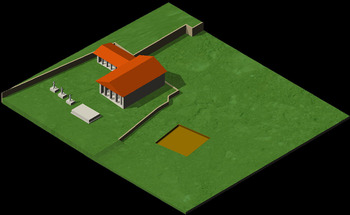
One important issue concerning the deposition needs to be addressed: was it really a wholly unsuitable place? What would this part of the public space of the city have looked like at the time of the deposition? The picture is quite clear for the upper terrace, a few metres away from the ditch. At the end of the fourth century the imposing Doric temple with its attached stoa faced the big altar to the east and dominated the terrace, while three bases for monumental dedications completed the picture of the organised sacred area, as revealed so far (Fig. 29). The finds (inscriptions and statues) demonstrate a connection with Eukleia, deity of glory and good repute, and Zeus Meilichios, a chthonian god bearing the epithet ‘the good-tempered’, but also with the royal family (chiefly Eurydice, mother of Philip II) (Saatsoglou-Paliadeli Reference Saatsoglou-Paliadeli2000). The sanctity of the area throughout the centuries is further underpinned by the big depositional ditch of the late first century bc–early first century ad just outside the northern wall of the temple, which contained statues and inscriptions of the fourth century arranged in a way that recalls burial practices (Kyriakou and Tourtas Reference Kyriakou, Tourtas and Driessen2013; Kyriakou and Tourtas forthcoming). More broadly, the sanctuary of Eukleia along with the palace and the theatre were part of the religious and political centre (basileia) of the city (Höpfner Reference Höpfner, Höpfner and Brands1998).
Model of the main terrace in the sanctuary of Eukleia in relation to the ditch.

Burials in public places and sanctuaries were accorded to eminent persons, mythical figures or hero- and mortal founders. It was beyond doubt a great honour to be buried in central areas of the fortified city (e.g. Malkin Reference Malkin1987, 204–40; Themelis Reference Themelis2000).
To sum up, the study so far has come up with the following basic results:
-
• The gold wreath is the product of a skilled craftsman and lies within the tradition of fourth century Macedonian jewellery.
-
• It is one of five fourth century gold oak wreaths discovered in Macedonia. Three of them come from Aegae, the ancient capital of the Macedonians, of which two are believed to belong to royal burials, one attributed to Philip II and the other to his grandson Alexander IV.
-
• Our wreath shows similarities to the one from the ‘Tomb of the Prince’.
-
• The skeletal remains of the adolescent and the wreath are crucial elements in the interpretation of the assemblage.
-
• The particularities of the burial echo practices related to the ruling family.
-
• The assemblage bears special characteristics that enhance the impact of the wreath as an item with special meaning.
-
• The choice of a sacred and public place for a burial in the last quarter of the fourth century bc is absolutely indicative of the social rank of the dead, but the lack of monumental structures or even some sort of grave marking must be attributed to special historical circumstances.
IX. COMBINING HISTORICAL AND ARCHAEOLOGICAL EVIDENCE: A WORKING HYPOTHESIS
Following the above analysis, the likelihood that the find from the sanctuary of Eukleia is related to the ruling family must be strong. The owner of the oak wreath appears to be a member of the royal house, since he was using an attribute easily recognised in the land of Macedonia as connected with exceptional persons, namely the kings. The gold oak wreath should be considered as an insigne for the boy. According to Diodorus Siculus the royal insignia were the throne, the diadem and the wreath – although we should be careful about the period he refers to (Diodorus Siculus 18.60–1; Huguenot Reference Huguenot2008, 189).
Research in the literary evidence – sources concerning Herakles, son of Alexander the Great
It is reasonable to investigate whether the literary evidence can point us towards any specific members of the Temenid dynasty.
Searching in the history of the royal house we come across Herakles, the illegitimate son of Alexander the Great (Hammond and Walbank Reference Hammond and Walbank1988, 100, 129, 164–9; Wheatley Reference Wheatley1998; Carney Reference Carney2000, 148–50). When the conqueror took control of Susa and the court of Darius, he met not only all the female relatives of the Great King but also noblewomen of the highest rank. Alexander was attracted by Barsine, daughter of satrap Artabazus and of a Rhodian lady. She was of seductive beauty and had had a Greek education. Besides, it is highly possible that Alexander already knew her from their childhood: her father had moved to Philip's court in 352 bc for 10 years with all his kin. Alexander never married Barsine, but their son was named Herakles, after the hero, forefather and almost symbolic prototype of Alexander the Great.
Things changed when Alexander married Roxane and a legitimate heir was anticipated from her. Soon after Alexander's death she gave birth to a boy who was given the name Alexander. Alexander IV was placed in custody when Kassander, who saw the boy as an obstacle to his ambitions, prevailed in the affairs of Macedonia. In 310 bc Kassander gave the order for the murder of the boy and his mother. At that point the general Polyperchon conceived the idea of using Alexander's first son, who was in Pergamum with his mother, and Herakles was brought to Greece, possibly along with his mother, in order to act as a focus of attraction for the army. Unfortunately, in the end Kassander persuaded Polyperchon to kill the boy in exchange for power. Polyperchon acted as ordered and finally also met his own death.Footnote 19 According to Justin, Kassander ordered that ‘the boy and his mother Barsine be secretly killed and their bodies buried without ceremony lest their violent deaths come to light if a funeral were held’ (Justin 15.2.3).
There is an interesting similarity between the descriptions and the material evidence. There was a burial following all the rules of rich funerals of noblemen or royals, namely a cremation, a fabric of purple and gold for the bones, a gold wreath and a gold receptacle. A bronze container served as the protective vessel. No special honours were bestowed on the deceased in the last phase of the funeral, and there was no proper grave. But the funerary receptacles were not buried in an insignificant place. They were possibly transferred from wherever they had been to Aegae, the official burial ground of the ruling dynasty. This ‘homeland’ was considered to hold symbolic meaning. And yet they were not buried in the cemetery, but in a deliberately chosen place, in a public area in the vicinity of the sanctuary of Eukleia, a deity of fame and bravery. The boy, along with the other two people, was buried in the fill of a construction that ceased to be used, as though they were founders of the city.
Symbolic aspects for the heir to the throne
The next issue to arise is that of whether the gold oak wreath would have had symbolic value for Herakles and who would have decided on his appearance and insignia. Is it justified to assume that the oak wreath was chosen on purpose? What has been said above about the promotion of the public image of Philip II touches on only a small part of the use of symbols in the Greek world in the Classical and particularly in the Hellenistic periods. If it was really connected with the royal family, the gold oak wreath would have had a special meaning for the people of the Macedonian kingdom. It had only very recently been worn by Alexander IV, if the ‘Tomb of the Prince’ can indeed be attributed to the murdered legitimate son of Alexander the Great. From this perspective, the oak wreath indicates continuity from the grandfather to the grandsons.
The person who might have decided on the symbols borne by Herakles could have been Polyperchon. He was the one who brought Herakles from Pergamum to Macedonia and in fact used him for his own ends. It is interesting that Polyperchon may have been the person who ordered and supervised the construction of the propylon bearing the names of Philip Arrhidaeus and Alexander IV at the entrance to the sanctuary of the Great Gods on Samothrace (Wescoat Reference Wescoat, Palagia and Tracy2003, 115–16).
In this scheme of interpretation the other two oak wreaths discovered in the area of Amphipolis and Derveni must be regarded as showing the importance of their owners in the society in which they lived and their possible connection to the royal family.
Future work and study
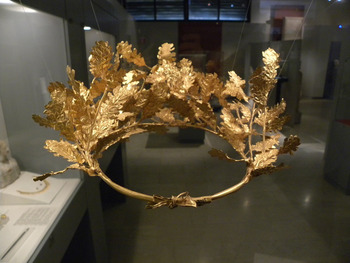
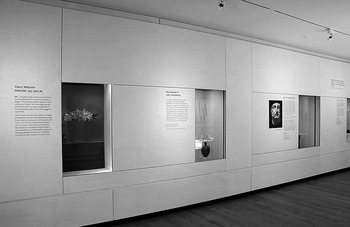
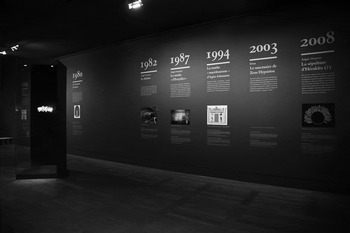
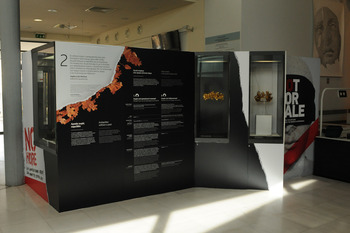
The analysis presented above remains a working hypothesis until the study of the two assemblages is completed. Conservation of the valuable items and bones, and careful examination of the contents of the vessels, form a fundamental step at the beginning of the study. Full exploration of the ditch will also provide the data with which to test this construction. Meanwhile, the biography of the gold oak wreath from the sanctuary of Eukleia has been enriched by new episodes. It was presented for the first time in the exhibition ‘Heracles to Alexander the Great. Treasures from the Royal Capital of Macedon, a Hellenic Kingdom in the Age of Democracy’ in the Ashmolean Museum, Oxford (April–August 2011) (Saatsoglou-Paliadeli Reference Saatsoglou-Paliadeli and Galanakis2011) (Fig. 30), and later (October 2011–January 2012) in the exhibition ‘Au royaume d'Alexandre le Grand. La Macédoine antique’ in the Louvre (Descamps-Lequime Reference Descamps-Lequime2011) (Fig. 31). Right after that, until September 2013, it was exhibited in the Archaeological Museum of Thessaloniki, in ‘Trafficking of Antiquities: Stop it’, where it was shown as a contrast to the myrtle wreath, the product of illegal excavation, which was returned from the Getty Museum to the Archaeological Museum of Thessaloniki (Adam-Veleni Reference Adam-Veleni2012) (Fig. 32). In all these cases it took a new metonymic form, as a representative of an entire assemblage. Soon it is going to be displayed in the new museum at Vergina which is under construction; in this case it is going to be presented together with the gold and bronze receptacles.
Exhibition ‘Heracles to Alexander the Great’ – Ashmolean Museum, Oxford.

Exhibition ‘Au royaume d'Alexandre le Grand. La Macédoine antique’ – Musée du Louvre. Photograph by Antoine Mongodin.

Exhibition ‘Trafficking of Antiquities. Stop it’ – Archaeological Museum of Thessaloniki.

ACKNOWLEDGEMENTS
It is a pleasure to thank friends and colleagues for providing invaluable help in a variety of ways. Prof. Chr. Paliadeli generously handed over the study of the artefact. Alexandros Tourtas followed the course of my thoughts and questions and was always there not only for exciting theoretical discussions, but also for practical issues. Nassia Chourmouziadi, always a stimulating partner in analysing archaeological material, has opened up new, unexplored areas for me. Eleni Mitsopoulou, with her accurate and well-developed arguments, also helped greatly. Rosemary Jeffreys commented in detail on a draft of the article. I am indebted to all of them. The hospitality of the archaeologists and conservators of the Archaeological Museum of Thessaloniki made the study very much easier. Finally, I am also grateful to the anonymous reviewers.
The majority of the illustrations come from the Archive of the Aristotle University of Thessaloniki (copyright of ‘Aristotle University of Thessaloniki – Vergina excavation archive’). The wreath was photographed by Orestis Kourakis. The rest of the photographs, as well as drawings, 3D-models and photogrammetric plans were made by A. Tourtas.