Introduction
Australian dry rainforest communities occur in the country's eastern and northern regions and have structural and floristic similarities to mesic rainforests (Floyd, Reference Floyd1990; Curran et al., Reference Curran, Clarke and Bruhl2008). Throughout the eastern Australian states, small rainforest remnants exist from the once widespread ancient rainforests that covered much of the country (Benson et al., Reference Benson, Richards, Waller and Allen2010). Much of the rainforest vegetation in the region has been cleared for grazing or cropping with few remaining areas currently protected under a conservation agreement (Benson et al., Reference Benson, Richards, Waller and Allen2010; Lucas et al., Reference Lucas, Clewley, Accad, Butler, Armston, Bowen, Bunting, Carreiras, Dwyer and Eyre2014). North-west New South Wales (NSW) has five dry rainforest communities including Cadellia pentastylis (Ooline) forest, which is listed as a Threatened Ecological Community (TEC) under the NSW Biodiversity and Conservation Act 2016 (BC Act) (Curran et al., Reference Curran, Clarke and Bruhl2008). C. pentastylis F.Muell. is the dominant species within the community and itself is listed as vulnerable under the NSW BC Act, the Queensland (QLD) Nature Conservation (Plants) Regulation 2020, and federal Environment Protection and Biodiversity Act 1999 (EPBC Act) due to ongoing threats including land clearing, fire and a lack of recruitment. C. pentastylis has significant biogeographic interest since it is a relic of the once Australia-wide rainforest vegetation during the Pleistocene.
Cadellia pentastylis is a medium to large tree and is a monotypic genus in the Surianaceae, of which there are only four genera and five species in the family (Cronquist, Reference Cronquist1981; Benson, Reference Benson1993). C. pentastylis grows in semi-evergreen vine thickets and sclerophyll vegetation in north-west NSW and in southern and central QLD (Benson, Reference Benson1993). Peak flowering is spasmodic but occurs from October to December and fruit dispersal occurs in December and January (Beadle, Reference Beadle1984; Benson, Reference Benson1993). Three to five fleshy drupes are clustered together from a single flower, each containing a single hard-coated seed (Beadle, Reference Beadle1984). High rates of infertility and invertebrate predation severely impact fruit quality and quantity, and recruitment events appear rare (Benson, Reference Benson1993). Mature individuals are also capable of resprouting from rootstock and coppice from stumps which may help C. pentastylis to persist in drier environments and extended droughts rather than a reliance on successful seed recruitment. Seed biology research is a priority action for its ongoing management and may contribute to the lack of historical recruitment reported in extant populations (Benson, Reference Benson1993). Little is known of its seed biology, including the conditions conducive for germination; however, germination is anecdotally reported to increase following heat treatment (Benson, Reference Benson1993), which could be a response to fire or extreme soil temperatures during heatwaves and suggests that the seeds might have physical dormancy (PY) or physiological dormancy (PD) (Baskin and Baskin, Reference Baskin and Baskin2004).
Fernando and Quinn (Reference Fernando and Quinn1992) identified a palisade cell layer in the endocarp of C. pentastylis seeds indicating possible PY. In Stylobasium (Surianaceae), both S. australe and S. spathulatum seeds have PY due to a well-developed palisade layer in the endocarp (Baskin et al., Reference Baskin, Baskin and Dixon2006). Importantly, palisade cells are also present in seeds from plant families not known to have PY, suggesting that the physical and chemical properties of these cells are important determiners of water permeability (Baskin et al., Reference Baskin, Baskin and Li2000). The primary aim of this study was to determine if C. pentastylis seeds have PY and, because of the previously identified palisade cells, we hypothesized that this was true. A secondary aim was to determine if C. pentastylis seeds have PD. We performed a series of experiments to test our aims by (1) comparing water uptake rates (imbibition) between mechanically scarified and non-scarified seeds; (2) determining if germination increased following a short heat shock treatment and (3) examining if the addition of a gibberellic acid (GA3) or smoke-water pre-treatment increased germination.
Methods
Seed collection and processing
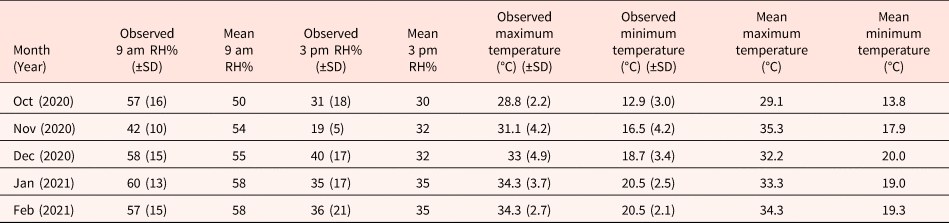
Flowering branches were bagged with organza bags in November 2020 on four mature C. pentastylis trees in Gamilaroi Nature Reserve north-east of Narrabri, in the Brigalow Belt South (BBS) bioregion of NSW. Dispersed fruits, which were presumed to be mature, were collected from within the bags in February 2021. It has been reported in other families that higher than normal humidity may lead to a decrease in physical dormancy levels (Tozer and Ooi, Reference Tozer and Ooi2014). Therefore, humidity and temperature records from the closest Australian Bureau of Meteorology station (Moree, 54 km away) were obtained (Table 1). In the months between flowering and the collection of dispersed seeds captured in organza bags, humidity and temperature recordings were close to average, giving C. pentastylis seeds opportunity to develop physical dormancy (Table 1).
Weather observations from the nearest Australian Bureau of Meteorology weather station at Moree (053115) which is 55 km from the study site.

Cadellia pentastylis seeds were collected in February 2021, so data were obtained for the preceding 5 months (October 2020). The Observed RH% for each month is the mean relative humidity recorded each day in the corresponding month. The Mean RH% is the long-term mean for the corresponding month. The observed maximum and minimum temperatures refer to the mean maximum and minimum temperatures recorded daily for each corresponding month. The mean maximum and minimum temperatures refer to the long-term mean maximum and minimum temperatures for each corresponding month. For observed data, where means were calculated from daily observations, standard deviation (SD) is shown.
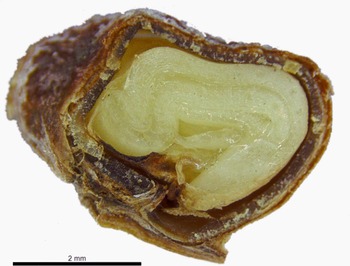
Due to a large proportion of empty seeds, the collection was cleaned and processed in a zig-zig aspirator to separate filled from empty seeds. A cut test on the processed collection resulted in a 90% fill rate. Seeds were visually checked for external signs of invertebrate damage prior to experiments and affected seeds were discarded. Due to the very limited number of seeds in the collection, coupled with the irregularity of seed production in extant C. pentastylis trees we used few but sufficient seed numbers in our experiments to conduct statistical evaluations. We imbibed ten seeds on 0.8% (w/v) water agar for 24 h and quantified the embryo:seed ratio by measuring the cross-section of each seed using a Leica MDG41 microscope. Owing to an approximate ratio of 1 and a clearly differentiated folded embryo, we determined that C. pentastylis seeds were not morphologically dormant (Fig. 1; Martyn Yenson et al., Reference Martyn Yenson, Offord, Meagher, Auld, Bush, Coates, Commander, Guja, Norton, Makinson, Stanley, Walsh, Wrigley and Broadhurst2021).
Cross-section of a Cadellia pentastylis seed after 24 h imbibition on 0.8% (w/v) water agar (scale bar = 2 mm). The embryo:seed ratio was ~1, indicating no morphological dormancy. Image captured using a Leica MDG41 microscope.

Experiments
We first investigated if C. pentastylis seeds showed PY by recording whether the seed coat prevented water imbibition. Prior to imbibing, 20 non-scarified and 20 scarified seeds were individually weighed. Scarification was achieved by manually chipping the endocarp using a scalpel. The seeds were placed on filter paper moistened with reverse-osmosis (RO) water with a numbered grid and incubated at room temperature (20–23°C) for 24. The seeds were removed from the filter paper, weighed, and returned to the filter paper after 1, 2, 4, 6, 8, 24 and 72 h.
To further determine if C. pentastylis seeds exhibited PY, we examined if high temperatures increased final germination. Seeds were exposed to one of five different temperature treatments: 20–23°C (i.e. room temperature control), 60, 80, 100 and 120°C for 5 min. Each temperature treatment comprised 3 replicates of 12 seeds that were spread evenly over pre-heated aluminium trays and then placed in an oven. Following the heat treatment, seeds were removed from the trays and allowed to cool at room temperature. Replicates were sown on Petri plates containing 0.8% water agar and incubated at 20°C with a 12/12 h light/dark regime for 42 d. Seeds were initially checked every 2–3 d for the first 2 weeks then weekly thereafter, and seeds with a radicle >1 mm were recorded as germinated and removed from the plates. A cut test was conducted on non-germinated seeds and seeds with a firm white embryo were scored as viable.
To determine if C. pentastylis seeds exhibited PD, we sowed seeds onto Petri plates containing 0.8% water agar with an additional pre-treatment of 1 ml of RO water, GA3 solution (1000 ppm) or 2% smoke-water solution spread across the plate. Each treatment comprised 3 replicates of 15 seeds and Petri plates were incubated under the same conditions as the heat shock experiment for 35 d. Germination and post-experiment viability checks were also conducted as above.
Statistical analyses
All data analyses were conducted using the R environment for statistical computing (ver. 4.0.2; R Core Team, 2021). The seed weight response data were analysed using a repeated-measures analysis of variance (ANOVA) with full interactions between scarification treatment and time as fixed factors. Seed weight data at 72 h were not included in the analysis as several seeds had germinated and it was expected that this may bias the data.
To calculate the final germination proportion, the cumulative germination after 42 d was divided by the total number of viable seeds in each replicate Petri plate. Time to 50% germination (t 50) was calculated using the Farooq method within the package ‘germinationmetrics’ (ver. 0.1.4; https://cran.r-project.org/package=germinationmetrics, accessed 22 July 2021). The final germination data were fit using binomial generalized linear models (GLMs) with a logit link function, and t 50 data were fit using Gaussian GLMs. An ANOVA was then performed on each model to gain global P-values for each factor.
Results
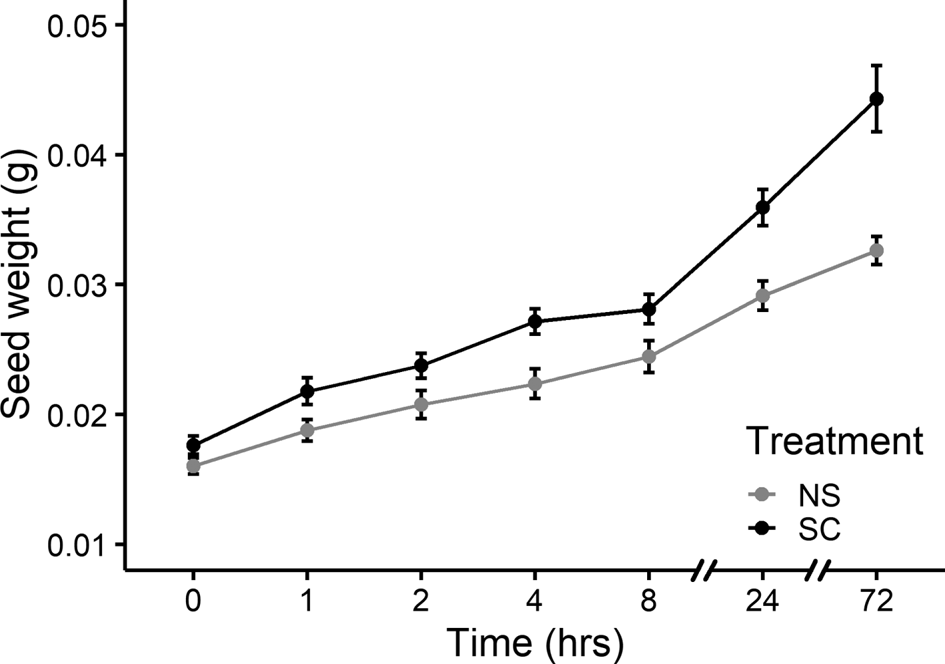
Both non-scarified and scarified C. pentastylis seeds readily imbibed water over a 72-h period (Fig. 2). On average, weights of non-scarified seeds had increased from 0.016 ± 0.002 g to 0.029 ± 0.005 g at 24 h and 0.033 ± 0.005 g at 72 h, representing an increase of 81 and 106%, respectively. Similarly, scarified seeds increased in weight from 0.017 ± 0.003 g to 0.036 ± 0.006 g at 24 h and 0.044 ± 0.011 g at 72 h, representing an increase of 118 and 159%, respectively (Fig. 2). By the end of the experiment, three and nine seeds had germinated in each of the non-scarified and scarified treatments, respectively. The model showed no significant interaction between treatment and time (P = 0.186), however scarified seeds imbibed water at a faster rate as these seeds were significantly heavier than non-scarified seeds throughout the experiment (P < 0.001). On average, seeds in both treatments had significantly increased in weight after 24 h (P < 0.001; Fig. 2).
Average weight (±SE) of scarified (black line) and non-scarified (grey line) Cadellia pentastylis seeds recorded over a 72 h period.

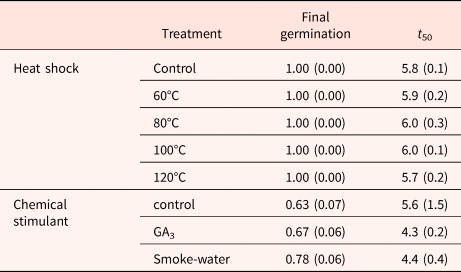
There was no significant effect of heat shock temperature (P = 1.000) or chemical stimulant (P = 0.461) on the final germination proportion of C. pentastylis seeds. All viable C. pentastylis seeds in the heat shock experiment had germinated in 6 weeks (Table 2). By comparison, final proportion germination was lower in the chemical stimulant experiment, with the highest germination recorded for C. pentastylis seeds treated with a 2% smoke-water solution (0.78 ± 0.06), followed by seeds treated with GA3 solution (0.67 ± 0.06) and then the control seeds (0.63 ± 0.07; Table 2). Time to 50% germination ranged from 5.7 ± 0.2 to 6.0 ± 0.3 d among the different heat shock temperatures and from 4.3 ± 0.2 to 5.6 ± 1.5 d among the chemical stimulant treatments (Table 2). The models showed no significant difference in t 50 among heat shock treatments (P = 0.685) or chemical stimulants (P = 0.507).
Mean (SE) final proportion germination and time to 50% germination (t 50) of Cadellia pentastylis seeds following a 5-min heat shock temperature, 1000 ppm gibberellic acid (GA3) or 2% smoke-water solution pre-treatment.

Discussion
Our results showed no physical barrier for water uptake in C. pentastylis seeds, thus our hypothesis of PY in this species was unfounded. In addition, non-scarified and scarified seeds readily germinated after 72 h of imbibition, and pre-treating the seeds with heat, GA3 or smoke-water did not significantly increase germination beyond the control treatments. Most seeds had germinated in the first week of incubation irrespective of the experimental treatment. Therefore, it is unlikely that the seeds have PD, and we conclude that C. pentastylis seeds are non-dormant.
This study reaffirms that the presence of a palisade cell layer does not guarantee PY (Baskin et al., Reference Baskin, Baskin and Li2000). The lack of PY in C. pentastylis may not be surprising given its seeds have a scattered palisade sclereid layer between the mesocarp and endocarp that may not be as strongly formed as observed in other Surianaceae species, such as Stylobasium (Fernando and Quinn, Reference Fernando and Quinn1992; Baskin et al., Reference Baskin, Baskin and Dixon2006). Seeds of the eastern Australian rainforest species and putative relative of C. pentastylis, Guilfoylia monostylis lack a palisade layer and endocarp, are non-dormant and recalcitrant, and capable of germinating at multiple temperatures (Fernando and Quinn, Reference Fernando and Quinn1992; Nkang, Reference Nkang2002). Many other rainforest species are reported to produce non-dormant seeds that readily germinate under suitable environmental conditions. Non-dormant seeds occur for approximately 41 and 49% of pioneer evergreen rainforest trees and non-pioneer rainforest trees, respectively, while seeds from 62% of pioneer species in seasonal rainforest in Northern Territory, Australia, were also non-dormant (Baskin and Baskin, Reference Baskin and Baskin2014; Thusithana et al., Reference Thusithana, Bellairs and Bach2018).
Most non-germinated seeds lost viability during the incubation period due to microbial contamination. There are three possible explanations for this: (1) the conditions may not have been conducive for germination which eventually allowed fungi to encompass the seeds; (2) these seeds might have been less fit or (3) these seeds were only partially filled and may not have been viable. If the former is true, then there might be conditional PD in some seeds as a bet-hedging strategy for ensuring germination success in a region with a highly unpredictable climate (Chenu et al., Reference Chenu, Deihimfard and Chapman2013). The latter may also explain the difference in final germination observed among the different control treatments in our study (Table 2). It is also possible that the cut test on non-germinated and uncontaminated seeds was not an accurate method to assess viability. We recommend that future germination testing of this species should surface sterilize seeds prior to sowing to minimize losses due to microbial contamination and compare seed viability using a cut test and tetrazolium staining.
Cadellia pentastylis is a sporadically flowering dry rainforest tree that occurs in fire and drought-prone environments. Since the seeds tested here were non-dormant, we might expect in situ seed production and dispersal to align with seasonal conditions conducive for germination (Curran and Curran, Reference Curran and Curran2005). However, the observed lack of recruitment might be caused by local environmental conditions quickly deteriorating post-dispersal and becoming unfavourable for germination. Although temperatures may be suitable for germination other factors such as available moisture may be limited and ultimately restrict recruitment (Emery and Collette, Reference Emery and Collette2021). Other trees from the BBS bioregion share similar reproductive and recruitment responses to environmental triggers, including Acacia harpophylla F.Muell. ex Benth. (Brigalow) which exhibits widespread masting following abundant winter and spring rainfall (Pedley, Reference Pedley1978). Poor recruitment might also be caused by low seed fill and invertebrate damage as approximately 80% of the original seed collection was disposed due to these reasons.
Owing to the rarity of C. pentastylis masting events, we recommend that seed collections of multiple populations are made, following national guidelines for threatened plants, and germinated shortly after to produce plants for restoration purposes or stored in ex situ Seedbanks (Crawford et al., Reference Crawford, Cochrane, Breman, Harrison, Quarmby and Driver2021). Importantly, non-viable or insect-damaged seeds should be separated and removed from collections. Monitoring emergent seedlings and examining soil seedbanks for viable seeds following dispersal events will help determine if recruitment failure is caused by poor seed quality or unfavourable environmental conditions. Future research should compare the germination success of C. pentastylis seeds under laboratory and field conditions as the latter may be more relevant for restoration and conservation nurseries. Additionally, as our study tested seeds from a population near the southern extent of its distribution, we also recommend seeds from multiple C. pentastylis populations and fruiting events are examined to determine if germination patterns are consistent.
Acknowledgements
Seeds were collected under a scientific license (SL100569) issued by the New South Wales Department of Planning, Industry and Environment. The authors thank Karen Sommerville for field and laboratory assistance. The authors also thank Susan Everingham and Veronica Viler for laboratory assistance. This work was funded by the NSW Government through a partnership grant between the Saving our Species program and the Environmental Trust (grant number 2018/SSC/0041).
Conflicts of interest
The authors declare none.