Introduction
Cocoa is a valuable export crop for several West African countries (including Ghana), where it is the largest agricultural commodity. It accounted for 16.4% of its export receipts in 2013 (SGER, 2013). In West Africa, the most damaging pests of cacao are the mirids, Sahlbergella singularis Haglund and Distantiella theobroma Distant (all Hemiptera: Miridae) (Entwistle, Reference Entwistle1972; Collingwood, Reference Collingwood and Lavabre1977). The former attacks cacao from Sierra Leone to Central African Republic, almost twice the geographical range of D. theobroma whose centre of abundance is Ghana, where it was once the more damaging of the two species (Collingwood, Reference Collingwood and Lavabre1977). In Ghana, mirids cause losses estimated at 25–30% per annum and as high as 75% in poorly managed farms (Stapley and Hammond, Reference Stapley and Hammond1959; Johnson, Reference Johnson and Wills1962). Babin et al. (Reference Babin, Sounigo, Dibog and Nyassé2004) and Anikwe and Makanjuola (Reference Anikwe and Makanjuola2013) have reported similar losses from elsewhere in West Africa. Damage varies from mild ‘blast’ (where leaves on fan branches die but remain hanging), to ‘staghead’ (where the whole canopy of individual trees is defoliated and shoots die back), to the most severe ‘pockets’ (where up to 100 trees become stagheaded, with corresponding breaks in the cacao canopy) (Johnson, Reference Johnson and Wills1962). For decades, the main method of mirid control has been foliar application of chemical insecticides (Johnson, Reference Johnson and Wills1962; Collingwood and Marchart, Reference Collingwood and Marchart1971; Owusu-Manu, Reference Owusu-Manu2002). However, an increasing market demand for organically produced cacao (Mahrizal et al., Reference Mahrizal, Nalley, Dixon and Popp2012), problems with pesticide-induced secondary pest outbreaks (Entwistle et al., Reference Entwistle, Johnson and Dunn1959), and a desire to minimize pesticide usage has stimulated research for more ecologically benign methods of control (Babin et al., Reference Babin, Sounigo, Dibog and Nyassé2004; Anikwe and Makanjuola, Reference Anikwe and Makanjuola2013), including sex pheromones (Padi et al., Reference Padi, Oduor and Hall2002; Ayenor et al., Reference Ayenor, Van Huis, Obeng-Ofori, Padi and Röling2007; Mahob et al., 2011).
Pheromone traps have become important tools for monitoring and managing pest populations in a range of crops (Witzgall et al., Reference Witzgall, Kirsch and Cork2010). Female S. singularis and D. theobroma were found to produce the same two pheromone components in essentially the same ratio (Downham et al., Reference Downham, Cork, Farman, Hall, Innoccenzi, Phythian, Padi, Lowor and Sarfo2002; Padi et al., Reference Padi, Oduor and Hall2002). Thomson et al. (Reference Thomson, Gut, Jenkins, Hall and Menn1999) report that varying pheromone trap design and placement can produce big differences in the numbers of insects trapped. In Cameroon, Mahob et al. (2011) showed that a rectangular trap constructed from fluted PVC sheet caught almost three times more male S. singularis than did a commercial delta trap, a finding that confirmed findings from an earlier experiment in Ghana using the same trap designs, in which four times more mirids were caught in the rectangular traps than in delta traps (Padi et al., Reference Padi, Oduor and Hall2002). Both trap types consisted of imported materials. While the costs of such imports may be affordable for research studies, if pheromone trapping was expanded country- or region-wide (either for monitoring or for mass trapping) (Ayenor et al., Reference Ayenor, Van Huis, Obeng-Ofori, Padi and Röling2007), locally sourced options would be preferable, to reduce costs and unnecessary imports, and to ensure continuity of supply.
Mahob et al. (2011) deployed their pheromone traps at about 2 m above ground, near to the height found most effective by Sarfo et al. (Reference Sarfo, Padi, Hall, Downham and Ackonor2007), using the same design of rectangular trap. Sarfo et al. (Reference Sarfo, Padi, Hall, Downham and Ackonor2007) used caged virgin female S. singularis as trap bait and found that 3.5x more males were trapped at 1.8 m than at 2.7 m, and almost twice that at 0.6 m. However, these findings were made in a relatively small experiment using six traps at each height and at a single location, so would benefit from confirmation at a wider range of sites and at a more extensive range of heights. In addition, trap height recommendations using virgin females as bait may not be optimal for traps using a synthetic lure, as observed by Yonce et al. (Reference Yonce, Gentry, Tumlinson, Doolittle and Nielsen1976) in the case of the lesser peachtree borer, Synanthedon pictipes (Grote & Robinson) (Lepidoptera: Sessiidae).
The objectives of the present study were to: (a) design a pheromone trap for cacao mirids from locally available materials that are at least as effective as the current best trap; and (b) determine the optimal placement of traps to maximize the catch.
Materials and methods
Study sites and experimental plots
Five experiments were made. Three were made on farmers’ cacao at Suhyen (6° 10′N, 0° 19′W) and Akwadum (two sites, 5° 59′N, 0° 44′W), and one each on CRIG research plantations at Acherensua (7° 1′N, 2° 16′W) and Afosu (6° 23′N, 1°0′W). Cacao trees at farmers’ sites were spaced irregularly, whereas those at CRIG sites were spaced 3 m × 3 m on a square planting. The cacao trees at all sites were upper amazon hybrids growing under partial shade from forest trees, with mostly closed canopies. Occasional canopy breaks were often the sites of mirid pockets, and wherever feasible, they were incorporated as plots for the experiments. No insecticides were applied for at least three months before experiments were started and during the trapping periods. Trees were about 10 years old and 3.5–6.5 m tall in the 7 ha and 3 ha sites at Akwadum, about 15 years old at the 1.5 ha site at Suhyen, 25 years at the 3.5 ha site at Acherensua and 30 years at Afosu in a 10 ha site. At the latter three sites, tree height varied between about 6.0–6.5 m high.
The mirid pheromone was dispensed from polyethylene vials (20 × 8 dia. × 1.5 mm thick; Just Plastics Ltd., Norwich, UK) charged with 1.5 mg of a 2:1 ratio of the diester, hexyl (R)-3-((E)-2-butenoy1)-butyrate, and the corresponding monoester, hexyl (R)-3-hydroxybutyrate and 1.5 mg 4-methyl-2,6-di-tert-butylphenol as antioxidant. The pheromone components were prepared at the Natural Resources Institute and were >95% pure by gas chromatographic analysis. Single lures, suspended 1–2 cm above the lowest heights of the apertures, were replaced at least monthly. The traps were either cleaned or replaced at the same intervals. A polybutene sticker (Agralan, Ashton Keynes, Wilts., UK) was used for sticky traps and a dilute solution of detergent in water in bottle traps.
Experiment 1: trap design
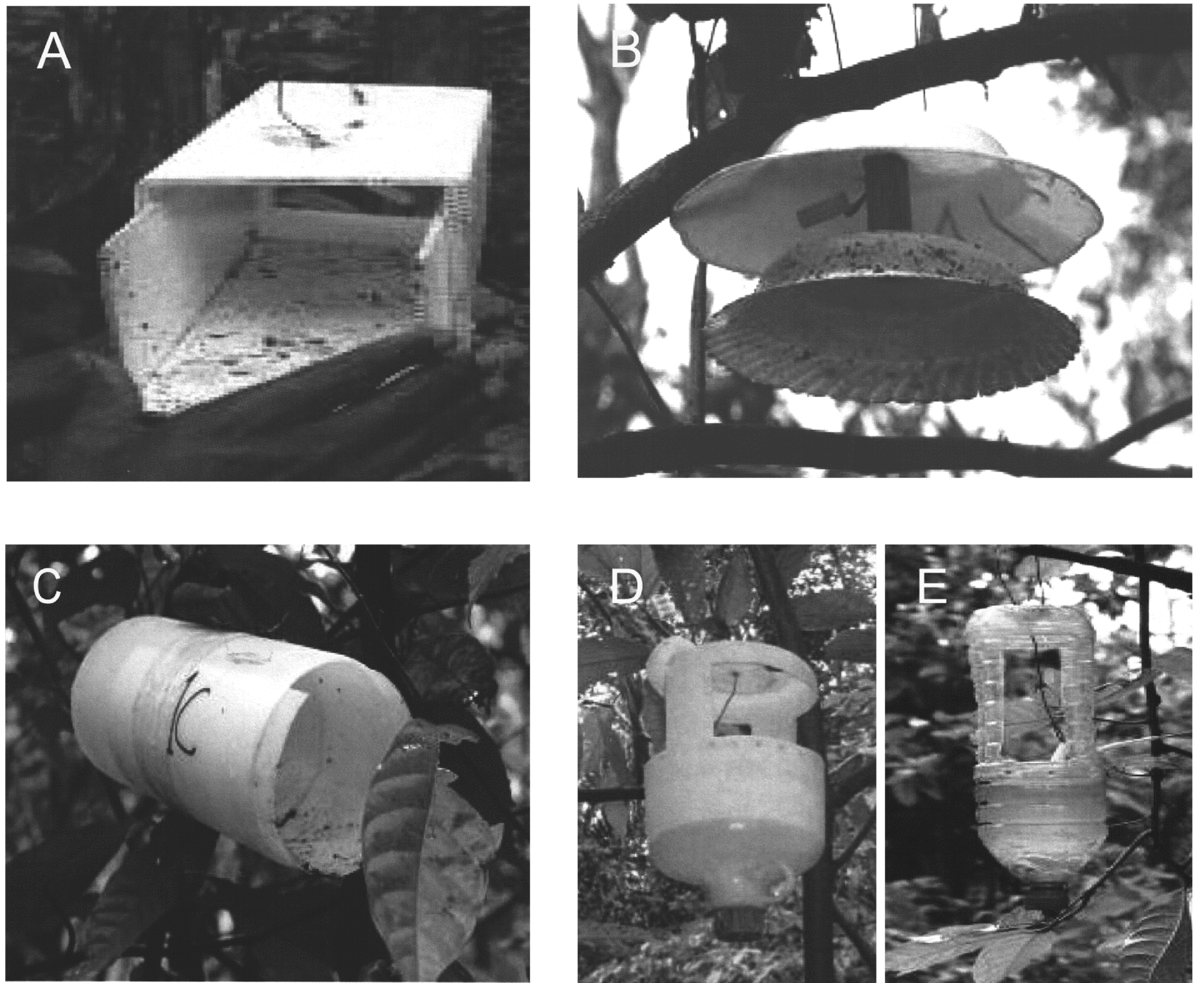
Five trap designs (three sticky and two water) were compared in the 7 ha site at Akwadum, using a randomized complete block design (RCBD) replicated eightfold. The aperture of all traps was standardized at 280 cm2 and in each trap a single lure was suspended by a wire ca 2 cm above the trapping medium. The traps (Fig. 1A–E) were as follows: (1) the rectangular design, as used by Sarfo et al. (Reference Sarfo, Padi, Hall, Downham and Ackonor2007) and Mahob et al. (2011) constructed from fluted PVC sheet (‘Correx’; Sign Trade Supplies, Maidstone, UK), folded into open-ended boxes 38L × 10W × 14H cm lined with a second Correx sheet 38L × 9.6W × 12H cm coated with sticker on sides and base, and deployed horizontally; (2) two circular plastic soup dishes from the local market deployed face down with the upper dish (18 cm dia.) separated from the lower (16 cm dia.) by a 5 cm wooden pillar. The upper surface of the lower dish was coated with sticker; (3) a cylinder trap constructed from two 2.5L high-density polyethylene (HDPE) bottles (13.4 cm dia.) with the neck portions removed and joined to form a hollow cylinder 34L cm and with an insert of the same material cut to occupy about 80% of the inner surface and coated with sticker. The cylinder was deployed horizontally; (4) large water trap constructed from a 4.5L polyurethane bottle (26H × 16 cm dia.) with two opposed windows (each 7.0 × 20 cm) cut in the sides; (5) small water trap constructed from a 1.5L polyethylene terephthalate (PET) water bottle (31.0H × 8.0 cm dia.) with four windows (5 × 14 cm) spaced equidistant radially. The bottle traps were inverted and filled to just below window level with the trapping solution. The traps were suspended from cacao trees at a height of 1.8 m, with an inter-trap spacing of 20 m and inter-block spacing of 40 m. Traps were emptied three times a week and systematically moved to the next position in each block at fortnightly intervals, so that each type of trap was exposed for the same length of time in every position in each plot. As Perry et al. (Reference Perry, Wall and Greenway1980) pointed out, such a systematic rotation of traps forms a Latin square design. The experiment was run from 3 March 2007–30 May 2008, and was halted after six rotations of the treatments when it was apparent that the null hypothesis of no significant difference between treatments would not be rejected.
Pheromone traps tested. A: Rectangular (sticky tray part exposed for illustration), B: Dish (entire upper surface of lower dish with sticker), C: Cylinder (sticky liner part exposed for illustration), D: Large bottle and E: Small bottle. In operation, bottle traps are filled to 1 cm below the aperture with water. A pheromone lure suspended by wire is visible in traps A, B, D and E, but obscured in C by the angle of view. The aperture of all traps is a standardized 280 cm2.

Experiment 2: increased trapping surface area
Behavioural observations, made while conducting Experiment 1, showed that male mirids often landed first on the outer surface of traps from whence they either entered and became trapped, or dispersed and escaped immediate capture. This experiment at Afosu aimed to assess whether trap efficiency could be improved by increasing the retention area. Mirid pockets of at least 30 × 30m and at least 40 m apart were chosen for the experiment. A RCBD was used, replicated eight-fold. The four traps in each block were arrayed 20 m apart in a square pattern. The treatments were: (1) the large water trap as described above, (2) large water trap with the outer surface completely coated with sticker, (3) sticky cylinder trap as described above, and (4) cylinder trap with the outer surface coated with sticker. Traps were emptied weekly and their positions moved round so that every trap in each block was exposed for an equal time in each quarter. Unlike Experiment 1, and in light of new evidence, the traps were deployed immediately below cacao canopy height. The experiment was run from 10 May–14 June 2011 and was halted after one full rotation of treatments, as F-tests already showed (P<0.001) that the objectives were met.
The following three experiments were made with the aim of establishing the optimal height(s) and pattern of deployment of traps. The large bottle traps described in Experiment 1 were used.
Experiment 3: effect of traps at three heights on the same cacao tree
The experiment was made at Acherensua. Traps were suspended at 0.6, 1.8 and 2.7 m above ground level on a single cacao tree at 15 locations spaced at least 20 m apart. The 45 traps were emptied fortnightly and the experiment run from 28 January–20 July 2009, and halted once F-tests showed (P<0.001) that the objectives were met.
Experiment 4: effect of traps at different heights on single poles
Results from Experiment 3 suggested that deploying traps at elevations above 2.7 m might be beneficial. The experiment was made at Suhyen from 12 March–3 August 2010. Four traps were suspended from each of 10 vertical bamboo poles sited among the cacao trees at 1.8 m and 2.7 m above ground level, 0.3 m below the 6.5 m high canopy and 0.3 m above it. The poles were sited at least 20 m apart, and catches recorded weekly. The experiment was terminated after 21 weeks of trapping, once F-tests showed (P<0.001) that the objectives were met.
Experiment 5: isolated single traps
The third height experiment was designed to test whether traps should be positioned relative to the local elevation of the tree canopy rather than at specific heights. The experiment was made in a 3 ha farm at Akwadum from 20 March–8 August 2010. Five treatments were compared in a RCBD experiment replicated sixfold. The traps were suspended on separate trees at 1.8 m above ground, 2.7 m above ground, 0.3 m below the ca. 6.5 m high canopy, 0.3 m above the ca. 6.5 m high canopy and at 1.8 m and below the canopy of a 3.5 m high cacao tree. Short trees were relatively uncommon and were surrounded by taller trees, so it was unfeasible to deploy a trap above the canopy of the short trees, as the canopies of adjacent taller trees would shroud them. Traps were spaced at least 30 m apart with an inter-block spacing of at least 40 m. Trap catches were recorded weekly. The experiment was halted after 26 weeks trapping, after successive F-tests showed consistently significant differences (P<0.05) between means.
Data analysis
Data were analysed using GenStat 9. Total trap catches were compared by ANOVA either raw, or transformed (√x + 0.5) to stabilize error variances. However, we found that the transformation neither altered the relationships between variables nor altered the statistical significance of the F-values and the significances of differences between means. Nonetheless, all ANOVA's were performed on transformed data, to preserve the validity of the distributional assumptions, but all means and SEs are presented using untransformed data, as this aids interpretation.
Two trap heights (1.8 and 2.7 m) were common treatments in the three height experiments. Pimentel-Gomes’ (Reference Pimentel Gomes1970) method for jointly analysing RCBD experiments with common treatments was used to combine the three height experiments in a single ANOVA, to improve the precision of the estimated optimal trap height.
A perusal of the data from Experiment 2 suggested that applying a sticker to the outside of the traps increased the overall catch and numbers of mirids entering traps coated with additional sticker. We examined this possibility by partitioning the variance and applying a linear contrast of numbers caught inside sticker-coated traps vs. numbers caught inside non-coated traps. Where ANOVA indicated significant F-ratios (P<0.05), differences between means were compared by Student–Newman–Keuls (SNK) test.
Results
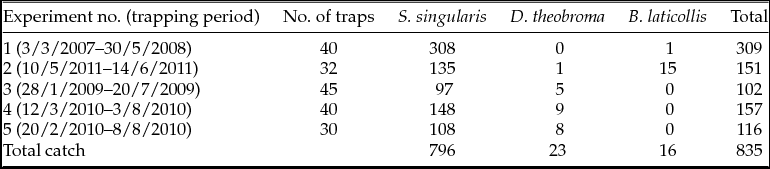
Sahlbergella singularis dominated the catches in all experiments (Table 1), followed by D. theobroma, which was trapped at four of the five sites, but in low numbers, and by B. laticollis, which was trapped at two sites (Akwadum and Afosu). Males only were trapped.
Total numbers captured in sex-pheromone traps of male Sahlbergella singularis, Distantiella theobroma and Bryocoropsis laticollis (Heteroptera: Miridae)

Experiment 1: trap design
No significant differences between any of the trap designs in the numbers of S. singularis caught (F = 0.10, df = 4,28, P>0.05) with mean (±SE) totals of 5.6 (±1.16), 7.7 (±3.10), 6.6 (±0.86), 8.3 (±4.79) and 7.5 mirids (±3.14) in rectangular, dish, cylinder, large and small water bottle traps, respectively, were noted. Although no significant differences between treatments were recorded, the large bottle traps were selected for the height experiments, as they had the highest mean catches and were constructed from local materials.
Experiment 2: increased trapping surface area
Increasing the trap catch area with an external coating of sticker increased the total catch of S. singularis by 4.4-fold for large bottle traps and 2.7-fold for cylindrical traps (F = 5.99; df = 5,35, P<0.001) (Table 2), suggesting that 80% of S. singularis males that responded to the pheromone released from bottle traps dispersed and avoided capture. Similarly, adding data for the other two mirid pests increased the difference marginally for bottle traps to 4.5-fold, and to 3.0-fold for the cylinder trap (F = 6.73; df = 5.35, P<0.001). The one D. theobroma caught (Table 1) was trapped in sticker on the outer surface of a trap, as were 11 of the 15 B. laticollis caught, but the difference between numbers caught inside and outside of traps for the latter species was non-significant (χ 2 = 2.4 with Yates’ correction).
Mean (±SE) catch of male cacao mirids in eight replicates of each trap treatment (Afosu; 10 May–14 June 2011)
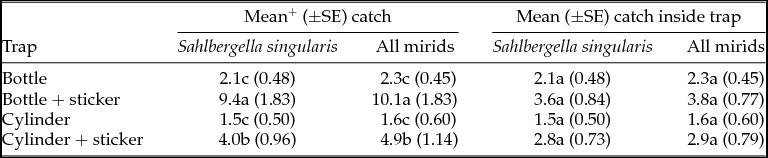
+Means in the same column followed by the same letter are non-significantly different P>0.05 by SNK test.
Spreading sticker on the outside of traps also increased significantly the overall numbers of S. singularis caught inside those traps compared to unenhanced traps (Mean (± SE) enhanced = 3.2 (±0.55), unenhanced = 1.8 (±0.34); F = 4.5; df = 1,35, P<0.05) and similarly for total mirids (enhanced = 3.3 (±0.55), unenhanced = 1.9 (±0.37); F = 5.60; df = 1,35, P<0.05), but failed to increase the catches in the two trap types individually (Table 2).
The results from this experiment further confirm the parity of performance between unenhanced bottle and cylinder traps found in Experiment 1, as there were no significant differences in mean catches between these two trap types (Table 2).
Experiment 3: effect of traps at three heights on the same cacao tree
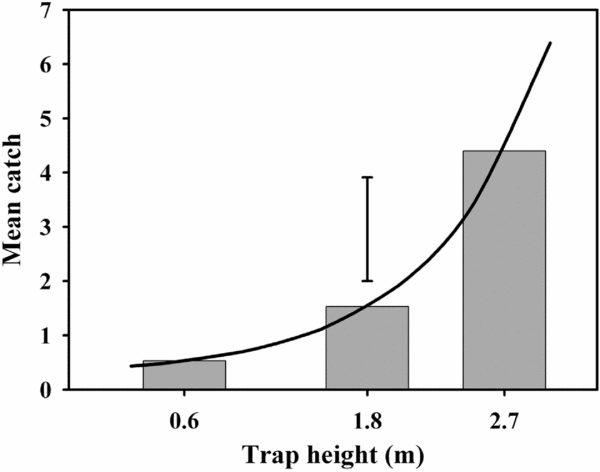
The mean catch of S. singularis increased exponentially with increasing trap height (Fig. 2). The best-fit exponential curve (SE of parameter in parentheses) was y = 0.27 (±1.23) + 0.117 (±0.397) × 3.74 (±4.37)x, which explained 26.6% of the variance and 52.8% after the inclusion of separate parameters for each block. The equation for the exponential curve using transformed data provided a marginally better fit (31.1 and 56.2% of variance explained, respectively). The catch was significantly greater at 2.7 m (F = 10.93; df = 2,42; P<0.001) than at 0.6 and 1.8 m, which were not significantly different (Fig. 2).
Mean catch in pheromone traps of Sahlbergella singularis at three heights above ground level on a single tree (vertical line = 5% LSD), and the best fit exponential curve, y = 0.27 + 0.117 * 3.74x (Acherensua; 28 January–20 July 2009).

Experiment 4: effect of traps at different heights on single poles
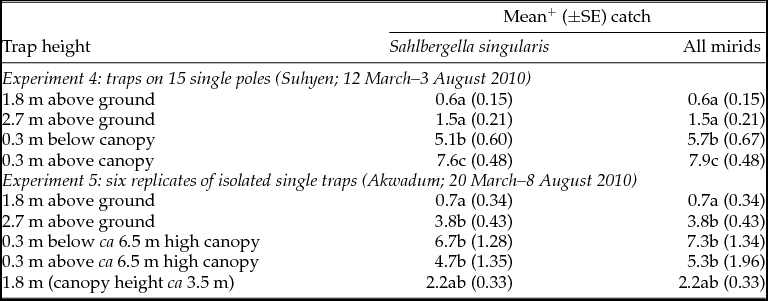
Mean catches of S. singularis increased significantly the closer traps approached the canopy from below and were significantly higher still (P<0.05) just above the canopy than just below (F = 33.98; df = 3,27, P<0.001) (Table 3). Distantiella theobroma was only trapped at the two highest elevations. Six individuals were caught just below the canopy and three above it. Including them in the analysis reinforced the conclusion that traps at near canopy height were the most effective for trapping male mirids (F = 35.48, df = 3,27, P<0.001).
Mean (±SE) catch of cacao mirids in traps at different heights

+ Means in the same column followed by the same letter in each experiment are non-significantly different P>0.05 by SNK test.
Experiment 5: isolated single traps
As in the previous experiment, the number of S. singularis caught increased with increasing trap height towards the underside of the canopy, although in this experiment no significant difference was noted between mean catch immediately below the canopy and just above it (F = 3.52; df = 4.20, P<0.05) (Table 3). Significantly, more S. singularis were caught in traps at 2.7, 6.2 and 6.8 m than at 1.8 m, whereas no significant differences between the catch at 2.7 m and at 1.8 m under low canopy trees, and no significant difference in catches at 1.8 m between tall and short trees (Table 3) were noted. Again, D. theobroma was only caught in traps at the two highest elevations with four individuals trapped at each of the locations immediately below and above the tall tree canopy (F = 3.78; df = 4,20, P<0.05), but the statistical relationships between trap positions were unaltered when these insects were included in the ANOVA.
Applying Pimentel-Gomes’ (Reference Pimentel Gomes1970) method to S. singularis data sets from experiments 3–5 gave adjusted means (±SE) of 0.13 (±0.19), 0.96 (±0.31), 2.75 (±0.59), 6.45 (±0.62) and 6.87 (±0.63) insects at 0.6, 1.8, 2.7, 6.2 and 6.8 m, respectively, which gives an estimated optimal trap height for capture of S. singularis as 5.6 m (±2.40 SD), on the assumption that the mean canopy height was 6.5 m. The adjusted mean catch for the traps at 1.8 m under 3.5 m high trees was 1.79 (±0.19) insects, but was not used for calculating the optimal trap height relative to the main canopy trees. A similar analysis was impossible for D. theobroma, as none was trapped at 1.8 and 2.7 m in Experiments 4 and 5.
Discussion
Three mirid pests of cacao were trapped in the present study, 95% S. singularis, 3% D. theobroma and 2% B. laticollis. The serendipitous capture of B. laticollis males in the pheromone traps suggests that, like the two more common mirid pests, it too may utilize similar sex pheromone chemistry. Collingwood (Reference Collingwood and Lavabre1977) reported that at that time D. theobroma was the most damaging of the two common mirid species averaging from 30 to 70% or more of all cacao mirid collections, although as a pest its range from Cameroon to Ivory Coast was much more restricted than that of S. singularis. For example, in Cameroon, its abundance was estimated as 1% of collections and from 2–18% in Nigeria, with S. singularis almost alone in making up the rest (Collingwood, Reference Collingwood and Lavabre1977). In Cote d'Ivoire, Lavabre et al. (Reference Lavabre, Decelle and Debord1963) reported that of 57,958 mirids collected over 2 years 74.2% were S. singularis, 25.8% D. theobroma and 0.01% B. laticollis. However, D. theobroma fluctuated between 0 and 93% of the mirid population at different localities in that study. Our results from five widespread sites suggest that D. theobroma may be declining in abundance in Ghana, as suggested by Owusu-Manu (Reference Owusu-Manu1994). However, the low trap catches may have been due to other factors, such as the known extremely patchy distribution of this species (Collingwood, Reference Collingwood and Lavabre1977), lower effectiveness of the traps and/or lures for this species and/or the trapping periods may have been outside the species outbreak period. More widespread surveys are required using pheromone traps and other means of population assessment.
The objective of the trap design experiment was to identify the best performing trap, preferably one that could be fabricated using locally available materials only. The latter consideration is important, given the large numbers of traps that would be needed in, for example, a nationwide monitoring programme, or for control by mass trapping. All of the traps tested were as effective as the rectangular design, which previous experiments had shown was superior to delta traps (Padi et al., Reference Padi, Oduor and Hall2002; Mahob et al., 2011). Because the local designs was as effective as the rectangular trap, factors such as cost, durability, availability of materials, ease of fabrication and convenience become important considerations. As the polybutene sticker used in the sticky traps must be imported, it follows that one of the water traps would be preferred for any extensive programme involving pheromone trapping.
The water traps were made from local materials that are easily available and cheap in local markets or wholesale suppliers. They were simple to fabricate and the large bottle trap was particularly durable. However, insects caught in water decompose rapidly in tropical temperatures, making identification and counting difficult (if they were left beyond a month in water traps), although replacing the water with brine may reduce decomposition. Also, the traps needed frequent topping up, owing to evaporation and/or drinking by birds and arboreal mammals. The water traps are, therefore, most suitable where no specific identification or count of the numbers of insects caught is needed (such as in a mass trapping or lure-and-kill programmes).
The sticky traps were also simple to fabricate and the materials were cheap to buy. Catches by these traps were identifiable after a month; therefore, unless a local substitute sticker can be identified, such traps would be most suitable for scientific monitoring of insect numbers, where species counts are needed. Furthermore, their cost is less restricting. Although water traps have been deployed for other mirid species (e.g. Yasuda and Higuchi, Reference Yasuda and Higuchi2012), this is the first study in which pheromone-baited water traps have been tested for capture of cacao mirids.
Results of the increased surface area for trapping experiment showed an up to 4.5-fold increase in catches when the outer surface was coated with sticker. This experiment suggests that perhaps 80% of mirids responding positively to the pheromone from unenhanced traps may disperse and escape capture, and if this behaviour proves species-specific, it implies that sticker-enhanced traps would be essential for monitoring species’ relative abundance. Applying polybutene sticker to the exterior of water traps defeats the criterion for using only local materials. Moreover, owing to the accumulation of dust and other debris, the exposed sticky surface needs regular cleaning and replenishment. However, for non-research purposes where insect counts are unwanted, it may be possible to impregnate the outer trap surface with a mammalian-safe contact insecticide (such as a synthetic pyrethroid) to kill mirids that land on the trap. Alternatively, one could reduce the proportion of surface area of the trap by increasing the size and number of windows, with a possible benefit of rendering such traps more omni-directional.
One surprise finding was that applying sticker to the outside of pheromone traps increased significantly the numbers of S. singularis caught inside those traps. A possible explanation is that mirids may divert their flight path towards the trap entrance when they encounter the sticker odour, or dying mirids on the outside of the trap may release decay odours (or even an alarm pheromone), as suggested by Trematerra et al. (Reference Trematerra, Fontana and Mancini1996) for the flour beetle Tribolium castaneum (Herbst.), and so be diverted from landing on the outside of the trap into the catching arena.
McBrien and Millar (Reference McBrien, Millar, Hardie and Minks1999) suggest that some mirid species fly into pheromone-baited traps, while other species land initially in the vicinity of the pheromone source. They report that the latter behaviour is more common among other heteropteran families. Results from the present study (in which up to 80% of mirids were trapped on the outer surfaces of two trap types), suggest that direct flight into traps in response to a pheromone point source may be uncommon behaviour for S. singularis (and possibly for B. laticollis). Similarly, Storberget (Reference Storberget2014) reported that 80–93% of Lygus rugulipennis Poppius landed on the outer surface of pheromone traps in a strawberry crop.
In the trap height/placement experiments, trap catches of S. singularis showed a closer association with the cacao canopy than with absolute trap height. Although too few D. theobroma males were caught for parametric statistical analysis, all but five of the 22 caught in the three height experiments were trapped near the canopy. The increased catch of S. singularis by deploying traps close to canopy level, compared with deploying them at 1.8 m, which is the previously recommended trap height (Sarfo et al., Reference Sarfo, Padi, Hall, Downham and Ackonor2007), increased the numbers caught by an average 12-fold. Similarly, increased catches were seen at both Suhyen and Akwadum, despite the presence of four traps at each trap location at the former and a single trap at each trap point in the latter. The significant differences between captures at the various heights when multiple traps were presented suggests that there is little vertical displacement by S. singularis males when tracking to pheromone lures and little overlapping of the pheromone plumes, possibly because of long periods of calm air flow below the canopy (Murlis et al., Reference Murlis, Willis and Cardé2000). However, our results suggest that the majority of mate-seeking males of both species orient flights near canopy height. Other non-cacao mirid species have been reported to orient flight near canopy level (McBrien et al., Reference McBrien, Judd and Borden1996; Ishimoto et al., Reference Ishimoto, Sato, Muraoka, Aoki, Takita, Noguchi, Fukumoto, Mochizuki, Takahashi and Higuchi2006) and such behaviour is not uncommon for other non-mirid pests; for instance, the apple leaf roller Archips pomivora Meyrick (Bhardwajt and Chander, Reference Bhardwajt and Chander1992).
The recommended trap height of 1.8 m is 1.58 SDs from the estimated mean optimal trap height of 5.6 m, and as such, fewer than 25% of the total males in flight in mature cacao are likely to encounter the traps, i.e. those flying between 1.8 and 2.7 m, although 1.8 m may be an appropriate elevation for traps in either immature cacao or clonal plantations. The estimated optimal trap elevation from our experiments is ca 1 m below the top of the cacao canopy; however, as only a single trap height was investigated above the canopy, further trapping experiments are needed to establish whether S. singularis males fly above or below the cacao canopy.
The results suggest that the two experimental layouts, i.e. having several traps at a single position or single traps at several positions, produced similar distribution patterns for S. singularis and less convincingly for D. theobroma, owing to the low numbers of this species that were trapped. However, results from the experiment with single traps were less precise than from the experiments with multiple traps at one position, owing to the greater plot-to-plot variation arising from the patchy spatial distribution of mirids (Gibbs et al., Reference Gibbs, Pickett and Leston1968; Bisseleua, et al., Reference Bisseleua, Yede and Vidal2011).
Conclusion
Mirids are the most important insect pests of cacao in West Africa. The current dependence on blanket applications of synthetic insecticides for managing them is ecologically unsustainable. Exploitation of the known synthetic sex pheromones of the two dominant species provides opportunities for ecologically benign management. We found that pheromone traps made from products locally available in Ghana were as effective at capturing male mirids as the previous best trap fabricated from imported materials. Coating the exterior of traps with a sticker increased mirid captures 4.4-fold in the best trap, and siting traps near canopy level also increased catches 12-fold compared to siting them at eye level. Further work is needed to establish whether this potential ca 50-fold improvement to current pheromone trapping practice will provide an adequate base for developing ecologically benign, sustainable management of cacao mirids.
Acknowledgements
We are grateful to Cocoa Research (UK) for funding this work. We thank Dr Godfred Awudzi, Messrs Henry Ahiagaziga, Ebenezer Kwapong, Emmanuel Owusu, Colins Asumadu, Dickson Ampadu, Ebenezer Obeng-Mintah, Gordon Fiakegbe and Kofi Dadzie for technical assistance. This paper is published with the permission of the Executive Director, CRIG.