INTRODUCTION
Several species from the Trypanosoma and the Leishmania genus are multi-host parasites of mammals whose distribution sometimes overlaps (Guhl and Vallejo, Reference Guhl and Vallejo2003; Quinnell and Courtenay, Reference Quinnell and Courtenay2009). This is particularly frequent in the Amazon Basin, where Trypanosoma cruzi, T. rangeli and some Leishmania species are described (Deane and Damasceno, Reference Deane and Damasceno1961; Miles et al. Reference Miles, Arias, Valente, Naiff, de Souza, Povoa, Lima and Cedillos1983; Dias et al. Reference Dias, Quartier, Romaña, Diotaiuti and Harry2010). The municipality of Abaetetuba, Pará State, is a place where at least 2 out these trypanosomatids, T. cruzi and L. infantum (syn. L. chagasi) cause severe health impacts in the local population: since 2006, more than 100 cases of acute Chagas Disease (ACD) and 70 cases of Visceral Leishmaniasis were registered (data from the Public Health Secretary of Pará State – SESPA). A challenging factor in the control of these zoonoses is the involvement of various wild reservoir hosts and their proximity to human settlements. Even in urban areas, the commonest feature of the Abaetetuba municipality is the closeness between domiciliary and wild environments, without clear boundaries between them.
In spite of being included in the same family and sharing some antigenic and molecular characteristics (Ferguson, Reference Ferguson1997), T. cruzi, T. rangeli and Leishmania spp. selected different life strategies along their evolution. T. cruzi and T. rangeli can produce mixed infection in both vectors – triatominae species from the Rhodnius genus (Heteroptera, Reduviidae) – and their multiple vertebrate mammalian hosts; but while the first is transmitted by a contaminative and/or oral route (feces of infected bugs), the latter is transmitted exclusively by the vectors' bite (Guhl and Vallejo, Reference Guhl and Vallejo2003; Noireau et al. Reference Noireau, Diosque and Jansen2009). L. infantum is transmitted to several mammal species by parasite regurgitation during a bloodmeal taken by an infected sand fly, mainly Lutzomyia longipalpis (Diptera: Psychodidae) (Lainson and Rangel, Reference Lainson and Rangel2005; Gramiccia and Gradoni, Reference Gramiccia and Gradoni2005).
Tamandua tetradactyla (Xenarthra, Myrmecophagidae) belong to the South American autochthonous fauna and can be found in diverse habitats, such as grasslands and transitional forests in all Brazilian biomes (Hayssen, Reference Hayssen2011). The anteater is nocturnal and can be found in hollow trees, burrows of armadillos, or other natural cavities (Medri et al. Reference Medri, Mourão, Rodrigues, Reis, Perachi, Petro and Lima2006). Anteaters are believed to be ancient hosts of T. cruzi (Yeo et al. Reference Yeo, Acosta, Llewellyn, Sánchez, Adamson, Miles, López, González, Patterson, Gaunt, de Arias and Miles2005) and since the 1940s T. cruzi infection has been described in T. tetradactyla from the Amazon basin (Rodrigues and Melo, Reference Rodrigues and Melo1942). This anteater species was found infected also by T. rangeli in the Brazilian Pará state (Miles et al. Reference Miles, Arias, Valente, Naiff, de Souza, Povoa, Lima and Cedillos1983). Concerning Leishmania sp. infection, only L. guyanensis (Lainson et al. Reference Lainson, Shaw and Povoa1981) and L. amazonensis (Mimori et al. Reference Mimori, Grimaldi, Kreutzer, Gomez, McMahon-Pratt, Tesh and Hashiguchi1989) were described infecting this anteater species.
Here, we describe an anteater infected by 3 trypanosomatid species (T. cruzi, T. rangeli and L. infantum) in a single bone marrow sample. The implications of this finding are discussed considering the influence of mixed infections on the role of this mammal species as a putative reservoir of these 3 trypanosomatid species.
MATERIALS AND METHODS
Study area and anteater capture
Within the Amazon basin, the Abaetetuba municipality is located in the Pará state, northern Brazil (01°43′05″S 48°52′57″W). The urban portion of the municipality is surrounded by agricultural areas, with a few remaining patches of the original Amazonian forest. The rest of the municipality is represented by islands composed by freshwater swamp forest, fitted between diverse river banks. In 2008, due to the recurrent and spread cases of Chagas disease, Abaetetuba was included in a Government Program supported by the Pará State to study the local Trypanosoma cruzi transmission.
In August 2008, during a field expedition, an anteater (Tamandua tetradactyla) was captured by the Fire Department in a house backyard in the periphery of the urban area and transported to the field laboratory. This anteater, an adult female, was anaesthetized, clinically examined and had its blood and bone marrow collected for further examination. Just after its complete recovery from the anaesthesia, the animal was released in a native area designated by the firemen.
Sample collection and parasitological assay
The anteater was anaesthetized (Ketamine, 100 mg/kg in combination with Acepromazin 1%) and approximately 1 ml of blood was collected by cardiac puncture. Half of this amount was inoculated into 2 sterile tubes containing Novy-McNeal-Nicole medium (NNN) with a liver infusion tryptose medium (LIT) overlay, and fresh blood samples were gathered and microscopically examined. A bone puncture was performed in the anteater`s femur and the collected material (approximately 0·3 ml) was inoculated in the same culture medium. A remaining drop of this material was imprinted in a slide smear and Giemsa-stained for microscopic examination. All procedures followed protocols approved by the FIOCRUZ Committees of Biosafety and of Bioethics (L0015/2007) and licensed by the Brazilian Institute of Environment and Renewable Natural Resources (IBAMA/CGFAU/LIC) (license 3665-1).
The cultures were examined once a week for the presence of trypanosomatids. Positive cultures were amplified in NNN medium with LIT (blood culture) or Schneider's (bone marrow culture) overlay for a maximum of 3 passages. Parasites obtained from blood culture were processed for DNA extraction as described below. The parasites from the bone marrow culture were divided into 2 samples: the first was used for experimental infection and DNA extraction (Sample A); while the second was amplified for an additional month and also processed for DNA extraction (Sample B).
Experimental infection and necropsy procedures
Two golden hamsters (Mesocricetus auratus) were intradermally inoculated into the right footpad (0·05 ml maximum volume) with the cultured material obtained from the anteater`s bone marrow. The inoculum was carried out with 1·7 × 105 parasites/animal derived from the culture with only 2 passages performed. From these, approximately 5% of the mixed culture was composed of promastigote forms and the remaining were epimastiogote and trypomastigote forms. T. cruzi metacyclic forms were about 20% of the mixed culture. The hamsters were obtained from the Oswaldo Cruz Foundation animal facilities and weekly accompanied for 3 and 4 months. The animals were provided with food and water ad libitum and kept under conventional conditions (temperature 24 °C, natural daylight) in polycarbonate cages with sawdust as bedding.
Euthanasia was performed with the animal previously anaesthetized (Ketamine, 100 mg/kg in combination with Acepromazin 1%) after intracardiac injection of potassium chloride 19·1% (4 ml/kg bodyweight). All procedures for parasitological diagnosis were undertaken in a biosafety cabinet: (i) inoculation of fragments of spleen, liver, inoculation site and bone marrow in biphasic culture mediums (NNN/Schneider's), which were examined every 3–4 days for 1 month; and (ii) slide imprints of spleen, liver and inoculation site, which were Giemsa-stained and microscopically observed at 400X magnification. The necropsy procedures followed protocols previously published (Roque et al. Reference Roque, Cupolillo, Marchevsky and Jansen2010).
DNA extraction for molecular characterization
Parasites were centrifuged (4000 g) at the end of the log phase and were washed 3 times with PBS, re-suspended in 1 ml of TE (10 mM Tris–HCl, pH 8·0/10 mM EDTA, pH 8·0) and incubated at 56 °C for 2 h with 100 mg/ml of proteinase K and 0·5% SDS (sodium dodecyl sulfate). The DNA of the lysed cells was extracted with phenol/chloroform (1:1) and precipitated after the addition of sodium acetate and ethanol (Sambrook et al. Reference Sambrook, Fritsch and Maniatis1989).
Molecular characterization of Trypanosoma spp. isolates
A mini-exon multiplex PCR (polymerase chain reaction) assay was carried out as described by Fernandes et al. (Reference Fernandes, Santos, Cupolillo, Mendonca, Derre, Junqueira, Santos, Sturm, Naiff, Barret, Campbell and Coura2001) with the following modifications: 10 μg of DNA as template, 25 pmol of each primer, 120 μM deoxynucleotidetriphosphates, 1·5 mM MgCl2 and 2·5 U of Amplitaq of Gold™ DNA polymerase (Perkin-Elmer). DNA products were analysed by electrophoresis in 2% agarose gel in TBE 0·5 × , stained with ethidium bromide, visualized under UV light, and documented with Polaroid film.
Molecular identification of Leishmania spp
A PCR was conducted using pureTaq Ready-To-Go PCR beads (GEHealthcare, Chalfont St. Giles, UK) and primers directed to the conserved region of the Leishmania kDNA minicircle as described elsewhere (Degrave et al. Reference Degrave, Fernandes, Thiemann, Wincker, Britto, Cardoso, Pereira, Bozza, Lopes and Morel1994). The amplicons were analysed in polyacrylamide gel electrophoresis (4%) stained with the DNA Silver Staining Kit (GEHealthcare, Chalfont St. Giles, UK). Confirming the Leishmania sp. infection and aiming to obtain a product that could be used for species identification, a PCR was performed with previously described primers (el Tai et al. Reference el Tai, Osman, el Fari, Presber and Schönian2000) targeting the ribosomal RNA Internal Transcribed Spacer 1 (ITS1). A reference strain of L. infantum was included in the assay as a positive control. Amplification reactions were performed in a volume of 50 μl containing 100 mM Tris–HCl (pH 8·3), 1·5 mM MgCl2, 0·2 mM of each deoxynucleotidetriphosphate, 0·2 mM of each primer, and 2 U of GoTaq DNA polymerase (Promega, Madison, WI, USA). PCR products were submitted to 4% acrylamide gel electrophoresis, stained with ethidium bromide, visualized under UV light, and photo documented. PCR products were purified with the Wizard SV Clean-up System® (Promega, Madison, WI, USA) from 2% agarose gels in order to extract only the band with the same size of the reference used as a control. Sequencing was performed with the same primers in an automated DNA Sequencer (ABI PRISM® BigDye™Terminator Cycle Sequencing). A consensus sequence was generated and edited in Phred/Phrap/Consed from 2 forward and 2 reverse strands and compared for similarity to sequences from the GeneBank using the BLAST algorithm hosted by NCBI, National Institute of Health, USA (http://www.ncbi.nlm.nih.gov).
RESULTS
Trypanosoma spp. infection in the anteater
Fresh blood examination of the anteater displayed flagellate forms, with typical T. cruzi morphology. No parasite was observed in the imprinted material from the bone marrow puncture.
Trypomastigote and epimastigote forms were observed already in the first examination of blood culture (15 days after collection). Trypanosoma cruzi – TcI genotype was characterized by the mini-exon multiplex PCR (data not shown) and deposited in the Trypanosoma from Sylvatic and Domestic Mammals and Vectors Collection from Oswaldo Cruz Foundation (ColTryp 00030).
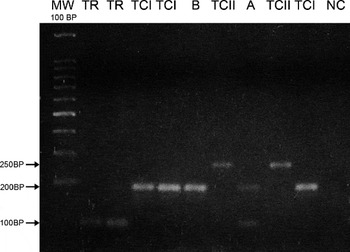
Seven days after bone marrow puncture, a high parasite load could be observed in the cultured material and promastigote, epimastigote and trypomastigote forms could be distinguished. This mixed culture was separated to provide parasite characterization at 2 different moments: (i) in the culture with only 2 passages, more trustable to the parasite multi-population infecting the anteater – Sample A; and (ii) after 30-day in vitro cultivation, which provided much more material for parasite characterization, but submits the culture to an in vitro selection of parasite populations – Sample B. The mini-exon multiplex PCR characterization confirmed the mixed infection – Trypanosoma cruzi TcI (200 bp) and T. rangeli (100 bp) in sample A, but only Trypanosoma cruzi TcI could be observed in sample B (Fig. 1). It is worth mentioning that the TcI detected by the mini-exon multiplex PCR protocol employed here corresponds to the same population designated as TcI in the current consensus for T. cruzi intraspecific nomenclature (Zingales et al. Reference Zingales, Andrade, Briones, Campbell, Chiari, Fernandes, Guhl, Lages-Silva, Macedo, Machado, Miles, Romanha, Sturm, Tibayrenc and Schijman2009).
Agarose gel (2%) stained with ethidium bromide, image captured by UV showing the mini exon PCR products. MW, molecular weight 100 base pairs; TR, Trypanosoma rangeli (100 bp); TCI, Trypanosoma cruzi, genotype TCI (200 bp); B, sample B; TCII, Trypanosoma cruzi, genotype TCII (250 bp); A, sample A; NC, negative control. From left to right, the first TR and the TCI and TCII just before the NC correspond to the reference strains: TR (H14), TcI (Silvio X10/1), TcII (Tu18 cl93).

Leishmania infantum infection in the anteater
No sign of parasitism was observed in the experimentally infected hamsters (all tissue imprints and cultures were negative).
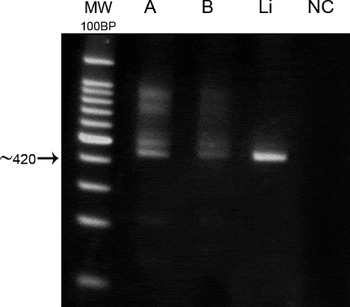
Leishmania sp. DNA was detected in samples A and B by kDNA PCR (120 bp, data not shown) and PCR targeting ITS1 (Fig. 2). Because the samples analysed came from a mixed culture of related protozoa, other shadows can be seen in the gel, but only the band with the same size of the reference sample (420 bp) was directly sequenced. After purification and DNA sequencing, BLAST search showed 100% of coverage and 100% of similarity with at least 2 different available sequences of L. infantum (gi|339730635|FN398343.2 and gi|332330750|HQ535858.1). All other sequences listed by the algorithm as ‘high similarity’ sequences belong to species of the L. donovani complex (L. infantum and L. donovani). The sequence obtained is available in GenBank under Accession number JQ776643.
Acrylamide gel (4%) stained with ethidium bromide, image captured by UV. MW, molecular weight 100 base pairs; A, ITS1 PCR product of sample A; B, ITS1 PCR product of sample B; Li, ITS1 PCR product of Leishmania infantum reference strain (MHOM/BR/1974/PP75 – positive control); NC, negative control.

DISCUSSION
This is the first description of a triple mixed infection (T. cruzi, T. rangeli and L. infantum) in a wild mammal host, the anteater Tamandua tetradactyla from the Brazilian Amazon basin. The high parasite load allowed parasite isolation already 7 days after collection. T. cruzi was also isolated from blood in the first culture examination indicating high parasitaemia and transmissibility potential. As far as we know, at least 2 findings are new: (i) isolation of T. rangeli in a culture from bone marrow; and (ii) molecular identification of L. infantum in a mammal species within the autochthonous superorder Xenarthra, which also includes sloths and armadillos.
Up to now, the tissue where T. rangeli multiplication takes place in the vertebrate host is still unknown and no other tissue apart from blood was ever found infected (Guhl and Vallejo, Reference Guhl and Vallejo2003). T. rangeli is able to pass through the triatomine gut epithelium cells by an intracellular route (parasitophorous vacuole), but up to now, intracellular invasion in mammal cells was only demonstrated in vitro and parasites did not survive for more than few hours (Eger-Mangrich et al. Reference Eger-Mangrich, de Oliveira, Grisard, de Souza and Steindel2001). Intracellular invasion was neither observed in the T. tetradactyla and the presence of free parasites in the bone marrow probably occurred through blood or lymph circulation, as described for other trypanosomes, like T. brucei subspecies (Gadelha et al. Reference Gadelha, Holden, Allison and Field2011). The T. rangeli-infected bone marrow may represent an unorthodox site for T. rangeli circulation and/or multiplication that should be considered in further studies. Although the possibility of blood contamination during the bone marrow puncture cannot be discarded, the successful procedure (the material was punctured only after the insertion of the needle inside the bone medullar canal and no blood extravasation was observed after the puncture) and the absence of T. rangeli DNA in the material cultured with blood reinforces the hypothesis of the presence of T. rangeli in the bone marrow.
Although no previous description of the occurrence of L infantum in xenarthrans has been published, L. infantum were already found infecting marsupials, primates, rodents, carnivores, and bats (de Lima et al. Reference de Lima, Rodríguez, Barrios, Avila, Cañizales and Gutiérrez2008; Quinnell and Courtenay, Reference Quinnell and Courtenay2009). Most of the reports, however, were described based only on highly sensitive PCR assays, enhancing the importance of the parasite isolation obtained in the present study. Although our finding is not sufficient to affirm that T. tetradactyla is a L. infantum reservoir in that area, it is an indication that this mammal species, now considered a putative L. infantum reservoir, has to be taken into account when evaluating the L. infantum wild reservoirs in a given area.
We were not able to re-isolate L. infantum from the experimentally infected hamsters, a recognized highly susceptible species. This is probably the result of the infection route performed, chosen due to the high abundance of T. cruzi metacyclic forms in the culture that, if intra-peritoneally inoculated, could result in the premature death of the hamster. The infection route and the low abundance of promastigote forms in the inoculum were probably the main factors that resulted in the absence or low L. infantum load in the experimentally infected hamsters, which could not be detected by any of the employed methods.
The isolation of T. cruzi from both blood and bone marrow showed that the parasite was very well established in the anteater. It was apparently healthy and without any clinical signs of these multiple parasite infections. The association of T. tetradactyla, Rhodnius sp. and palm trees in the Amazon Region may be the explanation of both T. rangeli and T. cruzi infections (Dias et al. Reference Dias, Quartier, Romaña, Diotaiuti and Harry2010). Nevertheless, while the first parasite infection occurs through the bite, the second depends on the contact of the contaminated bug's feces with the bite's (or other) lesion or host mucosa. This should not be a trivial process in the usually dense fur on the anteater's skin, but seems to be the only explanation for the T. cruzi infection. Considering its narrow oral cavity and specific diet (consisting of termites, ants, bees and honey) (Medri et al. Reference Medri, Mourão, Rodrigues, Reis, Perachi, Petro and Lima2006), we do not believe that bugs, even the initial nymph stages, could be ingested by this host. In this sense, T. cruzi infection must have resulted from a contaminative infection route. The infection by L. infantum is expected to occur by the bite of an infected Lutzomyia longipalpis, usually associated to peri-domestic environments (Lainson and Rangel, Reference Lainson and Rangel2005). Although expected to be found only in sylvatic habitats, the infected anteater was captured in a house backyard. Of epidemiological importance is the fact that an anteater can be infected in sylvatic habitats and could potentially be a source of infection to a vector inhabitating peridomestic areas, where infected dogs have been described for more than 70 years (Lainson and Rangel, Reference Lainson and Rangel2005).
These 3 trypanosomatid species found infecting the anteater have completely different biological strategies in vertebrate hosts: L. infantum are intracellular parasites of phagocyte cells; T. rangeli are extracellular parasites found circulating in host fluids; and T. cruzi displays both extracellular (trypomastigote) and intracellular (amastigote) forms in the same mammalian host. In the bone marrow from the studied anteater, the high parasite load observed for the 3 parasite species indicate the absence of direct competition amongst them. The same could not be extrapolated to other tissues, since high T. cruzi parasitaemia was observed in contrast to the absence of T. rangeli in the blood. The consequence of this competition is completely unpredictable, and may result in (i) elimination of 1 (or 2) parasite species, (ii) pressure for migration to other (even unorthodox) tissues, or (iii) their long-term co-habition. Moreover, these pressures, which may change over time, will influence the parasitism level, dispersal ability among distinct host tissues and transmissibility success of the 3 parasite species.
Most epidemiological studies in both animals and humans focus on a single infectious agent (Telfer et al. Reference Telfer, Lambin, Birtles, Beldomenico, Burthe, Paterson and Begon2010). When concomitant infections are taken into consideration, these studies are usually cross-sectional (exactly as ours), where the lack of time-scale information about the parasite infection impairs the determination of the influence of the co-infection for both parasite populations and vertebrate hosts. Studies concerning the infection modulation, common when it involves a helminth and an intracellular parasite, are rare considering different trypanosomatid species or even different protozoan species (Cox, Reference Cox2001). This should be especially important for Leishmania and Trypanosoma species which, besides presenting completely different biological and infection strategies, are paraphyletic (Maslov et al. Reference Maslov, Podlipaev and Lukes2001) and induce heterologous immunity (Ferguson, Reference Ferguson1997). Not only factors related to the host, but mainly related to the parasite community can modulate this triple infection since these parasite species are involved in an interconnected network of interactions. Moreover, considering any wild mammal, this dynamic becomes even more unpredictable due to several other infectious agents (helminths, viruses and bacteria) that are not being considered here but certainly influence the course of that infection.
Regardless of the number of studies describing wild mammals infected by trypanosomatid species, the description of a new mammal order harbouring L. infantum and of an unorthodox site for the multi-host parasite T. rangeli illustrates that some basic biological aspects of this trypanosomatid species still have to be clarified. Such reports emphasize the importance of a broad approach, not limited by previous studies, when evaluating host-parasite interactions in sylvatic habitats. The plasticity of these multi-host parasites (allowing their exploration in different tissues from different mammal species) and the putative (and frequent) occurrence of co-infections (modulating the parasite load and transmissibility success) drive the dynamic process of several trypanosomatid species in sylvatic habitats. Considering and understanding these pivotal points are crucial to elucidate the mechanisms of dispersion of these parasites in our native fauna.
ACKNOWLEDGEMENTS
The authors are thankful to Plataforma de Sequenciamento PDTIS/Fiocruz, to Marconny Gerhardt and Miguel Oliveira for field assistance and to Ana Cláudia Duarte and Grazielle da Graça for help with the molecular assay.
FINANCIAL SUPPORT
This research was supported by grants from IOC/FIOCRUZ, PAPES/FIOCRUZ, CNPq, FAPERJ, the European Commission (INCO-CT2005-015407) and the European Union Seventh Framework Program Grant 223034 – ChagasEpiNet.