





1. Introduction
Moral ideals, particularly the prohibition against harm, are deeply embedded in society (Haidt, Reference Haidt2007). People are generally more averse to harm when personally involved, as seen in moral dilemmas like the Trolley Dilemma (Thompson, Reference Thompson1985), where individuals are willing to flip a switch to save five lives, but reluctant to push someone off a bridge in the Footbridge Dilemma (Foot, Reference Foot and Wallace1978; Greene et al., Reference Greene, Sommerville, Nystrom, Darley and Cohen2001). Evidence suggests that these outcomes can change depending on the language context (e.g., Brouwer, Reference Brouwer2021; Cipolletti et al., Reference Cipolletti, McFarlane and Weissglass2016; Costa et al., Reference Costa, Foucart, Hayakawa, Aparici, Apesteguía, Heafner and Keysar2014; Del Maschio et al., Reference Del Maschio, Crespi, Peressotti, Abutalebi and Sulpizio2022; Geipel et al., Reference Geipel, Hadjichristidis and Surian2015a; Muda et al., Reference Muda, Pieńkosz, Francis and Białek2020). This phenomenon, also known as the Foreign-Language Effect (Keysar et al., Reference Keysar, Hayakawa and An2012), indicates that people are more inclined to sacrifice one person to save five when making decisions in a foreign language as opposed to a native language.
One potential explanation for the Foreign-Language Effect is psychological distance (Eyal & Liberman, Reference Eyal, Liberman, Mikulincer and Shaver2012). When people use a foreign language, they tend to be less emotionally engaged with the situation compared to when they use their native language, which can increase psychological distance. This distancing may attenuate intuitive emotional responses that typically inhibit harm, thereby shifting moral decisions in a more utilitarian way. Building on this account, the present study aims to investigate whether social distance cues embedded in the communicative context, specifically the presence of a narrator who is either socially close or distant, influence the Foreign-Language Effect in moral decision-making. This question is addressed across three experiments: in the written modality (Experiment 1), in the spoken modality (Experiment 2) and across different types of moral dilemmas (Experiment 3).
1.1. The Foreign-Language Effect in moral decision-making
Costa et al. (Reference Costa, Foucart, Hayakawa, Aparici, Apesteguía, Heafner and Keysar2014) were the first to discover the Foreign-Language Effect in moral dilemmas. The researchers found striking differences in the participants’ decisions based on whether a moral dilemma was presented in their first language or in their foreign language. Specifically, participants were more likely to make utilitarian decisions when reasoning in a foreign than in a native language. Many studies succeeded in replicating the Foreign-Language Effect across various language pairs (e.g., Brouwer, Reference Brouwer2021; Cipolletti et al., Reference Cipolletti, McFarlane and Weissglass2016; Corey et al., Reference Corey, Hayakawa, Foucart, Aparici, Botella, Costa and Keysar2017; Geipel et al., Reference Geipel, Hadjichristidis and Surian2015a; Hayakawa et al., Reference Hayakawa, Tannenbaum, Costa, Corey and Keysar2017; Kyriakou et al., Reference Kyriakou, Foucart and Mavrou2023; Muda et al., Reference Muda, Pieńkosz, Francis and Białek2020; Romero-Rivas et al., Reference Romero-Rivas, López‐Benítez and Rodríguez-Cuadrado2022), suggesting that the Foreign-Language Effect may be robust under certain conditions. However, a growing number of studies have failed to observe the effect (e.g., Brouwer, Reference Brouwer2019; Ĉavar & Tytus, Reference Ĉavar and Tytus2018; Dylman & Champoux–Larsson, Reference Dylman and Champoux–Larsson2020; Hou et al., Reference Hou, Jiang, Xie, Li and Huang2026; Muda et al., Reference Muda, Niszczota, Białek and Conway2018; Vega-Mendoza et al., Reference Vega-Mendoza, Hansson, Sörman and Ljungberg2021; Winskel & Bhatt, Reference Winskel and Bhatt2020; Yavuz et al., Reference Yavuz, Küntay and Brouwer2024), indicating that its presence is not consistent and may depend on factors such as language proficiency, native and foreign language characteristics, dilemma characteristics and task modality. This inconsistency highlights the need for further research to clarify the boundary conditions of the Foreign-Language Effect in moral decision-making.
Although the Foreign-Language Effect was originally observed using written moral dilemmas (Costa et al., Reference Costa, Foucart, Hayakawa, Aparici, Apesteguía, Heafner and Keysar2014), recent research has begun to examine the role of modality in moral decision-making. Studies comparing written and auditory presentations of dilemmas suggest that modality can influence moral decisions, although evidence is mixed (e.g., Brouwer, Reference Brouwer2019, Reference Brouwer2021; Muda et al., Reference Muda, Pieńkosz, Francis and Białek2020). Brouwer (Reference Brouwer2019), for instance, found differences in moral decisions depending on both the modality and the language of presentation. However, the later studies (Brouwer, Reference Brouwer2021; Muda et al., Reference Muda, Pieńkosz, Francis and Białek2020) did not report such interactions between modality and language. Notably, Brouwer (Reference Brouwer2021) did find that participants presented with auditory dilemmas made more utilitarian decisions than those reading dilemmas in written form, suggesting that auditory presentation can influence moral decisions, even if it does not always interact with language.
Moral dilemmas are commonly categorized as personal or impersonal, depending on whether the decision requires direct physical contact with the victim (Greene et al., Reference Greene, Sommerville, Nystrom, Darley and Cohen2001, Reference Greene, Morelli, Lowenberg, Nystrom and Cohen2008). Personal dilemmas, such as the Footbridge dilemma, involve physically harming someone to achieve a greater good, whereas impersonal dilemmas, such as the Switch dilemma, allow the same outcome without direct contact. Prior research suggests that personal dilemmas typically elicit stronger emotional responses and greater aversion to harm compared to impersonal dilemmas across modalities (e.g., Brouwer, Reference Brouwer2021; Costa et al., Reference Costa, Foucart, Hayakawa, Aparici, Apesteguía, Heafner and Keysar2014). Crucially, this distinction has been shown to interact with language: the Foreign-Language Effect is often more pronounced for personal dilemmas, where emotional engagement is higher in the native language and therefore more susceptible to attenuation in a foreign language (but see Gawinkowska et al., Reference Gawinkowska, Paradowski and Bilewicz2013; Geipel et al., Reference Geipel, Hadjichristidis and Surian2015b).
1.2. The role of social distance in the Foreign-Language Effect
Psychological distance, a concept introduced within Construal Level Theory (Liberman et al., Reference Liberman, Trope, Stephan, Higgins and Kruglanski2007; Trope & Liberman, Reference Trope and Liberman2010), provides a useful framework for understanding the Foreign-Language Effect. Psychological distance can be assessed across four dimensions: temporal (past vs. future), social (self vs. others), spatial (near vs. distant) and hypothetical (likelihood of events). Across these dimensions, greater distance is associated with higher level construals, in which situations are mentally represented in a more abstract manner, whereas reduced distances promote lower-level, more concrete representations.
Within this framework, using a foreign language may increase psychological distance, leading individuals to construe moral dilemmas at a higher level of abstraction. Here, abstract representations emphasize general goals, overarching outcomes and cost–benefit considerations, while downplaying specific actions and emotionally salient details. As a result, moral decisions may rely more strongly on utilitarian principles, such as maximizing overall welfare or minimizing total harm (e.g., saving five lives for the greater good). In contrast, reasoning in a native language is assumed to promote more concrete construals that foreground specific actions, immediate consequences and emotional reactions, thereby favoring deontological responses grounded in moral rules and prohibitions against directly causing harm.
In examining the social distance dimension, the primary focus of the current study, researchers have often manipulated perceived proximity to the protagonists in moral dilemmas by comparing factors such as self versus other, in-group versus out-group and family or friend versus stranger (e.g., Liberman et al., Reference Liberman, Trope, Stephan, Higgins and Kruglanski2007; Maglio et al., Reference Maglio, Trope and Liberman2013; Nan, Reference Nan2007; Pronin et al., Reference Pronin, Olivola and Kennedy2008). Only a few studies have focused on the effect of social distance on the Foreign-Language Effect (e.g., Corey et al., Reference Corey, Hayakawa, Foucart, Aparici, Botella, Costa and Keysar2017; Geipel et al., Reference Geipel, Hadjichristidis and Surian2015a; Xu et al., Reference Xu, Wang, Zhu, Liao, Wang, Wang and Liu2024). For example, Corey and colleagues suggested that the Foreign-Language Effect might arise from social distance between participants and victims categorized as in-group or out-group members. In their study, participants were explicitly informed that the victims were either in-group (Spanish) or out-group (American). While the Foreign-Language Effect was observed, it was not influenced by social distance, possibly because only strangers, rather than close family members, were used as victims. Conversely, Geipel et al. (Reference Geipel, Hadjichristidis and Surian2015a) found no Foreign-Language Effect in a dilemma where the victim was a family member, representing an extremely close social distance. Recently, Xu et al. (Reference Xu, Wang, Zhu, Liao, Wang, Wang and Liu2024) similarly identified the Foreign-Language Effect in moral dilemmas involving greater social distance (strangers), but not when the social distance was closer (family members or friends). The authors argued that close social distance may result in similar levels of mental imagery in both languages, prompting participants to adopt a more deontological approach (Aguilar et al., Reference Aguilar, Brussino and Fernández-Dols2013; Trope & Liberman, Reference Trope and Liberman2010).
While prior work on the Foreign-Language Effect has primarily operationalized social distance through characteristics of the victims or protagonists in moral dilemmas (e.g., family members vs. strangers, in-group vs. out-group), social distance can also be conveyed more implicitly through features of the communicative context. One such feature is the narrator of the dilemma. The narrator’s perceived group membership and social proximity to the listener may shape how personally involving or abstract a moral scenario feels, thereby influencing social distance and moral decision-making. This perspective shifts attention from who is affected by the dilemma to who is telling the dilemma, opening a complementary route through which social distance may interact with language context.
1.3. Narrator and group membership in moral decision-making
Previous work has often used visual cues to manipulate social distance. Visual information such as faces, clothing or other cultural markers can activate pre-existing stereotypes and implicit biases, which in turn might influence judgments of trustworthiness (e.g., Babel & Russell, Reference Babel and Russell2015; D’Onofrio, Reference D’Onofrio2019; Kutlu, Reference Kutlu2020; McGowan, Reference McGowan2015; Yi et al., Reference Yi, Phelps, Smiljanic and Chandrasekaran2013, Reference Yi, Smiljanic and Chandrasekaran2014; Zheng & Samuel, Reference Zheng and Samuel2017).
One early demonstration of this approach was reported by Donald (Reference Donald1992). Participants heard a native English speaker paired with either an Asian or a White face. The results revealed that comprehension ratings were lower and accentedness ratings were higher when the Asian face was shown, suggesting that visual cues could enhance perceptions of group membership. Similarly, in a recent large-scale online survey (Schmid et al., Reference Schmid, Witkower, Götz and Stieger2022), Asian, Black, Latino and White raters were shown faces whose trustworthiness they had to rate. The results showed that they rated faces with whom they shared their ethnicity, sex or eye color as more trustworthy, corroborating in-group-out-group effects.
A similar approach has been used in studies with written instead of spoken stimuli. In that work, participants were presented with pictures of narrators accompanied by biographies (e.g., Fairchild & Papafragou, Reference Fairchild and Papafragou2018; Fairchild et al., Reference Fairchild, Mathis and Papafragou2020). These biographies provide social information such as the narrator’s name, country of origin, study program and hobbies, allowing participants to form a sense of familiarity and social proximity. This method allows for a direct comparison of the effect of visual and biographical information featuring native versus non-native narrators, further exploring how group membership influences perceptions and potential biases. Both cues may modulate social distance independently of the content of the dilemma itself, thereby shaping moral decision-making and potentially interacting with language context.
2. The present study
The present study aims to investigate whether social distance conveyed through the communicative context, specifically, the presence of a socially close versus distant narrator, modulates the Foreign-Language Effect in moral decision-making. Although previous research has demonstrated that the Foreign-Language Effect can vary as a function of modality and dilemma type (e.g., Brouwer, Reference Brouwer2021; Costa et al., Reference Costa, Foucart, Hayakawa, Aparici, Apesteguía, Heafner and Keysar2014; Muda et al., Reference Muda, Pieńkosz, Francis and Białek2020), they have never been investigated jointly with a narrator. The current set of experiments, therefore, aims to address this gap by systematically introducing a narrator and varying modality and dilemma type across experiments.
Across three experiments, Dutch–English bilinguals were presented with moral dilemmas in either their native language (Dutch) or a foreign language (English). Importantly, each experiment consisted of two parts. In the first part, dilemmas were presented without any information about a narrator, closely replicating standard Foreign-Language Effect paradigms used in prior work (e.g., Costa et al., Reference Costa, Foucart, Hayakawa, Aparici, Apesteguía, Heafner and Keysar2014). This design allows us to assess whether previously reported Foreign-Language Effect patterns emerge in our materials and participant population. In the second part, a narrator was introduced via a picture of their face and a short biography, thereby increasing or decreasing the social distance and enabling an indirect manipulation of perceived social distance.
Based on a pretest (see page 9), a stereotypically Dutch face and voice were selected for the Dutch condition to represent relatively low social distance. For the English condition, a stereotypically foreign face and voice were used to represent higher perceived social distance. Specifically, we selected a narrator of Nigerian origin, as Dutch participants were expected to perceive this identity as more socially distant than narrators associated with British or American English, while still being a legitimate speaker of English, given that Standard Nigerian English is an officially recognized language. This approach aligns with prior work showing that visual and biographical cues can activate group membership representations and influence social judgments (e.g., Fairchild & Papafragou, Reference Fairchild and Papafragou2018; Zheng & Samuel, Reference Zheng and Samuel2017).
The three experiments were designed to incrementally extend prior research rather than test all factors simultaneously. The stepwise approach allows each experiment to inform the next and provides a clearer assessment of how communicative social cues, modality and dilemma type independently and jointly relate to the Foreign-Language Effect. Experiment 1 examined whether introducing a narrator influences the Foreign-Language Effect in the traditional written-dilemma paradigm. Experiment 2 extended this design to spoken dilemmas, allowing us to test whether narrator effects interact with auditory presentation, which has been suggested to amplify emotional engagement and, in some cases, the Foreign-Language Effect. Experiment 3 further expanded the scope by including both personal and impersonal dilemmas in spoken form, enabling us to assess whether narrator presence and social distance differentially affect dilemma types known to vary in emotional intensity.
In the first part of Experiment 1 (personal dilemmas in written modality), when no narrator was present, we expected to replicate the standard Foreign-Language Effect, with more utilitarian decisions in English than in Dutch. In the second part, introducing a narrator was predicted to amplify the Foreign-Language Effect: a socially close narrator in Dutch would increase deontological decisions, whereas a socially distant narrator in English would increase utilitarian decisions.
In Experiment 2 (personal dilemmas in spoken modality), we expected the same pattern as in Experiment 1, but potentially stronger, because auditory presentation may evoke richer emotional responses than written language and thus amplify both the Foreign-Language Effect and narrator effects.
In Experiment 3 (personal and impersonal dilemmas in written modality), we predicted that personal dilemmas would elicit stronger emotional responses than impersonal dilemmas, resulting in a larger Foreign-Language Effect and increased social-distance effects for personal dilemmas. Impersonal dilemmas were expected to show no effects. Overall, narrator presence was expected to interact with language and dilemma type, with the strongest effects occurring in personal dilemmas presented in a foreign language with a socially distant narrator.
3. Method
3.1. Pretest
A pretest was conducted for two purposes. First, select two faces, one to represent the narrator of the Dutch dilemmas and another for the English dilemmas. Second, the pretest aimed to gather feedback on the voices used.
3.1.1. Participants
In total, 22 participants took part in the pretest, but one participant was excluded due to a visual impairment and another due to hearing problems. The remaining 20 participants were native Dutch speakers with a mean age of 20.7 (SD = 6.0; one male). All participants had a high level of education, provided informed consent and were compensated with course credits.
3.1.2. Materials
Eight face pictures from the Chicago Face Database (Ma et al., Reference Ma, Correll and Wittenbrink2015) were selected for the pretest. The pictures labeled as WF-003, WF-008, WF-209 and WF-252 were considered for the Dutch narrator, while BF-050, BF-218, BF-229 and BF-250 were used for the English narrator (see Supplementary Tables S1 and S2 for all the faces). Additionally, two brief recordings, one in Dutch and the other in English, were included. Both recordings were created using AI-generated text-to-speech voices from the website Narakeet© (Version 2.36.6, 2024) to ensure maximal control and consistency across language conditions. For the Dutch recording, the AI voice “Lotte” was selected, and for the English recording, the AI voice “Thandiwe” was chosen. The text used for the recordings was: “I love to go outside when it is sunny” in English, or “Ik hou ervan om naar buiten te gaan als het zonnig is” in Dutch.
English as spoken in Nigeria has historically developed under British influence and is therefore more similar to British than to American English, while retaining distinctive phonological characteristics. This allowed us to use an English voice that is clearly identifiable as a legitimate variety of English, yet perceptibly non-native from the perspective of Dutch listeners.
3.1.3. Procedure and design
The pretest was conducted online via Qualtrics (Qualtrics, Provo, UT). Participants completed demographic questions on age, gender, mother tongue, education level and hearing impairment. They were then presented with two blocks: one consisting of pictures of individuals typically associated with Dutch identity accompanied by Dutch voice recordings, and the other consisting of pictures of individuals with more diverse appearances accompanied by English voice recordings. These blocks were presented in counterbalanced order, so participants either started with the Dutch block or the English block. Each block contained four pictures.
Participants were asked to identify the perceived origin of the individuals in the pictures and to rate their general impressions on attributes such as friendliness, annoyance, trustworthiness, education, success, kindness and sociability. Additionally, they were presented with two statements: “This person could be my friend” and “I can identify with this person”. Responses were recorded on a 7-point Likert scale, ranging from 1, totally disagree, to 7, totally agree.
After the identity-related questions, participants listened to a recording and selected which of the four faces best matched the voice, and they had to indicate their confidence in their choice. The order of face presentation was randomized. In the final part of each block, participants saw the same faces along with the recording and were asked to rate how well the voice paired with each face. After completing both language blocks, participants assessed their perception of the voices using a 7-point semantic differential scale (e.g., natural (1) versus robotic (7), friendly (1) versus annoyed (7), angry (1) versus happy (7)). The entire pretest lasted approximately ten minutes.
3.1.4. Data analysis
The selection criteria for the Dutch and the English faces differed. For the Dutch face, we selected the face perceived as most Dutch, with a strong association with the voice and positive ratings on the various statements. For the English face, we selected the face that received the highest response for Nigerian origin, which had similar positive ratings to the Dutch face, but lower ratings on the statements “I can identify with this person” and “This person could be a friend of mine.” This approach was intended to create a larger contrast between the two conditions, encouraging participants to feel more distant from the foreign person. The voice was also required to match the face closely.
Data analysis was conducted using R (Version 3.4.0; R Core Team, 2023). Note that the pretest was conducted for stimulus selection rather than for formal hypothesis testing, and decisions were based on overall patterns in the data rather than on individual significance tests. For this reason, we did not apply corrections for multiple comparisons. Paired t-tests were performed to investigate whether the perceptions of the two selected faces and voices differed significantly. Additionally, percentages were calculated for the perceived origin of the face that best matched the voice.
3.2. Results and discussion
In Supplementary Tables S1 and S2, the mean ratings (and SDs) on all attributes, the statements and the voices for all eight faces can be found. For each language, one picture out of four was chosen as the best representation of the narrator (see Figure 1). Lieke was chosen as the Dutch narrator because she was most often indicated to be of Dutch origin. Moreover, she had relatively high scores on the positive attributes and on the statements. Thandiwe was chosen as the English narrator because she was almost always indicated to be of foreign origin. In addition, she had relatively low scores on the positive attributes and statements.
The pictures and biographies of the narrator of the dilemmas for Dutch (Lieke) and English (Thandiwe).

Figure 1. Long description
The image consists of two side-by-side panels.
Left Panel:
At the top is the header Dutch narrator. Below is a portrait of Lieke, a woman with light skin and blonde hair. Underneath the portrait is a paragraph in Dutch: Hallo, mijn naam is Lieke en ik ben geboren in Nederland. Recent ben ik afgestudeerd in Biologie aan de Radboud Universiteit in Nijmegen. Ik had het daar erg naar mijn zin en dus heb ik besloten om in Nijmegen te blijven na mijn afstuderen. In mijn vrije tijd ga ik graag met vrienden naar de film. Het is een fijne manier om bij elkaar te zijn en tot rust te komen.
Right Panel:
At the top is the header English narrator. Below is a portrait of Thandiwe, a woman with dark skin and dark curly hair. Underneath the portrait is a paragraph in English: Hello, my name is Thandiwe and I am born in Nigeria. Recently I have graduated from the University of Lagos, where I majored in Biology. I enjoyed myself very much there and so I decided to stick around in Lagos after graduation. In my free time, I enjoy going to the movies with my friends. It’s a great way to be together and to unwind.
Table 1 presents the ratings on the attributes, the statements about the two narrators and the perception of the two voices. The ratings of the two narrators were compared with paired-samples t-tests. The outcomes of these tests are also shown in Table 1. They reveal that the Dutch narrator was overall more positively evaluated than the English narrator, particularly with regard to the attributes of friendliness, education, success, likeability and sociability, as well as both statements. However, the voice of the Dutch narrator was perceived as more robotic and more annoying than that of the English narrator.
Means and SDs on a 7-point Likert scale for the attributes and statements regarding the Dutch and English narrators, as well as the perception of the two voices, along with their respective statistical outcomes in the pretest

Table 1. Long description
The table is organized into six columns: Attribute/Statement, Dutch Narrator M, Dutch Narrator S D, English Narrator M, English Narrator S D, and Statistical outcomes.
Under Attributes:
* Friendly: Dutch M 5.1, S D 1.0; English M 4.3, S D 1.5; t 19 equals 2.37, p equals .03, d equals .53.
* Trustworthy: Dutch M 4.8, S D 1.2; English M 4.3, S D 1.3; p greater than .05.
* Annoying: Dutch M 2.8, S D 1.0; English M 3.1, S D 1.1; p greater than .05.
* Educated: Dutch M 5.1, S D .9; English M 4.0, S D 1.3; t 19 equals 3.28, p less than .01, d equals .73.
* Successful: Dutch M 4.9, S D .9; English M 4.0, S D 1.4; t 19 equals 2.43, p equals .03, d equals .54.
* Nice: Dutch M 5.1, S D 1.1; English M 4.4, S D 1.3; t 19 equals 2.29, p equals .03, d equals .51.
* Sociable: Dutch M 4.9, S D 1.2; English M 4.2, S D 1.4; t 19 equals 2.67, p equals .02, d equals .60.
Under Statements:
* This person could be my friend: Dutch M 4.4, S D 1.4; English M 3.5, S D 1.7; t 19 equals 2.39, p equals .03, d equals .53.
* I can identify with this person: Dutch M 4.0, S D 1.5; English M 3.1, S D 1.6; t 19 equals 2.65, p equals .02, d equals .59.
Under Voices:
* Voice matches narrator best (all faces shown): Dutch 30 percent (N equals 6); English 40 percent (N equals 8).
* Certainty of choice: Dutch M 3.9, S D 1.5; English M 3.9, S D 1.8; p greater than .05.
* Voice matches narrator (face rating one by one): Dutch M 4.1, S D 1.6; English M 4.3, S D 1.7; p greater than .05.
* Angry 1 vs happy 7: Dutch M 5.6, S D 1.0; English M 5.8, S D .8; p greater than .05.
* Robot 1 vs natural voice 7: Dutch M 2.6, S D 1.4; English M 3.7, S D 1.7; t 19 equals minus 3.04, p less than .01, d equals minus .68.
* Annoying 1 vs pleasant 7: Dutch M 3.6, S D 1.7; English M 5.1, S D 1.2; t 19 equals minus 4.46, p less than .001, d equals minus 1.00.
When presented with all Dutch faces, 30% (N = 6) of the participants indicated that the voice matched best with Lieke. The overall confidence of participants in their responses was intermediate (M = 3.9; SD = 1.5). When the faces were presented separately, Lieke was still chosen as the best match for the voice, with a mean confidence rating of M = 4.1 (SD = 1.6). When presented with all English faces, 40% (N = 8) of the participants indicated that the voice matched best with Thandiwe. The overall certainty of the response to this question was intermediate (M = 3.9; SD = 1.8). When the faces were presented separately, Thandiwe was given the second-best score of the English faces (M = 4.3; SD = 1.7).
Overall, the findings indicated that Lieke and Thandiwe were perceived as the most representative voices for Dutch and English, respectively. Moreover, Lieke was regarded as exhibiting greater social closeness compared to Thandiwe. However, Lieke’s voice was simultaneously evaluated as more robotic and annoying. This may be attributed to the fact that Dutch was the native language of the participants, making AI-generated features more easily recognizable and increasing emotional saliency compared to the foreign language.
4. Experiment 1: Personal dilemmas in written modality
4.1. Method
4.1.1. Participants
In total, 97 participants took part in Experiment 1. Eight participants did not finish the experiment, four failed to identify the face origin (Dutch or foreign) and one participant was excluded due to a visual impairment. Ultimately, 84 participants were included in the analysis,Footnote 1 consisting of 78 females and six males. The participants had a mean age of 19.6 years (SD = 1.8). They were all native speakers of Dutch and had normal or corrected-to-normal vision and hearing. Participants’ education level was high. Half of the participants were randomly assigned to the native language condition (Dutch), while the other half were assigned to the foreign language condition (English). Participants gave informed consent and they received compensation in the form of course credits.
Objective English proficiency data, measured by LexTALE scores (Lemhöfer & Broersma, Reference Lemhöfer and Broersma2012), indicated a mean proficiency of 77.6 (SD = 12.6) for the Dutch group and a mean proficiency of 75.7 (SD = 11.5) for the English group. Subjective English proficiency, assessed through ratings on a 7-point Likert scale, showed a mean score of 5.3 (SD = .9) for the Dutch group and a mean score of 5.4 (SD = .85) for the English group. Independent t-tests revealed no significant differences in English proficiency between participants in the Dutch condition compared to the English condition (LexTALE scores: t(82) = .74, p = .46, Cohen’s d = .16; Subjective scores: t(82) = −.39, p = .70, Cohen’s d = .08). The mean age of English onset was 9.3 years (SD = 2.2) in the Dutch group and 9.1 years (SD = 2.8) in the English group. This difference was not significant (t(76) = .28, p = .78, Cohen’s d = .06).
4.1.2. Materials
The moral dilemmas used were the same 10 personal dilemmas as in Greene et al. (Reference Greene, Morelli, Lowenberg, Nystrom and Cohen2008) and Brouwer et al. (Reference Brouwer2023). These sacrificial dilemmas highlight the conflict between intuitive and cognitive valuation (Greene et al., Reference Greene, Sommerville, Nystrom, Darley and Cohen2001). One example is the “crying baby” dilemma, where participants must decide whether to suffocate a noisy child to prevent detection by enemy soldiers and save themselves and others hiding in a cellar. Note that research on moral decision-making in the context of the Foreign-Language Effect has typically relied on a very limited number of dilemmas: most commonly only two, the Footbridge and Switch dilemmas (e.g., Costa et al., Reference Costa, Foucart, Hayakawa, Aparici, Apesteguía, Heafner and Keysar2014). Using 10 dilemmas, therefore, represents an extension of this line of work, allowing us to test the robustness and generalizability of previous findings across multiple sacrificial dilemmas rather than relying on a small, fixed set.
The dilemmas were presented in written format, following Costa et al. (Reference Costa, Foucart, Hayakawa, Aparici, Apesteguía, Heafner and Keysar2014). Originally, they were written in English, so they were translated into Dutch by two native Dutch speakers proficient in English at the C2 level. In the dilemma “vaccine test” (in Dutch vaccinatietest), the word “vaccine/vaccin” was changed to “cure/geneesmiddel” because the AI voices in Experiment 2 could not pronounce the word “vaccine” correctly. This adjustment ensured consistency between the written and auditory versions.
Additionally, the two female faces (Dutch and English) from the pretest were used to represent the narrators of the dilemmas. Biographical details were created for both individuals (see Table 1), following the approach of Fairchild and Papafragou (Reference Fairchild and Papafragou2018). These biographies included names, countries of origin, educational backgrounds and hobbies, aiming to manipulate social distance by creating a sense of closeness for the Dutch narrator and distance for the English narrator.
4.1.3. Procedure
The experiment was conducted online via Qualtrics (Qualtrics, Provo, UT). Participants were instructed to sit in a quiet area where they could not be disturbed. The instructions were given in the language of the randomly assigned language condition, either in English or Dutch. Before the experiment, participants had to fill out a questionnaire about their demographic information (i.e., gender, age, education level, mother tongue).
Next, they were presented with 10 moral dilemmas. After each moral dilemma, they were asked to judge the appropriateness of a proposed action by either clicking “yes” (utilitarian decision) or “no” (deontological decision). The answer options were counterbalanced for participants. The dilemmas were displayed pseudorandomly in four different lists, two per language. Importantly, in the first half of the experiment (i.e., the first five dilemmas), the moral dilemmas were presented without a narrator. In the second half of the experiment (i.e., the remaining five dilemmas), the narrator was introduced by presenting a picture of their face accompanied by a written biography. This design allowed us to systematically examine the influence of narrator presence on moral decision-making. This order was not counterbalanced to prevent participants from remembering the face of the introduced person throughout the experiment.
After presenting the dilemmas, participants answered questions about the narrator, identical to those in the pretest, except for those regarding the voice. Finally, participants rated their English proficiency and completed the English LexTALE test (Lemhöfer & Broersma, Reference Lemhöfer and Broersma2012). The experiment lasted about 30 minutes.
4.1.4. Design
The binary scores of yes-responses (utilitarian decisions) and no-responses (deontological decisions) in the different conditions were analyzed. The experiment had a 2 (language: native vs. foreign) by 2 (social distance: picture and biography absent vs. present) mixed design. Half of the participants took part in the native condition and the other half in the foreign condition (between-subjects). The participants were exposed to both levels of social distance within the same experimental run (within-subjects).
4.1.5. Data analysis
Data were analysed in R (Version 4.3.0; R Core Team, 2023). First, means and standard deviations were calculated for the perception of each face (i.e., language). Independent t-tests were performed to investigate whether the ratings of the Dutch- and Nigerian-origin faces differed. The package lsr (Navarro, Reference Navarro2015) was used to calculate Cohen’s d.
Next, a mixed-effects logistic regression model was run to investigate the influence of language (Dutch vs. English) and social distance (absent vs. present) on the binary dependent variable moral decision (0 = deontological; 1 = utilitarian). The fixed effects were contrast-coded. Dutch was set to −.5 and English to .5. Absent was set to −.5 and present to .5. The intercept represents the log-odds of a utilitarian decision at the grand mean of the predictors (i.e., averaged across language and social distance conditions). Positive coefficient estimates indicate an increase in the likelihood of a utilitarian decision for the coded category of interest (e.g., English relative to Dutch; present relative to absent). Random intercepts for participants and dilemmas were added. Random slopes did not converge. The packages lme4 (function glmer) (Bates et al., Reference Bates, Maechler, Bolker and Walker2015), effects (Fox, Reference Fox2003) and MuMIn (Bartoń, Reference Bartoń2025) were used.
4.2. Results and discussion
4.2.1. Face perception
Supplementary Table S3 presents the ratings on the perception of the two faces, along with the outcomes of the independent t-tests. The Dutch face was rated significantly higher on being educated, nice and sociable compared to the English face. Participants also identified better with Lieke than with Thandiwe.
4.2.2. Moral decisions
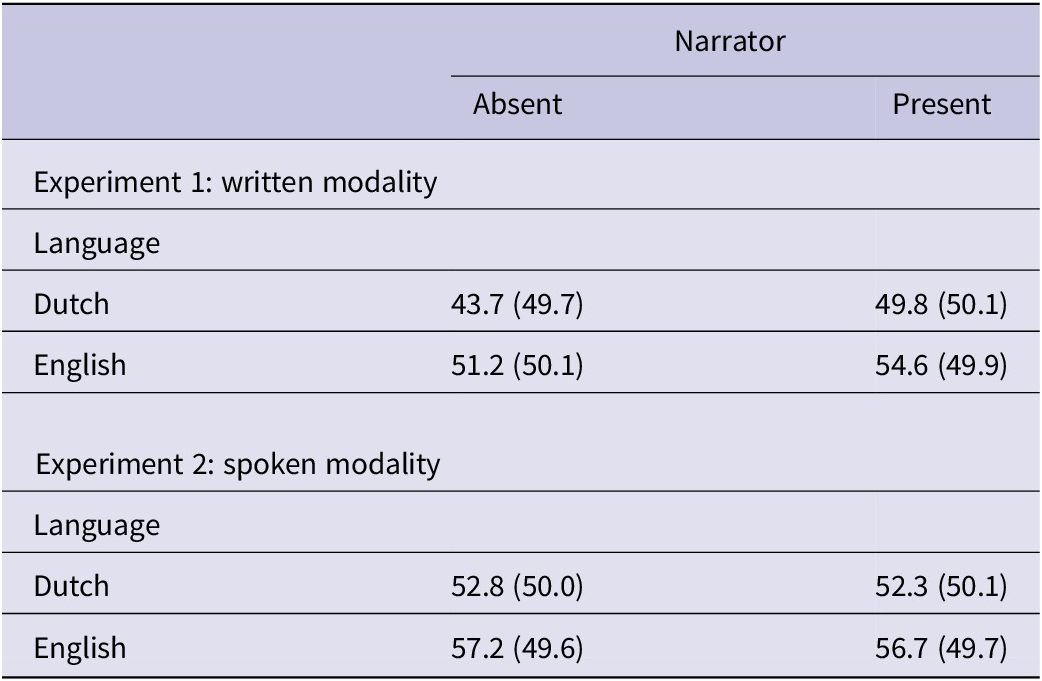
Table 2 (top panel) shows the means and SDs of the percentage of utilitarian decisions for language (Dutch vs. English) by social distance (absent vs. present). The results demonstrated no effect of language (estimate = .38, se = .43, z-value = .89, p = .37, odds ratio = 1.46, 95% CI [−.46, 1.22]), narrator (estimate = .15, se = .39, z-value = .38, p = .70, odds ratio = 1.16, 95% CI [−.62, .92]) and no significant interaction effect between language and narrator (estimate = −.03, se = .79, z-value = −.03, p = .97, odds ratio = .97, 95% CI [−1.57, 1.52]). The marginal R 2, the proportion of total variance explained by the fixed effects, was .008.
Means and SDs of the percentage of utilitarian decisions for language (Dutch vs. English) by narrator (absent vs. present) in Experiment 1 (written modality) and 2 (spoken modality)

Table 2. Long description
The table is divided into two main sections based on modality.
Experiment 1 written modality:
* For Dutch language, the percentage of utilitarian decisions is 43.7 with an S D of 49.7 when the narrator is absent, and 49.8 with an S D of 50.1 when the narrator is present.
* For English language, the percentage is 51.2 with an S D of 50.1 when the narrator is absent, and 54.6 with an S D of 49.9 when the narrator is present.
Experiment 2 spoken modality:
* For Dutch language, the percentage is 52.8 with an S D of 50.0 when the narrator is absent, and 52.3 with an S D of 50.1 when the narrator is present.
* For English language, the percentage is 57.2 with an S D of 49.6 when the narrator is absent, and 56.7 with an S D of 49.7 when the narrator is present.
As a follow-up, a Bayesian model comparison was conducted to quantify evidence for the effect of Language on moral decisions. The packages brm (Bürkner, Reference Bürkner2021) and bayestestR (Makowski et al., Reference Makowski, Ben-Shachar and Lüdecke2019) were used to run this. The full model, including Language and its interaction with Narrator, was compared with a reduced model excluding Language. The analyses showed a Bayes Factor of .28, indicating evidence in favor of the reduced (null) model. Specifically, the observed data are 3.5 times more likely under the null hypothesis than under the model including Language.
The results of Experiment 1 showed no Foreign-Language Effect, consistent with some previous studies that also failed to observe this effect (e.g., Brouwer, Reference Brouwer2019; Ĉavar & Tytus, Reference Ĉavar and Tytus2018; Yavuz et al., Reference Yavuz, Küntay and Brouwer2024). In addition, social distancing had no impact. Potential explanations for the absence of these effects will be given in the General Discussion. However, since previous research found a Foreign-Language Effect in the spoken modality with the same population (Brouwer, Reference Brouwer2019, Reference Brouwer2021), this was tested in Experiment 2.
5. Experiment 2: Personal dilemmas in spoken modality
Experiment 1 focused on written moral dilemmas, while Experiment 2 extended this investigation to spoken dilemmas. This allowed us to examine whether the presence of a narrator influences the Foreign-Language Effect differently depending on the modality of the moral dilemmas, providing a systematic test of the robustness of the effect across modalities. Experiment 2 is a replication of Experiment 1, except that the biographies and the moral dilemmas were presented to the participants in spoken form.
5.1. Method
5.1.1. Participants
In total, 91 native Dutch listeners were tested who did not take part in Experiment 1. Three were excluded due to not finishing the experiment, eight failed to identify the face origin (Dutch or foreign), one experienced hearing problems and four had a visual impairment. Of the remaining 75 participants,Footnote 2 70 were female and five were male. Their mean age was 19.5 (SD = 1.6). They had normal to corrected-to-normal vision and hearing, and their educational level was high. Half of the participants were randomly assigned to the native language condition (Dutch) and half to the foreign language condition (English). Participants gave informed consent and were compensated with course credits.
The mean objective English proficiency, measured using LexTALE (Lemhöfer & Broersma, Reference Lemhöfer and Broersma2012), was 79.1 (SD = 9.5) for the Dutch group and 77.5 (SD = 12.6) for the English group. The mean subjective English proficiency, collected via a 7-point Likert scale, was 5.8 (SD = .8) for the Dutch group and 5.8 (SD = .6) for the English group. Independent t-tests showed no significant difference between the Dutch and English groups in objective English proficiency (t(65) = .63, p = .53, Cohen’s d = .15) nor in subjective proficiency (t(70) = −.17, p = .87, Cohen’s d = .09). The mean age at which participants began learning English was 9.3 years (SD = 2.1) for the Dutch group and 8.9 years (SD = 2.2) for the English group. This difference was not significant (t(72) = .73, p = .46, Cohen’s d = .17).
5.1.2. Materials
The moral dilemmas used were the same 10 personal dilemmas as in Experiment 1, but presented in spoken instead of written form. The recordings were created using Narakeet© (Version 2.36.6, 2024) with AI-generated text-to-speech voice: “Lotte” for Dutch and “Thandiwe” for Standard Nigerian English. The recordings were checked for pronunciation, prosody and naturalness by a native Dutch speaker with a high proficiency in English.
5.1.3. Procedure and design
The procedure and design were identical to Experiment 1, except that in the second half of the experiment, the narrator was introduced by presenting a picture of their face accompanied by a spoken biography. In addition, a few questions regarding participants’ perception of the voice they had heard were asked. Using a 7-point semantic differential scale, participants rated how natural (1) versus robotic (7), friendly (1) versus annoyed (7) and angry (1) versus happy (7) the voice sounded, and whether the voice matched the face. Participants were also required to wear headphones and sit in a quiet, undisturbed area.
5.1.4. Data analysis
The data analysis was the same as in Experiment 1, except that independent t-tests were also conducted on the ratings across the two voices (i.e., languages).
5.2. Results and discussion
5.2.1. Face and voice perception
Supplementary Table S4 presents the ratings on the perception of the two faces and voices, along with the statistical outcomes. Unexpectedly, the Dutch face was rated as more annoying than the English one, and participants considered the English female more likely to be a friend than the Dutch one. Additionally, the English voice was rated as happier and more pleasant than the Dutch voice.
5.2.2. Moral decisions
Table 2 (bottom panel) shows the percentage of utilitarian decisions by language and social distance. The results demonstrated no effect of language (estimate = .19, se = .42, z-value = .46, p = .65, odds ratio = 1.21, 95% CI [−.63, 1.01]), narrator (estimate = −.10, se = .40, z-value = −.24, p = .81, odds ratio = .91, 95% CI [−.88, .68]) and no interaction effect between language and narrator (estimate = .05, se = .79, z-value = .06, p = .95, odds ratio = 1.05, 95% CI [−1.51, 1.61]). The marginal R 2, the proportion of total variance explained by the fixed effects, was .002.
Next, we conducted a Bayesian model comparison to quantify evidence for the effect of Language on moral decisions. The full model, which included Language and its interaction with Narrator, was compared with a reduced model excluding Language. The analyses showed a Bayes Factor of .36, indicating evidence in favor of the reduced (null) model. Specifically, the observed data are 2.7 times more likely under the null hypothesis than under the model including Language.
Consistent with the findings of Experiment 1, the current findings once again demonstrated no evidence of a Foreign-Language Effect (e.g., Brouwer, Reference Brouwer2019; Ĉavar & Tytus, Reference Ĉavar and Tytus2018; Yavuz et al., Reference Yavuz, Küntay and Brouwer2024). Moreover, social distance did not influence the results. Possible explanations for the absence of these effects will be addressed in the General Discussion. Given that previous research has found a Foreign-Language Effect in the spoken modality, particularly when both personal and impersonal dilemmas were presented (Brouwer, Reference Brouwer2023), this was further tested in Experiment 3.
6. Experiment 3: Personal and impersonal dilemmas in spoken modality
6.1. Method
6.1.1. Participants
The participants in this experiment did not take part in Experiment 1 or 2. In total, 138 native Dutch listeners participated, of whom nine did not complete the experiment, four had a visual impairment and 11 were unable to identify the origin of the narrator. Of the 114 remaining participants,Footnote 3 101 were female and 13 male, with a mean age of 19.4 (SD = 1.7). All had normal or corrected-to-normal vision and hearing, and a high educational level. Participants were randomly assigned to either the native language (Dutch) or the foreign language (English) condition. Informed consent was obtained, and participants received course credit as compensation.
The mean objective English proficiency was 75.6 (SD = 11.2) for the Dutch group and 75.2 (SD = 11.9) for the English group. The mean subjective English proficiency was 5.2 (SD = .8) for the Dutch group and 5.3 (SD = .7) for the English group. Independent t-tests showed no significant difference between the Dutch and English groups in objective English proficiency (t(101) = .22, p = .83, Cohen’s d = .04) nor in subjective proficiency (t(107) = −.61, p = .54, Cohen’s d = .12). The mean age at which participants began learning English was 9.7 years (SD = 2.1) for the Dutch group and 9.2 years (SD = 2.2) for the English group. This difference was not significant (t(103) = 1.09, p = .28, Cohen’s d = .21).
6.1.2. Materials and procedure
The same 10 personal dilemmas were presented as in Experiment 2, but 10 additional impersonal dilemmas were added. The first half of the experiment, therefore, consisted of 10 personal and impersonal moral dilemmas, while in the second half of the experiment (the remaining 10 dilemmas), a narrator was introduced by presenting a picture of their face accompanied by a spoken biography. These 20 dilemmas were also presented in Brouwer (Reference Brouwer2023). The procedure was identical to Experiment 2. The experiment took around 50 minutes.
6.1.3. Design and analysis
The same variables as in Experiment 2 were included, with Dilemma Type (impersonal vs. personal) added and contrast-coded (−.5 for impersonal, .5 for personal). The model included an interaction between Language, Narrator and Dilemma Type.
6.2. Results and discussion
6.2.1. Face and voice perception
Supplementary Table S5 presents the ratings on the perception of the two faces and voices with the statistical outcomes. Unexpectedly, the Dutch face was rated as more annoying than the English one. However, as anticipated, the Dutch face was rated as more educated. Additionally, the English voice was perceived as a better match with the face, sounding less robotic and more pleasant.
6.2.2. Moral decisions
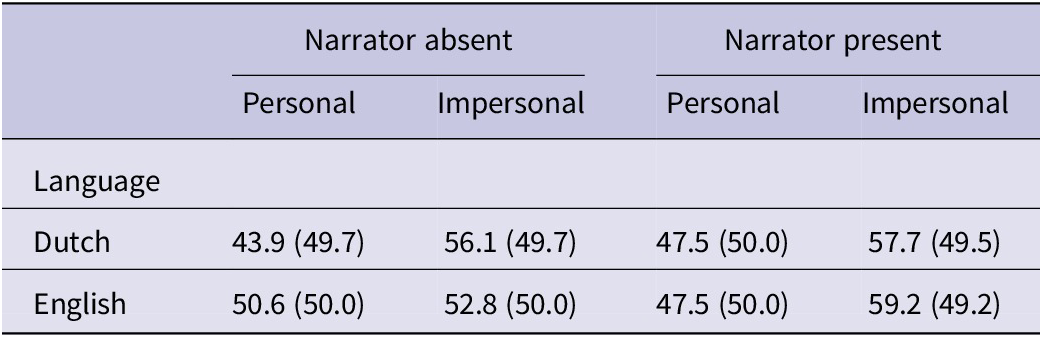
Table 3 shows the percentage of utilitarian decisions by language, social distance and dilemma type. The results demonstrated no significant effects (all ps > .05; see Supplementary Table S6). The marginal R2, indexing the variance explained by the fixed effects, was minimal (.02). A Bayesian model comparison examined whether Language contributed to moral decisions. Comparing the full model with a reduced model excluding Language yielded a Bayes Factor of .48, indicating evidence in favor of the reduced (null) model. Specifically, the observed data are 2.1 times as likely under the null hypothesis as under the model including Language.
Means and SDs of the percentage of utilitarian decisions for language (Dutch vs. English) by narrator (absent vs. present), and dilemma type (personal vs. impersonal) in Experiment 3

Table 3. Long description
The table presents means and S D s for utilitarian decisions. The columns are divided into two main categories: Narrator absent and Narrator present. Each of these is further subdivided into Personal and Impersonal dilemma types.
Row 1: Dutch language.
- Narrator absent: Personal 43.9 (49.7), Impersonal 56.1 (49.7).
- Narrator present: Personal 47.5 (50.0), Impersonal 57.7 (49.5).
Row 2: English language.
- Narrator absent: Personal 50.6 (50.0), Impersonal 52.8 (50.0).
- Narrator present: Personal 47.5 (50.0), Impersonal 59.2 (49.2).
6.2.3. Cross-experiment analyses
To provide an overall overview of our descriptive statistics, Supplementary Table S7 reports the mean proportion of utilitarian decisions, including 95% confidence intervals, across all dilemmas and conditions in each experiment. The observed variability between dilemmas is consistent with previous research showing that moral dilemmas differ in their emotional salience, perceived severity and the extent to which they elicit utilitarian responses (e.g., Brouwer et al., Reference Brouwer2019; Costa et al., Reference Costa, Foucart, Hayakawa, Aparici, Apesteguía, Heafner and Keysar2014; Geipel et al., Reference Geipel, Hadjichristidis and Surian2015a). Likewise, differences across experiments may reflect variations in sample characteristics or random variation rather than systematic effects of our experimental manipulations. The heterogeneity across dilemmas and experiments may have reduced the detectability of effects. At the same time, the absence of consistent patterns across dilemmas and experiments strengthens our conclusion that neither language nor the social-distance manipulation exerted a robust influence on moral decision-making in the present studies.
In addition, we examined whether participants showed invariant response patterns across dilemmas, which could indicate noncompliance or an extreme moral stance. Across all experiments, only two participants (one in Experiment 1 and one in Experiment 2) consistently selected the same response on every trial. In both cases, they always chose the utilitarian option. The vast majority of participants displayed variability in their responses across dilemmas. These findings suggest that invariant responding was rare and unlikely to have influenced the overall results. Detailed participant-level response distributions are reported in Supplementary Table S8 for transparency and to facilitate comparison with future studies.
As two of our experiments showed issues with power, we further assessed whether an increased sample size would reveal any effects. We therefore conducted an additional logistic mixed-effects regression analysis in which data from all three experiments were combined. For this analysis, the impersonal dilemmas from Experiment 3 were excluded, as they do not typically show the Foreign-Language Effect (e.g., Costa et al., Reference Costa, Foucart, Hayakawa, Aparici, Apesteguía, Heafner and Keysar2014). The combined dataset showed no significant effects of Language (estimate = .22, se = .40, z-value = .56, p = .58, odds ratio = 1.25, 95% CI [−.55, 1.00]), Social Distance (estimate = .04, se = .39, z-value = .09, p = .93, odds ratio = 1.04, 95% CI [−.72, .79]) or their interaction (estimate = −.03, se = .77, z-value = −.04, p = .97, odds ratio = .97, 95% CI [−1.55, 1.49]). The marginal R 2, the proportion of total variance explained by the fixed effects, was .002.
A Bayesian model comparison examined whether Language contributed to moral decision-making. Comparing the full model with a reduced model excluding Language yielded a Bayes Factor of .41, indicating that the observed data are 2.4 times more likely under the null hypothesis than under the model including Language.
A post hoc power analysis on the aggregated data indicated power of 100% for both Language and Social Distance, and 99.7% power for the interaction between the two variables, providing strong evidence that the absence of these effects cannot be attributed to insufficient power.
7. General discussion
This study investigated whether social distance conveyed through the communicative context, specifically, the presence of a socially close versus distant narrator, modulates the Foreign-Language Effect in moral decision-making. Based on Construal Level Theory (Eyal & Liberman, Reference Eyal, Liberman, Mikulincer and Shaver2012; Trope & Liberman, Reference Trope and Liberman2010), it was expected that increased social distance, whether induced by using a foreign language and/or conveyed through a distant narrator, would attenuate emotional responses that typically inhibit harm, shifting decisions toward more utilitarian outcomes. Across three experiments, Dutch–English bilinguals responded to moral dilemmas in either their native (Dutch) or foreign (English) language. Modality (written vs. spoken) and dilemma type (personal vs. impersonal) were varied to assess their independent and joint effects on moral decision-making. In all experiments, participants initially completed trials without information about the narrator; in the second half, they were introduced to the narrator via a picture of their face and an accompanying written or spoken biography, depending on the modality.
7.1. The lack of a Foreign-Language Effect
Contrary to our expectations, our data did not provide sufficient evidence to support the presence of the Foreign-Language Effect. Although initial studies reported consistent utilitarian shifts when reasoning in a foreign language (e.g., Brouwer, Reference Brouwer2021; Cipolletti et al., Reference Cipolletti, McFarlane and Weissglass2016; Costa et al., Reference Costa, Foucart, Hayakawa, Aparici, Apesteguía, Heafner and Keysar2014; Kyriakou et al., Reference Kyriakou, Foucart and Mavrou2023), several studies have failed to replicate the effect under certain conditions (e.g., Brouwer, Reference Brouwer2019; Ĉavar & Tytus, Reference Ĉavar and Tytus2018; Dylman & Champoux–Larsson, Reference Dylman and Champoux–Larsson2020; Hou et al., Reference Hou, Jiang, Xie, Li and Huang2026; Vega-Mendoza et al., Reference Vega-Mendoza, Hansson, Sörman and Ljungberg2021; Yavuz et al., Reference Yavuz, Küntay and Brouwer2024). Our results align with these final studies and suggest that other factors may account for this null effect.
First, participants’ high proficiency in English, as indicated by their high LexTALE and self-rating scores, may have reduced social distance, diminishing the language-driven shift toward utilitarian decisions. We therefore assessed in a post hoc exploratory analysis whether these measures interact with Language. The results revealed no significant interactions across all experiments (all ps > .05). In Experiment 1 and 2, we did find a main effect of LexTALE scores on moral decision-making such that higher scores were associated with more utilitarian decisions (Experiment 1: estimate = .02, se = .009, z-value = 2.31, p = .02; Experiment 2: estimate = .02, se = .009, z-value = 2.52, p = .01).
Second, although social distance was manipulated via narrator identity, language and narrator were not fully orthogonal. In particular, participants may have been more sensitive to AI-generated features of the narrator in their native language, leading the Dutch voice to be perceived as more robotic, whereas such features may have been less detectable in the foreign language. This pattern reflects differences in perceived narrator authenticity, as greater familiarity with the native language may heighten sensitivity to paralinguistic cues such as artificiality. Consequently, this asymmetry may have reduced perceived narrator humanness in the native language and thereby attenuated or obscured a potential Foreign-Language Effect in moral decision-making. This is in line with previous work that has shown that artificial voices can heighten perceived social distance by reducing the warmth and likeability that are typically conveyed through human interaction (e.g., Kühne et al., Reference Kühne, Fischer and Zhou2020; Lv et al., Reference Lv, Yang, Qin and Liu2025).
Using the same voice across languages, as in previous work (Brouwer, Reference Brouwer2019, Reference Brouwer2021, Reference Brouwer2023), would have provided tighter experimental control and reduced potential confounds. In our study, we prioritized ecological validity and the introduction of a socially relevant narrator, selecting voices that were representative and matched to each language condition based on pretest ratings. This choice introduced variability and limited the comparability of native and foreign conditions, and it introduced additional biases, such as those related to race, although some of our postexperiment ratings showed that the Nigerian narrator was not necessarily perceived as more socially distant, highlighting the complexity of social distance perceptions.
Most of the previous research has demonstrated the Foreign-Language Effect with various moral dilemmas, particularly personal moral dilemmas (e.g., Cipolletti et al., Reference Cipolletti, McFarlane and Weissglass2016; Costa et al., Reference Costa, Foucart, Hayakawa, Aparici, Apesteguía, Heafner and Keysar2014), across both written and spoken modalities (e.g., Brouwer, Reference Brouwer2021, Reference Brouwer2023; Muda et al., Reference Muda, Pieńkosz, Francis and Białek2020). In Experiments 1 and 2, the same 10 sacrificial moral dilemmas were used as in Brouwer (Reference Brouwer2023), in which the Foreign-Language Effect was previously detected. However, a key difference between these experiments and Brouwer’s (Reference Brouwer2023) is that Brouwer also included 10 impersonal dilemmas and employed a visual-world paradigm. We therefore tested in Experiment 3 whether mixing personal and impersonal dilemmas could result in an effect. However, yet again, no Foreign-Language Effect was detected. We did not replicate the exact setup of Costa et al. (Reference Costa, Foucart, Hayakawa, Aparici, Apesteguía, Heafner and Keysar2014) due to their use of only two dilemmas and the high number of conditions in our study. It is possible that using a larger number of moral dilemmas leads to chance behaviour, as the utilitarian percentages are all around 50% across both languages in all experiments.
7.2. No influence of narrator-based social distance on the Foreign-Language Effect
Regarding the role of social distance, prior research has indicated that the Foreign-Language Effect can vary depending on perceived proximity to the victim, with closer social distance potentially reducing the effect (e.g., Geipel et al., Reference Geipel, Hadjichristidis and Surian2015a; Xu et al., Reference Xu, Wang, Zhu, Liao, Wang, Wang and Liu2024). In the present study, we extended this logic to the communicator rather than the victim, hypothesizing that a socially distant narrator would amplify the Foreign-Language Effect, whereas a socially close narrator would attenuate it. The absence of any narrator effects in these experiments may reflect several factors.
First, while the Dutch narrator was intended to create low social distance and the English narrator high social distance, some of the postexperiment ratings revealed unexpected patterns in face and voice perception. The Dutch voice was, as indicated above, perceived as more robotic, possibly increasing social distance in the native language. These findings suggest that the presence of a narrator, particularly when presented via AI-generated voices, may not be sufficient to elicit the level of emotional engagement necessary to shift moral decisions. This complements prior work showing that social distance effects on moral decision making are strongest when in-group versus out-group membership or family versus stranger status is salient (e.g., Corey et al., Reference Corey, Hayakawa, Foucart, Aparici, Botella, Costa and Keysar2017; Xu et al., Reference Xu, Wang, Zhu, Liao, Wang, Wang and Liu2024). Future studies could use familiar human narrators or immersive avatars to strengthen social proximity cues and better test their interaction with language.
The results from the face and voice perception tasks revealed that, in the pretest and in Experiment 1, the Dutch face was rated more positively than the English face, whereas the opposite was true in Experiments 2 and 3. One could therefore argue that the social distance manipulation appeared to be more effective in Experiment 1 (written modality), but less so in Experiments 2 and 3 (spoken modality). As indicated before, one possible explanation is that the use of AI-generated voices in Experiments 2 and 3 may have increased the perceived distance in Dutch compared to when no voice was present, as in Experiment 1. However, no effect of social distance in interaction with language was found in Experiment 1 either. This might also suggest that employing a narrator as an indicator for social distance may be insufficient, despite previous research demonstrating that visual information can amplify social biases in written (e.g., Fairchild & Papafragou, Reference Fairchild and Papafragou2018; Fairchild et al., Reference Fairchild, Mathis and Papafragou2020) and spoken modalities (e.g., Babel & Russell, Reference Babel and Russell2015; Kutlu, Reference Kutlu2020; McGowan, Reference McGowan2015; Rubin, 1992; Yi et al., Reference Yi, Phelps, Smiljanic and Chandrasekaran2013, Reference Yi, Smiljanic and Chandrasekaran2014; Zheng & Samuel, Reference Zheng and Samuel2017). It is possible that using avatars or real narrators is a necessary condition for including pressure to deviate from one’s internal responses. This would need to be investigated in future research.
As an additional test, we conducted post hoc exploratory analyses linking the voice-rating data to moral decision-making in Experiments 2 and 3 (spoken modality) for each language. It was examined whether individual differences in perceived voice pleasantness or naturalness were associated with systematic differences in moral decision-making. The analyses revealed only an effect in Experiment 2 for the Dutch AI voice (estimate = .30, se = .12, z-value = 2.47, p = .01). Participants who rated the Dutch voice as more pleasant showed a greater tendency toward utilitarian responses. No other significant effects were found (all ps > .1). Overall, the findings suggest that moral decision-making was not systematically influenced by the voice ratings across the experiments.
Finally, the fixed order of the social-distance manipulation represents a limitation of the present design. The decision not to counterbalance narrator presence was motivated by concerns about carryover effects. Presenting a narrator first could have resulted in lingering influences of the narrator’s face and biographical information on subsequent trials in the ‘absent’ condition. However, this design choice limits our ability to disentangle effects of narrator presence from more general sequence-related factors, such as fatigue, increasing task familiarity or shifts in decision strategies over the course of the experiment. Although these factors are unlikely to fully account for the null effects observed, they may have attenuated any subtle influence of narrator-based social distance. Another possible option is that participants may have spontaneously imagined a narrator when reading dilemmas in their native language, making the experimentally introduced narrator insufficient to alter perceived proximity meaningfully.
7.3. Modality and dilemma type
Across experiments, modality (written vs. spoken) and dilemma type (personal vs. impersonal) did not produce consistent effects on moral decisions or interact with language or narrator-based manipulations. Although prior work suggested that auditory presentation could increase emotional engagement and amplify the Foreign-Language Effect (Brouwer, Reference Brouwer2019; Dewaele, Reference Dewaele2004; Harris et al., Reference Harris, Ayçiçeği and Gleason2003, Reference Harris, Gleason, Ayçiçeği and Pavlenko2006), spoken dilemmas did not produce stronger utilitarian responding than written dilemmas in our sample. It is possible that the use of AI-generated voices may have attenuated such effects, particularly in participants’ native language, where AI features were more salient.
Likewise, personal dilemmas, which generally elicit stronger emotional responses than impersonal dilemmas (e.g., Brouwer, Reference Brouwer2021; Costa et al., Reference Costa, Foucart, Hayakawa, Aparici, Apesteguía, Heafner and Keysar2014; Greene et al., Reference Greene, Sommerville, Nystrom, Darley and Cohen2001, Reference Greene, Morelli, Lowenberg, Nystrom and Cohen2008; but see Gawinkowska et al., Reference Gawinkowska, Paradowski and Bilewicz2013; Geipel et al., Reference Geipel, Hadjichristidis and Surian2015b), did not show a larger Foreign-Language Effect or social-distance effects. Together, these findings indicate that neither modality nor dilemma type was sufficient to generate the expected effects under the present experimental conditions.
7.4. Future directions
Future research could address the limitations above in several ways. Matching native and foreign voices on perceived naturalness, or directly comparing human versus AI-generated voices, would reduce potential confounds and allow a more precise assessment of social distance effects. Orthogonally manipulating language and narrator identity would further clarify their independent contributions. Stronger social distance cues, such as familiar versus unfamiliar narrators or in-group versus out-group identities, may be necessary to detect interactions with language context. Finally, more gender-balanced samples are needed to assess whether the observed patterns generalize across participants of different genders.
By addressing these limitations, future work can more rigorously test the conditions under which language and social distance cues influence moral decision-making and the emergence of the Foreign-Language Effect.
8. Conclusion
Across three experiments, manipulations of language, narrator-based social distance, modality and dilemma type failed to influence moral decision-making, highlighting the nuanced and context-dependent nature of the Foreign-Language Effect. These findings provide important boundary conditions for social distance explanations, indicating that subtle cues of social distance, particularly when mediated by artificial or unfamiliar narrators, may be insufficient to shift moral decision-making. By systematically examining these factors, the study underscores that the relationship between language, social distance and moral decision-making is more constrained than previously assumed, and that robust Foreign-Language Effects may require stronger emotional engagement, in-group cues or more ecologically valid social contexts. Overall, these results refine theoretical models by specifying the conditions under which language and social distance interact to shape moral decision-making, providing a foundation for future research aimed at clarifying when and how such effects emerge.
Supplementary material
The supplementary material for this article can be found at http://doi.org/10.1017/S1366728926101734.
Data availability statement
Materials, data, analysis scripts and model outputs of the pretests and the experiments are openly available at the Open Science Framework, see https://osf.io/y2r4z.
Acknowledgments
The authors thank Dalí Chirino and Merel Vermeer for their valuable assistance. They are also grateful for the financial support provided by CLS Small Research Funding.
Funding statement
Open access funding provided by Radboud University Nijmegen.
Competing interests
The authors declare no competing interests.




 Open access

