Introduction
Hyper-competitive markets, global financial crises, and complex changes in institutional factors make it difficult for firms to sustain competitive advantage for long (D'Aveni et al., Reference D'Aveni, Dagnino and Smith2010).
Scholars have proposed that ‘dynamic capability’ is a firm's ability to sense and seize the emerging changes in the business environment through redeployment and reconfiguration of existing resources and competencies (Teece, Pisano, & Shuen, Reference Teece, Pisano and Shuen1997).
Dynamic capabilities encompass organization processes wherein information about the market changes is processed and resources are created, modified, integrated, and transformed to create value for firms in a dynamic business environment to address emerging changes (Ambrosini, Bowman, & Collier, Reference Ambrosini, Bowman and Collier2009; Teece & Al-Aali, Reference Teece and Al-Aali2012). This capability of a firm aligns with the knowledge-based view (Conner & Prahalad, Reference Conner and Prahalad1996), which emphasizes that the ‘capacity to acquire and utilize knowledge’ is critical for improving firm performance and considers knowledge as a vital strategic resource that a firm possesses (Eisenhardt & Martin, Reference Eisenhardt and Martin2000; Grant, Reference Grant1996; Lee & Yang, Reference Lee and Yang2014). Scholars have strongly supported the fact that relationships developed with customers and strategic partners are important sources of knowledge, resources, and know-how capabilities (Foss & Pedersen, Reference Foss and Pedersen2002; Hart, Reference Hart1995; De Marchi & Grandinetti, Reference De Marchi and Grandinetti2013; Pinkse, Kuss, & Hoffmann, Reference Pinkse, Kuss and Hoffmann2010; Zou, Guo, & Guo, Reference Zou, Guo and Guo2019). The ability to create and maintain relationships with customers, suppliers, and other strategic partners to generate additional value for the firm is defined as the relational capability of the firm (Kohtamäki, Rabetino, & Möller, Reference Kohtamäki, Rabetino and Möller2018; Möller & Törrönen, Reference Möller and Törrönen2003). As the information and knowledge from customers and strategic partners are not readily available to the firm, relational capabilities are critical for a firm's survival to actively acquire this information and assimilate it into the organization's processes and practices. Furthermore, many organizations are unable to deal with fast-changing market competition using only their own resources and capabilities. Firms maintain relationships with their strategic partners to gain access to these external resources and capabilities (Dyer & Singh, Reference Dyer and Singh1998). In this specific case, access to knowledge obtained from the firm's relational capability facilitates the ability of a firm to sense changes in the market and modify their resource base. Also, knowledge reorganizes other tangible and intangible resources so they can be used effectively to improve firm performance (Grant, Reference Grant1996).
Therefore, relational capability as a strategic ability provides the firm access to the knowledge and resources (Bitencourt, de Oliveira Santini, Ladeira, Santos, & Teixeira, Reference Bitencourt, de Oliveira Santini, Ladeira, Santos and Teixeira2020) which facilitates the firm's ability to sense the changes in the business environment, leading to resource modification and reconfiguration to match the demand of a market.
Moreover, the impact of a firm's relational capability might be dependent on the market condition of the firm as the dynamic business environment increases the complexity, ambiguity, and risk of the business processes (Jaworski & Kohli, Reference Jaworski and Kohli1993). For example, in a highly competitive environment, access to information and complementary resources will have more importance to the firms to sense the market needs and fulfil them quickly as compared to their competitors. Studies also suggest that the effectiveness of a firm's relationships is subject to various external and internal factors (Singh, Charan, & Chattopadhyay, Reference Singh, Charan and Chattopadhyay2020; Wang, Jiang, & Dong, Reference Wang, Jiang and Dong2021). Therefore, exploring the role of the business environment would certainly provide an additional understanding of how relational capability drives dynamic capability under certain market conditions. To examine this question, the present study considers two key components of market dynamism – competitive intensity and environmental uncertainty – that are expected to influence the way firms get the benefit of customer and market knowledge obtained through their relational capability with customers and strategic partners.
The dynamic capability is more relevant to firms in the context of developing economies where the market dynamism is significantly high than in developed economies (Arndt, Reference Arndt2019; Fainshmidt, Pezeshkan, Lance Frazier, Nair, & Markowski, Reference Fainshmidt, Pezeshkan, Lance Frazier, Nair and Markowski2016; Zhou, Zhou, Feng, & Jiang, Reference Zhou, Zhou, Feng and Jiang2019). Due to the rapid growth, aggressive variations in consumer demand, accelerating globalization and international competition, and swift changes in technology, the Indian service industry has seen an unprecedented degree of change in recent years, thereby increasing uncertainty and competition in the business environment (KPMG-CII Report, 2016). Firms constantly need to sense the changes in customer preferences, expectations, and business opportunities, and in order to address these environmental changes effectively, dynamic capability is important to modify, develop, and alter the resource base (Teece, Reference Teece2007). Therefore, examining the enablers of dynamic capabilities in the context of emerging economies offers a more nuanced conceptualization of the relationship (Arndt, Reference Arndt2019). Adding to this, most studies on relational capabilities and their impact on the firm have been conducted in the context where an organization's networking practices are well structured and established (Kirca, Jayachandran, & Bearden, Reference Kirca, Jayachandran and Bearden2005). Zhou, Brown, Dev, and Agarwal (Reference Zhou, Brown, Dev and Agarwal2007) find that effectiveness in managing relationships with customers and strategic partners has a differential effect on developing and developed economies. Our study in an emerging context like India, where organizational practices are still developing, has the potential to add a new perspective to the existing literature.
Therefore, the objectives of this study are as follows: (1) to examine the effect of relational capabilities (namely, customer linking capability and strategic partnering capability) on dynamic capability development, and (2) to study whether the association between relational capability and dynamic capability is moderated by the firm's market conditions.
To empirically test our proposed relationships, we collected the responses from 218 service companies and analysed them using the moderated hierarchical regression method. The results support the increasing need for collaboration with customers and strategic partners for the development of dynamic capabilities to address the demands of the changing business environment. Furthermore, the level of competitive intensity influences the effectiveness of relational capability on dynamic capability.
This study contributes to the extant literature and practice in multiple ways. First, by integrating the relational capabilities perspective with the dynamic capabilities, this study confirms that an organization's strategic partnering capability and customer linking capability positively influence dynamic capability development; using the knowledge-based view as a theoretical lens to explore the said relationship; thereby providing sound anchoring. The finding emphasizes the importance of forming and maintaining good relationships with customers and strategic partners to adapt to changes in the environment. Second, the study contributes to the literature by analysing the moderating effect of the market competition on the association between relational capabilities and dynamic capabilities. Third, the study contributes to the discussion on the endogenous and exogenous perspectives of dynamic capability development. Findings suggest that relational capability as an internal factor together with environmental uncertainty as an external factor better explains the variation in the model of dynamic capability development than the models where these two factors were considered separately, therefore suggesting that dynamic capabilities are the result of co-evolution of both external and internal factors. The final contribution relates to the context of the study: the developing economy of India; being one of the largest and fastest developing economies today, India shares many features with other developing countries. For instance, the business conditions in emerging economies (e.g., India, South Africa, and Brazil) are quite similar, including the infrastructure quality (e.g., transportation, distribution, IT) and political stability, as well as the availability of important resources, such as reliable suppliers, qualified employees, managerial talent, etc. (Zhou et al., Reference Zhou, Brown, Dev and Agarwal2007). Furthermore, external competitive threats are significant in emerging markets because of globalization and technological development, which raises competition, uncertainty, and challenges for the firms (D'aveni, Reference D'aveni2010). Moreover, most emerging market firms lack extensive alliance experience and a well-developed governance structure, and they are still in the early phases of developing and maintaining relationships with customers, suppliers, and strategic partners (Kirca, Jayachandran, & Bearden, Reference Kirca, Jayachandran and Bearden2005; Wang, Jiang, & Dong, Reference Wang, Jiang and Dong2021). Thus, empirical findings from the Indian context provide important implications for firms operating in other developing economies.
The rest of the paper is organized as follows: we first explain the theoretical background related to the hypotheses proposed in Section ‘Theoretical background and hypotheses’. The research methodology is presented in Section ‘Methodology’, followed by the analysis and results. Lastly, the discussion of the findings with implications and limitations is provided.
Theoretical background and hypotheses
Dynamic capabilities
The dynamic capability theory is considered an addendum to Barney's (Reference Barney1991) resource-based view, which suggests that organizations can create and maintain competitiveness based on the resources that are valuable, rare, inimitable, and non-substitutable. Adding to this perspective, Teece, Pisano, and Shuen (Reference Teece, Pisano and Shuen1997) proposed the concept of dynamic capability and defined it as a ‘firm's ability to integrate, built, and reconfigure external and internal resources and competencies to address rapidly changing environment’ (Teece, Pisano, & Shuen, Reference Teece, Pisano and Shuen1997). Dynamic capability includes standard entrepreneurial processes (i.e., identifying under-satisfied demands and mobilizing resources in such a way as to create a profit from satisfying them); but its critical value arises out of helping organizations to do this repeatedly, thereby helping them create a durable competitive advantage (Arndt & Bach, Reference Arndt and Bach2015; Zollo & Winter, Reference Zollo and Winter2002). Consistent with existing studies, we chose to define dynamic capabilities as encompassing those activities wherein information about the market changes are processed and resources are created, integrated, and transformed to create value for firms in a turbulent environment to address emerging changes (Ambrosini, Bowman, & Collier, Reference Ambrosini, Bowman and Collier2009). This study, therefore, conceptualizes dynamic capability in four dimensions: sensing, learning, integration, and reconfiguration capability.
Sensing refers to the organizational process to sense and interpret changes in the business environment by effectively scanning and analysing available information (Osiyevskyy, Shirokova, & Ritala, Reference Osiyevskyy, Shirokova and Ritala2020). This enables organizations to discover latent opportunities while creating new ones.
Learning, on the other hand, refers to the ability to transform and use new skills and knowledge. It is the ability to upgrade an organization's resources and capabilities. Through the learning process, managers use organizational knowledge and resources, along with other capabilities to create or modify organizational routines that adapt to changing business environment (Lubatkin, Simsek, Ling, & Veiga, Reference Lubatkin, Simsek, Ling and Veiga2006).
Integration capability alludes to the dissemination of learned information and skills throughout an organization for a shared understanding and to create an effective response to turbulent market conditions (Weaven, Quach, Thaichon, Frazer, Billot, & Grace, Reference Weaven, Quach, Thaichon, Frazer, Billot and Grace2021).
Reconfiguration capability refers to the ability to transform or reassemble existing resources and organizational structures to deal with the market changes based on the evolution of the markets and competitors' actions. It includes investment in human and technological resources (Biesenthal, Gudergan, & Ambrosini, Reference Biesenthal, Gudergan and Ambrosini2019). Accordingly, firms with purposeful insight towards the market changes update their existing resources and capabilities to adapt to new changes and survive in a hypercompetitive business environment.
Relational capabilities
The nature of competition has shifted from being an individual organization to competing networks of strategic partnerships. Firms' own resources are limited and scholars have suggested that creating and maintaining a relationship with customers and strategic partners can provide access to complementary resources and capabilities, as well as information about new markets or business opportunities (Bitencourt et al., Reference Bitencourt, de Oliveira Santini, Ladeira, Santos and Teixeira2020; Wu, Reference Wu2014). Relational capabilities focus on those activities that create and improve the relationship and closeness of the organization to its customers and other stakeholders by enhancing trust and confidence within associations and increasing willingness for further collaboration (Garrette, Castañer, & Dussauge, Reference Garrette, Castañer and Dussauge2009; Rodríguez-Díaz & Espino-Rodríguez, Reference Rodríguez-Díaz and Espino-Rodríguez2006). The scholars further emphasize that two firms or parties always co-create ‘relational rents’ whereby none of them would be able to achieve the same level of performance alone (Ngugi, Johnsen, & Erdélyi, Reference Ngugi, Johnsen and Erdélyi2010).
Consistent with the literature, the study defines relational capability as the ability of a firm to develop and maintain relationships with customers and strategic partners (Theoharakis, Sajtos, & Hooley, Reference Theoharakis, Sajtos and Hooley2009). Therefore, we have conceptualized the relational capability as a two-dimensional construct: customer linking capability and strategic partnering capability. Customer linking capability is a firm's ability to build and manage proper relationships with its customers by understanding their needs and expectations. Customer linking capability facilitates access to any customer-related information, such as their changing needs and expectations, new market opportunities, etc. (Tajeddini, Reference Tajeddini2010), which in fact helps the firms to innovate, be it in terms of new product development, or an alternate process, which ultimately leads to improved customer service and firm performance (Grissemann, Plank, & Brunner-Sperdin, Reference Grissemann, Plank and Brunner-Sperdin2013).
Strategic partnering capability emphasizes forming and maintaining alliances based on knowledge, expertise, trust, and commitment. Strategic partnering among organizations enhances their access to new knowledge, skills, technologies, markets, or business opportunities, which positively affects firm performance (Kohtamäki, Rabetino, & Möller, Reference Kohtamäki, Rabetino and Möller2018; Theoharakis, Sajtos, & Hooley, Reference Theoharakis, Sajtos and Hooley2009).
Therefore, organizations need to develop and maintain relationships with customers and strategic partners in order to understand and address the demands of the changing business environment. However, ‘the underlying mechanism’ through which knowledge and resources acquired from a firm's relational capabilities influence the firm performance has remained unclear. Furthermore, an emerging perspective in the literature contends that relational capabilities enable ‘higher-order capabilities’, which in turn improves firm performance (Agarwal & Selen, Reference Agarwal and Selen2013; Ngugi, Johnsen, & Erdélyi, Reference Ngugi, Johnsen and Erdélyi2010). Firms' dynamic capabilities are considered higher-order capabilities (Winter, Reference Winter2003), which operate to extend, modify, or create existing resources and capabilities to address the changes in the market. Scholars have also suggested that an organization's ability to change its resource bases may either come from within, in the form of change in leadership style for example, or it could come from outside, in the form of external agents (Ambrosini, Bowman, & Collier, Reference Ambrosini, Bowman and Collier2009; Dyer & Singh, Reference Dyer and Singh1998). In the present research, we have postulated that the ability of a firm to modify and reconfigure its resources comes from outside in the form of customers and strategic partners, which provides access to new knowledge, information, technologies, and/or new opportunities. This facilitates the process of sensing the changes in the market, learning and integrating new knowledge and information into the firm, and reconfiguring existing resources to deal with the demands of a turbulent business environment.
Relational capabilities and dynamic capabilities
One of the primary functions of dynamic capability is sensing customers' changing needs and the market opportunities (Teece, Reference Teece2007), and integrating this new information and knowledge into the system to reconfigure existing resources and capabilities (Eisenhardt & Martin, Reference Eisenhardt and Martin2000; Teece, Reference Teece2007). However, knowledge about changing customer needs and the market is not readily available to the firm. The customer linking capability of the firms provides access to such information. Firms use this new information to sense business opportunities and reconfigure the resource base to deal with market changes (Tzokas, Kim, Akbar, & Al-Dajani, Reference Tzokas, Kim, Akbar and Al-Dajani2015). With customer linking capability, firms create and maintain relationships with customers and get timely feedback on changing customer needs, market trends, etc., which facilitates the firm to recognize the opportunities and reorganize its resources to develop new offerings that cater to changes in demand (Stringfellow, Nie, & Bowen, Reference Stringfellow, Nie and Bowen2004; Tajeddini, Reference Tajeddini2010). High-quality customer relationships help organizations with joint problem-solving – specifically, they help the firms obtain valuable insights on creating customer value while determining the root causes of customer problems more readily (and respond more quickly) than if the firms were to identify problems and search for solutions without customer input (Mediano & Ruiz-Alba, Reference Mediano and Ruiz-Alba2019; Stringfellow, Nie, & Bowen, Reference Stringfellow, Nie and Bowen2004; Xu, Guo, Zhang, & Dang, Reference Xu, Guo, Zhang and Dang2018). Thus, we hypothesize:
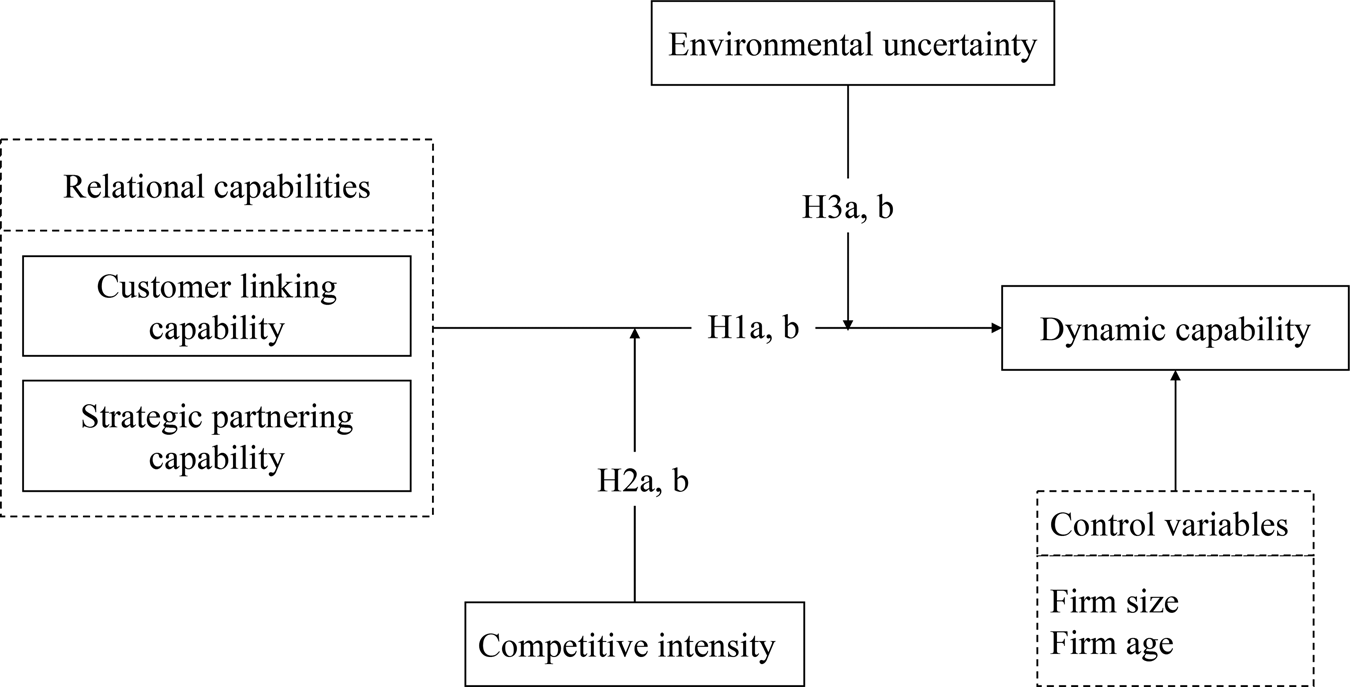
Hypothesis 1a: Customer linking capability has a positive influence on the development of dynamic capability.
Though organizations in the same industry have a similar business environment, each one of them possesses unique knowledge and experience. Maintaining relationships with strategic partners, based on trust and commitment aids in the acquisition of new information, resources, and technology. Firms can identify the opportunities and threats in the business environment by actively collecting market-related information and modifying their resources and capabilities to adapt to the changing environment (Day & Wensley, Reference Day and Wensley1988). Essentially, in strategic partnering, an organization's valuable networks serve as the key hubs for information and knowledge flow (Kohtamäki, Rabetino, & Möller, Reference Kohtamäki, Rabetino and Möller2018); this new information and knowledge could help organizations identify appropriate alternative strategies to deal with emerging changes (Garrette, Castañer, & Dussauge, Reference Garrette, Castañer and Dussauge2009). Moreover, even if appropriate strategies to deal with unpredictable changes in the environment have been determined, a firm has limited resources. A high level of strategic partnering capability, therefore, helps organizations gain access to important knowledge, resources, and capabilities (Kohtamäki, Rabetino, & Möller, Reference Kohtamäki, Rabetino and Möller2018; Zheng, Wei, Zhang, & Yang, Reference Zheng, Wei, Zhang and Yang2016). The access to new knowledge, resources, and capabilities allow the firms to build higher-order capabilities through better communication, information sharing, and transparency (Gupta & Govindarajan, Reference Gupta and Govindarajan2000; Lee & Yang, Reference Lee and Yang2014). Agarwal and Selen (Reference Agarwal and Selen2013) find the ties with strategic partners enable the firms to cope with the market complexity and uncertainty through appropriate resource allocation and skill-building. Thus, we hypothesize:
Hypothesis 1b: Strategic partnering capability has a positive influence on the development of dynamic capability.
Moderating role of the market dynamism
Organizations with a high level of relational capability, that is, those that build and maintain relationships with consumers and strategic partners, will be able to obtain access to market and customer-related data and restructure their resources to better meet the market demand (Lee & Yang, Reference Lee and Yang2014). However, despite the importance of maintaining relationships with customers and strategic partners, the existing mixed evidence in the literature suggests that the effectiveness of organization relationships depends on various internal and external factors (Christensen & Bower, Reference Christensen and Bower1996; Grewal & Tansuhaj, Reference Grewal and Tansuhaj2001; Joshi, Reference Joshi2016; Wang, Jin, Zhou, Li, & Yin, Reference Wang, Jin, Zhou, Li and Yin2020). As a response to account for the possible moderators, we introduced the market dynamism as a possible moderating factor that might have an impact on the effectiveness of relational capability of the firm (Houston, Reference Houston1986).
Dess and Beard (Reference Dess and Beard1984) defined the market dynamism as ‘the degree of unpredictability of change within an industry’. A substantial part of market dynamism emanates from fierce competition in the industry (competitive intensity), whereas another substantial part derives from uncertainty in customers' needs and preferences (environmental uncertainty) (Su & Linderman, Reference Su and Linderman2016).
The market dynamism increases the ambiguity and the risk for the firm's strategy and business processes, leading to an impact on the effectiveness of the firm's relational capabilities. The reason we have chosen market dynamism as a possible moderator is as follows: first, in a highly uncertain environment, firms are required to continuously modify their offering to satisfy the changing preferences of the customers, which is relatively less required in the case of a more stable market where customer preferences do not evolve much (Grewal & Tansuhaj, Reference Grewal and Tansuhaj2001; Jaworski & Kohli, Reference Jaworski and Kohli1993). Therefore, the importance of the information and knowledge from the customers about the changing market needs might not be very useful for resource modification and reconfiguration. Furthermore, in a highly competitive market, customers have a lot of alternative options when choosing a product or service. In that case, information about changes in the market and complementary resources from the strategic partners will have more importance to detect changes in the business environment and respond quickly in comparison with the competitors (Jaworski & Kohli, Reference Jaworski and Kohli1993).
Next, we have discussed in greater detail how different market conditions can moderate the effect of customer linking and strategic partnering capability on dynamic capability of the firm.
When the competition is low or moderate, then it is necessary for organizations to monitor and respond to the changes in customer needs and preferences to ensure that customers choose their offerings over their competitors. But, when competition is very intense, customers can easily switch to substitutes available in order to satisfy their demands (Porter & Millar, Reference Porter and Millar1985). In such a situation, customer linking capability becomes more important to gain access to customer-related information as firms require this information to respond closely and quickly to customer needs (Porter & Millar, Reference Porter and Millar1985). However, studies also suggest that intensive customer involvement is not always better and decreases the performance of radical innovation projects (Grewal & Tansuhaj, Reference Grewal and Tansuhaj2001; Lin, Tu, Chen, & Huang, Reference Lin, Tu, Chen and Huang2013). These authors reason that being too much dependent on the information provided by the customers would cause the firms to lock into a standard mode of cognition and response (Grewal & Tansuhaj, Reference Grewal and Tansuhaj2001; Wang et al., Reference Wang, Jin, Zhou, Li and Yin2020). Thus, instead of only following customers' preferences, organizations should look for business opportunities and establish hard-to-duplicate competitive positions by influencing and directing the market demand through the introduction of new and innovative products and service offerings (Workman, Reference Workman1993). For example, the cell phone market is highly competitive, whereby new models are launched almost every month. Apple did not follow what others were doing; instead, it created its own competitive position in the market through advanced interface technology and superior software experience (West & Mace, Reference West and Mace2010). Furthermore, firms that focus more on customer needs and preferences to guide their resource modification and allocation are more likely to be confined to institutionalized thinking about customer behaviour. This type of thinking is not always fruitful, as in a highly competitive environment there is a need for an appropriate response to competitors' actions (Jaworski & Kohli, Reference Jaworski and Kohli1993). To respond to competitors' actions, firms require knowledge and resources. In emerging countries where resources are scarce, customer linking capability may be less valuable. Though customer intelligence can provide information about the customer's needs, it offers very little guidance about how to secure the necessary resources (Zhou & Li, Reference Zhou and Li2010; Zhou et al., Reference Zhou, Brown, Dev and Agarwal2007). Thus, we propose that customer-linking capability becomes less influential for guiding an organization's resource redeployment and reconfiguration, that is, dynamic capability, when competitive intensity is very high. Therefore, we hypothesize:
Hypothesis 2a: The higher the competitive intensity in the business environment, the weaker the influence of customer linking capability on dynamic capability.
Organizations struggle to survive in highly competitive markets and come up with renewed products and services to maintain their competitive stance in the market. In such a scenario, information is a crucial resource, and firms are highly motivated to seek ideas from various strategic partners (Adomako, Danso, Boso, & Narteh, Reference Adomako, Danso, Boso and Narteh2018; Wang, Dou, Zhu, & Zhou, Reference Wang, Dou, Zhu and Zhou2015). However, the risk of opportunism and the cost of safeguarding also increase. Organizations become protective of their knowledge, ideas, and intellectual properties; in fact, at times, they even avoid engaging with external network members. A firm's strategic partnering capability can actually help them lessen such apprehensions by implementing an effective governance mechanism that can improve the cooperation among firms for knowledge sharing (Day, Reference Day2000; Wang et al., Reference Wang, Dou, Zhu and Zhou2015). Moreover, insights and knowledge gained from close interaction with strategic partners assist an organization during the process of exploiting new business opportunities and mobilizing and deploying resources that may help them create a relative competitive advantage against major competitors (Ebbers, Reference Ebbers2014; Makadok, Reference Makadok2001). Thus, we hypothesize:
Hypothesis 2b: The effect of strategic partnering capability on dynamic capability is strengthened when the level of competitive intensity increases.
Environmental uncertainties imply instability and uncertainty in customer preferences and expectations. When customers' needs and preferences are relatively stable or moderately uncertain, maintaining relationships with customers can increase an organization's ability to know about the customers' potential needs, and thereby provide services and products accordingly. Thus, the effort organizations put into maintaining relationships with customers improves their ability to adapt to environmental changes (Zhou & Li, Reference Zhou and Li2010). However, on the other hand, when customers' needs and preferences are highly uncertain, information and knowledge that the same organizations get from customers to identify and predict their potential needs, may not be helpful in guiding resource reconfiguration or in improving product and service offerings to address their highly uncertain demands (Workman, Reference Workman1993). This is because customers cannot predict the trends of the market; they mainly focus on their existing needs. Tight coupling with short-sighted customers might lead to failure in recognizing the signals for innovation (Danneels, Reference Danneels2003). Moreover, organizations focusing primarily on customers may overlook business opportunities and therefore lag behind on changes occurring in the business environment; and due to the allocation of resources on the wrong tracks, firms may fail to adapt effectively. Thus, we hypothesize:
Hypothesis 2c: The higher level of environmental uncertainty weakens the impact of customer linking capability on dynamic capability.
When environmental uncertainty is very high, organizations tend to turn to strategic partners for more insightful information, which in turn enables them to understand the market trends and take competitive actions (Day & Wensley, Reference Day and Wensley1988). An organization that has good relationships with strategic partners would have up-to-date and in-depth knowledge of the competitive environment and potential trends, which would help it reallocate resources to develop products and services to address the target customers' preferences and adapt to emerging changes in the business environment (Wu, Reference Wu2014). Thus, firms with good strategic partnering capabilities are more prepared to integrate and modify their resources to provide improved offerings and to handle changing customers' needs and preferences. Thus, we hypothesize:
Hypothesis 2d: The effect of strategic partnering capability on dynamic capability is strengthened when the level of environmental uncertainty increases.
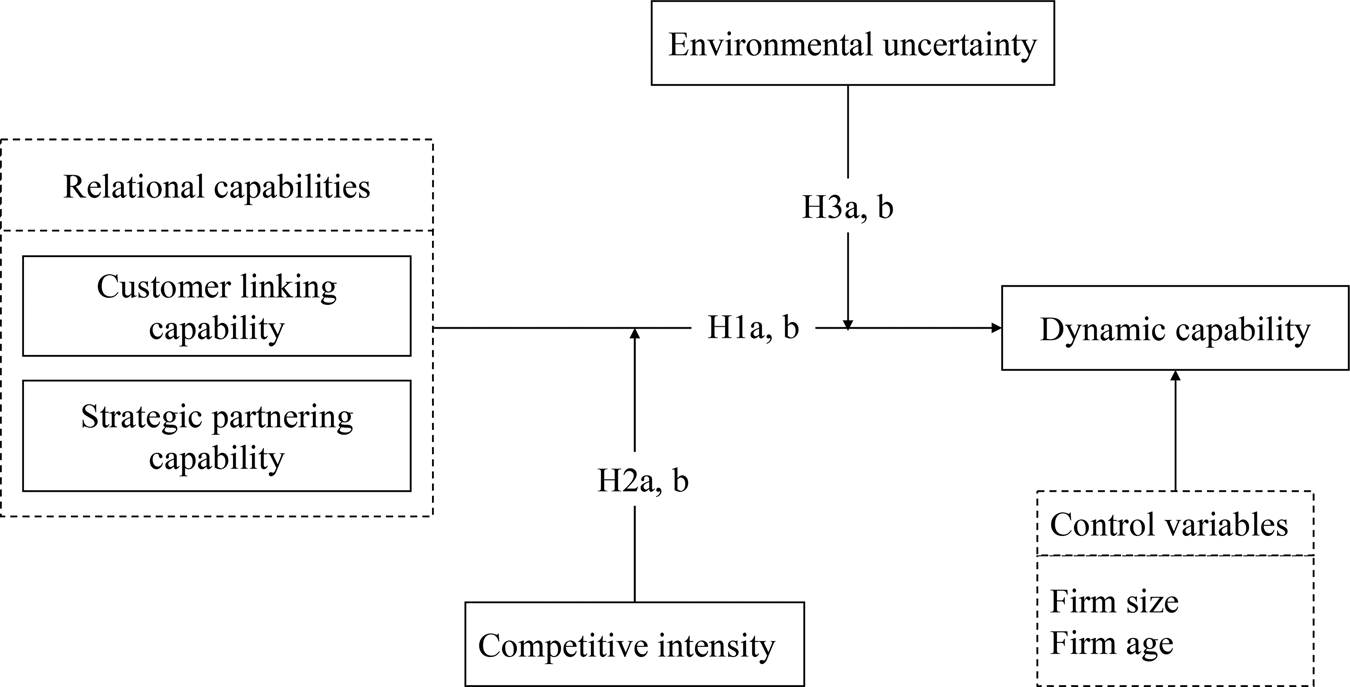
A research model is presented in (Figure 1) following the aforementioned hypotheses.
Research framework.
Methodology
Sample and data collection procedure
India is an emerging economy with an extremely dynamic and complex business environment in which firms face not only new challenges, but also deal with collapsing capabilities (Lakshman, Kumra, & Adhikari, Reference Lakshman, Kumra and Adhikari2017; Pandit, Joshi, Sahay, & Gupta, Reference Pandit, Joshi, Sahay and Gupta2018). Since the introduction of privatization, economic reforms, and liberalization policies in 1991, India has begun to experience rapid economic transformation as the market has opened for international investment and competition. The country has emerged as one of the fastest-growing economies, with the business environment consistently experiencing higher levels of market turbulence, competition, and uncertainty (Lakshman, Kumra, & Adhikari, Reference Lakshman, Kumra and Adhikari2017). Such dynamics significantly affect managerial decision-making processes and actions (Zhou & Li, Reference Zhou and Li2010). For these reasons, the Indian market represents a robust setting to examine the factors impacting the development of dynamic capability under different levels of market dynamism.
We have used the Prowess database of the Centre for Monitoring the Indian Economy (CMIE) to achieve a representative sample of Indian service firms. CMIE is India's largest database containing the financial performance data of more than 51,000 companies. Using this database, we began the data collection process by establishing a sampling frame of 13,722 firms from different service sectors, such as telecommunication services, computer & IT services, financial services, hospitality, tourism services, etc. The use of a cross-industry sample is considered ideal for research on organizational capabilities (e.g., Gutierrez-Gutierrez, Barrales-Molina, & Kaynak, Reference Gutierrez-Gutierrez, Barrales-Molina and Kaynak2018).
During the selection process of firms to send the questionnaire, we ensured that our final sample data have a sufficient level of performance variance. An email specifying the objective of the research project, containing a direct link to the survey, was sent to a minimum of five senior-level and five mid-level managers because earlier studies have confirmed the attitudinal difference between those levels of the hierarchy (Payne & Mansfield, Reference Payne and Mansfield1973). We also ensured that subjects chosen to fill out the survey have sufficient experience with the company to be able to answer the organizational level questions and provided anonymity to respondents to enhance the quality of data obtained.
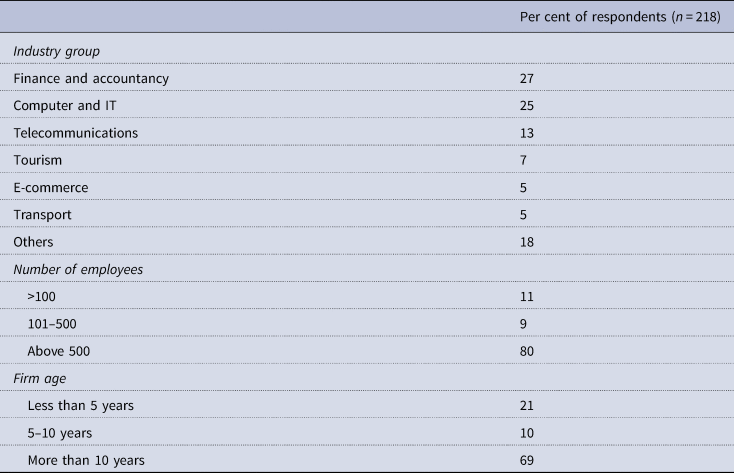
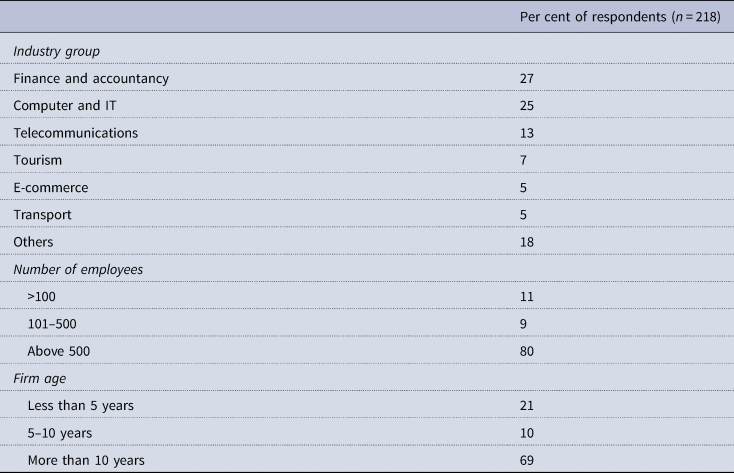
Out of 2,100 questionnaires distributed, 218 usable responses were received, representing a 10.4% response rate, an acceptable level of response rate for an organizational level of analysis (Klassen & Jacobs, Reference Klassen and Jacobs2001). Well-represented industries include finance and accountancy (27%), computer and IT (25%), telecommunications (13%), and tourism (7%) (see Table 1).
Characteristics of the study sample
Measurement items
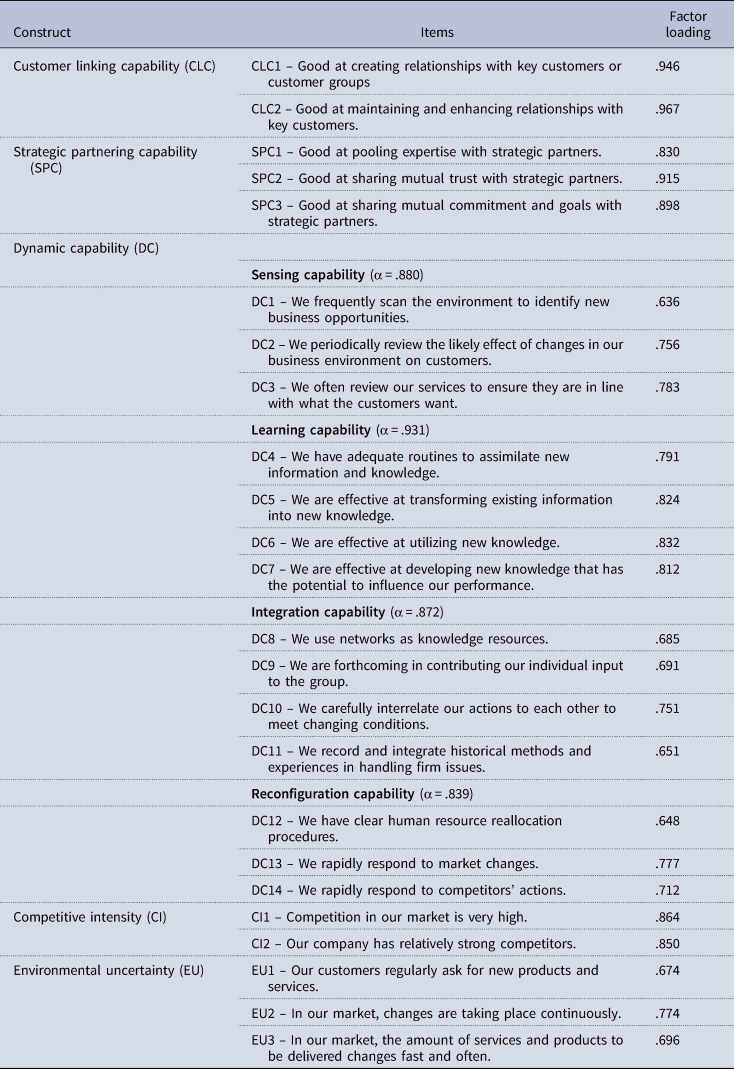
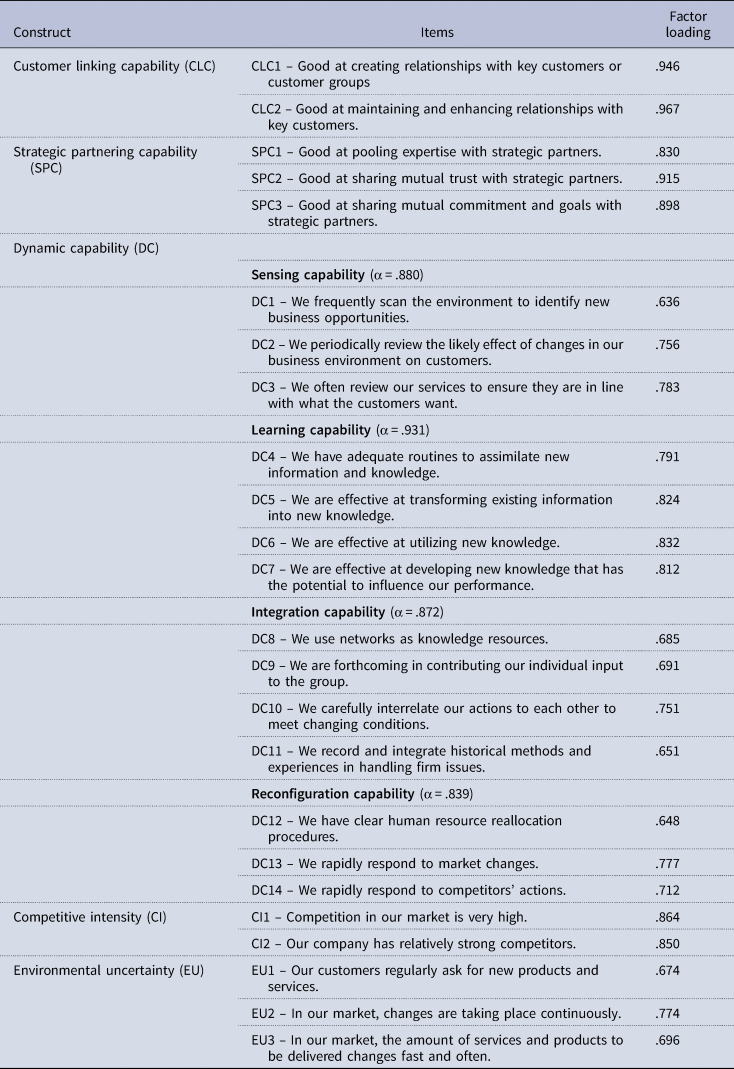
All the measurement items used in this study are established measures adapted from the literature. The items were pre-tested with the help of two faculty members, two CEOs, and three senior managers to check the face validity in the Indian context. The purpose was to identify problems in item wording, exhaustion, possible ambiguities, and constraints on the respondents. The list of final measurement items is given in Table 2 and explained below.
Construct's measurement items and factor loadings
Relational capability
The relational capability construct is measured by asking the managers to rate their firm in terms of how good it is at creating and maintaining relationships with its customers and strategic partners compared to its competitors. The items were adapted from established scales in the literature (see, Theoharakis, Sajtos, & Hooley, Reference Theoharakis, Sajtos and Hooley2009). Respondents rated the items on a 7-point scale (1 = far below; 7 = far above) by comparing their own firm performance to that of their competitors.
Dynamic capability
The dynamic capability has been measured in terms of sensing, learning, integration, and reconfiguration capability. The measurement items for dynamic capability have been adapted from the existing studies (see, Lin & Wu, Reference Lin and Wu2014; Pavlou & El Sawy, Reference Pavlou and El Sawy2011; Teece, Reference Teece2007; Teece, Pisano, & Shuen, Reference Teece, Pisano and Shuen1997). Respondents rated the survey items on a 7-point scale (1 = strongly disagree; 7 = strongly agree).
Market dynamism
Market dynamism is measured in terms of competitive intensity and environmental uncertainty. Competitive intensity assesses the extent to which a firm's market is characterized by strong competitors, the number of players in the market, and fierce price wars (Jaworski & Kohli, Reference Jaworski and Kohli1993). Environmental uncertainty captures the unpredictability and uncertainty caused by either customers' needs and expectations, market demands, or technological changes, which makes the firm's business environment unpredictable. The measurement items were taken from the study by Su and Linderman (Reference Su and Linderman2016). Respondents rated the survey items on a 7-point scale (1 = strongly disagree; 7 = strongly agree). As shown in Table 2, for competitive intensity, only two of the three items were retained after confirmatory factor analysis (CFA). The mean, standard deviation (sd), and correlations of these constructs are given in Table 3.
Mean, SD, Cronbach's α, CR, AVE values, and inter-factor correlations

*Correlation is significant at the .05 level (two-tailed).
∗∗Correlation is significant at the .01 level (two-tailed).
Control variables
The study includes two control variables: firm size and age to account for extraneous sources of performance variation. Firm size is measured as the number of employees and age is measured as the number of years since the firm formation.
Non-response bias
Following the approach proposed by Armstrong and Overton (Reference Armstrong and Overton1977), we performed an independent sample t-test to check the non-response bias between early and late respondents in terms of firm age, size, and sales growth. For this test, an independent sample t-test was chosen because it compares scores on the same variables but for two different groups. The first 6-week responses were considered as early responses (n = 111), whereas last 6-week responses were considered as late responses (n = 107). The result showed no significant difference (p-value >.1) between early and late respondents, which suggests that non-response bias is not a concern in this study.
Data analysis and results
Common method variance
Common method variance (CMV) refers to the shared variance among the measured variables that occurs when all data (independent, dependent, mediating, and/or moderating variables) are collected using a common method (Podsakoff, MacKenzie, & Podsakoff, Reference Podsakoff, MacKenzie and Podsakoff2012), resulting in artificial inflation or deflation of the relationships between two different variables (Jordan & Troth, Reference Jordan and Troth2020). Lack of careful consideration of CMV can lead to several problems in the interpretation of research outcomes, for example, biased estimates of validity and reliability of measures used, incorrect results about the amount of variance attributed to a dependent variable by an independent variable leading to the problem of type I or II errors in hypothesis testing (Podsakoff, MacKenzie, & Podsakoff, Reference Podsakoff, MacKenzie and Podsakoff2012). All these problems together make it very difficult to interpret the results of those who are affected by the CMV.
We used several measures to reduce the method bias. To reduce the answer ambiguity and increase the honest answer, we used an anonymous questionnaire with no right or wrong answers (Lin et al., Reference Lin, Tu, Chen and Huang2013). Furthermore, to evaluate CMV, we followed the approach proposed by Podsakoff, MacKenzie, and Podsakoff (Reference Podsakoff, MacKenzie and Podsakoff2012) and examined the fit of the model in which all indicators were loaded onto one factor. The reasoning behind the ‘single-factor procedure’ is that a CFA should show that a single-factor model has a good fit with the data if CMV is largely responsible for the covariance among the measures. For our sample, the single-factor model did not fit well (CMIN/DF = 7.750, GFI = .510, comparative fit index [CFI] = .507, RMSEA = .158, S(RMR) = .1043), indicating that CMV is not a serious concern in this study.
Reliability and validity of measures
We ran a CFA in SPSS-AMOS 22 to assess the validity of the main variables (relational capability, dynamic capability, competitive intensity, and environmental uncertainty). We identified and dropped the measurement items that had either low factor loadings or high cross-loading. The measurement model shows a satisfactory fit: χ2/df = 1.718, CFI = .954, incremental fit index (IFI) = .954, root mean squared error of approximation (RMSEA) = .058 (Fornell & Larcker, Reference Fornell and Larcker1981). For each construct, all items' standardized factor loadings are significant (p < .001), and no major cross-loading emerged, supporting the unidimensionality of the latent constructs.
To check the reliability of the measurement scale, we assessed the Cronbach's α values. The Cronbach's α values for all the constructs ranged from .751 to .955 higher than the minimum requirement of .7, which indicates a high internal consistency among the measurement items of the constructs (see Table 3). We also assessed the composite reliability (CR) using the procedure outlined by Fornell and Larcker (Reference Fornell and Larcker1981). The CR values for all the constructs are higher than the minimum threshold value of .7. The average variance explained (AVE) value for all of the constructs is higher than the cut-off value of .5 (Hair, Black, Babin, Anderson, & Tatham, Reference Hair, Black, Babin, Anderson and Tatham2018) (see Table 3). Finally, we assessed the discriminant validity following the approach recommended by Fornell and Larcker (Reference Fornell and Larcker1981). The square root of each construct's AVE should have a higher value than the correlation with the other constructs, which is the case for this study (see Table 3). Overall, the above results suggest that the measurement scales are satisfactorily valid and reliable.
Hierarchical regression analysis
A hierarchical regression is a special form of multiple linear regression analysis where variables are included in the model in a stepwise process called ‘blocks’. The process is done to examine whether adding variables significantly improves a model's ability to predict the dependent variable and/or to investigate a moderating effect of a variable (Hair et al., Reference Hair, Black, Babin, Anderson and Tatham2018).
To test the moderating effect, the most common way is to use the product term (independent variable × moderator variable), which encompasses the interaction effect, and then calculate the R 2 values for both the ‘main-effect-only’ model (model for predicting dependent variable from independent and moderator variables), and for the model with product term in the main effect model (Cohen, West, & Aiken, Reference Cohen, West and Aiken2014; Hair et al., Reference Hair, Black, Babin, Anderson and Tatham2018). If the difference between the R 2 values of these two models is significantly different, then an interaction effect is present (Cohen, West, & Aiken, Reference Cohen, West and Aiken2014). However, there are issues of multicollinearity and redundancy with R 2; therefore, we have considered adjusted R 2 value to assess the model differences. The adjusted R 2 value signifies the percentage of variation explained by only the independent variables that actually affect the dependent variable.
To mitigate any potential multicollinearity problem between the main and interaction terms, we employed the ‘mean-centring’ method, which has also been used by Zhou and Li (Reference Zhou and Li2010). In all the regression results, for all four models, variance inflation factor values ranged between 1.116 and 2.520, which is well below the benchmark value of 10 (Hair et al., Reference Hair, Black, Babin, Anderson and Tatham2018). Thus, multicollinearity is not a concern for this study. To check for normality, the Kolmogorov–Smirnov test was used. In our results, the Kolmogorov–Smirnov test (p > .05) was statistically insignificant, that is, data can be considered normally distributed (Hair, Black, Babin, & Anderson, Reference Hair, Black, Babin and Anderson2014).
Results
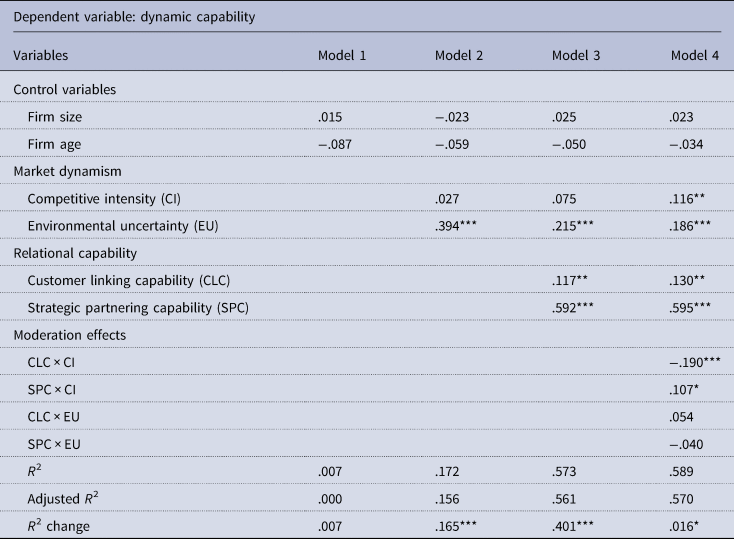
Table 4 presents the results of the moderated hierarchical regression analysis testing the interaction effects of the market dynamism. A change in the adjusted R 2 value is assessed through the block-wise hierarchical regression method, which included four models. Model 1 included the control variables, firm age and firm size only. In model 2, the market dynamism was added in the regression model; model 3 added the relational capabilities variable; while in model 4, the product/interaction term of the moderator (market dynamism) and independent variable (relational capabilities) were entered as a block.
Hierarchical regression result (standardized estimates)

*p < .10, **p < .05, ***p < .01.
The results show that the control variables, firm size and firm age, both have a non-significant effect on dynamic capability. It seems that in the sample of Indian firms, the extra resources available for larger-sized firms did not play any significant role in contributing to the development of dynamic capabilities. Besides, contrary to the general assumption of the inflexible nature of larger and older firms because of the institutionalization of norms and routines, findings show that firms can develop dynamic capabilities irrespective of their age and size.
The main effects of customer linking capability and strategic partnering capability are positive and statistically significant (β = .117, p < .05, and β = .592, p < .01, respectively), supporting hypotheses 1a and 1b. Model 4 result presents the moderating role of the market dynamism, indicating that customer linking capability × competitive intensity interaction is significantly negative (β = −.190, p < .01) and strategic partnering capability × competitive intensity interaction is significantly positive (β = .107, p < .1).
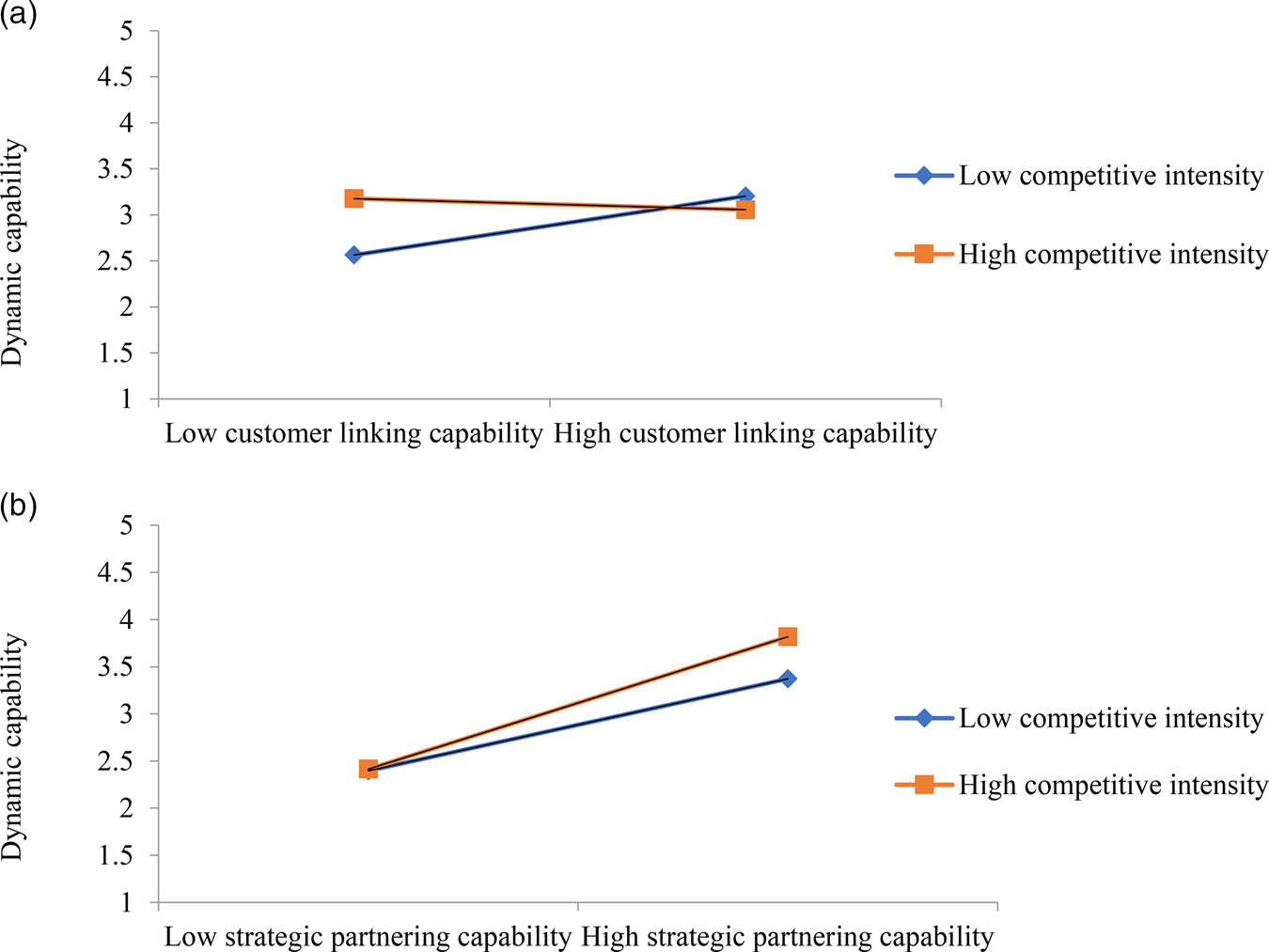
Following the approach proposed by Dawson (Reference Dawson2014), we conducted the post-hoc analysis for the interaction effect at low level (1 sd below the mean) and high level (1 sd above the mean) of competitive intensity. First, the interaction effect of competitive intensity on customer relational capability and dynamic capability (Figure 2a) is studied. The post-hoc analysis indicated that for both 1 sd below the mean (β = .64, p < .01) and 1 sd above the mean (β = −.12, p < .01), the interaction effects of competitive intensity on customer relational capability and dynamic capability were significant. Next, we examined the interaction effect of competitive intensity on strategic partnering capability and dynamic capability (Figure 2b). The post-hoc analyses indicated that for both 1 sd below the mean (β = .976, p < .01) and 1 sd above the mean (β = 1.404, p < .01), the interaction effects of competitive intensity on strategic partnering capability and dynamic capability were statistically significant; supporting hypotheses 2a and 2b.
(a) Two-way interaction of competitive intensity and customer linking capability on dynamic capability. Low designates −1 sd for the scale; high designates +1 sd for the scale. (b) Two-way interaction of competitive intensity and strategic partnering capability on dynamic capability. Low designates −1 sd for the scale; high designates +1 sd for the scale.

The interaction term of relational capability and environmental uncertainty is non-significant, which indicates no support for hypothesis 2c or 2d. However, model 2 result shows that environmental uncertainty has a significant, positive impact on dynamic capability (β = .394, p < .001), with an adjusted R 2 value of .156.
Robustness check
To cross-validate our findings, we conducted a robustness check following the well-established approach in the literature (see, Hair et al., Reference Hair, Black, Babin, Anderson and Tatham2018). The analysis suggests a significant association between relational capability and dynamic capability. We divided the sample data into high and low groups using the median of the scores of dynamic capability and conducted the regression analysis for each group and the regression estimates were consistent with the previous finding. We also did a robustness check for the interaction effect of market dynamism on relational capability–dynamic capability association. We divided the sample data into high and low groups using the median of the scores of competitive intensity and environmental uncertainty. The analysis was conducted separately for each group and the regression estimates were compared. The results are again consistent with previous findings.
Discussion
Due to intense competition, unpredictable changes in customer demands, and rapid technological advancements, organizations have been encountering serious challenges in sustaining their competitiveness. Consequently, they should focus on managing environmental turbulence by proactively predicting the market changes and reducing risks while maintaining competitive advantage. Over the years, scholars have recognized the importance of relational capability for firm performance, but the effect of relationship management on the development of dynamic capabilities under different market conditions has not been tested yet. This study empirically examines the association with a relative choice among sub-dimensions of relational capabilities on dynamic capabilities at the strategic level under conditions of the market dynamism in large- and medium-scale service organizations.
The findings provide strong support for the positive impact of relational capability (namely, customer linking capability and strategic partnering capability) on the firms' dynamic capability; however, this association is significantly moderated by the competitive intensity in the business environment. In a highly competitive market, the effect of customer relational capability decreases whereas the impact of strategic partnering capability on dynamic capability becomes stronger. Furthermore, the findings do not support the hypothesized moderating effect of environmental uncertainty. In other words, the linkage between relational capability and dynamic capability seems to be robust across contexts characterized by varying levels of market turbulence. Alternatively, it might be possible that the moderating effects do exist but were not detected because of the relatively small sample size.
Theoretical implications
The study contributes to the existing literature in several ways: first, the results suggest relational capabilities as a vital antecedent of dynamic capabilities. In particular, the study finds that a firm's strategic partnering capability and customer linking capability – key elements of relational capabilities, positively influence dynamic capability development. A firm's relational capability with customers and strategic partners provides access to new information, knowledge, or business environment, which enables the firm to sense the changes and integrate, modify, and reconfigure the resource bases to deal with the market changes. This finding is consistent with the view of Håkansson and Ford (Reference Håkansson and Ford2002) that the survival and growth of the firm depend on the interplay between internal investment and relationship investments.
Second, this study contributes to the extant literature by examining the moderating effect of the market dynamism. In terms of intensified competition, organizations should closely manage their relationships with their strategic partners to be able to access new knowledge and technologies before competitors and respond quickly to the market changes. The negative moderation of customer linking capability and the competitive intensity of the market is particularly worth mentioning because the finding contradicts the established belief that maintaining relationships with customers and focusing on their needs and preferences always helps with business activities (see, Slater & Narver, Reference Slater and Narver1998). However, this finding supports the result of studies about the possible downside of customer orientation (Wang et al., Reference Wang, Jin, Zhou, Li and Yin2020). Customers cannot see their future needs and cannot predict the market trends; so if an organization attempts to focus on a customer's existing needs, there is certainly a risk of losing the ability to adapt quickly to emerging market changes, especially when the competition is very intense. Therefore, in a highly competitive business environment, information about changes in customers' needs and preferences may not be an efficient guide for redeploying and reconfiguring resources.
Lastly, the findings suggest that environmental uncertainty drives dynamic capabilities. The reason behind the driving role of environmental uncertainty may be that organizations become more sensitive as the uncertainty in customer needs and preferences increases, thus cultivating a higher level of dynamic capability to handle emerging changes (Li & Liu, Reference Li and Liu2014). This result supports the exogenous perspective of dynamic capabilities development, which considers environmental changes cause the firm to alter its resources in alignment with these changes, however, these alignments should be purposeful and strategic, not random or ad-hoc (Zollo & Winter, Reference Zollo and Winter2002). Winter (Reference Winter2003, p. 992) argues that ‘if a firm adapts to the changes in the environment in an “ad-hoc problem solving” or “fire-fighting” mode, it does not necessarily exercise dynamic capabilities’. Then the finding could be well attributed to survival bias as the firms included in the study are currently operating and they might have developed the dynamic capabilities necessary to survive in an uncertain environment.
Furthermore, environmental uncertainty only explains around 16% of the variation (see Table 4), suggesting the presence of other factors for dynamic capability development. As result in model 3 shows, environmental uncertainty with the firm's relational capabilities explains a total of 56% variation in the model of dynamic capabilities development, which is better than the models where these two factors were considered separately. The result contributes to the discussion on the endogenous and exogenous perspectives of dynamic capabilities development suggesting that the dynamic capabilities are the outcomes of the co-evolution of external and internal factors.
Managerial implications
The study findings offer several implications for the managers of the emerging economies seeking to develop dynamic capabilities under different market conditions. First, the relationship management with customers is often viewed as a marketing activity mainly focusing on tasks such as customer acquisition and retention, customer loyalty programmes, operating in parallel but separate from the overall business departments such as business development, operational and strategic units. Although the above-mentioned tasks of the team dedicated to managing the relationships with customers are important, this study proposes that merit lies in focusing these efforts on capability development. This lack of focus explains the mixed results of the effectiveness of customer relationship management reported by firms thus far. The study thereby suggests that managers increase collaboration between customer relationship management teams and other operations-strategy-oriented organizational units to increase the merit of customer relationship management efforts for capability development.
Second, an organization can leverage the relational resource for knowledge acquisition and exploitation by building an effective relational governance mechanism with its strategic partners. Moreover, as the knowledge-based view suggests, knowledge is an important strategic resource, and it can create value creation through experiential learning and transfer, and integration of new knowledge into current organizational practices. Most importantly, it suggests that relationship management with strategic partners creates an opportunity to develop higher-order dynamic capabilities by means of learning from other firms. Thus, it is important for organizations to strengthen weak ties with strategic partners by participating in specific events such as trade fairs, business conferences, etc.
Third, the study suggests that managers need to be careful of the boundary conditions on the effectiveness of these relational capabilities on dynamic capability development. In a highly competitive business environment, the effectiveness of customer relationship management on the development of dynamic capabilities decreases, which suggests the managers should be careful while developing a guide for the redeployment and reconfiguration of resources based on the information acquired from customers. On the other hand, the effectiveness of strategic partnering capabilities on the dynamic capability development increases in an intense competitive environment, suggesting thereby that managers should closely manage their relationships with their strategic partners to be able to access new knowledge and technologies before their competitors and respond quickly to the market changes.
In conclusion, given the effect of the market competition and resource-consuming nature of customer linking and strategic partnering capabilities, the study suggests managers pursue a balanced approach to maintain their relationships for the development of dynamic capability.
Limitations and future research directions
Like other empirical studies, this study also has some limitations, which provide directions for future research. First, the limitation of perceptual data leads to the problem of social desirability bias (Podsakoff, MacKenzie, Lee, & Podsakoff, Reference Podsakoff, MacKenzie, Lee and Podsakoff2003). Though respondent confidentiality has helped in reducing this bias, longitudinal studies can be carried out to further verify the proposed causal model in different country contexts for more comprehensive insights, increasing thereby the generalizability of the study. Second, we have used only two moderators, competition and uncertainty. Other factors such as technological turbulence (Martin, Javalgi, & Ciravegna, Reference Martin, Javalgi and Ciravegna2020), organization structures (Lai, Reference Lai2013), etc. might have moderating effects on the proposed relationship. Therefore, future research could investigate these additional moderating factors. Third, we have only examined the influence of the firm's external relational capability (with customers and strategic partners). However, internal relational capability with employees can also impact the development of dynamic capability in a firm. Maintaining good relationships with employees creates a strong affective commitment among the employees towards the organization, and they are motivated to work hard to achieve organizational goals and create value for the firm (Allen & Grisaffe, Reference Allen and Grisaffe2001). Finally, the study has taken the service industry as the research context, which includes both highly volatile sectors such as the IT industry, and relatively stable sectors such as the tourism industry. Future research should examine the path model between different industries, use industry-specific variables as the control variable, or possibly focus only on one industry to overcome this limitation.
Conflict of interest
No potential competing interest was reported by the authors.
Dr. Ritu Singh is a faculty in the area of Operations Management & Quantitative Techniques at IMI Bhubaneswar. She received her PhD from the Indian Institute of Management Raipur and her masters in mathematics from Banaras Hindu University. Her area of research includes operation strategy, sustainability, and hospitality management. She has published research papers in international and national journals of repute such as Current Issues in Tourism, Knowledge Management Research & Practice, International Journal of Hospitality & Tourism Administration, etc.
Dr. Parikshit Charan is a faculty in the Operations Management area at IIM Raipur. He earned his Ph.D from Indian Institute of Technology, Delhi and recieved full time institute assistantship during his Ph.D from IIT Delhi. His area of research includes operations strategy, sustainable operations, and supply chain management. He has published more than 30 papers in international and national journals of repute such as International Journal of Operations and Production Management, Business Strategy and the Environment, Journal of Knowledge Management, International Journal of Logistics Management, etc.
Dr. Manojit Chattopadhyay is a faculty in the Decision Science and Systems area at IIM Raipur. He received his PhD from the University of Calcutta and his MBA (Systems) from Visva Bharati University. He has published more than 40 papers in various reputed international journals such as The Journal of Hospitality Management, Journal of Behavioural Finance, Energy Policy, International Journal of Production Research, Physica A, International Journal of Market Research, Applied Soft Computing, etc. His research interests include travel and tourism in new digital economy, artificial intelligence, policy mining, visual clustering, social network analysis, etc.