The acquisition of a second language (L2) sound system involves, among other things, learning the new language’s contrastive or phonemic sound categories, learning the noncontrastive sounds or allophones that make up the broader phonological system of the language, and acquiring the language-specific distributional patterns that constrain targetlike use of these noncontrastive phones. Previous research has documented the acquisition of new L2 contrasts (i.e., by learners’ whose first language [L1] does not possess the contrasts to be acquired, such as with the well-attested difficulty of Japanese learners of English acquiring English /ɹ/and /l/; e.g., Goto, Reference Goto1971) as well as the acquisition of L2 sounds that exist in the L1 but require remapping of phonemic boundaries (e.g., the acquisition of Spanish word-initial voice onset time [VOT] by native English speakers; e.g., Zampini & Green, Reference Zampini, Green and Nicol2001). Fewer studies have explored the acquisition of L2 allophones and the learning of the L2-specific contextual patterns that govern the use of one allophone over another. The central objective of the present study is to examine the acquisition, by adult L2 learners of Spanish, of a segment that exists in the learners’ L1 and in their L2 but that differs in its phonetic realization and allophonic patterning in the two languages.
Using a large cross-sectional sample, this study investigates development in the production of the alveolar lateral (i.e., /l/) in the L2 Spanish of native English speakers with the aim of exploring the acquisition of L2-specific phonetic details and allophonic patterns of a phoneme that learners already possess in their L1. This study provides insight into and empirical evidence of the process of the learning of acoustic properties that contribute not to phonological categorical (i.e., contrastive) differences but rather to phonetic differences that are noncontrastive but that can, for example, play a role in foreign-accented speech (e.g., Solon, Reference Solon, Willis, Butragueño and Herrera2015; Whitley, Reference Whitley2002). Additionally, this study tracks learners’ ability to acquire context-specific allophonic patterning in the L2, which, for this phone within this language pairing, involves the inhibition of a L1 allophonic distinction (as opposed to the addition of a new L2 distributional contrast).
BACKGROUND
L2 Phonetic and Phonological Acquisition
Research on L2 phonetic and phonological acquisition (similar to research on L2 acquisition within other linguistic domains) has focused on searching for evidence of developmental sequences and on describing and explaining patterns observed in the acquisition of L2 sounds and sound systems. Much research in this area has examined the acquisition of new L2 contrasts, positing and supporting the general claims, represented by models of L2 speech perception and production (e.g., the Perceptual Assimilation Model [PAM], Best, Reference Best and Strange1995; PAM-L2, Best & Tyler, Reference Best, Tyler, Bohn and Munro2007; the Speech Learning Model [SLM], Flege, Reference Flege and Strange1995), that new L2 sounds are typically associated, at least initially, with their closest L1 counterpart and that the degree of similarity between L1 and L2 phones can help predict the degree of difficulty in the perception and production of a new L2 sound. Flege’s (Reference Flege and Strange1995) SLM, for example, posits that L2 learners relate L1 and L2 sounds to each other on a “position-sensitive allophonic level” (p. 239), such that positional allophones in the L2 are perceptually linked with the closest positional allophones in the L1. Flege’s model hypothesizes that learners are more likely to establish new categories for L2 sounds that are perceived as more dissimilar to the closest L1 sound and that, in cases in which phonetic dissimilarity between L1 and L2 sounds is not perceived, a single phonetic category is used to process both sounds—a phenomenon Flege refers to as “equivalence classification” (p. 239). In these cases, the sounds are likely to resemble one another in production. Finally, Flege recognizes that even when L2 learners establish a new phonetic category for a L2 sound, the properties of that category may differ from the native category for that sound, especially if nonnative speakers construct the new category around different features than those native speakers use to make distinctions. Although the SLM has generally been employed to model the acquisition of new L2 phonemic contrasts (e.g., Flege, Takagi, & Mann, Reference Flege, Takagi and Mann1995, Reference Flege, Takagi and Mann1996), it has also been used in previous studies of bilingual /l/ production (e.g., Barlow, Branson, & Nip, Reference Barlow, Branson and Nip2013; Simonet, Reference Simonet2010; reviewed in more detailed later in this section), and its hypotheses are relevant for the present study’s investigation of L2 allophonic acquisition.
L2 Allophonic Acquisition
In general, less is known about the L2 acquisition of noncontrastive sounds, or allophones, than about the acquisition of new L2 contrasts. Acquisition of L2 allophones involves acquiring both the phonetic features or acoustic properties of the particular variants used in the L2 as well as the L2-specific contextual patterns of use of these variants. Nevertheless, by definition, the nontargetlike employment of L2 allophones generally contributes not to any sort of potential meaning differences (as contrastive differences can) but rather to issues such as foreign-accented speech. One example of research on allophonic development is Shea and Curtin (Reference Shea and Curtin2011), which investigated the acquisition of the stop-approximant alternation of Spanish phonemes /b d ɡ/. In Spanish, the voiced plosives /b d ɡ/ are realized as stops [b d ɡ] after pauses, after nasal consonants, and, for /d/, after laterals; all other instances of these phonemes are realized as approximants [ß ð ɣ]. Measuring the deployment of two acoustic cues—consonant intensity and presence of a release burst—in different contexts (word-initial and word-medial positions, stressed and unstressed contexts), these authors demonstrated that, generally, learners with more language learning experience exhibited cue use that more closely approximated that of native speakers than did learners with less language learning experience. Additionally, Shea and Curtin found that phonological environment interacted with learner developmental level to affect the production of the phonetic detail of the L2 allophones: Learners with greater experience exhibited a more nuanced pattern of production in terms of the influence of position of the target sound in a word and lexical stress as well as the specific consonant being produced, as opposed to using a basic rule, such as word position alone, across all three consonants. Given these results, Shea and Curtin proposed that learners’ representations of these L2 phonetic categories become more detailed with greater experience with the target language: Their high intermediate learner group made use of more information (i.e., place of articulation details in addition to positional information) than the low intermediate learners (who demonstrated use of positional information but not place of articulation details), suggesting more robust and detailed representations of the L2 phonetic categories being acquired with greater experience.
The present study continues this line of research by investigating L2 allophonic acquisition, both in terms of phonetic detail and contextual patterning, but it investigates a learning situation that involves a different type of learning task than that examined by Shea and Curtin: one that involves ignoring or inhibiting L1 patterns (as opposed to acquiring new distinctions). As will be discussed in more detail in the next subsection, English and Spanish both contain lateral categories, but Spanish laterals are “lighter” or produced in a more fronted position overall than English laterals, which tend to be darker or more backed. In addition, English lateral allophonic production is conditioned by syllable position (i.e., a lighter or more fronted [l] is produced in onset positions; a darker or more velarized [ɫ] occurs in coda positions), whereas, in Spanish, a light lateral is deployed in both onset and coda positions. Thus, in addition to acquiring the phonetic features of Spanish [l] (i.e., the overall lighter realization), a primary challenge that English-speaking learners of Spanish face in this arena may actually be in inhibiting the native language’s contextual constraints on allophonic production. That is, English-speaking learners of Spanish must learn that Spanish /l/s are not conditioned by syllable position as English /l/s are. This may pose a special challenge because, similar to Escudero’s (Reference Escudero2005) discussion of subset scenarios—or learning situations in which learners must reduce the number of L1 categories to have an accurate representation of the new L2 sound system—in this case, learners must inhibit use of [ɫ] and instead deploy the same allophone, [l], in both onset and coda positions. The learning difficulty of subset scenarios arises from the fact that “the nonexistence of an L1 property in the L2 environment can be discovered on the basis of positive evidence alone” (Escudero, Reference Escudero2005, p. 204). Footnote 1
Relevant to the present discussion is Maye and Gerken’s (Reference Maye, Gerken, Howell, Fish and Keith-Lucas2000) account of the acquisition of phonetic categories based on the statistical distribution of exemplars in the input even in the absence of minimal pairs. In that study, two groups of native English-speaking participants were trained on a new contrast in an artificial language simply by hearing tokens along a continuum of /d/ (e.g., “day”) to unaspirated /t/ (e.g., “stay”), with the manipulated difference being formant onset frequencies of the following vowel. Although both of these sounds exist in English, these two sounds do not constitute a phonemic contrast for English speakers because they never occur in the same context. Both groups of participants heard the same stimuli but with differing frequencies of tokens along the continuum: One group received input with a bimodal distribution (i.e., hearing tokens at both ends of the continuum more frequently than those in the middle); the other group received input with a monomodal distribution (i.e., hearing tokens in the middle of the continuum more frequently than those at either end). During the test phase decision task, participants from the bimodal group correctly recognized /d/∼/t/ pairs as different significantly more often than those from the monomodal group, suggesting that the former group of participants was able to learn a new contrast using distributional properties that indicated the existence of two phonetic categories in the new language.
The present study asks, then, what happens when the L1 distribution of a particular category is bimodal and the L2 distribution of this same category is monomodal? Can learners acquire L2 distributional patterns and phonetic categories that involve ignoring a distinction made in the L1? This study explores these questions through an examination of the production of the Spanish /l/ by English-speaking learners and follows Shea and Curtin’s focus on contextual knowledge to explore the acquisition of the acoustic and distributional properties of this phone. The next section describes the phone under examination and its properties in the L1 and L2 of the present participants and reviews previous studies that have examined its realization in bilingual Spanish.
LATERALS
Laterals in L1 English and Spanish
The /l/ segment in English is generally described as a voiced alveolar lateral approximant that has two variants in American English: a light variant that occurs in onset or prevocalic positions, as in the word lamps [læmps], and a dark, or velarized, variant that occurs in postvocalic or coda positions as in feel [fí:ɫ] (Bronstein, Reference Bronstein1960; Olive, Greenwood, & Coleman, Reference Olive, Greenwood and Coleman1993). The light [l] is typically articulated with the tip of the tongue touching the alveolar ridge, whereas the dark [ɫ] is generally produced through a primary articulation including contact between the tongue tip and the alveolar ridge and a secondary articulation of the dorsum of the tongue arching upward at the velum (Ladefoged, Reference Ladefoged2006; Whitley, Reference Whitley2002). It is this secondary articulation that results in what is referred to as velarization or darkness (Ladefoged, Reference Ladefoged2006). It should be noted that, in American English, all /l/s are relatively velarized (Ladefoged, Reference Ladefoged2006; Sproat & Fujimura, Reference Sproat and Fujimura1993), although the degree of velarization varies on the basis of several factors including position of /l/ in the syllable and surrounding vowels (i.e., with back vowels conditioning darker /l/ productions; e.g., Lehiste, Reference Lehiste1964; Sproat & Fujimura, Reference Sproat and Fujimura1993). Acoustically, the difference is most often characterized by differences in the second formant (F2; a measure often used to determine tongue frontness/backness during vowel production), in which a lower F2 indicates a darker or more velarized production (e.g., Recasens, Reference Recasens2012; Thomas, Reference Thomas2011).
The /l/ in Spanish is also characterized as a lateral approximant whose standard allophone is also apicoalveolar (Hualde, Reference Hualde2005). Unlike in English, /l/ in most varieties of Spanish is pronounced as a light variant in all environments (Hualde, Reference Hualde2005). Spanish does contain several /l/ allophones that arise in specific contexts, typically as a result of assimilation of the place of articulation to that of the following consonant (e.g., a dental allophone [l̪] as in falda [fál̪.da] “skirt”; Hualde, Reference Hualde2005; Quilis, Reference Quilis1993), but all of these allophones are generally considered to be light.
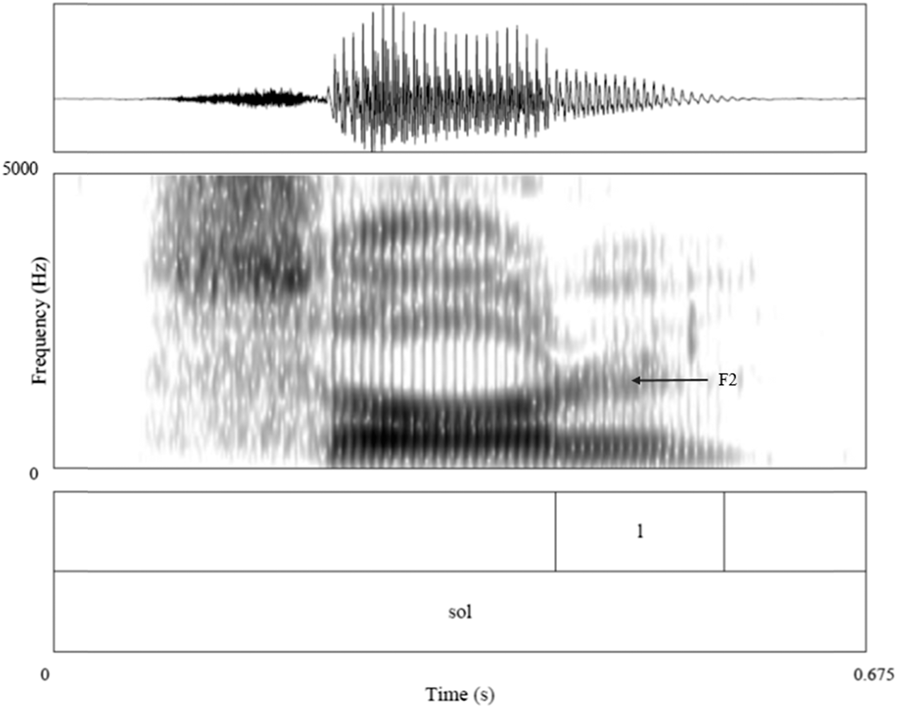
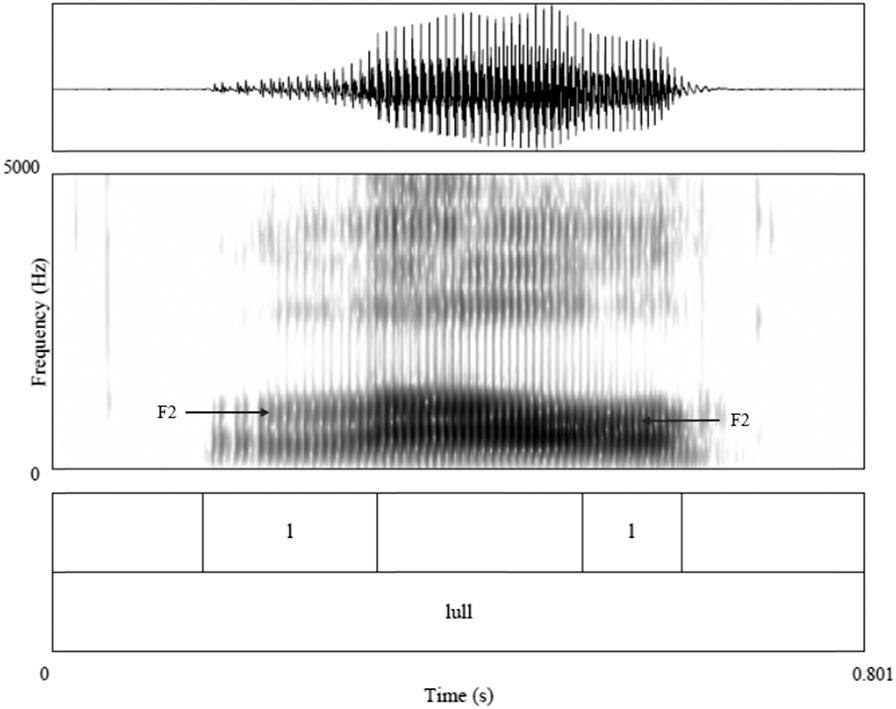
Acoustically, the articulatory and gestural differences between English and Spanish /l/s result in formant differences between Spanish and English laterals such that Spanish laterals exhibit substantially higher F2 values than do English laterals (e.g., Recasens, Reference Recasens2012; see Figures 1 [Spanish] and 2 [English]). Additionally, Spanish laterals are not thought to exhibit F2 variation based on the position of /l/ in the syllable as English laterals do (see Figure 2).
Production of Spanish word sol “sun” by native Spanish speaker participant (P2). Coda /-l/ has F2 of 1560 Hz.

Production of English word lull by native English-speaking first-year learner of Spanish (P121). Onset /l-/ has F2 of 1136 Hz; coda /-l/ has F2 of 826 Hz.

Laterals in Bilingual Spanish
The lateral phoneme has previously been utilized to examine phonetic and phonological systems in bilingual populations. Simonet (Reference Simonet2010) analyzed Spanish and Catalan alveolar laterals as produced by two groups of adult Majorcan Catalan-Spanish sequential bilinguals: Catalan-dominant bilinguals (i.e., Catalan L1) and Spanish-dominant bilinguals (i.e., Spanish L1). Catalan, like English, contains a dark /l/. Simonet found that Catalan-dominant speakers speaking Catalan produced significantly darker /l/s than Spanish-dominant speakers speaking Spanish, corroborating the difference between Catalan and Spanish /l/s described in the literature. Catalan-dominant speakers also produced significantly darker /l/s in Spanish than Spanish-dominant speakers, and Spanish-dominant speakers produced significantly lighter /l/s in Catalan than Catalan-dominant speakers, suggesting influence of speakers’ dominant language on their nondominant language. Additionally, within-speaker comparisons revealed that the majority of the Catalan-dominant speakers demonstrated intermediate formant values in their nondominant language (Spanish) that were significantly different from their dominant /l/ formant values but were also significantly different from Spanish-dominant speakers’ formant values. This statistical difference between L1 and L2 /l/ categories Footnote 2 suggests that these speakers had developed a “new” category for their nondominant language, although the new category was not identical to the category produced by native speakers of that language.
Barlow et al. (Reference Barlow, Branson and Nip2013) analyzed pre- and postvocalic lateral productions by Spanish-English bilingual, Spanish monolingual, and English monolingual children to explore whether Spanish-English bilinguals demonstrate productive allophonic differences in lateral realization in English (i.e., darker /l/ in postvocalic positions). Results indicated that, prevocalically, lateral productions, in both Spanish and English, of the bilingual children were realized with relatively high F2 values and large differences between F2 and the first formant (F1) and were comparable to the productions of the Spanish monolingual children. However, postvocalically, bilingual children produced /l/s with lower F2 values and smaller F2-F1 differences in English only. The authors concluded that the bilingual children have a merged phonetic category for English and Spanish [l] in prevocalic positions but maintain distinct phonetic categories for English and Spanish /l/ in postvocalic positions.
The present study aims to investigate similar questions with adult English-speaking L2 learners of Spanish, who are acquiring Spanish later in life than Barlow et al.’s (Reference Barlow, Branson and Nip2013) bilingual children and Simonet’s (Reference Simonet2010) early sequential bilinguals and who must contend not just with acquiring new phonetic properties (i.e., along the lightness/darkness continuum) as Simonet’s Catalan-Spanish bilinguals do, but must also learn the contextual patterning of allophones particular to Spanish, which involves inhibiting a distinction made in L1 English.
THE PRESENT STUDY
Given the literature just reviewed, the acquisition of Spanish /l/ by English-speaking learners presents an interesting test case to examine L2 phonetic and allophonic acquisition for several reasons. First, the phone exists both in English and in Spanish; consequently, English-speaking learners of Spanish need not acquire a new sound or contrast but rather, for targetlike production, must adjust the phonetic details of their L1 phone to more closely approximate those of the L2 phone. English laterals, in general, are much darker (i.e., produced further back in the mouth) than Spanish /l/s, meaning that, for targetlike production, English-speaking learners of Spanish must establish a Spanish /l/ phonetic category (to use Flege’s [1995] terminology) whose phonetic features include lighter or more fronted productions. In addition to new phonetic details, learners also have to acquire the different contextual patterning of Spanish /l/: Whereas in English, different variants occur in syllable-initial as compared to syllable-final positions, in Spanish, no such variation by syllable position exists, and English-speaking learners of Spanish must, then, inhibit or, in a sense, “unlearn” this distinction for targetlike L2 phone production. The present study aims to examine such development and to contribute to our knowledge of if, when, and to what extent modifications are made to the L2 sound system in a learning situation in which, for targetlike production, learners must acquire (noncontrastive) phonetic details as well as contextual patterning that includes only a subset of the options available in the L1. The present study is guided by the following research questions:
-
1. How do native English-speaking learners of Spanish at various levels of experience and native Spanish speakers produce Spanish /l/ in terms of frontness/backness, as measured by F2?
-
2. Do learners of Spanish at various levels of experience exhibit variation in /l/ darkness on the basis of syllable position and how does this compare to the native Spanish speakers’ /l/ patterns?
-
3. What is the effect of factors such as task, preceding vowel, stress, and cognate status on these lateral productions?
To explore these questions, this study followed the method and procedures described in the following sections.
METHOD
Participants
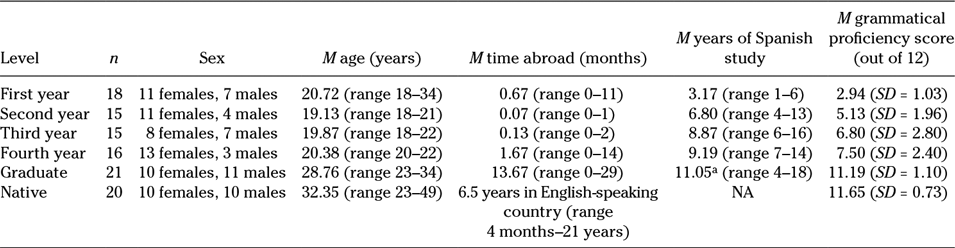
The participants for the present study comprised five learner groups and one native speaker group, for a total of 120 participants. The learner groups included 20–21 participants per group enrolled in Spanish courses at five different levels at a large midwestern university. These levels were selected to provide a cross-sectional view of phonetic development, beginning early in the language learning process and including highly advanced language learners. The learners were enrolled in the following courses during the semester in which the recordings were performed: (a) first year, (b) second year, (c) third year, (d) fourth year, and (e) graduate students and university instructors of Spanish. Footnote 3 Fifteen learners were removed from the participant pool after recording because one or both of their parents spoke Spanish (n = 7), because they had L1s other than English (n = 3), or because of a recording error (n = 5). Thus, the final learner participant pool was comprised of 85 participants (see Table 1).
Background information on participants

a It should be noted that many of the graduate student participants marked 4+ years in the number of years of studying Spanish in graduate school; it was a design error of the background questionnaire to not ask for specific numbers. Thus, all 4+ years answers were counted as four years, even though this may have indicated additional time studying Spanish.
The native speaker group was comprised of 20 native Spanish-speaking graduate students and instructors of Spanish at the same university. These speakers, who came from a wide variety of countries of origin (Mexico, n = 3; Peru, n = 2, Puerto Rico, n = 4; Spain n = 5; Costa Rica, n = 1; Colombia, n = 2; Argentina, n = 2; Bolivia, n = 1), are representative of the native-speaker auditory input that the learners included in this study receive. Footnote 4 Given their positions as instructors of Spanish and graduate students in the United States, these native Spanish speakers were also highly proficient in English. Footnote 5 As such, they represent a relevant comparison group for the L2 learners, as these native speakers of Spanish are, too, bilinguals (e.g., Ortega, Reference Ortega2013). A summary of background information on the final 105 participants is presented in Table 1.
MATERIALS AND TASKS
The data for the present study were elicited through three tasks: (a) a language background questionnaire, (b) a grammar test, and (c) an oral production task. Footnote 6 Two versions of the background questionnaire—one for learners and one for native speakers of Spanish—were created to gather pertinent personal and language-learning information about the participants, including native language(s), parents’ native languages, length of Spanish study, current course enrollment, and study abroad experience and/or time spent in Spanish-speaking (for learners) or English-speaking (for native speakers) countries. A summary of participant background information for all participant groups is provided in Table 1.
The grammar test was a 12-item, multiple-choice grammatical proficiency test adapted from the 25-item test used in Geeslin and Gudmestad (Reference Geeslin, Gudmestad, Bruhn de Garavito and Valenzuela2008), among other studies. The full test was designed to measure knowledge of Spanish grammatical structures that are generally associated with distinct levels of general Spanish proficiency. The version used in the present study was adapted by selecting the 12 most reliable items from the full test; after removing 13 items, the test’s reliability had a Cronbach’s alpha measure of .85 (B. Linford, personal communication, February 1, 2013).
The central elicitation task was an oral production task that encouraged production of /l/ during three elicitation activities: picture description, sentence reading, and word-list reading. Footnote 7 For the picture description portion of the task, the study’s target words (described later in this section) were incorporated into an oral production activity (modeled after similar tasks used in Ronquest, Reference Ronquest2012; Schmidt & Willis, Reference Schmidt, Willis and Alvord2011) that participants completed individually using a semi-self-automated PowerPoint presentation. Participants read about a situation involving a friend who was hosting a party and needed their assistance. They were guided through a series of activities in which they were first trained on the target words and their corresponding pictures. After the training, they then completed a series of chores for their friend that included, for example, telling her (aloud, based on pictures) which of her guests is bringing what to the party or describing the pictured items guests are bringing (e.g., in terms of color, style, or size). After completing the picture description portion of the task, participants were guided to read a series of sentences, all of which contained a target or other test word (e.g., for vowel normalization measures) within a carrier phrase and, following this, a list of the target words.
The Spanish target words (n = 20; see Appendix) were chosen on the basis of the presence of /l/ within particular contexts. These contextual factors were selected based on previous literature on lateral realization and coarticulation in English, Spanish, and Catalan; the four contextual variables considered were (a) position in the syllable, (b) stress, (c) preceding vowel, and (d) cognate status. Each target word was elicited at least once in each speech style/task (although some tokens were elicited more than once for productions in various phrase positions), for a total of 82 tokens per participant. Footnote 8 Thirty additional Spanish tokens containing the vowels /i/, /o/, or /u/ were elicited per participant to facilitate the normalization of F2 values (described later in this Methods section).
For comparison purposes, /l/s were also elicited in English using a word-list reading task. Target words in English (n = 22; see Appendix) were selected according to similar, albeit fewer, contextual variables: (a) position in the syllable and (b) preceding vowel. In this study, English productions are presented and commented on to provide a basic idea of learner’s L1 patterns with which to compare their L2 patterns and to facilitate comparison with other studies of bilingual Spanish /l/ production, but L2 production is the focus of the present analysis.
Participants were audio-recorded while completing the oral elicitation task. Recordings were made directly onto a laptop computer using CoolEdit and a USBPre external sound card with a Shur wh20 head-mounted microphone sampled at 44.1 kHz.
ANALYSIS
Acoustic Analysis
All target words were isolated and the lateral segments were analyzed using Praat (Boersma & Weenink, Reference Boersma and Weenink2014). This study follows others in considering the primary cue to the vowel-lateral boundary location to be “spectral discontinuity” (Sproat & Fujimura, Reference Sproat and Fujimura1993), most clearly observed as a shift in F2 frequency and a decrease in the intensity of F2 (e.g., Simonet, Reference Simonet2010; Sproat & Fujimura, Reference Sproat and Fujimura1993). The lateral onset was marked at the first pitch period that preceded a break in formant structure and/or a change in the darkness of F2, usually coupled with a drop in the amplitude of the waveform (e.g., White & Mattys, Reference White and Mattys2007). For word-initial laterals, the onset was marked at the beginning of the first pitch period in which F2 could be observed (following Simonet, Reference Simonet2010). Similarly, lateral-vowel boundaries were placed at the beginning of the pitch period “consistent with the body of the vowel (e.g., unfricated and of comparable amplitude)” (White & Mattys, Reference White and Mattys2007, p. 507).
As Recasens (Reference Recasens2012) noted, determining the segmental boundaries of dark laterals can be particularly difficult. Additionally, as has been widely documented in sociolinguistic research on /l/ vocalization in English (e.g., Hall-Lew & Fix, Reference Hall-Lew and Fix2012), the distinction between a dark /l/ and a vocalized /l/ is especially difficult to determine. Thus, in cases in which the boundary between the lateral segment and the preceding or following context could not reliably be determined (as was common in English productions and in many of the learners’ Spanish productions), the lateral tokens were coded as such and were removed from the dataset prior to the formant analysis. Additionally, other production types that prevented the clear reading of formants (e.g., fricativized laterals and creaked or devoiced productions) were also excluded.
Second formant measurements were taken from the midpoint of the lateral segments using a script in Praat. The settings included a window length of 0.025 s (the Praat standard) for all tokens and five formants estimated under 5500 Hz for females and under 5000 Hz for males. A randomly selected 10% of each participant’s data were manually checked; this method both ensured consistency in coding from early through late stages and verified the formant readings taken by the script. All observed errors in formant tracking were corrected, and if more than one token per speaker demonstrated errors in formant tracking using the settings previously described, then an additional 10% of tokens for that speaker were manually checked. If more than one additional token showed problems, that speaker’s data were recoded manually. Of the 105 total participants, 14 showed more than one error in the first round of manual checking, and six required recoding of the entire set of tokens. Formant measurements were manually changed or tokens were excluded due to formant tracking problems; such changes or exclusions affected 176 Spanish tokens, or 1.4% of the entire Spanish dataset and five English tokens (i.e., 0.002% of the entire English dataset).
To account for physiological differences (i.e., differences in vocal tract size) that could affect sound production and resonance structure, all F2 values were normalized using a vowel centroid ratio (VCR) that was derived from Watt and Fabricius’s (Reference Watt and Fabricius2002) vowel S-centroid normalization procedure, which calibrates speakers’ vowel frequency values according to each speaker’s F1∼F2 center of gravity. The VCR utilizes measurements of the speaker’s front vowel /i/ and back vowel /u/ Footnote 9 to determine a centroid value along only the F2 dimension. The VCR additionally incorporates a half-spread measure (i.e., a measure of the distance between the front and back extremes) to account for differences in vocal tract spaces that could be lost by using the centroid measure alone. Thus, productions that are VCR normalized are submitted to the following equation: (F2[token]–F2[centroid])/half-spread. Footnote 10 In the present study, F2 values that are VCR normalized are reported along a continuum from +1 to −1 with speakers’ centroid always at 0. A value closer to +1 indicates a higher F2 and, thus, a more fronted tongue position; a value closer to −1 indicates a lower F2 and, thus, a darker or more backed production.
Statistical Analysis
There was a theoretical ceiling of 8,610 Spanish /l/ tokens (105 participants × 82 tokens) and 1,870 English tokens (85 participants × 22 tokens). Nevertheless, 733 Spanish tokens across all levels and speakers and 10 English tokens were either not produced at all, were produced incorrectly (e.g., Participant 39 said carason instead of caracol for “snail”), or were produced in a way that interfered with the identification of the segment (e.g., such as laughing through the production). Additionally, as previously mentioned, there were several phenomena that were observed in the production of laterals (especially in the learner corpus) that interfered with formant measurements and resulted in the exclusion of these tokens from the formant analysis (n = 2,470 in Spanish; n = 1,027 in English). Footnote 11 The final corpus analyzed consisted of 5,407 Spanish tokens and 841 English tokens (a breakdown of Spanish token production by level is provided in the Results section).
The normalized F2 values for all Spanish data were submitted to a linear mixed model with restricted maximum likelihood in SAS (SAS Institute Inc., 2013). Visual inspection of residual plots revealed that the data were approximately normal and indicated the desired homoscedasticity. The model was fitted with participant and token as random effects and speaker level, task, syllable position, preceding vowel, stress, and cognate status as well as the interaction between level and all other independent factors as fixed effects. The model yielded no significant interactions between level and stress or level and cognate status nor any main effects of stress or cognate status; thus, these interactions (Level × Stress; Level × Cognate Status) and factors (stress and cognate status) were removed from the model in a stepwise fashion, and the model was refitted. The final model’s fit of the data did not differ significantly from that of the original model, χ2(17) = 19.70, p = .290.
A separate linear mixed model was run for learners’ Spanish and English /l/ data. The setup and results of this model will be mentioned briefly in the Discussion section and note 12 for comparative purposes but do not constitute a central component of this study.
RESULTS
As described, the Spanish normalized F2 values were submitted to a linear mixed model with participant and token as random intercepts and the following fixed factors (after refitting): level, task, syllable position, and preceding vowel as well as the interactions between level and task, level and syllable position, and level and preceding vowel. The Type III (omnibus) test of fixed effects revealed significant effects of level, F(5, 99) = 19.22, p < .001; task, F(2, 4653) = 12.40, p < .001; and preceding vowel, F(2, 41.5) = 7.59, p = .002; and significant interactions between level and task, F(10, 5236) = 2.74, p = .002; level and syllable position, F(5, 5243) = 4.92, p < .001; and level and preceding vowel, F(10, 5236) = 3.39, p < .001. Syllable position on its own yielded no significant main effect, F(1, 41.9) = 3.97, p = .053. The results of the statistical model suggest that the fixed factors task type, syllable position, and preceding vowel influenced the production of /l/ differentially across speaker level; the effect of each fixed factor and its interaction with speaker level is explored in turn, with examinations of the differences of least squares means (the SAS equivalent of estimated marginal means) to illuminate the direction of effects and the differences between groups and factors.
Level
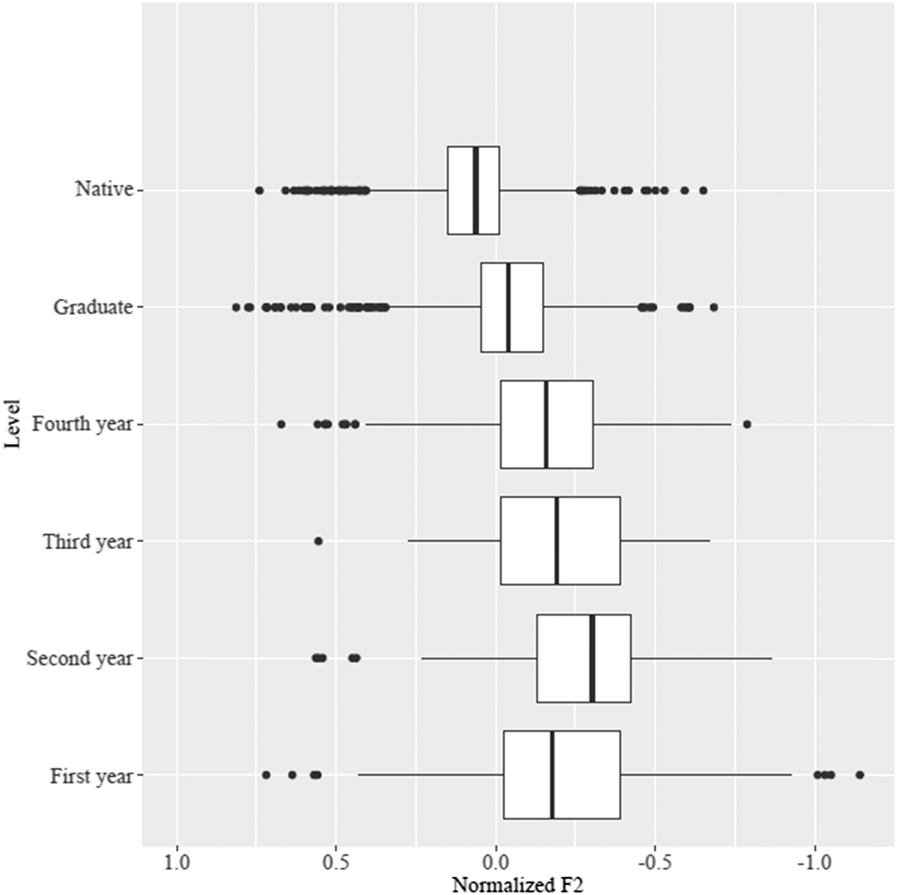
Recall that the first research question asked whether learners adjust the phonetic properties of /l/ as learner level increases to approximate the more fronted position of native Spanish /l/. Level was a significant factor affecting normalized F2 values in the statistical model, suggesting that lateral darkness differs significantly between groups. Figure 3 presents general patterns of lateral darkness by level.
Boxplot of normalized F2 values by speaker level. Figure is oriented to represent vocal tract with normalized F2 values along the x axis. A normalized F2 value closer to -1.0 represents a darker or more backed production, whereas a normalized F2 value closer to 1.0 represents a lighter or more fronted production.

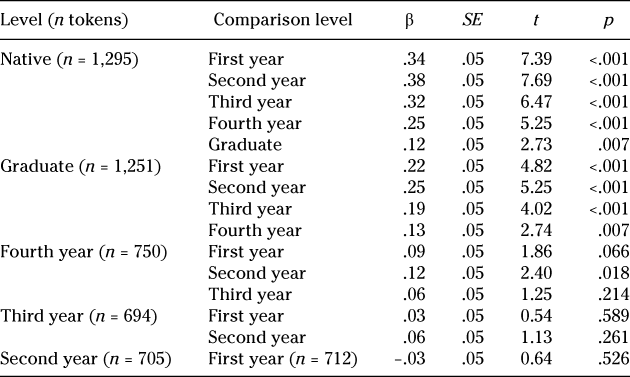
As can be observed in Figure 3, Spanish normalized F2 values generally increase (i.e., laterals get lighter or more fronted) as learner level increases (with a slight drop between the first- and second-year levels). Additionally, the range in normalized F2 values decreases as learner level increases, suggesting less variability in production as learners gain experience with the language. Table 2 presents a summary of the differences of least squares means, which provide information regarding the differences between levels: A positive β estimate indicates that the normalized F2 values of the speaker group/level in the far-left column are higher (i.e., /l/ productions are lighter) than the normalized F2 values of the speaker group/level in the second column, whereas a negative estimate indicates darker productions by the group/level in the far-left column.
Summary of the differences of least squares means comparing normalized F2 values for Spanish laterals produced by native speakers of Spanish and learners of Spanish at five levels

As can be observed in Table 2, learners at the first-, second-, third-, and fourth-year levels produced /l/s that were significantly darker (i.e., had lower normalized F2 values) than both the graduate-level learners’ /l/s and the /l/s of the native Spanish speaker group. Within these four lower levels, only second-year and fourth-year levels differed statistically, with second-year learners producing darker /l/s than those at the fourth-year level. Otherwise, there were no statistical differences in normalized F2 values (i.e., overall lateral darkness) between these four levels. Additionally, the /l/s of the highest level learners (i.e., the graduate-level L2 learners) were significantly darker than those of the native speaker group.
Syllable Position
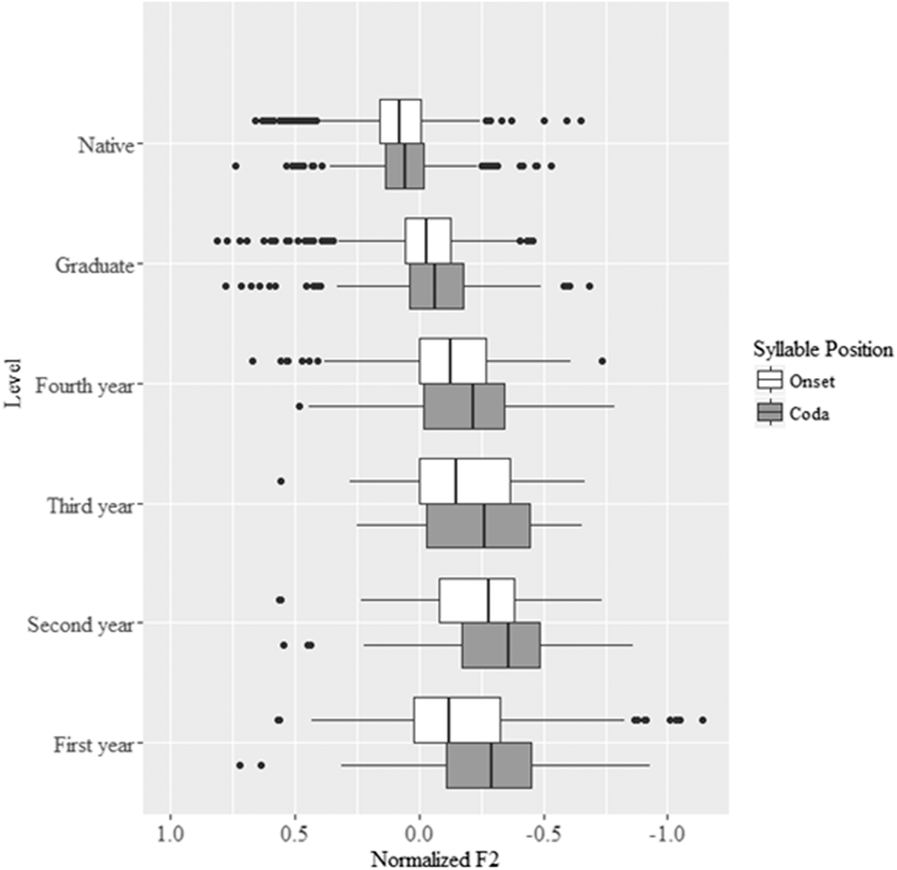
The second research question inquired about the effect of syllable position on lateral production in Spanish as a way of investigating the acquisition of the contextual patterning of /l/ in Spanish by L2 learners at various levels (as compared to that of native Spanish speakers). As a reminder, whereas English lateral allophony exhibits a bimodal distribution whereby lighter /l/s are produced in syllable onset position and darker /l/s in syllable coda position, Spanish makes no distinction in lateral allophones by syllable position. Thus, English-speaking learners of Spanish must acquire the monomodal distribution of Spanish laterals and learn to not distinguish laterals by syllable position. The significant interaction between syllable position and speaker level in the statistical model suggests that differences in normalized F2 values by syllable position varied by speaker level/group. Figure 4 presents a boxplot of normalized F2 values by syllable position and speaker level.
Boxplot of normalized F2 values according to syllable position and speaker level.

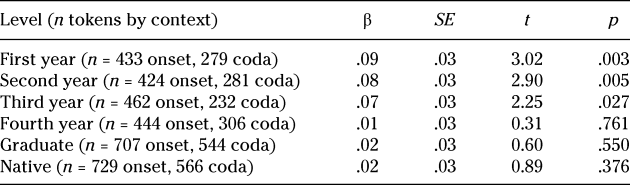
Table 3 presents a summary of the differences of least squares means for the differences in normalized F2 values by syllable position at each speaker level. A positive β estimate indicates that /l/s produced in onset position were lighter (i.e., had higher normalized F2 values) than /l/s produced in coda position.
Summary of the differences of least squares means comparing normalized F2 values for onset and coda by learners of Spanish at five levels and native speakers of Spanish

As Figure 4 and Table 3 show, at the first-, second-, and third-year learner levels, laterals produced in coda position were significantly darker than laterals produced in onset position. This difference is no longer significant at the fourth-year level, nor are significant distinctions between onset and coda laterals maintained for the graduate-level learners. These two most advanced learner groups show patterns similar to the native Spanish speakers, who (as expected) also do not distinguish in lateral darkness between onset and coda position. Thus, as learner level increases, learners do appear to acquire the contextual patterning of the L2 and inhibit the L1 distinction by syllable position.
Task
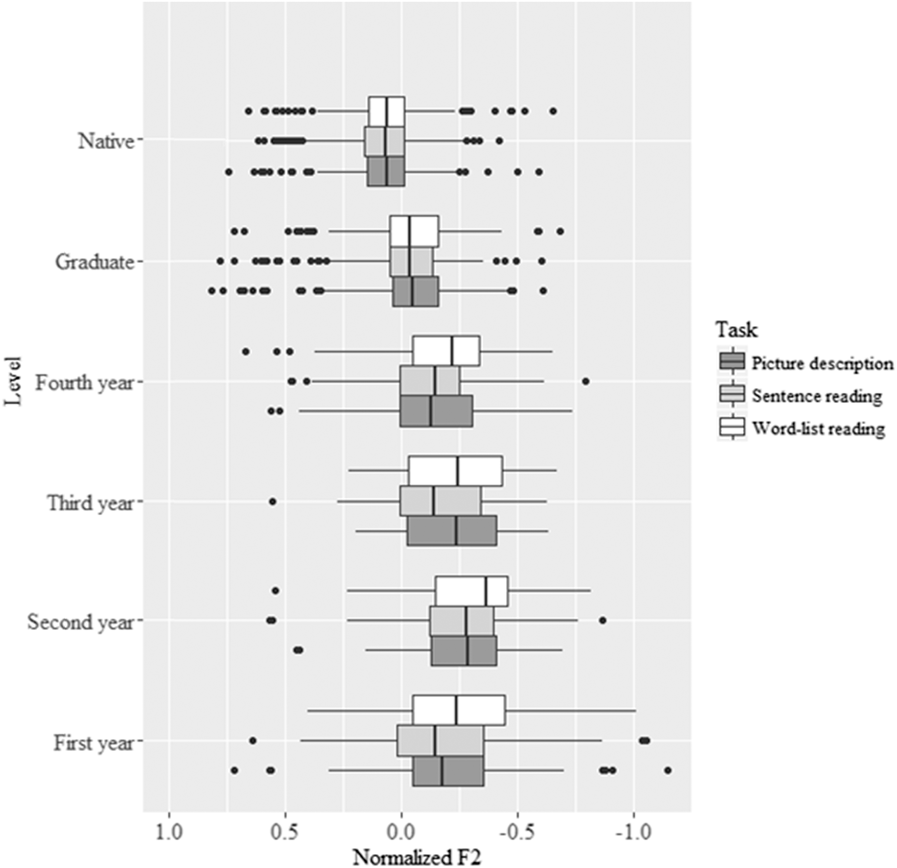
Recall that data were collected using three different oral production tasks in an attempt to collect both naturalistic data and to ensure that participants at all levels were able to produce a sufficient number of tokens for analysis; although task effects are not a central component of the research questions explored in this study, it is important to establish what, if any, effect task had on the realization of laterals during production. The results of the linear mixed model revealed a significant main effect of task in addition to a significant interaction between task and speaker level. Figure 5 presents normalized F2 values by task by level.
Boxplot of normalized F2 values by task and speaker level.

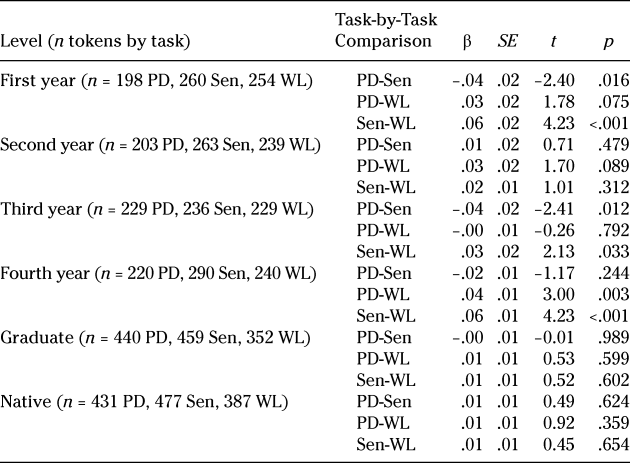
Table 4 presents a summary of the differences of least squares means, which provide a picture of how /l/ darkness differed by task at each level. A positive β estimate indicates that /l/s produced on the task type listed first in the comparison are lighter than those produced on the task type listed second; a negative β estimate indicates that /l/s produced on the first task type listed in the comparison are darker than those produced on the task type listed second.
Summary of the differences of least squares means comparing normalized F2 values for Spanish laterals produced by learners of Spanish at five levels and native speakers of Spanish

Note. PD = picture description; Sen = sentence reading; WL = word-list reading.
It is interesting to note that there were no significant differences between tasks for the graduate-level learners or for the native speakers of Spanish; similarly, learners at the second-year level showed no significant variation by task type. Learners at the other levels did show some differences in /l/ darkness across tasks. At the first- and third-year levels, /l/s produced during the word-list reading task and the picture description task (the most and least controlled tasks, respectively) were not statistically different from each other but were darker than those produced during the sentence reading task. At the fourth-year level, /l/s produced on the word-list reading task were significantly darker than those produced during the picture description and sentence reading tasks, but there were no differences between /l/s produced during these latter two tasks.
Preceding Vowel
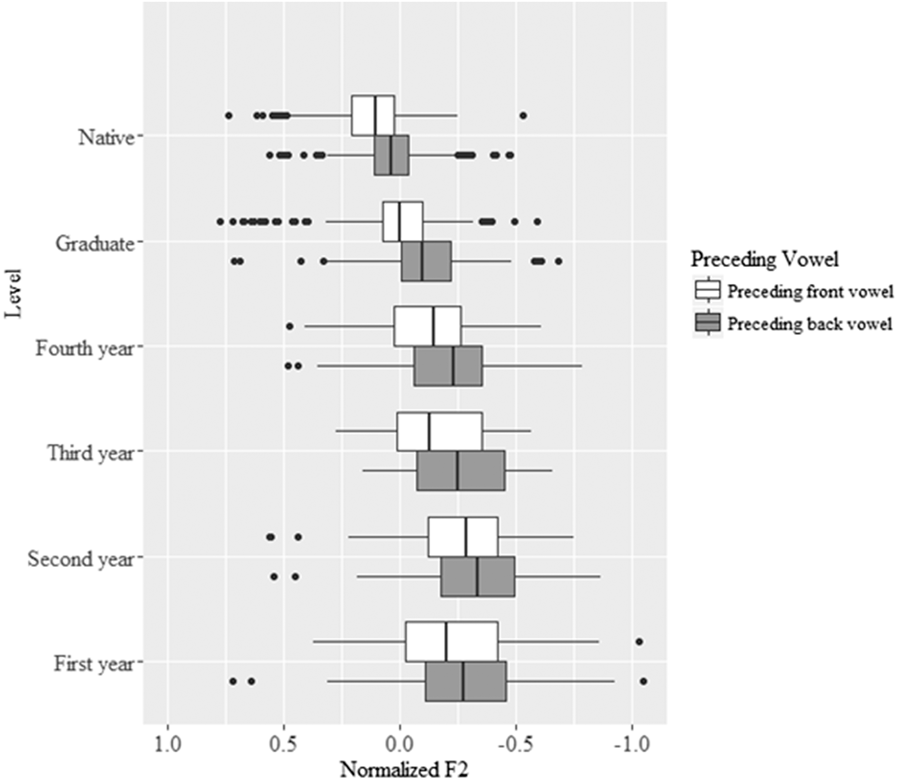
The effect of the vowel preceding /l/ was also found to be significant in the statistical model and to interact with speaker level. As can be seen in Figure 6, speakers at all levels produce darker /l/s when the lateral is preceded by a back vowel (e.g., /o/) than when the lateral is preceded by a front vowel (e.g., /e/). Nevertheless, the degree of this difference varied by level.
Boxplot of normalized F2 values according to preceding vowel and speaker level.

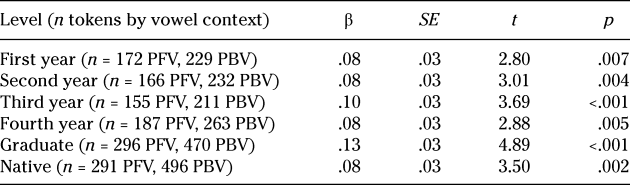
Table 5 presents the summary of the differences of least squares means for the differences in normalized F2 values by preceding vowel at each speaker level. A positive β estimate indicates that /l/s produced following a front vowel were lighter (i.e., had higher normalized F2 values) than /l/s produced following a back vowel.
Summary of the differences of least squares means comparing normalized F2 values for laterals preceded by front vowels and by back vowels by learners of Spanish at five levels and native speakers of Spanish

Note. PFV = preceding front vowel; PBV = preceding back vowel.
As can be observed in the estimates in Table 5, graduate-level learners exhibit the biggest differences in /l/s on the basis of the preceding vowel (with /l/s produced following a back vowel approximately .13 normalized Hz darker than those produced following a front vowel). Nevertheless, the effect is similar at all levels, including native speakers.
DISCUSSION
This study sought to examine the acquisition of a L2 phoneme that learners possess in their L1 but that differs in its phonetic detail and allophonic patterning in the two languages. The first research question inquired about how English-speaking learners of Spanish and native Spanish speakers produce Spanish /l/ in terms of tongue frontness/backness (as measured by F2) and whether learners show development toward nativelike F2 values as level increases. Results revealed that all learner groups produced significantly darker /l/s—that is, /l/s with lower normalized F2 values—than did native speakers of Spanish. No learner group, including the graduate-level learners, produced /l/s with statistically similar normalized F2 values as the native Spanish speaker group. Nevertheless, development in lateral frontness was observed: The fourth-year learner group produced lighter laterals than learners in their second year of study, and the graduate-level learner group, whose /l/s were the closest to (but still significantly darker than those of) the native Spanish speaker group, produced laterals that were significantly lighter than those of the first-, second-, third-, and fourth-year learner groups.
The second research question examined the issue of positional allophony, asking whether learners of Spanish exhibit variation in /l/ darkness on the basis of syllable position, how such allophony compared with native Spanish speakers’ patterns in L1 Spanish, and whether the effect of syllable position changed as learner level increased. Results suggested that, indeed, first-, second-, and third-year learner groups exhibited significant differences between onset and coda /l/s in their L2 Spanish. Learners at the fourth-year and graduate levels did not exhibit significant differences in normalized F2 by syllable position, a pattern that was similar to that expected and found for the native Spanish speakers. These results suggest that, with experience, learners are able to inhibit L1 contextual patterns to, in this case, produce L2 laterals in a manner that reflects their monomodal distribution (i.e., with no differentiation based on syllable position) in Spanish.
Finally, the third research question explored the impact of other factors on the production of Spanish laterals. The factors of elicitation task, preceding vowel, stress, and cognate status were examined, but stress and cognate status were eliminated from the statistical model due to nonsignificant effects. The factors elicitation task and preceding vowel interacted with level, suggesting that the effects of these factors differed significantly by speaker group. Graduate-level learners and native speakers demonstrated no significant task-based differences, whereas the impact of different tasks influenced lower level learner groups differentially, with some exhibiting darker productions on more controlled tasks and others on less controlled tasks. The effect of task was not a central question of the present study, but these results remind us of the importance of considering the impact of data elicitation methods and task types on L2 production more generally. The factor preceding vowel also interacted with level: All speaker groups produced darker /l/s when the lateral followed a back vowel than when it followed a front vowel, but the degree of difference varied by group/level. These results suggest that an exploration of the acquisition of L2-specific coarticulatory patterns may be a fruitful avenue to pursue with the current data (see Solon, Reference Solon and MacDonaldin press, for a preliminary account).
L2 Phonetic and Allophonic Acquisition
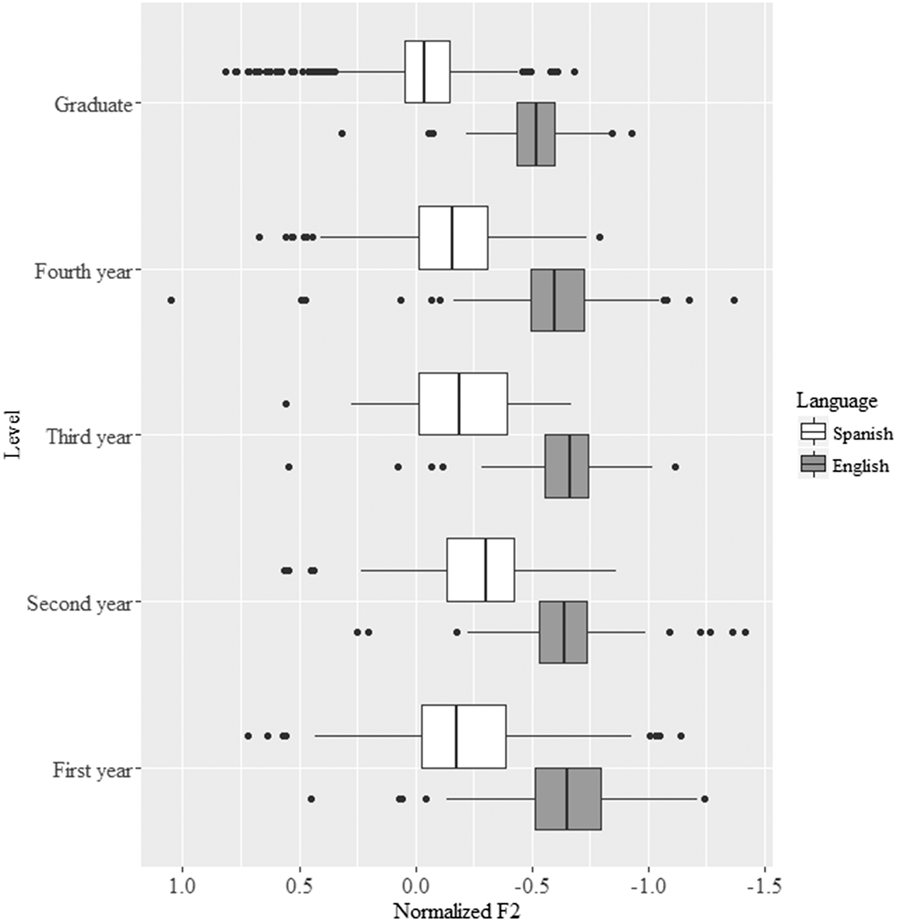
By tracking lateral production using a quantifiable acoustic measure (i.e., F2), the present study offered a detailed and nuanced characterization of the adjustment of this specific property of /l/. As summarized, results point to development in lateral production and L2 lateral phonetic properties (i.e., overall higher F2 or lighter productions) as learner level increases. Also of interest, however, is whether early learners produce their L2 lateral similarly to their L1 phone. As mentioned in the Methods section, although not a central focus of the present study, learners’ English lateral productions were also collected and analyzed for comparison purposes. Figure 7 reproduces the findings for learners’ Spanish /l/ F2 values side-by-side with these learners’ L1 English values by learner level.
Boxplot of normalized F2 values according to language and speaker level.

It is interesting to note that, visually, learners at all levels, including in their first year of study, appear to distinguish productively between Spanish /l/ and English /l/, and such findings were corroborated statistically. Footnote 12 Importantly, such results do not indicate whether individual learners have established separate phonetic categories in the two languages, but they do point to group trends of distinguishing phonetically between L1 English and L2 Spanish /l/s even at early stages.
As has been done for other accounts of lateral production by bilingual speakers (Barlow et al., Reference Barlow, Branson and Nip2013; Simonet, Reference Simonet2010), the present study referred to the hypotheses of the SLM (Flege, Reference Flege and Strange1995) to guide its examination and interpretation of the production of L2 Spanish laterals by native English-speaking learners. Of especial interest were the SLM’s predictions for “equivalence classification” at early stages of L2 learning for sounds that are similar in the L1 and the L2 and its hypotheses regarding the difficulty of establishing new L2 categories for these sounds as acquisition progresses. Some of the hypotheses of the SLM were borne out in the present study, whereas support for other hypotheses was not found. The comparison with L1 English productions, for instance, did not suggest that any of the learner groups in the present study functionally equate an English /l/ with a Spanish /l/, even at early stages. Although this does not mean that such “equivalence classification” did not occur earlier in the learning process (or for any particular learner), by the time the learners participated in this study (i.e., toward the end of their first semester of Spanish study or later), the group-level analyses suggest that L2 Spanish /l/ productions were statistically distinct from L1 English productions. This finding is surprising, especially given that (a) the first-year learners in the present study were tested within their first few months of learning and (b) the sound under examination requires the acquisition of low-level phonetic detail that would be assumed to be even more difficult to perceive than other, potentially contrastive, features. Such results may suggest that reconsideration of the likelihood of equivalence classification may be warranted.
The learner data do present evidence that learners adjust the phonetic properties of this /l/ category throughout the acquisition process, demonstrating more and more fronted productions as level of Spanish study increases. Nevertheless, as predicted by the SLM, the Spanish /l/ phonetic category of even the most advanced learners (i.e., the graduate-level learners) is not identical to that of the native speakers included in this study. As such, even though learners show development in Spanish /l/ production, and specifically in the fronting of this phone overall, the Spanish /l/ of even the most advanced learner group remains distinct from the category employed by native speakers of the target language. Considered in tandem with the differences between L1 English and L2 Spanish /l/s at all learner levels, the fact that even the most advanced learners (as a group) do not match native Spanish speaker normalized F2 values points to the potential existence of an intermediate category similar to those that have been previously reported for learners’ and bilinguals’ productions of this and other phones (e.g., Flege & Hillenbrand, Reference Flege and Hillenbrand1984, for English VOT values of Spanish-speaking late learners; Fowler, Sramko, Ostry, Rowland, & Hallé, Reference Fowler, Sramko, Ostry, Rowland and Hallé2008, for VOT values of French-English bilinguals; Harada, Reference Harada2007, for Japanese VOT values of English-speaking immersion learners; Simonet, Reference Simonet2010, for lateral darkness of Catalan-Spanish bilinguals). It is important to recognize, however, that it cannot be known from the present analysis whether these remaining group differences (e.g., between graduate-level learner and native speaker /l/s) are perceptible or would contribute to a significant difference in foreign accent perception. Thus, future studies can illuminate further whether this statistical difference contributes to a functional difference or not between advanced learners’ and native speakers’ productions.
With regard to differences between onset and coda /l/s, learners showed development in that higher level learners no longer differentiated lateral production by syllable position (whereas, such differences were evident in the productions of first-, second-, and third-year learners). It is interesting to note that a more Spanish-like monomodal distribution of this lateral phone was observed by certain learner groups even when those groups produced overall normalized F2 values for L2 Spanish laterals that were significantly darker than those of native speakers; that is, the acquisition of the phonetics details (i.e., overall frontness) was not a necessary precursor for developing L2-like allophonic patterns. For example, learners at the fourth-year level, whose /l/s were significantly darker than those of graduate-level learners and native speakers (and not significantly different from those of first- or third-year learners) demonstrated no significant difference in normalized F2 values by syllable position (even though first- and third-year learners continued to show such distinction by syllable position). Thus, even though the phonetic details of their L2 lateral category (at least in terms of the group) do not approximate those of native speakers, this group of learners has developed more targetlike allophonic patterns in that they deploy the same lateral category regardless of syllable position.
These results show some similarities to those of Shea and Curtin’s (Reference Shea and Curtin2011) account of allophonic acquisition of the [b d ɡ] – [β ð ɣ] alternation in Spanish, which provided evidence of learners’ development in their use of two acoustic cues of spirantization (i.e., consonant intensity and presence of a release burst) as learner experience or proficiency increased and in the interaction between the position of the target sound in a word, lexical stress, and the specific consonant being produced. In the present study, too, as learner experience or proficiency (i.e., level) increased, learners’ deployment of phones followed more L2-specific allophonic patterns, although the phonetic properties of the phones deployed did not necessarily reflect those of native speakers. These similarities are striking considering the differences in the learning tasks examined in the two studies: Shea and Curtin examine the acquisition of allophones that are either new to the L1 English speaker (i.e., [β ɣ]) or exist in the L1 phonological repertoire but as an allophone of a different phoneme (i.e., [ð]). Thus, the learning task for Shea and Curtin’s learners is (a) the establishment of new L2 allophones (and learning to employ them in the appropriate contexts) and (b) the remapping of the existent allophone to the appropriate L2 phoneme. In the scenario examined in the present study, learners instead have to adjust phonetic properties of a phone already possessed in the L1 and reduce the number of allophones employed, going from a system of two position-sensitive allophones of /l/ in English (i.e., [l-ɫ] determined by syllable position) to a system of one allophone in their target Spanish (i.e., [l] regardless of syllable position). Nevertheless, despite the differences in learning tasks, learners in both studies exhibit evidence of L2-specific contextual patterning and allophonic acquisition.
Phonetic Versus Phonological Acquisition
The lateral in English and Spanish provides an opportunity to (re)consider and appreciate the boundary and, more so, overlap between phonetics and phonology and, of course, the acquisition thereof. The gradient nature of the phonetic feature examined—lateral darkness (as measured by F2)—suggests that this study deals with the acquisition of phonetic detail (especially given that changes along this continuum from light to dark result in no meaning changes in either of the languages included in the pairing examined). Nevertheless, learners also appear to acquire L2-specific patterns of allophone deployment—acquisition in the phonological realm of systems and categories. As Scobbie (Reference Scobbie, Ramchand and Reiss2007) writes, “The fields come together when phoneticians address the subset of a language which directly relates to the realization of those abstract relations and when phonologists seek to explain aspects of the abstract patterns by reference to those self-same phonetic realizations” (p. 23). The scenario examined in the present study lies at precisely this type of intersection between abstract but systematic patterns realized phonetically. For the present study’s L2 learners of Spanish, absent explicit instruction, information in the input regarding patterns of Spanish lateral realization comes solely from positive (à la Escudero’s [2005] subset scenarios) and, naturally, noncontrastive evidence. Following Maye and Gerken (Reference Maye, Gerken, Howell, Fish and Keith-Lucas2000), we can assume that the L1 representation for /l/ for English speakers is bimodal along a light-dark continuum, with most realizations of this phone representing two extremes of the continuum and occurring in distinct environments (i.e., more light[er] /l/s in onset positions, more dark[er] /l/s in coda position). In their L2, however, English-speaking learners of Spanish receive input of /l/ along this same light-dark continuum (although likely at different levels of lightness/darkness) but in a monomodal distribution with the most frequent occurrence of this phone being a light (and lighter than English) token. The higher level learners of the present study acquired a Spanish monomodal distribution, effectively developing L2 phonological patterns (or L2 [phonetic] categories) from, we assume, phonetic (nonconstrastive) information in the input. Thus learners appear to adjust phonetic details but also acquire patterns and categories that imply phonological learning.
Of course, the present study examined only production of the sounds in question; as such, the picture of development that is offered is incomplete. Although production offers important information about what learners actually do, perception provides crucial insight regarding the phonological system that cannot be gleaned from production alone. Future investigations into the perception of /l/ and how distinct properties of /l/ cue particular interpretations or categorizations by learners as compared to native speakers of Spanish and as compared to judgments in L1 English will provide additional, important information regarding the L2 phonological system and the path of and limits to L2 phonetic and phonological acquisition.
CONCLUSIONS
The present study investigated the acquisition by adult English-speaking L2 learners of Spanish of the alveolar lateral—a segment that exists in the learners’ L1 and in their L2 but that differs in its phonetic realization and allophonic patterning in the two languages. The results of this study provide insight into and empirical evidence of the process of the acquisition of phonetic details that contribute not to phonological categorical (i.e., contrastive) differences but rather to phonetic differences that are noncontrastive but that can play a role in, for example, foreign-accented speech. Additionally, information was provided regarding learners’ ability to acquire context-specific allophonic patterning that involves inhibition of L1 sounds or the acquisition of a subset of L1 allophones. This study lays the groundwork for future explorations of the acquisition of this and other segments that consider additional factors that may potentially influence the learning process (e.g., explicit instruction) and other types of learning scenarios that are not adequately captured by existing models of L2 speech learning.
APPENDIX
TARGET WORD LISTS